Amos 5:18

Hebrew (Westminster Leningrad Codex) Amos 5:18 appears in the Hebrew Old Testament. The text above is from the Westminster Leningrad Codex. Each word links to its Strong’s number, a concise gloss, and parsing drawn from the Open Scriptures Hebrew Bible morphology. Click any word for its full Brown-Driver-Briggs (BDB) entry.
Download image
Cite this verse

Amos 5:18 (World English Bible). Public Domain. Lemma interlinear Bible study tool, https://lemma.gebible.app/v/amos/5/18.

Show BibTeX & RIS
BibTeX
RIS
English Translation
"Woe to you who desire the day of Yahweh! Why do you long for the day of Yahweh? It is darkness, And not light.
World English Bible · Public Domain
Download a study sheet

One document with this verse’s original text, its word-by-word gloss line, the meaning frame, cross-references with their text, attributed commentary, and full source and license credits — printable, and it pastes into notes with its structure intact.

This verse Autodidact and up

Study sheet (.html) Plain text (.txt)

A passage Seminary Student

Up to 50 verses in one chapter. A passage sheet keeps up to 6 commentary sources and 12 cross-references per verse, in the order this page ranks them, and says so on the sheet whenever that leaves anything out. Ask for a single verse and you get the Autodidact verse sheet above.

Everything on this page stays free to read, with no account — the sheet is a download of what is already on screen, not access to it.

Want to remove ads? Support Godless Engineer
Compare translations 3

The same verse in 3 English versions, stacked beneath the original-language interlinear above. Click any original word for its lexicon entry.

Each is an independent rendering of the whole verse — the interlinear is not word-aligned to these translations.

Highlighted words mark where these versions differ — a whole-verse word diff, not a word-by-word alignment.

  • World English Bible Public Domain
    "Woe to you who desire the day of Yahweh! Why do you long for the day of Yahweh? It is darkness, And not light.
  • King James Version Public Domain
    Woe unto you that desire the day of the LORD! to what end is it for you? the day of the LORD is darkness, and not light.
  • unfoldingWord Literal Text CC BY-SA 4.0
    Woe to you who desire the day of Yahweh! Why do you long for the day of Yahweh? It will be darkness and not light,

unfoldingWord Literal Text — © unfoldingWord, licensed CC BY-SA 4.0. Word-aligned USFM3 via Door43 (git.door43.org/unfoldingWord/en_ult).

Versions to compare (up to 4)

3 of 4 selected

Show all 18 translations

Every available English version of this verse, each an independent rendering of the whole verse.

  • World English Bible Public Domain
    "Woe to you who desire the day of Yahweh! Why do you long for the day of Yahweh? It is darkness, And not light.
  • Berean Standard Bible Public Domain
    Woe to you who long for the Day of the LORD! What will the Day of the LORD be for you? It will be darkness and not light.
  • Majority Standard Bible Public Domain
    Woe to you who long for the Day of the LORD! What will the Day of the LORD be for you? It will be darkness and not light.
  • King James Version Public Domain
    Woe unto you that desire the day of the LORD! to what end is it for you? the day of the LORD is darkness, and not light.
  • American Standard Version (1901) Public Domain
    Woe unto you that desire the day of Jehovah! Wherefore would ye have the day of Jehovah? It is darkness, and not light.
  • Revised Version (1885) Public Domain
    Woe unto you that desire the day of the LORD! wherefore would ye have the day of the LORD? it is darkness, and not light.
  • Geneva Bible (1599) Public Domain
    Woe vnto you, that desire the day of the Lord: what haue you to do with it? the day of the Lord is darkenes and not light.
  • Douay-Rheims (1899) Public Domain
    Woe to them that desire the day of the Lord: to what end is it for you? the day of the Lord is darkness, and not light.
  • Young's Literal Translation Public Domain
    Ho, ye who are desiring the day of Jehovah, Why `is' this to you -- the day of Jehovah? It is darkness, and not light,
  • Literal Standard Version CC BY-SA 4.0
    Behold, you who are desiring the Day of YHWH, || Why [is] this to you—the Day of YHWH? It is darkness, and not light,
  • Unlocked Literal Bible CC BY-SA 4.0
    Woe to you who desire the day of Yahweh! Why do you long for the day of Yahweh? It will be darkness and not light,
  • unfoldingWord Literal Text CC BY-SA 4.0
    Woe to you who desire the day of Yahweh! Why do you long for the day of Yahweh? It will be darkness and not light,
  • Darby Bible Public Domain
    Woe unto you that desire the day of Jehovah! To what end is the day of Jehovah for you? It shall be darkness and not light:
  • World Messianic Bible Public Domain
    “Woe to you who desire the day of the LORD! Why do you long for the day of the LORD? It is darkness, and not light.
  • Webster's Bible Public Domain
    Woe to you that desire the day of the LORD! to what end is it for you? the day of the LORD is darkness, and not light.
  • Free Bible Version CC BY-SA 4.0
    How disastrous it will be for those of you who long for the day of the Lord. Why would you want the day of the Lord to come? It will bring darkness, not light.
  • Bible in Basic English Public Domain
    Sorrow to you who are looking for the day of the Lord! what is the day of the Lord to you? it is dark and not light.
  • JPS Tanakh (1917) Public Domain
    Woe unto you that desire the day of the LORD! Wherefore would ye have the day of the LORD? It is darkness, and not light.

Literal Standard Version (2020), Covenant Press — licensed CC BY-SA 4.0. Text via the HelloAO Bible API (eBible.org). Unlocked Literal Bible (unfoldingWord) — licensed CC BY-SA 4.0. Text via the HelloAO Bible API (eBible.org). unfoldingWord Literal Text — © unfoldingWord, licensed CC BY-SA 4.0. Word-aligned USFM3 via Door43 (git.door43.org/unfoldingWord/en_ult). Free Bible Version, Dr. Jonathan Gallagher — licensed CC BY-SA 4.0. Text via the HelloAO Bible API (eBible.org).

Word by word

More ways to search: Search by grammar → Find every occurrence → Compare this word →

Practice this passage: Drill this verse → Learn its vocabulary →

הַמִּתְאַוִּ֖ים
ʼâvâh
H183
“the · desiring”
Particle, Definite Article + Verb, Hithpael, Participle Active, Masculine, Plural, Absolute
Part of Speech
Particle + Verb
Stem
Hithpael
Form
Participle Active
Gender
Masculine
Number
Plural
State
Absolute
Full BDB Definition

Origin: a primitive root

TWOT: 40

desire, incline, covet, wait longingly, wish, sigh, want, be greedy, prefer - (Piel) to desire, crave (food and drink) - (Hithpael) to desire, long for, lust after (of bodily appetites)
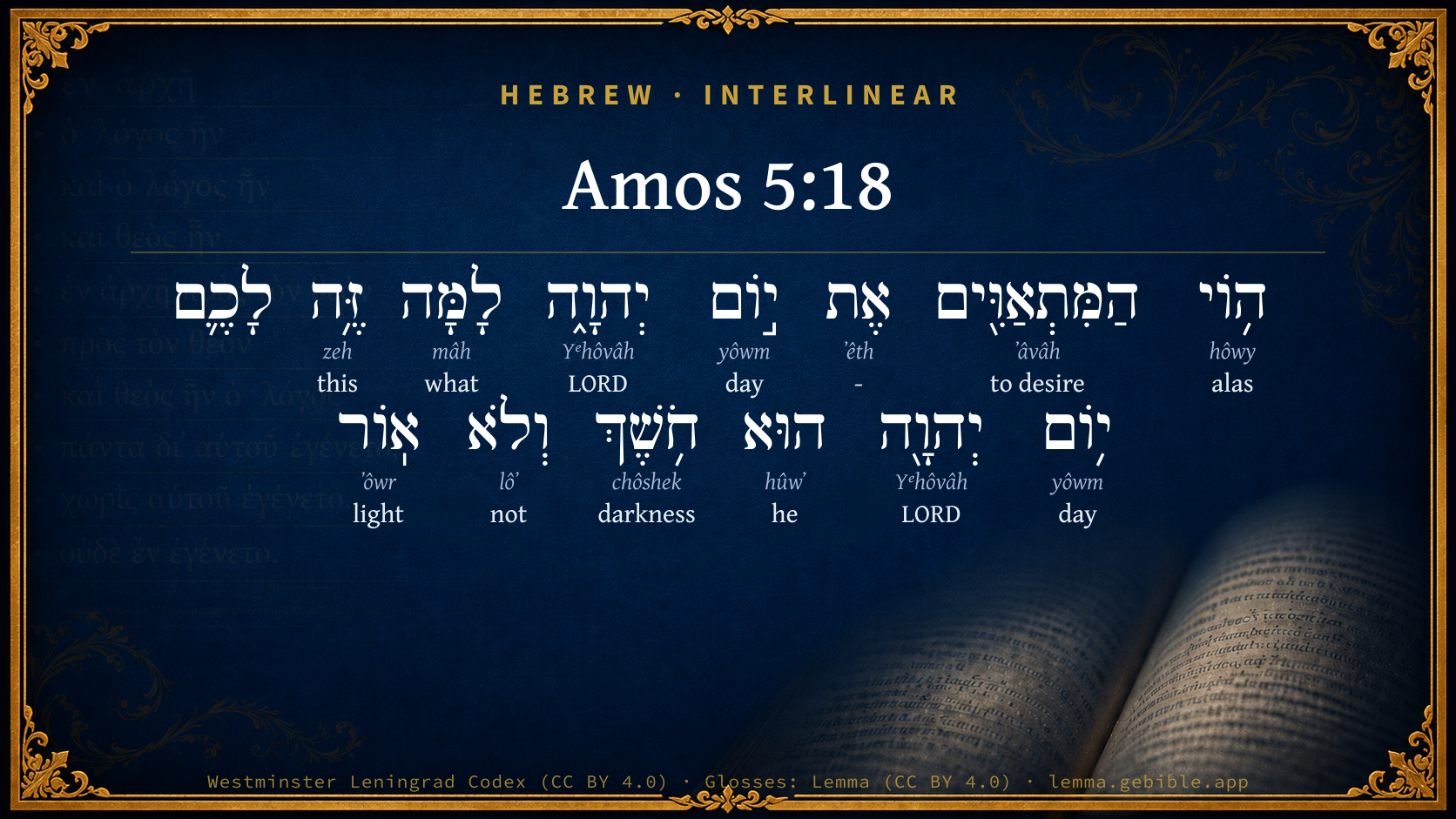
  1. ה֥וֹי hôwy H1945 “alas” Particle, Interjection
  2. אֶת ʼêth H853 “-” Particle, Direct Object
  3. י֣וֹם yôwm H3117 “day of” Noun, Common, Masculine, Singular, Construct
  4. יְהוָ֑ה Yᵉhôvâh H3068 “LORD” Noun, Proper
  5. לָמָּה mâh H4100 “to/for · what” Preposition + Particle, Interrogative
  6. זֶּ֥ה zeh H2088 “this” Pronoun, Demonstrative, Masculine, Singular
  7. י֥וֹם yôwm H3117 “day of” Noun, Common, Masculine, Singular, Construct
  8. יְהוָ֖ה Yᵉhôvâh H3068 “LORD” Noun, Proper
  9. הוּא hûwʼ H1931 “he” Pronoun, Personal, 3rd Person, Masculine, Singular
  10. חֹ֥שֶׁךְ chôshek H2822 “darkness” Noun, Common, Masculine, Singular, Absolute
  11. וְלֹא lôʼ H3808 “and · not” Conjunction + Particle, Negative
  12. אֽוֹר ʼôwr H216 “light” Noun, Common, Both, Singular, Absolute

About this verse

These counts appear in no published source. They are computed here, from the morphology-tagged text and Lemma’s own curated glosses. What Lemma adds →

14
words
11
distinct lemmas
Prophets
section

Shared distinctive vocabulary

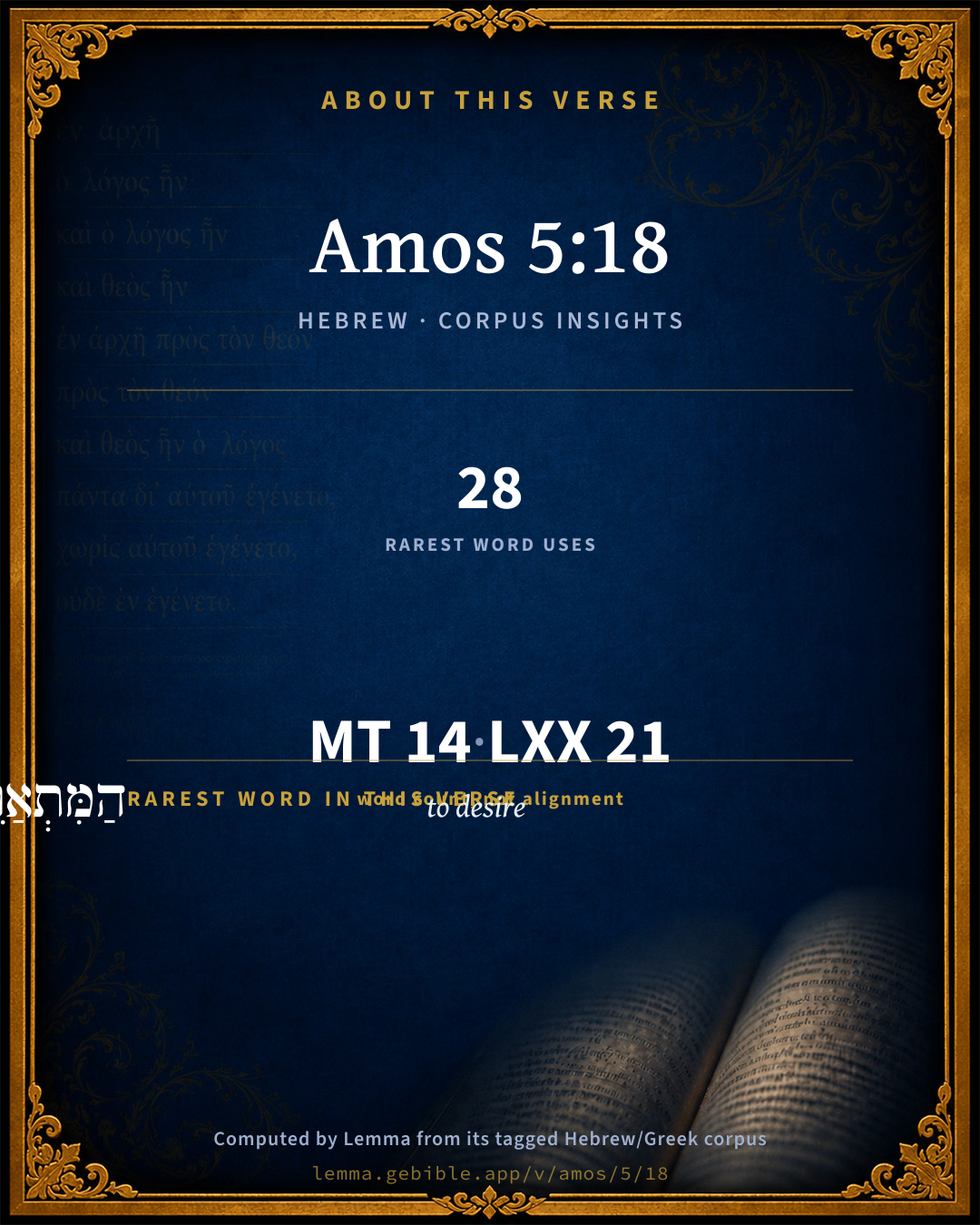
הַמִּתְאַוִּ֖ים to desire H183 occurs in 25 verses of the Hebrew Bible. Also found in:

Grammatical profile

  • 1 verb
  • 6 nouns
  • 2 pronouns
  • 1 preposition
  • 4 particles

Verb forms

  • הַמִּתְאַוִּ֖ים Hithpael · Participle Active

Repetition

Words recur within this verse — often emphatic in Hebrew:

  • י֣וֹם day H3117 ×2
  • יְהוָ֑ה LORD H3068 ×2

Hebrew & Septuagint length

In English translation the verse runs 24 words from the Hebrew and 26 from the Septuagint (LXX English) — closely comparable.

A rough comparison of the two English renderings, which tokenize alike — not a word-level alignment.

Word counts can differ between the Hebrew and the Greek without any difference in meaning — e.g. the Hebrew direct-object marker אֵת has no separate Greek word, and Greek often adds the article ὁ.

In the original languages it is 14 Hebrew tokens and 21 Greek tokens — but the two are counted differently (Hebrew bundles its prefixes and suffixes into one token; the Greek is in lemma form), so that isn’t a like-for-like length.

Cross-references

18

Topical passages linked to Amos 5:18 in the Treasury of Scripture Knowledge — connected by theme and wording, ordered by reader-vote popularity; previews shown in the World English Bible.

  • Joel 1:15 Alas for the day! For the day of Yahweh is at hand, And it will come as destruction from the Almighty.
  • Joel 2:1–2 Blow you the trumpet in Zion, And sound an alarm in my holy mountain! Let all the inhabitants of the land tremble, For the day of Yahweh comes, For it is close at hand:
  • Joel 2:31 The sun will be turned into darkness, And the moon into blood, Before the great and terrible day of Yahweh comes.
  • Jeremiah 30:7 Alas! for that day is great, so that none is like it: it is even the time of Jacob's trouble; but he shall be saved out of it.
  • Malachi 4:1 "For, behold, the day comes, it burns as a furnace; and all the proud, and all who work wickedness, will be stubble; and the day that comes will burn them up," says Yahweh of Hosts, "that it shall leave them neither root nor branch.
  • Isaiah 5:19 Who say, "Let him make speed, let him hasten his work, that we may see it; And let the counsel of the Holy One of Israel draw near and come, That we may know it!"
  • Isaiah 5:30 They will roar against them in that day like the roaring of the sea. If one looks to the land, behold, darkness and distress. The light is darkened in its clouds.
  • Isaiah 9:19 Through the wrath of Yahweh of hosts is the land burnt up; and the people are as the fuel of fire: no man spares his brother.
  • Isaiah 24:11–12 There is a crying in the streets because of the wine; all joy is darkened, the mirth of the land is gone.
  • Zephaniah 1:14–15 The great day of Yahweh is near. It is near, and hurries greatly, the voice of the day of Yahweh. The mighty man cries there bitterly.
  • Malachi 3:1–2 "Behold, I send my messenger, and he will prepare the way before me; and the Lord, whom you seek, will suddenly come to his temple; and the messenger of the covenant, whom you desire, behold, he comes!" says Yahweh of hosts.
  • Joel 2:10 The earth quakes before them. The heavens tremble. The sun and the moon are darkened, And the stars withdraw their shining.
  • Ezekiel 12:22 Son of man, what is this proverb that you have in the land of Israel, saying, The days are prolonged, and every vision fails?
  • Ezekiel 12:27 Son of man, behold, they of the house of Israel say, The vision that he sees is for many day to come, and he prophesies of times that are far off.
  • 2 Peter 3:4 and saying, "Where is the promise of his coming? For, from the day that the fathers fell asleep, all things continue as they were from the beginning of the creation."
  • Isaiah 28:15–22 Because you have said, We have made a covenant with death, and with Sheol are we at agreement; when the overflowing scourge shall pass through, it shall not come to us; for we have made lies our refuge, and under falsehood have we hid ourselves:
  • 2 Peter 3:10 But the day of the Lord will come as a thief in the night; in which the heavens will pass away with a great noise, and the elements will be dissolved with fervent heat, and the earth and the works that are in it will be burned up.
  • Jeremiah 17:15 Behold, they tell me, Where is the word of Yahweh? let it come now.

Cross-references courtesy of OpenBible.info (CC BY 4.0).

Hebrew and Greek witnesses Masoretic Hebrew ↔ Greek Septuagint

The same verse in the two great witnesses to the Old Testament, shown verse-for-verse.

These are two independent witnesses, not word-aligned to each other, and the Septuagint is shown in lemma (dictionary) form.

Hebrew Amos 5:18 Masoretic · Westminster Leningrad Codex

ה֥וֹי הַמִּתְאַוִּ֖ים אֶת י֣וֹם יְהוָ֑ה לָמָּה זֶּ֥ה לָכֶ֛ם י֥וֹם יְהוָ֖ה הוּא חֹ֥שֶׁךְ וְלֹא אֽוֹר

"Woe to you who desire the day of Yahweh! Why do you long for the day of Yahweh? It is darkness, And not light.

World English Bible · Public Domain

Greek LXX Amos 5:18 Septuagint · lemma form

οὐαί ὁ ἐπιθυμόω ὁ ἡμέρα κύριος ἵνα τίς οὗτος σύ ὁ ἡμέρα ὁ κύριος καί αὐτός εἰμί σκότος καί οὐ φῶς

Woe to you that desire the day of the Lord! what is this day of the Lord to you? whereas it is darkness, and not light.

LXX2012 (modern English Septuagint) · Public Domain

Hebrew: Westminster Leningrad Codex (CC BY 4.0). Greek: Septuagint (public domain); English from LXX2012 (modern English Septuagint) (Public Domain). How the Septuagint differs from the Hebrew →

Targum (Aramaic paraphrase)

1

The Targum is the ancient Jewish Aramaic paraphrase of the Hebrew Scriptures — an interpretive translation, not the Hebrew text itself. Onkelos (literal) and Pseudo-Jonathan (expansive) render the Torah, and Jonathan the Prophets. Coverage is partial: where no permissively-licensed English translation exists for a verse, only the Aramaic is shown. This is verse-level text, not a word-by-word alignment to the Hebrew.

  1. Targum Jonathan Prophets (Joshua–Malachi)
    וַי לִמְחַמְדִין לְיוֹמָא דַעֲתִיד לְמֵיתֵי מִן קֳדָם יְיָ לְמָא דְנַן לְכוֹן יוֹמָא דַעֲתִיד לְמֵיתֵי מִן קֳדָם יְיָ הוּא חֲשׁוֹךְ וְלָא נְהוֹר:

    (no public-domain English translation for this verse)

    Targum Jonathan — Aramaic: “Mikraot Gedolot” (public domain). English: “Sefaria Community Translation” (CC0 1.0 (public-domain dedication)); “London "Chaldee Paraphrase," 1871” (public domain). Text via Sefaria.

Commentary

Notes on Amos 5:18 from classic Christian and Jewish commentators (each source and its license shown beneath its notes). The classic Christian expositions comment on the surrounding passage and are grouped to its opening verse, so a note may address several verses; the Jewish commentaries on the Tanakh (Rashi and others) are per-verse, so they appear only where the commentator wrote on this verse.

Lemma curates 59 commentaries, every one of them public domain or Creative Commons licensed, each selected and text-cleaned for this edition rather than reprinted as found. About our sources →

The Cambridge Bible for Schools and Colleges

gen. ed. J. J. S. Perowne

18. Woe unto you that] Ah! they that.… The interjection Hôy (the same as that used in 1Ki_13:30 &c. quoted on Amo_5:16) implies commiseration rather than denunciation. It is used frequently, as here, to introduce an announcement of judgement: Isa_1:4; Isa_1:24; Isa_5:8; Isa_5:11; Isa_5:18; Isa_5:20-22; Isa_29:1; Isa_29:15 &c. (Woe … Isa_3:9; Isa_3:11; Isa_6:5; Isa_24:16 &c., is a different word, and is followed by the prep. to).

the day of Jehovah] i.e. the day in which Jehovah manifests Himself in triumph over His foes. The expression is based probably upon the Hebrew use of day as equivalent to day of battle or victory (Eze_13:5; cf. Isa_9:4, the ‘day’ of Midian, i.e. the day of victory over Midian). From the present passage it appears to have been a current popular idea that Jehovah would one day manifest Himself, and confer some crowning victory upon His people: Amos points out that whether that will be so or not, depends upon Israel’s moral condition; the ‘day of Jehovah,’ such as the people imagine, would not be necessarily a day of victory to Israel over foreign powers, but a day in which Jehovah’s righteousness would be vindicated against sin, whether among foreign nations or His own people: so long therefore as Israel neglects to amend its ways, and continues to treat ritual as a substitute for morality, it will find Jehovah’s day to be the reverse of what it anticipates, a day not of triumph but of disaster. The ‘day of Jehovah,’ as thus understood by Amos, becomes a figure which is afterwards often employed by the prophets in their pictures of impending judgement. The conception places out of sight the human agents, by whom actually the judgement, as a rule, is effected, and regards the decisive movements of history as the exclusive manifestation of Jehovah’s purpose and power. The prophets, in adopting the figure, develope it under varying imagery, suggested partly by the occasion, partly by their own imagination. Thus Isaiah (Isa_2:12-21) represents it as directed against the various objects of pride and strength which Judah had accumulated in the days of Uzziah; Joel (Amo_2:1 ff.) derives his imagery from a recent visitation of locusts (as described in ch. 1): for other examples, see Zep_1:7; Zep_1:14-16; Isa_13:6-10; Isa_24:8; Joe_3:14-16. Comp. further W. R. Smith, Prophets, pp. 397 f.; Schultz, O.T. Theol. ii. 354 ff.; Davidson on Zep_1:7.

to what end is it for you?] what good will it do you? See Gen_27:46, where substantially the same Hebrew expression is thus paraphrased in A.V., R.V.

darkness, and not light] figures, respectively, of disaster, and of prosperity or relief, as often in the Hebrew poets: see e.g. Isa_5:30; Isa_8:22; Isa_9:2; Isa_58:8; Isa_59:9; Jer_13:16.

18–20. Those who desire the “Day of Jehovah,” as though it could be anything but an interposition in their favour, will find to their surprise that it is a day fraught with peril and disaster.

The Cambridge Bible for Schools and Colleges (gen. ed. J. J. S. Perowne; Cambridge University Press, 1878–1918) — public domain. Text from a community e-Sword module.

Trapp's Complete Commentary

John Trapp

Amo 5:18 Woe unto you that desire the day of the LORD! to what end [is] it for you? the day of the LORD [is] darkness, and not light.

Ver. 18. Woe unto you that desire the day of the Lord] The day of his visitation when he will go through us, as you prophets would make believe. Where is the promise of his coming? Let him make speed and hasten his work, that we may see it, Isa 5:19 Jer 17:15. Let him increase his army and come down, Jdg 9:29. Such jeering and daring spirits there are still abroad. But do they provoke the Lord to anger? are they stronger than he? The great and terrible day of the Lord will come time enough to their cost; they need not accelerate it. Can they stand to his trial? or abide the thunder of his power? Job 26:14.

To what end is it for you] When God shall answer you, as he did a far better man, out of the whirlwind, and say, "Who is this that darkeneth counsel by words without knowledge? Gird up now thy loins like a man," Job 38:2-3. Where, then, shall the ungodly and the wicked appear? 1Pe 4:18; what hills will they call upon to fall on them, when the elements shall fall upon them like scalding lead or burning bell metal; and yet all this be but the beginning of their sorrows! "Now therefore be not ye mockers, lest your bands be made strong," Isa 28:22. God can easily hamper you if he once take you in hand.

The day of the Lord is darkness, and not light] No interchange of light; "an evil, an only evil," without mixture of mercy, Eze 7:5, a black and dismal day of one mischief upon another, in a continued series. "Affliction shall not rise up the second time," Nah 1:9, but ye shall totally and finally be destroyed; wrath shall come upon you to the utmost, 1Th 2:16. This is illustrated in the next verse by an apt similitude.

John Trapp, A Commentary or Exposition upon All the Books of the Old and New Testament (1647–1656) — public domain. Text from a community e-Sword module.

The Biblical Illustrator

Joseph S. Exell

Amo_5:18-19

Woe unto you that desire the day of the Lord!

The day of the Lord

I.

AN AWAKENING COMMINATION.

1. What is meant by the day of the Lord? The day of death, or personal dissolution. The day of captivity, or national dissolution. The day of judgment, or general account.

2. What is meant by desiring this day? The people are censured for desiring it rashly, because they did not consider it; scoffingly, because they did not believe it; desperately, because they did not fear it. Men desired the day of the Lord from discontentedness in their own condition; presumption of their own innocency; and from ignorance or misapprehension of the thing itself.

II. The convincing expostulation. To what end is it for you? Here is a calling of them to an account for their desire, or an expostulation. And a discovering to them the fruitlessness of their desire, or a conviction. To all good Christians and believers it is a day of absolution; a day of redemption; and a day of salvation.

III. The express conclusion or determination. The day of the Lord is darkness, and not light. This is to be understood of the day of death and judgment. This sentence may be taken--

1. In the general proposition of it, as it stands by itself.

(1) In the affirmative, what it is;

(2) In the negative, what it is not.

By way of opposition; by way of intention, to show the greatness of the darkness; by way of perpetuity. Darkness and always dark; by way of extent or explication, to show unto us the full nature of this business, wherein it does consist.

2. In its particular scope, as directed more especially to the persons above mentioned, who desired this day of the Lord. It carries a threefold force or emphasis with it. An emphasis of information; an emphasis of conviction to those who were obstinate; and an emphasis of astonishment to those which were desperate, which knew it, but laid aside the thoughts and considerations of it, and would put it to the venture. (T. Horton, D. D.)

Avengers of a broken covenan

t:--To the overthrow of the ten tribes for their idolatry Amos refers in the text. He asserts the absolute certainty of that overthrow except on their national repentance.

I. The hardened impiety of ungodly men. Numbers of these impenitent and blaspheming Jews openly defied the judgment of the Almighty, mocked at the messages and warnings of Gods Word, and, as though to show their utter contempt of the prophet and the prophecy, expressed their desire to see the day --to brave the worst--as though convinced that, in spite of warnings, the judgment announced would never take place, or if it did, it would not be nearly so formidable as was described. It is not safe to despise death, as some affect to do, nor that God whose minister death is, since the dread realities of the unseen world will far surpass our utmost apprehension. The Arabians have a saying that there are three things not to be trifled with. It is not good to jest of God, of death, or of the devil. Not of God, for God neither can nor will be mocked. Not of death, for death mocks the pride of all men, one time or other. Nor even of the devil, for the devil puts an eternal sarcasm on those who are too familiar with him.

II. The causes of this hardened impiety.

1. It proceeds from infidel presumption. Infidelity is often more of the heart than of the head. A man never set about proving Christianity untrue, hut he wished it first.

2. Sometimes from a one-sided view of Gods character. At one time they argue that God is merciful, and therefore they trust to escape. At other times they think that others having escaped is an encouragement to them, and that threatenings long delayed may never be fulfilled. They presume upon security because sentence against an evil work is not speedily executed. The silence of providence emboldens them.

3. From their practical immoralities. These darken the understanding, and sear the conscience, and blind the mind to its own guilt and deformity.

III. The threatened judgments to which they stand exposed.

1. The certainty of the punishment. The lion out of the forest; the bear from the wood; and the serpent by the sides of the house appear. These Jewish hypocrites defied the threatened judgment, but they could not escape it.

2. The slight and casual agency by which it was brought about. Amos paints to the life. To this day this is no uncommon circumstance. The naturalist in Jamaica tells us that the most common reptile of the serpent tribe in the East and West Indies, is the small black snake, which may often be seen hanging half out of the loose walls, so much used as fences, and thus lying motionless for its prey. Now apply these images to Gods judgments on the ancient Jews. Their own writers interpret this almost literally of the captivities they should suffer from the Chaldeans, the Persians, and the Grecian armies. Their words are, Fleeing from the face of Nebuchadnezzar, the Lion, you will be met by Ahasuerus the Persian, and encounter the Persecution instigated by Haman; or (the Empire of the Chaldeans being destroyed), next the Medes and Persians shall arise, compared by Daniel himself to the Bear, as their symbol. But When, at the command of Cyrus and Darius, your captivity is ended, and ye return to Jerusalem, and lean your weary hands upon its ruined wails in hope of peace and safety, then shall come Alexander the Great, the head of the Grecian Empire,--or Antiochus Epiphanes, the Great Persecutor, who shall bite like a serpent. Yet not without, as in Babylon or Susa, but within, in the very borders of the Holy Land itself. By all which it appears, say they, that the day you anticipate is a day not of joy but of sorrow, not of light but of darkness.

3. Guard against all approaches to this sin. Things do not suddenly come to the worst between man and God. Again, let the young beware of abusing the Divine forbearance to embolden them in sin. But though you escape the lion and the bear, you may, in an unexpected moment, be stung by the serpent to the heart, in the chinks and crevices of the wall.

4. Learn the value and preciousness of that Gospel which reveals a method of escape from greater evils than those which threatened ancient Israel.

5. Beware of neglecting the grace of the dispensation under which you live.

6. Implore especially the grace of the Holy Spirit to renew and restore your nature. To have a proud heart under humbling dispensations, and a hard heart under softening ones is awful. (Homiletic Magazine.)

On false hopes in death

We must distinguish the persons to whom the prophet addresses this solemn denunciation. They are self-deceivers. Notwithstanding the sinfulness of the people, that national pride which led them to imagine that because they had Abraham to their father they must needs be saved--was still their besetting sin.

1. From these words we gather at once this great, fact, that there is a day of the Lord coming--a day of judgment and righteous retribution. It is that day in which He will judge the world in righteousness by Jesus Christ. It will be a day of fearful discovery; of universal assembly; of awful decision.

2. The only ground of hope on which we Can look for salvation in that day. We have peace with God through our Lord Jesus Christ. There is a subordinate condition of acquittal and salvation in the day of judgment. The future destiny of each individual will have an exact reference to the tenor of his present conduct.

3. There are many who form vain hopes of salvation at the coming of our Lord. There are some who appear to have no fear or hope on the subject. There are others who have strong expectations, while they have no warrant from Scripture for their hope. Some trust to what they call the goodness and benevolence of God. Some are self-righteous. Some make a high profession of faith in His name, while they have in works denied Him. Theirs is the hope of the hypocrite that shall perish. (Anon.)

The Biblical Illustrator, edited by Joseph S. Exell (c. 1880s–1900s) — public domain. Text from a community e-Sword module.

Joseph Benson's Commentary

Amo 5:18-20. Wo unto you that desire the day of the Lord — Scoffingly, not believing any such day will come: for this seems to be spoken of some among them, who, in mockery, expressed a desire of seeing those things which the prophet predicted brought to pass. Or, it may respect those who, notwithstanding all the prophet had said, still expected God would appear in their favour, not to their destruction: see Isa 5:19. To what end is it for you? — To what purpose should you desire to see the day of the Lord? The day of the Lord is darkness — Adversity, black and doleful, and not light — No joy or comfort in it. It will certainly be a very dismal time to you, and indeed to all in the country, when evils shall succeed one another so fast, that he who seeks to escape one, shall fall into a greater. As if a man did flee from a lion — A creature that has something of generosity in his nature; and a bear met him — Which never spares any thing that comes in its way. Or went into the house — Namely, for fear of being devoured by beasts, or to avoid some other danger which threatened him without; and a serpent bit him — And a viper, whose sting is incurable, should creep out of the wall and bite him. Serpents sometimes concealed themselves in the holes and chinks of the walls of the eastern houses. Shall not the day of the Lord be darkness — It might indeed well be described as darkness; even very dark, without any brightness in it — Since it was to be no less than the destruction of the towns and cities, the desolation of the country, the slaughtering of the people, or the carrying of them into captivity, and even the overturning of the whole kingdom.

Joseph Benson's Commentary on the Old and New Testaments (1811–1818) — public domain. Text from a community e-Sword module.

Whedon's Commentary on the Bible

Daniel D. Whedon

THE DARKNESS AND DESPAIR OF THE DAY OF JEHOVAH, Amo_5:18-27.

The new section opens with a startling woe upon those who desire the day of Jehovah. They will be sorely disappointed, for it will be a day of terror and disaster (18-20). It cannot be otherwise since, in truth, they are enemies of Jehovah. Their service is an abomination to him, because it is not in accord with his requirements (21-25). As a result the terrors of Jehovah, in the form of an exile, will fall upon them (26, 27).

18-20. The day of Jehovah a day of calamity and ruin.

Woe — Introduces frequently announcements of judgment (Isa_5:8 ff; Isa_10:1, etc.). In the light of Amos’s general attitude it becomes exceedingly doubtful that it “implies commiseration rather than denunciation” (Driver).

Desire — Literally, desire for themselves, because they expect it to be a day of triumph.

Day of Jehovah — See on Joe_1:15.

To what end — R.V., “Wherefore would ye have.” A question of amazement that they should desire that day. What good will it be when it does come? The prophet does not leave them in uncertainty as to what they may expect. Would it not be wiser to shrink from it?

Darkness — A picture of calamity and distress (compare Joe_2:2; Joe_2:31; Joe_3:15; Isa_5:30; Isa_8:22, etc.).

Light — A picture of prosperity and salvation.

The awful character of the day of Jehovah is described in Amo_5:19 by illustrations familiar to the prophet and easily understood by the people. Though one danger may be avoided, another is sure to come; escape is absolutely out of the question.

Lion — See on Hos_5:14.

Bear — See on Hos_13:8. From the one the peasant escapes to meet the other; from him he seeks refuge in the house, only to meet his doom there.

Serpent — Here is meant, probably, the small adder (Psa_91:13; Isa_11:8), which sometimes hides in the cracks and crevices of old walls, and which “is one of the few serpents that manifest an aggressive disposition” (Van Lennep, Bible Lands, p. 308). Being disturbed by the terrified fugitive it comes forth to inflict a deadly bite. Amo_5:20 is an emphatic restatement, in the form of a rhetorical question, of the truth that the day of Jehovah is one of utter darkness and despair; there is in it not one ray of light and hope.

Daniel D. Whedon (gen. ed.), Commentary on the Old and New Testaments (1874–1909) — public domain. Text from a community e-Sword module.

Keil & Delitzsch

C. F. Keil & F. Delitzsch

The first turn. - Amo 5:18. "Woe to those who desire the day of Jehovah! What good is the day of Jehovah to you? It is darkness, and not light. Amo 5:19. As if a man fleeth before the lion, and the bear meets him; and he comes into the house, and rests his hand upon the wall, and the snake bites him. Amo 5:20. Alas! is not the day of Jehovah darkness, and not light; and gloom, and no brightness in it?" As the Israelites rested their hope of deliverance from every kind of hostile oppression upon their outward connection with the covenant nation (Amo 5:14); many wished the day to come, on which Jehovah would judge all the heathen, and redeem Israel out of all distress, and exalt it to might and dominion above all nations, and bless it with honour and glory, applying the prophecy of Joel in ch. 3 without the least reserve to Israel as the nation of Jehovah, and without considering that, according to Joe 2:32, those only would be saved on the day of Jehovah who called upon the name of the Lord, and were called by the Lord, i.e., were acknowledged by the Lord as His own. These infatuated hopes, which confirmed the nation in the security of its life of sin, are met by Amos with an exclamation of woe upon those who long for the day of Jehovah to come, and with the declaration explanatory of the woe, that that day is darkness and not light, and will bring them nothing but harm and destruction, and not prosperity and salvation. He explains this in Amo 5:19 by a figure taken from life. To those who wish the day of Jehovah to come, the same thing will happen as to a man who, when fleeing from a lion, meets a bear, etc. The meaning is perfectly clear: whoever would escape one danger, falls into a second; and whoever escapes this, falls into a third, and perishes therein. The serpent's bite in the hand is fatal. "In that day every place is full of danger and death; neither in-doors nor out-of-doors is any one safe: for out-of-doors lions and bears prowl about, and in-doors snakes lie hidden, even in the holes of the walls" (C. a. Lap.). After this figurative indication of the sufferings and calamities which the day of the Lord will bring, Amos once more repeats in v. 20, in a still more emphatic manner (הלא, nonne = assuredly), that it will be no day of salvation, sc. to those who seek evil and not good, and trample justice and righteousness under foot (Amo 5:14, Amo 5:15).

Keil & Delitzsch — Biblical Commentary on the Old Testament (1861–1891) — public domain (CC PDM 1.0). Text via the HelloAO Bible API. (Old Testament only.)

Tyndale Open Study Notes

Tyndale Open Resources

5:18–6:14 The pronouncements of sorrow in this section develop two themes: (1) Israel’s apostasy would make the “day of the Lord” a day of judgment, not salvation; and (2) Judah’s spiritual complacency would also bring judgment.

5:18 Amos again confronts the Israelites’ distorted view of their chosen status (see 3:2). • The phrase What sorrow awaits you denotes despair brought on by a great tragedy. • The day of the Lord in the Old Testament (see Isa 13:6, 9) was a time when God would intervene in the world to set right those things that had gone wrong. God’s intervention would mean vindication for the righteous, but judgment for the wicked. Israel thought that on that day (see also Amos 8:3, 9, 13; 9:11) God would save them. However, because the Israelites had been wicked, the day of the Lord would bring darkness, not light. Assyria conquered the northern kingdom in 722 BC (2 Kgs 17:7-23), fulfilling this prophecy.

Tyndale Open Study Notes — © Tyndale Open Resources, licensed CC BY-SA 4.0. Text via the HelloAO Bible API.

Geneva Bible (1599)

Geneva Bible translators

Thus he speaketh, because the wicked and hypocrites said they were content to abide God’s judgments, whereas the godly tremble and fear, Jer. 30:7; Joel 2:2, 11; Zeph. 1:15.

Geneva Bible (1599) marginal notes — public domain. Text via Bolls.life.

Jamieson, Fausset & Brown

Robert Jamieson, A. R. Fausset & David Brown

Woe unto you who do not scruple to say in irony, "We desire that the day of the Lord would come," that is, "Woe to you who treat it as if it were a mere dream of the prophets" (Isa 5:19; Jer 17:15; Eze 12:22).

to what end is it for you!--Amos taking their ironical words in earnest: for God often takes the blasphemer at his own word, in righteous retribution making the scoffer's jest a terrible reality against himself. Ye have but little reason to desire the day of the Lord; for it will be to you calamity, and not joy.

Jamieson, Fausset & Brown — Commentary Critical and Explanatory on the Whole Bible (1871) — public domain (CC PDM 1.0). Text via the HelloAO Bible API.

Adam Clarke's Commentary

Verse 18. Wo unto you that desire the day of the Lord] The prophet had often denounced the coming of God's day, that is, of a time of judgment; and the unbelievers had said, "Let his day come, that we may see it." Now the prophet tells them that that day would be to them darkness-calamity, and not light-not prosperity.

Adam Clarke's Commentary on the Bible (1810–1826) — public domain. Text from a community e-Sword/MySword module.

John Calvin's Commentaries

The Prophet expresses here more fully what he briefly and obscurely touched upon as to the passing of God through the land; for he shows that the Israelites acted strangely in setting up the name of God as their shield, as though they were under his protection, and in still entertaining a hope, though oppressed with many evils, because God had promised that they should be the objects of his care: he says that this was an extremely vain pretense. He yet more sharply reproves their presumption by saying, “Woe to those who desire the day of Jehovah!” This appears, even at the firstview, to be very severe; but we need not wonder that the Prophet burns with too much indignation towards hypocrites, from whom that security, through which they became ferocious against God, could hardly be shaken off. And we see that the holy Spirit treats hypocrites everywhere with much more severity than those who are openly impious and wicked: for the despisers of God, how stupid soever they may be, do not yet excuse their vices; but hypocrites seek ever to draw in God into the quarrel, and they have their veils to cover their turpitude: it was therefore necessary to treat them, as the Prophet does here, with sharpness and severity.

Woe, he says, to those who desire the day of Jehovah! Some expound this day of Jehovah of the day of death, and pervert the meaning of the Prophet; for they think that the Prophet speaks here of desperate men, who seek self-destruction, or lay violent hands on themselves. Woe, then, to those who desire the day of Jehovah, that is, who have recourse to hanging or to poison, as no other remedy appears to them. But the Prophet, as I have already reminded you, does here on the contrary rouse hypocrites. Others think that the contempt which Amos has before noticed, is here reproved; and this in part is true; but they do not sufficiently follow up the Prophet’s design; for they do not observe what is special in this place, — that hypocrites flattered themselves, falsely assuming this as a truth, that they were the people of God, and that God was bound to them. Though, then, the Israelites had been a hundred times perfidious, they yet continued arrogantly to boast of their circumcision; and then the law and the sacrifices, and all their ceremonies, were to them as banners, — “O! we are a holy nation, and God’s heritage; we are the children of Abraham, and the redeemed of the Lord; we are a priestly kingdom.” As then these things were ready in the mouth of all, the Prophet says, “Woe to those who desire the day of Jehovah!” And, indeed, when the Lord had begun to punish them for their sins, they still said, “The Lord, it may be, intends to try our constancy: but how can he destroy us? for he would then be false; his covenant cannot be made void: it is then certain that we shall be saved, and that he will be shortly reconciled to us.” They did not indeed expect that God would be propitious to them; but as they were overwhelmed with many evils, they sought to allay their sorrows by such a drug.

When therefore the Prophet saw, that the Israelites so waywardly flattered themselves, and so foolishly and wickedly laid claim to the name of God, he says, Woe to those who desire the day of Jehovah! What will this be, he says, to you? The day of Jehovah will be darkness and not light; as though he said, “God is an enemy to you, and the nearer he comes to you, the more grievously you must be afflicted: he will bring nothing to you but devastation, for he will come armed to destroy you. There is therefore no reason for you to boast that you are a chosen people, that you are a priestly kingdom, for ye are fallen away from the favor of God; and this is to be imputed to your own misconduct. God then is armed for your destruction; and whenever he will appear, he will at the same time pursue you with cruelty and violence; and it will be for your destruction that God will come thus armed to you. Whenever then the Lord will come, your evils must necessarily be increased. The day then of Jehovah will be darkness and not light.” He afterwards confirms this truth —

John Calvin's Commentaries (1540-1563) — public domain. Text from the Calvin Translation Society English edition (1840s-50s) via the Christian Classics Ethereal Library (ccel.org). Calvin's coverage is partial (roughly two-thirds of the Bible); uncommented books and verses are honest gaps, never fabricated. The 19th-century editor's footnotes and remarks are omitted so the notes are faithfully Calvin's own voice.

Ellicott's Commentary for English Readers

(18) Desire the day of the Lord.—Expecting that day to bring you deliverance and judgments upon your enemies. It shall bring the reverse! There is a dark side to the pillar of fire.

A Bible Commentary for English Readers, edited by Charles John Ellicott (1878–1897) — public domain. Text from a community e-Sword module.

John Gill's Exposition

Woe unto you that desire the day of the Lord,.... Either the day of Christ's coming in the flesh, as Cocceius interprets it; and which was desired by the people of Israel, not on account of spiritual and eternal salvation, but that they might be delivered by him from outward troubles and enemies, and enjoy temporal felicity; they had a notion of him as a temporal Saviour and Redeemer, in whose days they should possess much outward happiness, and therefore desired his coming; see Mal 3:1; or else the day of the Lord's judgments upon them, spoken of by the prophet, and which they were threatened with, but did not believe it would ever come; and therefore in a scoffing jeering manner, expressed their desire of it, to show their disbelief of it, and that they were in no pain or fear about it, like those in Isa 5:19;

to what end is it for you? why do you desire it? what benefit do you expect to get by it?

the day of the Lord is darkness, and not light; it will bring on affliction, calamities, miseries, and distress, which are often in Scripture expressed by "darkness", and not prosperity and happiness, which are sometimes signified by "light"; see Isa 5:30; and even the day of the coming of Christ were to the unbelieving Jews darkness, and not light; they were blinded in it, and given up to judicial blindness and darkness; they hating and rejecting the light of Christ, and his Gospel, and which issued in great calamities, in the utter ruin and destruction of that people, Joh 3:19.

John Gill's Exposition of the Whole Bible (1746–1763) — public domain (CC PDM 1.0). Text via the HelloAO Bible API.

Albert Barnes' Notes on the Bible

Woe unto you that desire - for yourselves.

The Day of the Lord - There were “mockers in those days” 2Pe 3:3-4; Jud 1:18, as there are now, and as there shall be in the last. And as the “scoffers in the last days” 2Pe 3:3-4; Jud 1:18 shall say, “Where is the promise of His coming?” so these said, “let Him make speed and hasten His work, that we way see it, and let the council of the Holy One of Israel draw nigh and come, that we may know it” Isa 5:19. Jeremiah complained; “they say unto me, where is the word of the Lord? let it come now!” Jer 17:15. And God says to Ezekiel, “Son of man, what is that proverb that ye have in the land of Israel, saying, the days are prolonged, and every vision faileth? The vision that he seeth is for many days, and he prophesieth of the times far off” Eze 12:22, Eze 12:27. “They would shew their courage and strength of mind, by longing for the Day of the Lord, which the prophets foretold, in which God was to shew forth His power on the disobedient.”

Lap.: “Let it come, what these prophets threaten until they are hoarse, let it come, let it come. It is ever held out to us, and never comes. We do not believe that it will come at all, or if it do come, it will not be so dreadful after all; it will go as it came.” It may be, however, that they who scoffed at Amos, cloked their unbelief under the form of desiring the good days, which God had promised by Joel afterward. Jerome: “There is not,” they would say, “so much of evil in the captivity, as there is of good in what the Lord has promised afterward.” Amos meets the hypocrisy or the scoff, by the appeal to their consciences, “to what end is it to you?” They had nothing in common with it or with God. Whatever it had of good, was not for such as them. “The Day of the Lord is darkness, and not light.” Like the pillar of the cloud between Israel and the Egyptians, which betokened God’s presence, every day in which He shows forth His presence, is a day of light and darkness to those of different characters.

The prophets foretold both, but not to all. These scoffers either denied the Coming of that day altogether, or denied its terrors. Either way, they disbelieved God, and, disbelieving Him, would have no share in His promises. To them, the Day of the Lord would be unmixed darkness, distress, desolation, destruction, without one ray of gladness. The tempers of people, their belief or disbelief, are the same, as to the Great Day of the Lord, the Day of Judgment. It is all one, whether people deny it altogether or deny its terrors. In either case, they deny it, such as God has ordained it. The words of Amos condemn them too. “The Day of the Lord” had already become the name for every day of judgment, leading on to the Last Day. The principle of all God’s judgments is one and the same. One and the same are the characters of those who are to be judged. In one and the same way, is each judgment looked forward to, neglected, prepared for, believed, disbelieved. In one and the same way, our Lord has taught us, will the Great Day come, as the judgments of the flood or upon Sodom, and will find people prepared or unprepared, as they were then. Words then, which describe the character of any day of Judgment, do, according to the Mind of God the Holy Spirit, describe all, and the last also. Of this too, and that chiefly, because it is the greatest, are the words spoken, “Woe unto you, who desire,” amiss or rashly or scornfully or in misbelief, “the Day of the Lord, to what end is it for you? The Day of the Lord is darkness and not light.”

Rup.: “This sounds a strange woe. It had not seemed strange, had he said, ‘Woe to you, who fear not the Day of the Lord.’ For, ‘not to fear,’ belongs to bad, ungodly people. But the good may desire it, so that the Apostle says, ‘I desire to depart and to be with Christ’ Phi 1:23. Yet even their desire is not without a sort of fear. For ‘who can say, I have made my heart clean?’ Pro 20:9. Yet that is the fear, not of slaves, but of sons; ‘nor hath it torment,’ 1Jo 4:18, for it hath ‘strong consolation through hope’ Heb 6:18; Rom 5:2. When then he says, ‘Woe unto you that desire the Day of the Lord,’ he rebuketh their boldness, ‘who trust in themselves, that they are righteous’ Luk 18:9.” “At one and the same time,” says Jerome, “the confidence of the proud is shaken off, who, in order to appear righteous before people, are accustomed to long for the Day of Judgment and to say, ‘Would that the Lord would come, would that we might be dissolved and be with Christ,’ imitating the Pharisee, who spake in the Gospel, “God, I thank Thee, that I am not as other men are” Luk 18:11-12.

For the very fact, that they “desire,” and do not fear, “the Day of the Lord,” shows, that they are worthy of punishment, since no man is without sin 2Ch 6:36, and the “stars are not pure in His sight” Job 25:5. And He “concluded all under sin, that he might have mercy upon all” Gal 3:22; Rom 11:32. Since, then, no one can judge concerning the Judgment of God, and we are to “give account of every idle word” Mat 12:36, and Job “offered sacrifices” Job 1:5 daily for his sons, lest they should have thought something perversely against the Lord, what rashness it is, to long to reign alone! 1Co 4:8. In troubles and distresses we are accustomed to say, ‘would that we might depart out of the body and be freed from the miseries of this world,’ not knowing that, while we are in this flesh, we have place for repentance; but if we depart, we shall hear that of the prophet, “in hell who will give Thee thanks?” Psa 6:5. That is “the sorrow of this world” 2Co 7:10, which worketh “death,” wherewith the Apostle would not have him sorrow who had sinned with his father’s wife; the sorrow whereby the wretched Judas too perished, who, “swallowed up with overmuch sorrow” 2Co 2:7, joined murder Mat 27:3-5 to his betrayal, a murder the worst of murders, so that where he thought to find a remedy, and that death by hanging was the end of ills, there he found the lion and the bear, and the serpent, under which names I think that different punishments are intended, or else the devil himself, who is rightly called a lion or bear or serpent.”

Albert Barnes' Notes on the Bible (1834–1885) — public domain. Text from a community e-Sword/MySword module.

Haydock's Catholic Bible Commentary

The day. Some imprudently laughed at the prophets, Isaias v. 19., and Jeremias xvii. 15. Others wished for the coming of the Lord, not reflecting that he would punish their guilt. (Calmet) --- Thus, many through impatience, desire to die. We must rather, repent, and leave our lives at God’s disposal. (St. Jerome)

George Leo Haydock (1774–1849), Haydock's Catholic Family Bible and Commentary, 1859 edition — public domain. Excludes Psalms (Douay-Rheims chapter numbering differs from Protestant) and Deuterocanonical books (Catholic canon only).

Matthew Poole's English Annotations

That desire, scoffingly, or not believing any such day would come: the prophets had long threatened such a day, but these scoffers thought no such thing could overtake them, and if it did they would know the worst of it; alter their course they will not, whatever comes on it, and they are confident the prophets fright them with bugbears: but woe to such scoffers!

The day of the Lord: see Joe 1:15; 2:1; Zep 1:14.

To what end is it for you? what do you think to get by it? what good can you expect when darkest calamities overwhelm you?

The day of the Lord is darkness; all adversity, most black and doleful, therefore called in the abstract darkness.

And not light; no joy, hope, or comfort in it.

Matthew Poole's English Annotations on the Holy Bible (1683–1685) — public domain. Text from a community e-Sword/MySword module.

The Pulpit Commentary

Vers. 18-27. The prophet enforces the threat by denouncing woe on those that trust to their covenant relation to God, expecting the day when he would punish the heathen for their sakes, and thinking that external, heartless worship was acceptable to him.

The day of the Lord. Anycrisis in the nation"s history is so called, when God interposes to punish and correct. To our minds it looks forward to the final judgment. It is often mentioned by the prophets (e.g. Isa_2:12 Isa_13:6, Isa_13:9; Joe_2:1, 11 3:18; Zep_1:7, Zep_1:14) as a time when the heathen should be judged, all the enemies of Israel defeated, and when Israel herself was exalted to the highest pitch of prosperity and dominion. Without any regard to the moral condition affixed to the realization of these expectations, (see Joe_2:32) the people "desired" the appearance of this day, thus foolishly confirming themselves in their sinful life and false security. Some think scoffers are intended, but the context shows that the persons signified are sincere but mistaken believers in the safety of Israel"s covenant position. To what end is it for you? the day of the Lord is darkness; Why would ye have the day of the Lord? It is darkness. Why do ye, such as ye are, want this day to come? Ye know not what ye ask. It will be the very contrary to your expectations; it will be darkness, and not light, tribulation and miser y, not joy and triumph for you. (comp. Mic_7:8)

Vers. 18-20.

The day of the Lord the night of the impenitent.

Divine judgments will be as sharp as they are sure. Sent in wrath, proportioned to guilt, falling on the vulnerable points, they are the least desirable of all imaginable things. The very thought of them should be sobering, and the sure prospect of them overwhelming. Now, the scoffer is the worst type of sinner, and will, in the nature of the case, be the greatest sufferer when judgment comes. He is at the same time the most utterly blinded character, and therefore likely to be taken most violently by surprise. How he shall be so, and to what extent, is made in these verses to appear.

I "THE DAY OF THE LORD." This is a common expression in the prophets, and its meaning is well defined. It is applied:

1. To the day of active Divine intervention on earth. (Job_1:15 Job_2:1; Isa_2:12; Jer_46:10; Oba_1:15) There are periods which God signalizes by special doings. Long quiescent, he becomes conspicuously active. He intervenes in human affairs with unusual emphasis. Judgments often menaced are sent. Sinners long berne with are punished. The godly, for a time imposed on, are delivered. Abuses, the growth of centuries, are dealt with on their merits, and swept away. Such a period is called "the day of the Lord" because it is the time of obvious and special Divine activity. God not only strikes, but shows his hand.

2. To the day of final judgment. All others foreshadow, lead up to, culminate and lose themselves in this. "The day of the Lord had already become the name forevery day of judgment, leading on to the last day" (Pusey). This is the day of the Lord in a unique sense. It is unique as regards universality. It will see dealt with, not individuals merely, or nations even, but the entire race. (Mat_25:31) It is unique in the matter of thoroughness. There will be inquisition as to each person, and as to every act of each. (2Co_5:10) It is unique also in the matter of finality. Questions already dealt with by temporal judgments will be reopened to be settled once for all. Its sentence will be final, and its adjudication of rewards and punishments for all eternity. (Mat_25:46)

II ITS SIGNIFICANCE TO THE WICKED. This is explicitly and minutely defined as:

1. Evil. "Darkness, and not light." It could not be otherwise. Sin means wrath, and wrath means infliction. Between a righteous God and all unrighteousness there must exist an infinite antagonism. Between his Law and such there is an essential incompatibility. Therefore his action towards them must be adverse, his judgment on them that of condemnation. It is a result of God"s purity, of the majesty of law, of the needs of moral government, that "with the froward he shall show himself froward.

2. Only evil. "And no brightness in it." The dispensation of forbearance, the time for any measure or kind of good, is over. While any hope of reformation remained, judgment was mingled with mercy. But when this is hopeless, and the question is only one of punishing the reprobate, the exercise of goodness would be an anachronism, and only severity can be meted out.

3. Evil playing into the hands of evil. "As if a man fleeth before the lion, and the bear meets him." Divine punitive measures are various and complete. They surround us. They hem us in on every side. They form as it were a circle of fire round us. They are not to be evaded or escaped (Jer_11:11; Rom_2:3; Heb_2:3) In running away from one, we only run into the jaws of another. If it is not the lion"s tooth, then in any case it will be the bear"s claws. If health escape, property will suffer. If both escape, the good name will be tarnished. If all three escape, conscience will be wounded and happiness destroyed. If earthly evil consequences do not reach us, there are eternal fires kindled against which there will be no appeal.

4. Evil in the arms of good. "And rests his hand upon the wall, and the snake bite him." The wall, a ready support for the feeble or weary to lean on, may furnish in its chinks a hiding place for the venomous snake. So with all human refuges in God"s day of visitation. They will fail us. Their help will not be available, or it will not be sufficient, or it will involve some other evil as great as the one it will relieve. "The staff of bruised reed" (Isa_36:6) is the fitting emblem of all fancied helps in the day of God"s wrath. Even the likeliest will be found wanting in the very matter in which it promises most.

III THEIR FOOLISH DESIRE FOR IT. "Woe to those who desire the day of Jehovah!" The sinner"s desiring the day of vengeance on his sins may mean:

1. Misapprehension. Israel did not realize the enormity of their sin. They did not see that the threatened judgments were for themselves and on account of it. They trusted to their position as "Israel after the flesh" to secure them the immunity that only belonged to Israel after the Spirit, And so their idea of the day of God was a time when their enemies would be destroyed, and they themselves delivered and exalted. With all the wicked, the eye for the sins of others is so much keener than the eye for their own, that coming good is unconsciously allocated to themselves and coming evil to others, and so Divine judgments desired which can only destroy them when they come.

2. Bravado. The prophets who foretold the coming of God"s day rebuked the people"s sin on account of which it was to come. Put on their mettle by the rebuke, many would affect to ridicule the prophecy. Like others (Jer_17:15; 2Pe_3:3, 2Pe_3:4) they would say, with an affectation of unbelief, "You are trying to frighten us with a bugbear. Let your talked of judgment fall, and then we will believe it." The delay of God"s judgment, which means that when it comes it shall be the more terrible, is often taken as meaning that it is not coming at all. (Eze_12:22, Eze_12:27)

3. Vindictiveness. Some would deem themselves less criminal than others their enemies, it may be, and oppressors. On these they would expectthe heaviest strokes to fall, and to bring this about they would suffer more or less themselves. There are Samsons among sinners who would run the risk of perishing themselves in order to secure the destruction of others. To all three classes "the day of the Lord is darkness, and no brightness in it." Evil will come none the less surely because it is good that is expected, and it will come all the more sharply on those who to their other sin have added malice against men and mockery of God.

The Pulpit Commentary (1880–1919), ed. H.D.M. Spence-Jones & Joseph S. Exell — public domain. Text from a community e-Sword module.

John Wesley's Explanatory Notes

That desire - Scoffingly, not believing any such day would come. To what end - What do you think to get by it? Is darkness - All adversity, black and doleful. Not light - No joy, or comfort an it.

John Wesley, Explanatory Notes Upon the Whole Bible (1754–1765) — public domain. Text via the GEBible commentary corpus.

unfoldingWord translationNotes

Door43 World Missions Community

Why do you long for the day of Yahweh?

God uses this question to rebuke the people for saying that they want the day of Yahweh to be soon. This can be translated as a statement. AT: "You long for the day of Yahweh." or "You should not long for the day of Yahweh!" (See: Rhetorical Question)

It will be darkness and not light

Here "darkness" represents a time when disasters happen, and "light" represents a time when good things happen. AT: "It will be a time of darkness and disaster, not of light and blessing" or "On that day there will be disasters, not blessings" (See: Metaphor)

Will not the day of Yahweh be darkness and not light?

This question emphasizes that bad things will happen then. It can be expressed as a statement. AT: "The day of Yahweh will certainly be darkness and not light!" or "Bad things, not good things, will certainly happen on the day of Yahweh!" (See: Rhetorical Question)

Gloom and no brightness?

The words "Will not the day of Yahweh be" is understood from the previous sentence. Like the previous question, it emphasizes that terrible things, not good things, will happen on the day of Yahweh. It can be expressed as a statement. AT: "It will be a time of when terrible things, not good things, will happen. (See: Rhetorical Question and Parallelism)

translationWords

day of the Lord

Yahweh

darkness

light

lions

serpent

unfoldingWord translationNotes — © Distant Shores Media and the Door43 World Missions Community, licensed CC BY-SA 4.0. Source: git.door43.org/Door43/en_tn.

Rashi

Rabbi Shlomo Yitzchaki (Rashi)

Woe to those who desire etc.—“Those who say, ‘Let Him hurry; let Him hasten His deed.’” (Isa. 5: 19)

Why would you have etc.—There is a parable concerning a rooster and a bat that were awaiting the dawn, as appears in the chapter entitled “Chelek.”

Rashi on the Tanakh — English translations: “The Judaica Press complete Tanach with Rashi, translated by A. J. Rosenberg” (CC BY 4.0); “Pentateuch with Rashi's commentary by M. Rosenbaum and A.M. Silbermann, 1929-1934” (public domain); “The Metsudah Tanach series, Lakewood, N.J” (CC BY 4.0); and “The Book of Joshua, Metsudah Publications, 1997” (CC BY 4.0). Text via Sefaria.

Lesson kit

Teaching starters — assembled from the data on this page, not authored interpretation. Every prompt links to the verse data it draws on. Edit before teaching.

Amos, in the Prophets, opens this verse with 14 words (11 distinct Hebrew lemmas). Its most distinctive word is ʼâvâh (“to desire”). A historical commentator’s framing appears above. Read the whole chapter for the surrounding context.

Discussion questions

  1. How does “to desire” (ʼâvâh) shape what this verse is saying?
  2. Numbers 11:4 shares the word «to desire» with this verse. How do the two illuminate each other?
  3. “day” occurs 2× in this one verse. What is the effect of the repetition?
  4. These translations render this verse differently; the difference is in the English rendering, not the original. What questions does that raise?
  5. The verb «הַמִּתְאַוִּ֖ים» is Hithpael Participle Active. How does its form color the action?
  6. Reading how The Cambridge Bible for Schools and Colleges and Trapp's Complete Commentary read this verse, where do the two commentators agree and where do they part?

Things to notice

Reading settings

Reading text

Shown beneath each verse's original-language words.

Old Testament
Old Testament edition

Read the OT as the Masoretic Hebrew (MT) or the Greek Septuagint (LXX).

English shown for the Greek Septuagint (in the Hebrew ↔ Greek comparison).

Comparing translations? Open the Compare panel on any verse page to stack up to four side by side.