Jeremiah 22:8

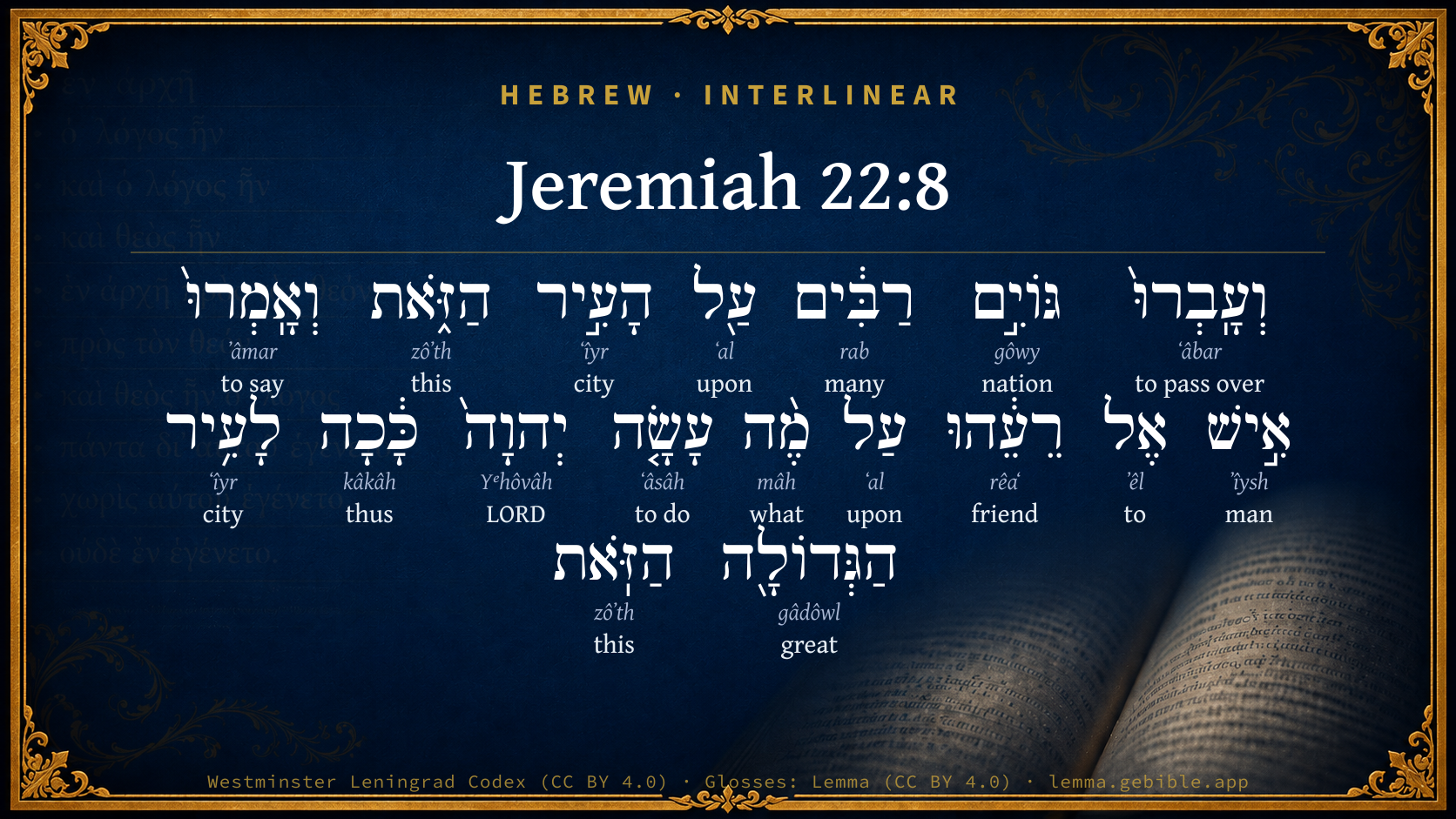
Hebrew (Westminster Leningrad Codex) Jeremiah 22:8 appears in the Hebrew Old Testament. The text above is from the Westminster Leningrad Codex. Each word links to its Strong’s number, a concise gloss, and parsing drawn from the Open Scriptures Hebrew Bible morphology. Click any word for its full Brown-Driver-Briggs (BDB) entry.
Download image
Cite this verse

Jeremiah 22:8 (World English Bible). Public Domain. Lemma interlinear Bible study tool, https://lemma.gebible.app/v/jeremiah/22/8.

Show BibTeX & RIS
BibTeX
RIS
English Translation
Many nations shall pass by this city, and they shall say every man to his neighbor, Why has Yahweh done thus to this great city?
World English Bible · Public Domain
Download a study sheet

One document with this verse’s original text, its word-by-word gloss line, the meaning frame, cross-references with their text, attributed commentary, and full source and license credits — printable, and it pastes into notes with its structure intact.

This verse Autodidact and up

Study sheet (.html) Plain text (.txt)

A passage Seminary Student

Up to 50 verses in one chapter. A passage sheet keeps up to 6 commentary sources and 12 cross-references per verse, in the order this page ranks them, and says so on the sheet whenever that leaves anything out. Ask for a single verse and you get the Autodidact verse sheet above.

Everything on this page stays free to read, with no account — the sheet is a download of what is already on screen, not access to it.

Want to remove ads? Support Godless Engineer
Compare translations 3

The same verse in 3 English versions, stacked beneath the original-language interlinear above. Click any original word for its lexicon entry.

Each is an independent rendering of the whole verse — the interlinear is not word-aligned to these translations.

Highlighted words mark where these versions differ — a whole-verse word diff, not a word-by-word alignment.

  • World English Bible Public Domain
    Many nations shall pass by this city, and they shall say every man to his neighbor, Why has Yahweh done thus to this great city?
  • King James Version Public Domain
    And many nations shall pass by this city, and they shall say every man to his neighbour, Wherefore hath the LORD done thus unto this great city?
  • unfoldingWord Literal Text CC BY-SA 4.0
    And many nations will pass by this city, and they will say, a man to his neighbor, ‘On account of what has Yahweh done thus to great this city?’

unfoldingWord Literal Text — © unfoldingWord, licensed CC BY-SA 4.0. Word-aligned USFM3 via Door43 (git.door43.org/unfoldingWord/en_ult).

Versions to compare (up to 4)

3 of 4 selected

Show all 18 translations

Every available English version of this verse, each an independent rendering of the whole verse.

  • World English Bible Public Domain
    Many nations shall pass by this city, and they shall say every man to his neighbor, Why has Yahweh done thus to this great city?
  • Berean Standard Bible Public Domain
    And many nations will pass by this city and ask one another, ‘Why has the LORD done such a thing to this great city?’
  • Majority Standard Bible Public Domain
    And many nations will pass by this city and ask one another, ‘Why has the LORD done such a thing to this great city?’
  • King James Version Public Domain
    And many nations shall pass by this city, and they shall say every man to his neighbour, Wherefore hath the LORD done thus unto this great city?
  • American Standard Version (1901) Public Domain
    And many nations shall pass by this city, and they shall say every man to his neighbor, Wherefore hath Jehovah done thus unto this great city?
  • Revised Version (1885) Public Domain
    And many nations shall pass by this city, and they shall say every man to his neighbour, Wherefore hath the LORD done thus unto this great city?
  • Geneva Bible (1599) Public Domain
    And many nations shall passe by this citie, and they shall say euery man to his neighbour, Wherefore hath the Lord done thus vnto this great citie?
  • Douay-Rheims (1899) Public Domain
    And many nations shall pass by this city: and they shall say every man to his neighbor: Why hath the Lord done so to this great city?
  • Young's Literal Translation Public Domain
    And many nations have passed by this city, And they have said, each to his neighbour, For what hath Jehovah done thus to this great city?
  • Literal Standard Version CC BY-SA 4.0
    And many nations have passed by this city, || And they have each said to his neighbor, “Why has YHWH done thus to this great city?”
  • Unlocked Literal Bible CC BY-SA 4.0
    Then many nations will pass by this city. Each person will say to the next, “Why has Yahweh acted in this way toward this great city?”
  • unfoldingWord Literal Text CC BY-SA 4.0
    And many nations will pass by this city, and they will say, a man to his neighbor, ‘On account of what has Yahweh done thus to great this city?’
  • Darby Bible Public Domain
    And many nations shall pass by this city, and they shall say every man to his neighbour, Wherefore hath Jehovah done thus unto this great city?
  • World Messianic Bible Public Domain
    “Many nations will pass by this city, and they will each ask his neighbor, ‘Why has the LORD done this to this great city?’
  • Webster's Bible Public Domain
    And many nations shall pass by this city, and they shall say every man to his neighbor, Why hath the LORD done thus to this great city?
  • Free Bible Version CC BY-SA 4.0
    Foreigners from many nations will pass by this city and ask each another, “Why has the Lord done such terrible things to this great city?”
  • Bible in Basic English Public Domain
    And nations from all sides will go past this town, and every man will say to his neighbour, Why has the Lord done such things to this great town?
  • JPS Tanakh (1917) Public Domain
    And many nations shall pass by this city, and they shall say every man to his neighbour: 'Wherefore hath the LORD done thus unto this great city?'

Literal Standard Version (2020), Covenant Press — licensed CC BY-SA 4.0. Text via the HelloAO Bible API (eBible.org). Unlocked Literal Bible (unfoldingWord) — licensed CC BY-SA 4.0. Text via the HelloAO Bible API (eBible.org). unfoldingWord Literal Text — © unfoldingWord, licensed CC BY-SA 4.0. Word-aligned USFM3 via Door43 (git.door43.org/unfoldingWord/en_ult). Free Bible Version, Dr. Jonathan Gallagher — licensed CC BY-SA 4.0. Text via the HelloAO Bible API (eBible.org).

Word by word

More ways to search: Search by grammar → Find every occurrence → Compare this word →

Practice this passage: Drill this verse → Learn its vocabulary →

כָּ֔כָה
kâkâh
  1. וְעָֽבְרוּ֙ ʻâbar H5674 “and · to pass over” Conjunction + Verb, Qal, Sequential Perfect, 3rd Person, Common, Plural
  2. גּוֹיִ֣ם gôwy H1471 “nations” Noun, Common, Masculine, Plural, Absolute
  3. רַבִּ֔ים rab H7227 “many” Adjective, Adjective, Masculine, Plural, Absolute
  4. עַ֖ל ʻal H5921 “upon” Preposition
  5. הָעִ֣יר ʻîyr H5892 “the · city” Particle, Definite Article + Noun, Common, Feminine, Singular, Absolute
  6. הַזֹּ֑את zôʼth H2063 “the · this” Particle, Definite Article + Pronoun, Demonstrative, Feminine, Singular
  7. וְאָֽמְרוּ֙ ʼâmar H559 “and · to say” Conjunction + Verb, Qal, Sequential Perfect, 3rd Person, Common, Plural
  8. אִ֣ישׁ ʼîysh H376 “man” Noun, Common, Masculine, Singular, Absolute
  9. אֶל ʼêl H413 “to” Preposition
  10. רֵעֵ֔הוּ rêaʻ H7453 “friend · his” Noun, Common, Masculine, Singular, Construct + Suffix, Personal, 3rd Person, Masculine, Singular
  11. עַל ʻal H5921 “upon” Preposition
  12. מֶ֨ה mâh H4100 “what” Particle, Interrogative
  13. עָשָׂ֤ה ʻâsâh H6213 “to do” Verb, Qal, Perfect, 3rd Person, Masculine, Singular
  14. יְהוָה֙ Yᵉhôvâh H3068 “LORD” Noun, Proper
  15. לָעִ֥יר ʻîyr H5892 “to/for the · city” Preposition, Determined + Noun, Common, Feminine, Singular, Absolute
  16. הַגְּדוֹלָ֖ה gâdôwl H1419 “the · great” Particle, Definite Article + Adjective, Adjective, Feminine, Singular, Absolute
  17. הַזֹּֽאת zôʼth H2063 “the · this” Particle, Definite Article + Pronoun, Demonstrative, Feminine, Singular

About this verse

These counts appear in no published source. They are computed here, from the morphology-tagged text and Lemma’s own curated glosses. What Lemma adds →

18
words
15
distinct lemmas
Prophets
section

Shared distinctive vocabulary

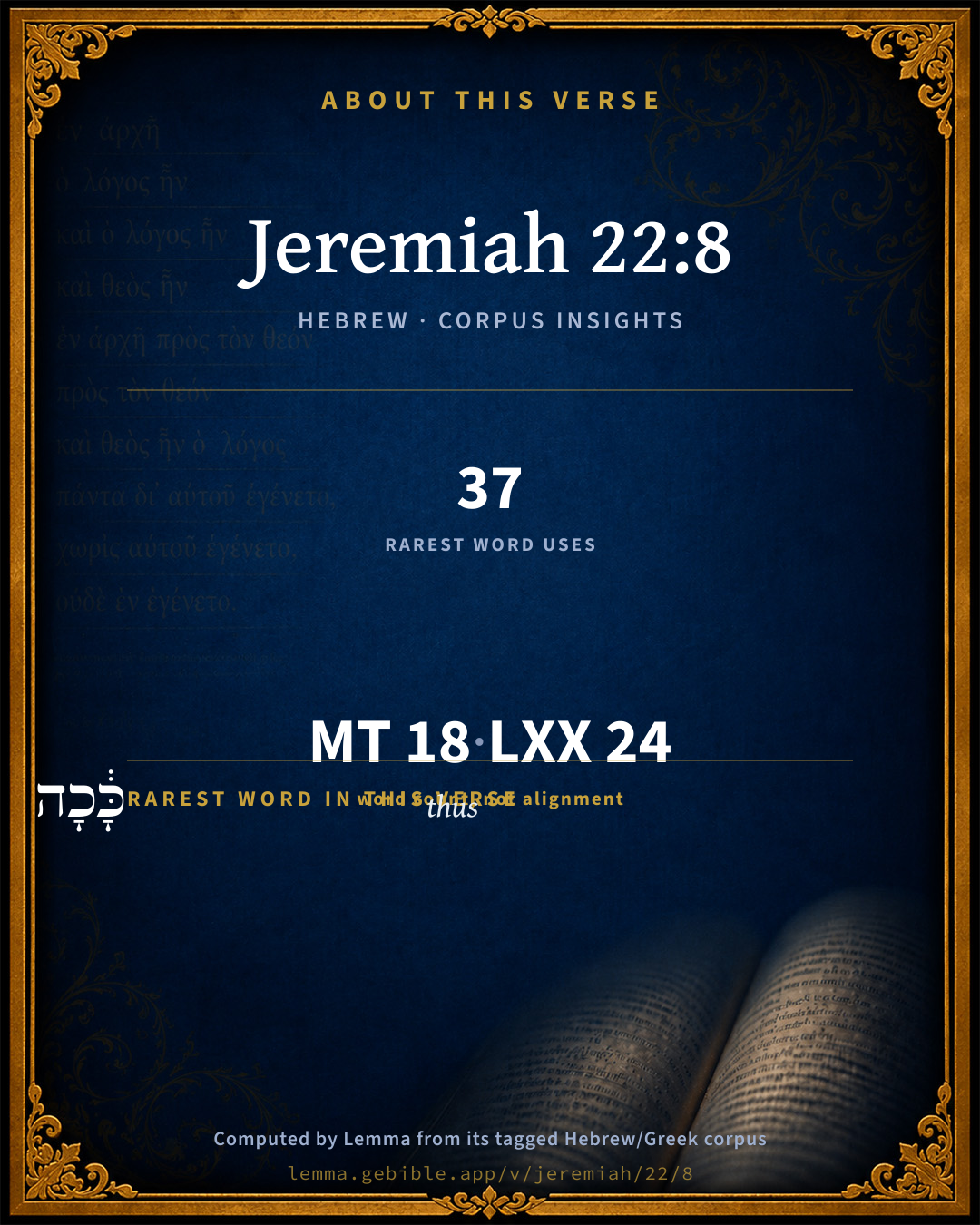
כָּ֔כָה thus H3602 occurs in 35 verses of the Hebrew Bible. Also found in:

Grammatical profile

  • 3 verbs
  • 6 nouns
  • 2 adjectives
  • 2 pronouns
  • 3 prepositions
  • 1 adverb
  • 1 particle

Verb forms

  • וְעָֽבְרוּ֙ Qal · Sequential Perfect
  • וְאָֽמְרוּ֙ Qal · Sequential Perfect
  • עָשָׂ֤ה Qal · Perfect

Repetition

Words recur within this verse — often emphatic in Hebrew:

  • עַ֖ל upon H5921 ×2
  • הָעִ֣יר city H5892 ×2
  • הַזֹּ֑את this H2063 ×2

Hebrew & Septuagint length

In the original languages it is 18 Hebrew tokens and 24 Greek tokens — but the two are counted differently (Hebrew bundles its prefixes and suffixes into one token; the Greek is in lemma form), so that isn’t a like-for-like length.

Cross-references

7

Topical passages linked to Jeremiah 22:8 in the Treasury of Scripture Knowledge — connected by theme and wording, ordered by reader-vote popularity; previews shown in the World English Bible.

  • 1 Kings 9:8–9 Though this house is so high, yet shall everyone who passes by it be astonished, and shall hiss; and they shall say, Why has Yahweh done thus to this land, and to this house?
  • 2 Chronicles 7:20–22 then will I pluck them up by the roots out of my land which I have given them; and this house, which I have made holy for my name, will I cast out of my sight, and I will make it a proverb and a byword among all peoples.
  • Deuteronomy 29:23–26 [and that] the whole land of it is sulfur, and salt, [and] a burning, [that] it is not sown, nor bears, nor any grass grows therein, like the overthrow of Sodom and Gomorrah, Admah and Zeboiim, which Yahweh overthrew in his anger, and in his wrath:
  • Lamentations 2:15–17 All that pass by clap their hands at you; They hiss and wag their head at the daughter of Jerusalem, [saying], Is this the city that men called The perfection of beauty, The joy of the whole earth?
  • Jeremiah 16:10 It shall happen, when you shall show this people all these words, and they shall tell you, Why has Yahweh pronounced all this great evil against us? or what is our iniquity? or what is our sin that we have committed against Yahweh our God?
  • Lamentations 4:12 The kings of the earth didn't believe, neither all the inhabitants of the world, That the adversary and the enemy would enter into the gates of Jerusalem.
  • Daniel 9:7 Lord, righteousness belongs to you, but to us confusion of face, as at this day; to the men of Judah, and to the inhabitants of Jerusalem, and to all Israel, who are near, and who are far off, through all the countries where you have driven them, because of their trespass that they have trespassed against you.

Cross-references courtesy of OpenBible.info (CC BY 4.0).

Hebrew and Greek witnesses Masoretic Hebrew ↔ Greek Septuagint

The same verse in the two great witnesses to the Old Testament, shown verse-for-verse.

These are two independent witnesses, not word-aligned to each other, and the Septuagint is shown in lemma (dictionary) form.

Hebrew Jeremiah 22:8 Masoretic · Westminster Leningrad Codex

וְעָֽבְרוּ֙ גּוֹיִ֣ם רַבִּ֔ים עַ֖ל הָעִ֣יר הַזֹּ֑את וְאָֽמְרוּ֙ אִ֣ישׁ אֶל רֵעֵ֔הוּ עַל מֶ֨ה עָשָׂ֤ה יְהוָה֙ כָּ֔כָה לָעִ֥יר הַגְּדוֹלָ֖ה הַזֹּֽאת

Many nations shall pass by this city, and they shall say every man to his neighbor, Why has Yahweh done thus to this great city?

World English Bible · Public Domain

Greek LXX Structure differs

In the Septuagint, Jeremiah is about an eighth shorter than the Hebrew and arranges its material differently — the Oracles Against the Nations (Hebrew chapters 46–51) appear in the middle of the Greek book, after 25:13. Because the chapter and verse boundaries do not line up, a verse-for-verse comparison with the Hebrew is not shown.

A verse-for-verse comparison isn’t shown here because the chapters and verses don’t line up. Switch to the LXX edition with the MT / LXX toggle above to read the Greek directly.

Hebrew: Westminster Leningrad Codex (CC BY 4.0). Greek: Septuagint (public domain); English from a public-domain English Septuagint. How the Septuagint differs from the Hebrew →

Targum (Aramaic paraphrase)

1

The Targum is the ancient Jewish Aramaic paraphrase of the Hebrew Scriptures — an interpretive translation, not the Hebrew text itself. Onkelos (literal) and Pseudo-Jonathan (expansive) render the Torah, and Jonathan the Prophets. Coverage is partial: where no permissively-licensed English translation exists for a verse, only the Aramaic is shown. This is verse-level text, not a word-by-word alignment to the Hebrew.

  1. Targum Jonathan Prophets (Joshua–Malachi)
    וְיֶעְבְּרוּן עַמְמִין סַגִיאִין עַל קַרְתָּא הָדָא וְיֵימְרוּן גְבַר לְחַבְרֵיהּ עַל מָה עֲבַד יְיָ כְּדֵין לְקַרְתָּא רַבְּתָא הָדָא:

    (no public-domain English translation for this verse)

    Targum Jonathan — Aramaic: “Mikraot Gedolot” (public domain). English: “Sefaria Community Translation” (CC0 1.0 (public-domain dedication)); “London "Chaldee Paraphrase," 1871” (public domain). Text via Sefaria.

Commentary

Notes on Jeremiah 22:8 from classic Christian and Jewish commentators (each source and its license shown beneath its notes). The classic Christian expositions comment on the surrounding passage and are grouped to its opening verse, so a note may address several verses; the Jewish commentaries on the Tanakh (Rashi and others) are per-verse, so they appear only where the commentator wrote on this verse.

Lemma curates 59 commentaries, every one of them public domain or Creative Commons licensed, each selected and text-cleaned for this edition rather than reprinted as found. About our sources →

Trapp's Complete Commentary

John Trapp

Jer 22:8 And many nations shall pass by this city, and they shall say every man to his neighbour, Wherefore hath the LORD done thus unto this great city?

Ver. 8. And many nations shall pass, &c.] By a personification of passengers admiring the utter ruin of so famous a city, the prophet setteth forth the cause of their desolations.

John Trapp, A Commentary or Exposition upon All the Books of the Old and New Testament (1647–1656) — public domain. Text from a community e-Sword module.

Tyndale Open Study Notes

Tyndale Open Resources

22:8-9 The ruin of Jerusalem would proclaim to other nations the consequences of Judah’s violation of their covenant with the Lord their God.

Tyndale Open Study Notes — © Tyndale Open Resources, licensed CC BY-SA 4.0. Text via the HelloAO Bible API.

Geneva Bible (1599)

Geneva Bible translators

As they that wonder at a thing which they thought would never have come so to pass, Deut. 29:24; 1 Kings 9:8.

Geneva Bible (1599) marginal notes — public domain. Text via Bolls.life.

Jamieson, Fausset & Brown

Robert Jamieson, A. R. Fausset & David Brown

(Deu 29:24-25). The Gentile nations, more intelligent than you, shall understand that which ye do not, namely, that this city is a spectacle of God's vengeance [CALVIN].

Jamieson, Fausset & Brown — Commentary Critical and Explanatory on the Whole Bible (1871) — public domain (CC PDM 1.0). Text via the HelloAO Bible API.

Adam Clarke's Commentary

Verse 8. Many nations shall pass] These words seem borrowed from De 29:22, &c.

Adam Clarke's Commentary on the Bible (1810–1826) — public domain. Text from a community e-Sword/MySword module.

John Calvin's Commentaries

The Prophet shews in these words how blind the Jews were as to their own ruin, in disregarding in so refractory a manner the judgment of God. The words no doubt embrace two contrasts; he compares mortal men with God, and those many nations with him alone. The Jews could not bear God as their judge, and were still refractory and strove by their perverseness to overcome him. Then the Prophet says, that as they would not endure to be judged by God, judges would come who would pronounce on them a free impartial sentence; and who were they to be? the heathens. And then, as the Jews would not obey the one true God, the Prophet sets many nations in contrast with the one true God.

We hence see the full import of these words, Pass shall many nations through this city; that is, God has hitherto adorned this city with many privileges, so that it became like a miracle to foreigners, for so conspicuous was the dignity of this city, that it attracted the notice of all, and its fame was known far and wide. Now, he says, this city shall be deprived of all its ornaments, when God shall depart from it. Pass, then, he says, shall man. nations through this city, and they will inquire, every one of his friend, Why hath Jehovah done thus to this city? Jeremiah, no doubt, indirectly condemns, not only the sloth, but also the insensibility which had so demented the Jews, that they never duly reflected on God’s judgment, nor were ever touched by the curses of the Law. He then shews that there would be more understanding and wisdom in the Gentiles, for on seeing Jerusalem overthrown and wholly demolished, they would know that this had not happened by chance, but was an evidence of vengeance from heaven. We thus see that he upbraided the Jews with their own stupidity, as they did not consider the judgment of God; but he ascribed to the nations wisdom and the spirit of inquiry; for they would ask, “Why has Jehovah done thus to this city?”

“The nations,” he says, “will understand what ye do not comprehend, even that this city will exhibit an example of dreadful vengeance, and this will be the subject of their inquiry; but while God now of his own free will foretell this to you, ye close your ears; surely there would be no need of much inquiry in a matter so clear, were you not deaf and blind, and indeed obstinate, for God of his own accord warns you beforehand. What, then, can this be, that God forewarns you and ye refuse to hear him, except that the devil bewitches you?”

And he says, this great city; for its ruin was more remarkable on account of its greatness. When a small town is destroyed, hardly any account is made of the event; but when a city falls, which was everywhere celebrated for its largeness, and also for the extraordinary benefits conferred on it by God, it excites the wonder of all, as though it had fallen from the clouds.

John Calvin's Commentaries (1540-1563) — public domain. Text from the Calvin Translation Society English edition (1840s-50s) via the Christian Classics Ethereal Library (ccel.org). Calvin's coverage is partial (roughly two-thirds of the Bible); uncommented books and verses are honest gaps, never fabricated. The 19th-century editor's footnotes and remarks are omitted so the notes are faithfully Calvin's own voice.

Ellicott's Commentary for English Readers

(8, 9) Wherefore hath the Lord done thus . . .—The coincidence of thought and language with Deuteronomy (Deu_29:24-26) again calls for notice.

A Bible Commentary for English Readers, edited by Charles John Ellicott (1878–1897) — public domain. Text from a community e-Sword module.

John Gill's Exposition

And many nations shall pass by this city,.... After it is burned down and destroyed; that is, people out of many nations travelling that way:

and they shall say every man to his neighbour; as in company together, passing along the ruined walls of the city:

wherefore hath the Lord done thus unto this great city? so fortified and so full of people; the metropolis of the whole nation; the greatest city in the east; yea, the joy of the whole earth; a city peculiarly dear to the Lord; greatly honoured by him with his presence, worship, and ordinances, and yet now in ruins; how comes this to pass? they see and acknowledge the hand of the Lord in it, having a better notion of things than the Jews themselves had.

John Gill's Exposition of the Whole Bible (1746–1763) — public domain (CC PDM 1.0). Text via the HelloAO Bible API.

Matthew Poole's English Annotations

According to God’s threatenings, Deu 29:24; 1Ki 9:8. Though the Jews would not understand that there was a cause, yet others would understand it, and inquire into it.

Matthew Poole's English Annotations on the Holy Bible (1683–1685) — public domain. Text from a community e-Sword/MySword module.

Whedon's Commentary on the Bible

Daniel D. Whedon

8, 9. Compare Deu_29:23-26, and 1Ki_9:8.

Daniel D. Whedon (gen. ed.), Commentary on the Old and New Testaments (1874–1909) — public domain. Text from a community e-Sword module.

The Pulpit Commentary

Vers. 8, 9. On visiting the ruins of a city.

What a picture we have here! Many nations passing by on the high-road between Egypt and the East struck with amazement at the ruins of Jerusalem. Is not the sight of a city in ruins always a source of pathetic interest? As we wander about the silent streets of Pompeii the stillness of death is appalling by contrast with the tumult of pleasure and commerce which formerly thronged those once busy thoroughfares. Such a melancholy spectacle muses thought and inquiry. Gibbon tells us that it was while seated among the ruins of the Capitol that he first thought of writing the history of the decline and fall of the city of Rome. The magnificent ruins of Carnac and of Persepolis naturally lead us to ask how prosperity and power came to pass away from Persia and Egypt. So must it have been in ancient times with the ruins of Jerusalem. Jeremiah warns the citizens that their city, now brilliant in splendor and prosperity, will soon astonish all beholders with its overthrow. We have in the words of the prophet a question and an answer.

I THE QUESTION. (Ver. 8) It is put by the heathen nations. These people who cannot understand the religion of Jerusalem can see clearly enough her ruin. The world has eyes for the shame of the Church in her overthrow, though none for her highest glory, that of the beauty of holiness. The question is asked by many nations. The spectacle is open to all, and so startling that many are arrested by it. How true is this even in the case of individual men! If a Christian falls into sin and shame the scandal rings through the world.

1. This question bears witness to the horrible doom of sin. The ruins are so extensive and so completely wrecked, that all who pass by are fascinated and appalled by the sight of them. If strangers are so struck, how must the children of the city feel? Well may they hang their harps on the willows, and sit them down in despair by the waters of Babylon. Yet the temporal ruin of a city is slight compared with the spiritual ruin of a soul.

2. The question bears witness to the surprise that this calamity excited.

(1) It was in contrast to former prosperity. We are too ready to see in prosperity the promise of its continuance. But no delusion can be greater.

(2) It was in opposition to the boasts of the Jews. They had regarded their city as sacred and invulnerable. So the French under the empire were taught to consider Paris. And this serf-confidence carries weight with others; for the world is indolent and thoughtless enough to take people very much at their own estimate of themselves. Nevertheless it is vain.

(3) It was in spite of the supposed protection of God. The Jews were the elect nation. Hence the expectation of their immunity; but a vain expectation. No Divine favoritism will save us from the consequences of our sins.

3. The question suggests no possibility of kelp from the nations. They may pity, but they can do nothing. The stare of the crowd only aggravates the calamity. Well may such a prospect strike grief into the people interested.

II THE ANSWER. (Ver. 9)

1. The cause of this calamity may be known. Even the heathen nations may know it. Providence is not so mysterious as we suppose. No study is more lofty or more useful than the study of the moral philosophy of history. Treated only on secular grounds, it may be perplexing and unsatisfactory. But regarded in the light of the principles of the Bible, it may be fruitful in sound results.

2. The cause is moral. The hosts of Nebuchadrezzar conquered Jerusalem. Swarms of northern races and Asiatic hordes swept away the power of imperial Rome. Paris fell before the guns and discipline of the German army. Yet in each of these cases moral corruption was behind the physical cause of ruin, sapping the strength of the doomed city and provoking the onslaught of its foes.

3. The special cause was unfaithfulness to God:

(1) forsaking God for God never withdraws his protection from his people till they have abandoned their fidelity to him;

(2) breaking the covenant for this had two sides, and God"s promised grace is conditioned by the conduct of his people; and

(3) positive idolatry for the unfaithful servant of God never rests with the abandonment of his God. He must serve some master. Such moral and religious corruption justifies punishment and requires chastisement. We may believe that a right understanding of the guilt and necessities of men will ultimately convince us of the righteousness and wisdom of God"s sterner dealings, which at first naturally excite our wonder and dismay.

Vers. 8, 9. Monumental judgments.

I EXCEPTIONAL PENALTIES WILL ATTEND THE ABUSE OF EXCEPTIONAL PRIVILEGES.

1. As a measure justice. The position attained by Jerusalem was due not so much to its site as to its being the center of a theocracy. The foundation of its prosperity was a spiritual one. It was God"s elective favor which had lifted it up above the cities of the earth. Presuming upon this, the first laws of righteousness had been violated and the whole conditions of the covenant relation ignored. This assumption of the inalienability of Divine blessings is at the root of every great apostasy. It is doubly unrighteous.

(1) As a robbing of God.

(2) As a misuse of a falsely acquired advantage and reputation.

The robbery of such things is of infinitely greater heinousness in so far as they transcend in their value merely earthly treasures, and differ from them in the terms of their acquisition. It is free grace and unrequited love that are trampled on, and the punishment must therefore be the more exemplary.

2. As a necessary precaution. Pretensions so great are apt to mislead others. People who say, "The temple of the Lord, the temple of the Lord are we," may be taken at their own estimation if no marked change takes place in their external condition. God, therefore, uses his judgment in its external signs as an index of his reprobation. Other nations than Israel have illustrated this principle in their decline and fall. The great peoples of Christendom are on their trial. There is nothing more hateful in the sight of God than a people that has outlived its religion and yet retains the profession of it. Although the chief penalties of unfaithfulness in spiritual things must be inward, external evidences will not.be wanting of what has taken place. How colossal the ruin of a power that has once been Christian, and has been exalted through Divine grace for the fulfillment of pledges, which have never been redeemed! (Mat_23:37 Mat_11:23)

II THE JUDGMENT OF GOD WILL BE ENDORSED BY THE VERDICT OF THE WORLD. Even the ruins of Jerusalem would be a thing to gaze at. Its desolation would be unlike any other. The epitaph of a forfeited spiritual supremacy would seem to be graven on the very stones. There is ever something unmistakable and peculiar in the condition of those who are rejected by God. Their misery is not as other misery, their ruin not as other ruin.

1. The spectacle will be self-explanatory. Not that every sin and failing of God"s people would be written in earthly chronicles, but the causes of their decay would be broadly apparent. So is it with the Church from which God removes his candlestick, and the soul in whom the light has become darkness.

2. It will be morally impressive. Even in its misery the people of God will instruct the nations; and the Church of Christ will be a spectacle to angels and to men in its failures as in its successes. M.

The Pulpit Commentary (1880–1919), ed. H.D.M. Spence-Jones & Joseph S. Exell — public domain. Text from a community e-Sword module.

unfoldingWord translationNotes

Door43 World Missions Community

Then many nations will pass by this city

Here "nations" refers to the people from those nations that pass by. AT: "Then many people from various nations will pass by this city" (See: Synecdoche)

bowed down to other gods and worshiped them

These two phrases mean the same thing. The phrase "bowed down" describes the posture that people used in worship. AT: "they worshiped other gods" (See: Doublet and Symbolic Action)

translationWords

nation

Yahweh

covenant

God

bow

false god

worship

unfoldingWord translationNotes — © Distant Shores Media and the Door43 World Missions Community, licensed CC BY-SA 4.0. Source: git.door43.org/Door43/en_tn.

Lesson kit

Teaching starters — assembled from the data on this page, not authored interpretation. Every prompt links to the verse data it draws on. Edit before teaching.

Jeremiah, in the Prophets, opens this verse with 18 words (15 distinct Hebrew lemmas). Its most distinctive word is kâkâh (“thus”). A historical commentator’s framing appears above. Read the whole chapter for the surrounding context.

Discussion questions

  1. The word kâkâh carries the sense “thus.” How does it shape the verse?
  2. How does Exodus 12:11, which shares the word «thus», read alongside this verse?
  3. What does the repetition of “upon” (2× in this one verse) do in this verse?
  4. These translations render this verse differently. What is at stake in choosing one wording over another?
  5. «וְעָֽבְרוּ֙» is a Qal Sequential Perfect verb. How does that grammatical form shape the action described?
  6. Compare how Trapp's Complete Commentary and Tyndale Open Study Notes read this verse. Where do they agree or differ?

Things to notice

Reading settings

Reading text

Shown beneath each verse's original-language words.

Old Testament
Old Testament edition

Read the OT as the Masoretic Hebrew (MT) or the Greek Septuagint (LXX).

English shown for the Greek Septuagint (in the Hebrew ↔ Greek comparison).

Comparing translations? Open the Compare panel on any verse page to stack up to four side by side.