
Ezekiel 21:13

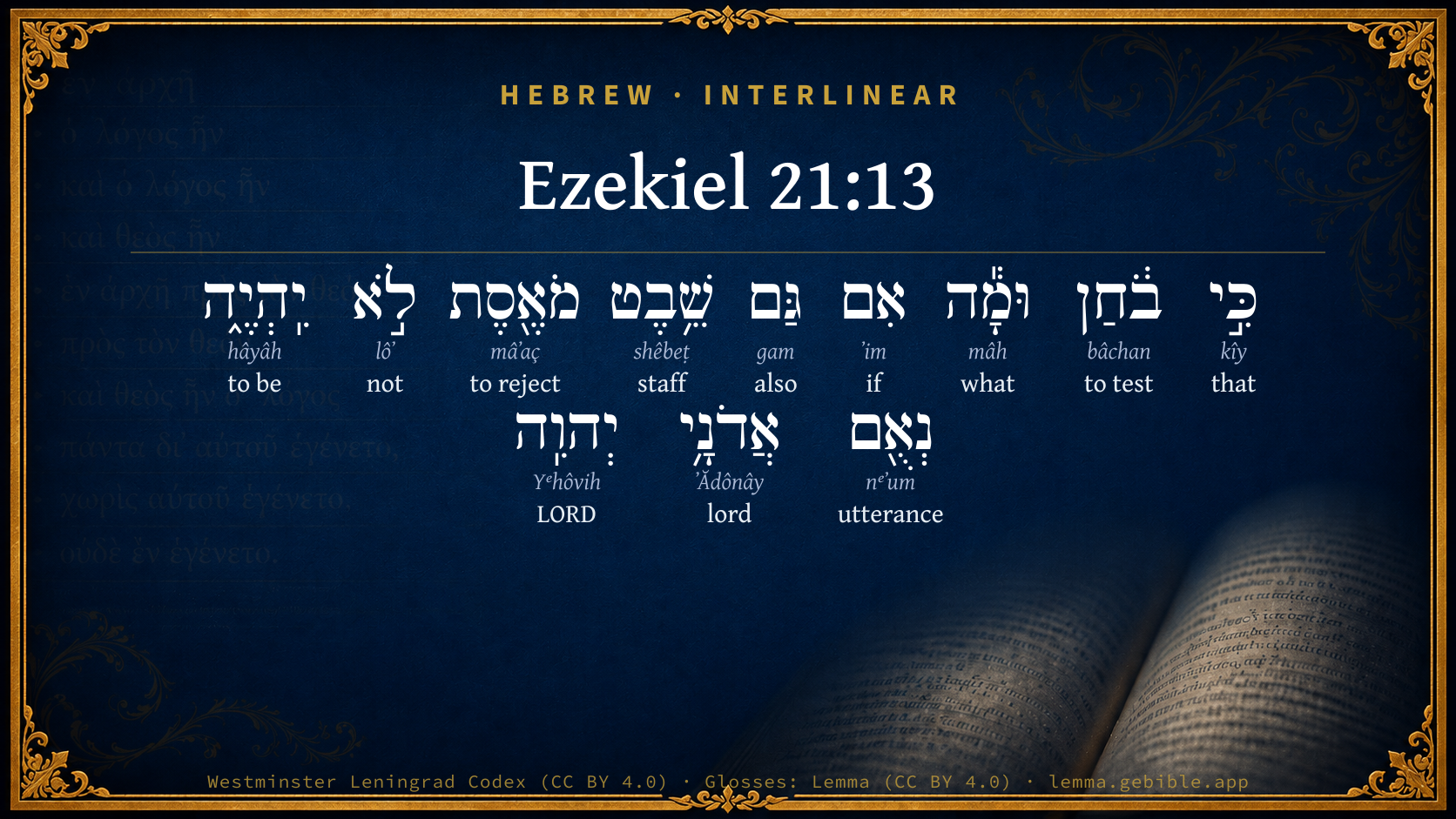
Hebrew (Westminster Leningrad Codex) Ezekiel 21:13 appears in the Hebrew Old Testament. The text above is from the Westminster Leningrad Codex. Each word links to its Strong’s number, a concise gloss, and parsing drawn from the Open Scriptures Hebrew Bible morphology. Click any word for its full Brown-Driver-Briggs (BDB) entry.
Download image
Cite this verse

Ezekiel 21:13 (World English Bible). Public Domain. Lemma interlinear Bible study tool, https://lemma.gebible.app/v/ezekiel/21/13.

Show BibTeX & RIS
BibTeX
RIS
English Translation
For there is a trial; and what if even the rod that condemns shall be no more? says the Lord Yahweh.
World English Bible · Public Domain
Download a study sheet

One document with this verse’s original text, its word-by-word gloss line, the meaning frame, cross-references with their text, attributed commentary, and full source and license credits — printable, and it pastes into notes with its structure intact.

This verse Autodidact and up

Study sheet (.html) Plain text (.txt)

A passage Seminary Student

Up to 50 verses in one chapter. A passage sheet keeps up to 6 commentary sources and 12 cross-references per verse, in the order this page ranks them, and says so on the sheet whenever that leaves anything out. Ask for a single verse and you get the Autodidact verse sheet above.

Everything on this page stays free to read, with no account — the sheet is a download of what is already on screen, not access to it.

Want to remove ads? Support Godless Engineer
Compare translations 3

The same verse in 3 English versions, stacked beneath the original-language interlinear above. Click any original word for its lexicon entry.

Each is an independent rendering of the whole verse — the interlinear is not word-aligned to these translations.

Highlighted words mark where these versions differ — a whole-verse word diff, not a word-by-word alignment.

  • World English Bible Public Domain
    For there is a trial; and what if even the rod that condemns shall be no more? says the Lord Yahweh.
  • King James Version Public Domain
    Because it is a trial, and what if the sword contemn even the rod? it shall be no more, saith the Lord GOD.
  • unfoldingWord Literal Text CC BY-SA 4.0
    For there is a trial, but what if the scepter does not last?—this is the Lord Yahweh’s declaration.

unfoldingWord Literal Text — © unfoldingWord, licensed CC BY-SA 4.0. Word-aligned USFM3 via Door43 (git.door43.org/unfoldingWord/en_ult).

Versions to compare (up to 4)

3 of 4 selected

Show all 18 translations

Every available English version of this verse, each an independent rendering of the whole verse.

  • World English Bible Public Domain
    For there is a trial; and what if even the rod that condemns shall be no more? says the Lord Yahweh.
  • Berean Standard Bible Public Domain
    Surely testing will come! And what if even the scepter, which the sword despises, does not continue?’ declares the Lord GOD.
  • Majority Standard Bible Public Domain
    Surely testing will come! And what if even the scepter, which the sword despises, does not continue?’ declares the Lord GOD.
  • King James Version Public Domain
    Because it is a trial, and what if the sword contemn even the rod? it shall be no more, saith the Lord GOD.
  • American Standard Version (1901) Public Domain
    For there is a trial; and what if even the rod that contemneth shall be no more? saith the Lord Jehovah.
  • Revised Version (1885) Public Domain
    For there is a trial; and what if even the rod that contemneth shall be no more? saith the Lord GOD.
  • Geneva Bible (1599) Public Domain
    For it is a triall, and what shall this be, if the sworde contemne euen the rodde? It shall be no more, saith the Lord God.
  • Douay-Rheims (1899) Public Domain
    Because it is tried: and that when it shall overthrow the sceptre, and it shall not be, saith the Lord God.
  • Young's Literal Translation Public Domain
    Because `it is' a trier, And what if even the sceptre it is despising? It shall not be, an affirmation of the Lord Jehovah.
  • Literal Standard Version CC BY-SA 4.0
    Because [it is] a trier, || And what if it is even despising the scepter? It will not be, a declaration of Lord YHWH.
  • Unlocked Literal Bible CC BY-SA 4.0
    For there is a trial, but what if the scepter does not last?—this is the Lord Yahweh's declaration.
  • unfoldingWord Literal Text CC BY-SA 4.0
    For there is a trial, but what if the scepter does not last?—this is the Lord Yahweh’s declaration.
  • Darby Bible Public Domain
    For the trial [is made]; and what if even the contemning sceptre shall be no [more]? saith the Lord Jehovah.
  • World Messianic Bible Public Domain
    “For there is a trial. What if even the rod that condemns will be no more?” says the Lord GOD.
  • Webster's Bible Public Domain
    Because it is a trial, and what if the sword contemneth even the rod? it shall be no more, saith the Lord GOD.
  • Free Bible Version CC BY-SA 4.0
    They will be tested. What if the scepter that despises others doesn't continue? declares the Lord God.
  • Bible in Basic English Public Domain
    ...
  • JPS Tanakh (1917) Public Domain
    (21-18) For there is a trial; and what if it contemn even the rod? It shall be no more, saith the Lord GOD.

Literal Standard Version (2020), Covenant Press — licensed CC BY-SA 4.0. Text via the HelloAO Bible API (eBible.org). Unlocked Literal Bible (unfoldingWord) — licensed CC BY-SA 4.0. Text via the HelloAO Bible API (eBible.org). unfoldingWord Literal Text — © unfoldingWord, licensed CC BY-SA 4.0. Word-aligned USFM3 via Door43 (git.door43.org/unfoldingWord/en_ult). Free Bible Version, Dr. Jonathan Gallagher — licensed CC BY-SA 4.0. Text via the HelloAO Bible API (eBible.org).

Word by word

More ways to search: Search by grammar → Find every occurrence → Compare this word →

Practice this passage: Drill this verse → Learn its vocabulary →

בֹ֔חַן
bâchan
H974
“to test”
Verb, Pual, Perfect, 3rd Person, Masculine, Singular
Part of Speech
Verb
Stem
Pual
Form
Perfect
Person
3rd Person
Gender
Masculine
Number
Singular
Full BDB Definition

Origin: a primitive root

TWOT: 230

to examine, try, prove - (Qal) - to examine, scrutinise - to test, prove, try (of gold, persons, the heart, man of God) - (Niphal) to be tried, proved - (Pual) to make a trial
  1. כִּ֣י kîy H3588 “that” Conjunction
  2. וּמָ֕ה mâh H4100 “and · what” Conjunction + Particle, Interrogative
  3. אִם ʼim H518 “if” Conjunction
  4. גַּם gam H1571 “also” Particle, Accusative
  5. שֵׁ֥בֶט shêbeṭ H7626 “staff” Noun, Common, Masculine, Singular, Absolute
  6. מֹאֶ֖סֶת mâʼaç H3988 “rejecting” Verb, Qal, Participle Active, Feminine, Singular, Absolute
  7. לֹ֣א lôʼ H3808 “not” Particle, Negative
  8. יִֽהְיֶ֑ה hâyâh H1961 “to be” Verb, Qal, Imperfect, 3rd Person, Masculine, Singular
  9. נְאֻ֖ם nᵉʼum H5002 “utterance of” Noun, Common, Masculine, Singular, Construct
  10. אֲדֹנָ֥י ʼĂdônây H136 “Lord · my” Noun, Common, Masculine, Plural, Construct + Suffix, Personal, 1st Person, Common, Singular
  11. יְהוִֽה Yᵉhôvih H3069 “LORD” Noun, Proper

About this verse

These counts appear in no published source. They are computed here, from the morphology-tagged text and Lemma’s own curated glosses. What Lemma adds →

12
words
12
distinct lemmas
Prophets
section

Shared distinctive vocabulary

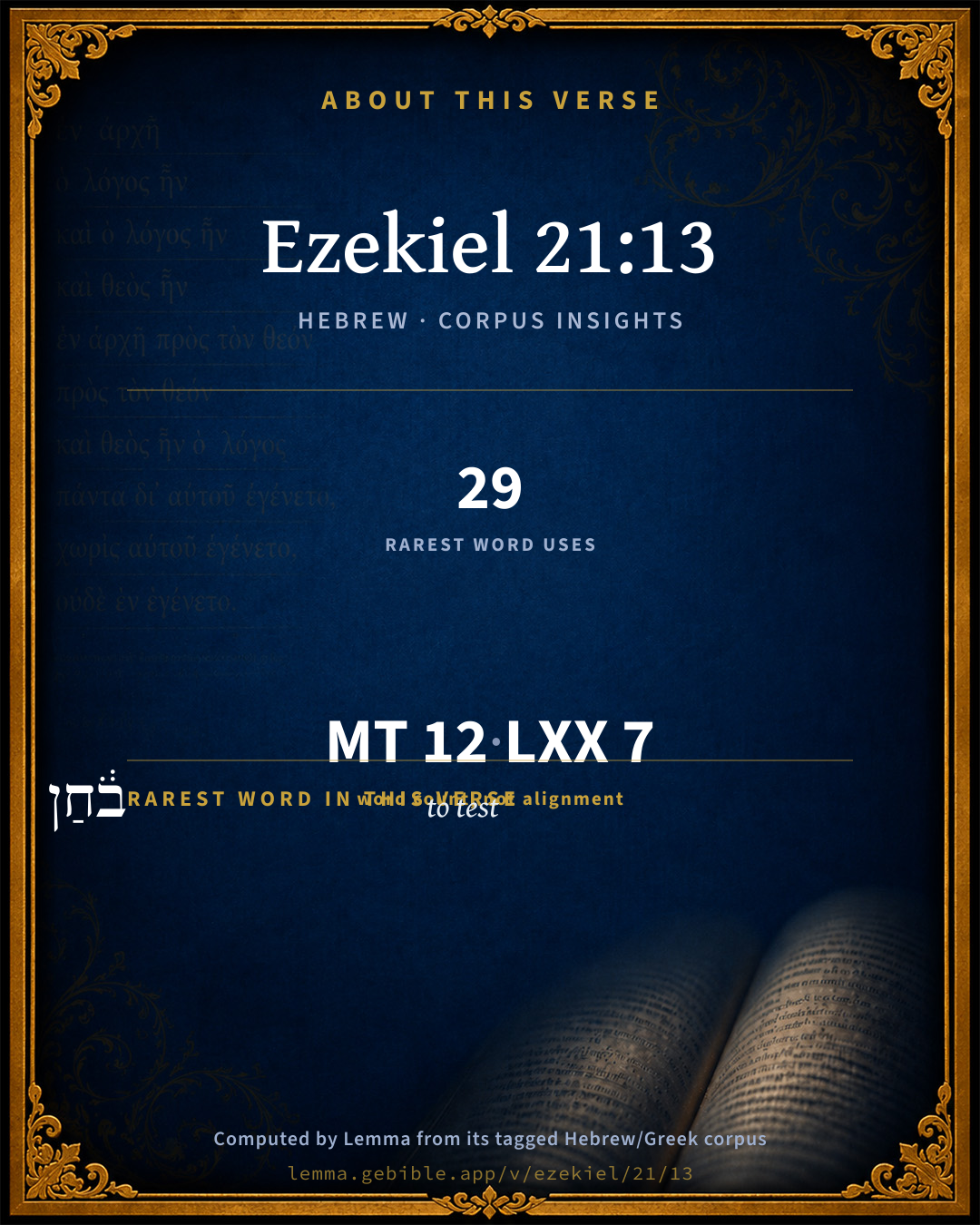
בֹ֔חַן to test H974 occurs in 28 verses of the Hebrew Bible. Also found in:

Grammatical profile

  • 3 verbs
  • 4 nouns
  • 2 conjunctions
  • 3 particles

Verb forms

  • בֹ֔חַן Pual · Perfect
  • מֹאֶ֖סֶת Qal · Participle Active
  • יִֽהְיֶ֑ה Qal · Imperfect

Hebrew & Septuagint length

In English translation the verse runs 21 words from the Hebrew and 16 from the Septuagint (LXX English) — closely comparable.

A rough comparison of the two English renderings, which tokenize alike — not a word-level alignment.

Word counts can differ between the Hebrew and the Greek without any difference in meaning — e.g. the Hebrew direct-object marker אֵת has no separate Greek word, and Greek often adds the article ὁ.

In the original languages it is 12 Hebrew tokens and 7 Greek tokens — but the two are counted differently (Hebrew bundles its prefixes and suffixes into one token; the Greek is in lemma form), so that isn’t a like-for-like length.

Cross-references

4

Topical passages linked to Ezekiel 21:13 in the Treasury of Scripture Knowledge — connected by theme and wording, ordered by reader-vote popularity; previews shown in the World English Bible.

  • Ezekiel 21:10 it is sharpened that it may make a slaughter; it is furbished that it may be as lightning: shall we then make mirth? the rod of my son, it condemns every tree.
  • Ezekiel 21:25 You, deadly wounded wicked one, the prince of Israel, whose day is come, in the time of the iniquity of the end,
  • 2 Corinthians 8:2 how that in much proof of affliction the abundance of their joy and their deep poverty abounded to the riches of their liberality.
  • Job 9:23 If the scourge kills suddenly, He will mock at the trial of the innocent.

Cross-references courtesy of OpenBible.info (CC BY 4.0).

Hebrew and Greek witnesses Masoretic Hebrew ↔ Greek Septuagint

The same verse in the two great witnesses to the Old Testament, shown verse-for-verse.

These are two independent witnesses, not word-aligned to each other, and the Septuagint is shown in lemma (dictionary) form.

Hebrew Ezekiel 21:13 Masoretic · Westminster Leningrad Codex

כִּ֣י בֹ֔חַן וּמָ֕ה אִם גַּם שֵׁ֥בֶט מֹאֶ֖סֶת לֹ֣א יִֽהְיֶ֑ה נְאֻ֖ם אֲדֹנָ֥י יְהוִֽה

For there is a trial; and what if even the rod that condemns shall be no more? says the Lord Yahweh.

World English Bible · Public Domain

Greek LXX Ezekiel 21:13 Septuagint · lemma form

καί γίγνομαι λόγος κύριος πρός ἐγώ λέγω

and what if even the tribe be rejected? it shall not be, says the Lord God.

LXX2012 (modern English Septuagint) · Public Domain

On this verse, The Pulpit Commentary discusses the Septuagint’s reading. Read the note in Commentary ↓

Hebrew: Westminster Leningrad Codex (CC BY 4.0). Greek: Septuagint (public domain); English from LXX2012 (modern English Septuagint) (Public Domain). How the Septuagint differs from the Hebrew →

Targum (Aramaic paraphrase)

1

The Targum is the ancient Jewish Aramaic paraphrase of the Hebrew Scriptures — an interpretive translation, not the Hebrew text itself. Onkelos (literal) and Pseudo-Jonathan (expansive) render the Torah, and Jonathan the Prophets. Coverage is partial: where no permissively-licensed English translation exists for a verse, only the Aramaic is shown. This is verse-level text, not a word-by-word alignment to the Hebrew.

  1. Targum Jonathan Prophets (Joshua–Malachi)
    וַהֲוָה פִּתְגַם נְבוּאָה מִן קֳדָם יְיָ עִמִי לְמֵימָר:

    (no public-domain English translation for this verse)

    Targum Jonathan — Aramaic: “Mikraot Gedolot” (public domain). English: “Sefaria Community Translation” (CC0 1.0 (public-domain dedication)); “London "Chaldee Paraphrase," 1871” (public domain). Text via Sefaria.

Commentary

Notes on Ezekiel 21:13 from classic Christian and Jewish commentators (each source and its license shown beneath its notes). The classic Christian expositions comment on the surrounding passage and are grouped to its opening verse, so a note may address several verses; the Jewish commentaries on the Tanakh (Rashi and others) are per-verse, so they appear only where the commentator wrote on this verse.

Lemma curates 59 commentaries, every one of them public domain or Creative Commons licensed, each selected and text-cleaned for this edition rather than reprinted as found. About our sources →

Trapp's Complete Commentary

John Trapp

Eze 21:13 Because [it is] a trial, and what if [the sword] contemn even the rod? it shall be no [more], saith the Lord GOD.

Ver. 13. Because it is a trial.] Sore and sharp; therefore cry and howl, especially since they are not bettered. Hang heavy weights on rotten boughs, they presently break; the best divination of men is at the parting way. See Eze 21:21.

And what if the sword contemn even the rod?] q.d., What doth this silly rod do here? will they not stoop? will they not put their necks under the yoke of God’s Son? {Eze 21:10} Let me come; I will make them either bow or break, either yield or bleed.

John Trapp, A Commentary or Exposition upon All the Books of the Old and New Testament (1647–1656) — public domain. Text from a community e-Sword module.

Geneva Bible (1599)

Geneva Bible translators

Ezekiel moved with compassion, thus complaineth, fearing the destruction of the kingdom which God had confirmed to David and his posterity by promise, which promise God performed, although here it seemed to man’s eye that it should utterly perish.

Geneva Bible (1599) marginal notes — public domain. Text via Bolls.life.

Jamieson, Fausset & Brown

Robert Jamieson, A. R. Fausset & David Brown

it is a trial--rather, "There is a trial" being made: the sword of the Lord will subject all to the ordeal. "What, then, if it contemn even the rod" (scepter of Judah)? Compare as to a similar scourge of unsparing trial, Job 9:23.

it shall be no more--the scepter, that is, the state, must necessarily then come to an end. Fulfilled in part at the overthrow of Judah by Nebuchadnezzar, but fully at the time of "Shiloh's" (Messiah's) coming (Gen 49:10), when Judea became a Roman province.

Jamieson, Fausset & Brown — Commentary Critical and Explanatory on the Whole Bible (1871) — public domain (CC PDM 1.0). Text via the HelloAO Bible API.

Adam Clarke's Commentary

Verse 13. Because it is a trial] This will be a trial of strength and skill between the Chaldeans and the Jews; and a trial of faith and patience to the righteous.

And what if the sword, (Nebuchadnezzar,) contemn even the rod?] Overthrow Zedekiah? It will do so; for the regal government of Judea shall be no more. Or, it is tried; that is, the sword. Nebuchadnezzar has already shown himself strong and skilful.

Adam Clarke's Commentary on the Bible (1810–1826) — public domain. Text from a community e-Sword/MySword module.

Ellicott's Commentary for English Readers

(13) Because it is a trial.—Here again the original is obscure from its conciseness and abruptness, leading to great variety of interpretation. Neither the text nor the margin of our translation is quite intelligible. The words for “rod” and “contemn” are the same as in Eze_21:10, and must be taken in the same sense. The most satisfactory translation is this: “For it (the sword) has been proved (viz., on others), and what if this contemning rod shall be no more?” i.e., the power of the sword of Babylon has already been proved; and the sceptre of Judah, which despises it, shall be clean swept away. Various other translations, differing in detail, give the same general sense.

A Bible Commentary for English Readers, edited by Charles John Ellicott (1878–1897) — public domain. Text from a community e-Sword module.

The Cambridge Bible for Schools and Colleges

gen. ed. J. J. S. Perowne

13. Because it is a trial] Or, for there is a trial. So accented the word occurs again Isa_28:16, a stone of trial (tried stone). The word might be read as a verb: for trial has been made. In any case reference is not to the “sword” nor the Babylonian conqueror who wields it, as if the meaning were: trial has been made of what it or he can do! Such a sense has no probability. The word must refer to those on whom the calamity is to fall.

and what if … be no more] The same difficulties recur here as in Eze_21:10, and the translation will follow that adopted there. Ew., “for it has been tried—and what? is it also a soft rod?—that will not be, saith” &c.; i.e. the rod (the sword) has been tried, and it will be found no soft one. This is wholly improbable. Boett., “for (as to) trial, what (is to be effected) with that, when thou hast even contemned the rod?” (Aehrenlese, ii. p. 174.) Others (Hitz., Corn.) point the word “trial” differently, and read: for with kindness what (should I accomplish)? &c.—which is quite destitute of probability. In spite of the grammatical harshness (cf. however Eze_21:27) the construction followed in R.V. is perhaps the most probable: “for trial hath been made, and what if the sceptre (R. V. rod) that contemneth should be no more!”—reference being to the royal house of Judah which shall perish, cf. Eze_21:25-27; Eze_21:29?

The Cambridge Bible for Schools and Colleges (gen. ed. J. J. S. Perowne; Cambridge University Press, 1878–1918) — public domain. Text from a community e-Sword module.

John Gill's Exposition

I have set the point of the sword against all their gates,.... The word rendered "point" is nowhere else used, and is differently translated: by some the "fear" of the sword (z), as Menachem and Kimchi; by others the "cry" of the sword, or of those that are slain with it, as Jarchi; and the Targum paraphrases it,

"those that slay with the sword:''

some, as both Jarchi and Kimchi, observe, by an inversion of the letters of the alphabet, called "athbash", render it, the "slaughter" of the sword; and De Dieu and Dr. Castel, from the use of the word in the Ethiopic language, the "destruction" of it, or, the power of it. The meaning is, that the enemy, with their swords drawn, should be placed at every gate of the city of Jerusalem, or of their houses, pointed towards them; which would be very terrible, and sore destruction to them.

That their hearts may faint; seeing nothing but death before their eyes, and no way to escape it:

and their ruins be multiplied; of their families, and of their houses.

Ah! it is made bright; to terrify the more, as in Eze 21:10, appearing as a flaming sword, and so causing fear; the prophet expresses his sorrow and concern for it. The Targum is,

"woe! the sword is drawn out to kill.''

It is wrapped up for slaughter; in its sheath or scabbard, that it might not rust or be blunted, it being furbished and brightened; but this seems contrary to its being drawn out of its sheath, as in Eze 21:3. Kimchi renders it, therefore, "sharpened", as in Eze 21:10 and so the Targum,

"it is sharpened to destroy;''

the more easily and speedily.

(z) "terrorem gladii", Munster, Pagninus, Montanus.

John Gill's Exposition of the Whole Bible (1746–1763) — public domain (CC PDM 1.0). Text via the HelloAO Bible API.

Haydock's Catholic Bible Commentary

God. Perhaps you will say it is only a trial: but what will be your sentiments, when you behold the king and his people led away? (Calmet) --- Protestants, "Because it is a trial; and what if the sword contemn even the rod? it shall be no more, saith." (Haydock)

George Leo Haydock (1774–1849), Haydock's Catholic Family Bible and Commentary, 1859 edition — public domain. Excludes Psalms (Douay-Rheims chapter numbering differs from Protestant) and Deuterocanonical books (Catholic canon only).

Matthew Poole's English Annotations

It is a sore trial, therefore show all the signs of grief and sorrow; or it may refer to what follows in the verse; thus, since this is the exploration, or trial, which I make in so severe manner to bring them to repentance, mourn for them, lest they should harden themselves.

What if the sword? the addition of sword, which is not in the original, hath perplexed the words in my thoughts. I would read them thus,

and what if the rod contemn? It shall be no more. Then the sense runs thus: But if the king and kingdom of Judah despise this trial, and harden themselves against this sword, both shall be destroyed, and be no more, for nothing but a right use of this last trial could help them. Or else, if we must adhere to our version, what if it amount to this: All this is for probation and trial, not for utterly extirpating Israel, saith God to his prophet; who might propose this, What if the sword contemn those bounds, and despise the king and kingdom, and resolve to destroy them from being a nation? as Isa 10:6,7. To this God gives answer thus; This he shall never effect, and in due time this sword shall be no more; Babylon shall be destroyed. In so perplexed a place I rather conjecture than affirm.

Matthew Poole's English Annotations on the Holy Bible (1683–1685) — public domain. Text from a community e-Sword/MySword module.

Whedon's Commentary on the Bible

Daniel D. Whedon

13. Because it is a trial, and what if the sword contemn even the rod? it shall be no more — Perhaps, for the trial hath been made, and what if even the contemning scepter should be no more? (Kliefoth, Schroder, R.V.) This would refer to the destruction of the royal house of Judah. (See Eze_21:10; Eze_21:25-27.) The corruption of the text is seen from the fact that with a few changes Cornill can read, “for by favor what (can I accomplish)? Have they turned from their uncleanness? It shall not be.”

Daniel D. Whedon (gen. ed.), Commentary on the Old and New Testaments (1874–1909) — public domain. Text from a community e-Sword module.

The Pulpit Commentary

Because it is a trial, etc. The verse has received as many interpretations, and is just as obscure as ver. 10, with which it is obviously connected. I begin as before with that which seems most probable.

(1) Keil: For the trial is made, and what if the despising sceptre shall riot come? The "despising sceptre" is the kingdom of Judah, and the prophet asks, "What will happen, what extreme of misery is to be looked for, if that kingdom shall not appear, if Judah shall be left without a ruler?

(2) Ewald: For it is tried and what? Whether it is also a soft rod! That will not be. Sc. men will find on trial that the sword of Jehovah is not a soft rod, but the sharpest of all weapons.

(3) Hengstenberg: And how? Shall the despising rod that outstript all other punishments not be? i.e. shall the sword of Jehovah not do its work effectively?

(4) Cornill, in part following Hitzig, again rewrites the text, and gets the meaning: How should I judge with favour? They have not turned themselves from their pollution. They shall find no place.

(5) The Authorized Version inserts t he word "sword," apparently with the meaning that the "trial" will show that the sword of the Lord contemns the rod, i.e. the sceptre of Judah, and that that rod shall be no more.

(6) The Authorized Version (margin): When the trial hath been, what then? Shall not they also belong to the despising rod? may have had a moaning for those who adopted it, but I fail to find it.

(7) The Revised Version relegates the Authorized Version text into the margin, and substitutes, For there is a trial, and what if even the rod that contemneth (i.e. the sceptre of Judah) shall be no more?

(8) The LXX and Vulgate connect "because there is a trial" with the preceding clause, rendering it respectively, "for it has been justified (dedikaiwtai)," and "because it has been tested (probatus)," and translate what follows the LXX, "What if even a tribe be repulsed? It shall not be;" and the Vulgate, "And this when it (the sword!) has overturned the kingdom, and it shall not be," etc. This will be a sufficient summary of the difficulties of the exegetical problem. At the best, we must say that it remains unsolved.

The Pulpit Commentary (1880–1919), ed. H.D.M. Spence-Jones & Joseph S. Exell — public domain. Text from a community e-Sword module.

John Wesley's Explanatory Notes

If - But if the king and kingdom of Judah despise this trial, both shall be destroyed and be no more.

John Wesley, Explanatory Notes Upon the Whole Bible (1754–1765) — public domain. Text via the GEBible commentary corpus.

Lesson kit

Teaching starters — assembled from the data on this page, not authored interpretation. Every prompt links to the verse data it draws on. Edit before teaching.

Ezekiel, in the Prophets, opens this verse with 12 words (12 distinct Hebrew lemmas). Its most distinctive word is bâchan (“to test”). A historical commentator’s framing appears above. Read the whole chapter for the surrounding context.

Discussion questions

  1. The word bâchan carries the sense “to test.” How does it shape the verse?
  2. Genesis 42:15 shares the word «to test» with this verse. How do the two illuminate each other?
  3. The translations on this page render this verse differently — a whole-verse word diff, not a word-by-word alignment. What might account for the different wordings?
  4. The verb «בֹ֔חַן» is Pual Perfect. How does its form color the action?
  5. Reading how Trapp's Complete Commentary and Geneva Bible (1599) read this verse, where do the two commentators agree and where do they part?

Things to notice

Reading settings

Reading text

Shown beneath each verse's original-language words.

Old Testament
Old Testament edition

Read the OT as the Masoretic Hebrew (MT) or the Greek Septuagint (LXX).

English shown for the Greek Septuagint (in the Hebrew ↔ Greek comparison).

Comparing translations? Open the Compare panel on any verse page to stack up to four side by side.