
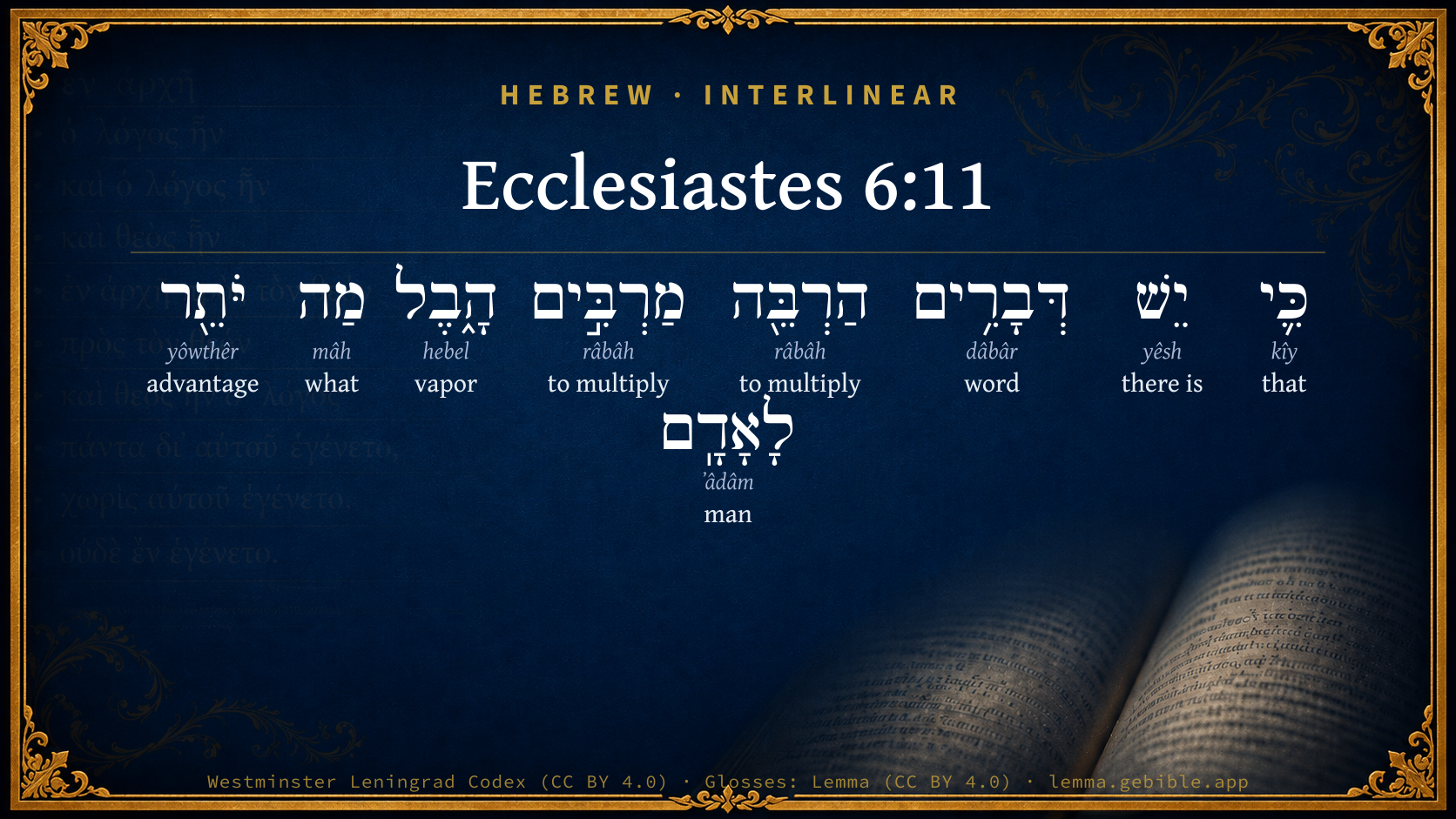
Ecclesiastes 6:11

Hebrew (Westminster Leningrad Codex) Ecclesiastes 6:11 appears in the Hebrew Old Testament. The text above is from the Westminster Leningrad Codex. Each word links to its Strong’s number, a concise gloss, and parsing drawn from the Open Scriptures Hebrew Bible morphology. Click any word for its full Brown-Driver-Briggs (BDB) entry.
Download image
Cite this verse

Ecclesiastes 6:11 (World English Bible). Public Domain. Lemma interlinear Bible study tool, https://lemma.gebible.app/v/ecclesiastes/6/11.

Show BibTeX & RIS
BibTeX
RIS
English Translation
For there are many words that create vanity. What does that profit man?
World English Bible · Public Domain
Download a study sheet

One document with this verse’s original text, its word-by-word gloss line, the meaning frame, cross-references with their text, attributed commentary, and full source and license credits — printable, and it pastes into notes with its structure intact.

This verse Autodidact and up

Study sheet (.html) Plain text (.txt)

A passage Seminary Student

Up to 50 verses in one chapter. A passage sheet keeps up to 6 commentary sources and 12 cross-references per verse, in the order this page ranks them, and says so on the sheet whenever that leaves anything out. Ask for a single verse and you get the Autodidact verse sheet above.

Everything on this page stays free to read, with no account — the sheet is a download of what is already on screen, not access to it.

Want to remove ads? Support Godless Engineer
Compare translations 3

The same verse in 3 English versions, stacked beneath the original-language interlinear above. Click any original word for its lexicon entry.

Each is an independent rendering of the whole verse — the interlinear is not word-aligned to these translations.

Highlighted words mark where these versions differ — a whole-verse word diff, not a word-by-word alignment.

  • World English Bible Public Domain
    For there are many words that create vanity. What does that profit man?
  • King James Version Public Domain
    Seeing there be many things that increase vanity, what is man the better?
  • unfoldingWord Literal Text CC BY-SA 4.0
    When there are many words are increasingly vaporous, what advantage to humanity?

unfoldingWord Literal Text — © unfoldingWord, licensed CC BY-SA 4.0. Word-aligned USFM3 via Door43 (git.door43.org/unfoldingWord/en_ult).

Versions to compare (up to 4)

3 of 4 selected

Show all 17 translations

Every available English version of this verse, each an independent rendering of the whole verse.

  • World English Bible Public Domain
    For there are many words that create vanity. What does that profit man?
  • Berean Standard Bible Public Domain
    For the more words, the more futility—and how does that profit anyone?
  • Majority Standard Bible Public Domain
    For the more words, the more futility—and how does that profit anyone?
  • King James Version Public Domain
    Seeing there be many things that increase vanity, what is man the better?
  • American Standard Version (1901) Public Domain
    Seeing there are many things that increase vanity, what is man the better?
  • Revised Version (1885) Public Domain
    Seeing there be many things that increase vanity, what is man the better?
  • Douay-Rheims (1899) Public Domain
    There are many words that have much vanity in disputing.
  • Young's Literal Translation Public Domain
    For there are many things multiplying vanity; what advantage `is' to man?
  • Literal Standard Version CC BY-SA 4.0
    For there are many things multiplying vanity; What advantage [is] to man?
  • Unlocked Literal Bible CC BY-SA 4.0
    The more words that are spoken, the more futility increases, so what advantage is that to a man?
  • unfoldingWord Literal Text CC BY-SA 4.0
    When there are many words are increasingly vaporous, what advantage to humanity?
  • Darby Bible Public Domain
    For there are many things that increase vanity: what is man advantaged?
  • World Messianic Bible Public Domain
    For there are many words that create vanity. What does that profit man?
  • Webster's Bible Public Domain
    Seeing there are many things that increase vanity, what is man the better?
  • Free Bible Version CC BY-SA 4.0
    For the more words you use, the harder it is to make sense. So what's the point?
  • Bible in Basic English Public Domain
    There are words without number for increasing what is to no purpose, but what is man profited by them?
  • JPS Tanakh (1917) Public Domain
    Seeing there are many words that increase vanity, what is man the better?

Literal Standard Version (2020), Covenant Press — licensed CC BY-SA 4.0. Text via the HelloAO Bible API (eBible.org). Unlocked Literal Bible (unfoldingWord) — licensed CC BY-SA 4.0. Text via the HelloAO Bible API (eBible.org). unfoldingWord Literal Text — © unfoldingWord, licensed CC BY-SA 4.0. Word-aligned USFM3 via Door43 (git.door43.org/unfoldingWord/en_ult). Free Bible Version, Dr. Jonathan Gallagher — licensed CC BY-SA 4.0. Text via the HelloAO Bible API (eBible.org).

Word by word

More ways to search: Search by grammar → Find every occurrence → Compare this word →

Practice this passage: Drill this verse → Learn its vocabulary →

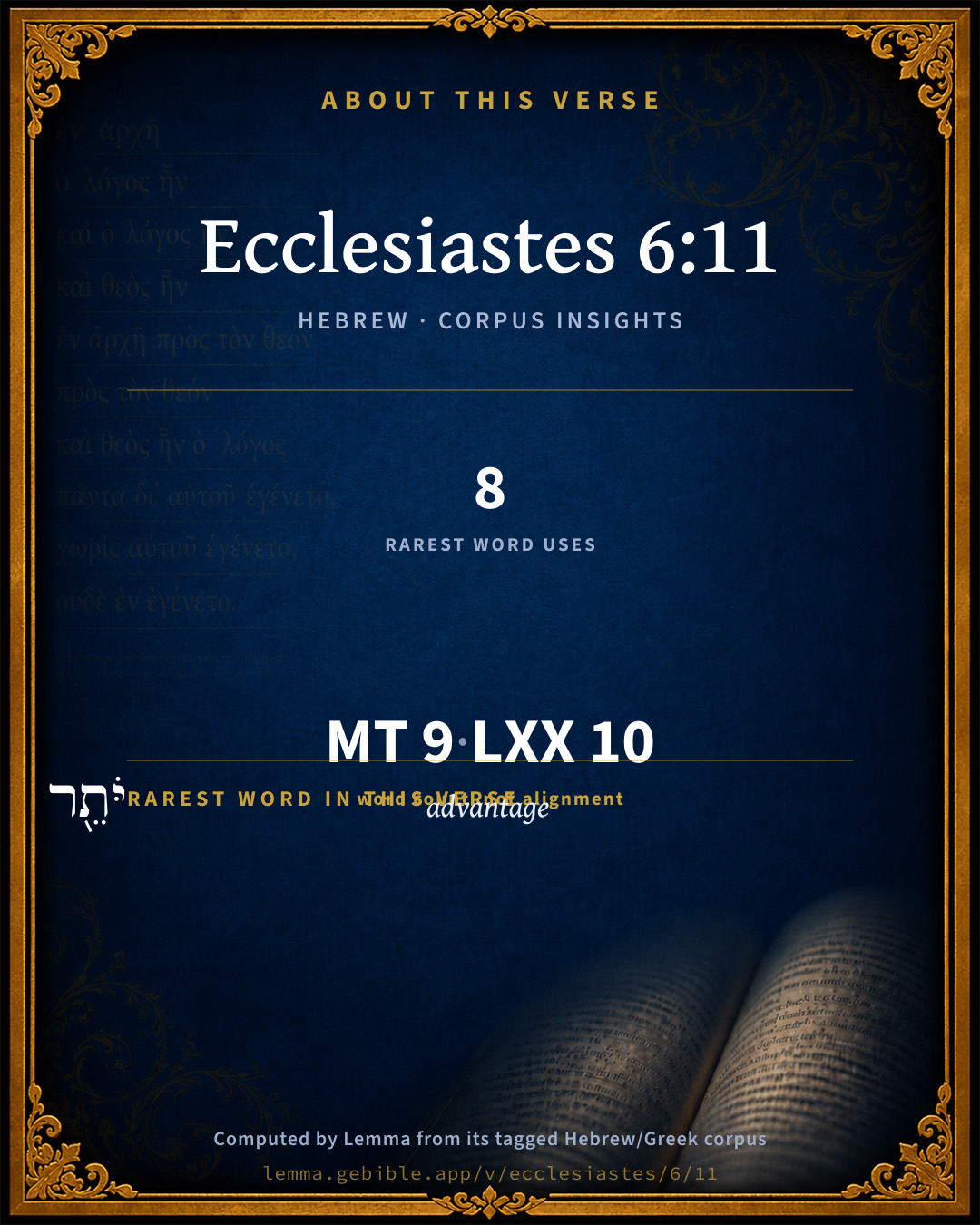
About this verse

These counts appear in no published source. They are computed here, from the morphology-tagged text and Lemma’s own curated glosses. What Lemma adds →

9
words
8
distinct lemmas
Wisdom
section

Notable vocabulary

The rarest word here is יֹּתֵ֖ר advantage H3148 — appearing just 8 times in the whole Hebrew Bible.

Shared distinctive vocabulary

יֹּתֵ֖ר advantage H3148 occurs in 8 verses of the Hebrew Bible. Also found in:

Grammatical profile

  • 2 verbs
  • 4 nouns
  • 1 conjunction
  • 2 particles

Verb forms

  • הַרְבֵּ֖ה Hiphil · Infinitive Absolute
  • מַרְבִּ֣ים Hiphil · Participle Active

Repetition

A word recurs within this verse — often emphatic in Hebrew:

  • הַרְבֵּ֖ה to multiply H7235 ×2

Hebrew & Septuagint length

In English translation the verse runs 13 words from the Hebrew and 8 from the Septuagint (LXX English) — the Septuagint runs noticeably shorter here. See the side-by-side →

A rough comparison of the two English renderings, which tokenize alike — not a word-level alignment.

Word counts can differ between the Hebrew and the Greek without any difference in meaning — e.g. the Hebrew direct-object marker אֵת has no separate Greek word, and Greek often adds the article ὁ.

In the original languages it is 9 Hebrew tokens and 10 Greek tokens — but the two are counted differently (Hebrew bundles its prefixes and suffixes into one token; the Greek is in lemma form), so that isn’t a like-for-like length.

Cross-references

10

Topical passages linked to Ecclesiastes 6:11 in the Treasury of Scripture Knowledge — connected by theme and wording, ordered by reader-vote popularity; previews shown in the World English Bible.

  • Ecclesiastes 4:16 There was no end of all the people, even of all them over whom he was--yet those who come after shall not rejoice in him. Surely this also is vanity and a chasing after wind.
  • Ecclesiastes 5:7 For in the multitude of dreams there are vanities, as well as in many words: but you must fear God.
  • Psalms 73:6 Therefore pride is like a chain around their neck. Violence covers them like a garment.
  • Ecclesiastes 1:6–9 The wind goes toward the south, and turns around to the north. It turns around continually as it goes, and the wind returns again to its courses.
  • Ecclesiastes 1:17–18 I applied my heart to know wisdom, and to know madness and folly. I perceived that this also was a chasing after wind.
  • Ecclesiastes 2:3–11 I searched in my heart how to cheer my flesh with wine, my heart yet guiding me with wisdom, and how to lay hold of folly, until I might see what it was good for the sons of men that they should do under heaven all the days of their lives.
  • Ecclesiastes 3:19 For that which happens to the sons of men happens to animals. Even one thing happens to them. As the one dies, so the other dies. Yes, they have all one breath; and man has no advantage over the animals: for all is vanity.
  • Ecclesiastes 4:1–4 Then I returned and saw all the oppressions that are done under the sun: and, behold, the tears of those who were oppressed, and they had no comforter; and on the side of their oppressors there was power; but they had no comforter.
  • Ecclesiastes 4:8 There is one who is alone, and he has neither son nor brother. There is no end to all of his labor, neither are his eyes satisfied with wealth. For whom then, do I labor, and deprive my soul of enjoyment? This also is vanity, yes, it is a miserable business.
  • Hosea 12:1 Ephraim feeds on wind, And chases the east wind. He continually multiplies lies and desolation. They make a covenant with Assyria, And oil is carried into Egypt.

Cross-references courtesy of OpenBible.info (CC BY 4.0).

Hebrew and Greek witnesses Masoretic Hebrew ↔ Greek Septuagint

The same verse in the two great witnesses to the Old Testament, shown verse-for-verse.

Here the Septuagint runs noticeably shorter than the Hebrew — LXX2012 (modern English Septuagint) 8 words vs World English Bible 13. A rough length comparison of the two English translations, not a word-level alignment — read both below.

These are two independent witnesses, not word-aligned to each other, and the Septuagint is shown in lemma (dictionary) form.

Hebrew Ecclesiastes 6:11 Masoretic · Westminster Leningrad Codex

כִּ֛י יֵשׁ דְּבָרִ֥ים הַרְבֵּ֖ה מַרְבִּ֣ים הָ֑בֶל מַה יֹּתֵ֖ר לָאָדָֽם

For there are many words that create vanity. What does that profit man?

World English Bible · Public Domain

Greek LXX Ecclesiastes 6:11 Septuagint · lemma form

ὅτι εἰμί λόγος πολύς πληθύνω ματαιότης τίς περισσόν ὁ ἄνθρωπος

For there are many things which increase vanity.

LXX2012 (modern English Septuagint) · Public Domain

On this verse, John Gill's Exposition discusses the Septuagint’s reading. Read the note in Commentary ↓

Hebrew: Westminster Leningrad Codex (CC BY 4.0). Greek: Septuagint (public domain); English from LXX2012 (modern English Septuagint) (Public Domain). How the Septuagint differs from the Hebrew →

Commentary

Notes on Ecclesiastes 6:11 from classic Christian and Jewish commentators (each source and its license shown beneath its notes). The classic Christian expositions comment on the surrounding passage and are grouped to its opening verse, so a note may address several verses; the Jewish commentaries on the Tanakh (Rashi and others) are per-verse, so they appear only where the commentator wrote on this verse.

Lemma curates 59 commentaries, every one of them public domain or Creative Commons licensed, each selected and text-cleaned for this edition rather than reprinted as found. About our sources →

Trapp's Complete Commentary

John Trapp

Ecc 6:11 Seeing there be many things that increase vanity, what [is] man the better?

Ver. 11. Seeing there be many things that increase.] Seeing it is in vain to wrestle or wrangle with God, to seek to ward off his blow, to moat up one’s self against his fire. Why should vain man contend with his Maker? Why should he beat himself to froth, as the surges of the sea do against the rock? Why should he, like the untamed heifer unaccustomed to the yoke, gall his neck by wriggling? - make his crosses heavier than God makes them, by crossness and impatience? The very heathen could tell him that,

“ Deus crudelius urit,

Quos videt invitos succubuisse sibi. ”

- Tibul. Eleg. 1.

God will have the better of those that contend with him: and his own reason will tell him that it is not fit that God should cast down the bucklers first: and that the deeper a man wades, the more he shall be wet.

John Trapp, A Commentary or Exposition upon All the Books of the Old and New Testament (1647–1656) — public domain. Text from a community e-Sword module.

Joseph Benson's Commentary

Ecc 6:11-12. Seeing there be many things which increase vanity — This seems to be added as a conclusion from all the foregoing chapters; seeing not only man is a vain creature in himself, but there are also many other things, which, instead of diminishing, do but increase this vanity, as wisdom, pleasure, power, wealth; seeing even the good things of this life bring so much toil, and cares, and fears with them; what is man the better — By all that he can either desire or enjoy here? For who knoweth what is good for a man — No man certainly knows what is best for him here, whether to be high or low, rich or poor, because those things which men generally desire and pursue, are very frequently the occasions of their utter ruin, as has been observed again and again in this book; all the days of his vain life — Life itself, which is the foundation of all men’s comforts and enjoyments here, is a vain, uncertain, and transitory thing, and therefore all things that depend upon it must needs be so too; which he spendeth as a shadow — Which, while it abides, hath nothing solid or substantial in it, and which speedily passes away, and leaves no sign behind it; for who can tell a man, &c. — And as no man can be happy with these things while he lives, so he can have no satisfaction in leaving them to others, because he knows not either who shall possess them, or how the future owners will use or abuse them, or what mischief they may do by them, either to others, or even to themselves.

Joseph Benson's Commentary on the Old and New Testaments (1811–1818) — public domain. Text from a community e-Sword module.

The Preacher's Complete Homiletical Commentary

Joseph S. Exell (gen. ed.)

CRITICAL NOTES.—

Ecc_6:6. Do not all go to one place?] All go to School—“the house of assembly of all living” (Job_30:23). There all arrive equally poor; nor is the chance afforded them to regain what they have failed to enjoy on earth.

Ecc_6:7. The appetite is not filled] The deep wants of the inner man are not satisfied, though the sensual part of him may lack nothing of indulgence.

Ecc_6:8. Knoweth to walk before the living] Knows how to walk accurately by the proper rule of life. Thus St. Paul—“See that ye walk circumspectly, i.e., accurately, Eph_5:15.

Ecc_6:9. Better is the sight of the eyes] The enjoyment of what is before us—our eyes resting contentedly on our lot.

Ecc_6:10. That which hath been is named already] Whatever happens has happened before, and long ago received its name; i.e., the nature of it was accurately described and known in the plan of God. And it is known that it is man] Lit., Adam. There is a play upon the name. Man is known to be what he really is, Adam, i.e., man from earth. Mightier than he] He cannot contend with the All Powerful One.

Ecc_6:11. Increase vanity] All that tends to strengthen the impression of vanity.

Ecc_6:12. What is good for man in this life] What kind of lot is the best; seeing that all is uncertain, and the future is concealed. After him] The meaning is—not after his death, but after his present condition. The force of the question is—who can tell what is the next thing that will happen to him, or through what changes of fortune he may be called to pass?

MAIN HOMILETICS OF THE PARAGRAPH.—Ecc_6:11-12

THREE OPPRESSIONS OF HUMANITY

I. The Oppression of fruitless Toil after Happiness. (Ecc_6:11.) Some fancied good ever lies before us, but we are doomed—if we have no resource but earthly wisdom or contrivance—to toil after it in vain.

1. Every advance we make only increases the sources of annoyance. As we pass from the possession of one seeming good to another, in this life, our brief happiness receives successive impulses; and we indulge the hope of enjoying in peace the rewards of endurance and conflict. But when we have gained what we sought after, and the gifts of life are multiplied, and the objects of our ambition secured, we find that at the same time there is generated for us an increase of vanity and vexation—a more complicated misery. Riches bring cares; honour and fame set a man up as a mark for envy, and make him feel more keenly the pain of wounded pride.

2. In the best conditions of earthly happiness, there is a craving for some unpossessed good. Men never attain to the end of their desires—never reach a state of satisfaction and repose—the goal ever lies beyond them. There is no anchor to stay the soul on the troubled sea of life but immortal hope, and those who have it not drift in danger and in fear. They have no safe harbour where they can be sheltered till the indignation be overpast. This fruitless toil after happiness is one of the oppressions of man. It is that burden of vanity under which the creation groans, and which only God himself can lift from the soul.

II. The Oppression of Ignorance. (Ecc_6:12.) The empire of human knowledge expands from age to age, but the great problems of existence still remain unsolved. All our investigation, all our labour of speculative thought only pushes the mystery further back into the darkness. The unknown is ever the terrible; and darkness is not only the deprivation of light, but also the region of fear and terror. The imagination paints horrid forms where the eye can no longer see. This ignorance is considered here under two forms.

1. Ignorance of the best conditions of happiness. If we have only the wisdom of this world to direct us, it is hard to tell what state of life, on the whole, is the best. Every condition has some disadvantage, and it is difficult to strike the balance. Humanity without the light and comfort of religion must remain in ignorance of that most concerning question, how can the soul be happy in all the scenes and changes through which it is called to pass? Even spiritual men must feel that there are aspects of human life, the contemplation of which, for the present, is not without pain. They also must wait for the clearing up of mystery. This burden of ignorance presses upon all; some are sustained under it by faith and hope, to the rest it is an intolerable load—a weariness and vexation.

2. Ignorance of the future. A man “cannot tell what shall be after him.” He knows not what shall occur in his own immediate circle, or in the broader field of history. The intellect is equal to the task of framing principles which future history will be certain to illustrate. The spiritual man knows that certain great moral truths will be vindicated through all the events of the future. But what those events shall be in their number, variety, and special issues, no human sagacity can foresee. That part of the roll of history which is still to be unfolded by time, is hidden from us, and our keenest vision cannot read the writing there. In front of the darkness and uncertainty lying before us, we can only utter the cry, “Who can tell?”

III. The Oppression of Weakness. Man’s life is “vain,” and he spends it “as a shadow.” There is no enduring substance in it—no power of defence against the terrible forces which threaten, and will in the end overwhelm it.

1. This weakness is felt in our utter helplessness before the great troubles and disasters of life. In the time of prosperity, when the love of life is strong, and the enjoyment of it keen, we may glory in the conscious possession of power. But our triumph is short and when a great trouble arises, we feel how weak we are. All our science and skill can raise no permanent defence against disease, nor hold us back from going down one of the many paths to death. Wealth and grandeur are no defence in the day of trouble. The grim realities of existence mock at our poor refuges and sweep them ruthlessly away.

2. This weakness is a cause of sadness and misery to humanity. To feel ourselves strong is a happiness—a grateful assurance for the mind. While we have plentiful reserves of strength, there is a consciousness of security which is pure enjoyment. But to be weak is to be miserable—to feel ourselves the sport of every unfriendly power. The weakness of man revealed to him by misfortune, suffering, and death is one of the saddest burdens of the race. The Gospel makes a gracious provision for humanity oppressed by these three burdens.

1. Christ offers rest to those who weary themselves for very vanity.

2. Christ promises to dispel the darkness of this present state. He makes duty the condition of the higher revelation; through goodness, man reaches that splendour where all is clear.

3. Christ arms the soul with His own strength. That soul whom He strengthens can fear no foe. He who is joined to the highest is as secure as the throne of God.

SUGGESTIVE COMMENTS ON THE VERSES

Ecc_6:11. What the better is man of that reputation which only makes him more envied? What the better is he of that wealth which only makes him obnoxious to plots and dangers? What the better of that philosophy which, like a taper on the face of a midnight cliff, only shows how beetling is the brow above him, and how profound the gulf below, whilst he himself is crawling a wingless reptile on the ever-narrowing ledge? What the better is acquirement, when, after all, man’s intellect, man’s conscience, man’s affections, must remain a vast and unappeasable vacuity? [Dr. J. Hamilton.]

In our anxiety to get rid of the burden of vanity by new diversions, pursuits, and acquirements, we only make that burden the heavier, and condemn ourselves to the grief of failure.

The boasted improvements of reason, while they enlarge our view and refine our taste, at the same time serve to render the sense of misery more acute.

No imagined change in the external conditions of a man’s life can make any radical improvement of his real self.

The diseases of the human spirit are inveterate. Not only are we not healed by the physicians who undertake our case, but we grow worse under their hands. We can only be healed by a miracle of grace.

Ecc_6:12. What we often looked forward to as a source of great good has turned out to be a great evil. The sages have failed so often in the experiment of determining the best conditions of happiness, that there can be no certain knowledge except by Revelation. Faith alone can heal the sorrows of the mind.

The voice of complaint and distress is heard from every position in the social scale. In the face of this fact, who can tell, on merely human principles, what is best for man?

It is a “vain life,” and all its days a “shadow.” A shadow is the nearest thing to a nullity. It is seldom noticed. Even a “vapour” in the firmament—a cloud, may catch the eye, and in watching its changing hues or figure, you may find the amusement of a moment; and if that cloud condense into a shower, a few fields may thank it for its timely refreshment. But a shadow—the shadow of a vapour! who notes it? Who records it?.… But Jesus Christ hath brought immortality to light. This fleeting life He has rendered important as “a shadow from the rock eternity.” In His own teaching, and in the teaching of His Apostles, the present existence acquires a fearful consequence as the germ, or rather as the outset of one which is never ending. To their view, this existence is both everything and nothing. As the commencement of eternity, and as giving complexion to all the changeless future, it is everything; as the competitor of that eternity, or the counterpoise to its joys and sorrows, it is nothing [Dr. J. Hamilton].

The mysterious depths of the future are hidden from human eye, but nothing shall be found there which can hurt or alarm the righteous. In the upshot of things, there will be seen the triumph of great moral principles, and the vindication of goodness wherever it is found.

The Preacher's Complete Homiletical Commentary (gen. ed. Joseph S. Exell; Funk & Wagnalls, c. 1892) — public domain (pre-1929). A full-Bible homiletical/sermon-outline anthology covering 65 of 66 books (2 John is absent from the source module). Text from a community e-Sword module.

Tyndale Open Study Notes

Tyndale Open Resources

6:11 more words . . . the less they mean: Cp. Prov 10:19; 17:28.

Tyndale Open Study Notes — © Tyndale Open Resources, licensed CC BY-SA 4.0. Text via the HelloAO Bible API.

Matthew Henry's Commentary

Here, 1. Solomon lays down his conclusion which he had undertaken to prove, as that which was fully confirmed by the foregoing discourse: There be many things that increase vanity; the life of man is vain, at the best, and there are abundance of accidents that concur to make it more so; even that which pretends to increase the vanity and make it more vexatious. 2. He draws some inferences from it, which serve further to evince the truth of it. (1.) That a man is never the nearer to true happiness for the abundance that he has in this world: What is man the better for his wealth and pleasure, his honour and preferment? What remains to man? What residuum has he, what overplus, what real advantage, when he comes to balance his accounts? Nothing that will do him any good or turn to account. (2.) That we do not know what to wish for, because that which we promise ourselves most satisfaction in often proves most vexatious to us: Who knows what is good for a man in this life, where every thing is vanity, and any thing, even that which we most covet, may prove a calamity to us? Thoughtful people are in care to do every thing for the best, if they knew it; but as it is an instance of the corruption of our hearts that we are apt to desire that as good for us which is really hurtful, as children that cry for knives to cut their fingers with, so is it an instance of the vanity of this world that what, according to all probable conjectures, seems to be for the best, often proves otherwise; such is our shortsightedness concerning the issues and events of things, and such broken reeds are all our creature-confidences. We know not how to advise others for the best, nor how to act ourselves, because that which we apprehend likely to be for our welfare may become a trap. (3.) That therefore our life upon earth is what we have no reason to take any great complacency in, or to be confident of the continuance of. It is to be reckoned by days; it is but a vain life, and we spend it as a shadow, so little is there in it substantial, so fleeting, so uncertain, so transitory is it, and so little in it to be fond of or to be depended on. If all the comforts of life be vanity, life itself can have no great reality in it to constitute a happiness for us. (4.) That our expectations from this world are as uncertain and deceitful as our enjoyments are. Since every thing is vanity, Who can tell a man what shall be after him under the sun? He can no more please himself with the hopes of what shall be after him, to his children and family, than with the relish of what is with him, since he can neither foresee himself, nor can any one else foretel to him, what shall be after him. Nor shall he have any intelligence sent him of it when he is gone. His sons come to honour, and he knows it not. So that, look which way we will, Vanity of vanity, all is vanity.

Matthew Henry's Commentary on the Whole Bible (1708–1710) — public domain (CC PDM 1.0). Text via the HelloAO Bible API.

Jamieson, Fausset & Brown

Robert Jamieson, A. R. Fausset & David Brown

"Seeing" that man cannot escape from the "vanity," which by God's "mighty" will is inherent in earthly things, and cannot call in question God's wisdom in these dispensations (equivalent to "contend," &c.),

what is man the better--of these vain things as regards the chief good? None whatever.

Jamieson, Fausset & Brown — Commentary Critical and Explanatory on the Whole Bible (1871) — public domain (CC PDM 1.0). Text via the HelloAO Bible API.

Ellicott's Commentary for English Readers

(11) Things.—We might also translate “words.”

A Bible Commentary for English Readers, edited by Charles John Ellicott (1878–1897) — public domain. Text from a community e-Sword module.

The Cambridge Bible for Schools and Colleges

gen. ed. J. J. S. Perowne

11. there be many things that increase vanity] The Hebrew noun, as so often throughout the book, may stand either for things or words. In the former case, the maxim points to the pressure of affairs, what we call “business,” the cares about many things, which make men feel the hollowness of life. In the latter, it probably refers to the speculative discussions on the chief good, destiny, and the like, which were rife in the schools both of Jews and Greeks, and finds a parallel in ch. Ecc_12:12, and in Milton’s description of like debates, as to

“Fixed fate, free will, fore-knowledge absolute;

Vain wisdom all, and false philosophy.”

The latter fits in best with the explanation which refers the previous verse to the Divine decrees, the former with that which has been adopted here.

what is man the better] Literally, what profit (the word is another form of that which occurs so frequently), what outcome, is there for man?

The Cambridge Bible for Schools and Colleges (gen. ed. J. J. S. Perowne; Cambridge University Press, 1878–1918) — public domain. Text from a community e-Sword module.

John Gill's Exposition

Seeing there be many things that increase vanity,.... As appears by all that has been said in this and the preceding chapters; such as wisdom and knowledge, wealth and riches, pleasure, power, and authority. Man is a poor vain creature himself, all he is and has is vanity; and these serve but to increase it, and make him vainer and vainer still;

what is man the better? for these things? not at all, rather the worse, being more vain; there is no profit by them, no excellency arises to him from them, no happiness in them, nothing that will be of any service to him, especially with respect to a future state, or when he comes to die. It may be rendered, as it is in the Septuagint and Vulgate Latin versions, "seeing there are many words that multiply vanity"; as all such words do that are used with God by way of murmur and complaint concerning a man's lot and condition in this world, and as expostulating and contending with him about it; these increase sin, and by them men contract more guilt, and therefore are not the better for such litigations, but the worse; and so the words stand in connection with Ecc 6:10, but the former sense seems best, this being the conclusion of the wise man's discourse concerning vanity. So the Targum and Jarchi understand it of things, and not words.

John Gill's Exposition of the Whole Bible (1746–1763) — public domain (CC PDM 1.0). Text via the HelloAO Bible API.

Albert Barnes' Notes on the Bible

Things - Namely, the various circumstances detailed in the foregoing chapters, from the Preacher’s personal experience, and his observation of other people, ending with the comprehensive declaration in Ecc 6:10 to the effect that vanity is an essential part of the constitution of creation as it now exists, and was foreknown.

What is man the better? - Rather, what is profitable to man?

Albert Barnes' Notes on the Bible (1834–1885) — public domain. Text from a community e-Sword/MySword module.

Haydock's Catholic Bible Commentary

Disputing. Are we better acquainted with nature than former ages? This is another subject of confusion. (Calmet)

George Leo Haydock (1774–1849), Haydock's Catholic Family Bible and Commentary, 1859 edition — public domain. Excludes Psalms (Douay-Rheims chapter numbering differs from Protestant) and Deuterocanonical books (Catholic canon only).

Matthew Poole's English Annotations

This seems to be added as a conclusion of the disputation managed in all the foregoing chapters,

Seeing not only man is a vain creature in himself, as hath been now said, but there are also many other things in the world, which instead of removing or diminishing, as might be expected, do but increase this vanity, as wisdom, pleasure, power, wealth, and the like, the vanity of all which hath been fully and particularly declared. Seeing even the good things of this life bring so much toil, and cares, and fears, &c. with them.

What is man the better, to wit, by all that he can either desire or enjoy here? Hence it is evident that all these things cannot make him happy, but that he must seek for happiness elsewhere.

Matthew Poole's English Annotations on the Holy Bible (1683–1685) — public domain. Text from a community e-Sword/MySword module.

Whedon's Commentary on the Bible

Daniel D. Whedon

11. Seeing, should be merely emphatic, that is, truly. All human concerns tend the same way; the mere affairs, the mere vanities. What advantage, then, can man gain from more or less of them, or, how can he make any selection among them?

Daniel D. Whedon (gen. ed.), Commentary on the Old and New Testaments (1874–1909) — public domain. Text from a community e-Sword module.

The Pulpit Commentary

Seeing there be many things that increase vanity. The noun rendered"things" (dabar) may equally mean "words;" and it is a question which signification is most appropriate here. The Septuagint has logoi polloi, "many words." So the Vulgate, verba sunt plurima. If we take the rendering of the Authorized Version, we must understand the passage to mean that the distractions of business, the cares of life, the constant disappointments, make men feel the hollowness and unsatisfactory nature of labor and wealth and earthly goods, and their absolute dependence upon Providence. But in view of the previous context, and especially of ver. 10, which speaks of contending (din) with God, it is most suitable to translate debarim "words," and to understand them of the expressions of impatience, doubt, and unbelief to which men give utterance when arraigning the acts or endeavoring to explain the decrees of God. Such profitless words only increase the perplexity in which men are involved. It is very possible that reference is here made to the discussions on the chief good, free-will, predestination, and the like subjects, which, as we know from Josephus, had begun to be mooted in Jewish schools, as they had long been rife in those of Greece. In these disputes Pharisees and Sadducees took opposite sides. The former maintained that some things, but not all, were the subject of fate (thv eiJmarmenhv), and that certain things were in our own power to do or not to do; that is, while they attribute all that happens to fate, or God"s decree, they hold that man has the power of assent, supposing that God tempers all in such sort, that by his ordinance and man"s will all things are performed, good or evil. The Sadducees eliminated fate altogether from human actions, and asserted that men are in all things governed, not by any external force, but by their own will alone; that their success and happiness depended upon themselves, and that ill fortune was the consequence of their own folly or stupidity. A third school, the Essenes, held that fate was supreme, and that nothing could happen to mankind beyond or in contravention of its decree ("Joseph. Ant.," 13:5. 9; 18:1:3, 4; "Bell. Jud:," 2:8:14). Such speculative discussions may have been in Koheleth"s mind when he wrote this sentence. Whatever may be the difficulties of the position, we Christians know and feel that in matters of religion and morality we are absolutely free, have an unfettered choice, and that from this fact arises our responsibility. What is man the better? What profit has man from such speculations or words of skepticism?

Vers. 11, 12.

What is man"s good?

The author of this book constantly reverts to this inquiry, from which tendency we cannot fail to see how deep an impression the inquiry made upon his mind. In this he is not peculiar; the theme is one that grows not old with the lapse of centuries.

I A NATURAL QUESTION, AND ONE BOTH LEGITIMATE AND NECESSARY. "There be many that say, Who will show us any good?" Sometimes the inquiry arises upon the suggestion of daily occupation; sometimes as the result of prolonged philosophical reflection. The good of man is certainly not obvious, or there would not be so many and varying replies to the question presented. A lower nature, not being self-conscious, could not consider such a question as the surnmum bonum ; being what he is, a rational and moral creation, man cannot avoid it.

II A QUESTION TO WHICH SO SATISFACTORY REPLY CAN BE GIVEN UPON THE BASIS OF EXPERIENCE.

1. The occupations and enjoyments of the present are proved to be productive of vanity. "Many things increase vanity." Man "spendeth his vain life as a shadow." The several objects of human pursuit agree only in their failure to afford the satisfaction that is desired and sought. Yet the path which one has abandoned another follows, only to be misled like those who have gone before, only to be put further than ever from the destination desired. The objects which excite human ambition or cupidity remain the same from age to age; and they have no more power to give satisfaction than in former periods of human history.

2. The future is felt to be clouded by uncertainty. "Who can tell a man what shall be after him under the sun?" This element of uncertainty occasioned perplexity and distress in former times, as now. What shall be a man"s reputation after his decease? Who shall inherit his estates? and what use shall be made of possessions accumulated with toil and difficulty? These and similar inquiries, made but not satisfactorily answered, disheartened even the energetic and the prosperous, and took the interest and joy out of their daily life. The present is unsatisfactory, and the future uncertain; where, then, shall we look for the true, the real good?

III A QUESTION WHICH IS SOLVED ONLY BY FAITH. As long as we confine our attention to what can be apprehended by the senses, we cannot determine what is the real good in life. For that, in the case of rational and immortal natures, lies outside of the province in which supreme good must be sought. Good for man is not bodily or temporal good; it is something which appeals to his higher nature. The enjoyment of God"s favor and the fulfillment of God"s service this is the good of man. This renders men independent of the prosperity upon which multitudes set their hearts. "Lord, lift thou up the light of thy countenance upon us:" such is the desire and prayer of those who are emancipated from the bondage to time and sense, who see all things as in the light of Heaven, and whose thoughts and affections are not called away from the Giver of life and happiness by the gifts of his bounty, by the shadow of the substance that endures for ever. "Thy loving-kindness is better than life. T.

The Pulpit Commentary (1880–1919), ed. H.D.M. Spence-Jones & Joseph S. Exell — public domain. Text from a community e-Sword module.

John Wesley's Explanatory Notes

Seeing - This seems to be added as a conclusion from all the foregoing chapters; seeing not only man is a vain creature in himself, but there are also many other things, which instead of diminishing, do but increase this vanity, as wisdom, pleasure, power, wealth; seeing even the good things of this life bring so much toil, and cares, and fears, with them. The better - By all that he can either desire or enjoy here?

John Wesley, Explanatory Notes Upon the Whole Bible (1754–1765) — public domain. Text via the GEBible commentary corpus.

Keil & Delitzsch

C. F. Keil & F. Delitzsch

"For there are many words which increase vanity: What cometh forth therefrom for man?" The dispute (objection), דּין, takes place in words; דּברים here will thus not mean "things" (Hengst., Ginsb., Zckl., Bullock, etc.), but "words." As that wrestling or contending against God's decision and providence is vain and worthless, nothing else remains for man but to be submissive, and to acknowledge his limitation by the fear of God; thus there are also many words which only increase yet more the multitude of vanities already existing in this world, for, because they are resultless, they bring no advantage for man. Rightly, Elster finds herein a hint pointing to the influence of the learning of the Jewish schools already existing in Koheleth's time. We know from Josephus that the problem of human freedom and of God's absoluteness was a point of controversy between opposing parties: the Sadducees so emphasized human freedom, that they not only excluded (Antt. xiii. 5. 9; Bell. ii. 8. 14) all divine predetermination, but also co-operation; the Pharisees, on the contrary supposed an interconnection between divine predetermination (εἱμαρμένη) and human freedom (Antt. xiii. 5. 9, xviii. 1. 3; Bell. ii. 8. 14). The Talm. affords us a glance at this controversy; but the statement in the Talm. (in Berachoth 33a, and elsewhere), which conditions all by the power of God manifesting itself in history, but defends the freedom of the religious-moral self-determination of man, may be regarded as a Pharisaic maxim. In Rom 9, Paul places himself on this side; and the author of the Book of Koheleth would subscribe this passage as his testimony, for the "fear God" is the "kern und stern" kernel and star of his pessimistic book.

Keil & Delitzsch — Biblical Commentary on the Old Testament (1861–1891) — public domain (CC PDM 1.0). Text via the HelloAO Bible API. (Old Testament only.)

unfoldingWord translationNotes

Door43 World Missions Community

The more words that are spoken

This can be stated in active form. AT: "The more words that people speak" (See: Active or Passive)

the more futility increases

The more a person speaks, the more likely he will speak about meaningless things. AT: "the more meaningless those words are"

futility

being useless, without profit

what advantage is that to a man?

The author uses this rhetorical question to emphasize that there is no advantage for a man to talk a lot. This question can be written as a statement. AT: "that is no advantage to a man." (See: Rhetorical Question)

For who knows what is good for man ... he passes like a shadow?

The author uses this rhetorical question to emphasize that no person truly knows what is good for man. This question can be written as a statement. AT: "No one knows what is good for man ... he passes like a shadow." (See: Rhetorical Question)

in his life during his futile, numbered days through which he passes like a shadow

This speaks of how life passes quickly by saying that it is like a shadow that quickly disappears. The phrase "numbered days" emphasizes that a person's life is short. AT: "during his futile, short life, which he passes through as quickly as a shadow passes by" (See: Simile)

Who can tell a man ... after he passes?

The author uses this rhetorical question to emphasize that no one knows what will happen after a person dies. This question can be written as a statement. AT: "No one can tell a man ... after he passes." (See: Rhetorical Question)

what will come under the sun

This refers to things that are done on earth. See how you translated "under the sun" in Ecclesiastes 1:3. AT: "what will happen on the earth" (See: Idiom)

after he passes

This is a polite expression for death. AT: "after he dies" (See: Euphemism)

translationWords

good

shadow

unfoldingWord translationNotes — © Distant Shores Media and the Door43 World Missions Community, licensed CC BY-SA 4.0. Source: git.door43.org/Door43/en_tn.

Rashi

Rabbi Shlomo Yitzchaki (Rashi)

For there are many things with which he occupied himself during his lifetime, such as the games of the kings: monkeys, elephants and lions. They increased vanity for him, and what will remain for him after he dies?

Rashi on the Tanakh — English translations: “The Judaica Press complete Tanach with Rashi, translated by A. J. Rosenberg” (CC BY 4.0); “Pentateuch with Rashi's commentary by M. Rosenbaum and A.M. Silbermann, 1929-1934” (public domain); “The Metsudah Tanach series, Lakewood, N.J” (CC BY 4.0); and “The Book of Joshua, Metsudah Publications, 1997” (CC BY 4.0). Text via Sefaria.

Lesson kit

Teaching starters — assembled from the data on this page, not authored interpretation. Every prompt links to the verse data it draws on. Edit before teaching.

Ecclesiastes, in the Wisdom, opens this verse with 9 words (8 distinct Hebrew lemmas). Its most distinctive word is yôwthêr (“advantage”). The Greek Septuagint runs shorter here. A historical commentator’s framing appears above. Read the whole chapter for the surrounding context.

Discussion questions

  1. The word yôwthêr carries the sense “advantage.” How does it shape the verse?
  2. Esther 6:6 shares the word «advantage» with this verse. How do the two illuminate each other?
  3. “to multiply” occurs 2× in this one verse. What is the effect of the repetition?
  4. Compared with the Hebrew, the Septuagint runs shorter here. What questions does that raise?
  5. The translations on this page render this verse differently — a whole-verse word diff, not a word-by-word alignment. What might account for the different wordings?
  6. The verb «הַרְבֵּ֖ה» is Hiphil Infinitive Absolute. How does its form color the action?
  7. Reading how Trapp's Complete Commentary and Joseph Benson's Commentary read this verse, where do the two commentators agree and where do they part?

Things to notice

Reading settings

Reading text

Shown beneath each verse's original-language words.

Old Testament
Old Testament edition

Read the OT as the Masoretic Hebrew (MT) or the Greek Septuagint (LXX).

English shown for the Greek Septuagint (in the Hebrew ↔ Greek comparison).

Comparing translations? Open the Compare panel on any verse page to stack up to four side by side.