
Jeremiah 23:33

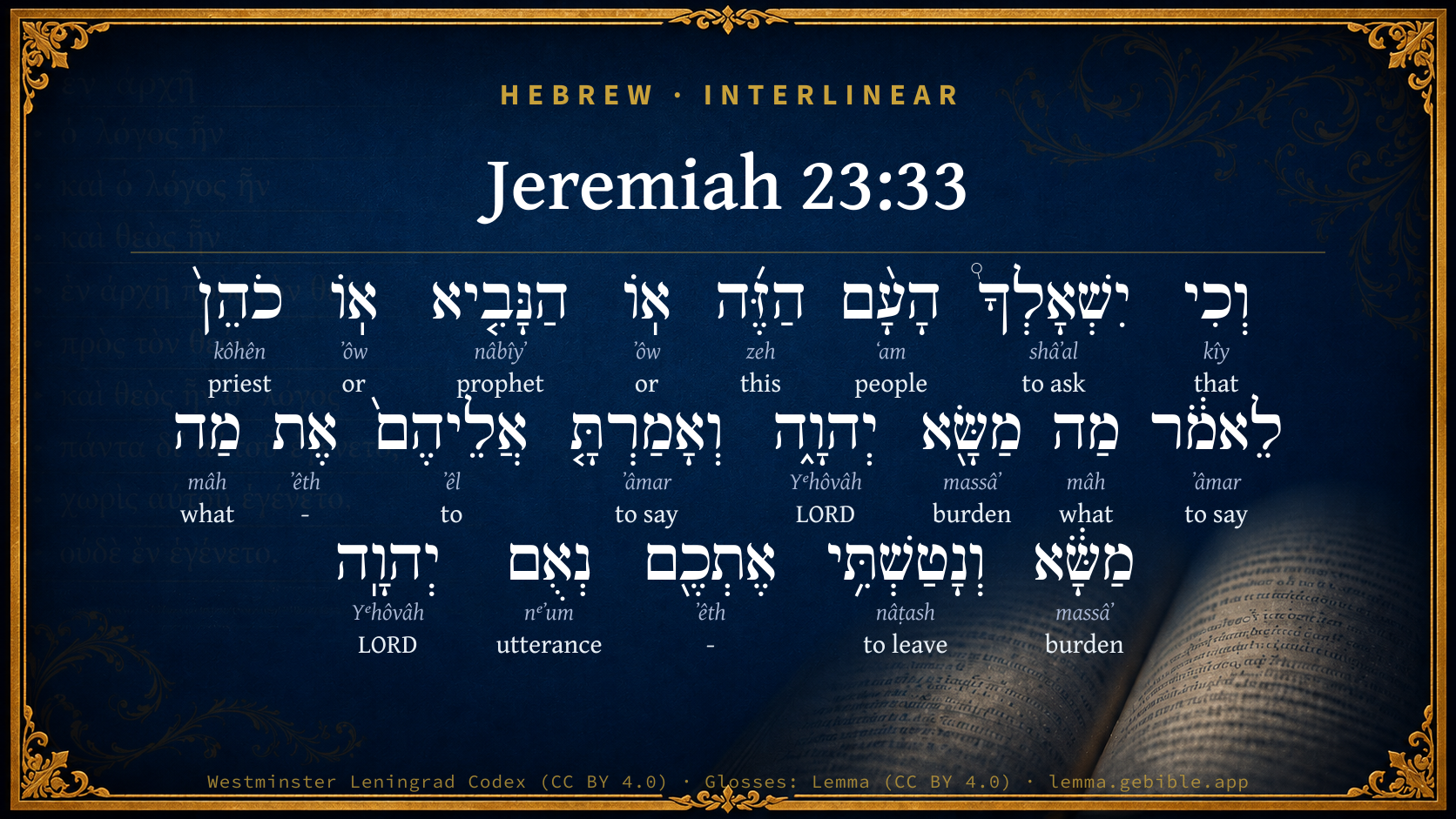
Hebrew (Westminster Leningrad Codex) Jeremiah 23:33 appears in the Hebrew Old Testament. The text above is from the Westminster Leningrad Codex. Each word links to its Strong’s number, a concise gloss, and parsing drawn from the Open Scriptures Hebrew Bible morphology. Click any word for its full Brown-Driver-Briggs (BDB) entry.
Download image
Cite this verse

Jeremiah 23:33 (World English Bible). Public Domain. Lemma interlinear Bible study tool, https://lemma.gebible.app/v/jeremiah/23/33.

Show BibTeX & RIS
BibTeX
RIS
English Translation
When this people, or the prophet, or a priest, shall ask you, saying, What is the burden of Yahweh? then shall you tell them, What burden! I will cast you off, says Yahweh.
World English Bible · Public Domain
Download a study sheet

One document with this verse’s original text, its word-by-word gloss line, the meaning frame, cross-references with their text, attributed commentary, and full source and license credits — printable, and it pastes into notes with its structure intact.

This verse Autodidact and up

Study sheet (.html) Plain text (.txt)

A passage Seminary Student

Up to 50 verses in one chapter. A passage sheet keeps up to 6 commentary sources and 12 cross-references per verse, in the order this page ranks them, and says so on the sheet whenever that leaves anything out. Ask for a single verse and you get the Autodidact verse sheet above.

Everything on this page stays free to read, with no account — the sheet is a download of what is already on screen, not access to it.

Want to remove ads? Support Godless Engineer
Compare translations 3

The same verse in 3 English versions, stacked beneath the original-language interlinear above. Click any original word for its lexicon entry.

Each is an independent rendering of the whole verse — the interlinear is not word-aligned to these translations.

Highlighted words mark where these versions differ — a whole-verse word diff, not a word-by-word alignment.

  • World English Bible Public Domain
    When this people, or the prophet, or a priest, shall ask you, saying, What is the burden of Yahweh? then shall you tell them, What burden! I will cast you off, says Yahweh.
  • King James Version Public Domain
    And when this people, or the prophet, or a priest, shall ask thee, saying, What is the burden of the LORD? thou shalt then say unto them, What burden? I will even forsake you, saith the LORD.
  • unfoldingWord Literal Text CC BY-SA 4.0
    “And when this people, or a prophet, or a priest asks you, saying, ‘What the burden of Yahweh?’—then you shall say to them, ‘What burden?’ And I will abandon you, the declaration of Yahweh.”

unfoldingWord Literal Text — © unfoldingWord, licensed CC BY-SA 4.0. Word-aligned USFM3 via Door43 (git.door43.org/unfoldingWord/en_ult).

Versions to compare (up to 4)

3 of 4 selected

Show all 18 translations

Every available English version of this verse, each an independent rendering of the whole verse.

  • World English Bible Public Domain
    When this people, or the prophet, or a priest, shall ask you, saying, What is the burden of Yahweh? then shall you tell them, What burden! I will cast you off, says Yahweh.
  • Berean Standard Bible Public Domain
    “Now when this people or a prophet or priest asks you, ‘What is the burden of the LORD?’ you are to say to them, ‘What burden? I will forsake you, declares the LORD.’
  • Majority Standard Bible Public Domain
    “Now when this people or a prophet or priest asks you, ‘What is the burden of the LORD?’ you are to say to them, ‘What burden? I will forsake you, declares the LORD.’
  • King James Version Public Domain
    And when this people, or the prophet, or a priest, shall ask thee, saying, What is the burden of the LORD? thou shalt then say unto them, What burden? I will even forsake you, saith the LORD.
  • American Standard Version (1901) Public Domain
    And when this people, or the prophet, or a priest, shall ask thee, saying, What is the burden of Jehovah? then shalt thou say unto them, What burden! I will cast you off, saith Jehovah.
  • Revised Version (1885) Public Domain
    And when this people, or the prophet, or a priest, shall ask thee, saying, What is the burden of the LORD? then shalt thou say unto them, What burden! I will cast you off, saith the LORD.
  • Geneva Bible (1599) Public Domain
    And when this people, or the prophet, or a Priest shall aske thee, saying, What is the burden of the Lord? thou shalt then say vnto them, What burden? I will euen forsake you, saith the Lord.
  • Douay-Rheims (1899) Public Domain
    If therefore this people, or the prophet, or the priest shall ask thee, saying: What is the burden of the Lord? thou shalt say to them: You are the burden: for I will cast you away, saith the Lord.
  • Young's Literal Translation Public Domain
    And when this people, or the prophet, Or a priest, doth ask thee, saying, What `is' the burden of Jehovah? Then thou hast said unto them: Ye `are' the burden, and I have left you, An affirmation of Jehovah.
  • Literal Standard Version CC BY-SA 4.0
    “And when this people, or the prophet, || Or a priest, asks you, saying, What [is] the burden of YHWH? Then you have said to them: You [are] the burden, and I have left you,” || A declaration of YHWH.
  • Unlocked Literal Bible CC BY-SA 4.0
    When these people, or a prophet, or a priest asks you, 'What is the burden of Yahweh?' you will say to them, 'You are the burden, and I will cast you off'—this is Yahweh's declaration.
  • unfoldingWord Literal Text CC BY-SA 4.0
    “And when this people, or a prophet, or a priest asks you, saying, ‘What the burden of Yahweh?’—then you shall say to them, ‘What burden?’ And I will abandon you, the declaration of Yahweh.”
  • Darby Bible Public Domain
    And when this people, or a prophet, or a priest, ask thee, saying, What is the burden of Jehovah? thou shalt then say unto them, What burden? I will even cast you off, saith Jehovah.
  • World Messianic Bible Public Domain
    “When this people, or the prophet, or a priest, asks you, saying, ‘What is the message from the LORD?’ Then you shall tell them, ‘“What message? I will cast you off,” says the LORD.’
  • Webster's Bible Public Domain
    And when this people, or the prophet, or a priest, shall ask thee, saying, What is the burden of the LORD? thou shalt then say to them, What burden? I will even forsake you, saith the LORD.
  • Free Bible Version CC BY-SA 4.0
    So when a prophet or priest or anyone else comes and asks you, “What is ‘the burden of the Lord?’” tell them, I'm not giving you a burden. I'm giving up on you, declares the Lord.
  • Bible in Basic English Public Domain
    And if this people, or the prophet, or a priest, questioning you, says, What word of weight is there from the Lord? then you are to say to them, You are the word, for I will not be troubled with you any more, says the Lord.
  • JPS Tanakh (1917) Public Domain
    And when this people, or the prophet, or a priest, shall ask thee, saying: 'What is the burden of the LORD?' then shalt thou say unto them: 'What burden! I will cast you off, saith the LORD.'

Literal Standard Version (2020), Covenant Press — licensed CC BY-SA 4.0. Text via the HelloAO Bible API (eBible.org). Unlocked Literal Bible (unfoldingWord) — licensed CC BY-SA 4.0. Text via the HelloAO Bible API (eBible.org). unfoldingWord Literal Text — © unfoldingWord, licensed CC BY-SA 4.0. Word-aligned USFM3 via Door43 (git.door43.org/unfoldingWord/en_ult). Free Bible Version, Dr. Jonathan Gallagher — licensed CC BY-SA 4.0. Text via the HelloAO Bible API (eBible.org).

Word by word

More ways to search: Search by grammar → Find every occurrence → Compare this word →

Practice this passage: Drill this verse → Learn its vocabulary →

וְנָטַשְׁתִּ֥י
nâṭash
H5203
“and · to leave”
Conjunction + Verb, Qal, Sequential Perfect, 1st Person, Common, Singular
Part of Speech
Conjunction + Verb
Stem
Qal
Form
Sequential Perfect
Person
1st Person
Gender
Common
Number
Singular
Full BDB Definition

Origin: a primitive root

TWOT: 1357

to leave, permit, forsake, cast off or away, reject, suffer, join, spread out or abroad, be loosed, cease, abandon, quit, hang loose, cast down, make a raid, lie fallow, let fall, forgo, draw - (Qal) - to leave, let alone, lie fallow, entrust to - to forsake, abandon - to permit - (Niphal) - to be forsaken - to be loosened, be loose - to be let go, spread abroad - (Pual) to be abandoned, be deserted
  1. וְכִי kîy H3588 “and · that” Conjunction + Conjunction
  2. יִשְׁאָלְךָ֩ shâʼal H7592 “to ask · you” Verb, Qal, Imperfect, 3rd Person, Masculine, Singular + Suffix, Personal, 2nd Person, Masculine, Singular
  3. הָעָ֨ם ʻam H5971 “the · people” Particle, Definite Article + Noun, Common, Masculine, Singular, Absolute
  4. הַזֶּ֜ה zeh H2088 “the · this” Particle, Definite Article + Pronoun, Demonstrative, Masculine, Singular
  5. אֽוֹ ʼôw H176 “or” Conjunction
  6. הַנָּבִ֤יא nâbîyʼ H5030 “the · prophet” Particle, Definite Article + Noun, Common, Masculine, Singular, Absolute
  7. אֽוֹ ʼôw H176 “or” Conjunction
  8. כֹהֵן֙ kôhên H3548 “priest” Noun, Common, Masculine, Singular, Absolute
  9. לֵאמֹ֔ר ʼâmar H559 “to say” Preposition + Verb, Qal, Infinitive Construct
  10. מַה mâh H4100 “what” Particle, Interrogative
  11. מַשָּׂ֖א massâʼ H4853 “burden of” Noun, Common, Masculine, Singular, Construct
  12. יְהוָ֑ה Yᵉhôvâh H3068 “LORD” Noun, Proper
  13. וְאָמַרְתָּ֤ ʼâmar H559 “and · to say” Conjunction + Verb, Qal, Sequential Perfect, 2nd Person, Masculine, Singular
  14. אֲלֵיהֶם֙ ʼêl H413 “to · them” Preposition + Suffix, Personal, 3rd Person, Masculine, Plural
  15. אֶת ʼêth H853 “-” Particle, Direct Object
  16. מַה mâh H4100 “what” Particle, Interrogative
  17. מַשָּׂ֔א massâʼ H4853 “burden” Noun, Common, Masculine, Singular, Absolute
  18. אֶתְכֶ֖ם ʼêth H853 “- · you” Particle, Direct Object + Suffix, Personal, 2nd Person, Masculine, Plural
  19. נְאֻם nᵉʼum H5002 “utterance of” Noun, Common, Masculine, Singular, Construct
  20. יְהוָֽה Yᵉhôvâh H3068 “LORD” Noun, Proper

About this verse

These counts appear in no published source. They are computed here, from the morphology-tagged text and Lemma’s own curated glosses. What Lemma adds →

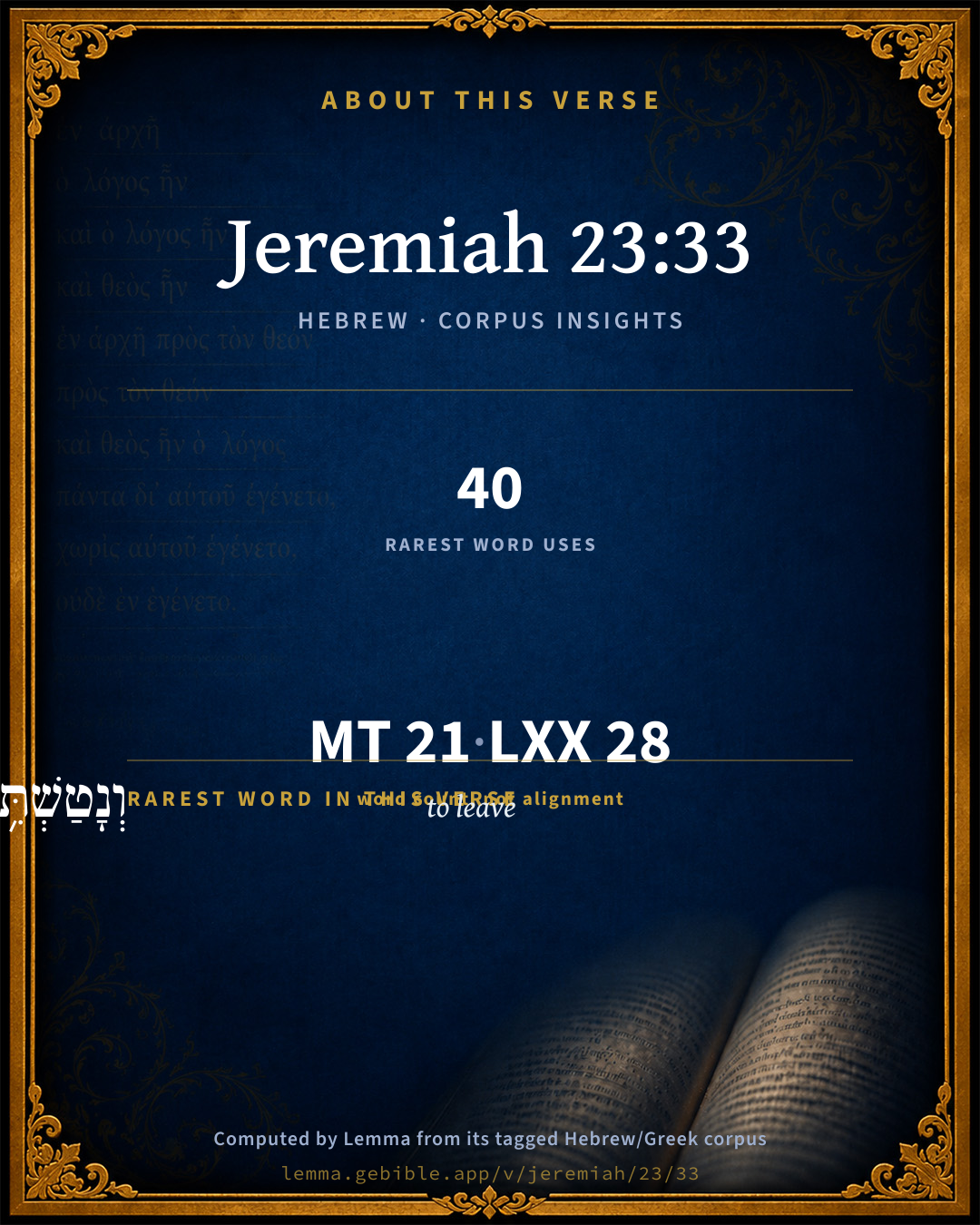
21
words
15
distinct lemmas
Prophets
section

Shared distinctive vocabulary

וְנָטַשְׁתִּ֥י to leave H5203 occurs in 39 verses of the Hebrew Bible. Also found in:

Grammatical profile

  • 4 verbs
  • 8 nouns
  • 1 pronoun
  • 1 preposition
  • 3 conjunctions
  • 4 particles

Verb forms

  • יִשְׁאָלְךָ֩ Qal · Imperfect
  • לֵאמֹ֔ר Qal · Infinitive Construct
  • וְאָמַרְתָּ֤ Qal · Sequential Perfect
  • וְנָטַשְׁתִּ֥י Qal · Sequential Perfect

Repetition

Words recur within this verse — often emphatic in Hebrew:

  • לֵאמֹ֔ר to say H559 ×2
  • מַשָּׂ֖א burden H4853 ×2
  • יְהוָ֑ה LORD H3068 ×2
  • אֽוֹ or H176 ×2
  • מַה what H4100 ×2

Hebrew & Septuagint length

In the original languages it is 21 Hebrew tokens and 28 Greek tokens — but the two are counted differently (Hebrew bundles its prefixes and suffixes into one token; the Greek is in lemma form), so that isn’t a like-for-like length.

Cross-references

14

Topical passages linked to Jeremiah 23:33 in the Treasury of Scripture Knowledge — connected by theme and wording, ordered by reader-vote popularity; previews shown in the World English Bible.

  • Malachi 1:1 An oracle: the word of Yahweh to Israel by Malachi.
  • Deuteronomy 32:19–20 Yahweh saw [it], and abhorred [them], Because of the provocation of his sons and his daughters.
  • Isaiah 13:1 The burden of Babylon, which Isaiah the son of Amoz did see.
  • Jeremiah 12:7 I have forsaken my house, I have cast off my heritage; I have given the dearly beloved of my soul into the hand of her enemies.
  • Hosea 9:12 Though they bring up their children, Yet I will bereave them, so that not a man shall be left. Indeed, woe also to them when I depart from them!
  • Nahum 1:1 An oracle about Nineveh. The book of the vision of Nahum the Elkoshite.
  • Habakkuk 1:1 The oracle which Habakkuk the prophet saw.
  • Deuteronomy 31:17–18 Then my anger shall be kindled against them in that day, and I will forsake them, and I will hide my face from them, and they shall be devoured, and many evils and troubles shall come on them; so that they will say in that day, Haven't these evils come on us because our God is not among us?
  • 2 Chronicles 15:2 and he went out to meet Asa, and said to him, Hear you me, Asa, and all Judah and Benjamin: Yahweh is with you, while you are with him; and if you seek him, he will be found of you; but if you forsake him, he will forsake you.
  • Psalms 78:59–60 When God heard this, he was angry, And greatly abhorred Israel;
  • Isaiah 14:28 In the year that king Ahaz died was this burden.
  • Jeremiah 17:15 Behold, they tell me, Where is the word of Yahweh? let it come now.
  • Jeremiah 20:7–8 Yahweh, you have persuaded me, and I was persuaded; you are stronger than I, and have prevailed: I am become a laughing-stock all the day, every one mocks me.
  • Jeremiah 23:39–40 therefore, behold, I will utterly forget you, and I will cast you off, and the city that I gave to you and to your fathers, away from my presence:

Cross-references courtesy of OpenBible.info (CC BY 4.0).

Hebrew and Greek witnesses Masoretic Hebrew ↔ Greek Septuagint

The same verse in the two great witnesses to the Old Testament, shown verse-for-verse.

These are two independent witnesses, not word-aligned to each other, and the Septuagint is shown in lemma (dictionary) form.

Hebrew Jeremiah 23:33 Masoretic · Westminster Leningrad Codex

וְכִי יִשְׁאָלְךָ֩ הָעָ֨ם הַזֶּ֜ה אֽוֹ הַנָּבִ֤יא אֽוֹ כֹהֵן֙ לֵאמֹ֔ר מַה מַשָּׂ֖א יְהוָ֑ה וְאָמַרְתָּ֤ אֲלֵיהֶם֙ אֶת מַה מַשָּׂ֔א וְנָטַשְׁתִּ֥י אֶתְכֶ֖ם נְאֻם יְהוָֽה

When this people, or the prophet, or a priest, shall ask you, saying, What is the burden of Yahweh? then shall you tell them, What burden! I will cast you off, says Yahweh.

World English Bible · Public Domain

Greek LXX Structure differs

In the Septuagint, Jeremiah is about an eighth shorter than the Hebrew and arranges its material differently — the Oracles Against the Nations (Hebrew chapters 46–51) appear in the middle of the Greek book, after 25:13. Because the chapter and verse boundaries do not line up, a verse-for-verse comparison with the Hebrew is not shown.

A verse-for-verse comparison isn’t shown here because the chapters and verses don’t line up. Switch to the LXX edition with the MT / LXX toggle above to read the Greek directly.

On this verse, Lange's Commentary on the Holy Scriptures discusses the Septuagint’s reading. Read the note in Commentary ↓

Hebrew: Westminster Leningrad Codex (CC BY 4.0). Greek: Septuagint (public domain); English from a public-domain English Septuagint. How the Septuagint differs from the Hebrew →

Targum (Aramaic paraphrase)

1

The Targum is the ancient Jewish Aramaic paraphrase of the Hebrew Scriptures — an interpretive translation, not the Hebrew text itself. Onkelos (literal) and Pseudo-Jonathan (expansive) render the Torah, and Jonathan the Prophets. Coverage is partial: where no permissively-licensed English translation exists for a verse, only the Aramaic is shown. This is verse-level text, not a word-by-word alignment to the Hebrew.

  1. Targum Jonathan Prophets (Joshua–Malachi)
    וַאֲרֵי יִשְׁאֲלִינָךְ עַמָא הָדֵין אוֹ סָפַר אוֹ בָהֵין לְמֵימָר מַה נְבוּאֲתָא בִּשְׁמָא דַייָ וְתֵימַר לְהוֹן כְּדֵין נְבוּאֲתָא וְאֶרְטוֹשׁ יַתְכוֹן אֲמַר יְיָ:

    (no public-domain English translation for this verse)

    Targum Jonathan — Aramaic: “Mikraot Gedolot” (public domain). English: “Sefaria Community Translation” (CC0 1.0 (public-domain dedication)); “London "Chaldee Paraphrase," 1871” (public domain). Text via Sefaria.

Commentary

Notes on Jeremiah 23:33 from classic Christian and Jewish commentators (each source and its license shown beneath its notes). The classic Christian expositions comment on the surrounding passage and are grouped to its opening verse, so a note may address several verses; the Jewish commentaries on the Tanakh (Rashi and others) are per-verse, so they appear only where the commentator wrote on this verse.

Lemma curates 59 commentaries, every one of them public domain or Creative Commons licensed, each selected and text-cleaned for this edition rather than reprinted as found. About our sources →

Matthew Henry's Commentary

The profaneness of the people, with that of the priests and prophets, is here reproved in a particular instance, which may seem of small moment in comparison of their greater crimes; but profaneness in common discourse, and the debauching of the language of a nation, being a notorious evidence of the prevalency of wickedness in it, we are not to think it strange that this matter was so largely and warmly insisted upon here. Observe,

I. The sin here charged upon them is bantering God's prophets and dialect they used, and jesting with sacred things. They asked, What is the burden of the Lord? Jer 23:33 and Jer 23:34. They say, The burden of the Lord, Jer 23:38. This was the word that gave great offence to God, that, whenever they spoke of the word of the Lord, they called it, in scorn and derision, the burden of the Lord. Now, 1. This was a word that the prophets much used, and used it seriously, to show what a weight the word of God was upon their spirits, of what importance it was, and how pressingly it should come upon those that heard it. The words of the false prophets had nothing ponderous in them, but God's words had; those were as chaff, these as wheat. Now the profane scoffers took this word, and made a jest and a byword of it; they made people merry with it, that so, when the prophets used it, they might not make people serious with it. Note, It has been the artifice of Satan, in all ages, to obstruct the efficacy of sacred things by turning them into matter of sport and ridicule; the mocking of God's messengers was the baffling of his messages. 2. Perhaps this word was caught at and reproached by the scoffers as an improper word, newly-coined by the prophets, and not used in that sense by any classic author. It was only in this and the last age that the word of the Lord was called the burden of the Lord, and it could not be found in their lexicons to have that signification. But if men take a liberty, as we see they do, to form new phrases which they think more expressive and significant in other parts of learning, why not in divinity? But especially we must observe it as a rule that the Spirit of God is not tied to our rules of speaking. 3. Some think that because when the word of the Lord is called a burden it signifies some word of reproof and threatening, which would lay a load upon the hearers (yet I know not whether that observation will always hold), therefore in using this word the burden of the Lord in a canting way they reflected upon God as always bearing hard upon them, always teasing them, always frightening them, and so making the word of God a perpetual uneasiness to them. They make the word of God a burden to themselves, and then quarrel with the ministers for making it a burden to them. Thus the scoffers of the latter days, while they slight heaven and salvation, reproach faithful ministers for preaching hell and damnation. Upon the whole we may observe that, how light soever men may make of it, the great God takes notice of, and is much displeased with, those who burlesque sacred things, and who, that they may make a jest of scripture truths and laws, put jests upon scripture language. In such wit as this I am sure there is no wisdom, and so it will appear at last. Be you not mockers, lest your bands be made strong. Those that were here guilty of this sin were some of the false prophets, who perhaps came to steal the word of God from the true prophets, some of the priests, who perhaps came to seek occasions against them on which to ground an information, and some of the people, who had learned of the profane priests and prophets to play with the things of God. The people would not have affronted the prophet and his God thus if the priests and the prophets, those ringleaders of mischief, had not shown them the way.

II. When they are reproved for this profane way of speaking they are directed how to express themselves more decently. We do not find that the prophets are directed to make no more use of this word; we find it used long after this (Zac 9:1; Mal 1:1; Nah 1:1; Hab 1:1); and we do not find it once used in this sense by Jeremiah either before or after. It is true indeed that in many cases it is advisable to make no use of such words and things as some have made a bad use of, and it may be prudent to avoid such phrases as, though innocent enough, are in danger of being perverted and made stumbling-blocks. But here God will have the prophet keep to his rule (Jer 15:19), Let them return unto thee, but return not thou unto them. Do not thou leave off using this word, but let them leave off abusing it. You shall not mention the burden of the Lord any more in this profane careless manner (Jer 23:36), for it is perverting the words of the living God and making a bad use of them, which is an impious dangerous thing; for, consider, he is the Lord of hosts our God. Note, If we will but look upon God as we ought to do in his greatness and goodness, and be but duly sensible of our relation and obligation to him, it may be hoped that we shall not dare to affront him by making a jest of his words. It is an impudent thing to abuse him that is the living God, the Lord of hosts, and our God. How then must they express themselves? He tells them (Jer 23:37): Thus shalt thou say to the prophet, when thou art enquiring of him, What hath the Lord answered thee? And what hath the Lord spoken? And they must say thus when they enquire of their neighbours, Jer 23:35. Note, We must always speak of the things of God reverently and seriously, and as becomes the oracles of God. It is a commendable practice to enquire after the mind of God, to enquire of our brethren what they have heard, to enquire of our prophets what they have to say from God; but then, to show that we enquire for a right end, we must do it after a right manner. Ministers may learn here, when they reprove people for what they say and do amiss, to teach them how to say and do better.

III. Because they would not leave off this bad way of speaking, though they were admonished of it, God threatens them here with utter ruin. They would still say, The burden of the Lord, though God had sent to them to forbid them, Jer 23:38. What little regard have those to the divine authority that will not be persuaded by it to leave an idle word! But see what will come of it. 1. Those shall be severely reckoned with that thus pervert the words of God, that put a wrong construction on them and make a bad use of them; and it shall be made to appear that it is a great provocation to God to mock his messengers: I will even punish that man and his house; whether he be prophet or priest, or one of the common people, it shall be visited upon him, Jer 23:34. Perverting God's word, and ridiculing the preachers of it, are sins that bring ruining judgments upon families and entail a curse upon a house. Another threatening we have Jer 23:36. Every man's word shall be his own burden; that is, the guilt of this sin shall be so heavy upon him as to sink him into the pit of destruction. God shall make their own tongue to fall upon them, Psa 64:8. God will give them enough of their jest, so that the burden of the Lord they shall have no heart to mention any more; it will be too heavy to make a jest of. They are as the madman that casts firebrands, arrows, and death, while they pretend to be in sport. 2. The words of God, though thus perverted, shall be accomplished. Do they ask, What is the burden of the Lord? Let the prophet ask them, What burden do you mean? Is it this: I will even forsake you? Jer 23:33. This is the burden that shall be laid and bound upon them (Jer 23:39, Jer 23:40): "Behold I, even I, will utterly forget you, and I will forsake you. I will leave you, and have no thoughts of returning to you." Those are miserable indeed that are forsaken and forgotten of God; and men's bantering God's judgments will not baffle them. Jerusalem was the city God had taken to himself as a holy city, and then given to them and their fathers; but that shall now be forsaken and forgotten. God had taken them to be a people near to him; but they shall now be cast out of his presence. They had been great and honourable among the nations; but now God will bring upon them an everlasting reproach and a perpetual shame. Both their sin and their punishment shall be their lasting disgrace. It is here upon record, to their infamy, and will remain so to the world's end. Note, God's word will be magnified and made honourable when those that mock at it shall be vilified and made contemptible. Those that despise me shall be lightly esteemed.

Matthew Henry's Commentary on the Whole Bible (1708–1710) — public domain (CC PDM 1.0). Text via the HelloAO Bible API.

Trapp's Complete Commentary

John Trapp

Jer 23:33 And when this people, or the prophet, or a priest, shall ask thee, saying, What [is] the burden of the LORD? thou shalt then say unto them, What burden? I will even forsake you, saith the LORD.

Ver. 33. What is the burden of the Lord?] Ironicum interrogandi genus: thus they profanely asked by way of scoff or despite, such as he will drive down their throats again, plaguing them for their profane malignity.

Then shalt thou say, What burden?] q.d., I will burden you to some purpose, since ye profanely count and call my Word a burden. You shall suddenly have your back burden of plagues and miseries for the contempt of it.

I will even forsake you.] And then woe be unto you, {Hos 9:12} you shall be eased of these burdens and of me together; and that you will find misery enough. See Jer 12:7. Learn therefore to speak holily and honourably of God’s Word, lest thou hear this word of his, Thou shalt never enter into my rest.

John Trapp, A Commentary or Exposition upon All the Books of the Old and New Testament (1647–1656) — public domain. Text from a community e-Sword module.

Joseph Benson's Commentary

Jer 23:33. When this people, or the prophet, &c., shall ask thee, &c. — “The remaining part of this chapter is directed against those who called the word of God, spoken by the true prophets, A BURDEN, by way of reproach; meaning that it always portended evil, and never good;” the word משׁא, a burden, generally signifying a calamitous prophecy. See note on Isa 13:1. “Ahab intended to cast the same slur on the Prophet Micaiah when he represented him as one that never prophesied good concerning him, but evil, 1Ki 22:8.” The false prophets, who said, Peace, peace, it seems, derided the true prophets, whose predictions were full of threatenings, as if God’s messages were a burden which they were weary of hearing; and made a jest of these words, The burden of the Lord, with which God’s prophets sometimes prefaced their prophecies. Upon this account God forbade the use of that expression, as in the following verses. See Lowth.

Joseph Benson's Commentary on the Old and New Testaments (1811–1818) — public domain. Text from a community e-Sword module.

Lange's Commentary on the Holy Scriptures

d. The criminal use of the word “burden.”

Jer_23:33-40

33          And when this people, or the prophets29 or priests,

Ask thee, What is the burden of Jehovah?

Thou shalt tell them what the burden of Jehovah Isaiah 30

Namely, “I reject you,”31saith Jehovah.

34     And the prophet, the priest, or the people

That say, “Burden of Jehovah;”

On such a man and his house will I visit it.

35     Thus shall ye say, every one to his neighbour and every one to 32his brother:

What hath Jehovah answered? or What hath Jehovah spoken?

36     But “burden of Jehovah ” ye shall no more take into your mouth;

For the burden will be to each his own word;

Because ye have perverted the words of the living God,

Jehovah Zebaoth, our God.

37     Thus shalt thou say to the prophet:

What has Jehovah answered thee?

Or, What has Jehovah spoken?

38     But if ye say, “Burden of Jehovah,”

On this account saith Jehovah thus:

Because ye say this word, “Burden of Jehovah,”

And I had sent unto you a message of this purport,

“Ye shall not say, ‘Burden of Jehovah,’ ”—

39     Therefore, behold, I burden you33 and thrust you,

And this city which I gave to you and your fathers,

Away from my presence;

40     And lay upon you everlasting reproach,

And everlasting shame, that shall not be forgotten.

EXEGETICAL AND CRITICAL

The word of double meaning מַשָׂא, which signifies both “saying” and “burden,” was misused by the Jews, who were accustomed to ask the prophets mockingly what sort of a מַשָּׂא they had. Jeremiah is to tell those who thus ask, what sort of a burden threatens them, viz., that they shall be rejected (Jer_23:33), and each who thus asks shall, for this derision, be subjected to a special visitation (Jer_23:34). If any wish to ask the prophets, he is to make use of the expression, What has the Lord answered or spoken? (Jer_23:35). But the expression מַשָׂא (burden and saying) is no more to be used, for this perversion of a divine word will be avenged, such insolent words falling back like a heavy burden on the head of their authors (Jer_23:36). The inquiry is to be made thus: What has the Lord answered or spoken? (Jer_23:37). If, notwithstanding, the forbidden word is used (Jer_23:38), the Lord will carry away the people like a burden (Jer_23:39), and give them up to everlasting shame (Jer_23:40).

Jer_23:33-34. And when this people … visit it.—What burden? It appears to have been the custom, whenever the prophets made their appearance in public to ask them if they had received any new revelation. There can be no doubt that משׂא means “saying, utterance,” as well as “burden.” Comp. the thorough demonstration in Graf, S. 315. The passages from which it evidently follows that משׂא signifies effatum, any utterance, besides those where the verb נֶשָׂא is used in the sense vocem proferre with and without קוֹל, voice (Isa_3:7; Isa_42:2; Isa_42:11 coll. Exo_20:7; Exo_23:1; Num_23:7; Psa_139:20, etc.), are especially the following: Isa_14:28; Lam_2:14; 2Ki_9:25; Pro_30:1; Pro_31:1. Hengstenberg and Rueckert, following the example of Jonathan, Aquila, the Syriac, Jerome and Luther, would take the word exclusively in the sense of “burden.” We have translated “burden” above, but only because we have no expression, which without forcing unites both meanings. Of the many attempts to unite them by De Wette, Ewald, Fuerst, Meier, none are really satisfactory. De Wette’s translation is most so. [Wehsagung: utterance of woe.—S. R. A.]. At all events the opposers emphasized the idea of burden. They wished to say that every declaration of Jehovah was only a new burden, that only what was burdensome, not what was pleasing, came from this God. In so far the question was one of blasphemous derision. It is implied by the word namely that what follows is a quotation. The passage to which Jeremiah refers is doubtless Jer_12:7, “rejected mine inheritance.” The significance of this passage is clear from the fact that it is reproduced in a comprehensive survey in 2Ki_21:14.—Will I visit it. Besides the judgment announced to the people generally on account of their sins, those who make use of the expression “burden” in a wicked manner, shall receive special punishment.

Jer_23:35-37. Thus shall ye say … Jehovah spoken.—For the burden will be, etc. Even the insolent words will be to him who utters them a crushing burden, though the utterance of Jehovah, with respect to which he uses the term, is not in itself a burden at all.—These words are a parenthesis, and hence because ye have perverted, etc., is connected with ye shall no more take into your mouth and declare the result of using the forbidden word.—Living God. Comp. Jer_10:10.

Footnotes:

[29]Jer_23:33.—The article is general, and נָבִיא expresses the idea of species. Comp. Naegelsb. Gr., § 71, 4, a.

[30]Jer_23:33.—את־מה־משׂא. Many modern commentators follow the LXX. and Vulg. which read אַתֶּם תַמַּשָׂא, but incorrectly. In His answer the Lord purposely uses the words of the question: Verba retorquet. The arrow directed against him must, being reversed, strike those insolent questioners. It should indeed properly read אַת אֲשֶׁר מַשָׂא. But the necessity of retaining the words of the question justified this grammatical license, which moreover (Comp. Naegelsb. Gr., § 79, 6) is not altogether without precedent. אֵת depends on וְאָמַרְתָּ Comp. Jer_14:17, etc. The construction is therefore by no means so artificial and clumsy as Ewald supposes.

[31]Jer_23:33.—ונטשתי ו׳ is not co-ordinated with ואמרת, as is apparent from נְאֻם י׳. It rather expresses the purport of that which Jeremiah is to proclaim as the “burden,” etc. ו is therefore=and indeed. It should only be remarked that ו here in this meaning stands before a whole sentence, which, however, on account of its brevity is not thereby rendered less easily intelligible.

[32]Jer_23:35.—On the interchange of עַל and אֵל, comp, rems. on Jer_10:1.

[33]Jer_23:39.—ונּשׁיתי נשׁא. The paronomasia requires us to read נָשׂא נָשִׂיתִי, as the LXX., Vulg., Syr., and some Codd. and editions really do. It is not necessary to assume the Piel form נִשֵׂיתִי, since forms like כַּלִאתִי Psa_119:102; כְּלִתִנִי 1Sa_25:33; צָמִת Rth_2:9, justify the assumption of י also in the Kal according to the analogy of the לה׳ verbs. Comp. Olsh., § 223, a, Anm.—The reading גָשִּׁיתִי, which does not afford any satisfactory sense, but may be translated “I forget,” or “I heard not,” is doubtless occasioned by the unusual punctuation (נשׂיתי). A proof that- the latter is the original is found in the Inf. נשֹׁא, the א of which is likewise abnormal and therefore a sure trace of the original כִּלִמּוּת .נָשׂא is ἄπ. λεγ. and perhaps to be read כְּלִמַּת, after Jer_20:11.

Lange's Commentary on the Holy Scriptures (Critical, Doctrinal, and Homiletical), ed. John Peter Lange, English translation edited by Philip Schaff (1864–1880) — public domain. Text from a community e-Sword module.

Tyndale Open Study Notes

Tyndale Open Resources

23:33-40 The Lord presented a hypothetical conversation to show Jeremiah how to handle the false prophets.

23:33 These false prophets might taunt Jeremiah by asking for the latest message the Lord had burdened him with. • You are the burden! This is a wordplay—it was common for a prophetic message to be called “a burden.” The false prophets were a heavy load that the Lord would throw off and abandon.

Tyndale Open Study Notes — © Tyndale Open Resources, licensed CC BY-SA 4.0. Text via the HelloAO Bible API.

Geneva Bible (1599)

Geneva Bible translators

The Prophets called their threatenings God’s burden, which the sinners were not able to sustain, therefore the wicked in deriding the word, would ask of the Prophets, what was the burden, as though they would say, You seek nothing else, but to lay burdens on our shoulders: and thus they rejected the word of God, as a grievous burden.

Geneva Bible (1599) marginal notes — public domain. Text via Bolls.life.

Jamieson, Fausset & Brown

Robert Jamieson, A. R. Fausset & David Brown

What is the burden--play on the double sense of the Hebrew: an oracle and a burden. They scoffingly ask, Has he got any new burden (burdensome oracle: for all his prophecies are disasters) to announce (Mal 1:1)? Jeremiah indignantly repeats their own question, Do you ask, What burden? This, then, it is, "I will forsake you." My word is burdensome in your eyes, and you long to be rid if it. You shall get your wish. There will be no more prophecy: I will forsake you, and that will be a far worse "burden" to you.

Jamieson, Fausset & Brown — Commentary Critical and Explanatory on the Whole Bible (1871) — public domain (CC PDM 1.0). Text via the HelloAO Bible API.

Adam Clarke's Commentary

Verse 33. What is the burden of the Lord?] The word משא massa, here used, signifies burden, oracle, prophetic discourse; and is used by almost every prophet. But the persons in the text appear to have been mockers. "Where is this burden of the Lord?"-"What is the burden now?" To this insolent question the prophet answers in the following verses.

I will even forsake you] I will punish the prophet, the priest and the people, that speak thus, Jer 23:34. Here are burdens.

Adam Clarke's Commentary on the Bible (1810–1826) — public domain. Text from a community e-Sword/MySword module.

John Calvin's Commentaries

It appears sufficiently evident from this passage, — that the contumacy of the Jews was so great, that they sought from every quarter some excuse for their insensibility, as though they could with impunity despise God when they rejected his word. For the devil by his artifice fascinates the reprobate, when he renders God’s word either hateful or contemptible; and whenever he can exasperate their minds, so that they hear not God’s word except with disdain and bitterness, he gains fully his object. The Jews, then, were led into such a state of mind, that they regarded God’s word with hatred; and they were thus alienated from all docility and from every care for religion. In short, the prophets, as it is well known, everywhere employ the word משא, mesha, which means a burden.

Now, a burden means a prophecy, which terrifies the despisers of God by threatening them with vengeance. As, then, their minds were exasperated, they called through hatred the word of God a burden, and used it as a proverbial saying, “It is a burden, a burden.” They ought to have been moved by God’s threatenings, and to have trembled on hearing that he was angry with them. The word burden, then, ought to have humbled them; but, on the contrary, they became exasperated, first, through haughtiness, then through an indomitable contumacy, and thirdly, they kindled into rage. We hence see how the expression arose, that the prophets called their prophecies burdens. God now severely condemns this fury, because they hesitated not thus openly to shew their insolence. It was surely a most shameful thing, that the word of God should be thus called in disdain and contempt, in the ways and streets; for they thus acted disdainfully and insolently against God; for it was the same as though they treated his word with open contempt. It was then no wonder that he reproved this fury with so much vehemence, by saying, But if this people ask thee, What is the burden of Jehovah?

This manner of asking was altogether derisive, when they said to Jeremiah and to other servants of God, “What is the burden?” that is, “What dost thou bring to us, what trouble is to come on us?” They thus not only spoke contemptuously of God’s word, but, as though this wickedness was not sufficient, they became, as I have said, irritated and exasperated. If, then, they ask thee, What is the burden? And he speaks not only of the common people, but of the very prophets and priests.

We hence learn how great a contempt for God then prevailed, so that there was no integrity either in the priestly or the prophetic order. It is indeed wonderful with what impudence they dared to boast themselves to be God’s servants, while they spoke with so much insolence! But the same thing happens in the world in our day; for we see that the ministers of Satan in no other way hold the world under their power, than by alluring the minds of the ungodly; and at the same time they cause God’s word to be hated, and say that it brings not only troubles, but also torments. Since, then, these unprincipled men, who thus lead with hatred and disdain the true doctrine, occupy pulpits, we need not wonder that the same evil prevailed in the ancient Church.

It follows: If a prophet or a priest ask thee, What is the burden of Jehovah? thou shalt say to them, What burden? I will forsake thee, saith Jehovah. This was a most grievous threatening, but it has not been well considered and rightly understood; for interpreters have overlooked the implied contrast between the presence and the absence of God. Nothing could have been more acceptable to the Jews than God’s silence. And yet in no other way does he more clearly show that he is a Father to us, caring for our salvation, than by familiarly addressing us. Whenever, then, the prophetic word is announced, we have a sure and a clear evidence of God’s presence, as though he wished to be connected with us. But when the ungodly not only reject so remarkable a benefit, but also furiously repel, as far as they can, such a favor, they desire and seek the absence of God. Therefore God says, “Ye cannot bear my word, by which symbol I shew that I am present with you; I will forsake you;” that is, “I will no longer endure this indignity, but I will depart from you; there shall be hereafter no prophecy.”

At the first view this was not deemed grievous to the Jews; for as I have said, the ungodly desire nothing more than that God should be silent, and they thought that they had gained their greatest happiness, when with consciences lulled to sleep they indulged themselves in their filth. It was then their chief wish that God should depart from them. But yet there was nothing more to be dreaded. The Prophet then shews here that they were extremely infatuated and wholly fascinated by the devil, for they could desire nothing more dreadful than that God should depart from them; as though he had said, “My word is a weariness to you, and I in my turn will now avenge myself, for I am weary of forbearing you, when I see that you can by no means be healed; and as I have been hitherto assiduous in instructing you, and have found you unteachable, I will now in my turn leave you.” It follows, —

John Calvin's Commentaries (1540-1563) — public domain. Text from the Calvin Translation Society English edition (1840s-50s) via the Christian Classics Ethereal Library (ccel.org). Calvin's coverage is partial (roughly two-thirds of the Bible); uncommented books and verses are honest gaps, never fabricated. The 19th-century editor's footnotes and remarks are omitted so the notes are faithfully Calvin's own voice.

Ellicott's Commentary for English Readers

(33) The burden of the Lord.—The English expresses the literal meaning of the word, “something lifted up, or borne.” It passed, however, as the English equivalent has done, through many shades of meaning, and became, in the language of the prophets, one of the received terms for a solemn, emphatic utterance. In 1Ch_15:22; 1Ch_15:27 it is applied to the chanted music of the Temple. Isaiah had brought it into use (see Note on Isa_13:1), and employs it twelve times as the title of special prophecies. Jeremiah never uses it of his own messages, probably, as this verse indicates, because it had become a favourite formula with the false prophets. This seems a more rational view than that which assumes that the false prophets applied the words in mockery to his utterances as being “burdens” in the ordinary sense of the word, oppressive and intolerable.

What burden?—The false prophets had come, not without a supercilious scorn, asking, with affected grandeur, what burden, what oracle Jeremiah had from Jehovah. He repeats their question with a deeper scorn, and tells them that for them the “burden” tells of exile and shame. A different division of the words of the prophet’s answer (which presents some exceptional grammatical difficulties) gives a rendering adopted by the LXX. and Vulgate, “Ye are the burden”—i.e., it is about you and for you.

I will even forsake you.—Better, I will cast you off, with a play upon the literal sense of the word “burden.” They have made themselves too grievous to be borne. Jehovah will disburden Himself of them.

A Bible Commentary for English Readers, edited by Charles John Ellicott (1878–1897) — public domain. Text from a community e-Sword module.

The Cambridge Bible for Schools and Colleges

gen. ed. J. J. S. Perowne

33. say unto them, What burden!] mg. (less well) tell them what the burden is, but mg. also suggests that we read, with LXX and Vulg., Ye are the burden. The change requires only a different division of the consonants in MT. and has general support.

33–40. See introd. summary to section. The original word means either a burden or a prophetic utterance. It would appear that those hostile to Jeremiah had taken to apply the word derisively to the prophet’s utterances as being indeed burdensome. “What new prophecy hast thou for us to hear? At any rate we will warrant it to be a wearying one.” Hence the word is to be used no longer, but expressions not open to such misuse are to take its place.

The Cambridge Bible for Schools and Colleges (gen. ed. J. J. S. Perowne; Cambridge University Press, 1878–1918) — public domain. Text from a community e-Sword module.

John Gill's Exposition

And when this people, or a prophet, or a priest, shall ask thee,.... Any of the people, who were grown very profane; or any of the false prophets, who encouraged them in their irreligion and impiety; or any of the priests, who were in combination with them against the true prophets of the Lord; when any of these, in a scoffing jeering manner, should ask the Prophet Jeremiah,

saying, what is the burden of the Lord? or prophesy in the name of the Lord, as the Targum; and because some of the prophecies are called "burdens", see Isa 13:1; hence, by way of derision, they called every one so; and because many of these, though not all, were predictions of judgments and calamities that were to come on men; therefore they accounted all that the true prophets brought from the Lord as such, and sneering asked, what bad news do you bring now? what calamities are now to befall us? as if he was always a bringer of evil tidings;

thou shalt then say unto them, what burden? making as if he was ignorant of what they meant; or rather as expressing indignation and resentment at the question; do you ask me such a question? I will tell you what it is, as follows: though the words may be rendered without an interrogation, "thou shalt then say unto them, that which is a burden" (t); which will fall heavy upon them, and be a burden unto them, and sink them down into ruin and destruction;

I will even forsake you, saith the Lord; so that they should have no more of his presence among them, or of prophecy with them, or of his protection of them.

(t) "dicito ad eos quodnam onus sit", Schmidt. So the Tigurine version, Junius & Tremellius, Piscator.

John Gill's Exposition of the Whole Bible (1746–1763) — public domain (CC PDM 1.0). Text via the HelloAO Bible API.

Albert Barnes' Notes on the Bible

Burden - Here a prophecy, either

(1) as being something weighty: or

(2) a something said aloud.

Isaiah brought the word into general use: Jeremiah never used it, though his predictions were all of impending evil. The false prophets, however, applied it in derision to Jeremiah’s prophecies, playing upon its double sense, and so turning solemn realities into mockery (see Jer 23:34).

What burden? - Or, according to another reading, Ye are the burden.

I will even forsake you - Rather, and I will cast you away. From the idea of a burden the thought naturally arises of refusing to bear it, and throwing it off.

Albert Barnes' Notes on the Bible (1834–1885) — public domain. Text from a community e-Sword/MySword module.

Haydock's Catholic Bible Commentary

Burden, Massa, (Haydock) denotes a weight, or sometimes a prediction. (Calmet)

George Leo Haydock (1774–1849), Haydock's Catholic Family Bible and Commentary, 1859 edition — public domain. Excludes Psalms (Douay-Rheims chapter numbering differs from Protestant) and Deuterocanonical books (Catholic canon only).

Matthew Poole's English Annotations

The true prophets, to let the people know how little pleasing it was to them to be the messengers of God’s threatenings, to denounce his judgments, usually thus began their prophecies of that nature, calling them

the burden of the Lord, as may be seen, Isa 13:1; 15:1; 22:1; Hab 1:1; Zec 9:1; Mal 1:1. The profane people, and false prophets, and corrupt priests, not loving to hear their doom, would ordinarily mock at the true prophets; and in derision ask them what was the burden of the Lord? what in news they had for them next? God bids the prophet tell them that God would forsake them, either as to the Spirit of prophecy, they should have no more prophets, or (which is more probable) as to his special providence, by which he had watched over, protected, and hitherto defended them; a burden heavy enough, Hos 9:12.

Matthew Poole's English Annotations on the Holy Bible (1683–1685) — public domain. Text from a community e-Sword/MySword module.

Whedon's Commentary on the Bible

Daniel D. Whedon

33. Burden of the Lord — This phrase occurs many times in the titles of Isaiah’s prophecies, and in the prophecies of Nahum, Habakkuk, Zechariah, and Malachi. It is never used by Jeremiah except, as here, in quoting the language of others and replying to it. Hence the enemies of the prophet must have used it by way of derision. The import of the term has been the subject of some difference of opinion. It comes from נשׂא, (nasah,) to lift up, and either implies a saying of weighty and dread import, one that must be taken up as “a burden,” or one which was announced by lifting up the voice. These two explanations coincide to a great extent, for that which should be proclaimed with a loud voice would be a matter of grave importance. But a careful study of the passages in which this term is employed will disclose the fact that, for whatever reason, the application of the term is to prophecies of a minatory character, so that the word, as here used, contained a sneering satire on Jeremiah’s work.

What burden — An echo or repetition of their question, in order to join the answer to it with more telling effect. The Septuagint here translates, ye are the burden, a reading which requires no change of the Hebrew consonants, but only a different division of them; and many commentators have preferred to follow it in this place, but unwisely, and with strange disregard of the special untrustworthiness of the Septuagint in this book.

I will… forsake you — Literally, I will cast you off — I will disburden myself of you.

Daniel D. Whedon (gen. ed.), Commentary on the Old and New Testaments (1874–1909) — public domain. Text from a community e-Sword module.

The Pulpit Commentary

Vers. 33-40. The abuse of a consecrated phrase. The prophets were accustomed to apply the term massa to their prophetic declarations in the sense of "oracle," or "utterance a sense derived from the use of the cognate verb for "to lift up the voice," i.e. to pronounce clearly and distinctly. But the word massa was also in common use for "load, burden," and hence the "false prophets" applied the term derisively to Jeremiah"s discourses. "Rightly does he call his word a massa; it is not merely a solemn utterance, but a heavy burden; as De Wette puts it, not merely a Weissagung, but a Wehsagung. The passage is important as indicating the sense in which the true prophets understood the term. It should be added that the term mused is prefixed to at least four Biblical passages which, not being of threatening import, do not admit of being entitled "burdens". (Zec_9:1 Zec_12:1 Pro_30:1 Pro_31:1; comp. Lam_2:14) How remarkable is the line adopted by Jeremiah 1 He simply abandons the use Of the term massa, consecrated as it was by the practice of inspired men! Better to adopt a new phrase, than to run the risk of misunderstanding or, even worse, profanity.

What burden? etc. The Hebrew text, as usually read, is extremely difficult; the Authorized Version is entirely unjustifiable. It is just possible to explain, with Ewald, "As to this question, What is the burden? the true meaning of the word is that," etc. But how harsh and artificial! By a change in the grouping of the consonants (which alone constitute the text), we may read, Ye are the burden. So the Septuagint, Vulgate, Hitzig, Graf, Payne Smith. We must in this case continue, and I will cast you off, as the same verb is to be rendered in Jer_7:29 Jer_12:7. Instead of carrying you with the long-suffering of a father, (Deu_1:31 Isa_46:3, 4 63:9 Psa_28:9) I will east you off as a troublesome load. (Isa_1:14)

Vers. 33, 34. The abuse of a word.

This is not a mere play upon a word, but a mocking abuse of the meaning of it, designed to convey a sinister insinuation. It illustrates what a dangerous and uncertain weapon language is. We are all inclined to attach too much importance to words, forgetting that they are not rigid landmarks of thought, but variable in meaning with the variations of the ideas we import into them.

I THE WORDS OF TRUTH MAY BE USED IN THE SERVICE OF FALSEHOOD. The Jews repeated the phrase of Jeremiah, but with a new and false signification. The "burden" as an utterance, was entirely distinct from the "burden" as a weight to be borne. Of course, mendacity belongs to our thought and intention, not to our mere language. We may tell a lie by using true words in such a way as to infuse into them a false meaning. Such conduct is peculiarly mean and dishonorable. It is robbing the armory of truth to turn its weapons against itself. No condemnation can be too strong for the treachery and dishonesty of those persons who appropriate the consecrated phrases of Christianity as a subterfuge under which to attack its spiritual truths. Let us be careful in using the Bible, not to read our own thoughts into the text, but to search simply for the original meaning of it.

II CONTROVERSY BECOMES DISHONEST WHEN IT IS MAINTAINED BY THE CONFUSION OF WORDS. This is the essence of sophistry. A word is spoken with one meaning; it is replied to with another. Often and often this is done unconsciously. Indeed, a large part of our contentions rest on nothing but "misunderstandings." Under such circumstances we may deplore the error, but we cannot severely condemn the moral conduct of the misguided disputants. But it may be done deliberately, to throw dust in the eyes of an opponent, to raise a laugh without justification, to gain a point by mere word-fencing. When this is the case it is untruthful and ungenerous. If we must dispute, let us be frank and fair, using every effort to understand our opponent, carefully guarding against misrepresenting him. So long as a word is used as the embodiment of a thought, it is a sacred thing to tamper with which may be to murder a truth.

III NO VERBAL BULWARKS WILL PRESERVE THE INTEGRITY OF TRUTH. This is just a corollary on what precedes. But it is sufficiently important to claim distinct and emphatic notice. Truth must find its expression in words, and to be intelligible these should be clear and definite. Hence the need of formulae. But nothing is more unreliable than a formula. Since it may be used against truth with all the force of its prestige if a new false meaning is foisted into it, we need to be constantly considering it afresh in the light of facts. Creeds may be useful as the expression of "views" of truth, but history proves that they are of little good as defenders of the faith.

IV WHEN A WORD HAS GIVEN TROUBLE IN CONTROVERSY IT MAY BE WELL TO ABANDON IT. Jeremiah is bidden no longer to use the word "burden." We are too jealous of words. There is a superstition of phrases. It is foolish to fight for a word. Anxiety about words is generally a sign of the loss of hold upon truth. If we are sure of possessing the truth and feel the living reality of it, we can afford to abandon any form of language, and can soon find other words in which to clothe it. Truth will not suffer. If it loses the aid of old associations, it loses also the hindrance of misunderstandings and antagonisms, and it gains the freshness of new suggestions. Let us be careful not to be the slaves of a vocabulary. We shall often find it wise to melt down our theological phrases and cast them in a new form, or rather to bury the old ones and let new ones naturally spring up as the embodiment of fresh living thoughts. Remember, "the letter killeth.

Vers. 33-40The "burden

I IT IS A MISTAKE TO REGARD THE REVELATION OF TRUTH AS A BURDEN. It comes to lighten our burdens. At first it may seem to increase them by making us conscious of them. It opens our eyes to our own condition. The very light may serve to reveal the existence of the deep mystery all around us, which was not felt while the soul slumbered in darkness. Yet the light does not make the darkness that fringes its radiance. Revelation does not create the burdens of which it makes us conscious. It has rather the opposite effect.

1. All truth clears away some of the burden of superstition. Men people the unknown with horrors. Midnight shadows shroud dread nightmares. Daylight dispels the shadows, and the evil dreams melt away.

2. Divine truth is expressly designed to liberate the soul from spiritual burdens. It is a light of blessing, not a message of death; an evangel promising consolation to the weary. Even the darker elements of truth have this object to attain, since the evil that they reveal is only made manifest that we may see how to escape it, or be prepared to endure it, or receive it so as to profit by it. On the whole and in the end the truth of God is revealed for the loosening of the weary weight of men"s greatest burdens, the burden of unforgiven sin, the burden of impossible duty, the burden of unendurable sorrow, the burden of unintelligible mystery.

II MEN WHO DO NOT RECEIVE THE REVELATION OF TRUTH MAY REGARD IT AS A BURDEN. Thus these Jews derided Jeremiah by mocking his language with words, however, which expressed their own sentiments if not their deeper convictions. To them his word was a weariness, a very burden. Is it not so regarded by many? We should note the causes of this sad mistake.

1. Ignorance. The word is heard, but it is not understood. On the outside it is harsh. This is the characteristic of much Divine truth. Far off it sounds like grating thunder, terrific and repellant. We must be near to hear its sweet but hidden music.

2. Want of sympathy. All truth is burdensome to those who have not sympathy with it. Spiritual truth is a weariness to the unspiritual.

3. Partial faith. Jeremiah"s words produced enough conviction to rouse fear, but not enough to lead to confidence in the wisdom, righteousness, and goodness of God in his acts of discipline and chastisement. A weak faith always makes truth a burden. To be joyous and exultant we must be trustful.

III THE REJECTION OF TRUTH WILL BRING A BURDEN, The revelation is not a burden, but the neglect of it will make one (ver. 36). Men turn from God"s truth for the trouble they think it threatens. They will find that this very act will bring the greatest trouble upon their heads.

1. This involves the loss of the blessing that truth is designed to bestow upon us. If we reject the truth we must bear the inevitable which the acceptance of it would have lightened. We then go our own way to meet unaided the crosses and toils of life.

2. This involves the addition of a new burden of guilt for the sin of rejecting truth. A willful rejection of light is, of course, wicked and most culpable in the sight of God. It must bring trouble.

Vers. 33-40. Despising prophesyings.

I THE HONOR OF GOD IS BOUND UP WITH HIS WORD.

1. It expresses his character. A careful, gradual unfolding of himself in his attributes and personal relations.

2. It declares his will.

a. His Law;

b. his gospel; both of which express his purpose.

The prophecies of God with his promises and appeals.

3. In its loftiest embodiment Jesus Christ it is identified with himself. (Joh_1:1)

II HE WILL NOT SUFFER IT TO BE TREATED LIGHTLY. To do so would be to court contempt, if not to condone the offence. As a sign of his displeasure:

1. He will give the false prophets another message to deliver. This is said satirically (ver. 33); their circumstances will prove that the true message is not one of acceptance but of rejection. The whole nation will be thrust out of covenant relationship.

2. Special penalties will be inflicted upon particular offenders. (Ver. 34) Handling the Word of God deceitfully will bring upon a man evident tokens of the Divine displeasure.

3. The word burden" itself will have a new and fearful significance. It was a spiritual offence to talk about "burdens" so lightly. People to whom the true message of God had no awful impressiveness would be taught reverence and fear by that which he would inflict upon them. It would be a true "burden," not so readily got rid of (vers. 39, 40). M.

The Pulpit Commentary (1880–1919), ed. H.D.M. Spence-Jones & Joseph S. Exell — public domain. Text from a community e-Sword module.

John Wesley's Explanatory Notes

What is - The false prophets, and corrupt priests, would ordinarily mock the true prophets; and ask them what was the burden of the Lord.

John Wesley, Explanatory Notes Upon the Whole Bible (1754–1765) — public domain. Text via the GEBible commentary corpus.

unfoldingWord translationNotes

Door43 World Missions Community

Connecting Statement:

Yahweh continues to deliver his message about the false prophets and priests that he began in Jeremiah 23:9 and completes in Jeremiah 23:40.

General Information:

In verses 33-40 there is a wordplay with the word "burden." Sometimes it means "a message" and other times it means "a heavy load to carry." This wordplay should be retained if possible.

asks you ... you will say

These two instances of "you" are singular and refer to Jeremiah. (See: Forms of You)

What is the burden of Yahweh?

Here "burden" means a message or prophecy from Yahweh.

You are the burden ... cast you off

These two instances of "you" are plural and refer to the false prophets and the priests. (See: Forms of You)

You are the burden

Here "burden" means a heavy load. This is a metaphor that means they annoy Yahweh and he no longer wants to put up with them. AT: "You are a burden that I am tired of carrying" (See: Metaphor)

this is Yahweh's declaration

Yahweh speaks of himself by name to express the certainty of what he is declaring. See how you translated this in Jeremiah 1:8. AT: "this is what Yahweh has declared" or "this is what I, Yahweh, have declared" (See: First, Second, or Third Person)

This is the burden of Yahweh

Here "burden" means a message or prophecy from Yahweh.

his house

Here "house" is a metonym for the family that lives inside it. AT: "his family" (See: Metonymy)

translationWords

priest

people group

punish

house

unfoldingWord translationNotes — © Distant Shores Media and the Door43 World Missions Community, licensed CC BY-SA 4.0. Source: git.door43.org/Door43/en_tn.

Rashi

Rabbi Shlomo Yitzchaki (Rashi)

“What is the burden of the Lord?” This is an expression of derision, for his prophecy is a burden to them.

you shall say to them, “What burden? And I will forsake you, etc.” They say to you (sic), “What is the burden?” You are the burden of the Holy One, blessed be He, and He says that He will forsake you and cast you off His arms from heaven to earth. So I heard.

and I will forsake Heb. וְעָזַבְתִּי.

Rashi on the Tanakh — English translations: “The Judaica Press complete Tanach with Rashi, translated by A. J. Rosenberg” (CC BY 4.0); “Pentateuch with Rashi's commentary by M. Rosenbaum and A.M. Silbermann, 1929-1934” (public domain); “The Metsudah Tanach series, Lakewood, N.J” (CC BY 4.0); and “The Book of Joshua, Metsudah Publications, 1997” (CC BY 4.0). Text via Sefaria.

Lesson kit

Teaching starters — assembled from the data on this page, not authored interpretation. Every prompt links to the verse data it draws on. Edit before teaching.

Jeremiah, in the Prophets, opens this verse with 21 words (15 distinct Hebrew lemmas). Its most distinctive word is nâṭash (“to leave”). A historical commentator’s framing appears above. Read the whole chapter for the surrounding context.

Discussion questions

  1. The word nâṭash carries the sense “to leave.” How does it shape the verse?
  2. Genesis 31:28 shares the word «to leave» with this verse. How do the two illuminate each other?
  3. “to say” occurs 2× in this one verse. What is the effect of the repetition?
  4. The translations on this page render this verse differently — a whole-verse word diff, not a word-by-word alignment. What might account for the different wordings?
  5. The verb «יִשְׁאָלְךָ֩» is Qal Imperfect. How does its form color the action?
  6. Reading how Matthew Henry's Commentary and Trapp's Complete Commentary read this verse, where do the two commentators agree and where do they part?

Things to notice

Reading settings

Reading text

Shown beneath each verse's original-language words.

Old Testament
Old Testament edition

Read the OT as the Masoretic Hebrew (MT) or the Greek Septuagint (LXX).

English shown for the Greek Septuagint (in the Hebrew ↔ Greek comparison).

Comparing translations? Open the Compare panel on any verse page to stack up to four side by side.