
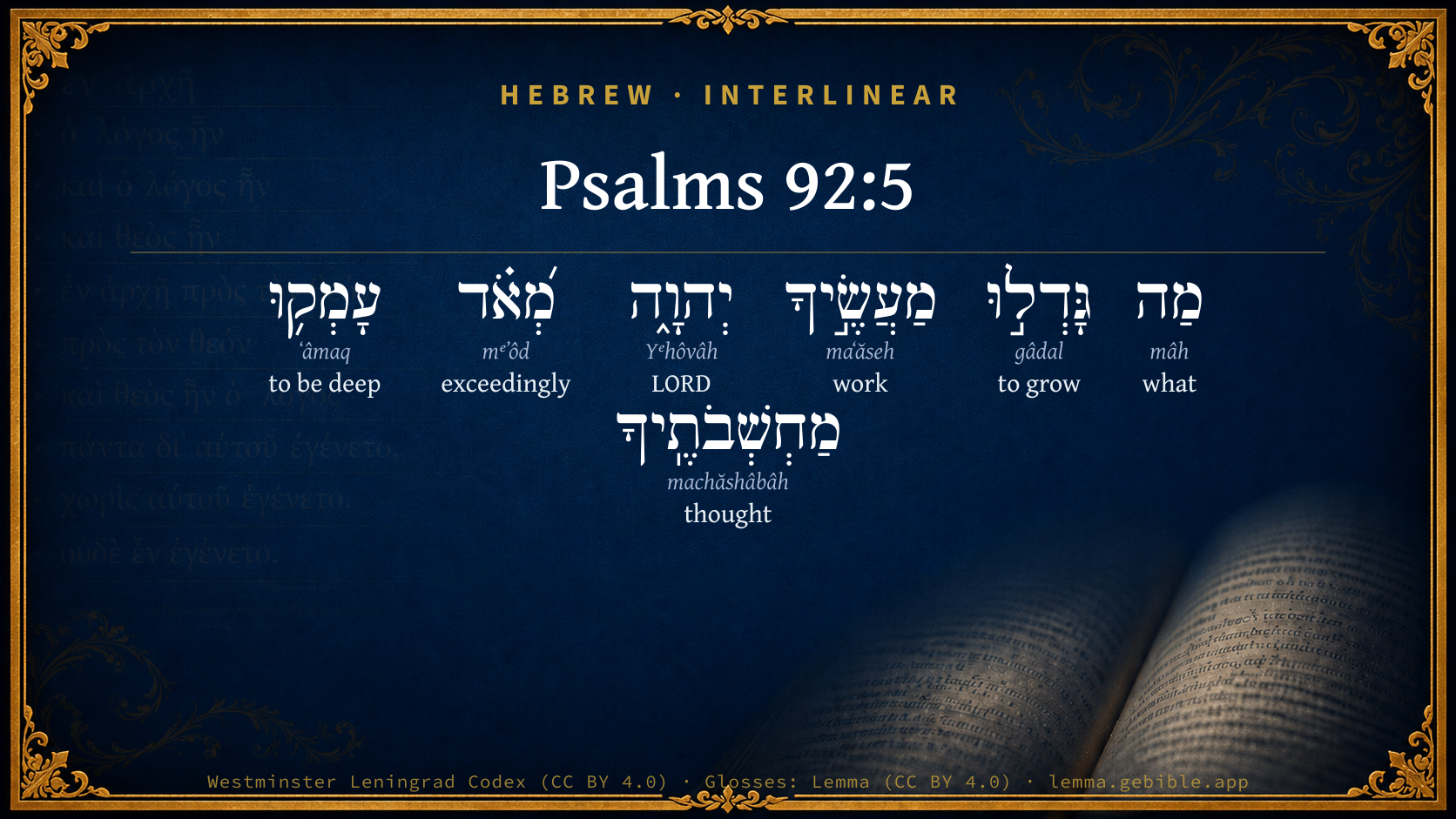
Psalms 92:5

Hebrew (Westminster Leningrad Codex) Psalms 92:5 appears in the Hebrew Old Testament. The text above is from the Westminster Leningrad Codex. Each word links to its Strong’s number, a concise gloss, and parsing drawn from the Open Scriptures Hebrew Bible morphology. Click any word for its full Brown-Driver-Briggs (BDB) entry.
Download image
Cite this verse

Psalms 92:5 (World English Bible). Public Domain. Lemma interlinear Bible study tool, https://lemma.gebible.app/v/psalms/92/5.

Show BibTeX & RIS
BibTeX
RIS
English Translation
How great are your works, Yahweh! Your thoughts are very deep.
World English Bible · Public Domain
Highlights
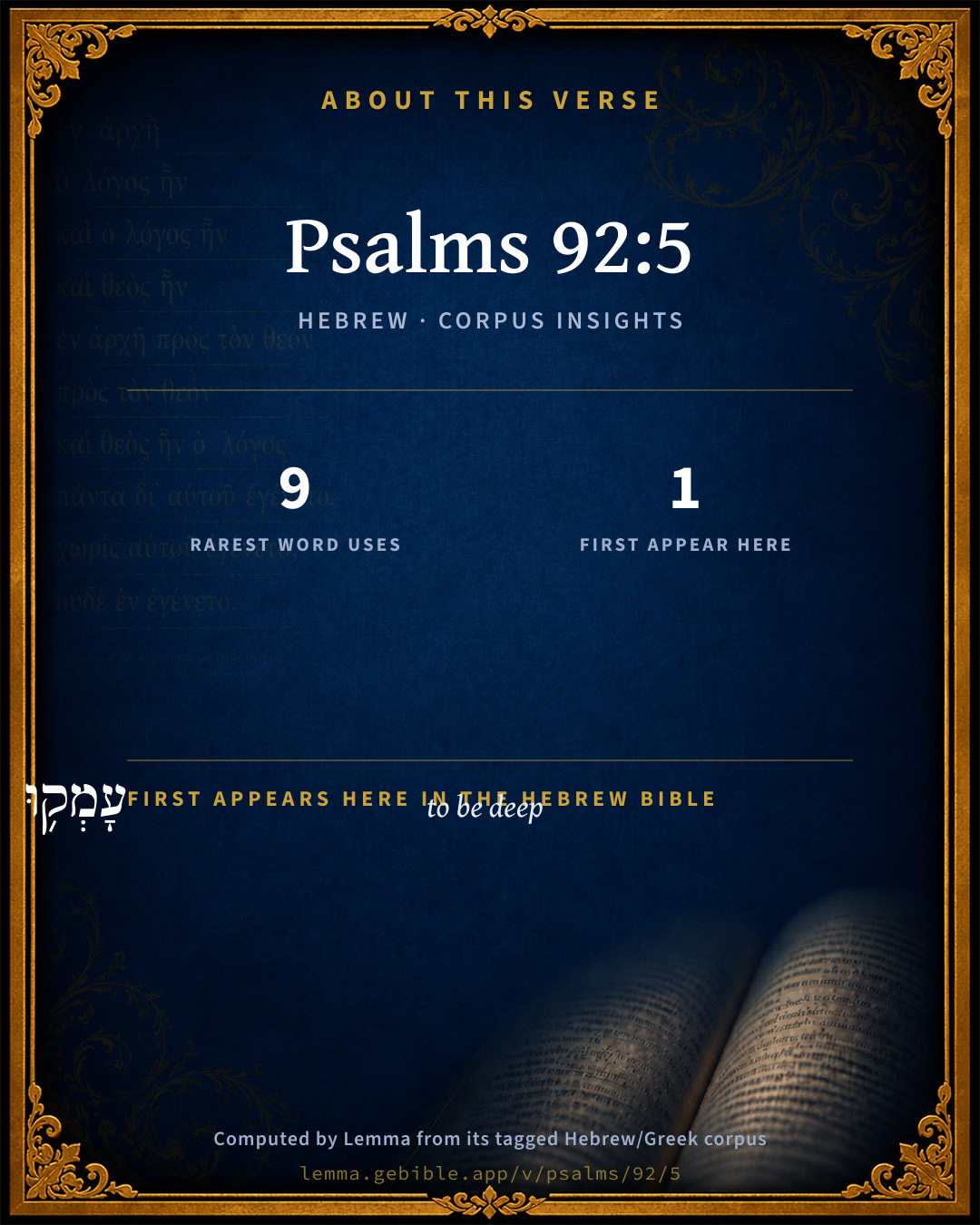
  • 1 first appearance in the Hebrew Bible
Full analysis ↓
Download a study sheet

One document with this verse’s original text, its word-by-word gloss line, the meaning frame, cross-references with their text, attributed commentary, and full source and license credits — printable, and it pastes into notes with its structure intact.

This verse Autodidact and up

Study sheet (.html) Plain text (.txt)

A passage Seminary Student

Up to 50 verses in one chapter. A passage sheet keeps up to 6 commentary sources and 12 cross-references per verse, in the order this page ranks them, and says so on the sheet whenever that leaves anything out. Ask for a single verse and you get the Autodidact verse sheet above.

Everything on this page stays free to read, with no account — the sheet is a download of what is already on screen, not access to it.

Want to remove ads? Support Godless Engineer
Compare translations 3

The same verse in 3 English versions, stacked beneath the original-language interlinear above. Click any original word for its lexicon entry.

Each is an independent rendering of the whole verse — the interlinear is not word-aligned to these translations.

Highlighted words mark where these versions differ — a whole-verse word diff, not a word-by-word alignment.

  • World English Bible Public Domain
    How great are your works, Yahweh! Your thoughts are very deep.
  • King James Version Public Domain
    O LORD, how great are thy works! and thy thoughts are very deep.
  • unfoldingWord Literal Text CC BY-SA 4.0
    How great are your deeds, Yahweh! Your thoughts are very deep.

unfoldingWord Literal Text — © unfoldingWord, licensed CC BY-SA 4.0. Word-aligned USFM3 via Door43 (git.door43.org/unfoldingWord/en_ult).

Versions to compare (up to 4)

3 of 4 selected

Show all 18 translations

Every available English version of this verse, each an independent rendering of the whole verse.

  • World English Bible Public Domain
    How great are your works, Yahweh! Your thoughts are very deep.
  • Berean Standard Bible Public Domain
    How great are Your works, O LORD, how deep are Your thoughts!
  • Majority Standard Bible Public Domain
    How great are Your works, O LORD, how deep are Your thoughts!
  • King James Version Public Domain
    O LORD, how great are thy works! and thy thoughts are very deep.
  • American Standard Version (1901) Public Domain
    How great are thy works, O Jehovah! Thy thoughts are very deep.
  • Revised Version (1885) Public Domain
    How great are thy works, O LORD! thy thoughts are very deep.
  • Geneva Bible (1599) Public Domain
    O Lord, how glorious are thy workes! and thy thoughtes are very deepe.
  • Douay-Rheims (1899) Public Domain
    For thou hast given me, O Lord, a delight in thy doings: and in the works of thy hands I shall rejoice.
  • Young's Literal Translation Public Domain
    How great have been Thy works, O Jehovah, Very deep have been Thy thoughts.
  • Literal Standard Version CC BY-SA 4.0
    How great Your works have been, O YHWH, || Your thoughts have been very deep.
  • Unlocked Literal Bible CC BY-SA 4.0
    How great are your deeds, Yahweh! Your thoughts are very deep.
  • unfoldingWord Literal Text CC BY-SA 4.0
    How great are your deeds, Yahweh! Your thoughts are very deep.
  • Darby Bible Public Domain
    Jehovah, how great are thy works! Thy thoughts are very deep:
  • World Messianic Bible Public Domain
    How great are your works, LORD! Your thoughts are very deep.
  • Webster's Bible Public Domain
    \\92:4\\For thou, LORD, hast made me glad through thy work: I will triumph in the works of thy hands.
  • Free Bible Version CC BY-SA 4.0
    Lord, what you do is amazing; your thoughts are very profound!
  • Bible in Basic English Public Domain
    O Lord, how great are your works! and your thoughts are very deep.
  • JPS Tanakh (1917) Public Domain
    (92-6) How great are Thy works, O LORD! Thy thoughts are very deep.

Literal Standard Version (2020), Covenant Press — licensed CC BY-SA 4.0. Text via the HelloAO Bible API (eBible.org). Unlocked Literal Bible (unfoldingWord) — licensed CC BY-SA 4.0. Text via the HelloAO Bible API (eBible.org). unfoldingWord Literal Text — © unfoldingWord, licensed CC BY-SA 4.0. Word-aligned USFM3 via Door43 (git.door43.org/unfoldingWord/en_ult). Free Bible Version, Dr. Jonathan Gallagher — licensed CC BY-SA 4.0. Text via the HelloAO Bible API (eBible.org).

Word by word

More ways to search: Search by grammar → Find every occurrence → Compare this word →

Practice this passage: Drill this verse → Learn its vocabulary →

About this verse

These counts appear in no published source. They are computed here, from the morphology-tagged text and Lemma’s own curated glosses. What Lemma adds →

7
words
7
distinct lemmas
Wisdom
section

Notable vocabulary

The rarest word here is עָמְק֥וּ to be deep H6009 — appearing just 9 times in the whole Hebrew Bible.

First appearance in Scripture

This word makes its first canonical appearance in the Hebrew Bible here:

  • עָמְק֥וּ to be deep H6009

Shared distinctive vocabulary

עָמְק֥וּ to be deep H6009 occurs in 9 verses of the Hebrew Bible. Also found in:

Grammatical profile

  • 2 verbs
  • 3 nouns
  • 1 adverb
  • 1 particle

Verb forms

  • גָּדְל֣וּ Qal · Perfect
  • עָמְק֥וּ Qal · Perfect

Hebrew & Septuagint length

In English translation the verse runs 11 words from the Hebrew and 13 from the Septuagint (LXX English) — closely comparable.

A rough comparison of the two English renderings, which tokenize alike — not a word-level alignment.

Word counts can differ between the Hebrew and the Greek without any difference in meaning — e.g. the Hebrew direct-object marker אֵת has no separate Greek word, and Greek often adds the article ὁ.

Cross-references

15

Topical passages linked to Psalms 92:5 in the Treasury of Scripture Knowledge — connected by theme and wording, ordered by reader-vote popularity; previews shown in the World English Bible.

  • Romans 11:33–34 Oh the depth of the riches both of the wisdom and the knowledge of God! How unsearchable are his judgments, and his ways past tracing out!
  • Isaiah 55:8–9 For my thoughts are not your thoughts, neither are your ways my ways, says Yahweh.
  • Psalms 40:5 Many, Yahweh, my God, are the wonderful works which you have done, And your thoughts which are toward us. They can't be set in order to you; If I would declare and speak of them, they are more than can be numbered.
  • Psalms 139:17 How precious to me are your thoughts, God! How vast is the sum of them!
  • Psalms 145:3–4 Great is Yahweh, and greatly to be praised! His greatness is unsearchable.
  • 1 Corinthians 2:10 But to us, God revealed them through the Spirit. For the Spirit searches all things, yes, the deep things of God.
  • Psalms 111:2 Yahweh's works are great, Pondered by all those who delight in them.
  • Revelation 15:3 They sang the song of Moses, the servant of God, and the song of the Lamb, saying, "Great and marvelous are your works, Lord God, the Almighty; Righteous and true are your ways, you King of the nations.
  • Psalms 104:24 Yahweh, how many are your works! In wisdom have you made them all. The earth is full of your riches.
  • Isaiah 28:29 This also comes forth from Yahweh of Hosts, who is wonderful in counsel, and excellent in wisdom.
  • Psalms 66:3 Tell God, "How awesome are your deeds! Through the greatness of your power, your enemies submit themselves to you.
  • Jeremiah 23:20 The anger of Yahweh shall not return, until he has executed, and until he have performed the intents of his heart: in the latter days you shall understand it perfectly.
  • Ecclesiastes 7:24 That which is, is far off and exceedingly deep. Who can find it out?
  • Psalms 36:6 Your righteousness is like the mountains of God. Your judgments are like a great deep. Yahweh, you preserve man and animal.
  • Psalms 64:6 They plot injustice, saying, "We have made a perfect plan!" Surely man's mind and heart are cunning.

Cross-references courtesy of OpenBible.info (CC BY 4.0).

Hebrew and Greek witnesses Masoretic Hebrew ↔ Greek Septuagint

The same verse in the two great witnesses to the Old Testament, shown verse-for-verse.

You’re reading Greek Psalm 91 (Hebrew Psalm 92). The Septuagint counts the superscription, so verse numbers can differ from the Hebrew — chapter-level alignment, not verse-by-verse. Numbering follows Rahlfs.

These are two independent witnesses, not word-aligned to each other, and the Septuagint is shown in lemma (dictionary) form.

Hebrew Psalms 92:5 Masoretic · Westminster Leningrad Codex

מַה גָּדְל֣וּ מַעֲשֶׂ֣יךָ יְהוָ֑ה מְ֝אֹ֗ד עָמְק֥וּ מַחְשְׁבֹתֶֽיךָ

How great are your works, Yahweh! Your thoughts are very deep.

World English Bible · Public Domain

Greek LXX Greek Psalm 91:5 Septuagint · lemma form

ὅτι εὐφραίνω ἐγώ κύριος ἐν ὁ ποίημα σύ καί ἐν ὁ ἔργον ὁ χείρ σύ ἀγαλλιάομαι

How have your works been magnified, O Lord! your thoughts are very deep.

LXX2012 (modern English Septuagint) · Public Domain

Hebrew: Westminster Leningrad Codex (CC BY 4.0). Greek: Septuagint (public domain); English from LXX2012 (modern English Septuagint) (Public Domain). How the Septuagint differs from the Hebrew →

Commentary

Notes on Psalms 92:5 from classic Christian and Jewish commentators (each source and its license shown beneath its notes). The classic Christian expositions comment on the surrounding passage and are grouped to its opening verse, so a note may address several verses; the Jewish commentaries on the Tanakh (Rashi and others) are per-verse, so they appear only where the commentator wrote on this verse.

Lemma curates 59 commentaries, every one of them public domain or Creative Commons licensed, each selected and text-cleaned for this edition rather than reprinted as found. About our sources →

Trapp's Complete Commentary

John Trapp

Psa 92:5 O LORD, how great are thy works! [and] thy thoughts are very deep.

Ver. 5. O Lord, how great are thy works!] Surely so great that I cannot utter them, and must, therefore, thus vent myself by an exclamation.

Expleri mentem nequeo, ardescoque tuendo

(Virgil.)

And thy thoughts are very deep] Here, then, we must do as those Romans did, who, when they found a lake the depth whereof was unknown, they dedicated it to Victory. Cry, O the depth! and there rest us.

John Trapp, A Commentary or Exposition upon All the Books of the Old and New Testament (1647–1656) — public domain. Text from a community e-Sword module.

The Biblical Illustrator

Joseph S. Exell

Psa_92:5

O Lord, how great are Thy works!

Mans admiration and marvel at Gods great works

A near connection of Sir David Brewster, but not a relative, who in former years often lived in his house, and formed one of the loving watchers by his death-bed, gives this characteristic and striking anecdote: When we were living in his house at St.

Andrews, he was much occupied with the microscope, and, as was his custom, he used to sit up studying it after the rest of the household had gone to bed. I often crept back into the room on pretence of having letters to write or something to finish, just to watch him. After a little he would forget that I was there, and I have often seen him suddenly throw himself back in his chair, lift up his hands, and exclaim, Good God, good God! how marvellous are Thy works. One Sunday morning I said to him that it had been given to him to show forth much of Gods great and marvellous works, and he answered, Yes, and I have found them to be great and marvellous; and I have felt them to be His.

Thy thoughts are very deep.

The depth of Gods thoughts

I. Out of those thoughts have come all that ever have been, and that are gone. Who can tell the number of worlds, with all their productions, populations, institutions, that have been and that are no more? They were all once in the thoughts of God.

II. Out of those thoughts have come all that are and will be. How vast is this universe! Who can tell the number of worlds and systems, and the myriad creatures of varied species, sentient and insentient, rational and irrational, that belong to them? They all came out of the depths of Gods thoughts; the archetypes and germs were all there as in immeasurable seas. Who shall tell what worlds and beings are yet to come? Generations of creatures in all planets may succeed each other as waves that break upon the shore. But all the worlds, systems, and existences that are ever to come, are in the thoughts of God. How deep, then, are Gods thoughts! (Homilist.)

The Biblical Illustrator, edited by Joseph S. Exell (c. 1880s–1900s) — public domain. Text from a community e-Sword module.

J. A. Alexander on Psalms

Joseph Addison Alexander

6. (Psa 92:5). How great are thy doings, Jehovah, (how) exceedingly deep thy thoughts! Thoughts and doings are correlative expressions, signifying plan and execution. Deep, not mysterious, but vast, immense, and inexhaustible, corresponding to great in the otlhr clause. With this verse, compare Psa 40:5, Isa 55:9, Rom 11:23.

Joseph Addison Alexander, The Psalms Translated and Explained (1850) — public domain. Text from a community e-Sword module.

Tyndale Open Study Notes

Tyndale Open Resources

92:5-6 The Lord’s thoughts do not make sense to the simpleton or the fool, the immoral person who desires no wisdom (Prov 1:22; 10:23).

Tyndale Open Study Notes — © Tyndale Open Resources, licensed CC BY-SA 4.0. Text via the HelloAO Bible API.

Adam Clarke's Commentary

Verse 5. How great are thy works!] They are multitudinous, stupendous, and splendid: and thy thoughts - thy designs and counsels, from which, by which, and in reference to which, they have been formed; are very deep - so profound as not to be fathomed by the comprehension of man.

Adam Clarke's Commentary on the Bible (1810–1826) — public domain. Text from a community e-Sword/MySword module.

John Calvin's Commentaries

5 O Jehovah! how highly exalted are thy works! The Psalmist, having spoken of the works of God in general, proceeds to speak more particularly of his justice in the government of the world. Though God may postpone the punishment of the wicked, he shows, in due time, that in conniving at their sins, he did not overlook or fail to perceive them; and though he exercises his own children with the cross, he proves in the issue, that he was not indifferent to their welfare. His reason for touching upon this particular point seems to be, that much darkness is thrown upon the scheme of Divine Providence by the inequality and disorder which prevail in human affairs. We see the wicked triumphing, and applauding their own good fortune, as if there was no judge above, and taking occasion from the Divine forbearance to run into additional excesses, under the impression that they have escaped his hand. The temptation is aggravated by that stupidity and blindness of heart which lead us to imagine that God exerts no superintendence over the world, and sits idle in heaven. It is known, too, how soon we are ready to sink under the troubles of the flesh. The Psalmist, therefore, intentionally selects this as a case in which he may show the watchful care exerted by God over the human family. He begins, by using the language of exclamation, for such is the dreadful distemper and disorder by which our understandings are confounded, that we cannot comprehend the method of God’s works, even when it is most apparent. We are to notice, that the inspired penman is not speaking here of the work of God in the creation of the heavens and earth, nor of his providential government of the world in general, but only of the judgments which he executes amongst men. He calls the works of God great, and his thoughts deep, because he governs the world in quite another manner than we are able to comprehend. Were things under our own management, we would entirely invert the order which God observes; and, such not being the case, we perversely expostulate with God for not hastening sooner to the help of the righteous, and to the punishment of the wicked. It strikes us as in the highest degree inconsistent with the perfections of God, that he should bear with the wicked when they rage against him, when they rush without restraint into the most daring acts of iniquity, and when they persecute at will the good and the innocent; — it seems, I say, in our eyes to be intolerable, that God should subject his own people to the injustice and violence of the wicked, while he puts no check upon abounding falsehood, deceit, rapine, bloodshed, and every species of enormity. Why does he suffer his truth to be obscured, and his holy name to be trampled under foot? This is that greatness of the Divine operation, that depth of the Divine counsel, into the admiration of which the Psalmist breaks forth. It is no doubt true, that there is an incomprehensible depth of power and wisdom which God has displayed in the fabric of the universe; but what the Psalmist has specially in view is, to administer a check to that disposition which leads us to murmur against God, when he does not pursue our plan in his providential managements. When anything in these may not agree with the general ideas of men, we ought to contemplate it with reverence, and remember that God, for the better trial of our obedience, has lifted his deep and mysterious judgments far above our conceptions.

John Calvin's Commentaries (1540-1563) — public domain. Text from the Calvin Translation Society English edition (1840s-50s) via the Christian Classics Ethereal Library (ccel.org). Calvin's coverage is partial (roughly two-thirds of the Bible); uncommented books and verses are honest gaps, never fabricated. The 19th-century editor's footnotes and remarks are omitted so the notes are faithfully Calvin's own voice.

Ellicott's Commentary for English Readers

(5) Thoughts.—Better, plans, or purposes. (Comp. in addition to references in margin, Psa_36:6.)

A Bible Commentary for English Readers, edited by Charles John Ellicott (1878–1897) — public domain. Text from a community e-Sword module.

The Cambridge Bible for Schools and Colleges

gen. ed. J. J. S. Perowne

5. How great are thy doings, Jehovah!

Exceeding deep are thy thoughts.

The grandeur and profundity of Jehovah’s designs in the government of the world stir the Psalmist’s admiration. Cp. Psa_36:6; Psa_40:5; Psa_139:17-18; Isa_55:8-9; Rom_11:33-34.

“Deep in unfathomable mines

Of never-failing skill

He treasures up His bright designs,

And works His sovereign Will.”

The Cambridge Bible for Schools and Colleges (gen. ed. J. J. S. Perowne; Cambridge University Press, 1878–1918) — public domain. Text from a community e-Sword module.

John Gill's Exposition

O Lord, how great are thy works!.... Of nature, providence, and grace, both for quantity and for quality, for number, excellency, and glory, as they are a display of God's wisdom, power, and goodness; see Psa 104:24,

and thy thoughts are very deep; his counsels, purposes, and designs, they are unfathomable and unsearchable; see Co1 2:10.

John Gill's Exposition of the Whole Bible (1746–1763) — public domain (CC PDM 1.0). Text via the HelloAO Bible API.

Albert Barnes' Notes on the Bible

O Lord, how great are thy works! - Compare Psa 8:3; Psa 40:5. See also the notes at Job 11:7. The meaning here is this: The psalmist, on the Sabbath, in giving himself to meditation on the works of God, is overwhelmed with a sense of their vastness, their incomprehensible nature, and the depth of wisdom evinced, far beyond the grasp of man, in what God had done. How soon is man lost; how soon does he get beyond his depth; how soon does he feel that here is greatness which he cannot comprehend, and wisdom which he cannot fathom, and goodness which he cannot appreciate, when he sits down to meditate on the works of God!

And thy thoughts are very deep - Compare Isa 28:29; Rom 11:33-34. The meaning is, that the plans or the purposes of God, as evinced in the works of creation and providence, are too profound for man to understand them. Who but God himself can comprehend them?

Albert Barnes' Notes on the Bible (1834–1885) — public domain. Text from a community e-Sword/MySword module.

Matthew Poole's English Annotations

Thy thoughts; thy counsels and methods in the government of the world and of thy church.

Matthew Poole's English Annotations on the Holy Bible (1683–1685) — public domain. Text from a community e-Sword/MySword module.

The Treasury of David

Charles H. Spurgeon

Ver. 5. O Lord, how great are thy works! He is lost in wonder. He utters an exclamation of amazement. How vast! How stupendous are the doings of Jehovah! Great for number, extent, and glory and design are all the creations of the Infinite One.

And thy thoughts are very deep. The Lord's plans are as marvellous as his acts; his designs are as profound as his doings are vast. Creation is immeasurable, and the wisdom displayed in it unsearchable. Some men think but cannot work, and others are mere drudges working without thought; in the Eternal the conception and the execution go together. Providence is inexhaustible, and the divine decrees which originate it are inscrutable. Redemption is grand beyond conception, and the thoughts of love which planned it are infinite. Man is superficial, God is inscrutable; man is shallow, God is deep. Dive as we may we shall never fathom the mysterious plan, or exhaust the boundless wisdom of the all comprehending mind of the Lord. We stand by the fathomless sea of divine wisdom, and exclaim with holy awe, "O the depth!"

Ver. 5. Thy thoughts. The plural of tbvrm, from the verb bvr, to meditate, to count, to weave; and this last word gives a good idea of what is here made the subject of admiration and praise, the wonderful intricacy and contrivance with which the Divine Mind designs and executes his plans, till at length the result is seen in a beautifully woven tissue of many delicately mingled and coloured threads. Christopher Wordsworth.

Ver. 5. Thy thoughts are very deep. Verily, my brethren, there is no sea so deep as these thoughts of God, who maketh the wicked flourish, and the good suffer: nothing so profound, nothing so deep; therein every unbelieving soul is wrecked, in that depth, in that profundity. Dost thou wish to cross this depth? Remove not from the wood of Christ's cross; and thou shalt not sink: hold thyself fast to Christ. Augustine.

Ver. 5. The unscalable mountains and the fathomless sea: or the divine works and the divine thoughts (God revealed and hidden) equally beyond human apprehension. C.A. Davis.

Psalms 92:6*

Charles H. Spurgeon's The Treasury of David (1869–1885) — public domain. Psalms only. Text from a community e-Sword/MySword module.

Whedon's Commentary on the Bible

Daniel D. Whedon

5. Thy works… thy thoughts—The term “works,” here, refers to those of creation and providence; “thoughts,” to plans and methods. These are words of that sound philosophy which penetrates deep enough into God’s “works” to perceive they are unfathomable to human intellect, and is modest enough to confess the same, while it is devout also to adore the wisdom which it cannot comprehend. Compare Rom_11:33

Daniel D. Whedon (gen. ed.), Commentary on the Old and New Testaments (1874–1909) — public domain. Text from a community e-Sword module.

The Pulpit Commentary

O Lord, how great are thy works!. (comp. Psa_40:5) Mighty and wonderful, i.e., are the ways of Providence. And thy thoughts are very deep. (comp. Job_11:8)

God"s thoughts seen in God"s works.

"How great are thy works! and thy thoughts are very deep." Reminding us of the fine passage in Isa_55:8, Isa_55:9, "For my thoughts are not your thoughts, neither are your ways my ways, saith the Lord. For as the heavens are higher than the earth, so are my ways higher than your ways, and my thoughts than your thoughts." The "thoughts" of God, his purposes and plannings, bring him before us as a moral Being, the sublime moral Being. And just as we read a man"s character by his acts, so we may know God"s mind by the study of his works. A man is always greater, always better, than anything he does; and yet it is only from what he does that we can gain our apprehension of the man. So God is infinitely above and beyond anything of his handiwork; and yet only through the handiwork can we get to know him. It is not enough to say that God"s moral government is illustrated in nature; we must say that God himself and it is in what God is we find the secret of the character of his government is known through the works of his hands. The point suggested by the first sentences of this verse is that the more man studies God"s works, the more he feels their greatness, their mystery, their beyondness. And then he can no longer be surprised that God"s thoughts and purposes, the higher moral ends he ever keeps in view and works towards, should be deep, altogether out of his reach.

I THE KNOWN REVEALING WHAT CAN BE KNOWN OF GOD. We can understand much of God"s handiwork. We can see God"s purpose in much, and use many things as God designed they should be used. We can see the moral message in much of God"s work. So argues St. Paul, in Act_14:15-17 Rom_1:19, Rom_1:20. We may know, thus, all the natural attributes of God, and gain also some apprehension of the moral attributes. But what can be known of God in this way must always be incomplete.

II THE UNKNOWN REVEALING THAT THERE IS AN UNKNOWN IN GOD. "His thoughts are very deep;" quite beyond man"s plummet. There is mystery in Nature. She holds secrets which even man"s science cannot force her to disclose. And those mysteries declare that there must be deeper mysteries in him who holds the secret of them all. He is more mysterious than they. R.T.

The Pulpit Commentary (1880–1919), ed. H.D.M. Spence-Jones & Joseph S. Exell — public domain. Text from a community e-Sword module.

John Wesley's Explanatory Notes

Thoughts - Thy counsels in the government of the world and of thy church.

John Wesley, Explanatory Notes Upon the Whole Bible (1754–1765) — public domain. Text via the GEBible commentary corpus.

Lesson kit

Teaching starters — assembled from the data on this page, not authored interpretation. Every prompt links to the verse data it draws on. Edit before teaching.

Psalms, in the Wisdom, opens this verse with 7 words (7 distinct Hebrew lemmas). Its most distinctive word is ʻâmaq (“to be deep”). A historical commentator’s framing appears above. Read the whole chapter for the surrounding context.

Discussion questions

  1. The word ʻâmaq carries the sense “to be deep.” How does it shape the verse?
  2. The word “to be deep” first appears here in Scripture. What is being introduced at this debut?
  3. Isaiah 7:11 shares the word «to be deep» with this verse. How do the two illuminate each other?
  4. The translations on this page render this verse differently — a whole-verse word diff, not a word-by-word alignment. What might account for the different wordings?
  5. The verb «גָּדְל֣וּ» is Qal Perfect. How does its form color the action?
  6. Reading how Trapp's Complete Commentary and The Biblical Illustrator read this verse, where do the two commentators agree and where do they part?

Things to notice

  • 1 word makes its first canonical appearance in Scripture here.
  • These translations choose different wording for 5 words in this verse.
  • 7 distinct Hebrew lemmas span 7 words in this verse.

Reading settings

Reading text

Shown beneath each verse's original-language words.

Old Testament
Old Testament edition

Read the OT as the Masoretic Hebrew (MT) or the Greek Septuagint (LXX).

English shown for the Greek Septuagint (in the Hebrew ↔ Greek comparison).

Comparing translations? Open the Compare panel on any verse page to stack up to four side by side.