
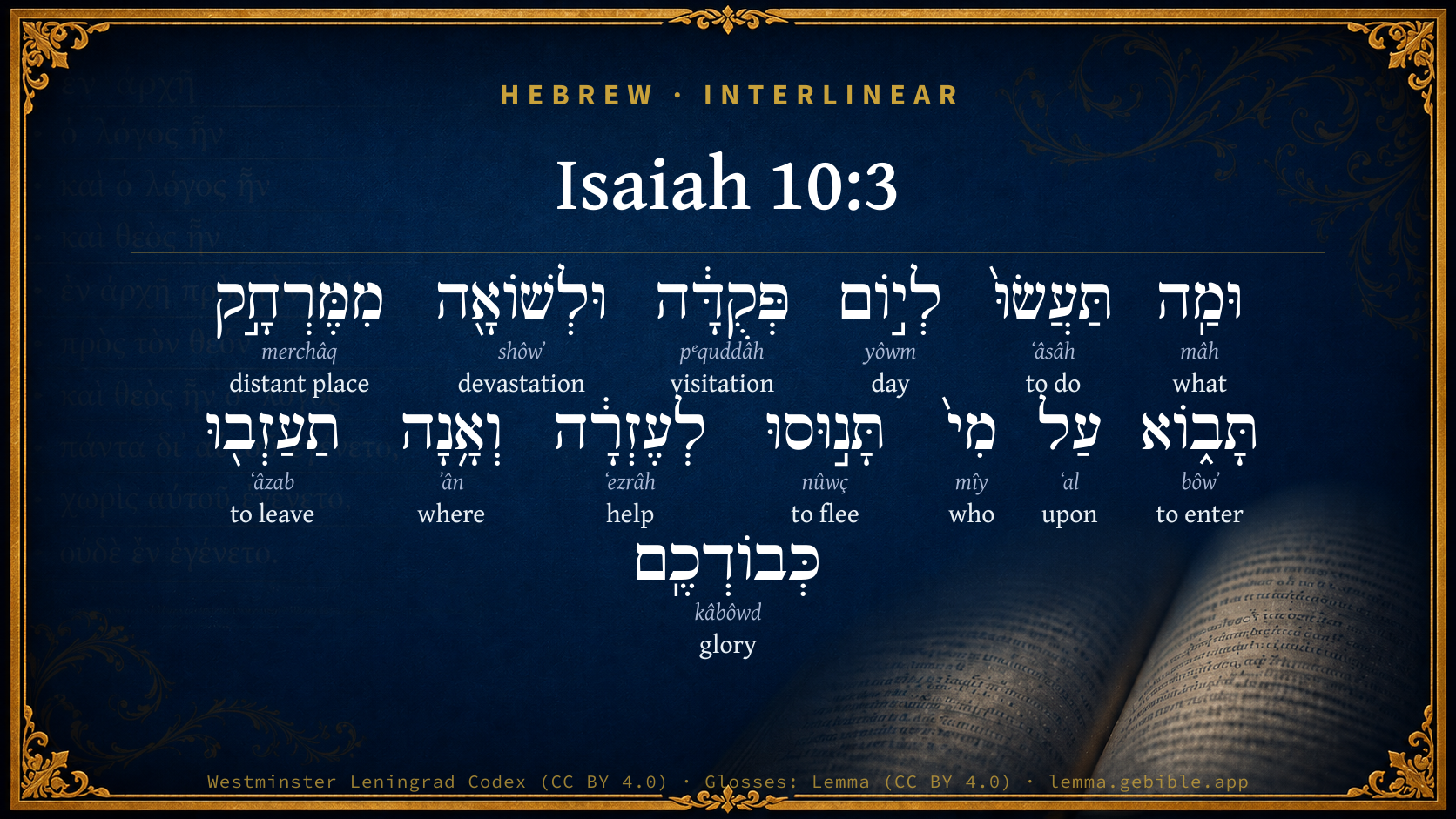
Isaiah 10:3

Hebrew (Westminster Leningrad Codex) Isaiah 10:3 appears in the Hebrew Old Testament. The text above is from the Westminster Leningrad Codex. Each word links to its Strong’s number, a concise gloss, and parsing drawn from the Open Scriptures Hebrew Bible morphology. Click any word for its full Brown-Driver-Briggs (BDB) entry.
Download image
Cite this verse

Isaiah 10:3 (World English Bible). Public Domain. Lemma interlinear Bible study tool, https://lemma.gebible.app/v/isaiah/10/3.

Show BibTeX & RIS
BibTeX
RIS
English Translation
What will you do in the day of visitation, and in the desolation which shall come from far? to whom will you flee for help? and where will you leave your glory?
World English Bible · Public Domain
Download a study sheet

One document with this verse’s original text, its word-by-word gloss line, the meaning frame, cross-references with their text, attributed commentary, and full source and license credits — printable, and it pastes into notes with its structure intact.

This verse Autodidact and up

Study sheet (.html) Plain text (.txt)

A passage Seminary Student

Up to 50 verses in one chapter. A passage sheet keeps up to 6 commentary sources and 12 cross-references per verse, in the order this page ranks them, and says so on the sheet whenever that leaves anything out. Ask for a single verse and you get the Autodidact verse sheet above.

Everything on this page stays free to read, with no account — the sheet is a download of what is already on screen, not access to it.

Want to remove ads? Support Godless Engineer
Compare translations 3

The same verse in 3 English versions, stacked beneath the original-language interlinear above. Click any original word for its lexicon entry.

Each is an independent rendering of the whole verse — the interlinear is not word-aligned to these translations.

Highlighted words mark where these versions differ — a whole-verse word diff, not a word-by-word alignment.

  • World English Bible Public Domain
    What will you do in the day of visitation, and in the desolation which shall come from far? to whom will you flee for help? and where will you leave your glory?
  • King James Version Public Domain
    And what will ye do in the day of visitation, and in the desolation which shall come from far? to whom will ye flee for help? and where will ye leave your glory?
  • unfoldingWord Literal Text CC BY-SA 4.0
    And what will you do on the day of visitation and about the desolation coming from afar? To whom will you flee for help, and where will you leave your glory?

unfoldingWord Literal Text — © unfoldingWord, licensed CC BY-SA 4.0. Word-aligned USFM3 via Door43 (git.door43.org/unfoldingWord/en_ult).

Versions to compare (up to 4)

3 of 4 selected

Show all 18 translations

Every available English version of this verse, each an independent rendering of the whole verse.

  • World English Bible Public Domain
    What will you do in the day of visitation, and in the desolation which shall come from far? to whom will you flee for help? and where will you leave your glory?
  • Berean Standard Bible Public Domain
    What will you do on the day of reckoning when devastation comes from afar? To whom will you flee for help? Where will you leave your wealth?
  • Majority Standard Bible Public Domain
    What will you do on the day of reckoning when devastation comes from afar? To whom will you flee for help? Where will you leave your wealth?
  • King James Version Public Domain
    And what will ye do in the day of visitation, and in the desolation which shall come from far? to whom will ye flee for help? and where will ye leave your glory?
  • American Standard Version (1901) Public Domain
    And what will ye do in the day of visitation, and in the desolation which shall come from far? to whom will ye flee for help? and where will ye leave your glory?
  • Revised Version (1885) Public Domain
    And what will ye do in the day of visitation, and in the desolation which shall come from far? to whom will ye flee for help? and where will ye leave your glory?
  • Geneva Bible (1599) Public Domain
    What will ye doe nowe in the day of visitation, and of destruction, which shall come from farre? to whom will ye flee for helpe? and where will ye leaue your glorie?
  • Douay-Rheims (1899) Public Domain
    What will you do in the day of visitation, and of the calamity which cometh from afar? to whom will ye flee for help? and where will ye leave your glory?
  • Young's Literal Translation Public Domain
    And what do ye at a day of inspection? And at desolation? -- from afar it cometh. Near whom do ye flee for help? And where do ye leave your honour?
  • Literal Standard Version CC BY-SA 4.0
    And what do you do at a day of inspection? And at desolation that comes from afar? Near whom do you flee for help? And where do you leave your glory?
  • Unlocked Literal Bible CC BY-SA 4.0
    What will you do on judgment day when the destruction comes from far away? To whom will you flee for help, and where will you leave your wealth?
  • unfoldingWord Literal Text CC BY-SA 4.0
    And what will you do on the day of visitation and about the desolation coming from afar? To whom will you flee for help, and where will you leave your glory?
  • Darby Bible Public Domain
    And what will ye do in the day of visitation, and in the sudden destruction [which] shall come from far? To whom will ye flee for help, and where will ye leave your glory?
  • World Messianic Bible Public Domain
    What will you do in the day of visitation, and in the desolation which will come from afar? To whom will you flee for help? Where will you leave your wealth?
  • Webster's Bible Public Domain
    And what will ye do in the day of visitation, and in the desolation which shall come from far? to whom will ye flee for help? and where will ye leave your glory?
  • Free Bible Version CC BY-SA 4.0
    What are you going to do on the day you're punished, when disaster falls on you from far away? Who are you going to run to so you can get help? Where are you going to leave all your wealth?
  • Bible in Basic English Public Domain
    And what will you do in the day of punishment, and in the destruction which is coming from far? to whom will you go for help, and what will become of your glory?
  • JPS Tanakh (1917) Public Domain
    And what will ye do in the day of visitation, and in the ruin which shall come from far? To whom will ye flee for help? And where will ye leave your glory?

Literal Standard Version (2020), Covenant Press — licensed CC BY-SA 4.0. Text via the HelloAO Bible API (eBible.org). Unlocked Literal Bible (unfoldingWord) — licensed CC BY-SA 4.0. Text via the HelloAO Bible API (eBible.org). unfoldingWord Literal Text — © unfoldingWord, licensed CC BY-SA 4.0. Word-aligned USFM3 via Door43 (git.door43.org/unfoldingWord/en_ult). Free Bible Version, Dr. Jonathan Gallagher — licensed CC BY-SA 4.0. Text via the HelloAO Bible API (eBible.org).

Word by word

More ways to search: Search by grammar → Find every occurrence → Compare this word →

Practice this passage: Drill this verse → Learn its vocabulary →

וּלְשׁוֹאָ֖ה
shôwʼ
H7722
“and · to/for · devastation”
Conjunction + Preposition + Noun, Common, Feminine, Singular, Absolute
Part of Speech
Conjunction + Preposition + Noun
Type
Common
Gender
Feminine
Number
Singular
State
Absolute
Full BDB Definition

Origin: from an unused root meaning to rush over

TWOT: 2339 , 2339a

ravage (noun masculine) - devastation, ruin, waste (noun feminine) - devastation, ruin - ruin, waste (of land)
  1. וּמַֽה mâh H4100 “and · what” Conjunction + Particle, Interrogative
  2. תַּעֲשׂוּ֙ ʻâsâh H6213 “to do” Verb, Qal, Imperfect, 2nd Person, Masculine, Plural
  3. לְי֣וֹם yôwm H3117 “to/for · day of” Preposition + Noun, Common, Masculine, Singular, Construct
  4. פְּקֻדָּ֔ה pᵉquddâh H6486 “visitation” Noun, Common, Feminine, Singular, Absolute
  5. מִמֶּרְחָ֣ק merchâq H4801 “from · distant place” Preposition + Noun, Common, Masculine, Singular, Absolute
  6. תָּב֑וֹא bôwʼ H935 “to enter” Verb, Qal, Imperfect, 3rd Person, Feminine, Singular
  7. עַל ʻal H5921 “upon” Preposition
  8. מִי֙ mîy H4310 “who” Particle, Interrogative
  9. תָּנ֣וּסוּ nûwç H5127 “to flee” Verb, Qal, Imperfect, 2nd Person, Masculine, Plural
  10. לְעֶזְרָ֔ה ʻezrâh H5833 “to/for · help” Preposition + Noun, Common, Feminine, Singular, Absolute
  11. וְאָ֥נָה ʼân H575 “and · where” Conjunction + Particle, Interrogative
  12. תַעַזְב֖וּ ʻâzab H5800 “to leave” Verb, Qal, Imperfect, 2nd Person, Masculine, Plural
  13. כְּבוֹדְכֶֽם kâbôwd H3519 “glory · your” Noun, Common, Both, Singular, Construct + Suffix, Personal, 2nd Person, Masculine, Plural

About this verse

These counts appear in no published source. They are computed here, from the morphology-tagged text and Lemma’s own curated glosses. What Lemma adds →

14
words
14
distinct lemmas
Prophets
section

Notable vocabulary

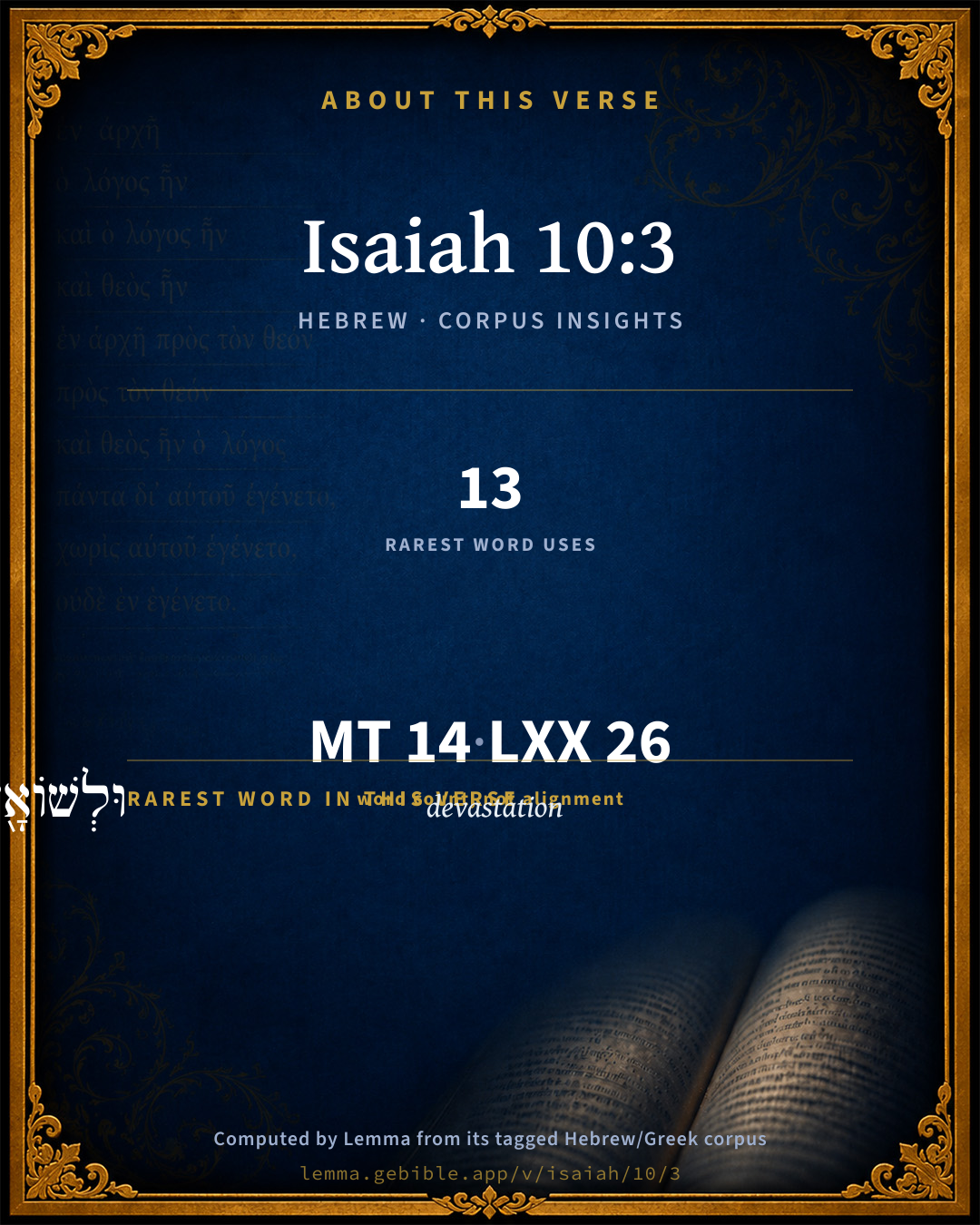
The rarest word here is וּלְשׁוֹאָ֖ה devastation H7722 — appearing just 13 times in the whole Hebrew Bible.

Shared distinctive vocabulary

וּלְשׁוֹאָ֖ה devastation H7722 occurs in 12 verses of the Hebrew Bible. Also found in:

Grammatical profile

  • 4 verbs
  • 6 nouns
  • 1 preposition
  • 3 particles

Verb forms

  • תַּעֲשׂוּ֙ Qal · Imperfect
  • תָּב֑וֹא Qal · Imperfect
  • תָּנ֣וּסוּ Qal · Imperfect
  • תַעַזְב֖וּ Qal · Imperfect

Hebrew & Septuagint length

In English translation the verse runs 32 words from the Hebrew and 33 from the Septuagint (LXX English) — closely comparable.

A rough comparison of the two English renderings, which tokenize alike — not a word-level alignment.

Word counts can differ between the Hebrew and the Greek without any difference in meaning — e.g. the Hebrew direct-object marker אֵת has no separate Greek word, and Greek often adds the article ὁ.

In the original languages it is 14 Hebrew tokens and 26 Greek tokens — but the two are counted differently (Hebrew bundles its prefixes and suffixes into one token; the Greek is in lemma form), so that isn’t a like-for-like length.

Cross-references

27

Topical passages linked to Isaiah 10:3 in the Treasury of Scripture Knowledge — connected by theme and wording, ordered by reader-vote popularity; previews shown in the World English Bible.

  • Hosea 9:7 The days of visitation have come. The days of reckoning have come. Israel will consider the prophet to be a fool, And the man who is inspired to be insane, Because of the abundance of your sins, And because your hostility is great.
  • Luke 19:44 and will dash you and your children within you to the ground. They will not leave in you one stone on another, because you didn't know the time of your visitation."
  • Job 31:14 What then shall I do when God rises up? When he visits, what shall I answer him?
  • Proverbs 11:4 Riches don't profit in the day of wrath, But righteousness delivers from death.
  • Isaiah 5:26 He will lift up a banner to the nations from far, And he will whistle for them from the end of the earth. Behold, they will come speedily and swiftly.
  • Isaiah 20:6 The inhabitant of this coast-land shall say in that day, Behold, such is our expectation, where we fled for help to be delivered from the king of Assyria: and we, how shall we escape?
  • Isaiah 26:21 For, behold, Yahweh comes forth out of his place to punish the inhabitants of the earth for their iniquity: the earth also shall disclose her blood, and shall no more cover her slain.
  • Zephaniah 1:18 Neither their silver nor their gold will be able to deliver them in the day of Yahweh's wrath, but the whole land will be devoured by the fire of his jealousy; for he will make an end, yes, a terrible end, of all those who dwell in the land.
  • 1 Peter 2:12 having good behavior among the nations, so in that which they speak against you as evil-doers, they may by your good works, which they see, glorify God in the day of visitation.
  • Deuteronomy 28:49 Yahweh will bring a nation against you from far, from the end of the earth, as the eagle flies; a nation whose language you shall not understand;
  • Revelation 6:15–16 The kings of the earth, the princes, the commanding officers, the rich, the strong, and every slave and free person, hid themselves in the caves and in the rocks of the mountains.
  • Genesis 31:1 He heard the words of Laban's sons, saying, "Jacob has taken away all that was our father's. From that which was our father's, has he gotten all this wealth."
  • 2 Kings 7:6–8 For the Lord had made the host of the Syrians to hear a noise of chariots, and a noise of horses, even the noise of a great host: and they said one to another, Behold, the king of Israel has hired against us the kings of the Hittites, and the kings of the Egyptians, to come on us.
  • 2 Kings 7:15 They went after them to the Jordan: and, behold, all the way was full of garments and vessels, which the Syrians had cast away in their haste. The messengers returned, and told the king.
  • Psalms 49:16–17 Don't be afraid when a man is made rich, When the glory of his house is increased.
  • Isaiah 2:20–21 In that day, men shall cast away their idols of silver, And their idols of gold, Which have been made for themselves to worship, To the moles and to the bats;
  • Isaiah 5:14 Therefore Sheol has enlarged its desire, And opened its mouth without measure; And their glory, their multitude, their pomp, and he who rejoices among them, descend into it.
  • Isaiah 30:1–3 Woe to the rebellious children, says Yahweh, who take counsel, but not of me; and who make a league, but not of my Spirit, that they may add sin to sin,
  • Isaiah 30:16 but you said, No, for we will flee on horses; therefore shall you flee: and, We will ride on the swift; therefore shall those who pursue you be swift.
  • Isaiah 30:27–28 Behold, the name of Yahweh comes from far, burning with his anger, and in thick rising smoke: his lips are full of indignation, and his tongue is as a devouring fire;
  • Isaiah 31:1–3 Woe to those who go down to Egypt for help, and rely on horses, and trust in chariots because they are many, and in horsemen because they are very strong, but they don't look to the Holy One of Israel, neither seek Yahweh!
  • Isaiah 33:14 The sinners in Zion are afraid; trembling has seized the godless ones: Who among us can dwell with the devouring fire? who among us can dwell with everlasting burning?
  • Isaiah 39:3 Then came Isaiah the prophet to king Hezekiah, and said to him, What said these men? and from whence came they to you? Hezekiah said, They are come from a far country to me, even from Babylon.
  • Isaiah 39:6–7 Behold, the days are coming, when all that is in your house, and that which your fathers have laid up in store until this day, shall be carried to Babylon: nothing shall be left, says Yahweh.
  • Jeremiah 5:31 the prophets prophesy falsely, and the priests bear rule by their means; and my people love to have it so: and what will you do in the end of it?
  • Ezekiel 24:13–14 In your filthiness is lewdness: because I have cleansed you and you weren't cleansed, you shall not be cleansed from your filthiness any more, until I have caused my wrath toward you to rest.
  • Hosea 5:13 When Ephraim saw his sickness, And Judah his wound, Then Ephraim went to Assyria, And sent to king Jareb: But he is not able to heal you, Neither will he cure you of your wound.

Cross-references courtesy of OpenBible.info (CC BY 4.0).

Hebrew and Greek witnesses Masoretic Hebrew ↔ Greek Septuagint

The same verse in the two great witnesses to the Old Testament, shown verse-for-verse.

These are two independent witnesses, not word-aligned to each other, and the Septuagint is shown in lemma (dictionary) form.

Hebrew Isaiah 10:3 Masoretic · Westminster Leningrad Codex

וּמַֽה תַּעֲשׂוּ֙ לְי֣וֹם פְּקֻדָּ֔ה וּלְשׁוֹאָ֖ה מִמֶּרְחָ֣ק תָּב֑וֹא עַל מִי֙ תָּנ֣וּסוּ לְעֶזְרָ֔ה וְאָ֥נָה תַעַזְב֖וּ כְּבוֹדְכֶֽם

What will you do in the day of visitation, and in the desolation which shall come from far? to whom will you flee for help? and where will you leave your glory?

World English Bible · Public Domain

Greek LXX Isaiah 10:3 Septuagint · lemma form

καί τίς ποιέω ἐν ὁ ἡμέρα ὁ ἐπισκοπή ὁ γάρ θλῖψις σύ πόρρωθεν ἥκω καί πρός τίς καταφεύγω ὁ βοηθέω καί ποῦ καταλείπω ὁ δόξα σύ

And what will they do in the day of visitation? for affliction shall come to you from afar: and to whom will you⌃ flee for help? and where will you⌃ leave your glory,

LXX2012 (modern English Septuagint) · Public Domain

On this verse, Joseph Benson's Commentary discusses the Septuagint’s reading. Read the note in Commentary ↓

Hebrew: Westminster Leningrad Codex (CC BY 4.0). Greek: Septuagint (public domain); English from LXX2012 (modern English Septuagint) (Public Domain). How the Septuagint differs from the Hebrew →

Targum (Aramaic paraphrase)

1

The Targum is the ancient Jewish Aramaic paraphrase of the Hebrew Scriptures — an interpretive translation, not the Hebrew text itself. Onkelos (literal) and Pseudo-Jonathan (expansive) render the Torah, and Jonathan the Prophets. Coverage is partial: where no permissively-licensed English translation exists for a verse, only the Aramaic is shown. This is verse-level text, not a word-by-word alignment to the Hebrew.

  1. Targum Jonathan Prophets (Joshua–Malachi)
    וּמַה תַּעְבְּדוּן לְיוֹמָא דְיִסְעֲרוּן עֲלֵיכוֹן חוֹבֵיכוֹן וּלְרִיגוּשׁ עָקָא מֵרָחִיק יֵיתֵי לְאָן תְּעַרְקוּן לְסָעִיד וְהֵיכָא תִשְׁבְּקוּן יְקָרְכוֹן:

    What will ye do in the day that your sins shall be visited upon you? when the tumult of oppression shall come from far? whither will ye flee for help? and where will ye leave your glory?

    Targum Jonathan — Aramaic: “Mikraot Gedolot” (public domain). English: “Sefaria Community Translation” (CC0 1.0 (public-domain dedication)); “London "Chaldee Paraphrase," 1871” (public domain). Text via Sefaria.

Commentary

Notes on Isaiah 10:3 from classic Christian and Jewish commentators (each source and its license shown beneath its notes). The classic Christian expositions comment on the surrounding passage and are grouped to its opening verse, so a note may address several verses; the Jewish commentaries on the Tanakh (Rashi and others) are per-verse, so they appear only where the commentator wrote on this verse.

Lemma curates 59 commentaries, every one of them public domain or Creative Commons licensed, each selected and text-cleaned for this edition rather than reprinted as found. About our sources →

Trapp's Complete Commentary

John Trapp

Isa 10:3 And what will ye do in the day of visitation, and in the desolation [which] shall come from far? to whom will ye flee for help? and where will ye leave your glory?

Ver. 3. And what will ye do in the day of visitation.] That is, of vastation by the Assyrians.

To whom will ye flee for help.] Who have denied help to the poor that fled unto you; but sped no better than the sheep that flee to the bush for defence in weather, where he is sure to lose part of his fleece.

And where will ye leave your glory?] Where will ye betrust or bestow your wealth, power, and worldly pomp, purchased by you at too dear a rate? who paid your honesty to get it - O magno emptas, et parum proficuas divitias! - and must now lose not it only, but your liberties and lives also, in the next verse.

John Trapp, A Commentary or Exposition upon All the Books of the Old and New Testament (1647–1656) — public domain. Text from a community e-Sword module.

The Biblical Illustrator

Joseph S. Exell

Isa_10:3

And what will ye do in the day of visitation?

--

The day of visitation

In Scripture style the season in which God is pleased to draw near to a person or people, that He may accomplish various important purposes, is called a day of visitation.

1. Sometimes His visitation is intended to afford deliverance and consolation to the oppressed, by extricating them from servitude and misery, and introducing them into a happy and comfortable condition. In this sense the Lord is said to have visited His people Israel, when He delivered them from Egyptian bondage (Exo_4:31); and to have visited and redeemed His people when He bestowed upon them the greatest mercy (Luk_1:68).

2. Sometimes it is designed to manifest His tender care and constant inspection of His people, over whom He exerciseth the most vigilant attention, that He may effectually promote their best interests (Psa_89:32). Such times are indeed days of visitation, wherein God sensibly draws near with the proofs of His kindness and favour, which He most undeservedly confers; and in which He appears with His rod of correction, that He may administer necessary chastisements, and restore those who had forsaken His laws from their wanderings.

3. At other times, God visits those who have not profited by the many warnings they have received, nor repented of the sins they have committed, notwithstanding the repeated corrections that He hath administered, to execute upon them desolating judgments and terrible vengeance Jer_5:9). In this last sense, I suppose, the day of visitation is here meant. (R. Macculloch.)

The day of visitation

So far from God having abandoned the world, He is continually calling it to account. Not only has He fixed in His eternal mind a period of final visitation, but days of visitation are repeatedly coming. And who knows how many may come to us?

I. THE SOLEMN PERIOD SPOKEN OF. God is said to visit men when He comes to them, or reveals Himself, either in mercy or judgment. Christ Himself calls the days of His ministry among the Jews the day of their visitation--their Gospel day of mercy. But the term, as used in our text, is to be understood in the contrary sense, to denote a period of judgment. There are several periods which are days of Divine visitation.

1. The day of trouble.

2. The day of affliction.

3. The day of death.

4. The day of judgment.

II. THE SOUL-AWAKENING APPEAL MADE. What will ye do? To whom will ye flee for help? This language implies that something has need to be done--that help will be required. Self-sufficient as we may wish to thinkourselves when all is bright, whenever either of the days of Divine visitation comes, we shall find that help will be needed in order to stand the trial well. If so, what will you do?

1. What in the day of trouble? Many are then overwhelmed thereby; in these circumstances many die in despair, fade away in melancholy, or lay violent hands on themselves. When every draught of lifes cup is the very gall of bitterness, where will ye go for sweetness?

2. Should afflictive visitations come on, what then will ye do? You may flee to the physician, but he can do no more than the God means may permit him.

3. And then, when the day of dissolution, that awful day of visitation comes, what will ye do? Will you send for your minister to pray for you? But what avail his prayers, if your do not pray for yourself?

4. And when the last great day--that day of all days--comes, oh, what then shall we do? And where shall we flee for help? Now, bring all this to a point.

(1) Settle it in your minds that days of visitation will come.

(2) How necessary, now in the time of our merciful visitation of Gospel offers and encouragements, to make the Almighty God our friend by faith in Christ.

(3) If we do not, must we not expect to be abandoned and left to everlasting ruin, without help or hope? (Essex Remembrancer.)

What will ye do in the day of visitation?

However wicked men may flatter themselves, or be flattered by others, God will not do it.

I. Let us notice TWO OR THREE PARTICULARS CONTAINED IN THE TEXT, before we pursue the principal inquiry.

1. The persons originally addressed were the children of Israel, a rebellious people; but the words are applicable to sinners of every description.

2. For the people of Israel a day of visitation was appointed, and the same may be said of us. There are days Of visitation to individuals as well as to whole nations.

II. PURSUE THE PRINCIPAL INQUIRY: What will ye do? etc.

1. Will you plead and expostulate with God? At a throne of grace the sinner may indeed plead with God, but what arguments will avail at the tribunal of His justice?

2. Will you attempt to resist Him!

3. Will you fly from Him! Whither?

4. Will you harden yourselves against Him; and seeing you cannot escape punishment, endeavour to support yourselves under it as well as you can; saying, with impenitent Israel, Truly this is a grief, and I must bear it? Jer_10:19). Who can stand before His indignation? (JoelNa 1:2-6).

5. Will you cast yourselves at His feet, and adopt the humble and submissive language of David: If He say, I have no delight in thee, here am I; let Him do to me as seemeth good in His sight? This certainly would be highly proper, before the decree is gone forth, and such humiliation would be accepted; but it cannot be done afterwards, or if done, it would not avail Propose then to yourselves another question: What shall I do before this day of visitation come, that I may avoid the tremendous consequences? (B. Beddome, M. A.)

The day of visitation and preparation for it

I. A DAY OF VISITATION IS COMING UPON ALL MEN.

II. IT IS OF THE GREATEST IMPORTANCE TO BE PREPARED FOR THIS DAY.

1. Because your happiness, when the day of visitation comes, will depend upon it.

2. It will be positive misery to be unprepared.

3. You have an invaluable treasure in peril.

4. If you come to judgment unprepared it will be too late forever.

III. GOD IN HIS MERCY PRESSES THIS SOLEMN QUESTION UPON OUR SERIOUS AND DEVOUT CONSIDERATION.

1. It appears clear that God does sincerely desire the happiness of all men.

2. His thus pressing this solemn thought upon mens consideration shows that they are unwilling to obey God.

3. Mans want of happiness is entirely with himself and not with God. (N. M. Harry.)

Where will ye leave your glory?--

The vanity of earthly glory

The principal word in this short question seems, by its very sound, to bring before the mind indistinctly, a vision of something great and magnificent, yet unsubstantial and vain. When we bring our thoughts upon it more distinctly, we recognise it as the most conspicuous favourite term of heathenism. We mean a heathenism of all times and countries; that action and passion of the human mind, by which notions and feelings of greatness, transcendent value, have been attached to certain things of but imaginary worth; which things have been coveted, adored, toiled for, fought for, lived for, died for--as glory. Glory, therefore, has been the name of vanity turned into a god. And how vast the dominion of this idolatrous delusion! What it consists of--the worlds glory--is readily apprehended. That a man be conspicuous among and above his fellow mortals; be much observed, admired, even envied as being that which they cannot be.

I. Where will ye LEAVE your glory? It is, then, after all, not really united to the man. He expends the ardour of his soul to combine it with his being--to make it his very substance--but it is extraneous still! He may have to go where it will not accompany him.

II. And WHERE will they leave their glory? Where, that it can in any sense continue to be theirs--theirs, for any beneficial or gratifying effect to them? What will it be to them how it falls to other mortals? Nothing is more mournful than parting with what is passionately loved, under a perfect certainty of possessing it no more.

III. As the concluding part of these meditations, let us briefly APPLY THEM TO SEVERAL OF THE FORMS OF THIS WORLDS GLORY. There is presented a Christian, a heavenly, an eternal glory. When the lovers of glory are invited to this, and scorn it, and reject it, what is it that they take?

1. The most common form of the idolised thing is--what may be called the material splendour of life; that which immediately strikes the senses. But they must leave their glory.

2. It is, in part, a different and additional form of the worlds glory, when we mention elevated rank in society. All know how vehemently coveted and envied is this glory,--how elated, for the most part, the possessors of it feel. But the thought of leaving it! With what a grim and ghostly aspect this thought must appear, when it will sometimes intrude!

3. The possession of power is perhaps the idol supreme; to have at control, and in complete subjection, the action and the condition of numbers of mankind; to see the crowd, whether in heart obsequious or rebellious, practically awed, submissive, obedient. But it is not that voice that is long to command!

4. We might have named martial glory,--the object of the most ardent aspiration, and of the most pernicious idolatry. There is often an utter delusion in this expectation.

5. In the last place might be named intellectual glory,--that of knowledge, talent, and great mental performance. If, in that passion for renown, you have exerted great powers of mind to do fatal mischief--to overwhelm truth--to corrupt the morals--to explode religion--to degrade the glory of the Redeemer--what then? If you can, in that world, have any vital sympathy with your fame, your influence remaining in this, the consequence would but be a quick continual succession of direful shocks, conveyed to your living spirit from what your works are doing here. Contrast with all them forms of folly, the predominant aim of a Christian--which is glory still; but a glory which he will not have to leave; aglory accumulating for him in the world to which he is going. (John Foster.)

The Biblical Illustrator, edited by Joseph S. Exell (c. 1880s–1900s) — public domain. Text from a community e-Sword module.

Joseph Benson's Commentary

Isa 10:3-4. What will ye do — To save yourselves? in the day of visitation? — When I shall come to visit you in wrath, as the next words limit the expression. The desolation which shall come from far — From the Assyrians. This he adds, because the Israelites, having weakened the Jews, and being in amity with the Syrians, their next neighbours, were secure. To whom will ye flee for help — To the Syrians, as now you do? But they shall be destroyed together with you, 2Ki 16:9; and where will you leave your glory — To be kept safe for your use, and to be restored to you when you call for it? By their glory, he means, either, 1st, their power and authority, which now they so wickedly abused; or, 2d, their wealth, gotten by injustice, as glory sometimes means: see Gen 31:1; Psa 49:16-17. Without me — Without my favour and help, which you have forfeited, and do not seek to recover; they shall bow down — Notwithstanding all their succours; under the prisoners — Or among the prisoners; and they shall fall under the slain — Or among the slain. The meaning is, that it was in vain for the Israelites to trust in their own strength, or in the assistance of the Syrians, or any other allies, since it was from God alone they could obtain deliverance, without whose aid, or when he deserted them, they should all bow down under the yoke of the Assyrians. In the Septuagint, and vulgar Latin, these words are joined to the foregoing verse, to this sense: “Whither will this people flee for refuge to preserve themselves, that they may not bow down, or be subdued among the captives, or destroyed among the slain?”

Joseph Benson's Commentary on the Old and New Testaments (1811–1818) — public domain. Text from a community e-Sword module.

The Preacher's Complete Homiletical Commentary

Joseph S. Exell (gen. ed.)

THE DAY OF VISITATION

Isa_10:3. And what will ye do in the day of visitation, &c.

These questions were addressed to men who were living lives of ungodliness, and who were rich and strong in the results of their iniquity. To such men I put the same questions. Do not resent them; answer them, at least to yourselves. All the warnings of the Bible are warnings of true and intelligent friendship, all its threatenings “are but the hoarse voice of God’s love, crying, Do thyself no harm!” (H. E. I., 604, 605). Let self-love, which has been your governing motive all through life, move you to consider, before it is too late, what you will do in “the day of visitation.” It will not always be with you as it is to-day.

1. There will probably come to you a “day of visitation” in the shape of AFFLICTION. You have known little of it, but, if life be prolonged, it will certainly come to you (Job_5:7; H. E. I., 47). In how many forms it may come upon you! Broken health—blasted reputation—poverty—bereavement: these things may come upon you singly, or in various combinations, or all together. Men quite as strong as you have been overtaken and overthrown by them (H. E. I., 3991, 4403–4406, 4975–4989). What will you do in the day of visitation and desolation? To whom will you flee for help? To man? You will then find what worldly friendship is worth (H. E. I., 2106–2112, 2131–2137). To God? But will He then hear you? He does not necessarily listen to men merely because they are in trouble (Jdg_10:14; Jer_7:16; Pro_1:26-31). It is the penitent’s suppliant only that God will hear and answer, and your very pain and terror may incapacitate you for the exercise of genuine repentance; that consists, not in dread of the consequences of sin, but in disgust of sin itself. As your friend I counsel you (Job_22:21-28). It is a mean and miserable thing to have recourse to God only when in trouble (H. E. I., 3877–3879).

II. But if your lot be different from that of all other men, and no day of sorrow ever dawns upon you, there will come to you a “day of visitation” in the shape of DEATH. That is certain! What will you do then? To whom and to what will you flee for help? Friends, wealth—what will be their power or value then? And “to whom will you leave your glory?” For you will have to leave it (Psa_49:16-17; Ecc_5:15; 1Ti_6:7). And when you have left it, what will become of you! Prepare for that which is at once so inevitable and so momentous (H. E. I., 1562–1566).

III. But that is not all. Beyond, there is a supreme “day of visitation,” the DAY OF JUDGMENT (H. E. I. 3054, 3055, 3061; P. D. 2100, 2103, 2106, 2107). You will be in that countless multitude which will stand before the “great white throne.” And you will not be overlooked or forgotten then; you will be judged according to the records in “the books” that will then be opened (Rom_14:12). Help—who can then render it to you? Your “glory”—it will have disappeared, or it may reappear as your shame. None of the things which secure for your consideration now will have a shadow of importance then. Do I speak to you as a foe or as a friend when I urge you to prepare for this inevitable meeting with God? (H. E. I., 3062–3066). The time to prepare is now. The way to prepare, you know; put into practice that which you have been taught. Then all these days of visitation will be transformed and stripped of their terrors. In the day of sorrow you will have a Friend who will know how to comfort you; in the day of death that Friend will be with you, upholding you in all that may be involved in that profound mystery; in the day of judgment that Friend will be the occupant of the throne, and He will speak to you, not words that will blast you for ever, but words that will fill you with eternal joy.

The Preacher's Complete Homiletical Commentary (gen. ed. Joseph S. Exell; Funk & Wagnalls, c. 1892) — public domain (pre-1929). A full-Bible homiletical/sermon-outline anthology covering 65 of 66 books (2 John is absent from the source module). Text from a community e-Sword module.

Tyndale Open Study Notes

Tyndale Open Resources

10:3 The implied answer to Isaiah’s rhetorical questions was that there would be no one to turn to when God punished Judah. • Disaster came first from the distant land of Assyria and later from Babylon.

Tyndale Open Study Notes — © Tyndale Open Resources, licensed CC BY-SA 4.0. Text via the HelloAO Bible API.

Geneva Bible (1599)

Geneva Bible translators

Your riches and authority, that they may be safe, and that ye may receive them again.

To wit, from Assyria.

Geneva Bible (1599) marginal notes — public domain. Text via Bolls.life.

Jamieson, Fausset & Brown

Robert Jamieson, A. R. Fausset & David Brown

what will ye do--what way of escape will there be for you?

visitation--of God's wrath (Isa 26:14; Job 35:15; Hos 9:7).

from far--from Assyria.

leave . . . glory--rather, "deposit (for safekeeping) your wealth" [LOWTH]. So Psa 49:17.

Jamieson, Fausset & Brown — Commentary Critical and Explanatory on the Whole Bible (1871) — public domain (CC PDM 1.0). Text via the HelloAO Bible API.

Ellicott's Commentary for English Readers

(3) And what will ye do in the day of visitation . . .?—The question was not without a certain touch of irony. Had those corrupt judges asked themselves what they would do when the Supreme Judge should call them to account? Had they an ally who could protect them against Jehovah? Or had they found a hiding-place for the treasures which they had made their “glory”? Had they made a covenant with Hades and with death? (Isa_28:18).

A Bible Commentary for English Readers, edited by Charles John Ellicott (1878–1897) — public domain. Text from a community e-Sword module.

The Cambridge Bible for Schools and Colleges

gen. ed. J. J. S. Perowne

3. The unjust lawgivers are reminded that there is a day of revision, when they must answer to the Supreme Judge.

And what will ye do?] cf. Hos_9:5. day of visitation] cf. Hos_9:7; Mic_7:4; Jer_11:23; Jer_23:12, &c.

desolation] or, storm; the word is only employed here by Isaiah. The “storm” of invasion “comes from far”; cf. ch. Isa_5:26, Isa_30:27.

leave your glory] i.e. “your wealth”; Gen_31:1; Isa_61:6; Isa_66:12.

The Cambridge Bible for Schools and Colleges (gen. ed. J. J. S. Perowne; Cambridge University Press, 1878–1918) — public domain. Text from a community e-Sword module.

John Gill's Exposition

And what will ye do in the day of visitation,.... Not in a way of grace and mercy, but of wrath and anger, as the following clause explains it, when God should come and punish them for their sins; and so the Targum,

"what will ye do in the day that your sins shall be visited upon you?''

it designs the Babylonish captivity, as the next words show; the same phrase is used of the destruction of the Jews by the Romans, Luk 19:44,

and in the desolation which shall come from far? from Assyria, which was distant from the land of Judea: the word (h) for "desolation" signifies a storm, tumult, noise, and confusion; referring to what would be made by the Assyrian army, when it came upon them:

to whom will ye flee for help? Rezin king of Syria, their confederate, being destroyed; and Syria, with whom they were in alliance, now become their enemy, see Isa 9:11,

and where will ye leave your glory? either their high titles, and ensigns of honour, as princes, judges, and civil magistrates, which they should be stripped of; or rather their mammon, as Aben Ezra interprets it, their unrighteous mammon, which they got by perverting the judgment of the poor and needy, the widow and the fatherless, of which they gloried; and which now would be taken away from them, when they should go into captivity.

(h) "sub procella, quae a longinquo veniet", Cocceius; so the Targum renders it, "in tumult of tribulation".

John Gill's Exposition of the Whole Bible (1746–1763) — public domain (CC PDM 1.0). Text via the HelloAO Bible API.

Albert Barnes' Notes on the Bible

And what will ye do - The prophet here proceeds to denounce the judgment, or punishment, that would follow the crimes specified in the previous verses. That punishment was the invasion of the land by a foreign force. ‘What will ye do? To whom will you fly? What refuge will them be?’ Implying that the calamity would be so great that there would be no refuge, or escape.

In the day of visitation - The word “visitation” (פקדה peqûddâh) is used here in the sense of God’s coming to punish them for their sins; compare Job 31:14; Job 35:15; Isa 26:14; Eze 9:1. The idea is probably derived from that of a master of a family who comes to take account, or to investigate the conduct of his servants, and where the visitation, therefore, is one of reckoning and justice. So the idea is applied to God as designing to visit the wicked; that is, to punish them for their offences; compare Hos 9:7.

And in the desolation - The destruction, or overthrowing. The word used here - שׁואה shô'âh - usually denotes a storm, a tempest Pro 1:27; and then sudden destruction, or calamity, that sweeps along irresistibly like a tempest; Zep 1:15; Job 30:3, Job 30:14; Psa 35:8.

Which shall come from far - That is, from Assyria, Media, Babylonia. The sense is, ‘a furious storm of war is about to rage. To what refuge can you then flee? or where can you then find safety?’

Where will ye leave your glory - By the word “glory” here, some have understood the prophet as referring to their aged men, their princes and nobles, and as asking where they would find a safe place for them. But he probably means their “riches, wealth, magnificence.” Thus Psa 49:17 :

For when he dieth, he shall carry nothing away;

His glory shall not descebd after him.

See also Hos 9:2; Isa 66:12. The word “leave” here, is used in the sense “of deposit,” or commit for safe keeping; compare Job 39:14. ‘In the time of the invasion that shall come up like a tempest on the land, where will you deposit your property so that it shall be safe?’

Albert Barnes' Notes on the Bible (1834–1885) — public domain. Text from a community e-Sword/MySword module.

Haydock's Catholic Bible Commentary

Afar. When Salmanasar shall come from Ninive to destroy Samaria, to punish the people for their idolatry (Calmet) and oppressions. (Haydock) --- Glory. Golden calves, (Osee viii. 5., and x. 5.) or possessions, chap. ix. 8.

George Leo Haydock (1774–1849), Haydock's Catholic Family Bible and Commentary, 1859 edition — public domain. Excludes Psalms (Douay-Rheims chapter numbering differs from Protestant) and Deuterocanonical books (Catholic canon only).

Matthew Poole's English Annotations

What will ye do to save yourselves? In the day of visitation: when I shall come to visit you in wrath, as the next words limit it, and as this phrase is oft used; although sometimes it signifies a visitation in mercy, as Luk 19:14, and elsewhere.

From far; from the Assyrians. This he adds, because the Israelites, having weakened the Jews, and being in amity with the Syrians their next neighbours, were secure.

To whom will ye flee for help? to the Syrians, as now you do? But they shall be destroyed together with you, as they were, 2Ki 16.

Where will you leave, to be kept safe for your use, and to be restored to you when you call for it, your glory? either,

1. Your power and authority, which now you so wickedly abuse; or,

2. Your wealth, got by injustice, as glory is taken, Gen 31:1; Psa 49:16,17, &c.

Matthew Poole's English Annotations on the Holy Bible (1683–1685) — public domain. Text from a community e-Sword/MySword module.

Whedon's Commentary on the Bible

Daniel D. Whedon

3. Day of visitation — Jer_13:21. A coming inspection with a view of ascertaining the character of the case.

And in the desolation — In the sudden loud crash of ruin. Pro_1:27.

Come from far — But certainly and swiftly.

Where… leave… glory — So as to find it again. “Glory,” here, means that which is weighty and valuable: money, possessions, any thing placed on deposit for safety. The answer implied is, nowhere.

Daniel D. Whedon (gen. ed.), Commentary on the Old and New Testaments (1874–1909) — public domain. Text from a community e-Sword module.

The Pulpit Commentary

What will ye do in the day of visitation? "The day of visitation" is the day when God reckons with his servants, and demands an account from each of the work done in his vineyard, being prepared to recompense the good and punish the bad. (comp. Hos_9:7) It is oftenest used in a bad sense because, unhappily, so many more are found to deserve punishment than reward. The desolation which shall come from far; rather, the crashing ruin (Cheyne). It is sudden, and complete destruction, rather than mere desolateness, that is threatened. Previous prophecies, especially Isa_7:17-20, had informed the Jews that it was to "come from far," "by them that were beyond the river." To whom will ye flee? The prophet speaks in bitter irony. Is there any one to whom ye can flee? any one who can protect you from the wrath of God? Ye well know there is no one. Where will ye leave your glory? With whom will ye deposit your riches, your magnificence, your jewels, your grand apparel? You cannot save them. They will all make to themselves wings, and "fly away like a bird". (Hos_9:11)

Ver. 3. God is man"s only sure Refuge in the day of calamity.

"God is our Refuge and Strength, a very present Help in trouble. Therefore will we not fear, though the earth be removed, and though the mountains be carried into the midst of the sea; though the waters thereof roar and be troubled, though the mountains shake with the swelling thereof". (Psa_46:1-3) So sang the psalmist, and so Israel and Judah felt, so long as they clung to the worship of Jehovah, and served him, and strove to keep his laws. As their fidelity wavered, and they grew cold in his service, and allowed themselves to be attracted by the sensuous religions of the nations around them, their trust in Jehovah departed, and they could no longer look to him as a Refuge. Whither, then, should they look? Should it be to the gods of the nations? or to foreign alliances? or to their own strong arms and dauntless hearts?

I FALSE GODS NO SURE REFUGE. Ahaz at one time sacrificed to the gods Of Damascus which smote him", (2Ch_28:23) thinking to obtain help from them; but "they were the ruin of him, and of all Israel." Other kings of Judah and Israel trusted in Baal, or Chemosh, or Moloch, or Beltis, or Ashtoreth. But none found any of them a" sure refuge." Indeed, how should false gods help, when they are either fictions of the imagination, mere nonentities, or else evil spirits, rebels against the Almighty, cast down by him from heaven? If the former, they can have no power at all, for how should something come out of nothing? If the latter, they are powerless, at any rate against God, who has proved their inability to resist him, and could at any time annihilate them by a word.

II THE KINGS OF THE EARTH NO SURE REFUGE. Put not your trust in princes, nor in any child of man, for there is no help in them". (Psa_146:3) Hoshea trusted in Shebek of Egypt (So), Hezekiah in Tirhakah, Zedekiah in Pharaoh-Hophra (Apries); but all were equally disappointed. Even Ahaz obtained no real advantage from his appeal to Tiglath-Pileser, who "distressed him, but strengthened him not". (2Ch_28:20) Foreign aid is always a poor thing to trust to; for the foreigner necessarily consults mainly his own interest, which he may find to conflict with ours at any moment. Let all go well, and an obligation is incurred, which it may cost us more than we bargained for to repay. Let things go ill, and we experience perhaps the fate of the horse when he called in man"s aid against the stag. In the best case, foreign powers can help us only against man, not against God. They can never be a "sure refuge." "Cease ye from man, whose breath is in his nostrils: for wherein is he to be accounted of?". (Isa_2:22)

III MEN"S OWN STRONG ARMS AND STOUT HEARTS NO SURE REFUGE. Better certainly to trust to these than to false gods or fickle princes. In many a strait, these will help us a long way. But let there come a time of serious trouble, of overpowering hostile force pressing upon a nation, or deep grief or dangerous sickness upon an individual, and their weakness and insufficiency is at once shown. In the one case, the strong man has met with a stronger, and all his struggles do but add to his sufferings. In the other, the heart and hands fail when the call is made on them. The stalwart frame is bowed down with grief or illness; the heart is "withered like grass", (Psa_102:4) or become "like wax that is melted". (Psa_22:14) Man discovers under these circumstances that he has no strength and "himself," and, unless he can find an external, refuge, is lost absolutely. Happy they who at such times can feel with David, The Lord is my Rock, and nay Fortress, and my Deliverer; nay God, nay Strength, in whom I will trust; my Buckler, and the Horn of nay salvation, and nay high Tower". (Psa_18:2) "The Lord is my Shepherd; I shall not want. He maketh me to lie down in green pastures: he leadeth me beside the still waters. He restoreth my soul: he leadeth me in the paths of righteousness for his Name"s sake. Yea, though I walk through the valley of the shadow of death, I will fear no evil: for thou art with me; thy rod and thy staff they comfort me". (Psa_23:1-4)

The Pulpit Commentary (1880–1919), ed. H.D.M. Spence-Jones & Joseph S. Exell — public domain. Text from a community e-Sword module.

John Wesley's Explanatory Notes

From far - From the Assyrians. This he adds, because the Israelites, having weakened the Jews and being in amity with the Assyrians their next neighbours, were secure. Leave - To be kept safe for your use. Glory - Your wealth.

John Wesley, Explanatory Notes Upon the Whole Bible (1754–1765) — public domain. Text via the GEBible commentary corpus.

J. A. Alexander on Isaiah

Joseph Addison Alexander

The wicked rulers are themselves addressed, and warned of an approaching crisis, when they must be deprived of all that they now glory in. “And (though you are now powerful and rich) what will ye do in the day of visitations and in the ruin (which) shall come from far (though all may appear safe at home)? To whom will ye flee for help, and where will ye leave your glory (for safe-keeping)?” The questions imply negation, as if he had said, you can do nothing to protect yourselves, there is no place of concealment for your glory. According to the usage of the Old Testament, the day of visitation is a time when God manifests His presence specially, whether in mercy or in wrath, but most frequently the latter. The word translated ruin originally signifies a noise or tumult, and is therefore peculiarly appropriate to the ruin caused by foreign invasions, such as those of the Assyrians and Babylonians, which appear to be alluded to. By glory we are to understand whatever they now boasted of and trusted in.

Joseph Addison Alexander, The Prophecies of Isaiah (1846–1847; New York: Scribner, 1870–1878) — public domain. Text from a community e-Sword module.

unfoldingWord translationNotes

Door43 World Missions Community

What will you do on judgment day ... away?

Isaiah uses a question to scold those in Judah who harm the poor and weak people. AT: "You will be able to do nothing on judgment day ... away!" (See: Rhetorical Question)

judgment day

"the day when Yahweh comes to judge you" or "the day when Yahweh punishes you"

To whom will you flee for help, and where will you leave your wealth?

Isaiah uses a question to scold those in Judah who harm the poor and weak people. AT: "You have nowhere to run for help, and you will have nowhere to hide your riches!" (See: Rhetorical Question)

Nothing remains, and you crouch

Possible meanings are 1) "None of your wealth remains as you crouch" or 2) "You can do nothing else but crouch."

you crouch among the prisoners or fall among the killed

"your enemies will either take you as a prisoner or will kill you"

In all these things, his anger does not subside

"Even though all these things have happened, he is still angry." See how you translated this in Isaiah 5:25.

his hand is still stretched out

Isaiah speaks as if Yahweh were a person about to hit another person with his fist. This is a metaphor for Yahweh punishing Israel. See how you translated this in Isaiah 5:25. AT: "he will still be ready to punish them" (See: Metaphor)

translationWords

prison

Yahweh

anger

hand

unfoldingWord translationNotes — © Distant Shores Media and the Door43 World Missions Community, licensed CC BY-SA 4.0. Source: git.door43.org/Door43/en_tn.

Rashi

Rabbi Shlomo Yitzchaki (Rashi)

for the day of visitation when the Holy One, blessed be He, visits upon you your iniquities.

and for the destruction Heb. וּלְשׁוֹאָה, an expression of destruction.

To whom will you flee for aid The Holy One, blessed be He, will afford you no aid.

and where will you leave all the riches you are accumulating from robbery, when you go into exile?

Rashi on the Tanakh — English translations: “The Judaica Press complete Tanach with Rashi, translated by A. J. Rosenberg” (CC BY 4.0); “Pentateuch with Rashi's commentary by M. Rosenbaum and A.M. Silbermann, 1929-1934” (public domain); “The Metsudah Tanach series, Lakewood, N.J” (CC BY 4.0); and “The Book of Joshua, Metsudah Publications, 1997” (CC BY 4.0). Text via Sefaria.

Ibn Ezra

Rabbi Abraham ibn Ezra

And what, etc. All this you have done, but what do you think to do in future, when the Lord will visit your iniquities?

כבודכם Your Glory. Your army.

Ibn Ezra on the Tanakh — English translations: “Sefaria Community Translation” (CC0 1.0 (public-domain dedication)); “Yalkut, Sifsei Chachomim Chumash, Metsudah Publications, 2009” (CC BY 4.0); and “Commentary of Ibn Ezra on Isaiah - trans. by M. Friedlander, 1873” (public domain). Text via Sefaria.

Lesson kit

Teaching starters — assembled from the data on this page, not authored interpretation. Every prompt links to the verse data it draws on. Edit before teaching.

Isaiah, in the Prophets, opens this verse with 14 words (14 distinct Hebrew lemmas). Its most distinctive word is shôwʼ (“devastation”). A historical commentator’s framing appears above. Read the whole chapter for the surrounding context.

Discussion questions

  1. The word shôwʼ carries the sense “devastation.” How does it shape the verse?
  2. How does Job 30:3, which shares the word «devastation», read alongside this verse?
  3. These translations render this verse differently. What is at stake in choosing one wording over another?
  4. «תַּעֲשׂוּ֙» is a Qal Imperfect verb. How does that grammatical form shape the action described?
  5. Compare how Trapp's Complete Commentary and The Biblical Illustrator read this verse. Where do they agree or differ?

Things to notice

Reading settings

Reading text

Shown beneath each verse's original-language words.

Old Testament
Old Testament edition

Read the OT as the Masoretic Hebrew (MT) or the Greek Septuagint (LXX).

English shown for the Greek Septuagint (in the Hebrew ↔ Greek comparison).

Comparing translations? Open the Compare panel on any verse page to stack up to four side by side.