Deuteronomy 6:20

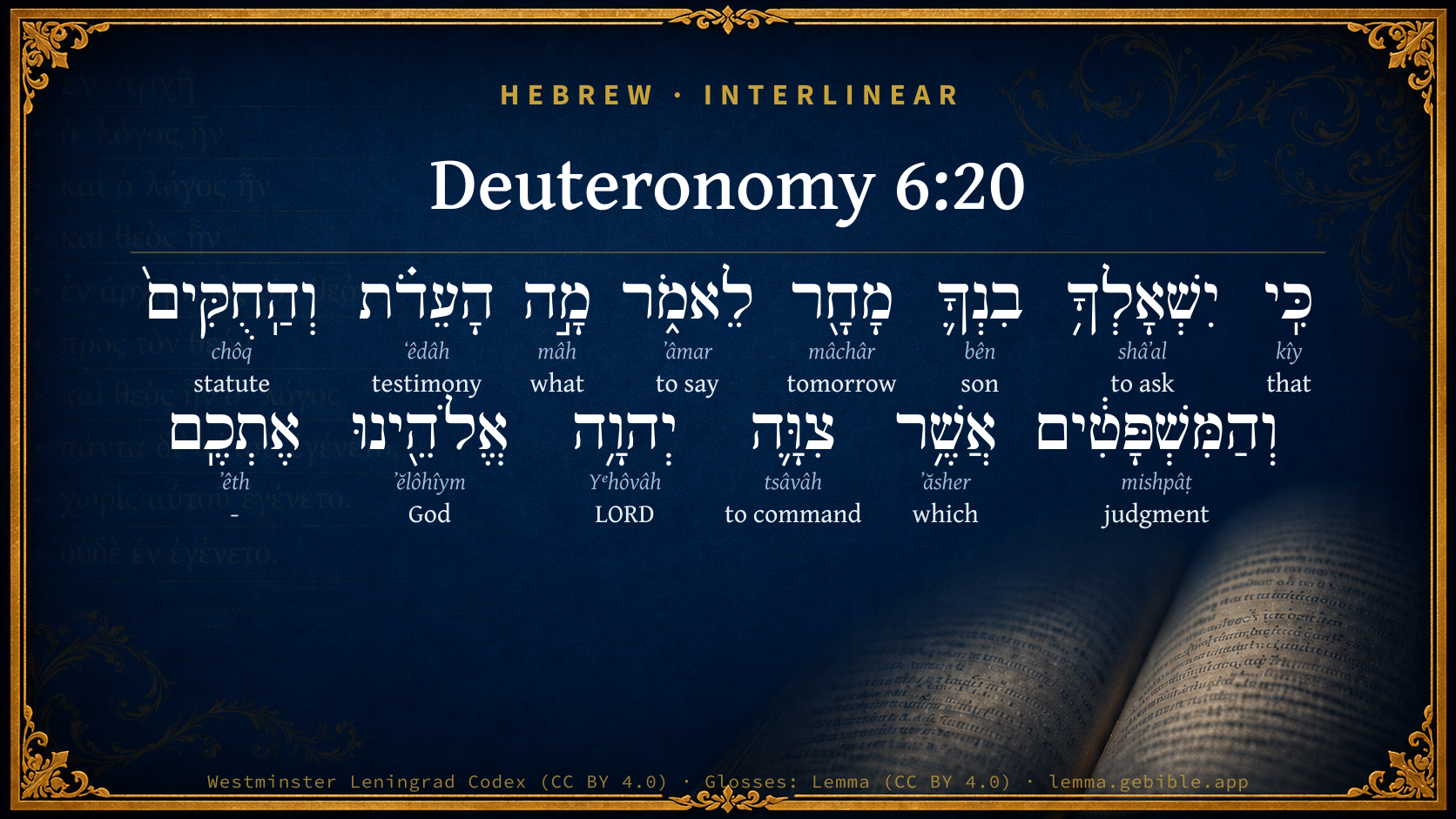
Hebrew (Westminster Leningrad Codex) Deuteronomy 6:20 appears in the Hebrew Old Testament. The text above is from the Westminster Leningrad Codex. Each word links to its Strong’s number, a concise gloss, and parsing drawn from the Open Scriptures Hebrew Bible morphology. Click any word for its full Brown-Driver-Briggs (BDB) entry.
Download image
Cite this verse

Deuteronomy 6:20 (World English Bible). Public Domain. Lemma interlinear Bible study tool, https://lemma.gebible.app/v/deuteronomy/6/20.

Show BibTeX & RIS
BibTeX
RIS
English Translation
When your son asks you in time to come, saying, What mean the testimonies, and the statutes, and the ordinances, which Yahweh our God has commanded you?
World English Bible · Public Domain
Download a study sheet

One document with this verse’s original text, its word-by-word gloss line, the meaning frame, cross-references with their text, attributed commentary, and full source and license credits — printable, and it pastes into notes with its structure intact.

This verse Autodidact and up

Study sheet (.html) Plain text (.txt)

A passage Seminary Student

Up to 50 verses in one chapter. A passage sheet keeps up to 6 commentary sources and 12 cross-references per verse, in the order this page ranks them, and says so on the sheet whenever that leaves anything out. Ask for a single verse and you get the Autodidact verse sheet above.

Everything on this page stays free to read, with no account — the sheet is a download of what is already on screen, not access to it.

Want to remove ads? Support Godless Engineer
Compare translations 3

The same verse in 3 English versions, stacked beneath the original-language interlinear above. Click any original word for its lexicon entry.

Each is an independent rendering of the whole verse — the interlinear is not word-aligned to these translations.

Highlighted words mark where these versions differ — a whole-verse word diff, not a word-by-word alignment.

  • World English Bible Public Domain
    When your son asks you in time to come, saying, What mean the testimonies, and the statutes, and the ordinances, which Yahweh our God has commanded you?
  • King James Version Public Domain
    And when thy son asketh thee in time to come, saying, What mean the testimonies, and the statutes, and the judgments, which the LORD our God hath commanded you?
  • unfoldingWord Literal Text CC BY-SA 4.0
    When your son asks you tomorrow, saying, ‘What the testimonies and the statutes and the ordinances that Yahweh our God commanded you?’

unfoldingWord Literal Text — © unfoldingWord, licensed CC BY-SA 4.0. Word-aligned USFM3 via Door43 (git.door43.org/unfoldingWord/en_ult).

Versions to compare (up to 4)

3 of 4 selected

Show all 18 translations

Every available English version of this verse, each an independent rendering of the whole verse.

  • World English Bible Public Domain
    When your son asks you in time to come, saying, What mean the testimonies, and the statutes, and the ordinances, which Yahweh our God has commanded you?
  • Berean Standard Bible Public Domain
    In the future, when your son asks, “What is the meaning of the decrees and statutes and ordinances that the LORD our God has commanded you?”
  • Majority Standard Bible Public Domain
    In the future, when your son asks, “What is the meaning of the decrees and statutes and ordinances that the LORD our God has commanded you?”
  • King James Version Public Domain
    And when thy son asketh thee in time to come, saying, What mean the testimonies, and the statutes, and the judgments, which the LORD our God hath commanded you?
  • American Standard Version (1901) Public Domain
    When thy son asketh thee in time to come, saying, What mean the testimonies, and the statutes, and the ordinances, which Jehovah our God hath commanded you?
  • Revised Version (1885) Public Domain
    When thy son asketh thee in time to come, saying, What mean the testimonies, and the statutes, and the judgments, which the LORD our God hath commanded you?
  • Geneva Bible (1599) Public Domain
    When thy sonne shall aske thee in time to come, saying, What meane these testimonies, and ordinances, and Lawes, which the Lord our God hath commanded you?
  • Douay-Rheims (1899) Public Domain
    And when thy son shall ask thee to morrow, saying: What mean these testimonies, and ceremonies and judgments, which the Lord our God hath commanded us?
  • Young's Literal Translation Public Domain
    `When thy son asketh thee hereafter, saying, What `are' the testimonies, and the statutes, and the judgments, which Jehovah our God hath commanded you?
  • Literal Standard Version CC BY-SA 4.0
    When your son asks you hereafter, saying, What [are] the testimonies, and the statutes, and the judgments which our God YHWH has commanded you?
  • Unlocked Literal Bible CC BY-SA 4.0
    When your son asks you in time to come, saying, 'What are the covenant decrees, the statutes, and the other decrees that Yahweh our God commanded you?'
  • unfoldingWord Literal Text CC BY-SA 4.0
    When your son asks you tomorrow, saying, ‘What the testimonies and the statutes and the ordinances that Yahweh our God commanded you?’
  • Darby Bible Public Domain
    When thy son shall ask thee in time to come, saying, What are the testimonies, and the statutes, and the ordinances, which Jehovah our God hath commanded you?
  • World Messianic Bible Public Domain
    When your son asks you in time to come, saying, “What do the testimonies, the statutes, and the ordinances, which the LORD our God has commanded you mean?”
  • Webster's Bible Public Domain
    And when thy son shall ask thee in time to come, saying, What mean the testimonies, and the statutes, and the judgments, which the LORD our God hath commanded you?
  • Free Bible Version CC BY-SA 4.0
    In the future, when your children come and ask you, “What's the point of decrees and rules and regulations that the Lord our God ordered you to follow?”
  • Bible in Basic English Public Domain
    And when your son says to you in time to come, What is the reason for these rules and laws and decisions which the Lord our God has given you?
  • JPS Tanakh (1917) Public Domain
    When thy son asketh thee in time to come, saying: 'What mean the testimonies, and the statutes, and the ordinances, which the LORD our God hath commanded you?

Literal Standard Version (2020), Covenant Press — licensed CC BY-SA 4.0. Text via the HelloAO Bible API (eBible.org). Unlocked Literal Bible (unfoldingWord) — licensed CC BY-SA 4.0. Text via the HelloAO Bible API (eBible.org). unfoldingWord Literal Text — © unfoldingWord, licensed CC BY-SA 4.0. Word-aligned USFM3 via Door43 (git.door43.org/unfoldingWord/en_ult). Free Bible Version, Dr. Jonathan Gallagher — licensed CC BY-SA 4.0. Text via the HelloAO Bible API (eBible.org).

Word by word

More ways to search: Search by grammar → Find every occurrence → Compare this word →

Practice this passage: Drill this verse → Learn its vocabulary →

הָעֵדֹ֗ת
ʻêdâh
H5713
“the · testimonies”
Particle, Definite Article + Noun, Common, Feminine, Plural, Absolute
Part of Speech
Particle + Noun
Type
Common
Gender
Feminine
Number
Plural
State
Absolute
Full BDB Definition

Origin: from H5707 in its technical sense

TWOT: 1576c , 1576e

testimony, witness - always plural and always of laws as divine testimonies
  1. כִּֽי kîy H3588 “that” Conjunction
  2. יִשְׁאָלְךָ֥ shâʼal H7592 “to ask · you” Verb, Qal, Imperfect, 3rd Person, Masculine, Singular + Suffix, Personal, 2nd Person, Masculine, Singular
  3. בִנְךָ֛ bên H1121 “son · your” Noun, Common, Masculine, Singular, Construct + Suffix, Personal, 2nd Person, Masculine, Singular
  4. מָחָ֖ר mâchâr H4279 “tomorrow” Noun, Common, Masculine, Singular, Absolute
  5. לֵאמֹ֑ר ʼâmar H559 “to say” Preposition + Verb, Qal, Infinitive Construct
  6. מָ֣ה mâh H4100 “what” Particle, Interrogative
  7. וְהַֽחֻקִּים֙ chôq H2706 “and · the · statutes” Conjunction + Particle, Definite Article + Noun, Common, Masculine, Plural, Absolute
  8. וְהַמִּשְׁפָּטִ֔ים mishpâṭ H4941 “and · the · judgments” Conjunction + Particle, Definite Article + Noun, Common, Masculine, Plural, Absolute
  9. אֲשֶׁ֥ר ʼăsher H834 “which” Particle, Relative
  10. צִוָּ֛ה tsâvâh H6680 “to command” Verb, Piel, Perfect, 3rd Person, Masculine, Singular
  11. יְהוָ֥ה Yᵉhôvâh H3068 “LORD” Noun, Proper
  12. אֱלֹהֵ֖ינוּ ʼĕlôhîym H430 “God(s) · our” Noun, Common, Masculine, Plural, Construct + Suffix, Personal, 1st Person, Common, Plural
  13. אֶתְכֶֽם ʼêth H853 “- · you” Particle, Direct Object + Suffix, Personal, 2nd Person, Masculine, Plural

About this verse

These counts appear in no published source. They are computed here, from the morphology-tagged text and Lemma’s own curated glosses. What Lemma adds →

14
words
14
distinct lemmas
Pentateuch
section

Shared distinctive vocabulary

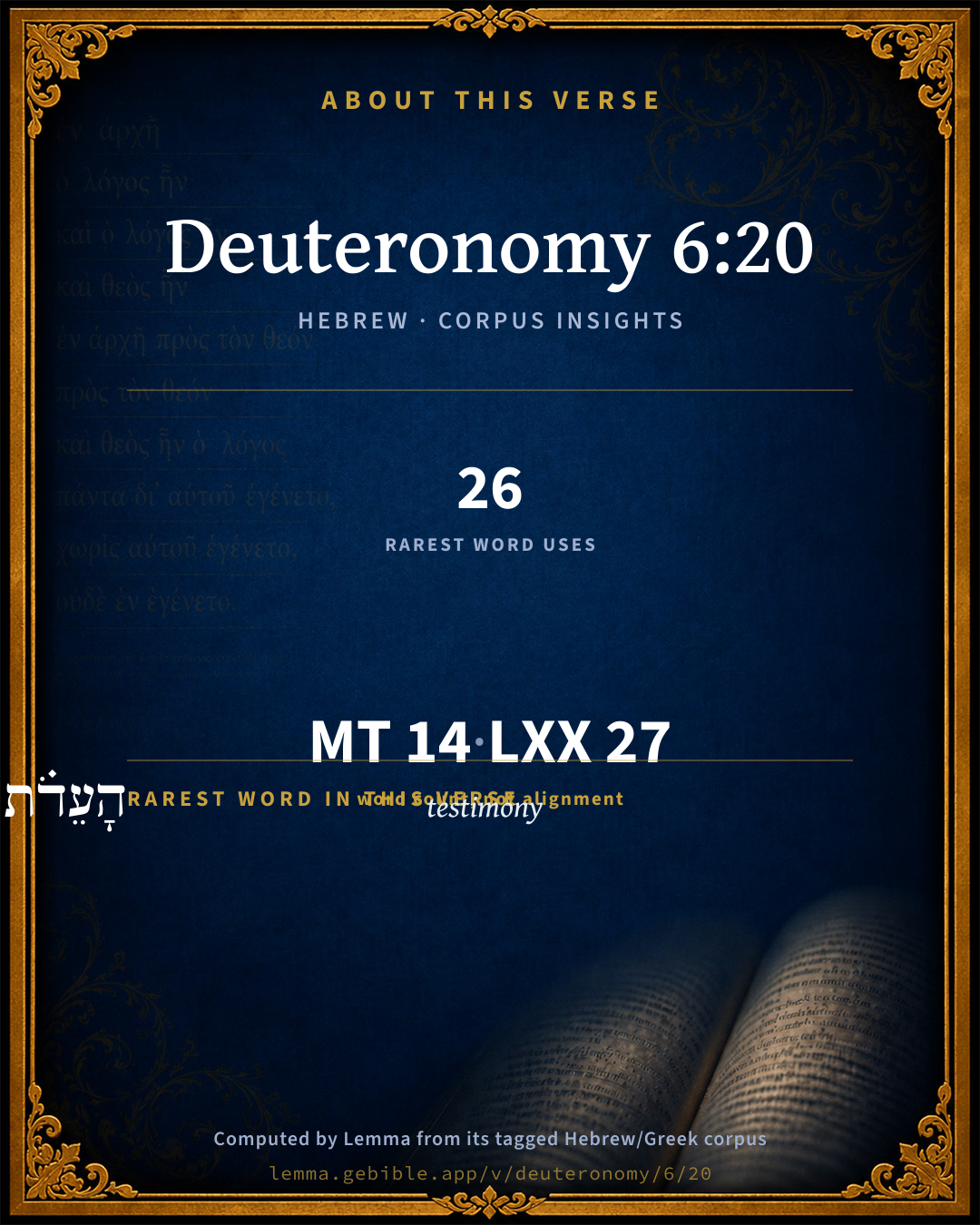
הָעֵדֹ֗ת testimony H5713 occurs in 25 verses of the Hebrew Bible. Also found in:

Grammatical profile

  • 3 verbs
  • 7 nouns
  • 1 conjunction
  • 3 particles

Verb forms

  • יִשְׁאָלְךָ֥ Qal · Imperfect
  • לֵאמֹ֑ר Qal · Infinitive Construct
  • צִוָּ֛ה Piel · Perfect

Hebrew & Septuagint length

In English translation the verse runs 27 words from the Hebrew and 35 from the Septuagint (LXX English) — closely comparable.

A rough comparison of the two English renderings, which tokenize alike — not a word-level alignment.

Word counts can differ between the Hebrew and the Greek without any difference in meaning — e.g. the Hebrew direct-object marker אֵת has no separate Greek word, and Greek often adds the article ὁ.

In the original languages it is 14 Hebrew tokens and 27 Greek tokens — but the two are counted differently (Hebrew bundles its prefixes and suffixes into one token; the Greek is in lemma form), so that isn’t a like-for-like length.

Cross-references

5

Topical passages linked to Deuteronomy 6:20 in the Treasury of Scripture Knowledge — connected by theme and wording, ordered by reader-vote popularity; previews shown in the World English Bible.

  • Exodus 13:14 It shall be, when your son asks you in time to come, saying, 'What is this?' that you shall tell him, 'By strength of hand Yahweh brought us out from Egypt, from the house of bondage;
  • Exodus 12:26 It will happen, when your children ask you, 'What do you mean by this service?'
  • Joshua 4:6–7 that this may be a sign among you, that when your children ask in time to come, saying, What do you mean by these stones?
  • Joshua 4:21–24 He spoke to the children of Israel, saying, When your children shall ask their fathers in time to come, saying, What mean these stones?
  • Deuteronomy 6:7 and you shall teach them diligently to your children, and shall talk of them when you sit in your house, and when you walk by the way, and when you lie down, and when you rise up.

Cross-references courtesy of OpenBible.info (CC BY 4.0).

Hebrew and Greek witnesses Masoretic Hebrew ↔ Greek Septuagint

The same verse in the two great witnesses to the Old Testament, shown verse-for-verse.

These are two independent witnesses, not word-aligned to each other, and the Septuagint is shown in lemma (dictionary) form.

Hebrew Deuteronomy 6:20 Masoretic · Westminster Leningrad Codex

כִּֽי יִשְׁאָלְךָ֥ בִנְךָ֛ מָחָ֖ר לֵאמֹ֑ר מָ֣ה הָעֵדֹ֗ת וְהַֽחֻקִּים֙ וְהַמִּשְׁפָּטִ֔ים אֲשֶׁ֥ר צִוָּ֛ה יְהוָ֥ה אֱלֹהֵ֖ינוּ אֶתְכֶֽם

When your son asks you in time to come, saying, What mean the testimonies, and the statutes, and the ordinances, which Yahweh our God has commanded you?

World English Bible · Public Domain

Greek LXX Deuteronomy 6:20 Septuagint · lemma form

καί εἰμί ὅταν ἐρωτάω σύ ὁ υἱός σύ αὔριον λέγω τίς εἰμί ὁ μαρτύριον καί ὁ δικαίωμα καί ὁ κρίμα ὅσος ἐντέλλομαι κύριος ὁ θεός ἐγώ ἐγώ

And it shall come to pass when your son shall ask you at a future time, saying, What are the testimonies, and the ordinances, and the judgments, which the Lord our God has commanded us?

LXX2012 (modern English Septuagint) · Public Domain

On this verse, The Cambridge Bible for Schools and Colleges discusses the Septuagint’s reading. Read the note in Commentary ↓

Hebrew: Westminster Leningrad Codex (CC BY 4.0). Greek: Septuagint (public domain); English from LXX2012 (modern English Septuagint) (Public Domain). How the Septuagint differs from the Hebrew →

Targum (Aramaic paraphrase)

2

The Targum is the ancient Jewish Aramaic paraphrase of the Hebrew Scriptures — an interpretive translation, not the Hebrew text itself. Onkelos (literal) and Pseudo-Jonathan (expansive) render the Torah, and Jonathan the Prophets. Coverage is partial: where no permissively-licensed English translation exists for a verse, only the Aramaic is shown. This is verse-level text, not a word-by-word alignment to the Hebrew.

  1. Targum Onkelos Torah (Genesis–Deuteronomy)
    אֲרֵי יִשְׁאֲלִנָךְ בְּרָךְ מְחָר לְמֵימָר מָא סָהֶדְוָתָא וּקְיָמַיָא וְדִינַיָא דִי פַקִיד יְיָ אֱלָהָנָא יָתְכוֹן

    (no public-domain English translation for this verse)

    Targum Onkelos — Aramaic: “Onkelos Genesis” (public domain); “Onkelos Exodus” (public domain); “Onkelos Leviticus” (public domain); “Onkelos Numbers” (public domain); “Onkelos Deuteronomy” (public domain). English: “Sefaria Community Translation” (CC0 1.0 (public-domain dedication)); “J.W. Etheridge. The Targums of Onkelos and Jonathan Ben Uzziel on the Pentateuch. London: Longmans, Green, 1862” (public domain). Text via Sefaria.

  2. Targum Pseudo-Jonathan Torah (Genesis–Deuteronomy)
    אֲרוּם יְשַׁיְילִינָךְ בְּרָךְ מְחַר לְמֵימָר מַה סְהִידְוָותָא וּקְיָימַיָא וְדִינַיָא דְפַקֵּיד יְיָ אֱלָהָנָא יַתְכוֹן

    When thy son, in time to come, shall ask thee, saying, What are the testimonies, statutes, and judgments which the Lord our God hath commanded you?

    Targum Pseudo-Jonathan — Aramaic: “Targum Jonathan on Genesis” (public domain); “Targum Jonathan on Exodus” (public domain); “Targum Jonathan on Leviticus” (public domain); “Targum Jonathan on Numbers” (public domain); “Targum Jonathan on Deuteronomy” (public domain). English: “The Targum of Jonathan ben Uzziel, trans. J. W. Etheridge, London, 1862” (public domain). Text via Sefaria.

Commentary

Notes on Deuteronomy 6:20 from classic Christian and Jewish commentators (each source and its license shown beneath its notes). The classic Christian expositions comment on the surrounding passage and are grouped to its opening verse, so a note may address several verses; the Jewish commentaries on the Tanakh (Rashi and others) are per-verse, so they appear only where the commentator wrote on this verse.

Lemma curates 59 commentaries, every one of them public domain or Creative Commons licensed, each selected and text-cleaned for this edition rather than reprinted as found. About our sources →

Trapp's Complete Commentary

John Trapp

Deu 6:20 [And] when thy son asketh thee in time to come, saying, What [mean] the testimonies, and the statutes, and the judgments, which the LORD our God hath commanded you?

Ver. 20. What mean the testimonies?] Here we have a brief catechism, which is a course and practice of singular profit. Luther scorned not to profess himself discipulum catechismi: and the Jesuits, by the example of our churches, do catechise their novices.

John Trapp, A Commentary or Exposition upon All the Books of the Old and New Testament (1647–1656) — public domain. Text from a community e-Sword module.

The Biblical Illustrator

Joseph S. Exell

Deu_6:20-21

When thy son asketh thee.

Remembrances of holy privileges

We are also favoured with Divine ordinances, as were the Israelites; and for the same purpose, for a pious testimony to keep alive upon the earth a remembrance of Gods surpassing love. As to them pertained the adoption and the glory and the covenants and the giving of the law and the service of God and the promises, so to us pertain the gracious promises of life and salvation, and all the privileges and ordinances of the Christian covenant. So that when children, as reason begins to dawn, and they find themselves growing up amid certain religious ordinances, shall ask the meaning, we may always be able to point, with humble gratitude, to the origin and intent of every duty and service. The lisping babe is given to hear, perchance is taught to sing, of the cross which was traced on its forehead in infancy; and the pious mother is asked, What did it signify? She will point with tenderness to the Cross of Christ, to the sacrifice of the spotless Lamb; and the holy emblem, thus stamped upon the youthful mind and heart, may be there forever fixed by the Holy Spirit of God, as a living image of the truth in Jesus, as an everlasting memorial of His dying love. The child lifts up its hands in prayer; and wherefore lifted up? To its Father in heaven; to the mercy seat at which a Saviour pleads; and from which the Holy Spirit, with His manifold gifts, is sent down, gifts for childhood and youth, for manhood and age: and this in obedience to that Saviours word (Mat_7:7; Joh_14:13; Joh_15:16). The child learns to read; the Bible is opened; and every page is fraught with grace, is glowing with mercy. Here are tender invitations which the youngest can understand and feel. And thus our youth have in their hand a constant remembrancer of God Almightys goodness; the Word written by the Spirit, and taught by the Spirit, to each obedient heart of old and young. The points are but few, respecting children, upon which we can now touch; but there is yet another, which marks rather the transition state between the child and the man, at least where greater responsibility beans. The children of the Church are brought to the bishop to be confirmed and here is a mighty memorial. All the privileges of holy baptism are then placed in view, and impressed powerfully on the heart. And over the whole of our Christian life and walk the tokens and reminiscences of Gods goodness are plentifully spread; in all our Divine ordinances and services, and in all our providential experiences. Every Sabbath, what a blessed memorial! How does it remind us of the great Creator, and of His resting from all His works! how of our own rest in Him and in heaven! There is likewise that holy rite and service which the Lord Himself appointed with His dying breath as the sacramental emblem of His love. This is the most perfect of all the testimonies: a perpetual representation of the sacrifice before the Church, for the benefit of the faithful, for the conviction of all; a perpetual application of it, through the power of the Spirit, to the believers heart and soul. And our faithful Church, in all her constitution and services, has acted upon this monitory plan; has sought to stir up continually the pure minds (of her children) by way of remembrance; and to keep the wonders of Divine grace, one after another, always before our eyes. At various seasons of the year she sets before us the marvellous acts of redeeming love, all that Jesus has done and suffered on our behalf: the mystery of His holy incarnation; His holy nativity and circumcision; His baptism, fasting, and temptation; His agony and bloody sweat; His cross and passion; His precious death and burial; His glorious resurrection and ascension, and the coming of the Holy Ghost. And besides her faithful dealing on these great occasions, she is continually bringing to view other objects also, other tokens of love, other means of grace, of high importance to be borne in mind and diligently observed. The lives and deaths of her apostles and martyrs are set in order, as so many patterns of righteousness, so many beacons of grace, etc. And there are other dealings of God with us to be treasured in the memory; the mercies of His providence and of His grace experienced in our own persons. We have been cast on a bed of sickness; who raised us up? in danger, who delivered us? in the deep of affliction, who sent the Comforter? We have sinned: we have been alarmed; we repented, prayed, promised, and were spared; and should not that holy season, should not all these days of grace, be kept in mind? Let us not unfrequently shut up the busy present, and muse upon the solemn past. God give us grace to deal faithfully; to prize the privileges, to look upon the blessings showered down upon us, to keep them in grateful remembrance, and so fix our affections upon the one thing needful. (J. Slade, M. A.)

Questions and answers

Suppose that one wholly uninstructed as to Christian faith and doctrine and practice should ask us--What mean ye?--account for yourselves; what are you doing? and why do you act as you do?--it would be pitiful to the point of unpardonableness if in the presence of such an inquiry we were dumb; our speechlessness would show that our piety is a mere superstition. It is surely, therefore, incumbent upon us to be able to give some reason or explanation for the faith and the hope that are in us. We cannot adopt a better reply than the answer suggested by Moses. No originality of answer is required. The leader of Israel gave the only reply that will stand the test of reason and the wear and tear of time. All we need is in this paragraph. Adopting this reply, what answer should we make to the kind of inquirer now supposed? We should, first of all, make the answer broadly historical. We are not called to invention, or speculation, or the recital of dreams: we do not want any mans impressions as a basis of rational and universal action; we call for history, facts, realities, points of time that can be identified, and circumstances that can be defined and have a determinate value fixed upon them. We could enlarge the answer which Israel was to give, and ennoble it. We, too, were in a house of bondage. That must be our first point. The house was dark; the life of the prison was intolerable; no morning light penetrated the dungeon; no summer beauty visited the eyes of those who were bound in fetters. Human nature had gone astray. The Christian argument starts there. All Christian doctrine is founded upon that one fact, or bears direct and vital relation to it. We, too, could add with Israel, human nature was Divinely delivered. The action began in heaven. No mans arm delivered us; no mans eye could look upon us with pity that was unstained and unenfeebled by sin. Gods eye pitied; Gods arm was outstretched to save. Then we could change, but their inner meaning is an eternal truth: it abides through all the ages, for every purpose of God in the miracles which were wrought was a purpose of life, growth, holiness, transformation into His own image. The purpose is in reality the miracle. That being so, the miracles never cease, for today the Gospel performs nothing less than the miracle of making the dead live, and the blind see, and the dumb speak in new and beauteous eloquence. In the next place, still following the idea laid down by Moses, we must make this answer definitely personal:--thou shalt say unto thy son (Deu_6:21). Speak about yourselves, about your own vital relation to the historical facts. The history is not something outside of you and beyond you: it is part and parcel of your own development, and your development would have been an impossibility apart from the history; let us, therefore, know what this history has done for you. The answer will be poor if it be but a recital of circumstances and occurrences and anecdotes--a vague, although partially reverent, reference to ancient history. The man who speaks must connect himself with the thing which is spoken. The answer is still incomplete. It is broadly historical, and therefore can be searched into by men who care for letters and events and ancient occurrences; the answer is definitely personal, and therefore the character of the witness has to be destroyed before any progress can be made with his particular view of the history; now the answer must, in the third place, be made vitally experimental. The twenty-fifth verse thus defines this conclusion: And it shall be our righteousness, if we observe to do all these commandments before the Lord our God, as He hath commanded us. One targum says, it shall he our merit. The general meaning would seem to be--it shall be accounted unto us for righteousness: the attention and the service shall not be disregarded or put down into any secondary place, but what we do in the way of attention and observance and duty and service shall be reckoned unto us as a species of righteousness. What is the meaning to us in our present state of education and our present relations to one another? The meaning is that out of the history and out of the present relations to that history there will come a quantity which is called character. God is all the while forming character. His object has been to do us good always, that He might preserve us alive, as it is at this day. Without the righteousness where is the history? Without the character what is the value of our personal testimony? We may be speaking from a wrong centre--from mental invention, from intellectual imagination, from spiritual impulse, from moral emotion; we may not be standing upon vital facts and spiritual realities. The outcome, then, is righteousness, character, moral manhood, great robustness and strength, and reality of life. The Christian mans history is to himself worthless if it be not sealed by character. (J. Parker, D. D.)

Childrens questions

Children often break upon their parents with very tough questions, and questions that wear a considerable looking towards infidelity. It requires, in fact, but a simple child to ask questions that no philosopher can answer. Parents are not to be hurried or flurried in such cases, and make up extempore answers that are only meant to confuse the child, and consciously have no real verity. It is equally bad if the child is scolded for his freedom; for what respect can he have for the truth when he may not so much as question where it is? Still worse, if the childs question is taken for an evidence of his superlative smartness, and repeated with evident pride in his hearing. In all such cases a quiet answer should be given to the childs question where it can be easily done, and where it cannot, some delay should be taken, wherein it will be confessed that not even his parents know everything. Or, sometimes, if the question is one that plainly cannot be answered by anybody, occasion should be taken to show the child how little we know, and how many things God knows which are too deep for us--how reverently, therefore, we are to submit our mind to His, and let Him teach us when He will what is true. It is a very great thing for a child to have had the busy infidel lurking in his questions, early instructed in regard to the necessary limits of knowledge, and accustomed to a simple faith in Gods requirement, where his knowledge fails. (H. Bushnell.)

Let the Bible speak

The mother of a family was married to an infidel, who made a jest of religion in presence of his own children; yet she succeeded in bringing them all up in the fear of the Lord. I one day asked her how she preserved them from the influence of a father whose sentiments were so openly opposed to her own. She answered: Because to the authority of a father I did not oppose the authority of a mother, but that of God. From earliest years my children have always seen the Bible upon the table. This Holy Book has constituted the whole of their religious instruction. I was silent that I might allow it to speak. Did they propose a question; did they commit any fault; did they perform any good action; I opened the Bible, and the Bible answered, reproved, or encouraged them. The constant reading of the Scriptures has alone wrought the prodigy which surprises you. (A. Monod.)

The significancy of the Jewish passover

The ordinances of Israel were the ordinances of a redeemed people, and they were the signs and memorials of the fact of their redemption. Selecting the passover, then, as the most prominent of these ordinances, let us inquire what it was designed to teach.

1. In the first place, we see in it a memorial of Divine sovereignty. Could the Jew look back upon the history of his forefathers, and doubt that it was not their own might nor their own wills that carried them forth from the land of tears?

2. Again, we see in it a memorial of Divine goodness and truth. It was a promise that God would not forget, that Abrahams seed should inherit the land of Canaan; and now that he was in possession of all this, was it not well that Abrahams child should be reminded of what had been done for him? In the passover, then, he learned how true and gracious the Lord had been to him and to his fathers. What would he trace but mercy and faithfulness in all His ways?

3. These were the aspects of the ordinances as they looked Godward; but there were others which reminded him of his own personal position. Could the Jew, for example, forget the Egyptian yoke, as he stood up, year after year, his loins girded and staff in hand, to eat the Lords passover? Is it not a little remarkable, that though they have lost the Sacrifice, this is the only ordinance the Jews celebrate to this day? Even in a strange land, and at such an interval of time, they fail not to call to remembrance the bondage of Pharaoh. How often does God set this before His people in the course of His dealings with them! Thou wast a servant in the land of Egypt. He frequently reminds them. He would have kept them in a due subordination, that they might not be lifted up to their own destruction.

4. But we see in the passover, lastly, a memorial of present deliverance. As long as the Jew could celebrate it in his own land, he was reminded of his deliverance from Egypt. In this respect the redemption of Israel from the house of bondage has been always a present blessing. As a nation, and therefore as a type of the Christian Church, they have never been enslaved a second time in Egypt. Once delivered, they were delivered forever from that bondage. Most truly, therefore, could the Jewish parent teach his son--We were Pharaohs bondmen in Egypt. That was a past history of terrible suffering and disgrace, and the remembrance of it could call up nothing in the heart of a faithful Jew but thankful, peaceful joy. The passover, consequently, was eminently a joyous festival; it was a feast upon a sacrifice; it was a celebration of Divine mercies, and of the entire destruction of the Egyptian yoke. And is not the Christian ordinance and history a counterpart of this? (W. Harrison, M. A.)

The Lord brought us out of Egypt.--

Deliverance from Egypt

It has been said that the earth is but the shadow of heaven, and that things therein are each to other like, more than on earth is thought. This may be a great truth, for in the Scriptures earthly things are used as types and symbols of heavenly. It is so in the words that I have read to you. Egypt was the symbol of captivity, darkness, and death; and the land of promise, the type of heaven, where there is freedom, light, and life without end. And so, the deliverance of the Israelites out of the bondage of Egypt by the mighty hand of God, and their entrance into the land of Canaan, are typical of our deliverance from the bondage of sin and the devil, and entrance into the kingdom of heaven, through Jesus Christ our Saviour. Hence we shall consider these words: first in their literal sense; and, secondly, in their spiritual meaning.

I. First, we shall consider these words in their literal sense. Nearly four thousand years ago, a period soon after the deluge, Egypt appears to have had its kings and princes, and to have been great as a kingdom of this world. Nor is it only remarkable for its antiquity, but also for its physical phenomena, its worldly wisdom, its idolatry, and its monuments. It was peopled by the descendants of Ham, and was dedicated to him, and therefore, from the earliest times, in the hieroglyphics and Scripture, it was called the land of Ham. Now Ham, as a deity, was reverenced as the sun, and no doubt he was the sole introducer of the worship of the sun after the deluge. That Egypt was addicted to sun-worship there can be no doubt; for it is not only seen in the hieroglyphics or sacred writings, but also by means of several of its most ancient names. The theology of Egypt, however, being so closely connected with astronomical principles, underwent as many changes as the planets themselves. Hence it is that there are so many and various opinions upon it. One thing is clear, that they paid great honours to brute animals, and employed them as representatives of their deities. Thus God manifested His power, and mercy, and faithfulness. His power in delivering a defenceless people from the oppression of one of the greatest military nations of the ancient world; and His mercy in giving them the land of Canaan; and His faithfulness in performing the oath which He sware unto Abraham, that He would give them.

II. We shall now consider the spiritual meaning of the words of our text. And here it will assist us very much to know that Egypt had several names; and we have found, after much research, that under whatever name we contemplate this land of spiritual darkness, we perceive the same root and source of post-diluvian idolatry--Ham associated with the sun; and along whatever line we pursue our investigations in the etymology of this land of spiritual wickedness, we arrive at the same goal. Here let us learn a lesson on worldly wisdom and human power.

1. Egypt was the mother of learning and of gross idolatry; of worldly light and spiritual darkness. It was sacred for a time to the physical sun, the source of light and life in the natural world; but it will be forever an emblem of darkness and death. It reared its pyramidical temples to the sun, symbolising its worldly greatness and light; but it was as full of darkness and dead mens bones as the pyramids themselves. In human language, Egypt, with its various names, means light; in the language of heaven, darkness; in the language of earth, life and fruitfulness; but in the language of heaven, death and corruption. Hence it is that Egypt in the Scriptures symbolises the present world. It was the source of worldly wisdom and gross idolatry. The Egyptians, professing themselves to be wise, became fools; for the wisdom of this world is foolishness with God. We read the wisdom of this world in the ruins of Egypt, Assyria, Palestine, Greece and Rome. The kingdoms of this world may build their nests in the rocks, as the Kenite of old; nevertheless they shall be wasted, and their palaces shall be for beasts to lie down in.

2. Egypt is synonymous with the world, and we know that the world is enmity against God. Let us, therefore, cast off the world, and its Egyptian darkness, and its enmity to God and truth. Let us turn from the world, so full of error, darkness, folly, and death; let us come out of it; let us walk worthy of our high calling; let us walk as children of light and children of the day. Now the deliverance of the Israelites from Egyptian bondage was typical of our deliverance from sin and Satan. We know very well how great the oppression of Egypt was. We know that their cries pierced the clouds, and found their way to the throne of God, and He came down to deliver them; and He accomplished this by His own power, and wisdom, and mercy, and gave them the land of Canaan, and a code of Divine laws. Now this faintly shadows forth the deliverance of all mankind from the slavery of sin and the devil, than which a more cruel slavery never oppressed the family of man. Our text admits a still higher development, namely, that the entrance of the Israelites into Canaan was typical of the entrance into heaven of all true believers. Of that glorious place, the brightest scenes of earth are but shadows dim and dark. The Israelite in Egypt never looked to the land of Canaan with the earnest longing of the disciples of Jesus for the heavenly Canaan; and why? Our title to it is clearer. It is our heavenly inheritance, purchased for us with the precious blood of Christ; and it is kept for us by the power of God through faith. We dwell on earth; but our heart and our life are there, hid with Christ in God. (A. Jones.)

The Biblical Illustrator, edited by Joseph S. Exell (c. 1880s–1900s) — public domain. Text from a community e-Sword module.

Keil & Delitzsch

C. F. Keil & F. Delitzsch

In Deu 6:20-25, the teaching to the children, which is only briefly hinted at in Deu 6:7, is more fully explained. The Israelites were to instruct their children and descendants as to the nature, meaning, and object of the commandments of the Lord; and in reply to the inquiries of their sons, to teach them what the Lord had done for the redemption of Israel out of the bondage of Egypt, and how He had brought them into the promised land, and thus to awaken in the younger generation love to the Lord and to His commandments. The "great and sore miracles" (Deu 6:22) were the Egyptian plagues, like מפתּים, in Deu 4:34. - "To fear," etc., i.e., that we might fear the Lord.

Keil & Delitzsch — Biblical Commentary on the Old Testament (1861–1891) — public domain (CC PDM 1.0). Text via the HelloAO Bible API. (Old Testament only.)

Geneva Bible (1599)

Geneva Bible translators

God requireth not only that we serve him all our life, but also that we take pains that our posterity may set forth his glory.

Geneva Bible (1599) marginal notes — public domain. Text via Bolls.life.

Jamieson, Fausset & Brown

Robert Jamieson, A. R. Fausset & David Brown

when thy son asketh thee in time to come, saying--The directions given for the instruction of their children form only an extension of the preceding counsels.

Next: Deuteronomy Chapter 7

Jamieson, Fausset & Brown — Commentary Critical and Explanatory on the Whole Bible (1871) — public domain (CC PDM 1.0). Text via the HelloAO Bible API.

Adam Clarke's Commentary

Verse 20. And when thy son asketh thee, &c.] "Here," as Mr. Ainsworth justly remarks, "followeth a brief catechism, containing the grounds of religion."

What mean the testimonies, &c.] The Hebrew language has no word to express to mean or signify, and therefore uses simply the substantive verb what is, i. e., what mean or signify, &c. The seven thin ears ARE, i. e., signify, seven years of famine. This form of speech frequently occurs.

Adam Clarke's Commentary on the Bible (1810–1826) — public domain. Text from a community e-Sword/MySword module.

Ellicott's Commentary for English Readers

(20) What mean the testimonies, and the statutes, and the judgments.—These three words appear for the first time together in the introduction to this discourse (Deu_4:45). The Law, or Torah, includes charges, and institutions, and requirements. The Decalogue itself is primarily the Torah; the charge which follows may come under the head of “testimony.” The “statutes” and “judgments” more properly describe the contents of the chapters from Deuteronomy 11-26 inclusive.

A Bible Commentary for English Readers, edited by Charles John Ellicott (1878–1897) — public domain. Text from a community e-Sword module.

The Cambridge Bible for Schools and Colleges

gen. ed. J. J. S. Perowne

20. When, etc.] Read, with Sam. and LXX, And it shall be when, as in the opening of Deu_6:10 and in Exo_13:14 (J), which the rest of this clause follows.

the testimonies … the statutes, and the judgements] as in Deu_4:45 q.v. With Sam. omit and before the statutes; the statutes and the judgements are the contents of the testimonies.

our God] For the reason of this instead of the usual Sg. thy God see on Deu_5:24.

hath commanded you] The perfect is natural to the time of the questioners’ generation, when the laws would already have been published. You (so Sam., but LXX us) is, of course, the older generations; this, therefore, is not an instance of the Pl. address.

20–25. These verses return to a favourite theme of Deut.: the close relation between Jehovah’s Laws and His Deeds. When a future generation shall ask the meaning of the Laws it shall be referred to the Lord’s deliverance of the nation from bondage in Egypt and His conduct of them to the land He promised. Having thus made them a nation, He would now preserve them as such by the Laws which He commands. These vv., throughout in the Sg., expand Deu_6:7 a, and contain nothing which leads us to doubt their originality. See on Deu_6:24.

The Cambridge Bible for Schools and Colleges (gen. ed. J. J. S. Perowne; Cambridge University Press, 1878–1918) — public domain. Text from a community e-Sword module.

John Gill's Exposition

And when thy son asketh thee in time to come,.... Or "tomorrow" (x); that is, in later times, as Jarchi interprets it; any time after this, and particularly after they were come into the land of Canaan, when the several laws, statutes, and ordinances appointed, would take place and be obeyed:

what mean the testimonies, and the statutes, and the judgments, which the Lord our God hath commanded you? what is the reason of the various rites, customs, and usages, the observance of which is directed to, such as the feasts of passover, pentecost, tabernacles, sacrifices, and other duties of religion?

(x) "cras", V. L. Pagninus, Montanus.

John Gill's Exposition of the Whole Bible (1746–1763) — public domain (CC PDM 1.0). Text via the HelloAO Bible API.

The Pulpit Commentary

Vers. 20-25. The injunction to teach the words of the Lord to the children (ver. 7) is here more largely explained. When asked by their sons the meaning and reason of the commandments and institutes which they observed, they were to show them what the Lord had done for his people in bringing them out of Egypt and establishing them in Canaan, and how he had enjoined on them all these statutes that they might fear Jehovah their God for their good always, and for their preservation and safety.

Vers. 20-25. The value of history in parental teaching.

The Bible is preeminently a family Book. Israel"s national life was supposed to find its centers of strength and permanence in godly homes. It would not be easy to find words which should overrate the importance of such a principle as this. That a young nation should at the outset of its existence have this laid down as a first law of its life: "The land will be as its homes are;" is an indication of the Divine guidance which was vouchsafed to him on whom, under God, the foundation of its national life depended. In the paragraph before us there are seven lines of thought suggested.

I AS YOUNG LIFE COMES NEWLY INTO BEING, IT FINDS ARRANGEMENTS IN LAW AND PRECEPT READY TO HAND. Parental life holds a great trust in charge, to be committed to those who shall come after; that though one generation passeth away and another cometh, there may be no break in the continuity of holy thinking and living, from age to age. The Hebrews had their Law, which, as a revelation from God, was in advance of aught possessed by the rest of the world, and in which was couched the germ of larger truth that was to follow. There might be more light thrown upon it; there was never to be a forfeiture of it. Hence there were special reasons why parents should guard it intact for all the ages that were to follow.

II YOUNG LIFE IS SUPPOSED TO BE AN INQUIRING LIFE. (Ver. 20.) It is not supposed that the children will lend themselves to either of two extremes: they will neither wildly tear up and obliterate "the old paths," nor will they walk in them heedlessly and without inquiry. The course here indicated is that which any sensible, well-disposed youth would naturally follow. He would ask," What mean," etc. However a spurious priesthood may demand a blind and uninquiring faith, the Word of God never does anything of the kind. Reason is made for reverent inquiry, but it may be neither deified nor stultified. And what can be more charming than the honest, eager inquisitiveness of the young, asking for the reasons which govern the faith and worship that they find at work before their eyes? Specially delightful is such inquiry, when the parent is well able to give his answer.

III THERE IS AWAITING THE YOUNG INQUIRER THE STORY OF A GREAT DELIVERANCE. (Vers. 21, 22.) The rescue from Egypt always formed the grand historic background of Israel"s life. (see Ps 78 Ps 99 Ps 105 Ps 106 Psa_103:7) Here was a disclosure of Divine love and care, the like of which had never been known. The great institution of sacrifice revealed provision for pardoning love. The precepts for the individual, the family, the nation, told what sort of a people God would have them be; while the oft-recurring strains, "I gave Egypt for thy ransom," "I brought thee up out of the land of bondage," would evoke all their national ardor, and create and foster a historic pride. The life-histories, too, of their fathers, Abraham, Isaac, and Jacob, would tell of the blessedness of having God as their God: and these, instilled into the heart with all the sweetness of fond parental love, would lead the young Israelite, when the teaching was sanctified by God"s grace, to say right joyously, "This God shall be my God forever and ever!" Yes! the young life ever coming on earth is not to be left to grope its way. The light from the past is to be handed down for the ages to come, that sire and son and son"s son may rejoice in the same God, and ensure a blessed continuity of holy faith and consecrated life.

IV THE GREAT DELIVERANCE WAS EFFECTED THAT THE RESCUED PEOPLE MIGHT RE A NEW NATION WORTHY OF GOD. Ver. 23, "That he might bring us in, to give us the land which he swore unto our fathers." And in this new relation they were to be witnesses for God. (Isa_43:10) They were to be a distinct, compact people,with faith, laws, and polity, higher than the rest of the world, holding in trust for mankind, till the fullness of times, much precious truth which was to find its outcome in a great, world-wide deliverance which should overshadow all; while the Israel of God was to merge into a spiritual Israel, made up of all who are Christ"s, known as a "peculiar people, zealous of good works.

V IN THIS CONTINUED LIFE, WORTHY OF GOD, WOULD THE JUSTIFICATION OF ISRAEL"S FAITH AND OBSERVANCES BE FOUND. "It shall be our righteousness," etc. (ver. 25). It is scarcely possible to regard these words as having reference to any doctrine of justification by faith; for though, even as far back as Abraham"s days, that was a doctrine, yet it was not formulated till the times of the gospel, by Paul. The meaning of the phrase seems to be: "This will be our justification of our position and claims; we claim to be a people of God, above all the nations that are on the face of the earth, and we shall vindicate that claim, not by words only, but by being what we profess to be." Thus would the parent quicken his child, and stimulate and inspire him to be all that his glorious faith bade him be unto the Lord his God!

VI IN THIS ARRANGEMENT, THE DIVINE BENEVOLENCE WAS AS MANIFEST AS GOD"S REGARD FOR HIS OWN HONOR. Ver. 24, "To fear the Lord our God, for our good always." The glory of God and the good of man are in harmony. So has God constructed the universe, so cloth he carry on his government, as to ensure that" they that honor him, he will honor." "All things work together for good to them that love God." "Great peace have they which love God"s Law; and nothing shall offend them." "Godliness is profitable unto all things." "Seek ye first the kingdom of God, and his righteousness; and all these things shall be added unto you.

VII NOT ONLY WOULD ISRAEL, BY OBEDIENCE, ENSURE ITS OWN GOOD, BUT ALSO ITS CONTINUANCE IN THE LAND. Ver. 24, "That he might preserve us alive." Repeatedly do we read that the prolongation of Israel"s days in the land depended on their loyalty to God. The land was given them, not for their own sakes merely, but for God"s. If they continued there, faithfully witnessing for him, the land would be continued to them; if not, they would have to quit, and give up the possession thereof to strangers. This is precisely the principle on which God governs the nations now. No nation can preserve itself in being by any other policy than that of obedience to God. Disloyalty to God and the right is the surest possible policy of decomposition. Even attempts at self-preservation which violate God"s laws will fail of their end. And is it not of vast significance that these are the principles by which the young life of a nation is to be molded? Whatever allowance must be made for changing circumstances, however true it may be that no nation now holds exactly the same place in the world that Israel did, yet it is also true that all the more substantial part of the seven lines of thought here indicated is unchanged and unchangeable. Christian parents are inheritors of the truth of God: they hold it in trust for their children: they, as they grow up, will inquire concerning it: its historic basis is the great deliverance effected by the Lord Jesus: Christians are now God"s peculiar people: they are redeemed that they may be holy, and that in holiness they may train succeeding generations: and just in proportion as through them loyalty to the truth and to God is leavening their posterity, are they bringing honor to the cause they espouse. Hebrews were to be conservative. Christians are to be also aggressive. We are to be the light of the world," and "the salt of the earth." By the light of God"s love we are to scatter men"s darkness, and by the salt of God"s truth are we to stay its corruption. And just so far as our nation is imbued with righteousness and truth, will it have within it the guarantee of its own perpetuation. The best defense is the armor of light. Without righteousness and the fear of God, not all the pretence and brag not all the fleets or armies at command, can ever guard a nation fromdecay. "If the salt have lost his savor... it is thenceforth good for nothing but to be cast out, and to be trodden under foot of men.

Vers. 20-25. The parental office.

In the Mosaic economy, the parental office is made prominent, and parental influence is pressed into service. All God"s arrangements for training mankind dovetail into one another.

I THE DUTY OF A PARENT TO PROVOKE RELIGIOUS INQUIRY. No greater folly can be perpetrated than the attempt to repress inquiry. Inquiry is the king"s highway to wisdom, and who dare block it up? God loves to hear honest inquiry. To afford instruction is the delight of the Divine Spirit, but what instruction will be valued if no spirit of inquiry is awake? Some questions which we ask can never be solved; they are beyond the range of the human mind. Some questions God will not answer, because they are vain and useless. But honest questions, with a view to practical obedience, God delights to hear. You can do the young no better service than encourage their minds to inquire after religious facts. "What mean these things?

II THE DUTY OF A PARENT TO ANSWER FULLY CHILDREN"S QUESTIONS. It is childish folly to attempt to conceal our lowly origin.

There is no real disgrace in an obscure parentage. To have been formerly enslaved, or imprisoned, or oppressed, through man"s injustice, is an honor, not a stigma of reproach. There is no real shame, except such as proceeds from wrong-doing. It will do us good, it will do our children good, to see the "rock whence we were hewn, the hole of the pit from which we were digged." It will foster humility, gratitude, contentment, trust. It will lead us afresh to adore the Divine goodness, and to count ourselves and our children the servants of this mighty God. Never let true Israelites forget that all they have they owe to God! Unto this state of happy privilege a Divine hand has brought us.

III THE DUTY OF A PARENT TO OPEN UP GOD"S BENEFICENT INTENTION. If any man is too indolent to investigate truth for his own sake, he may be provoked to do it for his children"s sake. We should have such a firm conviction that every arrangement and command of God was "for our good always," that we can demonstrate it to our children. Our knowledge of God and of his practical dealings should be so broad and clear that we might see and feel that his care for our good was paramount. This is the first and loftiest end he seeks not our enjoyment, but our good. Not to demonstrate his power, or his consistency, or his determination to conquer, these are not his foremost aims, but "our good always." His costliest deed of condescension was the yielding of his Son to death. And where shall we seek the moving principle? In his own future glory merely? No! In his love for the world! Yet his glory, and man"s real good, are but the separate threads that make one cord.

IV THE DUTY OF A PARENT TO PROMOTE HIS CHILDREN"S RIGHTEOUSNESS. "It shall be our righteousness, if we observe to do all these commandments." No more conclusive argument can parents use; no loftier end can they contemplate. To become righteous this is to be the lofty ideal we set before our children. But commensurate with the grand acquisition must be the care that we promote it by proper and practicable methods. It is impossible for guilty men to regain righteousness by their own efforts or merits. But real righteousness is provided for us by the bounty of God, and is offered to us in Christ as a free gift. "He hath brought in everlasting righteousness, which is for all and upon all that believe." Our ambition for our children must be the highest not that they be richly dowered, or learned, or placed in earthly rank, but that they may be internally and thoroughly righteous. D.

The Pulpit Commentary (1880–1919), ed. H.D.M. Spence-Jones & Joseph S. Exell — public domain. Text from a community e-Sword module.

unfoldingWord translationNotes

Door43 World Missions Community

General Information:

Moses continues to tell the people of Israel Yahweh's words as if the Israelites are one person. (See: Forms of You)

What are the covenant decrees ... commanded you

In this question the "covenant decrees" represent their meaning and purpose. AT: "What do the covenant decrees ... commanded mean to you" or "Why should you obey the covenant decrees ... commanded you" (See: Metonymy)

your son

This refers to the children of the adult people of Israel to whom Moses was speaking Yahweh's words.

with a mighty hand

Here "a mighty hand" refers to Yahweh's power. See how you translated this in Deuteronomy 4:34. AT: "with his mighty power" (See: Metaphor)

on all his house

Here the metonym "his house" refers to the people of Yahweh. AT: "on all of his people" (See: Metonymy)

before our eyes

Here the word "eyes" refers to the whole person. AT: "where we could see them" (See: Synecdoche)

might bring us in

The full meaning of this statement can be made explicit. AT: "might bring us into Canaan" (See: Assumed Knowledge and Implicit Information)

translationWords

son

covenant

decree

statute

Yahweh

command

Pharaoh

servant

Egypt

might

hand

miracle

house

oath

ancestor

unfoldingWord translationNotes — © Distant Shores Media and the Door43 World Missions Community, licensed CC BY-SA 4.0. Source: git.door43.org/Door43/en_tn.

Rashi

Rabbi Shlomo Yitzchaki (Rashi)

כי ישאלך בנך מחר WHEN THY SON ASKETH THEE — There is a usage of the word מחר that refers to a day that only comes after the lapse of some time (and this is so here, i.e. it here means “in time to come", not "to-morrow”) (Mekhilta).

Rashi on the Tanakh — English translations: “The Judaica Press complete Tanach with Rashi, translated by A. J. Rosenberg” (CC BY 4.0); “Pentateuch with Rashi's commentary by M. Rosenbaum and A.M. Silbermann, 1929-1934” (public domain); “The Metsudah Tanach series, Lakewood, N.J” (CC BY 4.0); and “The Book of Joshua, Metsudah Publications, 1997” (CC BY 4.0). Text via Sefaria.

Ramban (Nachmanides)

Rabbi Moshe ben Nachman (Ramban / Nachmanides)

WHEN THY SON ASKETH THEE IN TIME TO COME, SAYING: ‘WHAT MEAN THE TESTIMONIES, AND THE STATUTES, AND THE ORDINANCES etc.?’ The meaning thereof is that first he will ask, “These commandments called testimonies — to what do they testify?” For they are a memorial to His wonders and witnesses thereof, such as the Unleavened Bread, the Booth, the Passover, the Sabbath, the phylacteries, and the Mezuzah. [Then he will ask] “What are the statutes?,” for their reasons are hidden in the Torah. Of the ordinances he will inquire: “What are the ordinances that we enforce in these commandments — stoning him who does work on the Sabbath, burning him who has intercourse with a woman and her mother, and administering forty lashes to him who sows mixed seeds?” For the ordinances pertaining to the social order of countries — such as the laws of the ox, the pit, the guardians, and the rest of the laws of the Torah — are righteous and good, all that see them acknowledge them, [and of these they do not ask]. Now concerning the answer to this question, he commanded that we relate to the inquirer the whole subject of the exodus from Egypt, the intent thereof being as He stated in the Ten Commandments, Who brought thee out of the land of Egypt, directing us that we inform the inquiring son that the Eternal is the Creator [through Whom everything has come into existence] by His will and power, as has been made clear to us by the exodus from Egypt. This is the sense of the expression [And the Eternal showed signs …] ‘before our eyes,’ for it is we who know and are witnesses of the signs and wonders, for we saw there that the Eternal is our G-d, He is the G-d in heaven above and upon the earth beneath, and there is none else. All this was made known through the departure from Egypt, as I have explained in the first commandment. Thus it befits us to give honor to His Name, for He is our Creator, and [He] has magnified His mercy upon us, and He commanded us to do all these statutes mentioned in the testimonies, statutes, and ordinances [about which the son had asked]: to fear Him by performing [commandments known as] the testimonies which are a memorial to His wonders; for our good through performance of [commandments known as] the statutes for they are good, there being no statute which contains any evil, although their reasons have not been clarified to all people; that He might preserve us alive through [the commandments called] the ordinances. For we shall live by all [three kinds of commandments] together as they are all good, containing nothing harmful at all, but instead they all ultimately result in good life. Thus we are obliged to do the will of the Creator Who is our G-d, and we are His people, and the flock of His hand, and there is nothing but good in all of His commandments. And what is more, it shall be accounted virtue unto us before the Eternal our G-d and He will give us good reward for observing all these commandments. The verse refers to the reward for the observance of the commandments as “righteousness” [in the sense of charity] for the bondsman who was bought by his master is obliged to serve him [and has no claim to payment for his service]. If the master gives him payment for his service, he does an act of righteousness with him.

Ramban (Nachmanides) on the Tanakh — English translation: “Commentary on the Torah by Ramban (Nachmanides). Translated and annotated by Charles B. Chavel. New York, Shilo Pub. House, 1971-1976” (CC BY 4.0). Text via Sefaria.

Ibn Ezra

Rabbi Abraham ibn Ezra

And you will tell your son. That Hashem redeemed us from the house of slavery, and that He has performed so much kindness for us. Therefore we are obligated to fear His Name, for we already know how good He has been to us, and He continues to be good to us by giving us life, for His mitzvos are life to those who find them.

Ibn Ezra on the Tanakh — English translations: “Sefaria Community Translation” (CC0 1.0 (public-domain dedication)); “Yalkut, Sifsei Chachomim Chumash, Metsudah Publications, 2009” (CC BY 4.0); and “Commentary of Ibn Ezra on Isaiah - trans. by M. Friedlander, 1873” (public domain). Text via Sefaria.

Lesson kit

Teaching starters — assembled from the data on this page, not authored interpretation. Every prompt links to the verse data it draws on. Edit before teaching.

Deuteronomy, in the Pentateuch, opens this verse with 14 words (14 distinct Hebrew lemmas). Its most distinctive word is ʻêdâh (“testimony”). A historical commentator’s framing appears above. Read the whole chapter for the surrounding context.

Discussion questions

  1. What does “testimony” (ʻêdâh) contribute to the verse as a whole?
  2. How does Genesis 21:30, which shares the word «testimony», read alongside this verse?
  3. These translations render this verse differently; the difference is in the English rendering, not the original. What questions does that raise?
  4. «יִשְׁאָלְךָ֥» is a Qal Imperfect verb. How does that grammatical form shape the action described?
  5. Compare how Trapp's Complete Commentary and The Biblical Illustrator read this verse. Where do they agree or differ?

Things to notice

Reading settings

Reading text

Shown beneath each verse's original-language words.

Old Testament
Old Testament edition

Read the OT as the Masoretic Hebrew (MT) or the Greek Septuagint (LXX).

English shown for the Greek Septuagint (in the Hebrew ↔ Greek comparison).

Comparing translations? Open the Compare panel on any verse page to stack up to four side by side.