
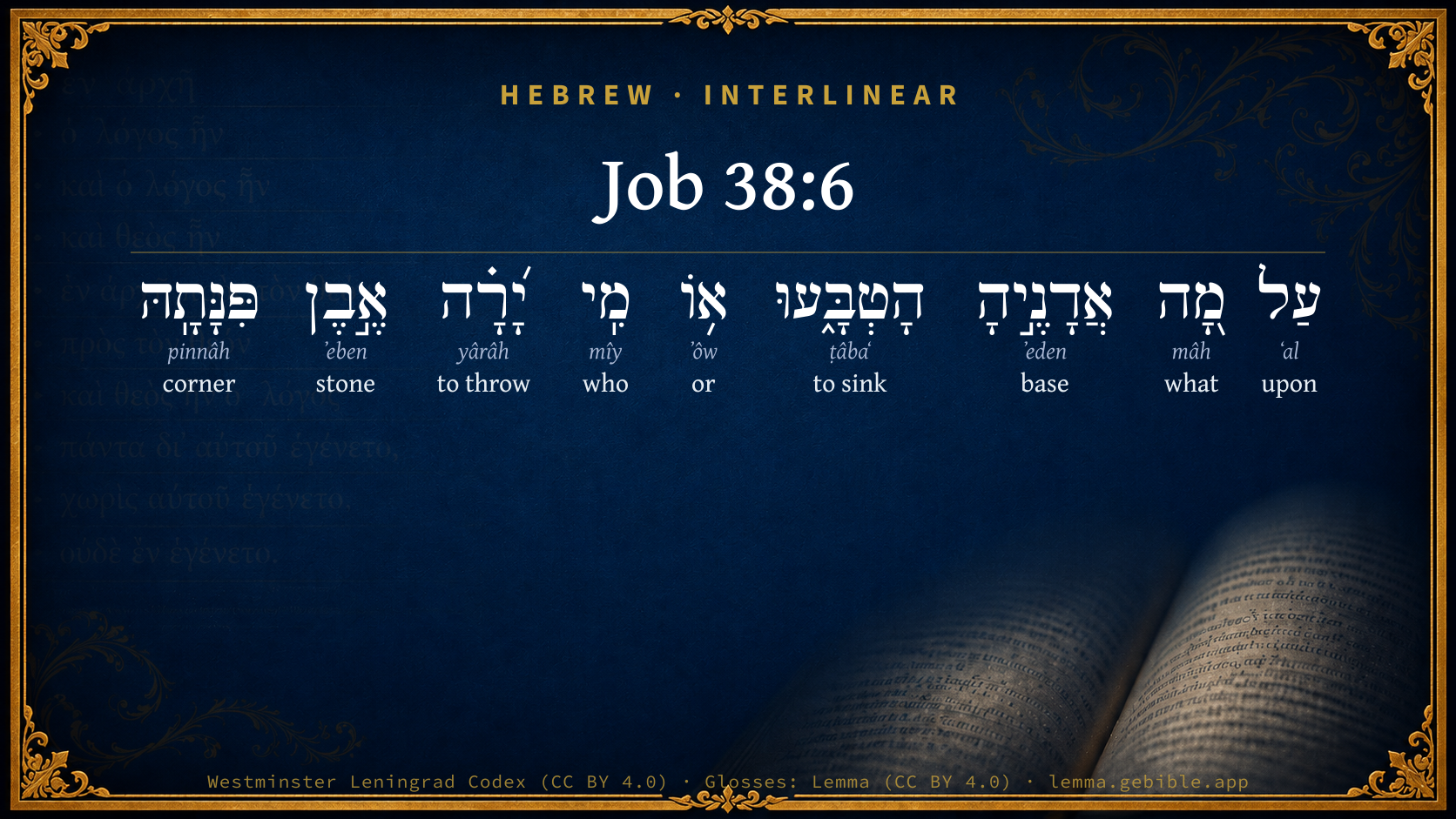
Job 38:6

Hebrew (Westminster Leningrad Codex) Job 38:6 appears in the Hebrew Old Testament. The text above is from the Westminster Leningrad Codex. Each word links to its Strong’s number, a concise gloss, and parsing drawn from the Open Scriptures Hebrew Bible morphology. Click any word for its full Brown-Driver-Briggs (BDB) entry.
Download image
Cite this verse

Job 38:6 (World English Bible). Public Domain. Lemma interlinear Bible study tool, https://lemma.gebible.app/v/job/38/6.

Show BibTeX & RIS
BibTeX
RIS
English Translation
Whereupon were the foundations of it fastened? Or who laid its cornerstone,
World English Bible · Public Domain
Download a study sheet

One document with this verse’s original text, its word-by-word gloss line, the meaning frame, cross-references with their text, attributed commentary, and full source and license credits — printable, and it pastes into notes with its structure intact.

This verse Autodidact and up

Study sheet (.html) Plain text (.txt)

A passage Seminary Student

Up to 50 verses in one chapter. A passage sheet keeps up to 6 commentary sources and 12 cross-references per verse, in the order this page ranks them, and says so on the sheet whenever that leaves anything out. Ask for a single verse and you get the Autodidact verse sheet above.

Everything on this page stays free to read, with no account — the sheet is a download of what is already on screen, not access to it.

Want to remove ads? Support Godless Engineer
Compare translations 3

The same verse in 3 English versions, stacked beneath the original-language interlinear above. Click any original word for its lexicon entry.

Each is an independent rendering of the whole verse — the interlinear is not word-aligned to these translations.

Highlighted words mark where these versions differ — a whole-verse word diff, not a word-by-word alignment.

  • World English Bible Public Domain
    Whereupon were the foundations of it fastened? Or who laid its cornerstone,
  • King James Version Public Domain
    Whereupon are the foundations thereof fastened? or who laid the corner stone thereof;
  • unfoldingWord Literal Text CC BY-SA 4.0
    On what were its foundations sunk? Or who laid its cornerstone,

unfoldingWord Literal Text — © unfoldingWord, licensed CC BY-SA 4.0. Word-aligned USFM3 via Door43 (git.door43.org/unfoldingWord/en_ult).

Versions to compare (up to 4)

3 of 4 selected

Show all 18 translations

Every available English version of this verse, each an independent rendering of the whole verse.

  • World English Bible Public Domain
    Whereupon were the foundations of it fastened? Or who laid its cornerstone,
  • Berean Standard Bible Public Domain
    On what were its foundations set, or who laid its cornerstone,
  • Majority Standard Bible Public Domain
    On what were its foundations set, or who laid its cornerstone,
  • King James Version Public Domain
    Whereupon are the foundations thereof fastened? or who laid the corner stone thereof;
  • American Standard Version (1901) Public Domain
    Whereupon were the foundations thereof fastened? Or who laid the corner-stone thereof,
  • Revised Version (1885) Public Domain
    Whereupon were the foundations thereof fastened? or who laid the corner stone thereof;
  • Geneva Bible (1599) Public Domain
    Whereupon are the foundations thereof set: or who layed the corner stone thereof:
  • Douay-Rheims (1899) Public Domain
    Upon what are its bases grounded? or who laid the corner stone thereof,
  • Young's Literal Translation Public Domain
    On what have its sockets been sunk? Or who hath cast its corner-stone?
  • Literal Standard Version CC BY-SA 4.0
    On what have its sockets been sunk? Or who has cast its cornerstone—
  • Unlocked Literal Bible CC BY-SA 4.0
    On what were its foundations laid? Who laid its cornerstone
  • unfoldingWord Literal Text CC BY-SA 4.0
    On what were its foundations sunk? Or who laid its cornerstone,
  • Darby Bible Public Domain
    Whereupon were the foundations thereof sunken? or who laid its corner-stone,
  • World Messianic Bible Public Domain
    What were its foundations fastened on? Or who laid its cornerstone,
  • Webster's Bible Public Domain
    Upon what are the foundations of it fastened? or who laid its corner stone;
  • Free Bible Version CC BY-SA 4.0
    What do its foundations rest upon? Who laid its cornerstone,
  • Bible in Basic English Public Domain
    On what were its pillars based, or who put down its angle-stone,
  • JPS Tanakh (1917) Public Domain
    Whereupon were the foundations thereof fastened? Or who laid the corner-stone thereof,

Literal Standard Version (2020), Covenant Press — licensed CC BY-SA 4.0. Text via the HelloAO Bible API (eBible.org). Unlocked Literal Bible (unfoldingWord) — licensed CC BY-SA 4.0. Text via the HelloAO Bible API (eBible.org). unfoldingWord Literal Text — © unfoldingWord, licensed CC BY-SA 4.0. Word-aligned USFM3 via Door43 (git.door43.org/unfoldingWord/en_ult). Free Bible Version, Dr. Jonathan Gallagher — licensed CC BY-SA 4.0. Text via the HelloAO Bible API (eBible.org).

Word by word

More ways to search: Search by grammar → Find every occurrence → Compare this word →

Practice this passage: Drill this verse → Learn its vocabulary →

About this verse

These counts appear in no published source. They are computed here, from the morphology-tagged text and Lemma’s own curated glosses. What Lemma adds →

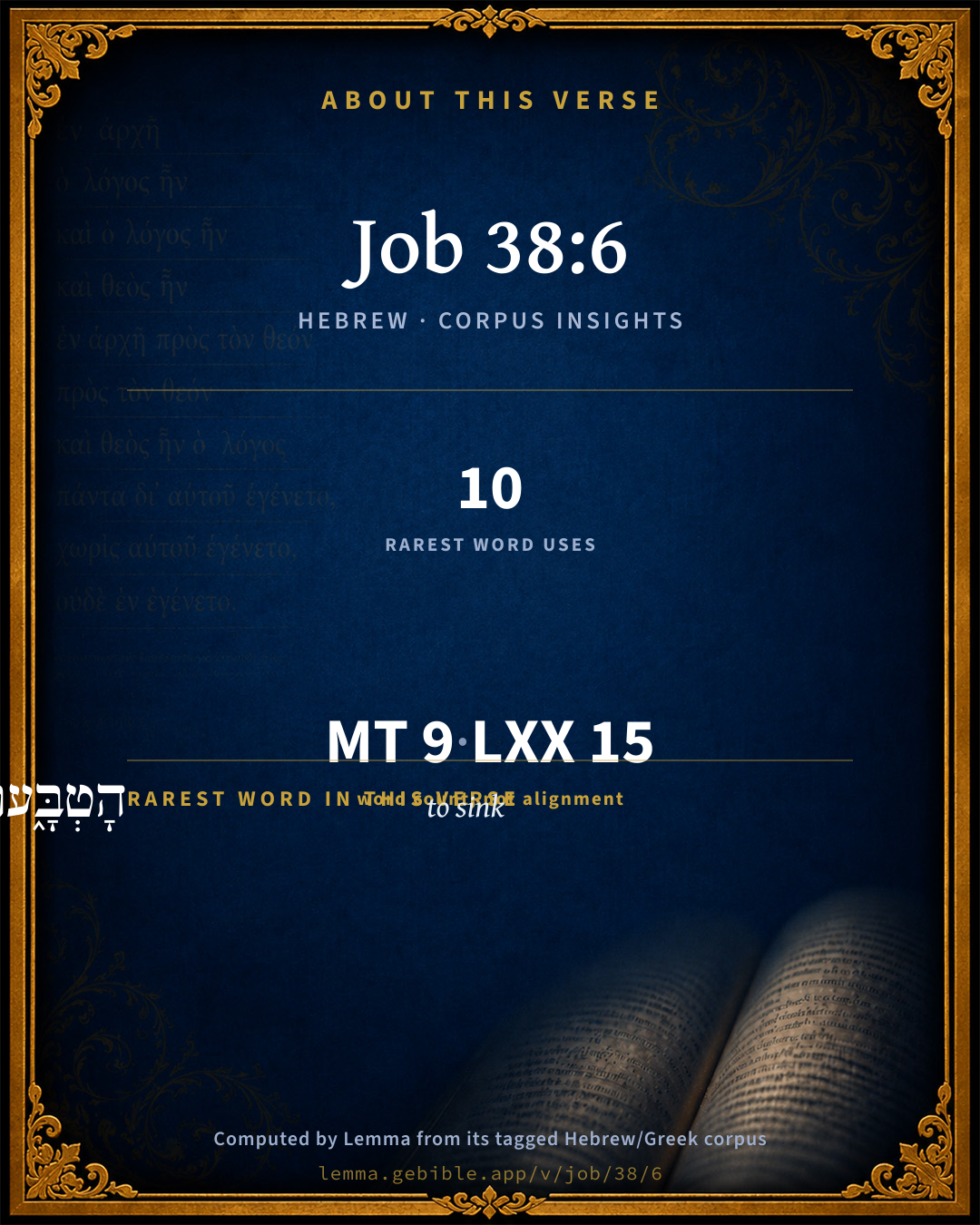
9
words
9
distinct lemmas
Wisdom
section

Notable vocabulary

The rarest word here is הָטְבָּ֑עוּ to sink H2883 — appearing just 10 times in the whole Hebrew Bible.

Shared distinctive vocabulary

הָטְבָּ֑עוּ to sink H2883 occurs in 10 verses of the Hebrew Bible. Also found in:

Grammatical profile

  • 2 verbs
  • 3 nouns
  • 1 preposition
  • 1 conjunction
  • 2 particles

Verb forms

  • הָטְבָּ֑עוּ Hophal · Perfect
  • יָ֝רָ֗ה Qal · Perfect

Hebrew & Septuagint length

In English translation the verse runs 12 words from the Hebrew and 16 from the Septuagint (LXX English) — closely comparable.

A rough comparison of the two English renderings, which tokenize alike — not a word-level alignment.

Word counts can differ between the Hebrew and the Greek without any difference in meaning — e.g. the Hebrew direct-object marker אֵת has no separate Greek word, and Greek often adds the article ὁ.

In the original languages it is 9 Hebrew tokens and 15 Greek tokens — but the two are counted differently (Hebrew bundles its prefixes and suffixes into one token; the Greek is in lemma form), so that isn’t a like-for-like length.

Cross-references

12

Topical passages linked to Job 38:6 in the Treasury of Scripture Knowledge — connected by theme and wording, ordered by reader-vote popularity; previews shown in the World English Bible.

  • Job 26:7 He stretches out the north over empty space, And hangs the earth on nothing.
  • Psalms 104:5 He laid the foundations of the earth, That it should not be moved forever.
  • Psalms 93:1 Yahweh reigns! He is clothed with majesty! Yahweh is armed with strength. The world also is established. It can't be moved.
  • Psalms 118:22 The stone which the builders rejected has become the head of the corner.
  • Isaiah 28:16 therefore thus says the Lord Yahweh, Behold, I lay in Zion for a foundation a stone, a tried stone, a precious corner -[stone] of sure foundation: he who believes shall not be in haste.
  • Zechariah 12:1 An oracle. The word of Yahweh concerning Israel. Yahweh, who stretches out the heavens, and lays the foundation of the earth, and forms the spirit of man within him says:
  • 2 Peter 3:5 For this they willfully forget, that there were heavens from of old, and an earth formed out of water and amid water, by the word of God;
  • Exodus 26:18–25 You shall make the boards for the tent, twenty boards for the south side southward.
  • Psalms 24:2 For he has founded it on the seas, And established it on the floods.
  • Psalms 144:12 Then our sons will be like well-nurtured plants, Our daughters like pillars carved to adorn a palace.
  • Ephesians 2:20–21 being built on the foundation of the apostles and prophets, Christ Jesus himself being the chief cornerstone;
  • 1 Samuel 2:8 He raises up the poor out of the dust, He lifts up the needy from the dunghill, To make them sit with princes, Inherit the throne of glory: For the pillars of the earth are Yahweh's, He has set the world on them.

Cross-references courtesy of OpenBible.info (CC BY 4.0).

Hebrew and Greek witnesses Masoretic Hebrew ↔ Greek Septuagint

The same verse in the two great witnesses to the Old Testament, shown verse-for-verse.

These are two independent witnesses, not word-aligned to each other, and the Septuagint is shown in lemma (dictionary) form.

Hebrew Job 38:6 Masoretic · Westminster Leningrad Codex

עַל מָ֭ה אֲדָנֶ֣יהָ הָטְבָּ֑עוּ א֥וֹ מִֽי יָ֝רָ֗ה אֶ֣בֶן פִּנָּתָֽהּ

Whereupon were the foundations of it fastened? Or who laid its cornerstone,

World English Bible · Public Domain

Greek LXX Job 38:6 Septuagint · lemma form

ἐπί τίς ὁ κρίκος αὐτός πήγνυμι τίς δέ εἰμί ὁ βάλλω λίθος γωνιαῖος ἐπί αὐτός

On what are its rings fastened? and who is he that laid the corner-stone upon it?

LXX2012 (modern English Septuagint) · Public Domain

Hebrew: Westminster Leningrad Codex (CC BY 4.0). Greek: Septuagint (public domain); English from LXX2012 (modern English Septuagint) (Public Domain). How the Septuagint differs from the Hebrew →

Commentary

Notes on Job 38:6 from classic Christian and Jewish commentators (each source and its license shown beneath its notes). The classic Christian expositions comment on the surrounding passage and are grouped to its opening verse, so a note may address several verses; the Jewish commentaries on the Tanakh (Rashi and others) are per-verse, so they appear only where the commentator wrote on this verse.

Lemma curates 59 commentaries, every one of them public domain or Creative Commons licensed, each selected and text-cleaned for this edition rather than reprinted as found. About our sources →

Trapp's Complete Commentary

John Trapp

Job 38:6 Whereupon are the foundations thereof fastened? or who laid the corner stone thereof;

Ver. 6. Whereupon are the foundations thereof fasttened?] Surely, upon nothing, but the word of God’s power. The philosophers dispute many things concerning the foundations of the earth but without any sound foundation of good reason. Some Jewish doctors make the mountains to be them; but these bear not up the earth, but the contrary. The Psalmist saith, that God hath founded the solid earth upon the liquid waters, Psa 24:2, wherein appeareth the infinite wisdom and power of God the founder. Vitruvius saith, In solido extruendum, foundations must be laid in solid places. But God is not tied to rules; his works are in oppositis mediis, as was above noted.

Or who laid the corner-stone thereof] i.e. The centre, say some Jewish doctors, whither all heavy things are carried, and about which the whole world hangeth; the elements and heavenly orbs surrounding it in their motions. Others fetch this corner stone out of the middle of the sea. But all this discourse is metaphorical, to show the firmness of the work, wherein none had any hand but only the essential wisdom of God, Pro 8:1, who did it with more ease than men can build a house.

John Trapp, A Commentary or Exposition upon All the Books of the Old and New Testament (1647–1656) — public domain. Text from a community e-Sword module.

Albert Barnes' Notes on the Bible

Whereupon are the foundations - Margin, “sockets.” The Hebrew word (אדן 'eden) means “a basis,” as of a column, or a pedestal; and then also the foundation of a building. The language here is evidently figurative, comparing the earth with an edifice. In building a house, the securing of a proper foundation is essential to its stability; and here God represents himself as rearing the earth on the most permanent and solid basis. The word is not used in the sense of sockets, as it is in the margin.

Fastened - Margin, “made to sink.” The margin rather expresses the sense of the Hebrew word הטבעוּ hāṭâba‛û. It is rendered “sink” and “sunk” in Psa 69:2, Psa 69:14; Psa 9:15; Lam 2:9; Jer 38:6, Jer 38:22; “drowned” in Exo 15:4; and were settled in Pro 8:25. The word does not elsewhere occur in the Scriptures, and the prevailing sense is that of “sinking,” or “settling down,” and hence, to “impress” - as a seal “settles down” into wax. The reference here is to a foundation-stone that sinks or settles down into clay or mire until it becomes solid.

Or who laid the corner stone thereof - Still an allusion to a building. The cornerstone sustains the principal weight of an edifice, as the weight of two walls is concentrated on it, and hence, it is of such importance that it should be solid and firmly fixed. The question proposed for the solution of Job is, On what the earth is founded? On this question a great variety of opinions waft entertained by the ancients, and of course no correct solution could be given of the difficulty. It was not known that it was suspended and held in its place by the laws of gravitation. The meaning here is, that if Job could not solve this inquiry, he ought not to presume to sit in judgment on the government of God, and to suppose that he was qualified to judge of his secret counsels.

Albert Barnes' Notes on the Bible (1834–1885) — public domain. Text from a community e-Sword/MySword module.

The Biblical Illustrator

Joseph S. Exell

Job_38:6-7

Whereupon are the foundations thereof fastened?

The laying of the earths foundation stone

Our text brings before us a period long antecedent to the creation of man, when the first step was taken towards building up and furnishing this planet for the abode of its future inhabitants. The text brings before us the truth in a parable. The transactions of another sphere are represented in an image drawn from this, in order that our conceptions of the truth may be lively and intelligent. These parables are no mere plays of the fancy--they are founded upon real analogies. Earthly things are really a shadow of heavenly things. The ways of nature are a real type of the ways of grace. The dealings of men with one another are really and objectively a figure of Gods dealings with man. God here sets forth heavenly transactions under a figure, drawn from the laying of a foundation stone. To lay the first stone of a great building is in itself, however auspicious, a solemn event. The structure, whose foundations we are laying, will witness a great fluctuation of human interests, and be associated with some great and critical event, Suppose that the building be dedicated to the edification of man, or to the worship of the Most High God--a great seminary, for example, or a great church. Here our feelings of solemnity and awe would be far more largely tempered with joy. There is ground for rejoicing, inasmuch as the good which may reasonably be expected to result from the work which we are inaugurating, so vastly preponderates over the evil, which may be accidentally associated with it. The text carries us back to a period of thought, antecedent to the creation of man--to the period when the first substratum of the globe was laid--to the period, when by the operation of laws which it has taken man upwards of five thousand years to discover, this planet was poised in mid-air--a little ball in the midst of suns and systems innumerable, with infinite space stretching round it on all sides. Man existed not yet, nor the place of his habitation; but that intelligent and rational creatures existed, our text itself furnishes sufficient proof . . . Angels assisting at the foundation of the earth, and sending forth Gods high praises in jubilant strains of triumph--it is a grand subject of meditation. What were the grounds for their solemn rejoicing? Their knowledge of the earths destiny could not have been of a prophetic character. The earth might be regarded by them in reference either to its future inhabitants, or to God, or to the evil which had already found its way into the universe.

I. Its future inhabitants. It was to be the house of a great family, and the school of a great character.

1. It was designed for the abode of a race, and not merely of those two individuals who were first placed in solitude and innocence upon it; and the destinies of that race, as of the individuals composing it, would fluctuate.

2. It was to be the school of human character. Earth was to be a scene of probation and discipline. The creature who was to be formed upon it was to be susceptible of improvement and progress. If the creature have capacities for the infinite, while the sphere on which it moves is finite, this must prove that the sphere is only preparatory--an introduction to a higher stage.

II. To God. Earth was destined to be a temple of God, from every corner of which should ascend to Him continually the incense of praise--where He should signally manifest His glory, and develop His perfections.

III. To the strife with evil. Man should become a sinner, and alienate himself from God. Then arose this difficulty--How was this moral mischief to be repaired? (E. M. Goulburn, D. C. L.)

The Biblical Illustrator, edited by Joseph S. Exell (c. 1880s–1900s) — public domain. Text from a community e-Sword module.

Joseph Benson's Commentary

Job 38:6-7. Whereupon are the foundations thereof fastened? — This strong and durable building hath no foundations but God’s power, which hath marvellously established it upon itself. Who laid the corner-stone? — By which the several walls are joined and fastened together, and in which, next to the foundations, the stability of a building consists. The sense is, Who was it that built this goodly fabric, and established it so firmly that it cannot be moved. When the morning stars sang together — When, in the morning of time, the blessed angels, the firstborn of the Father of lights, fitly called morning stars, because of their excellent lustre and glory, joined in praising God together for his glorious works, strangely rising up to their view from non-existence, by the infinite wisdom and power of their omnipotent Maker. “It is observable from many passages in the prophets, that the angels are spoken of under the metaphor of stars. See particularly Isa 14:12; Isa 14:14. The beauty and propriety of these allusions of the prophets will appear with greater lustre, when it is considered that the hosts of heaven were the objects of heathen idolatry: both the visible and invisible host; as well the angels as the lights of heaven; for the superstition seems to have been originally the same, as the worship of the heavenly bodies terminated in the worship of those angels or intelligences who were believed to animate or conduct them; and hence we see a reason why the angels are called stars and morning stars in Scripture.” — Peters. And the sons of God — The angels, as before, called the sons of God, because they had their whole being from him, and because they bear his divine and glorious image; shouted for joy — On the appearance of the new-made world, in the creation of which they saw new displays of their heavenly Father’s wisdom, power, and goodness, and learned to know more of his infinite perfections than they had known before, and, of consequence, to love and praise him with greater fervency and delight.

Joseph Benson's Commentary on the Old and New Testaments (1811–1818) — public domain. Text from a community e-Sword module.

Jamieson, Fausset & Brown

Robert Jamieson, A. R. Fausset & David Brown

foundations--not "sockets," as Margin.

fastened--literally, "made to sink," as a foundation-stone let down till it settles firmly in the clay (Job 26:7). Gravitation makes and keeps the earth a sphere.

Jamieson, Fausset & Brown — Commentary Critical and Explanatory on the Whole Bible (1871) — public domain (CC PDM 1.0). Text via the HelloAO Bible API.

Adam Clarke's Commentary

Verse 6. Whereupon are the foundations thereof fastened?] How does it continue to revolve in the immensity of space? What supports it? Has it foundations like a building, and is it fastened with a key-stone, to keep the mighty fabric in union?

Adam Clarke's Commentary on the Bible (1810–1826) — public domain. Text from a community e-Sword/MySword module.

The Cambridge Bible for Schools and Colleges

gen. ed. J. J. S. Perowne

6. are the foundations fastened] Or, were the foundations sunk? All the tenses here should be put in the simple past.

The creation of the earth is likened to the rearing of a great edifice, whose extent was determined by line, whose pillars were sunk in their bases, and its corner-stone laid with shoutings and songs of rejoicing among the heavenly hosts (comp. Ezr_3:10 seq., Zec_4:7).

Such music, as ’tis said,

Before was never made,

But when of old the sons of morning sung,

While the Creator great

His constellations set,

And the well balanced world on hinges hung;

And cast the dark foundations deep,

And bid the weltering waves their oozy channel keep.

Hymn on the Nativity.

The stars and the angels are here as usual conjoined, and the morning stars are named as the brightest and most glorious, as also because the earth rose into existence at the morning dawn.

The Cambridge Bible for Schools and Colleges (gen. ed. J. J. S. Perowne; Cambridge University Press, 1878–1918) — public domain. Text from a community e-Sword module.

John Gill's Exposition

Whereupon are the foundations thereof fastened?.... Or the pillars of it, as Ben Gersom interprets it; see Psa 75:3; and which Aben Ezra understands of the mountains: but be they what they may, on what can they be fastened or sunk into, when the earth hangs on nothing, and there is nothing visible to support it, nothing but the mighty hand of God?

or who laid the corner stone thereof? which unites, cements, and keeps the fabric together, and is the ornament and beauty of it; but who can tell what that is? Aben Ezra interprets it of the point or centre of the earth.

John Gill's Exposition of the Whole Bible (1746–1763) — public domain (CC PDM 1.0). Text via the HelloAO Bible API.

Matthew Poole's English Annotations

This strong and durable building hath no foundations but in God’s power and word, which hath marvellously established it upon itself.

Or who laid the cornerstone thereof; by which the several walls and parts of the building are joined and fastened together, and in which, next to the foundations, the stability of any building does consist? The sense is, Who was it that did build this goodly fabric, and established it so firmly that it cannot be moved without a miracle?

Matthew Poole's English Annotations on the Holy Bible (1683–1685) — public domain. Text from a community e-Sword/MySword module.

Whedon's Commentary on the Bible

Daniel D. Whedon

6. Whereupon are… fastened — On what were its foundations sunk? A question that implies that the earth hung free in space, as stated Job_26:7. Foundations — The Hebrew signifies also “pedestals,” “bases.”

The corner-stone — In ancient times it was massive, and not only served to bind together the sides of the building, but also as a depository for sacred objects. Sennacherib, in the Bellino inscription, speaks several times of the tinim — the clay tablets or cylinders that were inscribed with sacred writings, and deposited in the corner-stone. Compare a discourse in loc., by E.M. Goulburn.

Daniel D. Whedon (gen. ed.), Commentary on the Old and New Testaments (1874–1909) — public domain. Text from a community e-Sword module.

The Pulpit Commentary

Whereupon are the foundations thereof fastened? These details follow naturally upon the adoption of the particular metaphor of a house or building. They are not to be pressed. The object is to impress on Job his utter ignorance of God"s ways in creation. Or who laid the corner-stone thereof? Who gave the last finishing touch to the work? (see Psa_118:22 Zec_4:7) Canst thou tell? If not, why enter into controversy with the Creator?

The Pulpit Commentary (1880–1919), ed. H.D.M. Spence-Jones & Joseph S. Exell — public domain. Text from a community e-Sword module.

John Wesley's Explanatory Notes

Foundations - This strong and durable building hath no foundations but God's power, which hath marvelously established it upon itself. Cornerstone - By which the several walls are joined and fastened together, and in which, next to the foundations, the stability of a building consists. The sense is, who was it that built this goodly fabrick, and established it so firmly that it cannot be moved.

John Wesley, Explanatory Notes Upon the Whole Bible (1754–1765) — public domain. Text via the GEBible commentary corpus.

unfoldingWord translationNotes

Door43 World Missions Community

Connecting Statement:

Yahweh continues to challenge Job.

General Information:

The word "its" refers to the earth.

General Information:

Yahweh uses more questions to emphasize that his greatness. (See: Rhetorical Question)

On what were its foundations laid?

This can be translated as a statement. AT: "Tell me on what its foundations were laid." (See: Rhetorical Question)

On what were its foundations laid

This can be stated in active form. "On what did I set its foundations" (See: Active or Passive)

Who laid its cornerstone when ... the sons of God shouted for joy?

This can be translated as a statement. AT: "Tell me who laid its cornerstone when ... the sons of God shouted for joy." (See: Rhetorical Question)

when the morning stars sang together and all the sons of God shouted for joy

These two lines are similar in meaning. (See: Parallelism)

when the morning stars sang together

The morning stars are spoken of as singing like people sing. Possible meanings are: 1) the "morning stars" are the same as the "sons of God" in the next line or 2) "the morning stars" refer to stars in the sky. (See: Personification)

the morning stars

"the bright stars that shine in the morning"

sons of God

This refers to angels, heavenly beings. See how you translated this in Job 1:6.

shouted for joy

The abstract noun "joy" can be translated as the adverb "joyfully." AT: "shouted joyfully" (See: Abstract Nouns)

for joy

"because they were full of joy"

translationWords

found

cornerstone

sons of God

joy

unfoldingWord translationNotes — © Distant Shores Media and the Door43 World Missions Community, licensed CC BY-SA 4.0. Source: git.door43.org/Door43/en_tn.

Rashi

Rabbi Shlomo Yitzchaki (Rashi)

laid its cornerstone in the middle of the sea, whence the entire world was founded. Where were you?

Rashi on the Tanakh — English translations: “The Judaica Press complete Tanach with Rashi, translated by A. J. Rosenberg” (CC BY 4.0); “Pentateuch with Rashi's commentary by M. Rosenbaum and A.M. Silbermann, 1929-1934” (public domain); “The Metsudah Tanach series, Lakewood, N.J” (CC BY 4.0); and “The Book of Joshua, Metsudah Publications, 1997” (CC BY 4.0). Text via Sefaria.

Lesson kit

Teaching starters — assembled from the data on this page, not authored interpretation. Every prompt links to the verse data it draws on. Edit before teaching.

Job, in the Wisdom, opens this verse with 9 words (9 distinct Hebrew lemmas). Its most distinctive word is ṭâbaʻ (“to sink”). A historical commentator’s framing appears above. Read the whole chapter for the surrounding context.

Discussion questions

  1. What does “to sink” (ṭâbaʻ) contribute to the verse as a whole?
  2. Exodus 15:4 shares the word «to sink» with this verse. How do the two illuminate each other?
  3. These translations render this verse differently. What is at stake in choosing one wording over another?
  4. The verb «הָטְבָּ֑עוּ» is Hophal Perfect. How does its form color the action?
  5. Reading how Trapp's Complete Commentary and Albert Barnes' Notes on the Bible read this verse, where do the two commentators agree and where do they part?

Things to notice

Reading settings

Reading text

Shown beneath each verse's original-language words.

Old Testament
Old Testament edition

Read the OT as the Masoretic Hebrew (MT) or the Greek Septuagint (LXX).

English shown for the Greek Septuagint (in the Hebrew ↔ Greek comparison).

Comparing translations? Open the Compare panel on any verse page to stack up to four side by side.