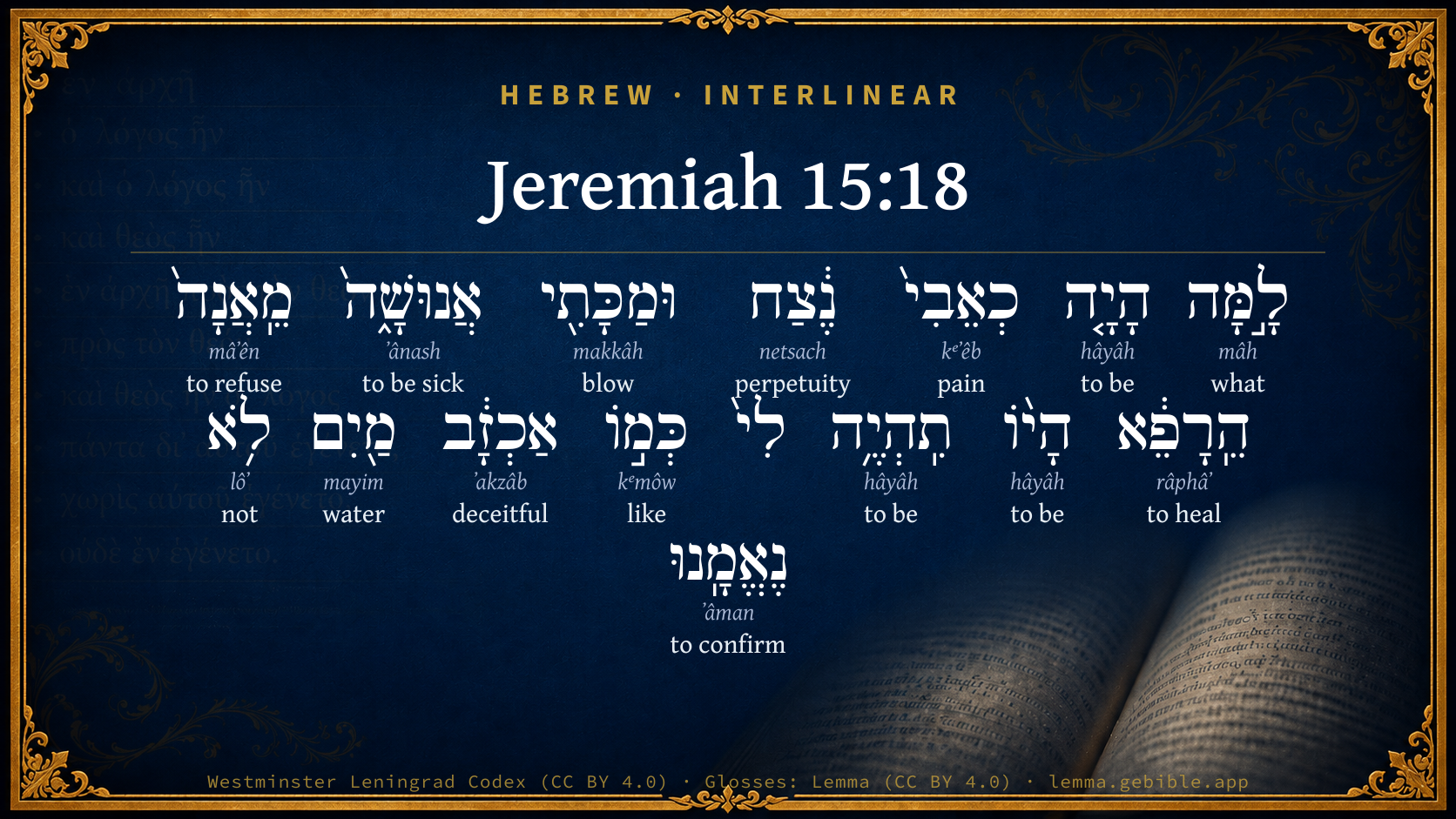
Jeremiah 15:18

Hebrew (Westminster Leningrad Codex) Jeremiah 15:18 appears in the Hebrew Old Testament. The text above is from the Westminster Leningrad Codex. Each word links to its Strong’s number, a concise gloss, and parsing drawn from the Open Scriptures Hebrew Bible morphology. Click any word for its full Brown-Driver-Briggs (BDB) entry.
Download image
Cite this verse

Jeremiah 15:18 (World English Bible). Public Domain. Lemma interlinear Bible study tool, https://lemma.gebible.app/v/jeremiah/15/18.

Show BibTeX & RIS
BibTeX
RIS
English Translation
Why is my pain perpetual, and my wound incurable, which refuses to be healed? will you indeed be to me as a deceitful [brook], as waters that fail?
World English Bible · Public Domain
Highlights
  • 1 first appearance in the Hebrew Bible
Full analysis ↓
Download a study sheet

One document with this verse’s original text, its word-by-word gloss line, the meaning frame, cross-references with their text, attributed commentary, and full source and license credits — printable, and it pastes into notes with its structure intact.

This verse Autodidact and up

Study sheet (.html) Plain text (.txt)

A passage Seminary Student

Up to 50 verses in one chapter. A passage sheet keeps up to 6 commentary sources and 12 cross-references per verse, in the order this page ranks them, and says so on the sheet whenever that leaves anything out. Ask for a single verse and you get the Autodidact verse sheet above.

Everything on this page stays free to read, with no account — the sheet is a download of what is already on screen, not access to it.

Want to remove ads? Support Godless Engineer
Compare translations 3

The same verse in 3 English versions, stacked beneath the original-language interlinear above. Click any original word for its lexicon entry.

Each is an independent rendering of the whole verse — the interlinear is not word-aligned to these translations.

Highlighted words mark where these versions differ — a whole-verse word diff, not a word-by-word alignment.

  • World English Bible Public Domain
    Why is my pain perpetual, and my wound incurable, which refuses to be healed? will you indeed be to me as a deceitful [brook], as waters that fail?
  • King James Version Public Domain
    Why is my pain perpetual, and my wound incurable, which refuseth to be healed? wilt thou be altogether unto me as a liar, and as waters that fail?
  • unfoldingWord Literal Text CC BY-SA 4.0
    Why is my pain endless and my wound incurable, refusing to be healed? Will you be to me like a deceptive, waters reliable?

unfoldingWord Literal Text — © unfoldingWord, licensed CC BY-SA 4.0. Word-aligned USFM3 via Door43 (git.door43.org/unfoldingWord/en_ult).

Versions to compare (up to 4)

3 of 4 selected

Show all 18 translations

Every available English version of this verse, each an independent rendering of the whole verse.

  • World English Bible Public Domain
    Why is my pain perpetual, and my wound incurable, which refuses to be healed? will you indeed be to me as a deceitful [brook], as waters that fail?
  • Berean Standard Bible Public Domain
    Why is my pain unending, and my wound incurable, refusing to be healed? You have indeed become like a mirage to me—water that is not there.
  • Majority Standard Bible Public Domain
    Why is my pain unending, and my wound incurable, refusing to be healed? You have indeed become like a mirage to me—water that is not there.
  • King James Version Public Domain
    Why is my pain perpetual, and my wound incurable, which refuseth to be healed? wilt thou be altogether unto me as a liar, and as waters that fail?
  • American Standard Version (1901) Public Domain
    Why is my pain perpetual, and my wound incurable, which refuseth to be healed? wilt thou indeed be unto me as a deceitful `brook', as waters that fail?
  • Revised Version (1885) Public Domain
    Why is my pain perpetual, and my wound incurable, which refuseth to be healed? wilt thou indeed be unto me as a deceitful brook, as waters that fail?
  • Geneva Bible (1599) Public Domain
    Why is mine heauines continuall? and my plague desperate and cannot be healed? why art thou vnto me as a lyar, and as waters that faile?
  • Douay-Rheims (1899) Public Domain
    Why is my sorrow become perpetual, and my wound desperate so as to refuse to be healed? it is become to me as the falsehood of deceitful waters that cannot be trusted.
  • Young's Literal Translation Public Domain
    Why hath my pain been perpetual? And my wound incurable? It hath refused to be healed, Thou art surely to me as a failing stream, Waters not stedfast.
  • Literal Standard Version CC BY-SA 4.0
    Why has my pain been continuous? And my wound incurable? It has refused to be healed, || You are surely as a failing stream to me, || Waters [that are] not steadfast.
  • Unlocked Literal Bible CC BY-SA 4.0
    Why is my pain ongoing and my wound incurable, refusing to be healed? Will you be like deceitful waters to me, waters that dry up?
  • unfoldingWord Literal Text CC BY-SA 4.0
    Why is my pain endless and my wound incurable, refusing to be healed? Will you be to me like a deceptive, waters reliable?
  • Darby Bible Public Domain
    Why is my pain perpetual, and my wound incurable? It refuseth to be healed. Wilt thou be altogether unto me as a treacherous [spring], [as] waters that fail?
  • World Messianic Bible Public Domain
    Why is my pain perpetual, and my wound incurable, which refuses to be healed? Will you indeed be to me as a deceitful brook, like waters that fail?
  • Webster's Bible Public Domain
    Why is my pain perpetual, and my wound incurable, which refuseth to be healed? wilt thou be altogether to me as a liar, and as waters that fail?
  • Free Bible Version CC BY-SA 4.0
    Why doesn't my pain ever stop? Why is my wound incurable? Why can't it be healed? You've really become like a seasonal stream to me, an unreliable source of water.
  • Bible in Basic English Public Domain
    Why is my pain unending and my wound without hope of being made well? Sorrow is mine, for you are to me as a stream offering false hope and as waters which are not certain.
  • JPS Tanakh (1917) Public Domain
    Why is my pain perpetual, and my wound incurable, so that it refuseth to be healed? Wilt Thou indeed be unto me as a deceitful brook, as waters that fail?

Literal Standard Version (2020), Covenant Press — licensed CC BY-SA 4.0. Text via the HelloAO Bible API (eBible.org). Unlocked Literal Bible (unfoldingWord) — licensed CC BY-SA 4.0. Text via the HelloAO Bible API (eBible.org). unfoldingWord Literal Text — © unfoldingWord, licensed CC BY-SA 4.0. Word-aligned USFM3 via Door43 (git.door43.org/unfoldingWord/en_ult). Free Bible Version, Dr. Jonathan Gallagher — licensed CC BY-SA 4.0. Text via the HelloAO Bible API (eBible.org).

Word by word

More ways to search: Search by grammar → Find every occurrence → Compare this word →

Practice this passage: Drill this verse → Learn its vocabulary →

אַכְזָ֔ב
ʼakzâb
H391
“deceitful”
Adjective, Adjective, Masculine, Singular, Absolute
Part of Speech
Adjective
Type
Adjective
Gender
Masculine
Number
Singular
State
Absolute
Full BDB Definition

Origin: from H3576

TWOT: 970b

deceitful, treacherous, deception, lie, deceptive, disappointing
  1. לָ֣מָּה mâh H4100 “to/for · what” Preposition + Particle, Interrogative
  2. הָיָ֤ה hâyâh H1961 “to be” Verb, Qal, Perfect, 3rd Person, Masculine, Singular
  3. כְאֵבִי֙ kᵉʼêb H3511 “pain · my” Noun, Common, Masculine, Singular, Construct + Suffix, Personal, 1st Person, Common, Singular
  4. נֶ֔צַח netsach H5331 “perpetuity” Noun, Common, Masculine, Singular, Absolute
  5. וּמַכָּתִ֖י makkâh H4347 “and · blow · my” Conjunction + Noun, Common, Feminine, Singular, Construct + Suffix, Personal, 1st Person, Common, Singular
  6. אֲנוּשָׁ֑ה֙ ʼânash H605 “incurable” Adjective, Adjective, Feminine, Singular, Absolute
  7. מֵֽאֲנָה֙ mâʼên H3985 “to refuse” Verb, Piel, Perfect, 3rd Person, Feminine, Singular
  8. הֵֽרָפֵ֔א râphâʼ H7495 “to heal” Verb, Niphal, Infinitive Construct
  9. הָי֨וֹ hâyâh H1961 “to be” Verb, Qal, Infinitive Absolute
  10. תִֽהְיֶ֥ה hâyâh H1961 “to be” Verb, Qal, Imperfect, 2nd Person, Masculine, Singular
  11. כְּמ֣וֹ kᵉmôw H3644 “like” Preposition
  12. מַ֖יִם mayim H4325 “water(s)” Noun, Common, Masculine, Plural, Absolute
  13. לֹ֥א lôʼ H3808 “not” Particle, Negative
  14. נֶאֱמָֽנוּ ʼâman H539 “to confirm” Verb, Niphal, Perfect, 3rd Person, Common, Plural

About this verse

These counts appear in no published source. They are computed here, from the morphology-tagged text and Lemma’s own curated glosses. What Lemma adds →

16
words
13
distinct lemmas
Prophets
section

Notable vocabulary

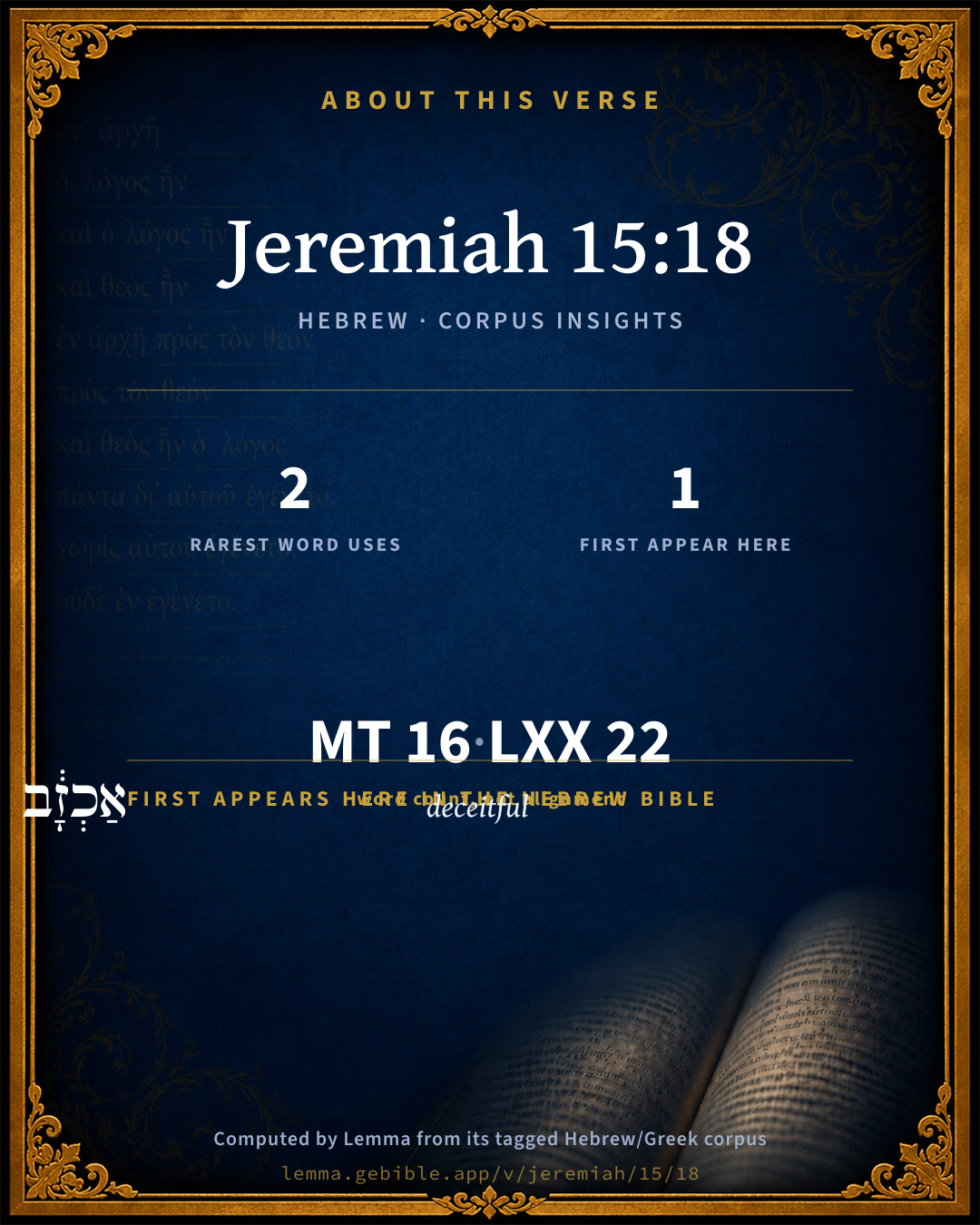
The rarest word here is אַכְזָ֔ב deceitful H391 — appearing just 2 times in the whole Hebrew Bible.

First appearance in Scripture

This word makes its first canonical appearance in the Hebrew Bible here:

  • אַכְזָ֔ב deceitful H391

Shared distinctive vocabulary

אַכְזָ֔ב deceitful H391 occurs in 2 verses of the Hebrew Bible. Also found in:

Grammatical profile

  • 6 verbs
  • 4 nouns
  • 2 adjectives
  • 2 prepositions
  • 2 particles

Verb forms

  • הָיָ֤ה Qal · Perfect
  • מֵֽאֲנָה֙ Piel · Perfect
  • הֵֽרָפֵ֔א Niphal · Infinitive Construct
  • הָי֨וֹ Qal · Infinitive Absolute
  • תִֽהְיֶ֥ה Qal · Imperfect
  • נֶאֱמָֽנוּ Niphal · Perfect

Repetition

A word recurs within this verse — often emphatic in Hebrew:

  • הָיָ֤ה to be H1961 ×3

Hebrew & Septuagint length

In the original languages it is 16 Hebrew tokens and 22 Greek tokens — but the two are counted differently (Hebrew bundles its prefixes and suffixes into one token; the Greek is in lemma form), so that isn’t a like-for-like length.

Cross-references

12

Topical passages linked to Jeremiah 15:18 in the Treasury of Scripture Knowledge — connected by theme and wording, ordered by reader-vote popularity; previews shown in the World English Bible.

  • Jeremiah 30:15 Why cry you for your hurt? your pain is incurable: for the greatness of your iniquity, because your sins were increased, I have done these things to you.
  • Job 34:6 Notwithstanding my right I am considered a liar; My wound is incurable, though I am without disobedience.'
  • Micah 1:9 For her wounds are incurable; For it has come even to Judah. It reaches to the gate of my people, Even to Jerusalem.
  • Job 6:15–20 My brothers have dealt deceitfully as a brook, As the channel of brooks that pass away;
  • Psalms 6:3 My soul is also in great anguish. But you, Yahweh--how long?
  • Psalms 13:1–3 How long, Yahweh? Will you forget me forever? How long will you hide your face from me?
  • Jeremiah 1:18–19 For, behold, I have made you this day a fortified city, and an iron pillar, and brazen walls, against the whole land, against the kings of Judah, against the princes of it, against the priests of it, and against the people of the land.
  • Jeremiah 14:3 Their nobles send their little ones to the waters: they come to the cisterns, and find no water; they return with their vessels empty; they are disappointed and confounded, and cover their heads.
  • Jeremiah 14:19 Have you utterly rejected Judah? has your soul loathed Zion? why have you struck us, and there is no healing for us? We looked for peace, but no good came; and for a time of healing, and, behold, dismay!
  • Jeremiah 20:7 Yahweh, you have persuaded me, and I was persuaded; you are stronger than I, and have prevailed: I am become a laughing-stock all the day, every one mocks me.
  • Jeremiah 30:12 For thus says Yahweh, Your hurt is incurable, and your wound grievous.
  • Lamentations 3:1–18 I am the man that has seen affliction by the rod of his wrath.

Cross-references courtesy of OpenBible.info (CC BY 4.0).

Hebrew and Greek witnesses Masoretic Hebrew ↔ Greek Septuagint

The same verse in the two great witnesses to the Old Testament, shown verse-for-verse.

These are two independent witnesses, not word-aligned to each other, and the Septuagint is shown in lemma (dictionary) form.

Hebrew Jeremiah 15:18 Masoretic · Westminster Leningrad Codex

לָ֣מָּה הָיָ֤ה כְאֵבִי֙ נֶ֔צַח וּמַכָּתִ֖י אֲנוּשָׁ֑ה֙ מֵֽאֲנָה֙ הֵֽרָפֵ֔א הָי֨וֹ תִֽהְיֶ֥ה לִי֙ כְּמ֣וֹ אַכְזָ֔ב מַ֖יִם לֹ֥א נֶאֱמָֽנוּ

Why is my pain perpetual, and my wound incurable, which refuses to be healed? will you indeed be to me as a deceitful [brook], as waters that fail?

World English Bible · Public Domain

Greek LXX Structure differs

In the Septuagint, Jeremiah is about an eighth shorter than the Hebrew and arranges its material differently — the Oracles Against the Nations (Hebrew chapters 46–51) appear in the middle of the Greek book, after 25:13. Because the chapter and verse boundaries do not line up, a verse-for-verse comparison with the Hebrew is not shown.

A verse-for-verse comparison isn’t shown here because the chapters and verses don’t line up. Switch to the LXX edition with the MT / LXX toggle above to read the Greek directly.

Hebrew: Westminster Leningrad Codex (CC BY 4.0). Greek: Septuagint (public domain); English from a public-domain English Septuagint. How the Septuagint differs from the Hebrew →

Targum (Aramaic paraphrase)

1

The Targum is the ancient Jewish Aramaic paraphrase of the Hebrew Scriptures — an interpretive translation, not the Hebrew text itself. Onkelos (literal) and Pseudo-Jonathan (expansive) render the Torah, and Jonathan the Prophets. Coverage is partial: where no permissively-licensed English translation exists for a verse, only the Aramaic is shown. This is verse-level text, not a word-by-word alignment to the Hebrew.

  1. Targum Jonathan Prophets (Joshua–Malachi)
    לְמָה הֲוָה כֵיבִי לְאַפְרַשׁ וּמְחָתִי תַקִיפָא לִמְסַרְבָא לְאִתַּסָאָה לָא יְהֵי מֵימְרָךְ לִי כַּדְבִין כְּמַבַּע דְמַיִין דְפַסְקִין מוֹהִי:

    (no public-domain English translation for this verse)

    Targum Jonathan — Aramaic: “Mikraot Gedolot” (public domain). English: “Sefaria Community Translation” (CC0 1.0 (public-domain dedication)); “London "Chaldee Paraphrase," 1871” (public domain). Text via Sefaria.

Commentary

Notes on Jeremiah 15:18 from classic Christian and Jewish commentators (each source and its license shown beneath its notes). The classic Christian expositions comment on the surrounding passage and are grouped to its opening verse, so a note may address several verses; the Jewish commentaries on the Tanakh (Rashi and others) are per-verse, so they appear only where the commentator wrote on this verse.

Lemma curates 59 commentaries, every one of them public domain or Creative Commons licensed, each selected and text-cleaned for this edition rather than reprinted as found. About our sources →

Trapp's Complete Commentary

John Trapp

Jer 15:18 Why is my pain perpetual, and my wound incurable, [which] refuseth to be healed? wilt thou be altogether unto me as a liar, [and as] waters [that] fail?

Ver. 18. Why is my pain perpetual? &c.] Here the prophet too freely expostulates with God, as less faithful, or less mindful at least, of the promised preservation. This was in a fit of diffidence and discontent, as the best have their outbursts, and the greatest lamps have needed snuffers. The Milesians, saith the philosopher, are not fools; yet they do the things that fools use to do. So the saints do oft as wicked ones, but not in the same manner and degree.

John Trapp, A Commentary or Exposition upon All the Books of the Old and New Testament (1647–1656) — public domain. Text from a community e-Sword module.

The Biblical Illustrator

Joseph S. Exell

Jer_15:18

Why is my pain perpetual?

The function of pain

This piteous lament may fitly represent the anguished cry of suffering humanity, from age to age. In all lands, under all skies, in all times, the same mournful wail is heard,--a ceaseless dirge of woe, day and night, from ten thousand times ten thousand hearts, struggling with adversity, battling with disease, staggering under the weight of sorrow or suffering. Why is my pain perpetual? It would almost seem that men had abandoned the attempt to solve these problems; for by common consent, pain and disease, suffering and sorrow, are called mysteries,--dark and inscrutable mysteries. But they are not all darkness and incomprehensibility. These mysteries are also masteries--masterful forces in the education and exaltation of humanity. Have you ever considered what kind of a world this would be if there were no pain here, no sick beds, no sorrow-stricken homes? Have you ever reflected that these inscrutable mysteries are the chosen instrumentalities for fashioning the highest types of character, both in the sufferer himself and in those who minister to his suffering? Pain and disease did, it is true, come into the world as the attendants and servants of sin; but it is pity indeed if we have not learned that the Lord has made them His ministers and His servants, even as He made the thorns and thistles, the labour and the sweat, which resulted from the Fall, the means of the development of the faculties and powers of man, the fountains of progress and civilisation. The earth was once a stranger to pain, and it will be again; but in the former case sin had not entered, and so perhaps pain was not needed; and in the latter, sin will be abolished because the lesson of pain will have been fully learned. Had there never been pain and suffering, what a different world it would have been! All marsh and meadow; all plain and prairie; no towering cliffs and yawning chasms; no heaven-kissing Mont Blanc; no thunderous Niagara; no valley of the Yosemite--a dead-level world! Those lofty heights of heroism and patience which now delight the eye in the retrospect of the past, would sink into monotonous stretches of commonplace lives. Those names writ large by the pen of history, and made radiant by the light of self-forgetting devotion, would disappear with the pain or the suffering or the calamity that made them great. We may, therefore, thank God for pain, for suffering, for sorrow. Whichever has been our lot, depend upon it we arc, or if not, we ought to be, the better, the wiser, the richer, for it. If we take it patiently, as the good will of our good God, then will it prove a blessing. Then will sorrow be the crucible in the hands of the Divine Master, wherein the dross of the soul will be purged away, and the gold refined. But let us not make the mistake of supposing that tribulation--this threshing of the soul--in any of its forms necessarily produces the results which I have described. These are the peaceable fruits which the gracious Father desires and designs that they should bring forth. These are what they are fitted to produce. But we must remember that the material to be fashioned in this case is a free, self-determining human soul, whose freedom cannot be violated without destroying its very essential fibre. The effect, then, of trial and affliction, whether bodily or mental, depends upon the way in which it is received. It may embitter, instead of sweetening, the spirit. It may harden, instead of softening, the heart. And then the gracious purpose of Him who chasteneth not in wrath, but in mercy, will be frustrated and turned aside by the perversity of man. To strengthen our faith, then, let us recall some of the utterances of those holy men of old who spake as they were moved by the Holy Ghost,--passages in which the casual connection between suffering and holiness is distinctly stated. Saith the wise man, The fining pot is for silver, and the furnace for gold: but the Lord trieth the hearts. Saith the afflicted patriarch, Though He slay me, yet will I trust in Him. When He hath tried me, I shall come forth as gold. Saith the prophet in the name of the Lord, I will bring the third part through the fire, and will refine them as silver is refined, etc. Our Lord said, I am the Vine, ye are the branches, and added, Every branch that beareth fruit, He purgeth it, etc. St. Peter, the foremost of the apostles, writes, Though now for a season . . . ye are in heaviness through manifold temptations, it is that the trial of your faith, etc. St. James bids us etc., giving as the reason, that chastisement produces the peaceable fruits of righteousness. Side by side with their words let us place the deeds, the examples, of these holy men of old. One can see in the mirror of their writings, as well as in the record of their lives, that these chosen ones were, like their Divine Master, made perfect through suffering, or at least that their sufferings and afflictions had led them far up the path whose goal is perfection. The intensity of their conviction glows and burns on every page. When they assert the purifying effect of suffering, we feel that they are testifying out of the fulness of a personal knowledge. They speak that they do know, and testify that they have seen and felt in their own hearts and lives. But not these holy men of old alone. Men and women of our time, too, a noble army, have ascended with Jesus into the holy mount by the same arduous path, leaving us an example that we should follow their steps. How often have we seen the purifying power of pain and loss, of sorrow and trial! How often have we marked in the life of some patient sufferer the gradual unfolding of the Christlikeness, till at length the crown of thorns has been changed into a mitre of glory, on which we could trace the words, Perfect through suffering! You may, therefore, strengthen your wavering faith, O sufferer! in the beneficent purpose of this, Gods strange economy, by lifting your eyes to the great cloud of witnesses who have trod the same rough and thorny path. Your suffering, whatever its form, whatever its intensity, is not without your Father. You are in His hands. He does not forget you; He will never leave or forsake you; He only designs thy dross to consume, and thy gold to refine. Look intently, O sufferer! and you will see pain slowly transfigured before your gaze till it takes on the very features of Him of whom the prophet said, He shall sit as a refiner and purifier of silver. You are suffering, moreover, it may be, not for your own benefit alone, but for that of others. There is a principle of vicariousness in human suffering. Let me illustrate. A poor traveller falls ill of fever all alone in the South American swamps. There he lies for days in a wretched hut, quenching his thirst with the waters of a pool close at hand. At last this pool dries up; and with extreme difficulty, the sick man crawls to another, half a mile distant. Its water is so bitter he can scarcely drink it; but he must drink it, or die of thirst. That afternoon he could not think why he felt stronger than for many weeks. Next day he drank more abundantly of the bitter pool; and still, the more he drank, the stronger he grew, till he was entirely restored; then he found that a tree had fallen into the water, which gave it its bitterness, and gave it also its power of cure. And this is the way in which one of the most important medicines now in use was discovered,--a medicine which has saved thousands and thousands of lives which must else have perished. Even so hath God appointed that some of us should drink the bitter waters of affliction or of pain, that others may be given spiritual health and salvation. (R. H. MKim, D. D.)

Uses of pain

Some plants owe their medicinal qualities to the marsh in which they grow; others to the shades in which alone they flourish. There are precious fruits put forth by the moon as well as by the sun. Boats need ballast as well as sail; a drag on the carriage wheel is no hindrance when the road runs downhill. Pain has, probably, in some cases developed genius, hunting out the soul which otherwise might have slept like a lion in its den. Had it not been for the broken wing some might have lost themselves in the clouds, some even of those choice doves who now bear the olive branch in their mouths, and show the way to the ark. (C. H. Spurgeon.)

Blessing of pain

Above all things let us learn this lesson from the example of Princess Alice--the quickening, purifying, bracing power of pain. In every trial that she had to undergo--and perhaps these trials were more than ordinarily severe and frequent--we see how her character developed and strengthened. To her each trial was as an April storm to a young plant or tree, lending new vigour to the roots, new power to its growth, so that when the sun shines the buds are seen to expand and blossom--those same buds which, without the rain cloud, would have shrivelled and died. Every time she was called upon to give up what she most deeply cherished, she counted, with faith and gratitude, the blessings that remained to her. Thus do we learn humility, she said with quivering lip. God has called for one life, and has given me back

Chronic fain

Pascal, the great mathematician and moralist, said, From the day I was eighteen, I do not know that I ever passed a single day without pain.

Wilt Thou be altogether unto me as a liar.--

God misjudged

Here the prophet overfreely expostulateth with God as less faithful, or less mindful, at least, of the promised preservation. This was in a fit of diffidence and discontent, as the best have their outbursts, and the greatest lamps have needed snuffers. The Milesians, saith the philosophers, are not fools, yet they do the things that fools use to do. So the saints do oft as wicked ones, but not in the same manner and degree. (John Trapp.)

The Biblical Illustrator, edited by Joseph S. Exell (c. 1880s–1900s) — public domain. Text from a community e-Sword module.

Tyndale Open Study Notes

Tyndale Open Resources

15:18 Jeremiah posed two rhetorical questions that seem to presuppose that he should not have to suffer.

Tyndale Open Study Notes — © Tyndale Open Resources, licensed CC BY-SA 4.0. Text via the HelloAO Bible API.

Geneva Bible (1599)

Geneva Bible translators

And hast not assisted me according to the promise? wherein appeareth that in the Saints of God is imperfection of faith, which through impatience is ofttimes assailed, as Jer. 20:7.

Geneva Bible (1599) marginal notes — public domain. Text via Bolls.life.

Jamieson, Fausset & Brown

Robert Jamieson, A. R. Fausset & David Brown

(Jer 30:15). "Pain," namely, the perpetual persecution to which he was exposed, and his being left by God without consolation and "alone." Contrast his feeling here with that in Jer 15:16, when he enjoyed the full presence of God, and was inspired by His words. Therefore he utters words of his natural "infirmity" (so David, Psa 77:10) here; as before he spoke under the higher spiritual nature given him.

as a liar, and as--rather, "as a deceiving (river) . . . waters that are not sure (lasting)"; opposed to "tiring (perennial) waters" (Job 6:15). Streams that the thirsty traveller had calculated on being full in winter, but which disappoint him in his sorest need, having run dry in the heat of summer. Jehovah had promised Jeremiah protection from his enemies (Jer 1:18-19); his infirmity suggests that God had failed to do so.

Jamieson, Fausset & Brown — Commentary Critical and Explanatory on the Whole Bible (1871) — public domain (CC PDM 1.0). Text via the HelloAO Bible API.

Adam Clarke's Commentary

Verse 18. Wilt thou be altogether unto me as - waters that fail?] Meaning either springs, which in the height of summer grow dry; or, like that phenomenon in the sandy desert, where, by a peculiar action of the air on the rising vapours, the resemblance of water is produced, so that the traveller, deceived, rejoices that he is come, in the sandy desert, to the verge of a beautiful lake; but the farther he travels, it is still at the same distance, and at last vanishes; and he finds the whole was an illusion, for the waters have failed. Nothing can exceed the disappointment of the farmer whose subsistence absolutely depends on the periodical rains, when these fail, or fall short of their usual quantity. Some times the rice is sown and springs up in the most promising manner; but the latter rains fail, and whole fields of young rice wither and perish.

Adam Clarke's Commentary on the Bible (1810–1826) — public domain. Text from a community e-Sword/MySword module.

John Calvin's Commentaries

Before we proceed, we shall shortly refer to the meaning of the passage. Jeremiah has before shewn that he possessed an heroic courage in despising all the splendor of the world, and in regarding as nothing those proud men who boasted that they were the rulers of the Church: but he now confesses his infirmity; and there is no doubt but that he was often agitated by different thoughts and feelings; and this necessarily happens to us, because the flesh always fights against the spirit. For though the Prophet announced nothing human when he declared the truth of God, yet he was not wholly exempt from sorrow and fear and other feelings of the flesh. For we must always distinguish, when we speak of the prophets and the apostles, between the truth, which was pure, free from every imperfection, and their own persons, as they commonly say, or themselves. Nor were, they so perfectly renewed but that some remnant of the flesh still continued in them. So then Jeremiah was in himself disturbed with anxiety and fear, and affected with weariness, and wished to shake off the burden which he felt so heavy on his shoulders. He was then subject to these feelings, that is, as to himself; yet his doctrine was free from every defect, for the Holy Spirit guided his mind, his thoughts, and his tongue, so that there was in it nothing human. The Prophet then has hitherto testified that he was called from above, and that he had cordially undertaken the office deputed to him by God, and had faithfully obeyed him: but now he comes to himself, and confesses that he was agitated by many thoughts, which betokened the infirmity of the flesh, and were not free from blame. This then is the meaning.

He says, Why is my grief strong, or hard? He intimates that his grief could not be eased by any soothing remedy. He alludes to ulcers, which by their hardness repel all emollients. And for the same purpose he adds, And my wound weak, as some render it, for it is from אנש anesh, to be feeble; and hence is אנוש anush, which means man; and it expresses his weakness, as אדם adam, shews his origin, and איש aish, intimates his strength and courage. Others render the words, “and my wound full of pain;” and others, “strong,” as he had before called his grief strong. He afterwards thus explains what he meant by the terms he used, It refuses to be healed There is no doubt, as I have already intimated, but that the Prophet here honestly expresses the perturbations of his own mind, and shews that he in a manner vacinated; the wickedness of the people was so great, that he could not so perseveringly execute his office as he ought to have done.

He adds, Thou wilt be to me as the deception of inconstant waters I wonder why some render the words, “Thou wilt be to me deceptive as inconstant waters.” The word may indeed be an adjective, but it is doubtless to be rendered as a substantive, “Thou wilt be to me as the deception,” and then, “of unfaithful waters.” that is, of such as flow not continually: for faithful or constant waters are those which never fail; as the Latins call a fountain inexhaustible whose spring never dries; so the Hebrews call a fountain faithful or constant which never fails either in summer or in drought. On the contrary, they call waters unfaithful which become dry, as when a well, which has no perennial veins, is made dry by great heat; and such also is often the case with large streams.

We now see the import of this comparison: but the words are apparently very singular; for the Prophet expostulates with God as though he had been deceived by him, “Thou wilt be to me,” he says, “as a vain hope, and as deceptive waters, which fail during great heat, when they are mostly wanted.” If we take the words as they appear to mean, they seem to border on blasphemy; for God had not without reason testified before, that he is the Fountain of living water; and he had condemned the Jews for having dug for themselves broken cisterns, and for having forsaken him, the Fountain of living water. Such, no doubt, had He been found by all who trusted in him. What then does Jeremiah mean here by saying, that God was to him as a vain hope, and as waters which continue not to flow? The Prophet, no doubt, referred to others rather than to himself; for his faith had never been shaken nor removed from his heart. He then knew that he could never be deceived; for relying on God’s word he greatly magnified his calling, not only before the world, but also with regard to himself: and his glorytug, which we have already seen, did not proceed except from the inward feeling of his heart. The Prophet then was ever fully confident, because he relied on God, that he could not be made ashamed; but here, as I have said, he had regard to others. And we have already seen similar passages, and the like expressions will hereafter follow.

There is no doubt but that it was often exultingly alleged that the Prophet was a deceiver: “Let him go on and set before us the words of his God; it has already appeared that his boasting is vain in saying that he has hitherto spoken as a prophet.” Since then the ungodly thus harassed the Prophet, he might have justly complained that God was not to him like perennial springs, because they all thought that he was deceived. And we must always bear in mind what I said yesterday, — that the Prophet does not speak here for his own sake, but raffler that he might reprove the impiety of the people. It therefore follows —

John Calvin's Commentaries (1540-1563) — public domain. Text from the Calvin Translation Society English edition (1840s-50s) via the Christian Classics Ethereal Library (ccel.org). Calvin's coverage is partial (roughly two-thirds of the Bible); uncommented books and verses are honest gaps, never fabricated. The 19th-century editor's footnotes and remarks are omitted so the notes are faithfully Calvin's own voice.

Ellicott's Commentary for English Readers

(18) Wilt thou be altogether unto me as a liar . . .?—The words express a bitter sense of failure and disappointment. God had not prospered the mission of His servant as He had promised. The Hebrew, however, is not so startlingly bold as the English, and is satisfied by the rendering, wilt thou be unto me as a winter torrent, i.e., as in Job_6:15, like one which flows only in that season, and is dried up and parched in summer. See the play upon the word achzib (= a lie) in Mic_1:14.

A Bible Commentary for English Readers, edited by Charles John Ellicott (1878–1897) — public domain. Text from a community e-Sword module.

The Cambridge Bible for Schools and Colleges

gen. ed. J. J. S. Perowne

18. a deceitful brook] The dried-up watercourse belies the anticipations of the thirsty traveller. Cp. Job_6:15.

fail] lit. as mg. are not sure.

The Cambridge Bible for Schools and Colleges (gen. ed. J. J. S. Perowne; Cambridge University Press, 1878–1918) — public domain. Text from a community e-Sword module.

John Gill's Exposition

Therefore thus saith the Lord, if thou return,.... From thine unbelief, diffidence, and impenitence, and repent of them; expressed in the preceding verses:

then will I bring thee again; or, "restore thee (s)"; pardon his sin, and return him to his post and place, to his office and ministry in it, and confirm and establish him therein:

and thou shalt stand before me; not only as a petitioner for the people; see Jer 15:1, but as a servant of the Lord, attending to his word, and waiting his orders, and ready to execute them. It denotes his stability in his office:

and if thou wilt take forth the precious from the vile; take precious truths, comparable to gold, silver, and precious stones; truths more valuable and desirable than thousands of gold and silver, from those doctrines which are worthless and contemptible, comparable to wood, hay, and stubble, and everything that is mean and vile; these faithful ministers should separate one from the other, and not mix and blend them together: or precious souls, truly gracious ones, who are precious in the sight of God, are redeemed by Christ, by his precious blood, and are adorned with the graces of the Spirit; these are to be distinguished from the vile, from sinners impenitent and unbelieving, that live in sin, in defiance of the law, and in contempt of the Gospel; a difference is to be made between them; delivering out comfortable words to the one, and denouncing severe threatenings to the other; doing the reverse of the false prophets, Eze 13:22,

thou shalt be as my mouth; to the people; speak what I command thee, and whatsoever thou sayest shall be as if I had spoken it myself:

let them return unto thee, but return not thou unto them; this is said of the people of the Jews, to whom the prophet was sent; and the sense is, that he should not at all comply with them, or conform to their humours, or flatter and sooth them in their sins, as the false prophets did; but if they returned to him, attended on his ministry, received his words and messages, and agreed and conformed to him, and followed his directions and example, it would be very well; but otherwise he was not in the least to give way to them, or go into any sinful compliance with them, either with respect to doctrine or practice,

(s) "restituam te", Tigurine version.

John Gill's Exposition of the Whole Bible (1746–1763) — public domain (CC PDM 1.0). Text via the HelloAO Bible API.

Haydock's Catholic Bible Commentary

Trusted. It is not cured as soon as might be expected. (Haydock) --- It continually breaks out again, (Menochius) like a bog not properly drained. (Haydock) --- Hebrew, "Thou art become," &c. Chaldean, "break not thy promise, as," &c., Do not reject me when I stand most in need of redress. (Calmet) --- My hopes seem (Haydock) vain. (Worthington)

George Leo Haydock (1774–1849), Haydock's Catholic Family Bible and Commentary, 1859 edition — public domain. Excludes Psalms (Douay-Rheims chapter numbering differs from Protestant) and Deuterocanonical books (Catholic canon only).

Matthew Poole's English Annotations

The words are judged to be the words of Jeremiah, and that with relation unto himself, complaining of the hard task which God had put upon him, continually filling his mouth With such bitter words of evil against the people, as exposed him to their most implacable rage against him, and persecution of him, so as his misery seemed like a

pain and a

wound, for which was no remedy but patience. Jeremiah, though a great prophet of the Lord, was (as Elijah) a man subject to like passions with other men; he here chargeth God with unfaithfulness, as if he had deceived his expectations, and had been to him as a pit of waters that promised fair, but failed a man when he had most need of them. The servants of God have sometimes been surprised with such passions and temptations, 1Sa 27:1; Psa 77:7,9. It is a hard thing not to see, and yet believe.

Matthew Poole's English Annotations on the Holy Bible (1683–1685) — public domain. Text from a community e-Sword/MySword module.

Whedon's Commentary on the Bible

Daniel D. Whedon

18. Pain perpetual — Implying that he had been long in the prophetical office.

A liar — Rather, a deceptive torrent, that dries up in the season of drought and so disappoints hope. See Job_6:15; Mic_1:16. The phrase waters that fail is epexegetical.

Daniel D. Whedon (gen. ed.), Commentary on the Old and New Testaments (1874–1909) — public domain. Text from a community e-Sword module.

The Pulpit Commentary

Why is my pain perpetual? One who could honestly speak of himself in terms such as those of Vers. 16, 17, seemed to have a special claim on the Divine protection. But Jeremiah"s hopes have been disappointed. His vexation is perpetual, and his wounded spirit finds no comfort. As a liar; rather, as a deceitful stream. The word "stream" has to be understood as in Mic_1:14. Many of the water courses of Palestine are filled with a rushing torrent in the winter, but dry in summer. Hence the pathetic complaint of Job. (Job_6:15) The opposite phrase to that used by Jeremiah is "a perennial stream". (Amo_5:24) The force of the passage is increased if we read it in the light of Dr. Gratz"s hypothesis.

The Pulpit Commentary (1880–1919), ed. H.D.M. Spence-Jones & Joseph S. Exell — public domain. Text from a community e-Sword module.

John Wesley's Explanatory Notes

Why - Jeremiah, though a great prophet, was (as Elijah) a man subject to like passions with other men.

John Wesley, Explanatory Notes Upon the Whole Bible (1754–1765) — public domain. Text via the GEBible commentary corpus.

Rashi

Rabbi Shlomo Yitzchaki (Rashi)

grievous sick. Comp. (II Sam. 12:15) “And he became mortally ill (וַיֵּאָנַֹש).” mentioned concerning Bath-sheba’s son.

You are to me Heb. הָיוֹ תִהְיֶה. as a failing spring Like a man whose trust has been cut off from him, for you allow me to suffer at their hands. אַכְזָב is a spring that stops (faylayne in O. F:), failing.

water that is not faithful to rely upon it.

Rashi on the Tanakh — English translations: “The Judaica Press complete Tanach with Rashi, translated by A. J. Rosenberg” (CC BY 4.0); “Pentateuch with Rashi's commentary by M. Rosenbaum and A.M. Silbermann, 1929-1934” (public domain); “The Metsudah Tanach series, Lakewood, N.J” (CC BY 4.0); and “The Book of Joshua, Metsudah Publications, 1997” (CC BY 4.0). Text via Sefaria.

Lesson kit

Teaching starters — assembled from the data on this page, not authored interpretation. Every prompt links to the verse data it draws on. Edit before teaching.

Jeremiah, in the Prophets, opens this verse with 16 words (13 distinct Hebrew lemmas). Its most distinctive word is ʼakzâb (“deceitful”). A historical commentator’s framing appears above. Read the whole chapter for the surrounding context.

Discussion questions

  1. How does “deceitful” (ʼakzâb) shape what this verse is saying?
  2. The word “deceitful” first appears here in Scripture. What is being introduced at this debut?
  3. Micah 1:14 shares the word «deceitful» with this verse. How do the two illuminate each other?
  4. “to be” occurs 3× in this one verse. What is the effect of the repetition?
  5. These translations render this verse differently. What is at stake in choosing one wording over another?
  6. The verb «הָיָ֤ה» is Qal Perfect. How does its form color the action?
  7. Reading how Trapp's Complete Commentary and The Biblical Illustrator read this verse, where do the two commentators agree and where do they part?

Things to notice

Reading settings

Reading text

Shown beneath each verse's original-language words.

Old Testament
Old Testament edition

Read the OT as the Masoretic Hebrew (MT) or the Greek Septuagint (LXX).

English shown for the Greek Septuagint (in the Hebrew ↔ Greek comparison).

Comparing translations? Open the Compare panel on any verse page to stack up to four side by side.