Jeremiah 49:4

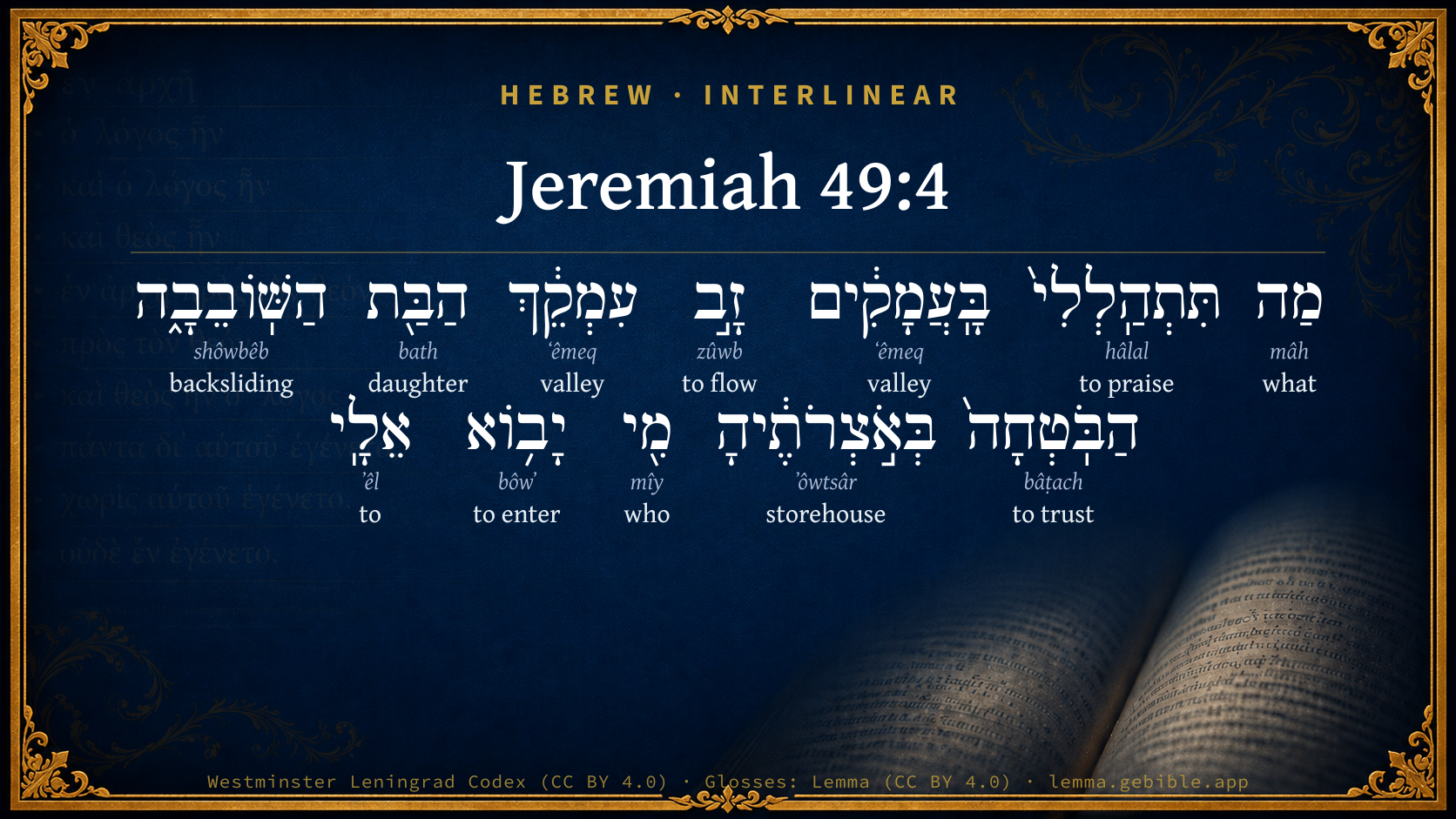
Hebrew (Westminster Leningrad Codex) Jeremiah 49:4 appears in the Hebrew Old Testament. The text above is from the Westminster Leningrad Codex. Each word links to its Strong’s number, a concise gloss, and parsing drawn from the Open Scriptures Hebrew Bible morphology. Click any word for its full Brown-Driver-Briggs (BDB) entry.
Download image
Cite this verse

Jeremiah 49:4 (World English Bible). Public Domain. Lemma interlinear Bible study tool, https://lemma.gebible.app/v/jeremiah/49/4.

Show BibTeX & RIS
BibTeX
RIS
English Translation
Why glory you in the valleys, your flowing valley, backsliding daughter? who trusted in her treasures, [saying], Who shall come to me?
World English Bible · Public Domain
Download a study sheet

One document with this verse’s original text, its word-by-word gloss line, the meaning frame, cross-references with their text, attributed commentary, and full source and license credits — printable, and it pastes into notes with its structure intact.

This verse Autodidact and up

Study sheet (.html) Plain text (.txt)

A passage Seminary Student

Up to 50 verses in one chapter. A passage sheet keeps up to 6 commentary sources and 12 cross-references per verse, in the order this page ranks them, and says so on the sheet whenever that leaves anything out. Ask for a single verse and you get the Autodidact verse sheet above.

Everything on this page stays free to read, with no account — the sheet is a download of what is already on screen, not access to it.

Want to remove ads? Support Godless Engineer
Compare translations 3

The same verse in 3 English versions, stacked beneath the original-language interlinear above. Click any original word for its lexicon entry.

Each is an independent rendering of the whole verse — the interlinear is not word-aligned to these translations.

Highlighted words mark where these versions differ — a whole-verse word diff, not a word-by-word alignment.

  • World English Bible Public Domain
    Why glory you in the valleys, your flowing valley, backsliding daughter? who trusted in her treasures, [saying], Who shall come to me?
  • King James Version Public Domain
    Wherefore gloriest thou in the valleys, thy flowing valley, O backsliding daughter? that trusted in her treasures, saying, Who shall come unto me?
  • unfoldingWord Literal Text CC BY-SA 4.0
    Why do you brag about your valleys, your valleys that are so fruitful, faithless daughter? You who trust in your wealth and say, ‘Who will come against me?’

unfoldingWord Literal Text — © unfoldingWord, licensed CC BY-SA 4.0. Word-aligned USFM3 via Door43 (git.door43.org/unfoldingWord/en_ult).

Versions to compare (up to 4)

3 of 4 selected

Show all 18 translations

Every available English version of this verse, each an independent rendering of the whole verse.

  • World English Bible Public Domain
    Why glory you in the valleys, your flowing valley, backsliding daughter? who trusted in her treasures, [saying], Who shall come to me?
  • Berean Standard Bible Public Domain
    Why do you boast of your valleys—your valleys so fruitful, O faithless daughter? You trust in your riches and say, ‘Who can come against me?’
  • Majority Standard Bible Public Domain
    Why do you boast of your valleys—your valleys so fruitful, O faithless daughter? You trust in your riches and say, ‘Who can come against me?’
  • King James Version Public Domain
    Wherefore gloriest thou in the valleys, thy flowing valley, O backsliding daughter? that trusted in her treasures, saying, Who shall come unto me?
  • American Standard Version (1901) Public Domain
    Wherefore gloriest thou in the valleys, thy flowing valley, O backsliding daughter? that trusted in her treasures, `saying', Who shall come unto me?
  • Revised Version (1885) Public Domain
    Wherefore gloriest thou in the valleys, thy flowing valley, O backsliding daughter? that trusted in her treasures, saying, Who shall come unto me?
  • Geneva Bible (1599) Public Domain
    Wherefore gloriest thou in the valleis? thy valley floweth away, O rebellious daughter: she trusted in her treasures, saying, Who shall come vnto me?
  • Douay-Rheims (1899) Public Domain
    Why gloriest thou in the valleys? thy valley hath flowed away, O delicate daughter, that hast trusted in thy treasures, and hast said: Who shall come to me?
  • Young's Literal Translation Public Domain
    What -- dost thou boast thyself in valleys? Flowed hath thy valley, O backsliding daughter, Who is trusting in her treasures: Who doth come in unto me?
  • Literal Standard Version CC BY-SA 4.0
    Why do you boast yourself in valleys? Your valley is flowing, || O backsliding daughter, || Who is trusting in her treasures: Who comes to me?
  • Unlocked Literal Bible CC BY-SA 4.0
    Why do you brag about your valleys, your valleys that are so fruitful, faithless daughter? you who trust in your wealth and say, 'Who will come against me?'
  • unfoldingWord Literal Text CC BY-SA 4.0
    Why do you brag about your valleys, your valleys that are so fruitful, faithless daughter? You who trust in your wealth and say, ‘Who will come against me?’
  • Darby Bible Public Domain
    Wherefore gloriest thou in the valleys? Thy valley shall flow down, O backsliding daughter, that trusteth in her treasures, [saying,] Who shall come against me?
  • World Messianic Bible Public Domain
    Why do you boast in the valleys, your flowing valley, backsliding daughter? You trusted in her treasures, saying, ‘Who will come to me?’
  • Webster's Bible Public Domain
    Why gloriest thou in the valleys, thy flowing valley, O backsliding daughter? that trusted in her treasures, saying, Who shall come to me?
  • Free Bible Version CC BY-SA 4.0
    Why do you boast that your valleys are so productive, you unfaithful people? You trust in your wealth, saying, “Who would dare attack us?”
  • Bible in Basic English Public Domain
    Why are you lifted up in pride on account of your valleys, your flowing valley, O daughter ever turning away? who puts her faith in her wealth, saying, Who will come against me?
  • JPS Tanakh (1917) Public Domain
    Wherefore gloriest thou in the valleys, thy flowing valley, O backsliding daughter? that didst trust in thy treasures: 'Who shall come unto me?'

Literal Standard Version (2020), Covenant Press — licensed CC BY-SA 4.0. Text via the HelloAO Bible API (eBible.org). Unlocked Literal Bible (unfoldingWord) — licensed CC BY-SA 4.0. Text via the HelloAO Bible API (eBible.org). unfoldingWord Literal Text — © unfoldingWord, licensed CC BY-SA 4.0. Word-aligned USFM3 via Door43 (git.door43.org/unfoldingWord/en_ult). Free Bible Version, Dr. Jonathan Gallagher — licensed CC BY-SA 4.0. Text via the HelloAO Bible API (eBible.org).

Word by word

More ways to search: Search by grammar → Find every occurrence → Compare this word →

Practice this passage: Drill this verse → Learn its vocabulary →

הַשּֽׁוֹבֵבָ֑ה
shôwbêb
H7728
“the · backsliding”
Particle, Definite Article + Adjective, Adjective, Feminine, Singular, Absolute
Part of Speech
Particle + Adjective
Type
Adjective
Gender
Feminine
Number
Singular
State
Absolute
Full BDB Definition

Origin: from H7725

TWOT: 2340d

backturning, apostate, backsliding
  1. מַה mâh H4100 “what” Particle, Interrogative
  2. תִּתְהַֽלְלִי֙ hâlal H1984 “to praise” Verb, Hithpael, Imperfect, 2nd Person, Feminine, Singular
  3. בָּֽעֲמָקִ֔ים ʻêmeq H6010 “in/at the · valleys” Preposition, Determined + Noun, Common, Masculine, Plural, Absolute
  4. זָ֣ב zûwb H2100 “flowing” Verb, Qal, Participle Active, Masculine, Singular, Absolute
  5. עִמְקֵ֔ךְ ʻêmeq H6010 “valley · your” Noun, Common, Masculine, Singular, Construct + Suffix, Personal, 2nd Person, Feminine, Singular
  6. הַבַּ֖ת bath H1323 “the · daughter” Particle, Definite Article + Noun, Common, Feminine, Singular, Absolute
  7. הַבֹּֽטְחָה֙ bâṭach H982 “the · trusting” Particle, Definite Article + Verb, Qal, Participle Active, Feminine, Singular, Absolute
  8. בְּאֹ֣צְרֹתֶ֔יהָ ʼôwtsâr H214 “in/at · storehouses · her” Preposition + Noun, Common, Masculine, Plural, Construct + Suffix, Personal, 3rd Person, Feminine, Singular
  9. מִ֖י mîy H4310 “who” Particle, Interrogative
  10. יָב֥וֹא bôwʼ H935 “to enter” Verb, Qal, Imperfect, 3rd Person, Masculine, Singular
  11. אֵלָֽי ʼêl H413 “to · me” Preposition + Suffix, Personal, 1st Person, Common, Singular

About this verse

These counts appear in no published source. They are computed here, from the morphology-tagged text and Lemma’s own curated glosses. What Lemma adds →

12
words
11
distinct lemmas
Prophets
section

Notable vocabulary

The rarest word here is הַשּֽׁוֹבֵבָ֑ה backsliding H7728 — appearing just 3 times in the whole Hebrew Bible.

Shared distinctive vocabulary

הַשּֽׁוֹבֵבָ֑ה backsliding H7728 occurs in 3 verses of the Hebrew Bible. Also found in:

Grammatical profile

  • 4 verbs
  • 4 nouns
  • 1 adjective
  • 1 preposition
  • 2 particles

Verb forms

  • תִּתְהַֽלְלִי֙ Hithpael · Imperfect
  • זָ֣ב Qal · Participle Active
  • הַבֹּֽטְחָה֙ Qal · Participle Active
  • יָב֥וֹא Qal · Imperfect

Repetition

A word recurs within this verse — often emphatic in Hebrew:

  • בָּֽעֲמָקִ֔ים valley H6010 ×2

Cross-references

17

Topical passages linked to Jeremiah 49:4 in the Treasury of Scripture Knowledge — connected by theme and wording, ordered by reader-vote popularity; previews shown in the World English Bible.

  • 1 Timothy 6:17 Charge those who are rich in this present world that they not be haughty, nor have their hope set on the uncertainty of riches, but on the living God, who richly provides us with everything to enjoy;
  • Jeremiah 9:23 Thus says Yahweh, Don't let the wise man glory in his wisdom, neither let the mighty man glory in his might, don't let the rich man glory in his riches;
  • Jeremiah 21:13 Behold, I am against you, O inhabitant of the valley, [and] of the rock of the plain, says Yahweh; you that say, Who shall come down against us? or who shall enter into our habitations?
  • Psalms 49:6 Those who trust in their wealth, And boast in the multitude of their riches--
  • Psalms 52:7 "Behold, this is the man who didn't make God his strength, But trusted in the abundance of his riches, And strengthened himself in his wickedness."
  • Psalms 62:10 Don't trust in oppression. Don't become vain in robbery. If riches increase, Don't set your heart on them.
  • Jeremiah 3:14 Return, backsliding children, says Yahweh; for I am a husband to you: and I will take you one of a city, and two of a family, and I will bring you to Zion:
  • Jeremiah 48:7 For, because you have trusted in your works and in your treasures, you also shall be taken: and Chemosh shall go forth into captivity, his priests and his princes together.
  • Proverbs 10:15 The rich man's wealth is his strong city. The destruction of the poor is their poverty.
  • Isaiah 28:1–4 Woe to the crown of pride of the drunkards of Ephraim, and to the fading flower of his glorious beauty, which is on the head of the fat valley of those who are overcome with wine!
  • Isaiah 47:7–8 You said, I shall be mistress forever; so that you did not lay these things to your heart, neither did remember the latter end of it.
  • Jeremiah 7:24 But they didn't listen nor turn their ear, but walked in [their own] counsels [and] in the stubbornness of their evil heart, and went backward, and not forward.
  • Jeremiah 49:16 As for your terror, the pride of your heart has deceived you, O you who dwell in the clefts of the rock, who hold the height of the hill: though you should make your nest as high as the eagle, I will bring you down from there, says Yahweh.
  • Ezekiel 28:4–7 by your wisdom and by your understanding you have gotten you riches, and have gotten gold and silver into your treasures;
  • Hosea 4:16 For Israel has behaved extremely stubbornly, like a stubborn heifer. Then how will Yahweh feed them like a lamb in a meadow.
  • Obadiah 1:4–5 Though you mount on high as the eagle, and though your nest is set among the stars, I will bring you down from there, says Yahweh.
  • Revelation 18:7 However much she glorified herself, and grew wanton, so much give her of torment and mourning. For she says in her heart, 'I sit a queen, and am no widow, and will in no way see mourning.'

Cross-references courtesy of OpenBible.info (CC BY 4.0).

Hebrew and Greek witnesses Masoretic Hebrew ↔ Greek Septuagint

The same verse in the two great witnesses to the Old Testament, shown verse-for-verse.

These are two independent witnesses, not word-aligned to each other, and the Septuagint is shown in lemma (dictionary) form.

Hebrew Jeremiah 49:4 Masoretic · Westminster Leningrad Codex

מַה תִּתְהַֽלְלִי֙ בָּֽעֲמָקִ֔ים זָ֣ב עִמְקֵ֔ךְ הַבַּ֖ת הַשּֽׁוֹבֵבָ֑ה הַבֹּֽטְחָה֙ בְּאֹ֣צְרֹתֶ֔יהָ מִ֖י יָב֥וֹא אֵלָֽי

Why glory you in the valleys, your flowing valley, backsliding daughter? who trusted in her treasures, [saying], Who shall come to me?

World English Bible · Public Domain

Greek LXX Structure differs

In the Septuagint, Jeremiah is about an eighth shorter than the Hebrew and arranges its material differently — the Oracles Against the Nations (Hebrew chapters 46–51) appear in the middle of the Greek book, after 25:13. Because the chapter and verse boundaries do not line up, a verse-for-verse comparison with the Hebrew is not shown.

A verse-for-verse comparison isn’t shown here because the chapters and verses don’t line up. Switch to the LXX edition with the MT / LXX toggle above to read the Greek directly.

On this verse, The Cambridge Bible for Schools and Colleges discusses the Septuagint’s reading. Read the note in Commentary ↓

Hebrew: Westminster Leningrad Codex (CC BY 4.0). Greek: Septuagint (public domain); English from a public-domain English Septuagint. How the Septuagint differs from the Hebrew →

Targum (Aramaic paraphrase)

1

The Targum is the ancient Jewish Aramaic paraphrase of the Hebrew Scriptures — an interpretive translation, not the Hebrew text itself. Onkelos (literal) and Pseudo-Jonathan (expansive) render the Torah, and Jonathan the Prophets. Coverage is partial: where no permissively-licensed English translation exists for a verse, only the Aramaic is shown. This is verse-level text, not a word-by-word alignment to the Hebrew.

  1. Targum Jonathan Prophets (Joshua–Malachi)
    מַה אַתְּ מִשְׁתַּבְּחֵי בְּמֵישְׁרָךְ חֲרוֹבוּ תוּקְפָךְ מַלְכוּתָא טִפְּשָׁתָא דְמִתְרַחֲצָא בְּבֵית גִנְזָהָא אָמְרָה מַן יֵיעוּל עֲלָי:

    (no public-domain English translation for this verse)

    Targum Jonathan — Aramaic: “Mikraot Gedolot” (public domain). English: “Sefaria Community Translation” (CC0 1.0 (public-domain dedication)); “London "Chaldee Paraphrase," 1871” (public domain). Text via Sefaria.

Commentary

Notes on Jeremiah 49:4 from classic Christian and Jewish commentators (each source and its license shown beneath its notes). The classic Christian expositions comment on the surrounding passage and are grouped to its opening verse, so a note may address several verses; the Jewish commentaries on the Tanakh (Rashi and others) are per-verse, so they appear only where the commentator wrote on this verse.

Lemma curates 59 commentaries, every one of them public domain or Creative Commons licensed, each selected and text-cleaned for this edition rather than reprinted as found. About our sources →

Trapp's Complete Commentary

John Trapp

Jer 49:4 Wherefore gloriest thou in the valleys, thy flowing valley, O backsliding daughter? that trusted in her treasures, [saying], Who shall come unto me?

Ver. 4. Wherefore gloriest thou in the valleys?] Because fat and fertile, as being near to Sodom and Gomorrah, that pleasant plain. {Gen 13:10}

O backsliding daughter.] {a} Or, Untoward and refractory. Sept., Thou daughter of rashness, or of impudence, quae ita lascivis sicut puella quae libidinatur, et virum quaerit, saith Oecolampadius.

That trusted in her treasures.] Never yet true to those that trusted them. {1Ti 6:17 Psa 52:7}

Who shall come unto me?] Or, Who can come at me?

{a} Appellat homines regni erroneos filiam vagam.

John Trapp, A Commentary or Exposition upon All the Books of the Old and New Testament (1647–1656) — public domain. Text from a community e-Sword module.

Joseph Benson's Commentary

Jer 49:4-6. Wherefore gloriest thou in the valleys? — That is, in the riches of thy fat and plentiful valleys, which overflow with abundance of all things: compare Isa 28:1; Isa 28:4. Though they be fruitful, yet glory not therein, for, notwithstanding their fertility, they shall be no security to thee against the terror which I shall bring upon thee. Behold, I will bring fear upon thee — When God gives up a people to destruction, he commonly takes from them their usual courage. But the word fear here may denote a hostile army, the cause of fear and terror. And ye shall be driven out every man right forth — That is, so as not to dare to look back, or stop to consider which way to go, but flee for your lives that way which lies next. And none shall gather up him that wandereth — None shall bring him that flees from the enemy to his house, or afford him any shelter or accommodation. And afterward I will bring again the captivity of Ammon. See note on Jer 48:47.

Joseph Benson's Commentary on the Old and New Testaments (1811–1818) — public domain. Text from a community e-Sword module.

Tyndale Open Study Notes

Tyndale Open Resources

49:4-6 The Ammonites trusted in their wealth, but it could not provide security. The Lord ensured their judgment and their future restoration.

Tyndale Open Study Notes — © Tyndale Open Resources, licensed CC BY-SA 4.0. Text via the HelloAO Bible API.

Geneva Bible (1599)

Geneva Bible translators

In thy plentiful country.

Geneva Bible (1599) marginal notes — public domain. Text via Bolls.life.

Jamieson, Fausset & Brown

Robert Jamieson, A. R. Fausset & David Brown

thy flowing valley--rather, "thy valley shall flow," namely with the blood of the slain; in sad contrast to their "valleys" in which they had heretofore "gloried," as flowing with milk and honey [GROTIUS]. Or else, as Margin, "shall flow away."

backsliding--apostate from Jehovah, the God of their father Lot, to Molech.

treasures--her resources for resisting the foe.

Who shall, &c.--Who can come . . . (Jer 21:13).

Jamieson, Fausset & Brown — Commentary Critical and Explanatory on the Whole Bible (1871) — public domain (CC PDM 1.0). Text via the HelloAO Bible API.

Adam Clarke's Commentary

Verse 4. Wherefore gloriest thou] Though thy valleys be fruitful, yet glory not in them. Though thou have much political and military power, do not trust in them, nor in the multitude of thy cities; a stronger than thou is coming against thee.

Adam Clarke's Commentary on the Bible (1810–1826) — public domain. Text from a community e-Sword/MySword module.

John Calvin's Commentaries

As the minds of men continually vacillate, because they do not sufficiently consider the infinite power of God, the Prophet, that he might remove all obstacles which might have rendered his prophecy doubtful, now declares that the Ammonites gloried in vain in their valleys. Some understand by valleys a fertile land, well watered. But the Prophet, as I think, refers rather to fortified places. He then says, that they in vain gloried in their deep valleys; as they were surrounded with mountains, so they thought that they could not be approached. He derides this vain confidence, Why, he says, dost thou glory in thy valleys, or, profundities? Flown down has thy valley. By saying, that the valley, or depth, had flown down, he alludes to its situation: for when any one considers a region situated among mountains, the land appears as flowing, like a river gliding between its banks. It is then a striking allusion to a deep place, when he says that the valley flowed down It was the same as though he had said, “Thy depth has vanished,” or, “It shall not be to thee such a protection as thou thinkest.” But the meaning is, that though the Ammonites, confiding in their defences, disregarded all attacks of enemies, they would yet be exposed to plunder; for their mountains and valleys would avail them nothing, notwithstanding the opinion they entertained, that they were so fortified, that they could not be assailed.

He calls Ammon a rebellious, or a backsliding daughter, though he mentions no particulars. But Ezekiel and also Amos and Zephaniah, these three, clearly show why God was so severe towards the Ammonites, (Ezekiel 25; Amos 1:13; Zephaniah 2:9;) it was because they had uttered blasphemies against him and his people, exulted over the miseries and calamities of the chosen people, and plundered them when they saw them overcome by their enemies. For these reasons, then, our Prophet now calls them a rebellious people: they had proudly exalted themselves against God, and exercised cruel tyranny as to the miserable Israelites, who were yet, as it has been stated, connected with them by blood.

Who trusts in her secrecies, or hidden places: rendered by some, “in her treasures.” But as אצר, atser, means to hide, the reference is, as I think, to strongholds; for the Prophet in the next words explains himself, Who can come to me? It appears, then, that the Ammonites thought themselves thus secure, because they were not exposed to their enemies, but protected by their mountains, as though they were in hiding places. This boasting sufficiently shews that they did not so much trust in their treasures as in their hidden places, because they dwelt in recesses. The meaning is, that though the Ammonites gloried that they were beyond the reach of danger, yet God would become the avenger of the cruelty which they had exercised towards their relations, the Israelites. It follows —

John Calvin's Commentaries (1540-1563) — public domain. Text from the Calvin Translation Society English edition (1840s-50s) via the Christian Classics Ethereal Library (ccel.org). Calvin's coverage is partial (roughly two-thirds of the Bible); uncommented books and verses are honest gaps, never fabricated. The 19th-century editor's footnotes and remarks are omitted so the notes are faithfully Calvin's own voice.

Ellicott's Commentary for English Readers

(4) In the valleys.—The word exactly describes the conformation of the Ammonite country, as a high plateau intersected by streams which make their way to the Jordan. For “thy flowing valley” read “thy valley” (this is, of course, the valley in which Rabbah was situated) “that floweth with plenty.” The words admit, however, of being rendered, “Thy valley floweth away,” i.e., is wasted and emptied.

O backsliding daughter.—There is something suggestive in the fact that the prophet applies to Ammon the epithet which he had applied before to the kingdom of the Ten Tribes (Jer_3:6; Jer_3:8; Jer_3:11; Jer_3:14). Ammon also had the opportunity of worshipping the God of Israel, and had probably, as long as the Israelites were her rulers, adopted that worship wholly or in part, and so she also was an apostate. The question which follows, as in Jer_21:13, implies that the people of Rabbah looked on their city as impregnable.

A Bible Commentary for English Readers, edited by Charles John Ellicott (1878–1897) — public domain. Text from a community e-Sword module.

The Cambridge Bible for Schools and Colleges

gen. ed. J. J. S. Perowne

4. Wherefore … flowing valley] mg. (scarcely possible), Wherefore gloriest thou in the valleys? thy valley floweth away. Rabbah was on a broad tableland about 2700 feet above the sea, but it was surrounded by hills, so that it could be described as in a vale. “Thy flowing valley” is, however, a strange expression, and in the Hebrew looks like a somewhat corrupted dittography of the previous letters, a conjecture to which the LXX lend a certain amount of support.

backsliding] Cp. in Jer_31:22, referring, however, there to Ephraim. In the case of a heathen people it is less appropriate. Du. suggests an emendation, which gives the sense of arrogant.

The Cambridge Bible for Schools and Colleges (gen. ed. J. J. S. Perowne; Cambridge University Press, 1878–1918) — public domain. Text from a community e-Sword module.

John Gill's Exposition

Wherefore gloriest thou in the valleys,.... Of which there were many in the country of Ammon, fruitful and well watered, which were situated by the rivers of Arnon and Jabbok, the borders of this country, and in which was the plain of the vineyards; see Jdg 11:13; and indeed the whole country was a vale. For, as Josephus (c) says, the country both of the Moabites and Ammonites were in the valley of Syria, or Coelesyria; that is, hollow Syria, so called from its lying low, or in a valley; for this country lay between the mountains Libanus and Antilibanus, as Strabo (d) says, and brought forth a large increase; in this they gloried, in the produce of these valleys, in the grass, corn, and vines, that grew upon them, and the flocks that fed there; but now should have no occasion to glory, all being swept away by the enemy:

thy flowing valley, or, "thy valley flows" (e); is overflowed with water, through abundance of rain, which destroyed the fruits of it, so Jarchi; or rather flowed with the blood of the slain, as Kimchi, Ben Melech, and Abarbinel; the enemy having entered it, and made so great a slaughter of men in it:

O backsliding daughter? the Targum is, O foolish kingdom; the whole kingdom of Ammon is meant, or the people of it; who, descending from righteous Lot, may be called backsliders; and, being also idolaters, have this character; for such revolt from the true God, to worship idols: it may be rendered, "refractory", "rebellious" (f); as all such persons are:

that trusteth in her treasures, saying, who shall come unto me? dwelling in valleys encompassed with mountains, and in fortified cities, and abounding in wealth and riches, whereby they were able to procure men and arms to defend themselves; thought they were safe from any enemy, and that none could come nigh them, and so dwelt at ease, and in great security.

(c) Ibid. (Antiqu.) l. 1. c. 11. sect. 5. (d) Geograph. l. 16. p. 519, 520. (e) "defluxit vallis tua", V. L. Schmidt; "fluxit", Pagninus, Montanus; "fluit", Cocceius. (f) "O filia pervesa", Schmidt; "pervicax" vel "temeraria", Grotius; "rebellis", Pagninus, Calvin; "refractaria", Montanus.

John Gill's Exposition of the Whole Bible (1746–1763) — public domain (CC PDM 1.0). Text via the HelloAO Bible API.

Albert Barnes' Notes on the Bible

Thy flowing valley - The (fertile) valley in which Rabbah was situated. The Septuagint again has: “in the valleys of the Anakim,” as in Jer 47:5 (see the note).

Albert Barnes' Notes on the Bible (1834–1885) — public domain. Text from a community e-Sword/MySword module.

Haydock's Catholic Bible Commentary

Delicate. Hebrew, "rebel or dissolute." Septuagint, "impudent."

George Leo Haydock (1774–1849), Haydock's Catholic Family Bible and Commentary, 1859 edition — public domain. Excludes Psalms (Douay-Rheims chapter numbering differs from Protestant) and Deuterocanonical books (Catholic canon only).

Matthew Poole's English Annotations

It should seem that this country was full of very fruitful valleys, which we know are always the most fertile places, lying lower and at a greater distance from the sun than mountains, and also receiving at second hand the moisture that falls upon the hills, and being usually watered with rivers; from whence they may be called

flowing valleys, either as flowing with receptacles of water, or plenty of corn and grass; though some read it, (and it seems rather more agreeable to the Hebrew,) thy valley floweth, either with the blood of men slain, or floweth away, the fertility of it ceaseth or decayeth. Or, floods of waters shall destroy the fruit of thy rich valleys, &c. O backsliding daughter: Ammon having never been in covenant with God, the word in the Hebrew (though it comes from שוב which signifies to return) seemeth ill translated backsliding, thou that hast turned thyself away from God.

That trusted in her treasures, saying, Who shall come unto me? thou that trustedst in thy riches, or in thy valleys full of riches, and promisedst thyself security from the situation of thy rich country, thinking none could come at thee.

Matthew Poole's English Annotations on the Holy Bible (1683–1685) — public domain. Text from a community e-Sword/MySword module.

Whedon's Commentary on the Bible

Daniel D. Whedon

4. Valleys — The territory of the Ammonites is largely made up of elevated tablelands, crossed by fertile valleys made by streams which make their way to the Jordan. The singular, thy flowing valley, probably may have reference to that one in which Rabbah was situated.

Daniel D. Whedon (gen. ed.), Commentary on the Old and New Testaments (1874–1909) — public domain. Text from a community e-Sword module.

The Pulpit Commentary

The valleys; i.e. long extended plains, such as were suitable for cornfields, (Isa_17:5 Psa_65:1-4) and such as characterized the territory of the Ammonites. Thy flowing valley. "Flowing;" that is, abounding with rich crops. The meaning of the phrase, however, is only probable.

The Pulpit Commentary (1880–1919), ed. H.D.M. Spence-Jones & Joseph S. Exell — public domain. Text from a community e-Sword module.

John Wesley's Explanatory Notes

Flowing - Either flowing with water, or plenty of corn and grass.

John Wesley, Explanatory Notes Upon the Whole Bible (1754–1765) — public domain. Text via the GEBible commentary corpus.

Rashi

Rabbi Shlomo Yitzchaki (Rashi)

You boast Heb. תתהללי (vanter in French).

about the valleys? That your land is a land of valleys and lack of rainfall is not harmful to it since the sun does not penetrate into it.

Your valley is flowing A misfortune of an overabundance of rain shall come upon it until the water will flow in the valley and inundate the roots of the grain So did Menahem [Machbereth Menahem p. 77] explain it.

Rashi on the Tanakh — English translations: “The Judaica Press complete Tanach with Rashi, translated by A. J. Rosenberg” (CC BY 4.0); “Pentateuch with Rashi's commentary by M. Rosenbaum and A.M. Silbermann, 1929-1934” (public domain); “The Metsudah Tanach series, Lakewood, N.J” (CC BY 4.0); and “The Book of Joshua, Metsudah Publications, 1997” (CC BY 4.0). Text via Sefaria.

Lesson kit

Teaching starters — assembled from the data on this page, not authored interpretation. Every prompt links to the verse data it draws on. Edit before teaching.

Jeremiah, in the Prophets, opens this verse with 12 words (11 distinct Hebrew lemmas). Its most distinctive word is shôwbêb (“backsliding”). A historical commentator’s framing appears above. Read the whole chapter for the surrounding context.

Discussion questions

  1. The word shôwbêb carries the sense “backsliding.” How does it shape the verse?
  2. Jeremiah 31:22 shares the word «backsliding» with this verse. How do the two illuminate each other?
  3. “valley” occurs 2× in this one verse. What is the effect of the repetition?
  4. These translations render this verse differently; the difference is in the English rendering, not the original. What questions does that raise?
  5. The verb «תִּתְהַֽלְלִי֙» is Hithpael Imperfect. How does its form color the action?
  6. Reading how Trapp's Complete Commentary and Joseph Benson's Commentary read this verse, where do the two commentators agree and where do they part?

Things to notice

Reading settings

Reading text

Shown beneath each verse's original-language words.

Old Testament
Old Testament edition

Read the OT as the Masoretic Hebrew (MT) or the Greek Septuagint (LXX).

English shown for the Greek Septuagint (in the Hebrew ↔ Greek comparison).

Comparing translations? Open the Compare panel on any verse page to stack up to four side by side.