
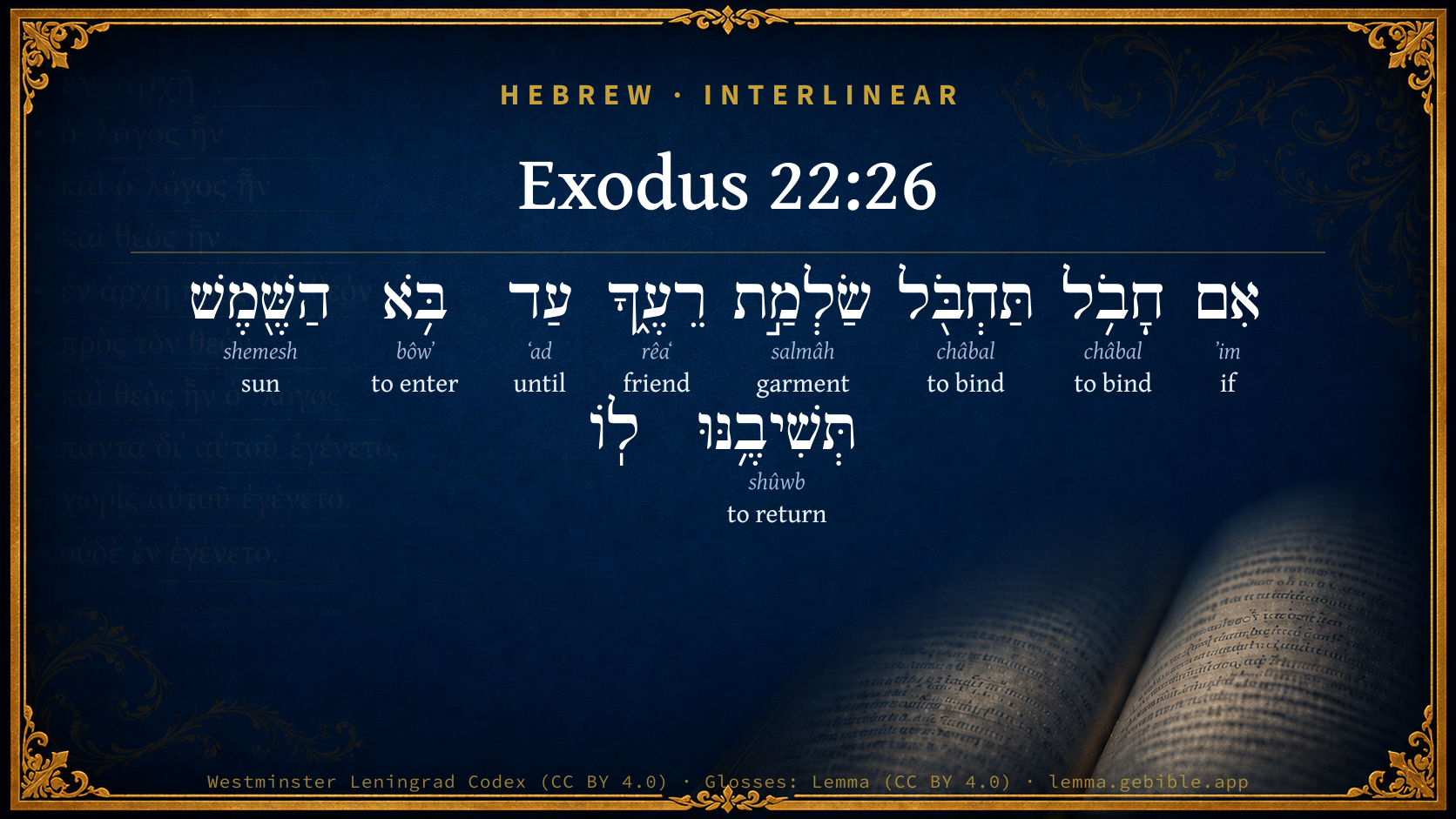
Exodus 22:26

Hebrew (Westminster Leningrad Codex) Exodus 22:26 appears in the Hebrew Old Testament. The text above is from the Westminster Leningrad Codex. Each word links to its Strong’s number, a concise gloss, and parsing drawn from the Open Scriptures Hebrew Bible morphology. Click any word for its full Brown-Driver-Briggs (BDB) entry.
Download image
Cite this verse

Exodus 22:26 (World English Bible). Public Domain. Lemma interlinear Bible study tool, https://lemma.gebible.app/v/exodus/22/26.

Show BibTeX & RIS
BibTeX
RIS
English Translation
If you take your neighbor's garment as collateral, you shall restore it to him before the sun goes down,
World English Bible · Public Domain
Highlights
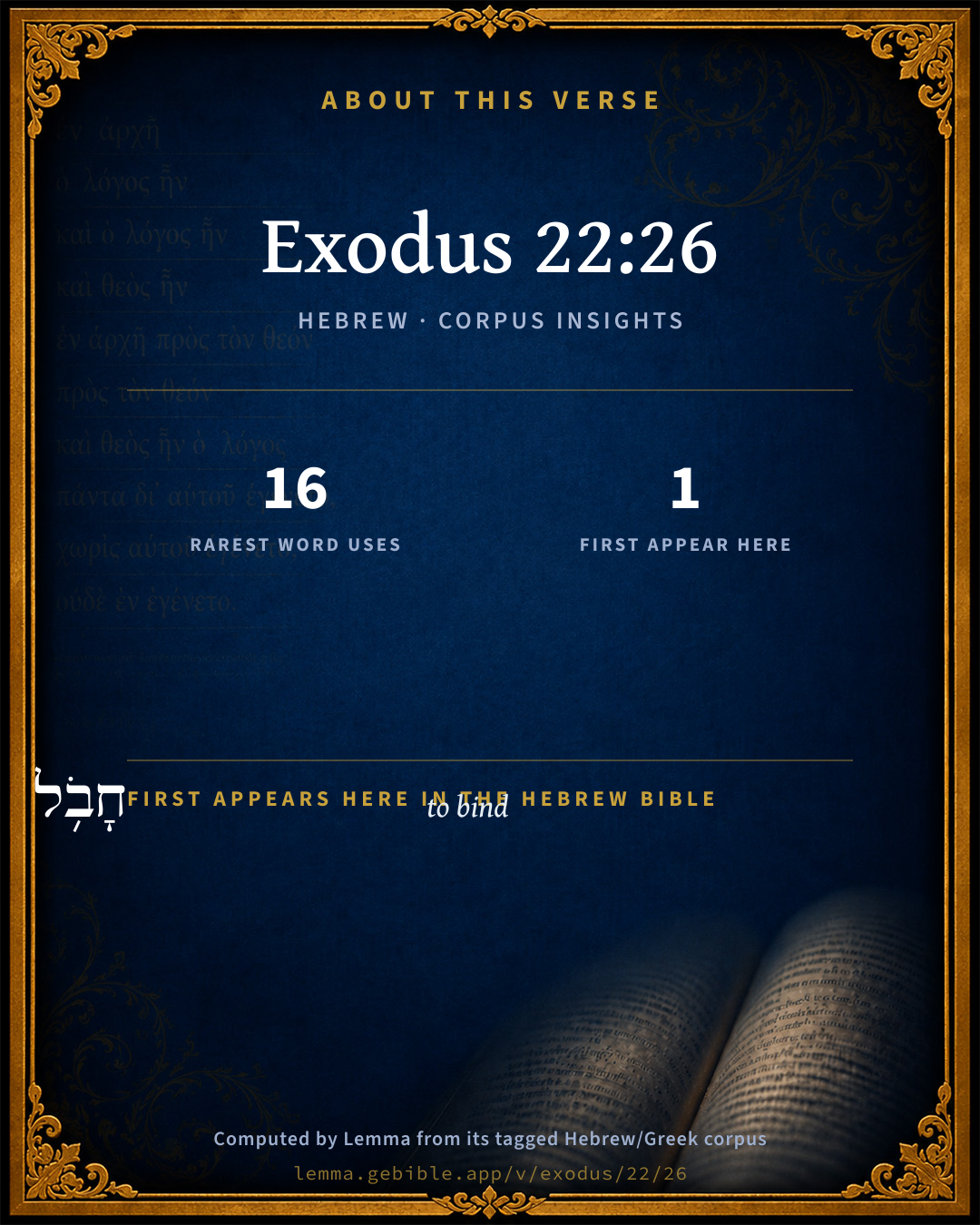
  • 1 first appearance in the Hebrew Bible
Full analysis ↓
Download a study sheet

One document with this verse’s original text, its word-by-word gloss line, the meaning frame, cross-references with their text, attributed commentary, and full source and license credits — printable, and it pastes into notes with its structure intact.

This verse Autodidact and up

Study sheet (.html) Plain text (.txt)

A passage Seminary Student

Up to 50 verses in one chapter. A passage sheet keeps up to 6 commentary sources and 12 cross-references per verse, in the order this page ranks them, and says so on the sheet whenever that leaves anything out. Ask for a single verse and you get the Autodidact verse sheet above.

Everything on this page stays free to read, with no account — the sheet is a download of what is already on screen, not access to it.

Want to remove ads? Support Godless Engineer
Compare translations 3

The same verse in 3 English versions, stacked beneath the original-language interlinear above. Click any original word for its lexicon entry.

Each is an independent rendering of the whole verse — the interlinear is not word-aligned to these translations.

Highlighted words mark where these versions differ — a whole-verse word diff, not a word-by-word alignment.

  • World English Bible Public Domain
    If you take your neighbor's garment as collateral, you shall restore it to him before the sun goes down,
  • King James Version Public Domain
    If thou at all take thy neighbor's raiment to pledge, thou shalt deliver it unto him by that the sun goeth down:
  • unfoldingWord Literal Text CC BY-SA 4.0
    If you actually take the clothing of your neighbor in pledge, you shall return it to him before the sun goes down,

unfoldingWord Literal Text — © unfoldingWord, licensed CC BY-SA 4.0. Word-aligned USFM3 via Door43 (git.door43.org/unfoldingWord/en_ult).

Versions to compare (up to 4)

3 of 4 selected

Show all 18 translations

Every available English version of this verse, each an independent rendering of the whole verse.

  • World English Bible Public Domain
    If you take your neighbor's garment as collateral, you shall restore it to him before the sun goes down,
  • Berean Standard Bible Public Domain
    If you take your neighbor’s cloak as collateral, return it to him by sunset,
  • Majority Standard Bible Public Domain
    If you take your neighbor’s cloak as collateral, return it to him by sunset,
  • King James Version Public Domain
    If thou at all take thy neighbor's raiment to pledge, thou shalt deliver it unto him by that the sun goeth down:
  • American Standard Version (1901) Public Domain
    If thou at all take thy neighbor's garment to pledge, thou shalt restore it unto him before the sun goeth down:
  • Revised Version (1885) Public Domain
    If thou at all take thy neighbour’s garment to pledge, thou shalt restore it unto him by that the sun goeth down:
  • Geneva Bible (1599) Public Domain
    If thou take thy neighbours rayment to pledge, thou shalt restore it vnto him before the sunne go downe:
  • Douay-Rheims (1899) Public Domain
    If thou take of thy neighbour a garment in pledge, thou shalt give it him again before sunset.
  • Young's Literal Translation Public Domain
    if thou dost at all take in pledge the garment of thy neighbour, during the going in of the sun thou dost return it to him:
  • Literal Standard Version CC BY-SA 4.0
    if you take the garment of your neighbor in pledge at all, you return it to him during the going in of the sun:
  • Unlocked Literal Bible CC BY-SA 4.0
    If you take your neighbor's garment in pledge, you must return it to him before the sun goes down,
  • unfoldingWord Literal Text CC BY-SA 4.0
    If you actually take the clothing of your neighbor in pledge, you shall return it to him before the sun goes down,
  • Darby Bible Public Domain
    -- If thou at all take thy neighbour's garment in pledge, thou shalt return it to him before the sun goes down;
  • World Messianic Bible Public Domain
    If you take your neighbor’s garment as collateral, you shall restore it to him before the sun goes down,
  • Webster's Bible Public Domain
    If thou shalt at all take thy neighbor's raiment to pledge, thou shalt deliver it to him by the setting of the sun.
  • Free Bible Version CC BY-SA 4.0
    If you require your neighbor's cloak as security for a loan, you must return it to him by sunset,
  • Bible in Basic English Public Domain
    If ever you take your neighbour's clothing in exchange for the use of your money, let him have it back before the sun goes down:
  • JPS Tanakh (1917) Public Domain
    (22-25) If thou at all take thy neighbour's garment to pledge, thou shalt restore it unto him by that the sun goeth down;

Literal Standard Version (2020), Covenant Press — licensed CC BY-SA 4.0. Text via the HelloAO Bible API (eBible.org). Unlocked Literal Bible (unfoldingWord) — licensed CC BY-SA 4.0. Text via the HelloAO Bible API (eBible.org). unfoldingWord Literal Text — © unfoldingWord, licensed CC BY-SA 4.0. Word-aligned USFM3 via Door43 (git.door43.org/unfoldingWord/en_ult). Free Bible Version, Dr. Jonathan Gallagher — licensed CC BY-SA 4.0. Text via the HelloAO Bible API (eBible.org).

Word by word

More ways to search: Search by grammar → Find every occurrence → Compare this word →

Practice this passage: Drill this verse → Learn its vocabulary →

About this verse

These counts appear in no published source. They are computed here, from the morphology-tagged text and Lemma’s own curated glosses. What Lemma adds →

10
words
8
distinct lemmas
Pentateuch
section

Notable vocabulary

The rarest word here is שַׂלְמַ֣ת garment H8008 — appearing just 16 times in the whole Hebrew Bible.

First appearance in Scripture

This word makes its first canonical appearance in the Hebrew Bible here:

  • חָבֹ֥ל to bind H2254

Shared distinctive vocabulary

שַׂלְמַ֣ת garment H8008 occurs in 16 verses of the Hebrew Bible. Also found in:

Grammatical profile

  • 4 verbs
  • 3 nouns
  • 2 prepositions
  • 1 conjunction

Verb forms

  • חָבֹ֥ל Qal · Infinitive Absolute
  • תַּחְבֹּ֖ל Qal · Imperfect
  • בֹּ֥א Qal · Infinitive Construct
  • תְּשִׁיבֶ֥נּוּ Hiphil · Imperfect

Repetition

A word recurs within this verse — often emphatic in Hebrew:

  • חָבֹ֥ל to bind H2254 ×2

Hebrew & Septuagint length

In English translation the verse runs 19 words from the Hebrew and 18 from the Septuagint (LXX English) — closely comparable.

A rough comparison of the two English renderings, which tokenize alike — not a word-level alignment.

Word counts can differ between the Hebrew and the Greek without any difference in meaning — e.g. the Hebrew direct-object marker אֵת has no separate Greek word, and Greek often adds the article ὁ.

Cross-references

12

Topical passages linked to Exodus 22:26 in the Treasury of Scripture Knowledge — connected by theme and wording, ordered by reader-vote popularity; previews shown in the World English Bible.

  • Proverbs 20:16 Take the garment of one who puts up collateral for a stranger; And hold him in pledge for a wayward woman.
  • Amos 2:8 And they lay themselves down beside every altar on clothes taken in pledge; And in the house of their God they drink the wine of those who have been fined.
  • Deuteronomy 24:6 No man shall take the mill or the upper millstone to pledge; for he takes [a man's] life to pledge.
  • Deuteronomy 24:10–13 When you do lend your neighbor any manner of loan, you shall not go into his house to get his pledge.
  • Deuteronomy 24:17 You shall not wrest the justice [due] to the foreigner, [or] to the fatherless, nor take the widow's clothing to pledge;
  • Job 24:3 They drive away the donkey of the fatherless, And they take the widow's ox for a pledge.
  • Proverbs 22:27 If you don't have means to pay, Why should he take away your bed from under you?
  • Ezekiel 18:7 and has not wronged any, but has restored to the debtor his pledge, has taken nothing by robbery, has given his bread to the hungry, and has covered the naked with a garment;
  • Ezekiel 18:16 neither has wronged any, has not taken anything to pledge, neither has taken by robbery, but has given his bread to the hungry, and has covered the naked with a garment;
  • Job 22:6 For you have taken pledges from your brother for nothing, And stripped the naked of their clothing.
  • Job 24:9 There are those who pluck the fatherless from the breast, And take a pledge of the poor,
  • Ezekiel 33:15 if the wicked restore the pledge, give again that which he had taken by robbery, walk in the statutes of life, committing no iniquity; he shall surely live, he shall not die.

Cross-references courtesy of OpenBible.info (CC BY 4.0).

Hebrew and Greek witnesses Masoretic Hebrew ↔ Greek Septuagint

The same verse in the two great witnesses to the Old Testament, shown verse-for-verse.

These are two independent witnesses, not word-aligned to each other, and the Septuagint is shown in lemma (dictionary) form.

Hebrew Exodus 22:26 Masoretic · Westminster Leningrad Codex

אִם חָבֹ֥ל תַּחְבֹּ֖ל שַׂלְמַ֣ת רֵעֶ֑ךָ עַד בֹּ֥א הַשֶּׁ֖מֶשׁ תְּשִׁיבֶ֥נּוּ לֽוֹ

If you take your neighbor's garment as collateral, you shall restore it to him before the sun goes down,

World English Bible · Public Domain

Greek LXX Exodus 22:26 Septuagint · lemma form

εἰμί γάρ οὗτος περιβόλαιον αὐτός μόνος οὗτος ὁ ἱμάτιον ἀσχημοσύνη αὐτός ἐν τίς κοιμάω ἐάν οὖν καταβοάω πρός ἐγώ εἰςἀκούω αὐτός ἐλεήμων γάρ εἰμί

And if you take your neighbor's garment for a pledge, you shall restore it to him before sunset.

LXX2012 (modern English Septuagint) · Public Domain

Hebrew: Westminster Leningrad Codex (CC BY 4.0). Greek: Septuagint (public domain); English from LXX2012 (modern English Septuagint) (Public Domain). How the Septuagint differs from the Hebrew →

Targum (Aramaic paraphrase)

2

The Targum is the ancient Jewish Aramaic paraphrase of the Hebrew Scriptures — an interpretive translation, not the Hebrew text itself. Onkelos (literal) and Pseudo-Jonathan (expansive) render the Torah, and Jonathan the Prophets. Coverage is partial: where no permissively-licensed English translation exists for a verse, only the Aramaic is shown. This is verse-level text, not a word-by-word alignment to the Hebrew.

  1. Targum Onkelos Torah (Genesis–Deuteronomy)
    אֲרֵי הִיא כְסוּתֵהּ בִּלְחוֹדַהּ הִיא תוֹתְבֵהּ לְמַשְׁכֵּיהּ בְּמָא יִשְׁכּוּב וִיהֵי אֲרֵי יִקְבֵל קֳדָמַי וֶאֱקַבֵּל קְבִלְתֵּהּ אֲרֵי חַנָנָא אֲנָא:

    (no public-domain English translation for this verse)

    Targum Onkelos — Aramaic: “Onkelos Genesis” (public domain); “Onkelos Exodus” (public domain); “Onkelos Leviticus” (public domain); “Onkelos Numbers” (public domain); “Onkelos Deuteronomy” (public domain). English: “Sefaria Community Translation” (CC0 1.0 (public-domain dedication)); “J.W. Etheridge. The Targums of Onkelos and Jonathan Ben Uzziel on the Pentateuch. London: Longmans, Green, 1862” (public domain). Text via Sefaria.

  2. Targum Pseudo-Jonathan Torah (Genesis–Deuteronomy)
    אֲרוּם הִיא טָלֵית דְּמִתְכַּסֵּי בָהּ בִּלְחוֹדָהּ הִיא תּוֹתְבֵיהּ דְּנַפְלָא לְמוֹשְׁכֵיהּ וְאִין תִּיסַב מַצַּע עַרְסֵיהּ בַּמֶּה יִשְׁכּוּב וִיהֵי אִין יִקְבּוֹל קֳדָמַי וַאֲקַבֵּיל צְלוֹתֵיהּ אֲרוּם אֱלָהָא חֲנָנָא אֲנָא

    for it may be his taleth which alone covereth him; (or) it is his only garment in which he rests, which falleth upon his skin; and if thou take the coverlet of the bed whereon he lies, and he be heard before Me, I will hearken to his prayer; for I am Eloah the Merciful.

    Targum Pseudo-Jonathan — Aramaic: “Targum Jonathan on Genesis” (public domain); “Targum Jonathan on Exodus” (public domain); “Targum Jonathan on Leviticus” (public domain); “Targum Jonathan on Numbers” (public domain); “Targum Jonathan on Deuteronomy” (public domain). English: “The Targum of Jonathan ben Uzziel, trans. J. W. Etheridge, London, 1862” (public domain). Text via Sefaria.

Commentary

Notes on Exodus 22:26 from classic Christian and Jewish commentators (each source and its license shown beneath its notes). The classic Christian expositions comment on the surrounding passage and are grouped to its opening verse, so a note may address several verses; the Jewish commentaries on the Tanakh (Rashi and others) are per-verse, so they appear only where the commentator wrote on this verse.

Lemma curates 59 commentaries, every one of them public domain or Creative Commons licensed, each selected and text-cleaned for this edition rather than reprinted as found. About our sources →

Trapp's Complete Commentary

John Trapp

Exo 22:26 If thou at all take thy neighbour’s raiment to pledge, thou shalt deliver it unto him by that the sun goeth down:

Ver. 26, 27. Thy neighbour’s raiment.] Meant only of his bedclothes, tegumentum nocturnum; without which he cannot comfortably rest in the night.

John Trapp, A Commentary or Exposition upon All the Books of the Old and New Testament (1647–1656) — public domain. Text from a community e-Sword module.

Jamieson, Fausset & Brown

Robert Jamieson, A. R. Fausset & David Brown

If thou at all take thy neighbour's raiment to pledge, &c.--From the nature of the case, this is the description of a poor man. No Orientals undress, but, merely throwing off their turbans and some of their heavy outer garments, they sleep in the clothes which they wear during the day. The bed of the poor is usually nothing else than a mat; and, in winter, they cover themselves with a cloak--a practice which forms the ground or reason of the humane and merciful law respecting the pawned coat.

Jamieson, Fausset & Brown — Commentary Critical and Explanatory on the Whole Bible (1871) — public domain (CC PDM 1.0). Text via the HelloAO Bible API.

Adam Clarke's Commentary

Verse 26. If thou - take thy neighbour's raiment to pledge] It seems strange that any pledge should be taken which must be so speedily restored; but it is very likely that the pledge was restored by night only, and that he who pledged it brought it back to his creditor next morning. The opinion of the rabbins is, that whatever a man needed for the support of life, he had the use of it when absolutely necessary, though it was pledged. Thus he had the use of his working tools by day, but he brought them to his creditor in the evening. His hyke, which serves an Arab as a plaid does a Highlander, (See Clarke on Ex 12:34), was probably the raiment here referred to: it is a sort of coarse blanket, about six yards long, and five or six feet broad, which an Arab always carries with him, and on which he sleeps at night, it being his only substitute for a bed. As the fashions in the east scarcely ever change, it is very likely that the raiment of the Israelites was precisely the same with that of the modern Arabs, who live in the very same desert in which the Hebrews were when this law was given. How necessary it was to restore the hyke to a poor man before the going down of the sun, that he might have something to repose on, will appear evident from the above considerations. At the same time, the returning it daily to the creditor was a continual acknowledgment of the debt, and served instead of a written acknowledgment or bond; as we may rest assured that writing, if practised at all before the giving of the law, was not common: but it is most likely that it did not exist.

Adam Clarke's Commentary on the Bible (1810–1826) — public domain. Text from a community e-Sword/MySword module.

Ellicott's Commentary for English Readers

(26, 27) Thy neighbour’s raiment.—The simlah, or salmah, here translated “raiment,” was the large flowing outer raiment, elsewhere called beged, which was commonly of woollen, and corresponded to the abba of the modern Arabs. It was a warm wrapper, and has sometimes been compared to a Scotch plaid. The poor Israelite did not much want it by day; but needed it as a blanket by night—a practice known to many modern tribes of Arabs. The present passage forbids the retention of this garment as a pledge during the night, and seems to imply a continuous practice of pledging the simlah by day, and being allowed to Enjoy the use of it, nevertheless, as a nocturnal covering.

A Bible Commentary for English Readers, edited by Charles John Ellicott (1878–1897) — public domain. Text from a community e-Sword module.

The Cambridge Bible for Schools and Colleges

gen. ed. J. J. S. Perowne

26. garment] mantle (Heb. salmâh), the large rectangular piece of cloth described in the note on Exo_12:34; perhaps the only article that a poor man would have to offer as a pledge, as well as his only covering by night (v. 27). The mantle might be retained by the debtor, in order that he might sleep in it himself: see Deu_24:12. A garment was a common pledge: see not only Amo_2:8, Job_22:6, already quoted, but also Pro_20:16 = Pro_27:13. The poor still sleep in Palestine in their ordinary clothes (L. and B. i. 54, 99, iii. 89); cf. Shaw, Travels in Barbary and the Levant (1738), p. 290 (cited by Kn.).

26, 27. A garment taken in pledge to be returned before sun-down. Cf. Ḥamm. § 241. Comp. Deu_24:6; Deu_24:10-13, where other limitations are placed on the arbitrary power of the creditor. Loans on interest are forbidden, in Dt. (Deu_23:19 f.) not less than here (v. 25): but loans on the security of a pledge are permitted, under certain provisos checking harsh or arbitrary action on the part of the creditor; he is not, for instance, to enter the house of the debtor to choose his own pledge, or to take in pledge an article necessary to life, such as the domestic hand-mill. For pledges given on a large scale as security for a loan, see Neh_5:3 (where houses and vineyards were, as we should say in such a case, mortgaged), 5 (children). Allusions to abuses in the exaction or retention of pledges are contained in Amo_2:8, Eze_18:12; Eze_18:16 (contrast v. 7), Exo_33:15, Job_22:6; Job_24:3; Job_24:9.

The Cambridge Bible for Schools and Colleges (gen. ed. J. J. S. Perowne; Cambridge University Press, 1878–1918) — public domain. Text from a community e-Sword module.

John Gill's Exposition

Thou shalt not revile the gods,.... Meaning not the idols of the Gentiles, which they reckon gods, and worship as such; which is the sense of Philo, and some others, particularly Josephus (i), who, to curry favour with the Roman emperors given to idolatry, has from hence inserted the following among the laws given to Moses;"let no man blaspheme the gods, which other cities think are such, nor rob strange sacred places, nor receive a gift dedicated to any deity;''but this cannot be the sense of the text, being contrary to Deu 12:2 nor can it be thought that care should be taken, lest the honour of the Heathen deities should be detracted from; but civil magistrates, the judges of the land, and the like, are meant, who are powers ordained of God, are in his stead, and represent him, and therefore respect should be shown them; nor should they be treated with any degree of slight and contempt, which may discourage and intimidate them, and deter them from the execution of their office: the Targum of Jonathan interprets them of judges very rightly, agreeably to Psa 82:1 and so Aben Ezra says,"they are the judges and the priests, the sons of Levi, with whom the law is:"

nor curse the ruler of thy people whether civil or ecclesiastic; the last mentioned Jewish writer intend of the king, who is the supreme ruler in things civil, and ought to be honoured and loved, served and obeyed, and not hated and cursed, no, not secretly, not in the bedchamber, nor in the thought of the heart, since not only the thing is criminal but dangerous; it is much if it is not discovered, and then ruin follows upon it, Ecc 10:20. The Apostle Paul applies it to the high priest among the Jews, who was the ruler in sacred things, Act 23:5 and may be applicable to the prince of the sanhedrim, or chief in the grand court of judicature; and even to all dignified persons, who ought not to be spoken ill of, and to be abused in the execution of their office, and especially when they perform well.

(i) Antiqu. l. 4. c. 8. sect. 10. Contr. Apion. 1. 2. c. 33.

John Gill's Exposition of the Whole Bible (1746–1763) — public domain (CC PDM 1.0). Text via the HelloAO Bible API.

Albert Barnes' Notes on the Bible

The law regarding pledges is expanded, Deu 24:6, Deu 24:10-13.

Albert Barnes' Notes on the Bible (1834–1885) — public domain. Text from a community e-Sword/MySword module.

Matthew Poole's English Annotations

Thy neighbour’s; to wit, that is poor, as appears by comparing this with the next verse, where he is supposed to have but one garment, and with Deu 24:12,13.

By that the sun goeth down; because he speaks of such raiment or covering wherein he used to sleep, Exo 22:27. But you are not to think that the creditor would every morning take, and every night redeliver his pledge; and therefore this is rather a prohibition to take any such thing for a pledge as a man hath great and daily need of, by this argument, that if he did take it, he could not keep it. Compare Deu 24:6.

Matthew Poole's English Annotations on the Holy Bible (1683–1685) — public domain. Text from a community e-Sword/MySword module.

The Pulpit Commentary

If thou take at all thy neighbour"s raiment to pledge. Lending upon pledge, the business of our modern pawnbrokers, was not forbidden by the Jewish law; only certain articles of primary necessity were forbidden to be taken, as the handmill for grinding flour, or either of its mill-stones. (Deu_24:6) Borrowing upon pledge was practised largely in the time of Nehemiah, and led to very ill results. See Nehemiah ch. 5. Thou shalt deliver it unto him by that the sun goeth down. The reason is given in the next verse. As it could not have been worth while to take the pledge at all, if it was immediately to have been given back for good, we must suppose a practice of depositing the garment during the day, and being allowed to have it out at night.

The Pulpit Commentary (1880–1919), ed. H.D.M. Spence-Jones & Joseph S. Exell — public domain. Text from a community e-Sword module.

Rashi

Rabbi Shlomo Yitzchaki (Rashi)

כי הוא כסותה FOR THAT IS HIS RAIMENT — i. e. his upper garment;

שמלתו means HIS SHIRT (the שמלה for the skin);

במה ישכב WHEREIN SHALL HE LIE DOWN — These words are used to include amongst the articles which must be returned to him during the day the couch and its coverings on which he rests during day-time (Mekhilta).

Rashi on the Tanakh — English translations: “The Judaica Press complete Tanach with Rashi, translated by A. J. Rosenberg” (CC BY 4.0); “Pentateuch with Rashi's commentary by M. Rosenbaum and A.M. Silbermann, 1929-1934” (public domain); “The Metsudah Tanach series, Lakewood, N.J” (CC BY 4.0); and “The Book of Joshua, Metsudah Publications, 1997” (CC BY 4.0). Text via Sefaria.

Ramban (Nachmanides)

Rabbi Moshe ben Nachman (Ramban / Nachmanides)

AND I WILL HEAR FOR I AM GRACIOUS — showing favor and accepting everyone’s supplication even though he is unworthy, the word chanun (gracious) being derived from the word chinam (for nothing). And the meaning of the verse is that you should not think: “I will not take the righteous man’s garment as a pledge, but the garment of a man who is not righteous I will take as a pledge and not return to him, for G-d will not hear his cry.” Therefore He said, for I am gracious and I hear the cry of all who beseech Me.

Ramban (Nachmanides) on the Tanakh — English translation: “Commentary on the Torah by Ramban (Nachmanides). Translated and annotated by Charles B. Chavel. New York, Shilo Pub. House, 1971-1976” (CC BY 4.0). Text via Sefaria.

Lesson kit

Teaching starters — assembled from the data on this page, not authored interpretation. Every prompt links to the verse data it draws on. Edit before teaching.

Exodus, in the Pentateuch, opens this verse with 10 words (8 distinct Hebrew lemmas). Its most distinctive word is salmâh (“garment”). A historical commentator’s framing appears above. Read the whole chapter for the surrounding context.

Discussion questions

  1. How does “garment” (salmâh) shape what this verse is saying?
  2. The word “to bind” first appears here in Scripture. What is being introduced at this debut?
  3. Exodus 22:9 shares the word «garment» with this verse. How do the two illuminate each other?
  4. “to bind” occurs 2× in this one verse. What is the effect of the repetition?
  5. The translations on this page render this verse differently — a whole-verse word diff, not a word-by-word alignment. What might account for the different wordings?
  6. The verb «חָבֹ֥ל» is Qal Infinitive Absolute. How does its form color the action?
  7. Reading how Trapp's Complete Commentary and Jamieson, Fausset & Brown read this verse, where do the two commentators agree and where do they part?

Things to notice

  • 1 word makes its first canonical appearance in Scripture here.
  • These translations choose different wording for 17 words in this verse.
  • “to bind” occurs 2× in this single verse.
  • 8 distinct Hebrew lemmas span 10 words in this verse.

Reading settings

Reading text

Shown beneath each verse's original-language words.

Old Testament
Old Testament edition

Read the OT as the Masoretic Hebrew (MT) or the Greek Septuagint (LXX).

English shown for the Greek Septuagint (in the Hebrew ↔ Greek comparison).

Comparing translations? Open the Compare panel on any verse page to stack up to four side by side.