
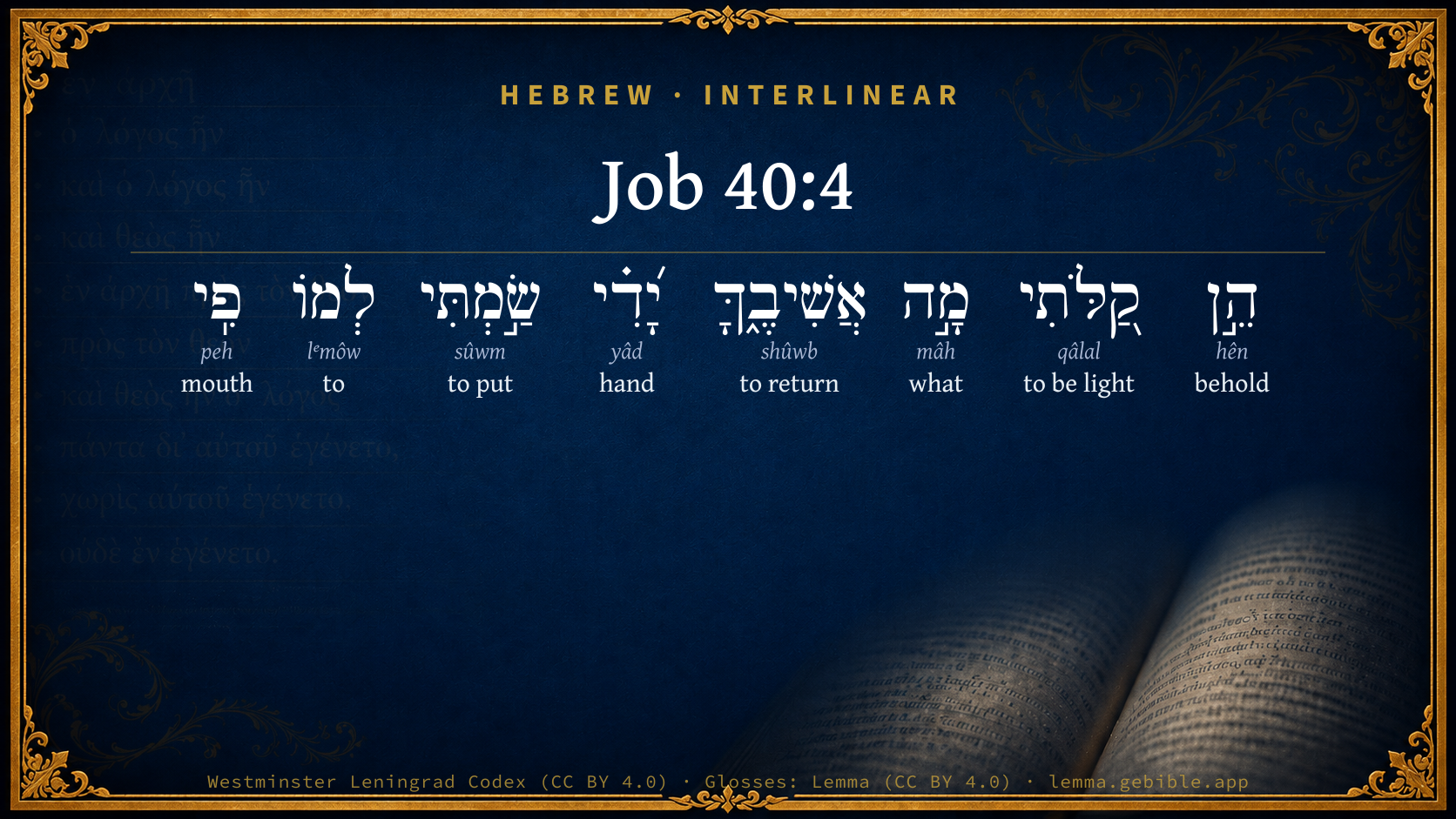
Job 40:4

Hebrew (Westminster Leningrad Codex) Job 40:4 appears in the Hebrew Old Testament. The text above is from the Westminster Leningrad Codex. Each word links to its Strong’s number, a concise gloss, and parsing drawn from the Open Scriptures Hebrew Bible morphology. Click any word for its full Brown-Driver-Briggs (BDB) entry.
Download image
Cite this verse

Job 40:4 (World English Bible). Public Domain. Lemma interlinear Bible study tool, https://lemma.gebible.app/v/job/40/4.

Show BibTeX & RIS
BibTeX
RIS
English Translation
"Behold, I am of small account. What shall I answer you? I lay my hand on my mouth.
World English Bible · Public Domain
Download a study sheet

One document with this verse’s original text, its word-by-word gloss line, the meaning frame, cross-references with their text, attributed commentary, and full source and license credits — printable, and it pastes into notes with its structure intact.

This verse Autodidact and up

Study sheet (.html) Plain text (.txt)

A passage Seminary Student

Up to 50 verses in one chapter. A passage sheet keeps up to 6 commentary sources and 12 cross-references per verse, in the order this page ranks them, and says so on the sheet whenever that leaves anything out. Ask for a single verse and you get the Autodidact verse sheet above.

Everything on this page stays free to read, with no account — the sheet is a download of what is already on screen, not access to it.

Want to remove ads? Support Godless Engineer
Compare translations 3

The same verse in 3 English versions, stacked beneath the original-language interlinear above. Click any original word for its lexicon entry.

Each is an independent rendering of the whole verse — the interlinear is not word-aligned to these translations.

Highlighted words mark where these versions differ — a whole-verse word diff, not a word-by-word alignment.

  • World English Bible Public Domain
    "Behold, I am of small account. What shall I answer you? I lay my hand on my mouth.
  • King James Version Public Domain
    Behold, I am vile; what shall I answer thee? I will lay mine hand upon my mouth.
  • unfoldingWord Literal Text CC BY-SA 4.0
    “Behold, I am slight; how shall I answer you? I put my hand over my mouth.

unfoldingWord Literal Text — © unfoldingWord, licensed CC BY-SA 4.0. Word-aligned USFM3 via Door43 (git.door43.org/unfoldingWord/en_ult).

Versions to compare (up to 4)

3 of 4 selected

Show all 18 translations

Every available English version of this verse, each an independent rendering of the whole verse.

  • World English Bible Public Domain
    "Behold, I am of small account. What shall I answer you? I lay my hand on my mouth.
  • Berean Standard Bible Public Domain
    “Behold, I am insignificant. How can I reply to You? I place my hand over my mouth.
  • Majority Standard Bible Public Domain
    “Behold, I am insignificant. How can I reply to You? I place my hand over my mouth.
  • King James Version Public Domain
    Behold, I am vile; what shall I answer thee? I will lay mine hand upon my mouth.
  • American Standard Version (1901) Public Domain
    Behold, I am of small account; What shall I answer thee? I lay my hand upon my mouth.
  • Revised Version (1885) Public Domain
    Behold, I am of small account; what shall I answer thee? I lay mine hand upon my mouth.
  • Geneva Bible (1599) Public Domain
    Or hast thou an arme like God? or doest thou thunder with a voyce like him?
  • Douay-Rheims (1899) Public Domain
    And hast thou an arm like God, and canst thou thunder with a voice like him?
  • Young's Literal Translation Public Domain
    Lo, I have been vile, What do I return to Thee? My hand I have placed on my mouth.
  • Literal Standard Version CC BY-SA 4.0
    “Behold, I have been vile, || What do I return to You? I have placed my hand on my mouth.
  • Unlocked Literal Bible CC BY-SA 4.0
    “See, I am insignificant; how can I answer you? I put my hand over my mouth.
  • unfoldingWord Literal Text CC BY-SA 4.0
    “Behold, I am slight; how shall I answer you? I put my hand over my mouth.
  • Darby Bible Public Domain
    Behold, I am nought: what shall I answer thee? I will lay my hand upon my mouth.
  • World Messianic Bible Public Domain
    “Behold, I am of small account. What will I answer you? I lay my hand on my mouth.
  • Webster's Bible Public Domain
    \\40:9\\Hast thou an arm like God? or canst thou thunder with a voice like his?
  • Free Bible Version CC BY-SA 4.0
    “Me—I am nothing at all. I have no answers. I put my hand in front of my mouth.
  • Bible in Basic English Public Domain
    Have you an arm like God? have you a voice of thunder like his?
  • JPS Tanakh (1917) Public Domain
    Behold, I am of small account; what shall I answer Thee? I lay my hand upon my mouth.

Literal Standard Version (2020), Covenant Press — licensed CC BY-SA 4.0. Text via the HelloAO Bible API (eBible.org). Unlocked Literal Bible (unfoldingWord) — licensed CC BY-SA 4.0. Text via the HelloAO Bible API (eBible.org). unfoldingWord Literal Text — © unfoldingWord, licensed CC BY-SA 4.0. Word-aligned USFM3 via Door43 (git.door43.org/unfoldingWord/en_ult). Free Bible Version, Dr. Jonathan Gallagher — licensed CC BY-SA 4.0. Text via the HelloAO Bible API (eBible.org).

Word by word

More ways to search: Search by grammar → Find every occurrence → Compare this word →

Practice this passage: Drill this verse → Learn its vocabulary →

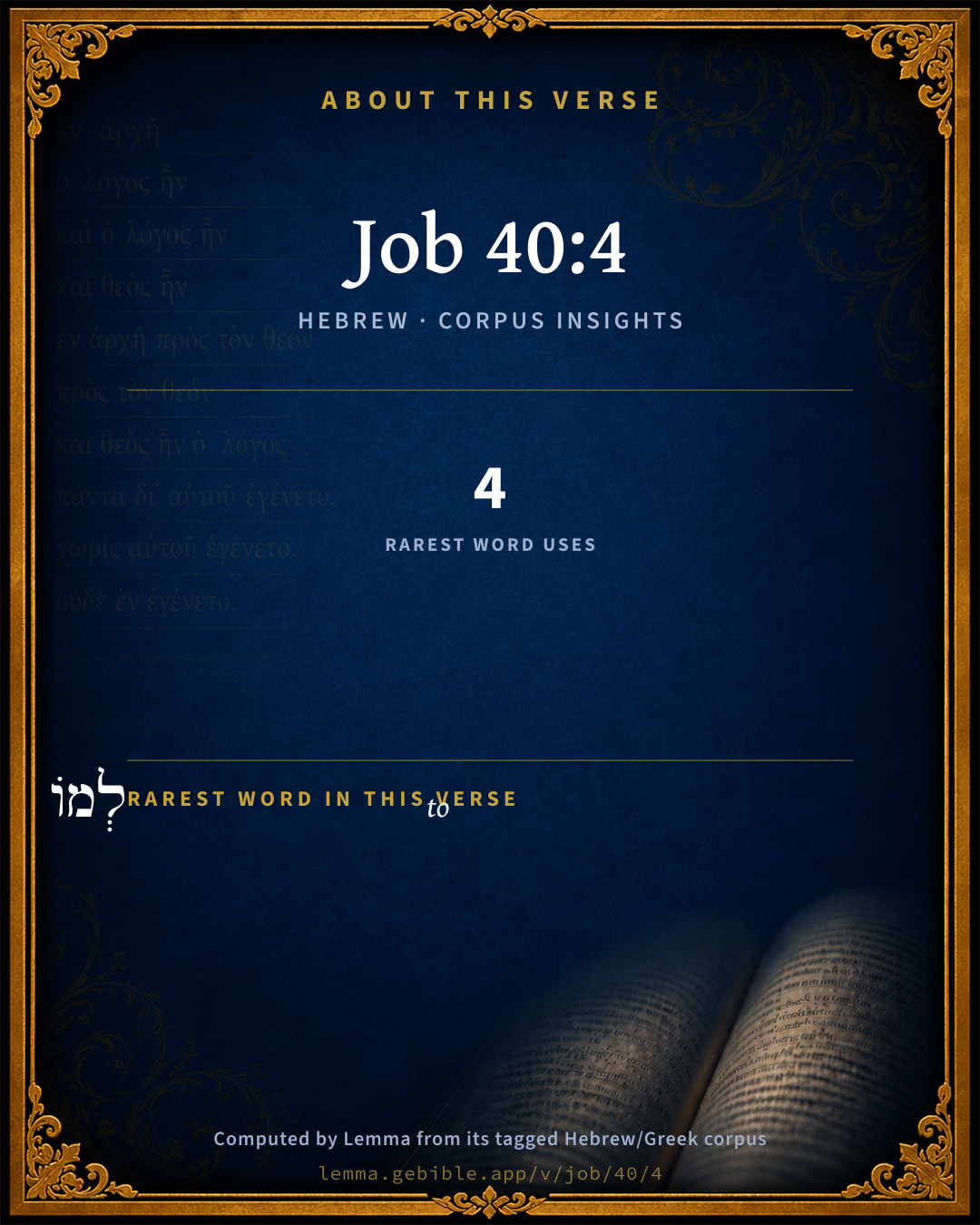
About this verse

These counts appear in no published source. They are computed here, from the morphology-tagged text and Lemma’s own curated glosses. What Lemma adds →

8
words
8
distinct lemmas
Wisdom
section

Notable vocabulary

The rarest word here is לְמוֹ to H3926 — appearing just 4 times in the whole Hebrew Bible.

Shared distinctive vocabulary

לְמוֹ to H3926 occurs in 4 verses of the Hebrew Bible. Also found in:

Grammatical profile

  • 3 verbs
  • 2 nouns
  • 1 preposition
  • 2 particles

Verb forms

  • קַ֭לֹּתִי Qal · Perfect
  • אֲשִׁיבֶ֑ךָּ Hiphil · Imperfect
  • שַׂ֣מְתִּי Qal · Perfect

Hebrew & Septuagint length

In English translation the verse runs 18 words from the Hebrew and 16 from the Septuagint (LXX English) — closely comparable.

A rough comparison of the two English renderings, which tokenize alike — not a word-level alignment.

Word counts can differ between the Hebrew and the Greek without any difference in meaning — e.g. the Hebrew direct-object marker אֵת has no separate Greek word, and Greek often adds the article ὁ.

Cross-references

30

Topical passages linked to Job 40:4 in the Treasury of Scripture Knowledge — connected by theme and wording, ordered by reader-vote popularity; previews shown in the World English Bible.

  • Proverbs 30:32 "If you have done foolishly in lifting up yourself, Or if you have thought evil, Put your hand over your mouth.
  • Job 29:9 The princes refrained from talking, And laid their hand on their mouth;
  • Job 21:5 Look at me, and be astonished. Lay your hand on your mouth.
  • Job 42:6 Therefore I abhor myself, And repent in dust and ashes."
  • Genesis 18:27 Abraham answered, "See now, I have taken it on myself to speak to the Lord, who am but dust and ashes.
  • Judges 18:19 They said to him, Hold your peace, lay your hand on your mouth, and go with us, and be to us a father and a priest: is it better for you to be priest to the house of one man, or to be priest to a tribe and a family in Israel?
  • Ezra 9:6 and I said, my God, I am ashamed and blush to lift up my face to you, my God; for our iniquities are increased over our head, and our guiltiness is grown up to the heavens.
  • Genesis 32:10 I am not worthy of the least of all the loving kindnesses, and of all the truth, which you have shown to your servant; for with just my staff I passed over this Jordan; and now I have become two companies.
  • Psalms 39:9 I was mute. I didn't open my mouth, Because you did it.
  • Isaiah 6:5 Then I said, "Woe is me! For I am undone, because I am a man of unclean lips, and I dwell in the midst of a people of unclean lips: for my eyes have seen the King, Yahweh of Hosts!"
  • Micah 7:16 The nations will see and be ashamed of all their might. They will lay their hand on their mouth. Their ears will be deaf.
  • Zechariah 2:13 Be silent, all flesh, before Yahweh; for he has roused himself from his holy habitation!"
  • Luke 5:8 But Simon Peter, when he saw it, fell down at Jesus' knees, saying, "Depart from me, for I am a sinful man, Lord."
  • Luke 15:18–19 I will get up and go to my father, and will tell him, "Father, I have sinned against heaven, and in your sight.
  • Luke 18:13 But the tax collector, standing far away, wouldn't even lift up his eyes to heaven, but beat his breast, saying, 'God, be merciful to me, a sinner!'
  • 1 Timothy 1:15 The saying is faithful and worthy of all acceptance, that Christ Jesus came into the world to save sinners; of whom I am chief.
  • 2 Samuel 24:10 David's heart struck him after that he had numbered the people. David said to Yahweh, I have sinned greatly in that which I have done: but now, Yahweh, put away, I beg you, the iniquity of your servant; for I have done very foolishly.
  • 1 Kings 19:4 But he himself went a day's journey into the wilderness, and came and sat down under a juniper tree: and he requested for himself that he might die, and said, It is enough; now, O Yahweh, take away my life; for I am not better than my fathers.
  • Ezra 9:15 Yahweh, the God of Israel, you are righteous; for we are left a remnant that is escaped, as it is this day: behold, we are before you in our guiltiness; for none can stand before you because of this.
  • Nehemiah 9:33 However you are just in all that is come on us; for you have dealt truly, but we have done wickedly;
  • Job 9:31–35 Yet you will plunge me in the ditch. My own clothes shall abhor me.
  • Job 16:21 That he would maintain the right of a man with God, Of a son of man with his neighbor!
  • Job 23:4–7 I would set my cause in order before him, And fill my mouth with arguments.
  • Job 31:37 I would declare to him the number of my steps. As a prince would I go near to him.
  • Psalms 51:4–5 Against you, and you only, have I sinned, And done that which is evil in your sight; That you may be proved right when you speak, And justified when you judge.
  • Isaiah 53:6 All we like sheep have gone astray; everyone has turned to his own way; and Yahweh has laid on him the iniquity of us all.
  • Isaiah 64:6 For we are all become as one who is unclean, and all our righteousness are as a polluted garment: and we all do fade as a leaf; and our iniquities, like the wind, take us away.
  • Daniel 9:5 we have sinned, and have dealt perversely, and have done wickedly, and have rebelled, even turning aside from your precepts and from your ordinances;
  • Daniel 9:7 Lord, righteousness belongs to you, but to us confusion of face, as at this day; to the men of Judah, and to the inhabitants of Jerusalem, and to all Israel, who are near, and who are far off, through all the countries where you have driven them, because of their trespass that they have trespassed against you.
  • Habakkuk 2:20 But Yahweh is in his holy temple. Let all the earth be silent before him!"

Cross-references courtesy of OpenBible.info (CC BY 4.0).

Hebrew and Greek witnesses Masoretic Hebrew ↔ Greek Septuagint

The same verse in the two great witnesses to the Old Testament, shown verse-for-verse.

These are two independent witnesses, not word-aligned to each other, and the Septuagint is shown in lemma (dictionary) form.

Hebrew Job 40:4 Masoretic · Westminster Leningrad Codex

הֵ֣ן קַ֭לֹּתִי מָ֣ה אֲשִׁיבֶ֑ךָּ יָ֝דִ֗י שַׂ֣מְתִּי לְמוֹ פִֽי

"Behold, I am of small account. What shall I answer you? I lay my hand on my mouth.

World English Bible · Public Domain

Greek LXX Job 40:4 Septuagint · lemma form

τίς ἔτι ἐγώ κρίνω νουθετέω καί ἐλέγχω κύριος ἀκούω τοιοῦτος οὐδείς εἰμί ἐγώ δέ τίς ἀπόκρισις δίδωμι πρός οὗτος χείρ τίθημι ἐπί στόμα ἐγώ

Have you an arm like the Lord's? or do you thunder with a voice like his?

LXX2012 (modern English Septuagint) · Public Domain

On this verse, John Gill's Exposition discusses the Septuagint’s reading. Read the note in Commentary ↓

Hebrew: Westminster Leningrad Codex (CC BY 4.0). Greek: Septuagint (public domain); English from LXX2012 (modern English Septuagint) (Public Domain). How the Septuagint differs from the Hebrew →

Commentary

Notes on Job 40:4 from classic Christian and Jewish commentators (each source and its license shown beneath its notes). The classic Christian expositions comment on the surrounding passage and are grouped to its opening verse, so a note may address several verses; the Jewish commentaries on the Tanakh (Rashi and others) are per-verse, so they appear only where the commentator wrote on this verse.

Lemma curates 59 commentaries, every one of them public domain or Creative Commons licensed, each selected and text-cleaned for this edition rather than reprinted as found. About our sources →

Trapp's Complete Commentary

John Trapp

Job 40:4 Behold, I am vile; what shall I answer thee? I will lay mine hand upon my mouth.

Ver. 4. Behold, I am vile] Light and little worth; and therefore deserve to be slighted and laid by, as a broken vessel. The humble man vilifies, yea, nullifies, himself before God, as Abraham, Gen 18:27; as Agur, Pro 30:3; as Paul, Eph 3:8; as that martyr who cried out, Gehenna sum Domine, Lord, Thou art heaven, but I am hell, &c. Tantillitas nostra, saith Ignatius of himself and his colleagues. Behold, I am an abject, saith Job here, contemptible and inconsiderable. This was well, but not all; an excellent confession, but not full enough: his meanness he acknowledgeth, and that he was no fit match for God; but not his sinfulness, with desire of pardon and deprecation of punishment; God therefore gives him not over so, but sets upon him a second time, Job 40:6, and brings him to it, Job 42:1. There must be some proportion between a man’s sin and his repentance, Ezr 9:1-15, and this God will bring all his Jobs to ere he leave them.

What shall I answer thee?] I am silenced, and set down; I see there is no reasoning against thee; I acknowledge thy greatness so plainly and plentifully demonstrated in the foregoing discourse; and am well pleased that thou shouldest be justified when thou speakest and overcome when thou judgest, Psa 51:4 Rom 3:4.

I will lay my hand upon my mouth] I that have spoken more freely and boldly than I ought, Et ore patulo multa sine iudicio effutivi, and have opened my mouth more wide than was meet, will henceforth be better advised, and keep my mouth with a bridle, or muzzle, as Psa 31:1. {See Trapp on "Job 21:5"}

John Trapp, A Commentary or Exposition upon All the Books of the Old and New Testament (1647–1656) — public domain. Text from a community e-Sword module.

Tyndale Open Study Notes

Tyndale Open Resources

40:4 I am nothing (cp. 42:6): Job was not repenting from sin; like Abraham, he recognized his unworthiness (Gen 18:27). • Job had asked his comforters to cover their mouth to acknowledge shock (21:5); here he does so himself in reaction to his own rash words.

Tyndale Open Study Notes — © Tyndale Open Resources, licensed CC BY-SA 4.0. Text via the HelloAO Bible API.

Jamieson, Fausset & Brown

Robert Jamieson, A. R. Fausset & David Brown

I am (too) vile (to reply). It is a very different thing to vindicate ourselves before God, from what it is before men. Job could do the latter, not the former.

lay . . . hand . . . upon . . . mouth--I have no plea to offer (Job 21:5; Jdg 18:19).

Jamieson, Fausset & Brown — Commentary Critical and Explanatory on the Whole Bible (1871) — public domain (CC PDM 1.0). Text via the HelloAO Bible API.

Adam Clarke's Commentary

Verse 4. Behold, I am vile] I acknowledge my inward defilement. I cannot answer thee.

I will lay mine hand upon my mouth.] I cannot excuse myself, and I must be dumb before thee.

Adam Clarke's Commentary on the Bible (1810–1826) — public domain. Text from a community e-Sword/MySword module.

The Cambridge Bible for Schools and Colleges

gen. ed. J. J. S. Perowne

4. behold, I am vile] The word vile here is not a moral term, it signifies, mean, small. The verse may be read,

Behold I am too mean; what shall I answer thee?

I lay mine hand upon my mouth.

Job is abased before Jehovah; he feels his meanness and is silent, comp. ch. Job_21:5, Job_29:9.

The Cambridge Bible for Schools and Colleges (gen. ed. J. J. S. Perowne; Cambridge University Press, 1878–1918) — public domain. Text from a community e-Sword module.

John Gill's Exposition

Behold, I am vile,.... Or "light" (a); which may have respect either to his words and arguments, which he thought had force in them, but now he saw they had none; or to his works and actions, the integrity of his life, and the uprightness of his ways, which he imagined were weighty and of great importance, but now being weighed in the balances of justice were found wanting; or it may refer to his original meanness and distance from God, being dust and ashes, and nothing in comparison of him; and so the Septuagint version is, "I am nothing"; see Isa 40:17; or rather to the original vileness and sinfulness of his nature he had now a sight of, and saw how he had been breaking forth in unbecoming expressions concerning God and his providence: the nature of man is exceeding vile and sinful; his heart desperately wicked; his thoughts, and the imaginations of them, evil, and that continually; his mind and conscience are defiled; his affections inordinate, and his understanding and will sadly depraved; he is vile in soul and body; of all which an enlightened man is convinced, and will acknowledge;

what shall I answer thee? I am not able to answer thee, who am but dust and ashes; what more can I say than to acknowledge my levity, vanity, and vileness? he that talked so big, and in such a blustering manner of answering God, as in Job 13:22; now has nothing to say for himself;

I will lay mine hand upon my mouth; impose silence upon himself, and as it were lay a restraint upon himself from speaking: it looks as if there were some workings in Job's heart; he thought he could say something, and make some reply, but durst not, for fear of offending yet more and more, and therefore curbed it in; see Psa 39:1.

(a) "levis sum", Cocceius, Michaelis; "leviter locutus sum", V. L.

John Gill's Exposition of the Whole Bible (1746–1763) — public domain (CC PDM 1.0). Text via the HelloAO Bible API.

Albert Barnes' Notes on the Bible

Behold, I am vile: what shall I answer thee? - “Instead of being able to argue my cause, and to vindicate myself as I had expected, I now see that I am guilty, and I have nothing to say.” He had argued boldly with his friends. He had, before them, maintained his innocence of the charges which they brought against him, and had supposed that he would be able to maintain the same argument before God. But when the opportunity was given, he felt that he was a poor, weak man; a guilty and miserable offender. It is a very different thing to maintain our cause before God, from what it is to maintain it before people; and though we may attempt to vindicate our own righteousness when we argue with our fellow-creatures, yet when we come to maintain it before God we shall be dumb. On earth, people vindicate themselves; what will they do when they come to stand before God in the judgment?

I will lay mine hand upon my mouth - An expression of silence. Catlin, in his account of the Mandan Indians, says that this is a common custom with them when anything wonderful occurs. Some of them laid their hands on their mouths and remained in this posture by the hour, as an expression of astonishment at the wonders produced by the brush in the art of painting; compare Job 21:5, note; Job 29:9, note.

Albert Barnes' Notes on the Bible (1834–1885) — public domain. Text from a community e-Sword/MySword module.

Matthew Poole's English Annotations

I am vile, what am I, a mean and contemptible creature that should presume to contend with my Maker and Judge? I confess my fault and folly.

What shall I answer thee? I neither desire nor am able to dispute with thee. I will for the future bridle my tongue, and instead of contesting with thee, do here humbly and willingly submit myself to thee.

Matthew Poole's English Annotations on the Holy Bible (1683–1685) — public domain. Text from a community e-Sword/MySword module.

Whedon's Commentary on the Bible

Daniel D. Whedon

JOB’S ANSWER — HIS SELF-HUMILIATION AND CONFESSION, 4, 5.

Job confesses that he is base, and that he has been foolish in his repeated speeches; and, finally, retracting his arrogant challenges of God, covenants with him that he will no longer contend with Deity, 4, 5.

“From the marvellous in nature, Job now divines that which is marvellous in his affliction. His humiliation under the mysteries of nature, is at the same time humiliation under the mystery of affliction; and only now, when he penitently reverses the mystery he has hitherto censured, is it time that its inner glory should be revealed to him. The bud is mature, and can now burst forth in order to disclose the blended colors of its natural beauty.” — Delitzsch.

4. Behold, I am vile — In the sense of mean, despicable: קלתי; a word Job had in part applied to the wicked — “light (קל) is he on the face of the waters.” (Job_24:18.) Job’s sense of shame is quickened. He feels his folly; but is not yet sufficiently sensible of his spiritual deformity. Hence the necessity that God should speak again. The conciseness of the reply points to trouble within; deep conviction is never wordy. It is thus with the cry “God be merciful to me, the sinner.” Luk_18:13. Hand upon my mouth — See Job_21:5; Job_29:9.

Daniel D. Whedon (gen. ed.), Commentary on the Old and New Testaments (1874–1909) — public domain. Text from a community e-Sword module.

The Pulpit Commentary

Humbled before God.

At length Job is brought near to the state of mind that God desires to see in him. Proud and defiant before the unwise and unjust attacks of his human accusers, he is humbled in the dust in presence of the revelation of God.

I THE VISION OF GOD IN HIS WORKS HUMBLES US. Job has seen a succession of vivid pictures of the works of God in nature. They all transcend human efforts. Then how great must the Author of nature be! How small are we in his awful presence! Pride is always a form of godlessness. We forget God when we exalt ourselves. Our self-exaltation is only possible while we shut ourselves up in a little world. When we see God we are humbled. Now, this is not only because God is supremely powerful. There is some heroism in the weak maintaining their right in the presence of the strong. But God"s greatness in nature is seen in intellectual and moral features. The wonderful thought of God impressed upon his works reveals a mind infinitely greater than the human mind; and the care with which God provides for all his creatures wild asses, heedless ostriches, and repulsive ravens, as well as those creatures that seem more deserving of his providence shows us how good God is. Thus the wisdom and goodness of God, added to the power that makes resistance useless, crown the revealed character of God with glory, and invite our humble adoration.

II SILENCE BEFORE GOD IS THE TRUE EXPRESSION OF HUMILITY. It cannot be said that Job is as yet deeply conscious of sin. The "vileness" of which he makes confession is rather his mean estate, his poor, feeble, human helplessness, than moral guilt. Therefore it does not need to be made much of, or regarded as anything like a full confession. It is, however, the mark of humility to admit it, and then to relapse into silence. This is the Condition to which the great argument of the drama is designed to bring its readers. We are too busy with our own performances in religion. In prayer we have too many words to speak to God. We are always telling him what he knows already, and often dictating to him what we think he should be doing, instead of patiently waiting for his voice and humbly submitting to his will. There is room for more silence in religion and in all life.

III SILENT HUMILITY IS A PREPARATION FOR EXALTATION, At the end of the book we discover that God exalts Job and loads him with favour and prosperity. But he must be humbled first. The later honour is only possible after Job has abased himself. So long as he justified himself and arraigned the justice of God, he could not be restored and exalted. Thus the poem shows to us the way in which God disciplines his servants and prepares them to enjoy his goodness. Humility is the door to honour. This is a very Christian truth. It is taught by Christ: "Whosoever exalteth himself shall be abased; and he that humbleth himself shall be exalted." It is gloriously illustrated in the life and death and exaltation of Christ. W.F.A. (see Php_2:5-11)

The Pulpit Commentary (1880–1919), ed. H.D.M. Spence-Jones & Joseph S. Exell — public domain. Text from a community e-Sword module.

Keil & Delitzsch

C. F. Keil & F. Delitzsch

4 Behold, I am too mean: what shall I answer Thee?

I lay my hand upon my mouth.

5 Once have I spoken, and will not begin again;

And twice - I will do it no more.

He is small, i.e., not equal to the task imposed, therefore he keeps his mouth firmly closed (comp. Job 21:5; Job 29:9), for whatever he might say would still not be to the point. Once he has dared to criticise God's doings; a second time (שׁתּים = שׁנית, Ges. 120, 5) he ventures it no more, for God's wondrous wisdom and all-careful love dazzle him, and he gladly bows.

But how? Is not the divine speech altogether different from what one ought to expect? One expects to hear from the mouth of Jehovah something unheard of in the previous course of the drama, and in this expectation we find ourselves disappointed at the outset. For one need only look back and read Job 9:4-10, where Job acknowledges and describes God as a wise and mighty Lord over the natural world, especially as an irresistible Ruler over everything great in it; Job 12:7-10, where he refers to the creatures of the sky and deep as proofs of God's creative power; Job 12:11-25, where he sketches the grandest picture of God's terrible doings in nature and among men; Job 26:5-14, where he praises God as the Creator and Lord of all things, and describes what he says concerning Him as only a faint echo of the thunder of His might; Job 28:23, where he ascribes absolute wisdom to Him as the Creator of and Ruler of the world. If one ponders these passages of Job's speeches, he will not be able to say that the speech of Jehovah, in the exhibition of the creative power and wisdom of God, which is its theme, would make Job conscious of anything which was previously unknown to him; and it is accordingly asked, What, then, is there that is new in the speech of Jehovah by which the great effect is brought about, that Job humbles himself in penitence, and becomes ready for the act of redemption which follows?

It has indeed never occurred to Job to desire to enter into a controversy with God concerning the works of creation; he is far from the delusion of being able to stand such a test; he knows in general, that if God were willing to contend with him, he would not be able to answer God one in a thousand, Job 9:3. And yet God closely questioned him, and thereby Job comes to the perception of his sin - how comes it to pass? Has the plot of the drama perhaps failed in this point? Has the poet made use of means unsuited to the connection of the whole, to bring about the needful effect, viz., the repentance of Job, - because, perhaps, the store of his thoughts was exhausted? But this poet is not so poor, and we shall therefore be obliged to try and understand the disposition of the speech of Jehovah before we censure it.

When one of Job's last words before the appearing of Jehovah was the word שׁדי יענני, Job thereby desired God's decision concerning the testimony of his innocence. This wish is in itself not sinful; yea, it is even a fruit of his hidden faith, when he casts the look of hope away from his affliction and the accusation of the friends, into the future to God as his Vindicator and Redeemer. But that wish becomes sinful when he looks upon his affliction as a de facto accusation on the part of God, because he cannot think of suffering and sin as separable, and because he is conscious of his innocence, looks upon it as a decree of God, his opponent and his enemy, which is irreconcilable with the divine justice. This Job's condition of conflict and temptation is the prevailing one; his faith is beclouded, and breaks through the night which hangs over him only in single rays. The result of this condition of conflict is the sinful character which that wish assumes: it becomes a challenge to God, since Job directs against God Himself the accusation which the friends have directed against him, and asserts his ability to carry through his good cause even if God would enter with him into a judicial contention; he becomes a יסור and מוכיח אלוה, and raises himself above God, because he thinks he has Him for an enemy who is his best friend. This defiance is, however, not common godlessness; on the contrary, Job is really the innocent servant of God, and his defiant tone is only the result of a false conception which the tempted one indulges respecting the Author of his affliction. So, then, this defiance has not taken full possession of Job's mind; on the contrary, the faith which lays firm hold on confidence in the God whom he does not comprehend, is in conflict against it; and this conflict tends in the course of the drama, the nearer it comes to the catastrophe, still nearer to the victory, which only awaits a decisive stroke in order to be complete. Therefore Jehovah yields to Job's longing שׁדי יענני, in as far as He really answers Job; and even that this takes place, and that, although out of the storm, it nevertheless takes place, not in a way to crush and destroy, but to instruct and convince, and displaying a loving condescension, is an indirect manifestation that Job is not regarded by God as an evil-doer mature for judgment. But that folly and temerity by which the servant of God is become unlike himself must notwithstanding be destroyed; and before Job can realize God as his Witness and Redeemer, in which character his faith in the brighter moments has foreseen Him, his sinful censuring and blaming of God must be blotted out by penitence; and with it at the same time his foolish imagination, by which his faith has been almost overwhelmed, must be destroyed, viz., the imagination that his affliction is a hostile dispensation of God.

And by what means is Job brought to the penitent recognition of his gloomy judgment concerning the divine decree, and of his contending with God? Is it, perhaps, by God's admitting to him what really is the case: that he does not suffer as a sinner the punishment of his sin, but showing at the same time that the decree of suffering is not an unjust one, because its design is not hostile? No, indeed, for Job is not worthy that his cause should be acknowledged on the part of God before he has come to a penitent recognition of the wrong by which he has sinned against God. God would be encouraging self-righteousness if He should give Job the testimony of his innocence, before the sin of vainglory, into which Job has fallen in the consciousness of his innocence, is changed to humility, by which all uprightness that is acceptable with God is tested. Therefore, contrary to expectation, God begins to speak with Job about totally different matters from His justice or injustice in reference to his affliction. Therein already lies a deep humiliation for Job. But a still deeper one in God's turning, as it were, to the abecedarium naturae, and putting the censurer of His doings to the blush. That God is the almighty and all-wise Creator and Ruler of the world, that the natural world is exalted above human knowledge and power, and is full of marvellous divine creations and arrangements, full of things mysterious and incomprehensible to ignorant and feeble man, Job knows even before God speaks, and yet he must now hear it, because he does not know it rightly; for the nature with which he is acquainted as the herald of the creative and governing power of God, is also the preacher of humility; and exalted as God the Creator and Ruler of the natural world is above Job's censure, so is He also as the Author of his affliction. That which is new, therefore, in the speech of Jehovah, is not the proof of God's exaltation in itself, but the relation to the mystery of his affliction, and to his conduct towards God in this his affliction, in which Job is necessitated to place perceptions not in themselves strange to him. He who cannot answer a single one of those questions taken from the natural kingdom, but, on the contrary, must everywhere admire and adore the power and wisdom of God-he must appear as an insignificant fool, if he applies them to his limited judgment concerning the Author of his affliction.

The fundamental tone of the divine speech is the thought, that the divine working in nature is infinitely exalted above human knowledge and power, and that consequently man must renounce all claim to better knowledge and right of contention in the presence of the divine dispensations. But at the same time, within the range of this general thought, it is also in particular shown how nature reflects the goodness of God as well as His wisdom (He has restrained the destructive power of the waters, He also sendeth rain upon the steppe, though untenanted by man); how that which accomplishes the purposes for which it was in itself designed, serves higher purposes in the moral order of the world (the dawn of day puts an end to the works of darkness, snow and hail serve as instruments of divine judgments); how divine providence extends to all creatures, and always according to their need (He provides the lion its prey, He satisfies the ravens that cry to Him); and how He has distributed His manifold gifts in a way often paradoxical to man, but in truth worthy of admiration (to the steinbock ease in bringing forth and growth without toil, to the wild ass freedom, to the antelope untameable fleetness, to the ostrich freedom from anxiety about its young and swiftness, to the horse heroic and proud lust for the battle, to the hawk the instinct of migration, to the eagle a lofty nest and a piercing sight). Everywhere the wonders of God's power and wisdom, and in fact of His goodness abounding in power, and His providence abounding in wisdom, infinitely transcend Job's knowledge and capacity. Job cannot answer one of all these questions, but yet he feels to what end they are put to him. The God who sets bounds to the sea, who refreshes the desert, who feeds the ravens, who cares for the gazelle in the wilderness and the eagle in its eyrie, is the same God who now causes him seemingly thus unjustly to suffer. But if the former is worthy of adoration, the latter will also be so. Therefore Job confesses that he will henceforth keep silence, and solemnly promises that he will now no longer contend with Him. From the marvellous in nature he divines that which is marvellous in his affliction. His humiliation under the mysteries of nature is at the same time humiliation under the mystery of his affliction; and only now, when he penitently reveres the mystery he has hitherto censured, is it time that its inner glory should be unveiled to him. The bud is mature, and can now burst forth, in order to disclose the blended colours of its matured beauty.

Keil & Delitzsch — Biblical Commentary on the Old Testament (1861–1891) — public domain (CC PDM 1.0). Text via the HelloAO Bible API. (Old Testament only.)

Lesson kit

Teaching starters — assembled from the data on this page, not authored interpretation. Every prompt links to the verse data it draws on. Edit before teaching.

Job, in the Wisdom, opens this verse with 8 words (8 distinct Hebrew lemmas). Its most distinctive word is lᵉmôw (“to”). A historical commentator’s framing appears above. Read the whole chapter for the surrounding context.

Discussion questions

  1. What does “to” (lᵉmôw) contribute to the verse as a whole?
  2. How does Job 27:14, which shares the word «to», read alongside this verse?
  3. These translations render this verse differently; the difference is in the English rendering, not the original. What questions does that raise?
  4. «קַ֭לֹּתִי» is a Qal Perfect verb. How does that grammatical form shape the action described?
  5. Compare how Trapp's Complete Commentary and Tyndale Open Study Notes read this verse. Where do they agree or differ?

Things to notice

Reading settings

Reading text

Shown beneath each verse's original-language words.

Old Testament
Old Testament edition

Read the OT as the Masoretic Hebrew (MT) or the Greek Septuagint (LXX).

English shown for the Greek Septuagint (in the Hebrew ↔ Greek comparison).

Comparing translations? Open the Compare panel on any verse page to stack up to four side by side.