
Isaiah 58:3

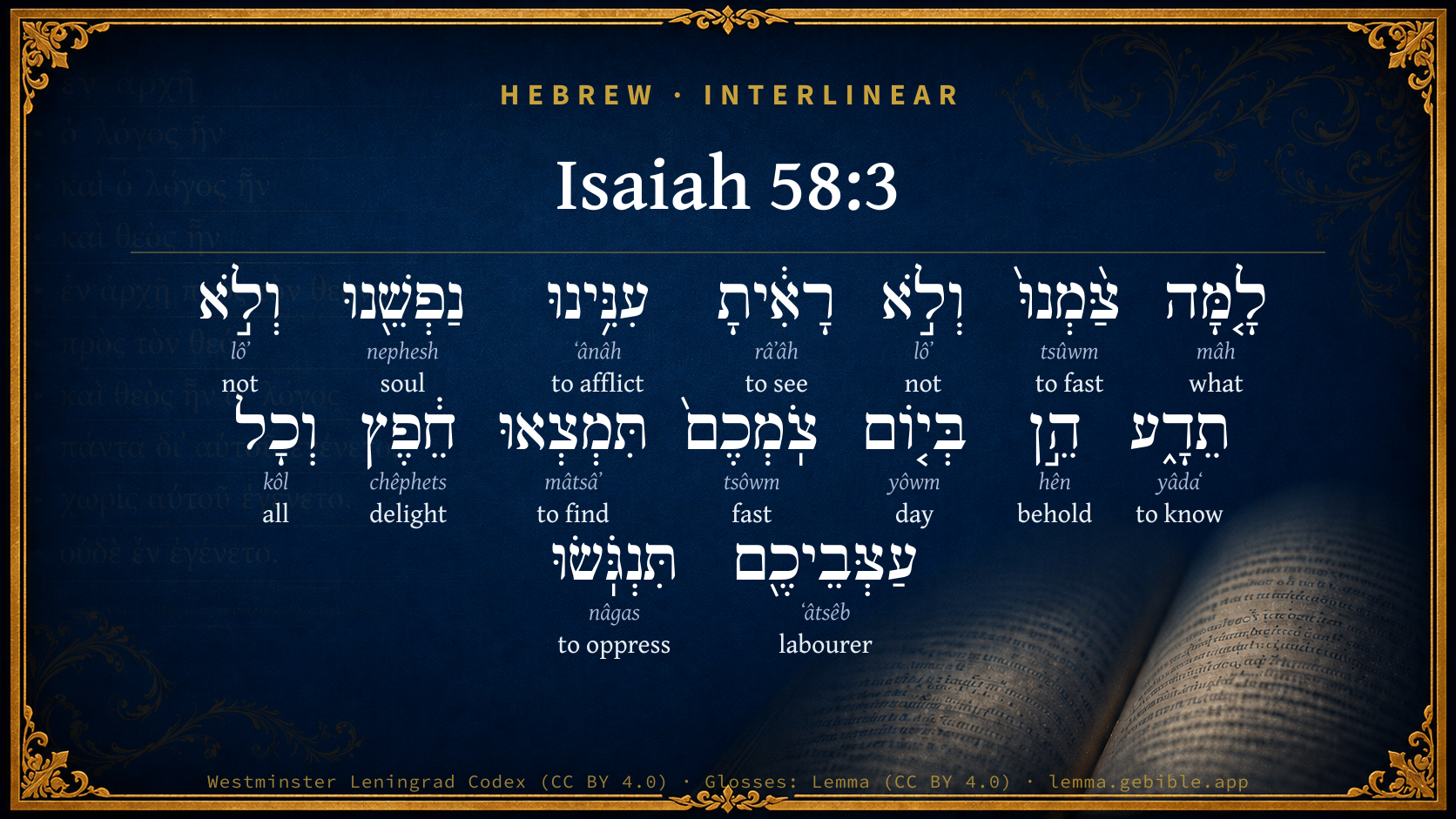
Hebrew (Westminster Leningrad Codex) Isaiah 58:3 appears in the Hebrew Old Testament. The text above is from the Westminster Leningrad Codex. Each word links to its Strong’s number, a concise gloss, and parsing drawn from the Open Scriptures Hebrew Bible morphology. Click any word for its full Brown-Driver-Briggs (BDB) entry.
Download image
Cite this verse

Isaiah 58:3 (World English Bible). Public Domain. Lemma interlinear Bible study tool, https://lemma.gebible.app/v/isaiah/58/3.

Show BibTeX & RIS
BibTeX
RIS
English Translation
Why have we fasted, [say they], and you don't see? [why] have we afflicted our soul, and you take no knowledge? Behold, in the day of your fast you find [your own] pleasure, and exact all your labors.
World English Bible · Public Domain
Highlights
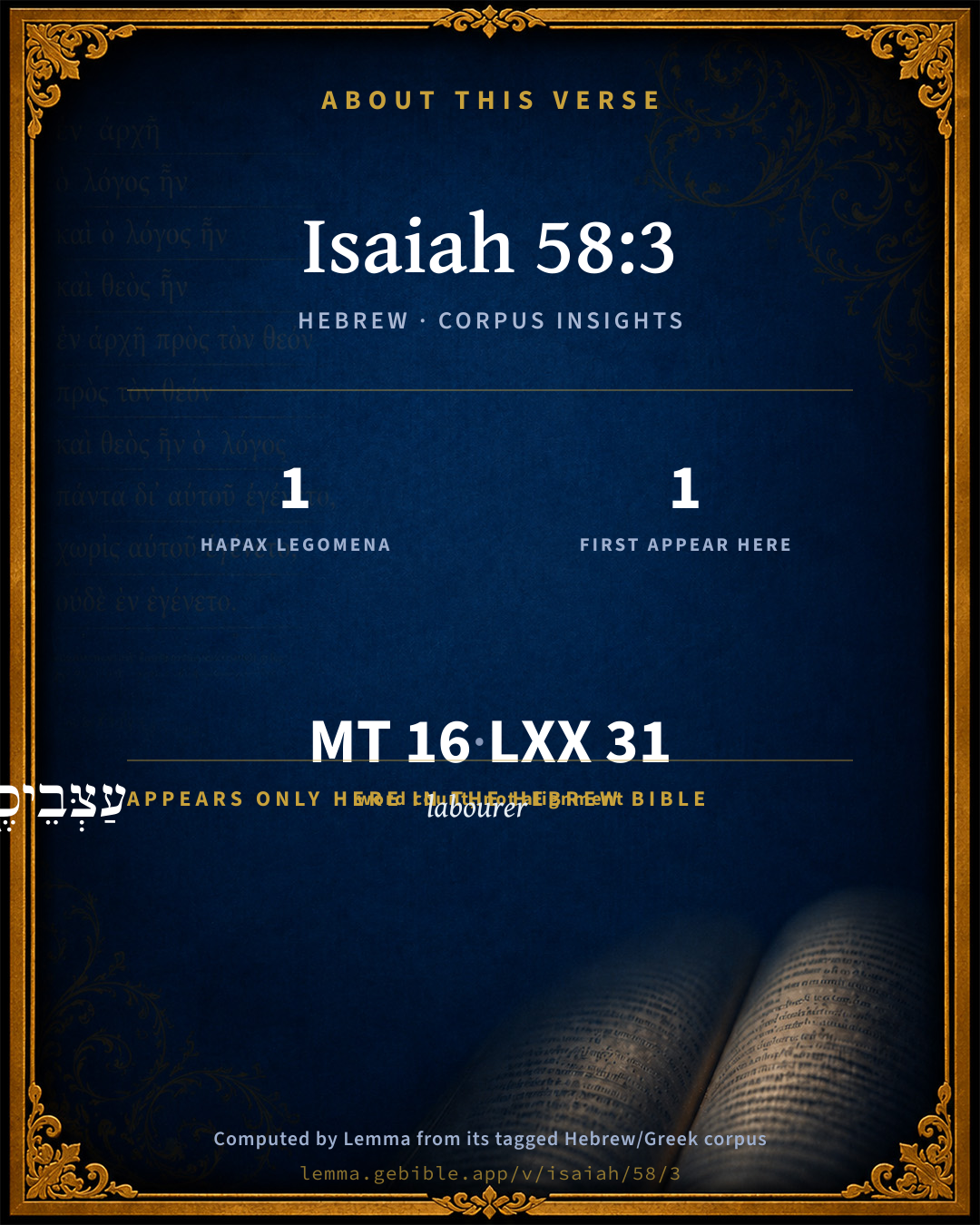
  • 1 hapax legomenon — only here in the Hebrew Bible
  • 1 first appearance in the Hebrew Bible
Full analysis ↓
Download a study sheet

One document with this verse’s original text, its word-by-word gloss line, the meaning frame, cross-references with their text, attributed commentary, and full source and license credits — printable, and it pastes into notes with its structure intact.

This verse Autodidact and up

Study sheet (.html) Plain text (.txt)

A passage Seminary Student

Up to 50 verses in one chapter. A passage sheet keeps up to 6 commentary sources and 12 cross-references per verse, in the order this page ranks them, and says so on the sheet whenever that leaves anything out. Ask for a single verse and you get the Autodidact verse sheet above.

Everything on this page stays free to read, with no account — the sheet is a download of what is already on screen, not access to it.

Want to remove ads? Support Godless Engineer
Compare translations 3

The same verse in 3 English versions, stacked beneath the original-language interlinear above. Click any original word for its lexicon entry.

Each is an independent rendering of the whole verse — the interlinear is not word-aligned to these translations.

Highlighted words mark where these versions differ — a whole-verse word diff, not a word-by-word alignment.

  • World English Bible Public Domain
    Why have we fasted, [say they], and you don't see? [why] have we afflicted our soul, and you take no knowledge? Behold, in the day of your fast you find [your own] pleasure, and exact all your labors.
  • King James Version Public Domain
    Wherefore have we fasted, say they, and thou seest not? wherefore have we afflicted our soul, and thou takest no knowledge? Behold, in the day of your fast ye find pleasure, and exact all your labours.
  • unfoldingWord Literal Text CC BY-SA 4.0
    ‘Why have we fasted, but you have not seen, have we humbled our soul, but you have not known?’ Behold, on the day of your fast, you find pleasure, and you oppress all of your laborers.

unfoldingWord Literal Text — © unfoldingWord, licensed CC BY-SA 4.0. Word-aligned USFM3 via Door43 (git.door43.org/unfoldingWord/en_ult).

Versions to compare (up to 4)

3 of 4 selected

Show all 18 translations

Every available English version of this verse, each an independent rendering of the whole verse.

  • World English Bible Public Domain
    Why have we fasted, [say they], and you don't see? [why] have we afflicted our soul, and you take no knowledge? Behold, in the day of your fast you find [your own] pleasure, and exact all your labors.
  • Berean Standard Bible Public Domain
    “Why have we fasted, and You have not seen? Why have we humbled ourselves, and You have not noticed?” “Behold, on the day of your fast, you do as you please, and you oppress all your workers.
  • Majority Standard Bible Public Domain
    “Why have we fasted, and You have not seen? Why have we humbled ourselves, and You have not noticed?” “Behold, on the day of your fast, you do as you please, and you oppress all your workers.
  • King James Version Public Domain
    Wherefore have we fasted, say they, and thou seest not? wherefore have we afflicted our soul, and thou takest no knowledge? Behold, in the day of your fast ye find pleasure, and exact all your labours.
  • American Standard Version (1901) Public Domain
    Wherefore have we fasted, `say they', and thou seest not? `wherefore' have we afflicted our soul, and thou takest no knowledge? Behold, in the day of your fast ye find `your own' pleasure, and exact all your labors.
  • Revised Version (1885) Public Domain
    Wherefore have we fasted, say they, and thou seest not? wherefore have we afflicted our soul, and thou takest no knowledge? Behold, in the day of your fast ye find your own pleasure, and exact all your labours.
  • Geneva Bible (1599) Public Domain
    Wherefore haue we fasted, and thou seest it not? we haue punished our selues, and thou regardest it not. Beholde, in the day of your fast you will seeke your will, and require all your dettes.
  • Douay-Rheims (1899) Public Domain
    Why have we fasted, and thou hast not regarded: have we humbled our souls, and thou hast not taken notice? Behold in the day of your fast your own will is found, and you exact of all your debtors.
  • Young's Literal Translation Public Domain
    `Why have we fasted, and Thou hast not seen? We have afflicted our soul, and Thou knowest not.' Lo, in the day of your fast ye find pleasure, And all your labours ye exact.
  • Literal Standard Version CC BY-SA 4.0
    Why have we fasted, and You have not seen? We have afflicted our soul, and You do not know. Behold, you find pleasure in the day of your fast, || And exact all your laborers.
  • Unlocked Literal Bible CC BY-SA 4.0
    'Why have we fasted,' they say, 'but you do not see it? Why have we humbled ourselves, but you do not notice?' Look, on the day of your fast you find your own pleasure and oppress all your laborers.
  • unfoldingWord Literal Text CC BY-SA 4.0
    ‘Why have we fasted, but you have not seen, have we humbled our soul, but you have not known?’ Behold, on the day of your fast, you find pleasure, and you oppress all of your laborers.
  • Darby Bible Public Domain
    -- Wherefore have we fasted, and thou seest not; have afflicted our soul, and thou takest no knowledge? Behold, in the day of your fast ye find what pleaseth [you], and exact all your labours.
  • World Messianic Bible Public Domain
    ‘Why have we fasted,’ they say, ‘and you don’t see? Why have we afflicted our soul, and you don’t notice?’ “Behold, in the day of your fast you find pleasure, and oppress all your laborers.
  • Webster's Bible Public Domain
    Why have we fasted, say they, and thou seest not? why have we afflicted our soul, and thou takest no knowledge? Behold, in the day of your fast ye find pleasure, and exact all your labors.
  • Free Bible Version CC BY-SA 4.0
    “Didn't you see that we fasted?” they ask. “Didn't you notice how we denied ourselves?” That's because whenever you fast you still do whatever you want, and you treat your workers badly.
  • Bible in Basic English Public Domain
    They say, Why have we kept ourselves from food, and you do not see it? why have we kept ourselves from pleasure, and you take no note of it? If, in the days when you keep from food, you take the chance to do your business, and get in your debts;
  • JPS Tanakh (1917) Public Domain
    'Wherefore have we fasted, and Thou seest not? Wherefore have we afflicted our soul, and Thou takest no knowledge?' — Behold, in the day of your fast ye pursue your business, and exact all your labours.

Literal Standard Version (2020), Covenant Press — licensed CC BY-SA 4.0. Text via the HelloAO Bible API (eBible.org). Unlocked Literal Bible (unfoldingWord) — licensed CC BY-SA 4.0. Text via the HelloAO Bible API (eBible.org). unfoldingWord Literal Text — © unfoldingWord, licensed CC BY-SA 4.0. Word-aligned USFM3 via Door43 (git.door43.org/unfoldingWord/en_ult). Free Bible Version, Dr. Jonathan Gallagher — licensed CC BY-SA 4.0. Text via the HelloAO Bible API (eBible.org).

Word by word

More ways to search: Search by grammar → Find every occurrence → Compare this word →

Practice this passage: Drill this verse → Learn its vocabulary →

עַצְּבֵיכֶ֖ם
ʻâtsêb
H6092
“labourers · your”
Noun, Common, Masculine, Plural, Construct + Suffix, Personal, 2nd Person, Masculine, Plural
Part of Speech
Noun
Type
Common
Gender
Masculine
Number
Plural
State
Construct
Full BDB Definition

Origin: from H6087

TWOT: 1666c

labourer, toiler, labour
  1. לָ֤מָּה mâh H4100 “to/for · what” Preposition + Particle, Interrogative
  2. צַּ֨מְנוּ֙ tsûwm H6684 “to fast” Verb, Qal, Perfect, 1st Person, Common, Plural
  3. וְלֹ֣א lôʼ H3808 “and · not” Conjunction + Particle, Negative
  4. רָאִ֔יתָ râʼâh H7200 “to see” Verb, Qal, Perfect, 2nd Person, Masculine, Singular
  5. עִנִּ֥ינוּ ʻânâh H6031 “to afflict” Verb, Piel, Perfect, 1st Person, Common, Plural
  6. נַפְשֵׁ֖נוּ nephesh H5315 “soul · our” Noun, Common, Both, Singular, Construct + Suffix, Personal, 1st Person, Common, Plural
  7. וְלֹ֣א lôʼ H3808 “and · not” Conjunction + Particle, Negative
  8. תֵדָ֑ע yâdaʻ H3045 “to know” Verb, Qal, Imperfect, 2nd Person, Masculine, Singular
  9. הֵ֣ן hên H2005 “behold” Particle, Demonstrative
  10. בְּי֤וֹם yôwm H3117 “in/at · day of” Preposition + Noun, Common, Masculine, Singular, Construct
  11. צֹֽמְכֶם֙ tsôwm H6685 “fast · your” Noun, Common, Masculine, Singular, Construct + Suffix, Personal, 2nd Person, Masculine, Plural
  12. תִּמְצְאוּ mâtsâʼ H4672 “to find” Verb, Qal, Imperfect, 2nd Person, Masculine, Plural
  13. חֵ֔פֶץ chêphets H2656 “delight” Noun, Common, Masculine, Singular, Absolute
  14. וְכָל kôl H3605 “and · all of” Conjunction + Noun, Common, Masculine, Singular, Construct
  15. תִּנְגֹּֽשׂוּ nâgas H5065 “to oppress” Verb, Qal, Imperfect, 2nd Person, Masculine, Plural

About this verse

These counts appear in no published source. They are computed here, from the morphology-tagged text and Lemma’s own curated glosses. What Lemma adds →

16
words
15
distinct lemmas
Prophets
section

Notable vocabulary

1 hapax legomenon — a word that appears only here in the entire Hebrew Bible:

  • עַצְּבֵיכֶ֖ם labourer H6092

First appearance in Scripture

This word makes its first canonical appearance in the Hebrew Bible here:

  • עַצְּבֵיכֶ֖ם labourer H6092

Shared distinctive vocabulary

צַּ֨מְנוּ֙ to fast H6684 occurs in 17 verses of the Hebrew Bible. Also found in:

Grammatical profile

  • 6 verbs
  • 6 nouns
  • 4 particles

Verb forms

  • צַּ֨מְנוּ֙ Qal · Perfect
  • רָאִ֔יתָ Qal · Perfect
  • עִנִּ֥ינוּ Piel · Perfect
  • תֵדָ֑ע Qal · Imperfect
  • תִּמְצְאוּ Qal · Imperfect
  • תִּנְגֹּֽשׂוּ Qal · Imperfect

Repetition

A word recurs within this verse — often emphatic in Hebrew:

  • וְלֹ֣א not H3808 ×2

Hebrew & Septuagint length

In English translation the verse runs 38 words from the Hebrew and 42 from the Septuagint (LXX English) — closely comparable.

A rough comparison of the two English renderings, which tokenize alike — not a word-level alignment.

Word counts can differ between the Hebrew and the Greek without any difference in meaning — e.g. the Hebrew direct-object marker אֵת has no separate Greek word, and Greek often adds the article ὁ.

In the original languages it is 16 Hebrew tokens and 31 Greek tokens — but the two are counted differently (Hebrew bundles its prefixes and suffixes into one token; the Greek is in lemma form), so that isn’t a like-for-like length.

Cross-references

20

Topical passages linked to Isaiah 58:3 in the Treasury of Scripture Knowledge — connected by theme and wording, ordered by reader-vote popularity; previews shown in the World English Bible.

  • Luke 18:9–12 He spoke also this parable to certain people who were convinced of their own righteousness, and who despised all others.
  • Malachi 3:14 You have said, 'It is vain to serve God;' and 'What profit is it that we have kept his charge, and that we have walked mournfully before Yahweh of Hosts?
  • Leviticus 16:29 "It shall be a statute to you forever: in the seventh month, on the tenth day of the month, you shall afflict your souls, and shall do no manner of work, the native-born, or the stranger who lives as a foreigner among you:
  • Proverbs 28:9 He who turns away his ear from hearing the law, Even his prayer is an abomination.
  • Nehemiah 5:7 Then I consulted with myself, and contended with the nobles and the rulers, and said to them, You exact usury, everyone of his brother. I held a great assembly against them.
  • Jonah 3:6–8 The news reached the king of Nineveh, and he arose from his throne, and took off his royal robe, covered himself with sackcloth, and sat in ashes.
  • Matthew 20:11–12 When they received it, they murmured against the master of the household,
  • Exodus 2:23–24 It happened in the course of those many days, that the king of Egypt died, and the children of Israel sighed because of the bondage, and they cried, and their cry came up to God because of the bondage.
  • Leviticus 16:31 It is a Sabbath of solemn rest to you, and you shall afflict your souls; it is a statute forever.
  • Leviticus 23:27 "However on the tenth day of this seventh month is the day of atonement: it shall be a holy convocation to you, and you shall afflict yourselves; and you shall offer an offering made by fire to Yahweh.
  • Numbers 23:4 God met Balaam: and he said to him, I have prepared the seven altars, and I have offered up a bull and a ram on every altar.
  • Psalms 69:10 When I wept and I fasted, That was to my reproach.
  • Isaiah 22:13 and behold, joy and gladness, killing oxen and killing sheep, eating flesh and drinking wine: let us eat and drink, for tomorrow we shall die.
  • Isaiah 47:6 I was angry with my people, I profaned my inheritance, and gave them into your hand: you did show them no mercy; on the aged have you very heavily laid your yoke.
  • Jeremiah 34:9–17 that every man should let his man-servant, and every man his maid-servant, who is a Hebrew or a Hebrewess, go free; that none should make bondservants of them, [to wit], of a Jew his brother.
  • Daniel 10:2–3 In those days I, Daniel, was mourning three whole weeks.
  • Micah 3:9–11 Please listen to this, you heads of the house of Jacob, And rulers of the house of Israel, Who abhor justice, And pervert all equity.
  • Zechariah 7:5–7 "Speak to all the people of the land, and to the priests, saying, 'When you fasted and mourned in the fifth and in the seventh month for these seventy years, did you at all fast to me, really to me?
  • Matthew 18:28–35 "But that servant went out, and found one of his fellow servants, who owed him one hundred denarii, and he grabbed him, and took him by the throat, saying, 'Pay me what you owe!'
  • Luke 15:29 But he answered his father, 'Behold, these many years I have served you, and I never disobeyed a commandment of yours, but you never gave me a goat, that I might celebrate with my friends.

Cross-references courtesy of OpenBible.info (CC BY 4.0).

Hebrew and Greek witnesses Masoretic Hebrew ↔ Greek Septuagint

The same verse in the two great witnesses to the Old Testament, shown verse-for-verse.

These are two independent witnesses, not word-aligned to each other, and the Septuagint is shown in lemma (dictionary) form.

Hebrew Isaiah 58:3 Masoretic · Westminster Leningrad Codex

לָ֤מָּה צַּ֨מְנוּ֙ וְלֹ֣א רָאִ֔יתָ עִנִּ֥ינוּ נַפְשֵׁ֖נוּ וְלֹ֣א תֵדָ֑ע הֵ֣ן בְּי֤וֹם צֹֽמְכֶם֙ תִּמְצְאוּ חֵ֔פֶץ וְכָל עַצְּבֵיכֶ֖ם תִּנְגֹּֽשׂוּ

Why have we fasted, [say they], and you don't see? [why] have we afflicted our soul, and you take no knowledge? Behold, in the day of your fast you find [your own] pleasure, and exact all your labors.

World English Bible · Public Domain

Greek LXX Isaiah 58:3 Septuagint · lemma form

λέγω τίς ὅτι νηστεύω καί οὐ ὁράω ταπεινόω ὁ ψυχή ἐγώ καί οὐ γιγνώσκω ἐν γάρ ὁ ἡμέρα ὁ νηστεία σύ εὑρίσκω ὁ θέλημα σύ καί πᾶς ὁ ὑποχείριος σύ ὑπονύσσω

saying, Why have we fasted, and you regard not? why have we afflicted our souls, and you did not know it? Nay, in the days of your fasts you⌃ find your pleasures, and all them that are under your power you⌃ wound.

LXX2012 (modern English Septuagint) · Public Domain

On this verse, Adam Clarke's Commentary discusses the Septuagint’s reading. Read the note in Commentary ↓

Hebrew: Westminster Leningrad Codex (CC BY 4.0). Greek: Septuagint (public domain); English from LXX2012 (modern English Septuagint) (Public Domain). How the Septuagint differs from the Hebrew →

Targum (Aramaic paraphrase)

1

The Targum is the ancient Jewish Aramaic paraphrase of the Hebrew Scriptures — an interpretive translation, not the Hebrew text itself. Onkelos (literal) and Pseudo-Jonathan (expansive) render the Torah, and Jonathan the Prophets. Coverage is partial: where no permissively-licensed English translation exists for a verse, only the Aramaic is shown. This is verse-level text, not a word-by-word alignment to the Hebrew.

  1. Targum Jonathan Prophets (Joshua–Malachi)
    אָמְרִין לְמָא אֲנַחְנָא צַיְמִין וּקְדָמָךְ גְלֵי מְסַגְפִין נַפְשָׁתָנָא וּקְדָמָךְ יְדִיעַ נְבִיָא אֲמַר לְהוֹן הָא בְיוֹם תַּעֲנִיתְכוֹן אַתּוּן תָּבְעִין צָרְכֵיכוֹן וְכָן תַּקְלַתְכוֹן אַתּוּן מְקָרְבִין:

    They say, Wherefore do we fast, as it is revealed before Thee? wherefore have we afflicted ourselves, as known unto Thee? The prophet said unto them, Behold, in the day of your fast ye seek your extortions, and ye bring near all your stumbling-blocks.

    Targum Jonathan — Aramaic: “Mikraot Gedolot” (public domain). English: “Sefaria Community Translation” (CC0 1.0 (public-domain dedication)); “London "Chaldee Paraphrase," 1871” (public domain). Text via Sefaria.

Commentary

Notes on Isaiah 58:3 from classic Christian and Jewish commentators (each source and its license shown beneath its notes). The classic Christian expositions comment on the surrounding passage and are grouped to its opening verse, so a note may address several verses; the Jewish commentaries on the Tanakh (Rashi and others) are per-verse, so they appear only where the commentator wrote on this verse.

Lemma curates 59 commentaries, every one of them public domain or Creative Commons licensed, each selected and text-cleaned for this edition rather than reprinted as found. About our sources →

Matthew Henry's Commentary

Here we have, I. The displeasure which these hypocrites conceived against God for not accepting the services which they themselves had a mighty opinion of (Isa 58:3): Wherefore have we fasted, say they, and thou seest not? Thus they went in the way of Cain, who was angry at God, and resented it as a gross affront that his offering was not accepted. Having gone about to put a cheat upon God by their external services, here they go about to pick a quarrel with God for not being pleased with their services, as if he had not done fairly or justly by them. Observe, 1. How they boast of themselves, and magnify their own performances: "We have fasted, and afflicted our souls; we have not only sought God daily (Isa 58:2), but have kept some certain times of more solemn devotion." Some think this refers to the yearly fast (which was called the day of atonement), others to their arbitrary occasional fasts. Note, It is common for unhumbled hearts to be proud of their professions of humiliation, as the Pharisee (Luk 18:12), I fast twice in the week. 2. What they expected from their performances. They thought God should take great notice of them, and own himself a debtor to them for their services. Note, It is a common thing for hypocrites, while they perform the external services of religion, to promise themselves that acceptance with God which he has promised only to the sincere; as if they must be accepted of course, or for a compliment. 3. How heinously they take it that God had not put some particular marks of his favour upon them, that he had not immediately delivered them out of their troubles and advanced them to honour and prosperity. They charge God with injustice and partiality, and seem resolved to throw up their religion, and justify themselves in doing so with this, that they had found no profit in praying to God, Job 21:14, Job 21:15; Mal 3:14. Note, Reigning hypocrisy often breaks out in daring impiety and an open contempt and reproach of God and religion for that which the hypocrisy itself must bear all the blame of. Sinners reflect upon religion as a hard and melancholy service, and on which there is nothing to be got by, when really it is owing to themselves that it seems so to them, because they are not sincere in it.

II. The true reason assigned why God did not accept their fastings, nor answer the prayers they made on their fast-days; it was because they did not fast aright - to God, even to him, Zac 7:5. They fasted indeed, but they persisted in their sins, and did not, as the Ninevites, turn every one from his evil way; but in the day of their fast, notwithstanding the professed humiliations and covenants of that day, they went on to find pleasure, that is, to do whatsoever seemed right in their own eyes, lawful or unlawful, quicquid libet, licet - making their inclinations their law; though they seemed to afflict their souls, they still gratified their lusts as much as ever. 1. They were as covetous and unmerciful as ever: "You exact all your labours from your servants, and will neither release them according to the law nor relax the rigour of their servitude." This was their fault before the captivity, Jer 34:8, Jer 34:9. It was no less their fault after their captivity, notwithstanding all their solemn fasts, Neh 5:5. "You exact all your dues, your debts" (so some read it); "you are as rigorous and severe in extorting what you demand from those that are poor as ever you were, though it was at the close of the yearly fast that the release was proclaimed." 2. They were contentious and spiteful (Isa 58:4): Behold, you fast for strife and debate. When they proclaimed a fast to deprecate God's judgments, they pretended to search for those sins which provoked God to threaten them with his judgments, and under that pretence perhaps particular persons were falsely accused, as Naboth in the day of Jezebel's fast, Kg1 21:12. Or the contending parties among them upon those occasions were bitter and severe in their reflections one upon another, one side crying out, "It is owing to you," and the other, "It is owing to you, that our deliverance is not wrought." Thus, instead of judging themselves, which is the proper work of a fast-day, they condemned one another. They fasted for strife, with emulation which should make the most plausible appearance on a fast-day and humour the matter best. Nor was it only tongue-quarrels that were fomented in the times of their fasting, but they came to blows too: You smite with the fist of wickedness. The cruel task-masters beat their servants, and the creditors their insolvent debtors, whom they delivered to the tormentors; they abused poor innocents with wicked hands. Now while they thus continued in sin, in those very sins which were directly contrary to the intention of a fasting day, (1.) God would not allow them the use of such solemnities: "You shall not fast at all if you fast as you do this day, causing your voice to be heard on high, in the heat of your clamours one against another, or in your devotions, which you perform so as to make them to be taken notice of for ostentation. Bring me no more of these empty, noisy, vain oblations," Isa 1:13. Note, Those are justly forbidden the honour of a profession of religion that will not submit to the power of it. (2.) He would not accept of them in the use of them: "You shall not fast, that is, it shall not be looked upon as a fast, nor shall the voice of your prayers on those days be heard on high in heaven." Note, Those that fast and pray, and yet go on in their wicked ways, do but mock God and deceive themselves.

III. Plain instructions given concerning the true nature of a religious fast.

1. In general, a fast is intended, (1.) For the honouring and pleasing of God. It must be such a performance as he has chosen (Isa 58:5); it must be an acceptable day to the Lord, in the duties of which we must study to approve ourselves to him and obtain his favour, else it is not a fast, else there is nothing done to any purpose. (2.) For the humbling and abasing of ourselves. A fast is a day to afflict the soul; if it do not express a genuine sorrow for sin, and do not promote a real mortification of sin, it is not a fast; the law of the day of atonement was that on that day they should afflict their souls, Lev 16:29. That must be done on a fast-day which is a real affliction to the soul, as far as it is yet unregenerate and unsanctified, though a real pleasure and advantage to the soul as far as it is itself.

2. It concerns us therefore to enquire, on a fast-day, what it is that will be acceptable to God, and afflictive to our corrupt nature, and tending to its mortification.

(1.) We are here told negatively what is not the fast that God has chosen, and which does not amount to the afflicting of the soul. [1.] It is not enough to look demure, to put on a grave and melancholy aspect, to bow down the head like a bulrush that is withered and broken: as the hypocrites, that were of a sad countenance, and disfigured their faces, that they might appear unto men to fast, Mat 6:16. Hanging down the head did indeed well enough become the publican, whose heart was truly humbled and broken for sin, and who therefore, in token of that, would not so much as lift up his eyes to heaven (Luk 18:13); but when it was only mimicked, as here, it was justly ridiculed: it is but hanging down the head like a bulrush, which nobody regards or takes any notice of. As the hypocrite's humiliations are but like the hanging down of a bulrush, so his elevations in his hopes are but like the flourishing of a bulrush (Job 8:11, Job 8:12), which, while it is yet in its greenness, withers before any other herb. [2.] It is not enough to do penance, to mortify the body a little, while the body of sin is untouched. It is not enough for a man to spread sackcloth and ashes under him, which may indeed give him some uneasiness for the present, but will soon be forgotten when he returns to stretch himself upon his beds of ivory, Amo 6:4. Wilt thou call this a fast? No, it is but the shadow and carcase of a fast. Wilt thou call this an acceptable day to the Lord? No, it is so far from being so that the hypocrisy of it is an abomination to him. Note, The shows of religion, though they show ever so fair in the eye of the world, will not be accepted of God without the substance of it.

(2.) We are here told positively what is the fast that God has chosen, what that is which will recommend a fast-day to the divine acceptance, and what is indeed afflicting the soul, that is, crushing and subduing the corrupt nature. It is not afflicting the soul for a day (as some read it, Isa 58:5) that will serve; no, it must be the business of our whole lives. It is here required, [1.] That we be just to those with whom we have dealt hardly. The fast that God has chosen consists in reforming our lives and undoing what we have done amiss (Isa 58:6): To loose the bands of wickedness, the bands which we have wickedly tied, and by which others are bound out from their right or bound down under severe usage. Those which perhaps were at first bands of justice, tying men to pay a due debt, become, when the debt is exacted with rigour from those whom Providence has reduced and emptied, bands of wickedness, and they must be loosed, or they will bring us into bonds of guilt much more terrible. It is to undo the heavy burden laid on the back of the poor servant, under which he is ready to sink. It is to let the oppressed go free from the oppression which makes his life bitter to him. "Let the prisoner for debt that has nothing to pay be discharged, let the vexatious action be quashed, let the servant that is forcibly detained beyond the time of his servitude be released, and thus break every yoke; not only let go those that are wrongfully kept under the yoke, but break the yoke of slavery itself, that it may not serve again another time nor any by made again to serve under it." [2.] That we be charitable to those that stand in need of charity, Isa 58:7. The particulars in the former verse may be taken as acts of charity, that we not only release those whom we have unjustly oppressed - that is justice, but that we contribute to the rescue and ransom of those that are oppressed by others, to the release of captives and the payment of the debts of the poor; but those in this verse are plainly acts of charity. This then is the fast that God has chosen. First, To provide food for those that want it. This is put first, as the most necessary, and which the poor can but a little while live without. It is to break thy bread to the hungry. Observe, "It must be thy bread, that which is honestly got (not that which thou hast robbed others of), the bread which thou thyself hast occasion for, the bread of thy allowance." We must deny ourselves, that we may have to give to him that needeth. "Thy bread which thou hast spared from thyself and thy family, on the fast-day, if that, or the value of it, be not given to the poor, it is the miser's fast, which he makes a hand of; it is fasting for the world, not for God. This is the true fast, to break thy bread to the hungry, not only to give them that which is already broken meat, but to break bread on purpose for them, to give them loaves and not to put them off with scraps." Secondly, To provide lodging for those that want it: It is to take care of the poor that are cast out, that are forced from their dwelling, turned out of house and harbour, are cast out as rebels (so some critics render it), that are attainted, and whom therefore it is highly penal to protect. "If they suffer unjustly, make no difficulty of sheltering them; do not only find out quarters for them and pay for their lodging elsewhere, but, which is a greater act of kindness, bring them to thy own house, make them thy own guests. Be not forgetful to entertain strangers: for though thou mayest not, as some have done, thereby entertain angels, thou mayest entertain Christ himself, who will recompense it in the resurrection of the just. I was a stranger and you took me in." Thirdly, To provide clothing for those that want it: "When thou seest the naked, that thou cover him, both to shelter him from the injuries of the weather and to enable him to appear decently among his neighbours; give him clothes to come to church in, and in these and other instances hide not thyself from thy own flesh." Some understand it more strictly of a man's own kindred and relations: "If those of thy own house and family fall into decay, thou art worse than an infidel if thou dost not provide for them." Ti1 5:8. Others understand it more generally; all that partake of the human nature are to be looked upon as our own flesh, for have we not all one Father? And for this reason we must not hide ourselves from them, not contrive to be out of the way when a poor petitioner enquires for us, not look another way when a moving object of charity and compassion presents itself; let us remember that they are flesh of our flesh and therefore we ought to sympathize with them, and in doing good to them we really do good to our own flesh and spirit too in the issue; for thus we lay up for ourselves a good foundation, a good bond, for the time to come.

Matthew Henry's Commentary on the Whole Bible (1708–1710) — public domain (CC PDM 1.0). Text via the HelloAO Bible API.

Trapp's Complete Commentary

John Trapp

Isa 58:3 Wherefore have we fasted, [say they], and thou seest not? [wherefore] have we afflicted our soul, and thou takest no knowledge? Behold, in the day of your fast ye find pleasure, and exact all your labours.

Ver. 3. Wherefore have we fasted, say they, and thou seest not?] Here they begin to bluster, and their hypocrisy to blister out at their lips. {a} God, they held, was not a little beholden to them, and now also in arrears with them. For as that heathen emperor {b} said once of his gods, Non sic deos coluimus, ut iste nos vinceret, We have not served our gods, that they should serve us no better than to allow our enemies to get the better of us; so were these proud pretenders ready to say of God Almighty, We have better deserved than to be so served; rated by these prophets, and evil entreated by our enemies; beaten on both sides. A rich chapman, that hath had a good stock and trading, is loath to be a journeyman again; he will be trading, though it be but for pins; so we, bankrupt in Adam, yet will be doing, and think to be saved for a company of poor beggarly duties, dead prayers, formal fastings, &c., and to set off with God by our good deeds for our bad, as the Papists do, and not a few ignorants among us.

Behold, in the day of your fast.] Which is called a day of restraint, because therein you should amerce yourselves and abridge yourselves of all sorts of delights.

Ye find pleasure.] Ye find your own desire, pleasure, or will; {c} ye gratify your flesh, pursue your sinful lusts and purposes. Grande malum propria voluntas, saith Bernard, qua fit ut bona tua tibi bona non sint. A man’s own will or pleasure proves a great evil to him many times, making his good duties (fastings, prayers, and the like) no way good to him. In vain is the body macerated, if men’s lusts be not mortified.

And exact all your labours,] i.e., Your debts and dues with rigour and extremity, not considering that utmost right is utmost wrong; and that, howsoever, you should take another time for such work. Feriis iurgia amovento, brawl not on a holiday, was one of the laws of the Twelve Tables in Rome.

{a} Ecce non diu occultant se hypocrisis et superbia. - Oecol.

{b} Antonin., Philos. Referente.

{c} Chephets significat id quod libet.

John Trapp, A Commentary or Exposition upon All the Books of the Old and New Testament (1647–1656) — public domain. Text from a community e-Sword module.

The Biblical Illustrator

Joseph S. Exell

Isa_58:3-7

Wherefore have we fasted?

--

Fasts

Fasts were a common feature of the old Israelitish religion (1Ki_21:9; 1Ki_21:12; Jer_36:9). In Zec_8:19 we learn expressly that during the exile four days were observed annually as fasts, in commemoration of dates connected with the fall of Jerusalem. (Prof. S. R. Driver, D. D.)

Fasting

I. CONSIDER IN GENERAL THE DUTY OF FASTING, ITS NATURE, ENDS AND USES. As to the meaning of the word, fasting is only an abstinence from food. Whether this abstinence should be total or partial, and how long it should be continued, cannot be determined by any general rule that can reach all persons; but the constitutions and strength of particular persons must be considered, and such abstinence used by them respectively as will best answer in each the ends and uses of fasting. We are not to look upon fasting in itself as a thing that recommends us to God. But there are good ends for which fasting is appointed, and which are promoted by it, that make it acceptable to God regard, therefore, must ever be had to those ends, and such measures taken as may be most conducive to them, and they are chiefly these--

1. For subduing and mortifying the sinful appetites of the body.

2. For the better disposing the mind to prayer and other spiritual exercises. The corruptible body is too apt to press down the immortal soul.

3. For the testifying our shame and sorrow; our anger at ourselves for our sins. We have Gods express command for it to His people the Jews. The prophet Joel frequently and earnestly presses them to this duty. Holy men of old practised it, as we find in the instances of Ezra, David, Daniel, etc. And that we may not think this to be such a Jewish rite, as concerned only those that lived under their dispensation, we read that when the prophet Jonah denounced Gods judgment against Nineveh, those Gentiles proclaimed a fast, and observed it universally from the greatest to the least. And to put this matter out of all doubt, the blessed Author of our holy roll,on, in His Sermon on the Mount, though He does not directly command fasting yet supposes it a duty to be practised by Christians, gives directions for the right performance of it, and upon such a performance assures us of a blessing from our Father in heaven.

II. REFLECT UPON THOSE FAULTS OF THE JEWS RECORDED IN MY TEXT, WHICH MADE THEIR FASTS UNACCEPTABLE TO GOD.

1. Though they used great outward austerity, and severe discipline towards the body, there was no inward change.

2. Their divisions and contentions. Ye fast for strife and debate, etc.

3. Their want of compassion and charity to those that were in affliction (verse 7). A like thread of hypocrisy ran through their fasts, and prayers, and alms, and all their services in our Saviours time.

III. INQUIRE WHETHER WE OF THIS NATION ARE NOT JUSTLY CHARGEABLE WITH THE SAME SINS WHICH THEY COMMITTED, and so severely smarted for; and whether we have not too much reason to fear that God may expostulate with us about our public fasts, as He did with them, Are they such fasts as I have chosen?

IV. PRESS YOU TO THE PRACTICE OF SUCH THINGS AS MAY MAKE THIS DAY OF HUMILIATION AN ACCEPTABLE DAY UNTO THE LORD. And what can do this but our careful avoiding those sins which the Jews are here reproved for, and practising their contrary duties?

1. We must be sure to avoid that foolish and provoking sin of hypocrisy.

2. Also all strife and division. S. Let us take heed of unmercifulness and hard-heartedness to those that are in want and misery; for, with what face can we ask, with what reason can we expect from God, supplies for our wants, or succour in our distress, if we refuse such help as we can give to our poor brethren in their affliction? (Bp. Talbot.)

Incipient Pharisaism

There is an incipient Pharisaism in their evident expectation that by external works of righteousness they would hasten the coming of the Messianic salvation. (Prof. J. Skinner, D. D.)

Ye fast for strife

J. D. Michaelis tells a story of a lady who was never known to scold her servants so severely as on fast days, which he says agrees well with physiological principles and facts! (J. A. Alexander.)

The Biblical Illustrator, edited by Joseph S. Exell (c. 1880s–1900s) — public domain. Text from a community e-Sword module.

Joseph Benson's Commentary

Isa 58:3. Wherefore have we fasted, &c. — They complain of hard usage from God; that although they prayed, and fasted, and observed the rest of his ordinances, all which are comprehended under the title of fasting, all their labour was lost, and God neither delivered nor regarded them. Wherefore have we afflicted our soul — Defrauded our appetites with fasting, of which this phrase is used, Lev 16:29; Lev 23:27; Lev 23:29. Behold, in the day of your fast — In those solemn days of fasting which I have appointed; or, in those times when I have called you, by the course of my providence, and counsels of my prophets, unto fasting, and weeping, and mourning, Isa 22:12; ye find pleasure, and exact, &c. — Or, as the words may be more significantly rendered, You find wherewithal to please yourselves, and are rigorous in grieving, or burdening, others: that is, You gratify your own passions, especially your covetousness, and you oppress the poor, and so are defective in the duties of justice and charity. By labours may be meant money gotten by labour, and lent to others, either for their need or the lender’s advantage. For labour is often put for the fruit of labour, as Deu 28:33; Isa 45:14. But the Hebrew here, עצביכם, is literally, your griefs, namely, the things which cause griefs, which are grievous and burdensome to others, as either, 1st, Hard service required of servants above their strength, or beyond the time limited by God for their service, of which see Jer 34:13-16: or, 2d, Debts, which they required, either with usury or with rigour and cruelty, when the general law of charity, or God’s particular law, enjoined the release, or, at least, the forbearance of them. See Neh 5:1-2.

Joseph Benson's Commentary on the Old and New Testaments (1811–1818) — public domain. Text from a community e-Sword module.

Tyndale Open Study Notes

Tyndale Open Resources

58:3 Fasting should be a time of self-deprivation in order to focus on God and pleasing him (Lev 16:29; see Zech 7:5). However, these people were only interested in pleasing themselves and continuing in their sins.

Tyndale Open Study Notes — © Tyndale Open Resources, licensed CC BY-SA 4.0. Text via the HelloAO Bible API.

Geneva Bible (1599)

Geneva Bible translators

He setteth forth the malice and disdain of the hypocrites, which grudge against God, if their works be not accepted.

Thus he convinceth the hypocrites by the second table, and by their duty toward their neighbor, that they have neither faith nor religion.

Geneva Bible (1599) marginal notes — public domain. Text via Bolls.life.

Jamieson, Fausset & Brown

Robert Jamieson, A. R. Fausset & David Brown

Wherefore--the words of the Jews: "Why is it that, when we fast, Thou dost not notice it" (by delivering us)? They think to lay God under obligation to their fasting (Psa 73:13; Mal 3:14).

afflicted . . . soul-- (Lev 16:29).

Behold--God's reply.

pleasure--in antithesis to their boast of having "afflicted their soul"; it was only in outward show they really enjoyed themselves. GESENIUS not so well translates, "business."

exact . . . labours--rather, "oppressive labors" [MAURER]. HORSLEY, with Vulgate, translates, "Exact the whole upon your debtors"; those who owe you labor (Neh 5:1-5, Neh 5:8-10, &c.).

Jamieson, Fausset & Brown — Commentary Critical and Explanatory on the Whole Bible (1871) — public domain (CC PDM 1.0). Text via the HelloAO Bible API.

Adam Clarke's Commentary

Verse 3. Have we adopted our soul - "Have we afflicted our souls"] Twenty-seven MSS. (six ancient) of Dr. Kennicott's, thirty-six of De Rossi's, and two of my own, and the old edition of 1488 have the noun in the plural number, נפשינו naphsheynu, our souls; and so the Septuagint, Chaldee, and Vulgate. This reading is undoubtedly genuine.

In the day of your fast ye find pleasure] Fast days are generally called holidays, and holidays are days of idleness and pleasure. In numberless cases the fast is turned into a feast.

And exact all your labours.] Some disregard the most sacred fast, and will oblige their servant to work all day long; others use fast days for the purpose of settling their accounts, posting up their books, and drawing out their bills to be ready to collect their debts. These are sneaking hypocrites; the others are daringly irreligious.

Adam Clarke's Commentary on the Bible (1810–1826) — public domain. Text from a community e-Sword/MySword module.

Ellicott's Commentary for English Readers

(3) Wherefore have we fasted . . .—The words remind us of those of a much later prophet (Mal_3:14), but the complaints of the unconscious hypocrites who are amazed that their service is not accepted as sincere are in every age the same. Only one fast, that of the Day of Atonement, was prescribed by the Law. In practice, however, they were often held in times of calamity (comp. Isa_32:12; Joe_1:13; 2Ch_20:3),and we may legitimately think of them as having been more or less frequent under Hezekiah (Isa_37:1-2). Now, as though that had been a meritorious work, the people ask what good had come of it? After the exile fasts were instituted, commemorative of the siege of Jerusalem, its capture, its destruction, and the murder of Gedaliah (Zec_7:3; Zec_8:19), and those who maintain the later date of the book naturally suppose that these are the fasts referred to.

In the day of your fast ye find pleasure . . .—Better, ye carry on your business. Fasts were not governed, like the Sabbath, by a fixed law, and the people consequently lost sight of the true end of fasting—prayer, meditation, penitence.

Exact all your labours.—The words are rendered by some critics more vividly, though with the same meaning, ye oppress all your labourers. (Comp. Jas_5:4.)

A Bible Commentary for English Readers, edited by Charles John Ellicott (1878–1897) — public domain. Text from a community e-Sword module.

The Cambridge Bible for Schools and Colleges

gen. ed. J. J. S. Perowne

3. The first half of the verse expresses the people’s sense of disappointment at the failure of their efforts to win the favour of Jehovah; the second half begins the prophet’s exposure of their hypocrisy. There is an incipient Pharisaism in their evident expectation that by external works of righteousness they would hasten the coming of the Messianic salvation. The prophet also maintains that salvation is conditioned by righteousness on the part of the people; but he insists that the righteousness which secures the fulfilment of the promises is ethical righteousness, not the mechanical observance of ceremonial forms.

have we afflicted our soul] see below on Isa_58:5.

you find pleasure] Rather business (see on ch. Isa_44:28), i.e. “you find opportunity to do a profitable stroke of business.” Cf. Isa_58:13.

and exact all your labours] Or, as R.V. marg., and oppress all your labourers. According to the law of Lev_16:29 a fast implied universal cessation of work, but these men while fasting themselves, extorted from their slaves and hired servants their full tale of work. On slavery in the post-exilic community see Neh_5:5. The translation “labourers” is somewhat uncertain; the word does not occur elsewhere in this sense.

The Cambridge Bible for Schools and Colleges (gen. ed. J. J. S. Perowne; Cambridge University Press, 1878–1918) — public domain. Text from a community e-Sword module.

John Gill's Exposition

Wherefore have we fasted, say they, and thou seest not?.... Our fasting; takest no notice of it; expresses no approbation of it, and pleasure in it: this is put for all religious services, being what was frequently performed under the Old Testament, not only at certain times appointed by the Lord, but on other occasions, and of their own fixing; in which they put their confidence, and often boasted of, Luk 18:12, "wherefore have we afflicted our soul", by fasting, "and thou takest no knowledge?" of that, nor of us, and dost not save us from our enemies, and deliver us from our troubles, and bestow favours on us: they had a high opinion of their own performances, and thought that God must have likewise; and were displeased that he showed no more regard unto them:

behold, in the day of your fast you find pleasure; this, and what follows in the two next verses, are an answer to their questions, and give reasons why the Lord took no more notice of their fasting, or of their services; because they were not done aright, they found their own pleasure in them; not that they indulged to bodily recreations and carnal delights, but they gratified the inward desires of the flesh, malice, envy, and the like; and they pleased themselves with their own duties, and fancied they procured the favour of God by them:

and exact all your labours; of their servants, or their money of their debtors; they grieved and afflicted their debtors, by demanding their debts of them, as Jarchi interprets it; and that in a very rigorous manner, requiring whole and immediate payment; or, as it is usual with establishments, they require an exact conformity to their manner of service, worship, and discipline.

John Gill's Exposition of the Whole Bible (1746–1763) — public domain (CC PDM 1.0). Text via the HelloAO Bible API.

Albert Barnes' Notes on the Bible

Wherefore have we fasted - They had fasted much, evidently with the expectation of delivering themselves from impending calamities, and securing the divine favor. They are here introduced as saying that they had been disappointed. God had not interposed as they had expected. Chagrined and mortified, they now complain that he had not noticed their very conscientious and faithful regard for the duties of religion.

And thou seest not? - All had been in vain. Calamities still impended; judgments threatened; and there were no tokens of the divine approbation. Hypocrites depend on their fastings and prayers as laying God under obligation to save them. If he does not interpose, they complain and murmur. When fasting is the result of a humble and broken heart, it is acceptable; when it is instituted as a means of purchasing the divine favor, and as laying God under obligation, it can be followed by no happy result to the soul.

Have we afflicted our soul - By fasting. Twenty-one manuscripts (six ancient), says Lowth, have this in the plural number - ‘our souls’ and so the Septuagint, Chaldee, and the Vulgate. The sense is not materially affected, however. It is evident here that they regarded their numerous fastings as laying the foundation of a claim on the favor of God, and that they were disposed to complain when that claim was not acknowledged. Fasting, like other religious duties, is proper; but in that, as in all other services of religion, there is danger of supposing that we bring God under obligations, and that we are laying the foundation of a claim to his favor.

Thou takest no knowledge - Thou dost not regard our numerous acts of self-denial.

Behold, in the day of your fast you find pleasure - The prophet here proceeds to state the reasons why their fastings were not succeeded as they supposed they would be, by the divine favor. The first reason which he states is, that even when they were fasting, they were giving full indulgence to their depraved appetites and lusts. The Syriac has well rendered this, ‘In the day of your fasting you indulge your lusts, and draw near to all your idols.’ This also was evidently the case with the Jews in the time of the Saviour. They were Characterized repeatedly by him as ‘an evil and adulterous generation,’ and yet no generation perhaps was ever more punctual and strict in the external duties of fasting and other religious ceremonies.

And exact all your labors - This is the second reason why their fasting was attended with no more happy results. The margin renders this ‘griefs,’ or things wherewith ye grieve others.’ Lowth renders it, ‘All your demands of labor ye rigorously exact.’ Castellio renders it, ‘And all things which are due to you, you exact.’ The word rendered here ‘labors’ denotes usually hard and painful labor; toil, travail, etc. The Septuagint renders it here, ‘And goad (ὑπονύσσετε huponussete) all those who are under your control’ (τοὺς ὑποχειρίους ὑμῶν tous hupocheirious humōn). The idea seems to be that they were at that time oppressive in exacting all that was due to them; they remitted nothing, they forgave nothing. Alas, how often is this still true! People may be most diligent in the external duties of religion; most abundant in fasting and in prayer, and at the same time most unyielding in demanding all that is due to them. Like Shylock - another Jew like those in the time of Isaiah - they may demand ‘the pound of flesh,’ at the same time that they may be most formal, punctual, precise, and bigoted in the performance of the external duties of religion. The sentiment taught here is, that if we desire to keep a fast that shall be acceptable to God, it must be such as shall cause us to unbind heavy burdens from the poor, and to lead us to relax the rigor of the claims which would be oppressive on those who are subject to us (see Isa 58:6).

Albert Barnes' Notes on the Bible (1834–1885) — public domain. Text from a community e-Sword/MySword module.

Haydock's Catholic Bible Commentary

Will. This alone suggested their fasts, and they did not shew compassion, Ezechiel vii. 2. (Calmet) --- Debtors, who are not able to pay. (St. Jerome) (Deuteronomy xxiv. 12.)

George Leo Haydock (1774–1849), Haydock's Catholic Family Bible and Commentary, 1859 edition — public domain. Excludes Psalms (Douay-Rheims chapter numbering differs from Protestant) and Deuterocanonical books (Catholic canon only).

Matthew Poole's English Annotations

Wherefore have we fasted, say they, and thou seest not? They complain of hard usage from God, that although they prayed, and fasted, and kept the rest of God’s ordinances, all which are synecdochically comprehended under the title of fasting, all their labour was lost, and God neither regarded nor delivered them.

Afflicted our soul; defrauded and pinched our appetites with fasting, of which this phrase is used, Lev 16:29; 23:27,29.

In the day of your fast; in those solemn days of fasting which I have appointed; or, in those times when I have called you by the course of my providence, and counsels of my prophets, unto fasting, and weeping, and mourning, &c., Isa 22:12. Ye find pleasure; either,

1. You indulge yourselves in sensuality, as they did, Isa 22:13. But this doth not agree with that afflicting of their souls which they now professed, and which God acknowledgeth, Isa 58:5. Or rather,

2. You pursue and satisfy your own lusts; though you abstain from bodily food, you do not mortify your own sinful concupiscences; and when you are restrained from outwards acts, yet even then your thoughts and affections are set upon and working toward those things which gratify your fleshly inclinations and worldly interests.

Your labours; your money got by your labour, and lent to others, either for their need, or your own advantage; for labour is oft put for wealth, as Deu 28:33; Isa 45:14, &c. Heb. your griefs; not passively, those things which are grievous to you; but actively, such as are very grievous and burdensome to others; either hard service, above the strength of your servants, or beyond the time limited by God for their service, of which see an instance, Jer 34:13-16; or debts, which you require either with usury, or at least with rigour and cruelty, when either the general law of charity, or God’s particular and positive law, commanded the release, or at least the forbearance, of them; of which see an instance, Neh 5:1,2, &c.

Matthew Poole's English Annotations on the Holy Bible (1683–1685) — public domain. Text from a community e-Sword/MySword module.

Whedon's Commentary on the Bible

Daniel D. Whedon

3, 4. Wherefore have we fasted, (say they,) and thou seest not — They turn to complaining of God. He does not honour their work-righteousness; does not see it; gives it no attention. The answer is, Ye deserve it not. While pretending solemn devotion, ye exact all your labours — Your grievous tasks. (Gesenius.) Ye do all this for gain. Your devotion to me is all hypocrisy. More than this: ye fast for strife — Your fasting and self-imposed inflictions make you no better. All of it, with the spirit you have, renders you contentious. And… smite with the fist of wickedness. Exo_21:18. Your servants suffer by your fasting. This requires you to be mild, patient to all, and humble before all. Nerves rasped by abstinence should be better under control. Your fasting is an offence “I cannot away with.” Isa_1:11-15.

Daniel D. Whedon (gen. ed.), Commentary on the Old and New Testaments (1874–1909) — public domain. Text from a community e-Sword module.

The Pulpit Commentary

Wherefore have we fasted, say they, and thou seest not? The fasting" spoken of is probably that of the great Day of Atonement. the only fasting commanded in the Law. (Lev_16:29, Lev_16:31) Other fasts were from time to time appointed by civil or ecclesiastical authority; (1Ki_21:9, 12 2Ch 20:3Jo 2Ch_1:14 2Ch_2:12, 2Ch_2:15) but they were rare, and do not seem to be here intended. Still, the lesson is general, and would apply to all occasions of fasting. The Jews of the time expected, it would seem, some special definite result, in the way of victory or relief, to follow from their observance of the Atonement fast. As it did not follow, they regarded themselves as ill used, and accordingly made complaint. Their feelings approached to those of the Vedic worshippers, who regarded their religious observances as "not merely pleasing. the god who was the object of them, but as laying him under a binding obligation, and almost compelling him to grant the requests of the worshipper" ("Religions of the Ancient World," pp. 143, 144). Afflicted our soul These are the exact words of Lev_16:29, Lev_16:31, by which the fast of the great Day of Atonement was instituted. And thou takest no knowledge; rather, no notice. In the day of your fast ye find pleasure. Delitzsch and Mr. Cheyne render, "ye carry on business," which accords better with the clause which follows. The great Day of Atonement was, like the sabbath, a day on which no work was to be done. (Lev_16:29) The Jews, while priding themselves on their observance of the day, did not really observe it in this particular. And exact all your labours; i.e. "require of your servants and subordinates all the services that they have to render on other days." Days of religious observance, even under the Law, were always intended to be days of kindly forbearance towards the poor, of the remission of burdens, or even of the actual giving of relief.

Vers. 3-7. Rightful and wrongful fasting need to be carefully distinguished.

Among wrong kinds of fasting may be noticed the following.

I PURELY FORMAL FASTING IS WRONG. The fasting that consists in mere abstinence from food, without any accompaniment of prayer or meditation or almsgiving, has in it nothing religious, and is an indifferent act, unless it be viewed as in some sort a pious exercise. Viewed in this light, it is a delusion and a snare an encouragement to men to make all their religion formal, and to trust in mechanical acts as having a power to justify and to save. That which was indifferent in itself becomes wrong through the ill results to which it leads.

II FASTING FOR OSTENTATION"S SAKE IS STILL MORE WRONG. In the time of our Lord"s ministry there were persons among the Jews who, when they fasted, purposely made themselves "of a sad countenance, that they might appear unto men to fast". (Mat_6:16) Their sole object was to attract attention, and obtain a reputation for asceticism in religion beyond their contemporaries. They looked to making a gain out of godliness, and were so far successful that our Lord says, "They had their reward." Men accounted them holier than others, and respected them accordingly, whereas their ostentatious fasting deserved no respect.

III FASTING FOR STRIFE AND DEBATE IS ALSO WRONG. Wherever the practice stirs up "strife and debate," it is for men to ask themselves whether such "strife and debate" are their incentives for maintaining it or no. If they fast for other, sufficient. reasons, it may well be that there is no call upon them to relinquish the practice, because it calls forth opposition even violent and bitter opposition. Christ declared that he "came not to bring peace on earth, but a sword". (Mat_10:34) Whatever is good is sure to be evil spoken of. But, on the other hand, opposition may be courted, may be the real end and aim of those who head the movement. The Jews in Isaiah"s time "fasted for strife and debate;" it is not impossible that Christians may do so now. But if they do, this is certainly not such a fast as is acceptable to the Almighty, or such as will cause the voices of those who keep it to be heard on high.

Rightful fasting such fasting as both the Old and the New Testaments allow and require has also certain tolerably distinct characteristics.

I RIGHTFUL FASTING MUST BE UNOSTENTATIOUS. "Thou, when thou fastest," says our blessed Lord, "anoint thy head, and wash thy face, that thou appear not unto men to fast." There must be no desire to obtain the praise of men by the observance; there must be no parade of it; so far as possible, it must be done "in secret." Then, and then only, will the "Father, which seeth in secret, reward it openly". (Mat_6:17, Mat_6:18)

II RIGHTFUL FASTING MUST BE NOT MERELY OUTWARD, BUT ALSO INWARD. "Is not this the fast that I have chosen? to loose the bands of wickedness," etc.? Unless fasting be with a spiritual object and accompanied by distinctly spiritual acts, it is absolutely vain and idle. Its natural spiritual concomitants are

(1) repentance; (1Ki_21:27 Neh_9:1, 2Jn_1:2:12, 13Joh_2:5-10, etc.)

(2) prayer; (Dan 9:3Jo Dan_2:17)

(3) almsgiving, and other acts of charity and mercy towards our fellowIsa 58:5-7). To neglect such acts, and to regard the mere opus operatum of fasting as having any spiritual efficacy, is a most dangerous delusion, and one akin to the heresy of Montanus.

Vers. 3, 4. Selfishness spoiling religious habits.

"Behold, in the day of your fast ye find pleasure. " That is, you make your religion a mode of pleasing yourselves. You really enjoy your fastings. Two points may be illustrated and enforced. As introductory, it may be shown that externalism is the special temptation of a people who have been cured of idolatry. Pharisaic formalism is the evil that threatens a nation that rebounds from the notion of many gods to the idea of one, spiritual God. "Self" becomes, in a subtle way, the idol of men"s worship.

I SELF-PLEASING IS AN END GAINED IN RELIGIOUS DUTIES. Those who give themselves heartily to the religious life do come positively to enjoy it. It is the Divine reward of their devotion that they find personal pleasure in their pious works and ways. What strikes us as a most marked contrast between the older and the new religious life is this our fathers found their pleasure in their religion, while we find our pleasure in anything and everything but our religion. The irksomeness of religious services and religious works is the sure sign that we have little or no pleasure in these things. God does not give us this reward because our hearts and energies are not in such things. A kind of force and fear holds us to a round of engagement; relics of old association and of an old sense of duty, keep us to formal acts of worship; but when the heart is gone out of religious service joy goes too. The lost sense of pleasure is not the worst thing" in our spiritual condition, but it may be one of the signs of the worst. Self-pleasure is God"s reward is one of the proper ends of the pious life.

II SELF-PLEASING MUST NOT BE THE END SOUGHT IN RELIGIOUS DUTIES. We need not dwell on the case of the hypocrite, who purposely seeks ends of his own in making his show of piety. It is more searching to deal with the case of the self-deceived, who mistakes the idea of religion, and thinks himself to be serving God when he is only gratifying himself; and with the case of those who act from divided motives, and are always in danger of making self-pleasing the ruling one. God is to be honoured, obeyed, and served for his own sake alone, no matter what a man may get or lose by his service. It is the sternest reproach of some professed followers of God, that "they feared Jehovah, but served their own gods; " it would adapt the expression to modern mistakes if we read it, "They feared the Lord, but lived for ends of self-pleasing." It may be shown that the teachings concerning the heaven which is to be obtained through a religious life are too often presented as an encouragement to self-pleasing. Illustrate by the calamity that befell Pliable, in "Pilgrim"s Progress," who was going on pilgrimage for the sake of what he himself would get by it. R.T.

The Pulpit Commentary (1880–1919), ed. H.D.M. Spence-Jones & Joseph S. Exell — public domain. Text from a community e-Sword module.

John Wesley's Explanatory Notes

Afflicted - Defrauded our appetites with fasting, of which this phrase is used, Levit xvi, 29. Ye find - Either you indulge yourselves in sensuality, as they did, chap. xxii, 13. But this does not agree with that afflicting of their souls which they now professed, and which God acknowledges; or you pursue and satisfy your own desires: though you abstain from bodily food, you do not mortify your sinful inclinations. Exact - Your money, got by your labour, and lent to others, either for their need or your own advantage, which you require either with usury, or at least with rigor, when either the general law of charity, or God's particular law, commanded the release, or at least the forbearance of them.

John Wesley, Explanatory Notes Upon the Whole Bible (1754–1765) — public domain. Text via the GEBible commentary corpus.

Keil & Delitzsch

C. F. Keil & F. Delitzsch

There follow now the words of the work-righteous themselves, who hold up their fasting before the eyes of God, and complain that He takes no notice of it. And how could He?! "'Wherefore do we fast and Thou seest not, afflict our soul and Thou regardest not?' Behold, on the day of your fasting ye carry on your business, and ye oppress all your labourers. Behold, ye fast with strife and quarrelling, and with smiting with the fist maliciously closed: ye do not fast now to make your voice audible on high." By the side of צוּם (root צם, to press, tie up, constrain) we have here the older expression found in the Pentateuch, נפשׁ ענּה, to do violence to the natural life. In addition to the fasting on the day of atonement (the tenth of the seventh month Tizri), the only fast prescribed by the law, other fasts were observed according to Zac 7:3; Zac 8:19, viz., fasts to commemorate the commencement of the siege of Jerusalem (10th Tebeth), its capture (17th Tammuz), its destruction (9th Aibb), and the murder of Gedaliah (3rd Tizri). The exiles boast of this fasting here; but it is a heartless, dead work, and therefore worthless in the sight of God. There is the most glaring contrast between the object of the fast and their conduct on the fast-day: for they carry on their work-day occupation; they are then, more than at any other time, true taskmasters to their work-people (lest the service of the master should suffer form the service of God); and because when fasting they are doubly irritable and ill-tempered, this leads to quarrelling and strife, and even to striking with angry fist (בּאגרף, from גּרף, to collect together, make into a ball, clench). Hence in their present state the true purpose of fasting is quite unknown to them, viz., to enable them to draw near with importunate prayer to God, who is enthroned on high (Isa 57:15).

(Note: The ancient church called a fast statio, because he who fasted had to wait in prayer day and night like a soldier at his post. See on this and what follows, the Shepherd of Hermas, iii. Sim. 5, and the Epistle of Barnabas, c. iii.)

The only difficulty here is the phrase חפץ מצא. In the face of Isa 58:13, this cannot have any other meaning than to stretch one's hand after occupation, to carry on business, to occupy one's self with it - חפץ combining the three meanings, application or affairs, striving, and trade or occupation. מצא, however, maintains its primary meaning, to lay hold of or grasp (cf., Isa 10:14; Targ. צרכיכון תּבעין אתּוּן, ye seek your livelihood). This is sustained by what follows, whether we derive עצּביכם (cf., חלּקי, Isa 57:6) from עצב (et omnes labores vestros graves rigide exigitis), נגשׂ (from which we have here תּנגּשׂוּ for תּגּשׂוּ, Deu 15:3) being construed as in Kg2 23:35 with the accusative of what is peremptorily demanded; or (what we certainly prefer) from עצב; or better still from עצב morf ll (like עמל): omnes operarios vestros adigitis (urgetis), נגשׂ being construed with the accusative of the person oppressed, as in Deu 15:2, where it is applied to the oppression of a debtor. Here, however, the reference is not to those who owe money, but to those who owe labour, or to obligations to labour; and עצב does not signify a debtor (an idea quite foreign to this verbal root), but a labourer, one who eats the bread of sorrows, or of hard toil (Psa 127:2). The prophet paints throughout from the life; and we cannot be persuaded by Stier's false zeal for Isaiah's authorship to give up the opinion, that we have here a figure drawn from the life of the exiles in Babylon.

Keil & Delitzsch — Biblical Commentary on the Old Testament (1861–1891) — public domain (CC PDM 1.0). Text via the HelloAO Bible API. (Old Testament only.)

J. A. Alexander on Isaiah

Joseph Addison Alexander

“Why have we fasted and thou hast not seen (it), afflicted our soul (or ourselves) and thou wilt not know (it)? Behold, in the day of your fast ye will find pleasure, and all your labors ye will exact.” The two interpretations which have been propounded of the foregoing verse agree in making this a particular exemplification of the people’s self-righteous confidence in the meritorious efficacy of their outward services. The first clause contains their complaint, and the last the prophet’s answer. The structure of the first clause is like that in Isa 5:4; Isa 50:2. In our idiom the idea would be naturally thus expressed, ‘Why dost thou not see when we fast, or recognize our merit when we mortify ourselves before thee?’ The word ‘soul’ here may either mean the appetite, or the soul as distinguished from the body, or it may supply the place of the reflexive pronoun self which last is entitled to the preference, because the context shows that their mortifications were not of a spiritual but of a corporeal nature. The combination of the preterit (hast not seen) and the future (wilt not know) includes all time. The clause describes Jehovah as indifferent and inattentive to their labored austerities. The reason given is analogous to that for the rejection of their sacrifices in Isa 1:11-13, viz. the combination of their formal service with unhallowed practice. The meaning of the next clause is that they made their pretended self-denial a means or an occasion of sinful gratification. The remaining member of the sentence has been variously explained. According to the Septuagint and Vulgate, it charges them with specially oppressing their dependants at such times. Luther supposes a particular allusion to the treatment of debtors. Some prefer the specific sense of laborers or workmen forced to toil on fast-days as at other times. ‘Ye exact all your labors’, (i.e., all the labor due to you from your dependants).

Joseph Addison Alexander, The Prophecies of Isaiah (1846–1847; New York: Scribner, 1870–1878) — public domain. Text from a community e-Sword module.

unfoldingWord translationNotes

Door43 World Missions Community

'Why have we fasted,' they say, 'but you do not see it? Why have we humbled ourselves, but you do not notice?'

The people of Israel use questions to complain to God because they feel he is ignoring them. (See: Rhetorical Question)

translationWords

fast

humble

oppress

labor

unfoldingWord translationNotes — © Distant Shores Media and the Door43 World Missions Community, licensed CC BY-SA 4.0. Source: git.door43.org/Door43/en_tn.

Rashi

Rabbi Shlomo Yitzchaki (Rashi)

and [from] all your debtors Heb. עַצְּבֵיכֶם [lit. your griefs.] Your debtors, who are grieved because of you, you exact payment from them on the day of your fast.

Rashi on the Tanakh — English translations: “The Judaica Press complete Tanach with Rashi, translated by A. J. Rosenberg” (CC BY 4.0); “Pentateuch with Rashi's commentary by M. Rosenbaum and A.M. Silbermann, 1929-1934” (public domain); “The Metsudah Tanach series, Lakewood, N.J” (CC BY 4.0); and “The Book of Joshua, Metsudah Publications, 1997” (CC BY 4.0). Text via Sefaria.

Ibn Ezra

Rabbi Abraham ibn Ezra

Wherefore have we fasted, etc. They fast, and then they say, Wherefore have we fasted. And thou seest not, etc. It is as if thou didst not see, nor take any knowledge of it; for thou dost not help us. The reply to these questions is: Behold in the day of your fast, etc. On the very day of the fast every one that has a dispute with his neighbour proceeds with his lawsuit.

עצביכם Your debtors. עצבים means money. Comp. ועצביך and thy wealth (Prov. 5:10); it is probably connected with עצבון labour2a (Gen. 3:17); comp. יגיע בפיך the labour of thine hands (Ps. 128:2); יגיע מצרים the labour of Egypt (45:14).

תנגשו You press. It is written in full with נ, like כהנדוף as is driven, תנדף drive (Ps. ixviii. 3). וכל בעל עצביכם תנגשו═וכל עצביכם תננשו And you press all your debtors. Comp. אשה בעלת יראת יי═אשה יראת יי a woman that feareth the Lord (Prov. 31:30); there are many other instances of this kind of ellipsis.

Ibn Ezra on the Tanakh — English translations: “Sefaria Community Translation” (CC0 1.0 (public-domain dedication)); “Yalkut, Sifsei Chachomim Chumash, Metsudah Publications, 2009” (CC BY 4.0); and “Commentary of Ibn Ezra on Isaiah - trans. by M. Friedlander, 1873” (public domain). Text via Sefaria.

Lesson kit

Teaching starters — assembled from the data on this page, not authored interpretation. Every prompt links to the verse data it draws on. Edit before teaching.

Isaiah, in the Prophets, opens this verse with 16 words (15 distinct Hebrew lemmas). Its most distinctive word is ʻâtsêb (“labourer”). A historical commentator’s framing appears above. Read the whole chapter for the surrounding context.

Discussion questions

  1. What does “labourer” (ʻâtsêb) contribute to the verse as a whole?
  2. 1 word here appears nowhere else in the Hebrew Bible. Why might the author reach for such rare wording?
  3. This is the first place “labourer” appears in Scripture (first appears here). What does its debut here establish?
  4. How does Judges 20:26, which shares the word «to fast», read alongside this verse?
  5. What does the repetition of “not” (2× in this one verse) do in this verse?
  6. The translations on this page render this verse differently — a whole-verse word diff, not a word-by-word alignment. What might account for the different wordings?
  7. «צַּ֨מְנוּ֙» is a Qal Perfect verb. How does that grammatical form shape the action described?
  8. Compare how Matthew Henry's Commentary and Trapp's Complete Commentary read this verse. Where do they agree or differ?

Things to notice

  • 1 word in this verse appears nowhere else in the Hebrew Bible.
  • 1 word makes its first canonical appearance in Scripture here.
  • This verse counts 16 Hebrew ↔ 31 Greek words.
  • These translations choose different wording for 20 words in this verse.
  • “not” occurs 2× in this single verse.

Reading settings

Reading text

Shown beneath each verse's original-language words.

Old Testament
Old Testament edition

Read the OT as the Masoretic Hebrew (MT) or the Greek Septuagint (LXX).

English shown for the Greek Septuagint (in the Hebrew ↔ Greek comparison).

Comparing translations? Open the Compare panel on any verse page to stack up to four side by side.