
Ezekiel 24:19

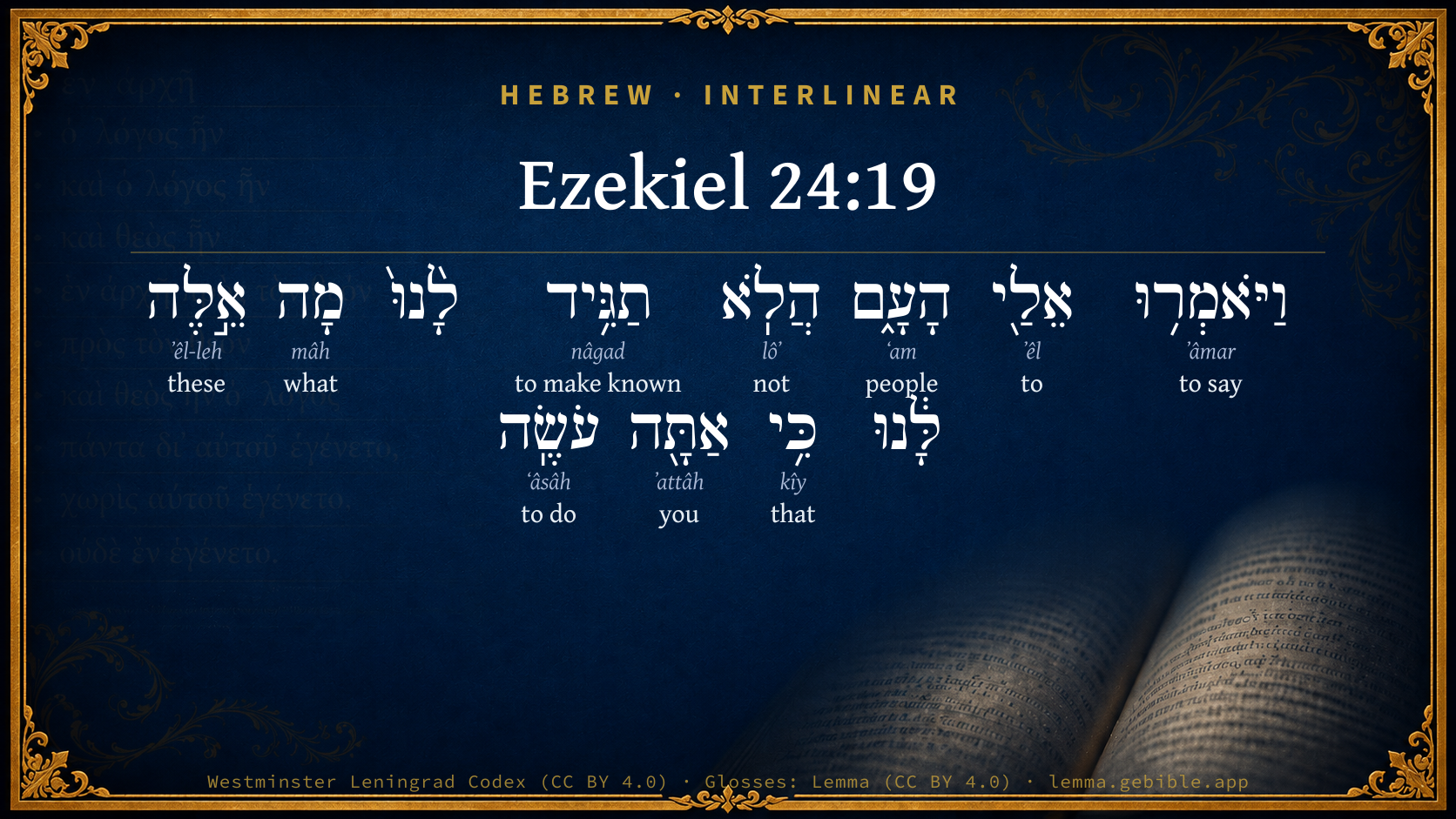
Hebrew (Westminster Leningrad Codex) Ezekiel 24:19 appears in the Hebrew Old Testament. The text above is from the Westminster Leningrad Codex. Each word links to its Strong’s number, a concise gloss, and parsing drawn from the Open Scriptures Hebrew Bible morphology. Click any word for its full Brown-Driver-Briggs (BDB) entry.
Download image
Cite this verse

Ezekiel 24:19 (World English Bible). Public Domain. Lemma interlinear Bible study tool, https://lemma.gebible.app/v/ezekiel/24/19.

Show BibTeX & RIS
BibTeX
RIS
English Translation
The people said to me, Won't you tell us what these things are to us, that you do so?
World English Bible · Public Domain
Download a study sheet

One document with this verse’s original text, its word-by-word gloss line, the meaning frame, cross-references with their text, attributed commentary, and full source and license credits — printable, and it pastes into notes with its structure intact.

This verse Autodidact and up

Study sheet (.html) Plain text (.txt)

A passage Seminary Student

Up to 50 verses in one chapter. A passage sheet keeps up to 6 commentary sources and 12 cross-references per verse, in the order this page ranks them, and says so on the sheet whenever that leaves anything out. Ask for a single verse and you get the Autodidact verse sheet above.

Everything on this page stays free to read, with no account — the sheet is a download of what is already on screen, not access to it.

Want to remove ads? Support Godless Engineer
Compare translations 3

The same verse in 3 English versions, stacked beneath the original-language interlinear above. Click any original word for its lexicon entry.

Each is an independent rendering of the whole verse — the interlinear is not word-aligned to these translations.

Highlighted words mark where these versions differ — a whole-verse word diff, not a word-by-word alignment.

  • World English Bible Public Domain
    The people said to me, Won't you tell us what these things are to us, that you do so?
  • King James Version Public Domain
    And the people said unto me, Wilt thou not tell us what these things are to us, that thou doest so?
  • unfoldingWord Literal Text CC BY-SA 4.0
    The people asked me, “Will you not tell us what these things mean, the things that you are doing?”

unfoldingWord Literal Text — © unfoldingWord, licensed CC BY-SA 4.0. Word-aligned USFM3 via Door43 (git.door43.org/unfoldingWord/en_ult).

Versions to compare (up to 4)

3 of 4 selected

Show all 18 translations

Every available English version of this verse, each an independent rendering of the whole verse.

  • World English Bible Public Domain
    The people said to me, Won't you tell us what these things are to us, that you do so?
  • Berean Standard Bible Public Domain
    Then the people asked me, “Won’t you tell us what these things you are doing mean to us?”
  • Majority Standard Bible Public Domain
    Then the people asked me, “Won’t you tell us what these things you are doing mean to us?”
  • King James Version Public Domain
    And the people said unto me, Wilt thou not tell us what these things are to us, that thou doest so?
  • American Standard Version (1901) Public Domain
    And the people said unto me, Wilt thou not tell us what these things are to us, that thou doest so?
  • Revised Version (1885) Public Domain
    And the people said unto me, Wilt thou not tell us what these things are to us, that thou doest so?
  • Geneva Bible (1599) Public Domain
    And the people said vnto me, Wilt thou not tell vs what these things meane towarde vs that thou doest so?
  • Douay-Rheims (1899) Public Domain
    And the people said to me: Why dost thou not tell us what these things mean that thou doest?
  • Young's Literal Translation Public Domain
    And the people say unto me, `Dost thou not declare to us what these `are' to us, that thou art doing?'
  • Literal Standard Version CC BY-SA 4.0
    And the people say to me, “Do you not declare to us what these [are] to us, that you are doing?”
  • Unlocked Literal Bible CC BY-SA 4.0
    The people asked me, “Will you not tell us what these things mean, the things that you are doing?”
  • unfoldingWord Literal Text CC BY-SA 4.0
    The people asked me, “Will you not tell us what these things mean, the things that you are doing?”
  • Darby Bible Public Domain
    And the people said unto me, Wilt thou not tell us what these things are to us, which thou doest?
  • World Messianic Bible Public Domain
    The people asked me, “Won’t you tell us what these things mean to us, that you act like this?”
  • Webster's Bible Public Domain
    And the people said to me, Wilt thou not tell us what these things are to us, that thou doest so?
  • Free Bible Version CC BY-SA 4.0
    The people asked me, “What are you doing? Aren't you going to explain to us what this means?”
  • Bible in Basic English Public Domain
    And the people said to me, Will you not make clear to us the sense of these things; is it for us you do them?
  • JPS Tanakh (1917) Public Domain
    And the people said unto me: 'Wilt thou not tell us what these things are to us, that thou doest so?'

Literal Standard Version (2020), Covenant Press — licensed CC BY-SA 4.0. Text via the HelloAO Bible API (eBible.org). Unlocked Literal Bible (unfoldingWord) — licensed CC BY-SA 4.0. Text via the HelloAO Bible API (eBible.org). unfoldingWord Literal Text — © unfoldingWord, licensed CC BY-SA 4.0. Word-aligned USFM3 via Door43 (git.door43.org/unfoldingWord/en_ult). Free Bible Version, Dr. Jonathan Gallagher — licensed CC BY-SA 4.0. Text via the HelloAO Bible API (eBible.org).

Word by word

More ways to search: Search by grammar → Find every occurrence → Compare this word →

Practice this passage: Drill this verse → Learn its vocabulary →

תַגִּ֥יד
nâgad
H5046
“to make known”
Verb, Hiphil, Imperfect, 2nd Person, Masculine, Singular
Part of Speech
Verb
Stem
Hiphil
Form
Imperfect
Person
2nd Person
Gender
Masculine
Number
Singular
Full BDB Definition

Origin: a primitive root

TWOT: 1289

to be conspicuous, tell, make known - (Hiphil) to tell, declare - to tell, announce, report - to declare, make known, expound - to inform of - to publish, declare, proclaim - to avow, acknowledge, confess - messenger (participle) - (Hophal) to be told, be announced, be reported
  1. וַיֹּאמְר֥וּ ʼâmar H559 “and · to say” Conjunction + Verb, Qal, Sequential Imperfect, 3rd Person, Masculine, Plural
  2. אֵלַ֖י ʼêl H413 “to · me” Preposition + Suffix, Personal, 1st Person, Common, Singular
  3. הָעָ֑ם ʻam H5971 “the · people” Particle, Definite Article + Noun, Common, Masculine, Singular, Absolute
  4. הֲלֹֽא lôʼ H3808 “not” Particle, Interrogative + Particle, Negative
  5. מָה mâh H4100 “what” Particle, Interrogative
  6. אֵ֣לֶּה ʼêl-leh H428 “these” Pronoun, Demonstrative, Common, Plural
  7. כִּ֥י kîy H3588 “that” Conjunction
  8. אַתָּ֖ה ʼattâh H859 “you” Pronoun, Personal, 2nd Person, Masculine, Singular
  9. עֹשֶֽׂה ʻâsâh H6213 “doing” Verb, Qal, Participle Active, Masculine, Singular, Absolute

About this verse

These counts appear in no published source. They are computed here, from the morphology-tagged text and Lemma’s own curated glosses. What Lemma adds →

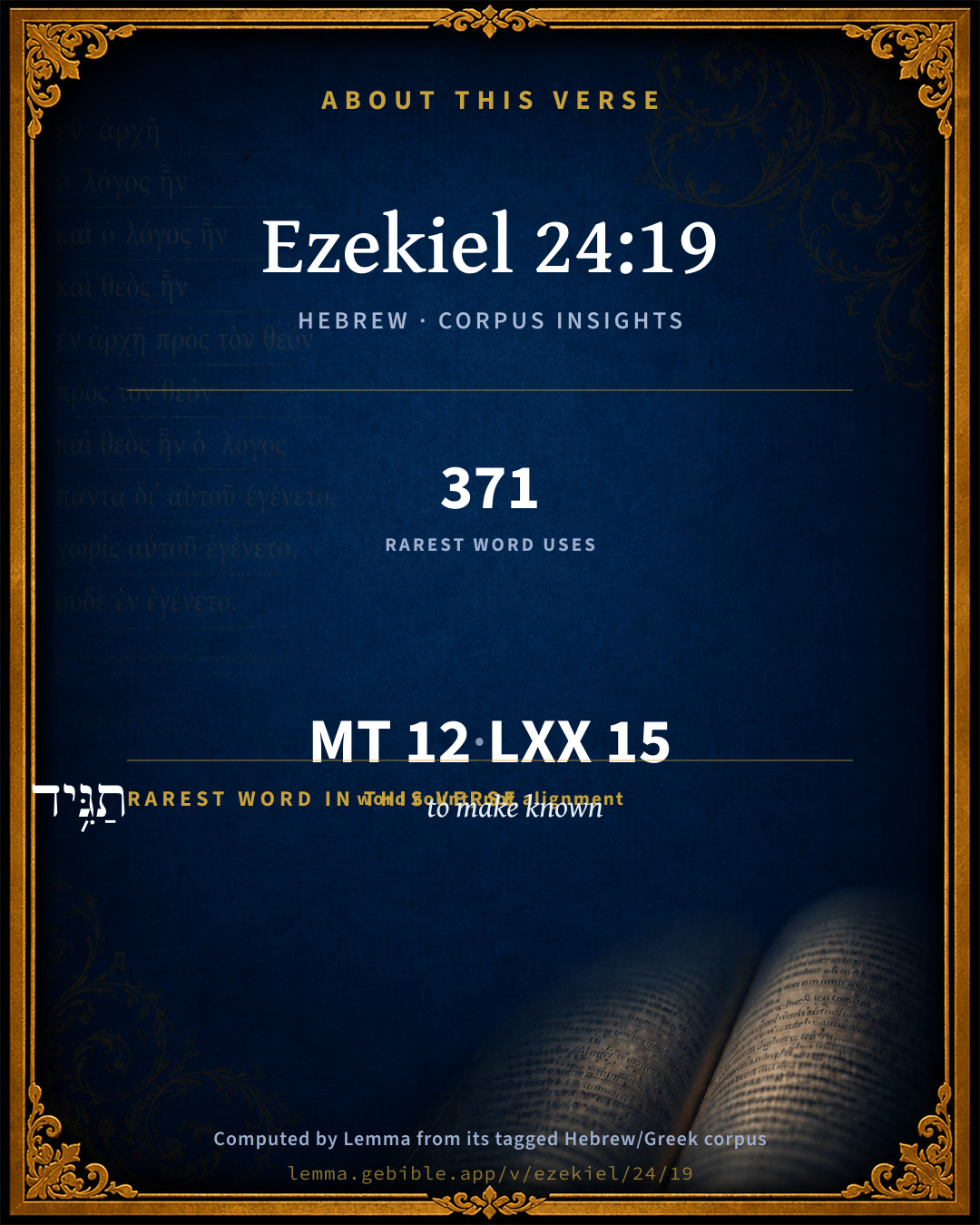
12
words
10
distinct lemmas
Prophets
section

Grammatical profile

  • 3 verbs
  • 1 noun
  • 2 pronouns
  • 3 prepositions
  • 1 conjunction
  • 2 particles

Verb forms

  • וַיֹּאמְר֥וּ Qal · Sequential Imperfect
  • תַגִּ֥יד Hiphil · Imperfect
  • עֹשֶֽׂה Qal · Participle Active

Hebrew & Septuagint length

In English translation the verse runs 19 words from the Hebrew and 18 from the Septuagint (LXX English) — closely comparable.

A rough comparison of the two English renderings, which tokenize alike — not a word-level alignment.

Word counts can differ between the Hebrew and the Greek without any difference in meaning — e.g. the Hebrew direct-object marker אֵת has no separate Greek word, and Greek often adds the article ὁ.

In the original languages it is 12 Hebrew tokens and 15 Greek tokens — but the two are counted differently (Hebrew bundles its prefixes and suffixes into one token; the Greek is in lemma form), so that isn’t a like-for-like length.

Cross-references

7

Topical passages linked to Ezekiel 24:19 in the Treasury of Scripture Knowledge — connected by theme and wording, ordered by reader-vote popularity; previews shown in the World English Bible.

  • Ezekiel 12:9 Son of man, has not the house of Israel, the rebellious house, said to you, What do you?
  • Ezekiel 37:18 When the children of your people shall speak to you, saying, Will you not show us what you mean by these?
  • Ezekiel 17:12 Say now to the rebellious house, Don't you know what these things mean? tell them, Behold, the king of Babylon came to Jerusalem, and took the king of it, and the princes of it, and brought them to him to Babylon:
  • Ezekiel 20:49 Then said I, Ah Lord Yahweh! they say of me, Isn't he a speaker of parables?
  • Ezekiel 21:7 It shall be, when they tell you, Why do you sigh? that you shall say, Because of the news, for it comes; and every heart shall melt, and all hands shall be feeble, and every spirit shall faint, and all knees shall be weak as water: behold, it comes, and it shall be done, says the Lord Yahweh.
  • Malachi 3:7–8 From the days of your fathers you have turned aside from my ordinances, and have not kept them. Return to me, and I will return to you," says Yahweh of Hosts. "But you say, 'How shall we return?'
  • Malachi 3:13 "Your words have been stout against me," says Yahweh. "Yet you say, 'What have we spoken against you?'

Cross-references courtesy of OpenBible.info (CC BY 4.0).

Hebrew and Greek witnesses Masoretic Hebrew ↔ Greek Septuagint

The same verse in the two great witnesses to the Old Testament, shown verse-for-verse.

These are two independent witnesses, not word-aligned to each other, and the Septuagint is shown in lemma (dictionary) form.

Hebrew Ezekiel 24:19 Masoretic · Westminster Leningrad Codex

וַיֹּאמְר֥וּ אֵלַ֖י הָעָ֑ם הֲלֹֽא תַגִּ֥יד לָ֨נוּ֙ מָה אֵ֣לֶּה לָּ֔נוּ כִּ֥י אַתָּ֖ה עֹשֶֽׂה

The people said to me, Won't you tell us what these things are to us, that you do so?

World English Bible · Public Domain

Greek LXX Ezekiel 24:19 Septuagint · lemma form

καί εἶπον πρός ἐγώ ὁ λαός οὐ ἀναἀγγέλλω ἐγώ τίς εἰμί οὗτος ὅς σύ ποιέω

And the people said to me, Will you not tell us what these things are that you do?

LXX2012 (modern English Septuagint) · Public Domain

Hebrew: Westminster Leningrad Codex (CC BY 4.0). Greek: Septuagint (public domain); English from LXX2012 (modern English Septuagint) (Public Domain). How the Septuagint differs from the Hebrew →

Targum (Aramaic paraphrase)

1

The Targum is the ancient Jewish Aramaic paraphrase of the Hebrew Scriptures — an interpretive translation, not the Hebrew text itself. Onkelos (literal) and Pseudo-Jonathan (expansive) render the Torah, and Jonathan the Prophets. Coverage is partial: where no permissively-licensed English translation exists for a verse, only the Aramaic is shown. This is verse-level text, not a word-by-word alignment to the Hebrew.

  1. Targum Jonathan Prophets (Joshua–Malachi)
    וַאֲמָרוּ לִי עַמָא הֲלָא תְחַוֵי לָנָא מָא אִילֵן לָנָא אֲרֵי אַתְּ עָבֵיד:

    (no public-domain English translation for this verse)

    Targum Jonathan — Aramaic: “Mikraot Gedolot” (public domain). English: “Sefaria Community Translation” (CC0 1.0 (public-domain dedication)); “London "Chaldee Paraphrase," 1871” (public domain). Text via Sefaria.

Commentary

Notes on Ezekiel 24:19 from classic Christian and Jewish commentators (each source and its license shown beneath its notes). The classic Christian expositions comment on the surrounding passage and are grouped to its opening verse, so a note may address several verses; the Jewish commentaries on the Tanakh (Rashi and others) are per-verse, so they appear only where the commentator wrote on this verse.

Lemma curates 59 commentaries, every one of them public domain or Creative Commons licensed, each selected and text-cleaned for this edition rather than reprinted as found. About our sources →

Trapp's Complete Commentary

John Trapp

Eze 24:19 And the people said unto me, Wilt thou not tell us what these [things are] to us, that thou doest [so]?

Ver. 19. Wilt thou not tell us.] They well knew that there was something in it more than ordinary, for the prophet was no stoic, but sensible enough of what he suffered.

John Trapp, A Commentary or Exposition upon All the Books of the Old and New Testament (1647–1656) — public domain. Text from a community e-Sword module.

The Biblical Illustrator

Joseph S. Exell

Eze_24:19

Wilt thou not tell us what these things are to us, that thou doest so?

An ancient question modernised

Just as Ezekiel, at his Lords command, did many strange things entirely with a view to other people, we must remember that many things that we do have some relation to others. As long as we are here we can never so isolate ourselves as to become absolutely independent of our surroundings; and it is often well, when we note the behaviour of other people, to say to somebody, if not to them, as the people did to Ezekiel, Wilt thou not tell us what these things are to us?

I. This should be your question to the Lord Jesus. Very reverently, though, let us approach our Divine Master, and looking at Him in His wondrous passion, let us earnestly ask Him, Wilt Thou not tell us what these things are to us, that Thou doest so? His answer is, Sin is an exceedingly bitter thing; and to remove it costs Me the agony of My soul. But do you see through the trees the lanterns twinkling? Men are coming, evil men, with rough voices, with torches, and lanterns, and staves, to take the blessed pleading One. Dear Master, while the traitors kiss is still wet upon Thee, and Thou art being led away bound to Caiaphas, tell me, I pray Thee, what meanest Thou by all this? What has this to do with us? He answers, I go willingly; I must be bound, for sin has bound you; sin has bound your hands, sin has hampered and crippled you, and made you prisoners. You are the bond slaves of Satan, and I must be bound to set you free. But now they have taken Him before His judges. He stands before Annas, and Caiaphas, and Pilate. Blessed Sufferer, like a lamb in the midst of wolves, tell us, if Thou wilt speak a word, why this silence? And He whispers into the hearts of His beloved, I was silent, for there was nothing to say; willing to be your Advocate, what could I say? You had sinned, though I had not. I might have pleaded for Myself; but I stood there for you, in your room, and place, and stead; and what could I say, what excuse, what apology, what extenuation could I urge? But now they are scourging Him, they are crowning Him with thorns, they are mocking Him, blindfolding Him, and then smiting Him with the palms of their hands. What scorn, what shame they poured on Him: Blessed One, blessed One, wilt Thou not tell us what these things are to us? But now, you see, they take Him out through the streets of Jerusalem; along the Via Dolorosa He pursues His weary walk, blood drops falling on the pavement, Himself staggering beneath the load of the Cross. Tell me, Jesus, why goest Thou out there, to the place of public execution, the Old Bailey, the Tyburn of Jerusalem? And He answers, I suffer without the gate because God will not tolerate sin in His city. Sin is an unclean thing; and I, though not Myself unclean, yet standing in the stead of the unclean, must die outside the city gates. And He answers, That I may draw all men unto Me. Earth refuses Me, and heaven denies Me shelter. I hang here, the Just for the unjust, that I may bring men to God. They take Him down from the Cross, for He is dead; but before they take Him down they pierce His heart, and even after death that heart for us its tribute pours. But they have buried Him, and He lies in His cell alone through the long, dark night of death; but the third morning sees Him rise. Or ever the sun is up, the Sun of Righteousness has arisen, with healing in His wings. Jesus has quitted the tomb, and I invite all sinners to say to the risen Redeemer, Wilt Thou not fell us what these things are to us, that Thou doest so? This is what I understand that His Resurrection means to us, He is able to save to the uttermost them that come unto God by Him, seeing He ever liveth to make intercession for them. He not only rises from the dead; but He ascends to His Father. Ask Him what He means by that, and He will tell you that He has led captivity captive, and received gifts for men, yea, for the rebellious also.

II. This may be your question to the church. We are coming here, to keep Christs death in remembrance. Every first day of the week, if you can, come to the table as a part of your Sabbath worship. This service is intended to be a memorial of Christs death. The best memorial of any event is to associate with it the observance of some rite, or some ceremony frequently repeated; this will cause it to be a perpetual memorial. Now, as long as half a dozen Christians meet together for the breaking of bread, Christs death can never be forgotten. We are not, however, coming to the table merely to look at the bread and the wine. We are coming there to eat and to drink, to show our personal benefit by Jesus Christs death. We wish all who see us to know that we enjoy the result of Christs death. We have a life that feeds upon His sacrifice; we have a hope that makes Christ to be its very meat and drink. But we not only come to the table to eat and to drink, but there is this point about the communion, that we come together to declare our unity in Jesus Christ. If I went home, and broke bread, and drank of the juice of the vine by myself alone, it would not be the observance of the Lords Supper. It is a united participation. It is a festival. It is a token and display of brotherhood. Once more, when this communion is over, if we live, we shall meet again next Lords day, and when that is over, if we are spared, we shall meet again the following Lords day. We meet continually, to show our belief in Jesus Christs coming again. Perhaps you still inquire, Wilt thou not tell us what these things are to us, that thou doest so? Well, they are this to you, that, whether you remember Jesus Christs coming or not, He is coming; He is coming quickly. Let Him come when He may, His coming will be full of love and joy to all who have trusted Him.

III. This is our question to you, Wilt thou not tell us what these things are to us, that thou doest so? First, there are some of you who are here who do not often go to a place of worship; I know you. By seldom coming to the Lords house you teach us your utter indifference. Your carelessness seems to say to me, God is nobody, put Him in a corner. Get on in business; mind the main chance. Gospel? Salvation? Oh, they are trifles, not worth anybodys consideration! There are others of you who are not indifferent; you come to the services, and you are attentive listeners; but just observe what you are going to do. The Lords table is spread, Christ is to be remembered, fellowship is to be had with Him, and you are going home! I hear another say, I am not going home; I shall remain at the ordinance as a spectator. I always like to see you look on. You are getting into a place of happy danger. Get where the shots fly, and one of them may make a target of you. Oh, that it might be so! But tonight you are going to be only a spectator. Will you tell me what that means--only a spectator? In Paris, during the siege, when it was straitly shut up, there were meals given at certain times in appointed places; but what would you have thought if you had been there, and had been allowed to come to the window and see the feeding, and yourself remain only a spectator? Do not be merely spectators; but if you mean to be so, then I say this to you, there will be no spectators in heaven. They will all partake of the feast above, or they will not be there. And, I grieve to add, there will be no spectators in hell. You will have to participate in the award of vengeance, or else in the gift of mercy. Therefore have done with being spectators. (C. H. Spurgeon.)

.

The Biblical Illustrator, edited by Joseph S. Exell (c. 1880s–1900s) — public domain. Text from a community e-Sword module.

Joseph Benson's Commentary

Eze 24:19-24. Wilt thou not tell us what these things are — That is, what is the meaning of thy unusual actions. They seem to make this inquiry by way of derision and contempt. Speak unto the house of Israel — Now he is commissioned to declare the meaning of what he did. Thus saith the Lord, Behold, I will profane my sanctuary — I will deliver my temple into the hands of the heathen, and they shall profane and destroy it: even that temple wherein you placed your glory, and thought your greatest protection. The desire of your eyes, and that which your soul pitieth — As much your desire, as my wife was mine; most dear to you, the destruction of which will affect you with a most poignant grief. Your sons and your daughters whom ye have left shall fall by the sword — Whom you left behind you when you were made captives; for this was addressed to those who were at this time captives in Babylonia, having been carried thither with Jehoiachin. Or the meaning may be, Your sons, &c., who are left to you, from the famine and the pestilence. Ye shall not mourn nor weep —

These terrible judgments shall strike you with astonishment, and produce in you such distress as is too great to be expressed by words or actions; but ye shall pine away for your iniquities, &c. — You shall be absorbed in silent sorrow, and shall waste away by lingering grief, and secret lamentation over each other’s calamities, as the punishment of your iniquities, which have made your land, city, temple, and families desolate, and yourselves miserable. Thus Ezekiel is a sign unto you — His actions foreshow you what your conditions shall be. The sacred writers, in several places, speak of themselves in the third person. And when this cometh, ye shall know that I am the Lord — Comparing the prediction with the event will convince the most obstinate that the immediate hand of God is in the judgments which are come upon you.

Joseph Benson's Commentary on the Old and New Testaments (1811–1818) — public domain. Text from a community e-Sword module.

Jamieson, Fausset & Brown

Robert Jamieson, A. R. Fausset & David Brown

what these things are to us--The people perceive that Ezekiel's strange conduct has a symbolical meaning as to themselves; they ask, "What is that meaning?"

Jamieson, Fausset & Brown — Commentary Critical and Explanatory on the Whole Bible (1871) — public domain (CC PDM 1.0). Text via the HelloAO Bible API.

Adam Clarke's Commentary

Verse 19. Wilt thou not tell us] In the following verses he explains and applies the whole of what he had done and said.

Adam Clarke's Commentary on the Bible (1810–1826) — public domain. Text from a community e-Sword/MySword module.

John Gill's Exposition

Then I answered them,.... And gave them an account of the design of the whole, and what was signified hereby:

the word of the Lord came unto me, saying; ordering him to do all he did; for he did nothing of himself, but all according to the divine will; and who also directed him to say the following things to the people, by way of explanation.

John Gill's Exposition of the Whole Bible (1746–1763) — public domain (CC PDM 1.0). Text via the HelloAO Bible API.

Matthew Poole's English Annotations

The people said; some of the ordinary sort, the people, not rulers or priests.

Tell us; explain, and declare whether there be not, and what it is that we are to learn by this. These are types, but what do they mean?

Matthew Poole's English Annotations on the Holy Bible (1683–1685) — public domain. Text from a community e-Sword/MySword module.

The Pulpit Commentary

We must read between the lines what had passed in that eventful night of sorrow. The rumor must have spread among the exiles of Tel-Abib that the prophet had lost the wife whom he loved so tenderly.

They were ready, we may imagine, to offer their consolations and their sympathy. And, behold, he appears as one on whom no special sorrow had fallen. But that strange outward hardness had the effect which it was meant to have. It roused them to ask questions, and it was one of the cases in which the prudens interrogatio, which if not in itself the dimidium seientiae, at least prepared the way for it. The form of their question implies that they had a forecast that the strange conduct was, in some way, connected with the prophet"s work. Wilt thou not tell us what these things are to us?

The Pulpit Commentary (1880–1919), ed. H.D.M. Spence-Jones & Joseph S. Exell — public domain. Text from a community e-Sword module.

unfoldingWord translationNotes

Door43 World Missions Community

General Information:

The people of Israel question Ezekiel, and Ezekiel tells them what Yahweh has said to them.

The word of Yahweh came

This is an idiom that is used to introduce something that God told his prophets or his people. See how you translated this in Ezekiel 3:16. AT: "Yahweh spoke this message" or "Yahweh spoke these words" (See: Idiom)

the house of Israel

The word "house" is a metonym for the family that lives in the house, in this case the Israelites, the descendants of Jacob over many years. See how you translated this in Ezekiel 3:1. AT: "the Israelites" or "the Israelite people group" (See: Metonymy)

Behold

The word "behold" here alerts us to pay attention to the surprising information that follows.

I will desecrate my sanctuary—the pride of ... of your soul, and your sons

"I will desecrate my sanctuary which is the pride ... of your soul. Your sons"

the pride of your power

This describes the temple as the building that the people are proud of. This speaks of it as being their "pride" instead of the source of their pride. AT: "the building that you are proud of" or "the source of your strong pride" (See: Metonymy)

the delight of your eyes

Here Yahweh refers to the people by their "eyes." AT: "the building that you delight to look at" (See: Synecdoche)

the yearning of your soul

Here Yahweh refers to the people by their "soul" to emphasize their inner feelings. AT: "the building that you truly love" (See: Synecdoche)

your sons and your daughters ... will fall by the sword

This refers to their enemies by their swords. AT: "your sons and daughters ... will be killed in war" or "your enemies will kill your sons and your daughters ... with their swords" (See: Metonymy)

translationWords

house

Israel

Lord Yahweh

proud

lust

desecrate

sanctuary

sword

unfoldingWord translationNotes — © Distant Shores Media and the Door43 World Missions Community, licensed CC BY-SA 4.0. Source: git.door43.org/Door43/en_tn.

Rashi

Rabbi Shlomo Yitzchaki (Rashi)

what these mean to us What are these signs to us?

Rashi on the Tanakh — English translations: “The Judaica Press complete Tanach with Rashi, translated by A. J. Rosenberg” (CC BY 4.0); “Pentateuch with Rashi's commentary by M. Rosenbaum and A.M. Silbermann, 1929-1934” (public domain); “The Metsudah Tanach series, Lakewood, N.J” (CC BY 4.0); and “The Book of Joshua, Metsudah Publications, 1997” (CC BY 4.0). Text via Sefaria.

Lesson kit

Teaching starters — assembled from the data on this page, not authored interpretation. Every prompt links to the verse data it draws on. Edit before teaching.

Ezekiel, in the Prophets, opens this verse with 12 words (10 distinct Hebrew lemmas). Its most distinctive word is nâgad (“to make known”). A historical commentator’s framing appears above. Read the whole chapter for the surrounding context.

Discussion questions

  1. What does “to make known” (nâgad) contribute to the verse as a whole?
  2. How does Ezekiel 12:9, which shares this passage’s theme, read alongside this verse?
  3. The translations on this page render this verse differently — a whole-verse word diff, not a word-by-word alignment. What might account for the different wordings?
  4. «וַיֹּאמְר֥וּ» is a Qal Sequential Imperfect verb. How does that grammatical form shape the action described?
  5. Compare how Trapp's Complete Commentary and The Biblical Illustrator read this verse. Where do they agree or differ?

Things to notice

Reading settings

Reading text

Shown beneath each verse's original-language words.

Old Testament
Old Testament edition

Read the OT as the Masoretic Hebrew (MT) or the Greek Septuagint (LXX).

English shown for the Greek Septuagint (in the Hebrew ↔ Greek comparison).

Comparing translations? Open the Compare panel on any verse page to stack up to four side by side.