
Psalms 118:6

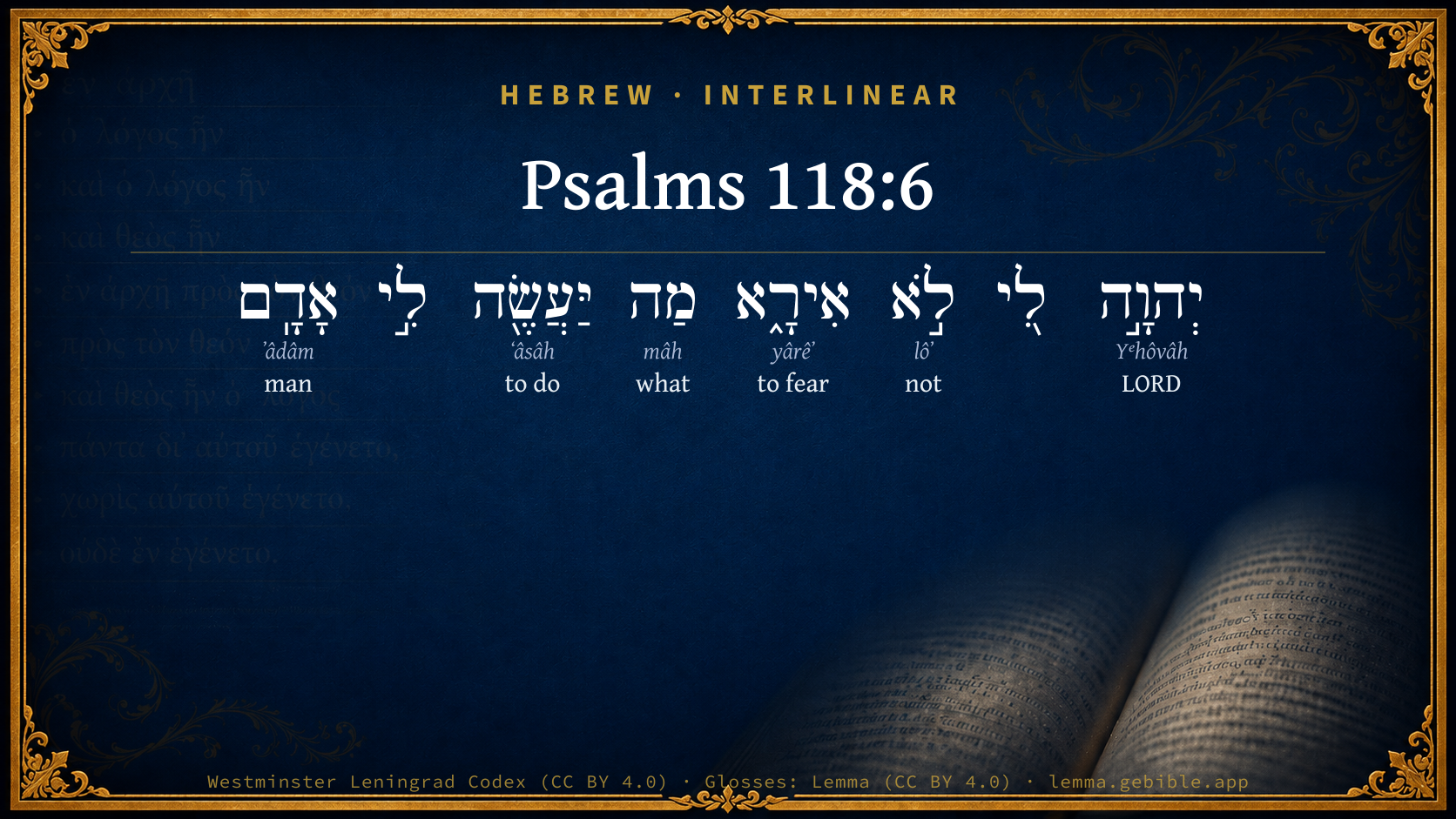
Hebrew (Westminster Leningrad Codex) Psalms 118:6 appears in the Hebrew Old Testament. The text above is from the Westminster Leningrad Codex. Each word links to its Strong’s number, a concise gloss, and parsing drawn from the Open Scriptures Hebrew Bible morphology. Click any word for its full Brown-Driver-Briggs (BDB) entry.
Download image
Cite this verse

Psalms 118:6 (World English Bible). Public Domain. Lemma interlinear Bible study tool, https://lemma.gebible.app/v/psalms/118/6.

Show BibTeX & RIS
BibTeX
RIS
English Translation
Yahweh is on my side. I will not be afraid. What can man do to me?
World English Bible · Public Domain
Download a study sheet

One document with this verse’s original text, its word-by-word gloss line, the meaning frame, cross-references with their text, attributed commentary, and full source and license credits — printable, and it pastes into notes with its structure intact.

This verse Autodidact and up

Study sheet (.html) Plain text (.txt)

A passage Seminary Student

Up to 50 verses in one chapter. A passage sheet keeps up to 6 commentary sources and 12 cross-references per verse, in the order this page ranks them, and says so on the sheet whenever that leaves anything out. Ask for a single verse and you get the Autodidact verse sheet above.

Everything on this page stays free to read, with no account — the sheet is a download of what is already on screen, not access to it.

Want to remove ads? Support Godless Engineer
Compare translations 3

The same verse in 3 English versions, stacked beneath the original-language interlinear above. Click any original word for its lexicon entry.

Each is an independent rendering of the whole verse — the interlinear is not word-aligned to these translations.

Highlighted words mark where these versions differ — a whole-verse word diff, not a word-by-word alignment.

  • World English Bible Public Domain
    Yahweh is on my side. I will not be afraid. What can man do to me?
  • King James Version Public Domain
    The LORD is on my side; I will not fear: what can man do unto me?
  • unfoldingWord Literal Text CC BY-SA 4.0
    Yahweh for me; I will not be afraid; what can man do to me?

unfoldingWord Literal Text — © unfoldingWord, licensed CC BY-SA 4.0. Word-aligned USFM3 via Door43 (git.door43.org/unfoldingWord/en_ult).

Versions to compare (up to 4)

3 of 4 selected

Show all 18 translations

Every available English version of this verse, each an independent rendering of the whole verse.

  • World English Bible Public Domain
    Yahweh is on my side. I will not be afraid. What can man do to me?
  • Berean Standard Bible Public Domain
    The LORD is on my side; I will not be afraid. What can man do to me?
  • Majority Standard Bible Public Domain
    The LORD is on my side; I will not be afraid. What can man do to me?
  • King James Version Public Domain
    The LORD is on my side; I will not fear: what can man do unto me?
  • American Standard Version (1901) Public Domain
    Jehovah is on my side; I will not fear: What can man do unto me?
  • Revised Version (1885) Public Domain
    The LORD is on my side; I will not fear: what can man do unto me?
  • Geneva Bible (1599) Public Domain
    The Lord is with mee: therefore I will not feare what man can doe vnto me.
  • Douay-Rheims (1899) Public Domain
    The Lord is my helper, I will not fear what man can do unto me.
  • Young's Literal Translation Public Domain
    Jehovah `is' for me, I do not fear what man doth to me.
  • Literal Standard Version CC BY-SA 4.0
    YHWH [is] for me, || I do not fear what man does to me.
  • Unlocked Literal Bible CC BY-SA 4.0
    Yahweh is with me; I will not be afraid; what can man do to me?
  • unfoldingWord Literal Text CC BY-SA 4.0
    Yahweh for me; I will not be afraid; what can man do to me?
  • Darby Bible Public Domain
    Jehovah is for me, I will not fear; what can man do unto me?
  • World Messianic Bible Public Domain
    The LORD is on my side. I will not be afraid. What can man do to me?
  • Webster's Bible Public Domain
    The LORD is on my side; I will not fear: what can man do to me?
  • Free Bible Version CC BY-SA 4.0
    The Lord is with me, so I have nothing to fear. No one can harm me.
  • Bible in Basic English Public Domain
    The Lord is on my side; I will have no fear: what is man able to do to me?
  • JPS Tanakh (1917) Public Domain
    The LORD is for me; I will not fear; what can man do unto me?

Literal Standard Version (2020), Covenant Press — licensed CC BY-SA 4.0. Text via the HelloAO Bible API (eBible.org). Unlocked Literal Bible (unfoldingWord) — licensed CC BY-SA 4.0. Text via the HelloAO Bible API (eBible.org). unfoldingWord Literal Text — © unfoldingWord, licensed CC BY-SA 4.0. Word-aligned USFM3 via Door43 (git.door43.org/unfoldingWord/en_ult). Free Bible Version, Dr. Jonathan Gallagher — licensed CC BY-SA 4.0. Text via the HelloAO Bible API (eBible.org).

Word by word

More ways to search: Search by grammar → Find every occurrence → Compare this word →

Practice this passage: Drill this verse → Learn its vocabulary →

אִירָ֑א
yârêʼ
H3372
“to fear”
Verb, Qal, Imperfect, 1st Person, Common, Singular
Part of Speech
Verb
Stem
Qal
Form
Imperfect
Person
1st Person
Gender
Common
Number
Singular
Full BDB Definition

Origin: a primitive root

TWOT: 907 , 908

to fear, revere, be afraid - (Qal) - to fear, be afraid - to stand in awe of, be awed - to fear, reverence, honour, respect - (Niphal) - to be fearful, be dreadful, be feared - to cause astonishment and awe, be held in awe - to inspire reverence or godly fear or awe - (Piel) to make afraid, terrify - (TWOT) to shoot, pour
  1. יְהוָ֣ה Yᵉhôvâh H3068 “LORD” Noun, Proper
  2. לֹ֣א lôʼ H3808 “not” Particle, Negative
  3. מַה mâh H4100 “what” Particle, Interrogative
  4. יַּעֲשֶׂ֖ה ʻâsâh H6213 “to do” Verb, Qal, Imperfect, 3rd Person, Masculine, Singular
  5. אָדָֽם ʼâdâm H120 “man” Noun, Common, Masculine, Singular, Absolute

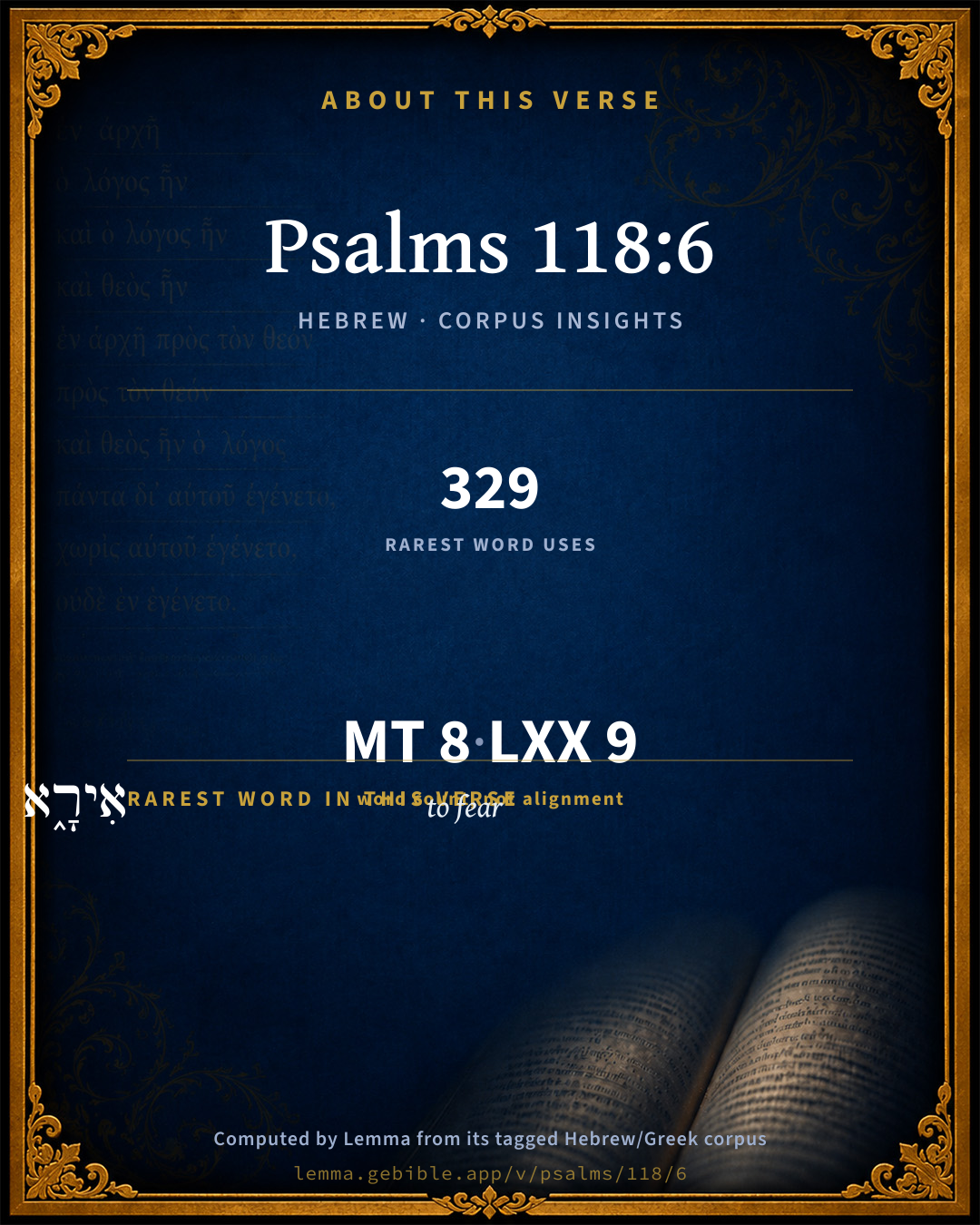
About this verse

These counts appear in no published source. They are computed here, from the morphology-tagged text and Lemma’s own curated glosses. What Lemma adds →

8
words
6
distinct lemmas
Wisdom
section

Grammatical profile

  • 2 verbs
  • 2 nouns
  • 2 prepositions
  • 2 particles

Verb forms

  • אִירָ֑א Qal · Imperfect
  • יַּעֲשֶׂ֖ה Qal · Imperfect

Hebrew & Septuagint length

In English translation the verse runs 16 words from the Hebrew and 16 from the Septuagint (LXX English) — the same length.

A rough comparison of the two English renderings, which tokenize alike — not a word-level alignment.

Word counts can differ between the Hebrew and the Greek without any difference in meaning — e.g. the Hebrew direct-object marker אֵת has no separate Greek word, and Greek often adds the article ὁ.

In the original languages it is 8 Hebrew tokens and 9 Greek tokens — but the two are counted differently (Hebrew bundles its prefixes and suffixes into one token; the Greek is in lemma form), so that isn’t a like-for-like length.

Cross-references

13

Topical passages linked to Psalms 118:6 in the Treasury of Scripture Knowledge — connected by theme and wording, ordered by reader-vote popularity; previews shown in the World English Bible.

  • Hebrews 13:6 So that with good courage we say, "The Lord is my helper. I will not fear. What can man do to me?"
  • Romans 8:31 What then shall we say about these things? If God is for us, who can be against us?
  • Psalms 56:4 In God, I praise his word. In God, I put my trust. I will not be afraid. What can flesh do to me?
  • Psalms 56:11 I have put my trust in God. I will not be afraid. What can man do to me?
  • Micah 7:8–10 Don't rejoice against me, my enemy. When I fall, I will arise. When I sit in darkness, Yahweh will be a light to me.
  • Psalms 27:1–3 Yahweh is my light and my salvation. Whom shall I fear? Yahweh is the strength of my life. Of whom shall I be afraid?
  • Psalms 56:9 Then my enemies shall turn back in the day that I call. I know this, that God is for me.
  • Jeremiah 20:11 But Yahweh is with me as an awesome mighty one: therefore my persecutors shall stumble, and they shall not prevail; they shall be utterly disappointed, because they have not dealt wisely, even with an everlasting dishonor which shall never be forgotten.
  • Psalms 23:4 Even though I walk through the valley of the shadow of death, I will fear no evil, for you are with me. Your rod and your staff, they comfort me.
  • Isaiah 51:12 I, even I, am he who comforts you: who are you, that you are afraid of man who shall die, and of the son of man who shall be made as grass;
  • Psalms 46:11 Yahweh of Hosts is with us. The God of Jacob is our refuge. Selah.
  • Psalms 146:5 Happy is he who has the God of Jacob for his help, Whose hope is in Yahweh, his God:
  • Psalms 46:1 God is our refuge and strength, A very present help in trouble.

Cross-references courtesy of OpenBible.info (CC BY 4.0).

Hebrew and Greek witnesses Masoretic Hebrew ↔ Greek Septuagint

The same verse in the two great witnesses to the Old Testament, shown verse-for-verse.

You’re reading Greek Psalm 117 (Hebrew Psalm 118). The Septuagint counts the superscription, so verse numbers can differ from the Hebrew — chapter-level alignment, not verse-by-verse. Numbering follows Rahlfs.

These are two independent witnesses, not word-aligned to each other, and the Septuagint is shown in lemma (dictionary) form.

Hebrew Psalms 118:6 Masoretic · Westminster Leningrad Codex

יְהוָ֣ה לִ֭י לֹ֣א אִירָ֑א מַה יַּעֲשֶׂ֖ה לִ֣י אָדָֽם

Yahweh is on my side. I will not be afraid. What can man do to me?

World English Bible · Public Domain

Greek LXX Greek Psalm 117:6 Septuagint · lemma form

κύριος ἐγώ βοηθός οὐ φοβέω τίς ποιέω ἐγώ ἄνθρωπος

The Lord is my helper; and I will not fear what man shall do to me.

LXX2012 (modern English Septuagint) · Public Domain

Hebrew: Westminster Leningrad Codex (CC BY 4.0). Greek: Septuagint (public domain); English from LXX2012 (modern English Septuagint) (Public Domain). How the Septuagint differs from the Hebrew →

Commentary

Notes on Psalms 118:6 from classic Christian and Jewish commentators (each source and its license shown beneath its notes). The classic Christian expositions comment on the surrounding passage and are grouped to its opening verse, so a note may address several verses; the Jewish commentaries on the Tanakh (Rashi and others) are per-verse, so they appear only where the commentator wrote on this verse.

Lemma curates 59 commentaries, every one of them public domain or Creative Commons licensed, each selected and text-cleaned for this edition rather than reprinted as found. About our sources →

Trapp's Complete Commentary

John Trapp

Psa 118:6 The LORD [is] on my side; I will not fear: what can man do unto me?

Ver. 6. I will not fear, &c.] See Psa 56:4; Psa 56:11.

John Trapp, A Commentary or Exposition upon All the Books of the Old and New Testament (1647–1656) — public domain. Text from a community e-Sword module.

J. A. Alexander on Psalms

Joseph Addison Alexander

6. (Psa 118:6) Jehovah (is) for me; I will not fear; what can man do to me? Instead of for me, i.e. in my favour, on my side, the Hebrew may also be translated to me, i.e. is or belongs to me, is mine. See above, on Psa 56:4; Psa 56:9; Psa 56:11. Man does not here mean a man, but mankind, or Man as opposed to God.

Joseph Addison Alexander, The Psalms Translated and Explained (1850) — public domain. Text from a community e-Sword module.

Tyndale Open Study Notes

Tyndale Open Resources

118:6-7 The Lord is for me: Cp. Rom 8:31; Heb 13:6. • God’s presence cancels out the need to fear mere people (Ps 56:11). The psalmist joyfully expects God’s rescue (59:10; 112:8).

Tyndale Open Study Notes — © Tyndale Open Resources, licensed CC BY-SA 4.0. Text via the HelloAO Bible API.

Geneva Bible (1599)

Geneva Bible translators

Being exalted to this estate, he assured himself to have man ever to be his enemy. Yet he doubted not, but God would maintain him, because he had placed him.

Geneva Bible (1599) marginal notes — public domain. Text via Bolls.life.

John Calvin's Commentaries

6 Jehovah is with me among those who help me Confiding solely in God’s help, he sets at defiance not a few enemies merely, but the whole world. “Defended by God’s hand, I may boldly and safely set at nought all the machinations of men.” When all the power of the universe is deemed as nothing, in comparison of God, then, indeed, is due honor attributed to him. Thus he tacitly reproves the unbelief of almost all men, who spontaneously alarm themselves with groundless fears. All, indeed, desire peace of mind; but, in consequence of robbing God of the praise due to his power, their own ingratitude does not permit them to realize this blessing. Were they, as is fitting, to submit in all things to the good pleasure and power of God, they would be always ready boldly to surmount all those difficulties, the dread of which from time to time annoys them. But paying more regard to the mischievous attempts of men, than to the help which God can give them, they deserve to tremble at the rustling of the falling leaf. It is the wish of David, by his own example, to correct such perversity; and, with this view, he affirms that, in the enjoyment of God’s favor, he would fear no man, being fully persuaded that he could rescue him from all the nefarious plots which were laid for him. Or if he composed this psalm after his deliverance, we see how much he had profited by the experience of the grace of God. Therefore, as frequently as God shall succor us, let our confidence in him for the future be increased, and let us not be unmindful of his goodness and power, which we experienced in our extremity. Possibly, he relates the meditations which occurred to him in the midst of his distresses; the former conjecture appears more probable, that, after he obtained deliverance, he gloried, for the future, in God’s continued assistance. Some refer the clause, those who are helpers with me, to the small troop which David had drawn to him; but this, in my opinion, is too refined; for it would tend little to the honor of God to class him among the six hundred whom David commanded, as if he were one of the troop. My interpretation is more simple, that he calls God his helper. “It is enough for me that God is on my side.” Were he deprived of all human aid, still he would have no hesitation in opposing God against all his enemies.

John Calvin's Commentaries (1540-1563) — public domain. Text from the Calvin Translation Society English edition (1840s-50s) via the Christian Classics Ethereal Library (ccel.org). Calvin's coverage is partial (roughly two-thirds of the Bible); uncommented books and verses are honest gaps, never fabricated. The 19th-century editor's footnotes and remarks are omitted so the notes are faithfully Calvin's own voice.

Ellicott's Commentary for English Readers

(6) A reminiscence of Psa_56:9-11.

A Bible Commentary for English Readers, edited by Charles John Ellicott (1878–1897) — public domain. Text from a community e-Sword module.

The Cambridge Bible for Schools and Colleges

gen. ed. J. J. S. Perowne

6. From Psa_56:9; Psa_56:11. Cited in Heb_13:6.

The Cambridge Bible for Schools and Colleges (gen. ed. J. J. S. Perowne; Cambridge University Press, 1878–1918) — public domain. Text from a community e-Sword module.

John Gill's Exposition

It is better to trust in the Lord,.... This, with what follows in Psa 118:9, is the conclusion from the above premises and experience; it is good to trust in the Lord; such enjoy peace, are in safety, shall not want any good thing, nor ever be ashamed and confounded: the Targum is,

"it is better to trust in the Word of the Lord;''

than to put confidence in man; it is not good to put confidence in man at all; it is trusting to a broken staff, to a mere shadow, which can yield no support or relief: it is best to trust in the Lord; he is able to help, as well as willing; he is faithful to his word, and unchangeable in his promises; whereas man, though he may have a will to help, oftentimes has it not in his power; and when it is in his power, and has promised it, he disappoints, being changeable or unfaithful. Wherefore trust not in man, but in the Lord; yea, cursed is the man that trusts in man; see Jer 17:5.

John Gill's Exposition of the Whole Bible (1746–1763) — public domain (CC PDM 1.0). Text via the HelloAO Bible API.

Albert Barnes' Notes on the Bible

The Lord is on my side - Margin, as in Hebrew,” for me.” The Lord is with me. He is my helper. He defends my cause.

I will not fear - I have nothing to be afraid of. God is more mighty than any or all of my foes, and he can deliver me from them all. Compare Psa 56:4, Psa 56:9,Psa 56:11.

What can man do unto me? - Any person; all people. They can do no more than God permits. They cannot destroy me when he means to save me; they cannot defeat his gracious designs toward me. I am safe if God is my Friend. Compare the notes at Rom 8:31.

Albert Barnes' Notes on the Bible (1834–1885) — public domain. Text from a community e-Sword/MySword module.

Matthew Poole's English Annotations

A frail and impotent creature in himself, and much more when he is opposed to the Almighty God.

Matthew Poole's English Annotations on the Holy Bible (1683–1685) — public domain. Text from a community e-Sword/MySword module.

The Treasury of David

Charles H. Spurgeon

Ver. 6. The LORD is on my side, or, he is "for me." Once his justice was against me, but now he is my reconciled God, and engaged on my behalf. The Psalmist naturally rejoiced in the divine help; all men turned against him, but God was his defender and advocate, accomplishing the divine purposes of his grace. The expression may also be translated "to me, "that is to say, Jehovah belongs to me, and is mine. What infinite wealth is here! If we do not magnify the Lord we are of all men most brutish.

I will not fear. He does not say that he should not suffer, but that he would not fear: the favour of God infinitely outweighed the hatred of men, therefore setting the one against the other he felt that he had no reason to be afraid. He was calm and confident, though surrounded with enemies, and so let all believers be, for thus they honour God.

What can man do unto me? He can do nothing more than God permits; at the very uttermost he can only kill the body, but he hath no more that he can do. God having purposed to set his servant upon the throne, the whole race of mankind could do nothing to thwart the divine decree: the settled purpose of Jehovah's heart could not be turned aside, nor its accomplishment delayed, much less prevented, by the most rancorous hostility of the most powerful of men. Saul sought to slay David, but David outlived Saul, and sat upon his throne. Scribe and Pharisee, priest and Herodian, united in opposing the Christ of God, but he is exalted on high none the less because of their enmity. The mightiest man is a puny thing when he stands in opposition to God, yea, he shrinks into utter nothingness. It were a pity to be afraid of such a pitiful, miserable, despicable object as a man opposed to the almighty God. The Psalmist here speaks like a champion throwing down the gauntlet to all comers, defying the universe in arms; a true Bayard, without fear and without reproach, he enjoys God's favour, and he defies every foe.

Ver. 6. The LORD is on my side. The reason which the Psalmist gives here for his trusting, or for his not fearing, is the great fact, that the Lord is on his side; and the prominent idea which this brings before us is Alliance; the making common cause, which the great God undoubtedly does, with imperfect, yet with earnest, trusting man.

We know very well the great anxiety shown by men, in all their worldly conflicts, to secure the aid of a powerful ally; in their lawsuits, to retain the services of a powerful advocate; or, in their attempts at worldly advancement, to win the friendship and interest of those who can further the aims they have in view. When Herod was highly displeased with the armies of Tyre and Sidon, they did not venture to approach him until they had made Blastus, the king's chamberlain, their friend. If such and such a person be on their side, men think that all must go well. Who so well off as he who is able to say, The LORD is on my side? Philip Bennet Power, in "The I Will's of the Psalms, "1861.

Ver. 6. God is with those he calls and employs in public service. Joshua was exhorted to be strong and of good courage, "For the Lord thy God is with thee" (Jos 1:9). So also was Jeremiah, "Be not afraid of their faces; for I am with thee to deliver thee" (Jer 1:8). God's presence should put life into us. When inferior natures are backed with a superior, they are full of courage: when the master is by, the dog will venture upon creatures greater than himself and fear not; at another time he will not do it when his master is absent. When God is with us, who is the supreme, it should make us fearless. It did David; The LORD is on my side; I will not fear what man can do unto me. Let him do his worst, frown, threat, plot, arm, strike; the Lord is on my side, he hath a special care for me, he is a shield unto me, I will not fear, but hope; as it is in the next verse. "I shall see my desire on them that hate me, "I shall see them changed or ruined. Our help is in the name of the Lord, but our fears are in the name of man. William Green hill.

Ver. 6. I will not fear. David, (or God's people, if you will,) being taught by experience, exults in great confidence, but does not say, the Lord is my helper, and I shall suffer no more, knowing that while he is a pilgrim here below he will have much to suffer from his daily enemies; but he says, The LORD is my helper, I will not fear what man can do unto me. Robert Bellarmine.

Ver. 6. Man does not here mean a man, but mankind, or man as opposed to God. Joseph Addison, Alexander.

Ver. 6.

1. When may a man know that God is on his side?

2. What confidence may that man enjoy who is assured of divine aid?

Psalms 118:7*

Charles H. Spurgeon's The Treasury of David (1869–1885) — public domain. Psalms only. Text from a community e-Sword/MySword module.

The Pulpit Commentary

The Lord is on my side. "At this point the speaker transfers his point of view into the past; he is once more fear less in the midst of foes" (Cheyne). I will not fear. (comp. Psa_23:4 Psa_27:1 Psa_56:4, etc.) What can man do unto me? Man is powerless against God. "If God be for us i.e. on our side, who can be against us?". (Rom_8:31)

The Pulpit Commentary (1880–1919), ed. H.D.M. Spence-Jones & Joseph S. Exell — public domain. Text from a community e-Sword module.

Lesson kit

Teaching starters — assembled from the data on this page, not authored interpretation. Every prompt links to the verse data it draws on. Edit before teaching.

Psalms, in the Wisdom, opens this verse with 8 words (6 distinct Hebrew lemmas). Its most distinctive word is yârêʼ (“to fear”). A historical commentator’s framing appears above. Read the whole chapter for the surrounding context.

Discussion questions

  1. The word yârêʼ carries the sense “to fear.” How does it shape the verse?
  2. Hebrews 13:6 shares this passage’s theme. How do the two illuminate each other?
  3. The translations on this page render this verse differently — a whole-verse word diff, not a word-by-word alignment. What might account for the different wordings?
  4. The verb «אִירָ֑א» is Qal Imperfect. How does its form color the action?
  5. Reading how Trapp's Complete Commentary and J. A. Alexander on Psalms read this verse, where do the two commentators agree and where do they part?

Things to notice

Reading settings

Reading text

Shown beneath each verse's original-language words.

Old Testament
Old Testament edition

Read the OT as the Masoretic Hebrew (MT) or the Greek Septuagint (LXX).

English shown for the Greek Septuagint (in the Hebrew ↔ Greek comparison).

Comparing translations? Open the Compare panel on any verse page to stack up to four side by side.