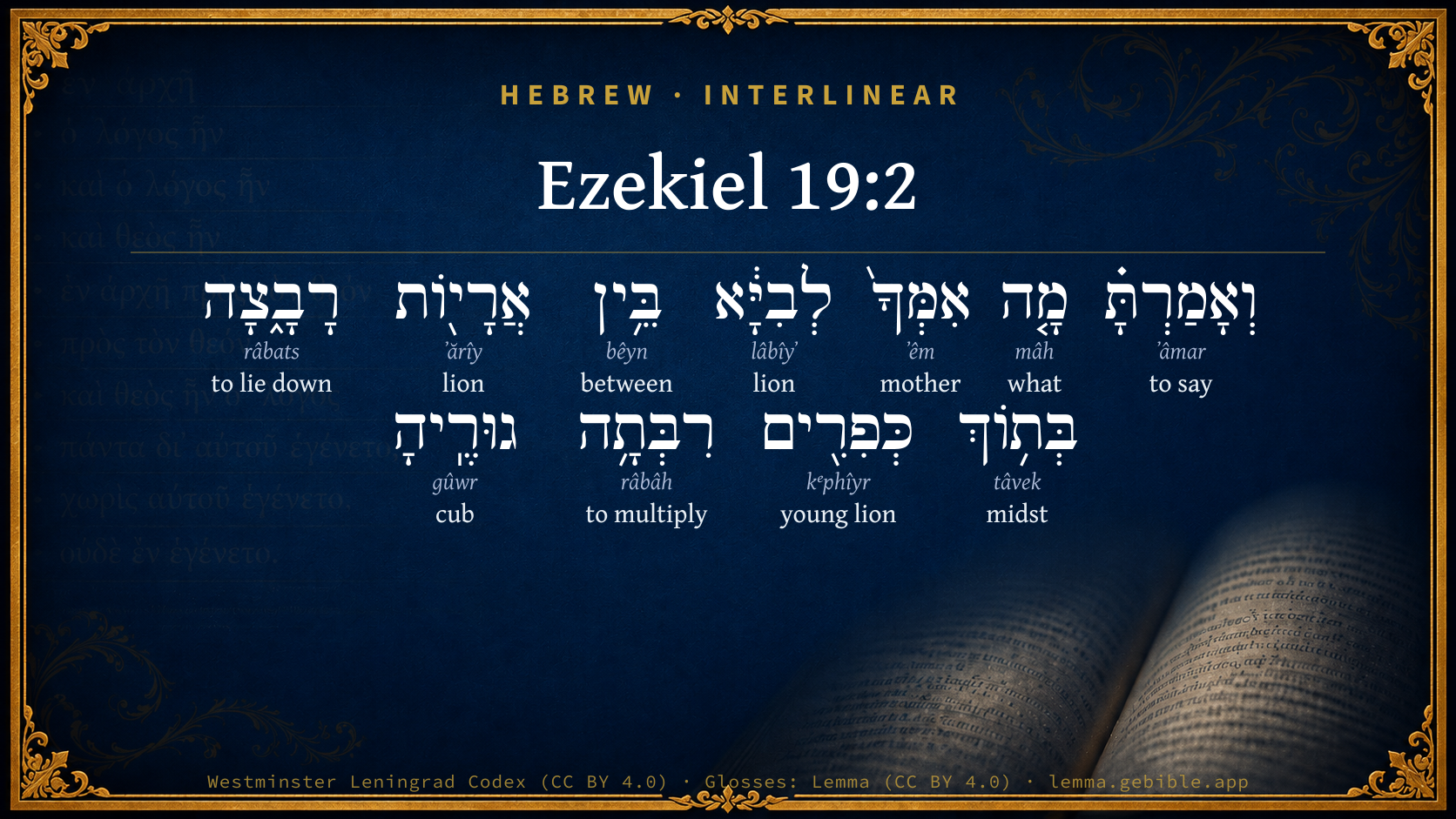
Ezekiel 19:2

Hebrew (Westminster Leningrad Codex) Ezekiel 19:2 appears in the Hebrew Old Testament. The text above is from the Westminster Leningrad Codex. Each word links to its Strong’s number, a concise gloss, and parsing drawn from the Open Scriptures Hebrew Bible morphology. Click any word for its full Brown-Driver-Briggs (BDB) entry.
Download image
Cite this verse

Ezekiel 19:2 (World English Bible). Public Domain. Lemma interlinear Bible study tool, https://lemma.gebible.app/v/ezekiel/19/2.

Show BibTeX & RIS
BibTeX
RIS
English Translation
and say, What was your mother? A lioness: she couched among lions, in the midst of the young lions she nourished her cubs.
World English Bible · Public Domain
Download a study sheet

One document with this verse’s original text, its word-by-word gloss line, the meaning frame, cross-references with their text, attributed commentary, and full source and license credits — printable, and it pastes into notes with its structure intact.

This verse Autodidact and up

Study sheet (.html) Plain text (.txt)

A passage Seminary Student

Up to 50 verses in one chapter. A passage sheet keeps up to 6 commentary sources and 12 cross-references per verse, in the order this page ranks them, and says so on the sheet whenever that leaves anything out. Ask for a single verse and you get the Autodidact verse sheet above.

Everything on this page stays free to read, with no account — the sheet is a download of what is already on screen, not access to it.

Want to remove ads? Support Godless Engineer
Compare translations 3

The same verse in 3 English versions, stacked beneath the original-language interlinear above. Click any original word for its lexicon entry.

Each is an independent rendering of the whole verse — the interlinear is not word-aligned to these translations.

Highlighted words mark where these versions differ — a whole-verse word diff, not a word-by-word alignment.

  • World English Bible Public Domain
    and say, What was your mother? A lioness: she couched among lions, in the midst of the young lions she nourished her cubs.
  • King James Version Public Domain
    And say, What is thy mother? A lioness: she lay down among lions, she nourished her whelps among young lions.
  • unfoldingWord Literal Text CC BY-SA 4.0
    and say, ‘Who was your mother? A lioness, she lived with a lion’s son; in the midst of young lions, she nurtured her cubs.

unfoldingWord Literal Text — © unfoldingWord, licensed CC BY-SA 4.0. Word-aligned USFM3 via Door43 (git.door43.org/unfoldingWord/en_ult).

Versions to compare (up to 4)

3 of 4 selected

Show all 18 translations

Every available English version of this verse, each an independent rendering of the whole verse.

  • World English Bible Public Domain
    and say, What was your mother? A lioness: she couched among lions, in the midst of the young lions she nourished her cubs.
  • Berean Standard Bible Public Domain
    and say: ‘What was your mother? A lioness among the lions! She lay down among the young lions; she reared her cubs.
  • Majority Standard Bible Public Domain
    and say: ‘What was your mother? A lioness among the lions! She lay down among the young lions; she reared her cubs.
  • King James Version Public Domain
    And say, What is thy mother? A lioness: she lay down among lions, she nourished her whelps among young lions.
  • American Standard Version (1901) Public Domain
    and say, What was thy mother? A lioness: she couched among lions, in the midst of the young lions she nourished her whelps.
  • Revised Version (1885) Public Domain
    and say, What was thy mother? A lioness: she couched among lions, in the midst of the young lions she nourished her whelps.
  • Geneva Bible (1599) Public Domain
    And say, Wherefore lay thy mother as a lyonesse among the lyons? she nourished her yong ones among the lyons whelps,
  • Douay-Rheims (1899) Public Domain
    And say: Why did thy mother the lioness lie down among the lions, and bring up her whelps in the midst of young lions?
  • Young's Literal Translation Public Domain
    and thou hast said: What `is' thy mother? -- a lioness, Among lions she hath crouched down, In the midst of young lions she hath multiplied her whelps.
  • Literal Standard Version CC BY-SA 4.0
    and you have said: What [is] your mother? A lioness, || She has crouched down among lions, || She has multiplied her whelps in the midst of young lions.
  • Unlocked Literal Bible CC BY-SA 4.0
    and say, 'Who was your mother? A lioness, she lived with a lion's son; in the midst of young lions, she nurtured her cubs.
  • unfoldingWord Literal Text CC BY-SA 4.0
    and say, ‘Who was your mother? A lioness, she lived with a lion’s son; in the midst of young lions, she nurtured her cubs.
  • Darby Bible Public Domain
    and say, What was thy mother? A lioness: she lay down among lions, she nourished her whelps in the midst of the young lions.
  • World Messianic Bible Public Domain
    and say, ‘What was your mother? A lioness. She couched among lions, in the middle of the young lions she nourished her cubs.
  • Webster's Bible Public Domain
    And say, What is thy mother: A lioness: she lay down among lions, she nourished her whelps among young lions.
  • Free Bible Version CC BY-SA 4.0
    with these words: “What was your mother? She was a lioness among the lions! She lay down in her place among the young lions and reared her cubs.
  • Bible in Basic English Public Domain
    What was your mother? Like a she-lion among lions, stretched out among the young lions she gave food to her little ones.
  • JPS Tanakh (1917) Public Domain
    and say: How was thy mother a lioness; among lions she couched, in the midst of the young lions she reared her whelps!

Literal Standard Version (2020), Covenant Press — licensed CC BY-SA 4.0. Text via the HelloAO Bible API (eBible.org). Unlocked Literal Bible (unfoldingWord) — licensed CC BY-SA 4.0. Text via the HelloAO Bible API (eBible.org). unfoldingWord Literal Text — © unfoldingWord, licensed CC BY-SA 4.0. Word-aligned USFM3 via Door43 (git.door43.org/unfoldingWord/en_ult). Free Bible Version, Dr. Jonathan Gallagher — licensed CC BY-SA 4.0. Text via the HelloAO Bible API (eBible.org).

Word by word

More ways to search: Search by grammar → Find every occurrence → Compare this word →

Practice this passage: Drill this verse → Learn its vocabulary →

גוּרֶֽיהָ
gûwr
H1482
“cubs · her”
Noun, Common, Masculine, Plural, Construct + Suffix, Personal, 3rd Person, Feminine, Singular
Part of Speech
Noun
Type
Common
Gender
Masculine
Number
Plural
State
Construct
Full BDB Definition

Origin: perhaps from H1481

TWOT: 331b

cub, whelp, young
  1. וְאָמַרְתָּ֗ ʼâmar H559 “and · to say” Conjunction + Verb, Qal, Sequential Perfect, 2nd Person, Masculine, Singular
  2. מָ֤ה mâh H4100 “what” Particle, Interrogative
  3. אִמְּךָ֙ ʼêm H517 “mother · your” Noun, Common, Feminine, Singular, Construct + Suffix, Personal, 2nd Person, Masculine, Singular
  4. לְבִיָּ֔א lâbîyʼ H3833 “lion” Noun, Common, Feminine, Singular, Absolute
  5. בֵּ֥ין bêyn H996 “between” Preposition
  6. אֲרָי֖וֹת ʼărîy H738 “lions” Noun, Common, Masculine, Plural, Absolute
  7. רָבָ֑צָה râbats H7257 “to lie down” Verb, Qal, Perfect, 3rd Person, Feminine, Singular
  8. בְּת֥וֹךְ tâvek H8432 “in/at · midst of” Preposition + Noun, Common, Masculine, Singular, Construct
  9. כְּפִרִ֖ים kᵉphîyr H3715 “young lions” Noun, Common, Masculine, Plural, Absolute
  10. רִבְּתָ֥ה râbâh H7235 “to multiply” Verb, Piel, Perfect, 3rd Person, Feminine, Singular

About this verse

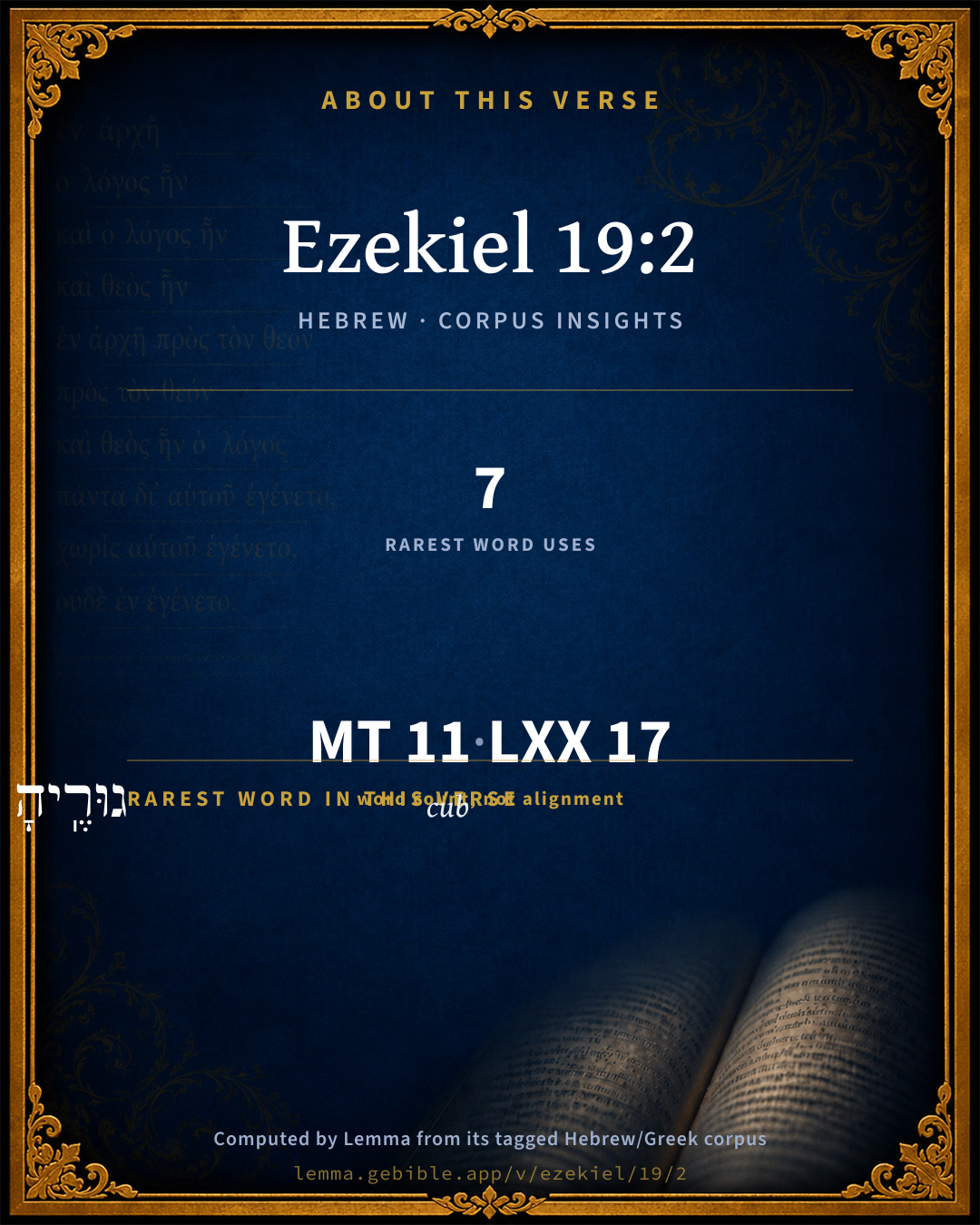
These counts appear in no published source. They are computed here, from the morphology-tagged text and Lemma’s own curated glosses. What Lemma adds →

11
words
11
distinct lemmas
Prophets
section

Notable vocabulary

The rarest word here is גוּרֶֽיהָ cub H1482 — appearing just 7 times in the whole Hebrew Bible.

Shared distinctive vocabulary

גוּרֶֽיהָ cub H1482 occurs in 7 verses of the Hebrew Bible. Also found in:

Grammatical profile

  • 3 verbs
  • 6 nouns
  • 1 preposition
  • 1 particle

Verb forms

  • וְאָמַרְתָּ֗ Qal · Sequential Perfect
  • רָבָ֑צָה Qal · Perfect
  • רִבְּתָ֥ה Piel · Perfect

Hebrew & Septuagint length

In English translation the verse runs 23 words from the Hebrew and 24 from the Septuagint (LXX English) — closely comparable.

A rough comparison of the two English renderings, which tokenize alike — not a word-level alignment.

Word counts can differ between the Hebrew and the Greek without any difference in meaning — e.g. the Hebrew direct-object marker אֵת has no separate Greek word, and Greek often adds the article ὁ.

In the original languages it is 11 Hebrew tokens and 17 Greek tokens — but the two are counted differently (Hebrew bundles its prefixes and suffixes into one token; the Greek is in lemma form), so that isn’t a like-for-like length.

Cross-references

7

Topical passages linked to Ezekiel 19:2 in the Treasury of Scripture Knowledge — connected by theme and wording, ordered by reader-vote popularity; previews shown in the World English Bible.

  • Job 4:11 The old lion perishes for lack of prey, The cubs of the lioness are scattered abroad.
  • Psalms 58:6 Break their teeth, God, in their mouth. Break out the great teeth of the young lions, Yahweh.
  • Isaiah 5:29 Their roaring will be like a lioness. They will roar like young lions. Yes, they shall roar, And seize their prey and carry it off, And there will be no one to deliver.
  • Isaiah 11:6–9 The wolf shall dwell with the lamb, and the leopard shall lie down with the kid; and the calf and the young lion and the fattened calf together; and a little child shall lead them.
  • Nahum 2:11–12 Where is the den of the lions, and the feeding-place of the young lions, where the lion and the lioness walked, the lion's cubs, and no one made them afraid?
  • Zephaniah 3:1–4 Woe to her who is rebellious and polluted, the oppressing city!
  • Zechariah 11:3 A voice of the wailing of the shepherds! For their glory is destroyed: a voice of the roaring of young lions! For the pride of the Jordan is ruined.

Cross-references courtesy of OpenBible.info (CC BY 4.0).

Hebrew and Greek witnesses Masoretic Hebrew ↔ Greek Septuagint

The same verse in the two great witnesses to the Old Testament, shown verse-for-verse.

These are two independent witnesses, not word-aligned to each other, and the Septuagint is shown in lemma (dictionary) form.

Hebrew Ezekiel 19:2 Masoretic · Westminster Leningrad Codex

וְאָמַרְתָּ֗ מָ֤ה אִמְּךָ֙ לְבִיָּ֔א בֵּ֥ין אֲרָי֖וֹת רָבָ֑צָה בְּת֥וֹךְ כְּפִרִ֖ים רִבְּתָ֥ה גוּרֶֽיהָ

and say, What was your mother? A lioness: she couched among lions, in the midst of the young lions she nourished her cubs.

World English Bible · Public Domain

Greek LXX Ezekiel 19:2 Septuagint · lemma form

καί εἶπον τίς ὁ μήτηρ σύ σκύμνος ἐν μέσος λέων γίγνομαι ἐν μέσος λέων πληθύνω σκύμνος αὐτός

and say, Why is your mother become a whelp in the midst of lions? in the midst of lions she has multiplied her whelps.

LXX2012 (modern English Septuagint) · Public Domain

On this verse, The Pulpit Commentary discusses the Septuagint’s reading. Read the note in Commentary ↓

Hebrew: Westminster Leningrad Codex (CC BY 4.0). Greek: Septuagint (public domain); English from LXX2012 (modern English Septuagint) (Public Domain). How the Septuagint differs from the Hebrew →

Targum (Aramaic paraphrase)

1

The Targum is the ancient Jewish Aramaic paraphrase of the Hebrew Scriptures — an interpretive translation, not the Hebrew text itself. Onkelos (literal) and Pseudo-Jonathan (expansive) render the Torah, and Jonathan the Prophets. Coverage is partial: where no permissively-licensed English translation exists for a verse, only the Aramaic is shown. This is verse-level text, not a word-by-word alignment to the Hebrew.

  1. Targum Jonathan Prophets (Joshua–Malachi)
    וְתֵימַר מַה כְּנִשְׁתָּא דְיִשְׂרָאֵל דַהֲוַת דַמְיָא לְלַיְתָא בֵּינֵי מַלְכַיָא רַבָּא בֵּינֵי שִׁלְטוֹנַיָא רַבִּיאַת בְּנָהָא:

    (no public-domain English translation for this verse)

    Targum Jonathan — Aramaic: “Mikraot Gedolot” (public domain). English: “Sefaria Community Translation” (CC0 1.0 (public-domain dedication)); “London "Chaldee Paraphrase," 1871” (public domain). Text via Sefaria.

Commentary

Notes on Ezekiel 19:2 from classic Christian and Jewish commentators (each source and its license shown beneath its notes). The classic Christian expositions comment on the surrounding passage and are grouped to its opening verse, so a note may address several verses; the Jewish commentaries on the Tanakh (Rashi and others) are per-verse, so they appear only where the commentator wrote on this verse.

Lemma curates 59 commentaries, every one of them public domain or Creative Commons licensed, each selected and text-cleaned for this edition rather than reprinted as found. About our sources →

Trapp's Complete Commentary

John Trapp

Eze 19:2 And say, What [is] thy mother? A lioness: she lay down among lions, she nourished her whelps among young lions.

Ver. 2. What is thy mother?] Whereby is meant thy city of Jerusalem and people of the Jews, who took these four for their kings, and soon had enough of them.

A lioness.] So called for her nobleness, courage, and cruelty.

She lay down among lions.] Alludit ad coitum It signifieth that this state, by conversing with other heathen princes, had been corrupted by them and conformed unto them.

She nourished her whelps among young lions.] From whom they took in but few good principles for young princes. Wickedness is soon learned Of a certain prince of Germany it was said, Esset alius si esset apud alios, his company undid him: So it did Julian the apostate.

John Trapp, A Commentary or Exposition upon All the Books of the Old and New Testament (1647–1656) — public domain. Text from a community e-Sword module.

Tyndale Open Study Notes

Tyndale Open Resources

19:2-4 The first picture is of a lioness and one of her cubs, whom she chose as the leader of her pack. This cub represented Jehoahaz, who reigned for a mere three months before being carried to Egypt by Pharaoh Neco (2 Kgs 23:33-34). • hunt . . . devour prey . . . man-eater: The prophet characterizes Jehoahaz’s brief reign in entirely negative terms. • Lions were traditionally hunted with a net and a pit, here a metaphor for the violent way that Jehoahaz would be carried away to Egypt.

Tyndale Open Study Notes — © Tyndale Open Resources, licensed CC BY-SA 4.0. Text via the HelloAO Bible API.

Geneva Bible (1599)

Geneva Bible translators

To wit, Jehoahaz’s mother, or Jerusalem.

Geneva Bible (1599) marginal notes — public domain. Text via Bolls.life.

Jamieson, Fausset & Brown

Robert Jamieson, A. R. Fausset & David Brown

thy mother--the mother of Jehoiachin, the representative of David's line in exile with Ezekiel. The "mother" is Judea: "a lioness," as being fierce in catching prey (Eze 19:3), referring to her heathenish practices. Jerusalem was called Ariel (the lion of God) in a good sense (Isa 29:1); and Judah "a lion's whelp . . . a lion . . . an old lion" (Gen 49:9), to which, as also to Num 23:24; Num 24:9, this passage alludes.

nourished . . . among young lions--She herself had "lain" among lions, that is, had intercourse with the corruptions of the surrounding heathen and had brought up the royal young ones similarly: utterly degenerate from the stock of Abraham.

Lay down--or "couched," is appropriate to the lion, the Arab name of which means "the coucher."

Jamieson, Fausset & Brown — Commentary Critical and Explanatory on the Whole Bible (1871) — public domain (CC PDM 1.0). Text via the HelloAO Bible API.

Adam Clarke's Commentary

Verse 2. What is thy mother? A lioness] Judea may here be the mother; the lioness, Jerusalem. Her lying down among lions, her having confederacy with the neighbouring kings; for lion here means king.

Adam Clarke's Commentary on the Bible (1810–1826) — public domain. Text from a community e-Sword/MySword module.

John Calvin's Commentaries

He says next, that their mother lay down among lions, alluding to the people’s origin from lions, as we said before, when the Prophet calls Judea the descendant of Canaan, and the sister of Sodom and Samaria. When he now says, their mother lay down among lions, he means that they were shamefully mixed with the corruption of the Gentiles, so that they did not differ from them. But God had chosen them as his peculiar people on the very condition of being separate from all the filth of the Gentiles. There was, therefore, a certain withdrawing of God’s favor when the mother of the people lay down among the lions, that is, when they all promiscuously gave themselves up to the perverse morals and superstitions of the Gentiles. He says, that she brought up whelps, or young lions, which she produced to these lions; since their origin was impure, being all Abraham’s children, but, as I have said, a degenerate race. He afterwards adds, that the lion’s whelp, or young lion, grew up till it became a lion: then it learnt to seize prey, says he, and to devour men. He refers to King Jehoahaz, son of Josiah, (2 Kings 23:30-32:) but he had before asserted that the whole people had a lion’s disposition, and that the princes, who were more exalted, were like whelps. As only one lion is here brought forward, it ought to be referred to the violence by which that wicked king manifested his real disposition. But if it be asked whence the lion went forth, the reply is, from amidst his brethren, for they were all lions’ whelps, or young lions. They could not administer the government either together or singly, but each devoured his brother, and was devoted to robbery and rapine. The king only, because freed from all fear, could surpass the rest in rapine and robbery with impunity. We see, then, that not only the king was here condemned, but that he becomes the type of the whole nation; because, since no one could restrain his passions, he could rob and devour mankind with unbridled freedom.

John Calvin's Commentaries (1540-1563) — public domain. Text from the Calvin Translation Society English edition (1840s-50s) via the Christian Classics Ethereal Library (ccel.org). Calvin's coverage is partial (roughly two-thirds of the Bible); uncommented books and verses are honest gaps, never fabricated. The 19th-century editor's footnotes and remarks are omitted so the notes are faithfully Calvin's own voice.

Ellicott's Commentary for English Readers

(2) Thy mother.—Mother stands for the whole national community—the theocracy, as is plain from Eze_19:10. This was represented, since the captivity of the ten tribes, by Judah; and her “princes,” of the line of David, were the legitimate kings of the whole nation. The figure of the lion is a common one in Scripture (see Gen_49:9; Num_23:24; Num_24:9), and was also familiar in Babylonia.

A Bible Commentary for English Readers, edited by Charles John Ellicott (1878–1897) — public domain. Text from a community e-Sword module.

John Gill's Exposition

And say, what is thy mother?.... That is, say so to the then reigning prince, Zedekiah, what is thy mother like? to what is she to be compared? by whom is meant, not the royal family of David only, or Jerusalem the metropolis of the nation, but the whole body of the people; and so the Targum interprets it of the congregation of Israel. The answer to the question is,

a lioness; she is like to one, not for her strength and glory, but for her cruelty and rapine; for her want of humanity, mercy, and justice:

she lay down among lions; that is, kings, as the Targum interprets it Heathen princes, the kings of the nations about them, as of Egypt and Babylon, Jer 50:17; so called for their despotic and arbitrary power, tyranny, and cruelty: now this lioness, the people of the Jews, lay down among them, joined with them in leagues and marriages, and learned their manners, and became of the same temper and disposition:

she nourisheth her whelps among young lions; princes, as the Targum explains it; either the princes of Judah, who were become like young lions, fierce and cruel; or the princes of other nations, among whom the children of the royal family were brought up; or, however, they were trained up in the principles of such, even of arbitrary and despotic power, and were taught to oppress their subjects, and not execute justice and mercy among them.

John Gill's Exposition of the Whole Bible (1746–1763) — public domain (CC PDM 1.0). Text via the HelloAO Bible API.

Albert Barnes' Notes on the Bible

Thy mother - The people represented by Judah. Compare Gen 49:9; Num 23:24.

Albert Barnes' Notes on the Bible (1834–1885) — public domain. Text from a community e-Sword/MySword module.

Haydock's Catholic Bible Commentary

Lioness; Jerusalem (Challoner) which made alliances with the lions, or nations. (Calmet)

George Leo Haydock (1774–1849), Haydock's Catholic Family Bible and Commentary, 1859 edition — public domain. Excludes Psalms (Douay-Rheims chapter numbering differs from Protestant) and Deuterocanonical books (Catholic canon only).

Matthew Poole's English Annotations

What resemblance shall I use to set out the nature, deportment, and state of the mother of these princes? an unhappy mother of unhappy children! Or, Alas! thy mother, &c.

Thy; one of these was upon the throne at once, and therefore the prophet speaks to one at a time, in the singular number. Mother; the land of Judea and Jerusalem, the chief city of it, the royal family of David.

A lioness; though chosen of God to execute justice, defend the poor, to be his vicegerents, and to delight in mercy; yet once advanced, they soon degenerated into the fierce and ravening nature of the lioness, and as violently seized the prey.

She lay down; associated, couched, and grew familiar with, by leagues, commerce, and intermixture of marriages with neighbour kings, called here lions: thou didst learn their manners, and grewest fierce and bloody, as they.

She nourished: the Hebrew includes both her bringing forth many, and her advancing them to greatness: the royal family of flat nation had many kings, and some very great, but the time the prophet points now at in particular was after Josiah, whose character, given Jer 22:16, is, that he judged the poor and needy, but his successors were of another temper, as Jer 22:13-15,17.

Her whelps, i.e. her sons, successors to the crown, which could be called nothing else, to keep the decorum of the parable.

Among young lions; either foreign princes and kings, or else some of the fiercer, unjuster, aspiring, and tyrannizing princes at home; for such there were in these, as well as in Rehoboam’s times, who would have the son’s finger thicker than the father’s loins.

Matthew Poole's English Annotations on the Holy Bible (1683–1685) — public domain. Text from a community e-Sword/MySword module.

The Pulpit Commentary

What is thy mother? etc.; better, with the Vulgate, LXX, and Keil, Why did thy mother, a lioness, lie down among lionesses? The image may have been suggested by Gen_49:9 and Num_23:24, or perhaps also by Nah_2:11, Nah_2:12. The lioness is Israel, the kingdom idealized and personified. The lionesses among whom she had lain down are the heathen kingdoms. The question asks why she had become as one of them and adopted their cruelty and ferocity.

The Pulpit Commentary (1880–1919), ed. H.D.M. Spence-Jones & Joseph S. Exell — public domain. Text from a community e-Sword module.

John Wesley's Explanatory Notes

What - What resemblance shall I use to set out the nature, deportment, and state of the mother of these princes? Thy - One of whom was upon the throne at once, and therefore the prophet speaks to one at a time. Mother - The land of Judea, and Jerusalem, the chief city of it, the royal family of David. Lioness - Tho' chosen of God to execute justice; yet they soon degenerated into the fierce and ravening nature of the lioness. Lay down - Associated, and grew familiar with neighbour kings, called here lions; fierce and bloody. Her whelps - Her sons, successors to the crown. Young lions - Either foreign princes and kings, or some of the fierce, unjust, tyrannizing princes at home.

John Wesley, Explanatory Notes Upon the Whole Bible (1754–1765) — public domain. Text via the GEBible commentary corpus.

Rashi

Rabbi Shlomo Yitzchaki (Rashi)

How was your mother a lioness! How esteemed was your mother you, Zedekiah—that she was compared to a lioness!

Among the lions The princes of Judah.

Rashi on the Tanakh — English translations: “The Judaica Press complete Tanach with Rashi, translated by A. J. Rosenberg” (CC BY 4.0); “Pentateuch with Rashi's commentary by M. Rosenbaum and A.M. Silbermann, 1929-1934” (public domain); “The Metsudah Tanach series, Lakewood, N.J” (CC BY 4.0); and “The Book of Joshua, Metsudah Publications, 1997” (CC BY 4.0). Text via Sefaria.

Lesson kit

Teaching starters — assembled from the data on this page, not authored interpretation. Every prompt links to the verse data it draws on. Edit before teaching.

Ezekiel, in the Prophets, opens this verse with 11 words (11 distinct Hebrew lemmas). Its most distinctive word is gûwr (“cub”). A historical commentator’s framing appears above. Read the whole chapter for the surrounding context.

Discussion questions

  1. What does “cub” (gûwr) contribute to the verse as a whole?
  2. How does Genesis 49:9, which shares the word «cub», read alongside this verse?
  3. The translations on this page render this verse differently — a whole-verse word diff, not a word-by-word alignment. What might account for the different wordings?
  4. «וְאָמַרְתָּ֗» is a Qal Sequential Perfect verb. How does that grammatical form shape the action described?
  5. Compare how Trapp's Complete Commentary and Tyndale Open Study Notes read this verse. Where do they agree or differ?

Things to notice

Reading settings

Reading text

Shown beneath each verse's original-language words.

Old Testament
Old Testament edition

Read the OT as the Masoretic Hebrew (MT) or the Greek Septuagint (LXX).

English shown for the Greek Septuagint (in the Hebrew ↔ Greek comparison).

Comparing translations? Open the Compare panel on any verse page to stack up to four side by side.