Proverbs 25:8

Hebrew (Westminster Leningrad Codex) Proverbs 25:8 appears in the Hebrew Old Testament. The text above is from the Westminster Leningrad Codex. Each word links to its Strong’s number, a concise gloss, and parsing drawn from the Open Scriptures Hebrew Bible morphology. Click any word for its full Brown-Driver-Briggs (BDB) entry.
Download image
Cite this verse

Proverbs 25:8 (World English Bible). Public Domain. Lemma interlinear Bible study tool, https://lemma.gebible.app/v/proverbs/25/8.

Show BibTeX & RIS
BibTeX
RIS
English Translation
Don't be hasty in bringing charges to court. What will you do in the end when your neighbor shames you?
World English Bible · Public Domain
Download a study sheet

One document with this verse’s original text, its word-by-word gloss line, the meaning frame, cross-references with their text, attributed commentary, and full source and license credits — printable, and it pastes into notes with its structure intact.

This verse Autodidact and up

Study sheet (.html) Plain text (.txt)

A passage Seminary Student

Up to 50 verses in one chapter. A passage sheet keeps up to 6 commentary sources and 12 cross-references per verse, in the order this page ranks them, and says so on the sheet whenever that leaves anything out. Ask for a single verse and you get the Autodidact verse sheet above.

Everything on this page stays free to read, with no account — the sheet is a download of what is already on screen, not access to it.

Want to remove ads? Support Godless Engineer
Compare translations 3

The same verse in 3 English versions, stacked beneath the original-language interlinear above. Click any original word for its lexicon entry.

Each is an independent rendering of the whole verse — the interlinear is not word-aligned to these translations.

Highlighted words mark where these versions differ — a whole-verse word diff, not a word-by-word alignment.

  • World English Bible Public Domain
    Don't be hasty in bringing charges to court. What will you do in the end when your neighbor shames you?
  • King James Version Public Domain
    Go not forth hastily to strive, lest thou know not what to do in the end thereof, when thy neighbour hath put thee to shame.
  • unfoldingWord Literal Text CC BY-SA 4.0
    Do not go out hastily to dispute, or else what will you do in its end when your neighbor humiliates you?

unfoldingWord Literal Text — © unfoldingWord, licensed CC BY-SA 4.0. Word-aligned USFM3 via Door43 (git.door43.org/unfoldingWord/en_ult).

Versions to compare (up to 4)

3 of 4 selected

Show all 18 translations

Every available English version of this verse, each an independent rendering of the whole verse.

  • World English Bible Public Domain
    Don't be hasty in bringing charges to court. What will you do in the end when your neighbor shames you?
  • Berean Standard Bible Public Domain
    do not bring hastily to court. Otherwise, what will you do in the end when your neighbor puts you to shame?
  • Majority Standard Bible Public Domain
    do not bring hastily to court. Otherwise, what will you do in the end when your neighbor puts you to shame?
  • King James Version Public Domain
    Go not forth hastily to strive, lest thou know not what to do in the end thereof, when thy neighbour hath put thee to shame.
  • American Standard Version (1901) Public Domain
    Go not forth hastily to strive, Lest `thou know not' what to do in the end thereof, When thy neighbor hath put thee to shame.
  • Revised Version (1885) Public Domain
    Go not forth hastily to strive, lest thou know not what to do in the end thereof, when thy neighbour hath put thee to shame.
  • Geneva Bible (1599) Public Domain
    Goe not foorth hastily to strife, least thou know not what to doe in the ende thereof, when thy neighbour hath put thee to shame.
  • Douay-Rheims (1899) Public Domain
    The things which thy eyes have seen, utter not hastily in a quarrel: lest after- ward thou mayst not be able to make amends, when thou hast dishonoured thy friend.
  • Young's Literal Translation Public Domain
    Go not forth to strive, haste, turn, What dost thou in its latter end, When thy neighbour causeth thee to blush?
  • Literal Standard Version CC BY-SA 4.0
    Do not go forth to strive, hurry, turn, || What do you do in its latter end, || When your neighbor causes you to blush?
  • Unlocked Literal Bible CC BY-SA 4.0
    do not bring quickly to trial. For what will you do in the end when your neighbor puts you to shame?
  • unfoldingWord Literal Text CC BY-SA 4.0
    Do not go out hastily to dispute, or else what will you do in its end when your neighbor humiliates you?
  • Darby Bible Public Domain
    Go not forth hastily to strive, lest [thou know not] what to do in the end thereof, when thy neighbour hath put thee to shame.
  • World Messianic Bible Public Domain
    Don’t be hasty in bringing charges to court. What will you do in the end when your neighbor shames you?
  • Webster's Bible Public Domain
    Go not forth hastily to strive, lest thou know not what to do in the end thereof, when thy neighbor hath put thee to shame.
  • Free Bible Version CC BY-SA 4.0
    don't rush to take legal action, for what are you going to do in the end when your neighbor shows you're wrong and humiliates you?
  • Bible in Basic English Public Domain
    Do not be quick to go to law about what you have seen, for what will you do in the end, when your neighbour has put you to shame?
  • JPS Tanakh (1917) Public Domain
    Go not forth hastily to strive, lest thou know not what to do in the end thereof, when thy neighbour hath put thee to shame.

Literal Standard Version (2020), Covenant Press — licensed CC BY-SA 4.0. Text via the HelloAO Bible API (eBible.org). Unlocked Literal Bible (unfoldingWord) — licensed CC BY-SA 4.0. Text via the HelloAO Bible API (eBible.org). unfoldingWord Literal Text — © unfoldingWord, licensed CC BY-SA 4.0. Word-aligned USFM3 via Door43 (git.door43.org/unfoldingWord/en_ult). Free Bible Version, Dr. Jonathan Gallagher — licensed CC BY-SA 4.0. Text via the HelloAO Bible API (eBible.org).

Word by word

More ways to search: Search by grammar → Find every occurrence → Compare this word →

Practice this passage: Drill this verse → Learn its vocabulary →

מַ֫הֵ֥ר
mahêr
H4118
“swift”
Verb, Piel, Infinitive Absolute
Part of Speech
Verb
Stem
Piel
Form
Infinitive Absolute
Full BDB Definition

Origin: from H4116

TWOT: 1152a , 1152b

hurrying, speedy, swift, hastening (adjective) - quickly, speedily (adverb)
  1. אַל ʼal H408 “not” Particle, Negative
  2. תֵּצֵ֥א yâtsâʼ H3318 “to go out” Verb, Qal, Jussive, 2nd Person, Masculine, Singular
  3. לָרִ֗ב rîyb H7378 “to contend” Preposition + Verb, Qal, Infinitive Construct
  4. פֶּ֣ן pên H6435 “lest” Conjunction
  5. מַה mâh H4100 “what” Particle, Interrogative
  6. תַּ֭עֲשֶׂה ʻâsâh H6213 “to do” Verb, Qal, Imperfect, 2nd Person, Masculine, Singular
  7. בְּאַחֲרִיתָ֑הּ ʼachărîyth H319 “in/at · latter end · her” Preposition + Noun, Common, Feminine, Singular, Construct + Suffix, Personal, 3rd Person, Feminine, Singular
  8. בְּהַכְלִ֖ים kâlam H3637 “in/at · to shame” Preposition + Verb, Hiphil, Infinitive Construct
  9. אֹתְךָ֣ ʼêth H853 “- · you” Particle, Direct Object + Suffix, Personal, 2nd Person, Masculine, Singular
  10. רֵעֶֽךָ rêaʻ H7453 “friend · your” Noun, Common, Masculine, Singular, Construct + Suffix, Personal, 2nd Person, Masculine, Singular

About this verse

These counts appear in no published source. They are computed here, from the morphology-tagged text and Lemma’s own curated glosses. What Lemma adds →

11
words
11
distinct lemmas
Wisdom
section

Notable vocabulary

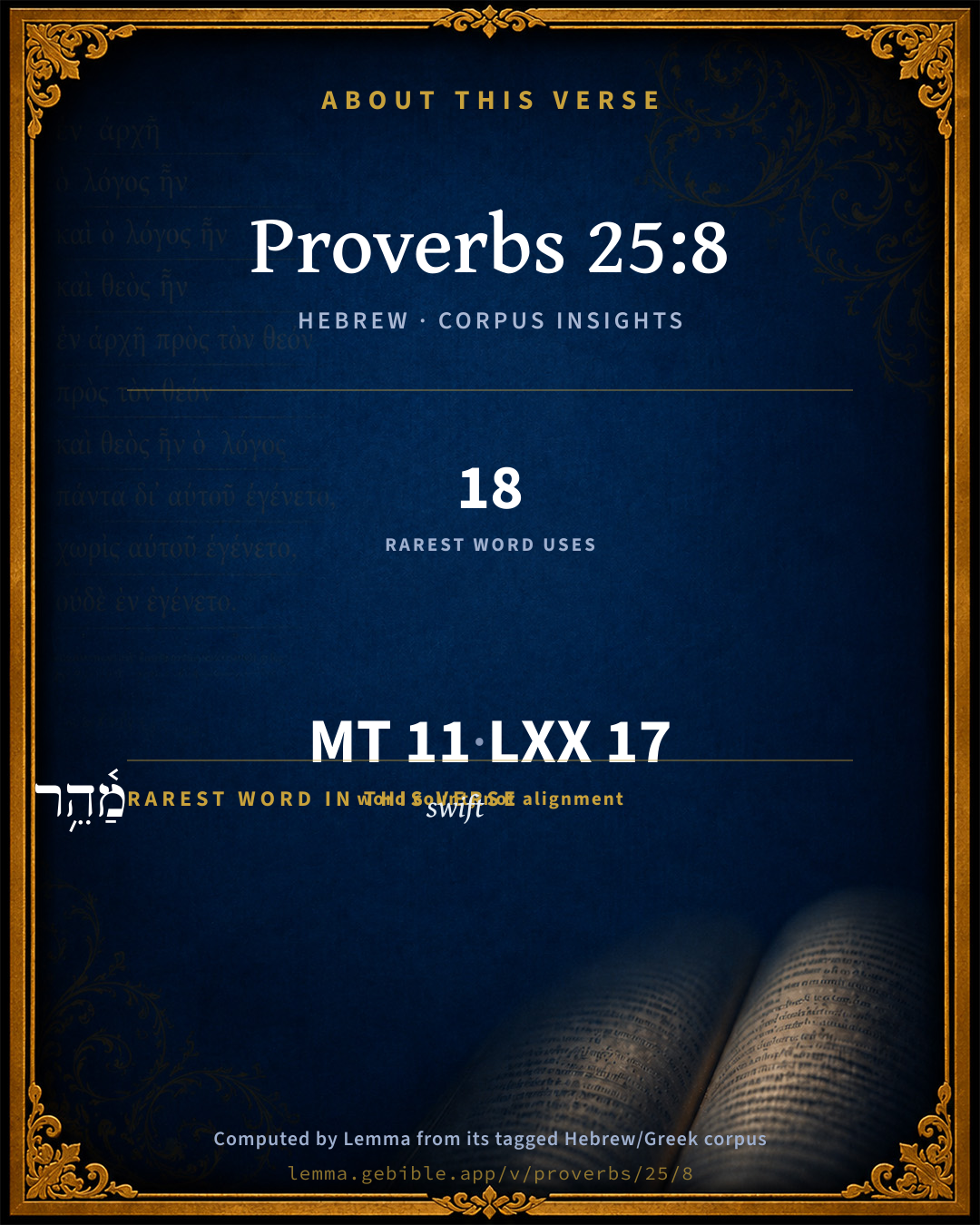
The rarest word here is מַ֫הֵ֥ר swift H4118 — appearing just 18 times in the whole Hebrew Bible.

Shared distinctive vocabulary

מַ֫הֵ֥ר swift H4118 occurs in 17 verses of the Hebrew Bible. Also found in:

Grammatical profile

  • 5 verbs
  • 2 nouns
  • 1 conjunction
  • 3 particles

Verb forms

  • תֵּצֵ֥א Qal · Jussive
  • לָרִ֗ב Qal · Infinitive Construct
  • מַ֫הֵ֥ר Piel · Infinitive Absolute
  • תַּ֭עֲשֶׂה Qal · Imperfect
  • בְּהַכְלִ֖ים Hiphil · Infinitive Construct

Hebrew & Septuagint length

In English translation the verse runs 20 words from the Hebrew and 11 from the Septuagint (LXX English) — the Septuagint runs noticeably shorter here. See the side-by-side →

A rough comparison of the two English renderings, which tokenize alike — not a word-level alignment.

Word counts can differ between the Hebrew and the Greek without any difference in meaning — e.g. the Hebrew direct-object marker אֵת has no separate Greek word, and Greek often adds the article ὁ.

In the original languages it is 11 Hebrew tokens and 17 Greek tokens — but the two are counted differently (Hebrew bundles its prefixes and suffixes into one token; the Greek is in lemma form), so that isn’t a like-for-like length.

Cross-references

10

Topical passages linked to Proverbs 25:8 in the Treasury of Scripture Knowledge — connected by theme and wording, ordered by reader-vote popularity; previews shown in the World English Bible.

  • Matthew 5:25 Agree with your adversary quickly, while you are with him in the way; lest perhaps the prosecutor deliver you to the judge, and the judge deliver you to the officer, and you be cast into prison.
  • Proverbs 17:14 The beginning of strife is like breaching a dam, Therefore stop contention before quarreling breaks out.
  • Proverbs 18:6 A fool's lips come into strife, And his mouth invites beatings.
  • Proverbs 14:12 There is a way which seems right to a man, But in the end it leads to death.
  • Proverbs 30:33 For as the churning of milk brings forth butter, And the wringing of the nose brings forth blood; So the forcing of wrath brings forth strife."
  • 2 Samuel 2:26 Then Abner called to Joab, and said, "Shall the sword devour forever? Don't you know that it will be bitterness in the latter end? How long shall it be then, before you bid the people return from following their brothers?"
  • Jeremiah 5:31 the prophets prophesy falsely, and the priests bear rule by their means; and my people love to have it so: and what will you do in the end of it?
  • Luke 14:31–32 Or what king, as he goes to encounter another king in war, will not sit down first and consider whether he is able with ten thousand to meet him who comes against him with twenty thousand?
  • 2 Samuel 2:14–16 Abner said to Joab, Please let the young men arise and play before us. Joab said, Let them arise.
  • 2 Kings 14:8–12 Then Amaziah sent messengers to Jehoash, the son of Jehoahaz son of Jehu, king of Israel, saying, Come, let us look one another in the face.

Cross-references courtesy of OpenBible.info (CC BY 4.0).

Hebrew and Greek witnesses Masoretic Hebrew ↔ Greek Septuagint

The same verse in the two great witnesses to the Old Testament, shown verse-for-verse.

Here the Septuagint runs noticeably shorter than the Hebrew — LXX2012 (modern English Septuagint) 11 words vs World English Bible 20. A rough length comparison of the two English translations, not a word-level alignment — read both below.

These are two independent witnesses, not word-aligned to each other, and the Septuagint is shown in lemma (dictionary) form.

Hebrew Proverbs 25:8 Masoretic · Westminster Leningrad Codex

אַל תֵּצֵ֥א לָרִ֗ב מַ֫הֵ֥ר פֶּ֣ן מַה תַּ֭עֲשֶׂה בְּאַחֲרִיתָ֑הּ בְּהַכְלִ֖ים אֹתְךָ֣ רֵעֶֽךָ

Don't be hasty in bringing charges to court. What will you do in the end when your neighbor shames you?

World English Bible · Public Domain

Greek LXX Proverbs 25:8 Septuagint · lemma form

μή προςπίπτω εἰς μάχη ταχέως ἵνα μή μεταμελέω ἐπί ἔσχατος ἡνίκα ἄν σύ ὀνειδίζω ὁ σός φίλος

Get not suddenly into a quarrel, lest you repent at last.

LXX2012 (modern English Septuagint) · Public Domain

On this verse, Haydock's Catholic Bible Commentary discusses the Septuagint’s reading. Read the note in Commentary ↓

Hebrew: Westminster Leningrad Codex (CC BY 4.0). Greek: Septuagint (public domain); English from LXX2012 (modern English Septuagint) (Public Domain). How the Septuagint differs from the Hebrew →

Commentary

Notes on Proverbs 25:8 from classic Christian and Jewish commentators (each source and its license shown beneath its notes). The classic Christian expositions comment on the surrounding passage and are grouped to its opening verse, so a note may address several verses; the Jewish commentaries on the Tanakh (Rashi and others) are per-verse, so they appear only where the commentator wrote on this verse.

Lemma curates 59 commentaries, every one of them public domain or Creative Commons licensed, each selected and text-cleaned for this edition rather than reprinted as found. About our sources →

Matthew Henry's Commentary

I. Here is good counsel given about going to law: - 1. "Be not hasty in bringing an action, before thou hast thyself considered it, and consulted with thy friends about it: Go not forth hastily to strive; do not send for a writ in a passion, or upon the first appearance of right on thy side, but weigh the matter deliberately, because we are apt to be partial in our own cause; consider the certainty of the expenses and the uncertainty of the success, how much care and vexation it will be the occasion of, and, after all, the cause may go against thee; surely then thou shouldst not go forth hastily to strive." 2. "Bring not an action before thou hast tried to end the matter amicably (Pro 25:9): Debate thy cause with thy neighbour privately, and perhaps you will understand one another better and see that there is no occasion to go to law." In public quarrels the war that must at length end might better have been prevented by a treaty of peace, and a great deal of blood and treasure spared. It is so in private quarrels: "Sue not thy neighbour as a heathen man and a publican until thou hast told him his fault between thee and him alone, and he has refused to refer the matter, or to come to an accommodation. Perhaps the matter in variance is a secret, not fit to be divulged to any, much less to be brought upon the stage before the country; and therefore end it privately, that it may not be discovered." Reveal not the secret of another, so some read it. "Do not, in revenge, to disgrace thy adversary, disclose that which should be kept private and which does not at all belong to the cause."

II. Two reasons he gives why we should be thus cautious in going to law: - 1. "Because otherwise the cause will be in danger of going against thee, and thou wilt not know what to do when the defendant has justified himself in what thou didst charge upon him, and made it out that thy complaint was frivolous and vexatious and that thou hadst no just cause of action, and so put thee to shame, non-suit thee, and force thee to pay costs, all which might have been prevented by a little consideration." 2. "Because it will turn very much to thy reproach if thou fall under the character of being litigious. Not only the defendant himself (Pro 25:8), but he that hears the cause tried will put thee to shame, will expose thee as a man of no principle, and thy infamy will not turn away; thou wilt never retrieve thy reputation."

Matthew Henry's Commentary on the Whole Bible (1708–1710) — public domain (CC PDM 1.0). Text via the HelloAO Bible API.

Trapp's Complete Commentary

John Trapp

Pro 25:8 Go not forth hastily to strive, lest [thou know not] what to do in the end thereof, when thy neighbour hath put thee to shame.

Ver. 8. Go not forth hastily to strive.] Contention is the daughter of arrogance and ambition. {Jas 4:1} Hence Solomon, whose very name imports peace, persuades to peaceableness very oft in this book, and sets forth the mischief of strife and dissension. Stir not strife, saith he, but make haste to stint it - so the words may be rendered - you may do that in your haste that you may repent by leisure. Hasty men, we say, never want woe. If every man were a law to himself, as the Thracians are said to be, {a} there would not be so much lawing, warbling, and warring as there is. There is a curse upon those "that delight in war," {Psa 68:30} as King Pyrrhus did, but a blessing for all the children of peace, {Mat 10:40-42} who shall also be called the children of God. {Mat 5:9} Paul and Barnabas had a sharp, {b} but short fit of falling out. {Act 15:39} Jerome and Augustine had their bickerings in their disputations; but it was no great matter who gained the day, for they would both win by understanding their errors.

When thy neighbour hath put thee to shame.] That is, When thine adversary hath got the upper hand, and foiled thee. Those are ignoble quarrels, saith one, Ubi vincere inglorium est, atteri sordidum, wherein, whether a man get the better or the worse, he is sure to go by the worse, to sit down with loss in his name, state, or both.

{a} αυτονομοι. - Herodot.

{b} παροξυσμος.

John Trapp, A Commentary or Exposition upon All the Books of the Old and New Testament (1647–1656) — public domain. Text from a community e-Sword module.

The Biblical Illustrator

Joseph S. Exell

Pro_25:8-10

Go not forth hastily to strive.

The worst and best ways of treating social dissensions

The social dissensions that are rife in our world are incontestable proofs that humanity has fallen from its normal condition. There is society in heaven, but no social differences or strifes. The text indicates the best and the worst way of treating such dissensions.

I. The worst way. Go not forth hastily to strive.

1. Precipitant strife is bad in itself. Men should never be hasty in yielding to a passion. They should make the passion, however strong and tumultuous for the moment, the subject of thought, and by thought should subdue, purify, and direct it.

2. Precipitant strife exposes to shame. Lest thou know not what to do in the end thereof, when thy neighbour hath put thee to shame.

II. The best way. Debate thy cause with thy neighbour himself, etc. The direction here seems to imply three things--

1. That an interview is to be obtained at once with the offender. Debate thy cause with thy neighbour himself.

2. That an interview is to be obtained in order to talk the offence over. Debate thy cause.

3. That the offence must be thus debated before the secret is divulged to another. Discover not a secret to another.

4. That should the secret be divulged to another the pacific objects of the interview might be nullified. Lest he that heareth it, etc. (Homilist.)

The Biblical Illustrator, edited by Joseph S. Exell (c. 1880s–1900s) — public domain. Text from a community e-Sword module.

Joseph Benson's Commentary

Pro 25:8-10. Go not forth hastily to strive — To contend with thy neighbour judicially or otherwise; especially take some time to consider both whether thy cause be good, and whether it be important, as also how to manage it, before thou bring an action at law against him; reflect on the certainty of the expense and the uncertainty of the success, and how much care and vexation it will occasion; lest thou know not what to do, &c. — Lest, in the conclusion, thou wish the matter had not been begun, when he puts thee to open shame, by showing thou hast sued him wrongfully, or for a trifle. Debate thy cause with thy neighbour — If thou hast any quarrel with him, first try to compose it by private discourse with him. And discover not a secret — Any secret; to another — Let no heat of contention provoke thee to divulge any of his secret counsels committed to thy trust, or to reproach him with any of his secret faults, as is usual in law- suits and other contentions. Or the words may be rendered, Discover not the secret; namely, the secret difference between thee and him; let it be ended secretly between you, and not be imparted to any other. Lest he that heareth it put thee to shame — Reproach thee for thy gross violation of the laws of prudence, justice, charity, and friendship therein; and thy infamy turn not away — And that disgrace, which thou didst design against another, fall and be fastened upon thyself.

Joseph Benson's Commentary on the Old and New Testaments (1811–1818) — public domain. Text from a community e-Sword module.

The Preacher's Complete Homiletical Commentary

Joseph S. Exell (gen. ed.)

CRITICAL NOTES.—

Pro_25:8. Lest thou know not, etc. As will be seen from the italics in the English version, this sentence is very elliptical. Zöckler reads, “lest (it be said to thee) what wilt thou do,” etc. Delitzsch, “That it may not be said,” etc. Miller, “Lest what thou doest, in its after consequence, be thy neighbour putting thee to shame.”

Pro_25:9. A secret to another. Rather “The secret of another”

Pro_25:11. Pictures of silver. Literally “sculpture,” or “figures” of silver. Delitzsch translates “salvers,” Zöckler “framework.” Stuart says, “The idea is that of a garment of precious stuff, on which is embroidered golden apples among picture-work of silver. Costly and precious was such a garment held to be; for, besides the ornaments upon it, the material itself was of high value.” Fitly spoken. Literally “in, or upon its time.”

MAIN HOMILETICS OF THE PARAGRAPH. Pro_25:8-11

TWO WAYS OF TREATING AN ENEMY

It is undoubtedly lawful, and sometimes indispensable, that a man who has been wronged by another should seek redress from the offending person. These verses seem no refer to an injury done to character and reputation, and seeing that these are a man’s most precious possessions, he has certainly as much right to seek restitution from him who has sought to rob him of this wealth, as he has to try and capture the thief who has stolen his money or his plate, and make him give back his unlawful gain. Solomon does not condemn all interference with a neighbour who puts us “to shame,” but sets before us two opposite courses of action, either of which may be taken in such a case. He gives the consequences of both.

I. There is the way of inconsiderate passion. This is a bad way, because—

1. It may lead us to overstep the bounds of right and justice. A man under the power of anger has no ear open to the counsels of reason and prudence, and under such an influence he will very likely become as great an offender against his neighbour as his neighbour was against him. He in his turn may become a slanderer and a betrayer of secrets (Pro_25:9), and so lose all hold on his opponent; and even be put to shame by the very person whom he intended to bring to shame. He is like a blindfolded man who rushes hastily down a steep path without considering what will be the end of so mad an Acts 2. It is the least likely way to convince the offender of his fault. Words of angry recrimination, or deeds which savour of the spirit of revenge, will almost certainly make an enemy tenfold more of an enemy. If he disliked us before without any reason, his dislike will now have some foundation to rest upon, and the gulf of separation will be widened instead of bridged over. The end to be aimed at when a brother man has trespassed against us is clearly defined by Christ. We are to try to “gain our brother” (Mat_18:15), that is, we are to try and win his esteem and love. This can never be done if we “go forth hastily to strive.” But—

II. There is the way of personal and wise remonstrance.

1. The complaint of our wrongs is to be made first to the person offending. Here the teaching of the wise man and the “greater than Solomon” are identical. “If thy brother trespass against thee, go and tell him his fault between thee and him alone.” (Mat_18:15.) To speak of it to a third person is to expose our neighbour unnecessarily, and, perhaps, to blacken his character far beyond his deserts. For, although we may give a plain unvarnished tale of his offence, he to whom we give it may colour it when he repeats it to another, and so what was but a molehill at the first may grow into a mountain before long. But if we go directly to the transgressor himself, we make it plain to him that we have no desire to make him suffer for his offence, and only ask him to deal with us in the same spirit of brotherly love in which we deal with him. Our willingness to cover his fault will go a long way towards persuading him to confess and forsake it.

2. We are to reason and persuade rather than to upbraid. The discourse is to take the form of a calm debate. We are to ask for the grounds of his attack upon us, and not be too proud to enter into explanations of any act that he may have misconstrued. We are to try and convince him of the harm he will do to himself if he persist in trying to injure another, and we are to seek to clothe all our arguments and entreaties in language which is the least likely to offend and most calculated to win. Such words are compared by Solomon to a beautiful work of art which is precious and admirable not only for the skill displayed in the workmanship, but for the costly nature of the material out of which it is fashioned. (See Critical Notes on Pro_25:11.) It may be a robe of costly material embroidered with gold and silver, or it may be a basket of wrought silver holding fruits of gold, but whatever the exact form of the production, it reveals skilful design on the part of the artist, and bears witness to his painstaking skill. A carefully framed appeal to lay before an offending brother is a work of art in a higher sphere—it calls forth all the tact and wisdom that we possess to fashion such a garment—to carve such a piece of work, but it is worth all the labour and pains that can be spent upon it, and will bring to its author the goodwill of others and the approval of his own conscience.

OUTLINES AND SUGGESTIVE COMMENTS

Pro_25:8. For the sake of illustration, to suppose two or three varieties of this result:—

1. The hasty man meets his supposed adversary,—some word or act of whom has just reached him. He is all full of the fuming pride of offended self-consequence; very big; very wrathful. In this spirit he makes his charge; and finds it is a mere idle unfounded rumour that has come to his ears; that there is actually nothing in it; that nothing of the kind has ever been either said or done; that there is no ground whatever for all his excitement and transport!—How foolish he looks, when his imagined enemy, against whom he has been breathing out the vehemence of passion, all collected and cool, stands wondering at his agitation,—unable to divine what has come over him!—And how is he laughed at for having stirred himself up to all this heat and hurry,—all this violence of emotion—for nothing!—

2. It turns out that in the cause between him and his neighbour, which he has so hastily taken up, he is in the wrong—that, after all his froth and bluster, truth and justice are clearly on the other side, with all the solid and satisfactory argument; while on his there is little or nothing beyond the noisy and vehement protestations of self-sufficiency, and he is quite unable to withstand the proofs against him—the verdict of all impartial persons being in favour of his opponent. In this case, he must either, after having his pride keenly mortified, cool down, and own himself in the wrong—which is the best thing he can do, but far from easy to a man of his temper; or the more he is overpowered by evidence of facts and by sound argument, the more must the sense of conscious defeat, and consequent feeling of inferiority, inflame him to rage; by which he will only render himself the more ridiculous, and give cause of more lasting mortification and shame.

3. The same things are true of a controversial dispute on any subject. Generally speaking, the hastiest and most self-confident is the most likely to fail. Such confidence very often accompanies partial information and superficial and one-sided views. The petulant, consequential disputant “goes forth hastily to strive,” in the full assurance that his arguments are such as cannot be resisted, and in the full flush of anticipated triumph—of victory before the battle. But objections meet him, of which he had never thought. Arguments are arrayed and urged on the opposite side, such as had never occurred to his own mind, and such, therefore, as he did not at all expect, and cannot refute.… He is abashed, confounded, stupified.—Wardlaw.

It is he that liveth in peace that doth enjoy himself. It is he that is at home, and findeth the comfort of what God hath bestowed upon him. He that falleth into strife goeth from his rest and contentment, goeth forth from himself, so that he is hardly himself while the strife continues.… Therefore let not strife be a thing into which thou art carried of thine own accord; but either let thine adversary drive thee into it, or else let necessity or some good reason either draw thee or force thee.—Jermin.

Pro_25:11. The beauty of the texture sets off the fruit with additional charms. So does a lovely medium enhance the attractiveness of truth. “The preacher should strive to find out acceptable words”—words fitly spoken—giving to each their proper meat—and that “in due season,” suited to their ages and difference of temperament. “How forcible are right words!” (Job_6:25.) Our Lord witnessed of Himself, as “gifted with the tongue of the learned, that He might know how to speak the word in season” (Isa_50:4)—a word upon the wheels—not forced or dragged, but rolling smoothly along, like the chariot-wheels. His discourses on the living water and the bread of life arose naturally out of the conversation, and therefore were full of arresting application. Paul powerfully charged superstition on the Athenians by an inscription on their own altar; and strengthened his reasoning by quoting from one of their own poets. (Act_17:22-28.) To a corrupt and profligate judge he preached “righteousness, temperance, and judgment to come.” (Act_24:25.)—Bridges.

That words may deserve this character, they must be the words of truth; for falsehood and error are on no occasion fit to be spoken. And therefore Job reproves his friends for endeavouring, by false doctrine, to comfort him, and direct his exercise in the time of his distress. But words may be true and yet unfitly spoken, for although nothing is to be spoken but truth, yet truth is not always to be spoken. Doeg the Edomite was guilty of murder before he killed the priests of the Lord, by telling the enraged tyrant that David had received bread and asword from Ahimelech. Jonathan was a man of a very opposite spirit, and discovered it by the seasonable mention he made to his father of David’s exploit in slaying Goliath. By putting Saul in mind of this noble action, he disarmed for a time his angry resentments.—Lawson.

The Preacher's Complete Homiletical Commentary (gen. ed. Joseph S. Exell; Funk & Wagnalls, c. 1892) — public domain (pre-1929). A full-Bible homiletical/sermon-outline anthology covering 65 of 66 books (2 John is absent from the source module). Text from a community e-Sword module.

Jamieson, Fausset & Brown

Robert Jamieson, A. R. Fausset & David Brown

(Compare Pro 3:30).

lest . . . shame--lest you do what you ought not, when shamed by defeat, or "lest thou art shut out from doing any thing."

Jamieson, Fausset & Brown — Commentary Critical and Explanatory on the Whole Bible (1871) — public domain (CC PDM 1.0). Text via the HelloAO Bible API.

Adam Clarke's Commentary

Verse 8. Go not forth hastily to strive] לרב lerib, to enter into a lawsuit. Keep from this pit of the bottomless deep, unless urged by the direst necessity.

Adam Clarke's Commentary on the Bible (1810–1826) — public domain. Text from a community e-Sword/MySword module.

Ellicott's Commentary for English Readers

(8) When thy neighbour hath put thee to shame.—Proved thee to be in the wrong, and won his cause against thee.

A Bible Commentary for English Readers, edited by Charles John Ellicott (1878–1897) — public domain. Text from a community e-Sword module.

The Cambridge Bible for Schools and Colleges

gen. ed. J. J. S. Perowne

8. thou know not] These words are also inserted in R.V. text, with the alternative in the margin, Lest it be said in the end thereof, What wilt thou do? when &c. The Heb. as it stands is forcible in its abruptness: Lest—what wilt thou do in the end thereof? &c.

8–10. The admonition in these verses is general: Be not of a contentious spirit; plunge not hastily into quarrels (comp. the use of the same word “strive,” Gen_26:20; Exo_21:18; Deu_33:8). But there is a special and perhaps primary reference to going to law (obs. thy cause, Pro_25:9, the same Heb. word as in Exo_23:2-3). The passage will then nearly resemble our Lord’s teaching: so far from “going forth hastily to strive,” “agree with thine adversary quickly, whiles thou art in the way with him”; show a placable disposition, and instead of seeking the publicity of the law-court, “debate thy cause with thy neighbour himself.” And do this from a consideration of what litigation persisted in may involve: lest thou know not what to do,” &c.; “lest at any time the adversary deliver thee to the judge,” &c. Mat_5:25-26.

The Cambridge Bible for Schools and Colleges (gen. ed. J. J. S. Perowne; Cambridge University Press, 1878–1918) — public domain. Text from a community e-Sword module.

John Gill's Exposition

Go not forth hastily to strive,.... To go to law with a neighbour; think well of it beforehand; consider the nature of the cause, whether right or wrong; or whether it is a matter of such moment as to go to law about; whether it will not be deemed a frivolous and vexatious suit; whether able to bear the expenses of it, and what may probably be the success of it;

lest thou know not what to do in the end thereof; for a livelihood, having spent all thy substance in the lawsuit, and so reduced to poverty as not to know how to live, or how and where to show thy face, through the disgrace that shall fall upon time by losing the cause;

when that neighbour hath put thee to shame; in open court, and proved himself to be in the right, and that thou art in the wrong; himself an honest man, and thee a litigious person.

John Gill's Exposition of the Whole Bible (1746–1763) — public domain (CC PDM 1.0). Text via the HelloAO Bible API.

Albert Barnes' Notes on the Bible

The general meaning is: It is dangerous to plunge into litigation. At all times, there is the risk of failure, and, if we fail, of being at the mercy of an irritated adversary. Without the italics, the clause may be rendered, “lest thou do something (i. e., something humiliating and vexatious) at the end thereof.”

Albert Barnes' Notes on the Bible (1834–1885) — public domain. Text from a community e-Sword/MySword module.

Haydock's Catholic Bible Commentary

Not. Septuagint, "repent when thy friend may reproach thee." (Haydock) --- Friend. A word spoken in haste may expose him to ridicule.

George Leo Haydock (1774–1849), Haydock's Catholic Family Bible and Commentary, 1859 edition — public domain. Excludes Psalms (Douay-Rheims chapter numbering differs from Protestant) and Deuterocanonical books (Catholic canon only).

Matthew Poole's English Annotations

Go not forth hastily, without necessary cause and due consideration, to strive, either judicially or otherwise.

Put thee to shame, for thy folly in undertaking what thou wast not able to accomplish, and for thy injustice in charging him wrongfully.

Matthew Poole's English Annotations on the Holy Bible (1683–1685) — public domain. Text from a community e-Sword/MySword module.

Whedon's Commentary on the Bible

Daniel D. Whedon

8. Go not forth… to strive — Do not begin controversies, nor contend at law.

Know not what to do — Or, lest thou do something in the end that is humiliating or vexatious. Some critics would read the passage, Lest it be said to thee, What wilt thou do? The teaching is: “It is dangerous to plunge into litigation;” and the experience of thousands of years, and ten thousands of men, confirm it.

Daniel D. Whedon (gen. ed.), Commentary on the Old and New Testaments (1874–1909) — public domain. Text from a community e-Sword module.

The Pulpit Commentary

A tristich with no parallelism. Go not forth hastily to strive. The idea is either of one entering into litigation with undue haste, or of one hurrying to meet an adversary. St. Jerome, taking in the final words of the previous verse, renders, Quae viderunt oculi tui, ne proferas in jurgio cito, "What thine eyes have seen reveal not hastily in a quarrel." This is like Ver. 9 below, and Christ"s injunction, "If thy brother shall trespass against thee, go and tell him his fault between thee and him alone". (Mat_18:15) Lest thou know not what to do in the end thereof. The Hebrew is elliptical, "Lest by chance (p) thou do something (bad, humiliating) in the end thereof." But Delitzsch, Nowack, and others consider the sentence as interrogative, (as 1Sa_20:19) and translate, "That it may not be said in the end thereof, What wilt thou do?" Either way, the warning comes to this Do not enter hastily upon strife of any kind, lest thou be utterly at a loss what to do. When thy neighbour hath put thee to shame, by putting thee in the wrong, gaining his cause, or getting the victory over thee in some way. Septuagint, "Fall not quickly into a contest, lest thou repent at the last." There is an English proverb, "Anger begins with folly and ends with repentance;" and "Haste is the beginning of wrath, its end is repentance.

Vers. 8-10. Some social pests.

I THE CONTENTIOUS PERSON. (Ver. 8) He is irritable, easily takes offence, is readily provoked, barbs even the playful darts of jest with poison. When the consequences of this ill temper have broken out in full force, its mischief is seen and exposed too late. Beware, then, of "entrance to a quarrel." The contentious man may make real in the end the enmity of which he only dreams.

II MANFUL CONDUCT IN DISPUTES. (Ver. 9) If an unavoidable dispute has begun, bear thyself in it with energy, but with honour. It is unmanly and base to employ against one"s opponent the secrets that have been learned from him in some earlier confidential moment. Go first to your adversary, and seek a cordial explanation of the difference, and a lair and honourable settlement. And do not be tempted to mix up foreign matters with it. "Agree with thine adversary quickly.

III THE EVIL OF NOURISHING QUARRELS. (Ver. 10) Lawsuits consume time, money, rest, and friends. Worst of all consequences, however, is that in the man"s own mind. He lights a fire in his own bosom and keeps it ever supplied with the fuel of passion, and may turn his heart, and perhaps his home, into a hell. J.

Vers. 8, 9. The wise way of settlement.

We look at

I THE INEVITABLENESS OF DISPUTES. It is quite impossible that, with our present complication of interests individual, domestic, social, civic, national differences and difficulties should not arise amongst us. There must be a conflict of opinion, a clash of wishes and purposes, the divergence which may issue in dissension. What reason would teach us to anticipate experience shows us to exist.

II THE TEMPTATION OF THE HASTY. This is to enter at once upon strife; to "carry it to the court," to "enter an action," to make a serious charge; or (in the case of a community) to take such hostile action as threatens, if it does not end in, war. The folly of this procedure is seen in the considerations:

1. That it interposes an insurmountable barrier between ourselves and our neighbours; we shall never again live in perfect amity with the man with whom we have thus strives; we are sowing seeds of bitterness and discord which wilt bear fruit all our days.

2. That we are likely enough to be discomfited and ashamed.

(1) Those who judge "hastily" are usually in the wrong,

(2) No man is a wise and good judge in his own cause; to every man that which makes for himself seems stronger, and that which makes for his opponent seems weaker, than it appears to a disinterested observer.

(3) Whether a case will prosper or not at law depends on several uncertainties; and even if we have a righteous cause we may be entirely defeated a brilliant advocate against us will easily "make the worse appear the better cause.

(4) The issue may be such that we shall be impoverished and ashamed. And that which will aggravate our misery will be that we have so foolishly neglected

III THE WAY OF THE WISE. To go at once to the offender and to state our complaint to him. This is in every way right and wise.

1. It is the way of manliness and honour. To talk to a third person about it is more easy and pleasant "to the flesh," but it is not the straightforward and manly course.

2. It is the way that is becoming. It is not the fitting thing to disclose our secrets to another; personal and domestic and ecclesiastical contentious are hidden by the wise and the worthy rather than made known to the world.

3. It is the way of peace; for, in the majority of cases, a very little explanation or a very simple apology at the beginning will set everything right.

4. It is the distinctly Christian way. C. (Mat_5:25, 26 18:15)

The Pulpit Commentary (1880–1919), ed. H.D.M. Spence-Jones & Joseph S. Exell — public domain. Text from a community e-Sword module.

Keil & Delitzsch

C. F. Keil & F. Delitzsch

8 Go not forth hastily to strife,

That it may not be said, "What wilt thou do in the end thereof,

When now thy neighbour bringeth disgrace upon thee?"

9 Art thou striving with thy neighbour? strive with him,

But disclose not the secret of another;

10 That he who heareth it may not despise thee,

And thine evil name depart no more.

Whether ריב in לריב is infin., as at Jdg 21:22, or subst., as at Ch2 19:8, is not decided: ad litigandum and ad litem harmonize. As little may it be said whether in אל־תּצא [go not forth], a going out to the gate (court of justice), or to the place where he is to be met who is to be called to account, is to be thought of; in no respect is the sense metaphorical: let not thyself transgress the bounds of moderation, ne te laisse pas emporter; יצא לרב is correlate to בּוא לרוב, Jdg 21:22. The use of פּן in 8b is unprecedented. Euchel and Lwenstein regard it as an imper.: reflect upon it (test it); but פּנה does not signify this, and the interjectional הס does not show the possibility of an imper. Kal פּן, and certainly not פּן (פּן). The conj. פּן is the connecting form of an original subst. (= panj), which signifies a turning away. It is mostly connected with the future, according to which Nolde, Oetinger, Ewald, and Bertheau explain מה indefinite, something, viz., unbecoming. In itself, it may, perhaps, be possible that פן מה was used in the sense of ne quid (Venet. μήποτέ τι); but "to do something," for "to commit something bad," is improbable; also in that case we would expect the words to be thus: פן תעשׂה מה. Thus מה will be an interrogative, as at Sa1 20:10 (vid., Keil), and the expression is brachyogical: that thou comest not into the situation not to know what thou oughtest to do (Rashi: פן תבא לידי לא תדע הם לעשׂות), or much rather anakoluth.; for instead of saying פּן־לא תדע מה־לּעשׂות, the poet, shunning this unusual פן לא, adopts at once the interrogative form: that it may not be said at the end thereof (viz., of the strife); what wilt thou do? (Umbreit, Stier, Elster, Hitzig, and Zckler). This extreme perplexity would occur if thy neighbour (with whom thou disputest so eagerly and unjustly) put thee to shame, so that thou standest confounded (כלם, properly to hurt, French blesser). If now the summons 9a follows this warning against going out for the purpose of strife: fight out thy conflict with thy neighbour, then ריבך, set forth with emphasis, denotes not such a strife as one is surprised into, but that into which one is drawn, and the tuam in causam tuam is accented in so far as 9b localizes the strife to the personal relation of the two, and warns against the drawing in of an אחר, i.e., in this case, of a third person: and expose not the secret of another אל־תּגל (after Michlol 130a, and Ben-Bileam, who places the word under the 'פ'פתחין בס, is vocalized with Pathach on ג, as is Cod. 1294, and elsewhere in correct texts). One ought not to bring forward in a dispute, as material of proof and means of acquittal, secrets entrusted to him by another, or secrets which one knows regarding the position and conduct of another; for such faithlessness and gossiping affix a stigma on him who avails himself of them, in the public estimation, Pro 25:10; that he who hears it may not blame thee (חסּד = Aram. חסּד, vid., under Pro 14:34), and the evil report concerning thee continue without recall. Fleischer: ne infamia tua non recedat i.e., nunquam desinat per ora hominum propagari, with the remark, "in דבּה, which properly means in stealthy creeping on of the rumour, and in שׁוּב lies a (Arab.) tarshyḥ," i.e., the two ideas stand in an interchangeable relation with a play upon the words: the evil rumour, once put in circulation, will not again retrace its steps; but, on the contrary, as Virgil says:

Mobilitate viget viresque acquirit eundo.

In fact, every other can sooner rehabilitate himself in the public estimation that he who is regarded as a prattler, who can keep no secret, or as one so devoid of character that he makes public what he ought to keep silent, if he can make any use of it in his own interest. In regard to such an one, the words are continually applicable, hic niger est, hunc tu, Romane, caveto, Pro 20:19. The lxx has, instead of ודבתך 10b, read ומריבתך, and translated it with the addition of a long appendix: "They quarrel, and hostilities will not cease, but will be to thee like death. Kindness and friendship deliver, let these preserve thee, that thou mayest not become one meriting reproaches (Jerome: ne exprobrabilis fias), but guard thy ways, εὐσυναλλάκτως."

Keil & Delitzsch — Biblical Commentary on the Old Testament (1861–1891) — public domain (CC PDM 1.0). Text via the HelloAO Bible API. (Old Testament only.)

Bridges on Proverbs

Charles Bridges

Dissension under any circumstances is a serious evil. The considerate Christian will rather concede rights, than insist upon them to the hazard of his own soul, and to the injury of the Church. (1Co 6:1-7 .) Hasty strife must alway be wrong. Think well beforehand, whether the case be right, or, even if it be, whether it be worth the contention. Duly calculate the uncertainty or consequence of the end. See the fruits in Gaal’s quarrel with Abimelech,†1 Amaziah’s strife with his brother king of Israel,†2 godly Josiah’s unadvised contention with Pharaoh.†3 So little do we know what to do in the end thereof! Often has a man brought himself to ruin by a hasty strife at law. Instead of triumphing, his neighbor has put him to shame. So long as ’meum and tuum’ are in the world, sin and Satan will stir up contention. Yet never forget, that not "hatred and wrath" only, but "variance and strife" are "works of the flesh," excluding from heaven. (Gal 5:19-21 .) Hence the constraining obligations to "seek peace, and pursue it" (Psa 34:14 ); after the noble example of our father Abraham, who quenched "the beginning of the strife," by yielding to this nephew his natural superiority, and his just rights. (Gen 13:8 . Compare Pro 17:14 .)

Yet if, after all, strife be inevitable, then let us ponder, how much wisdom and rule over our own spirit is needful, to conduct it honorably to our profession. Debate thy cause with thy neighbor himself. Shew him, that the great object is not to make good thy cause, but to put a speedy end to the strife. Abraham, instead of complaining to others, carried his wrongs straight to the king, who was answerable for them. (Gen 21:25-32 .) Jephthah thus debated his cause with the king of Ammon himself, as the best means of bringing it to an amicable settlement.†4 But to discover secrets to others, even though we enjoin them to secrecy, is a breach of integrity.†5 And if, as often is the case, confidence is betrayed, the just consequence must be infamy to ourselves, that may not turn away from us. Backbiter will be the stamp on our name. And many privacies hitherto unknown may be published in retaliation to our shame.

How many unholy heats would be restrained by the practice of these rules of wisdom and love! Obviously the most faulty is bound to yield. But if, as usually happens, he is too unreasonable to do so; let a generous, self-forgetting kindness deny ourselves the pleasure of a triumph, instead of standing upon punctilious forms, or waiting for an acknowledgment from the offender. And if we find it more easy to talk of our neighbor’s faults to others, than wisely and prayerfully to tell him of them alone, ask for self-discipline, and the mind of Christ. "Let the peace of God rule in your hearts, to the which also ye are called in one body." (Col 3:15 .)

Footnotes:

†1 Jdg 9:26-40. Compare Sir 8:1 .

†2 2Ki 14:8-12 .

†3 2Ch 35:21-22 .

†4 Jdg 11:12-27. Compare the rule of the great Lawgiver, Mat 18:15 .

†5 Compare Sir 8:17-19 . ’To tell our own secrets’ — says our great moralist — ’is generally folly; but the folly is without guilt. To communicate those with which we are entrusted is always treachery, and treachery for the most part combined with folly.’ — Rambler, No. 13.

Charles Bridges, An Exposition of the Book of Proverbs (1846) — public domain. Text from a community e-Sword module.

Rashi

Rabbi Shlomo Yitzchaki (Rashi)

lest [you will not know] what you will do at its end Lest you come to a situation that you will not know what to do at its end.

Rashi on the Tanakh — English translations: “The Judaica Press complete Tanach with Rashi, translated by A. J. Rosenberg” (CC BY 4.0); “Pentateuch with Rashi's commentary by M. Rosenbaum and A.M. Silbermann, 1929-1934” (public domain); “The Metsudah Tanach series, Lakewood, N.J” (CC BY 4.0); and “The Book of Joshua, Metsudah Publications, 1997” (CC BY 4.0). Text via Sefaria.

Lesson kit

Teaching starters — assembled from the data on this page, not authored interpretation. Every prompt links to the verse data it draws on. Edit before teaching.

Proverbs, in the Wisdom, opens this verse with 11 words (11 distinct Hebrew lemmas). Its most distinctive word is mahêr (“swift”). The Greek Septuagint runs shorter here. A historical commentator’s framing appears above. Read the whole chapter for the surrounding context.

Discussion questions

  1. What does “swift” (mahêr) contribute to the verse as a whole?
  2. Exodus 32:8 shares the word «swift» with this verse. How do the two illuminate each other?
  3. Compared with the Hebrew, the Septuagint runs shorter here. What questions does that raise?
  4. These translations render this verse differently; the difference is in the English rendering, not the original. What questions does that raise?
  5. The verb «תֵּצֵ֥א» is Qal Jussive. How does its form color the action?
  6. Reading how Matthew Henry's Commentary and Trapp's Complete Commentary read this verse, where do the two commentators agree and where do they part?

Things to notice

Reading settings

Reading text

Shown beneath each verse's original-language words.

Old Testament
Old Testament edition

Read the OT as the Masoretic Hebrew (MT) or the Greek Septuagint (LXX).

English shown for the Greek Septuagint (in the Hebrew ↔ Greek comparison).

Comparing translations? Open the Compare panel on any verse page to stack up to four side by side.