
Ecclesiastes 11:5

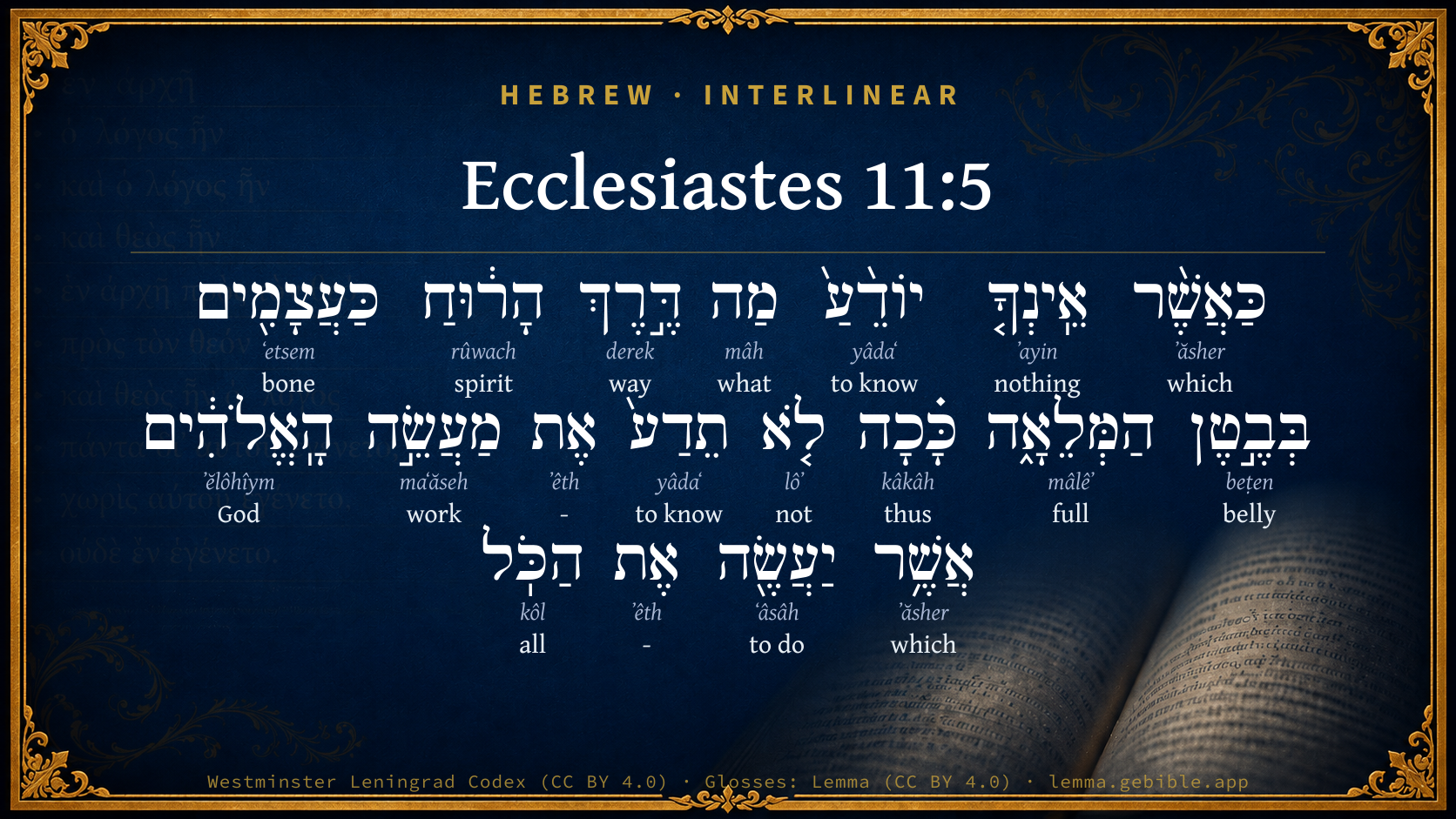
Hebrew (Westminster Leningrad Codex) Ecclesiastes 11:5 appears in the Hebrew Old Testament. The text above is from the Westminster Leningrad Codex. Each word links to its Strong’s number, a concise gloss, and parsing drawn from the Open Scriptures Hebrew Bible morphology. Click any word for its full Brown-Driver-Briggs (BDB) entry.
Download image
Cite this verse

Ecclesiastes 11:5 (World English Bible). Public Domain. Lemma interlinear Bible study tool, https://lemma.gebible.app/v/ecclesiastes/11/5.

Show BibTeX & RIS
BibTeX
RIS
English Translation
As you don't know what is the way of the wind, Nor how the bones grow in the womb of her who is with child; Even so you don't know the work of God who does all.
World English Bible · Public Domain
Download a study sheet

One document with this verse’s original text, its word-by-word gloss line, the meaning frame, cross-references with their text, attributed commentary, and full source and license credits — printable, and it pastes into notes with its structure intact.

This verse Autodidact and up

Study sheet (.html) Plain text (.txt)

A passage Seminary Student

Up to 50 verses in one chapter. A passage sheet keeps up to 6 commentary sources and 12 cross-references per verse, in the order this page ranks them, and says so on the sheet whenever that leaves anything out. Ask for a single verse and you get the Autodidact verse sheet above.

Everything on this page stays free to read, with no account — the sheet is a download of what is already on screen, not access to it.

Want to remove ads? Support Godless Engineer
Compare translations 3

The same verse in 3 English versions, stacked beneath the original-language interlinear above. Click any original word for its lexicon entry.

Each is an independent rendering of the whole verse — the interlinear is not word-aligned to these translations.

Highlighted words mark where these versions differ — a whole-verse word diff, not a word-by-word alignment.

  • World English Bible Public Domain
    As you don't know what is the way of the wind, Nor how the bones grow in the womb of her who is with child; Even so you don't know the work of God who does all.
  • King James Version Public Domain
    As thou knowest not what is the way of the spirit, nor how the bones do grow in the womb of her that is with child: even so thou knowest not the works of God who maketh all.
  • unfoldingWord Literal Text CC BY-SA 4.0
    Just as you are not knowing what the way of the wind, as the bones into the womb of the full, so thus you do not know the work of the God who does everything. q1

unfoldingWord Literal Text — © unfoldingWord, licensed CC BY-SA 4.0. Word-aligned USFM3 via Door43 (git.door43.org/unfoldingWord/en_ult).

Versions to compare (up to 4)

3 of 4 selected

Show all 18 translations

Every available English version of this verse, each an independent rendering of the whole verse.

  • World English Bible Public Domain
    As you don't know what is the way of the wind, Nor how the bones grow in the womb of her who is with child; Even so you don't know the work of God who does all.
  • Berean Standard Bible Public Domain
    As you do not know the path of the wind, or how the bones are formed in a mother’s womb, so you cannot understand the work of God, the Maker of all things.
  • Majority Standard Bible Public Domain
    As you do not know the path of the wind, or how the bones are formed in a mother’s womb, so you cannot understand the work of God, the Maker of all things.
  • King James Version Public Domain
    As thou knowest not what is the way of the spirit, nor how the bones do grow in the womb of her that is with child: even so thou knowest not the works of God who maketh all.
  • American Standard Version (1901) Public Domain
    As thou knowest not what is the way of the wind, `nor' how the bones `do grow' in the womb of her that is with child; even so thou knowest not the work of God who doeth all.
  • Revised Version (1885) Public Domain
    As thou knowest not what is the way of the wind, nor how the bones do grow in the womb of her that is with child; even so thou knowest not the work of God who doeth all.
  • Geneva Bible (1599) Public Domain
    As thou knowest not which is ye way of the spirit, nor how the bones doe growe in the wombe of her that is with child: so thou knowest not the worke of God that worketh all.
  • Douay-Rheims (1899) Public Domain
    As thou knowest not what is the way of the spirit, nor how the bones are joined together in the womb of her that is with child: so thou knowest not the works of God, who is the maker of all.
  • Young's Literal Translation Public Domain
    As thou knowest not what `is' the way of the spirit, How -- bones in the womb of the full one, So thou knowest not the work of God who maketh the whole.
  • Literal Standard Version CC BY-SA 4.0
    As you do not know what [is] the way of the spirit, || How—bones in the womb of the full one, || So you do not know the work of God who makes the whole.
  • Unlocked Literal Bible CC BY-SA 4.0
    As you do not know the path of the wind, nor how a baby's bones grow in the pregnant womb, so also you cannot comprehend the work of God, who created everything.
  • unfoldingWord Literal Text CC BY-SA 4.0
    Just as you are not knowing what the way of the wind, as the bones into the womb of the full, so thus you do not know the work of the God who does everything. q1
  • Darby Bible Public Domain
    As thou knowest not what is the way of the spirit, how the bones [grow] in the womb of her that is with child, even so thou knowest not the work of God who maketh all.
  • World Messianic Bible Public Domain
    As you don’t know what is the way of the wind, nor how the bones grow in the womb of her who is with child; even so you don’t know the work of God who does all.
  • Webster's Bible Public Domain
    As thou knowest not what is the way of the spirit, nor the structure of the parts of conception in her that is with child: even so thou knowest not the works of God who maketh all.
  • Free Bible Version CC BY-SA 4.0
    Just as you don't know how the breath of life comes to the child in its mother's womb, so you can't understand the work of God, the Creator of everything.
  • Bible in Basic English Public Domain
    As you have no knowledge of the way of the wind, or of the growth of the bones in the body of her who is with child, even so you have no knowledge of the works of God who has made all.
  • JPS Tanakh (1917) Public Domain
    As thou knowest not what is the way of the wind, nor how the bones do grow in the womb of her that is with child; even so thou knowest not the work of God who doeth all things.

Literal Standard Version (2020), Covenant Press — licensed CC BY-SA 4.0. Text via the HelloAO Bible API (eBible.org). Unlocked Literal Bible (unfoldingWord) — licensed CC BY-SA 4.0. Text via the HelloAO Bible API (eBible.org). unfoldingWord Literal Text — © unfoldingWord, licensed CC BY-SA 4.0. Word-aligned USFM3 via Door43 (git.door43.org/unfoldingWord/en_ult). Free Bible Version, Dr. Jonathan Gallagher — licensed CC BY-SA 4.0. Text via the HelloAO Bible API (eBible.org).

Word by word

More ways to search: Search by grammar → Find every occurrence → Compare this word →

Practice this passage: Drill this verse → Learn its vocabulary →

כָּ֗כָה
kâkâh
  1. כַּאֲשֶׁ֨ר ʼăsher H834 “like/as · which” Preposition + Particle, Relative
  2. אֵֽינְךָ֤ ʼayin H369 “nothing · you” Particle, Negative + Suffix, Personal, 2nd Person, Masculine, Singular
  3. יוֹדֵ֨עַ֙ yâdaʻ H3045 “knowing” Verb, Qal, Participle Active, Masculine, Singular, Absolute
  4. מַה mâh H4100 “what” Particle, Interrogative
  5. דֶּ֣רֶךְ derek H1870 “way of” Noun, Common, Both, Singular, Construct
  6. הָר֔וּחַ rûwach H7307 “the · spirit” Particle, Definite Article + Noun, Common, Both, Singular, Absolute
  7. כַּעֲצָמִ֖ים ʻetsem H6106 “like/as · bones” Preposition + Noun, Common, Feminine, Plural, Absolute
  8. בְּבֶ֣טֶן beṭen H990 “in/at · belly of” Preposition + Noun, Common, Feminine, Singular, Construct
  9. הַמְּלֵאָ֑ה mâlêʼ H4392 “the · full” Particle, Definite Article + Adjective, Adjective, Feminine, Singular, Absolute
  10. לֹ֤א lôʼ H3808 “not” Particle, Negative
  11. תֵדַע֙ yâdaʻ H3045 “to know” Verb, Qal, Imperfect, 2nd Person, Masculine, Singular
  12. אֶת ʼêth H853 “-” Particle, Direct Object
  13. מַעֲשֵׂ֣ה maʻăseh H4639 “work of” Noun, Common, Masculine, Singular, Construct
  14. הָֽאֱלֹהִ֔ים ʼĕlôhîym H430 “the · God(s)” Particle, Definite Article + Noun, Common, Masculine, Plural, Absolute
  15. אֲשֶׁ֥ר ʼăsher H834 “which” Particle, Relative
  16. יַעֲשֶׂ֖ה ʻâsâh H6213 “to do” Verb, Qal, Imperfect, 3rd Person, Masculine, Singular
  17. אֶת ʼêth H853 “-” Particle, Direct Object
  18. הַכֹּֽל kôl H3605 “the · all” Particle, Definite Article + Noun, Common, Masculine, Singular, Absolute

About this verse

These counts appear in no published source. They are computed here, from the morphology-tagged text and Lemma’s own curated glosses. What Lemma adds →

19
words
16
distinct lemmas
Wisdom
section

Shared distinctive vocabulary

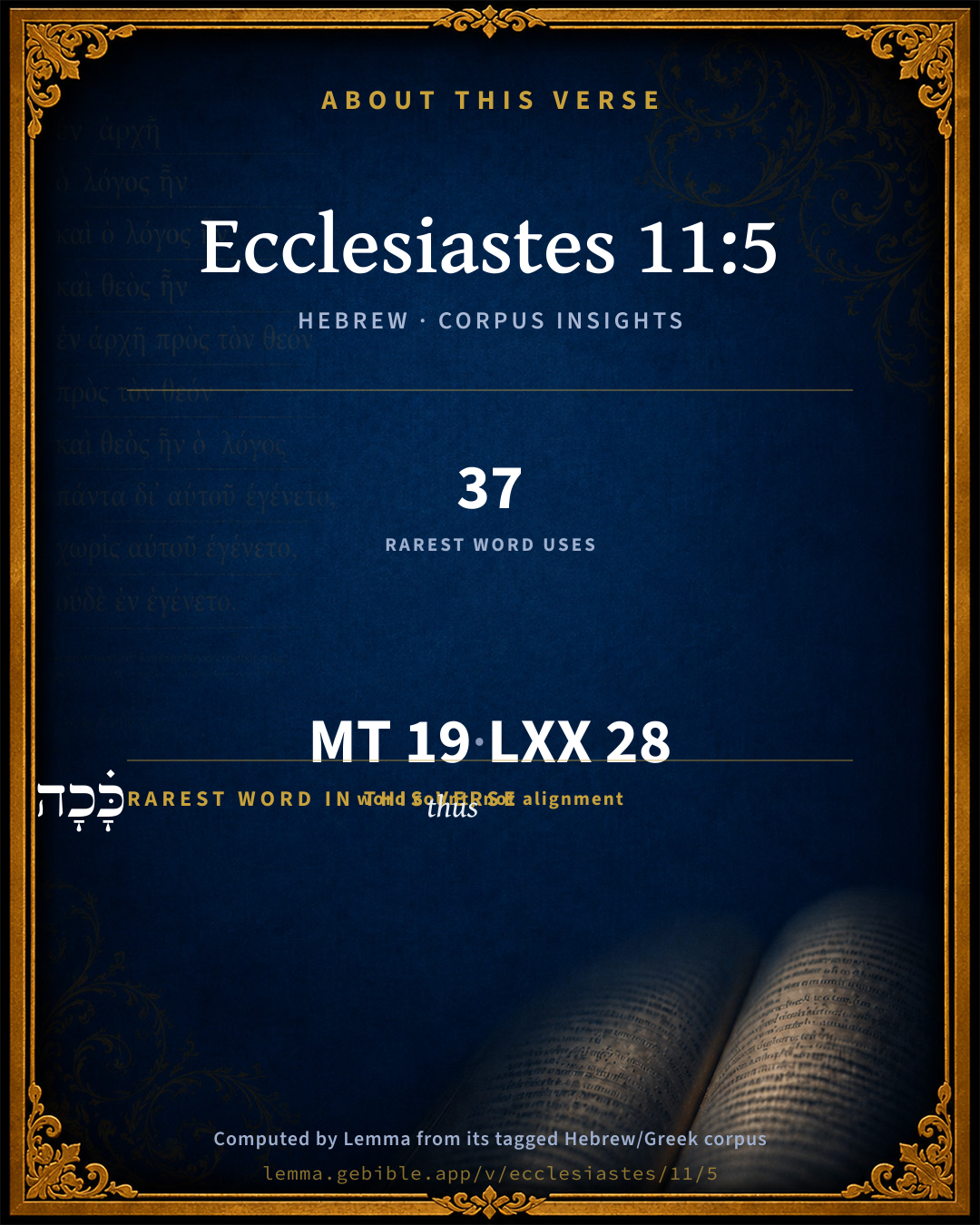
כָּ֗כָה thus H3602 occurs in 35 verses of the Hebrew Bible. Also found in:

Grammatical profile

  • 3 verbs
  • 7 nouns
  • 1 adjective
  • 1 adverb
  • 7 particles

Verb forms

  • יוֹדֵ֨עַ֙ Qal · Participle Active
  • תֵדַע֙ Qal · Imperfect
  • יַעֲשֶׂ֖ה Qal · Imperfect

Repetition

Words recur within this verse — often emphatic in Hebrew:

  • יוֹדֵ֨עַ֙ to know H3045 ×2
  • כַּאֲשֶׁ֨ר which H834 ×2

Hebrew & Septuagint length

In English translation the verse runs 37 words from the Hebrew and 39 from the Septuagint (LXX English) — closely comparable.

A rough comparison of the two English renderings, which tokenize alike — not a word-level alignment.

Word counts can differ between the Hebrew and the Greek without any difference in meaning — e.g. the Hebrew direct-object marker אֵת has no separate Greek word, and Greek often adds the article ὁ.

In the original languages it is 19 Hebrew tokens and 28 Greek tokens — but the two are counted differently (Hebrew bundles its prefixes and suffixes into one token; the Greek is in lemma form), so that isn’t a like-for-like length.

Cross-references

14

Topical passages linked to Ecclesiastes 11:5 in the Treasury of Scripture Knowledge — connected by theme and wording, ordered by reader-vote popularity; previews shown in the World English Bible.

  • John 3:8 The wind blows where it wants to, and you hear its sound, but don't know where it comes from and where it is going. So is everyone who is born of the Spirit."
  • Psalms 92:5 How great are your works, Yahweh! Your thoughts are very deep.
  • Ecclesiastes 8:17 then I saw all the work of God, that man can't find out the work that is done under the sun, because however much a man labors to seek it out, yet he won't find it. Yes even though a wise man thinks he can comprehend it, he won't be able to find it.
  • Romans 11:33 Oh the depth of the riches both of the wisdom and the knowledge of God! How unsearchable are his judgments, and his ways past tracing out!
  • Isaiah 40:28 Have you not known? have you not heard? The everlasting God, Yahweh, the Creator of the ends of the earth, doesn't faint, neither is weary; there is no searching of his understanding.
  • Psalms 104:24 Yahweh, how many are your works! In wisdom have you made them all. The earth is full of your riches.
  • Psalms 139:13–16 For you formed my inmost being. You knit me together in my mother's womb.
  • Ecclesiastes 7:24 That which is, is far off and exceedingly deep. Who can find it out?
  • Job 26:5–14 "Those who are deceased tremble, Those beneath the waters and all that live in them.
  • Job 36:24–33 "Remember that you magnify his work, Whereof men have sung.
  • Job 5:9 Who does great things that can't be fathomed, Marvelous things without number;
  • Job 37:23 We can't reach the Almighty, He is exalted in power; In justice and great righteousness he will not oppress.
  • Job 38:4–39:30 "Where were you when I laid the foundations of the earth? Declare, if you have understanding.
  • Psalms 40:5 Many, Yahweh, my God, are the wonderful works which you have done, And your thoughts which are toward us. They can't be set in order to you; If I would declare and speak of them, they are more than can be numbered.

Cross-references courtesy of OpenBible.info (CC BY 4.0).

Hebrew and Greek witnesses Masoretic Hebrew ↔ Greek Septuagint

The same verse in the two great witnesses to the Old Testament, shown verse-for-verse.

These are two independent witnesses, not word-aligned to each other, and the Septuagint is shown in lemma (dictionary) form.

Hebrew Ecclesiastes 11:5 Masoretic · Westminster Leningrad Codex

כַּאֲשֶׁ֨ר אֵֽינְךָ֤ יוֹדֵ֨עַ֙ מַה דֶּ֣רֶךְ הָר֔וּחַ כַּעֲצָמִ֖ים בְּבֶ֣טֶן הַמְּלֵאָ֑ה כָּ֗כָה לֹ֤א תֵדַע֙ אֶת מַעֲשֵׂ֣ה הָֽאֱלֹהִ֔ים אֲשֶׁ֥ר יַעֲשֶׂ֖ה אֶת הַכֹּֽל

As you don't know what is the way of the wind, Nor how the bones grow in the womb of her who is with child; Even so you don't know the work of God who does all.

World English Bible · Public Domain

Greek LXX Ecclesiastes 11:5 Septuagint · lemma form

ἐν ὅς οὐ εἰμί γιγνώσκω τίς ὁ ὁδός ὁ πνεῦμα ὡς ὀστέον ἐν γαστήρ ὁ κυοφορέω οὕτως οὐ γιγνώσκω ὁ ποίημα ὁ θεός ὅσος ποιέω σύν ὁ πᾶς

Among whom none knows what is the way of the wind: as the bones are hid in the womb of a pregnant woman, so you shall not know the works of God, even all things whatever he shall do.

LXX2012 (modern English Septuagint) · Public Domain

On this verse, The Pulpit Commentary discusses the Septuagint’s reading. Read the note in Commentary ↓

Hebrew: Westminster Leningrad Codex (CC BY 4.0). Greek: Septuagint (public domain); English from LXX2012 (modern English Septuagint) (Public Domain). How the Septuagint differs from the Hebrew →

Commentary

Notes on Ecclesiastes 11:5 from classic Christian and Jewish commentators (each source and its license shown beneath its notes). The classic Christian expositions comment on the surrounding passage and are grouped to its opening verse, so a note may address several verses; the Jewish commentaries on the Tanakh (Rashi and others) are per-verse, so they appear only where the commentator wrote on this verse.

Lemma curates 59 commentaries, every one of them public domain or Creative Commons licensed, each selected and text-cleaned for this edition rather than reprinted as found. About our sources →

Trapp's Complete Commentary

John Trapp

Ecc 11:5 As thou knowest not what [is] the way of the spirit, [nor] how the bones [do grow] in the womb of her that is with child: even so thou knowest not the works of God who maketh all.

Ver. 5. As thou knowest not what is the way of the Spirit.] Or, Of the wind, as some render it, grounding upon the former verse - q.d., Why should any so observe the wind, the nature whereof he so little understands, {Joh 3:8} and the inconstancy whereof is grown to, and known by, a common proverb? But by spirit I rather think is meant the soul, as by bones the body. Who can tell when and how the body is formed, the soul infused? The body is the "soul’s sheath," {Dan 7:15 marg.} an abridgment of the visible world, as the soul is of the invisible. The members of the body were made all by book, {Psa 139:16} "and curiously wrought in the lowest parts of the earth," that is, in the womb: as curious workmen, when they have some choice piece in hand, they perfect it in private, and then bring it forth to light for men to gaze at. What an admirable piece of work is man’s head piece! - God’s masterpiece in this little world - the chief seat of the soul, that cura divini ingenii, as one calls it! {a} There is nothing great on earth but man, nothing in man but his mind, said the philosopher. {b} Many locks and keys argue the price of the jewel that they keep; aud many papers wrapping the token within them, the worth of the token. The tables of the testament - First, Laid up in the ark; secondly, The ark bound about with pure gold; thirdly, Overshadowed with cherubims’ wings; fourthly, Enclosed with the veil of the tabernacle; fifthly, With the compass of the tabernacle; sixthly, With a court about all; seventhly, With a treble covering of goats’, rams’, and badgers’ skins above all - must needs be precious tables. So when the Almighty made man’s head, the seat of the reasonable soul, and overlaid it with hair, skin, and flesh, like the threefold covering of the tabernacle, and then encompassed it with a skull of bones, like boards of cedar, and afterwards with various skins, like silken curtains, and, lastly, enclosed it with the yellow skin that covers the brain, like the purple veil, which Solomon calls the "golden ewer," {Ecc 12:6} he would doubtless have us to know it was made for some great treasure to be put therein. How and when the reasonable soul is put into this curious cabinet, philosophers dispute many things, but can affirm nothing of a certainty: as neither "how the bones do grow in the womb," how of the same substance the several parts - as bones, nerves, arteries, veins, gristles, flesh, and blood - are fashioned there, and receive daily increase. This David looks at as a just wonder. {Psa 139:14-15} Mirificatus sum mirabilibus operis tuis, {c} saith he, I am fearfully and wonderfully made: and Galen, a profane philosopher, could not but hereupon sing a hymn to man’s most wise Creator, whom yet he knew not.

Even so thou knowest not the work of God,] i.e., The rest of his works of creation and providence, which are very various, and to us no less unknown than uncertain. Do thou that which God commandeth, and let things occur as they will, there is an overruling hand in all for the good of those that love God. "Trust therefore in the Lord with all thine heart, and lean not to thine own understanding." {Pro 3:5} "Hide not thine eyes from thine own flesh." {Isa 58:7} He that doeth so shall have many a curse. The apostle useth a word for liberality, {d} which properly signifieth simplicity; and this he doth in opposition to that crafty and witty wiliness of the covetous, to defend themselves from the danger, as they take it, of liberality.

{a} Homo est σοφου τεκτονος καλλον ποικιλμα.. - Eurip.

{b} Favorin.

{c} Montanus.

{d} Aπλοτης. {2Co 8:2}

John Trapp, A Commentary or Exposition upon All the Books of the Old and New Testament (1647–1656) — public domain. Text from a community e-Sword module.

The Biblical Illustrator

Joseph S. Exell

Ecc_11:5

Thou knowest not the work of God, who doeth all

Christian agnosticism

(with Jam_1:5-6):--The favourite intellectual mood of unbelief in recent times has been agnosticism.

It declares that the greatest things we do not know, shall never know. Ecclesiastes is a very modern book in respect of this recognition of human ignorance. And it is more than modern in that while it fully states the puzzle, it gives the key.

I. We know nothing. There is a farmer observing the wind now, saying, It is in the right quarter; I will put in my seed. He shall not. The seed is six miles away, and a cart-wheel is broken. To-morrow the land will be flooded. The next day his child will be dying, and he will postpone everything. Another was very anxious about the rainy harvest; he regarded the clouds, he chose a good week and set the men on; but he fell from his horse and died; some one else saw the harvest home. Thou knowest not what is the way of the wind. That is the kind of experience that makes Tennyson say, Behold, we know not anything. Of course there is very much in the regularity of things to make us think we know. A shrewd and careful farmer usually gets on well. The wind is a sign, and the clouds are a sign, that any man of common sense must pay attention to. Say we do not know what God doeth, if you like. But lay upon Him all that is done. If a man sows wild oats it is God who makes them come up. Do not say it is nature; it is God. And then if they seem not to come up--one man does wrong and is punished, another does wrong and is not punished--you are not embarrassed with any irregularity hard to account for. God has them both in hand. And with Him is no variableness or shadow that is cast by turning.

II. We know God. The unbelieving agnostic says we can know everything earthly, but nothing heavenly; we cannot know God. The Christian agnostic says, We are not certain of anything earthly; but we are certain of God. We know whom we have believed. God shines into all the world with the pure light of goodness; and all iniquity, greed, violence, and so on, of which we say the earth is so full, is really a vision, too, of God by contrast. The earth is full of the glory of God, and that is why the bad things about us show up so. Christ has come--a human character up against which every one begins to feel ashamed by sheer contrast. He dares to say, I am the light of the world, and men have to recognize it, because they all show up dark against it. The character of God is there, plain enough, in touch with us.

III. If we know God we are in the way to know everything--and the only way. Do not imagine there is some long, toilsome path, as the Deists used to say, through nature up to natures God. It is not far to get through nature. It is as thin as paper. Put the two texts together--Thou knowest not the work of God, who doeth all. If any lack, let him ask of God, in faith, nothing doubting. By faith all things are yours, ye are Christs, and Christ is Gods. (J. H. Stowell, M. A.)

The Biblical Illustrator, edited by Joseph S. Exell (c. 1880s–1900s) — public domain. Text from a community e-Sword module.

Joseph Benson's Commentary

Ecc 11:5. As thou knowest not the way of the spirit — Of the soul of man, how it comes into the child in the womb; or how it is united with the body; or how, and whether it goes out of the body. Nor how the bones do grow — That is, the whole body, which is elsewhere signified by the bones, because they are a principal part, and the very foundation and support of the body; that is, thou knowest not how, from small and unpromising beginnings, the various parts of the body, as nerves, arteries, veins, sinews, entrails, bones, flesh, and skin, are gradually formed, nourished, increased, and brought to perfection: even so thou knowest not the works of God — What God is doing, and will do with thee or others; the counsels and methods of his providence in the future time of thy life, what evil God will send upon the earth, how he will chastise or punish mankind for their sins, or how long he will continue thy life, or preserve to thee the enjoyment of thy property; or how soon he will call thee to an account. Therefore use the present opportunity, and commit thyself and all thy affairs to him in well doing.

Joseph Benson's Commentary on the Old and New Testaments (1811–1818) — public domain. Text from a community e-Sword module.

Tyndale Open Study Notes

Tyndale Open Resources

11:5 The activity of God is often unpredictable and mysterious. Our job is to work when we have the opportunity to do so (see Prov 12:11; 24:27).

Tyndale Open Study Notes — © Tyndale Open Resources, licensed CC BY-SA 4.0. Text via the HelloAO Bible API.

Jamieson, Fausset & Brown

Robert Jamieson, A. R. Fausset & David Brown

spirit--How the soul animates the body! Thus the transition to the formation of the body "in the womb" is more natural, than if with MAURER we translate it "wind" (Ecc 1:6; Joh 3:8).

bones . . . grow-- (Job 10:8-9; Psa 139:15-16).

knowest not the works of God-- (Ecc 3:11; Ecc 8:17; Ecc 9:12).

Jamieson, Fausset & Brown — Commentary Critical and Explanatory on the Whole Bible (1871) — public domain (CC PDM 1.0). Text via the HelloAO Bible API.

Adam Clarke's Commentary

Verse 5. As thou knowest not - the way of the spirit] Why God should have permitted such an such persons to fall into want, and how they came into all their distresses, thou canst not tell, no more than thou canst how their soul is united to their body, how it came to inform that body, or how the child was formed in the womb of its mother. Nor canst thou discern the end which God has in view in these things. He maketh all, every thing is open to him; and take heed lest, while pretending motives of scrupulosity and prudence, in not relieving the distresses of those thou pretendest to suspect to be unworthy, he does not see that a love of money is the motive of thy conduct, and a want of the bowels of mercy the cause why thou drivest this suspected beggar from thy door.

Adam Clarke's Commentary on the Bible (1810–1826) — public domain. Text from a community e-Sword/MySword module.

Ellicott's Commentary for English Readers

(5) The wording of this passage leaves it ambiguous whether we have here two illustrations of man’s ignorance, or only one; whether we are to understand the verse as declaring that we know neither the way of the wind nor the growth of the embryo, or whether, retaining the translation “spirit,” we take the whole verse as relating to the latter subject. (Comp. Joh_3:6.) The word for “her that is with child” occurs in that sense here only in the Old Testament, and in later Hebrew.

A Bible Commentary for English Readers, edited by Charles John Ellicott (1878–1897) — public domain. Text from a community e-Sword module.

The Cambridge Bible for Schools and Colleges

gen. ed. J. J. S. Perowne

5. As thou knowest not what is the way of the spirit] The Hebrew word for “spirit” has also the meaning of “wind” as in the verse immediately preceding, and this has led many commentators (as with the corresponding Greek word in Joh_3:8) to prefer that meaning, here. Two different examples of man’s ignorance of the processes of the common phenomena of nature are adduced on this view as analogous to his ignorance of the “work of God,” of what we call the Divine Government of the Universe. It may be questioned however whether, both here and in Joh_3:8, a more adequate meaning is not given by retaining the idea of “spirit” as the “breath of life” of Gen_2:7. The growth of the human embryo was for the early observers of nature an impenetrable mystery (Job_10:11; Psa_139:13-17). It became yet more mysterious when men thought of life, with all its phenomena of sensation and consciousness entering into the material structure thus “fearfully and wonderfully made.” This sense of the word agrees it will be seen, with its use in chaps. Ecc_3:21, Ecc_12:7. The word “nor” has nothing answering to it in the Hebrew and the sentence should run thus, describing not two distinct phenomena but one complex fact, “as thou knowest not the way of the spirit (the breath of life) how the framework of the body (literally the bones, but the word is used commonly for the whole body as in Lam_4:7; Job_7:15; Pro_15:30; Pro_16:24 and elsewhere) is in the womb of her that is with child.

the works of God who maketh all] So in ch. Ecc_7:13, we had “Consider the work of God.” Here the addition of “who maketh all” indicates a higher stage of faith. That “never-failing Providence orders all things both in heaven and earth.” The agnosticism of the Debater is, like that of Hooker (Eccl. Pol. i. 2. § 3), the utterance of a devout Theism, content to keep within the limits of the Knowable, but not placing the object of its adoration in the category of the Unknown and Unknowable.

The Cambridge Bible for Schools and Colleges (gen. ed. J. J. S. Perowne; Cambridge University Press, 1878–1918) — public domain. Text from a community e-Sword module.

John Gill's Exposition

As thou knowest not what is the way of the spirit,.... If indeed a man could foresee and be assured of seasonable weather for sowing and reaping, or a proper opportunity for doing good, all circumstances agreeing, it would be right to wait for it, and take it; but as these things are not in our power, nor within the compass of our knowledge, we should take the first opportunity of doing good, and leave the issue to divine Providence: as in many things in nature we are and should be content to be ignorant of them, and leave them with God, who brings them about by his secret power and providence: as, for instance, we know not "the way of the spirit", or "of the wind" (r), as some render it; from whence it comes and whither it goes, where and when it will subside, or what wind will blow next; or of the spirit or soul of man, how it enters into the body. So the Targum,

"how the spirit of the breath of life goes into the body of an infant:''

whether it is by traduction, as some, which is not likely; or by transfusion, or by creation out of nothing, or by formation out of something pre-existent, and by an immediate infusion of it: or, "what is the way of the breath"; of the breath of a child in the womb, whether it breathes or not; if it does, how? if not, how does it live? or what is the way of the soul out of the body, how it goes out of it when the body dies;

nor how the bones do grow in the womb of her that is with child; or is "full", pregnant, big with child: or "in the womb that is full" (s); full of liquids, and yet bones are separated from them, grow out of them, and in them, and are hardened; all which how it should be is unknown: "bones" are mentioned because they are the more solid and substantial parts of the body, the basis and strength of it; and because it may seem more difficult how any part of the seed should harden into them, while other parts are converted into skin and flesh;

even so thou knowest not the works of God, who maketh all; the Targum adds, in wisdom; as men are ignorant of many of the works of nature, so of those of Providence, especially which are future; as whether men shall be rich or poor, have days of prosperity or adversity; what their latter end will be, whether they shall not stand in need of the assistance of others, it may be of them or theirs to whom they now give; or what will be the issue of present acts of beneficence and liberality; these, with many other things of the like kind, should be left with God. Some understand this of the work of grace and conversion, which is a secret and difficult work, only wrought by the power and grace of God; and may be begun, or shortly will, in a poor person, judged an unworthy object of charity for supposed want of it, a thing unknown.

(r) "venti", Pagninus, Montanus, Junius & Tremellius, Piscator, Drusius, Mercerus, Amama, Cocceius, Gejerus, Rambachius; so Broughton, and the Syriac and Arabic versions. (s) "in utero pleno", Mercerus, Gejerus, Gussetius, p. 936. "in ventre pleno", Cocceius, so Aben Ezra.

John Gill's Exposition of the Whole Bible (1746–1763) — public domain (CC PDM 1.0). Text via the HelloAO Bible API.

Haydock's Catholic Bible Commentary

Spirit. In a man, or of the wind. Why then wouldst thou judge of the merit of thy petitioner? or pretend to determine why God has made thee rich and him poor?

George Leo Haydock (1774–1849), Haydock's Catholic Family Bible and Commentary, 1859 edition — public domain. Excludes Psalms (Douay-Rheims chapter numbering differs from Protestant) and Deuterocanonical books (Catholic canon only).

Matthew Poole's English Annotations

Of the spirit; of the spirit or soul of man, how it first comes into the body of the child in the womb, whether from God by creation, or from the parents by propagation; nor how it is united with and so fixed in the body, that it cannot get out of it when it would; nor how and whither it goes out of the body; all which things are great mysteries. Others translate it, of the wind, whence it cometh, and whither it goeth, as is observed Joh 3:8, or how violently it will blow, or how long it will last. But the former translation seems to agree better with the following clause.

The bones, i.e. the whole body, which is elsewhere signified by the bones, as Psa 34:20; 35:10, because they are a principal part, and the very foundation and support, of the body. Grow in the womb; how it comes to pass that one and the same small quantity of seed should diversify itself into skin, and flesh, and sinews, and veins, and bones, and entrails, or how it receiveth nourishment and growth.

The works of God; what God is doing, and will do with thee and others; the counsels and methods of God’s providence in the future time of thy life, what evil God will send upon the earth, Ecc 11:2, or what weather he will send, of which Ecc 11:4, how long or how little a while God will continue thy life or estate, and how soon God will call thee to an account. These and many other future events thou canst not foresee, and therefore thy wisdom and duty is to cast off all distracting cares and distrustful fears about them, and cheerfully to commit thyself, and all thy affairs, into the hand of God in well doing.

Matthew Poole's English Annotations on the Holy Bible (1683–1685) — public domain. Text from a community e-Sword/MySword module.

Whedon's Commentary on the Bible

Daniel D. Whedon

5. The way of the spirit — Better, “The way of the” wind. Our utter ignorance of the commonest things in nature really extends to all the works and ways of God. The wind is viewless and trackless, though it surely blows; the growth of the embryo is a mystery, though it surely comes to birth. So with other works of God, who doeth all things.

Daniel D. Whedon (gen. ed.), Commentary on the Old and New Testaments (1874–1909) — public domain. Text from a community e-Sword module.

The Pulpit Commentary

As thou knowest not what is the way of the spirit. In this verse are presented one or two examples of man"s ignorance of natural facts and processes as analogous to the mysteries of God"s moral government. The word translated "spirit" (ruach) may mean also "wind," and is so taken hero by many commentators. (see Ecc_1:6 Ecc_8:8; and comp. Joh_3:8) In this view there would be two instances given,viz. the wind and the embryo. Certainly, the mention of the wind seems to come naturally after what has preceded; and man"s ignorance of its way, and powerlessness to control it, are emblematic of his attitude towards Divine providence. The versions, however, seem to support the rendering of the Authorized Version. Thus the Septuagint (which connects the clause with ver. 4), ejn oiv ("among whom," i.e. those who watch the weather), "There is none that knoweth what is the way of the spirit (tou pneumatov);" Vulgate. Quomodo ignoras quae sit via spiritus. If we take this view, we have only one idea in the verse, and that is the infusion of the breath of life in the embryo, and its growth in its mother"s womb. Nor how the bones do grow in the womb of her that is with child. Our version, by its insertions, has made two facts out of the statement in the Hebrew, which is literally, holy the bones (are) in the womb of a pregnant woman. Septuagint, "As (wJv) bones are in the womb," etc.; Vulgate, Et qua ratione compingantur ossa in ventre praegnantis, "And in what way the bones are framed in the womb of the pregnant." The formation and quickening of the foetus were always regarded as mysterious and inscrutable. (comp. Job_10:8, Job_10:9; Psa_139:15 RAPC Wis 7:1, etc.) Wright compares M. Aurelius, 10:26, "The first principles of life are extremely slender and mysterious; and yet nature works them up into a strange increase of bulk, diversity, and proportion." Controversies concerning the origin of the soul have been rife from early times, some holding what is called Traducianism, i.e. that soul and body are both derived by propagation from earthly parents; others supporting Creationism, i.e. that the soul, created specially by God, is infused into the child before birth. St. Augustine confesses ("Op. Imperf.," 4:104) that he is unable to determine the truth of either opinion. And, indeed, this is one of those secret things which Holy Scripture has not decided for us, and about which no authoritative sentence has been given. The term "bones" is used for the whole conformation of the body; (comp. Pro_15:30 Pro_16:24) meleah, "pregnant," means literally, "full," and is used like the Latin plena can here and nowhere else in the Old.Testament, though common in later Hebrew. Thus Ovid, "Metam.," 10:469

Plena patris thalamis excedit, et impia dire Semina fert utero.

And "Fast.," 4:633

Nunc gravidum pecus est; gravidae sunt semine terrae Telluri plenae victima plena datur.

Even so thou knowest not the works of God who maketh all. Equally mysterious in its general scope and in its details is the working of God"s providence. And as everything lies in God"s hands, it must needs be secret and beyond human ken. This is why to "the works of God" (Ecc_7:13) is added, "who maketh all." The God of nature is Lord of the future; (comp. Amo_3:6; Ecc 18:6) man must not disquiet himself about this.

The Pulpit Commentary (1880–1919), ed. H.D.M. Spence-Jones & Joseph S. Exell — public domain. Text from a community e-Sword module.

John Wesley's Explanatory Notes

The spirit - Of the soul of man, how it comes into the child in the womb; or how it is united with the body; or how and whether it goes out of the body. The works - What God is doing and will do with thee or others; the counsels and methods of God's providence. Therefore use the present opportunity.

John Wesley, Explanatory Notes Upon the Whole Bible (1754–1765) — public domain. Text via the GEBible commentary corpus.

Keil & Delitzsch

C. F. Keil & F. Delitzsch

"As thou hast no knowledge what is the way of the wind, like as the bones in the womb of her who is with child; so thou knowest not the work of God who accomplisheth all." Luther, after Jerome, renders rightly: "As thou knowest not the way of the wind, and how the bones in the mother's womb do grow; so," etc. The clause, instar ossium in ventre praegnantis, is the so-called comparatio decurtata for instar ignorantiae tuae ossium, etc., like thy ignorance regarding the bones, i.e., the growth of the bones. כּעץ,

(Note: The Targ. reads בעץ, and construes: What the way of the spirit in the bones, i.e., how the embryo becomes animated.)

because more closely defined by 'בּב הם, has not the art. used elsewhere after כ of comparison; an example for the regular syntax (vid., Riehm, under Psa 17:12) is found at Deu 32:2. That man has no power over the wind, we read at Ecc 8:8; the way of the wind he knows not (Joh 3:8), because he has not the wind under his control: man knows fundamentally only that which he rules. Regarding the origin and development of the embryo as a _secret which remained a mystery to the Israel. Chokma, vid., Psychol. p. 209ff. For עצם, cf. Psa 139:15 and Job 10:11. Regarding meleah, pregnant (like the Lat. plena). With fine discrimination, the fut. תדע לא in the apodosis interchanges with the particip. יודע אינך in the protasis, as when we say: If thou knowest not that, as a consequence thou shalt also not know this. As a man must confess his ignorance in respect to the way of the wind, and the formation of the child in the mother's womb; so in general the work of God the All-Working lies beyond his knowledge: he can neither penetrate it in the entireness of its connection, nor in the details of its accomplishment. The idea 'oseh kol, Isa 44:24, is intentionally unfolded in a fut. relat. clause, because here the fut. in the natural world, as well as in human history, comes principally into view. For that very reason the words את־הכּל are also used, not: (as in passages where there is a reference to the world of creation in its present condition) eth-kol-elleh, Isa 66:2. Also the growth of the child in the mother's womb is compared to the growth of the future in the womb of the present, out of which it is born (Pro 27:1; cf. Zep 2:2). What is established by this proof that man is not lord of the future, - viz. that in the activity of his calling he should shake off anxious concern about the future, - is once again inferred with the combination of what is said in Ecc 11:4 and Ecc 11:2 (according to our interpretation, here confirmed).

Keil & Delitzsch — Biblical Commentary on the Old Testament (1861–1891) — public domain (CC PDM 1.0). Text via the HelloAO Bible API. (Old Testament only.)

Rashi

Rabbi Shlomo Yitzchaki (Rashi)

As you do not know, etc., as things enclosed in the full womb things closed in and confined in the womb which is full, even though it protrudes outward, just as you do not know the way of the wind. This is a transposed verse, expounded from its end to its beginning. Just as you do not know the way of the wind, i.e., the knowledge of both these things is equal. Neither is this one revealed to you nor is that one revealed to you. Sometimes you think to perceive in the clouds that the wind will come, and it does not come here, but it passes and goes away to another land. This expression is like (Gen. 13: 10): “like the garden of the Lord, so the land of Egypt”; (Isa. 24:2): “as with the maidservant, so with her mistress; as with the buyer so with the seller.” Sometimes Scripture compares the former to the latter, and sometimes it compares the latter to the former. Here too, it teaches the knowledge of the wind from the knowledge of the womb, i.e., you should not await the wind by looking at the clouds. (GLOSS: This matter is transposed in Rashi’s words, and it is in the opposite order. We must therefore emend it as it is in exact editions, and then it will better understood, and this is the authentic version:

As you do not know This is a transposed verse, explained from the end to the beginning: Just as you cannot identify the things enclosed in the full womb, that is, the things closed in and confined in the full womb, and even though it protrudes outward, you do not know what is in her womb, so do you not know the way of the wind, i.e., the knowledge of both these things is equal [from the book Sifthei Hachamim].)

as things enclosed Heb כַּעֲצָמִים, enclos in Old French, like (Isa. 33:15): “and closes (וְעֹצֵם) his eyes.”

so you will not know, etc. Also the decrees of the Omnipresent in matters of poverty and riches are hidden from you, and you should not refrain from doing kindness because you are concerned, perhaps I will lack some of my possessions and become impoverished. I will not engage in Torah and neglect my work and become poor. I will not wed and have children, because I will have to spend money on them.

Rashi on the Tanakh — English translations: “The Judaica Press complete Tanach with Rashi, translated by A. J. Rosenberg” (CC BY 4.0); “Pentateuch with Rashi's commentary by M. Rosenbaum and A.M. Silbermann, 1929-1934” (public domain); “The Metsudah Tanach series, Lakewood, N.J” (CC BY 4.0); and “The Book of Joshua, Metsudah Publications, 1997” (CC BY 4.0). Text via Sefaria.

Lesson kit

Teaching starters — assembled from the data on this page, not authored interpretation. Every prompt links to the verse data it draws on. Edit before teaching.

Ecclesiastes, in the Wisdom, opens this verse with 19 words (16 distinct Hebrew lemmas). Its most distinctive word is kâkâh (“thus”). A historical commentator’s framing appears above. Read the whole chapter for the surrounding context.

Discussion questions

  1. The word kâkâh carries the sense “thus.” How does it shape the verse?
  2. How does Exodus 12:11, which shares the word «thus», read alongside this verse?
  3. What does the repetition of “to know” (2× in this one verse) do in this verse?
  4. These translations render this verse differently. What is at stake in choosing one wording over another?
  5. «יוֹדֵ֨עַ֙» is a Qal Participle Active verb. How does that grammatical form shape the action described?
  6. Compare how Trapp's Complete Commentary and The Biblical Illustrator read this verse. Where do they agree or differ?

Things to notice

Reading settings

Reading text

Shown beneath each verse's original-language words.

Old Testament
Old Testament edition

Read the OT as the Masoretic Hebrew (MT) or the Greek Septuagint (LXX).

English shown for the Greek Septuagint (in the Hebrew ↔ Greek comparison).

Comparing translations? Open the Compare panel on any verse page to stack up to four side by side.