
Ecclesiastes 3:22

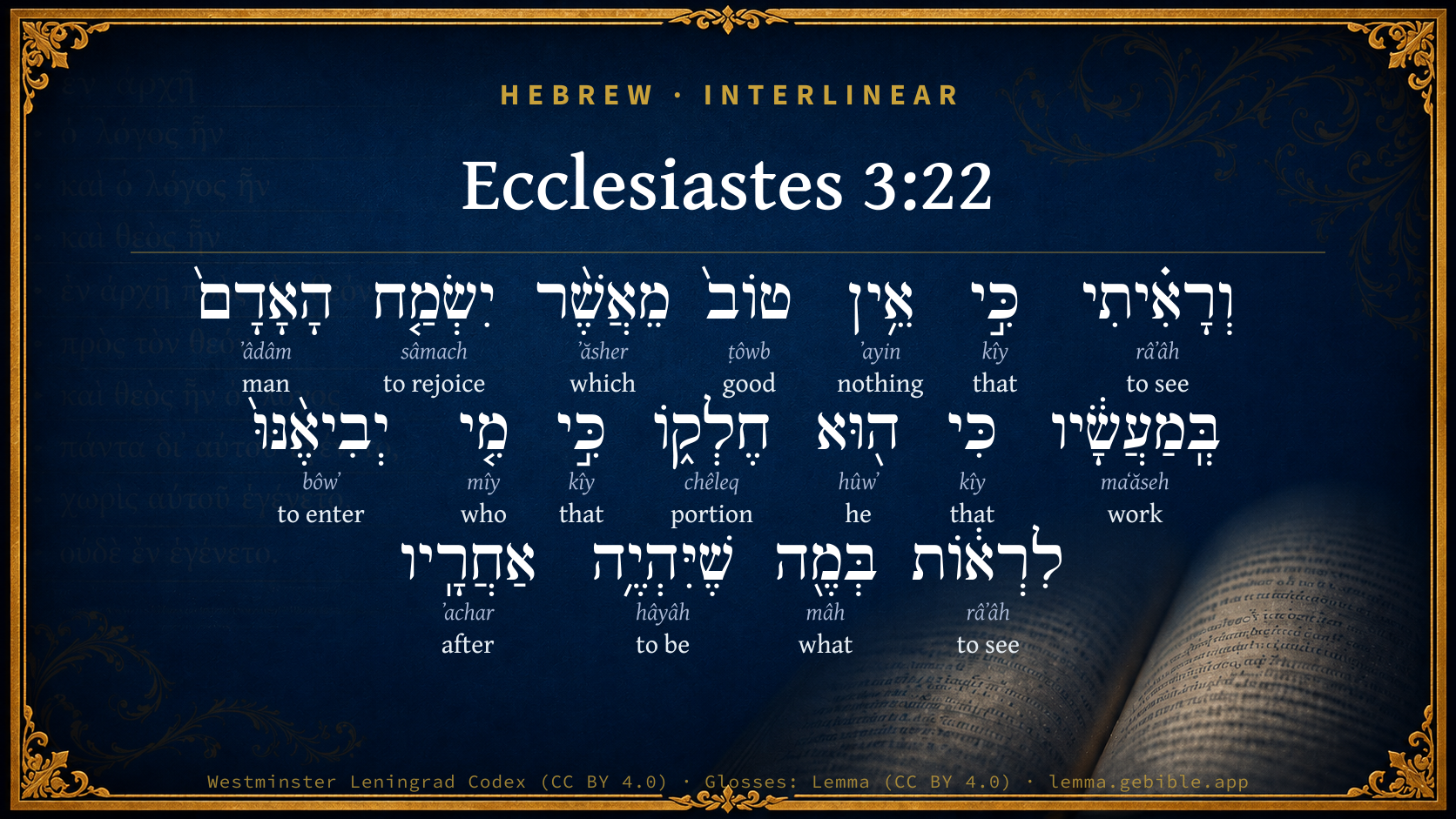
Hebrew (Westminster Leningrad Codex) Ecclesiastes 3:22 appears in the Hebrew Old Testament. The text above is from the Westminster Leningrad Codex. Each word links to its Strong’s number, a concise gloss, and parsing drawn from the Open Scriptures Hebrew Bible morphology. Click any word for its full Brown-Driver-Briggs (BDB) entry.
Download image
Cite this verse

Ecclesiastes 3:22 (World English Bible). Public Domain. Lemma interlinear Bible study tool, https://lemma.gebible.app/v/ecclesiastes/3/22.

Show BibTeX & RIS
BibTeX
RIS
English Translation
Therefore I saw that there is nothing better, than that a man should rejoice in his works; for that is his portion: for who can bring him to see what will be after him?
World English Bible · Public Domain
Download a study sheet

One document with this verse’s original text, its word-by-word gloss line, the meaning frame, cross-references with their text, attributed commentary, and full source and license credits — printable, and it pastes into notes with its structure intact.

This verse Autodidact and up

Study sheet (.html) Plain text (.txt)

A passage Seminary Student

Up to 50 verses in one chapter. A passage sheet keeps up to 6 commentary sources and 12 cross-references per verse, in the order this page ranks them, and says so on the sheet whenever that leaves anything out. Ask for a single verse and you get the Autodidact verse sheet above.

Everything on this page stays free to read, with no account — the sheet is a download of what is already on screen, not access to it.

Want to remove ads? Support Godless Engineer
Compare translations 3

The same verse in 3 English versions, stacked beneath the original-language interlinear above. Click any original word for its lexicon entry.

Each is an independent rendering of the whole verse — the interlinear is not word-aligned to these translations.

Highlighted words mark where these versions differ — a whole-verse word diff, not a word-by-word alignment.

  • World English Bible Public Domain
    Therefore I saw that there is nothing better, than that a man should rejoice in his works; for that is his portion: for who can bring him to see what will be after him?
  • King James Version Public Domain
    Wherefore I perceive that there is nothing better, than that a man should rejoice in his own works; for that is his portion: for who shall bring him to see what shall be after him?
  • unfoldingWord Literal Text CC BY-SA 4.0
    So, I saw that there is nothing better than that humanity should rejoice in his works, for it his portion. For who will bring him to look at what that will be after him?

unfoldingWord Literal Text — © unfoldingWord, licensed CC BY-SA 4.0. Word-aligned USFM3 via Door43 (git.door43.org/unfoldingWord/en_ult).

Versions to compare (up to 4)

3 of 4 selected

Show all 18 translations

Every available English version of this verse, each an independent rendering of the whole verse.

  • World English Bible Public Domain
    Therefore I saw that there is nothing better, than that a man should rejoice in his works; for that is his portion: for who can bring him to see what will be after him?
  • Berean Standard Bible Public Domain
    I have seen that there is nothing better for a man than to enjoy his work, because that is his lot. For who can bring him to see what will come after him?
  • Majority Standard Bible Public Domain
    I have seen that there is nothing better for a man than to enjoy his work, because that is his lot. For who can bring him to see what will come after him?
  • King James Version Public Domain
    Wherefore I perceive that there is nothing better, than that a man should rejoice in his own works; for that is his portion: for who shall bring him to see what shall be after him?
  • American Standard Version (1901) Public Domain
    Wherefore I saw that there is nothing better, than that a man should rejoice in his works; for that is his portion: for who shall bring him `back' to see what shall be after him?
  • Revised Version (1885) Public Domain
    Wherefore I saw that there is nothing better, than that a man should rejoice in his works; for that is his portion: for who shall bring him back to see what shall be after him?
  • Geneva Bible (1599) Public Domain
    Therefore I see that there is nothing better then that a man shoulde reioyce in his affaires, because that is his portion. For who shall bring him to see what shalbe after him?
  • Douay-Rheims (1899) Public Domain
    And I have found that nothing is better than for a man to rejoice in his work, and that this is his portion. For who shall bring him to know the things that shall be after him?
  • Young's Literal Translation Public Domain
    And I have seen that there is nothing better than that man rejoice in his works, for it `is' his portion; for who doth bring him in to look on that which is after him?
  • Literal Standard Version CC BY-SA 4.0
    And I have seen that there is nothing better than that man rejoice in his works, for it [is] his portion; for who brings him to look on that which is after him?
  • Unlocked Literal Bible CC BY-SA 4.0
    So again I realized that there is nothing better for anyone than to take pleasure in his work, for that is his assignment. Who can bring him back to see what happens after him?
  • unfoldingWord Literal Text CC BY-SA 4.0
    So, I saw that there is nothing better than that humanity should rejoice in his works, for it his portion. For who will bring him to look at what that will be after him?
  • Darby Bible Public Domain
    And I have seen that there is nothing better than that man should rejoice in his own works; for that is his portion; for who shall bring him to see what shall be after him?
  • World Messianic Bible Public Domain
    Therefore I saw that there is nothing better than that a man should rejoice in his works, for that is his portion; for who can bring him to see what will be after him?
  • Webster's Bible Public Domain
    Wherefore I perceive that there is nothing better, than that a man should rejoice in his own works; for that is his portion: for who shall bring him to see what shall be after him?
  • Free Bible Version CC BY-SA 4.0
    So I concluded that there's nothing better than for people to enjoy their work. This is what we are meant to do. For who can bring anyone back from the dead to show them what will happen after they die?
  • Bible in Basic English Public Domain
    So I saw that there is nothing better than for a man to have joy in his work--because that is his reward. Who will make him see what will come after him?
  • JPS Tanakh (1917) Public Domain
    Wherefore I perceived that there is nothing better, than that a man should rejoice in his works; for that is his portion; for who shall bring him to see what shall be after him?

Literal Standard Version (2020), Covenant Press — licensed CC BY-SA 4.0. Text via the HelloAO Bible API (eBible.org). Unlocked Literal Bible (unfoldingWord) — licensed CC BY-SA 4.0. Text via the HelloAO Bible API (eBible.org). unfoldingWord Literal Text — © unfoldingWord, licensed CC BY-SA 4.0. Word-aligned USFM3 via Door43 (git.door43.org/unfoldingWord/en_ult). Free Bible Version, Dr. Jonathan Gallagher — licensed CC BY-SA 4.0. Text via the HelloAO Bible API (eBible.org).

Word by word

More ways to search: Search by grammar → Find every occurrence → Compare this word →

Practice this passage: Drill this verse → Learn its vocabulary →

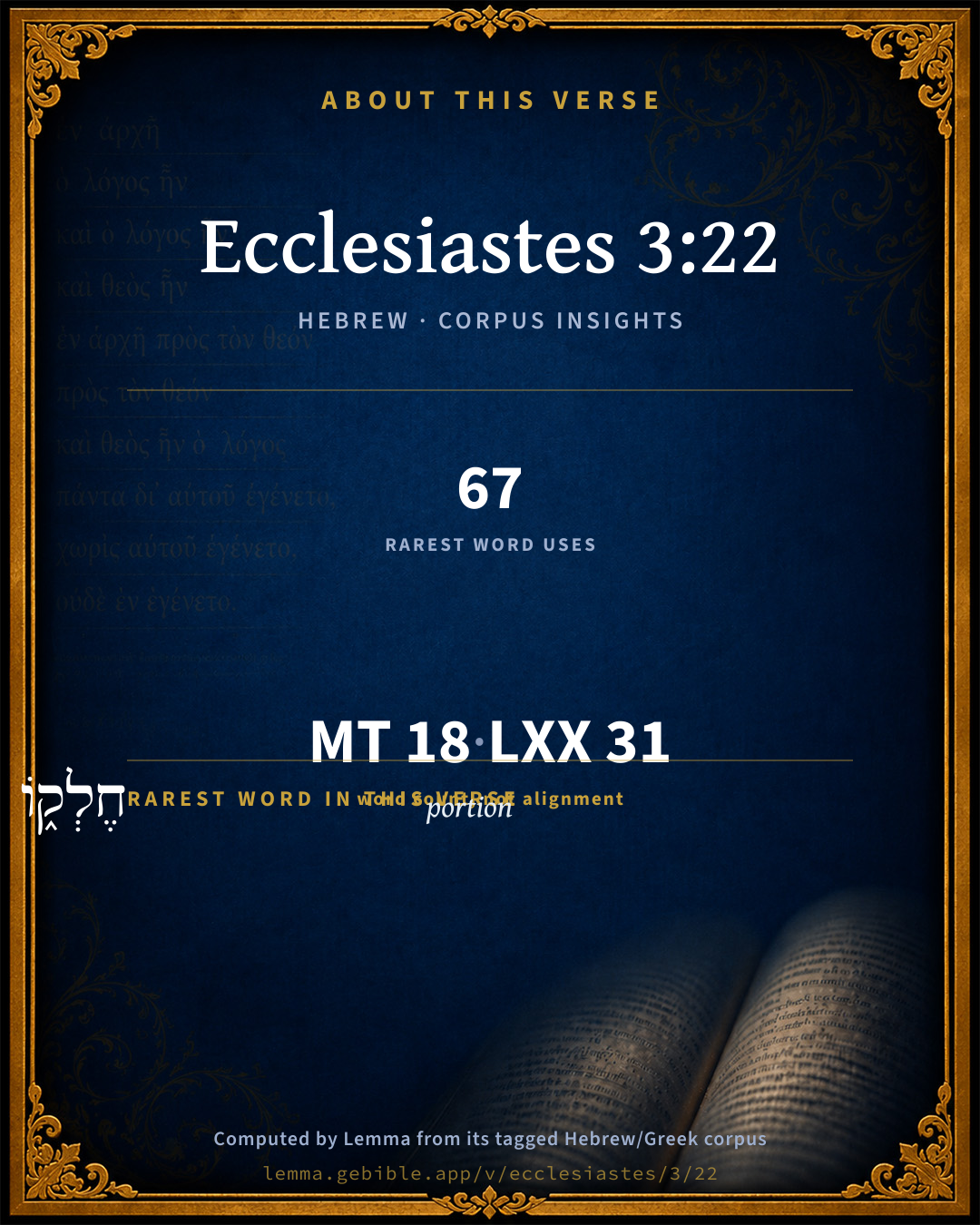
חֶלְק֑וֹ
chêleq
H2506
“portion · his”
Noun, Common, Masculine, Singular, Construct + Suffix, Personal, 3rd Person, Masculine, Singular
Part of Speech
Noun
Type
Common
Gender
Masculine
Number
Singular
State
Construct
Full BDB Definition

Origin: from H2505

TWOT: 669a

portion, share, part, territory - portion, share - portion, tract, parcel (of land) - one's portion, one's possession - (chosen) portion - portion, award (from God) - smoothness, seductiveness, flattery
  1. וְרָאִ֗יתִי râʼâh H7200 “and · to see” Conjunction + Verb, Qal, Perfect, 1st Person, Common, Singular
  2. כִּ֣י kîy H3588 “that” Conjunction
  3. אֵ֥ין ʼayin H369 “nothing” Particle, Negative
  4. טוֹב֙ ṭôwb H2896 “good” Adjective, Adjective, Masculine, Singular, Absolute
  5. מֵאֲשֶׁ֨ר ʼăsher H834 “from · which” Preposition + Particle, Relative
  6. יִשְׂמַ֤ח sâmach H8055 “to rejoice” Verb, Qal, Imperfect, 3rd Person, Masculine, Singular
  7. הָאָדָם֙ ʼâdâm H120 “the · man” Particle, Definite Article + Noun, Common, Masculine, Singular, Absolute
  8. בְּֽמַעֲשָׂ֔יו maʻăseh H4639 “in/at · works · his” Preposition + Noun, Common, Masculine, Plural, Construct + Suffix, Personal, 3rd Person, Masculine, Singular
  9. כִּי kîy H3588 “that” Conjunction
  10. ה֖וּא hûwʼ H1931 “he” Pronoun, Personal, 3rd Person, Masculine, Singular
  11. כִּ֣י kîy H3588 “that” Conjunction
  12. מִ֤י mîy H4310 “who” Particle, Interrogative
  13. יְבִיאֶ֨נּוּ֙ bôwʼ H935 “to enter · him” Verb, Hiphil, Imperfect, 3rd Person, Masculine, Singular + Suffix, Personal, 3rd Person, Masculine, Singular
  14. לִרְא֔וֹת râʼâh H7200 “to see” Preposition + Verb, Qal, Infinitive Construct
  15. בְּמֶ֖ה mâh H4100 “in/at · what” Preposition + Particle, Interrogative
  16. שֶׁיִּהְיֶ֥ה hâyâh H1961 “who/which · to be” Particle, Relative + Verb, Qal, Imperfect, 3rd Person, Masculine, Singular
  17. אַחֲרָֽיו ʼachar H310 “after · him” Preposition + Suffix, Personal, 3rd Person, Masculine, Singular

About this verse

These counts appear in no published source. They are computed here, from the morphology-tagged text and Lemma’s own curated glosses. What Lemma adds →

18
words
15
distinct lemmas
Wisdom
section

Grammatical profile

  • 5 verbs
  • 3 nouns
  • 1 adjective
  • 1 pronoun
  • 1 preposition
  • 3 conjunctions
  • 4 particles

Verb forms

  • וְרָאִ֗יתִי Qal · Perfect
  • יִשְׂמַ֤ח Qal · Imperfect
  • יְבִיאֶ֨נּוּ֙ Hiphil · Imperfect
  • לִרְא֔וֹת Qal · Infinitive Construct
  • שֶׁיִּהְיֶ֥ה Qal · Imperfect

Repetition

Words recur within this verse — often emphatic in Hebrew:

  • וְרָאִ֗יתִי to see H7200 ×2
  • כִּ֣י that H3588 ×3

Hebrew & Septuagint length

In English translation the verse runs 34 words from the Hebrew and 39 from the Septuagint (LXX English) — closely comparable.

A rough comparison of the two English renderings, which tokenize alike — not a word-level alignment.

Word counts can differ between the Hebrew and the Greek without any difference in meaning — e.g. the Hebrew direct-object marker אֵת has no separate Greek word, and Greek often adds the article ὁ.

In the original languages it is 18 Hebrew tokens and 31 Greek tokens — but the two are counted differently (Hebrew bundles its prefixes and suffixes into one token; the Greek is in lemma form), so that isn’t a like-for-like length.

Cross-references

21

Topical passages linked to Ecclesiastes 3:22 in the Treasury of Scripture Knowledge — connected by theme and wording, ordered by reader-vote popularity; previews shown in the World English Bible.

  • Ecclesiastes 2:24 There is nothing better for a man than that he should eat and drink, and make his soul enjoy good in his labor. This also I saw, that it is from the hand of God.
  • Ecclesiastes 3:11–12 He has made everything beautiful in its time. He has also set eternity in their hearts, yet so that man can't find out the work that God has done from the beginning even to the end.
  • Ecclesiastes 6:12 For who knows what is good for man in life, all the days of his vain life which he spends like a shadow? For who can tell a man what will be after him under the sun?
  • Ecclesiastes 8:7 For he doesn't know that which will be; for who can tell him how it will be?
  • Ecclesiastes 10:14 A fool also multiplies words. Man doesn't know what will be; and that which will be after him, who can tell him?
  • Ecclesiastes 11:9 Rejoice, young man, in your youth, And let your heart cheer you in the days of your youth, And walk in the ways of your heart, And in the sight of your eyes; But know that for all these things God will bring you into judgment.
  • Philippians 4:4–5 Rejoice in the Lord always! Again I will say, Rejoice!
  • Ecclesiastes 2:10–11 Whatever my eyes desired, I didn't keep from them. I didn't withhold my heart from any joy, for my heart rejoiced because of all my labor, and this was my portion from all my labor.
  • Deuteronomy 12:7 and there you shall eat before Yahweh your God, and you shall rejoice in all that you put your hand to, you and your households, in which Yahweh your God has blessed you.
  • Deuteronomy 12:18 but you shall eat them before Yahweh your God in the place which Yahweh your God shall choose, you, and your son, and your daughter, and your man-servant, and your maid-servant, and the Levite who is within your gates: and you shall rejoice before Yahweh your God in all that you put your hand to.
  • Deuteronomy 26:10–11 Now, behold, I have brought the first of the fruit of the ground, which you, Yahweh, have given me. You shall set it down before Yahweh your God, and worship before Yahweh your God:
  • Deuteronomy 28:47 Because you didn't serve Yahweh your God with joyfulness, and with gladness of heart, by reason of the abundance of all things;
  • Job 14:21 His sons come to honor, and he doesn't know it; They are brought low, but he doesn't perceive it of them.
  • Ecclesiastes 5:18–20 Behold, that which I have seen to be good and proper is for one to eat and to drink, and to enjoy good in all his labor, in which he labors under the sun, all the days of his life which God has given him; for this is his portion.
  • Ecclesiastes 8:15 Then I commended mirth, because a man has no better thing under the sun, than to eat, and to drink, and to be joyful: for that will accompany him in his labor all the days of his life which God has given him under the sun.
  • Ecclesiastes 9:7–9 Go your way--eat your bread with joy, and drink your wine with a merry heart; for God has already accepted your works.
  • Ecclesiastes 9:12 For man also doesn't know his time. As the fish that are taken in an evil net, and as the birds that are caught in the snare, even so are the sons of men snared in an evil time, when it falls suddenly on them.
  • Daniel 12:9–10 He said, Go your way, Daniel; for the words are shut up and sealed until the time of the end.
  • Daniel 12:13 But go you your way until the end be; for you shall rest, and shall stand in your lot, at the end of the days.
  • Matthew 6:34 Therefore don't be anxious for tomorrow, for tomorrow will be anxious for itself. Each day's own evil is sufficient.
  • Romans 12:11–12 not lagging in diligence; fervent in spirit; serving the Lord;

Cross-references courtesy of OpenBible.info (CC BY 4.0).

Hebrew and Greek witnesses Masoretic Hebrew ↔ Greek Septuagint

The same verse in the two great witnesses to the Old Testament, shown verse-for-verse.

These are two independent witnesses, not word-aligned to each other, and the Septuagint is shown in lemma (dictionary) form.

Hebrew Ecclesiastes 3:22 Masoretic · Westminster Leningrad Codex

וְרָאִ֗יתִי כִּ֣י אֵ֥ין טוֹב֙ מֵאֲשֶׁ֨ר יִשְׂמַ֤ח הָאָדָם֙ בְּֽמַעֲשָׂ֔יו כִּי ה֖וּא חֶלְק֑וֹ כִּ֣י מִ֤י יְבִיאֶ֨נּוּ֙ לִרְא֔וֹת בְּמֶ֖ה שֶׁיִּהְיֶ֥ה אַחֲרָֽיו

Therefore I saw that there is nothing better, than that a man should rejoice in his works; for that is his portion: for who can bring him to see what will be after him?

World English Bible · Public Domain

Greek LXX Ecclesiastes 3:22 Septuagint · lemma form

καί ὁράω ὅτι οὐ εἰμί ἀγαθός εἰ μή ὅς εὐφραίνω ὁ ἄνθρωπος ἐν ποίημα αὐτός ὅτι αὐτός μερίς αὐτός ὅτι τίς ἄγω αὐτός ὁ ὁράω ἐν ὅς ἐάν γίγνομαι μετά αὐτός

And I saw that there was no good, but that wherein a man shall rejoice in his works, for it is his portion, for who shall bring him to see any thing of that which shall be after him?

LXX2012 (modern English Septuagint) · Public Domain

Hebrew: Westminster Leningrad Codex (CC BY 4.0). Greek: Septuagint (public domain); English from LXX2012 (modern English Septuagint) (Public Domain). How the Septuagint differs from the Hebrew →

Commentary

Notes on Ecclesiastes 3:22 from classic Christian and Jewish commentators (each source and its license shown beneath its notes). The classic Christian expositions comment on the surrounding passage and are grouped to its opening verse, so a note may address several verses; the Jewish commentaries on the Tanakh (Rashi and others) are per-verse, so they appear only where the commentator wrote on this verse.

Lemma curates 59 commentaries, every one of them public domain or Creative Commons licensed, each selected and text-cleaned for this edition rather than reprinted as found. About our sources →

Trapp's Complete Commentary

John Trapp

Ecc 3:22 Wherefore I perceive that [there is] nothing better, than that a man should rejoice in his own works; for that [is] his portion: for who shall bring him to see what shall be after him?

Ver. 22. Wherefore I perceive.] He resumeth his assertion, {Ecc 3:13} and concludeth. See Ecc 2:24.

John Trapp, A Commentary or Exposition upon All the Books of the Old and New Testament (1647–1656) — public domain. Text from a community e-Sword module.

The Biblical Illustrator

Joseph S. Exell

Ecc_3:22

There is nothing better than that a man should rejoice in his own works.

Worldliness: the Epicurean gospel

These words seem to mean that a man had better get all he can, and then enjoy what he has gathered, for that is his share of the worlds good things, and as life is short it is best to spend it as pleasantly as possible. The advice has been often given; it will, I expect, be often given again. We are familiar with it in many forms. Seize the passing day and make it a day of enjoyment. Beauty and brightness, wine and song--make the most of them while you can, for neither you nor they will be long here. This is the sum of many mens idea of life. Whether gross or refined in its outward forms, the idea remains essentially the same. We sometimes speak of it as an Epicurean view, naming it from the Greek philosopher Epicurus. Not that it originated with him, for it is older far; as old, in fact, as human nature. But Epicurus reduced it to a system, gave it form and logical consistency, so as to make it a philosophy. He, too, presented it under its least repulsive features, for he seems to have been personally an estimable man. But nothing, not even genius, can redeem such a mode of thought from reproach, for it is altogether earthly and of the senses. It makes much of the animal element in our nature; ii lives intoxicated with the outward and visible. Yet, for this very reason it has always been popular both in theory and practice, especially in practice. Great numbers have an intense love for the pleasures of sense, though they would shrink from confessing oven to themselves how great a part of their lives these pleasures occupy. But if men have any touch of cultivation, they cannot be content to live the life of unmixed animalism. A sense of dignity, always awakened by thought, protests and rebels. They must take their pleasure with something to qualify its grossness. I know no better type of the class of which I am thinking than King Charles II. No one can compliment the purity of the pleasures in which he indulged. And yet the man of cultivation and refinement flashes out from the very midst of those scenes of revelry. There is an urbanity, a kindliness, a moderation even, which are not without their charms, tie never went to the extremes which injure health and inspire disgust. He was a lover, too, of art and science. If the king spent the evening in banqueting, as he did, he passed the earlier parts of the day in chemical experiments, and other forms of scientific research. Easy in temper, good-natured, self-indulgent, indolent; such is the man. The type of character is common, and it is common partly because it is so popular. Men of such nature are considered good fellows, and treated with boundless indulgence. But these light-hearted men, who seem not so much to sin as to be unconscious of responsibility, are really the poison of social life. They are corrupt and corrupting to others. Of them it is by emphasis true, One sinner destroyeth much good. King Charles lulled the nation into a lazy, voluptuous sleep, the ruin of liberty and progress. And those who, in more private life, repeat his character, will shrink into the shame and remorse of perdition when they are brought face to face with the generous impulses they have blighted, the aspirations they have chocked, and the opening faith and love they have destroyed. Worldliness, however, is a larger fact, and one more widely spread than the conscious pursuit of pleasure. There are men whose lives are most respectable, men at any rate laborious and earnest, whose course is guided at bottom by the Epicurean theory of action. They have a god and a worship whose rites and ceremonies are most exacting. Their deity is money. They worship the power of gold. They hold with Napoleon, that not only every thing but every man has his price, and that there is no door which will not open to a golden key. No doubt there are many facts which suggest such a view and seem to give it support. Money will do many things. It will bring houses, and land, and luxuries. It will secure almost unbounded social influence. And yet there is a limit to its potency. Money is not almighty. Its powers are hedged about by strict limitations. It cannot greatly alter you. The essential self of every man is beyond its sway. Neither can money alter the permanent conditions of well-being. That vice leads to sickness and death, to feebleness of thought and deadened petrifaction of feeling, is a fact which no money can touch. There is a form of worldliness which is even more strange than the love of money. It shows itself in an eager desire for what is called social position. Social display and pretensions are starving bodies and souls, and often plunging men into the vortex of fraudulent crime. Position in society is a good thing, no doubt, but it is not worth having at the price of honour and self-respect. These are different forms assumed by the gospel of worldliness. In a very intelligible sense it is good news, a veritable gospel to the outward or sensuous man; it has the promise of the life that now is. And we need not deny that the promise is redeemed. Give yourself to the world, and the world will probably give itself to you. You may, if you go heartily for it, have pleasure, or wealth, or social honour. Will you, then, accept this gospel of the worldly life? I do not know. Many of you, I am afraid, will. But to me it seems open to the gravest objections. My intellect and my feelings rise in protest against it. Shall I try and tell you why? First, it is a selfish good which is offered to us after all. Worldliness must be selfish, for it is clear that the pursuit of pleasure only becomes possible when we centre our thoughts on self. How will this affect me? is the one question which every event suggests to thought. Accordingly in its more vulgar forms the worldly life disgusts us by a selfishness which is naked and not ashamed. It recommends us coarsely, to take care of number one, as though number one were not, as it is, about the most worthless thing in the universe of being. Or it sings most untunefully about a little pelf to provide for yourself, with a mean-spirited glorying in its purblind limitation of view. The same spirit, in its more refined forms, speaks with contempt of the herd, and wraps itself in a mantle of supercilious pride. Yet a selfish life is essentially a life of misery. By one of those moral paradoxes which are so strange, and yet so beautiful, the only way to happiness is to give up seeking for it and to seek for something better and higher. Go teach the orphan boy to read, or teach the orphan girl to sew; forget your narrow, restless self; let your heart flow out in sympathy with others, and you have taken one step toward inward peace. He who has no love for others will one day cry in vain for others to love him. For love is life, and those who live without it are dead while they live. I object, further, to the gospel of worldliness that it fails to bring satisfaction to those who follow its rules. This is singularly true. The most discontented, unresting class of men in the world are those who give themselves to the pursuit of pleasure on system. As they grow older, they almost always become cynics, as we say--that is, they sneer and snarl at everything and everybody. The emptiness, the vanity, the sham is in the worldlings heart, and he sees other things through the mist of his own thoughts. Depend upon it there is no satisfaction to be had for men in mere pleasure-hunting. And I will tell you why. There is that in our souls which is related to the Infinite and Eternal. We are thirsting after the water of life, though we know it not. The aching void in the worldlings heart is an indirect testimony to the nobleness of his nature. The prodigal would fain have stayed his hunger with the husks that the swine did eat, but a man cannot live on swines food, and that precisely because he is a man. Oh, sirs, there standeth One among you whom ye know not. His face is so marred more than any man, and His form than the sons of men. And yet, oh, blessed Lord, to whom shall we go but unto Thee? Thou, Thou only, hast the words of eternal life. I object, finally, to the gospel of the world as being irreligious. Religion, or the sense of a boundless destiny, is a fact in the nature of man. It is the mightiest fact in his history also. It has built temples, woven creeds, invented ceremonies, animated heroisms, and written itself in a thousand ways upon all human things. You may try to put it down, but it will be too strong for you. What happens when a power or faculty of our nature is forcibly suppressed? I will tell you; men go mad. The oppressed tendency, like the volcanic fires of the earth, smoulders underground till it gathers ungovernable force, and then bursts forth scattering devastation and death. So it is with mans religious nature. Every attempt to keep it down, however it may succeed for a time, only brings it out in the long run in violent and perverted forms. Men try to live on this world and cannot, and then they Lake to revolution and bloodshed, with the worship of some abstraction of liberty or equality, or else they descend into spiritual idiotcy, and finish by turning tables, and finding mighty revelations in raps upon the floor. The superstition of the day is in near relation to its worldliness. I know only one deliverance from either, and that, thank God, is a deliverance from both. It is found in rational spiritual religion, or, as the apostle expresses it, repentance towards God and faith in our Lord Jesus Christ. (J. F. Stevenson, LL. B.)

.

The Biblical Illustrator, edited by Joseph S. Exell (c. 1880s–1900s) — public domain. Text from a community e-Sword module.

Joseph Benson's Commentary

Ecc 3:22. I perceive there is nothing better — For a man’s present satisfaction, and the happiness of this life; than that a man should rejoice in his own works — That he should comfortably enjoy what God hath given him, and not disquiet himself with cares about future events. He seems to speak this not in the person of an epicure, but as his own judgment, which also he declares, Ecc 2:24; Ecc 5:18-19; Ecc 8:15. For that is his portion — This is the benefit of his labours: he hath no more than he uses, for what he leaves behind him is not his, but another man’s. For who shall bring him to see, &c. — When once he is dead he shall never return to see into whose hands his estate falls, and how it is either used or abused; nor is he at all concerned in those matters.

Joseph Benson's Commentary on the Old and New Testaments (1811–1818) — public domain. Text from a community e-Sword module.

Tyndale Open Study Notes

Tyndale Open Resources

3:22 happy in their work: Work now stands alone as a source of enjoyment, apart from food and drink (cp. 2:24-25; 3:12-13).

Tyndale Open Study Notes — © Tyndale Open Resources, licensed CC BY-SA 4.0. Text via the HelloAO Bible API.

Geneva Bible (1599)

Geneva Bible translators

By the often repetition of this sentence, as Eccl. 2:24; 3:12, 22; 5:17 and 8:15, he declareth that man by reason can comprehend nothing better in this life, than to use the gifts of God soberly and comfortably: for to know further, is a special gift of God revealed by his Spirit.

Geneva Bible (1599) marginal notes — public domain. Text via Bolls.life.

Jamieson, Fausset & Brown

Robert Jamieson, A. R. Fausset & David Brown

(Compare Ecc 3:12; Ecc 5:18). Inculcating a thankful enjoyment of God's gifts, and a cheerful discharge of man's duties, founded on fear of God; not as the sensualist (Ecc 11:9); not as the anxious money-seeker (Ecc 2:23; Ecc 5:10-17).

his portion--in the present life. If it were made his main portion, it would be "vanity" (Ecc 2:1; Luk 16:25).

for who, &c.--Our ignorance as to the future, which is God's "time" (Ecc 3:11), should lead us to use the present time in the best sense and leave the future to His infinite wisdom (Mat 6:20, Mat 6:25, Mat 6:31-34).

Next: Ecclesiastes Chapter 4

Jamieson, Fausset & Brown — Commentary Critical and Explanatory on the Whole Bible (1871) — public domain (CC PDM 1.0). Text via the HelloAO Bible API.

Adam Clarke's Commentary

Verse 22. A man should rejoice in his own works] Do not turn God's blessings into sin by perverseness and complaining; make the best of life. God will sweeten its bitters to you, if you be faithful. Remember this is the state to prepare for glory; and the evils of life may be so sanctified to you as to work for your good. Though even wretched without, you may be happy within; for God can make all grace to abound towards you. You may be happy if you please; cry to God, who never rejects the prayer of the humble, and gives his Holy Spirit to all them that ask him.

Adam Clarke's Commentary on the Bible (1810–1826) — public domain. Text from a community e-Sword/MySword module.

The Cambridge Bible for Schools and Colleges

gen. ed. J. J. S. Perowne

22. Wherefore I perceive] The lesson of a tranquil regulated Epicureanism with its blending of healthy labour and calm enjoyment, is enforced as the conclusion from our ignorance of what comes after death, as before it flowed from the experience of life (ch. Ecc_2:24). Who knows whether we shall even have the power to take cognizance of what passes on earth after we are gone, or what our own state will be, if we continue to exist at all? The feeling was not unknown even to men of a higher faith than the Debater (Psa_30:9; Psa_88:10-12, Isa_38:18).

The Cambridge Bible for Schools and Colleges (gen. ed. J. J. S. Perowne; Cambridge University Press, 1878–1918) — public domain. Text from a community e-Sword module.

John Gill's Exposition

Wherefore I perceive that there is nothing better than that a man should rejoice in his own works,.... The Targum is, "in his good works"; not as justifying him before God, but as vindicating him before men, from unjust censures and charges: rather the sense is, that this is the wise man's conclusion, and this his sentiment, upon the whole; that there is nothing better for a man, than cheerfully to enjoy the fruit of his labours; to eat and drink in moderation, freely, joyfully, and thankfully; and make use of his riches, power, and authority, for his own good, the good of his family for the present, and the good of his fellow creatures; see Ecc 2:21;

for that is his portion; what is allotted to him, and thus enjoyed, is a very good one, and for which he has reason to be thankful;

for who shall bring him to see what shall be after him? to see who shall succeed him, and what use they will make of what he leaves them; he shall never return after death to see anything of this kind, nor shall any acquaint him with it; he shall not be able to know when he is dead what shall befall his sons, whether they will prosper or rio, so Jarchi; wherefore it is best for him to enjoy his substance himself in a comfortable way, and be beneficial to others, and not oppressive to them. The Midrash illustrates it thus,

"who shall bring David to see what Solomon did? and who shall bring Solomon to see what Rehoboam did?''

Next: Ecclesiastes Chapter 4

John Gill's Exposition of the Whole Bible (1746–1763) — public domain (CC PDM 1.0). Text via the HelloAO Bible API.

Haydock's Catholic Bible Commentary

After him. He knows not who shall be his heir, or how soon he may die. None returns from the other world to inform him of what is there transacted. Thus the libertine encourages himself. (Calmet)

George Leo Haydock (1774–1849), Haydock's Catholic Family Bible and Commentary, 1859 edition — public domain. Excludes Psalms (Douay-Rheims chapter numbering differs from Protestant) and Deuterocanonical books (Catholic canon only).

Matthew Poole's English Annotations

There is nothing better, to wit, for a man’s present satisfaction, and the happiness of this life, than that a man should rejoice in his own works; that he comfortably enjoy what God hath given him, and not disquiet himself with cares about future events. He seems to speak this, not in the person of an epicure, but as his own judgment, which also he declareth, Ecc 2:24; 5:18,19; 8:15.

That is his portion; this is the benefit of his labours; he hath no more than he useth, for what he leaveth behind him is not his, but another man’s.

Who shall bring him to see what shall be after him? when once he is dead he shall never return into this life to see into whose hands his estate falls, and how it is either used or abused; nor is he at all concerned in those matters.

Matthew Poole's English Annotations on the Holy Bible (1683–1685) — public domain. Text from a community e-Sword/MySword module.

Whedon's Commentary on the Bible

Daniel D. Whedon

22. Wherefore — Seeing, then, that man’s hold is only upon the present, and no one can reveal to him the future, what is left but to enjoy the present, getting from it all the good which it can yield? The point of view now reached is certainly very gloomy and discouraging. It is not, be it remembered, the conclusion of the whole matter. The writer is now not far from the state of mind in which Hamlet utters his sad and beautiful soliloquy: — he discusses “the thousand natural shocks that flesh is heir to,” “the law’s delay,” “to grunt and sweat under a weary life,” with no comfort from any thing after death, that “undiscovered country from whose bourn no traveller returns;” — only that Koheleth, instead of being goaded to desperation, takes the wiser counsel of courageous endurance, and cheerful enjoyment of what good so sad a state may yet contain.

Daniel D. Whedon (gen. ed.), Commentary on the Old and New Testaments (1874–1909) — public domain. Text from a community e-Sword module.

The Pulpit Commentary

After all, the writer arrives at the conclusion intimated in ver. 12; only here the result is gathered from the acknowledgment of man"s impotence (vers. 16-18), as there from the experience of life. Wherefore I perceive that there is nothing better, etc.; rather, so, or wherefore I saw that there was nothing, etc. As man is not master of his own lot, cannot order events as he would like, is powerless to control the forces of nature and the providential arrangements of the world, his duty and his happiness consist in enjoying the present, in making the best of life, and availing himself of the bounties which the mercy of God places before him. Thus he will free himself from anxieties and cares, perform present labors, attend to present duties, content himself with the daily round, and not vex his heart with solicitude for the future. There is no Epicureanism here, no recommendation of sensual enjoyment; the author simply advises men to make a thankful use of the blessings which God provides for them. For who shall bring him to see what shall be after him? The Revised Version, by inserting "backWho shall bring him back to see? affixes a meaning to the clause which it need not and does not bear. It is, indeed, commonly interpreted to signify that man knows and can know nothing that happens to him after death whether he will exist or not, whether he will have cognizance of what passes on earth, or be insensible to all that befalls here. But Koheleth has completed that thought already; his argument now turns to the future in this life. Use the present, for you cannot be sure of the future; this is his exhortation. So he says, (Ecc_6:12) "Who can tell a man what shall be after him under the sun?" where the expression, "under the sun," shows that earthly life is meant, not existence after death. Ignorance of the future is a very common topic throughout the book, but it is the terrestrial prospect that is in view. There would be little force in urging the impotence of men"s efforts towards their own happiness by the consideration of their ignorance of what may happen when they are no more; but one may reasonably exhort men to cease to torment themselves with hopes and fears, with labors that may be useless and preparations that may never be needed, by the reflection that they cannot foresee the future, and that, for all they know, the pains which they take may be utterly wasted (cf. Ecc_7:14 Ecc_9:3) Thus in this section there is neither skepticism nor Epicureanism. In brief, the sentiment is this There are injustices and anomalies in the life of men and in the course of this world"s events which man cannot control or alter; these may be righted and compensated hereafter. Meantime, man"s happiness is to make the best of the present, and cheerfully to enjoy what Providence offers, without anxious care for the future.

The earthly portion.

When a man is, perhaps suddenly, awakened to a sense of the transitoriness of life and the vanity of human pursuits, what more natural than that, under the influence of novel conceptions and convictions, he should rush from a career of self-indulgence into the opposite extreme? Life is brief: why concern one"s self with its affairs? Sense-experiences are changeable and perishable: why not neglect and despise them? Earth will soon vanish: why endeavor to accommodate ourselves to its conditions? But subsequent reflection convinces us that such practical inferences are unjust. Because this earth and this life are not everything, it does not follow that they are nothing. Because they cannot satisfy us, it does not follow that we should not use them.

I IT IS POSSIBLE TO LIMIT OUR VIEW OF THIS EARTHLY LIFE UNTIL IT LOSES ITS INTEREST FOR US.

1. Man"s works, to the observant and reflecting mind, are perishable and poor.

2. Nan"s joys are often both superficial and transitory.

3. The future of human existence and progress upon earth is utterly uncertain, and, if it could be foreseen, would probably occasion bitter disappointment.

II IT IS UNWISE AND UNSATISFACTORY SO TO LIMIT OUR VIEW OF LIFE. There is true wisdom in the wise man"s declaration, "There is nothing better than that a man should rejoice in his works; for that is his portion." The epicurean is wrong who makes pleasure his one aim. The cynic is wrong who despises pleasure as something beneath the dignity of his nature. Neither work nor enjoyment is the whole of life; for life is not to be understood save in relation to spiritual and disciplinary purposes. Man has for a season a bodily nature; let him use that nature with discretion, and it may prove organic to his moral welfare. Man is for a season stationed upon earth; let him fulfill earth"s duties, and taste earth"s delights. Earthly experience may be a stage towards heavenly service and bliss. T.

The Pulpit Commentary (1880–1919), ed. H.D.M. Spence-Jones & Joseph S. Exell — public domain. Text from a community e-Sword module.

John Wesley's Explanatory Notes

Better - For a man's present satisfaction. Should rejoice - That he comfortably enjoys what God hath given him. His portion - This is the benefit of his labours. For - When once he is dead he shall never return to see into whose hands his estate falls.

John Wesley, Explanatory Notes Upon the Whole Bible (1754–1765) — public domain. Text via the GEBible commentary corpus.

Keil & Delitzsch

C. F. Keil & F. Delitzsch

"Thus I then saw that there is nothing better than that a man should rejoice in his works, for that is his portion; for who can bring him to this, that he gains an insight into that which shall be after him?" Hengstenberg, who has decided against the interrog. signification of the twice-repeated ה in Ecc 3:21, now also explains אהריו ... בּמה, not: What shall become of him after it (his death)? but: What further shall be done after the state in which he now finds himself? Zckler, although rightly understanding both ה as well as אחריו (after him = when he will be separated, or separates from this life, Ecc 7:14; Ecc 9:3; cf. Gen 24:67), yet proceeds on that explanation of Hengstenberg's, and gives it the rendering: how things shall be on the earth after his departure. But (1) for this thought, as Ecc 6:12 shows, the author had a more suitable form of expression; (2) this thought, after the author has, Ecc 3:21, explained it as uncertain whether the spirit of a man in the act of death takes a different path from that of a beast, is altogether aside from the subject, and it is only an apologetic tendency not yet fully vanquished which here constrains him. The chain of thought is however this: How it will be with the spirit of a man when he dies, who knows? What will be after death is thus withdrawn from human knowledge. Thus it is best to enjoy the present, since we connect together (Ecc 2:24) labour and enjoyment mediated thereby. This joy of a man in his work - i.e., as Ecc 5:18 : which flows from his work as a fountain, and accompanies him in it (Ecc 8:15) - is his portion, i.e., the best which he has of life in this world. Instead of בּמה־שּׁ, the punctuation is בּמה, because שׁיהיה אחריו is a kindred idea; vid.' regarding מה under Ecc 2:22. And לראות בּ is sued, because it is not so much to be said of the living, that he cannot foresee how it shall be with him when he dies, as that he can gain no glimpse into that world because it is an object that has for him no fixity.

Keil & Delitzsch — Biblical Commentary on the Old Testament (1861–1891) — public domain (CC PDM 1.0). Text via the HelloAO Bible API. (Old Testament only.)

Rashi

Rabbi Shlomo Yitzchaki (Rashi)

And I saw in all of these.

that there is nothing better for man.

than that man rejoice in his deeds in the toil of his hands he should rejoice and eat, but not to widen his desire like the grave, to covet riches, to accumulate that which is not his.

for that is his portion The toil of his hands—that is his portion given him from Heaven, and with it he will rejoice.

for who will bring him to see after he dies, what his sons will have; if they too will prosper with the riches that he gathered and left over for them or whether they will not prosper.

Rashi on the Tanakh — English translations: “The Judaica Press complete Tanach with Rashi, translated by A. J. Rosenberg” (CC BY 4.0); “Pentateuch with Rashi's commentary by M. Rosenbaum and A.M. Silbermann, 1929-1934” (public domain); “The Metsudah Tanach series, Lakewood, N.J” (CC BY 4.0); and “The Book of Joshua, Metsudah Publications, 1997” (CC BY 4.0). Text via Sefaria.

Lesson kit

Teaching starters — assembled from the data on this page, not authored interpretation. Every prompt links to the verse data it draws on. Edit before teaching.

Ecclesiastes, in the Wisdom, opens this verse with 18 words (15 distinct Hebrew lemmas). Its most distinctive word is chêleq (“portion”). A historical commentator’s framing appears above. Read the whole chapter for the surrounding context.

Discussion questions

  1. How does “portion” (chêleq) shape what this verse is saying?
  2. How does Ecclesiastes 2:24, which shares this passage’s theme, read alongside this verse?
  3. What does the repetition of “to see” (2× in this one verse) do in this verse?
  4. The translations on this page render this verse differently — a whole-verse word diff, not a word-by-word alignment. What might account for the different wordings?
  5. «וְרָאִ֗יתִי» is a Qal Perfect verb. How does that grammatical form shape the action described?
  6. Compare how Trapp's Complete Commentary and The Biblical Illustrator read this verse. Where do they agree or differ?

Things to notice

Reading settings

Reading text

Shown beneath each verse's original-language words.

Old Testament
Old Testament edition

Read the OT as the Masoretic Hebrew (MT) or the Greek Septuagint (LXX).

English shown for the Greek Septuagint (in the Hebrew ↔ Greek comparison).

Comparing translations? Open the Compare panel on any verse page to stack up to four side by side.