
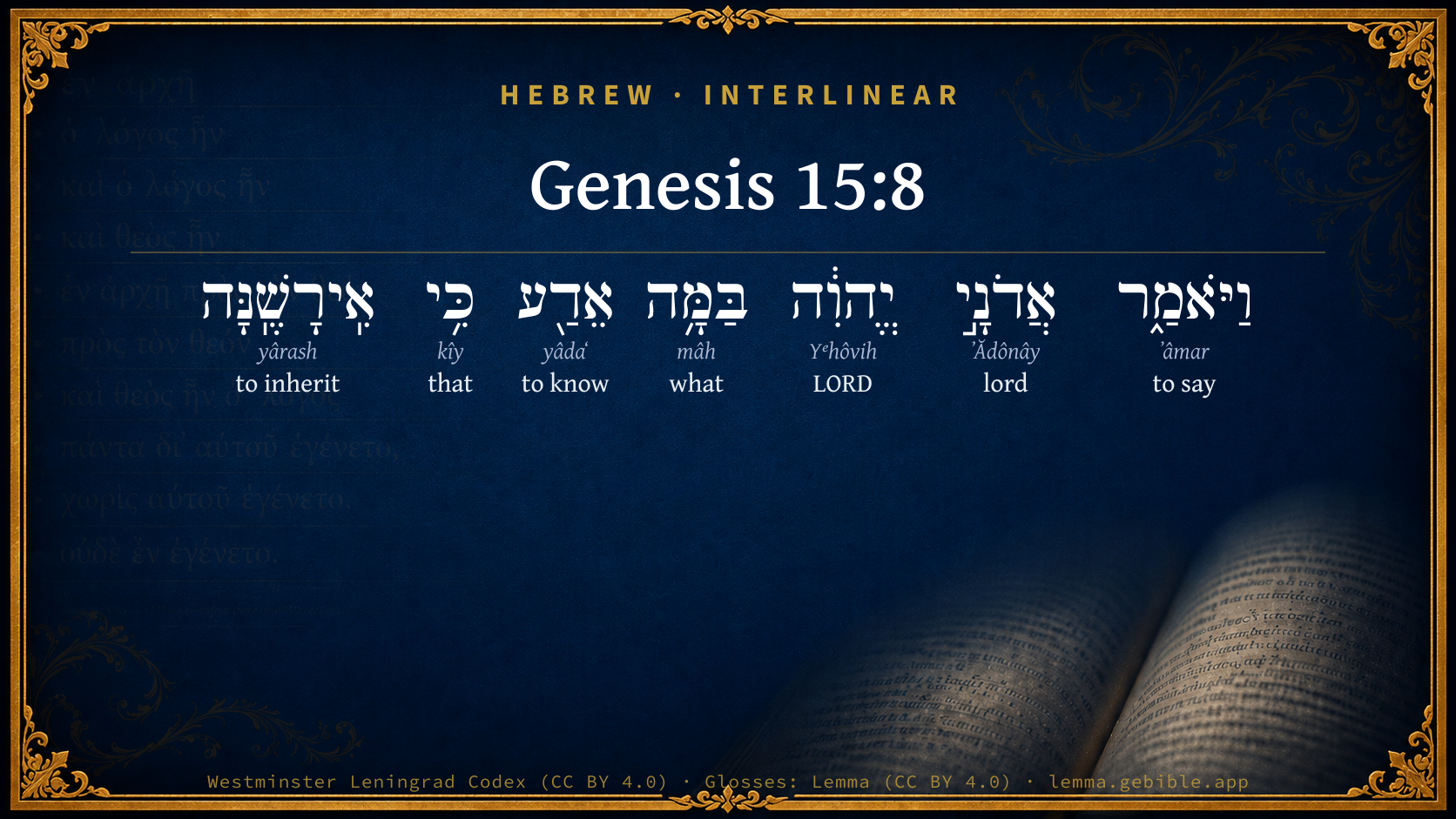
Genesis 15:8

Hebrew (Westminster Leningrad Codex) Genesis 15:8 appears in the Hebrew Old Testament. The text above is from the Westminster Leningrad Codex. Each word links to its Strong’s number, a concise gloss, and parsing drawn from the Open Scriptures Hebrew Bible morphology. Click any word for its full Brown-Driver-Briggs (BDB) entry.
Download image
Cite this verse

Genesis 15:8 (World English Bible). Public Domain. Lemma interlinear Bible study tool, https://lemma.gebible.app/v/genesis/15/8.

Show BibTeX & RIS
BibTeX
RIS
English Translation
He said, "Lord Yahweh, how will I know that I will inherit it?"
World English Bible · Public Domain
Download a study sheet

One document with this verse’s original text, its word-by-word gloss line, the meaning frame, cross-references with their text, attributed commentary, and full source and license credits — printable, and it pastes into notes with its structure intact.

This verse Autodidact and up

Study sheet (.html) Plain text (.txt)

A passage Seminary Student

Up to 50 verses in one chapter. A passage sheet keeps up to 6 commentary sources and 12 cross-references per verse, in the order this page ranks them, and says so on the sheet whenever that leaves anything out. Ask for a single verse and you get the Autodidact verse sheet above.

Everything on this page stays free to read, with no account — the sheet is a download of what is already on screen, not access to it.

Want to remove ads? Support Godless Engineer
Compare translations 3

The same verse in 3 English versions, stacked beneath the original-language interlinear above. Click any original word for its lexicon entry.

Each is an independent rendering of the whole verse — the interlinear is not word-aligned to these translations.

Highlighted words mark where these versions differ — a whole-verse word diff, not a word-by-word alignment.

  • World English Bible Public Domain
    He said, "Lord Yahweh, how will I know that I will inherit it?"
  • King James Version Public Domain
    And he said, LORD God, whereby shall I know that I shall inherit it?
  • unfoldingWord Literal Text CC BY-SA 4.0
    Then he said, “My Lord Yahweh, how will I know that I will possess it?”

unfoldingWord Literal Text — © unfoldingWord, licensed CC BY-SA 4.0. Word-aligned USFM3 via Door43 (git.door43.org/unfoldingWord/en_ult).

Versions to compare (up to 4)

3 of 4 selected

Show all 18 translations

Every available English version of this verse, each an independent rendering of the whole verse.

  • World English Bible Public Domain
    He said, "Lord Yahweh, how will I know that I will inherit it?"
  • Berean Standard Bible Public Domain
    But Abram replied, “Lord GOD, how can I know that I will possess it?”
  • Majority Standard Bible Public Domain
    But Abram replied, “Lord GOD, how can I know that I will possess it?”
  • King James Version Public Domain
    And he said, LORD God, whereby shall I know that I shall inherit it?
  • American Standard Version (1901) Public Domain
    And he said, O Lord Jehovah, whereby shall I know that I shall inherit it?
  • Revised Version (1885) Public Domain
    And he said, O Lord GOD, whereby shall I know that I shall inherit it?
  • Geneva Bible (1599) Public Domain
    And he said, O Lord God, whereby shall I knowe that I shall inherite it?
  • Douay-Rheims (1899) Public Domain
    But he said: Lord God, whereby may I know that I shall possess it?
  • Young's Literal Translation Public Domain
    and he saith, `Lord Jehovah, whereby do I know that I possess it?'
  • Literal Standard Version CC BY-SA 4.0
    and he says, “Lord YHWH, whereby do I know that I possess it?”
  • Unlocked Literal Bible CC BY-SA 4.0
    He said, “Lord Yahweh, how will I know that I will inherit it?”
  • unfoldingWord Literal Text CC BY-SA 4.0
    Then he said, “My Lord Yahweh, how will I know that I will possess it?”
  • Darby Bible Public Domain
    And he said, Lord Jehovah, how shall I know that I shall possess it?
  • World Messianic Bible Public Domain
    He said, “Lord GOD, how will I know that I will inherit it?”
  • Webster's Bible Public Domain
    And he said, Lord GOD, by what shall I know that I shall inherit it?
  • Free Bible Version CC BY-SA 4.0
    “But Lord God, how can I be certain that I will own it?” Abram asked.
  • Bible in Basic English Public Domain
    And he said, O Lord God, how may I be certain that it will be mine?
  • JPS Tanakh (1917) Public Domain
    And he said: 'O Lord GOD, whereby shall I know that I shall inherit it?'

Literal Standard Version (2020), Covenant Press — licensed CC BY-SA 4.0. Text via the HelloAO Bible API (eBible.org). Unlocked Literal Bible (unfoldingWord) — licensed CC BY-SA 4.0. Text via the HelloAO Bible API (eBible.org). unfoldingWord Literal Text — © unfoldingWord, licensed CC BY-SA 4.0. Word-aligned USFM3 via Door43 (git.door43.org/unfoldingWord/en_ult). Free Bible Version, Dr. Jonathan Gallagher — licensed CC BY-SA 4.0. Text via the HelloAO Bible API (eBible.org).

Word by word

More ways to search: Search by grammar → Find every occurrence → Compare this word →

Practice this passage: Drill this verse → Learn its vocabulary →

אִֽירָשֶֽׁנָּה
yârash
H3423
“to inherit · her”
Verb, Qal, Imperfect, 1st Person, Common, Singular + Suffix, Personal, 3rd Person, Feminine, Singular
Part of Speech
Verb
Stem
Qal
Form
Imperfect
Person
1st Person
Gender
Common
Number
Singular
Full BDB Definition

Origin: a primitive root

TWOT: 920

to seize, dispossess, take possession off, inherit, disinherit, occupy, impoverish, be an heir - (Qal) - to take possession of - to inherit - to impoverish, come to poverty, be poor - (Niphal) to be dispossessed, be impoverished, come to poverty - (Piel) to devour - (Hiphil) - to cause to possess or inherit - to cause others to possess or inherit - to impoverish - to dispossess - to destroy, bring to ruin, disinherit
  1. וַיֹּאמַ֑ר ʼâmar H559 “and · to say” Conjunction + Verb, Qal, Sequential Imperfect, 3rd Person, Masculine, Singular
  2. אֲדֹנָ֣י ʼĂdônây H136 “Lord · my” Noun, Common, Masculine, Plural, Construct + Suffix, Personal, 1st Person, Common, Singular
  3. יֱהוִ֔ה Yᵉhôvih H3069 “LORD” Noun, Proper
  4. בַּמָּ֥ה mâh H4100 “in/at · what” Preposition + Particle, Interrogative
  5. אֵדַ֖ע yâdaʻ H3045 “to know” Verb, Qal, Imperfect, 1st Person, Common, Singular
  6. כִּ֥י kîy H3588 “that” Conjunction

About this verse

These counts appear in no published source. They are computed here, from the morphology-tagged text and Lemma’s own curated glosses. What Lemma adds →

7
words
7
distinct lemmas
Pentateuch
section

Grammatical profile

  • 3 verbs
  • 2 nouns
  • 1 conjunction
  • 1 particle

Verb forms

  • וַיֹּאמַ֑ר Qal · Sequential Imperfect
  • אֵדַ֖ע Qal · Imperfect
  • אִֽירָשֶֽׁנָּה Qal · Imperfect

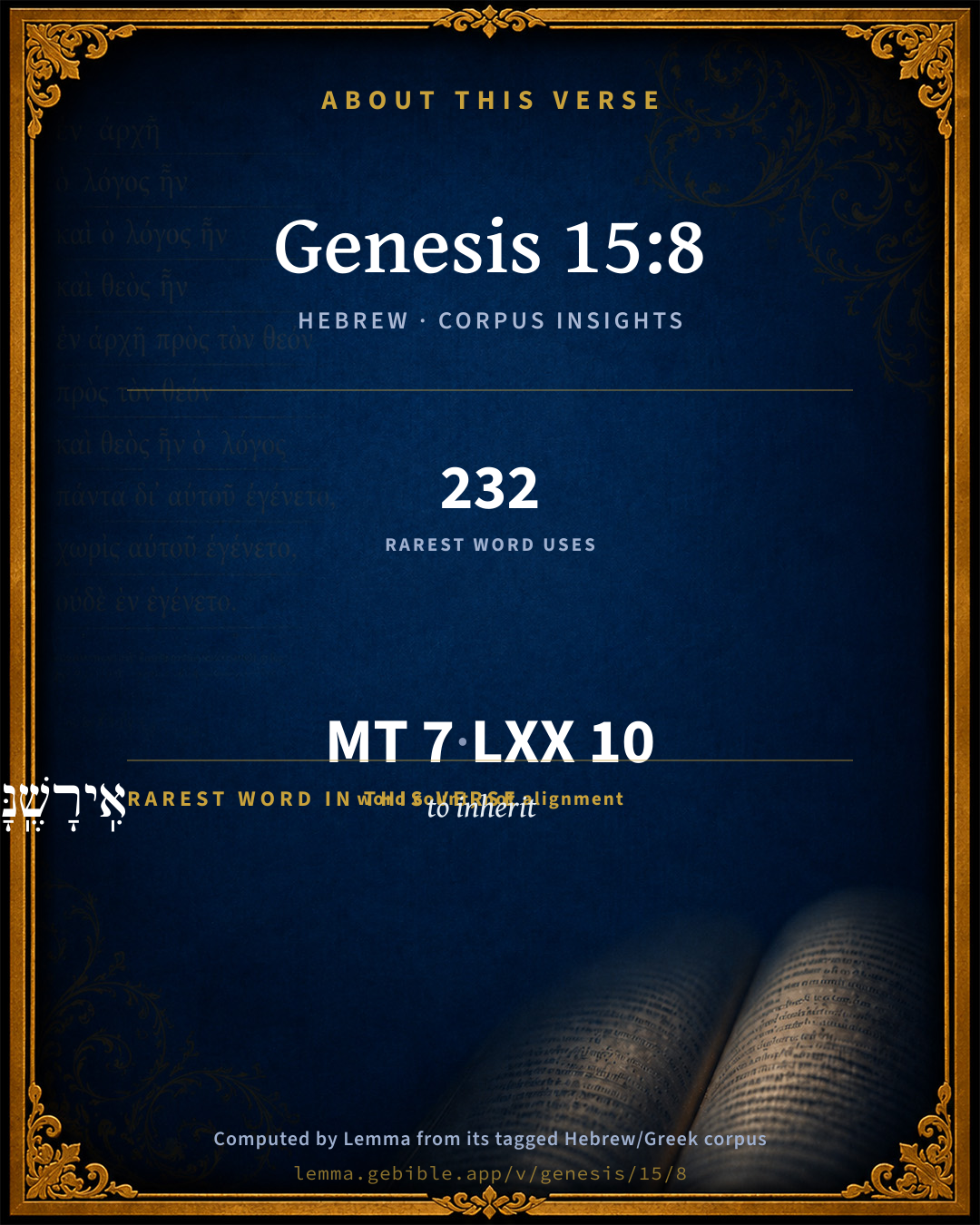
Hebrew & Septuagint length

In English translation the verse runs 13 words from the Hebrew and 15 from the Septuagint (LXX English) — closely comparable.

A rough comparison of the two English renderings, which tokenize alike — not a word-level alignment.

Word counts can differ between the Hebrew and the Greek without any difference in meaning — e.g. the Hebrew direct-object marker אֵת has no separate Greek word, and Greek often adds the article ὁ.

In the original languages it is 7 Hebrew tokens and 10 Greek tokens — but the two are counted differently (Hebrew bundles its prefixes and suffixes into one token; the Greek is in lemma form), so that isn’t a like-for-like length.

Cross-references

10

Topical passages linked to Genesis 15:8 in the Treasury of Scripture Knowledge — connected by theme and wording, ordered by reader-vote popularity; previews shown in the World English Bible.

  • Luke 1:18 Zacharias said to the angel, "How can I be sure of this? For I am an old man, and my wife is well advanced in years."
  • Luke 1:34 Mary said to the angel, "How can this be, seeing I am a virgin?"
  • 2 Kings 20:8 Hezekiah said to Isaiah, What shall be the sign that Yahweh will heal me, and that I shall go up to the house of Yahweh the third day?
  • Isaiah 7:11 "Ask a sign of Yahweh your God; ask it either in the depth, or in the height above."
  • Judges 6:17–24 He said to him, If now I have found favor in your sight, then show me a sign that it is you who talk with me.
  • Judges 6:36–40 Gideon said to God, If you will save Israel by my hand, as you have spoken,
  • Psalms 86:17 Show me a sign of your goodness, That those who hate me may see it, and be shamed, Because you, Yahweh, have helped me, and comforted me.
  • Genesis 24:2–4 Abraham said to his servant, the elder of his house, who ruled over all that he had, "Please put your hand under my thigh.
  • Genesis 24:13–14 Behold, I am standing by the spring of water. The daughters of the men of the city are coming out to draw water.
  • 1 Samuel 14:9–10 If they say thus to us, Wait until we come to you; then we will stand still in our place, and will not go up to them.

Cross-references courtesy of OpenBible.info (CC BY 4.0).

Hebrew and Greek witnesses Masoretic Hebrew ↔ Greek Septuagint

The same verse in the two great witnesses to the Old Testament, shown verse-for-verse.

These are two independent witnesses, not word-aligned to each other, and the Septuagint is shown in lemma (dictionary) form.

Hebrew Genesis 15:8 Masoretic · Westminster Leningrad Codex

וַיֹּאמַ֑ר אֲדֹנָ֣י יֱהוִ֔ה בַּמָּ֥ה אֵדַ֖ע כִּ֥י אִֽירָשֶֽׁנָּה

He said, "Lord Yahweh, how will I know that I will inherit it?"

World English Bible · Public Domain

Greek LXX Genesis 15:8 Septuagint · lemma form

εἶπον δέ δεσπότης κύριος κατά τίς γιγνώσκω ὅτι κληρονομέω αὐτός

And he said, Master and Lord, how shall I know that I shall inherit it?

LXX2012 (modern English Septuagint) · Public Domain

Hebrew: Westminster Leningrad Codex (CC BY 4.0). Greek: Septuagint (public domain); English from LXX2012 (modern English Septuagint) (Public Domain). How the Septuagint differs from the Hebrew →

Targum (Aramaic paraphrase)

2

The Targum is the ancient Jewish Aramaic paraphrase of the Hebrew Scriptures — an interpretive translation, not the Hebrew text itself. Onkelos (literal) and Pseudo-Jonathan (expansive) render the Torah, and Jonathan the Prophets. Coverage is partial: where no permissively-licensed English translation exists for a verse, only the Aramaic is shown. This is verse-level text, not a word-by-word alignment to the Hebrew.

  1. Targum Onkelos Torah (Genesis–Deuteronomy)
    וַאֲמָר יְיָ אֱלֹהִים בְּמָה אִידַע אֲרֵי אֵרְתִנַהּ

    (no public-domain English translation for this verse)

    Targum Onkelos — Aramaic: “Onkelos Genesis” (public domain); “Onkelos Exodus” (public domain); “Onkelos Leviticus” (public domain); “Onkelos Numbers” (public domain); “Onkelos Deuteronomy” (public domain). English: “Sefaria Community Translation” (CC0 1.0 (public-domain dedication)); “J.W. Etheridge. The Targums of Onkelos and Jonathan Ben Uzziel on the Pentateuch. London: Longmans, Green, 1862” (public domain). Text via Sefaria.

  2. Targum Pseudo-Jonathan Torah (Genesis–Deuteronomy)
    וַאֲמַר יְיָ אֱלֹהִים בְּמָה אִינְדַע אֲרוּם אִירְתִינֵהּ

    And he said, Lord God, by what may I know that I shall be the heir of it?

    Targum Pseudo-Jonathan — Aramaic: “Targum Jonathan on Genesis” (public domain); “Targum Jonathan on Exodus” (public domain); “Targum Jonathan on Leviticus” (public domain); “Targum Jonathan on Numbers” (public domain); “Targum Jonathan on Deuteronomy” (public domain). English: “The Targum of Jonathan ben Uzziel, trans. J. W. Etheridge, London, 1862” (public domain). Text via Sefaria.

Commentary

Notes on Genesis 15:8 from classic Christian and Jewish commentators (each source and its license shown beneath its notes). The classic Christian expositions comment on the surrounding passage and are grouped to its opening verse, so a note may address several verses; the Jewish commentaries on the Tanakh (Rashi and others) are per-verse, so they appear only where the commentator wrote on this verse.

Lemma curates 59 commentaries, every one of them public domain or Creative Commons licensed, each selected and text-cleaned for this edition rather than reprinted as found. About our sources →

Trapp's Complete Commentary

John Trapp

Gen 15:8 And he said, Lord GOD, whereby shall I know that I shall inherit it?

Ver. 8. Lord God, whereby shall I know?] He desires a sign, not that he believed not before, but that he might better believe. How great is God’s love in giving us sacraments, and therein to make himself to us visible, as well as audible

John Trapp, A Commentary or Exposition upon All the Books of the Old and New Testament (1647–1656) — public domain. Text from a community e-Sword module.

Joseph Benson's Commentary

Gen 15:8. Whereby shall I know that I shall inherit it? — This inquiry did not proceed from distrust of God’s power or promise, but he desired a token for the strengthening of his own faith, and for the ratifying of the promise to his posterity, that they also might believe it.

Joseph Benson's Commentary on the Old and New Testaments (1811–1818) — public domain. Text from a community e-Sword module.

Geneva Bible (1599)

Geneva Bible translators

This is a particular motion of God’s Spirit, which is not lawful for all to follow, in asking signs: but was permitted to some by a peculiar motion, as to Gideon and Hezekiah.

Geneva Bible (1599) marginal notes — public domain. Text via Bolls.life.

Adam Clarke's Commentary

Verse 8. And he said, Lord God] אדני יהוה Adonai Yehovah, my Lord Jehovah. Adonai is the word which the Jews in reading always substitute for Jehovah, as they count it impious to pronounce this name. Adonai signifies my director, basis, supporter, prop, or stay; and scarcely a more appropriate name can be given to that God who is the framer and director of every righteous word and action; the basis or foundation on which every rational hope rests; the supporter of the souls and bodies of men, as well as of the universe in general; the prop and stay of the weak and fainting, and the buttress that shores up the building, which otherwise must necessarily fall. This word often occurs in the Hebrew Bible, and is rendered in our translation Lord; the same term by which the word Jehovah is expressed: but to distinguish between the two, and to show the reader when the original is יהוה Yehovah, and when אדני Adonai, the first is always put in capitals, LORD, the latter in plain Roman characters, Lord. For the word Jehovah See Clarke on Ge 2:4, and on "Ex 34:6".

Whereby shall I know] By what sign shall I be assured, that I shall inherit this land? It appears that he expected some sign, and that on such occasions one was ordinarily given.

Adam Clarke's Commentary on the Bible (1810–1826) — public domain. Text from a community e-Sword/MySword module.

John Calvin's Commentaries

8. Lord God, whereby shall I know. It may appear absurd, first, that Abram, who before had placed confidence in the simple word of God, without moving any question concerning the promises given to him, should now dispute whether what he hears from the mouth of God be true or not. Secondly, that he ascribes but little honor to God, not merely by murmuring against him, when he speaks, but by requiring some additional pledge to be given him. Further, whence arises the knowledge which belongs to faith, but from the word? Therefore Abram in vain desires to be assured of the future possession of the land, while he ceases to depend upon the word of God. I answer, the Lord sometimes concedes to his children, that they may freely express any objection which comes into their mind. For he does not act so strictly with them, as not to suffer himself to be questioned. Yea, the more certainly Abram was persuaded that God was true, and the more he was attached to His word, so much the more familiarly did he disburden his cares into God’s bosom. To this may be added, that the protracted delay was no small obstacle to Abram’s faith. For after God had held him in suspense through a great part of his life, now when he was worn down with age, and had nothing before his eyes but death and the grave, God anew declares that he shall be lord of the land. He does not, however, reject, on account of its difficulty, what might have appeared to him incredible, but brings before God the anxiety by which he is inwardly oppressed. And therefore his questioning with God is rather a proof of faith, than a sign of incredulity. The wicked, because their minds are entangled with various conflicting thoughts, do not in any way receive the promises, but the pious, who feel the impediments in their flesh, endeavor to remove them, lest they should obstruct the way to God’s word; and they seek a remedy for those evils of which they are conscious. It is, nevertheless, to be observed, that there were some special impulses in the saints of old, which it would not now be lawful to draw into a precedent. For though Hezekiah and Gideon required certain miracles, this is not a reason why the same thing should be attempted by us in the present day; let it suffice us to seek for such confirmation only as the Lord himself according to his own pleasure, shall judge most eligible.

John Calvin's Commentaries (1540-1563) — public domain. Text from the Calvin Translation Society English edition (1840s-50s) via the Christian Classics Ethereal Library (ccel.org). Calvin's coverage is partial (roughly two-thirds of the Bible); uncommented books and verses are honest gaps, never fabricated. The 19th-century editor's footnotes and remarks are omitted so the notes are faithfully Calvin's own voice.

Ellicott's Commentary for English Readers

(8) Lord God.—Heb., Lord Jehovah, as in Gen_15:2.

Whereby shall I know that I shall inherit it?—Jehovah had required Abram to leave his home in Ur of the Chaldees on a general promise of future endowment with the land of Canaan. Abram now asks this question, not from want of faith, but from a desire for a more direct confirmation of the promise and fuller knowledge of the details. What Abram, therefore, receives is an exact and circumstantial prophecy, made in the form of a solemn covenant.

A Bible Commentary for English Readers, edited by Charles John Ellicott (1878–1897) — public domain. Text from a community e-Sword module.

The Cambridge Bible for Schools and Colleges

gen. ed. J. J. S. Perowne

8. whereby shall I know] Abram requests a sign to assure him of the fulfilment of the promise: cf. the action of Gideon, Jdg_6:17, and of Hezekiah, 2Ki_20:8. On “Lord God,” see note on Gen_15:2.

The Cambridge Bible for Schools and Colleges (gen. ed. J. J. S. Perowne; Cambridge University Press, 1878–1918) — public domain. Text from a community e-Sword module.

John Gill's Exposition

And he said, Lord God, whereby shall I know that I shall inherit it? Not as questioning or doubting whether he should or not; but this he asked for the further confirmation of his faith in the promise, and for the sake of his posterity, that they might more easily and strongly believe that they should inherit the land given and promised to them; nor is it culpable to ask a sign of God with such a view; good men have done it, as Gideon, Jdg 6:36, and Hezekiah, Kg2 20:8, without being blamed for it; yea, Ahaz is blamed for not asking one, Isa 7:10.

.

Genesis 15:9

gen 15:9

gen 15:9

gen 15:9And he said unto him, take me an heifer of three years old,.... This, with what follows, is the sign by which Abram might know that he, that is, his seed, should inherit the land of Canaan; for the whole of this is an emblem of the state and condition of his posterity, until they should enter into that land: wherefore he is ordered to "take" out of his herds and flocks this and the following creatures, which were used in sacrifice before the ceremonial law was given, as well as under it; and the distinction of creatures for sacrifice, though not for food, was known as early, as appears from Gen 8:20; hence Onkelos renders the phrase, "offer before me"; and the Targum of Jonathan is,"take unto me oblations, and offer before me.''Though this difference is to be observed, that the Levitical law required creatures of a year old only to be offered; whereas these were three years old, because they are then at their full growth, and in their full strength and greatest perfection; and such were used among the Heathens for sacrifice; so Lucian (h) represents Ganymedes as proposing to Jupiter, that if he would let her go she would offer a ram of three years old: but it should be remarked, that these creatures here were not taken merely for sacrifice, nor is there any mention made of their being offered; though it is probable they might be offered after they had answered the principal end, which was to be a sign, whereby Abram might know that his seed should inherit the land; but the intention of God was, that as by them Abram's seed might be taught what sort of creatures they were to offer for their sins, so chiefly to show that they themselves would fall a sacrifice to the rage and fury of their enemies, in a land not theirs, and be used as these creatures were: and the number three may denote the three complete centuries in which they would be afflicted, and in the fourth come out safe and whole like the undivided birds, the turtle, dove, and pigeon, to which they were comparable. Ramban (i) thinks, that this number represents the three sorts of sacrifices, the burnt offering, the sin offering, and the peace offering; and that of these three kinds of animals, only one individual of them was taken, and is called "treble", because each individual were joined together. Onkelos renders it three heifers, and so three goats and three rams afterwards; in which he is followed by Jarchi and Ben Melech; the former thinks the three heifers refer to the heifer of the day of atonement, that for uncertain murder, and the red heifer; and in like manner he interprets the three goats and rams; but the Targum of Jonathan, and Aben Ezra, interpret them as we do of creatures of three years old: it follows:

and a she goat of three years old, and a ram of three years old, and a turtledove and a young pigeon. Some Jewish writers (k) have a notion that these creatures represent the four monarchies; the "heifer", the Babylonian monarchy, which had three kings, Nebuchadnezzar, Evilmerodach, and Belshazzar; but others make this to be the fourth monarchy, they call Idumaean or Roman, which is like an heifer at grass, Jer 50:11, which passage better suits with Babylon; the "goat", Media (or Persia), which had three kings, Cyrus, Darius, and Ahasuerus; and the "ram", Grecia; but others say the goat signifies the Grecian monarchy, and the ram the Medo-Persian monarchy, which latter agrees with Dan 8:3; and by the "turtle", the word for which, in the Syriac language, signifies an ox, they understand, some the children of Ishmael, or the Turkish empire, and others Edom, or the Roman: but it is much better to interpret them of Abram's posterity, comparable to these creatures, both for their good and bad qualities; to an "heifer" for laboriousness in service, and patience in sufferings; and for their backslidings, Hos 4:16; to a "goat" for their vicious qualities, their lusts and lasciviousness; and to a "ram", for their strength and fortitude; and to a "turtle", and a young pigeon, for their simplicity, innocence, and harmlessness, when they were in their purest state, see Psa 74:19; and it may be observed, that these were the only fowl used in sacrifice.

(h) Dialogis Deorum. (i) Apud Munster in loc. (k) Vid. Bereshit Rabba, sect. 43. fol. 39. 2. Pirke Eliezer, c. 28.

John Gill's Exposition of the Whole Bible (1746–1763) — public domain (CC PDM 1.0). Text via the HelloAO Bible API.

Haydock's Catholic Bible Commentary

Whereby, &c. Thus the blessed Virgin asked, how shall this be done? Luke i. 34, without the smallest degree of unbelief. Abram wished to know, by what signs he should be declared the lawful owner of the land. (Haydock)

George Leo Haydock (1774–1849), Haydock's Catholic Family Bible and Commentary, 1859 edition — public domain. Excludes Psalms (Douay-Rheims chapter numbering differs from Protestant) and Deuterocanonical books (Catholic canon only).

Matthew Poole's English Annotations

He asks a sign, not out of distrust of God's promise, for he was strong in faith, Rom 4:20, but for further assurance and confirmation of it. And such an asking of a sign was not an unusual practice with good men, as Jdg 6:37; 2Ki 20:8, not are they reproved for it; but on the contrary, Ahaz was commanded to ask a sign, and reproved for not asking it, Isa 7:1-25.

Matthew Poole's English Annotations on the Holy Bible (1683–1685) — public domain. Text from a community e-Sword/MySword module.

Whedon's Commentary on the Bible

Daniel D. Whedon

8. Whereby shall I know — Abram would pass from belief to knowledge. He would have some visible token or sign. “Even where there is much faith, a man may distrust himself; may feel that, though now the belief is strong, yet ere long the first impression, and so the firm conviction, may fade away. Thus Gideon, (Jdg_6:17,) Hezekiah, (2Ki_20:8,) the blessed Virgin, (Luk_1:34,) asked a sign in confirmation of their faith, and, as here to Abram, it was graciously given them.” — Speaker’s Commentary.

Daniel D. Whedon (gen. ed.), Commentary on the Old and New Testaments (1874–1909) — public domain. Text from a community e-Sword module.

The Pulpit Commentary

And he said, Lord God (Adonai Jehovah; vide Ver. 2), whereby shall I know that I shall inherit it? Not the language of doubt, though slight misgivings are not incompatible with faith (cf. 2Ki_20:8; Luk_1:34) and questioning with God "is rather a proof of faith than a sign of incredulity" (Calvin); but of desire for a sign in confirmation of the grant (Luther), either for the strengthening of his own faith (Chrysostom, Augustine, Keil, "Speaker"s Commentary"), or for the sake of his posterity (Jarchi, Michaelis), or for some intimation as to the time and mode of taking possession (Murphy). Rosenm conceives the question put in Abram"s mouth to be only a device of the narrator"s to lead up to the subject following.

The Pulpit Commentary (1880–1919), ed. H.D.M. Spence-Jones & Joseph S. Exell — public domain. Text from a community e-Sword module.

John Wesley's Explanatory Notes

Whereby shall I know that I shall inherit it? - This did not proceed from distrust of God's power or promise, but he desired this,

1. For the strengthening of his own faith. He believed, ver. 6, but here he prays, Lord help me against my unbelief, Now, he believed, but he desired a sign, to be treasured up against an hour of temptation.

2. For the ratifying of the promise to his posterity, that they also might believe it.

John Wesley, Explanatory Notes Upon the Whole Bible (1754–1765) — public domain. Text via the GEBible commentary corpus.

Radak

Rabbi David Kimhi (Radak)

?ויאמר.. במה אדע כי אירשנה, he meant: “how do I know that my son will inherit it?” We have a similar construction in Genesis 48,22 אשר לקחתי מיד האמורי, where Yaakov also does not mean that he, personally, had battled the Emorite, but that his sons had done so successfully. The meaning of the words במה אדע cannot be that the same man who had just been given credit for his utter faith in G’d now has developed doubts, nothing having occurred to cause such doubts. He wanted to know how he could be certain that when his sons, i.e. offspring, would inherit the land that it would remain theirs forever. Perhaps, due to some sin, future generations might forfeit their claim to the land of Canaan, just as the present occupants had forfeited their claim through their sins. Unless they had, why would G’d want to dispossess them? He hoped that just as G’d had shown him the stars as an illustration that his offspring would be people of great substance, so G’d would show him a further illustration of a means by which his offspring would reinforce their title to that land once they had settled in it.

Radak on the Tanakh — English translations: “Sefaria Community Translation” (CC0 1.0 (public-domain dedication)); “Eliyahu Munk, HaChut Hameshulash” (CC BY 4.0); “Rabbi Mike Feuer, Jerusalem Anthology” (CC BY 4.0); and “R. David Kimhi on the first book of Psalms, Translated by R.G. Finch, London, 1919” (public domain). Text via Sefaria.

Lesson kit

Teaching starters — assembled from the data on this page, not authored interpretation. Every prompt links to the verse data it draws on. Edit before teaching.

Genesis, in the Pentateuch, opens this verse with 7 words (7 distinct Hebrew lemmas). Its most distinctive word is yârash (“to inherit”). A historical commentator’s framing appears above. Read the whole chapter for the surrounding context.

Discussion questions

  1. The word yârash carries the sense “to inherit.” How does it shape the verse?
  2. Luke 1:18 shares this passage’s theme. How do the two illuminate each other?
  3. The translations on this page render this verse differently — a whole-verse word diff, not a word-by-word alignment. What might account for the different wordings?
  4. The verb «וַיֹּאמַ֑ר» is Qal Sequential Imperfect. How does its form color the action?
  5. Reading how Trapp's Complete Commentary and Joseph Benson's Commentary read this verse, where do the two commentators agree and where do they part?

Things to notice

Reading settings

Reading text

Shown beneath each verse's original-language words.

Old Testament
Old Testament edition

Read the OT as the Masoretic Hebrew (MT) or the Greek Septuagint (LXX).

English shown for the Greek Septuagint (in the Hebrew ↔ Greek comparison).

Comparing translations? Open the Compare panel on any verse page to stack up to four side by side.