
Numbers 23:3

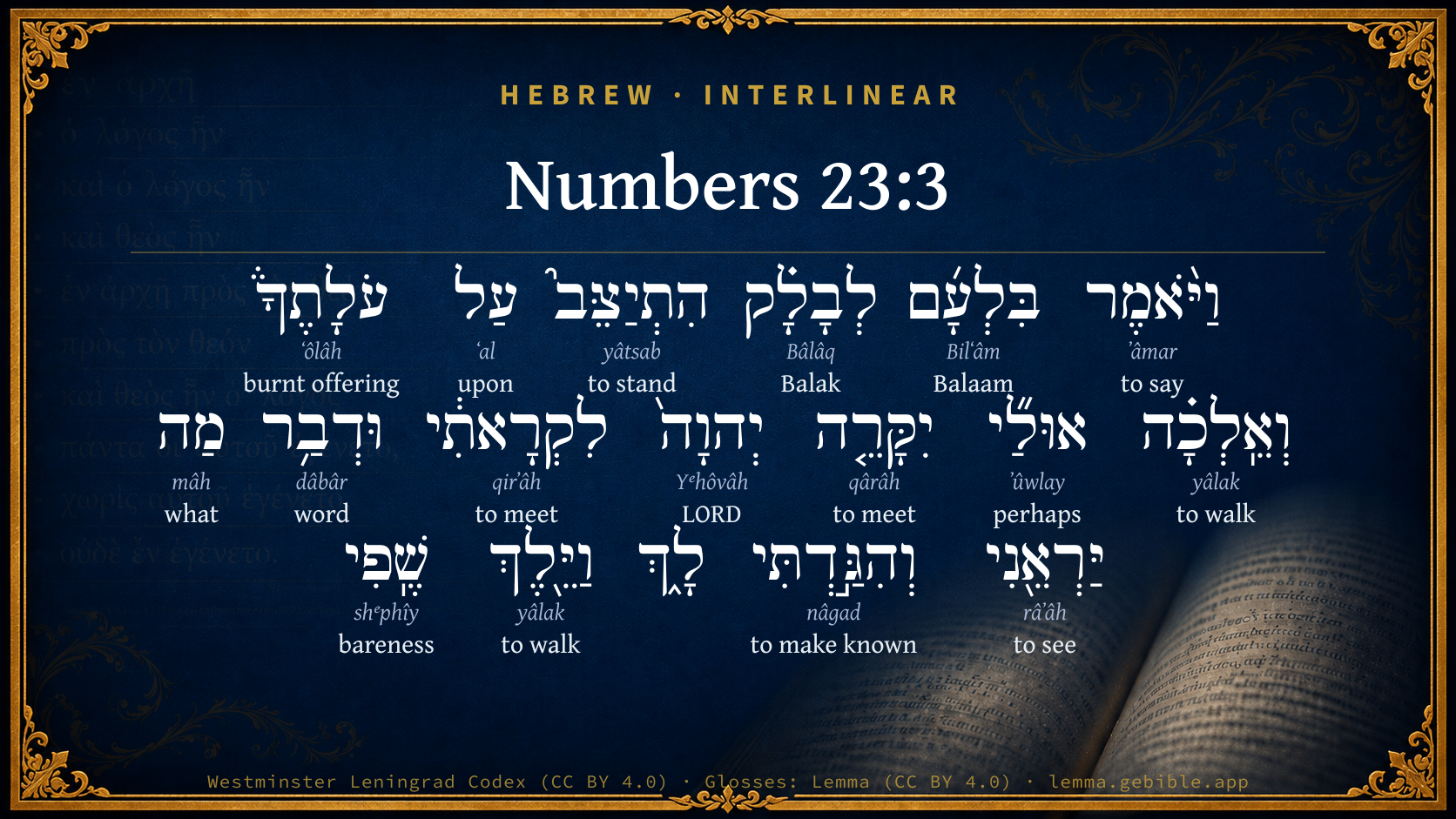
Hebrew (Westminster Leningrad Codex) Numbers 23:3 appears in the Hebrew Old Testament. The text above is from the Westminster Leningrad Codex. Each word links to its Strong’s number, a concise gloss, and parsing drawn from the Open Scriptures Hebrew Bible morphology. Click any word for its full Brown-Driver-Briggs (BDB) entry.
Download image
Cite this verse

Numbers 23:3 (World English Bible). Public Domain. Lemma interlinear Bible study tool, https://lemma.gebible.app/v/numbers/23/3.

Show BibTeX & RIS
BibTeX
RIS
English Translation
Balaam said to Balak, Stand by your burnt offering, and I will go: perhaps Yahweh will come to meet me; and whatever he shows me I will tell you. He went to a bare height.
World English Bible · Public Domain
Highlights
  • 1 first appearance in the Hebrew Bible
Full analysis ↓
Download a study sheet

One document with this verse’s original text, its word-by-word gloss line, the meaning frame, cross-references with their text, attributed commentary, and full source and license credits — printable, and it pastes into notes with its structure intact.

This verse Autodidact and up

Study sheet (.html) Plain text (.txt)

A passage Seminary Student

Up to 50 verses in one chapter. A passage sheet keeps up to 6 commentary sources and 12 cross-references per verse, in the order this page ranks them, and says so on the sheet whenever that leaves anything out. Ask for a single verse and you get the Autodidact verse sheet above.

Everything on this page stays free to read, with no account — the sheet is a download of what is already on screen, not access to it.

Want to remove ads? Support Godless Engineer
Compare translations 3

The same verse in 3 English versions, stacked beneath the original-language interlinear above. Click any original word for its lexicon entry.

Each is an independent rendering of the whole verse — the interlinear is not word-aligned to these translations.

Highlighted words mark where these versions differ — a whole-verse word diff, not a word-by-word alignment.

  • World English Bible Public Domain
    Balaam said to Balak, Stand by your burnt offering, and I will go: perhaps Yahweh will come to meet me; and whatever he shows me I will tell you. He went to a bare height.
  • King James Version Public Domain
    And Balaam said unto Balak, Stand by thy burnt offering, and I will go: peradventure the LORD will come to meet me: and whatsoever he showeth me I will tell thee. And he went to an high place.
  • unfoldingWord Literal Text CC BY-SA 4.0
    And Balaam said to Balak, “Station yourself beside your burnt offering, and let me go. Perhaps Yahweh will meet me, and the word of whatever he makes me see, I will declare to you.” And he went to a bare height.

unfoldingWord Literal Text — © unfoldingWord, licensed CC BY-SA 4.0. Word-aligned USFM3 via Door43 (git.door43.org/unfoldingWord/en_ult).

Versions to compare (up to 4)

3 of 4 selected

Show all 18 translations

Every available English version of this verse, each an independent rendering of the whole verse.

  • World English Bible Public Domain
    Balaam said to Balak, Stand by your burnt offering, and I will go: perhaps Yahweh will come to meet me; and whatever he shows me I will tell you. He went to a bare height.
  • Berean Standard Bible Public Domain
    “Stay here by your burnt offering while I am gone,” Balaam said to Balak. “Perhaps the LORD will meet with me. And whatever He reveals to me, I will tell you.” So Balaam went off to a barren height,
  • Majority Standard Bible Public Domain
    “Stay here by your burnt offering while I am gone,” Balaam said to Balak. “Perhaps the LORD will meet with me. And whatever He reveals to me, I will tell you.” So Balaam went off to a barren height,
  • King James Version Public Domain
    And Balaam said unto Balak, Stand by thy burnt offering, and I will go: peradventure the LORD will come to meet me: and whatsoever he showeth me I will tell thee. And he went to an high place.
  • American Standard Version (1901) Public Domain
    And Balaam said unto Balak, Stand by thy burnt-offering, and I will go: peradventure Jehovah will come to meet me; and whatsoever he showeth me I will tell thee. And he went to a bare height.
  • Revised Version (1885) Public Domain
    And Balaam said unto Balak, Stand by thy burnt offering, and I will go; peradventure the LORD will come to meet me: and whatsoever he sheweth me I will tell thee. And he went to a bare height.
  • Geneva Bible (1599) Public Domain
    Then Balaam sayde vnto Balak, Stande by the burnt offring, and I will goe, if so be that the Lord will come and meete me: and whatsoeuer he sheweth me, I will tell thee: so he went forth alone.
  • Douay-Rheims (1899) Public Domain
    And Balaam said to Balac: Stand a while by thy burnt offering, until I go, to see if perhaps the Lord will meet me, and whatsoever he shall command, I will speak to thee.
  • Young's Literal Translation Public Domain
    and Balaam saith to Balak, `Station thyself by thy burnt-offering and I go on, it may be Jehovah doth come to meet me, and the thing which He sheweth me -- I have declared to thee;' and he goeth `to' a high place.
  • Literal Standard Version CC BY-SA 4.0
    and Balaam says to Balak, “Station yourself by your burnt-offering and I go on, it may be YHWH comes to meet me, and the thing which He shows me I have declared to you”; and he goes [to] a high place.
  • Unlocked Literal Bible CC BY-SA 4.0
    Then Balaam said to Balak, “Stand at your burnt offering and I will go. Perhaps Yahweh will come to meet me. Whatever he shows me I will tell you.” So he went away to a hilltop with no trees.
  • unfoldingWord Literal Text CC BY-SA 4.0
    And Balaam said to Balak, “Station yourself beside your burnt offering, and let me go. Perhaps Yahweh will meet me, and the word of whatever he makes me see, I will declare to you.” And he went to a bare height.
  • Darby Bible Public Domain
    And Balaam said to Balak, Stand by thy burnt-offering, and I will go; perhaps Jehovah will come to meet me; and whatever he shews me I will tell thee. And he went to a hill.
  • World Messianic Bible Public Domain
    Balaam said to Balak, “Stand by your burnt offering, and I will go. Perhaps the LORD will come to meet me. Whatever he shows me I will tell you.” He went to a bare height.
  • Webster's Bible Public Domain
    And Balaam said to Balak, Stand by thy burnt-offering, and I will go: it may be the LORD will come to meet me: and whatever he showeth me I will tell thee. And he went to a high place.
  • Free Bible Version CC BY-SA 4.0
    Balaam said to Balak, “Wait here beside your burnt offering while I go and see if perhaps the Lord will come and meet with me. Whatever he reveals to me, I'll share with you.” Then Balaam left to climb up a rocky crag.
  • Bible in Basic English Public Domain
    Then Balaam said to Balak, Take your place by your burned offering, and I will go and see if the Lord comes to me: and I will give you word of whatever he says to me. And he went to an open place on a hill.
  • JPS Tanakh (1917) Public Domain
    And Balaam said unto Balak: 'Stand by thy burnt-offering, and I will go; peradventure the LORD will come to meet me; and whatsoever He showeth me I will tell thee.' And he went to a bare height.

Literal Standard Version (2020), Covenant Press — licensed CC BY-SA 4.0. Text via the HelloAO Bible API (eBible.org). Unlocked Literal Bible (unfoldingWord) — licensed CC BY-SA 4.0. Text via the HelloAO Bible API (eBible.org). unfoldingWord Literal Text — © unfoldingWord, licensed CC BY-SA 4.0. Word-aligned USFM3 via Door43 (git.door43.org/unfoldingWord/en_ult). Free Bible Version, Dr. Jonathan Gallagher — licensed CC BY-SA 4.0. Text via the HelloAO Bible API (eBible.org).

Word by word

More ways to search: Search by grammar → Find every occurrence → Compare this word →

Practice this passage: Drill this verse → Learn its vocabulary →

שֶֽׁפִי
shᵉphîy
H8205
“bareness”
Noun, Common, Masculine, Singular, Absolute
Part of Speech
Noun
Type
Common
Gender
Masculine
Number
Singular
State
Absolute
Full BDB Definition

Origin: from H8192

TWOT: 2440b

bareness, smooth or bare height, bare place, high places, barren height - bareness - bare place, bare height
  1. וַיֹּ֨אמֶר ʼâmar H559 “and · to say” Conjunction + Verb, Qal, Sequential Imperfect, 3rd Person, Masculine, Singular
  2. בִּלְעָ֜ם Bilʻâm H1109 “Balaam” Noun, Proper
  3. לְבָלָ֗ק Bâlâq H1111 “to/for · Balak” Preposition + Noun, Proper
  4. הִתְיַצֵּב֮ yâtsab H3320 “stand” Verb, Hithpael, Imperative, 2nd Person, Masculine, Singular
  5. עַל ʻal H5921 “upon” Preposition
  6. עֹלָתֶךָ֒ ʻôlâh H5930 “burnt offering · your” Noun, Common, Feminine, Singular, Construct + Suffix, Personal, 2nd Person, Masculine, Singular
  7. וְאֵֽלְכָ֗ה yâlak H3212 “and · to walk” Conjunction + Verb, Qal, Cohortative, 1st Person, Common, Singular
  8. אוּלַ֞י ʼûwlay H194 “perhaps” Adverb
  9. יִקָּרֵ֤ה qârâh H7136 “to meet” Verb, Niphal, Imperfect, 3rd Person, Masculine, Singular
  10. יְהוָה֙ Yᵉhôvâh H3068 “LORD” Noun, Proper
  11. לִקְרָאתִ֔י qirʼâh H7125 “to meet · me” Preposition + Verb, Qal, Infinitive Construct + Suffix, Personal, 1st Person, Common, Singular
  12. וּדְבַ֥ר dâbâr H1697 “and · word of” Conjunction + Noun, Common, Masculine, Singular, Construct
  13. מַה mâh H4100 “what” Particle, Interrogative
  14. יַּרְאֵ֖נִי râʼâh H7200 “to see · me” Verb, Hiphil, Imperfect, 3rd Person, Masculine, Singular + Suffix, Personal, 1st Person, Common, Singular
  15. וְהִגַּ֣דְתִּי nâgad H5046 “and · to make known” Conjunction + Verb, Hiphil, Sequential Perfect, 1st Person, Common, Singular
  16. וַיֵּ֖לֶךְ yâlak H3212 “and · to walk” Conjunction + Verb, Qal, Sequential Imperfect, 3rd Person, Masculine, Singular

About this verse

These counts appear in no published source. They are computed here, from the morphology-tagged text and Lemma’s own curated glosses. What Lemma adds →

18
words
16
distinct lemmas
Pentateuch
section

Notable vocabulary

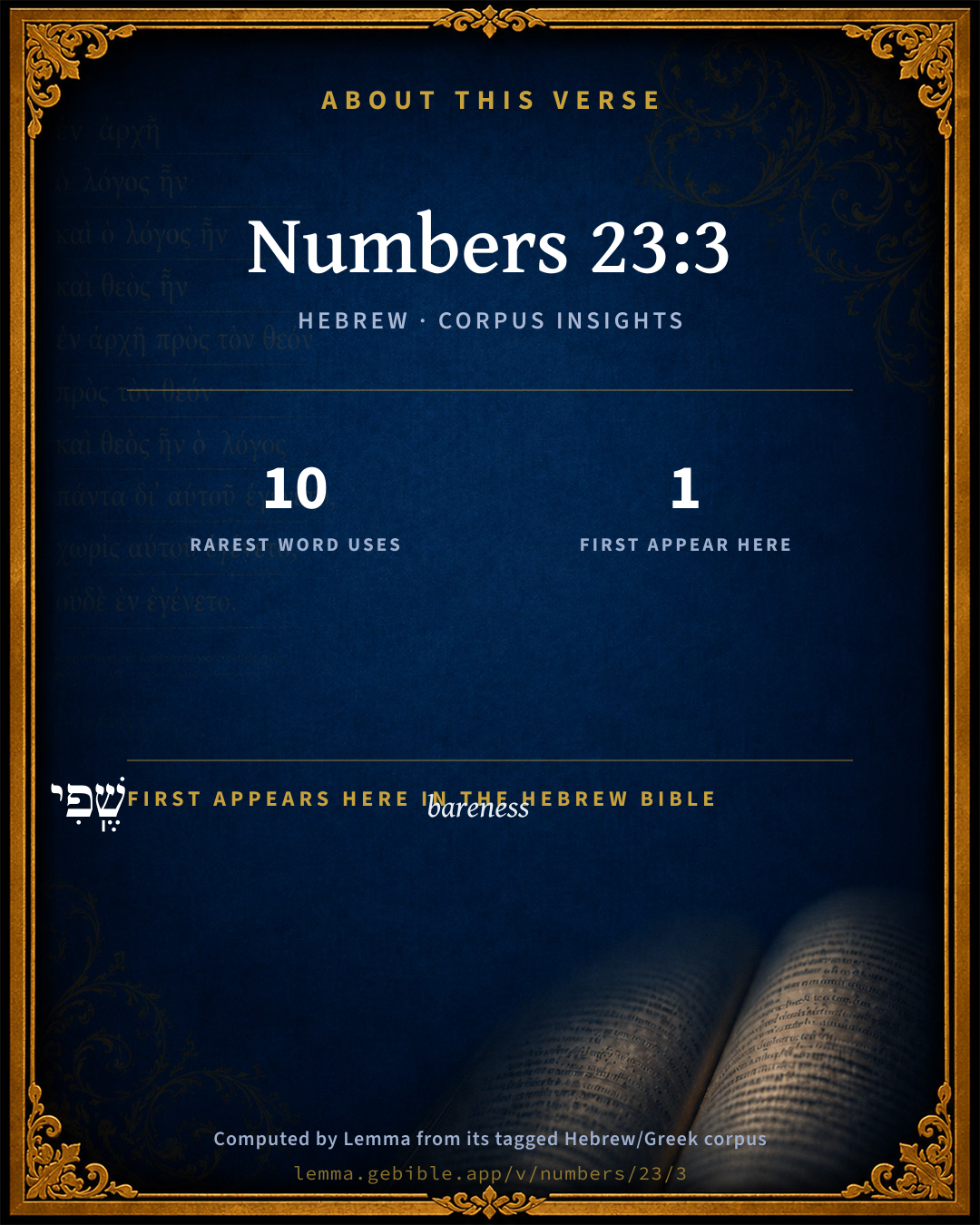
The rarest word here is שֶֽׁפִי bareness H8205 — appearing just 10 times in the whole Hebrew Bible.

First appearance in Scripture

This word makes its first canonical appearance in the Hebrew Bible here:

  • שֶֽׁפִי bareness H8205

Shared distinctive vocabulary

שֶֽׁפִי bareness H8205 occurs in 10 verses of the Hebrew Bible. Also found in:

Grammatical profile

  • 8 verbs
  • 6 nouns
  • 2 prepositions
  • 1 adverb
  • 1 particle

Verb forms

  • וַיֹּ֨אמֶר Qal · Sequential Imperfect
  • הִתְיַצֵּב֮ Hithpael · Imperative
  • וְאֵֽלְכָ֗ה Qal · Cohortative
  • יִקָּרֵ֤ה Niphal · Imperfect
  • לִקְרָאתִ֔י Qal · Infinitive Construct
  • יַּרְאֵ֖נִי Hiphil · Imperfect
  • וְהִגַּ֣דְתִּי Hiphil · Sequential Perfect
  • וַיֵּ֖לֶךְ Qal · Sequential Imperfect

Repetition

A word recurs within this verse — often emphatic in Hebrew:

  • וְאֵֽלְכָ֗ה to walk H3212 ×2

Hebrew & Septuagint length

In English translation the verse runs 35 words from the Hebrew and 43 from the Septuagint (LXX English) — closely comparable.

A rough comparison of the two English renderings, which tokenize alike — not a word-level alignment.

Word counts can differ between the Hebrew and the Greek without any difference in meaning — e.g. the Hebrew direct-object marker אֵת has no separate Greek word, and Greek often adds the article ὁ.

Cross-references

10

Topical passages linked to Numbers 23:3 in the Treasury of Scripture Knowledge — connected by theme and wording, ordered by reader-vote popularity; previews shown in the World English Bible.

  • Numbers 23:15 He said to Balak, Stand here by your burnt offering, while I meet [Yahweh] yonder.
  • Genesis 8:20 Noah built an altar to Yahweh, and took of every clean animal, and of every clean bird, and offered burnt offerings on the altar.
  • Genesis 22:2 He said, "Now take your son, your only son, whom you love, even Isaac, and go into the land of Moriah. Offer him there for a burnt offering on one of the mountains which I will tell you of."
  • Genesis 22:7–8 Isaac spoke to Abraham his father, and said, "My father?" He said, "Here I am, my son." He said, "Here is the fire and the wood, but where is the lamb for a burnt offering?"
  • Genesis 22:13 Abraham lifted up his eyes, and looked, and saw that behind him was a ram caught in the thicket by his horns. Abraham went and took the ram, and offered him up for a burnt offering instead of his son.
  • Leviticus 1:1 Yahweh called to Moses, and spoke to him out of the Tent of Meeting, saying,
  • Numbers 22:31–35 Then Yahweh opened the eyes of Balaam, and he saw the angel of Yahweh standing in the way, with his sword drawn in his hand; and he bowed his head, and fell on his face.
  • Numbers 24:1 When Balaam saw that it pleased Yahweh to bless Israel, he didn't go, as at the other times, to meet with enchantments, but he set his face toward the wilderness.
  • Exodus 18:12 Jethro, Moses' father-in-law, took a burnt offering and sacrifices for God. Aaron came with all of the elders of Israel, to eat bread with Moses' father-in-law before God.
  • Numbers 22:8–9 He said to them, Lodge here this night, and I will bring you word again, as Yahweh shall speak to me: and the princes of Moab abode with Balaam.

Cross-references courtesy of OpenBible.info (CC BY 4.0).

Hebrew and Greek witnesses Masoretic Hebrew ↔ Greek Septuagint

The same verse in the two great witnesses to the Old Testament, shown verse-for-verse.

These are two independent witnesses, not word-aligned to each other, and the Septuagint is shown in lemma (dictionary) form.

Hebrew Numbers 23:3 Masoretic · Westminster Leningrad Codex

וַיֹּ֨אמֶר בִּלְעָ֜ם לְבָלָ֗ק הִתְיַצֵּב֮ עַל עֹלָתֶךָ֒ וְאֵֽלְכָ֗ה אוּלַ֞י יִקָּרֵ֤ה יְהוָה֙ לִקְרָאתִ֔י וּדְבַ֥ר מַה יַּרְאֵ֖נִי וְהִגַּ֣דְתִּי לָ֑ךְ וַיֵּ֖לֶךְ שֶֽׁפִי

Balaam said to Balak, Stand by your burnt offering, and I will go: perhaps Yahweh will come to meet me; and whatever he shows me I will tell you. He went to a bare height.

World English Bible · Public Domain

Greek LXX Numbers 23:3 Septuagint · lemma form

καί εἶπον βαλααμ πρός βαλακ παραἵστημι ἐπί ὁ θυσία σύ καί πορεύομαι εἰ ἐγώ φαίνω ὁ θεός ἐν συνάντησις καί ῥῆμα ὅς ἐάν ἐγώ δεικνύω ἀναἀγγέλλω σύ καί παραἵστημι βαλακ ἐπί ὁ θυσία αὐτός καί βαλααμ πορεύομαι ἐπιἐρωτάω ὁ θεός καί πορεύομαι εὐθύς

And Balaam said to Balac, Stand by your sacrifice, and I will go and see if God will appear to me and meet me, and the word which he shall show me, I will report to you. And Balac stood by his sacrifice.

LXX2012 (modern English Septuagint) · Public Domain

Hebrew: Westminster Leningrad Codex (CC BY 4.0). Greek: Septuagint (public domain); English from LXX2012 (modern English Septuagint) (Public Domain). How the Septuagint differs from the Hebrew →

Targum (Aramaic paraphrase)

2

The Targum is the ancient Jewish Aramaic paraphrase of the Hebrew Scriptures — an interpretive translation, not the Hebrew text itself. Onkelos (literal) and Pseudo-Jonathan (expansive) render the Torah, and Jonathan the Prophets. Coverage is partial: where no permissively-licensed English translation exists for a verse, only the Aramaic is shown. This is verse-level text, not a word-by-word alignment to the Hebrew.

  1. Targum Onkelos Torah (Genesis–Deuteronomy)
    וַאֲמַר בִּלְעָם לְבָלָק אִתְעַתֵּד עַל עֲלָתָךְ וְאֵיהַךְ מָאִים יְעָרַע מֵימַר מִן קֳדָם יְיָ לָקֳדָמוּתִי וּפִתְגָמָא דְיַחֲזִנַנִי וְאֵחַוֵי לָךְ וַאֲזַל יְחִידִי

    (no public-domain English translation for this verse)

    Targum Onkelos — Aramaic: “Onkelos Genesis” (public domain); “Onkelos Exodus” (public domain); “Onkelos Leviticus” (public domain); “Onkelos Numbers” (public domain); “Onkelos Deuteronomy” (public domain). English: “Sefaria Community Translation” (CC0 1.0 (public-domain dedication)); “J.W. Etheridge. The Targums of Onkelos and Jonathan Ben Uzziel on the Pentateuch. London: Longmans, Green, 1862” (public domain). Text via Sefaria.

  2. Targum Pseudo-Jonathan Torah (Genesis–Deuteronomy)
    וַאֲמַר בִּלְעָם לְבָלָק אִתְעַתַּד עַל עֲלָתָךְ וְאֵיהַךְ וְדִלְמָא יִזְדְמַן מֵימְרָא דַיְיָ לְקָדָמוּתִי וּפִתְגָם מָה דִיחַוֵי לִי וְאֵיתְנֵיהּ לָךְ וְאָזִיל גָחִין כְּחִיוְיָא

    And Bileam said to Balak, Stand by thy burnt offering, and I will go, if preadventure the Word of the Lord may come to meet me; and the word that shall be discovered to me, that I will declare to thee. And he went, bending as a serpent.

    Targum Pseudo-Jonathan — Aramaic: “Targum Jonathan on Genesis” (public domain); “Targum Jonathan on Exodus” (public domain); “Targum Jonathan on Leviticus” (public domain); “Targum Jonathan on Numbers” (public domain); “Targum Jonathan on Deuteronomy” (public domain). English: “The Targum of Jonathan ben Uzziel, trans. J. W. Etheridge, London, 1862” (public domain). Text via Sefaria.

Commentary

Notes on Numbers 23:3 from classic Christian and Jewish commentators (each source and its license shown beneath its notes). The classic Christian expositions comment on the surrounding passage and are grouped to its opening verse, so a note may address several verses; the Jewish commentaries on the Tanakh (Rashi and others) are per-verse, so they appear only where the commentator wrote on this verse.

Lemma curates 59 commentaries, every one of them public domain or Creative Commons licensed, each selected and text-cleaned for this edition rather than reprinted as found. About our sources →

Trapp's Complete Commentary

John Trapp

Num 23:3 And Balaam said unto Balak, Stand by thy burnt offering, and I will go: peradventure the LORD will come to meet me: and whatsoever he sheweth me I will tell thee. And he went to an high place.

Ver. 3. Stand by thy burnt offering.] Or, Present thyself, to see if God will accept thy person.

John Trapp, A Commentary or Exposition upon All the Books of the Old and New Testament (1647–1656) — public domain. Text from a community e-Sword module.

Joseph Benson's Commentary

Num 23:3. Stand by thy burnt-offering — As in God’s presence; as one that offers himself, as well as his sacrifices, to obtain God’s favour. I will go — To some solitary and convenient place, where I may prevail with God to appear to me. From this passage it is inferred, that in those early times it was customary for prophets, and other pious persons, after performing the sacred rites, to retire into some solitary place, there to wait for an answer from God. Whatsoever he showeth me — Reveals to me, either by word or sign. He went to a high place — Some, considering that he was already in a high place, would render it, He went into the plain, or valley. But it must be observed the original word שׁפי, shephi, from שׁפהshephah, eminere, eminens, excelsum esse, properly means, a high and rocky place. See Hebrew, Isa 13:2; Jer 3:2. And, no doubt, Balaam ascended into a higher part of the mountain, for the greater convenience of retirement, and beholding Israel, as he says, (Num 23:9,) From the top of the rocks I see him.

Joseph Benson's Commentary on the Old and New Testaments (1811–1818) — public domain. Text from a community e-Sword module.

Geneva Bible (1599)

Geneva Bible translators

Or, went up higher.

Geneva Bible (1599) marginal notes — public domain. Text via Bolls.life.

Jamieson, Fausset & Brown

Robert Jamieson, A. R. Fausset & David Brown

Stand by thy burnt offering--as one in expectation of an important favor.

peradventure the Lord will come to meet me: and whatsoever he showeth me--that is, makes known to me by word or sign.

he went to an high place--apart by himself, where he might practise rites and ceremonies, with a view to obtain a response of the oracle.

Jamieson, Fausset & Brown — Commentary Critical and Explanatory on the Whole Bible (1871) — public domain (CC PDM 1.0). Text via the HelloAO Bible API.

Adam Clarke's Commentary

Verse 3. Stand by thy burnt-offering] We have already seen that blessing and cursing in this way were considered as religious rites, and therefore must be always preceded by sacrifice. See this exemplified in the case of Isaac, before he blessed Jacob and Esau, Ge 27:19; Ge 27:28-29; Ge 27:33-40, and the notes there. The venison that was brought to Isaac, of which he did eat, was properly the preparatory sacrifice.

Adam Clarke's Commentary on the Bible (1810–1826) — public domain. Text from a community e-Sword/MySword module.

Ellicott's Commentary for English Readers

(3) To an high place.—Rather, to a bare or barren height The heathen augurs were accustomed to choose elevated places for their auspices with an extensive prospect, especially the barren summits of mountains.

A Bible Commentary for English Readers, edited by Charles John Ellicott (1878–1897) — public domain. Text from a community e-Sword module.

The Cambridge Bible for Schools and Colleges

gen. ed. J. J. S. Perowne

3. Balaam went some distance away, in the hope that Jehovah would meet him. It is not necessary to suppose that he went to practise enchantments like a soothsayer, e.g. to watch the clouds or the flight of birds. Jehovah had already spoken to him when he was in his own home, and he might expect Him to do so again. In the following verse, indeed, Balaam claims that in the seven-fold sacrifice he has already taken the necessary means to obtain a message.

he went to a bare height] It is not clear why he should choose a bare height. The word is perhaps corrupt. A.V. ‘a high place,’ and marg. ‘solitary’ are wrong.

The Cambridge Bible for Schools and Colleges (gen. ed. J. J. S. Perowne; Cambridge University Press, 1878–1918) — public domain. Text from a community e-Sword module.

John Gill's Exposition

And Balaam said unto Balak, stand by thy burnt offering,.... By which it appears that the sacrifices offered were of this sort, and there might be one, which was more peculiarly the burnt offering of Balak; though he might be more or less with Balaam concerned in them all; at which he was directed to stand while it was burning, presenting that and himself to the Lord, that he would have respect to both:

and I will go; depart from thence, at some little distance, unto some private place:

peradventure the Lord will come to meet me; upon the offering of these sacrifices to him, though he could not be certain of it, he having lately shown some displeasure and resentment unto him; and this was also in the daytime, when it was in the night he usually came unto him:

and whatsoever he showeth me I will tell thee; the whole of it, truly as it is, whether agreeable or not:

and he went to an high place; but he was in one already, and therefore if this is the sense of the word, he must go to another, into a grove in one of the high places, where he might be retired, and so fit for a divine converse; and the Targum of Onkelos renders it alone: but rather the sense is, that he went into a plain, as De Dieu has shown from the use of the word in the Syriac language; he was upon a high place, and he went down from thence into the plain, perhaps into a cave at the bottom of the hill, a retired place, where he hoped the Lord would meet him, as he did.

John Gill's Exposition of the Whole Bible (1746–1763) — public domain (CC PDM 1.0). Text via the HelloAO Bible API.

Albert Barnes' Notes on the Bible

Balaam apparently expected to mark some phenomenon in the sky or in nature, which he would be able, according to the rules of his art, to interpret as a portent. It was for such “auguries” (not as the King James Version “enchantments” Num 23:23) that he now departed to watch; contrast Num 24:1.

An high place - Or, “A bare place on the hill,” as opposed to the high place with its grove of trees.

Albert Barnes' Notes on the Bible (1834–1885) — public domain. Text from a community e-Sword/MySword module.

Matthew Poole's English Annotations

By thy burnt-offering; as in God’s presence, as one that offers thyself its well as thy sacrifices to obtain his favour. I will go to some solitary and convenient place, where I may by my enchantments prevail with God to appear to me, and to answer thy and my desires in cursing this people.

Whatsoever he showeth me, i.e. reveals to me, either by word or sign.

To an high place; or, into the plain, as that word properly signifies, for he was now in a high place, Num 22:4. But this is not material, it was doubtless some solitary place, where he might use some gestures and ceremonies which he would not have others see, and where he might more reasonably expect to meet with God; for both good and evil spirits most commonly appeared to persons in such places.

Matthew Poole's English Annotations on the Holy Bible (1683–1685) — public domain. Text from a community e-Sword/MySword module.

Whedon's Commentary on the Bible

Daniel D. Whedon

3. Burnt offering — See Lev_1:3, note.

The Lord will come to meet me — In what way he expected the manifestation of Jehovah is seen in Num_24:1 : “He went not to seek for enchantments,” which, after the manner of false prophets, he colours with the name of Jehovah. See Lev_19:26, note. We have here a further commingling of Judaism and paganism — an expectation of a revelation of Jehovah’s will, but through the significant phenomena of nature, because heathenism had no “sure word of prophecy.”

A high place — A bald height. To such high and solitary places soothsayers were accustomed to resort for an observation of the signs.

Daniel D. Whedon (gen. ed.), Commentary on the Old and New Testaments (1874–1909) — public domain. Text from a community e-Sword module.

The Pulpit Commentary

Peradventure the Lord will come to meet me. It might be concluded from Num_24:1 that Balaam went only to look for "auguries," i.e., for such natural signs in the flight of birds and the like as the heathen were wont to observe as manifestations of the favour or disfavour of God, the success or failure of enterprises. It seems clear that it was his practice to do so, either as having some faith himself in such uncertainties, or as stooping to usual heathen arts which he inwardly despised. But from the fact that God met him (we know not how), and that such supernatural communication was not unexpected, we may conclude that Balaam"s words meant more for himself than the mere observance of auguries, whatever they may have meant for Balak. To a high place. Rather, "to a bald place" (ypiv, compare the meaning of "Calvary"), from which the immediate prospect was uninterrupted.

The Pulpit Commentary (1880–1919), ed. H.D.M. Spence-Jones & Joseph S. Exell — public domain. Text from a community e-Sword module.

John Wesley's Explanatory Notes

Stand by thy burnt-offering - As in God's presence, as one that offers thyself as well as thy sacrifices to obtain his favour. I will go - To some solitary and convenient place, where I may prevail with God to appear to me. Sheweth me - Reveals to me, either by word or sign. An high place - Or, into the plain, as that word properly signifies.

John Wesley, Explanatory Notes Upon the Whole Bible (1754–1765) — public domain. Text via the GEBible commentary corpus.

Keil & Delitzsch

C. F. Keil & F. Delitzsch

After the offering of the sacrifices, Balaam directed the king to stand by his burnt-offering, i.e., by the sacrifices that had been offered for him upon the seven altars, that he might go out for auguries. The meaning of the words, "I will go, peradventure Jehovah will come to meet me," is apparent from Num 24:1 : and "he went no more to meet with the auguries" (נחשׁים, see at Lev 19:26). Balaam went out to look for a manifestation of Jehovah in the significant phenomena of nature. The word which Jehovah should show to him, he would report to Balak. We have here what is just as characteristic in relation to Balaam's religious stand-point, as it is significant in its bearing upon the genuine historical character of the narrative, namely, an admixture of the religious ideas of both the Israelites and the heathen, inasmuch as Balaam hoped to receive or discover, in the phenomena of nature, a revelation from Jehovah. Because heathenism had no "sure word of prophecy," it sought to discover the will and counsel of God, which are displayed in the events of human history, through various signs that were discernible in natural phenomena, or, as Chryssipus the Stoic expresses it in Cicero de divin. ii. 63, "Signa quae a Diis hominibus portendantur."

(Note: See the remarks of Ngelsbach and Hartung on the nature of the heathen auspices, in Hengstenberg's Balaam and his Prophecies (pp. 396-7). Hartung observes, for example: "As the gods did not live outside the world, or separated from it, but the things of time and space were filled with their essence, it followed, as a matter of course, that the signs of their presence were sought and seen in all the visible and audible occurrences of nature, whether animate or inanimate. Hence all the phenomena which affected the senses, either in the elements or in the various creatures, whether sounds or movements, natural productions or events, of a mechanical or physical, or voluntary or involuntary kind, might serve as the media of revelation." And again (p. 397): "The sign in itself is useless, if it be not observed. It was therefore necessary that man and God should come to meet one another, and that the sign should not merely be given, but should also be received.")

To look for a word of Jehovah in this way, Balaam betook himself to a "bald height." This is the only meaning of שׁפי, from שׁפה, to rub, to scrape, to make bare, which is supported by the usage of the language; it is also in perfect harmony with the context, as the heathen augurs were always accustomed to select elevated places for their auspices, with an extensive prospect, especially the towering and barren summits of mountains that were rarely visited by men (see Hengstenberg, ut sup.). Ewald, however, proposes the meaning "alone," or "to spy," for which there is not the slightest grammatical foundation.

Keil & Delitzsch — Biblical Commentary on the Old Testament (1861–1891) — public domain (CC PDM 1.0). Text via the HelloAO Bible API. (Old Testament only.)

Rashi

Rabbi Shlomo Yitzchaki (Rashi)

'אולי יקרה ה‎‎ לקראתי PERHAPS THE LORD WILL HAPPEN TO MEET ME — Perhaps: He is not accustomed to speak with me by day.

וילך שפי AND HE WENT שפי — Understand this as the Targum does: “alone”; it is an expression denoting ease and tranquillity; the statement means that there was nothing with him except silence (nothing to disturb him).

Rashi on the Tanakh — English translations: “The Judaica Press complete Tanach with Rashi, translated by A. J. Rosenberg” (CC BY 4.0); “Pentateuch with Rashi's commentary by M. Rosenbaum and A.M. Silbermann, 1929-1934” (public domain); “The Metsudah Tanach series, Lakewood, N.J” (CC BY 4.0); and “The Book of Joshua, Metsudah Publications, 1997” (CC BY 4.0). Text via Sefaria.

Lesson kit

Teaching starters — assembled from the data on this page, not authored interpretation. Every prompt links to the verse data it draws on. Edit before teaching.

Numbers, in the Pentateuch, opens this verse with 18 words (16 distinct Hebrew lemmas). Its most distinctive word is shᵉphîy (“bareness”). A historical commentator’s framing appears above. Read the whole chapter for the surrounding context.

Discussion questions

  1. What does “bareness” (shᵉphîy) contribute to the verse as a whole?
  2. The word “bareness” first appears here in Scripture. What is being introduced at this debut?
  3. Job 33:21 shares the word «bareness» with this verse. How do the two illuminate each other?
  4. “to walk” occurs 2× in this one verse. What is the effect of the repetition?
  5. These translations render this verse differently; the difference is in the English rendering, not the original. What questions does that raise?
  6. The verb «וַיֹּ֨אמֶר» is Qal Sequential Imperfect. How does its form color the action?
  7. Reading how Trapp's Complete Commentary and Joseph Benson's Commentary read this verse, where do the two commentators agree and where do they part?

Things to notice

  • 1 word makes its first canonical appearance in Scripture here.
  • These translations choose different wording for 24 words in this verse.
  • “to walk” occurs 2× in this single verse.
  • 16 distinct Hebrew lemmas span 18 words in this verse.

Reading settings

Reading text

Shown beneath each verse's original-language words.

Old Testament
Old Testament edition

Read the OT as the Masoretic Hebrew (MT) or the Greek Septuagint (LXX).

English shown for the Greek Septuagint (in the Hebrew ↔ Greek comparison).

Comparing translations? Open the Compare panel on any verse page to stack up to four side by side.