
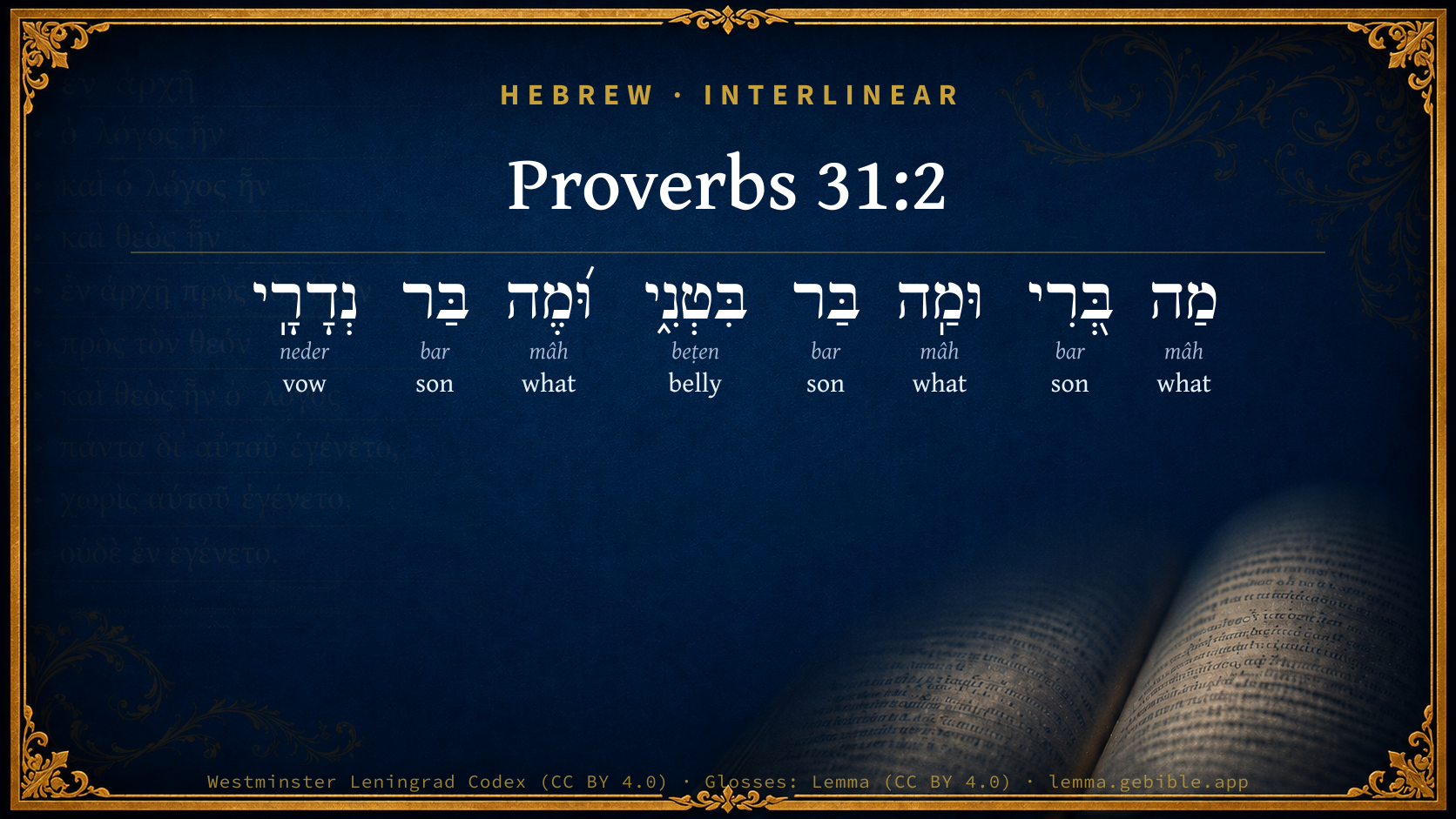
Proverbs 31:2

Hebrew (Westminster Leningrad Codex) Proverbs 31:2 appears in the Hebrew Old Testament. The text above is from the Westminster Leningrad Codex. Each word links to its Strong’s number, a concise gloss, and parsing drawn from the Open Scriptures Hebrew Bible morphology. Click any word for its full Brown-Driver-Briggs (BDB) entry.
Download image
Cite this verse

Proverbs 31:2 (World English Bible). Public Domain. Lemma interlinear Bible study tool, https://lemma.gebible.app/v/proverbs/31/2.

Show BibTeX & RIS
BibTeX
RIS
English Translation
"Oh, my son!" Oh, son of my womb! Oh, son of my vows!
World English Bible · Public Domain
Download a study sheet

One document with this verse’s original text, its word-by-word gloss line, the meaning frame, cross-references with their text, attributed commentary, and full source and license credits — printable, and it pastes into notes with its structure intact.

This verse Autodidact and up

Study sheet (.html) Plain text (.txt)

A passage Seminary Student

Up to 50 verses in one chapter. A passage sheet keeps up to 6 commentary sources and 12 cross-references per verse, in the order this page ranks them, and says so on the sheet whenever that leaves anything out. Ask for a single verse and you get the Autodidact verse sheet above.

Everything on this page stays free to read, with no account — the sheet is a download of what is already on screen, not access to it.

Want to remove ads? Support Godless Engineer
Compare translations 3

The same verse in 3 English versions, stacked beneath the original-language interlinear above. Click any original word for its lexicon entry.

Each is an independent rendering of the whole verse — the interlinear is not word-aligned to these translations.

Highlighted words mark where these versions differ — a whole-verse word diff, not a word-by-word alignment.

  • World English Bible Public Domain
    "Oh, my son!" Oh, son of my womb! Oh, son of my vows!
  • King James Version Public Domain
    What, my son? and what, the son of my womb? and what, the son of my vows?
  • unfoldingWord Literal Text CC BY-SA 4.0
    What, my son? And what, son of my womb? And what, son of my vows?

unfoldingWord Literal Text — © unfoldingWord, licensed CC BY-SA 4.0. Word-aligned USFM3 via Door43 (git.door43.org/unfoldingWord/en_ult).

Versions to compare (up to 4)

3 of 4 selected

Show all 18 translations

Every available English version of this verse, each an independent rendering of the whole verse.

  • World English Bible Public Domain
    "Oh, my son!" Oh, son of my womb! Oh, son of my vows!
  • Berean Standard Bible Public Domain
    What shall I say, O my son? What, O son of my womb? What, O son of my vows?
  • Majority Standard Bible Public Domain
    What shall I say, O my son? What, O son of my womb? What, O son of my vows?
  • King James Version Public Domain
    What, my son? and what, the son of my womb? and what, the son of my vows?
  • American Standard Version (1901) Public Domain
    What, my son? and what, O son of my womb? And what, O son of my vows?
  • Revised Version (1885) Public Domain
    What, my son? and what, O son of my womb, and what, O son of my vows?
  • Geneva Bible (1599) Public Domain
    What my sonne! and what ye sonne of my wombe! and what, O sonne of my desires!
  • Douay-Rheims (1899) Public Domain
    What, O my beloved, what, O the beloved of my womb, what, O the beloved of my vows?
  • Young's Literal Translation Public Domain
    `What, my son? and what, son of my womb? And what, son of my vows?
  • Literal Standard Version CC BY-SA 4.0
    “What, my son? And what, son of my womb? And what, son of my vows?
  • Unlocked Literal Bible CC BY-SA 4.0
    What, my son? What is it, son of my womb? What do you want, son of my vows?
  • unfoldingWord Literal Text CC BY-SA 4.0
    What, my son? And what, son of my womb? And what, son of my vows?
  • Darby Bible Public Domain
    What, my son? and what, O son of my womb? and what, O son of my vows?
  • World Messianic Bible Public Domain
    “Oh, my son! Oh, son of my womb! Oh, son of my vows!
  • Webster's Bible Public Domain
    What, my son? and what, the son of my womb? and what, the son of my vows?
  • Free Bible Version CC BY-SA 4.0
    What shall I tell you, my son?—the son I gave birth to, the son given in response to my vows.
  • Bible in Basic English Public Domain
    What am I to say to you, O Lemuel, my oldest son? and what, O son of my body? and what, O son of my oaths?
  • JPS Tanakh (1917) Public Domain
    What, my son? and what, O son of my womb? and what, O son of my vows?

Literal Standard Version (2020), Covenant Press — licensed CC BY-SA 4.0. Text via the HelloAO Bible API (eBible.org). Unlocked Literal Bible (unfoldingWord) — licensed CC BY-SA 4.0. Text via the HelloAO Bible API (eBible.org). unfoldingWord Literal Text — © unfoldingWord, licensed CC BY-SA 4.0. Word-aligned USFM3 via Door43 (git.door43.org/unfoldingWord/en_ult). Free Bible Version, Dr. Jonathan Gallagher — licensed CC BY-SA 4.0. Text via the HelloAO Bible API (eBible.org).

Word by word

More ways to search: Search by grammar → Find every occurrence → Compare this word →

Practice this passage: Drill this verse → Learn its vocabulary →

About this verse

These counts appear in no published source. They are computed here, from the morphology-tagged text and Lemma’s own curated glosses. What Lemma adds →

8
words
4
distinct lemmas
Wisdom
section

Notable vocabulary

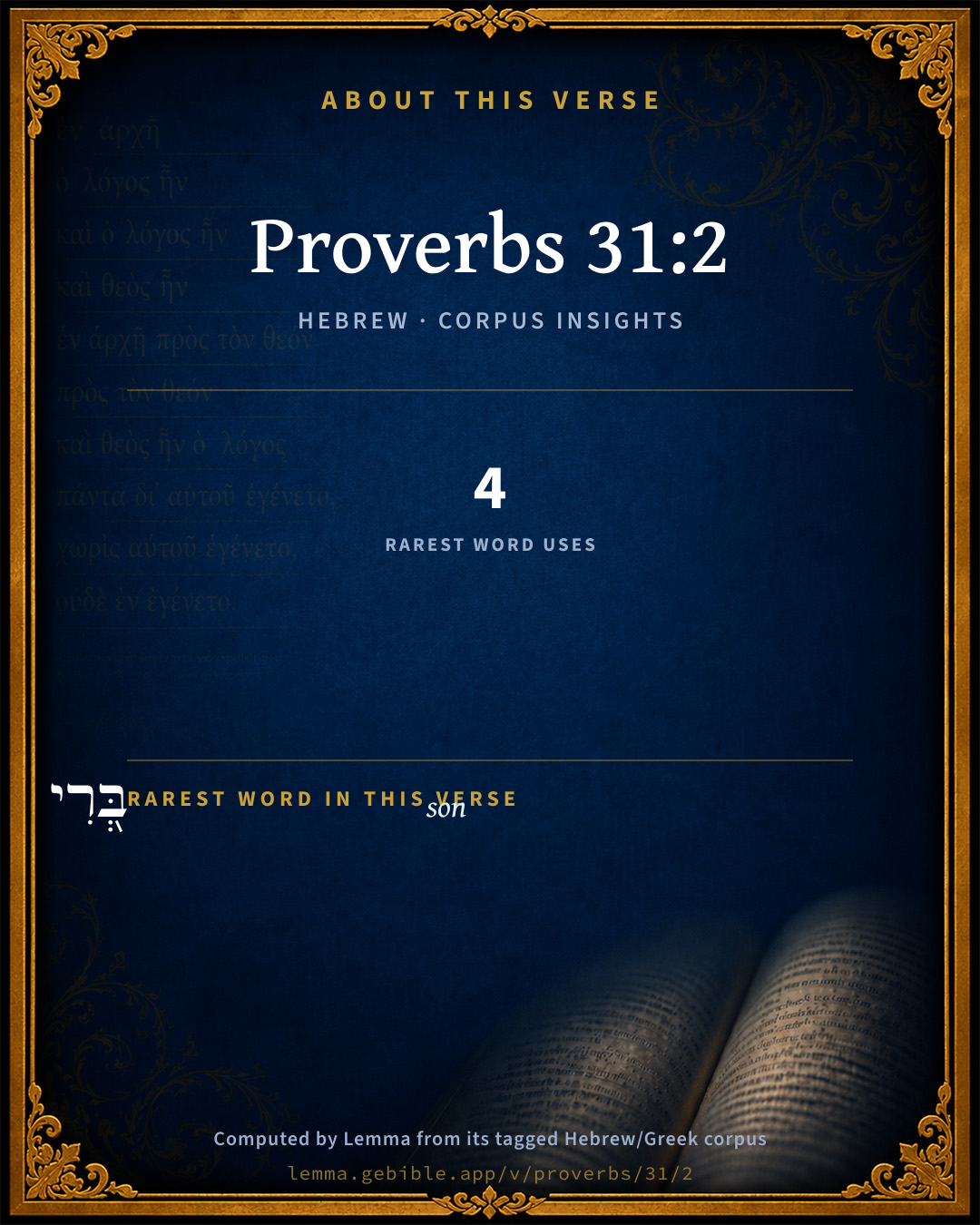
The rarest word here is בְּ֭רִי son H1248 — appearing just 4 times in the whole Hebrew Bible.

Shared distinctive vocabulary

בְּ֭רִי son H1248 occurs in 2 verses of the Hebrew Bible. Also found in:

Grammatical profile

  • 5 nouns
  • 3 particles

Repetition

Words recur within this verse — often emphatic in Hebrew:

  • בְּ֭רִי son H1248 ×3
  • מַה what H4100 ×3

Hebrew & Septuagint length

In English translation the verse runs 13 words from the Hebrew and 28 from the Septuagint (LXX English) — the Septuagint runs noticeably longer here. See the side-by-side →

A rough comparison of the two English renderings, which tokenize alike — not a word-level alignment.

Word counts can differ between the Hebrew and the Greek without any difference in meaning — e.g. the Hebrew direct-object marker אֵת has no separate Greek word, and Greek often adds the article ὁ.

Cross-references

3

Topical passages linked to Proverbs 31:2 in the Treasury of Scripture Knowledge — connected by theme and wording, ordered by reader-vote popularity; previews shown in the World English Bible.

  • Isaiah 49:15 Can a woman forget her sucking child, that she should not have compassion on the son of her womb? yes, these may forget, yet I will not forget you.
  • 1 Samuel 1:11 She vowed a vow, and said, Yahweh of hosts, if you will indeed look on the affliction of your handmaid, and remember me, and not forget your handmaid, but will give to your handmaid a man-child, then I will give him to Yahweh all the days of his life, and there shall no razor come on his head.
  • 1 Samuel 1:28 therefore also I have granted him to Yahweh; as long as he lives he is granted to Yahweh. He worshiped Yahweh there.

Cross-references courtesy of OpenBible.info (CC BY 4.0).

Hebrew and Greek witnesses Masoretic Hebrew ↔ Greek Septuagint

The same verse in the two great witnesses to the Old Testament, shown verse-for-verse.

Here the Septuagint runs noticeably longer than the Hebrew — LXX2012 (modern English Septuagint) 28 words vs World English Bible 13. A rough length comparison of the two English translations, not a word-level alignment — read both below.

These are two independent witnesses, not word-aligned to each other, and the Septuagint is shown in lemma (dictionary) form.

Hebrew Proverbs 31:2 Masoretic · Westminster Leningrad Codex

מַה בְּ֭רִי וּמַֽה בַּר בִּטְנִ֑י וּ֝מֶה בַּר נְדָרָֽי

"Oh, my son!" Oh, son of my womb! Oh, son of my vows!

World English Bible · Public Domain

Greek LXX Proverbs 31:2 Septuagint · lemma form

τίς τέκνον τηρέω τίς ῥέω θεός πρωτογενής σύ λέγω υἱός τίς τέκνον ἐμός κοιλία τίς τέκνον ἐμός εὐχή

What will you keep, my son, what? the words of God. My firstborn son, I speak to you: what? son of my womb? what? son of my vows?

LXX2012 (modern English Septuagint) · Public Domain

On this verse, The Cambridge Bible for Schools and Colleges discusses the Septuagint’s reading. Read the note in Commentary ↓

Hebrew: Westminster Leningrad Codex (CC BY 4.0). Greek: Septuagint (public domain); English from LXX2012 (modern English Septuagint) (Public Domain). How the Septuagint differs from the Hebrew →

Commentary

Notes on Proverbs 31:2 from classic Christian and Jewish commentators (each source and its license shown beneath its notes). The classic Christian expositions comment on the surrounding passage and are grouped to its opening verse, so a note may address several verses; the Jewish commentaries on the Tanakh (Rashi and others) are per-verse, so they appear only where the commentator wrote on this verse.

Lemma curates 59 commentaries, every one of them public domain or Creative Commons licensed, each selected and text-cleaned for this edition rather than reprinted as found. About our sources →

Trapp's Complete Commentary

John Trapp

Pro 31:2 What, my son? and what, the son of my womb? and what, the son of my vows?

Ver. 2. What, my son? and what, the son of my womb?] An abrupt speech, importing abundance of affection; even more than might be uttered. There is an ocean of love in a parent’s heart, a fathomless depth of desire after the child’s welfare, in the mother especially. Some of the Hebrew doctors hold that this was Bathsheba’s speech to her son after his father’s death, when she partly perceived which way his genius leaned and led him: that she schooled him in this way, q.d., Is it even so, my son, my most dear son, &c. Oh do not give thy strength to women, &c.

John Trapp, A Commentary or Exposition upon All the Books of the Old and New Testament (1647–1656) — public domain. Text from a community e-Sword module.

Joseph Benson's Commentary

Pro 31:2. What, my son — A short speech, arguing her great passion for him; what words shall I take? What counsels shall I give thee? My heart is full; I must give it vent; but where shall I begin? What, the son of my womb — My son, not by adoption, but whom I bare in the womb, and therefore it is my duty to give thee admonitions, and thine to receive them. What, the son of my vows — On whose behalf I have made many prayers and sacrifices, and solemn vows to God; whom I have, as far as in me lay, devoted to the work, and service, and glory of God.

Joseph Benson's Commentary on the Old and New Testaments (1811–1818) — public domain. Text from a community e-Sword module.

Tyndale Open Study Notes

Tyndale Open Resources

31:2-3 The admonition not to waste energy on lust for women echoes earlier warnings (ch 5; 6:20-35; 7:1-27).

Tyndale Open Study Notes — © Tyndale Open Resources, licensed CC BY-SA 4.0. Text via the HelloAO Bible API.

Geneva Bible (1599)

Geneva Bible translators

By this often repetition of one thing, she declareth her motherly affection.

Geneva Bible (1599) marginal notes — public domain. Text via Bolls.life.

Jamieson, Fausset & Brown

Robert Jamieson, A. R. Fausset & David Brown

What, my son?--that is, What shall I say? Repetitions denote earnestness.

son of my womb--as our phrase, "my own son," a term of special affection.

son of my vows--as one dedicated to God; so the word "Lemuel" may mean.

Jamieson, Fausset & Brown — Commentary Critical and Explanatory on the Whole Bible (1871) — public domain (CC PDM 1.0). Text via the HelloAO Bible API.

Adam Clarke's Commentary

Verse 2. What, my son?] The Chaldee בר bar is used twice in this verse, instead of the Hebrew בן ben, son. This verse is very elliptical; and commentators, according to their different tastes, have inserted words, indeed some of them a whole sentence, to make up the sense. Perhaps Coverdale has hit the sense as nearly as any other: "These are the wordes of Kynge Lemuel; and the lesson that his mother taughte him. My sonne, thou son of my body, O my deare beloved sonne!"

The son of my vows?] A child born after vows made for offsprings is called the child of a person's vows.

Adam Clarke's Commentary on the Bible (1810–1826) — public domain. Text from a community e-Sword/MySword module.

Ellicott's Commentary for English Readers

(2) What, my son?—i.e., what shall I say? The question, thrice repeated, shows her extreme anxiety to give good advice to this son, who was “tender, and only beloved in the sight of his mother.”

The son of my vows.—Perhaps given, like Samuel, in answer to her prayers and vows.

A Bible Commentary for English Readers, edited by Charles John Ellicott (1878–1897) — public domain. Text from a community e-Sword module.

The Cambridge Bible for Schools and Colleges

gen. ed. J. J. S. Perowne

2. What] This word thrice repeated finds its sufficient explanation in the yearning earnestness of a mother’s heart. The LXX. expand it, “What, my son, shalt thou keep? What? the sayings of God.” Similarly Maurer and Rosenmuller, “What shall I say unto thee? With what precepts shall I be able sufficiently to instruct and inform thee, so that thou mayest be truly wise and mayest rule well thy kingdom?”

son of my vows] “For whom I have made so many vows, if I might bring thee safely into the world, and rightly educate thee.” Maur. Comp. 1Sa_1:11.

The word here used for son is not the usual Heb. word, ben (as in Benjamin), but the Aramaic word bar (as in Bar-jona, Bar-Jesus); and this Aramaism is in keeping with other dialectic peculiarities of this Section of this Book.

The Cambridge Bible for Schools and Colleges (gen. ed. J. J. S. Perowne; Cambridge University Press, 1878–1918) — public domain. Text from a community e-Sword module.

John Gill's Exposition

What, my son?.... What shall I call thee? though thou art a king, can I address thee in more suitable language, or use a more endearing appellative than this, and what follows? permit me, thy mother, to speak unto thee as my son: and what shall I say to thee? I want words, I want wisdom; O that I knew what to say to thee, that would be proper and profitable; or what is it I am about to say to thee? things of the greatest moment and importance, and therefore listen to me; and so the manner of speaking is designed to excite attention: or what shall I ask of thee? no part of thy kingdom, or any share in the government of it; only this favour, to avoid the sins unbecoming a prince, and to do the duty of a king, later mentioned. The Targum and Syriac version represent her as exclaiming, reproving, and threatening; as, Alas my son! is this the life thou designest to live, to give up thyself to wine and women? fie upon it, my son, is this becoming thy birth, education, and dignity? is this the fruit of all the pains I have taken in bringing thee up? consider the unbecoming part thou art acting;

and what, the son of my womb? whom I bore in sorrow, brought forth in pain, and took so much care and trouble to bring up in a religious way, and form for usefulness in church and state? not an adopted son, but my own flesh and blood; and therefore what I say must be thought to proceed from pure affection to thee, and solely for thy good; see Isa 49:15;

and what, the son of my vows? whom I asked of God, and promised to give up to him again, and did; for which reason she might call him Lemuel, as Hannah called her son Samuel, for a like reason, Sa1 1:28; a son for whom she had put up many prayers, for his temporal and spiritual good; and on whose account she had made many vows, promises, and resolutions, that she would do so and so, should she be so happy as to bring him into the world, and bring him up to man's estate, and see him settled on the throne of Israel.

John Gill's Exposition of the Whole Bible (1746–1763) — public domain (CC PDM 1.0). Text via the HelloAO Bible API.

Albert Barnes' Notes on the Bible

The repetitions are emphatic; expressive of anxious love.

Son of my vows - Like Samuel, and Samson, the child often asked for in prayer, the prayer ratified by a vow of dedication. The name Lemuel (literally “for God,” consecrated to Him) may be the expression of that dedication; and the warning against indulging in wine Pro 31:4 shows that it had something of the Nazarite or Rechabite idea in it.

Albert Barnes' Notes on the Bible (1834–1885) — public domain. Text from a community e-Sword/MySword module.

Haydock's Catholic Bible Commentary

Vows. She seems unable to express her concern for him when he first mounted the throne, and shewed her the greatest reverence, 3 Kings ii. 19.

George Leo Haydock (1774–1849), Haydock's Catholic Family Bible and Commentary, 1859 edition — public domain. Excludes Psalms (Douay-Rheims chapter numbering differs from Protestant) and Deuterocanonical books (Catholic canon only).

Matthew Poole's English Annotations

What? a short speech, arguing her great passion for him; what dost thou do? or, what words shall I take? what counsels shall I give thee? My heart is full, I must give it vent; but where shall I begin?

The son of my womb; my son, not by adoption, but whom I bare in my womb, and brought forth with great pain, and brought up with tender care; and therefore it is my duty to give thee admonitions, and thine to receive them; and what I speak is from sincere and fervent affection to thee, which I trust thou wilt not despise.

The son of my vows; on whose behalf I have made many prayers, and sacrifices, and solemn vows to God; whom I have, as far as in me lay, devoted to the work, and service, and glory of God.

Matthew Poole's English Annotations on the Holy Bible (1683–1685) — public domain. Text from a community e-Sword/MySword module.

Whedon's Commentary on the Bible

Daniel D. Whedon

2. What, my son? This is the language of strong emotion and affection — brief, elliptical, and leaving something for the imagination to supply. These repeated interrogations denote great earnestness in demanding attention. Zockler renders: “O, my son! O, thou son of my womb!” etc. “She claims heedful attention to what must readily suggest itself, his relations and duties as a son and a sovereign.” — Conant. In this verse we meet with the unusual word בר, (bar,) son, instead of the usual בן, ben. It occurs three times here, and only once elsewhere, in the Hebrew portion of the Bible, (Psa_2:12,) though it is usual in the Chaldee parts of the book, and is the ordinary Chaldee word for son. Hence some have been disposed to regard this chapter as of Chaldee origin, or, at least, as belonging to the later Hebrew, in which Chaldaisms are found. To this purpose is adduced the form מלכין, (melakhin,) in Pro_31:3, instead of מלכים, (melakhim,) kings. But this conclusion does not necessarily follow, for poetry often avoids common terms, and employs for its peculiar purposes those which are either new, antiquated, or unusual. Besides, bar, in this sense, is not necessarily Chaldee, but may be legitimately derived from bara, (see Gesenius,) or from barar, as a term of affection or endearment — my beloved — my precious one.

Son of my womb — A son given in answer to vows made before his birth, (see 1Sa_1:11,) or concerning whom she had offered many prayers and vows subsequently, that he might be preserved, rightly guided, and rightly influenced. The words express vehement maternal tenderness, and solicitude for the welfare and well-doing of a beloved child, and are probably to be understood as the habitual mood and manner of the queen mother.

Daniel D. Whedon (gen. ed.), Commentary on the Old and New Testaments (1874–1909) — public domain. Text from a community e-Sword module.

The Pulpit Commentary

Vers. 2-9. Here follows the exhortation, which seems to come from the same source as the "burden" of Agur above. In this section the connection and parallelism of the parts are exhibited by repetition of thought and often of words in the several clauses.

What, my son? Mah, "what," is repeated thrice, both to enforce the attention of the son, and to show the mother"s anxious care for his good. She feels the vast importance of the occasion, and asks as in perplexity, "What shall I say? What advice shall I give thee?" "Son" is here not ben, but bar, one of the Aramaic forms which are found in these two last chapters. The word occurs also in Psa_2:12. Son of my vows. This might mean, "son who wast asked in prayer," like Samuel, (1Sa_1:11) and dedicated to God, as the name Lemuel implies; or it may signify, "thou who art the object of my daily vows and prayers." Septuagint, "What, my son, wilt thou observe (thrhseiv )? What? the sayings of God. My firstborn son, to thee I speak. What, son of my womb? What, son of my vows?

Vers. 2-9. A mother"s maxims.

The mother"s heart, deep in emotions of affection and urgent solicitude, is expressed in the passionate form of the address.

I ON WOMEN OR THE DUTY OF CHASTITY. (Ver. 3) The weakness of this passion was one of the things, Alexander the Great was wont to say, which reminded him that he was mortal David and Solomon were both warnings and beacon lights against yielding to it. (2Sa_12:9, 2Sa_12:10; comp. ch. 2, 5, 7)

II ON WINE, OR THE DUTY OF TEMPERANCE. (Ver. 4. sqq.) Here is a sin in close affinity to the former. (Hos_4:11)

1. A vice degrading in all, drunkenness is most especially unbefitting those in high station. Elah, (1Ki_16:8, 1Ki_16:9) Benhadad, (1Ki_20:16) and Belshazzar, (Dan_5:2-4) were all dark examples of the danger. (comp. Hos_7:5)

2. It may lead to moral perversion. (Ver. 5) The woman wrongly condemned by Philip of Macedon exclaimed, "I appeal from Philip drunk to Philip sober." Ahasuerus (Est_1:10, Est_1:11) and Herod (Mar_6:21-28) appear to have been guilty of arbitrary conduct under the same besotting influence. Men "err through strong drink". (Isa_28:7)

3. The true use of wine. (ver. 6) It is a medicine for the fainting. It is a restorative under extreme depression. The Bible tolerates and admits the blessing of wine in moderation as promotive of social cheerfulness. It "maketh glad the heart of man," and is even said to "cheer God". (Jud_1:9:13) Hence libations were a part of the sacrificial feast offered to the Majesty on high. As an anodyne it is admitted here (ver. 7). But all this does not exempt from close circumspection as to time, place, persons, and circumstances in its use. The priests, when performing their sacred functions in the tabernacle and temple, were to abstain from wine. But here, as in other matters, there is large latitude given to the exercise of the private judgment, the personal Christian conscience. Any attempt to overrule the right of personal freedom creates a new class of evils. Let those who see their duty in that light adopt total abstinence; and others labour according to their ability to strike at the indirect and deeper causes of what many regard as a national vice. Wherever there is a widespread vice, it is rooted in some profound misery. The surest, though longest, cure is by the eradication of the pain of the mind which drives so many towards the nepenthes, or draught of oblivion.

III ON THE FREE AND FULL ADMINISTRATION OF JUSTICE. (vers. 8, 9) The royal heart and hand are to be at the service of those who cannot help themselves the widow, the orphan, the poor, and "all that are desolate and oppressed". (Job_29:15, Job_29:16) He is to be both advocate and judge. He is to be an earthly type of God. "Let his representatives on earth study the character of their King in heaven, and be conformed more fully to his image of forgiveness and love. J.

The Pulpit Commentary (1880–1919), ed. H.D.M. Spence-Jones & Joseph S. Exell — public domain. Text from a community e-Sword module.

John Wesley's Explanatory Notes

What - A short speech, arguing her great passion for him; what words shall I take? What counsels shall I give thee? My heart is full, but where shall I begin? Of my womb - My son, not by adoption, but whom I bare in the womb, and therefore it is my duty to give thee admonitions, and thine to receive them. My vows - On whose behalf I have made many prayers and sacrifices, and solemn vows to God; whom I have, as far as in me lay, devoted to the work, and service, and glory of God.

John Wesley, Explanatory Notes Upon the Whole Bible (1754–1765) — public domain. Text via the GEBible commentary corpus.

Keil & Delitzsch

C. F. Keil & F. Delitzsch

2 What, my son? and what the son of my womb?

And what, O son of my vows?!

The thrice repeated מה is completed by תּעשׂה (cf. Khler under Mal 2:15), and that so that the question is put for the purpose of exciting attention: Consider well, my son, what thou wilt do as ruler, and listen attentively to my counsel (Fleischer). But the passionate repetition of מה would be only affectation if thus interpreted; the underlying thought must be of a subjective nature: what shall I say, אדבּר (vid., under Isa 38:15), what advise thee to do? The question, which is at the same time a call, is like a deep sigh from the heart of the mother concerned for the welfare of her son, who would say to him what is beneficial, and say it in words which strike and remain fixed. He is indeed her dear son, the son whom she carries in her heart, the son for whom with vows of thanksgiving she prayed to God; and as he was given her by God, so to His care she commits him. The name "Lemuel" is, as we interpret it, like the anagram of the fulfilment of the vows of his mother. בּרי bears the Aramaic shade in the Arameo-Arab. colouring of these proverbs from Massa; בּריהּ is common in the Aram., and particularly in the Talmudic, but it can scarcely be adduced in support of ברי. וּמה belongs to the 24, מה, with ח or ע not following; vid., the Masora to Exo 32:1, and its correction by Norzi at Deu 29:23. We do not write וּמה־בּר; מה, with Makkeph and with Metheg, exclude one another.

Keil & Delitzsch — Biblical Commentary on the Old Testament (1861–1891) — public domain (CC PDM 1.0). Text via the HelloAO Bible API. (Old Testament only.)

Rashi

Rabbi Shlomo Yitzchaki (Rashi)

What, my son What is this that you have done and told that you are my son, and [you did] not [tell] that you are the son of your father. Everybody knows that your father was completely righteous, and if you are wicked, they will say, “His mother made him that way.”

the son of my womb All your father’s wives, as soon as they conceived, would not return for marital relations, but I pushed and entered in order to have a son well-formed and of strong vitality, because marital relations are beneficial during the last six months.

and what, the son of my vows? All your father’s wives would vow that they would have a son fit for the throne, but I vowed that I would have a son bright in Torah.

Rashi on the Tanakh — English translations: “The Judaica Press complete Tanach with Rashi, translated by A. J. Rosenberg” (CC BY 4.0); “Pentateuch with Rashi's commentary by M. Rosenbaum and A.M. Silbermann, 1929-1934” (public domain); “The Metsudah Tanach series, Lakewood, N.J” (CC BY 4.0); and “The Book of Joshua, Metsudah Publications, 1997” (CC BY 4.0). Text via Sefaria.

Lesson kit

Teaching starters — assembled from the data on this page, not authored interpretation. Every prompt links to the verse data it draws on. Edit before teaching.

Proverbs, in the Wisdom, opens this verse with 8 words (4 distinct Hebrew lemmas). Its most distinctive word is bar (“son”). The Greek Septuagint runs longer here. A historical commentator’s framing appears above. Read the whole chapter for the surrounding context.

Discussion questions

  1. How does “son” (bar) shape what this verse is saying?
  2. How does Psalms 2:12, which shares the word «son», read alongside this verse?
  3. What does the repetition of “son” (3× in this one verse) do in this verse?
  4. The Septuagint runs longer here than the Hebrew. What might account for the difference?
  5. The translations on this page render this verse differently — a whole-verse word diff, not a word-by-word alignment. What might account for the different wordings?
  6. Compare how Trapp's Complete Commentary and Joseph Benson's Commentary read this verse. Where do they agree or differ?

Things to notice

Reading settings

Reading text

Shown beneath each verse's original-language words.

Old Testament
Old Testament edition

Read the OT as the Masoretic Hebrew (MT) or the Greek Septuagint (LXX).

English shown for the Greek Septuagint (in the Hebrew ↔ Greek comparison).

Comparing translations? Open the Compare panel on any verse page to stack up to four side by side.