
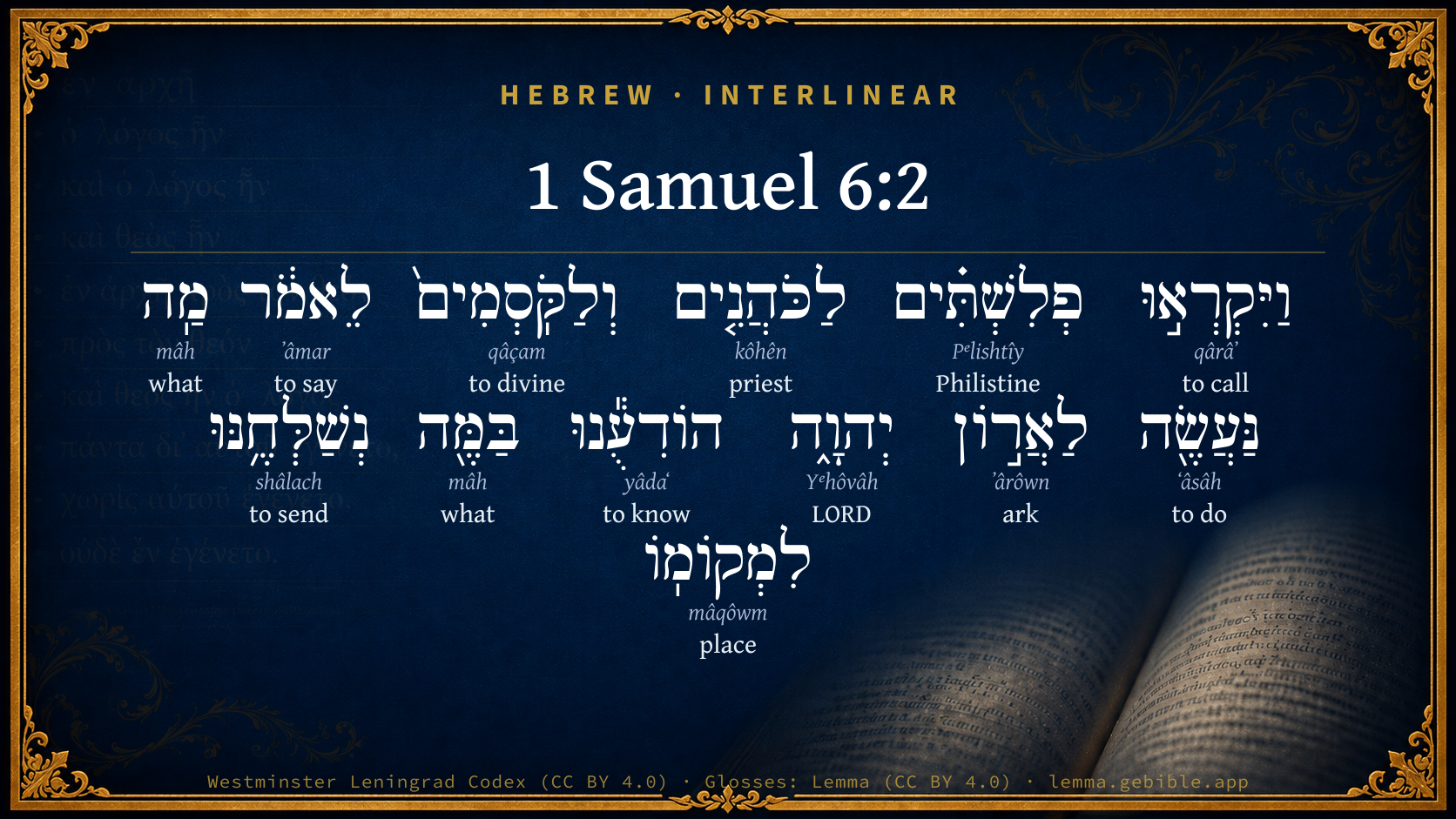
1 Samuel 6:2

Hebrew (Westminster Leningrad Codex) 1 Samuel 6:2 appears in the Hebrew Old Testament. The text above is from the Westminster Leningrad Codex. Each word links to its Strong’s number, a concise gloss, and parsing drawn from the Open Scriptures Hebrew Bible morphology. Click any word for its full Brown-Driver-Briggs (BDB) entry.
Download image
Cite this verse

1 Samuel 6:2 (World English Bible). Public Domain. Lemma interlinear Bible study tool, https://lemma.gebible.app/v/1-samuel/6/2.

Show BibTeX & RIS
BibTeX
RIS
English Translation
The Philistines called for the priests and the diviners, saying, "What shall we do with the ark of Yahweh? Show us with which we shall send it to its place."
World English Bible · Public Domain
Download a study sheet

One document with this verse’s original text, its word-by-word gloss line, the meaning frame, cross-references with their text, attributed commentary, and full source and license credits — printable, and it pastes into notes with its structure intact.

This verse Autodidact and up

Study sheet (.html) Plain text (.txt)

A passage Seminary Student

Up to 50 verses in one chapter. A passage sheet keeps up to 6 commentary sources and 12 cross-references per verse, in the order this page ranks them, and says so on the sheet whenever that leaves anything out. Ask for a single verse and you get the Autodidact verse sheet above.

Everything on this page stays free to read, with no account — the sheet is a download of what is already on screen, not access to it.

Want to remove ads? Support Godless Engineer
Compare translations 3

The same verse in 3 English versions, stacked beneath the original-language interlinear above. Click any original word for its lexicon entry.

Each is an independent rendering of the whole verse — the interlinear is not word-aligned to these translations.

Highlighted words mark where these versions differ — a whole-verse word diff, not a word-by-word alignment.

  • World English Bible Public Domain
    The Philistines called for the priests and the diviners, saying, "What shall we do with the ark of Yahweh? Show us with which we shall send it to its place."
  • King James Version Public Domain
    And the Philistines called for the priests and the diviners, saying, What shall we do to the ark of the LORD? tell us wherewith we shall send it to his place.
  • unfoldingWord Literal Text CC BY-SA 4.0
    And the Philistines called to the priests and to the diviners, saying, “What should we do with the Box of Yahweh? Cause us to know with what we should send it to its place.”

unfoldingWord Literal Text — © unfoldingWord, licensed CC BY-SA 4.0. Word-aligned USFM3 via Door43 (git.door43.org/unfoldingWord/en_ult).

Versions to compare (up to 4)

3 of 4 selected

Show all 18 translations

Every available English version of this verse, each an independent rendering of the whole verse.

  • World English Bible Public Domain
    The Philistines called for the priests and the diviners, saying, "What shall we do with the ark of Yahweh? Show us with which we shall send it to its place."
  • Berean Standard Bible Public Domain
    the Philistines summoned the priests and diviners, saying, “What shall we do with the ark of the LORD? Tell us how to send it back to its place.”
  • Majority Standard Bible Public Domain
    the Philistines summoned the priests and diviners, saying, “What shall we do with the ark of the LORD? Tell us how to send it back to its place.”
  • King James Version Public Domain
    And the Philistines called for the priests and the diviners, saying, What shall we do to the ark of the LORD? tell us wherewith we shall send it to his place.
  • American Standard Version (1901) Public Domain
    And the Philistines called for the priests and the diviners, saying, What shall we do with the ark of Jehovah? show us wherewith we shall sent it to its place.
  • Revised Version (1885) Public Domain
    And the Philistines called for the priests and the diviners, saying, What shall we do with the ark of the LORD? shew us wherewith we shall send it to its place.
  • Geneva Bible (1599) Public Domain
    And the Philistims called the priests and the soothsayers, saying, What shall we doe with the Arke of the Lord? tell vs wherewith we shall send it home againe.
  • Douay-Rheims (1899) Public Domain
    And the Philistines called for the priests and the diviners, saying: What shall we do with the ark of the Lord? tell us how we are to send it back to its place? And they said:
  • Young's Literal Translation Public Domain
    and the Philistines call for priests and for diviners, saying, `What do we do to the ark of Jehovah? let us know wherewith we send it to its place?'
  • Literal Standard Version CC BY-SA 4.0
    and the Philistines call for priests and for diviners, saying, “What do we do to the Ark of YHWH? Let us know with what we send it to its place.”
  • Unlocked Literal Bible CC BY-SA 4.0
    Then the Philistine people called for the priests and the diviners; they said to them, “What should we do with the ark of Yahweh? Tell us how we should send it back to its own country.”
  • unfoldingWord Literal Text CC BY-SA 4.0
    And the Philistines called to the priests and to the diviners, saying, “What should we do with the Box of Yahweh? Cause us to know with what we should send it to its place.”
  • Darby Bible Public Domain
    And the Philistines called for the priests and the diviners, saying, What shall we do with the ark of Jehovah? tell us wherewith we shall send it to its place.
  • World Messianic Bible Public Domain
    The Philistines called for the priests and the diviners, saying, “What shall we do with the LORD’s ark? Show us how we should send it to its place.”
  • Webster's Bible Public Domain
    And the Philistines called for the priests and the diviners, saying, What shall we do to the ark of the LORD? tell us with what we shall send it to its place.
  • Free Bible Version CC BY-SA 4.0
    the Philistines summoned the priests and fortune-tellers, and asked, “What should we do with the Ark of the Lord? Explain to us how to send it back to where it came from.”
  • Bible in Basic English Public Domain
    And the Philistines sent for the priests and those who were wise in secret arts, and said to them, What are we to do with the ark of the Lord? How are we to send it away to its place?
  • JPS Tanakh (1917) Public Domain
    And the Philistines called for the priests and the diviners, saying: 'What shall we do with the ark of the LORD? declare unto us wherewith we shall send it to its place.'

Literal Standard Version (2020), Covenant Press — licensed CC BY-SA 4.0. Text via the HelloAO Bible API (eBible.org). Unlocked Literal Bible (unfoldingWord) — licensed CC BY-SA 4.0. Text via the HelloAO Bible API (eBible.org). unfoldingWord Literal Text — © unfoldingWord, licensed CC BY-SA 4.0. Word-aligned USFM3 via Door43 (git.door43.org/unfoldingWord/en_ult). Free Bible Version, Dr. Jonathan Gallagher — licensed CC BY-SA 4.0. Text via the HelloAO Bible API (eBible.org).

Word by word

More ways to search: Search by grammar → Find every occurrence → Compare this word →

Practice this passage: Drill this verse → Learn its vocabulary →

וְלַקֹּֽסְמִים֙
qâçam
H7080
“and · to/for the · divining”
Conjunction + Preposition, Determined + Verb, Qal, Participle Active, Masculine, Plural, Absolute
Part of Speech
Conjunction + Preposition + Verb
Stem
Qal
Form
Participle Active
Gender
Masculine
Number
Plural
State
Absolute
Full BDB Definition

Origin: a primitive root

TWOT: 2044

(Qal) to practice divination, divine - of diviners of the nations, Balaam - of false prophets of Israel - prohibited
  1. וַיִּקְרְא֣וּ qârâʼ H7121 “and · to call” Conjunction + Verb, Qal, Sequential Imperfect, 3rd Person, Masculine, Plural
  2. פְלִשְׁתִּ֗ים Pᵉlishtîy H6430 “Philistines” Noun, Gentilic, Masculine, Plural, Absolute
  3. לַכֹּהֲנִ֤ים kôhên H3548 “to/for the · priests” Preposition, Determined + Noun, Common, Masculine, Plural, Absolute
  4. לֵאמֹ֔ר ʼâmar H559 “to say” Preposition + Verb, Qal, Infinitive Construct
  5. מַֽה mâh H4100 “what” Particle, Interrogative
  6. נַּעֲשֶׂ֖ה ʻâsâh H6213 “to do” Verb, Qal, Imperfect, 1st Person, Common, Plural
  7. לַאֲר֣וֹן ʼârôwn H727 “to/for · ark of” Preposition + Noun, Common, Both, Singular, Construct
  8. יְהוָ֑ה Yᵉhôvâh H3068 “LORD” Noun, Proper
  9. הוֹדִעֻ֕נוּ yâdaʻ H3045 “know · us” Verb, Hiphil, Imperative, 2nd Person, Masculine, Plural + Suffix, Personal, 1st Person, Common, Plural
  10. בַּמֶּ֖ה mâh H4100 “in/at · what” Preposition + Particle, Interrogative
  11. נְשַׁלְּחֶ֥נּוּ shâlach H7971 “to send · him” Verb, Piel, Imperfect, 1st Person, Common, Plural + Suffix, Personal, 3rd Person, Masculine, Singular
  12. לִמְקוֹמֽוֹ mâqôwm H4725 “to/for · place · his” Preposition + Noun, Common, Masculine, Singular, Construct + Suffix, Personal, 3rd Person, Masculine, Singular

About this verse

These counts appear in no published source. They are computed here, from the morphology-tagged text and Lemma’s own curated glosses. What Lemma adds →

13
words
12
distinct lemmas
Historical
section

Notable vocabulary

The rarest word here is וְלַקֹּֽסְמִים֙ to divine H7080 — appearing just 23 times in the whole Hebrew Bible.

Shared distinctive vocabulary

וְלַקֹּֽסְמִים֙ to divine H7080 occurs in 20 verses of the Hebrew Bible. Also found in:

Grammatical profile

  • 6 verbs
  • 5 nouns
  • 2 particles

Verb forms

  • וַיִּקְרְא֣וּ Qal · Sequential Imperfect
  • וְלַקֹּֽסְמִים֙ Qal · Participle Active
  • לֵאמֹ֔ר Qal · Infinitive Construct
  • נַּעֲשֶׂ֖ה Qal · Imperfect
  • הוֹדִעֻ֕נוּ Hiphil · Imperative
  • נְשַׁלְּחֶ֥נּוּ Piel · Imperfect

Repetition

A word recurs within this verse — often emphatic in Hebrew:

  • מַֽה what H4100 ×2

Hebrew & Septuagint length

In English translation the verse runs 30 words from the Hebrew and 34 from the Septuagint (LXX English) — closely comparable.

A rough comparison of the two English renderings, which tokenize alike — not a word-level alignment.

Word counts can differ between the Hebrew and the Greek without any difference in meaning — e.g. the Hebrew direct-object marker אֵת has no separate Greek word, and Greek often adds the article ὁ.

Cross-references

8

Topical passages linked to 1 Samuel 6:2 in the Treasury of Scripture Knowledge — connected by theme and wording, ordered by reader-vote popularity; previews shown in the World English Bible.

  • Genesis 41:8 It happened in the morning that his spirit was troubled, and he sent and called for all the magicians of Egypt, and all the wise men of it. Pharaoh told them his dream, but there was no one who could interpret them to Pharaoh.
  • Exodus 7:11 Then Pharaoh also called for the wise men and the sorcerers. They also, the magicians of Egypt, did in like manner with their enchantments.
  • Daniel 2:2 Then the king commanded to call the magicians, and the enchanters, and the sorcerers, and the Chaldeans, to tell the king his dreams. So they came in and stood before the king.
  • Daniel 5:7 The king cried aloud to bring in the enchanters, the Chaldeans, and the soothsayers. The king spoke and said to the wise men of Babylon, Whoever shall read this writing, and show me the interpretation of it, shall be clothed with purple, and have a chain of gold about his neck, and shall be the third ruler in the kingdom.
  • Isaiah 2:6 For you have forsaken your people, the house of Jacob, Because they are filled from the east, With those who practice divination like the Philistines, And they clasp hands with the children of foreigners.
  • Isaiah 47:12–13 Stand now with your enchantments, and with the multitude of your sorceries, in which you have labored from your youth; if so be you shall be able to profit, if so be you may prevail.
  • Micah 6:6–9 How shall I come before Yahweh, And bow myself before the exalted God? Shall I come before him with burnt offerings, With calves a year old?
  • Matthew 2:4 Gathering together all the chief priests and scribes of the people, he asked them where the Christ would be born.

Cross-references courtesy of OpenBible.info (CC BY 4.0).

Hebrew and Greek witnesses Masoretic Hebrew ↔ Greek Septuagint

The same verse in the two great witnesses to the Old Testament, shown verse-for-verse.

These are two independent witnesses, not word-aligned to each other, and the Septuagint is shown in lemma (dictionary) form.

Hebrew 1 Samuel 6:2 Masoretic · Westminster Leningrad Codex

וַיִּקְרְא֣וּ פְלִשְׁתִּ֗ים לַכֹּהֲנִ֤ים וְלַקֹּֽסְמִים֙ לֵאמֹ֔ר מַֽה נַּעֲשֶׂ֖ה לַאֲר֣וֹן יְהוָ֑ה הוֹדִעֻ֕נוּ בַּמֶּ֖ה נְשַׁלְּחֶ֥נּוּ לִמְקוֹמֽוֹ

The Philistines called for the priests and the diviners, saying, "What shall we do with the ark of Yahweh? Show us with which we shall send it to its place."

World English Bible · Public Domain

Greek LXX 1 Samuel 6:2 Septuagint · lemma form

καί καλέω ἀλλόφυλος ὁ ἱερεύς καί ὁ μάντις καί ὁ ἐπαοιδός αὐτός λέγω τίς ποιέω ὁ κιβωτός κύριος γνωρίζω ἐγώ ἐν τίς ἀποστέλλω αὐτός εἰς ὁ τόπος αὐτός

And the Philistines call their priests, and their prophets, and their enchanters, saying, What shall we do to the ark of the Lord? teach us wherewith we shall send it away to its place.

LXX2012 (modern English Septuagint) · Public Domain

On this verse, Ellicott's Commentary for English Readers discusses the Septuagint’s reading. Read the note in Commentary ↓

Hebrew: Westminster Leningrad Codex (CC BY 4.0). Greek: Septuagint (public domain); English from LXX2012 (modern English Septuagint) (Public Domain). How the Septuagint differs from the Hebrew →

Targum (Aramaic paraphrase)

1

The Targum is the ancient Jewish Aramaic paraphrase of the Hebrew Scriptures — an interpretive translation, not the Hebrew text itself. Onkelos (literal) and Pseudo-Jonathan (expansive) render the Torah, and Jonathan the Prophets. Coverage is partial: where no permissively-licensed English translation exists for a verse, only the Aramaic is shown. This is verse-level text, not a word-by-word alignment to the Hebrew.

  1. Targum Jonathan Prophets (Joshua–Malachi)
    וּקְרוֹ פְלִשְׁתָּאֵי לְכוּמָרַיָא וּלְקָסְמַיָא לְמֵימַר מָה נַעְבֵּיד לַאֲרוֹנָא דַייָ הוֹדִיעוּנָנָא בַּמֶה נְשַׁלְחִינֵיהּ לְאַתְרֵיהּ:

    (no public-domain English translation for this verse)

    Targum Jonathan — Aramaic: “Mikraot Gedolot” (public domain). English: “Sefaria Community Translation” (CC0 1.0 (public-domain dedication)); “London "Chaldee Paraphrase," 1871” (public domain). Text via Sefaria.

Commentary

Notes on 1 Samuel 6:2 from classic Christian and Jewish commentators (each source and its license shown beneath its notes). The classic Christian expositions comment on the surrounding passage and are grouped to its opening verse, so a note may address several verses; the Jewish commentaries on the Tanakh (Rashi and others) are per-verse, so they appear only where the commentator wrote on this verse.

Lemma curates 59 commentaries, every one of them public domain or Creative Commons licensed, each selected and text-cleaned for this edition rather than reprinted as found. About our sources →

Trapp's Complete Commentary

John Trapp

1Sa 6:2 And the Philistines called for the priests and the diviners, saying, What shall we do to the ark of the LORD? tell us wherewith we shall send it to his place.

Ver. 2. And the Philistines called for the priests and the diviners.] Who were so called from their divinations, that is, their superstitious searchings into things secret, and to foretell future events. Cicero saith they were called diviners, a divis, from the gods, that is, from the devils, with whom they dealt doubtless.

What shall we do to the ark of the Lord?] They say not, What shall we do with it? for they were most of them resolved to send it home; but What shall we do to it? how shall we send it as it should be sent? for they knew that it is the manner that maketh or marreth an action. Sure it is, that in divine matters men must look that not only the body of their service be found, but that the clothes be fit: that it may be καλον καλως.

John Trapp, A Commentary or Exposition upon All the Books of the Old and New Testament (1647–1656) — public domain. Text from a community e-Sword module.

Joseph Benson's Commentary

1Sa 6:2. What shall we do to the ark of the Lord? — Hebrew, Jehovah. They never termed it the ark of Jehovah till this time: but now they seem to have been struck with some apprehension that Jehovah, the God of Israel, was above all gods. Tell us wherewith we shall send it, &c. — They did not call the priests and diviners together, to be resolved whether they should send it home or not, (for upon that point they seem to have been resolved already, 1Sa 6:11,) but in what manner it should be sent, and whether accompanied with any presents, to obtain the favour of him whose ark it was.

Joseph Benson's Commentary on the Old and New Testaments (1811–1818) — public domain. Text from a community e-Sword module.

Tyndale Open Study Notes

Tyndale Open Resources

6:2 priests and diviners: Divination was a part of Philistine religion (cp. 28:7; Deut 18:10-14).

Tyndale Open Study Notes — © Tyndale Open Resources, licensed CC BY-SA 4.0. Text via the HelloAO Bible API.

Jamieson, Fausset & Brown

Robert Jamieson, A. R. Fausset & David Brown

the Philistines called for the priests and the diviners--The designed restoration of the ark was not, it seems, universally approved of, and many doubts were expressed whether the prevailing pestilence was really a judgment of Heaven. The priests and diviners united all parties by recommending a course which would enable them easily to discriminate the true character of the calamities, and at the same time to propitiate the incensed Deity for any acts of disrespect which might have been shown to His ark.

Jamieson, Fausset & Brown — Commentary Critical and Explanatory on the Whole Bible (1871) — public domain (CC PDM 1.0). Text via the HelloAO Bible API.

Adam Clarke's Commentary

Verse 2. The diviners] קסמים kosemim, from קסם kasam, to presage or prognosticate. See De 18:10. In what their pretended art consisted, we know not.

Adam Clarke's Commentary on the Bible (1810–1826) — public domain. Text from a community e-Sword/MySword module.

Ellicott's Commentary for English Readers

(2) What shall we do to the ark of the Lord?—During the seven months which followed the great Philistine victory of Aphek, the Ark remained in the country of the enemies of Israel. It was removed from temple to temple in the various cities, but the same doom always followed it. The inhabitants of the city where was the Ark were smitten with deadly abscesses, in addition to which, from the statement in 1Sa_6:5, a plague of field-mice during the same period probably desolated the land. In their distress the Philistine rulers, determining to get rid of the fatal trophy of which they were once so proud, consulted their priests and diviners as to the most graceful and effective way of returning the captured Hebrew emblem. The “diviners” in the counsels of all the nations of antiquity occupy a distinguished place. We hear of them under different designations, as magicians, sorcerers, soothsayers, augurs, oracles, &c. They plied their strange trade, now with the aid of arrows, now with the entrails of slain animals, now with observation of the stars, now with the watching of natural signs, the flight of birds, &c. These men, who in one form or other dabbled in occult science, and perhaps here and there were aided by evil and unclean spirits, but who more frequently traded on the credulity and superstition of their fellows, occupied a considerable position among the nations of antiquity. We hear of them frequently among the Israelites, who seem to have adopted this class of advisers from the heathen nations around them. Isaiah (Isa_3:2) specially mentions them, and reckons these diviners among the leading orders of the State. The English Version, however, with singular inconsistency, renders the word in that same passage by “prudent;” possibly, it has been ingeniously suggested, owing to the translators being displeased at finding the professors of a forbidden art ranked so highly among the chosen people.

In the first verse the LXX. add, “and the land swarmed with mice,” another of the many explanatory additions so common in the Greek translation of the Hebrew.

A Bible Commentary for English Readers, edited by Charles John Ellicott (1878–1897) — public domain. Text from a community e-Sword module.

The Cambridge Bible for Schools and Colleges

gen. ed. J. J. S. Perowne

2. diviners] Men who professed to predict future events or interpret the will of heaven by the observation of omens. See Exo_7:11; Dan_2:2. Philistine diviners seem to have been celebrated. Cp. Isa_2:6.

The Cambridge Bible for Schools and Colleges (gen. ed. J. J. S. Perowne; Cambridge University Press, 1878–1918) — public domain. Text from a community e-Sword module.

John Gill's Exposition

And the Philistines called for the priests and for the diviners,.... The one were skilled in the rites and ceremonies of religion, not only of their own, but of other nations, particularly of Israel; and that they were not strangers to the history and affairs of that people is plain from Sa1 6:6 and the other were skilled in judicial astrology, and knowledge of future events, at least as they pretended to; and therefore were both thought fit persons to advise with on the occasion of the ark, and the circumstances they were in through that:

saying, what shall we do to the ark of the Lord? shall we send it back to its own land, or not? the Ekronites had moved it might be sent back, and the five lords sent for the priests and diviners to have their advice upon it, whether it was right or not, and what they should do to it, or with it; for if it was advisable to send it back, then another question follows:

tell us wherewith we shall send it to its place; whether on men's shoulders, or on horses or asses, or on a carriage; and whether just as it was taken, or with some presents with it.

John Gill's Exposition of the Whole Bible (1746–1763) — public domain (CC PDM 1.0). Text via the HelloAO Bible API.

Albert Barnes' Notes on the Bible

The word for “priest” here is the same as that used for the priests of the true God; that for diviners is everywhere used of idolatrous or superstitious divining. Three modes of divination are described Eze 21:21-22, by arrows, by teraphim, and by the entrails of beasts. (Compare Exo 7:11; Dan 2:2).

Albert Barnes' Notes on the Bible (1834–1885) — public domain. Text from a community e-Sword/MySword module.

Haydock's Catholic Bible Commentary

Diviners. The priests generally pretended to a knowledge of magic, among the pagans. (Calmet)

George Leo Haydock (1774–1849), Haydock's Catholic Family Bible and Commentary, 1859 edition — public domain. Excludes Psalms (Douay-Rheims chapter numbering differs from Protestant) and Deuterocanonical books (Catholic canon only).

Matthew Poole's English Annotations

The diviners; whose art was in great esteem with heathen nations, and especially with the Philistines and their neighbours the Canaanites and Egyptians.

Wherewith; in what manner, and with what gifts; for to send it they had decreed before, 1Sa 5:11.

Matthew Poole's English Annotations on the Holy Bible (1683–1685) — public domain. Text from a community e-Sword/MySword module.

Whedon's Commentary on the Bible

Daniel D. Whedon

2. The priests and the diviners — These were the sacred orders among the Philistines, as the sacred scribes and magicians were among the Egyptians. Gen_41:8; Exo_7:11.

Wherewith we shall send — That is, with what kind of a present.

To his place — The land of Israel. They had already fully resolved to send the ark back, but they wished to be careful about the manner of their sending it, lest further woes afflict them.

Daniel D. Whedon (gen. ed.), Commentary on the Old and New Testaments (1874–1909) — public domain. Text from a community e-Sword module.

Rashi

Rabbi Shlomo Yitzchaki (Rashi)

How we should send it back. In what manner should we send it away, so that He will not be angry, and so that His wrath will be removed from us.

Rashi on the Tanakh — English translations: “The Judaica Press complete Tanach with Rashi, translated by A. J. Rosenberg” (CC BY 4.0); “Pentateuch with Rashi's commentary by M. Rosenbaum and A.M. Silbermann, 1929-1934” (public domain); “The Metsudah Tanach series, Lakewood, N.J” (CC BY 4.0); and “The Book of Joshua, Metsudah Publications, 1997” (CC BY 4.0). Text via Sefaria.

Lesson kit

Teaching starters — assembled from the data on this page, not authored interpretation. Every prompt links to the verse data it draws on. Edit before teaching.

1 Samuel, in the Historical, opens this verse with 13 words (12 distinct Hebrew lemmas). Its most distinctive word is qâçam (“to divine”). A historical commentator’s framing appears above. Read the whole chapter for the surrounding context.

Discussion questions

  1. How does “to divine” (qâçam) shape what this verse is saying?
  2. Deuteronomy 18:10 shares the word «to divine» with this verse. How do the two illuminate each other?
  3. “what” occurs 2× in this one verse. What is the effect of the repetition?
  4. These translations render this verse differently. What is at stake in choosing one wording over another?
  5. The verb «וַיִּקְרְא֣וּ» is Qal Sequential Imperfect. How does its form color the action?
  6. Reading how Trapp's Complete Commentary and Joseph Benson's Commentary read this verse, where do the two commentators agree and where do they part?

Things to notice

Reading settings

Reading text

Shown beneath each verse's original-language words.

Old Testament
Old Testament edition

Read the OT as the Masoretic Hebrew (MT) or the Greek Septuagint (LXX).

English shown for the Greek Septuagint (in the Hebrew ↔ Greek comparison).

Comparing translations? Open the Compare panel on any verse page to stack up to four side by side.