Ecclesiastes 6:10

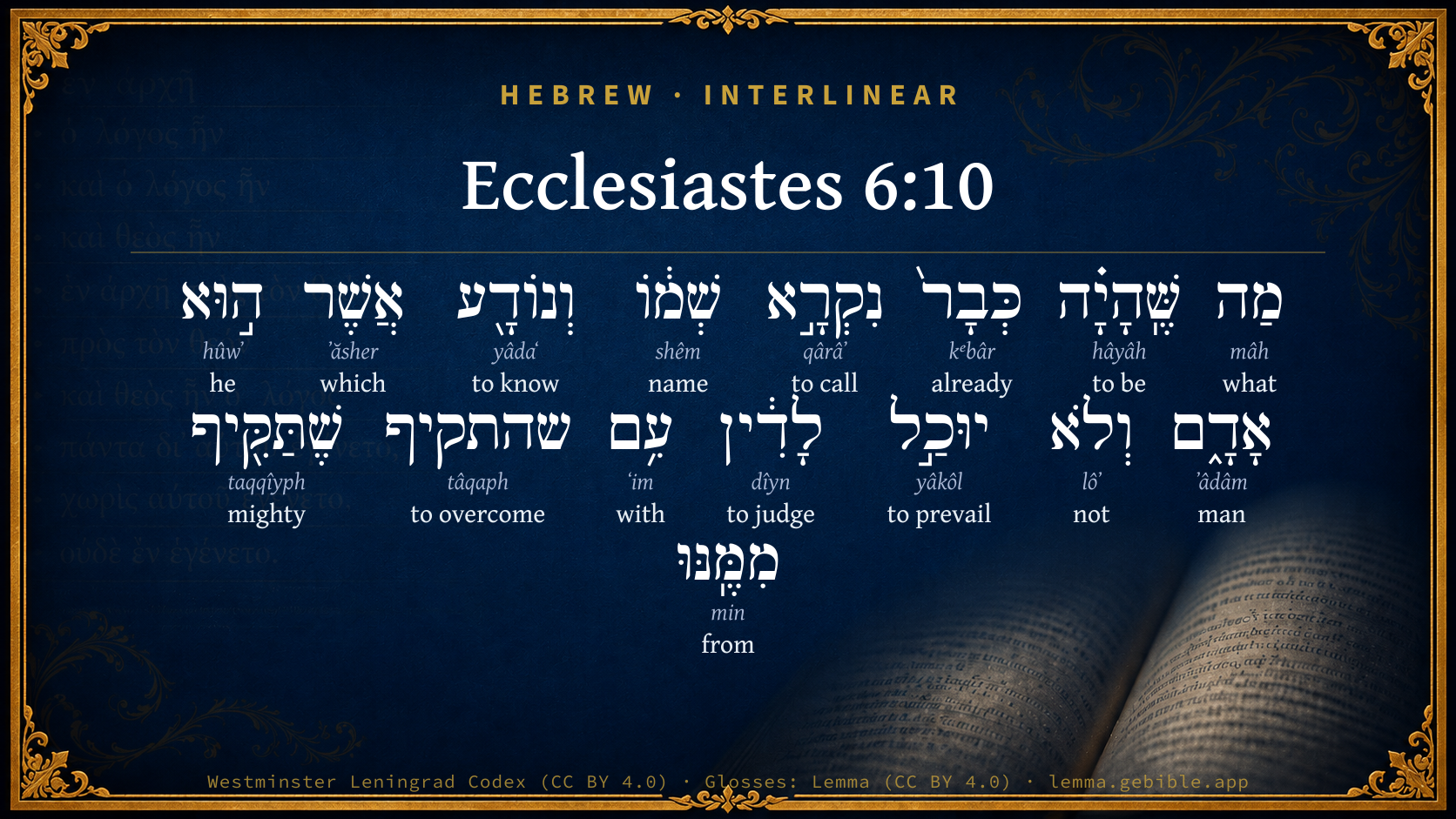
Hebrew (Westminster Leningrad Codex) Ecclesiastes 6:10 appears in the Hebrew Old Testament. The text above is from the Westminster Leningrad Codex. Each word links to its Strong’s number, a concise gloss, and parsing drawn from the Open Scriptures Hebrew Bible morphology. Click any word for its full Brown-Driver-Briggs (BDB) entry.
Download image
Cite this verse

Ecclesiastes 6:10 (World English Bible). Public Domain. Lemma interlinear Bible study tool, https://lemma.gebible.app/v/ecclesiastes/6/10.

Show BibTeX & RIS
BibTeX
RIS
English Translation
Whatever has been, its name was given long ago; and it is known what man is; neither can he contend with him who is mightier than he.
World English Bible · Public Domain
Highlights
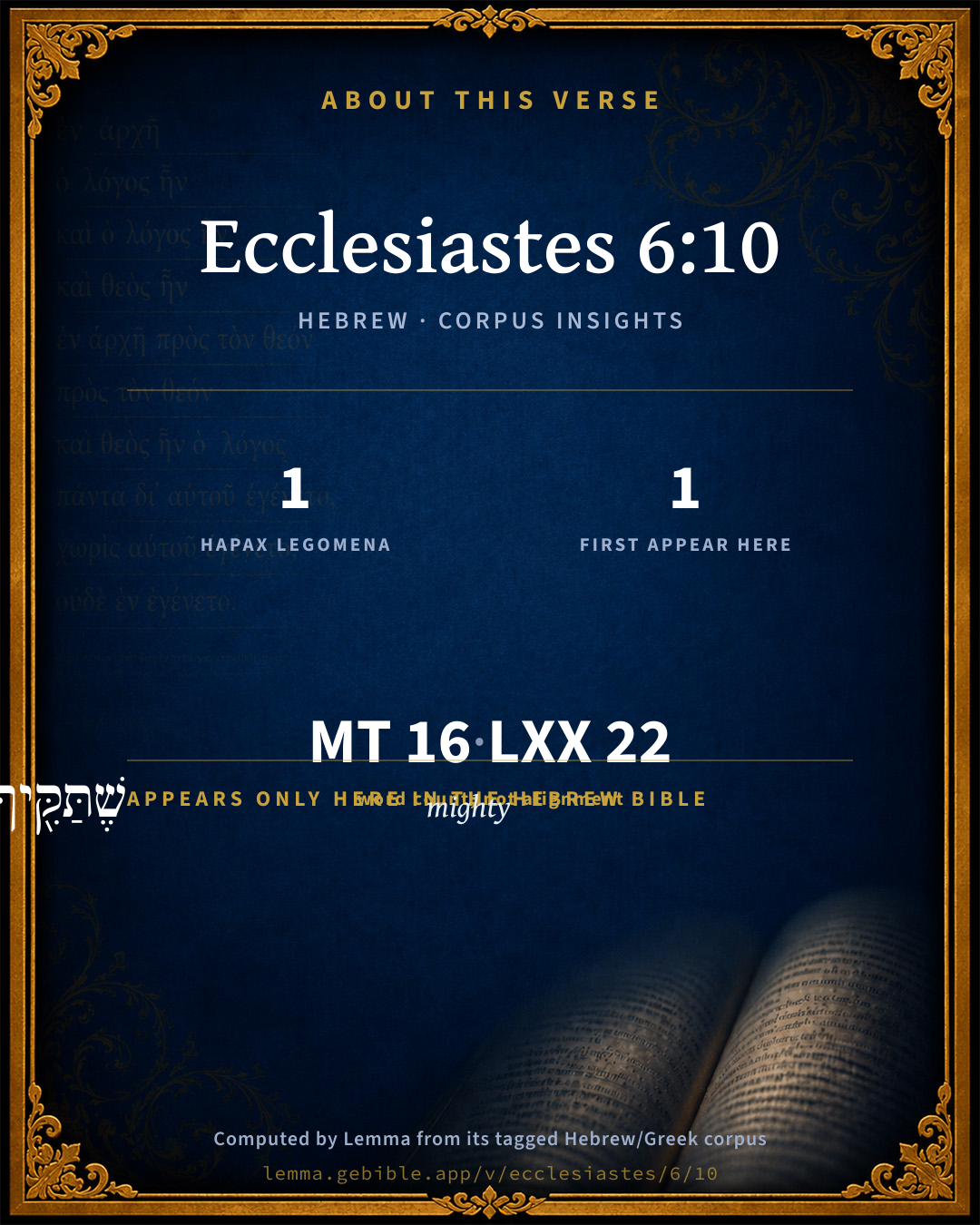
  • 1 hapax legomenon — only here in the Hebrew Bible
  • 1 first appearance in the Hebrew Bible
Full analysis ↓
Download a study sheet

One document with this verse’s original text, its word-by-word gloss line, the meaning frame, cross-references with their text, attributed commentary, and full source and license credits — printable, and it pastes into notes with its structure intact.

This verse Autodidact and up

Study sheet (.html) Plain text (.txt)

A passage Seminary Student

Up to 50 verses in one chapter. A passage sheet keeps up to 6 commentary sources and 12 cross-references per verse, in the order this page ranks them, and says so on the sheet whenever that leaves anything out. Ask for a single verse and you get the Autodidact verse sheet above.

Everything on this page stays free to read, with no account — the sheet is a download of what is already on screen, not access to it.

Want to remove ads? Support Godless Engineer
Compare translations 3

The same verse in 3 English versions, stacked beneath the original-language interlinear above. Click any original word for its lexicon entry.

Each is an independent rendering of the whole verse — the interlinear is not word-aligned to these translations.

Highlighted words mark where these versions differ — a whole-verse word diff, not a word-by-word alignment.

  • World English Bible Public Domain
    Whatever has been, its name was given long ago; and it is known what man is; neither can he contend with him who is mightier than he.
  • King James Version Public Domain
    That which hath been is named already, and it is known that it is man: neither may he contend with him that is mightier than he.
  • unfoldingWord Literal Text CC BY-SA 4.0
    Whatever that is, already its name has been called, and it is known what a person —and he is not able to contend with he who is more powerful than him.

unfoldingWord Literal Text — © unfoldingWord, licensed CC BY-SA 4.0. Word-aligned USFM3 via Door43 (git.door43.org/unfoldingWord/en_ult).

Versions to compare (up to 4)

3 of 4 selected

Show all 18 translations

Every available English version of this verse, each an independent rendering of the whole verse.

  • World English Bible Public Domain
    Whatever has been, its name was given long ago; and it is known what man is; neither can he contend with him who is mightier than he.
  • Berean Standard Bible Public Domain
    Whatever exists was named long ago, and what happens to a man is foreknown; but he cannot contend with one stronger than he.
  • Majority Standard Bible Public Domain
    Whatever exists was named long ago, and it is known what man is; but he cannot contend with one stronger than he.
  • King James Version Public Domain
    That which hath been is named already, and it is known that it is man: neither may he contend with him that is mightier than he.
  • American Standard Version (1901) Public Domain
    Whatsoever hath been, the name thereof was given long ago; and it is know what man is; neither can he contend with him that is mightier than he.
  • Revised Version (1885) Public Domain
    Whatsoever hath been, the name thereof was given long ago, and it is known that it is man: neither can he contend with him that is mightier than he.
  • Geneva Bible (1599) Public Domain
    What is that that hath bene? the name thereof is nowe named: and it is knowen that it is man: and he cannot striue with him that is stronger then he.
  • Douay-Rheims (1899) Public Domain
    He that shall be, his name is already called: and it is known, that he is man, and cannot contend in judgment with him that is stronger than himself.
  • Young's Literal Translation Public Domain
    What `is' that which hath been? already is its name called, and it is known that it `is' man, and he is not able to contend with him who is stronger than he.
  • Literal Standard Version CC BY-SA 4.0
    What [is] that which has been? Already is its name called, and it is known that it [is] man, || And he is not able to contend with him who is stronger than he.
  • Unlocked Literal Bible CC BY-SA 4.0
    Whatever has existed has already been given its name, and what mankind is like has already been known. So it has become useless to dispute with the one who is the mighty judge of all.
  • unfoldingWord Literal Text CC BY-SA 4.0
    Whatever that is, already its name has been called, and it is known what a person —and he is not able to contend with he who is more powerful than him.
  • Darby Bible Public Domain
    That which is hath already been named; and what man is, is known, and that he cannot contend with him that is mightier than he.
  • World Messianic Bible Public Domain
    Whatever has been, its name was given long ago; and it is known what man is; neither can he contend with him who is mightier than he.
  • Webster's Bible Public Domain
    That which hath been is named already, and it is known that it is man: neither may he contend with him that is mightier than he.
  • Free Bible Version CC BY-SA 4.0
    Everything that exists has already been described. Everyone knows what people are like, and that you can't win an argument with a superior.
  • Bible in Basic English Public Domain
    That which is, has been named before, and of what man is there is knowledge. He has no power against one stronger than he.
  • JPS Tanakh (1917) Public Domain
    Whatsoever cometh into being, the name thereof was given long ago, and it is foreknown what man is; neither can he contend with Him that is mightier than he.

Literal Standard Version (2020), Covenant Press — licensed CC BY-SA 4.0. Text via the HelloAO Bible API (eBible.org). Unlocked Literal Bible (unfoldingWord) — licensed CC BY-SA 4.0. Text via the HelloAO Bible API (eBible.org). unfoldingWord Literal Text — © unfoldingWord, licensed CC BY-SA 4.0. Word-aligned USFM3 via Door43 (git.door43.org/unfoldingWord/en_ult). Free Bible Version, Dr. Jonathan Gallagher — licensed CC BY-SA 4.0. Text via the HelloAO Bible API (eBible.org).

Word by word

More ways to search: Search by grammar → Find every occurrence → Compare this word →

Practice this passage: Drill this verse → Learn its vocabulary →

שֶׁתַּקִּ֖יף
taqqîyph
H8623
“the · mighty”
Particle, Definite Article + Adjective, Adjective, Masculine, Singular, Absolute
Part of Speech
Particle + Adjective
Type
Adjective
Gender
Masculine
Number
Singular
State
Absolute
Full BDB Definition

Origin: from H8630

TWOT: 2542b

mighty
  1. מַה mâh H4100 “what” Particle, Interrogative
  2. שֶּֽׁהָיָ֗ה hâyâh H1961 “who/which · to be” Particle, Relative + Verb, Qal, Perfect, 3rd Person, Masculine, Singular
  3. כְּבָר֙ kᵉbâr H3528 “already” Adverb
  4. נִקְרָ֣א qârâʼ H7121 “calling” Verb, Niphal, Participle Active, Masculine, Singular, Absolute
  5. שְׁמ֔וֹ shêm H8034 “name · his” Noun, Common, Masculine, Singular, Construct + Suffix, Personal, 3rd Person, Masculine, Singular
  6. וְנוֹדָ֖ע yâdaʻ H3045 “and · knowing” Conjunction + Verb, Niphal, Participle Active, Masculine, Singular, Absolute
  7. אֲשֶׁר ʼăsher H834 “which” Particle, Relative
  8. ה֣וּא hûwʼ H1931 “he” Pronoun, Personal, 3rd Person, Masculine, Singular
  9. אָדָ֑ם ʼâdâm H120 “man” Noun, Common, Masculine, Singular, Absolute
  10. וְלֹא lôʼ H3808 “and · not” Conjunction + Particle, Negative
  11. יוּכַ֣ל yâkôl H3201 “to prevail” Verb, Qal, Imperfect, 3rd Person, Masculine, Singular
  12. לָדִ֔ין dîyn H1777 “to judge” Preposition + Verb, Qal, Infinitive Construct
  13. עִ֥ם ʻim H5973 “with” Preposition
  14. שהתקיף tâqaph H8630 “who/which · to overcome” Particle, Relative + Verb, Hiphil, Infinitive Construct
  15. מִמֶּֽנּוּ min H4480 “from · him” Preposition + Suffix, Personal, 3rd Person, Masculine, Singular

About this verse

These counts appear in no published source. They are computed here, from the morphology-tagged text and Lemma’s own curated glosses. What Lemma adds →

16
words
16
distinct lemmas
Wisdom
section

Notable vocabulary

1 hapax legomenon — a word that appears only here in the entire Hebrew Bible:

  • שֶׁתַּקִּ֖יף mighty H8623

First appearance in Scripture

This word makes its first canonical appearance in the Hebrew Bible here:

  • שֶׁתַּקִּ֖יף mighty H8623

Shared distinctive vocabulary

שהתקיף to overcome H8630 occurs in 4 verses of the Hebrew Bible. Also found in:

Grammatical profile

  • 6 verbs
  • 2 nouns
  • 1 adjective
  • 1 pronoun
  • 2 prepositions
  • 1 adverb
  • 3 particles

Verb forms

  • שֶּֽׁהָיָ֗ה Qal · Perfect
  • נִקְרָ֣א Niphal · Participle Active
  • וְנוֹדָ֖ע Niphal · Participle Active
  • יוּכַ֣ל Qal · Imperfect
  • לָדִ֔ין Qal · Infinitive Construct
  • שהתקיף Hiphil · Infinitive Construct

Hebrew & Septuagint length

In English translation the verse runs 27 words from the Hebrew and 28 from the Septuagint (LXX English) — closely comparable.

A rough comparison of the two English renderings, which tokenize alike — not a word-level alignment.

Word counts can differ between the Hebrew and the Greek without any difference in meaning — e.g. the Hebrew direct-object marker אֵת has no separate Greek word, and Greek often adds the article ὁ.

In the original languages it is 16 Hebrew tokens and 22 Greek tokens — but the two are counted differently (Hebrew bundles its prefixes and suffixes into one token; the Greek is in lemma form), so that isn’t a like-for-like length.

Cross-references

14

Topical passages linked to Ecclesiastes 6:10 in the Treasury of Scripture Knowledge — connected by theme and wording, ordered by reader-vote popularity; previews shown in the World English Bible.

  • Job 9:32 For he is not a man, as I am, that I should answer him, That we should come together in judgment.
  • Isaiah 45:9–10 Woe to him who strives with his Maker--a potsherd among the potsherds of the earth! Shall the clay ask him who fashions it, "What are you making?" or your work, "He has no hands?"
  • Job 40:2 "Shall he who argues contend with the Almighty? He who argues with God, let him answer it."
  • Genesis 3:17–19 To Adam he said, "Because you have listened to your wife's voice, and have eaten of the tree, of which I commanded you, saying, 'You shall not eat of it,' cursed is the ground for your sake. In toil you will eat of it all the days of your life.
  • Job 33:13 Why do you strive against him, Because he doesn't give account of any of his matters?
  • Ecclesiastes 3:15 That which is has been long ago, and that which is to be has been long ago: and God seeks again that which is passed away.
  • Jeremiah 49:19 Behold, he shall come up like a lion from the pride of the Jordan against the strong habitation: for I will suddenly make them run away from it; and whoever is chosen, him will I appoint over it: for who is like me? and who will appoint me a time? and who is the shepherd who will stand before me?
  • Romans 9:19–20 You will say then to me, "Why does he still find fault? For who withstands his will?"
  • Job 9:3–4 If he is pleased to contend with him, He can't answer him one time in a thousand.
  • Job 14:1–4 "Man, who is born of a woman, Is of few days, and full of trouble.
  • Psalms 39:6 "Surely every man walks like a shadow. Surely they busy themselves in vain. He heaps up, and doesn't know who shall gather.
  • Psalms 82:6–7 I said, "You are gods, All of you are sons of the Most High.
  • Ecclesiastes 1:9–11 That which has been is that which shall be; and that which has been done is that which shall be done: and there is no new thing under the sun.
  • Psalms 103:15 As for man, his days are like grass. As a flower of the field, so he flourishes.

Cross-references courtesy of OpenBible.info (CC BY 4.0).

Hebrew and Greek witnesses Masoretic Hebrew ↔ Greek Septuagint

The same verse in the two great witnesses to the Old Testament, shown verse-for-verse.

These are two independent witnesses, not word-aligned to each other, and the Septuagint is shown in lemma (dictionary) form.

Hebrew Ecclesiastes 6:10 Masoretic · Westminster Leningrad Codex

מַה שֶּֽׁהָיָ֗ה כְּבָר֙ נִקְרָ֣א שְׁמ֔וֹ וְנוֹדָ֖ע אֲשֶׁר ה֣וּא אָדָ֑ם וְלֹא יוּכַ֣ל לָדִ֔ין עִ֥ם שהתקיף שֶׁתַּקִּ֖יף מִמֶּֽנּוּ

Whatever has been, its name was given long ago; and it is known what man is; neither can he contend with him who is mightier than he.

World English Bible · Public Domain

Greek LXX Ecclesiastes 6:10 Septuagint · lemma form

εἰ τίς γίγνομαι ἤδη καλέω ὄνομα αὐτός καί γιγνώσκω ὅς εἰμί ἄνθρωπος καί οὐ δύναμαι ὁ κρίνω μετά ὁ ἰσχυρός ὑπέρ αὐτός

If anything has been, its name has already been called: and it is known what man is; neither can he contend with him who is stronger than he.

LXX2012 (modern English Septuagint) · Public Domain

On this verse, The Pulpit Commentary discusses the Septuagint’s reading. Read the note in Commentary ↓

Hebrew: Westminster Leningrad Codex (CC BY 4.0). Greek: Septuagint (public domain); English from LXX2012 (modern English Septuagint) (Public Domain). How the Septuagint differs from the Hebrew →

Commentary

Notes on Ecclesiastes 6:10 from classic Christian and Jewish commentators (each source and its license shown beneath its notes). The classic Christian expositions comment on the surrounding passage and are grouped to its opening verse, so a note may address several verses; the Jewish commentaries on the Tanakh (Rashi and others) are per-verse, so they appear only where the commentator wrote on this verse.

Lemma curates 59 commentaries, every one of them public domain or Creative Commons licensed, each selected and text-cleaned for this edition rather than reprinted as found. About our sources →

Trapp's Complete Commentary

John Trapp

Ecc 6:10 That which hath been is named already, and it is known that it [is] man: neither may he contend with him that is mightier than he.

Ver. 10. That which hath been is named already.] Or thus, That which is the name of it, hath been named already, {viz., Ecc 1:2-3} and it is known that it is Adam, or earthly man. The very notation of his name argues him mortal and miserable; whether he be wise or foolish, rich or poor, that alters not the case: - Homo sum, said one, humanum nihil a me alienum puto: I am a man, and therefore may not think strange of misery, whereunto I am born, as the sparks fly upward; {Job 5:7} he that forgets not that he is a man, will not take it ill that evil befalls him, {a} saith another. When Francis, King of France, being held prisoner by Charles V, Emperor of Germany, saw the Emperor’s motto, Plus ultra, More yet, written on the wall of his chamber, he underwrote these words, Hodie mihi, cras tibi: Today is my turn to suffer, tomorrow thine. The Emperor observed it and wrote underneath that, Fateor me esse hominem: I confess I am a man, and therefore subject to misery. {b} Metellus was by the Romans counted and called Felix, happy; so was Sulla, {c} but he proved true that holy proverb, "Better is the end of a thing than the beginning," for he died miserably of the lousy disease, that dashed all his former happiness. The Delphian oracle pronounced one Aglaus, a poor contented Arcadian, the only happy man alive. Solon preferred Tellus the Athenian, and Cleobis, and Bitus also, before rich Croesus, telling him further that he might be called rich and mighty but not blessed, till he had made a happy end; and so confuting his fond conceit of an imaginary felicity. {d} The Greeks, when they would call a man thrice miserable, they call him thrice a man. {e} The Hebrews, whereas they name a bee from the order of her working, a grasshopper from devouring, an ant from gnawing, an adamant from strokes bearing, a serpent from curious observing, a horse from neighing, &c, they give man his name Adam, from the dust whereof he was made, and Enoch, sorry-man, sick of a deadly disease, and so no way fit to "contend with God, who is much mightier than he," to require a reason of his judgments, which are sometimes secret, always just. God hath shut up all persons and things (as it were close prisoners) under vanity, by an irresistible decree. To strive against this stream, and by heaping riches, honours, pleasures, to seek to break prison and to withstand God’s will, is lost labour. Misery need not go to find such out, they run to meet their bane; which yet will - as we say of foul weather - come time enough before it is sent for.

{a} O μεμνημενος οτι εστον ανθρωπος, &c. - Isoc.

{b} Joh. Man., loc. com., p. 175.

{c} Dictas potius est quam fuerit felix Sulla. - Solin. c. 7.

{d} Valer. Max., lib. vii., cap. 3.

{e} Tροσανθρωπος. πας εστιν ανθρωπος συμφορα. - Herodot.

John Trapp, A Commentary or Exposition upon All the Books of the Old and New Testament (1647–1656) — public domain. Text from a community e-Sword module.

The Biblical Illustrator

Joseph S. Exell

Ecc_6:10-12

That which hath been is named already, and it is known that it is man.

Solomons dark ideas of life

He says in effect--

I. Fate is fixed. That which hath been. Everything is fate. Most men feel this at times. Do you ever say, I must obey my destiny? It is no use contending with fate. Mine m an unlucky star. There is some truth in this idea. Christ taught a preordination in all events. But His fate was moral, not mechanical; not a blind destiny, but a wise decree.

II. Man is feeble. Neither may he contend with Him that is mightier than he. And Christless humanity is a very feeble thing. His bodily frame is feeble. An insects sting has been known to consign it to dissolution. Mans intellect is feeble; still the human intellect can do something great in connection with Christ.

III. Joy is futile (Ecc_6:11). What the better is man for all he has? What the better for his wealth, his reputation, his philosophy?

IV. Life is fleeting. It is a vain life, and all its days are a shadow. A shadow is the nearest thing to anility. A cloud may catch the eye, and its changing views and figures may give amusement for a few minutes--a shadow, who notes it or records it?

V. The future is enigmatic. Who can tell what shall be after him under the sun? (J. Hamilton, D. D.)

Seeing there be many things that increase vanity, what is man the better?--

How is the adherent vanity of every condition most effectually abated by serious godliness

I. Every condition is clogged with vanity.

1. God never made the world, nor any condition in it, to be a place of rest and satisfaction. And since sin hath so far marred the beauty of the universe, there is a judicial vanity upon the whole creation (Rom_8:20).

2. We know but very little of the true nature of things, nor of ourselves, nor of our temptations, nor of our interests (Job_8:9).

3. That little that we do know of anything, we come so droppingly to the knowledge of it that, ere we can lay things together, so as to compare them, and separate them, and sort them, and compound them, so as if to make a judgment, either things themselves or our circumstances are altered, or upon alteration.

II. All things on this side religion, whereby men endeavour to get above vanity, increase it. The multiplication of cyphers amounts to less than nothing. Can anything of the world supply the soul with grace, satisfy the desires in so much as any one thing, or fill any one faculty of the soul to satisfaction? Can the world fill the mind with heavenly light, or the will with heavenly love, or the conscience with that peace that passeth understanding?

III. It is only serious godliness that can any whit really abate the vanity that cleaves to every condition. To hate sin and love holiness; to live a life of faith, in dependence upon God and resignation to Him; to live above the transports of hopes and fears about things temporal; in short, to be blessings to the world while we live, and to be blessed with God when we die: this is the business and fruit of serious godliness; and this alone is that which at present can effectually abate the vexatious vanities which every condition swarms with.

1. Serious godliness will make your present condition good for you, be it what it will.

2. Serious godliness will make every change of condition good for us, though the change shock both nature and grace.

3. Serious godliness will make relative afflictions (which of all outward afflictions are the most grievous) good for us; and nothing else can do it.

4. Serious godliness will make horror of conscience and Divine desertions good for us.

5. Serious godliness will force something good out of the evil of sin. The rising ground of a dunghill may help to raise thy flight towards heaven.

6. Though to your own apprehension you have no faith at all to believe any one word of all this, nor any skill at all to know what to do; yet serious godliness will make all this good to thee.

Uses:--

1. Set your hears upon serious godliness.

2. Learn to be more than barely contented with your present condition.

3. Make conscience of both sorts of duties,--religious and worldly; and allot fit and distinct times for heavenly and worldly business. But with this difference, let religion mix itself with worldly business, and spare not; but let not the world break in upon religion, lest it spoil it.

4. Whatever you do for the bettering of your condition, follow God, but do not go before Him. (S. Annesley, LL. D.)

The Biblical Illustrator, edited by Joseph S. Exell (c. 1880s–1900s) — public domain. Text from a community e-Sword module.

Joseph Benson's Commentary

Ecc 6:10. That which hath been — Or, that which is, for the Hebrew מה שׁהיה, may be rendered either way; namely, Man, considered with all his endowments and enjoyments, whether he be wise or foolish, rich or poor; man, who is the chief of all visible and sublunary beings, for whom they all were made, is named already, namely, by God, who immediately after his creation called him Adam, (Gen 5:2,) to signify what his nature and condition were or would be. This verse seems to be added as a further instance of the vanity of all things in this life. And it is known that it is man — This is certain and manifest, that that being, which makes all this noise in the world, however magnified by himself, and almost adored by flatterers; and however differenced from, or advanced above others, by wisdom or riches, or such like things, is but a mean, earthly, mortal, and miserable creature, as his very name signifies, which God gave him for this very end, that he might be always sensible of his vain and miserable estate in this world, and therefore never expect satisfaction or happiness from it. Neither may he contend with him that is mightier than he — That is, with Almighty God, with whom men are very apt to contend upon every slight occasion; and against whom they are ready to murmur on account of this their vanity, and mortality, and misery, although they brought it upon themselves by their sins. Bishop Patrick’s interpretation of this obscure verse is very nearly to the same purpose, thus: “What if a man have already arrived at great renown, as well as riches, still it is notorious that he is but a man, made out of the dust, and therefore weak and frail, and subject to many disasters; which it is not possible for him, by his most anxious cares, to prevent, or by his power and wealth to throw off when he pleases.” “This sense,” adds he, in a note, “seems to me the most simple, and most agreeable to the whole discourse, and it is that which Melancthon hath expressed in these words, ‘Although a man grow famous, yet it is known that he is but a man; and he cannot contend with that which is stronger than himself;’ that is, he cannot govern events.”

Joseph Benson's Commentary on the Old and New Testaments (1811–1818) — public domain. Text from a community e-Sword module.

Tyndale Open Study Notes

Tyndale Open Resources

6:10–7:22 God’s sovereign rule over everything is sobering, but it is ultimately a source of hope.

6:10 Everything has already been decided: Cp. Rom 8:29; Eph 1:5, 11. • It was known long ago what each person would be: Cp. Ps 139:15-16. • no use arguing with God about your destiny: Cp. Rom 9:20-24.

Tyndale Open Study Notes — © Tyndale Open Resources, licensed CC BY-SA 4.0. Text via the HelloAO Bible API.

Geneva Bible (1599)

Geneva Bible translators

Meaning, God who will make him to feel that he is mortal.

Geneva Bible (1599) marginal notes — public domain. Text via Bolls.life.

Jamieson, Fausset & Brown

Robert Jamieson, A. R. Fausset & David Brown

Part II begins here. Since man's toils are vain, what is the chief good? (Ecc 6:12). The answer is contained in the rest of the book.

That which hath been--man's various circumstances

is named already--not only has existed, Ecc 1:9; Ecc 3:15, but has received its just name, "vanity," long ago,

and it is known that it--vanity

is man--Hebrew, "Adam," equivalent to man "of red dust," as his Creator appropriately named him from his frailty.

neither may he contend, &c.-- (Rom 9:20).

Jamieson, Fausset & Brown — Commentary Critical and Explanatory on the Whole Bible (1871) — public domain (CC PDM 1.0). Text via the HelloAO Bible API.

Adam Clarke's Commentary

Verse 10. That which hath been is named already] The Hebrew of this verse might be translated, "Who is he who is? His name has been already called. And it is known that he is Adam; and that he cannot contend in judgment with him who is stronger than he."

"What is more excellent than man; yet can he not, in the lawe, get the victory of him that is mightier than he." - COVERDALE.

ADAM is his name; and it at once points out,

1. His dignity; he was made in the image of God.

2. His fall; he sinned against his Maker and was cast out of Paradise. And

3. His recovery by Christ; the second man (Adam) was the Lord from heaven, and a quickening Spirit.

Adam Clarke's Commentary on the Bible (1810–1826) — public domain. Text from a community e-Sword/MySword module.

Ellicott's Commentary for English Readers

(10) Of this difficult verse I prefer the translation, “What he is his name has been called long ago, and it is known that it is man; neither may he strive,” &c—i.e., the name given long ago to man (Gen_2:7) indicates his weakness; neither can he contend with the Almighty. There may be a reference to Gen_6:3, where a kindred word is used.

Mightier.—The word here used is found only in the Chaldee books of the Bible and in later Hebrew.

A Bible Commentary for English Readers, edited by Charles John Ellicott (1878–1897) — public domain. Text from a community e-Sword module.

The Cambridge Bible for Schools and Colleges

gen. ed. J. J. S. Perowne

10. That which hath been is named already] The maxim is enigmatic. As viewed by many commentators, it asserts that man is the creature of a destiny, which he cannot resist. Long ago, in the far eternity, his name has been written, and what he will be. He cannot plead against the Power that is mightier than himself, i.e. against God. There is nothing left but submission. So taken, the words have a parallel in all utterances in the Bible, or out of it, that assert, or seem to assert, an absolutely predestinating fatalism (Isa_45:9; Act_15:18; Rom_9:20). In such a fatalism, reconciled in some way or other with man’s freedom and responsibility, both the Stoics and Pharisees believed, and so far there would be nothing strange in finding a like maxim in a book which contains so many mingled and heterogeneous elements, both Greek and Jewish, of oscillating thought. There are, however, what seem sufficient reasons for rejecting this interpretation. The word for “already,” which occurs only in this book (chs. Ecc_1:10, Ecc_2:12, Ecc_3:15), is never used of the eternity of the Divine decrees, but, as the passages referred to shew, of that which belongs essentially to human history; that for “mightier,” found in the O. T. only here and in Ezr_4:20; Dan_2:40; Dan_2:42; Dan_4:3; Dan_7:7, is not used, in any of these passages, of God. The sequence of thought leads the writer to dwell on the shortness of man’s life, rather than on its subjection to a destiny. The following explanation gives that sequence more clearly, What he is, long ago his name was called. In the last words we find a reference to Gen_2:7, where the name of Adam (= man) is connected with Adamah (= the ground), as homo was, by older philologists, derived ex humo. The very name of man bore witness to his frailty. This being so, he cannot take his stand in the cause, which one “mightier” than himself pleads against him. Death is that mightier one, and will assert his power. So taken, the thought is continuous and harmonious throughout.

The Cambridge Bible for Schools and Colleges (gen. ed. J. J. S. Perowne; Cambridge University Press, 1878–1918) — public domain. Text from a community e-Sword module.

John Gill's Exposition

That which hath been is named already, and it is known that it is man,.... Which may be understood of the first man Adam, who has been, has existed, was produced by the immediate power of God, creating and forming him out of the dust of the earth; was made after the image, and in the likeness of God, a wise and knowing creature, a rich and powerful one, the figure of him that was to come, being the head and representative of all his posterity; and he has been named already, he had his name from the Lord himself, suitable to his nature and formation; he called his name Adam, from "Adamah", the earth, from whence he was taken; and though he was so wise and great, and even affected deity, which was the snare laid for him by his enemy, it is well known he was but a man, of the earth, earthly, and returned to it again. Some have applied this to the second man, the Lord from heaven, as the ordinary gloss, and Jerom; and render it, "that which shall be", so the Vulgate Latin version; as yet he was not man, though he had agreed to be and was prophesied of that he should; however be was named already the seed of the woman, Shiloh, Ithiel, the Messiah, or Anointed; hence by Solomon, in allusion to this name, his "name is said to be as ointment poured forth", Sol 1:3; and as it was known that he should be man, so it is now known that he is really and truly man; though not merely so, but God as well as man; yet as to his human nature his Father is greater and mightier than he; but this sense some interpreters despise and laugh at: and indeed though the whole of it is truth, it does not seem to be the truth of the text, nor suitable to the context: rather the words are to be understood of mankind in general, of all men, not only that have been, but that are or shall be; these were all appointed to come into being by the Lord; they have been in his eternal purposes and decrees, and their names are written or not written in the Lamb's book of life; and they have all one common name, that of "man", weak, frail, mortal, wretched man; they are, as is said of the Egyptians, men and not God, Isa 31:3; particularly this is true of persons the most famous that have been in the world; such who have been in ages past, and their names have been called, or they have obtained a name among men, men of renown, that are on the list of fame; such who have been the most famous for wisdom, for riches, for strength, or for power and authority, and have even had deity ascribed to them, and divine worship given them; yet it has been notorious that they were but men, and not God, so Jarchi; and died as such; see Psa 9:20. Moreover, this may be understood of all things relating to men; that all that has been, is, or shall be, has been already named of God, determined and appointed by him; so the Targum renders it,

"all is the decree of the Word of the Lord;''

all things relating to the temporal affairs of men, as to their birth and place of abode, their callings and stations of life; so to their circumstances of poverty or riches, which with all their craving desires and carking cares it is impossible for them to alter, or make them otherwise than they are; which is observed, to check the wandering and insatiable desires of men after worldly things;

neither may he contend with him that is mightier than he; the Lord of the world, as the Targum; not the angel of death, as Jarchi; the devil, which had the power of death, and is stronger than men; nor death itself, as others, against which there is no standing, Ecc 8:8, Isa 28:15; but God himself, who is mightier than men, and with whom a creature should not strive or contend; either about his being and the make of it, or concerning his circumstances in the world, that they are not, greater and better than they be; or about God's decrees concerning these or other things; but quietly submit to his will, and be content in whatsoever circumstances they are, considering that he is the Creator, and a sovereign Being, they are creatures, and dependent on him; and let their circumstances be what they will, wise or unwise, rich or poor, they are but men, and can never rise higher; see Job 9:3. It is observed by the Masorites that this is just the middle of the book.

John Gill's Exposition of the Whole Bible (1746–1763) — public domain (CC PDM 1.0). Text via the HelloAO Bible API.

Albert Barnes' Notes on the Bible

Or, “That which has been named - i. e., events past or current, either Ecc 1:9 as they present themselves to man, or Ecc 3:15 as they are ordered by God - was long ago (i. e., was decreed, its nature and place were defined by the Almighty), and was known that it is man;” i. e., the course of events shapes the conduct and character of man, so that what he does and suffers is said to be or constitute the man. God from the beginning definitely ordained the course of events external to man, and constituted man in such a way that events materially affect his conduct and his destiny. Hence, God, by withholding from certain people the gift of contentment, and thus subjecting them to vanity, is acting according to the predetermined course of His Providence which man cannot alter (compare Rom 8:20). Others translate, “What there is, its name is named long ago and known, that it is man;” i. e., “What hath been and is, not only came into existence long ago Ecc 1:9; Ecc 3:15, but also has been known and named, and is acknowledged that it, besides other things, is specially man; that man always remains the same, and cannot go beyond his appointed bounds.”

Him that is mightier - i. e., God; compare Ecc 9:1; 1Co 10:22, and marginal references.

Albert Barnes' Notes on the Bible (1834–1885) — public domain. Text from a community e-Sword/MySword module.

Haydock's Catholic Bible Commentary

He, &c. This is plainly spoken of Christ, whose name was given before he was born; (St. Jerome; Worthington) or men resemble each other in all ages, (chap. i. 9.; Calmet) being proud, fragile, &c.

George Leo Haydock (1774–1849), Haydock's Catholic Family Bible and Commentary, 1859 edition — public domain. Excludes Psalms (Douay-Rheims chapter numbering differs from Protestant) and Deuterocanonical books (Catholic canon only).

Matthew Poole's English Annotations

This verse is added either as a proof of what he last said concerning the vanity and wandering of insatiable desires, or as a timber instance of the vanity of all things in this life.

That which hath been (or, is, for the Hebrew verb) may be rendered either way, to wit, man considered with all his endowments and enjoyments, whether he be wise or foolish, rich or poor; man, who is the chief of all visible and sublunary beings, for whom they all were made) is named already, to wit, by God, who, presently after his creation, gave him the following name, to signify what his nature and condition was or would be. Heb. What is that which hath been, or is, it is, or hath been named already. Others understand it thus, All the several conditions which men have had or shall have in the world, riches or poverty, &c., are already named, i.e. appointed or determined by God’s unchangeable counsel and invincible providence. But though this be true, it seems not to suit so well with the following clause as the other interpretation doth.

It is known that it is man; this is certain and manifest, that that being which makes all this noise and stir in the world, howsoever magnified by themselves, and sometimes adored by flatterers, and howsoever differenced from or advanced above others, by wisdom, or riches, or the like, is but a man, i.e. a mean earthly mortal and miserable creature, as his very name signifies, which God gave him for this very end, that he might be always sensible of his vain, and base, and miserable estate in this world, and therefore never expect satisfaction or happiness in it.

With him that is mightier than he, i.e. with Almighty God, with whom men are very apt to contend upon every slight occasion, and against whom they are ready to murmur for this vanity, and mortality, and misery of mankind, although they brought it upon themselves by their own sins. So this is seasonably added to prevent the abuse of the foregoing passage.

Matthew Poole's English Annotations on the Holy Bible (1683–1685) — public domain. Text from a community e-Sword/MySword module.

Whedon's Commentary on the Bible

Daniel D. Whedon

10. Koheleth reverts to the matter of wealth, as if asking why it affords no satisfaction. Because of the fixed order which the Almighty has established, and against which it is useless for man to struggle.

That which hath been is named already — Rather, was previously called by name.

Him that is mightier — That is, the Almighty. “Woe unto him that contendeth with his Maker.”

Daniel D. Whedon (gen. ed.), Commentary on the Old and New Testaments (1874–1909) — public domain. Text from a community e-Sword module.

The Pulpit Commentary

Vers. 10-12. Section 11. All things are foreknown and foreordained by God; it is useless to murmur against or to discuss this great fact; and as the future is beyond our knowledge and control, it is wise to make the best of the present.

That which hath been is named already; better, whatsoever hath been, long ago hath its name been given. The word rendered "already," kebar, (Ecc_1:10 Ecc_2:12 Ecc_3:15 Ecc_4:2) "long ago," though used elsewhere in this book of events in human history, may appropriately be applied to the Divine decrees which predetermine the circumstances of man"s life. This is its significance in the present passage, which asserts that everything which happens has been known and fixed beforehand, and therefore that man cannot shape his own life. No attempt is here made to reconcile this doctrine with man"s free-will and consequent responsibility. The idea has already been presented in Ecc_3:1, etc. It comes forth in Isa_45:9, "Shall the clay say to him that fashioneth it, What makest thou? or thy work, He hath no hands?" (comp.; Rom_9:20 Act_15:18 according to the Textus Receptus) "Known unto God are all his works from the beginning of the world." The same idea is brought out more fully in the following clauses. Septuagint, "If anything ever was, already hath its name been called," which gives the correct sense of the passage. The Vulgate is not so happy, Qui futurus est, jam vocatum est nomen ejus, being rather opposed to the grammar. And it is known that it is man. What is meant by the Authorized Version is doubtful. If the first clause had been translated, as in the margin of the Revised Version, "Whatsoever he be, his name was given him long ago," the conclusion would come naturally, "and it is known that he is man" (Adam), and we should see an allusion to man"s name and to the ground (adamah) from which he was taken, (Gen_2:7) as if his very name betokened his weakness. But the present version is very obscure. Cox gives, "It is very certain that even the greatest is but a man, and cannot contend with him," etc. But the Hebrew will not admit this rendering. The clause really amplifies the previous statement of man"s predetermined destiny, and it should be rendered, "And it is known what a man shall be." Every individual comes under God"s prescient superintendence. Septuagint, jEgnwsqh o ejstw anqrwpov, "It is known what man is;" Vulgate, Et scitur quod homo sit. But it is not the nature of man that is in question, but his conditioned state. Neither may he contend with him that is mightier than he. The mightier One is God, in accordance with the passages quoted above from Isaiah, Acts, and Romans. Some consider that death is intended, and that the author is referring to the shortness of man"s life. They say that the word taqqiph, "mighty" (which occurs only in Ezra and Daniel), is never used of God. But is it used of death? And is it not used of God in Dan_4:3 (3:33, Hebrew), where Nebuchadnezzar says, "How mighty are his wonders"? To bring death into consideration is to introduce a new thought having no connection with the context, which is not speaking of the termination of man"s life, but of its course, the circumstances of which are arranged by a higher Power. Septuagint, Kaisetai kriqhnai metarou uJper aujton. With this we may comparen;)." 1Co_10:22, "Do we provoke the Lord to jealousy? are we stronger than he? (mhteroi aujtou ejsme)

Vers. 10-12.

Four aspects of human life.

I MAN AS A CREATURE OF DESTINY. "Whatsoever hath been, the name thereof was given long ago, and it is known that it is man" (ver. 10); or, "Whatsoever he be, his name was given him long ago, and it is known that he is man" (Revised Version margin); or, "That which hath been, its name hath long ago been named; and it is determined what a man shall be" (Delitzsch, Wright). These different readings suggest three thoughts.

1. That mans appearance upon the earth had been long ago foreseen. The sentiment holds good of man collectively or individually, i.e. of the race, or of the unit in the race. Neither did "man" originally spring into being by a happy accident, without the direct or indirect cognizance of God, nor does the "individual" so arrive upon the scene of time; but both the hour and the manner of man"s arrival upon the globe, and of each individual"s birth, were prearranged from eternity by him who "made the earth, and created man upon it", (Isa_45:12) and who "giveth to alllife and breath and all things". (Act_17:25)

2. That mans character as a creature had been long ago foreknown. In this respect, indeed, he had in no way differed from other creatures. Known unto God had been all his works from the beginning of the world. (Act_15:18) Human character is not in any instance an accidental product of blind forces, but is determined by fixed laws, moral and spiritual, which have been prearranged and instituted by the supreme moral Governor. Hence, within limits, it is possible for man to predict what himself or another shall become. "He that doeth righteousness" not only "is righteous" in the sense of already possessing the fundamental and essential principle of righteousness, viz. faith in, love of, and submission to God, but his righteousness shall eventually become within him the all-pervading and permanent quality of his being; and similarly "he that doeth unrighteousness" not only is potentially, but shall become permanently, unrighteous. Moral character in all men tends to fixity, whether of good or evil. Hence the greater possibility, amounting to certainty, that the Divine Mind, whose creation the laws are under which these results are wrought out, can, ab initio, foresee the issue to which, in every separate instance, they lead.

3. That mans destiny as an individual had been long ago determined, The doctrine of Divine predestination, however hard to harmonize with that of human freedom, is clearly revealed in Scripture (Exo_9:16; 2Ch_6:6; Psa_135:4; Isa_44:1-7; Jer_1:5. Mat_11:25, Mat_11:26; Joh_6:37; Rom_8:29 Rom_9:11) and is supported by the plain testimony of experience, which shows that

There"s a divinity that shapes our ends, Rough-hew them how we will. ("Hamlet. )

Or, in the words of Caesar, that nothing

Can be avoided Whose end is purposed by the mighty gods. ("Julius Caesar. )

II MAN AS THE POSSESSOR OF FREE-WILL. "Neither may or, "can" he contend with him that is mightier than he" (ver. 10); in which are contained the following thoughts:

1. That mighty as man is (in virtue of his free-will), there is a mightier than he. That mightier is not death (Plumptre), but God (Delitzsch), who also is a Being possessed of free-will, which must still less be interfered with by man"s choices and intentions, than man"s free-win must be impaired by God"s purposes and plans. This thought frequently forgotten, that if man, in virtue of his free-will, must be able to carry out his volitions, much more must God be able to carry out the free decisions of his infinite mind. In this concession the whole doctrine of predestination, or election, is involved.

2. That if in any instance man"s purposes and God"s come into collision, these of man must give way. One has only to put the question, whether it is of greater moment that God"s purposes with regard to the universe and the individual should be carried out, or that man"s with regard to himself should, to perceive the absurdity of limiting the Divine sovereignty in order to avoid the appearance of restricting human freedom, rather than seeming to impair human freedom in order to preserve intact the absolute and entire supremacy of God.

3. That Gods determinations, when accomplished, will not be impeachable by man. The veil of mystery now shrouding the Divine procedure will in the end be in great measure, perhaps wholly, uplifted, and man himself constrained to acknowledge that the supreme Ruler hath done all things well. (Mar_7:37)

III MAN AS A VICTIM OF IGNORANCE. "Seeing there be many things or, "words that increase vanity," what is man the better? For who knoweth," etc.? and "who can tell?" (vers. 11, 12).

1. The fact of his ignorance. Elsewhere in Scripture explicitly asserted (Deu_32:28; Psa_14:4; Pro_19:3; Joh_1:5; Eph_4:18) and abundantly confirmed by experience.

2. The extent of his ignorance. Restricting attention to the Preacher"s words, two subjects may be noted concerning which man apart, i.e., from God and religion is comparatively unenlightened:

(1) the supreme good, (Psa_4:6) which he places now in pleasure, now in possessions, now in philosophy, now in power, never in God; and

(2) the future, which is to him so much a sealed book that he cannot tell what a day may bring forth, (Pro_27:1) and far less "what shall be after him under the sun.

1. The strangeness of his ignorance. Considering that man is a being possessed of high natural endowments, and is often much and earnestly engaged in searching after knowledge. That with all his lofty capacity, and devotion to intellectual pursuits, he should, it" left to himself, be unable to tell either what is good for man in this life (all his discussions upon this subject having been little else than words, words, words), or how the course of events shall shape itself when he has passed from this earthly scene, is a surprising phenomenon which calls for examination.

2. The explanation of his ignorance lies in two things:

(1) in the natural limitation of his faculties, which are finite, and not infinite; and

(2) in the moral depravation of his faculties, which are nosy those not of an unfallen, but of a fallen, being.

IV MAN AS A DENIZEN OF EARTH.

1. His continuance is not permanent. He and his generation shall pass on, that those coming after may enter in and take possession. (Ecc_1:4)

2. His days are not many. His life he spendeth like a shadow, which has no substance, and abides not in one stay. "Man that is born of a woman is of few days," etc.. (Job_14:1, Job_14:2)

3. His life is not good. Apart from God and religion it is "vain," i.e. empty of real happiness, and. destitute of solid worth.

LESSONS.

1. The sovereignty of God.

2. The weakness of man.

3. The duty of submission to the Supreme.

4. The inability of earthly things to make man better.

5. The chief good for man on earth is God.

Contending against power.

The limitation which is characteristic of the human life and lot is observable, not only in man"s inability to attain the happiness he conceives and desires, but also in his inability to execute the purposes he forms. Conscious of powers which are yet undeveloped, inspired by an ambition that knows so bounds, he puts forth effort in many directions, at first with strong confidence and high hope. Experience alone convinces him of the truth expressed by the wise man in the assertion, "Neither can he contend with him that is mightier than he.

I THE WAY OF RESISTANCE. The will may be strong, and naturally prone to self-assertion, to energetic volition, and to contention with any resisting force.

1. God is, as the providential Ruler of the world, the Lord and Controller of all circumstances, mightier than man. Men fret against the conditions and limitations of their lot; they would fain possess greater strength and health, a longer life, enjoyments more varied and unmixed, etc. They resent the imposition of laws in the determination of which they had no voice. They are even disposed to believe that the world has been ordered, not by a benevolent Intelligence, but by a hard and cruel fate.

2. God is, as the moral Administrator and Judge, mightier than man. In their selfishness and prejudice, men may and do question the sway of reason in the universe; they assign all things to chance; they deny any laws superior to such as are physical and political; they deem man the measure of all things; they ridicule responsibility. All this they may do; but it is of no avail. God is mightier than they. They may violate his laws, but they cannot escape from their action; they may spurn his authority, but that authority is all the same maintained and exercised. The time comes when the insurgent and the rebel are constrained to admit that they are powerless, and that the Almighty is, and that he works and rules, and effects his righteous purposes.

II THE WAY OF SUBMISSION. It is the province of religion to point out to men that there is a Power in the universe which is above all, and to summon men to yield to this Power a cheerful subjection.

1. Submission is a just requirement on the part of God, and an honorable attitude on the part of man. He is no tyrant, capricious and unjust, who claims our loyalty and service; but the Being who is himself infinitely righteous. To do him homage is to bow, not before irresistible power merely, but before moral perfection. Resistance here is slavery; subjection is freedom.

2. Submission is the one only condition of efficient work and solid happiness. Whilst we resist God, we can do nothing satisfactory and good; when we accept his will and receive our commands from him, we become fellow-workers with God. Just as the secret of the mechanician"s success is in obeying the laws of nature, i.e. the laws of God in the physical realm, so the secret of the success of the thinker and the philanthropist lies in the apprehension and acknowledgment of Divine law in the intellectual and moral kingdoms. Man may do great things when he labors under God and with God. And in such a course of life there is true peace as well as true success. "If God be for us, who can be against us? T.

Heroism; infatuation; wisdom.

Translating the latter part of this passage thus, "And it is very certain that even the greatest is but man, and cannot contend with him who is mightier than he" (Cox), we have our attention directed to three things.

I REAL HEROISM. This is found in opposing ourselves to the strong on behalf of the weak, even though the odds against us are very great, and apparently overwhelming. Wonderful triumphs have been achieved, even though the agents have "been but men," when they have courageously and devoutly addressed themselves to the work before them. They have triumphed over

(1) powerful interests;

(2) imperious passions;

(3) deep-rooted prejudices;

(4) mighty numbers, in the cause of

(a) their country,

(b) truth,

(c) Jesus Christ.

II PITIFUL INFATUATION. This is seen in those who are foolish enough to measure their poor strength (or their weakness) with the power of God, with "him who is mightier than they." And this they do when they:

1. Act as if he did not regard them; when they say, "How doth God know? and is there knowledge in the Most High?". (Psa_73:11)

2. Imagine they can outwit him; when they think they will sin and be forgiven; will corrupt their lives and waste their powers, and yet find entrance at the last hour into his kingdom. But "God is not mocked; whatsoever a man sows, that does he reap." Sin always carries its penalty at one time and in some form, if not in another.

3. Live in simple defiance of his rule; go on in conscious wrong-doing, in the vague and senseless hope that somehow they will "escape the judgment of God.

III TRUE WISDOM. This is realized in:

1. Submitting to his will; in acknowledging his supreme claims, as Father and Savior of our spirit, upon our worship and trust, our love, our service, and in yielding ourselves unreservedly to him.

2. Enlisting his Divine strength on our side. For if we are reconciled to him, and become his true and trusted children disciples indeed then is God on our side; there is no need to speak of "contending" with him that is mightier than we; there is no further contest or variance. Surely "God is with us," bestowing upon us his fatherly favor, admitting us to his intimate friendship, accepting us as his fellow-laborers, (1Co_3:9) overruling all adverse (or apparently adverse) forces and making them work our true and lasting good, (Rom_8:28) guarding us from every evil thing, leading us on to a peaceful end and out to a glorious future. C.

Vers. 10-12.

Inexorable destiny.

Before considering these words of the Preacher, we need to obtain a clear and precise idea of the statements he makes. A considerable measure of obscurity hangs over the passage, and renders it all the more difficult to catch the writer"s meaning. This is apparent from the alternative renderings of several clauses in it which we have in the margin of the Revised Version. The general idea of the passage seems to be Mans powerlessness and short-sightedness with respect to destiny. "Whatsoever hath been, the name thereof was given long ago, and it is known that it is man: neither can he contend with him that is mightier than he" (ver. 10). The difficult phrase is that thus translated is known that it is man," But if we take the Hebrew phrase, as several eminent critics (Delitzsch, Wright) do, to be equal to scitur id quod homo sit "it is known that which a man is an intelligible and appropriate meaning of the passage is obtained. It seems to point to the fact that man has been placed in certain unalterable conditions by the will of God, and to urge the advisability of submitting to the inevitable. Both as to time and place, the conditions have been fixed from of old, and no human effort can change them. The same thought occurs in St. Paul"s address to the Athenians: "He made of one every nation of men for to dwell on all the face of the earth, having determined their appointed seasons, and the bounds of their habitation". (Act_17:26, Revised Version) It is to be found also in Isaiah"s saying, "Woe unto him that striveth with his Maker! a potsherd among the potsherds of the earth! Shall the clay say to him that fashioneth it, What makest thou? or thy work, He hath no hands?" And this passage in Ecclcsiastes seems to have been in the mind of the Apostle Paul quite as certainly as that just quoted from Isaiah, when he wrote the famous paragraph in the Epistle to the Romans on the potter and the clay (9:20, et seq.). That God has predetermined the conditions of our lives, and that it is useless to strive against his power, seems, therefore, the teaching of ver. 10. The obscurity in ver. 11 is caused by the translation, both in our Authorized Version and Revised Version, of the Hebrew as "things" instead of "words." In the Revised Version "words" is given in the margin, but assuredly should be in the text, as in the ancient versions (LXX, Vulgate, Syriac): "Seeing there be many words that increase vanity, what is man the better?" (ver. 11). Most probably the reference is to discussions concerning man"s freedom and God"s decrees, that were coming into rogue among the Jews. The nascent school of the Pharisees maintained fatalistic views concerning human conduct, that of the Sadducees denied the existence of fate (Josephus, "Ant.," 13:5. 9; 18:1.3, 4; "Bell. Jud:," 2:8:14). The uselessness of all such discussions is also asserted later in Ecc_12:12, and is pathetically reiterated in the famous passage of Milton"s "Paradise Lost," in which some of the fallen angels are described as discussing Fixed fate, free-will, foreknowledge absolute; Vain wisdom all, and false philosophy.

The twelfth verse is clear enough. After all discussion as to the true course of life, who can give a decided answer? Life is a shadow; the future is unknown to us. "For who knoweth what is good for man in this life, all the days of his vain life, which he spendeth as a shadow? for who can tell a man what shall be after him under the sun?" No one can read the words without being struck with the dark, despairing Pyrrhonism of their tone. "A cloud of irrepressible, inexpressible melancholy hangs around the writer, a leaden weight is on the spring of his spirit." And it is only when we consider that the spiritual education of the world by God has been gradual, that we can tolerate the words as expressing the thoughts of a mind not yet privileged to see truth in its fullness. If we believe that the light of truth is, like the light of the sun, increasing from the first faint rays that begin to dispel the darkness of midnight to the splendor of noonday, we shall not be surprised at the words of the Preacher. They would be highly inappropriate in one to whom the revelation of God in Christ had been given; as used by him, they would necessarily imply a gross unbelief, which would excite our indignation rather than our sympathy. Christianity puts the facts which the Preacher regarded as so somber in a fresh light, and strips them of all their terror. Let us take them in order.

I THAT WHICH HE CALLED FATE WE CALL PROVIDENCE. "Since fate bears sway, and everything must be as it is, why dost thou strive against it?" said the Stoic, Marcus Aurelius (12:13), and his words seem exactly similar to those before us. The idea of a fixed order in human life, a Divine will governing all things, does not necessarily fill us with the same gloomy thoughts, or summon us to a proud and scornful resignation to that which we cannot change or modify. In the teaching of Christ we have the fact of a preordination of things by God frequently alluded to, in such sentences as "Mine hour is not yet come;" "The hairs of your head are all numbered;" "Many be called, but few chosen;" "No man can come to me except the Father draw him;" "For the elect"s sake whom he hath chosen God hath shortened the days." This is not a dark, inexorable fate governing all things, but the wise and gracious will of a Father, in which his children may trust with confidence and joy. The thought, I say, of all things being predetermined by the Divine will is prominent in the teaching of Christ, but it is set in such a light as to be a source of inspiration and strength. It prompts such comfortable assurances as, "Fear not, little flock; it is your Father"s good pleasure to give you the kingdom.

II THE PREACHER WAS HUMILIATED AT THE THOUGHT OF HUMAN" WEAKNESS. "Neither may he contend with one that is mightier than he." But we know more clearly than he did of the Divine compassion for the poor and feeble and helpless a compassion that prompted God to send forth his Son for our redemption. We know that the Son of God took on him our nature, submitted to the toils, trials, privations, and temptations of a mortal lot, and overcame the worst foes by whom we are assailed sin and death. If, as some think, "the mightier" one here referred to is death, we believe that Christ took away his power, and that in his triumphant resurrection we have the pledge of everlasting life. And the one great lesson taught by the Church"s history is that God has chosen the weak things of the world to confound the strong.

III ANOTHER CAUSE OF GRIEF WAS THE FLEETING CHARACTER OF LIFE. Vain life which man spendeth as a shadow." But this does not afflict us, who know that the grave is not the end of all things, but the door of a better life. The present existence acquires new value and solemnity when we consider it as the prelude to eternity, the time and place given us in which to prepare ourselves for the world to come. We have his words, "I am the Resurrection and the Life: whosoever liveth and believeth in me shall never die." The sorrows and trials of the present dwindle into insignificance as compared with the reward we anticipate as in store for us if we are faithful to God. "Our light affliction, which is but for a moment, worketh for us a far more exceeding and eternal weight of glory; while we look not at the things which are seen, but at the things which are not seen: for the things which are seen are temporal; but the things which are not seen are eternal". (2Co_4:17, 2Co_4:18)

IV A FINAL CAUSE OF GRIEF WAS THAT THE FUTURE WAS DARK AND UNKNOWN. "Who can tell a man what shall be after him under the sun?" This is still true in many departments of life. The mightiest potentate cannot tell how long the dynasty he has founded, or of which he may be the brightest ornament, will last. The conqueror may be distressed by the thought that the power, to obtain which he has squandered myriads of lives and countless treasures, may soon fade away, and in a short time after his death vanish "like the baseless fabric of a vision." The poet does not know that even the most brilliant of his works will be kept alive in the memories of men, and treasured among the things they will not willingly let die, within a generation or two after he has passed away. The successful merchant, who has built up a colossal fortune by the labors of a lifetime, cannot guard against its being dissipated in a very short time by those to whom he leaves it. But the Christian is in no such uncertainty. The cause of his Master he knows will prosper and grow to far vaster proportions in the time to come. The good work he has done will aid in the advancement of the kingdom of God, and no blight of failure will fall upon his efforts; the plans of God in which during his earthly life he co-operated will not be frustrated, and his own personal happiness is for ever secured. All the various causes of despondency by which the Preacher"s mind was harassed and perplexed vanish before the brighter revelation of God"s will given us in the mission and work of Christ. And it is only because we keep in mind that the truth vouchsafed to us was withheld from him, that we can read his words without being depressed by the burden by which his spirit was borne down and saddened. It would only be by our deliberately sinning against the light we enjoy that we could ever adopt his words as expressing our views of life. J.W.

The Pulpit Commentary (1880–1919), ed. H.D.M. Spence-Jones & Joseph S. Exell — public domain. Text from a community e-Sword module.

John Wesley's Explanatory Notes

Is named - This is added as a further instance of the vanity of all things in this life. That which hath been (man, who is the chief of all visible beings) is named already, by God, who, presently after his creation, gave him the following name, to signify what his nature and condition was. Man - A mortal and miserable creature, as his very name signifies, which God gave him for this very end, that he might be always sensible of his vain and miserable estate in this world. With him - With almighty God, with whom men are apt to contend upon every slight occasion, and against whom they are ready to murmur for this vanity, and mortality, and misery.

John Wesley, Explanatory Notes Upon the Whole Bible (1754–1765) — public domain. Text via the GEBible commentary corpus.

Keil & Delitzsch

C. F. Keil & F. Delitzsch

"That which hath been, its name hath long ago been named; and it is determined what a man shall be: and he cannot dispute with Him who is stronger than he." According to the usage of the tense, it would be more correct to translate: That which (at any time) has made its appearance, the name of which was long ago named, i.e., of which the What? and the How? were long ago determined, and, so to speak, formulated. This שׁ ... כּבר does not stand parallel to היה כבר, Ecc 1:10; for the expression here does not refer to the sphere of that which is done, but of the predetermination. Accordingly, אדם ... ונו is also to be understood. Against the accents, inconsistently periodizing and losing sight of the comprehensiveness of אדם ... אשׁר, Hitzig renders: "and it is known that, if one is a man, he cannot contend," etc., which is impossible for this reason, that אדם הוא cannot be a conditional clause enclosed within the sentence יוכל ... אשׁר. Obviously ונודע, which in the sense of constat would be a useless waste of words, stands parallel to שׁמו נקרא, and signifies known, viz., previously known, as passive of ידע, in the sense of Zac 14:7; cf. Psa 139:1. Bullock rightly compares Act 15:18. After ידע, asher, like ki, which is more common, may signify "that," Ecc 8:12; Eze 20:26; but neither "that he is a man" (Knobel, Vaih., Luzz., Hengst., Ginsb.), nor "that he is the man" (Ewald, Elst., Zckler), affords a consistent meaning. As mah after yada' means quid, so asher after it may mean quod = that which (cf. Dan 8:19, although it does not at all stand in need of proof); and id quod homo est (we cannot render הוּא without the expression of a definite conception of time) is intended to mean that the whole being of a man, whether of this one or that one, at all times and on all sides, is previously known; cf. to this pregnant substantival sentence, Ecc 12:13. Against this formation of his nature and of his fate by a higher hand, man cannot utter a word.

The thought in 10b is the same as that at Isa 45:9; Rom 9:20. The Chethı̂b שׁהתּקּיף

(Note: With He unpointed, because it is omitted in the Kerı̂, as in like manner in כּשׁה, Ecc 10:3, שׁה, Lam 5:18. In the bibl. Rabb., the ה is noted as superfluous.)

is not inadmissible, for the stronger than man is מנּהּ ... מרי. Also התקיף might in any case be read: with one who overcomes him, has and manifests the ascendency over him. There is indeed no Hiph. הת .hpiH found in the language of the Bible (Herzf. and Frst compare הג, Psa 12:5); but in the Targ., אתקף is common; and in the school-language of the Talm., הת is used of the raising of weighty objections, e.g., Kamma 71a. The verb, however, especially in the perf., is in the passage before us less appropriate. In לא־יוּכל lie together the ideas of physical (cf. Gen 43:32; Deu 12:17; Deu 16:5, etc.) and moral inability.

Keil & Delitzsch — Biblical Commentary on the Old Testament (1861–1891) — public domain (CC PDM 1.0). Text via the HelloAO Bible API. (Old Testament only.)

Rashi

Rabbi Shlomo Yitzchaki (Rashi)

What was, its name was already called the esteem and greatness that he had during his lifetime. Its name was already called, i.e., it already was and passed. He already had a name in his office, and now it has passed, and it was made known that he was a man and not God, and his end was that he died, and he will not be able to strive with the angel of death, who is stronger than he.

Rashi on the Tanakh — English translations: “The Judaica Press complete Tanach with Rashi, translated by A. J. Rosenberg” (CC BY 4.0); “Pentateuch with Rashi's commentary by M. Rosenbaum and A.M. Silbermann, 1929-1934” (public domain); “The Metsudah Tanach series, Lakewood, N.J” (CC BY 4.0); and “The Book of Joshua, Metsudah Publications, 1997” (CC BY 4.0). Text via Sefaria.

Lesson kit

Teaching starters — assembled from the data on this page, not authored interpretation. Every prompt links to the verse data it draws on. Edit before teaching.

Ecclesiastes, in the Wisdom, opens this verse with 16 words (16 distinct Hebrew lemmas). Its most distinctive word is taqqîyph (“mighty”). A historical commentator’s framing appears above. Read the whole chapter for the surrounding context.

Discussion questions

  1. How does “mighty” (taqqîyph) shape what this verse is saying?
  2. 1 word here appears nowhere else in the Hebrew Bible. Why might the author reach for such rare wording?
  3. This is the first place “mighty” appears in Scripture (first appears here). What does its debut here establish?
  4. How does Job 14:20, which shares the word «to overcome», read alongside this verse?
  5. The translations on this page render this verse differently — a whole-verse word diff, not a word-by-word alignment. What might account for the different wordings?
  6. «שֶּֽׁהָיָ֗ה» is a Qal Perfect verb. How does that grammatical form shape the action described?
  7. Compare how Trapp's Complete Commentary and The Biblical Illustrator read this verse. Where do they agree or differ?

Things to notice

Reading settings

Reading text

Shown beneath each verse's original-language words.

Old Testament
Old Testament edition

Read the OT as the Masoretic Hebrew (MT) or the Greek Septuagint (LXX).

English shown for the Greek Septuagint (in the Hebrew ↔ Greek comparison).

Comparing translations? Open the Compare panel on any verse page to stack up to four side by side.