
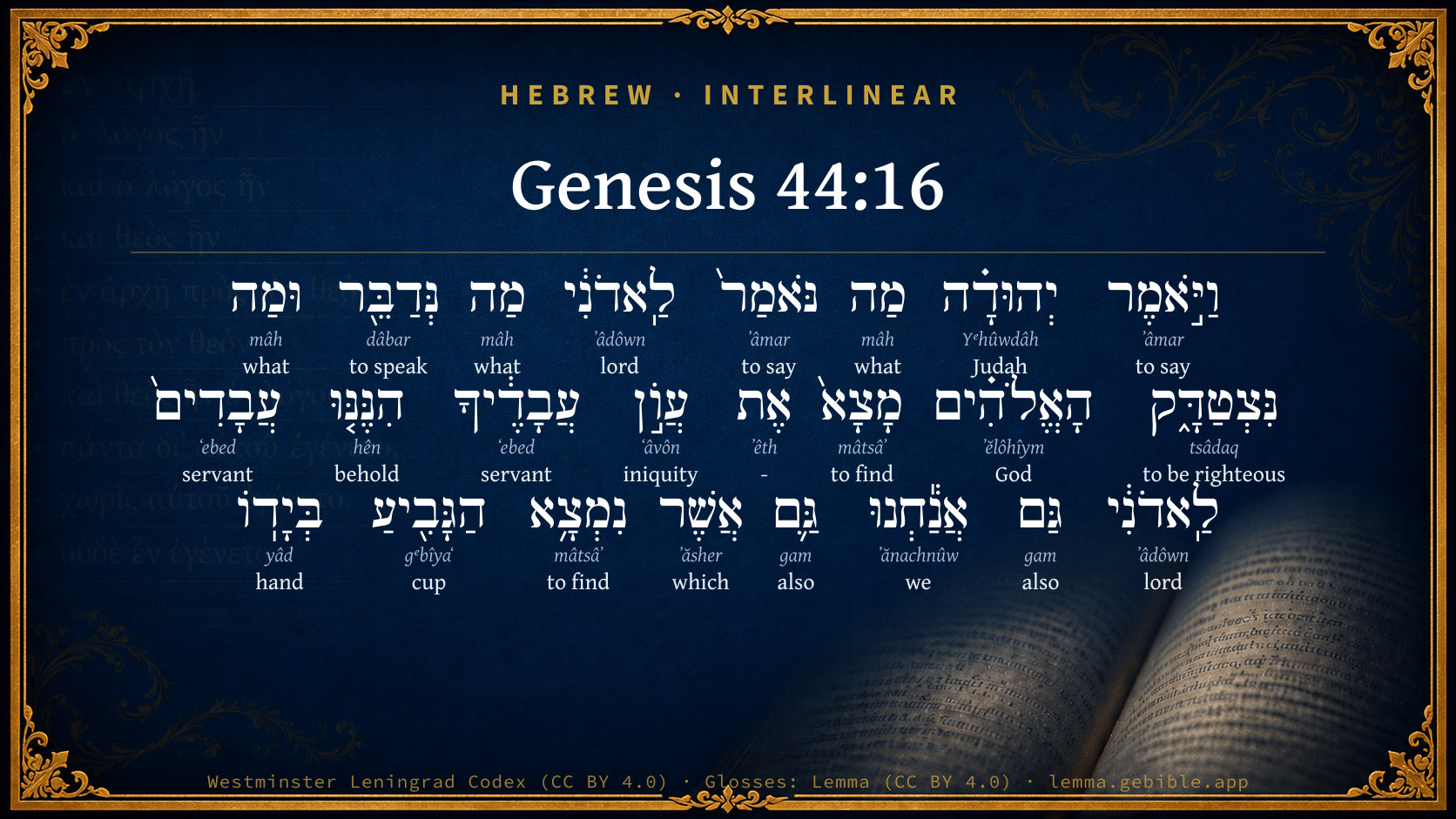
Genesis 44:16

Hebrew (Westminster Leningrad Codex) Genesis 44:16 appears in the Hebrew Old Testament. The text above is from the Westminster Leningrad Codex. Each word links to its Strong’s number, a concise gloss, and parsing drawn from the Open Scriptures Hebrew Bible morphology. Click any word for its full Brown-Driver-Briggs (BDB) entry.
Download image
Cite this verse

Genesis 44:16 (World English Bible). Public Domain. Lemma interlinear Bible study tool, https://lemma.gebible.app/v/genesis/44/16.

Show BibTeX & RIS
BibTeX
RIS
English Translation
Judah said, "What will we tell my lord? What will we speak? Or how will we clear ourselves? God has found out the iniquity of your servants. Behold, we are my lord's bondservants, both we, and he also in whose hand the cup is found."
World English Bible · Public Domain
Download a study sheet

One document with this verse’s original text, its word-by-word gloss line, the meaning frame, cross-references with their text, attributed commentary, and full source and license credits — printable, and it pastes into notes with its structure intact.

This verse Autodidact and up

Study sheet (.html) Plain text (.txt)

A passage Seminary Student

Up to 50 verses in one chapter. A passage sheet keeps up to 6 commentary sources and 12 cross-references per verse, in the order this page ranks them, and says so on the sheet whenever that leaves anything out. Ask for a single verse and you get the Autodidact verse sheet above.

Everything on this page stays free to read, with no account — the sheet is a download of what is already on screen, not access to it.

Want to remove ads? Support Godless Engineer
Compare translations 3

The same verse in 3 English versions, stacked beneath the original-language interlinear above. Click any original word for its lexicon entry.

Each is an independent rendering of the whole verse — the interlinear is not word-aligned to these translations.

Highlighted words mark where these versions differ — a whole-verse word diff, not a word-by-word alignment.

  • World English Bible Public Domain
    Judah said, "What will we tell my lord? What will we speak? Or how will we clear ourselves? God has found out the iniquity of your servants. Behold, we are my lord's bondservants, both we, and he also in whose hand the cup is found."
  • King James Version Public Domain
    And Judah said, What shall we say unto my lord? what shall we speak? or how shall we clear ourselves? God hath found out the iniquity of thy servants: behold, we are my lord's servants, both we, and he also with whom the cup is found.
  • unfoldingWord Literal Text CC BY-SA 4.0
    And Judah said, “What can we say to my lord? What can we speak? And how can we justify ourselves? God has found out the sin of your servants. Behold, we slaves for my lord, both we and in whose hand the cup was found.”

unfoldingWord Literal Text — © unfoldingWord, licensed CC BY-SA 4.0. Word-aligned USFM3 via Door43 (git.door43.org/unfoldingWord/en_ult).

Versions to compare (up to 4)

3 of 4 selected

Show all 18 translations

Every available English version of this verse, each an independent rendering of the whole verse.

  • World English Bible Public Domain
    Judah said, "What will we tell my lord? What will we speak? Or how will we clear ourselves? God has found out the iniquity of your servants. Behold, we are my lord's bondservants, both we, and he also in whose hand the cup is found."
  • Berean Standard Bible Public Domain
    “What can we say to my lord?” Judah replied. “How can we plead? How can we justify ourselves? God has exposed the iniquity of your servants. We are now my lord’s slaves—both we and the one who was found with the cup.”
  • Majority Standard Bible Public Domain
    “What can we say to my lord?” Judah replied. “How can we plead? How can we justify ourselves? God has exposed the iniquity of your servants. We are now my lord’s slaves—both we and the one who was found with the cup.”
  • King James Version Public Domain
    And Judah said, What shall we say unto my lord? what shall we speak? or how shall we clear ourselves? God hath found out the iniquity of thy servants: behold, we are my lord's servants, both we, and he also with whom the cup is found.
  • American Standard Version (1901) Public Domain
    And Judah said, What shall we say unto my lord? what shall we speak? or how shall we clear ourselves? God hath found out the iniquity of thy servants: behold, we are my lord's bondmen, both we, and he also in whose hand the cup is found.
  • Revised Version (1885) Public Domain
    And Judah said, What shall we say unto my lord? what shall we speak? or how shall we clear ourselves? God hath found out the iniquity of thy servants: behold, we are my lord’s bondmen, both we, and he also in whose hand the cup is found.
  • Geneva Bible (1599) Public Domain
    Then sayd Iudah, What shall we say vnto my lord? what shall we speake? and howe can we iustifie our selues? God hath found out the wickednesse of thy seruants: beholde, we are seruants to my Lord, both wee, and he, with whome the cuppe is founde.
  • Douay-Rheims (1899) Public Domain
    And Juda said to him: What shall we answer my lord? or what shall we say, or be able justly to allege? God hath found out the iniquity of thy servants: behold, we are all bondmen to my lord, both we, and he with whom the cup was found.
  • Young's Literal Translation Public Domain
    And Judah saith, `What do we say to my lord? what do we speak? and what -- do we justify ourselves? God hath found out the iniquity of thy servants; lo, we `are' servants to my lord, both we, and he in whose hand the cup hath been found;'
  • Literal Standard Version CC BY-SA 4.0
    And Judah says, “What do we say to my lord? What do we speak? And how do we justify ourselves? God has found out the iniquity of your servants; behold, we [are] servants to my lord, both we, and he in whose hand the cup has been found”;
  • Unlocked Literal Bible CC BY-SA 4.0
    Judah said, “What can we say to my master? What can we speak? Or how can we justify ourselves? God has found out the iniquity of your servants. Look, we are my master's slaves, both we and he also in whose hand the cup was found.”
  • unfoldingWord Literal Text CC BY-SA 4.0
    And Judah said, “What can we say to my lord? What can we speak? And how can we justify ourselves? God has found out the sin of your servants. Behold, we slaves for my lord, both we and in whose hand the cup was found.”
  • Darby Bible Public Domain
    And Judah said, What shall we say to my lord? what shall we speak, and how justify ourselves? God has found out the iniquity of thy servants; behold, we are my lord's bondmen, both we, and he in whose hand the cup has been found.
  • World Messianic Bible Public Domain
    Judah said, “What will we tell my lord? What will we speak? How will we clear ourselves? God has found out the iniquity of your servants. Behold, we are my lord’s slaves, both we and he also in whose hand the cup is found.”
  • Webster's Bible Public Domain
    And Judah said, What shall we say to my lord? what shall we speak? or how shall we clear ourselves? God hath found out the iniquity of thy servants: behold we are my lord's servants, both we, and he also with whom the cup is found.
  • Free Bible Version CC BY-SA 4.0
    “My lord, what can we say?” Judah replied. “How can we explain this to you? In what way can we prove our innocence? God has exposed the guilt of your servants. My lord, we are your slaves—all of us, including the one who was found with the cup.”
  • Bible in Basic English Public Domain
    And Judah said, What are we to say to my lord? how may we put ourselves right in his eyes? God has made clear the sin of your servants: now we are in your hands, we and the man in whose bag your cup was seen.
  • JPS Tanakh (1917) Public Domain
    And Judah said: 'What shall we say unto my lord? what shall we speak? or how shall we clear ourselves? God hath found out the iniquity of thy servants; behold, we are my lord's bondmen, both we, and he also in whose hand the cup is found.'

Literal Standard Version (2020), Covenant Press — licensed CC BY-SA 4.0. Text via the HelloAO Bible API (eBible.org). Unlocked Literal Bible (unfoldingWord) — licensed CC BY-SA 4.0. Text via the HelloAO Bible API (eBible.org). unfoldingWord Literal Text — © unfoldingWord, licensed CC BY-SA 4.0. Word-aligned USFM3 via Door43 (git.door43.org/unfoldingWord/en_ult). Free Bible Version, Dr. Jonathan Gallagher — licensed CC BY-SA 4.0. Text via the HelloAO Bible API (eBible.org).

Word by word

More ways to search: Search by grammar → Find every occurrence → Compare this word →

Practice this passage: Drill this verse → Learn its vocabulary →

הַגָּבִ֖יעַ
gᵉbîyaʻ
H1375
“the · cup”
Particle, Definite Article + Noun, Common, Masculine, Singular, Absolute
Part of Speech
Particle + Noun
Type
Common
Gender
Masculine
Number
Singular
State
Absolute
Full BDB Definition

Origin: from an unused root

TWOT: 309b

cup, bowl
  1. וַיֹּ֣אמֶר ʼâmar H559 “and · to say” Conjunction + Verb, Qal, Sequential Imperfect, 3rd Person, Masculine, Singular
  2. יְהוּדָ֗ה Yᵉhûwdâh H3063 “Judah” Noun, Proper
  3. מַה mâh H4100 “what” Particle, Interrogative
  4. נֹּאמַר֙ ʼâmar H559 “to say” Verb, Qal, Imperfect, 1st Person, Common, Plural
  5. לַֽאדֹנִ֔י ʼâdôwn H113 “to/for · lord · my” Preposition + Noun, Common, Masculine, Singular, Construct + Suffix, Personal, 1st Person, Common, Singular
  6. מַה mâh H4100 “what” Particle, Interrogative
  7. נְּדַבֵּ֖ר dâbar H1696 “to speak” Verb, Piel, Imperfect, 1st Person, Common, Plural
  8. וּמַה mâh H4100 “and · what” Conjunction + Particle, Interrogative
  9. נִּצְטַדָּ֑ק tsâdaq H6663 “to be righteous” Verb, Hithpael, Imperfect, 1st Person, Common, Plural
  10. הָאֱלֹהִ֗ים ʼĕlôhîym H430 “the · God(s)” Particle, Definite Article + Noun, Common, Masculine, Plural, Absolute
  11. מָצָא֙ mâtsâʼ H4672 “to find” Verb, Qal, Perfect, 3rd Person, Masculine, Singular
  12. אֶת ʼêth H853 “-” Particle, Direct Object
  13. עֲוֺ֣ן ʻâvôn H5771 “iniquity of” Noun, Common, Both, Singular, Construct
  14. עֲבָדֶ֔יךָ ʻebed H5650 “servants · your” Noun, Common, Masculine, Plural, Construct + Suffix, Personal, 2nd Person, Masculine, Singular
  15. הִנֶּנּ֤וּ hên H2005 “behold · us” Particle, Demonstrative + Suffix, Personal, 1st Person, Common, Plural
  16. עֲבָדִים֙ ʻebed H5650 “servants” Noun, Common, Masculine, Plural, Absolute
  17. לַֽאדֹנִ֔י ʼâdôwn H113 “to/for · lord · my” Preposition + Noun, Common, Masculine, Singular, Construct + Suffix, Personal, 1st Person, Common, Singular
  18. גַּם gam H1571 “also” Particle, Accusative
  19. אֲנַ֕חְנוּ ʼănachnûw H587 “we” Pronoun, Personal, 1st Person, Common, Plural
  20. גַּ֛ם gam H1571 “also” Particle, Accusative
  21. אֲשֶׁר ʼăsher H834 “which” Particle, Relative
  22. נִמְצָ֥א mâtsâʼ H4672 “to find” Verb, Niphal, Perfect, 3rd Person, Masculine, Singular
  23. בְּיָדֽוֹ yâd H3027 “in/at · hand · his” Preposition + Noun, Common, Both, Singular, Construct + Suffix, Personal, 3rd Person, Masculine, Singular

About this verse

These counts appear in no published source. They are computed here, from the morphology-tagged text and Lemma’s own curated glosses. What Lemma adds →

24
words
17
distinct lemmas
Pentateuch
section

Notable vocabulary

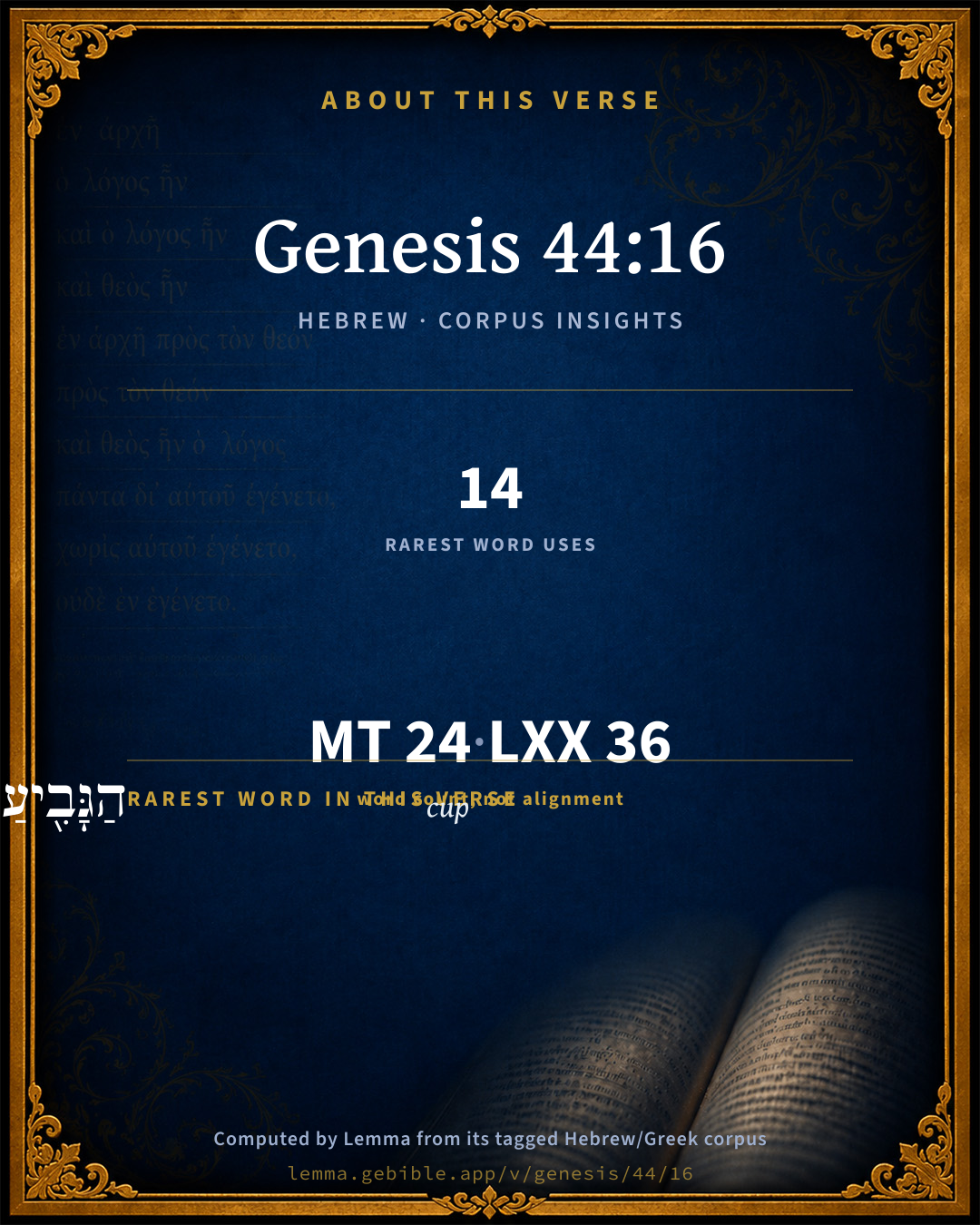
The rarest word here is הַגָּבִ֖יעַ cup H1375 — appearing just 14 times in the whole Hebrew Bible.

Shared distinctive vocabulary

הַגָּבִ֖יעַ cup H1375 occurs in 11 verses of the Hebrew Bible. Also found in:

Grammatical profile

  • 6 verbs
  • 9 nouns
  • 1 pronoun
  • 8 particles

Verb forms

  • וַיֹּ֣אמֶר Qal · Sequential Imperfect
  • נֹּאמַר֙ Qal · Imperfect
  • נְּדַבֵּ֖ר Piel · Imperfect
  • נִּצְטַדָּ֑ק Hithpael · Imperfect
  • מָצָא֙ Qal · Perfect
  • נִמְצָ֥א Niphal · Perfect

Repetition

Words recur within this verse — often emphatic in Hebrew:

  • וַיֹּ֣אמֶר to say H559 ×2
  • לַֽאדֹנִ֔י lord H113 ×2
  • מָצָא֙ to find H4672 ×2
  • עֲבָדֶ֔יךָ servant H5650 ×2
  • גַּם also H1571 ×2
  • מַה what H4100 ×3

Hebrew & Septuagint length

In English translation the verse runs 45 words from the Hebrew and 48 from the Septuagint (LXX English) — closely comparable.

A rough comparison of the two English renderings, which tokenize alike — not a word-level alignment.

Word counts can differ between the Hebrew and the Greek without any difference in meaning — e.g. the Hebrew direct-object marker אֵת has no separate Greek word, and Greek often adds the article ὁ.

In the original languages it is 24 Hebrew tokens and 36 Greek tokens — but the two are counted differently (Hebrew bundles its prefixes and suffixes into one token; the Greek is in lemma form), so that isn’t a like-for-like length.

Cross-references

23

Topical passages linked to Genesis 44:16 in the Treasury of Scripture Knowledge — connected by theme and wording, ordered by reader-vote popularity; previews shown in the World English Bible.

  • Genesis 44:9 With whoever of your servants it be found, let him die, and we also will be my lord's bondservants."
  • Daniel 9:7 Lord, righteousness belongs to you, but to us confusion of face, as at this day; to the men of Judah, and to the inhabitants of Jerusalem, and to all Israel, who are near, and who are far off, through all the countries where you have driven them, because of their trespass that they have trespassed against you.
  • Numbers 32:23 But if you will not do so, behold, you have sinned against Yahweh; and be sure your sin will find you out.
  • Luke 12:2 But there is nothing covered up, that will not be revealed, nor hidden, that will not be known.
  • Genesis 37:7 for, behold, we were binding sheaves in the field, and behold, my sheaf arose and also stood upright; and behold, your sheaves came around, and bowed down to my sheaf."
  • Genesis 37:9 He dreamed yet another dream, and told it to his brothers, and said, "Behold, I have dreamed yet another dream: and behold, the sun and the moon and eleven stars bowed down to me."
  • Genesis 37:18–28 They saw him afar off, and before he came near to them, they conspired against him to kill him.
  • Genesis 42:21–22 They said one to another, "We are most assuredly guilty concerning our brother, in that we saw the distress of his soul, when he begged us, and we wouldn't listen. Therefore this distress has come on us."
  • Genesis 43:8–9 Judah said to Israel, his father, "Send the boy with me, and we will arise and go, so that we may live, and not die, both we, and you, and also our little ones.
  • Genesis 44:32 For your servant became collateral for the boy to my father, saying, 'If I don't bring him to you, then I will bear the blame to my father forever.'
  • Deuteronomy 25:1 If there be a controversy between men, and they come to judgment, and [the judges] judge them; then they shall justify the righteous, and condemn the wicked;
  • Joshua 7:1 But the children of Israel committed a trespass in the devoted thing; for Achan, the son of Carmi, the son of Zabdi, the son of Zerah, of the tribe of Judah, took of the devoted thing: and the anger of Yahweh was kindled against the children of Israel.
  • Joshua 7:18 and he brought near his household man by man; and Achan, the son of Carmi, the son of Zabdi, the son of Zerah, of the tribe of Judah, was taken.
  • Judges 1:7 Adoni-bezek said, "Seventy kings, having their thumbs and their great toes cut off, gathered [their food] under my table: as I have done, so God has requited me." They brought him to Jerusalem, and he died there.
  • Ezra 9:10 Now, our God, what shall we say after this? for we have forsaken your commandments,
  • Ezra 9:15 Yahweh, the God of Israel, you are righteous; for we are left a remnant that is escaped, as it is this day: behold, we are before you in our guiltiness; for none can stand before you because of this.
  • Job 40:4 "Behold, I am of small account. What shall I answer you? I lay my hand on my mouth.
  • Proverbs 17:15 He who justifies the wicked, and he who condemns the righteous, Both of them alike are an abomination to Yahweh.
  • Proverbs 28:17 A man who is tormented by life blood will be a fugitive until death; No one will support him.
  • Isaiah 5:3 "Now, inhabitants of Jerusalem and men of Judah, Please judge between me and my vineyard.
  • Isaiah 27:9 Therefore by this shall the iniquity of Jacob be forgiven, and this is all the fruit of taking away his sin: that he makes all the stones of the altar as chalk stones that are beaten in sunder, [so that] the Asherim and the sun-images shall rise no more.
  • Matthew 7:2 For with whatever judgment you judge, you will be judged; and with whatever measure you measure, it will be measured to you.
  • Acts 2:37 Now when they heard this, they were cut to the heart, and said to Peter and the rest of the apostles, "Brothers, what shall we do?"

Cross-references courtesy of OpenBible.info (CC BY 4.0).

Hebrew and Greek witnesses Masoretic Hebrew ↔ Greek Septuagint

The same verse in the two great witnesses to the Old Testament, shown verse-for-verse.

These are two independent witnesses, not word-aligned to each other, and the Septuagint is shown in lemma (dictionary) form.

Hebrew Genesis 44:16 Masoretic · Westminster Leningrad Codex

וַיֹּ֣אמֶר יְהוּדָ֗ה מַה נֹּאמַר֙ לַֽאדֹנִ֔י מַה נְּדַבֵּ֖ר וּמַה נִּצְטַדָּ֑ק הָאֱלֹהִ֗ים מָצָא֙ אֶת עֲוֺ֣ן עֲבָדֶ֔יךָ הִנֶּנּ֤וּ עֲבָדִים֙ לַֽאדֹנִ֔י גַּם אֲנַ֕חְנוּ גַּ֛ם אֲשֶׁר נִמְצָ֥א הַגָּבִ֖יעַ בְּיָדֽוֹ

Judah said, "What will we tell my lord? What will we speak? Or how will we clear ourselves? God has found out the iniquity of your servants. Behold, we are my lord's bondservants, both we, and he also in whose hand the cup is found."

World English Bible · Public Domain

Greek LXX Genesis 44:16 Septuagint · lemma form

εἶπον δέ ἰούδας τίς ἀντιεἶπον ὁ κύριος ἤ τίς λαλέω ἤ τίς δικαιόω ὁ δέ θεός εὑρίσκω ὁ ἀδικία ὁ παῖς σύ ἰδού εἰμί οἰκέτης ὁ κύριος ἐγώ καί ἐγώ καί παρά ὅς εὑρίσκω ὁ κόνδυ

And Judas said, What shall we answer to our lord, or what shall we say, or wherein should we be justified? whereas God has revealed the unrighteousness of your servants; behold, we are slaves to our lord, both we and he with whom the cup has been found.

LXX2012 (modern English Septuagint) · Public Domain

Hebrew: Westminster Leningrad Codex (CC BY 4.0). Greek: Septuagint (public domain); English from LXX2012 (modern English Septuagint) (Public Domain). How the Septuagint differs from the Hebrew →

Targum (Aramaic paraphrase)

2

The Targum is the ancient Jewish Aramaic paraphrase of the Hebrew Scriptures — an interpretive translation, not the Hebrew text itself. Onkelos (literal) and Pseudo-Jonathan (expansive) render the Torah, and Jonathan the Prophets. Coverage is partial: where no permissively-licensed English translation exists for a verse, only the Aramaic is shown. This is verse-level text, not a word-by-word alignment to the Hebrew.

  1. Targum Onkelos Torah (Genesis–Deuteronomy)
    וַאֲמַר יְהוּדָה מַה נֵּימַר לְרִבּוֹנִי מַה נְּמַלֵּל וּמַה נִזְכֵּי מִן קֳדָם יְיָ אִשְׁתְּכַח יָת חוֹבָא דְעַבְדָּיךְ הָא אֲנַחְנָא עַבְדִּין לְרִבּוֹנִי אַף אֲנַחְנָא אַף דְּאִשְׁתְּכַח כַּלִּידָא בִּידֵהּ

    (no public-domain English translation for this verse)

    Targum Onkelos — Aramaic: “Onkelos Genesis” (public domain); “Onkelos Exodus” (public domain); “Onkelos Leviticus” (public domain); “Onkelos Numbers” (public domain); “Onkelos Deuteronomy” (public domain). English: “Sefaria Community Translation” (CC0 1.0 (public-domain dedication)); “J.W. Etheridge. The Targums of Onkelos and Jonathan Ben Uzziel on the Pentateuch. London: Longmans, Green, 1862” (public domain). Text via Sefaria.

  2. Targum Pseudo-Jonathan Torah (Genesis–Deuteronomy)
    וַאֲמַר יְהוּדָה מַה נֵימַר לְרִבּוֹנִי עַל כַּסְפָּא קַדְמָאָה וּמַה נְמַלֵל עַל כַּסְפָּא בַּתְרָאָה וּמַה נִזְדַכֵּי עַל אוֹגְבִין מִן קֳדָם יְיָ אִשְׁתְּכַח חוֹבָא עַל עַבְדָךְ הָא אֲנַחְנָא עַבְדִין לְרִבּוֹנִי אוּף אֲנַן אוּף מַאן דְאִשְׁתַּכַּח כַּלִידָא בִּידֵיהּ

    And Jehuda said to him What shall we say to my lord concerning the former money, and what concerning the latter money? and how shall we be acquitted concerning the cup? From before the Lord there is sin found upon thy servants. Behold, we are my lord's servants, and he in whose hand the chalice hath been found.

    Targum Pseudo-Jonathan — Aramaic: “Targum Jonathan on Genesis” (public domain); “Targum Jonathan on Exodus” (public domain); “Targum Jonathan on Leviticus” (public domain); “Targum Jonathan on Numbers” (public domain); “Targum Jonathan on Deuteronomy” (public domain). English: “The Targum of Jonathan ben Uzziel, trans. J. W. Etheridge, London, 1862” (public domain). Text via Sefaria.

Commentary

Notes on Genesis 44:16 from classic Christian and Jewish commentators (each source and its license shown beneath its notes). The classic Christian expositions comment on the surrounding passage and are grouped to its opening verse, so a note may address several verses; the Jewish commentaries on the Tanakh (Rashi and others) are per-verse, so they appear only where the commentator wrote on this verse.

Lemma curates 59 commentaries, every one of them public domain or Creative Commons licensed, each selected and text-cleaned for this edition rather than reprinted as found. About our sources →

Trapp's Complete Commentary

John Trapp

Gen 44:16 And Judah said, What shall we say unto my lord? what shall we speak? or how shall we clear ourselves? God hath found out the iniquity of thy servants: behold, we [are] my lord’s servants, both we, and [he] also with whom the cup is found.

Ver. 16. What shall we say, &c.] An ingenuous and penitent confession, joined with self-loathing and self-judging; teaching us how to confess to God.

“Sit simplex, humilis, confessio, pura, fidelis,

Atque frequens, nuda, et discreta, lubeas, verecunda,

Integra, secreta et lachrymabilis, accelerata,

Fortis, et accusans, et se punire parata.”

These sixteen conditions were composed in these verses by the Schoolmen. And such a confession is the sponge that wipes away all the blots and blurs of our lives. {1Jn 1:7} Never any confessed his sin in this sort to God, but went away with his pardon. Wot ye what, - quoth King Henry VIII. to the Duke of Suffolk, concerning Stephen Gardiner, when he confessed his Popery, for which he should have been, the morrow after, sent to the Tower, - he hath confessed himself as guilty in this matter, as his man; and hath, with much sorrow and pensiveness, sued for my pardon: and you know what my nature and custom hath been in such matters, evermore to pardon them that will not dissemble, but confess their fault. {a} How much more will God!

{a} Act. and Mon., fol. 1175.

John Trapp, A Commentary or Exposition upon All the Books of the Old and New Testament (1647–1656) — public domain. Text from a community e-Sword module.

The Biblical Illustrator

Joseph S. Exell

Gen_44:16-34

And Judah said, What shall we say unto my lord?

--

Judahs intercession

I. IT WAS ABLE.

II. IT WAS NOBLE.

III. IT GAVE PROMISE OF FUTURE GREATNESS,

IV. IT SUGGESTS SOME FEATURES OF OUR LORDS INTERCESSION FOR US.

V. IT SUGGESTS THE QUALITIES OF TRUE PRAYER. In true prayer the soul is stirred to its depths. I would give very much, says Luther, if I could pray to cur Lord God as well as Judah prays to Joseph here; for it is a perfect specimen of prayer--the true feeling there ought to be in prayer. (T. H.Leale.)

Judahs intercession

The whole of this intercession, taken together, is not one twentieth part of the length which our best advocates would have made of it in a court of justice; yet the speaker finds room to expatiate upon those parts which are the most tender, and on which a minute description will heighten the general effect. We are surprised, delighted, and melted with his charming parenthesis: Seeing his life is bound up with the lads life. It is also remarkable how he repeats things which are the most tender; as, when I come, and the lad be not with us . . . it shall come to pass, when he seeth that the lad is not with us . . . So also in describing the effect which this would produce: When he seeth that the lad is not with us, he will die; and we shall bring down the grey hairs of thy servant, my father, with sorrow to the grave. And now, having stated his situation, he presumes to express his petition. His withholding that to the last was holding the mind of his judge in a state of affecting suspense, and preventing the objections which an abrupt introduction of it at the beginning might have created. Thus Esther, when presenting her petition to Ahasuerus, kept it back till she had, by holding him in suspense, raised his desire to the utmost height to know what it was, and induced in him a predisposition to grant it. And when we consider his petition, and the filial regard from which it proceeds, we may say, that if we except the grace of another and greater Substitute, never surely was there a more generous proposal! (A. Fuller.)

Josephs love, and Judahs charge

I. BENJAMINS SURETY.

II. THE FRIENDLY BANQUET.

III. THE STRANGE STRATAGEM.

IV. THE ELOQUENT APPEAL. Judah makes a speech which is very natural, simple, and pathetic. It is conciliatory towards Joseph. Josephs greatness, power, and high rank are fully recognized (Thou art as Pharaoh). It is considerate in reference to the statements about Jacobs peculiar reasons for sorrow. It is courageous in its announcement of Judahs own responsibility, and of his readiness to be a substitute for his brother. And all through the speech tenderness and sympathy are exhibited in a very simple but touching manner. (W. S. Smith, B. D.)

Judahs argument

To point out the force of this overwhelming argument requires a view of the human mind, when, like a complicate machine in motion, the various powers and passions of it are at work. The whole calamity of the family arising from obedience to the judges own command; an obedience yielded to on their part with great reluctance, because of the situation of their aged father; and on his part with stiff greater, because his brother was, as he supposed, torn in pieces, and he the only surviving child of a beloved wife; and the declaration of a venerable grey-headed man, that if he lose him it will be his death--was enough to melt the heart of any one possessed of human feelings. If Joseph had really been what he appeared, an Egyptian nobleman, he must have yielded the point. To have withstood it would have proved him not a man, much less a man who feared God, as he professed to be. But if such would have been his feelings even on that supposition, what must they have been to know what he knew? It is also observable with what singular adroitness Judah avoids making mention of this elder brother of the lad, in any other than his fathers words. He did not say he was torn in pieces. No, he knew it was not so! But his father had once used that language, and though he had lately spoken in a manner which bore hard on him and his brethren, yet this is passed over, and nothing hinted but what will turn to account. (A. Fuller.)

Judahs intercession

I. HE REHEARSES THE PAST (Gen_44:18-29).

1. The speaker. Judah. Well that it was he. Had it been Reuben the proof of penitence had not been so clear. It had been too much like the old Reuben Gen_37:22 with Gen_42:22). It was Judah, and not like the old Judah (Gen_37:26-27). The last time Joseph heard Judah speak of his fathers favourite was when he (Joseph) was in the pit, and Judah, on the edge, was proposing to sell him into Bondage. Now he intercedes to save Benjamin from bondage.

2. The subject. He

(1) recalls the former visit, and the conversation of that time (Gen_42:18-20). He then

(2) proceeds to remind Joseph of his command (Gen_42:21), but for which they had not brought their brother. Of their expostulations (Gen_42:22) and of his firmness of purpose (Gen_42:23). He then drew the portrait of the old man, described the long time they bore the pangs of hunger before Jacob at last would suffer Benjamin to go; and, having hinted at the loss of one other son, repeated the final words of the old man (Gen_42:29).

II. HE PICTURES THE FUTURE. This he was the better able to do, from his memory of a former occasion. That picture of sorrow and wail of agony had ever since haunted him. It might be repeated with still more painful consequences. It might hasten the death of his father. He records, without a censure, the endearing union of the old father and his younger brother. There was one life between them. The death or loss of Benjamin might be the death of the father. He relates that he had become a surety for the safe return of the lad. As he thus earnestly and most pathetically pleads for the release of Benjamin, what feelings must have risen in the mind of Joseph. Chiefly of joy that Judah was so changed; but also of attachment to a father who had mourned his own supposed death so long and truly.

III. HE PROPOSES A COMPROMISE.

1. Its nature. If one must be held in bondage for this supposed crime, let it be himself, who is confessedly innocent, in place of Benjamin, whose guilt is assumed. Judah has wife and children at home, yet will leave all rather than abandon his brother. He will be henceforth a slave, if only Benjamin may be free. Was ever love like this? Greater love hath no man than this, that a man lay down his life for his friends (Joh_15:13; see especially Rom_5:6-8).

2. The motive. To spare his father all needless pain, he would accept the position of being less loved than Benjamin. His father might grieve at his loss, as he had at Simeons, but the loss of Benjamin would affect him more.

3. The result. The test had proved to Joseph that Judah repented the past. It was a happy discovery. What can give greater joy to a brother than to see a right moral change in a brother? Learn:

1. Fearlessly to take the side of the innocent and the aged.

2. To bring forth fruit meet for repentance.

3. Not to be ashamed of an honourable change of heart and mind.

4. To love and honour Him who became a surety for us. (J. C. Gray.)

The Biblical Illustrator, edited by Joseph S. Exell (c. 1880s–1900s) — public domain. Text from a community e-Sword module.

Joseph Benson's Commentary

Gen 44:16. And Judah said, &c. — Judah speaks in this cause, as being one of the eldest, and a person of most gravity and readiness of speech, and most eminently concerned for his brother; and nothing can be more affecting than what he advances on this occasion. God hath found out the iniquity of thy servants — Though the cup was found only in Benjamin’s sack, yet he speaks of himself and the rest as guilty, being his brothers, and in company with him. But, probably, he refers rather to their sins in general, for which, he meant to signify that God was now punishing them, and to the injury which they had done Joseph in particular. Even in those afflictions wherein we apprehend ourselves to be wronged by men, yet we must own that God is righteous, and finds out our iniquity. We cannot judge what men are, by what they have been formerly, nor what they will do, by what they have done. Age and experience may make men wiser and better. They that had sold Joseph, yet would not abandon Benjamin.

Joseph Benson's Commentary on the Old and New Testaments (1811–1818) — public domain. Text from a community e-Sword module.

The Preacher's Complete Homiletical Commentary

Joseph S. Exell (gen. ed.)

CRITICAL NOTES.—

Gen_44:21. That I may set mine eyes upon him.] An expression meaning the exercising of a tender care towards him. Thus (Jer_29:12.) “Take him, and look well to him, and do him no harm.” Heb. “Set thine eyes upon him.”

MAIN HOMILETICS OF THE PARAGRAPH.—Gen_44:16-34

JUDAH’S INTERCESSION

There are some remarkable features in this intercession—

I. It was able. Judah was the man of eloquence among his brethren. His eloquence proposed and carried out the measure of Joseph’s sale, prevailed on Jacob to send Benjamin with the rest to Egypt; and now it persuades and overcomes this unknown Joseph who cannot endure any longer the restraint which he put upon himself. Judah confines himself to facts, but arranges them in the best order for effect. They are all speaking facts, each one has a tender memory or sorrow of its own. They suggest so much to the hearer that the whole speech is fired with the passion of true eloquence. Kalisch justly calls this pleading speech of Judah’s, “one of the masterpieces of Hebrew composition.” The facts narrated are simple, but they are told with the true touches of nature. What fiction can surpass the pathos of Gen_44:20? “And we said unto my lord, we have a father, an old man, and a child of his old age; a little one; and his brother is dead, and he alone is left of his mother, and his father loveth him.”

II. It was noble. He does not insist upon the innocence of Benjamin, nor does he confess the theft; but acknowledges the general iniquity of his life. He generously offers himself as a surety for Benjamin. This heroic and self-sacrificing deed speaks louder than any words. He accepts slavery in his brother’s stead. Here was an appeal to Joseph’s sense of a self-forgetting devotion. In Judah there were many faults, and yet we find in him fond love for his father, and compassion for a brother stronger than even the desire of life.

III. It gave promise of future greatness. In sacred history, Judah’s name becomes great, is associated with all that is strong and noble. He is the pleader, “Hear, Lord, the voice of Judah.” (Deu_33:7.) “The sceptre shall not depart from Judah.” (Gen_49:10.) David was chosen to be king of the tribe of Judah. (Psa_78:67-68.)

IV. It suggests some features of our Lord’s intercession for us. Judah was a type of Christ. “Our Lord sprang out of Judah.” (Heb_7:14.) He was “the Lion of the tribe of Judah.” (Rev_5:5.) His human ancestor was a remarkable type of Him, of His power, His wisdom, His triumphs, His preeminence. A type also, as here, of His intercession. Christ appears in the presence of God for us. He “maketh intercession for us.” (Rom_8:34.) He bears the curse that would otherwise fall upon us. Though Himself the birthright son, He bears the cross that we, the humblest and the least, might be free.

V. It suggests the qualities of true prayer. In true prayer the soul is stirred to its depths. “I would give very much,” says Luther, “if I could pray to our Lord God as well as Judah prays to Joseph here; for it is a perfect specimen of prayer—the true feeling that there ought to be in prayer.”

SUGGESTIVE COMMENTS ON THE VERSES

Gen_44:16. They well knew that they had sold Joseph for a slave, and filled up many of the years of their father’s life with bitter anguish; and they admit that it were a righteous thing with God to make them all slaves for crimes which their consciences charged upon them, but of which they supposed Joseph to be profoundly ignorant.—(Bush.)

An ingenuous and penitent confession, joined with self-loathing and self-judging; teaching us how to confess to God.—(Trapp.)

Gen_44:17. This was to try the truth of their love to Benjamin, and whether they would stick to him in his utmost peril. God hath like ends in afflicting His children. “The King of Babylon stood at the parting-way, at the head of the two ways, to use divination” (Eze_21:21.) So doth God. He knows that the best divining of men is at the parting-way; there every dog will show to what master he belongs.—(Trapp.)

Gen_44:18. He asks the privilege of speaking a word.

“Say, what is prayer, when it is prayer indeed?

The mighty utterance of a mighty need.”

He begs that the lord’s anger may not burn against him. He is in his power; the evidence is against him. But he will press his suit, if possible to get a hearing. He owns the royal authority which he addresses; but he must tell the facts in some faint hope of prevalence.—(Jacobus.)

The surety here becomes the advocate, and presents one of the most powerful pleas ever uttered. Though he knew nothing of the schools or the rules of the rhetoricians, yet no orator ever pronounced a more moving oration. His good sense, and his affection for his venerable father, taught him the highest strains of eloquence.—(Bush.)

This brief introduction was admirably calculated to soften resentment, and obtain a patient hearing. The respectful title given him, “my lord;” the entreaty for permission to “speak;” the intimation that it should be but as it were “a word;” the deprecation of his anger, as being in a manner equal to that of “Pharaoh;” and all this prefaced with an interjection of sorrow, as though nothing but the deepest distress should have induced him to presume to speak on such a subject, showed him to be well qualified for his undertaking.—(Fuller.)

Gen_44:19-29. It is observable that Judah said nothing but what was true, although he did not tell all the truth. It was not to be expected that he would tell how Benjamin’s brother was lost. He only told his father’s opinion concerning it, and that was enough to melt any man’s heart into compassion for a father bereaved in such a cruel manner of one son, and trembling in apprehension of the loss of another.—(Bush.)

Gen_44:30-34. The whole of this intercession, taken together, is not one twentieth part of the length which our best advocates would have made of it in a court of justice; yet the speaker finds room to expatiate upon those parts which are the most tender, and on which a minute description will heighten the general effect. We are surprised, delighted, and melted with his charming parenthesis: “Seeing his life is bound up with the lad’s life” It is also remarkable how he repeats things which are the most tender; as, “when I come, and the lad be not with us … it shall come to pass, when he seeth that the lad is not with us”.… So also in describing the effect which this would produce: “When he seeth that the lad is not with us, he will die; and we shall bring down the grey hairs of thy servant, my father, with sorrow to the grave. And now, having stated his situation, he presumes to express his petition. His withholding that to the last was holding the mind of his judge in a state of affecting suspense, and preventing the objections which an abrupt introduction of it at the beginning might have created. Thus Esther, when presenting her petition to Ahasuerus, kept it back till she had, by holding him in suspense, raised his desire to the utmost height to know what it was, and induced in him a predisposition to grant it. And when we consider his petition, and the filial regard from which it proceeds, we may say, that if we except the grace of another and greater Substitute, never surely was there a more generous proposal!—(Fuller.)

The Preacher's Complete Homiletical Commentary (gen. ed. Joseph S. Exell; Funk & Wagnalls, c. 1892) — public domain (pre-1929). A full-Bible homiletical/sermon-outline anthology covering 65 of 66 books (2 John is absent from the source module). Text from a community e-Sword module.

Tyndale Open Study Notes

Tyndale Open Resources

44:16 Judah again spoke for the group. • God is punishing us for our sins: God was completing the work of repentance in their hearts. Judah again proposed that they all be punished. Benjamin was seemingly guilty of this theft, but all of the others were guilty of sin against Joseph. They preferred not returning to Jacob at all versus seeing his grief at the loss of Benjamin (44:34).

Tyndale Open Study Notes — © Tyndale Open Resources, licensed CC BY-SA 4.0. Text via the HelloAO Bible API.

Geneva Bible (1599)

Geneva Bible translators

If we see no evident cause of our affliction, let us look to the secret counsel of God, who punisheth us justly for our sins.

Geneva Bible (1599) marginal notes — public domain. Text via Bolls.life.

Jamieson, Fausset & Brown

Robert Jamieson, A. R. Fausset & David Brown

Judah said, What shall we say?--This address needs no comment--consisting at first of short, broken sentences, as if, under the overwhelming force of the speaker's emotions, his utterance were choked, it becomes more free and copious by the effort of speaking, as he proceeds. Every word finds its way to the heart; and it may well be imagined that Benjamin, who stood there speechless like a victim about to be laid on the altar, when he heard the magnanimous offer of Judah to submit to slavery for his ransom, would be bound by a lifelong gratitude to his generous brother, a tie that seems to have become hereditary in his tribe. Joseph's behavior must not be viewed from any single point, or in separate parts, but as a whole--a well-thought, deep-laid, closely connected plan; and though some features of it do certainly exhibit an appearance of harshness, yet the pervading principle of his conduct was real, genuine, brotherly kindness. Read in this light, the narrative of the proceedings describes the continuous, though secret, pursuit of one end; and Joseph exhibits, in his management of the scheme, a very high order of intellect, a warm and susceptible heart, united to a judgment that exerted a complete control over his feelings--a happy invention in devising means towards the attainment of his ends and an inflexible adherence to the course, however painful, which prudence required.

Next: Genesis Chapter 45

Jamieson, Fausset & Brown — Commentary Critical and Explanatory on the Whole Bible (1871) — public domain (CC PDM 1.0). Text via the HelloAO Bible API.

Adam Clarke's Commentary

Verse 16. What shall we say, c.] No words can more strongly mark confusion and perturbation of mind. They, no doubt, all thought that Benjamin had actually stolen the cup and the probability of this guilt might be heightened by the circumstance of his having that very cup to drink out of at dinner; for as he had the most honourable mess, so it is likely he had the most honourable cup to drink out of at the entertainment.

Adam Clarke's Commentary on the Bible (1810–1826) — public domain. Text from a community e-Sword/MySword module.

John Calvin's Commentaries

16. Behold, we are my lord’s servants. They had before called themselves servants through modesty; now they consign themselves over to him as slaves. But in the case of Benjamin they plead for a mitigation of the severity of the punishment; and this is a kind of entreaty, that he might not be capitally punished, as they had agreed to, at the first.

John Calvin's Commentaries (1540-1563) — public domain. Text from the Calvin Translation Society English edition (1840s-50s) via the Christian Classics Ethereal Library (ccel.org). Calvin's coverage is partial (roughly two-thirds of the Bible); uncommented books and verses are honest gaps, never fabricated. The 19th-century editor's footnotes and remarks are omitted so the notes are faithfully Calvin's own voice.

The Cambridge Bible for Schools and Colleges

gen. ed. J. J. S. Perowne

16. God hath found out] Judah confesses the wrong-doing of himself and his brothers (Gen_42:21). So mysterious a misfortune could only be explained as a Divine recompense for secret guilt. Cf. Num_32:23, “be sure your sin will find you out.”

“God,” Elohim, is spoken of in address to a foreigner, as Judah supposes Joseph to be. See notes on Gen_39:9, Gen_43:29.

The Cambridge Bible for Schools and Colleges (gen. ed. J. J. S. Perowne; Cambridge University Press, 1878–1918) — public domain. Text from a community e-Sword module.

John Gill's Exposition

And Judah said, what shall we say unto my lord? what shall we speak?.... Signifying that they were nonplussed, confounded, knew not what to say; they could not acknowledge guilt, for they were not conscious of any, and yet could not deny the fact, the cup being found on one of them; and though they might have a suspicion of fraud, yet were afraid to speak out what they suspected, and therefore were at the utmost loss to express themselves:

or how shall we clear ourselves? to assert their innocence signified nothing, here was full proof against them, at least against their brother Benjamin:

God hath found the iniquity of thy servants; brought it to their remembrance, fastened the guilt of it on their consciences, and in his providence was bringing them to just punishment for it; meaning not the iniquity of taking away the cup, which they were not conscious of, but some other iniquity of theirs they had heretofore been guilty of, and now God was contending with them for it; particularly the iniquity of selling Joseph; this was brought to their minds before, when in distress, and now again, see Gen 42:21,

behold, we are my lord's servants, both we, and he also with whom the cup is found; hereby fulfilling his dream more manifestly than ever; for, by bowing down to the earth to him, they might be thought to do no other than what all did, that came to buy corn of him; but here they own themselves to be his servants, and him to be lord over them, and to have dominion over them all, and them to be his slaves and bondmen.

John Gill's Exposition of the Whole Bible (1746–1763) — public domain (CC PDM 1.0). Text via the HelloAO Bible API.

Haydock's Catholic Bible Commentary

Iniquity. He begins with the greatest humility, acknowledging that they were justly punished by God for some transgression, though they were, in his opinion, innocent of any theft. (Haydock) --- Perhaps he might imagine that Benjamin had been guilty, (Bonfrere) and is willing to bear a part of the blame with the rest; or his conscience still presents before him the injustice done to Joseph so long before. (Haydock)

George Leo Haydock (1774–1849), Haydock's Catholic Family Bible and Commentary, 1859 edition — public domain. Excludes Psalms (Douay-Rheims chapter numbering differs from Protestant) and Deuterocanonical books (Catholic canon only).

Matthew Poole's English Annotations

Judah speaks in the cause, as being one of the eldest, and a person of most gravity and discretion, and readiness of speech, and most eminently concerned for his brother.

God hath found out the iniquity, viz. this iniquity, of which it seems some of us are guilty, and God hath discovered it. Or iniquity may be put for iniquities; whether we are guilty of this fact or not, we are certainly guilty of many other sins, for which God is now punishing us, to whose providence we therefore willingly submit.

Matthew Poole's English Annotations on the Holy Bible (1683–1685) — public domain. Text from a community e-Sword/MySword module.

John Wesley's Explanatory Notes

God hath found out the iniquity of thy servants - Referring to the injury they had formerly done to Joseph, for which they thought God was now reckoning with them. Even in those afflictions wherein we apprehend ourselves wronged by men, yet we must own that God is righteous, and finds out our iniquity. We cannot judge what men are, by what they have been formerly, not what they will do, by what they have done. Age and experience may make men wiser and better, They that had sold Joseph, yet would not abandon Benjamin.

John Wesley, Explanatory Notes Upon the Whole Bible (1754–1765) — public domain. Text via the GEBible commentary corpus.

unfoldingWord translationNotes

Door43 World Missions Community

What can we say to my master? What can we speak? Or how can we justify ourselves?

All 3 questions mean basically the same thing. They use these questions to emphasize that there is nothing they can say to explain what happened. AT: "We have nothing to say, my master. We cannot speak anything of value. We cannot justify ourselves." (See: Parallelism and Rhetorical Question)

What can we say to my master ... my master's slaves

Here "my master" refers to Joseph. This is a formal way of speaking to someone with greater authority. It can be stated in second person. AT: "What can we say to you ... your slaves" (See: First, Second, or Third Person)

God has found out the iniquity of your servants

Here "found out" does not mean God just found out what the brothers did. It means God is now punishing them for what they did. AT: "God is punishing us for our past sins"

the iniquity of your servants

The brothers refer to themselves as "your servants." This is a formal way of speaking to someone with greater authority. It can be stated in first person. AT: "our iniquity" (See: First, Second, or Third Person)

he also in whose hand the cup was found

Here "hand" stands for the whole person. Also, "was found" can be stated in active form. AT: "the one who had your cup" (See: Synecdoche and Active or Passive)

Far be it from me that I should do so

Something that a person would never do is spoken of as if it were an object the person wants put far away from him. AT: "It is not like me to do something like that" (See: Metaphor)

The man in whose hand the cup was found

Here "hand" stands for the whole person. Also, "was found" can be stated in active form. AT: "The man who had my cup" (See: Synecdoche and Active or Passive)

translationWords

Judah

lord

just

God

iniquity

servant

peace

unfoldingWord translationNotes — © Distant Shores Media and the Door43 World Missions Community, licensed CC BY-SA 4.0. Source: git.door43.org/Door43/en_tn.

Rashi

Rabbi Shlomo Yitzchaki (Rashi)

האלהים מצא GOD HATH FOUND OUT — We know that we have done no wrong, but it has been brought about by the Holy One, blessed be He, that this should come upon us. The Creditor has found an opportunity to collect His debt (Genesis Rabbah 92:9).

מה נצטדק How shall we justify ourselves? — This is a verbal form of צדק. In the same way every root whose first letter is צ when used in the Hithpael or Nithpael takes a ט instead of the ת of the prefix. This, however, is not placed before the first radical letter, but between the first two letters of the root. For example: נצטדק of the root צדק; (Daniel 4:13) “and let it be wet (ויצטבע)” of the root צבע to steep; Joshua 9:4) “and made as if they had been ambassadors (ויצטירו)”, of the same root as ציר in (Proverbs 13:17), ציר אמונים a faithful ambassador”; (Joshua 9:12) “we took our provision (הצטידנו)” of the same root as צדה in (Genesis 45:21) צדה לדרך “provision for the way”. And in the same way, with a root whose first letter is ס or ש, when it is used in the Hithpael, the ת of the prefix separate (i.e. is placed between) the first two letters of the root. For example: (Ecclesiastes 12:5) “and the grasshopper shall drag itself along heavily (ויסתבל)” from the root סבל “to carry a load”; (Daniel 7:8) “I considered (משתכל הוית) the horns”, from the root שכל to reflect on: (Micah 6:16) “for the statutes of Omri are kept (ישתמרו)” from the root שמר to keep; (Isaiah 59:15) “And he that departeth from evil (משתולל) is regarded as a fool”, from the same root as שולל in (Job 12:17) “He leadeth counsellors away (שולל) as though they were fools”; (Exodus 9:17) “Thou treadest down (מסתולל) my people”, from the same root as סלולה in (Jeremiah 18:15) “a way not trodden down (סלולה).”

Rashi on the Tanakh — English translations: “The Judaica Press complete Tanach with Rashi, translated by A. J. Rosenberg” (CC BY 4.0); “Pentateuch with Rashi's commentary by M. Rosenbaum and A.M. Silbermann, 1929-1934” (public domain); “The Metsudah Tanach series, Lakewood, N.J” (CC BY 4.0); and “The Book of Joshua, Metsudah Publications, 1997” (CC BY 4.0). Text via Sefaria.

Sforno

Rabbi Ovadia Sforno

What shall we say. What can we say in response?

How can we justify ourselves. How can we prove that we have been framed?

God has found the iniquity. Hashem is punishing us not for this deed, of which we are innocent, but for a much earlier crime

Sforno on the Tanakh — English translation: “Yalkut, Sifsei Chachomim Chumash, Metsudah Publications, 2009” (CC BY 4.0). Text via Sefaria.

Radak

Rabbi David Kimhi (Radak)

ומה נצעק, what good would it do if we loudly proclaim our innocence. In the matter of the goblet we cannot argue that we have already previously proved our honesty, as we could in respect of the money we had brought back.

האלוקים מצא, G’d found our guilt and has now devised a way to trap us and to punish us. This corresponds to how the prophet Ezekiel 3,20 describes G’d’s modus operandi, saying ונתתי מכשול לפניו, “I shall place a stumbling block before him” (a penitent who slides back into sin).

Radak on the Tanakh — English translations: “Sefaria Community Translation” (CC0 1.0 (public-domain dedication)); “Eliyahu Munk, HaChut Hameshulash” (CC BY 4.0); “Rabbi Mike Feuer, Jerusalem Anthology” (CC BY 4.0); and “R. David Kimhi on the first book of Psalms, Translated by R.G. Finch, London, 1919” (public domain). Text via Sefaria.

Lesson kit

Teaching starters — assembled from the data on this page, not authored interpretation. Every prompt links to the verse data it draws on. Edit before teaching.

Genesis, in the Pentateuch, opens this verse with 24 words (17 distinct Hebrew lemmas). Its most distinctive word is gᵉbîyaʻ (“cup”). A historical commentator’s framing appears above. Read the whole chapter for the surrounding context.

Discussion questions

  1. What does “cup” (gᵉbîyaʻ) contribute to the verse as a whole?
  2. How does Genesis 44:2, which shares the word «cup», read alongside this verse?
  3. What does the repetition of “to say” (2× in this one verse) do in this verse?
  4. The translations on this page render this verse differently — a whole-verse word diff, not a word-by-word alignment. What might account for the different wordings?
  5. «וַיֹּ֣אמֶר» is a Qal Sequential Imperfect verb. How does that grammatical form shape the action described?
  6. Compare how Trapp's Complete Commentary and The Biblical Illustrator read this verse. Where do they agree or differ?

Things to notice

Reading settings

Reading text

Shown beneath each verse's original-language words.

Old Testament
Old Testament edition

Read the OT as the Masoretic Hebrew (MT) or the Greek Septuagint (LXX).

English shown for the Greek Septuagint (in the Hebrew ↔ Greek comparison).

Comparing translations? Open the Compare panel on any verse page to stack up to four side by side.