Leviticus 25:20

Hebrew (Westminster Leningrad Codex) Leviticus 25:20 appears in the Hebrew Old Testament. The text above is from the Westminster Leningrad Codex. Each word links to its Strong’s number, a concise gloss, and parsing drawn from the Open Scriptures Hebrew Bible morphology. Click any word for its full Brown-Driver-Briggs (BDB) entry.
Download image
Cite this verse

Leviticus 25:20 (World English Bible). Public Domain. Lemma interlinear Bible study tool, https://lemma.gebible.app/v/leviticus/25/20.

Show BibTeX & RIS
BibTeX
RIS
English Translation
If you said, "What shall we eat the seventh year? Behold, we shall not sow, nor gather in our increase;"
World English Bible · Public Domain
Download a study sheet

One document with this verse’s original text, its word-by-word gloss line, the meaning frame, cross-references with their text, attributed commentary, and full source and license credits — printable, and it pastes into notes with its structure intact.

This verse Autodidact and up

Study sheet (.html) Plain text (.txt)

A passage Seminary Student

Up to 50 verses in one chapter. A passage sheet keeps up to 6 commentary sources and 12 cross-references per verse, in the order this page ranks them, and says so on the sheet whenever that leaves anything out. Ask for a single verse and you get the Autodidact verse sheet above.

Everything on this page stays free to read, with no account — the sheet is a download of what is already on screen, not access to it.

Want to remove ads? Support Godless Engineer
Compare translations 3

The same verse in 3 English versions, stacked beneath the original-language interlinear above. Click any original word for its lexicon entry.

Each is an independent rendering of the whole verse — the interlinear is not word-aligned to these translations.

Highlighted words mark where these versions differ — a whole-verse word diff, not a word-by-word alignment.

  • World English Bible Public Domain
    If you said, "What shall we eat the seventh year? Behold, we shall not sow, nor gather in our increase;"
  • King James Version Public Domain
    And if ye shall say, What shall we eat the seventh year? behold, we shall not sow, nor gather in our increase:
  • unfoldingWord Literal Text CC BY-SA 4.0
    And if you say, “What shall we eat in the seventh year? Look, we shall not sow and we shall not gather our produce.”

unfoldingWord Literal Text — © unfoldingWord, licensed CC BY-SA 4.0. Word-aligned USFM3 via Door43 (git.door43.org/unfoldingWord/en_ult).

Versions to compare (up to 4)

3 of 4 selected

Show all 18 translations

Every available English version of this verse, each an independent rendering of the whole verse.

  • World English Bible Public Domain
    If you said, "What shall we eat the seventh year? Behold, we shall not sow, nor gather in our increase;"
  • Berean Standard Bible Public Domain
    Now you may wonder, ‘What will we eat in the seventh year if we do not sow or gather our produce?’
  • Majority Standard Bible Public Domain
    Now you may wonder, ‘What will we eat in the seventh year if we do not sow or gather our produce?’
  • King James Version Public Domain
    And if ye shall say, What shall we eat the seventh year? behold, we shall not sow, nor gather in our increase:
  • American Standard Version (1901) Public Domain
    And if ye shall say, What shall we eat the seventh year? Behold, we shall not sow, nor gather in our increase;
  • Revised Version (1885) Public Domain
    And if ye shall say, What shall we eat the seventh year? behold, we shall not sow, nor gather in our increase:
  • Geneva Bible (1599) Public Domain
    And if ye shall say, What shall we eate the seuenth yeere, for we shall not sowe, nor gather in our increase?
  • Douay-Rheims (1899) Public Domain
    But if you say: What shall we eat the seventh year, if we sow not, nor gather our fruits?
  • Young's Literal Translation Public Domain
    `And when ye say, What do we eat in the seventh year, lo, we do not sow, nor gather our increase?
  • Literal Standard Version CC BY-SA 4.0
    And when you say, What do we eat in the seventh year, behold, do we not sow, nor gather our increase?
  • Unlocked Literal Bible CC BY-SA 4.0
    You might say, “What will we eat during the seventh year? Look, we cannot plant or gather our produce.”
  • unfoldingWord Literal Text CC BY-SA 4.0
    And if you say, “What shall we eat in the seventh year? Look, we shall not sow and we shall not gather our produce.”
  • Darby Bible Public Domain
    And if ye say, What shall we eat in the seventh year? behold, we may not sow, nor gather in our produce;
  • World Messianic Bible Public Domain
    If you said, “What shall we eat the seventh year? Behold, we shall not sow, nor gather in our increase;”
  • Webster's Bible Public Domain
    And if ye shall say, What shall we eat the seventh year? behold, we shall not sow nor gather in our increase:
  • Free Bible Version CC BY-SA 4.0
    But if you ask, ‘What are we going to do in the seventh year if we do not sow or harvest our crops?’
  • Bible in Basic English Public Domain
    And if you say, Where will our food come from in the seventh year, when we may not put in seed, or get in the increase
  • JPS Tanakh (1917) Public Domain
    And if ye shall say: 'What shall we eat the seventh year? behold, we may not sow, nor gather in our increase';

Literal Standard Version (2020), Covenant Press — licensed CC BY-SA 4.0. Text via the HelloAO Bible API (eBible.org). Unlocked Literal Bible (unfoldingWord) — licensed CC BY-SA 4.0. Text via the HelloAO Bible API (eBible.org). unfoldingWord Literal Text — © unfoldingWord, licensed CC BY-SA 4.0. Word-aligned USFM3 via Door43 (git.door43.org/unfoldingWord/en_ult). Free Bible Version, Dr. Jonathan Gallagher — licensed CC BY-SA 4.0. Text via the HelloAO Bible API (eBible.org).

Word by word

More ways to search: Search by grammar → Find every occurrence → Compare this word →

Practice this passage: Drill this verse → Learn its vocabulary →

תְּבוּאָתֵֽנוּ
tᵉbûwʼâh
H8393
“produce · our”
Noun, Common, Feminine, Singular, Construct + Suffix, Personal, 1st Person, Common, Plural
Part of Speech
Noun
Type
Common
Gender
Feminine
Number
Singular
State
Construct
Full BDB Definition

Origin: from H935

TWOT: 212c

produce, product, revenue - product, yield, crops (of the earth usually) - income, revenue - gain (of wisdom) (figuratively) - product of lips (figuratively)
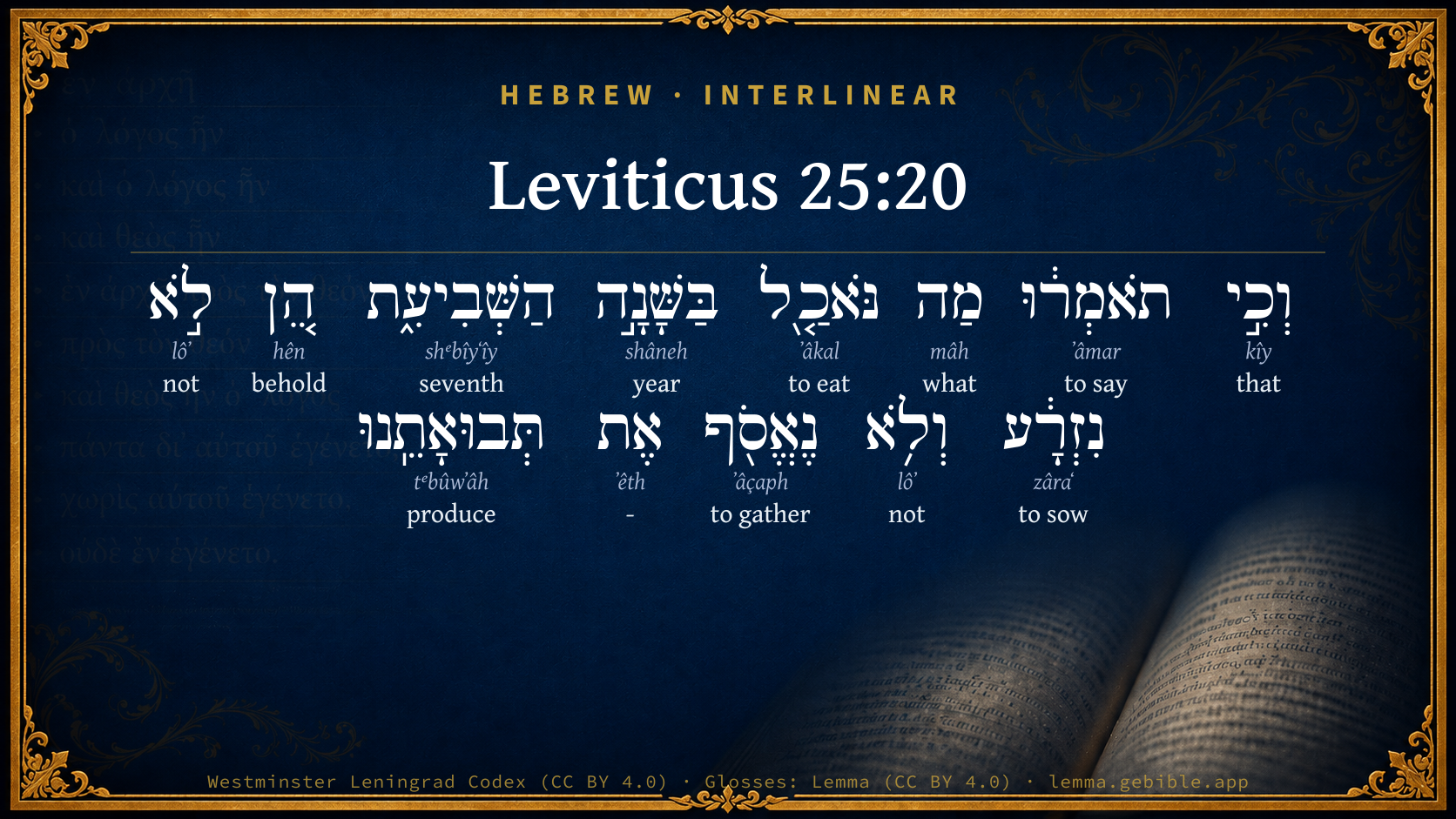
  1. וְכִ֣י kîy H3588 “and · that” Conjunction + Conjunction
  2. תֹאמְר֔וּ ʼâmar H559 “to say” Verb, Qal, Imperfect, 2nd Person, Masculine, Plural
  3. מַה mâh H4100 “what” Particle, Interrogative
  4. נֹּאכַ֤֖ל ʼâkal H398 “to eat” Verb, Qal, Imperfect, 1st Person, Common, Plural
  5. בַּשָּׁנָ֣ה shâneh H8141 “in/at the · year” Preposition, Determined + Noun, Common, Feminine, Singular, Absolute
  6. הַשְּׁבִיעִ֑ת shᵉbîyʻîy H7637 “the · seventh” Particle, Definite Article + Adjective, Ordinal number, Feminine, Singular, Absolute
  7. הֵ֚ן hên H2005 “behold” Particle, Demonstrative
  8. לֹ֣א lôʼ H3808 “not” Particle, Negative
  9. נִזְרָ֔ע zâraʻ H2232 “to sow” Verb, Qal, Imperfect, 1st Person, Common, Plural
  10. וְלֹ֥א lôʼ H3808 “and · not” Conjunction + Particle, Negative
  11. נֶאֱסֹ֖ף ʼâçaph H622 “to gather” Verb, Qal, Imperfect, 1st Person, Common, Plural
  12. אֶת ʼêth H853 “-” Particle, Direct Object

About this verse

These counts appear in no published source. They are computed here, from the morphology-tagged text and Lemma’s own curated glosses. What Lemma adds →

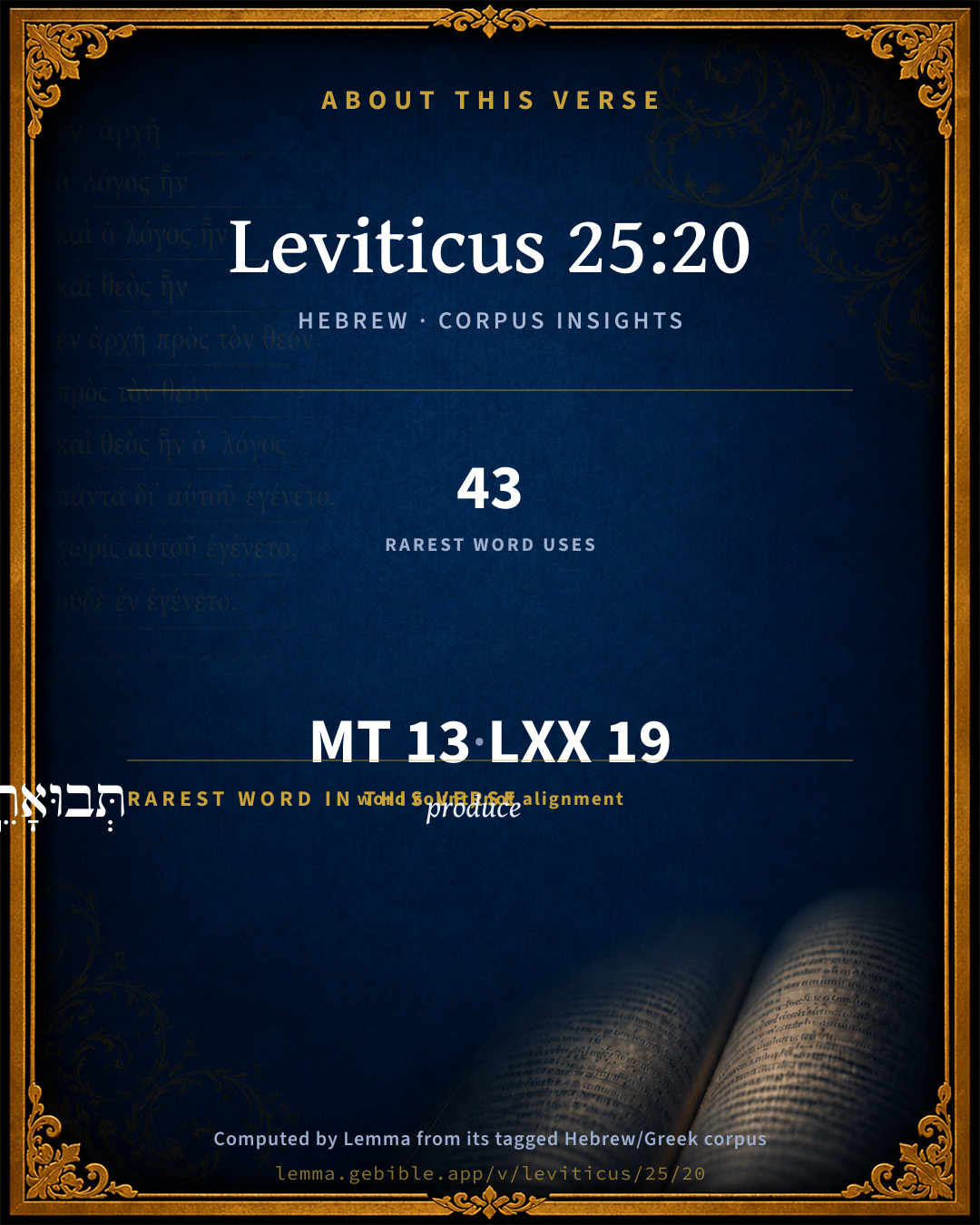
13
words
12
distinct lemmas
Pentateuch
section

Shared distinctive vocabulary

תְּבוּאָתֵֽנוּ produce H8393 occurs in 40 verses of the Hebrew Bible. Also found in:

Grammatical profile

  • 4 verbs
  • 2 nouns
  • 1 adjective
  • 1 conjunction
  • 5 particles

Verb forms

  • תֹאמְר֔וּ Qal · Imperfect
  • נֹּאכַ֤֖ל Qal · Imperfect
  • נִזְרָ֔ע Qal · Imperfect
  • נֶאֱסֹ֖ף Qal · Imperfect

Repetition

A word recurs within this verse — often emphatic in Hebrew:

Hebrew & Septuagint length

In English translation the verse runs 20 words from the Hebrew and 23 from the Septuagint (LXX English) — closely comparable.

A rough comparison of the two English renderings, which tokenize alike — not a word-level alignment.

Word counts can differ between the Hebrew and the Greek without any difference in meaning — e.g. the Hebrew direct-object marker אֵת has no separate Greek word, and Greek often adds the article ὁ.

In the original languages it is 13 Hebrew tokens and 19 Greek tokens — but the two are counted differently (Hebrew bundles its prefixes and suffixes into one token; the Greek is in lemma form), so that isn’t a like-for-like length.

Cross-references

13

Topical passages linked to Leviticus 25:20 in the Treasury of Scripture Knowledge — connected by theme and wording, ordered by reader-vote popularity; previews shown in the World English Bible.

  • Leviticus 25:4 but in the seventh year there shall be a Sabbath of solemn rest for the land, a Sabbath to Yahweh. You shall not sow your field or prune your vineyard.
  • Luke 12:29 Don't seek what you will eat or what you will drink; neither be anxious.
  • Numbers 11:4 The mixed multitude that was among them lusted exceedingly: and the children of Israel also wept again, and said, Who shall give us flesh to eat?
  • Numbers 11:13 Whence should I have flesh to give to all this people? for they weep to me, saying, Give us flesh, that we may eat.
  • 2 Kings 6:15–17 When the servant of the man of God was risen early, and gone forth, behold, a host with horses and chariots was round about the city. His servant said to him, Alas, my master! how shall we do?
  • 2 Chronicles 25:9 Amaziah said to the man of God, But what shall we do for the hundred talents which I have given to the army of Israel? The man of God answered, Yahweh is able to give you much more than this.
  • Psalms 78:19–20 Yes, they spoke against God. They said, "Can God prepare a table in the wilderness?
  • Isaiah 1:2 Hear, heavens, And listen, earth; for Yahweh has spoken: I have nourished and brought up children, And they have rebelled against me.
  • Matthew 6:25–34 Therefore, I tell you, don't be anxious for your life: what you will eat, or what you will drink; nor yet for your body, what you will wear. Isn't life more than food, and the body more than clothing?
  • Matthew 8:26 He said to them, "Why are you fearful, oh you of little faith?" Then he got up, rebuked the wind and the sea, and there was a great calm.
  • Philippians 4:6 In nothing be anxious, but in everything, by prayer and petition with thanksgiving, let your requests be made known to God.
  • Hebrews 13:5–6 Be free from the love of money, content with such things as you have, for he has said, "I will in no way leave you, neither will I in any way forsake you."
  • 2 Kings 7:2 Then the captain on whose hand the king leaned answered the man of God, and said, Behold, if Yahweh should make windows in heaven, might this thing be? He said, Behold, you shall see it with your eyes, but shall not eat of it.

Cross-references courtesy of OpenBible.info (CC BY 4.0).

Hebrew and Greek witnesses Masoretic Hebrew ↔ Greek Septuagint

The same verse in the two great witnesses to the Old Testament, shown verse-for-verse.

These are two independent witnesses, not word-aligned to each other, and the Septuagint is shown in lemma (dictionary) form.

Hebrew Leviticus 25:20 Masoretic · Westminster Leningrad Codex

וְכִ֣י תֹאמְר֔וּ מַה נֹּאכַ֤֖ל בַּשָּׁנָ֣ה הַשְּׁבִיעִ֑ת הֵ֚ן לֹ֣א נִזְרָ֔ע וְלֹ֥א נֶאֱסֹ֖ף אֶת תְּבוּאָתֵֽנוּ

If you said, "What shall we eat the seventh year? Behold, we shall not sow, nor gather in our increase;"

World English Bible · Public Domain

Greek LXX Leviticus 25:20 Septuagint · lemma form

ἐάν δέ λέγω τίς ἐσθίω ἐν ὁ ἔτος ὁ ἕβδομος οὗτος ἐάν μή σπείρω μηδέ συνἄγω ὁ γένημα ἐγώ

And if you⌃ should say, What shall we eat in this seventh year, if we do not sow nor gather in our fruits?

LXX2012 (modern English Septuagint) · Public Domain

Hebrew: Westminster Leningrad Codex (CC BY 4.0). Greek: Septuagint (public domain); English from LXX2012 (modern English Septuagint) (Public Domain). How the Septuagint differs from the Hebrew →

Targum (Aramaic paraphrase)

2

The Targum is the ancient Jewish Aramaic paraphrase of the Hebrew Scriptures — an interpretive translation, not the Hebrew text itself. Onkelos (literal) and Pseudo-Jonathan (expansive) render the Torah, and Jonathan the Prophets. Coverage is partial: where no permissively-licensed English translation exists for a verse, only the Aramaic is shown. This is verse-level text, not a word-by-word alignment to the Hebrew.

  1. Targum Onkelos Torah (Genesis–Deuteronomy)
    וַאֲרֵי תֵימְרוּן מָא נֵיכוּל בְּשַׁתָּא שְׁבִיעֵתָא הָא לָא נִזְרָע וְלָא נִכְנוֹשׁ יָת עֲלַלְתָּנָא

    (no public-domain English translation for this verse)

    Targum Onkelos — Aramaic: “Onkelos Genesis” (public domain); “Onkelos Exodus” (public domain); “Onkelos Leviticus” (public domain); “Onkelos Numbers” (public domain); “Onkelos Deuteronomy” (public domain). English: “Sefaria Community Translation” (CC0 1.0 (public-domain dedication)); “J.W. Etheridge. The Targums of Onkelos and Jonathan Ben Uzziel on the Pentateuch. London: Longmans, Green, 1862” (public domain). Text via Sefaria.

  2. Targum Pseudo-Jonathan Torah (Genesis–Deuteronomy)
    וַאֲרוּם אִין תֵּימְרוּן מַה נֵיכוֹל בְּשַׁתָּא שְׁבִיעָתָא הָא לָא נִזְרַע וְלָא נִכְנוֹשׁ יַת כַּתֵּי עֲלַלְתָּנָא

    But if you say, What shall we eat in the seventh year; behold, we sow not, nor ingather even the after crop of our provision?

    Targum Pseudo-Jonathan — Aramaic: “Targum Jonathan on Genesis” (public domain); “Targum Jonathan on Exodus” (public domain); “Targum Jonathan on Leviticus” (public domain); “Targum Jonathan on Numbers” (public domain); “Targum Jonathan on Deuteronomy” (public domain). English: “The Targum of Jonathan ben Uzziel, trans. J. W. Etheridge, London, 1862” (public domain). Text via Sefaria.

Commentary

Notes on Leviticus 25:20 from classic Christian and Jewish commentators (each source and its license shown beneath its notes). The classic Christian expositions comment on the surrounding passage and are grouped to its opening verse, so a note may address several verses; the Jewish commentaries on the Tanakh (Rashi and others) are per-verse, so they appear only where the commentator wrote on this verse.

Lemma curates 59 commentaries, every one of them public domain or Creative Commons licensed, each selected and text-cleaned for this edition rather than reprinted as found. About our sources →

Trapp's Complete Commentary

John Trapp

Lev 25:20 And if ye shall say, What shall we eat the seventh year? behold, we shall not sow, nor gather in our increase:

Ver. 20. And if ye shall say.] A clear answer to a carnal objection. Usually God conceals the objection in Scripture, and meets it with an answer, which is an act of grace.

John Trapp, A Commentary or Exposition upon All the Books of the Old and New Testament (1647–1656) — public domain. Text from a community e-Sword module.

Adam Clarke's Commentary

Verse 20. What shall we eat the seventh year?] A very natural question, which could only be laid at rest by the sovereign promise in the next verse: I will COMMAND my BLESSING upon you in the sixth year, and it shall bring forth fruit for THREE YEARS. See Clarke on Le 25:2.

Adam Clarke's Commentary on the Bible (1810–1826) — public domain. Text from a community e-Sword/MySword module.

Ellicott's Commentary for English Readers

(20) What shall we eat the seventh year ?—The Lawgiver here anticipates an objection on the part of those who are called upon to abstain from cultivating the land in the sabbatical year, and who are overanxious about the provisions of their families.

Behold, we shall not sow.—That is, are forbidden to sow. (See Lev_25:4.)

Nor gather in our increase.—That is, we are even prohibited to gather the spontaneous growths and store them up, and are commanded to leave “the increase” in the field. (See Lev_25:7.)

A Bible Commentary for English Readers, edited by Charles John Ellicott (1878–1897) — public domain. Text from a community e-Sword module.

John Gill's Exposition

And ye shall say, what shall ye eat the seventh year?.... Such as are of little faith, disbelieve the promise, and distrust the providence of God, and take thought for tomorrow, and indulge an anxiety of mind how they shall be provided with food in the sabbatical year ordered to be observed, in which there were to be no tillage of land, nor pruning of trees:

behold, we shall not sow; that being forbidden:

nor gather in our increase; neither the barley, nor the wheat, nor the grapes, nor olives, nor figs, into their houses and barns, to lay up for stores, as in other years; though they might go out and gather in for present use in common with others: now if any should put the above question, as it was very likely some would, in such a view of things, the answer to it follows.

John Gill's Exposition of the Whole Bible (1746–1763) — public domain (CC PDM 1.0). Text via the HelloAO Bible API.

Matthew Poole's English Annotations

A like objection, see Exo 34:23,24.

Matthew Poole's English Annotations on the Holy Bible (1683–1685) — public domain. Text from a community e-Sword/MySword module.

Whedon's Commentary on the Bible

Daniel D. Whedon

20. What shall we eat the seventh year — This question is kindly anticipated and answered by God, lest the strain upon their faith might be too great if the people were left with no special promise. He knoweth our frame.

Daniel D. Whedon (gen. ed.), Commentary on the Old and New Testaments (1874–1909) — public domain. Text from a community e-Sword module.

unfoldingWord translationNotes

Door43 World Missions Community

You might say

Here "You" refers to the people of Israel. (See: Forms of You)

I will command my blessing to come upon you

God speaks of his blessing as if it were a person that could obey him. AT: "I will send my blessing on you" or "I will bless you" (See: Personification)

from the provisions stored

This can be stated in active form. AT: "from the food you store" (See: Active or Passive)

translationWords

command

bless

harvest

unfoldingWord translationNotes — © Distant Shores Media and the Door43 World Missions Community, licensed CC BY-SA 4.0. Source: git.door43.org/Door43/en_tn.

Rashi

Rabbi Shlomo Yitzchaki (Rashi)

ולא נאסף [AND IF YE SHALL SAY,… BEHOLD WE SHALL NOT SOW] NOR GATHER IN — into the house.

את תבואתנו OUR INCREASE — as, e. g., the wine and the fruits of trees and the aftergrowth of the fields, which grow of their own accord (Pesachim 51b).

Rashi on the Tanakh — English translations: “The Judaica Press complete Tanach with Rashi, translated by A. J. Rosenberg” (CC BY 4.0); “Pentateuch with Rashi's commentary by M. Rosenbaum and A.M. Silbermann, 1929-1934” (public domain); “The Metsudah Tanach series, Lakewood, N.J” (CC BY 4.0); and “The Book of Joshua, Metsudah Publications, 1997” (CC BY 4.0). Text via Sefaria.

Ramban (Nachmanides)

Rabbi Moshe ben Nachman (Ramban / Nachmanides)

AND IF YE SHALL SAY: ‘WHAT SHALL WE EAT THE SEVENTH YEAR?’ The verse is, as it were, inverted, meaning: “and if you shall say in the seventh year, ‘What shall we eat [in the eighth year]?’ for their worry would be about the eighth year. For since the beginning of the Sabbatical year and the Jubilee is in Tishri, then they would eat of the produce of the sixth year during the seventh year, as is the normal way in all other years to eat [of the old produce] until after the reaping [of the new], which is at the time of the Festival of Weeks, and even afterwards until the work of fanning and sifting the produce is finished. Therefore the correct interpretation of the verse, and it shall bring forth produce for the three years is that on account of the year of Jubilee [which always follows a Sabbatical year, G-d will command His blessing in the sixth year, meaning] that the sixth year will bring forth [sufficient produce] for the whole of the Sabbatical year, the Jubilee and the year after the Jubilee, and during all these [three years] they will eat of the old crop. Thus Scripture is assuring them that should they fear in the seventh year saying, “What shall we eat?” then I will command My blessing in the sixth year that it shall bring forth produce for the three years following after [the sixth year], this being an additional blessing [to that of every Sabbatical year, when the sixth year brings forth sufficient produce for the seventh and eighth years; and when in addition there is a Jubilee year, it will bring forth enough for three years] so that it should suffice also for the Sabbatical year and the Jubilee. He states, And ye shall sow the eighth year, meaning to say that you should sow in the eighth year in the customary manner of every year, and you should not hurry to plow and sow, or to reap, for until her produce come in into the house at the time that the harvest [usually] takes place every year, at the Festival of Tabernacles, ye shall eat the old crop. And in the Torath Kohanim [it is stated]: 4:6. “For the three years — for the sixth, the seventh, and the year after the seventh. Another interpretation: For the three years — for the Seventh year, the Jubilee, and the year after the Jubilee.”

Ramban (Nachmanides) on the Tanakh — English translation: “Commentary on the Torah by Ramban (Nachmanides). Translated and annotated by Charles B. Chavel. New York, Shilo Pub. House, 1971-1976” (CC BY 4.0). Text via Sefaria.

Lesson kit

Teaching starters — assembled from the data on this page, not authored interpretation. Every prompt links to the verse data it draws on. Edit before teaching.

Leviticus, in the Pentateuch, opens this verse with 13 words (12 distinct Hebrew lemmas). Its most distinctive word is tᵉbûwʼâh (“produce”). A historical commentator’s framing appears above. Read the whole chapter for the surrounding context.

Discussion questions

  1. What does “produce” (tᵉbûwʼâh) contribute to the verse as a whole?
  2. How does Genesis 47:24, which shares the word «produce», read alongside this verse?
  3. What does the repetition of “not” (2× in this one verse) do in this verse?
  4. These translations render this verse differently; the difference is in the English rendering, not the original. What questions does that raise?
  5. «תֹאמְר֔וּ» is a Qal Imperfect verb. How does that grammatical form shape the action described?
  6. Compare how Trapp's Complete Commentary and Adam Clarke's Commentary read this verse. Where do they agree or differ?

Things to notice

Reading settings

Reading text

Shown beneath each verse's original-language words.

Old Testament
Old Testament edition

Read the OT as the Masoretic Hebrew (MT) or the Greek Septuagint (LXX).

English shown for the Greek Septuagint (in the Hebrew ↔ Greek comparison).

Comparing translations? Open the Compare panel on any verse page to stack up to four side by side.