
Job 19:22

Hebrew (Westminster Leningrad Codex) Job 19:22 appears in the Hebrew Old Testament. The text above is from the Westminster Leningrad Codex. Each word links to its Strong’s number, a concise gloss, and parsing drawn from the Open Scriptures Hebrew Bible morphology. Click any word for its full Brown-Driver-Briggs (BDB) entry.
Download image
Cite this verse

Job 19:22 (World English Bible). Public Domain. Lemma interlinear Bible study tool, https://lemma.gebible.app/v/job/19/22.

Show BibTeX & RIS
BibTeX
RIS
English Translation
Why do you persecute me as God, And are not satisfied with my flesh?
World English Bible · Public Domain
Download a study sheet

One document with this verse’s original text, its word-by-word gloss line, the meaning frame, cross-references with their text, attributed commentary, and full source and license credits — printable, and it pastes into notes with its structure intact.

This verse Autodidact and up

Study sheet (.html) Plain text (.txt)

A passage Seminary Student

Up to 50 verses in one chapter. A passage sheet keeps up to 6 commentary sources and 12 cross-references per verse, in the order this page ranks them, and says so on the sheet whenever that leaves anything out. Ask for a single verse and you get the Autodidact verse sheet above.

Everything on this page stays free to read, with no account — the sheet is a download of what is already on screen, not access to it.

Want to remove ads? Support Godless Engineer
Compare translations 3

The same verse in 3 English versions, stacked beneath the original-language interlinear above. Click any original word for its lexicon entry.

Each is an independent rendering of the whole verse — the interlinear is not word-aligned to these translations.

Highlighted words mark where these versions differ — a whole-verse word diff, not a word-by-word alignment.

  • World English Bible Public Domain
    Why do you persecute me as God, And are not satisfied with my flesh?
  • King James Version Public Domain
    Why do ye persecute me as God, and are not satisfied with my flesh?
  • unfoldingWord Literal Text CC BY-SA 4.0
    Why do you pursue me as God? And will you not be satisfied with my flesh?

unfoldingWord Literal Text — © unfoldingWord, licensed CC BY-SA 4.0. Word-aligned USFM3 via Door43 (git.door43.org/unfoldingWord/en_ult).

Versions to compare (up to 4)

3 of 4 selected

Show all 18 translations

Every available English version of this verse, each an independent rendering of the whole verse.

  • World English Bible Public Domain
    Why do you persecute me as God, And are not satisfied with my flesh?
  • Berean Standard Bible Public Domain
    Why do you persecute me as God does? Will you never get enough of my flesh?
  • Majority Standard Bible Public Domain
    Why do you persecute me as God does? Will you never get enough of my flesh?
  • King James Version Public Domain
    Why do ye persecute me as God, and are not satisfied with my flesh?
  • American Standard Version (1901) Public Domain
    Why do ye persecute me as God, And are not satisfied with my flesh?
  • Revised Version (1885) Public Domain
    Why do ye persecute me as God, and are not satisfied with my flesh?
  • Geneva Bible (1599) Public Domain
    Why do ye persecute me, as God? and are not satisfied with my flesh?
  • Douay-Rheims (1899) Public Domain
    Why do you persecute me as God, and glut yourselves with my flesh?
  • Young's Literal Translation Public Domain
    Why do you pursue me as God? And with my flesh are not satisfied?
  • Literal Standard Version CC BY-SA 4.0
    Why do you pursue me as God? And are not satisfied with my flesh?
  • Unlocked Literal Bible CC BY-SA 4.0
    Why do you pursue me like God does? Will you ever be satisfied with my flesh?
  • unfoldingWord Literal Text CC BY-SA 4.0
    Why do you pursue me as God? And will you not be satisfied with my flesh?
  • Darby Bible Public Domain
    Why do ye persecute me as ùGod, and are not satisfied with my flesh?
  • World Messianic Bible Public Domain
    Why do you persecute me as God, and are not satisfied with my flesh?
  • Webster's Bible Public Domain
    Why do ye persecute me as God, and are not satisfied with my flesh?
  • Free Bible Version CC BY-SA 4.0
    Why are you persecuting me like God does? Aren't you satisfied with getting your pound of flesh?
  • Bible in Basic English Public Domain
    Why are you cruel to me, like God, for ever saying evil against me?
  • JPS Tanakh (1917) Public Domain
    Why do ye persecute me as God, and are not satisfied with my flesh?

Literal Standard Version (2020), Covenant Press — licensed CC BY-SA 4.0. Text via the HelloAO Bible API (eBible.org). Unlocked Literal Bible (unfoldingWord) — licensed CC BY-SA 4.0. Text via the HelloAO Bible API (eBible.org). unfoldingWord Literal Text — © unfoldingWord, licensed CC BY-SA 4.0. Word-aligned USFM3 via Door43 (git.door43.org/unfoldingWord/en_ult). Free Bible Version, Dr. Jonathan Gallagher — licensed CC BY-SA 4.0. Text via the HelloAO Bible API (eBible.org).

Word by word

More ways to search: Search by grammar → Find every occurrence → Compare this word →

Practice this passage: Drill this verse → Learn its vocabulary →

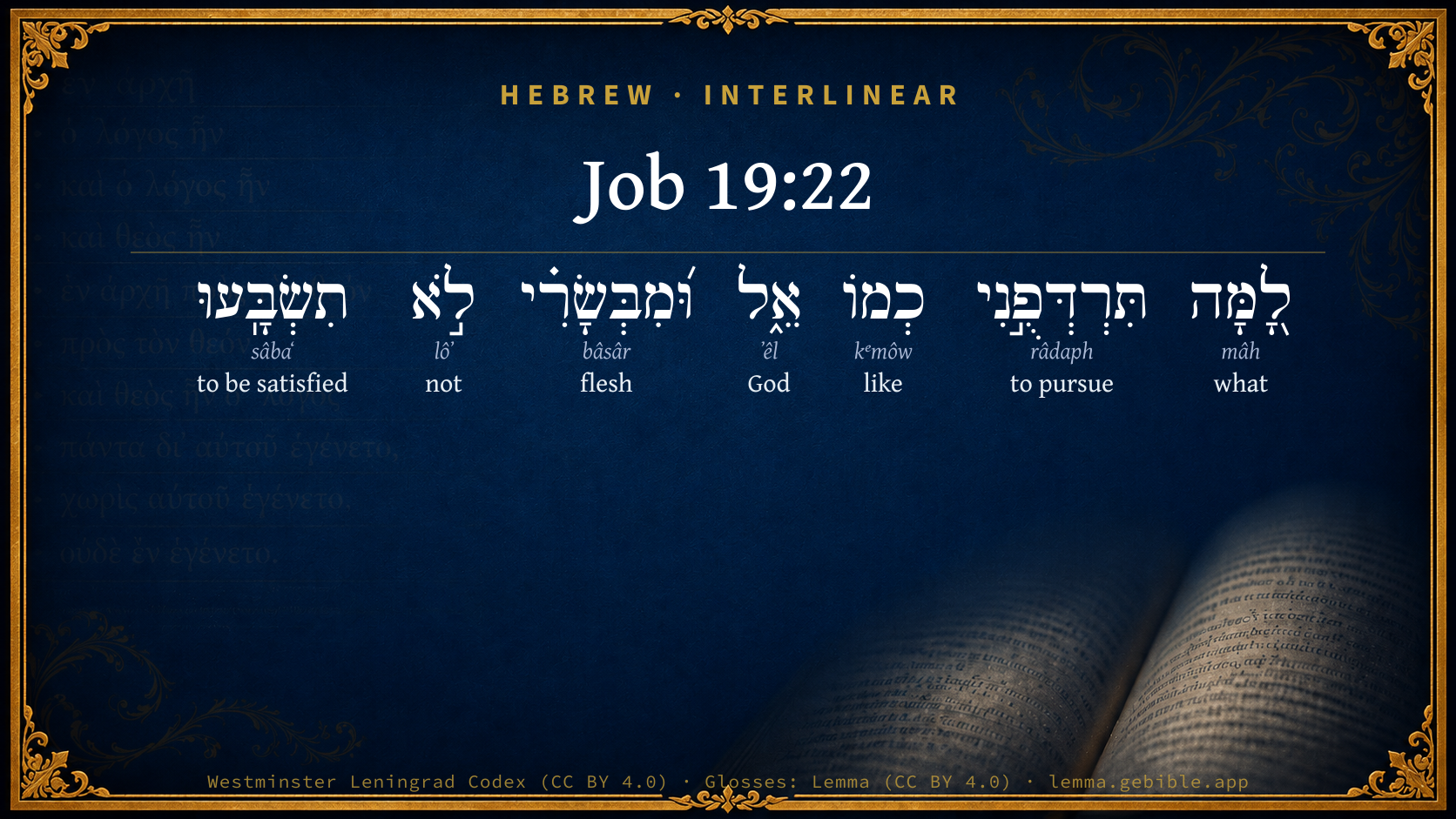
תִשְׂבָּֽעוּ
sâbaʻ
H7646
“to be satisfied”
Verb, Qal, Imperfect, 2nd Person, Masculine, Plural
Part of Speech
Verb
Stem
Qal
Form
Imperfect
Person
2nd Person
Gender
Masculine
Number
Plural
Full BDB Definition

Origin: a primitive root

TWOT: 2231

to be satisfied, be sated, be fulfilled, be surfeited - (Qal) - to be sated (with food) - to be sated, be satisfied with, be fulfilled, be filled, have one's fill of (have desire satisfied) - to have in excess, be surfeited, be surfeited with - to be weary of (figuratively) - (Piel) to satisfy - (Hiphil) - to satisfy - to enrich - to sate, glut (with the undesired)
  1. לָ֭מָּה mâh H4100 “to/for · what” Preposition + Particle, Interrogative
  2. תִּרְדְּפֻ֣נִי râdaph H7291 “to pursue · me” Verb, Qal, Imperfect, 2nd Person, Masculine, Plural + Suffix, Personal, 1st Person, Common, Singular
  3. כְמוֹ kᵉmôw H3644 “like” Preposition
  4. אֵ֑ל ʼêl H410 “God” Noun, Common, Masculine, Singular, Absolute
  5. וּ֝מִבְּשָׂרִ֗י bâsâr H1320 “and · from · flesh · my” Conjunction + Preposition + Noun, Common, Masculine, Singular, Construct + Suffix, Personal, 1st Person, Common, Singular
  6. לֹ֣א lôʼ H3808 “not” Particle, Negative

About this verse

These counts appear in no published source. They are computed here, from the morphology-tagged text and Lemma’s own curated glosses. What Lemma adds →

7
words
7
distinct lemmas
Wisdom
section

Grammatical profile

  • 2 verbs
  • 2 nouns
  • 1 preposition
  • 2 particles

Verb forms

  • תִּרְדְּפֻ֣נִי Qal · Imperfect
  • תִשְׂבָּֽעוּ Qal · Imperfect

Hebrew & Septuagint length

In English translation the verse runs 14 words from the Hebrew and 17 from the Septuagint (LXX English) — closely comparable.

A rough comparison of the two English renderings, which tokenize alike — not a word-level alignment.

Word counts can differ between the Hebrew and the Greek without any difference in meaning — e.g. the Hebrew direct-object marker אֵת has no separate Greek word, and Greek often adds the article ὁ.

Cross-references

9

Topical passages linked to Job 19:22 in the Treasury of Scripture Knowledge — connected by theme and wording, ordered by reader-vote popularity; previews shown in the World English Bible.

  • Psalms 69:26 For they persecute him whom you have wounded. They tell of the sorrow of those whom you have hurt.
  • Job 2:5 But put forth your hand now, and touch his bone and his flesh, and he will renounce you to your face."
  • Job 10:16 If my head is held high, you hunt me like a lion. Again you show yourself powerful to me.
  • Job 13:25 Will you harass a driven leaf? Will you pursue the dry stubble?
  • Job 16:11 God delivers me to the ungodly, And casts me into the hands of the wicked.
  • Job 31:31 If the men of my tent have not said, 'Who can find one who has not been filled with his meat?'
  • Isaiah 51:23 and I will put it into the hand of those who afflict you, who have said to your soul, Bow down, that we may go over; and you have laid your back as the ground, and as the street, to those who go over.
  • Micah 3:3 Who also eat the flesh of my people, And flay their skin from off them, And break their bones, And chop them in pieces, as for the pot, And as flesh within the caldron.
  • Job 16:13–14 His archers surround me. He splits my kidneys apart, and does not spare. He pours out my gall on the ground.

Cross-references courtesy of OpenBible.info (CC BY 4.0).

Hebrew and Greek witnesses Masoretic Hebrew ↔ Greek Septuagint

The same verse in the two great witnesses to the Old Testament, shown verse-for-verse.

These are two independent witnesses, not word-aligned to each other, and the Septuagint is shown in lemma (dictionary) form.

Hebrew Job 19:22 Masoretic · Westminster Leningrad Codex

לָ֭מָּה תִּרְדְּפֻ֣נִי כְמוֹ אֵ֑ל וּ֝מִבְּשָׂרִ֗י לֹ֣א תִשְׂבָּֽעוּ

Why do you persecute me as God, And are not satisfied with my flesh?

World English Bible · Public Domain

Greek LXX Job 19:22 Septuagint · lemma form

διά τίς δέ ἐγώ διώκω ὥσπερ καί ὁ κύριος ἀπό δέ σάρξ ἐγώ οὐ ἐνπίμπλημι

Therefore do you⌃ persecute me as also the Lord does, and are not satisfied with my flesh?

LXX2012 (modern English Septuagint) · Public Domain

Hebrew: Westminster Leningrad Codex (CC BY 4.0). Greek: Septuagint (public domain); English from LXX2012 (modern English Septuagint) (Public Domain). How the Septuagint differs from the Hebrew →

Commentary

Notes on Job 19:22 from classic Christian and Jewish commentators (each source and its license shown beneath its notes). The classic Christian expositions comment on the surrounding passage and are grouped to its opening verse, so a note may address several verses; the Jewish commentaries on the Tanakh (Rashi and others) are per-verse, so they appear only where the commentator wrote on this verse.

Lemma curates 59 commentaries, every one of them public domain or Creative Commons licensed, each selected and text-cleaned for this edition rather than reprinted as found. About our sources →

Trapp's Complete Commentary

John Trapp

Job 19:22 Why do ye persecute me as God, and are not satisfied with my flesh?

Ver. 22. Why do ye persecute me as God?] Is this that pitying of me thus to press me with reproaches, and therein to think you gratify God, and do him good service? Know ye not, that to persecute him whom he hath smitten is greatest cruelty? and to talk to the grief of those whom he hath wounded is to heap up guilt, and thereby wrath? Psa 69:26-27. When a deer is shot the rest of the herd push him out of the company. When a tree falleth every passenger is ready to be pulling at it, Dρυος πεσουσης ανηρ πας ξυλευεται. But God’s people should love as brethren, be pitiful, be courteous, 1Pe 3:8; and of some have compassion, making a difference, and others save with fear, pulling them out of the fire, Jdg 1:22-23. Thus it should be; but as of old, in Egypt, one Hebrew smote another; blows enough were not dealt by the common adversary, but their own must add to the violence. Still Satan is thus busy, and Christians are thus malicious; that, as if they wanted persecutors, they persecute one another; and if (as here) they can but do as God, that is, for God, as they mispersuade themselves (to vindicate his justice, and to promote his glory), then they rage and are confident, as these friends of Job; in whom nevertheless it was rather error amoris than amor erroris, an error of love than any love of error.

And are not satisfied with my flesh?] Which is pined away with pain and grief; this contents you not, but you must break my bones also, and suck my blood by your contumelies and calumnies. Brentius and others apply this text to slanderers and backbiters, whom they compare to cannibals, Est detractoris periphrasis (Mercer). Non minus enim calumniatores homines devorant quam Scythae (Brent. in loc.). It is reported of wolves, that when they have once fed upon man’s flesh they desist not, but desire more of it. Job looketh upon his friends as such man eaters, wherein his sorrow transported him too far; and while he was moving them to compassion he shows himself overly passionate.

John Trapp, A Commentary or Exposition upon All the Books of the Old and New Testament (1647–1656) — public domain. Text from a community e-Sword module.

Joseph Benson's Commentary

Job 19:22. Why do you persecute me as God? — As if you had the same infinite knowledge which God hath, whereby you could search my heart, and know my hypocrisy, and the same sovereign authority, to say and do what you please with me. And are not satisfied with my flesh — That is, with the consumption and torment of my whole body, but add to it the vexation of my spirit, by grievous censures and reproaches, and are like wolves and lions, which are not contented with devouring the flesh of their prey, but also break their bones.

Joseph Benson's Commentary on the Old and New Testaments (1811–1818) — public domain. Text from a community e-Sword module.

Tyndale Open Study Notes

Tyndale Open Resources

19:22 persecute (literally pursue): Job complained that God had tracked him like a hunter (10:16) or a warrior (16:13).

Tyndale Open Study Notes — © Tyndale Open Resources, licensed CC BY-SA 4.0. Text via the HelloAO Bible API.

Geneva Bible (1599)

Geneva Bible translators

To see my body punished, except ye trouble my mind?

Is it not enough that God doth punish me, except you by reproaches increase my sorrow?

Geneva Bible (1599) marginal notes — public domain. Text via Bolls.life.

Jamieson, Fausset & Brown

Robert Jamieson, A. R. Fausset & David Brown

as God--has persecuted me. Prefiguring Jesus Christ (Psa 69:26). That God afflicts is no reason that man is to add to a sufferer's affliction (Zac 1:15).

satisfied with my flesh--It is not enough that God afflicts my flesh literally (Job 19:20), but you must "eat my flesh" metaphorically (Psa 27:2); that is, utter the worst calumnies, as the phrase often means in Arabic.

Jamieson, Fausset & Brown — Commentary Critical and Explanatory on the Whole Bible (1871) — public domain (CC PDM 1.0). Text via the HelloAO Bible API.

Adam Clarke's Commentary

Verse 22. Why do ye persecute me as God] Are not the afflictions which God sends enough? Do ye not see that I have as much as I can bear? When the papists were burning Dr. Taylor at Oxford, while wrapped in the flames, one of the true sons of the Church took a stick out of the faggots, and threw it at his head, and split open his face. To whom he calmly said, Man, why this wrong? Do not I suffer enough?

And are not satisfied with my flesh?] Will ye persecute my soul, while God is persecuting my body? Is it not enough that my body is destroyed? Why then labour to torment my mind?

Adam Clarke's Commentary on the Bible (1810–1826) — public domain. Text from a community e-Sword/MySword module.

Ellicott's Commentary for English Readers

(22) Why do ye persecute me as God?—Comp. Job_16:9.

A Bible Commentary for English Readers, edited by Charles John Ellicott (1878–1897) — public domain. Text from a community e-Sword module.

The Cambridge Bible for Schools and Colleges

gen. ed. J. J. S. Perowne

22. satisfied with my flesh] Why cannot ye be sated with devouring me? The figure is sufficiently plain. In Oriental phrase “to devour or eat the parts or pieces of one” is to calumniate him, to accuse him, Dan_3:8, Dan. 6:34. Job asks why they will not cease to bring accusations against him?

The Cambridge Bible for Schools and Colleges (gen. ed. J. J. S. Perowne; Cambridge University Press, 1878–1918) — public domain. Text from a community e-Sword module.

John Gill's Exposition

O that my words were now written!.... Not his things (q), as some render it, his affairs, the transactions of his life; that so it might appear with what uprightness and integrity he had lived, and was not the bad man he was thought to be; nor the words he had delivered already, the apologies and defences he had made for himself, the arguments he had used in his own vindication, and the doctrines respecting God and his providence which he had laid down and asserted; and was so far from being ashamed of them, or retracting them, that he wishes they had been taken down in writing, that posterity might read and judge of the controversy between him and his friends; but rather the words he was about to deliver in Job 19:25, expressing his faith in Christ, in the resurrection of the dead, and in a future state of happiness and glory; these he wishes were "written", that they might remain as a standing testimony of his faith and hope; for what is written abides, when that which is only spoken is soon forgot, and not easily recalled:

O that they were printed in a book! not written on loose sheets, which might be lost, but in a book bound up, or rolled up in a volume, as was the custom of ancient times; though this cannot be understood of printing properly taken, which has not been in use but little more than five hundred years, but of engrossing, as of statutes and decrees in public records; and the word for "statutes comes" from this that is here used.

(q) "res meae", Polychronius apud Pinedam in loc.

John Gill's Exposition of the Whole Bible (1746–1763) — public domain (CC PDM 1.0). Text via the HelloAO Bible API.

Albert Barnes' Notes on the Bible

Why do ye persecute me as God? - As God has done. That is, without giving me any reason for it; accusing me of crimes without proof, and condeming me without mitigation. That there is here an improper reflection on God, will be apparent to all. It accords with what Job frequently expresses where he speaks of him as judging him severly, and is on of the instances which prove that he was not entirely perfect.

And are not satisfied with my flesh - That is, are not contented that my “body” is subjected to inexpressible torment, and is wholly wasting away, but add to this the torment of the soul. Why is it not enough that my “body” is thus tormented without adding the severer tortures of the mind?

Albert Barnes' Notes on the Bible (1834–1885) — public domain. Text from a community e-Sword/MySword module.

Haydock's Catholic Bible Commentary

Flesh? acting with the like inhumanity towards me. Am I not then sufficiently tormented in you opinion, that you insult over my distress? (Calmet)

George Leo Haydock (1774–1849), Haydock's Catholic Family Bible and Commentary, 1859 edition — public domain. Excludes Psalms (Douay-Rheims chapter numbering differs from Protestant) and Deuterocanonical books (Catholic canon only).

Matthew Poole's English Annotations

As God; either,

1. As God doth; or rather,

2. As if you were gods, and not men; as if you had the same infinite knowledge which God hath, whereby you can search my heart, and know my hypocrisy; and the same sovereign and absolute authority, to say and do what you please with me, without giving any reason or account of it, which is indeed the prerogative of the great God; but it belongs not to you, who are men, and therefore liable to mistake and misjudging, and such as must give all account to God of all their words and carriages towards their brethren, and particularly towards persons in affliction, and withal subject to the same diseases and calamities under which I groan; and therefore may need the pity which I expect from you.

With my flesh, i.e. with the consumption and torment of my whole body, but add to it the vexation of my spirit, by grievous reproaches and censures; but are like wolves or lions, that are not contented with devouring the flesh of their prey, but also break their bones.

Matthew Poole's English Annotations on the Holy Bible (1683–1685) — public domain. Text from a community e-Sword/MySword module.

Whedon's Commentary on the Bible

Daniel D. Whedon

22. Satisfied with my flesh — According to Schultens, to eat the flesh of another, is an Arabic phrase for calumniating him. The comparison, so common in the East, of an evil report to a wild beast devouring the flesh, appears often in the classics, and is still retained in our word backbite. Psa_27:2.

Daniel D. Whedon (gen. ed.), Commentary on the Old and New Testaments (1874–1909) — public domain. Text from a community e-Sword module.

The Pulpit Commentary

Why do ye persecute me as God? i.e. Why are ye as hard on me as God himself? If I have offended him, what have I done to offend you? And are not satisfied with my flesh? i.e. "devour my flesh, like wild beasts, and yet are not satisfied."

The Pulpit Commentary (1880–1919), ed. H.D.M. Spence-Jones & Joseph S. Exell — public domain. Text from a community e-Sword module.

John Wesley's Explanatory Notes

As God - As if you had the same infinite knowledge which God hath, whereby you can search my heart and know my hypocrisy, and the same sovereign authority to say and do what you please with me. Not satisfied - Are like wolves or lions that are not contented with devouring the flesh of their prey, but also break their bones.

John Wesley, Explanatory Notes Upon the Whole Bible (1754–1765) — public domain. Text via the GEBible commentary corpus.

Lesson kit

Teaching starters — assembled from the data on this page, not authored interpretation. Every prompt links to the verse data it draws on. Edit before teaching.

Job, in the Wisdom, opens this verse with 7 words (7 distinct Hebrew lemmas). Its most distinctive word is sâbaʻ (“to be satisfied”). A historical commentator’s framing appears above. Read the whole chapter for the surrounding context.

Discussion questions

  1. What does “to be satisfied” (sâbaʻ) contribute to the verse as a whole?
  2. How does Psalms 69:26, which shares this passage’s theme, read alongside this verse?
  3. These translations render this verse differently. What is at stake in choosing one wording over another?
  4. «תִּרְדְּפֻ֣נִי» is a Qal Imperfect verb. How does that grammatical form shape the action described?
  5. Compare how Trapp's Complete Commentary and Joseph Benson's Commentary read this verse. Where do they agree or differ?

Things to notice

Reading settings

Reading text

Shown beneath each verse's original-language words.

Old Testament
Old Testament edition

Read the OT as the Masoretic Hebrew (MT) or the Greek Septuagint (LXX).

English shown for the Greek Septuagint (in the Hebrew ↔ Greek comparison).

Comparing translations? Open the Compare panel on any verse page to stack up to four side by side.