
2 Kings 18:19

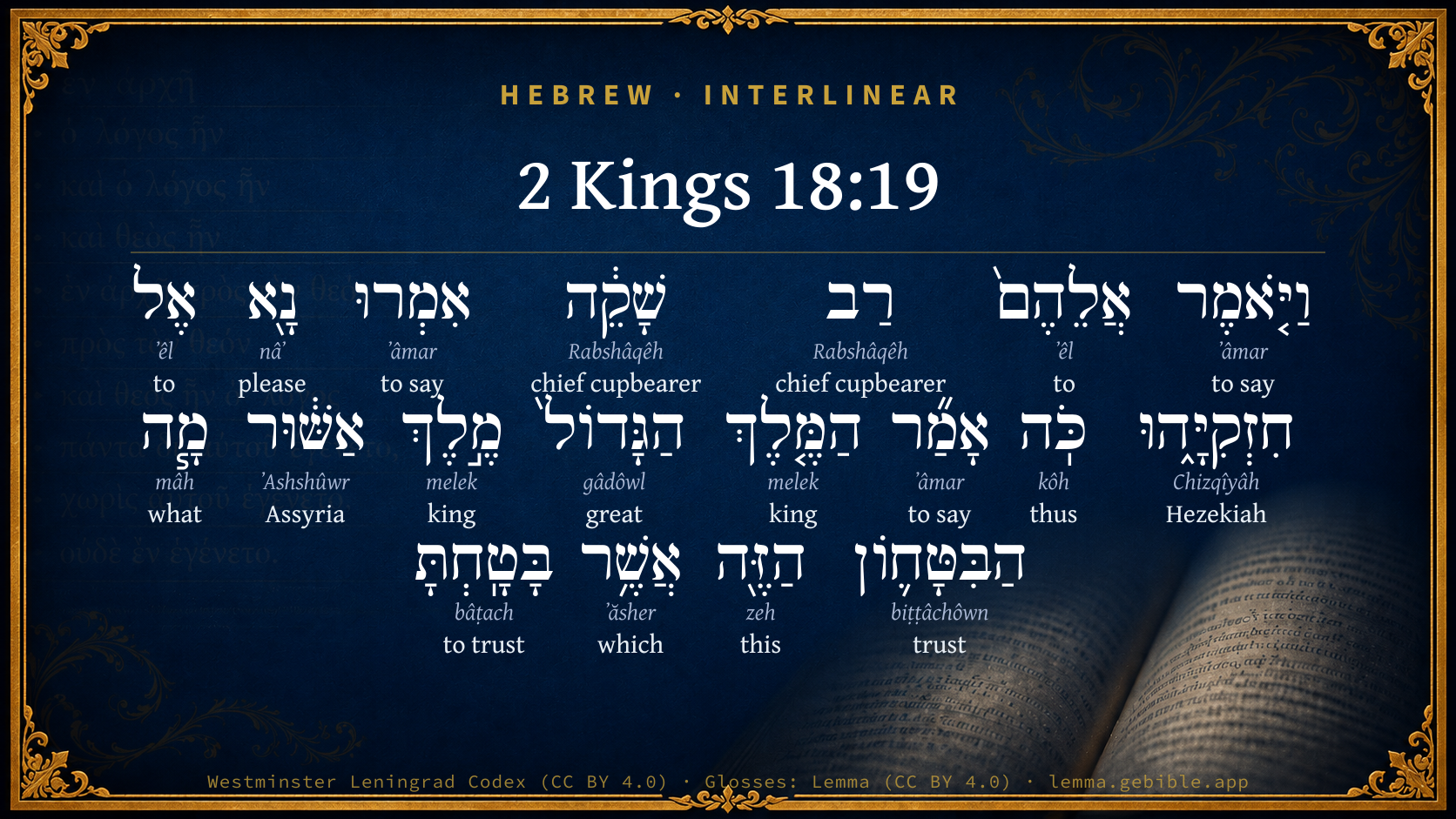
Hebrew (Westminster Leningrad Codex) 2 Kings 18:19 appears in the Hebrew Old Testament. The text above is from the Westminster Leningrad Codex. Each word links to its Strong’s number, a concise gloss, and parsing drawn from the Open Scriptures Hebrew Bible morphology. Click any word for its full Brown-Driver-Briggs (BDB) entry.
Download image
Cite this verse

2 Kings 18:19 (World English Bible). Public Domain. Lemma interlinear Bible study tool, https://lemma.gebible.app/v/2-kings/18/19.

Show BibTeX & RIS
BibTeX
RIS
English Translation
Rabshakeh said to them, Say you now to Hezekiah, Thus says the great king, the king of Assyria, What confidence is this in which you trust?
World English Bible · Public Domain
Highlights
  • 1 first appearance in the Hebrew Bible
Full analysis ↓
Download a study sheet

One document with this verse’s original text, its word-by-word gloss line, the meaning frame, cross-references with their text, attributed commentary, and full source and license credits — printable, and it pastes into notes with its structure intact.

This verse Autodidact and up

Study sheet (.html) Plain text (.txt)

A passage Seminary Student

Up to 50 verses in one chapter. A passage sheet keeps up to 6 commentary sources and 12 cross-references per verse, in the order this page ranks them, and says so on the sheet whenever that leaves anything out. Ask for a single verse and you get the Autodidact verse sheet above.

Everything on this page stays free to read, with no account — the sheet is a download of what is already on screen, not access to it.

Want to remove ads? Support Godless Engineer
Compare translations 3

The same verse in 3 English versions, stacked beneath the original-language interlinear above. Click any original word for its lexicon entry.

Each is an independent rendering of the whole verse — the interlinear is not word-aligned to these translations.

Highlighted words mark where these versions differ — a whole-verse word diff, not a word-by-word alignment.

  • World English Bible Public Domain
    Rabshakeh said to them, Say you now to Hezekiah, Thus says the great king, the king of Assyria, What confidence is this in which you trust?
  • King James Version Public Domain
    And Rabshakeh said unto them, Speak ye now to Hezekiah, Thus saith the great king, the king of Assyria, What confidence is this wherein thou trustest?
  • unfoldingWord Literal Text CC BY-SA 4.0
    And the Rabshakeh said to them, “Now say to Hezekiah, ‘Thus says the great king, the king of Assyria, “What this trust that you trust?

unfoldingWord Literal Text — © unfoldingWord, licensed CC BY-SA 4.0. Word-aligned USFM3 via Door43 (git.door43.org/unfoldingWord/en_ult).

Versions to compare (up to 4)

3 of 4 selected

Show all 18 translations

Every available English version of this verse, each an independent rendering of the whole verse.

  • World English Bible Public Domain
    Rabshakeh said to them, Say you now to Hezekiah, Thus says the great king, the king of Assyria, What confidence is this in which you trust?
  • Berean Standard Bible Public Domain
    The Rabshakeh said to them, “Tell Hezekiah that this is what the great king, the king of Assyria, says: What is the basis of this confidence of yours?
  • Majority Standard Bible Public Domain
    The Rabshakeh said to them, “Tell Hezekiah that this is what the great king, the king of Assyria, says: What is the basis of this confidence of yours?
  • King James Version Public Domain
    And Rabshakeh said unto them, Speak ye now to Hezekiah, Thus saith the great king, the king of Assyria, What confidence is this wherein thou trustest?
  • American Standard Version (1901) Public Domain
    And Rabshakeh said unto them, Say ye now to Hezekiah, Thus saith the great king, the king of Assyria, What confidence is this wherein thou trustest?
  • Revised Version (1885) Public Domain
    And Rabshakeh said unto them, Say ye now to Hezekiah, Thus saith the great king, the king of Assyria, What confidence is this wherein thou trustest?
  • Geneva Bible (1599) Public Domain
    And Rabshakeh sayde vnto them, Tell ye Hezekiah, I pray you, Thus saith the great King, euen the great King of Asshur, What confidence is this wherein thou trustest?
  • Douay-Rheims (1899) Public Domain
    And Rabsaces said to them: Speak to Ezechias: Thus saith the great king, the king of the Assyrians: What is this confidence, wherein thou trustest?
  • Young's Literal Translation Public Domain
    And the chief of the butlers saith unto them, `Say, I pray you, unto Hezekiah, Thus said the great king, the king of Asshur, What `is' this confidence in which thou hast confided?
  • Literal Standard Version CC BY-SA 4.0
    And the chief of the butlers says to them, “Now say to Hezekiah, Thus said the great king, the king of Asshur: What [is] this confidence in which you have confided?
  • Unlocked Literal Bible CC BY-SA 4.0
    So the chief commander said to them to tell Hezekiah what the great king, the king of Assyria, said: “What is the source of your confidence?
  • unfoldingWord Literal Text CC BY-SA 4.0
    And the Rabshakeh said to them, “Now say to Hezekiah, ‘Thus says the great king, the king of Assyria, “What this trust that you trust?
  • Darby Bible Public Domain
    And Rab-shakeh said to them, Say now to Hezekiah, Thus says the great king, the king of Assyria: What confidence is this wherein thou trustest?
  • World Messianic Bible Public Domain
    Rabshakeh said to them, “Say now to Hezekiah, ‘The great king, the king of Assyria, says, “What confidence is this in which you trust?
  • Webster's Bible Public Domain
    And Rab-shakeh said to them, Speak ye now to Hezekiah, Thus saith the great king, the king of Assyria, What confidence is this in which thou trustest?
  • Free Bible Version CC BY-SA 4.0
    The Assyrian army general said to them, “Tell Hezekiah this is what the great king, the king of Assyria, says: What are you trusting in that gives you such confidence?
  • Bible in Basic English Public Domain
    And the Rab-shakeh said to them, Say now to Hezekiah, These are the words of the great king, the king of Assyria: In what are you placing your hope?
  • JPS Tanakh (1917) Public Domain
    And Rab-shakeh said unto them: 'Say ye now to Hezekiah: Thus saith the great king, the king of Assyria: What confidence is this wherein thou trustest?

Literal Standard Version (2020), Covenant Press — licensed CC BY-SA 4.0. Text via the HelloAO Bible API (eBible.org). Unlocked Literal Bible (unfoldingWord) — licensed CC BY-SA 4.0. Text via the HelloAO Bible API (eBible.org). unfoldingWord Literal Text — © unfoldingWord, licensed CC BY-SA 4.0. Word-aligned USFM3 via Door43 (git.door43.org/unfoldingWord/en_ult). Free Bible Version, Dr. Jonathan Gallagher — licensed CC BY-SA 4.0. Text via the HelloAO Bible API (eBible.org).

Word by word

More ways to search: Search by grammar → Find every occurrence → Compare this word →

Practice this passage: Drill this verse → Learn its vocabulary →

הַבִּטָּח֛וֹן
biṭṭâchôwn
H986
“the · trust”
Particle, Definite Article + Noun, Common, Masculine, Singular, Absolute
Part of Speech
Particle + Noun
Type
Common
Gender
Masculine
Number
Singular
State
Absolute
Full BDB Definition

Origin: from H982

TWOT: 233c

trust, confidence, hope
  1. וַיֹּ֤אמֶר ʼâmar H559 “and · to say” Conjunction + Verb, Qal, Sequential Imperfect, 3rd Person, Masculine, Singular
  2. אֲלֵהֶם֙ ʼêl H413 “to · them” Preposition + Suffix, Personal, 3rd Person, Masculine, Plural
  3. רַב Rabshâqêh H7262 “chief cupbearer of” Noun, Common, Masculine, Singular, Construct
  4. שָׁקֵ֔ה Rabshâqêh H7262 “chief cupbearer” Noun, Proper
  5. אִמְרוּ ʼâmar H559 “say” Verb, Qal, Imperative, 2nd Person, Masculine, Plural
  6. נָ֖א nâʼ H4994 “please” Particle, Exhortation
  7. אֶל ʼêl H413 “to” Preposition
  8. חִזְקִיָּ֑הוּ Chizqîyâh H2396 “Hezekiah” Noun, Proper
  9. כֹּֽה kôh H3541 “thus” Adverb
  10. אָמַ֞ר ʼâmar H559 “to say” Verb, Qal, Perfect, 3rd Person, Masculine, Singular
  11. הַמֶּ֤לֶךְ melek H4428 “the · king” Particle, Definite Article + Noun, Common, Masculine, Singular, Absolute
  12. הַגָּדוֹל֙ gâdôwl H1419 “the · great” Particle, Definite Article + Adjective, Adjective, Masculine, Singular, Absolute
  13. מֶ֣לֶךְ melek H4428 “king of” Noun, Common, Masculine, Singular, Construct
  14. אַשּׁ֔וּר ʼAshshûwr H804 “Assyria” Noun, Proper
  15. מָ֧ה mâh H4100 “what” Particle, Interrogative
  16. הַזֶּ֖ה zeh H2088 “the · this” Particle, Definite Article + Pronoun, Demonstrative, Masculine, Singular
  17. אֲשֶׁ֥ר ʼăsher H834 “which” Particle, Relative
  18. בָּטָֽחְתָּ bâṭach H982 “to trust” Verb, Qal, Perfect, 2nd Person, Masculine, Singular

About this verse

These counts appear in no published source. They are computed here, from the morphology-tagged text and Lemma’s own curated glosses. What Lemma adds →

19
words
14
distinct lemmas
Historical
section

Notable vocabulary

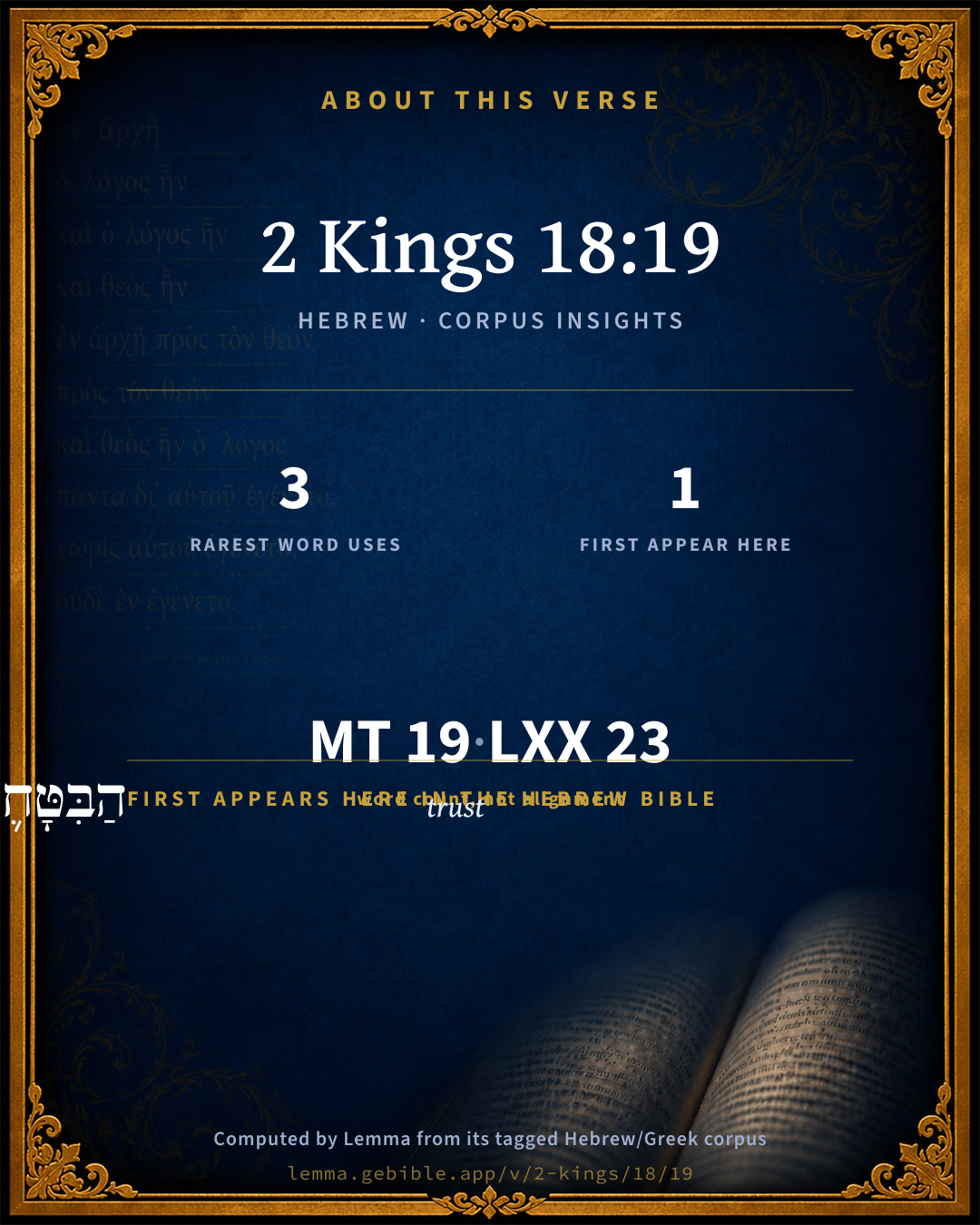
The rarest word here is הַבִּטָּח֛וֹן trust H986 — appearing just 3 times in the whole Hebrew Bible.

First appearance in Scripture

This word makes its first canonical appearance in the Hebrew Bible here:

  • הַבִּטָּח֛וֹן trust H986

Shared distinctive vocabulary

הַבִּטָּח֛וֹן trust H986 occurs in 3 verses of the Hebrew Bible. Also found in:

Grammatical profile

  • 4 verbs
  • 7 nouns
  • 1 adjective
  • 1 pronoun
  • 2 prepositions
  • 1 adverb
  • 3 particles

Verb forms

  • וַיֹּ֤אמֶר Qal · Sequential Imperfect
  • אִמְרוּ Qal · Imperative
  • אָמַ֞ר Qal · Perfect
  • בָּטָֽחְתָּ Qal · Perfect

Repetition

Words recur within this verse — often emphatic in Hebrew:

  • וַיֹּ֤אמֶר to say H559 ×3
  • רַב chief cupbearer H7262 ×2
  • הַמֶּ֤לֶךְ king H4428 ×2
  • אֲלֵהֶם֙ to H413 ×2

Hebrew & Septuagint length

In English translation the verse runs 26 words from the Hebrew and 26 from the Septuagint (LXX English) — the same length.

A rough comparison of the two English renderings, which tokenize alike — not a word-level alignment.

Word counts can differ between the Hebrew and the Greek without any difference in meaning — e.g. the Hebrew direct-object marker אֵת has no separate Greek word, and Greek often adds the article ὁ.

In the original languages it is 19 Hebrew tokens and 23 Greek tokens — but the two are counted differently (Hebrew bundles its prefixes and suffixes into one token; the Greek is in lemma form), so that isn’t a like-for-like length.

Cross-references

13

Topical passages linked to 2 Kings 18:19 in the Treasury of Scripture Knowledge — connected by theme and wording, ordered by reader-vote popularity; previews shown in the World English Bible.

  • Isaiah 36:4 Rabshakeh said to them, Say you now to Hezekiah, Thus says the great king, the king of Assyria, What confidence is this in which you trust?
  • 2 Kings 19:10 Thus shall you speak to Hezekiah king of Judah, saying, Don't let your God in whom you trust deceive you, saying, Jerusalem shall not be given into the hand of the king of Assyria.
  • Isaiah 10:8–14 For he says, Aren't my princes all of them kings?
  • 2 Kings 18:22 But if you tell me, We trust in Yahweh our God; isn't that he whose high places and whose altars Hezekiah has taken away, and has said to Judah and to Jerusalem, You shall worship before this altar in Jerusalem?
  • 2 Kings 18:29–30 Thus says the king, Don't let Hezekiah deceive you; for he will not be able to deliver you out of his hand:
  • 2 Chronicles 32:7–8 Be strong and of good courage, don't be afraid nor dismayed for the king of Assyria, nor for all the multitude who is with him; for there is a greater with us than with him:
  • 2 Chronicles 32:10–11 Thus says Sennacherib king of Assyria, Whereon do you trust, that you abide the siege in Jerusalem?
  • 2 Chronicles 32:14–16 Who was there among all the gods of those nations which my fathers utterly destroyed, that could deliver his people out of my hand, that your God should be able to deliver you out of my hand?
  • Psalms 4:2 You sons of men, how long shall my glory be turned into dishonor? Will you love vanity, and seek after falsehood? Selah.
  • Isaiah 36:7 But if you tell me, We trust in Yahweh our God: isn't that he, whose high places and whose altars Hezekiah has taken away, and has said to Judah and to Jerusalem, You shall worship before this altar?
  • Isaiah 37:10 Thus shall you speak to Hezekiah king of Judah, saying, Don't let your God in whom you trust deceive you, saying, Jerusalem shall not be given into the hand of the king of Assyria.
  • Isaiah 37:13 Where is the king of Hamath, and the king of Arpad, and the king of the city of Sepharvaim, of Hena, and Ivvah?
  • Daniel 4:30 The king spoke and said, Is not this great Babylon, which I have built for the royal dwelling-place, by the might of my power and for the glory of my majesty?

Cross-references courtesy of OpenBible.info (CC BY 4.0).

Hebrew and Greek witnesses Masoretic Hebrew ↔ Greek Septuagint

The same verse in the two great witnesses to the Old Testament, shown verse-for-verse.

These are two independent witnesses, not word-aligned to each other, and the Septuagint is shown in lemma (dictionary) form.

Hebrew 2 Kings 18:19 Masoretic · Westminster Leningrad Codex

וַיֹּ֤אמֶר אֲלֵהֶם֙ רַב שָׁקֵ֔ה אִמְרוּ נָ֖א אֶל חִזְקִיָּ֑הוּ כֹּֽה אָמַ֞ר הַמֶּ֤לֶךְ הַגָּדוֹל֙ מֶ֣לֶךְ אַשּׁ֔וּר מָ֧ה הַבִּטָּח֛וֹן הַזֶּ֖ה אֲשֶׁ֥ר בָּטָֽחְתָּ

Rabshakeh said to them, Say you now to Hezekiah, Thus says the great king, the king of Assyria, What confidence is this in which you trust?

World English Bible · Public Domain

Greek LXX 2 Kings 18:19 Septuagint · lemma form

καί εἶπον πρός αὐτός ραψακης εἶπον δή πρός εζεκιας ὅδε λέγω ὁ βασιλεύς ὁ μέγας βασιλεύς ἀσσύριος τίς ὁ πεποίθησις οὗτος ὅς πείθω

And Rapsakes said to them, Say now to Ezekias, Thus says the king, the great king of the Assyrians, What is this confidence wherein you trust?

LXX2012 (modern English Septuagint) · Public Domain

Hebrew: Westminster Leningrad Codex (CC BY 4.0). Greek: Septuagint (public domain); English from LXX2012 (modern English Septuagint) (Public Domain). How the Septuagint differs from the Hebrew →

Targum (Aramaic paraphrase)

1

The Targum is the ancient Jewish Aramaic paraphrase of the Hebrew Scriptures — an interpretive translation, not the Hebrew text itself. Onkelos (literal) and Pseudo-Jonathan (expansive) render the Torah, and Jonathan the Prophets. Coverage is partial: where no permissively-licensed English translation exists for a verse, only the Aramaic is shown. This is verse-level text, not a word-by-word alignment to the Hebrew.

  1. Targum Jonathan Prophets (Joshua–Malachi)
    וַאֲמַר לְהוֹן רַבְשָׁקֵה אֲמָרוּ כְעַן לְחִזְקִיָה כִּדְנַן אֲמַר מַלְכָּא דְרַבְּתָנָא מַלְכָּא דְאַתּוּר מָא רוֹחֲצָנָא הָדֵין דְאִתְרְחֵיצְתָּא:

    (no public-domain English translation for this verse)

    Targum Jonathan — Aramaic: “Mikraot Gedolot” (public domain). English: “Sefaria Community Translation” (CC0 1.0 (public-domain dedication)); “London "Chaldee Paraphrase," 1871” (public domain). Text via Sefaria.

Commentary

Notes on 2 Kings 18:19 from classic Christian and Jewish commentators (each source and its license shown beneath its notes). The classic Christian expositions comment on the surrounding passage and are grouped to its opening verse, so a note may address several verses; the Jewish commentaries on the Tanakh (Rashi and others) are per-verse, so they appear only where the commentator wrote on this verse.

Lemma curates 59 commentaries, every one of them public domain or Creative Commons licensed, each selected and text-cleaned for this edition rather than reprinted as found. About our sources →

Jamieson, Fausset & Brown

Robert Jamieson, A. R. Fausset & David Brown

Rab-shakeh said--The insolent tone he assumed appears surprising. But this boasting [Kg2 18:19-25], both as to matter and manner, his highly colored picture of his master's powers and resources, and the impossibility of Hezekiah making any effective resistance, heightened by all the arguments and figures which an Oriental imagination could suggest, has been paralleled in all, except the blasphemy, by other messages of defiance sent on similar occasions in the history of the East.

Jamieson, Fausset & Brown — Commentary Critical and Explanatory on the Whole Bible (1871) — public domain (CC PDM 1.0). Text via the HelloAO Bible API.

Trapp's Complete Commentary

John Trapp

2Ki 18:19 And Rabshakeh said unto them, Speak ye now to Hezekiah, Thus saith the great king, the king of Assyria, What confidence [is] this wherein thou trustest?

Ver. 19. Thus saith the great king.] An expression that savoureth of intolerable pride, and, as some think, uttered in way of deriding the prophets of Israel, who usually prefaced, Thus saith the Lord God. Hezekiah might well have replied, as afterward Agesilaus, king of Sparta, did upon a like occasion, Nemo me maior nisi qui iustior: or, as Seneca, Anime magno nihil magnum. But empty spirits affect swelling titles: the Grand Signor, for instance, and great John O’Neal.

John Trapp, A Commentary or Exposition upon All the Books of the Old and New Testament (1647–1656) — public domain. Text from a community e-Sword module.

Joseph Benson's Commentary

2Ki 18:19-20. Thus saith the great king, What confidence is this, &c. — What is it thou canst trust in to defend thee from my great power? Thou sayest — Either to thy people, to encourage them, or rather, within thy own heart. But, (or, surely,) they are vain words — Unprofitable, idle talk, without any effect: or they come not from thy heart; thou speakest this against thy knowledge. I have counsel and strength for the war — Counsel to contrive, strength, or courage, to execute; which two things are of greatest necessity and use in war. But the original words may be rendered, Thou speakest surely words of the lips; that is, thou encouragest thyself and thy people with words, but counsel and strength are for war — Are necessary for thy defence; neither of which thou hast within thyself, but must seek them from others, and where wilt thou find them? On whom, as it follows, dost thou trust?

Joseph Benson's Commentary on the Old and New Testaments (1811–1818) — public domain. Text from a community e-Sword module.

Tyndale Open Study Notes

Tyndale Open Resources

18:19-22 In earlier days, the term great king was reserved for the kings of the leading military powers, but it had become a standard epithet for Assyrian kings. • What are you trusting in? The Assyrian officer asserted that the citizens of Jerusalem, faced with Assyria’s overwhelming military superiority, would be foolish to trust in Hezekiah’s words. Similarly, soliciting help from Egypt would be foolish. Finally, the chief of staff argued that trust in the Lord would also be misplaced. Perhaps the officer hoped to gain the loyalty of citizens who had worshiped at the shrines and altars that Hezekiah had destroyed.

Tyndale Open Study Notes — © Tyndale Open Resources, licensed CC BY-SA 4.0. Text via the HelloAO Bible API.

Adam Clarke's Commentary

Verse 19. What confidence is this] מה הבטחן הזה ma habbittachon hazzeh. The words are excessively insulting: What little, foolish, or unavailing cause of confidence is it, to which thou trustest? I translate thus, because I consider the word בטחון bittachon as a diminutive, intended to express the utmost contempt for Hezekiah's God.

Adam Clarke's Commentary on the Bible (1810–1826) — public domain. Text from a community e-Sword/MySword module.

Ellicott's Commentary for English Readers

(19) And Rab-shakeh said.—Tiglath Pileser records that he sent a rab-sak as his envoy to Tyre. Thenius supposes the present rab-sak may have been a better master of Hebrew than his companions. Schrader says it would have been beneath the tartan’s dignity to speak, and that such vigorous language as follows would have had a very strange effect in the mouth of a eunuch (the rabsaris).

The great king, the king of Assyria.—Comp. the usual grandiloquent style of the Assyrian sovereigns: “I, Esarhaddon, the great king, the mighty king, the king of multitudes, the king of the country of Asshur;” and the title, “king of princes,” which Hosea applies to the king of Assyria (Hos_8:10).

A Bible Commentary for English Readers, edited by Charles John Ellicott (1878–1897) — public domain. Text from a community e-Sword module.

The Cambridge Bible for Schools and Colleges

gen. ed. J. J. S. Perowne

19. Speak ye now to Hezekiah] Their message was first addressed to the king, but afterwards they turn (verse 29) to the people who had gathered to hear the parley. The briefer record of the Chronicler combines both parts of the conference and says the messengers were sent ‘unto Hezekiah … and unto all Judah that were at Jerusalem’.

the great king] Hezekiah would know that his own father Ahaz had been one of Assyria’s tributaries, and that many other petty kings around were in the same condition. Hence the term is calculated to warn him against resistance.

What confidence is this wherein thou trustest] The question in Chronicles, being represented as at once addressed both to king and people, is put in the plural number ‘Whereon do ye trust’?

The Cambridge Bible for Schools and Colleges (gen. ed. J. J. S. Perowne; Cambridge University Press, 1878–1918) — public domain. Text from a community e-Sword module.

Albert Barnes' Notes on the Bible

The Rab-shakeh, the third in rank of the three Assyrian ambassadors, probably took the prominent part in the conference because he could speak Hebrew 2Ki 18:26, whereas the Tartan and the Rabsaris could not do so.

The great king - This title of the monarchs of Assyria is found in use as early as 1120 B.C. Like the title, “king of kings,” the distinctive epithet “great” served to mark emphatically the vast difference between the numerous vassal monarchs and the suzerain of whom they held their crowns.

Albert Barnes' Notes on the Bible (1834–1885) — public domain. Text from a community e-Sword/MySword module.

Whedon's Commentary on the Bible

Daniel D. Whedon

19. Rab-shakeh said — He seems to have been the chief speaker — the herald and principal ambassador of the king, while Tartan had higher authority and command in the matter of the movements of the army.

The great king — Thus the Assyrian, Babylonian, and Persian kings delighted to be called and to call themselves, for their “princes were altogether kings.” Isa_10:8; compare Ezr_7:12; Eze_26:7; Dan_2:37. Hence the frequent occurrence on the monuments of such titles as “great king,” “mighty king,” “king of hosts,” “king of kings,” “the glorious king,” “the mighty ruler.”

What confidence is this — Better, what is this trust which thou trustest? What does it amount to? He refers to Hezekiah’s supposed trust in the king of Egypt. Compare 2Ki_18:21.

Daniel D. Whedon (gen. ed.), Commentary on the Old and New Testaments (1874–1909) — public domain. Text from a community e-Sword module.

The Pulpit Commentary

And Rabshakeh said unto them. Although the third in order of dignity, Rabshakeh took the word, probably because he was familiar with the Hebrew language, and could speak it fluently (see ver. 26). His being spokesman made him appear to be the chief ambassador, and made Isaiah, in the parallel passage (36.), pass over in silence the other two. Speak ye now to Hezekiah. It was a rude, almost an insulting commencement, to give Hezekiah no title neither "the king," nor "King of Judah," nor even "your master," but to call him merely "Hezekiah." The same rudeness is persisted in throughout (vers. 22, 29, 30, 31, 32), and it is emphasized by the employment of some title or other, generally a lofty title, when Sennacherib is spoken of. Sennacherib himself is less rude in his inscriptions (see the "Eponym Canon," pp. 133, line 45; 134, line 6; 136, lines 21, 15). Thus saith the great king, the King of Assyria. The "great kingsarru rabu was the ordinary title assumed by Assyrian monarchs. It passed from them to the Babylonians and the Persians. Sennacherib calls himself, on Bellino"s cylinder," the great king, the powerful king, the King of Assyria, the king unrivalled, the pious monarch, the worshipper of the great gods, the protector of the just,.the lover of the righteous, the noble warrior, the valiant hero, the first of all kings, the great punisher of unbelievers" (see "Records of the Past," vol. 1.p.25). What confidence is this wherein thou trustest? We may assume that Hezekiah had, at the beginning of the year, withheld his tribute. He had certainly not gone out to meet the "great king" as he approached his territories, to do homage, and place the forces of Judah at his disposal. On the contrary, he had taken up an attitude of hostility. He had fortified his capital; (2Ch_32:2-5) he had collected arms and soldiers, and had shut himself up in Jerusalem, having made every preparation for a siege. Sennacherib inquires why he has dared to do all this on what strength does he rely? What is the ground of his confidence?

The Pulpit Commentary (1880–1919), ed. H.D.M. Spence-Jones & Joseph S. Exell — public domain. Text from a community e-Sword module.

John Wesley's Explanatory Notes

Thus saith, &c. - But what are the greatest men when they come to compare with God, or when God comes to contend with them?

John Wesley, Explanatory Notes Upon the Whole Bible (1754–1765) — public domain. Text via the GEBible commentary corpus.

unfoldingWord translationNotes

Door43 World Missions Community

General Information:

Rabshakeh continues telling the message from the king of Assyria to King Hezekiah's men.

What is the source of your confidence? ... In whom are you trusting, that you should rebel against me?

The King of Assyria (through his messenger Rabshakeh) does not ask these questions looking for an answer, but wants to make King Hezekiah doubt himself and Egypt's support. AT: "Do not trust in anybody. You were foolish to rebel against me." (See: Rhetorical Question)

walking stick of this bruised reed of Egypt

The King of Assyria compares Egypt to a weak walking stick; you expect that it will support you when you lean on it, but instead it breaks and cuts you. AT: "the weak support from Egypt" (See: Metaphor)

but if a man leans ... and pierce it

The speaker is extending the metaphor by describing what happens when a reed is used as a support. AT: "but if someone uses this for support, he will be injured" (See: Metaphor)

translationWords

confidence

strength

trust

courage

rebel

Pharaoh

Egypt

unfoldingWord translationNotes — © Distant Shores Media and the Door43 World Missions Community, licensed CC BY-SA 4.0. Source: git.door43.org/Door43/en_tn.

Lesson kit

Teaching starters — assembled from the data on this page, not authored interpretation. Every prompt links to the verse data it draws on. Edit before teaching.

2 Kings, in the Historical, opens this verse with 19 words (14 distinct Hebrew lemmas). Its most distinctive word is biṭṭâchôwn (“trust”). A historical commentator’s framing appears above. Read the whole chapter for the surrounding context.

Discussion questions

  1. What does “trust” (biṭṭâchôwn) contribute to the verse as a whole?
  2. This is the first place “trust” appears in Scripture (first appears here). What does its debut here establish?
  3. How does Ecclesiastes 9:4, which shares the word «trust», read alongside this verse?
  4. What does the repetition of “to say” (3× in this one verse) do in this verse?
  5. These translations render this verse differently; the difference is in the English rendering, not the original. What questions does that raise?
  6. «וַיֹּ֤אמֶר» is a Qal Sequential Imperfect verb. How does that grammatical form shape the action described?
  7. Compare how Jamieson, Fausset & Brown and Trapp's Complete Commentary read this verse. Where do they agree or differ?

Things to notice

Reading settings

Reading text

Shown beneath each verse's original-language words.

Old Testament
Old Testament edition

Read the OT as the Masoretic Hebrew (MT) or the Greek Septuagint (LXX).

English shown for the Greek Septuagint (in the Hebrew ↔ Greek comparison).

Comparing translations? Open the Compare panel on any verse page to stack up to four side by side.