Psalms 66:3

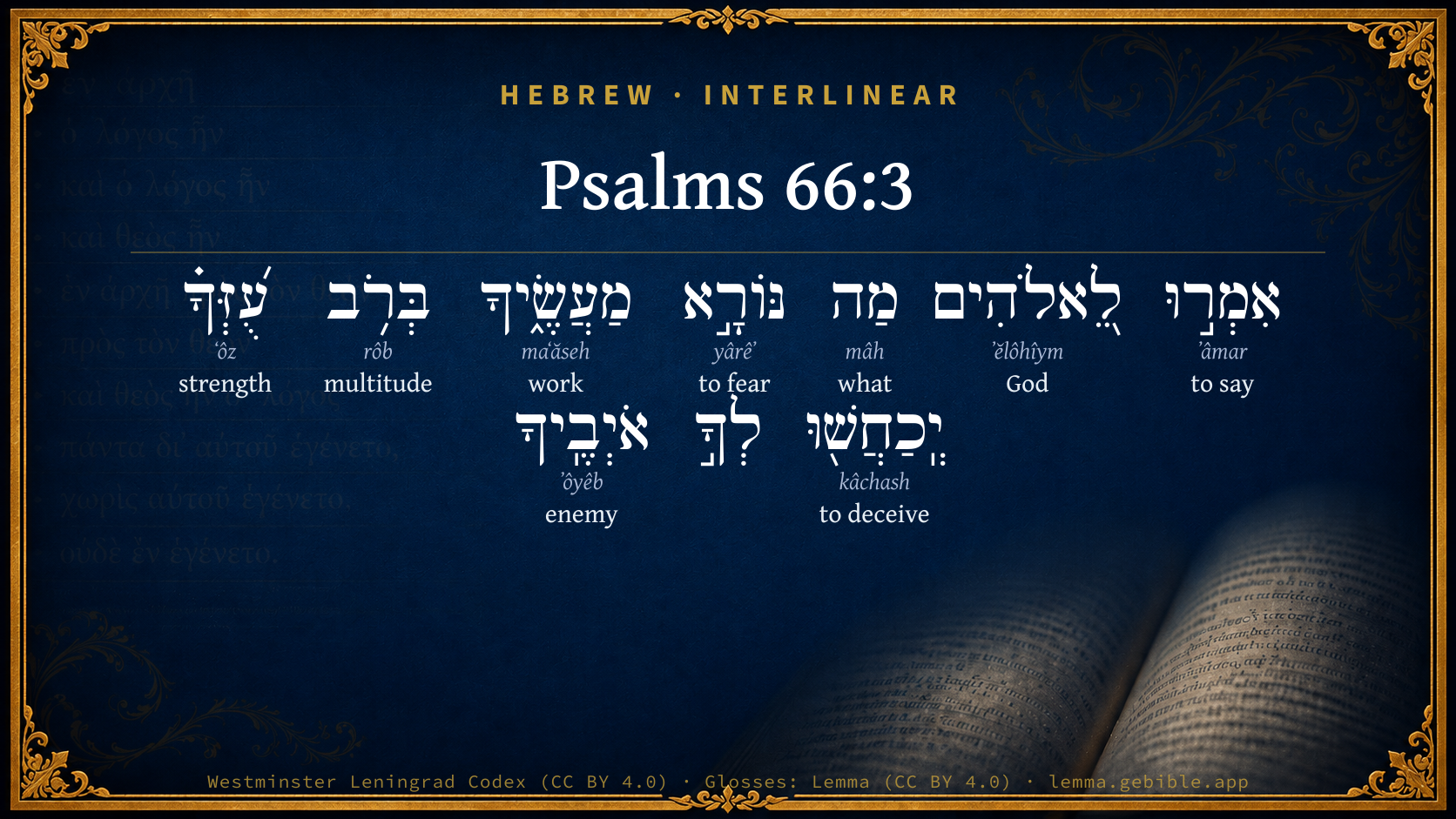
Hebrew (Westminster Leningrad Codex) Psalms 66:3 appears in the Hebrew Old Testament. The text above is from the Westminster Leningrad Codex. Each word links to its Strong’s number, a concise gloss, and parsing drawn from the Open Scriptures Hebrew Bible morphology. Click any word for its full Brown-Driver-Briggs (BDB) entry.
Download image
Cite this verse

Psalms 66:3 (World English Bible). Public Domain. Lemma interlinear Bible study tool, https://lemma.gebible.app/v/psalms/66/3.

Show BibTeX & RIS
BibTeX
RIS
English Translation
Tell God, "How awesome are your deeds! Through the greatness of your power, your enemies submit themselves to you.
World English Bible · Public Domain
Download a study sheet

One document with this verse’s original text, its word-by-word gloss line, the meaning frame, cross-references with their text, attributed commentary, and full source and license credits — printable, and it pastes into notes with its structure intact.

This verse Autodidact and up

Study sheet (.html) Plain text (.txt)

A passage Seminary Student

Up to 50 verses in one chapter. A passage sheet keeps up to 6 commentary sources and 12 cross-references per verse, in the order this page ranks them, and says so on the sheet whenever that leaves anything out. Ask for a single verse and you get the Autodidact verse sheet above.

Everything on this page stays free to read, with no account — the sheet is a download of what is already on screen, not access to it.

Want to remove ads? Support Godless Engineer
Compare translations 3

The same verse in 3 English versions, stacked beneath the original-language interlinear above. Click any original word for its lexicon entry.

Each is an independent rendering of the whole verse — the interlinear is not word-aligned to these translations.

Highlighted words mark where these versions differ — a whole-verse word diff, not a word-by-word alignment.

  • World English Bible Public Domain
    Tell God, "How awesome are your deeds! Through the greatness of your power, your enemies submit themselves to you.
  • King James Version Public Domain
    Say unto God, How terrible art thou in thy works! through the greatness of thy power shall thine enemies submit themselves unto thee.
  • unfoldingWord Literal Text CC BY-SA 4.0
    Say to God, “How fearsome your deeds! Because of the greatness of your power, your enemies cringe before you.

unfoldingWord Literal Text — © unfoldingWord, licensed CC BY-SA 4.0. Word-aligned USFM3 via Door43 (git.door43.org/unfoldingWord/en_ult).

Versions to compare (up to 4)

3 of 4 selected

Show all 18 translations

Every available English version of this verse, each an independent rendering of the whole verse.

  • World English Bible Public Domain
    Tell God, "How awesome are your deeds! Through the greatness of your power, your enemies submit themselves to you.
  • Berean Standard Bible Public Domain
    Say to God, “How awesome are Your deeds! So great is Your power that Your enemies cower before You.
  • Majority Standard Bible Public Domain
    Say to God, “How awesome are Your deeds! So great is Your power that Your enemies cower before You.
  • King James Version Public Domain
    Say unto God, How terrible art thou in thy works! through the greatness of thy power shall thine enemies submit themselves unto thee.
  • American Standard Version (1901) Public Domain
    Say unto God, How terrible are thy works! Through the greatness of thy power shall thine enemies submit themselves unto thee.
  • Revised Version (1885) Public Domain
    Say unto God, How terrible are thy works! through the greatness of thy power shall thine enemies submit themselves unto thee.
  • Geneva Bible (1599) Public Domain
    Say vnto God, Howe terrible art thou in thy workes! through the greatnesse of thy power shall thine enemies be in subiection vnto thee.
  • Douay-Rheims (1899) Public Domain
    Say unto God, How terrible are thy works, O Lord! in the multitude of thy strength thy enemies shall lie to thee.
  • Young's Literal Translation Public Domain
    Say to God, `How fearful `are' Thy works, By the abundance of Thy strength, Thine enemies feign obedience to Thee.
  • Literal Standard Version CC BY-SA 4.0
    Say to God, “How fearful Your works—By the abundance of Your strength, || Your enemies feign obedience to You.
  • Unlocked Literal Bible CC BY-SA 4.0
    Say to God, “How terrifying are your deeds! By the greatness of your power your enemies will submit to you.
  • unfoldingWord Literal Text CC BY-SA 4.0
    Say to God, “How fearsome your deeds! Because of the greatness of your power, your enemies cringe before you.
  • Darby Bible Public Domain
    Say unto God, How terrible are thy works! because of the greatness of thy strength, thine enemies come cringing unto thee.
  • World Messianic Bible Public Domain
    Tell God, “How awesome are your deeds! Through the greatness of your power, your enemies submit themselves to you.
  • Webster's Bible Public Domain
    Say to God, How terrible art thou in thy works! through the greatness of thy power shall thy enemies submit themselves to thee.
  • Free Bible Version CC BY-SA 4.0
    Tell God, “What you do is awesome! Your enemies are forced to bow before you because of your power.
  • Bible in Basic English Public Domain
    Say to God, How greatly to be feared are your works! because of your great power your haters are forced to put themselves under your feet.
  • JPS Tanakh (1917) Public Domain
    Say unto God: 'How tremendous is Thy work! Through the greatness of Thy power shall Thine enemies dwindle away before Thee.

Literal Standard Version (2020), Covenant Press — licensed CC BY-SA 4.0. Text via the HelloAO Bible API (eBible.org). Unlocked Literal Bible (unfoldingWord) — licensed CC BY-SA 4.0. Text via the HelloAO Bible API (eBible.org). unfoldingWord Literal Text — © unfoldingWord, licensed CC BY-SA 4.0. Word-aligned USFM3 via Door43 (git.door43.org/unfoldingWord/en_ult). Free Bible Version, Dr. Jonathan Gallagher — licensed CC BY-SA 4.0. Text via the HelloAO Bible API (eBible.org).

Word by word

More ways to search: Search by grammar → Find every occurrence → Compare this word →

Practice this passage: Drill this verse → Learn its vocabulary →

יְֽכַחֲשׁ֖וּ
kâchash
H3584
“to deceive”
Verb, Piel, Imperfect, 3rd Person, Masculine, Plural
Part of Speech
Verb
Stem
Piel
Form
Imperfect
Person
3rd Person
Gender
Masculine
Number
Plural
Full BDB Definition

Origin: a primitive root

TWOT: 975

to deceive, lie, fail, grow lean, be disappointing, be untrue, be insufficient, be found liars, belie, deny, dissemble, deal falsely - (Qal) to become lean - (Niphal) to cringe, feign obedience - (Piel) - to deceive, deny falsely - to act deceptively - to cringe - to disappoint, fail - (Hithpael) to cringe, feign obedience
  1. אִמְר֣וּ ʼâmar H559 “say” Verb, Qal, Imperative, 2nd Person, Masculine, Plural
  2. לֵ֭אלֹהִים ʼĕlôhîym H430 “to/for · God(s)” Preposition + Noun, Common, Masculine, Plural, Absolute
  3. מַה mâh H4100 “what” Particle, Interrogative
  4. נּוֹרָ֣א yârêʼ H3372 “fearing” Verb, Niphal, Participle Active, Masculine, Singular, Absolute
  5. מַעֲשֶׂ֑יךָ maʻăseh H4639 “works · your” Noun, Common, Masculine, Plural, Construct + Suffix, Personal, 2nd Person, Masculine, Singular
  6. בְּרֹ֥ב rôb H7230 “in/at · multitude of” Preposition + Noun, Common, Both, Singular, Construct
  7. עֻ֝זְּךָ֗ ʻôz H5797 “strength · your” Noun, Common, Masculine, Singular, Construct + Suffix, Personal, 2nd Person, Masculine, Singular
  8. אֹיְבֶֽיךָ ʼôyêb H341 “enemy · you” Verb, Qal, Participle Active, Masculine, Plural, Construct + Suffix, Personal, 2nd Person, Masculine, Singular

About this verse

These counts appear in no published source. They are computed here, from the morphology-tagged text and Lemma’s own curated glosses. What Lemma adds →

10
words
9
distinct lemmas
Wisdom
section

Notable vocabulary

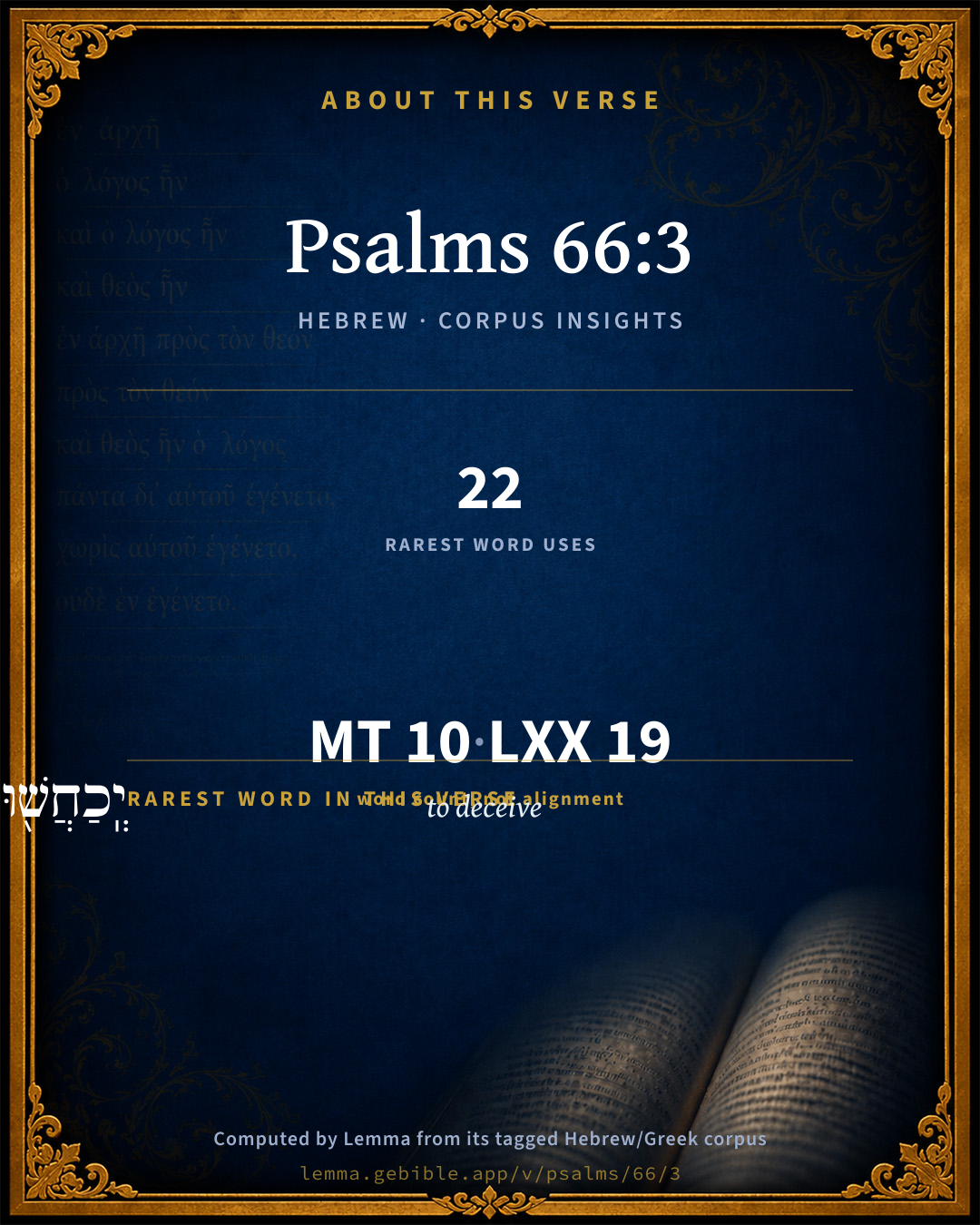
The rarest word here is יְֽכַחֲשׁ֖וּ to deceive H3584 — appearing just 22 times in the whole Hebrew Bible.

Shared distinctive vocabulary

יְֽכַחֲשׁ֖וּ to deceive H3584 occurs in 22 verses of the Hebrew Bible. Also found in:

Grammatical profile

  • 4 verbs
  • 4 nouns
  • 1 preposition
  • 1 particle

Verb forms

  • אִמְר֣וּ Qal · Imperative
  • נּוֹרָ֣א Niphal · Participle Active
  • יְֽכַחֲשׁ֖וּ Piel · Imperfect
  • אֹיְבֶֽיךָ Qal · Participle Active

Hebrew & Septuagint length

In English translation the verse runs 19 words from the Hebrew and 20 from the Septuagint (LXX English) — closely comparable.

A rough comparison of the two English renderings, which tokenize alike — not a word-level alignment.

Word counts can differ between the Hebrew and the Greek without any difference in meaning — e.g. the Hebrew direct-object marker אֵת has no separate Greek word, and Greek often adds the article ὁ.

In the original languages it is 10 Hebrew tokens and 19 Greek tokens — but the two are counted differently (Hebrew bundles its prefixes and suffixes into one token; the Greek is in lemma form), so that isn’t a like-for-like length.

Cross-references

15

Topical passages linked to Psalms 66:3 in the Treasury of Scripture Knowledge — connected by theme and wording, ordered by reader-vote popularity; previews shown in the World English Bible.

  • Psalms 18:44 As soon as they hear of me they shall obey me. The foreigners shall submit themselves to me.
  • Psalms 65:5 By awesome deeds of righteousness, you answer us, God of our salvation. You who are the hope of all the ends of the earth, Of those who are far away on the sea;
  • Psalms 81:15 The haters of Yahweh would cringe before him, And their punishment would last forever.
  • Psalms 47:2 For Yahweh Most High is awesome. He is a great King over all the earth.
  • Psalms 22:28–29 For the kingdom is Yahweh's. He is the ruler over the nations.
  • Psalms 78:35–36 They remembered that God was their rock, The Most High God their redeemer.
  • Isaiah 2:19 Men shall go into the caves of the rocks, And into the holes of the earth, From before the terror of Yahweh, And from the glory of his majesty, When he arises to shake the earth mightily.
  • Jeremiah 10:10 But Yahweh is the true God; he is the living God, and an everlasting King: at his wrath the earth trembles, and the nations are not able to abide his indignation.
  • Psalms 68:30 Rebuke the wild animal of the reeds, The multitude of the bulls, with the calves of the peoples. Being humbled, may it bring bars of silver. Scatter the nations that delight in war.
  • Psalms 76:12 He will cut off the spirit of princes. He is feared by the kings of the earth.
  • Isaiah 64:3 When you did terrible things which we didn't look for, you came down, the mountains quaked at your presence.
  • Exodus 15:1–16 Then Moses and the children of Israel sang this song to Yahweh, and said, "I will sing to Yahweh, for he has triumphed gloriously: The horse and his rider he has thrown into the sea.
  • Judges 5:2–4 For that the leaders took the lead in Israel, For that the people offered themselves willingly, Bless you Yahweh.
  • Judges 5:20–22 From the sky the stars fought, From their courses they fought against Sisera.
  • Exodus 15:21 Miriam answered them, "Sing to Yahweh, for he has triumphed gloriously: The horse and his rider he has thrown into the sea."

Cross-references courtesy of OpenBible.info (CC BY 4.0).

Hebrew and Greek witnesses Masoretic Hebrew ↔ Greek Septuagint

The same verse in the two great witnesses to the Old Testament, shown verse-for-verse.

You’re reading Greek Psalm 65 (Hebrew Psalm 66). The Septuagint counts the superscription, so verse numbers can differ from the Hebrew — chapter-level alignment, not verse-by-verse. Numbering follows Rahlfs.

These are two independent witnesses, not word-aligned to each other, and the Septuagint is shown in lemma (dictionary) form.

Hebrew Psalms 66:3 Masoretic · Westminster Leningrad Codex

אִמְר֣וּ לֵ֭אלֹהִים מַה נּוֹרָ֣א מַעֲשֶׂ֑יךָ בְּרֹ֥ב עֻ֝זְּךָ֗ יְֽכַחֲשׁ֖וּ לְךָ֣ אֹיְבֶֽיךָ

Tell God, "How awesome are your deeds! Through the greatness of your power, your enemies submit themselves to you.

World English Bible · Public Domain

Greek LXX Greek Psalm 65:3 Septuagint · lemma form

εἶπον ὁ θεός ὡς φοβερός ὁ ἔργον σύ ἐν ὁ πλῆθος ὁ δύναμις σύ ψεύδομαι σύ ὁ ἐχθρός σύ

Say to God, How awful are your works! through the greatness of your power your enemies shall lie to you.

LXX2012 (modern English Septuagint) · Public Domain

Hebrew: Westminster Leningrad Codex (CC BY 4.0). Greek: Septuagint (public domain); English from LXX2012 (modern English Septuagint) (Public Domain). How the Septuagint differs from the Hebrew →

Commentary

Notes on Psalms 66:3 from classic Christian and Jewish commentators (each source and its license shown beneath its notes). The classic Christian expositions comment on the surrounding passage and are grouped to its opening verse, so a note may address several verses; the Jewish commentaries on the Tanakh (Rashi and others) are per-verse, so they appear only where the commentator wrote on this verse.

Lemma curates 59 commentaries, every one of them public domain or Creative Commons licensed, each selected and text-cleaned for this edition rather than reprinted as found. About our sources →

Trapp's Complete Commentary

John Trapp

Psa 66:3 Say unto God, How terrible [art thou in] thy works! through the greatness of thy power shall thine enemies submit themselves unto thee.

Ver. 3. Say unto God] Hereby it appeareth that this, among other psalms of like nature, was written for the perpetual use of the Church, and to serve for a set form of praising God, as occasion required, either in public or private.

Shall thine enemies submit themselves unto thee] Heb. shall lie unto thee; that is, saith Kimchi, shall deny that they ever did anything against thee, or thy people. Or, rather, they shall perforce acknowledge thy power and prowess; as Julian the apostate did in his last Vicisti Galilaee; they shall also yield obedience to thee, such as it is, because they can neither will nor choose; this Virtus nolentinm nulla est.

John Trapp, A Commentary or Exposition upon All the Books of the Old and New Testament (1647–1656) — public domain. Text from a community e-Sword module.

J. A. Alexander on Psalms

Joseph Addison Alexander

3. (Psa 66:3) How fearful are thy doings! In the greatness of thy strength shall thine enemies lie to thee. Here begin, as some interpreters suppose, the words in which the required praise is to be rendered to Jehovah; an admissible, though not by any means a necessary supposition. The first clause may likewise be translated, how fearful (art thou in) thy doings, after the analogy of Psa 66:5 below, the ellipsis of the pronoun being similar to that in Psa 68:35. In the greatness of thy strength, i.e. because of it, or rather in the knowledge and belief of it. See above, on Psa 5:7. Lie to thee, make false professions of allegiance, yield a feigned obedience, through the influence of fear. See above, on Psa 18:44.

Joseph Addison Alexander, The Psalms Translated and Explained (1850) — public domain. Text from a community e-Sword module.

Tyndale Open Study Notes

Tyndale Open Resources

66:3 God conquers his enemies (see 18:44; 59:11; 81:15).

Tyndale Open Study Notes — © Tyndale Open Resources, licensed CC BY-SA 4.0. Text via the HelloAO Bible API.

Geneva Bible (1599)

Geneva Bible translators

As the faithful shall obey God willingly, so the infidels for fear shall dissemble themselves to be subject.

Geneva Bible (1599) marginal notes — public domain. Text via Bolls.life.

Jamieson, Fausset & Brown

Robert Jamieson, A. R. Fausset & David Brown

A specimen of the praise.

How terrible--(Compare Psa 65:8).

submit--(Compare Margin), show a forced subjection (Psa 18:44), produced by terror.

Jamieson, Fausset & Brown — Commentary Critical and Explanatory on the Whole Bible (1871) — public domain (CC PDM 1.0). Text via the HelloAO Bible API.

Adam Clarke's Commentary

Verse 3. How terrible art thou ] Consider the plagues with which he afflicted Egypt before he brought your fathers from their captivity, which obliged all his enemies to submit.

Thine enemies submit themselves] Literally, lie unto thee. This was remarkably the case with Pharaoh and the Egyptians. They promised again and again to let the people go, when the hand of the Lord was upon them: and they as frequently falsified their word.

Adam Clarke's Commentary on the Bible (1810–1826) — public domain. Text from a community e-Sword/MySword module.

John Calvin's Commentaries

3. Say unto God, How terrible art thou in thy works! Here he proceeds to state the grounds why he would have us to praise God. Many content themselves with coldly descanting to others of his praises, but with the view of awakening and more deeply impressing our hearts, he directs us to address ourselves immediately to God. It is when we hold converse with him apart, and with no human eye to witness us, that we feel the vanity of hypocrisy, and will be likely to utter only what we have well and seriously meditated in our hearts. Nothing tends more to beget a reverential awe of God upon our spirits than sisting ourselves in his presence. What the Psalmist adds is fitted and designed to produce the same feeling, that through the greatness of God’s power, his enemies feign submission to him Are they who would perversely and obstinately revolt from his service, forced to humble themselves before him, whether they will it or not, how much more, then, ought his own children to serve him, who are invited into his presence, by the accents of tenderness, instead of being reduced to subjection by terror? There is an implied contrast drawn between the voluntary homage which they yield, as attracted by the sweet influences of grace, and that slavish obedience which is wrung reluctantly from the unbeliever. The Hebrew word here used for to lie, signifies to yield such a submission as is constrained, and not free or cordial, as Psalm 18:45. Neither the words nor the scope favor the other senses which have been suggested, as, that his enemies would acknowledge themselves to have been deceived in their hopes, or that they would deny having ever intended hostilities against him. There are many ways in which hypocrites may lie, but nothing more is meant by the Psalmist here, than that the power of God is such as to force them into a reluctant subjection.

John Calvin's Commentaries (1540-1563) — public domain. Text from the Calvin Translation Society English edition (1840s-50s) via the Christian Classics Ethereal Library (ccel.org). Calvin's coverage is partial (roughly two-thirds of the Bible); uncommented books and verses are honest gaps, never fabricated. The 19th-century editor's footnotes and remarks are omitted so the notes are faithfully Calvin's own voice.

The Cambridge Bible for Schools and Colleges

gen. ed. J. J. S. Perowne

3. How terrible art thou in thy works!] Better as R.V., How terrible are thy works! Cp. Psa_65:5; Rev_15:3.

through the greatness of thy power] Rather, of thy strength; cp. Psa_46:1; Psa_63:2; Psa_68:33-34.

submit themselves unto thee] Or, come cringing unto thee. The word, which means literally to lie (hence P.B.V. be found liars unto thee) and so to yield feigned obedience, denotes the unwilling homage paid by the conquered to their conqueror. Cp. Psa_18:44; Psa_81:15; Deu_33:29.

The Cambridge Bible for Schools and Colleges (gen. ed. J. J. S. Perowne; Cambridge University Press, 1878–1918) — public domain. Text from a community e-Sword module.

John Gill's Exposition

Say unto God,.... Or, "concerning God" (t), as some; or, "before God", as the Targum; say to him as follows, in psalms and hymns of praise:

how terrible art thou in thy works! or "reverend" (u); to be feared and reverenced with a godly fear on account of them; such as the works of nature and providence, which are stupendous and marvellous, fearfully and wonderfully wrought; and especially those of grace and redemption, in which the goodness of Christ is manifest, and for which he is to be feared: unless rather his judgments upon his enemies are here meant; who, though he is a Lamb to his own people, is the Lion of the tribe of Judah to them, whom he will break in pieces as a potter's vessel it may be read, "how terrible", or "tremendous", is everyone of "thy works"; so Aben Ezra, and also Jarchi, who interprets the next clause,

through the greatness of thy power, thus,

"when thou showest to the world thy power, by the pestilence, or sword, or famine, or lightnings:''

shall thine enemies submit themselves unto thee? in a lying, flattering, and deceitful manner, as the word (w) here used signifies; See Gill on Psa 18:44; or, as the above interpreters,

"they shall, through the greatness of fear, confess the lies and transgressions they have committed.''

It will be a forced, and not a free, confession and submission; Christ's enemies, whether they will or not, will be obliged to own that he is Lord, to the glory of God the Father, Phi 2:10.

(t) "dicite de Deo", Campensis apud Gejerum; and some in Michaelis. (u) "reverendus", Junius & Tremellius. (w) "mentientur", V. L. Musculus, Montanus; "mendaciter se dedunt", Junius & Tremellius, Piscator, Amama.

John Gill's Exposition of the Whole Bible (1746–1763) — public domain (CC PDM 1.0). Text via the HelloAO Bible API.

Albert Barnes' Notes on the Bible

Say unto God - In your songs of praise. Let your songs be directly addressed to him, setting forth the grounds of that praise, or the reasons why it is due to him.

How terrible art thou in thy works! - How fearful! how much to be reverenced! The meaning is, that the manifestations of his power and greatness, in the events which occur under his government, are suited to impress the mind with awe and reverence.

Through the greatness of thy power - By the putting forth of thy power. Or, Thou hast such power over thine enemies as to be able to compel them to submit to thee.

Shall thine enemies submit themselves unto thee - Margin, Lie, or yield reigned obedience. The Hebrew word means to lie, to speak lies; then, to feign, to flatter, to play the hypocrite. It is thus applied to the vanquished, who make a hollow profession of submission and love to their victors. See the word explained in the notes at Psa 18:44; compare Psa 81:15; Deu 33:29; Job 31:28. The meaning here is, that he had power to subdue them, and to compel them to acknowledge his right to reign. It is the putting forth of mere power which is here referred to; and all that such power can do, is to secure outward and reigned submission. It cannot of itself secure the submission of the heart, the will, and the affections. That is to be secured by love, not by power; and the difference between the submission of the true people of God and that of all others is that the former are subdued by love, the latter by power; the submission of the former is genuine, that of the latter is forced. The inhabitants of heaven will be submissive to God because they love him; the dwellers in hell will be restrained by power, because they cannot deliver themselves. So now, the submission of a true child of God is that of love, or is a willing submission; the submission of a hypocrite is that of fear, when he feigns obedience because he cannot help it, or because he simply dreads the wrath of God. The object here is to celebrate the power of God, and it was sufficient, in order to set that forth, to say that it awed, and outwardly subdued the enemies of God.

Albert Barnes' Notes on the Bible (1834–1885) — public domain. Text from a community e-Sword/MySword module.

Matthew Poole's English Annotations

How terrible art thou in thy works! To wit to thine enemies, as it follows. Submit themselves unto thee, Heb. lie unto thee, i.e. profess subjection to thee, not sincerely and freely, but by constraint, and out of a servile fear.

Matthew Poole's English Annotations on the Holy Bible (1683–1685) — public domain. Text from a community e-Sword/MySword module.

The Treasury of David

Charles H. Spurgeon

Ver. 3. Say unto God. Turn all your praises to him. Devotion, unless it be resolutely directed to the Lord, is no better than whistling to the wind.

How terrible art thou in thy works. The mind is usually first arrested by those attributes which cause fear and trembling; and, even when the heart has come to love God, and rest in him, there is an increase of worship when the soul is awed by an extraordinary display of the more dreadful of the divine characteristics. Looking upon the convulsions which have shaken continents, the hurricanes which have devastated nations, the plagues which have desolated cities, and other great and amazing displays of divine working, men may well say: How terrible art thou in thy works. Till we see God in Christ, the terrible predominates in all our apprehensions of him.

Through the greatness of thy power shall thine enemies submit themselves unto thee; but, as the Hebrew clearly intimates, it will be a forced and false submission. Power brings a man to his knee, but love alone wins his heart. Pharaoh said he would let Israel go, but he lied unto God; he submitted in word but not in deed. Tens of thousands, both in earth and hell, are rendering this constrained homage to the Almighty; they only submit because they cannot do otherwise; it is not their loyalty, but his power, which keeps them subjects of his boundless dominion.

Ver. 3. Say. Dicite, say, says David, delight to speak of God; Dicite, say something. There was more required than to think of God. Consideration, meditation, contemplation upon God and divine objects, have their place and their season; but this is more than that, and more than admiration too; for all these may come to an end in ecstasies, and in stupidities, and in useless and frivolous imaginations. John Donne.

Ver. 3. Unto God. To God, not concerning God, as some interpret, but to God himself; to his praises, and with minds raised to God, as it is in Ps 66:4, sing to himself; Gejerus also correctly remarks, that the following discourse is addressed to God. Besides, it is to our God, as in Ps 66:8, O bless our God, ye people: he is called God absolutely, because he alone is the true God. Hermann Venema.

Ver. 3. How terrible. Take from the Bible its awful doctrines, and from providence its terrible acts, and the whole system, under which God has placed us, would be emasculated. William S. Plumer.

Ver. 3. Thine enemies shall submit themselves unto thee. In this, our first consideration is, that God himself hath enemies; and then, how should we hope to be, nay, why should we wish to be, without them. God had good, that is, glory from his enemies; and we may have good, that is, advantage in the way to glory, by the exercise of our patience, from enemies too. Those for whom God had done most, the angels, turned enemies first; vex not thou thyself, if those whom thou hast loved best hate thee deadliest... God himself hath enemies. Thine enemies shall submit, says the text, to God; there thou hast one comfort, though thou have enemies too; but the greater comfort is, that God calls thine enemies his. Nolite tangere Christus meos (Ps 105:15), says God of all holy people; you were as good touch me, as touch any of them, for, "they are the apple of mine eye" (Ps 17:8). Our Saviour Christ never expostulated for himself; never said, Why scourge you me? why spit you upon me? why crucify you me? As long as their rage determined in his person, he opened not his mouth; when Saul extended the violence to the church, to his servants, then Christ came to that, "Saul, Saul, why persecutest thou me?" ...Here is a holy league, defensive and offensive; God shall not only protect us from others, but he shall fight for us against them; our enemies are his enemies. Condensed from John Donne.

Ver. 3. Thine enemies submit themselves. Literally, lie unto thee. This was remarkably the case with Pharaoh and the Egyptians. They promised again and again to let the people go, when the hand of the Lord was upon them; and they as frequently falsified their word. Adam Clarke.

Ver. 3. (second clause). In times of affliction every hypocrite--all tag and rag--will be ready to come in to God in an outward profession; but usually this submission to God at this time is not out of truth. Hence it is said, Through the greatness of thy power shall thine enemies submit themselves unto thee: in the original it is, they shall lie unto thee, and so it is translated by Arias Montanus, and some others, noting hereby that a forced submission to God is seldom in truth. Jeremiah Burroughs.

Ver. 3. The earthquakes in New England occasioned a kind of religious panic. A writer, who was then one of the ministers of Boston, informs us, that immediately after the great earthquake, as it was called, a great number of his flock came and expressed a wish to unite themselves with the church. But, on conversing with them, he could find no evidence of improvement in their religious views or feelings, no convictions of their own sinfulness; nothing, in short, but a kind of superstitious fear, occasioned by a belief that the end of the world was at hand. All their replies proved that they had not found God, though they had seen the greatness of his power in the earthquake. Edward Payson, D.D.

Ver. 3. The terrible in God's works of nature and providence.

Psalms 66:4*

Charles H. Spurgeon's The Treasury of David (1869–1885) — public domain. Psalms only. Text from a community e-Sword/MySword module.

Whedon's Commentary on the Bible

Daniel D. Whedon

3. Say unto God—The psalmist now directs how to fulfil the requirement of Psa_66:2 : namely, by rehearsing and proclaiming the great events which have transpired, and ascribing them to God.

Terrible… thy works—The redemption of Israel from Egypt and Babylon was accomplished by acts of divine power which struck the idolatrous nations with terror. Thus is it in all ages. The triumph of the Church is the downfall of Christ’s enemies. Grace and judgment play their respective parts. See Psalms 2; Revelation 18; Rev_19:1-8.

Submit themselves—כחשׁ, (kahhash,) rendered “submit,” properly signifies to deceive, to lie, to feign, and must be here understood of that feigned submission, outward and formal but unreal and heartless which captives yield to a conqueror. So in Psa_18:44; Psa_81:15. Thus “the haters of the Lord shall submit themselves” with forced confession, being subdued and terrified at the majesty, power, and glory of God.

Daniel D. Whedon (gen. ed.), Commentary on the Old and New Testaments (1874–1909) — public domain. Text from a community e-Sword module.

The Pulpit Commentary

Say unto God, How terrible art thou in thy works! rather, How terrible are thy works! God"s deliverances, while rejoicing the persecuted, are "terrible" to the persecutors. Through the greatness of thy power shall thine enemies submit themselves unto thee. God"s enemies, compelled against their will, have to submit themselves, but it is a feigned submission. (comp. Psa_76:12)

The Pulpit Commentary (1880–1919), ed. H.D.M. Spence-Jones & Joseph S. Exell — public domain. Text from a community e-Sword module.

unfoldingWord translationNotes

Door43 World Missions Community

How terrifying are your deeds

The works of God cause us to be in awe and terrified because we know he is powerful and holy.

By the greatness of your power

"Because you have great power"

All the earth will worship you

This refers to all of the people who live on the earth. AT: "All the people on earth will worship you" (See: Metonymy)

they will sing to your name

Here "your name" refers to God himself. AT: "they will praise and honor you" (See: Metonymy)

translationWords

terror

works

power

submit

earth

worship

name

selah

unfoldingWord translationNotes — © Distant Shores Media and the Door43 World Missions Community, licensed CC BY-SA 4.0. Source: git.door43.org/Door43/en_tn.

Rashi

Rabbi Shlomo Yitzchaki (Rashi)

How awesome is each one of Your deeds!

Through the greatness of Your might When You show the world Your mightthrough pestilence, sword, famine, or lightning—

Your enemies, the wicked, confess their lies and sins because of their great fear.

Rashi on the Tanakh — English translations: “The Judaica Press complete Tanach with Rashi, translated by A. J. Rosenberg” (CC BY 4.0); “Pentateuch with Rashi's commentary by M. Rosenbaum and A.M. Silbermann, 1929-1934” (public domain); “The Metsudah Tanach series, Lakewood, N.J” (CC BY 4.0); and “The Book of Joshua, Metsudah Publications, 1997” (CC BY 4.0). Text via Sefaria.

Lesson kit

Teaching starters — assembled from the data on this page, not authored interpretation. Every prompt links to the verse data it draws on. Edit before teaching.

Psalms, in the Wisdom, opens this verse with 10 words (9 distinct Hebrew lemmas). Its most distinctive word is kâchash (“to deceive”). A historical commentator’s framing appears above. Read the whole chapter for the surrounding context.

Discussion questions

  1. What does “to deceive” (kâchash) contribute to the verse as a whole?
  2. How does Genesis 18:15, which shares the word «to deceive», read alongside this verse?
  3. These translations render this verse differently. What is at stake in choosing one wording over another?
  4. «אִמְר֣וּ» is a Qal Imperative verb. How does that grammatical form shape the action described?
  5. Compare how Trapp's Complete Commentary and J. A. Alexander on Psalms read this verse. Where do they agree or differ?

Things to notice

Reading settings

Reading text

Shown beneath each verse's original-language words.

Old Testament
Old Testament edition

Read the OT as the Masoretic Hebrew (MT) or the Greek Septuagint (LXX).

English shown for the Greek Septuagint (in the Hebrew ↔ Greek comparison).

Comparing translations? Open the Compare panel on any verse page to stack up to four side by side.