Ecclesiastes 2:22

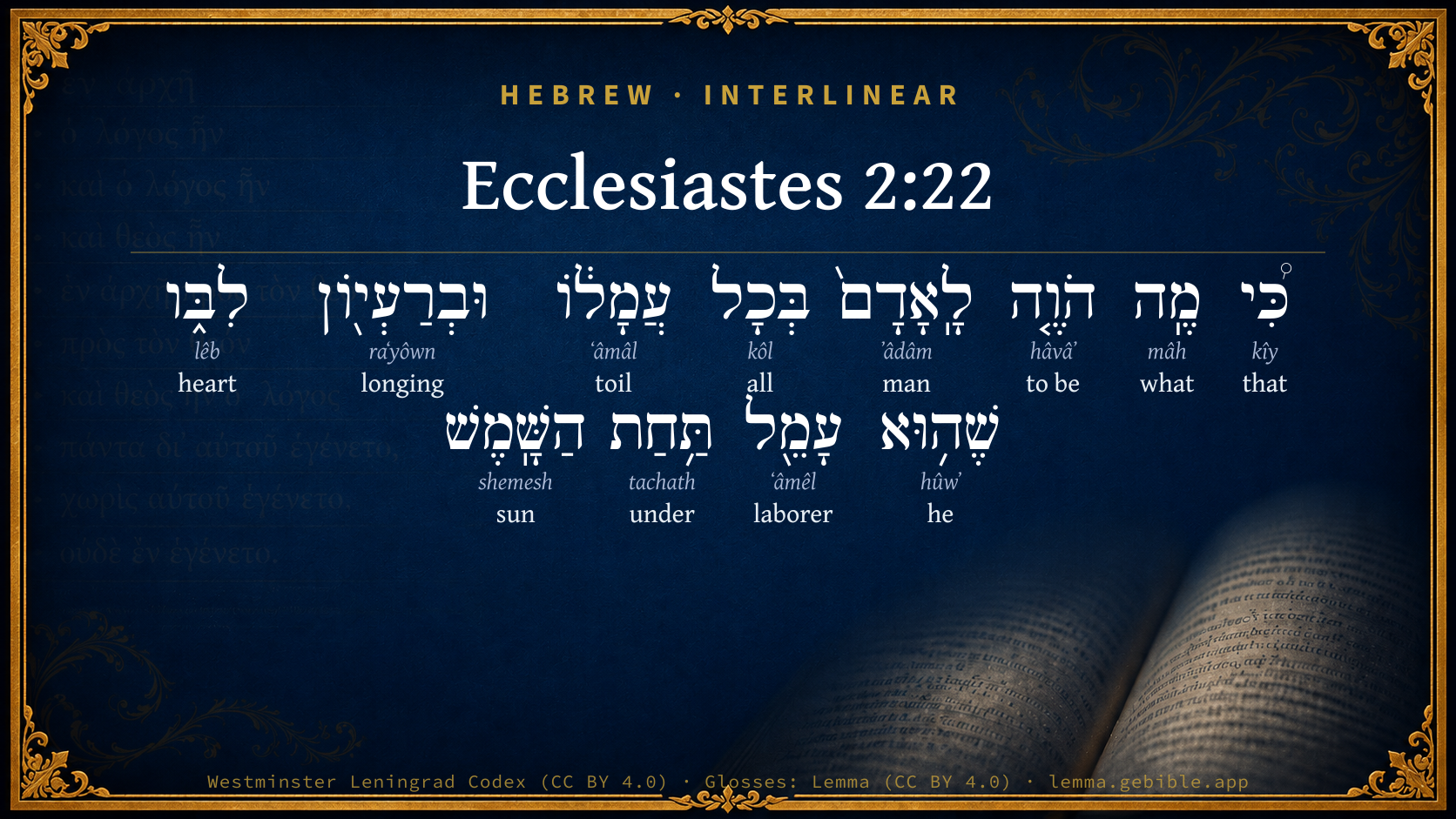
Hebrew (Westminster Leningrad Codex) Ecclesiastes 2:22 appears in the Hebrew Old Testament. The text above is from the Westminster Leningrad Codex. Each word links to its Strong’s number, a concise gloss, and parsing drawn from the Open Scriptures Hebrew Bible morphology. Click any word for its full Brown-Driver-Briggs (BDB) entry.
Download image
Cite this verse

Ecclesiastes 2:22 (World English Bible). Public Domain. Lemma interlinear Bible study tool, https://lemma.gebible.app/v/ecclesiastes/2/22.

Show BibTeX & RIS
BibTeX
RIS
English Translation
For what has a man of all his labor, and of the striving of his heart, in which he labors under the sun?
World English Bible · Public Domain
Download a study sheet

One document with this verse’s original text, its word-by-word gloss line, the meaning frame, cross-references with their text, attributed commentary, and full source and license credits — printable, and it pastes into notes with its structure intact.

This verse Autodidact and up

Study sheet (.html) Plain text (.txt)

A passage Seminary Student

Up to 50 verses in one chapter. A passage sheet keeps up to 6 commentary sources and 12 cross-references per verse, in the order this page ranks them, and says so on the sheet whenever that leaves anything out. Ask for a single verse and you get the Autodidact verse sheet above.

Everything on this page stays free to read, with no account — the sheet is a download of what is already on screen, not access to it.

Want to remove ads? Support Godless Engineer
Compare translations 3

The same verse in 3 English versions, stacked beneath the original-language interlinear above. Click any original word for its lexicon entry.

Each is an independent rendering of the whole verse — the interlinear is not word-aligned to these translations.

Highlighted words mark where these versions differ — a whole-verse word diff, not a word-by-word alignment.

  • World English Bible Public Domain
    For what has a man of all his labor, and of the striving of his heart, in which he labors under the sun?
  • King James Version Public Domain
    For what hath man of all his labour, and of the vexation of his heart, wherein he hath laboured under the sun?
  • unfoldingWord Literal Text CC BY-SA 4.0
    For what endures for the person in exchange for all his toil and in the striving of his heart which he a toiler under the sun?

unfoldingWord Literal Text — © unfoldingWord, licensed CC BY-SA 4.0. Word-aligned USFM3 via Door43 (git.door43.org/unfoldingWord/en_ult).

Versions to compare (up to 4)

3 of 4 selected

Show all 18 translations

Every available English version of this verse, each an independent rendering of the whole verse.

  • World English Bible Public Domain
    For what has a man of all his labor, and of the striving of his heart, in which he labors under the sun?
  • Berean Standard Bible Public Domain
    For what does a man get for all the toil and striving with which he labors under the sun?
  • Majority Standard Bible Public Domain
    For what does a man get for all the toil and striving with which he labors under the sun?
  • King James Version Public Domain
    For what hath man of all his labour, and of the vexation of his heart, wherein he hath laboured under the sun?
  • American Standard Version (1901) Public Domain
    For what hath a man of all his labor, and of the striving of his heart, wherein he laboreth under the sun?
  • Revised Version (1885) Public Domain
    For what hath a man of all his labour, and of the striving of his heart, wherein he laboureth under the sun?
  • Geneva Bible (1599) Public Domain
    For what hath man of all his trauaile and griefe of his heart, wherein he hath trauailed vnder the sunne?
  • Douay-Rheims (1899) Public Domain
    For what profit shall a man have of all his labour, and vexation of spirit, with which he bath been tormented under the sun?
  • Young's Literal Translation Public Domain
    For what hath been to a man by all his labour, and by the thought of his heart that he laboured at under the sun?
  • Literal Standard Version CC BY-SA 4.0
    For what has been to a man by all his labor, and by the thought of his heart that he labored at under the sun?
  • Unlocked Literal Bible CC BY-SA 4.0
    For what profit does the person gain who works so hard and tries in his heart to complete his labors under the sun?
  • unfoldingWord Literal Text CC BY-SA 4.0
    For what endures for the person in exchange for all his toil and in the striving of his heart which he a toiler under the sun?
  • Darby Bible Public Domain
    For what will man have of all his labour and of the striving of his heart, wherewith he hath wearied himself under the sun?
  • World Messianic Bible Public Domain
    For what does a man have of all his labor and of the striving of his heart, in which he labors under the sun?
  • Webster's Bible Public Domain
    For what hath man of all his labor, and of the vexation of his heart, in which he hath labored under the sun?
  • Free Bible Version CC BY-SA 4.0
    What do you get here on earth for all your hard work and worry?
  • Bible in Basic English Public Domain
    What does a man get for all his work, and for the weight of care with which he has done his work under the sun?
  • JPS Tanakh (1917) Public Domain
    For what hath a man of all his labour, and of the striving of his heart, wherein he laboureth under the sun?

Literal Standard Version (2020), Covenant Press — licensed CC BY-SA 4.0. Text via the HelloAO Bible API (eBible.org). Unlocked Literal Bible (unfoldingWord) — licensed CC BY-SA 4.0. Text via the HelloAO Bible API (eBible.org). unfoldingWord Literal Text — © unfoldingWord, licensed CC BY-SA 4.0. Word-aligned USFM3 via Door43 (git.door43.org/unfoldingWord/en_ult). Free Bible Version, Dr. Jonathan Gallagher — licensed CC BY-SA 4.0. Text via the HelloAO Bible API (eBible.org).

Word by word

More ways to search: Search by grammar → Find every occurrence → Compare this word →

Practice this passage: Drill this verse → Learn its vocabulary →

וּבְרַעְי֖וֹן
raʻyôwn
H7475
“and · in/at · longing of”
Conjunction + Preposition + Noun, Common, Masculine, Singular, Construct
Part of Speech
Conjunction + Preposition + Noun
Type
Common
Gender
Masculine
Number
Singular
State
Construct
Full BDB Definition

Origin: from H7462 in the sense of H7469

TWOT: 2187c

longing, striving
  1. כִּ֠י kîy H3588 “that” Conjunction
  2. מֶֽה mâh H4100 “what” Particle, Interrogative
  3. הֹוֶ֤ה hâvâʼ H1933 “being” Verb, Qal, Participle Active, Masculine, Singular, Absolute
  4. לָֽאָדָם֙ ʼâdâm H120 “to/for the · man” Preposition, Determined + Noun, Common, Masculine, Singular, Absolute
  5. בְּכָל kôl H3605 “in/at · all of” Preposition + Noun, Common, Masculine, Singular, Construct
  6. עֲמָל֔וֹ ʻâmâl H5999 “toil · his” Noun, Common, Both, Singular, Construct + Suffix, Personal, 3rd Person, Masculine, Singular
  7. לִבּ֑ו lêb H3820 “heart · his” Noun, Common, Masculine, Singular, Construct + Suffix, Personal, 3rd Person, Masculine, Singular
  8. שֶׁה֥וּא hûwʼ H1931 “who/which · he” Particle, Relative + Pronoun, Personal, 3rd Person, Masculine, Singular
  9. עָמֵ֖ל ʻâmêl H6001 “laborer” Adjective, Adjective, Masculine, Singular, Absolute
  10. תַּ֥חַת tachath H8478 “under” Preposition
  11. הַשָּֽׁמֶשׁ shemesh H8121 “the · sun” Particle, Definite Article + Noun, Common, Both, Singular, Absolute

About this verse

These counts appear in no published source. They are computed here, from the morphology-tagged text and Lemma’s own curated glosses. What Lemma adds →

12
words
12
distinct lemmas
Wisdom
section

Notable vocabulary

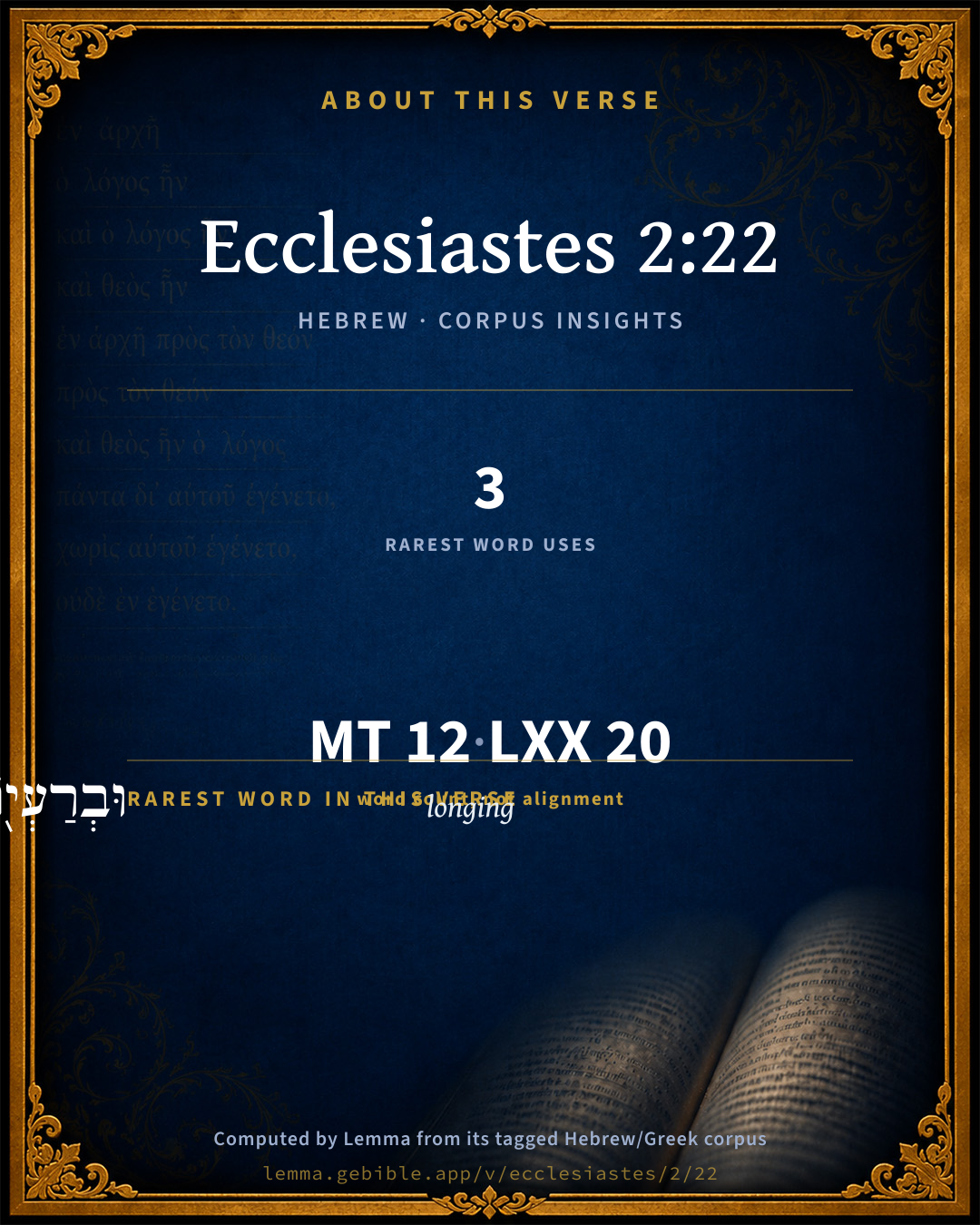
The rarest word here is וּבְרַעְי֖וֹן longing H7475 — appearing just 3 times in the whole Hebrew Bible.

Shared distinctive vocabulary

וּבְרַעְי֖וֹן longing H7475 occurs in 3 verses of the Hebrew Bible. Also found in:

Grammatical profile

  • 1 verb
  • 6 nouns
  • 1 adjective
  • 1 pronoun
  • 1 preposition
  • 1 conjunction
  • 1 particle

Verb forms

  • הֹוֶ֤ה Qal · Participle Active

Hebrew & Septuagint length

In English translation the verse runs 23 words from the Hebrew and 23 from the Septuagint (LXX English) — the same length.

A rough comparison of the two English renderings, which tokenize alike — not a word-level alignment.

Word counts can differ between the Hebrew and the Greek without any difference in meaning — e.g. the Hebrew direct-object marker אֵת has no separate Greek word, and Greek often adds the article ὁ.

In the original languages it is 12 Hebrew tokens and 20 Greek tokens — but the two are counted differently (Hebrew bundles its prefixes and suffixes into one token; the Greek is in lemma form), so that isn’t a like-for-like length.

Cross-references

19

Topical passages linked to Ecclesiastes 2:22 in the Treasury of Scripture Knowledge — connected by theme and wording, ordered by reader-vote popularity; previews shown in the World English Bible.

  • Psalms 127:2 It is vain for you to rise up early, To stay up late, Eating the bread of toil; For he gives sleep to his loved ones.
  • Ecclesiastes 1:3 What does man gain from all his labor in which he labors under the sun?
  • Ecclesiastes 3:9 What profit has he who works in that in which he labors?
  • Ecclesiastes 4:6 Better is a handful, with quietness, than two handfuls with labor and chasing after wind.
  • Matthew 6:34 Therefore don't be anxious for tomorrow, for tomorrow will be anxious for itself. Each day's own evil is sufficient.
  • Philippians 4:6 In nothing be anxious, but in everything, by prayer and petition with thanksgiving, let your requests be made known to God.
  • 1 Timothy 6:8 But having food and clothing, we will be content with that.
  • 1 Peter 5:7 casting all your worries on him, because he cares for you.
  • Ecclesiastes 4:8 There is one who is alone, and he has neither son nor brother. There is no end to all of his labor, neither are his eyes satisfied with wealth. For whom then, do I labor, and deprive my soul of enjoyment? This also is vanity, yes, it is a miserable business.
  • Ecclesiastes 5:10–11 He who loves silver shall not be satisfied with silver; nor he who loves abundance, with increase: this also is vanity.
  • Ecclesiastes 5:17 All his days he also eats in darkness, he is frustrated, and has sickness and wrath.
  • Ecclesiastes 6:7–8 All the labor of man is for his mouth, and yet the appetite is not filled.
  • Ecclesiastes 8:15 Then I commended mirth, because a man has no better thing under the sun, than to eat, and to drink, and to be joyful: for that will accompany him in his labor all the days of his life which God has given him under the sun.
  • Matthew 6:11 Give us today our daily bread.
  • Matthew 16:26 For what will it profit a man, if he gains the whole world, and forfeits his life? Or what will a man give in exchange for his life?
  • Proverbs 16:26 The appetite of the laboring man labors for him; For his mouth urges him on.
  • Matthew 6:25 Therefore, I tell you, don't be anxious for your life: what you will eat, or what you will drink; nor yet for your body, what you will wear. Isn't life more than food, and the body more than clothing?
  • Luke 12:22 He said to his disciples, "Therefore I tell you, don't be anxious for your life, what you will eat, nor yet for your body, what you will wear.
  • Luke 12:29 Don't seek what you will eat or what you will drink; neither be anxious.

Cross-references courtesy of OpenBible.info (CC BY 4.0).

Hebrew and Greek witnesses Masoretic Hebrew ↔ Greek Septuagint

The same verse in the two great witnesses to the Old Testament, shown verse-for-verse.

These are two independent witnesses, not word-aligned to each other, and the Septuagint is shown in lemma (dictionary) form.

Hebrew Ecclesiastes 2:22 Masoretic · Westminster Leningrad Codex

כִּ֠י מֶֽה הֹוֶ֤ה לָֽאָדָם֙ בְּכָל עֲמָל֔וֹ וּבְרַעְי֖וֹן לִבּ֑ו שֶׁה֥וּא עָמֵ֖ל תַּ֥חַת הַשָּֽׁמֶשׁ

For what has a man of all his labor, and of the striving of his heart, in which he labors under the sun?

World English Bible · Public Domain

Greek LXX Ecclesiastes 2:22 Septuagint · lemma form

ὅτι τίς γίγνομαι ὁ ἄνθρωπος ἐν πᾶς μόχθος αὐτός καί ἐν προαίρεσις καρδία αὐτός ὅς αὐτός μοχθέω ὑπό ὁ ἥλιος

For it happens to a man in all his labor, and in the purpose of his heart wherein he labors under the sun.

LXX2012 (modern English Septuagint) · Public Domain

On this verse, The Pulpit Commentary discusses the Septuagint’s reading. Read the note in Commentary ↓

Hebrew: Westminster Leningrad Codex (CC BY 4.0). Greek: Septuagint (public domain); English from LXX2012 (modern English Septuagint) (Public Domain). How the Septuagint differs from the Hebrew →

Commentary

Notes on Ecclesiastes 2:22 from classic Christian and Jewish commentators (each source and its license shown beneath its notes). The classic Christian expositions comment on the surrounding passage and are grouped to its opening verse, so a note may address several verses; the Jewish commentaries on the Tanakh (Rashi and others) are per-verse, so they appear only where the commentator wrote on this verse.

Lemma curates 59 commentaries, every one of them public domain or Creative Commons licensed, each selected and text-cleaned for this edition rather than reprinted as found. About our sources →

Trapp's Complete Commentary

John Trapp

Ecc 2:22 For what hath man of all his labour, and of the vexation of his heart, wherein he hath laboured under the sun?

Ver. 22. For what hath a man of all his labour.] What makes he of it, everything reckoned? See Ecc 1:3. What takes he with him when he dies, more than a poor winding sheet? As that great Emperor of Egypt caused to be proclaimed at his funeral, that that shirt of his, there hanged up for the purpose, was all that he now had of all his labour and great achievements. Saladin the mighty monarch of the East is gone, and hath taken no more with him than what you see, said the bare priest that went before the bier. {a} {See Trapp on "1Ti 6:7"}

{a} Carion. Chron.

John Trapp, A Commentary or Exposition upon All the Books of the Old and New Testament (1647–1656) — public domain. Text from a community e-Sword module.

Joseph Benson's Commentary

Ecc 2:22-23. For what hath man — “To what purpose,” a man may well say, “is all this toil of my body, and these solicitous thoughts, and this anguish of my mind? For all that a man can enjoy himself of the anxious labours wherein he spends his days, amounts to little or nothing; and what comfort hath he in thinking who shall enjoy the fruit of them hereafter?” For all his days are sorrows, &c. — “And yet, such is our folly, there is no end of our cares; for we see many a man, whose life is nothing but a mere drudgery; who never is at leisure to enjoy any thing that he hath, but still engaged in one troublesome employment or other to get more; which he follows so eagerly, as if it were his business to disquiet and vex himself, and make his life uneasy to him! being not content with his daily toils, unless he rack his mind also with cares in the night! This is so void of all reason that nothing can be imagined more vain and foolish.” — Bishop Patrick.

Joseph Benson's Commentary on the Old and New Testaments (1811–1818) — public domain. Text from a community e-Sword module.

Jamieson, Fausset & Brown

Robert Jamieson, A. R. Fausset & David Brown

Same sentiment as in Ecc 2:21, interrogatively.

Jamieson, Fausset & Brown — Commentary Critical and Explanatory on the Whole Bible (1871) — public domain (CC PDM 1.0). Text via the HelloAO Bible API.

Adam Clarke's Commentary

Verse 22. For what hath man of all his laborer] Labour of body, disappointment of hope, and vexation of heart, have been all my portion.

Adam Clarke's Commentary on the Bible (1810–1826) — public domain. Text from a community e-Sword/MySword module.

The Cambridge Bible for Schools and Colleges

gen. ed. J. J. S. Perowne

22. the vexation of his heart] The word differs from that for which “feeding on wind” has been suggested, but is akin to it, and has been, as in Ecc_1:17, rendered by meditation. Here, perhaps, “corroding care” would best convey its meaning.

The Cambridge Bible for Schools and Colleges (gen. ed. J. J. S. Perowne; Cambridge University Press, 1878–1918) — public domain. Text from a community e-Sword module.

John Gill's Exposition

For what hath man of all his labour, and of the vexation of his heart?.... What profit has he by it, when there is so much vexation in it, both in getting it, and in the thought of leaving it to others? What advantage is it to him, when it is all acquired for and possessed by another; and especially of what use is it to him after his death? Even of all

wherein he hath laboured under the sun? the Targum adds, "in this world"; though he has been labouring all his days, yet there is not one thing he has got by his labour that is of any real advantage to him, or can yield him any solid comfort and satisfaction, or bring him true happiness, or lead him to it.

John Gill's Exposition of the Whole Bible (1746–1763) — public domain (CC PDM 1.0). Text via the HelloAO Bible API.

Matthew Poole's English Annotations

What comfort or benefit remains to any man after this short and frail life is once ended? or, what advantage hath he by all his labours above him who never laboured, and yet enjoyeth all the fruits of his labours?

Matthew Poole's English Annotations on the Holy Bible (1683–1685) — public domain. Text from a community e-Sword/MySword module.

Whedon's Commentary on the Bible

Daniel D. Whedon

22. What hath man — That is, man has nothing — nothing solid and abiding — when the accumulations of a working life pass from his name and lineage.

Daniel D. Whedon (gen. ed.), Commentary on the Old and New Testaments (1874–1909) — public domain. Text from a community e-Sword module.

The Pulpit Commentary

What hath man of all his labor? i.e. what is to be the result to man? Ginetai ejn tw ajnqrwpw; (Septuagint); Quidenim proderit homini? (Vulgate). There is, indeed, the pleasure that accompanies the pursuit of objects, and the successful accomplishment of enterprise; but this is poor and unsubstantial and embittered. And of the vexation of his heart; the striving, the effort of his mind to direct his labor to great ends. What does all this produce? The answer intended is," Nothing." This striving, with all its wisdom and knowledge and skill (ver. 21), is for the laborer fruitless.

The Pulpit Commentary (1880–1919), ed. H.D.M. Spence-Jones & Joseph S. Exell — public domain. Text from a community e-Sword module.

John Wesley's Explanatory Notes

For what - What comfort or benefit remains to any man after this short and frail life is once ended?

John Wesley, Explanatory Notes Upon the Whole Bible (1754–1765) — public domain. Text via the GEBible commentary corpus.

Keil & Delitzsch

C. F. Keil & F. Delitzsch

"For what has man of all his labour, and the endeavours of his heart with which he wearies himself under the sun? All his days are certainly in sorrows, and his activity in grief; his heart resteth not even in the night: also this is vain." The question literally is: What is (comes forth, results) to a man from all his labour; for "to become, to be, to fall to, happen to," is the fundamental idea of הוה (whence here הוה, γινόμενον, as at Neh 6:6, γενεεσόμενος) or היה, the root signification of which is deorsum ferri, cadere, and then accidere, fieri, whence הוּה, eagerness precipitating itself upon anything (vid., under Pro 10:3), or object.: fall, catastrophe, destruction. Instead of שׁהוּא, there is here to be written שׁהוּא,

(Note: Thus according to tradition, in H, J, P, vid., Michlol 47b, 215b, 216a; vid., also Norzi.)

as at Ecc 3:18 שׁהם. The question looks forward to a negative answer. What comes out of his labour for man? Nothing comes of it, nothing but disagreeableness. This negative contained in the question is established by כּי, 23a. The form of the clause, "all his days are sorrows," viz., as to their condition, follows the scheme, "the porch was 20 cubits," Ch2 3:4, viz., in measurement; or, "their feast is music and wine," Isa 5:12, viz., in its combination (vid., Philippi's Stat. Const. p. 90ff.). The parallel clause is וכעם ענינו, not כו; for the final syllable, or that having the accent on the penult, immediately preceding the Athnach-word, takes Kametz, as e.g., Lev 18:5; Pro 25:3; Isa 65:17 (cf. Olsh. 224, p. 440).

(Note: But cf. also ולא with Zakeph Katan, Kg2 5:17; ואר וגו with Tiphcha, Isa 26:19; and וריב under Psa 45:10.)

Many interpreters falsely explain: at aegritudo est velut quotidiana occupatio ejus. For the sake of the parallelism, ענינו (from ענה, to weary oneself with labour, or also to strive, aim; vid., Psalmen, ii. 390) is subj. not pred.: his endeavour is grief, i.e., brings only grief or vexation with it.

Even in the night he has no rest; for even then, though he is not labouring, yet he is inwardly engaged about his labour and his plans. And this possession, acquired with such labour and restlessness, he must leave to others; for equally with the fool he fails under the stroke of death: he himself has no enjoyment, others have it; dying, he must leave all behind him, - threefold הבל, Ecc 2:17, Ecc 2:21, Ecc 2:23, and thus הבלים הבל.

Keil & Delitzsch — Biblical Commentary on the Old Testament (1861–1891) — public domain (CC PDM 1.0). Text via the HelloAO Bible API. (Old Testament only.)

Rashi

Rabbi Shlomo Yitzchaki (Rashi)

For what has, etc. For what profit has a man in all his toil and the breaking of his heart with toil and worry, which he toils, and leaves for others.

Rashi on the Tanakh — English translations: “The Judaica Press complete Tanach with Rashi, translated by A. J. Rosenberg” (CC BY 4.0); “Pentateuch with Rashi's commentary by M. Rosenbaum and A.M. Silbermann, 1929-1934” (public domain); “The Metsudah Tanach series, Lakewood, N.J” (CC BY 4.0); and “The Book of Joshua, Metsudah Publications, 1997” (CC BY 4.0). Text via Sefaria.

Lesson kit

Teaching starters — assembled from the data on this page, not authored interpretation. Every prompt links to the verse data it draws on. Edit before teaching.

Ecclesiastes, in the Wisdom, opens this verse with 12 words (12 distinct Hebrew lemmas). Its most distinctive word is raʻyôwn (“longing”). A historical commentator’s framing appears above. Read the whole chapter for the surrounding context.

Discussion questions

  1. What does “longing” (raʻyôwn) contribute to the verse as a whole?
  2. Ecclesiastes 1:17 shares the word «longing» with this verse. How do the two illuminate each other?
  3. The translations on this page render this verse differently — a whole-verse word diff, not a word-by-word alignment. What might account for the different wordings?
  4. The verb «הֹוֶ֤ה» is Qal Participle Active. How does its form color the action?
  5. Reading how Trapp's Complete Commentary and Joseph Benson's Commentary read this verse, where do the two commentators agree and where do they part?

Things to notice

Reading settings

Reading text

Shown beneath each verse's original-language words.

Old Testament
Old Testament edition

Read the OT as the Masoretic Hebrew (MT) or the Greek Septuagint (LXX).

English shown for the Greek Septuagint (in the Hebrew ↔ Greek comparison).

Comparing translations? Open the Compare panel on any verse page to stack up to four side by side.