
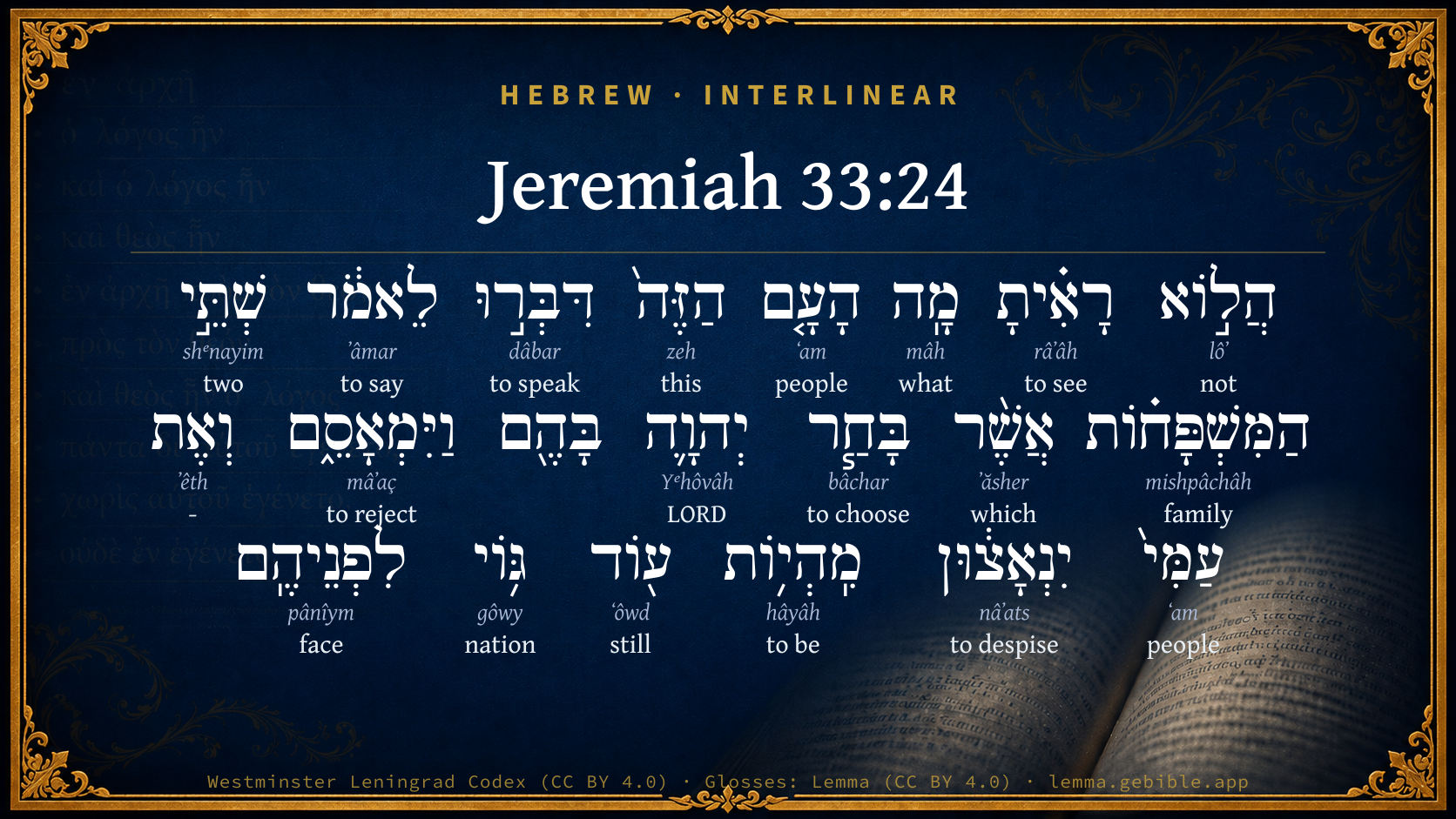
Jeremiah 33:24

Hebrew (Westminster Leningrad Codex) Jeremiah 33:24 appears in the Hebrew Old Testament. The text above is from the Westminster Leningrad Codex. Each word links to its Strong’s number, a concise gloss, and parsing drawn from the Open Scriptures Hebrew Bible morphology. Click any word for its full Brown-Driver-Briggs (BDB) entry.
Download image
Cite this verse

Jeremiah 33:24 (World English Bible). Public Domain. Lemma interlinear Bible study tool, https://lemma.gebible.app/v/jeremiah/33/24.

Show BibTeX & RIS
BibTeX
RIS
English Translation
Don't you consider what this people has spoken, saying, The two families which Yahweh did choose, he has cast them off? thus do they despise my people, that they should be no more a nation before them.
World English Bible · Public Domain
Download a study sheet

One document with this verse’s original text, its word-by-word gloss line, the meaning frame, cross-references with their text, attributed commentary, and full source and license credits — printable, and it pastes into notes with its structure intact.

This verse Autodidact and up

Study sheet (.html) Plain text (.txt)

A passage Seminary Student

Up to 50 verses in one chapter. A passage sheet keeps up to 6 commentary sources and 12 cross-references per verse, in the order this page ranks them, and says so on the sheet whenever that leaves anything out. Ask for a single verse and you get the Autodidact verse sheet above.

Everything on this page stays free to read, with no account — the sheet is a download of what is already on screen, not access to it.

Want to remove ads? Support Godless Engineer
Compare translations 3

The same verse in 3 English versions, stacked beneath the original-language interlinear above. Click any original word for its lexicon entry.

Each is an independent rendering of the whole verse — the interlinear is not word-aligned to these translations.

Highlighted words mark where these versions differ — a whole-verse word diff, not a word-by-word alignment.

  • World English Bible Public Domain
    Don't you consider what this people has spoken, saying, The two families which Yahweh did choose, he has cast them off? thus do they despise my people, that they should be no more a nation before them.
  • King James Version Public Domain
    Considerest thou not what this people have spoken, saying, The two families which the LORD hath chosen, he hath even cast them off? thus they have despised my people, that they should be no more a nation before them.
  • unfoldingWord Literal Text CC BY-SA 4.0
    “Have you not considered what this people has declared when they said, ‘The two families that Yahweh chose, now he has rejected them’? In this way they despise my people, saying that they are no longer a nation in their sight.

unfoldingWord Literal Text — © unfoldingWord, licensed CC BY-SA 4.0. Word-aligned USFM3 via Door43 (git.door43.org/unfoldingWord/en_ult).

Versions to compare (up to 4)

3 of 4 selected

Show all 18 translations

Every available English version of this verse, each an independent rendering of the whole verse.

  • World English Bible Public Domain
    Don't you consider what this people has spoken, saying, The two families which Yahweh did choose, he has cast them off? thus do they despise my people, that they should be no more a nation before them.
  • Berean Standard Bible Public Domain
    “Have you not noticed what these people are saying: ‘The LORD has rejected the two families He had chosen’? So they despise My people and no longer regard them as a nation.
  • Majority Standard Bible Public Domain
    “Have you not noticed what these people are saying: ‘The LORD has rejected the two families He had chosen’? So they despise My people and no longer regard them as a nation.
  • King James Version Public Domain
    Considerest thou not what this people have spoken, saying, The two families which the LORD hath chosen, he hath even cast them off? thus they have despised my people, that they should be no more a nation before them.
  • American Standard Version (1901) Public Domain
    Considerest thou not what this people have spoken, saying, The two families which Jehovah did choose, he hath cast them off? thus do they despise my people, that they should be no more a nation before them.
  • Revised Version (1885) Public Domain
    Considerest thou not what this people have spoken, saying, The two families which the LORD did choose, he hath cast them off? thus do they despise my people, that they should be no more a nation before them.
  • Geneva Bible (1599) Public Domain
    Considerest thou not what this people haue spoken, saying, The two families, which the Lord hath chosen, hee hath euen cast them off? thus they haue despised my people, that they should be no more a nation before them.
  • Douay-Rheims (1899) Public Domain
    Hast thou not seen what this people hath spoken, saying: The two families which the Lord had chosen, are cast off: and they have despised my people, so that it is no more a nation before them?
  • Young's Literal Translation Public Domain
    `Hast thou not considered what this people have spoken, saying: The two families on which Jehovah fixed, He doth reject them, And my people they despise -- So that they are no more a people before them!
  • Literal Standard Version CC BY-SA 4.0
    “Have you not considered what this people have spoken, saying, || The two families on which YHWH fixed, || He rejects them? And they despise My people, so that they are no longer a people before them!”
  • Unlocked Literal Bible CC BY-SA 4.0
    “Have you not considered what this people has declared when they said, 'The two families that Yahweh chose, now he has rejected them'? In this way they despise my people, saying that they are no longer a nation in their sight.
  • unfoldingWord Literal Text CC BY-SA 4.0
    “Have you not considered what this people has declared when they said, ‘The two families that Yahweh chose, now he has rejected them’? In this way they despise my people, saying that they are no longer a nation in their sight.
  • Darby Bible Public Domain
    Hast thou not seen what this people have spoken, saying, The two families that Jehovah had chosen, he hath even cast them off? And they despise my people, that they should be no more a nation before them.
  • World Messianic Bible Public Domain
    “Don’t consider what this people has spoken, saying, ‘Has the LORD cast off the two families which he chose?’ Thus they despise my people, that they should be no more a nation before them.”
  • Webster's Bible Public Domain
    Considerest thou not what this people have spoken, saying, The two families which the LORD hath chosen, he hath even cast them off? thus they have despised my people, that they should be no more a nation before them.
  • Free Bible Version CC BY-SA 4.0
    Have you heard what people are saying: “The Lord chose two families, but now he's rejected them”? So they look down on my people and don't consider them worthy of being called a nation.
  • Bible in Basic English Public Domain
    Have you taken note of what these people have said, The two families, which the Lord took for himself, he has given up? This they say, looking down on my people as being, in their eyes, no longer a nation.
  • JPS Tanakh (1917) Public Domain
    'Considerest thou not what this people have spoken, saying: The two families which the LORD did choose, He hath cast them off? and they contemn My people, that they should be no more a nation before them.

Literal Standard Version (2020), Covenant Press — licensed CC BY-SA 4.0. Text via the HelloAO Bible API (eBible.org). Unlocked Literal Bible (unfoldingWord) — licensed CC BY-SA 4.0. Text via the HelloAO Bible API (eBible.org). unfoldingWord Literal Text — © unfoldingWord, licensed CC BY-SA 4.0. Word-aligned USFM3 via Door43 (git.door43.org/unfoldingWord/en_ult). Free Bible Version, Dr. Jonathan Gallagher — licensed CC BY-SA 4.0. Text via the HelloAO Bible API (eBible.org).

Word by word

More ways to search: Search by grammar → Find every occurrence → Compare this word →

Practice this passage: Drill this verse → Learn its vocabulary →

יִנְאָצ֔וּן
nâʼats
H5006
“to despise”
Verb, Qal, Imperfect, 3rd Person, Masculine, Plural + Suffix, n
Part of Speech
Verb
Stem
Qal
Form
Imperfect
Person
3rd Person
Gender
Masculine
Number
Plural
Full BDB Definition

Origin: a primitive root

TWOT: 1274

to spurn, contemn, despise, abhor - (Qal) to spurn, contemn - (Piel) - to spurn - to cause to contemn - (Hiphil) to spurn - (Hithpolel) to be contemned
  1. הֲל֣וֹא lôʼ H3808 “not” Particle, Interrogative + Particle, Negative
  2. רָאִ֗יתָ râʼâh H7200 “to see” Verb, Qal, Perfect, 2nd Person, Masculine, Singular
  3. מָֽה mâh H4100 “what” Particle, Interrogative
  4. הָעָ֤ם ʻam H5971 “the · people” Particle, Definite Article + Noun, Common, Masculine, Singular, Absolute
  5. הַזֶּה֙ zeh H2088 “the · this” Particle, Definite Article + Pronoun, Demonstrative, Masculine, Singular
  6. דִּבְּר֣וּ dâbar H1696 “to speak” Verb, Piel, Perfect, 3rd Person, Common, Plural
  7. לֵאמֹ֔ר ʼâmar H559 “to say” Preposition + Verb, Qal, Infinitive Construct
  8. שְׁתֵּ֣י shᵉnayim H8147 “two” Adjective, Cardinal number, Feminine, Dual, Construct
  9. הַמִּשְׁפָּח֗וֹת mishpâchâh H4940 “the · families” Particle, Definite Article + Noun, Common, Feminine, Plural, Absolute
  10. אֲשֶׁ֨ר ʼăsher H834 “which” Particle, Relative
  11. בָּחַ֧ר bâchar H977 “to choose” Verb, Qal, Perfect, 3rd Person, Masculine, Singular
  12. יְהוָ֛ה Yᵉhôvâh H3068 “LORD” Noun, Proper
  13. וַיִּמְאָסֵ֑ם mâʼaç H3988 “and · to reject · them” Conjunction + Verb, Qal, Sequential Imperfect, 3rd Person, Masculine, Singular + Suffix, Personal, 3rd Person, Masculine, Plural
  14. וְאֶת ʼêth H853 “and · -” Conjunction + Particle, Direct Object
  15. עַמִּי֙ ʻam H5971 “people · my” Noun, Common, Masculine, Singular, Construct + Suffix, Personal, 1st Person, Common, Singular
  16. מִֽהְי֥וֹת hâyâh H1961 “from · to be” Preposition + Verb, Qal, Infinitive Construct
  17. ע֖וֹד ʻôwd H5750 “still” Adverb
  18. גּ֥וֹי gôwy H1471 “nation” Noun, Common, Masculine, Singular, Absolute
  19. לִפְנֵיהֶֽם pânîym H6440 “to/for · face(s) · their” Preposition + Noun, Common, Both, Plural, Construct + Suffix, Personal, 3rd Person, Masculine, Plural

About this verse

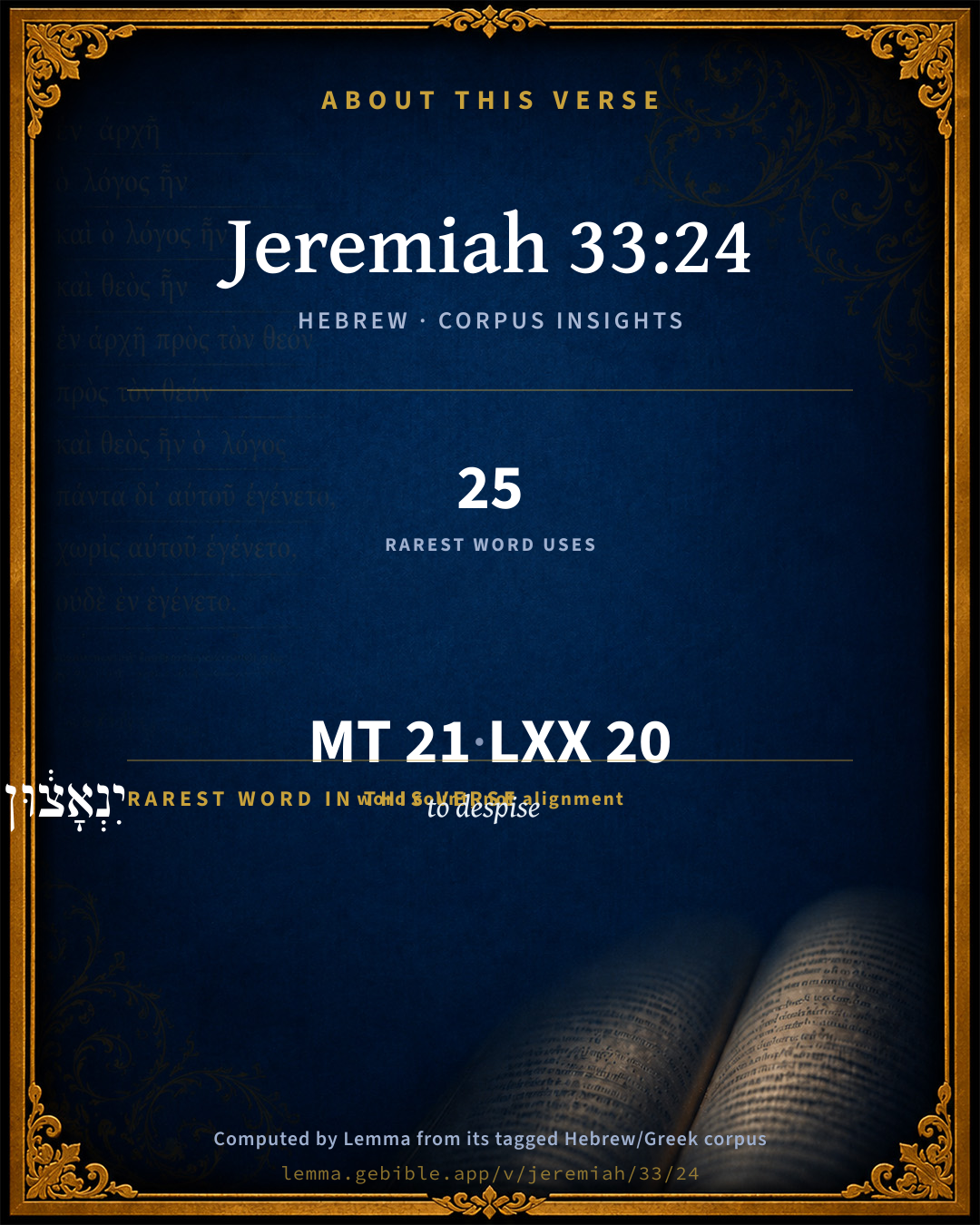
These counts appear in no published source. They are computed here, from the morphology-tagged text and Lemma’s own curated glosses. What Lemma adds →

21
words
19
distinct lemmas
Prophets
section

Notable vocabulary

The rarest word here is יִנְאָצ֔וּן to despise H5006 — appearing just 25 times in the whole Hebrew Bible.

Shared distinctive vocabulary

יִנְאָצ֔וּן to despise H5006 occurs in 24 verses of the Hebrew Bible. Also found in:

Grammatical profile

  • 7 verbs
  • 6 nouns
  • 1 adjective
  • 1 pronoun
  • 1 preposition
  • 1 adverb
  • 4 particles

Verb forms

  • רָאִ֗יתָ Qal · Perfect
  • דִּבְּר֣וּ Piel · Perfect
  • לֵאמֹ֔ר Qal · Infinitive Construct
  • בָּחַ֧ר Qal · Perfect
  • וַיִּמְאָסֵ֑ם Qal · Sequential Imperfect
  • יִנְאָצ֔וּן Qal · Imperfect
  • מִֽהְי֥וֹת Qal · Infinitive Construct

Repetition

A word recurs within this verse — often emphatic in Hebrew:

  • הָעָ֤ם people H5971 ×2

Hebrew & Septuagint length

In the original languages it is 21 Hebrew tokens and 20 Greek tokens — but the two are counted differently (Hebrew bundles its prefixes and suffixes into one token; the Greek is in lemma form), so that isn’t a like-for-like length.

Cross-references

17

Topical passages linked to Jeremiah 33:24 in the Treasury of Scripture Knowledge — connected by theme and wording, ordered by reader-vote popularity; previews shown in the World English Bible.

  • Nehemiah 4:2–4 He spoke before his brothers and the army of Samaria, and said, What are these feeble Jews doing? will they fortify themselves? will they sacrifice? will they make an end in a day? will they revive the stones out of the heaps of rubbish, seeing they are burned?
  • Psalms 44:13–14 You make us a reproach to our neighbors, A scoffing and a derision to those who are around us.
  • Psalms 83:4 "Come," they say, "and let's destroy them as a nation, That the name of Israel may be remembered no more."
  • Esther 3:6–8 But he scorned the thought of laying hands on Mordecai alone; for they had made known to him the people of Mordecai: therefore Haman sought to destroy all the Jews who were throughout the whole kingdom of Ahasuerus, even the people of Mordecai.
  • Psalms 71:11 Saying, "God has forsaken him. Pursue and take him, for no one will rescue him."
  • Psalms 94:14 For Yahweh won't reject his people, Neither will he forsake his inheritance.
  • Psalms 123:3–4 Have mercy on us, Yahweh, have mercy on us, For we have endured much contempt.
  • Jeremiah 30:17 For I will restore health to you, and I will heal you of your wounds, says Yahweh; because they have called you an outcast, [saying], It is Zion, whom no man seeks after.
  • Jeremiah 33:21–22 then may also my covenant be broken with David my servant, that he shall not have a son to reign on his throne; and with the Levites the priests, my ministers.
  • Lamentations 2:15–16 All that pass by clap their hands at you; They hiss and wag their head at the daughter of Jerusalem, [saying], Is this the city that men called The perfection of beauty, The joy of the whole earth?
  • Lamentations 4:15 Depart you, they cried to them, Unclean! depart, depart, don't touch! When they fled away and wandered, men said among the nations, They shall no more sojourn [here].
  • Ezekiel 25:3 and tell the children of Ammon, Hear the word of the Lord Yahweh: Thus says the Lord Yahweh, Because you said, Aha, against my sanctuary, when it was profaned; and against the land of Israel, when it was made desolate; and against the house of Judah, when they went into captivity:
  • Ezekiel 26:2 Son of man, because Tyre has said against Jerusalem, Aha, she is broken: the gate of the peoples; she is turned to me; I shall be replenished, now that she is laid waste:
  • Ezekiel 36:2 Thus says the Lord Yahweh: Because the enemy has said against you, Aha! and, The ancient high places are ours in possession;
  • Ezekiel 37:22 and I will make them one nation in the land, on the mountains of Israel; and one king shall be king to them all; and they shall be no more two nations, neither shall they be divided into two kingdoms any more at all;
  • Romans 11:1–6 I ask then, Did God reject his people? May it never be! For I also am an Israelite, a descendant of Abraham, of the tribe of Benjamin.
  • Ezekiel 35:10–15 Because you have said, These two nations and these two countries shall be mine, and we will possess it; whereas Yahweh was there:

Cross-references courtesy of OpenBible.info (CC BY 4.0).

Hebrew and Greek witnesses Masoretic Hebrew ↔ Greek Septuagint

The same verse in the two great witnesses to the Old Testament, shown verse-for-verse.

These are two independent witnesses, not word-aligned to each other, and the Septuagint is shown in lemma (dictionary) form.

Hebrew Jeremiah 33:24 Masoretic · Westminster Leningrad Codex

הֲל֣וֹא רָאִ֗יתָ מָֽה הָעָ֤ם הַזֶּה֙ דִּבְּר֣וּ לֵאמֹ֔ר שְׁתֵּ֣י הַמִּשְׁפָּח֗וֹת אֲשֶׁ֨ר בָּחַ֧ר יְהוָ֛ה בָּהֶ֖ם וַיִּמְאָסֵ֑ם וְאֶת עַמִּי֙ יִנְאָצ֔וּן מִֽהְי֥וֹת ע֖וֹד גּ֥וֹי לִפְנֵיהֶֽם

Don't you consider what this people has spoken, saying, The two families which Yahweh did choose, he has cast them off? thus do they despise my people, that they should be no more a nation before them.

World English Bible · Public Domain

Greek LXX Structure differs

In the Septuagint, Jeremiah is about an eighth shorter than the Hebrew and arranges its material differently — the Oracles Against the Nations (Hebrew chapters 46–51) appear in the middle of the Greek book, after 25:13. Because the chapter and verse boundaries do not line up, a verse-for-verse comparison with the Hebrew is not shown.

A verse-for-verse comparison isn’t shown here because the chapters and verses don’t line up. Switch to the LXX edition with the MT / LXX toggle above to read the Greek directly.

Hebrew: Westminster Leningrad Codex (CC BY 4.0). Greek: Septuagint (public domain); English from a public-domain English Septuagint. How the Septuagint differs from the Hebrew →

Targum (Aramaic paraphrase)

1

The Targum is the ancient Jewish Aramaic paraphrase of the Hebrew Scriptures — an interpretive translation, not the Hebrew text itself. Onkelos (literal) and Pseudo-Jonathan (expansive) render the Torah, and Jonathan the Prophets. Coverage is partial: where no permissively-licensed English translation exists for a verse, only the Aramaic is shown. This is verse-level text, not a word-by-word alignment to the Hebrew.

  1. Targum Jonathan Prophets (Joshua–Malachi)
    הֲלָא חֲזֵיתָא מָא עַמָא הָדֵין מְמַלְלִי לְמֵימָר תַּרְתֵּין זַרְעֲיָתָא דְאִתְרְעֵי יְיָ בְּהוֹן וְרָחִיקִינוּן וְיַת עַמִי מַרְגְזִין מִלְמֶהֱוֵי עוֹד עַם מְשַׁמֵשׁ קֳדָמַי כְּקִבְלֵיהוֹן:

    (no public-domain English translation for this verse)

    Targum Jonathan — Aramaic: “Mikraot Gedolot” (public domain). English: “Sefaria Community Translation” (CC0 1.0 (public-domain dedication)); “London "Chaldee Paraphrase," 1871” (public domain). Text via Sefaria.

Commentary

Notes on Jeremiah 33:24 from classic Christian and Jewish commentators (each source and its license shown beneath its notes). The classic Christian expositions comment on the surrounding passage and are grouped to its opening verse, so a note may address several verses; the Jewish commentaries on the Tanakh (Rashi and others) are per-verse, so they appear only where the commentator wrote on this verse.

Lemma curates 59 commentaries, every one of them public domain or Creative Commons licensed, each selected and text-cleaned for this edition rather than reprinted as found. About our sources →

Trapp's Complete Commentary

John Trapp

Jer 33:24 Considerest thou not what this people have spoken, saying, The two families which the LORD hath chosen, he hath even cast them off? thus they have despised my people, that they should be no more a nation before them.

Ver. 24. Consider thou not what this people have spoken.] This unbelieving, misgiving, desponding people of mine.

The two families.] Iudah et Israel habentur pro properipsemate.

John Trapp, A Commentary or Exposition upon All the Books of the Old and New Testament (1647–1656) — public domain. Text from a community e-Sword module.

Joseph Benson's Commentary

Jer 33:24-26. The two families which the Lord hath chosen — “It is plain from Jer 33:26,” says Blaney,” that the two families here meant are those of Jacob and David, though some have supposed the two kingdoms of Israel and Judah, others the royal and sacerdotal families of David and Levi, to be intended.” He hath even cast them off — The words are spoken by those unbelieving Jews who thought God would never restore them to their former condition, nor give them again a king of the seed of David, thus indirectly accusing him of a breach of promise. Thus they have despised my people, &c. — Thus, saith God, they have spoken in a reproachful and degrading manner of my people, as if they should never be a nation again, having rulers of themselves and a ministry. If my covenant be not with day and night, &c. — If I have not appointed the vicissitudes of day and night, and of summer and winter, upon which the seasons of the year and the fruitfulness of the earth depend; then will I cast away the seed of Jacob — Then will I finally, and for ever, abandon the body of the Jews and Israelites; and David my servant — Namely, the seed of David, all persons lineally descended from him, so that none of them shall ever hereafter reign over Israel and Judah. The sum of these verses is plainly this, that a restoration of them to their own land should as certainly succeed their captivity as the day succeeds the night, or summer follows winter. God had as certainly ordained the one as the other, and, would as certainly have mercy on his people as he would certainly continue the revolutions of the heavenly bodies. And in showing this mercy he would take care that one of the seed of David should be their ruler: which has been, and still more fully shall be, fulfilled in the Messiah, who shall always as certainly govern his church, whether consisting of converted Jews or Gentiles, as there will always be a church on earth to be governed.

Joseph Benson's Commentary on the Old and New Testaments (1811–1818) — public domain. Text from a community e-Sword module.

Geneva Bible (1599)

Geneva Bible translators

Meaning, the Chaldeans and other infidels which thought God had utterly cast off Judah and Israel or Benjamin, because he did correct them for a time for their amendment.

Geneva Bible (1599) marginal notes — public domain. Text via Bolls.life.

Jamieson, Fausset & Brown

Robert Jamieson, A. R. Fausset & David Brown

this people--certain of the Jews, especially those who spoke with Jeremiah in the court of the prison (Jer 32:12; Jer 38:1).

the two families--Judah and Israel.

before them--in their judgment. They suppose that I have utterly cast off Israel so as to he no more a nation. The expression, "My people," of itself, shows God has not cast off Israel for ever.

Jamieson, Fausset & Brown — Commentary Critical and Explanatory on the Whole Bible (1871) — public domain (CC PDM 1.0). Text via the HelloAO Bible API.

Adam Clarke's Commentary

Verse 24. The two families which the Lord hath chosen] Some think these refer to the two kingdoms of Israel and Judah; but they never can be considered as two distinct families, being of one and the same race. Others think that the families of Jacob and David are intended; but neither were these distinct. If the two families which had the priesthood be not meant, then the regal family of David, and the sacerdotal family of Jacob through Levi, may be designed. See Jer 33:26. Following the spiritual interpretation, neither the regal nor sacerdotal family has failed; for Jesus is a King and a Priest, and all true believers in him are kings and priests unto God and the Lamb. And the highest King that ever reigned is He who is the seed of David, King of kings and Lord of lords, who has all power in heaven and in earth.

Adam Clarke's Commentary on the Bible (1810–1826) — public domain. Text from a community e-Sword/MySword module.

John Calvin's Commentaries

He now assigns a reason why he had so largely spoken of the deliverance of the people and of their perpetual preservation, even because the blessing promised by God was regarded as uncertain by the unbelieving. Farther, God not only reminds his Prophet why he bade him to repeat so often the same thing, but speaks also for the sake of the people, in order that they might know that this repetition was not in vain, as it was necessary to contend against their perverse wickedness; for they had so filled their minds and hearts with despair, that they rejected all God’s promises, and gave no place to faith or hope.

There are some who explain this passage of the Chaldeans, who regarded the people with great contempt. But this explanation is cold and unmeaning. I have no doubt but that God here expostulates with the Israelites, because they relinquished the hope of a deliverance; for Jeremiah would not have spoken thus of the Chaldeans, Hast thou not seen this people? He expostulates with Jeremiah, because he had not moved from the city. He then shews, according to what I have already observed, that there was a necessity why he should so often confirm what had been said so plainly before of the return of the people, Hast thou not seen, he says, how this people speak? saying, Jehovah now rejects the two families whom he had chosen, even the kingdom of Israel and the kingdom of Judah.

It was indeed an unhappy event, that the people had been divided into two parts; for they ought to have been one nation. But though it had happened through the defection of the ten tribes that the body of the people had been torn asunder, yet the Prophet, according to the usual way of speaking, says, that the two families had been chosen The election of God was indeed different, even that the seed of Abraham might be one: for as there is but one head, so there ought to be but one body. But God had not wholly cast away the ten tribes, though they had wickedly and impiously revolted from the family of David. He then says, according to the language which prevailed, that the two families had been rejected, that is, the kingdom of Israel and the kingdom of Judah. Now the people said, that both were rejected, which was true, but not in the sense they intended; for as it has been before said, they thought that there was no hope remaining, as though the covenant of God had been wholly abolished, while yet the rejection was only for a time.

We hence see what God reproved in the common language of the people, even because they entertained no hope of mercy and pardon; for being struck with amazement, they had cast aside every thought of God’s promises, when they saw that they were to go into exile. For as before they had hardened themselves against threatenings, so now despair immediately laid hold on their minds, so that they could not conceive any idea of God’s goodness and mercy. He adds, that the people were contemptible in their eyes, so as not to be a nation any more Thus in the third place he teaches what we have before observed.

John Calvin's Commentaries (1540-1563) — public domain. Text from the Calvin Translation Society English edition (1840s-50s) via the Christian Classics Ethereal Library (ccel.org). Calvin's coverage is partial (roughly two-thirds of the Bible); uncommented books and verses are honest gaps, never fabricated. The 19th-century editor's footnotes and remarks are omitted so the notes are faithfully Calvin's own voice.

Ellicott's Commentary for English Readers

(24-26) Considerest thou not what this people have spoken . . .—The words that follow have been regarded by many commentators as the taunt of the heathen nations—Chaldæans, Egyptians, Edomites, and others—as they beheld what seemed to them the entire downfall of the kingly and the priestly orders, such as we find put into the lips of the heathen in Eze_35:10; Eze_36:20. The words “this people,” however, used as they are invariably of that to which the prophet himself belonged (Jer_4:10; Jer_5:14; Jer_5:23; Jer_6:19, and elsewhere), and indeed in the hundred or more passages in which the phrase occurs in the Old Testament, lead to a different conclusion. The prophet’s declaration of the steadfastness of God’s covenant was made in answer, not to the taunts of the heathen, but to the despair of Israel, such as had found utterance in the words recorded in Jer_33:10 and Jer_32:43. If the words “thus they have despised my people” seem to favour the former interpretation, it must be remembered that the subject of the verb is not necessarily the same as that of the previous clause, and that the scorn of other nations would be the natural outcome of the despondency into which Israel had fallen; or they might emphasise the fact that the despondency was itself, as it were, suicidal. Those who despised their own nation were despising the people of Jehovah. In contrast with this despondency, the prophet renews his assurance of the permanence of the kingly and priestly lines, and strengthens it by reference to the three great patriarchs of the race, with whom the truth of Jehovah’s promises was identified (Exo_3:15), and by connecting it with the promise of a return from the captivity. When that return came, it would be the pledge and earnest of the yet greater blessings which were involved in the new and everlasting covenant.

A Bible Commentary for English Readers, edited by Charles John Ellicott (1878–1897) — public domain. Text from a community e-Sword module.

The Cambridge Bible for Schools and Colleges

gen. ed. J. J. S. Perowne

24. this people] If the words be right, they must indicate the sceptical part of the nation. But the subsequent context, as it stands, rather requires the meaning to be hostile nations. The emendation which makes the best sense is that of Du. and Co.: “He hath cast them off and rejected His people, that they should be no more a nation before Him.”

The two families] Israel and Judah, as shewn by Jer_33:26.

The Cambridge Bible for Schools and Colleges (gen. ed. J. J. S. Perowne; Cambridge University Press, 1878–1918) — public domain. Text from a community e-Sword module.

John Gill's Exposition

Considerest thou not what this people have spoken,.... The words are directed to the prophet by an interrogation, if he had not considered in his mind what he heard the people say; not the Chaldeans, with whom the prophet was not; but the unbelieving Jews, either the profane part of them, who had a wicked view in it, to accuse God, and discourage the godly; or the weaker sort of the good people, indulging unbelief and despondency:

saying, the two families which the Lord had chosen, he hath even cast them off? the kingdom and the priesthood, as Jarchi; the family of David and the family of Aaron, as Kimchi and Ben Melech; the, one with respect to the kingdom, and the other with respect to the priesthood; so Abarbinel, which seems right: though some interpret it of the kingdoms of Israel and Judah; and others of the two tribes of Judah and Benjamin; but since the covenant with David, and with the priests, are before spoken of, and the seed of David afterwards, it seems rather to regard the two houses of David and Aaron, which the Lord chose for the kingdom and priesthood to continue in; but by the captivity of the royal family, and of the priests in Babylon, just now about to take place, it was suggested that both were cast off by the Lord, and that there would be no more kings out of the one, nor priests out of the other:

thus they have despised my people: as being rejected of God, whom he would never more regard or restore to their former condition in church and state; so giving them up for lost, that they would be no more a nation and church, having kings to reign over them, or priests to minister for them:

that they should be no more a nation before them; either before their kings and priests, or in the sight of those persons who spoke the words before related.

John Gill's Exposition of the Whole Bible (1746–1763) — public domain (CC PDM 1.0). Text via the HelloAO Bible API.

Albert Barnes' Notes on the Bible

Considerest thou not - literally, Hast thou not seen, i. e., noticed?

This people - i. e., the Jews.

Thus ... - Or, and “My people they have despised,” so that they are “no more a nation” in their sight. They say that God has rejected Judah as well as Israel: and thus they despise themselves in their relation to God as His covenant-people, by regarding their national existence as about immediately to cease forever.

Albert Barnes' Notes on the Bible (1834–1885) — public domain. Text from a community e-Sword/MySword module.

Haydock's Catholic Bible Commentary

Families of kings and priests, (Challoner) or the two kingdoms of Israel and Juda. The people complained that God had broken his word, (Calmet) so heretics assert that he has abandoned his Church for above 800 years. Providence watched in a particular manner over the families of Aaron and David, which enjoyed peculiar privileges, (Haydock) or blessings. (Worthington)

George Leo Haydock (1774–1849), Haydock's Catholic Family Bible and Commentary, 1859 edition — public domain. Excludes Psalms (Douay-Rheims chapter numbering differs from Protestant) and Deuterocanonical books (Catholic canon only).

Matthew Poole's English Annotations

This people, that is, (say some,) the enemies of the Jews; but it may as well be interpreted either of the wicked Jews, wicked men being always full of groundless, presumptuous hopes, or sunk in despair; or of such amongst them as were better, but weak in faith, that knew not how to give any firm assent to promises, the fulfilling of which seemed to the eyes of sense and reason so improbable. By

the two families here mentioned, the prophet either meaneth the kingdoms of Israel and Judah, or, which seemeth to me much more probable, the families of David and Aaron, mentioned before. Thus, saith God, they have spoken scornfully of my people, as if they should never be a nation more, having rulers of themselves and a ministry.

Matthew Poole's English Annotations on the Holy Bible (1683–1685) — public domain. Text from a community e-Sword/MySword module.

Whedon's Commentary on the Bible

Daniel D. Whedon

24. What this people — The Jews.

Two families — Israel and Judah.

Have despised my people — In that they have denied them their true and proper character as the covenant people of God.

Daniel D. Whedon (gen. ed.), Commentary on the Old and New Testaments (1874–1909) — public domain. Text from a community e-Sword module.

The Pulpit Commentary

This people; i.e. not Egyptians or Babylonians (as some have supposed), but the people of Judah, regarded as alienated from Jehovah (hence the touch of disparagement), as elsewhere in Jeremiah. (Jer_4:10, 11 5:14, 23 6:19 7:33, etc.) There were unworthy Jews, who, seeing their nation fallen from its high estate, despaired of its deliverance and regeneration. That they should be no more, etc.; rather, so that they are no more a people no more an independent people The "two families," of course, are the "two houses of Israel", (Isa_8:14) i.e. the two kingdoms of Israel and Judah.

The Pulpit Commentary (1880–1919), ed. H.D.M. Spence-Jones & Joseph S. Exell — public domain. Text from a community e-Sword module.

John Wesley's Explanatory Notes

The two families - The families of David and Aaron. Despised - Spoken scornfully of my people, as if they should never be a nation more, having rulers of themselves, and a ministry.

John Wesley, Explanatory Notes Upon the Whole Bible (1754–1765) — public domain. Text via the GEBible commentary corpus.

Rashi

Rabbi Shlomo Yitzchaki (Rashi)

The two families Viz. royalty and the priesthood.

and they make My people despise And with these words, they cause My people to despise being a nation to Me.

before them According to these words of theirs, that they teach them to say that the Holy One, blessed be He, will no longer return from His anger, and repentance will not avail them.

Rashi on the Tanakh — English translations: “The Judaica Press complete Tanach with Rashi, translated by A. J. Rosenberg” (CC BY 4.0); “Pentateuch with Rashi's commentary by M. Rosenbaum and A.M. Silbermann, 1929-1934” (public domain); “The Metsudah Tanach series, Lakewood, N.J” (CC BY 4.0); and “The Book of Joshua, Metsudah Publications, 1997” (CC BY 4.0). Text via Sefaria.

Lesson kit

Teaching starters — assembled from the data on this page, not authored interpretation. Every prompt links to the verse data it draws on. Edit before teaching.

Jeremiah, in the Prophets, opens this verse with 21 words (19 distinct Hebrew lemmas). Its most distinctive word is nâʼats (“to despise”). A historical commentator’s framing appears above. Read the whole chapter for the surrounding context.

Discussion questions

  1. The word nâʼats carries the sense “to despise.” How does it shape the verse?
  2. How does Numbers 14:11, which shares the word «to despise», read alongside this verse?
  3. What does the repetition of “people” (2× in this one verse) do in this verse?
  4. These translations render this verse differently. What is at stake in choosing one wording over another?
  5. «רָאִ֗יתָ» is a Qal Perfect verb. How does that grammatical form shape the action described?
  6. Compare how Trapp's Complete Commentary and Joseph Benson's Commentary read this verse. Where do they agree or differ?

Things to notice

Reading settings

Reading text

Shown beneath each verse's original-language words.

Old Testament
Old Testament edition

Read the OT as the Masoretic Hebrew (MT) or the Greek Septuagint (LXX).

English shown for the Greek Septuagint (in the Hebrew ↔ Greek comparison).

Comparing translations? Open the Compare panel on any verse page to stack up to four side by side.