Jeremiah 23:35

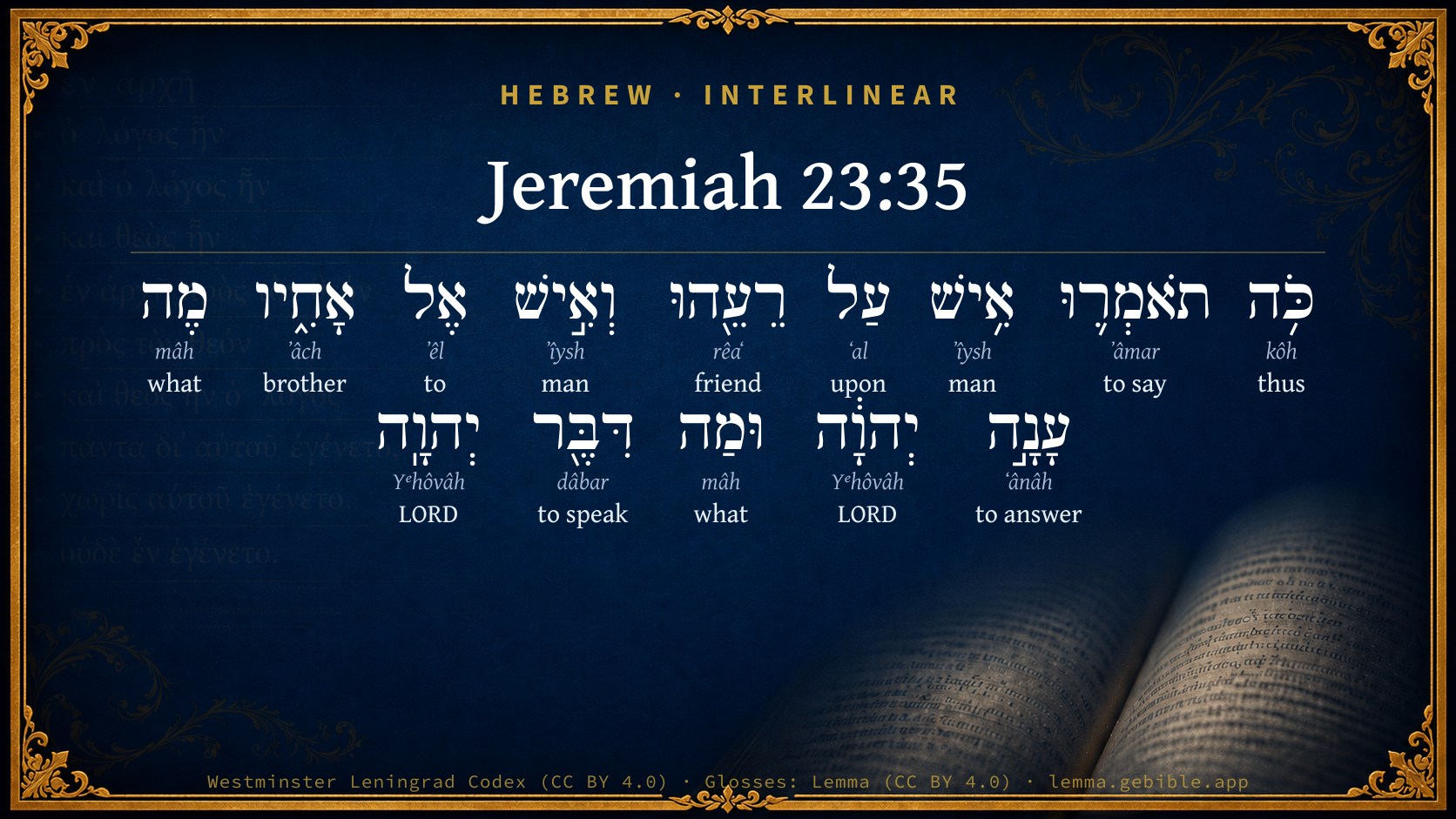
Hebrew (Westminster Leningrad Codex) Jeremiah 23:35 appears in the Hebrew Old Testament. The text above is from the Westminster Leningrad Codex. Each word links to its Strong’s number, a concise gloss, and parsing drawn from the Open Scriptures Hebrew Bible morphology. Click any word for its full Brown-Driver-Briggs (BDB) entry.
Download image
Cite this verse

Jeremiah 23:35 (World English Bible). Public Domain. Lemma interlinear Bible study tool, https://lemma.gebible.app/v/jeremiah/23/35.

Show BibTeX & RIS
BibTeX
RIS
English Translation
Thus shall you say everyone to his neighbor, and everyone to his brother, What has Yahweh answered? and, What has Yahweh spoken?
World English Bible · Public Domain
Download a study sheet

One document with this verse’s original text, its word-by-word gloss line, the meaning frame, cross-references with their text, attributed commentary, and full source and license credits — printable, and it pastes into notes with its structure intact.

This verse Autodidact and up

Study sheet (.html) Plain text (.txt)

A passage Seminary Student

Up to 50 verses in one chapter. A passage sheet keeps up to 6 commentary sources and 12 cross-references per verse, in the order this page ranks them, and says so on the sheet whenever that leaves anything out. Ask for a single verse and you get the Autodidact verse sheet above.

Everything on this page stays free to read, with no account — the sheet is a download of what is already on screen, not access to it.

Want to remove ads? Support Godless Engineer
Compare translations 3

The same verse in 3 English versions, stacked beneath the original-language interlinear above. Click any original word for its lexicon entry.

Each is an independent rendering of the whole verse — the interlinear is not word-aligned to these translations.

Highlighted words mark where these versions differ — a whole-verse word diff, not a word-by-word alignment.

  • World English Bible Public Domain
    Thus shall you say everyone to his neighbor, and everyone to his brother, What has Yahweh answered? and, What has Yahweh spoken?
  • King James Version Public Domain
    Thus shall ye say every one to his neighbour, and every one to his brother, What hath the LORD answered? and, What hath the LORD spoken?
  • unfoldingWord Literal Text CC BY-SA 4.0
    Thus you will say, a man to his neighbor and a man to his brother, ‘What has Yahweh answered?’ or ‘What has Yahweh spoken?’

unfoldingWord Literal Text — © unfoldingWord, licensed CC BY-SA 4.0. Word-aligned USFM3 via Door43 (git.door43.org/unfoldingWord/en_ult).

Versions to compare (up to 4)

3 of 4 selected

Show all 18 translations

Every available English version of this verse, each an independent rendering of the whole verse.

  • World English Bible Public Domain
    Thus shall you say everyone to his neighbor, and everyone to his brother, What has Yahweh answered? and, What has Yahweh spoken?
  • Berean Standard Bible Public Domain
    This is what each man is to say to his friend and to his brother: ‘What has the LORD answered?’ or ‘What has the LORD spoken?’
  • Majority Standard Bible Public Domain
    This is what each man is to say to his friend and to his brother: ‘What has the LORD answered?’ or ‘What has the LORD spoken?’
  • King James Version Public Domain
    Thus shall ye say every one to his neighbour, and every one to his brother, What hath the LORD answered? and, What hath the LORD spoken?
  • American Standard Version (1901) Public Domain
    Thus shall ye say every one to his neighbor, and every one to his brother, What hath Jehovah answered? and, What hath Jehovah spoken?
  • Revised Version (1885) Public Domain
    Thus shall ye say every one to his neighbour, and every one to his brother, What hath the LORD answered? and, What hath the LORD spoken?
  • Geneva Bible (1599) Public Domain
    Thus shall yee say euery one to his neighbour, and euerie one to his brother, What hath the Lord answered? and what hath the Lord spoken?
  • Douay-Rheims (1899) Public Domain
    Thus shall you say every one to his neighbor, and to his brother: What hath the Lord answered? and what hath the Lord spoken?
  • Young's Literal Translation Public Domain
    Thus do ye say each unto his neighbour, And each unto his brother: What hath Jehovah answered? And what hath Jehovah spoken?
  • Literal Standard Version CC BY-SA 4.0
    Thus you each say to his neighbor, || And each to his brother: What has YHWH answered? And what has YHWH spoken?
  • Unlocked Literal Bible CC BY-SA 4.0
    You continue to say, each person to his neighbor and each man to his brother, 'What did Yahweh answer?' and 'What did Yahweh declare?'
  • unfoldingWord Literal Text CC BY-SA 4.0
    Thus you will say, a man to his neighbor and a man to his brother, ‘What has Yahweh answered?’ or ‘What has Yahweh spoken?’
  • Darby Bible Public Domain
    Thus shall ye say every one to his neighbour, and every one to his brother: What hath Jehovah answered? and, What hath Jehovah spoken?
  • World Messianic Bible Public Domain
    You will say everyone to his neighbor, and everyone to his brother, ‘What has the LORD answered?’ and, ‘What has the LORD said?’
  • Webster's Bible Public Domain
    Thus shall ye say every one to his neighbor, and every one to his brother, What hath the LORD answered? and, What hath the LORD spoken?
  • Free Bible Version CC BY-SA 4.0
    This is what everybody should say to their friends and relatives: “What answer has the Lord given?” or, “What has the Lord said?”
  • Bible in Basic English Public Domain
    But this is what you are to say, every man to his neighbour and every man to his brother, What answer has the Lord given? and, What has the Lord said?
  • JPS Tanakh (1917) Public Domain
    Thus shall ye say every one to his neighbour, and every one to his brother: 'What hath the LORD answered?' and: 'What hath the LORD spoken?'

Literal Standard Version (2020), Covenant Press — licensed CC BY-SA 4.0. Text via the HelloAO Bible API (eBible.org). Unlocked Literal Bible (unfoldingWord) — licensed CC BY-SA 4.0. Text via the HelloAO Bible API (eBible.org). unfoldingWord Literal Text — © unfoldingWord, licensed CC BY-SA 4.0. Word-aligned USFM3 via Door43 (git.door43.org/unfoldingWord/en_ult). Free Bible Version, Dr. Jonathan Gallagher — licensed CC BY-SA 4.0. Text via the HelloAO Bible API (eBible.org).

Word by word

More ways to search: Search by grammar → Find every occurrence → Compare this word →

Practice this passage: Drill this verse → Learn its vocabulary →

רֵעֵ֖הוּ
rêaʻ
H7453
“friend · his”
Noun, Common, Masculine, Singular, Construct + Suffix, Personal, 3rd Person, Masculine, Singular
Part of Speech
Noun
Type
Common
Gender
Masculine
Number
Singular
State
Construct
Full BDB Definition

Origin: from H7462

TWOT: 2186a

friend, companion, fellow, another person - friend, intimate - fellow, fellow-citizen, another person (weaker sense) - other, another (reciprocal phrase)
  1. כֹּ֥ה kôh H3541 “thus” Adverb
  2. תֹאמְר֛וּ ʼâmar H559 “to say” Verb, Qal, Imperfect, 2nd Person, Masculine, Plural
  3. אִ֥ישׁ ʼîysh H376 “man” Noun, Common, Masculine, Singular, Absolute
  4. עַל ʻal H5921 “upon” Preposition
  5. וְאִ֣ישׁ ʼîysh H376 “and · man” Conjunction + Noun, Common, Masculine, Singular, Absolute
  6. אֶל ʼêl H413 “to” Preposition
  7. אָחִ֑יו ʼâch H251 “brother · his” Noun, Common, Masculine, Singular, Construct + Suffix, Personal, 3rd Person, Masculine, Singular
  8. מֶה mâh H4100 “what” Particle, Interrogative
  9. עָנָ֣ה ʻânâh H6030 “to answer” Verb, Qal, Perfect, 3rd Person, Masculine, Singular
  10. יְהוָ֔ה Yᵉhôvâh H3068 “LORD” Noun, Proper
  11. וּמַה mâh H4100 “and · what” Conjunction + Particle, Interrogative
  12. דִּבֶּ֖ר dâbar H1696 “to speak” Verb, Piel, Perfect, 3rd Person, Masculine, Singular
  13. יְהוָֽה Yᵉhôvâh H3068 “LORD” Noun, Proper

About this verse

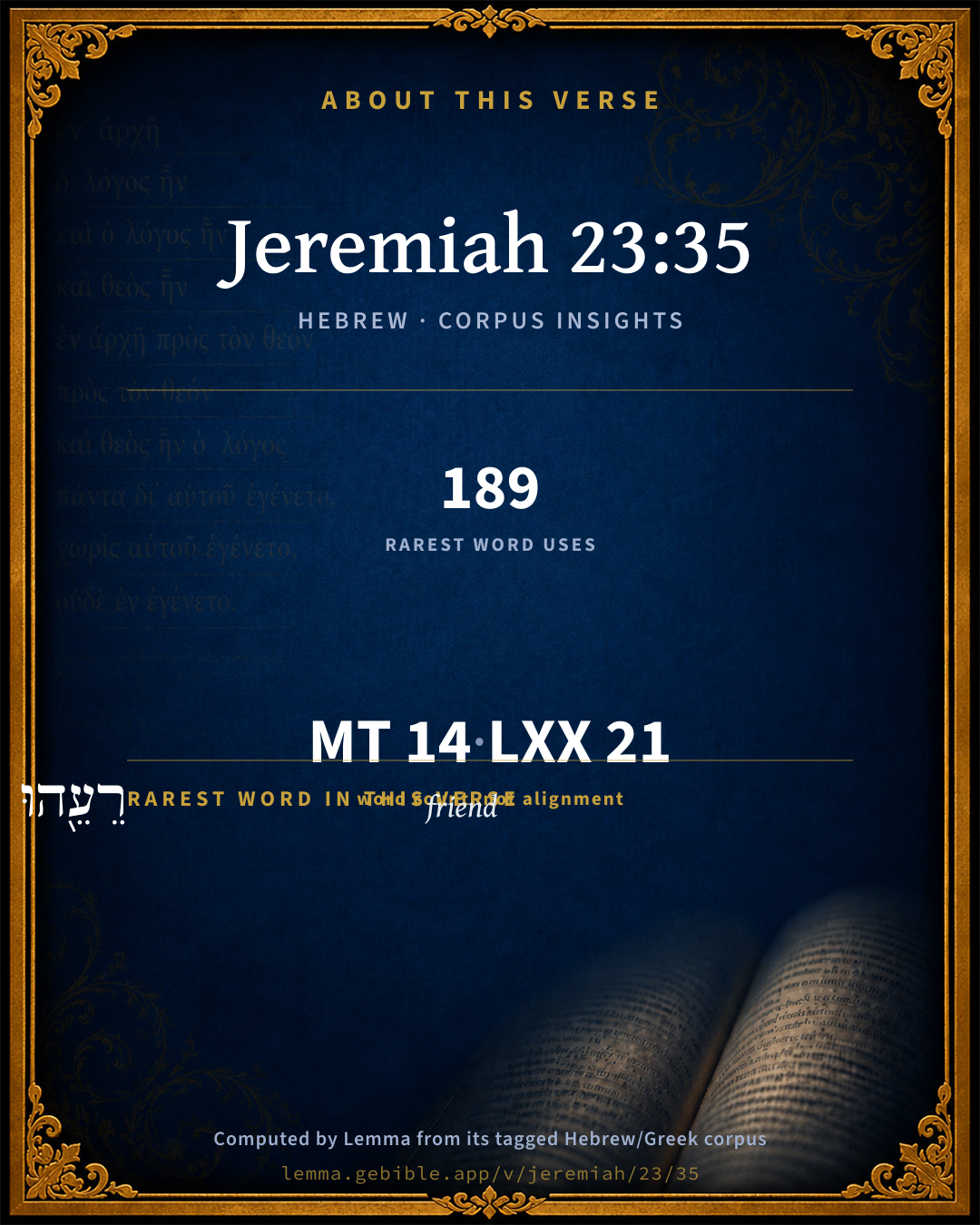
These counts appear in no published source. They are computed here, from the morphology-tagged text and Lemma’s own curated glosses. What Lemma adds →

14
words
11
distinct lemmas
Prophets
section

Grammatical profile

  • 3 verbs
  • 6 nouns
  • 2 prepositions
  • 1 adverb
  • 2 particles

Verb forms

  • תֹאמְר֛וּ Qal · Imperfect
  • עָנָ֣ה Qal · Perfect
  • דִּבֶּ֖ר Piel · Perfect

Repetition

Words recur within this verse — often emphatic in Hebrew:

  • אִ֥ישׁ man H376 ×2
  • יְהוָ֔ה LORD H3068 ×2
  • מֶה what H4100 ×2

Hebrew & Septuagint length

In the original languages it is 14 Hebrew tokens and 21 Greek tokens — but the two are counted differently (Hebrew bundles its prefixes and suffixes into one token; the Greek is in lemma form), so that isn’t a like-for-like length.

Cross-references

4

Topical passages linked to Jeremiah 23:35 in the Treasury of Scripture Knowledge — connected by theme and wording, ordered by reader-vote popularity; previews shown in the World English Bible.

  • Jeremiah 31:34 and they shall teach no more every man his neighbor, and every man his brother, saying, Know Yahweh; for they shall all know me, from the least of them to the greatest of them, says Yahweh: for I will forgive their iniquity, and their sin will I remember no more.
  • Jeremiah 33:3 Call to me, and I will answer you, and will show you great things, and difficult, which you don't know.
  • Jeremiah 42:4 Then Jeremiah the prophet said to them, I have heard you; behold, I will pray to Yahweh your God according to your words; and it shall happen that whatever thing Yahweh shall answer you, I will declare it to you; I will keep nothing back from you.
  • Hebrews 8:11 They will not teach every man his fellow citizen, Every man his brother, saying, 'Know the Lord,' For all will know me, From the least of them to the greatest of them.

Cross-references courtesy of OpenBible.info (CC BY 4.0).

Hebrew and Greek witnesses Masoretic Hebrew ↔ Greek Septuagint

The same verse in the two great witnesses to the Old Testament, shown verse-for-verse.

These are two independent witnesses, not word-aligned to each other, and the Septuagint is shown in lemma (dictionary) form.

Hebrew Jeremiah 23:35 Masoretic · Westminster Leningrad Codex

כֹּ֥ה תֹאמְר֛וּ אִ֥ישׁ עַל רֵעֵ֖הוּ וְאִ֣ישׁ אֶל אָחִ֑יו מֶה עָנָ֣ה יְהוָ֔ה וּמַה דִּבֶּ֖ר יְהוָֽה

Thus shall you say everyone to his neighbor, and everyone to his brother, What has Yahweh answered? and, What has Yahweh spoken?

World English Bible · Public Domain

Greek LXX Structure differs

In the Septuagint, Jeremiah is about an eighth shorter than the Hebrew and arranges its material differently — the Oracles Against the Nations (Hebrew chapters 46–51) appear in the middle of the Greek book, after 25:13. Because the chapter and verse boundaries do not line up, a verse-for-verse comparison with the Hebrew is not shown.

A verse-for-verse comparison isn’t shown here because the chapters and verses don’t line up. Switch to the LXX edition with the MT / LXX toggle above to read the Greek directly.

Hebrew: Westminster Leningrad Codex (CC BY 4.0). Greek: Septuagint (public domain); English from a public-domain English Septuagint. How the Septuagint differs from the Hebrew →

Targum (Aramaic paraphrase)

1

The Targum is the ancient Jewish Aramaic paraphrase of the Hebrew Scriptures — an interpretive translation, not the Hebrew text itself. Onkelos (literal) and Pseudo-Jonathan (expansive) render the Torah, and Jonathan the Prophets. Coverage is partial: where no permissively-licensed English translation exists for a verse, only the Aramaic is shown. This is verse-level text, not a word-by-word alignment to the Hebrew.

  1. Targum Jonathan Prophets (Joshua–Malachi)
    כְּדֵין תֵּימְרוּן גְבַר לְחַבְרֵיהּ וּגְבַר לַאֲחוֹהִי מַה אָתֵיב יְיָ וּמַה מַלֵיל יְיָ:

    (no public-domain English translation for this verse)

    Targum Jonathan — Aramaic: “Mikraot Gedolot” (public domain). English: “Sefaria Community Translation” (CC0 1.0 (public-domain dedication)); “London "Chaldee Paraphrase," 1871” (public domain). Text via Sefaria.

Commentary

Notes on Jeremiah 23:35 from classic Christian and Jewish commentators (each source and its license shown beneath its notes). The classic Christian expositions comment on the surrounding passage and are grouped to its opening verse, so a note may address several verses; the Jewish commentaries on the Tanakh (Rashi and others) are per-verse, so they appear only where the commentator wrote on this verse.

Lemma curates 59 commentaries, every one of them public domain or Creative Commons licensed, each selected and text-cleaned for this edition rather than reprinted as found. About our sources →

Trapp's Complete Commentary

John Trapp

Jer 23:35 Thus shall ye say every one to his neighbour, and every one to his brother, What hath the LORD answered? and, What hath the LORD spoken?

Ver. 35. Thus shall ye say.] God sets them a form, who otherwise knew not how to lisp out a syllable of sober language. Loquamur verba Scripturae, Let us speak the words of the Bible, saith Peter Ramus, utamur sermone Spiritus Sancti, Let us inure ourselves to Scripture expressions.

John Trapp, A Commentary or Exposition upon All the Books of the Old and New Testament (1647–1656) — public domain. Text from a community e-Sword module.

The Biblical Illustrator

Joseph S. Exell

Jer_23:35

What hath the Lord spoken?

The contents of the Bible

I. Impartiality of its contents. Each writer is an honest chronicler. With an unflinching adherence to truth the whole story is told whoever may be unpleasantly involved therein. Such is the undaunted boldness, sterling integrity, and resolute independence of the Scripture scribes that they do not pause to inquire whose faults they are recording. Such is their antipathy to sin in all its forms that they expose the hydra wherever he may be encountered. Ay, the writers even disclose their own faults and infirmities. They unfold their hearts without any reserve. They allude to their own virtuous actions without any ostentation, and do not palliate their vices. They refer to themselves with the same simplicity and fidelity with which they treat of others. Where will you find such a marked feature in any other book?

II. The originality of its contents.

1. Look, for example, at the disclosures given of the Divine Being--read the sublime language of the holy scribes concerning the self-existence, independence, omnipotence, omniscience, omnipresence, justice, long-suffering, and love of the Deity. Whence were these lordly conceptions derived? They were revealed by God to man, and so made known to mortals. You commend us to the productions of Horace; do you forget that a thousand years before his day the lyric poetry of the Hebrews was famous? Read the books of Grecian or Roman authors of the highest standard, and tell me in which of them can you discover themes so stately, thoughts so surprising, and diction so sublime as you have in the Bible

2. Look, again, at the Scripture teaching concerning Christ. Now, such a Divine Being either lived or He did not. If you grant He lived, then the evangelistic narratives are the authoritative biographies of Jesus. If He did not live, then the narratives are fictitious, and the character is an invention. But was it possible for the New Testament writers to have invented such an original character? It is a moral impossibility that they should have concocted a story such as that the New Testament contains. Nor did they gather the elements of the unique character of Christ from any person or persons then living. A sight acquaintance with the condition of society at the time of the Saviours appearing will suffice to satisfy us that there were no men who could sit as models to the evangelic artists. Nor did they reproduce themselves. Four men of very different temperaments produce a history of one Man in which all four coincide. There is but one way of accounting for this original, peerless, beautiful life in the Gospels, and that is by accepting the declaration of John--That which we have seen and heard, declare we unto you.

III. The high moral tone of the contents. From first to last the Book of books holds forth the Divine law as the safe and sole standard of morality. It points to God as the supreme lawgiver, and tells us that He, in His spotlessness, demands purity in man. It condemns not merely the overt evil, but the concealed offence; not only the spoken word, but the voiceless emotions; not alone the guilty act, but the hidden thought of its committal. Where was such elevated morality taught before the Bible propounded it? So far back as the days of Abraham, Egypt was sunk in sensuality and unrighteousness. Whence, then, did Moses obtain the morality with which his writings are full? He could not evolve it from his own brain--that were a greater miracle than the act of Divine revelation. And whence did the evangelists and apostles obtain their sublime and stainless sentiments? Not from Rome, not from Greece. In the lands where Homer, Hesiod, Euripides, Plato, Socrates, Virgil, and Cicero wrote--in the countries where philosophers, poets, and orators- of the most distinguished order lived and laboured, idolatry abounded, brutal savageness was patronised, voluptuousness and debauchery were approved. How out of paganism, as it then was, could there have sprung up the noble, beautiful, and blessed system of morality like that we possess in the New Testament? How could the icy, indiscreet, and infamous teachings of heathen philosophy have given birth to the warmhearted, winsome, and wonder-working ethics of our Scriptures? Do men expect figs from thistles?

IV. The beauties of its contents. The volume is full of literary splendours. Picture, proverb, parable, and poem arc blended to produce a superb Book. Creation has been ransacked that its choicest works may embellish the page of inspiration. The fairest flowers of nature are woven into this garland for the brow of Immanuel. The beauties of this volume are like the veins of gold beneath the surface soil. Generations of men intellectually cross and recross the hallowed ground, and remain in entire ignorance of a tithe of the hidden glories. Whole armies of mental athletes handle the sword of the Spirit, without ever detecting the jewels which decorate its hilt. Companies of learned men saunter in the gardens of revelation, examine one plant and another, and-pronounce an opinion upon the whole--an opinion dogmatic and defiant---whilst they have never discovered the sweetest flowers which are concealed by the masses of luxuriant foliage. And yet they who have judged simply by the conspicuous features of the volume are enthusiastic in their praises of the Book, even our enemies themselves being judges.

V. The prominence given to Christ. It is said that a celebrated artist of ancient times constructed a shield of so remarkable an order that he had worked his name into the device in a manner that it could not be removed. To erase the name you must destroy the shield. Thus is it emphatically with the Bible. From Genesis to Revelation the whole volume points to Jesus. He is the centre and soul of the Book. Take away Jesus from the Book of books, and you have a casket without a jewel, an envelope without a letter, a scaffolding without any superstructure, musical notation without any melody, a frame without a portrait, an assembly without a leader, ages of preparation on the most extensive scale for an event that never happens, centuries of practice for an oratorio that is never performed. From the fatal declension of Adam, He was the subject of promise and prophecy. In paradise He was referred to as the seed of the woman. Abraham rejoiced to see His day, and avowed that the Lord would provide Himself a Lamb. Jacob spake of Him as the coming Shiloh, Moses foretold the rising of a Prophet, Balaam saw Him as a Star and a Sceptre, Job rejoiced in the life of his Redeemer, David described the agonies, death, and resurrection of the Holy One, Solomon ecstatically praised his Beloved, Isaiah graphically dwelt upon the doings of the tender Plant, and the precious Corner-stone. He was Jeremiahs Branch, Ezekiel s River, Daniel s Ancient of Days, Hoseas Lord of hosts, Joel s Latter-day Glory, Obadiah s Saviour, Jonah s Salvation, Micahs Peace, Nahums Him that bringeth good tidings, Habakkuks Strength, Haggais Desire of all nations, Zechariah s Fountain, and Malachis Sun of Righteousness. How can you account for such a marked blending of all writers on one theme--such a manifest gravitation of thought toward one point--such a glorious clustering of hope, expectation, and joy around one centre? How was it that these scribes, separated by ages, and climes, and callings, and capacities, all looked Christward? There is but one answer. All were under the invisible spell of the Saviours attractive influence--all felt the centripetal force of the Cross which was to be erected on Calvary--all were God-guided and God-taught. (J. H. Hitchens.)

The Biblical Illustrator, edited by Joseph S. Exell (c. 1880s–1900s) — public domain. Text from a community e-Sword module.

Jamieson, Fausset & Brown

Robert Jamieson, A. R. Fausset & David Brown

The result of My judgments shall be, ye shall address the prophet more reverentially hereafter, no longer calling his message a burden, but a divine response or word. "What hath the LORD answered?"

Jamieson, Fausset & Brown — Commentary Critical and Explanatory on the Whole Bible (1871) — public domain (CC PDM 1.0). Text via the HelloAO Bible API.

John Calvin's Commentaries

Here the Prophet explains himself more clearly; he shews why God would not have his word to be called a burden. Why so? because they in a manner closed the way, so that they derived no benefit from God’s word, while they regarded it with disdain and hatred; for the word burden was an obstacle, so that they gave no access to God, nor opened their ears to hear his word. God then bids them to come with empty and sincere hearts; for it is a real preparation for a teachable spirit, when we acknowledge that we ought to believe in God’s word, and also when we are not possessed by a perverse feeling which forms a prejudice and in a manner holds us bound, so that we are not free to form a right judgment.

The import of the passage then is this, that the Jews, renouncing their blasphemies, were to prepare themselves reverently to hear God’s word, for hearing is due to God; and then that this word was to be heard with sincere hearts, so that no weariness, nor pride, nor hatred, nor any depraved feeling, might hinder his word from being believed and reverently heard by all. This then is what the Prophet means when he says, “Ye shall hereafter change your impious expression, and shall say, What has Jehovah answered? what has Jehovah spoken?” That is, they shall not themselves close the door, but willingly come to the school of God, being meek and teachable, so that nothing would hinder them from rendering honor to God and from embracing his word, that they might be terrified by his threatenings, and that being allured by his promises they might devote themselves wholly to him.

John Calvin's Commentaries (1540-1563) — public domain. Text from the Calvin Translation Society English edition (1840s-50s) via the Christian Classics Ethereal Library (ccel.org). Calvin's coverage is partial (roughly two-thirds of the Bible); uncommented books and verses are honest gaps, never fabricated. The 19th-century editor's footnotes and remarks are omitted so the notes are faithfully Calvin's own voice.

Ellicott's Commentary for English Readers

(35) Thus shall ye say . . .—The words are a protest against the high-sounding phrase, “This is the burden, the oracle of Jehovah.” This, with which the false prophets covered their teachings of lies, the prophet rejects, and he calls men back to the simpler terms, which were less open to abuse. The true prophet’s message was to be called an “answer” when men had come to him with questions—a “word of the Lord” when it was spoken to them without any previous inquiry.

A Bible Commentary for English Readers, edited by Charles John Ellicott (1878–1897) — public domain. Text from a community e-Sword module.

John Gill's Exposition

Thus shall ye say everyone to his neighbour, and everyone to his brother,.... When conferring about religious things, and the word of God in particular; when any inquiry is made of another, whether any message from the Lord by his prophets? or what is it? that it should not be put in such deriding and calumniating words, "what is the burden of the Lord?" but in more decent and becoming language, thus,

what hath the Lord answered? and what hath the Lord spoken? they might lawfully and laudably inquire of the prophet what answer he had received from the Lord, and what it was that he had said to him, provided they were serious in it, and asked with meekness and fear: the word of God should be reverently spoken of, and attended to.

John Gill's Exposition of the Whole Bible (1746–1763) — public domain (CC PDM 1.0). Text via the HelloAO Bible API.

Albert Barnes' Notes on the Bible

The proper words for prophecy. It is to be called an answer when the people have come to inquire of Yahweh: but His word when it is sent unasked.

Albert Barnes' Notes on the Bible (1834–1885) — public domain. Text from a community e-Sword/MySword module.

Haydock's Catholic Bible Commentary

Answered. I will make you alter your language by chastisements.

George Leo Haydock (1774–1849), Haydock's Catholic Family Bible and Commentary, 1859 edition — public domain. Excludes Psalms (Douay-Rheims chapter numbering differs from Protestant) and Deuterocanonical books (Catholic canon only).

Matthew Poole's English Annotations

I will have you speak more reverently of me and my word to my prophets.

Matthew Poole's English Annotations on the Holy Bible (1683–1685) — public domain. Text from a community e-Sword/MySword module.

The Pulpit Commentary

What hath the Lord answered? i.e. a simpler phraseology is to be used, Jehovah hath answered, saying, or, Jehovah hath spoken, according as a definite question had been put before the prophet or not.

The Pulpit Commentary (1880–1919), ed. H.D.M. Spence-Jones & Joseph S. Exell — public domain. Text from a community e-Sword module.

John Wesley's Explanatory Notes

Thus shall ye say - I will have you speak more reverently of me and my prophets.

John Wesley, Explanatory Notes Upon the Whole Bible (1754–1765) — public domain. Text via the GEBible commentary corpus.

unfoldingWord translationNotes

Door43 World Missions Community

Connecting Statement:

Yahweh continues to deliver his message about the false prophets and priests that he began in Jeremiah 23:9 and completes in Jeremiah 23:40.

General Information:

In verses 33-40 there is a wordplay with the word "burden." Sometimes it means "a message" and other times it means "a heavy load to carry." This wordplay should be retained if possible.

You continue to say ... 'What did Yahweh declare?'

It may be helpful to reorder this sentence. AT: "Each person continues to ask his neighbor and his brother, 'What did Yahweh answer?' and 'What did Yahweh declare?'"

But you must no longer talk about the 'burden of Yahweh,' for the burden is every man's own word, and

Possible meaning are 1) both instances of "burden" mean "message." AT: "You must no longer call your visions the 'burden of Yahweh' because they are really only every man's own words, and" or 2) the first 'burden' means "message" and the second means "heavy load." AT: "You must no longer talk about the 'message of Yahweh' because the words that each of you speak are what is a 'heavy load.' In this way"

you have perverted the words ... our God

To "pervert" something is to twist or distort it. AT: "you have changed the message of the living God, Yahweh of hosts, our God, to say what you want it to say and not what God said"

translationWords

brother

declare

word

life

God

Yahweh of hosts

unfoldingWord translationNotes — © Distant Shores Media and the Door43 World Missions Community, licensed CC BY-SA 4.0. Source: git.door43.org/Door43/en_tn.

Lesson kit

Teaching starters — assembled from the data on this page, not authored interpretation. Every prompt links to the verse data it draws on. Edit before teaching.

Jeremiah, in the Prophets, opens this verse with 14 words (11 distinct Hebrew lemmas). Its most distinctive word is rêaʻ (“friend”). A historical commentator’s framing appears above. Read the whole chapter for the surrounding context.

Discussion questions

  1. What does “friend” (rêaʻ) contribute to the verse as a whole?
  2. Jeremiah 31:34 shares this passage’s theme. How do the two illuminate each other?
  3. “man” occurs 2× in this one verse. What is the effect of the repetition?
  4. These translations render this verse differently. What is at stake in choosing one wording over another?
  5. The verb «תֹאמְר֛וּ» is Qal Imperfect. How does its form color the action?
  6. Reading how Trapp's Complete Commentary and The Biblical Illustrator read this verse, where do the two commentators agree and where do they part?

Things to notice

Reading settings

Reading text

Shown beneath each verse's original-language words.

Old Testament
Old Testament edition

Read the OT as the Masoretic Hebrew (MT) or the Greek Septuagint (LXX).

English shown for the Greek Septuagint (in the Hebrew ↔ Greek comparison).

Comparing translations? Open the Compare panel on any verse page to stack up to four side by side.