
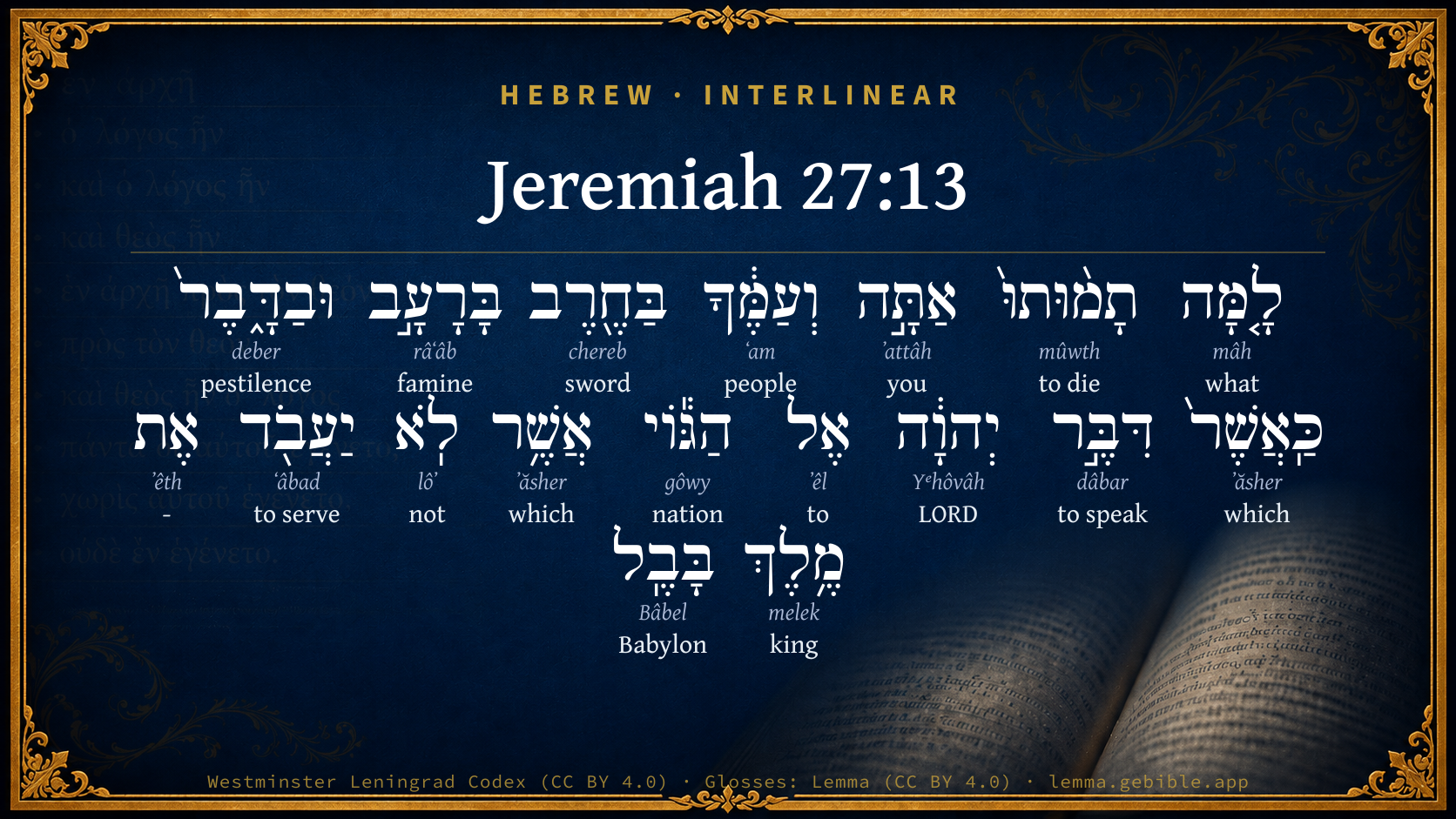
Jeremiah 27:13

Hebrew (Westminster Leningrad Codex) Jeremiah 27:13 appears in the Hebrew Old Testament. The text above is from the Westminster Leningrad Codex. Each word links to its Strong’s number, a concise gloss, and parsing drawn from the Open Scriptures Hebrew Bible morphology. Click any word for its full Brown-Driver-Briggs (BDB) entry.
Download image
Cite this verse

Jeremiah 27:13 (World English Bible). Public Domain. Lemma interlinear Bible study tool, https://lemma.gebible.app/v/jeremiah/27/13.

Show BibTeX & RIS
BibTeX
RIS
English Translation
Why will you die, you and your people, by the sword, by the famine, and by the pestilence, as Yahweh has spoken concerning the nation that will not serve the king of Babylon?
World English Bible · Public Domain
Download a study sheet

One document with this verse’s original text, its word-by-word gloss line, the meaning frame, cross-references with their text, attributed commentary, and full source and license credits — printable, and it pastes into notes with its structure intact.

This verse Autodidact and up

Study sheet (.html) Plain text (.txt)

A passage Seminary Student

Up to 50 verses in one chapter. A passage sheet keeps up to 6 commentary sources and 12 cross-references per verse, in the order this page ranks them, and says so on the sheet whenever that leaves anything out. Ask for a single verse and you get the Autodidact verse sheet above.

Everything on this page stays free to read, with no account — the sheet is a download of what is already on screen, not access to it.

Want to remove ads? Support Godless Engineer
Compare translations 3

The same verse in 3 English versions, stacked beneath the original-language interlinear above. Click any original word for its lexicon entry.

Each is an independent rendering of the whole verse — the interlinear is not word-aligned to these translations.

Highlighted words mark where these versions differ — a whole-verse word diff, not a word-by-word alignment.

  • World English Bible Public Domain
    Why will you die, you and your people, by the sword, by the famine, and by the pestilence, as Yahweh has spoken concerning the nation that will not serve the king of Babylon?
  • King James Version Public Domain
    Why will ye die, thou and thy people, by the sword, by the famine, and by the pestilence, as the LORD hath spoken against the nation that will not serve the king of Babylon?
  • unfoldingWord Literal Text CC BY-SA 4.0
    Why will you die, you and your people, by the sword, by the famine, and by the plague, as Yahweh has spoken concerning the nation that does not serve the king of Babylon?

unfoldingWord Literal Text — © unfoldingWord, licensed CC BY-SA 4.0. Word-aligned USFM3 via Door43 (git.door43.org/unfoldingWord/en_ult).

Versions to compare (up to 4)

3 of 4 selected

Show all 18 translations

Every available English version of this verse, each an independent rendering of the whole verse.

  • World English Bible Public Domain
    Why will you die, you and your people, by the sword, by the famine, and by the pestilence, as Yahweh has spoken concerning the nation that will not serve the king of Babylon?
  • Berean Standard Bible Public Domain
    Why should you and your people die by sword and famine and plague, as the LORD has decreed against any nation that does not serve the king of Babylon?
  • Majority Standard Bible Public Domain
    Why should you and your people die by sword and famine and plague, as the LORD has decreed against any nation that does not serve the king of Babylon?
  • King James Version Public Domain
    Why will ye die, thou and thy people, by the sword, by the famine, and by the pestilence, as the LORD hath spoken against the nation that will not serve the king of Babylon?
  • American Standard Version (1901) Public Domain
    Why will ye die, thou and thy people, by the sword, by the famine, and by the pestilence, as Jehovah hath spoken concerning the nation that will not serve the king of Babylon?
  • Revised Version (1885) Public Domain
    Why will ye die, thou and thy people, by the sword, by the famine, and by the pestilence, as the LORD hath spoken concerning the nation that will not serve the king of Babylon?
  • Geneva Bible (1599) Public Domain
    Why will ye dye, thou, and thy people by the sworde, by the famine, and by the pestilence, as the Lord hath spoken against the nation, that will not serue the King of Babel?
  • Douay-Rheims (1899) Public Domain
    Why will you die, thou and thy people by the sword, and by famine, and by the pestilence, as the Lord hath spoken against the nation that will not serve the king of Babylon?
  • Young's Literal Translation Public Domain
    Why do ye die, thou and thy people, by sword, by famine, and by pestilence, as Jehovah hath spoken concerning the nation that doth not serve the king of Babylon?
  • Literal Standard Version CC BY-SA 4.0
    Why do you die, you and your people, by sword, by famine, and by pestilence, as YHWH has spoken concerning the nation that does not serve the king of Babylon?
  • Unlocked Literal Bible CC BY-SA 4.0
    Why will you die—you and your people—by the sword, famine, and plague, just as I have declared about the nation that refuses to serve the king of Babylon?
  • unfoldingWord Literal Text CC BY-SA 4.0
    Why will you die, you and your people, by the sword, by the famine, and by the plague, as Yahweh has spoken concerning the nation that does not serve the king of Babylon?
  • Darby Bible Public Domain
    Why will ye die, thou and thy people, by the sword, by the famine, and by the pestilence, as Jehovah hath spoken concerning the nation that will not serve the king of Babylon?
  • World Messianic Bible Public Domain
    Why will you die, you and your people, by the sword, by the famine, and by the pestilence, as the LORD has spoken concerning the nation that will not serve the king of Babylon?
  • Webster's Bible Public Domain
    Why will ye die, thou and thy people, by the sword, by the famine, and by the pestilence, as the LORD hath spoken against the nation that will not serve the king of Babylon?
  • Free Bible Version CC BY-SA 4.0
    Why should you and your people die by war and famine and plague, as the Lord has said he would bring against any nation that does not serve the king of Babylon?
  • Bible in Basic English Public Domain
    Why are you desiring death, you and your people, by the sword, and because food is gone, and by disease, as the Lord has said of the nation which does not become the servant of the king of Babylon?
  • JPS Tanakh (1917) Public Domain
    Why will ye die, thou and thy people, by the sword, by the famine, and by the pestilence, as the LORD hath spoken concerning the nation that will not serve the king of Babylon?

Literal Standard Version (2020), Covenant Press — licensed CC BY-SA 4.0. Text via the HelloAO Bible API (eBible.org). Unlocked Literal Bible (unfoldingWord) — licensed CC BY-SA 4.0. Text via the HelloAO Bible API (eBible.org). unfoldingWord Literal Text — © unfoldingWord, licensed CC BY-SA 4.0. Word-aligned USFM3 via Door43 (git.door43.org/unfoldingWord/en_ult). Free Bible Version, Dr. Jonathan Gallagher — licensed CC BY-SA 4.0. Text via the HelloAO Bible API (eBible.org).

Word by word

More ways to search: Search by grammar → Find every occurrence → Compare this word →

Practice this passage: Drill this verse → Learn its vocabulary →

וּבַדָּ֑בֶר֙
deber
H1698
“and · in/at the · pestilence”
Conjunction + Preposition, Determined + Noun, Common, Masculine, Singular, Absolute
Part of Speech
Conjunction + Preposition + Noun
Type
Common
Gender
Masculine
Number
Singular
State
Absolute
Full BDB Definition

Origin: from H1696 (in the sense of destroying)

TWOT: 399b

pestilence, plague - murrain, cattle disease, cattle-plague
  1. לָ֤מָּה mâh H4100 “to/for · what” Preposition + Particle, Interrogative
  2. תָמ֨וּתוּ֙ mûwth H4191 “to die” Verb, Qal, Imperfect, 2nd Person, Masculine, Plural
  3. אַתָּ֣ה ʼattâh H859 “you” Pronoun, Personal, 2nd Person, Masculine, Singular
  4. וְעַמֶּ֔ךָ ʻam H5971 “and · people · your” Conjunction + Noun, Common, Masculine, Singular, Construct + Suffix, Personal, 2nd Person, Masculine, Singular
  5. בַּחֶ֖רֶב chereb H2719 “in/at the · sword” Preposition, Determined + Noun, Common, Feminine, Singular, Absolute
  6. בָּרָעָ֣ב râʻâb H7458 “in/at the · famine” Preposition, Determined + Noun, Common, Masculine, Singular, Absolute
  7. כַּֽאֲשֶׁר֙ ʼăsher H834 “like/as · which” Preposition + Particle, Relative
  8. דִּבֶּ֣ר dâbar H1696 “to speak” Verb, Piel, Perfect, 3rd Person, Masculine, Singular
  9. יְהוָ֔ה Yᵉhôvâh H3068 “LORD” Noun, Proper
  10. אֶל ʼêl H413 “to” Preposition
  11. הַגּ֕וֹי gôwy H1471 “the · nation” Particle, Definite Article + Noun, Common, Masculine, Singular, Absolute
  12. אֲשֶׁ֥ר ʼăsher H834 “which” Particle, Relative
  13. לֹֽא lôʼ H3808 “not” Particle, Negative
  14. יַעֲבֹ֖ד ʻâbad H5647 “to serve” Verb, Qal, Imperfect, 3rd Person, Masculine, Singular
  15. אֶת ʼêth H853 “-” Particle, Direct Object
  16. מֶ֥לֶךְ melek H4428 “king of” Noun, Common, Masculine, Singular, Construct
  17. בָּבֶֽל Bâbel H894 “Babylon” Noun, Proper

About this verse

These counts appear in no published source. They are computed here, from the morphology-tagged text and Lemma’s own curated glosses. What Lemma adds →

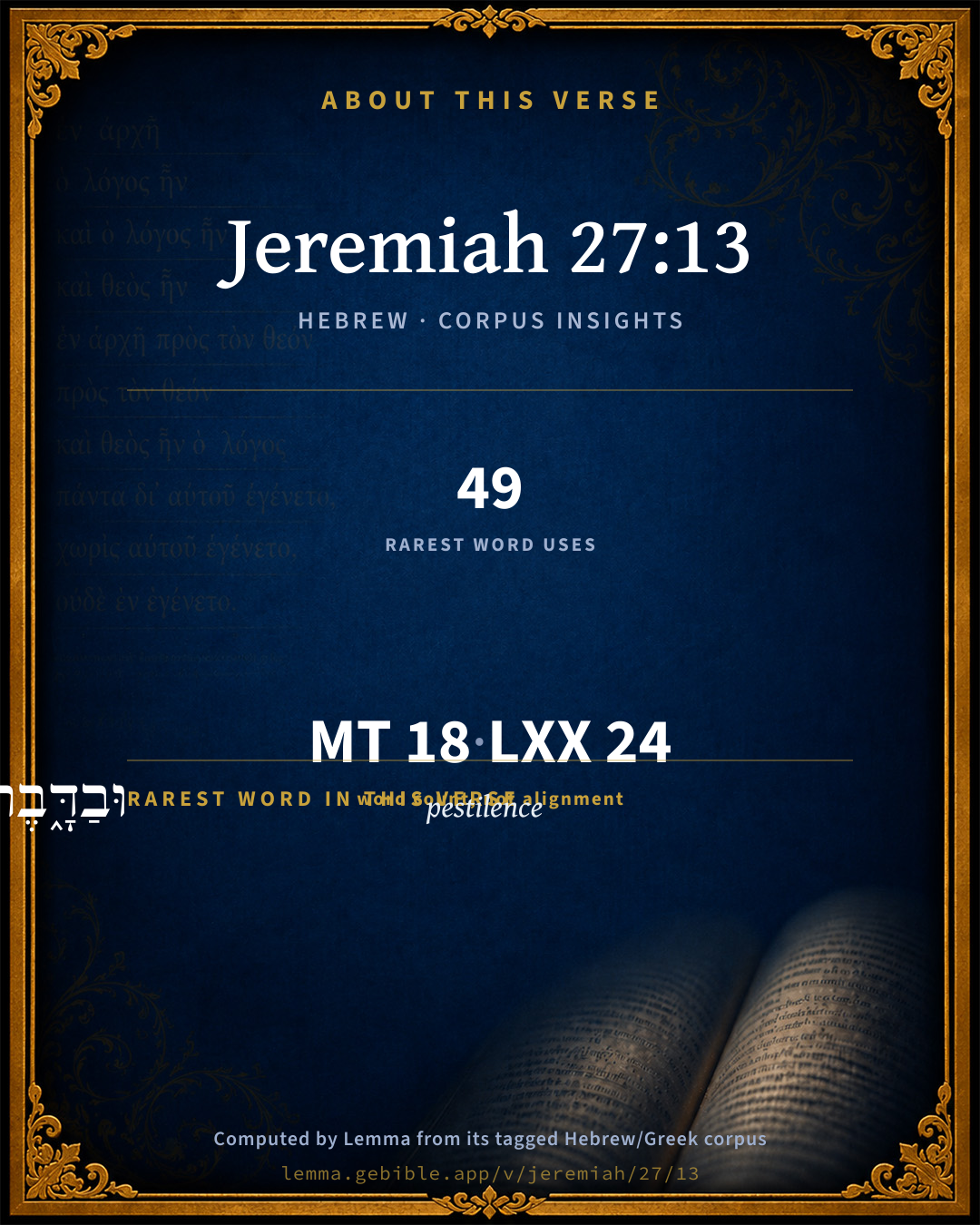
18
words
17
distinct lemmas
Prophets
section

Shared distinctive vocabulary

וּבַדָּ֑בֶר֙ pestilence H1698 occurs in 48 verses of the Hebrew Bible. Also found in:

Grammatical profile

  • 3 verbs
  • 8 nouns
  • 1 pronoun
  • 1 preposition
  • 5 particles

Verb forms

  • תָמ֨וּתוּ֙ Qal · Imperfect
  • דִּבֶּ֣ר Piel · Perfect
  • יַעֲבֹ֖ד Qal · Imperfect

Repetition

A word recurs within this verse — often emphatic in Hebrew:

  • כַּֽאֲשֶׁר֙ which H834 ×2

Hebrew & Septuagint length

In the original languages it is 18 Hebrew tokens and 24 Greek tokens — but the two are counted differently (Hebrew bundles its prefixes and suffixes into one token; the Greek is in lemma form), so that isn’t a like-for-like length.

Cross-references

9

Topical passages linked to Jeremiah 27:13 in the Treasury of Scripture Knowledge — connected by theme and wording, ordered by reader-vote popularity; previews shown in the World English Bible.

  • Ezekiel 18:31 Cast away from you all your transgressions, in which you have transgressed; and make you a new heart and a new spirit: for why will you die, house of Israel?
  • Jeremiah 27:8 It shall happen, that the nation and the kingdom which will not serve the same Nebuchadnezzar king of Babylon, and that will not put their neck under the yoke of the king of Babylon, that nation will I punish, says Yahweh, with the sword, and with the famine, and with the pestilence, until I have consumed them by his hand.
  • Proverbs 8:36 But he who sins against me wrongs his own soul. All those who hate me love death."
  • Jeremiah 38:20 But Jeremiah said, They shall not deliver you. Obey, I beg you, the voice of Yahweh, in that which I speak to you: so it shall be well with you, and your soul shall live.
  • Jeremiah 24:9 I will even give them up to be tossed back and forth among all the kingdoms of the earth for evil; to be a reproach and a proverb, a taunt and a curse, in all places where I shall drive them.
  • Jeremiah 38:2 Thus says Yahweh, He who remains in this city shall die by the sword, by the famine, and by the pestilence; but he who goes forth to the Chaldeans shall live, and his life shall be to him for a prey, and he shall live.
  • Ezekiel 14:21 For thus says the Lord Yahweh: How much more when I send my four sore judgments on Jerusalem, the sword, and the famine, and the evil animals, and the pestilence, to cut off from it man and animal!
  • Ezekiel 18:24 But when the righteous turns away from his righteousness, and commits iniquity, and does according to all the abominations that the wicked man does, shall he live? None of his righteous deeds that he has done shall be remembered: in his trespass that he has trespassed, and in his sin that he has sinned, in them shall he die.
  • Ezekiel 33:11 Tell them, As I live, says the Lord Yahweh, I have no pleasure in the death of the wicked; but that the wicked turn from his way and live: turn you, turn you from your evil ways; for why will you die, house of Israel?

Cross-references courtesy of OpenBible.info (CC BY 4.0).

Hebrew and Greek witnesses Masoretic Hebrew ↔ Greek Septuagint

The same verse in the two great witnesses to the Old Testament, shown verse-for-verse.

These are two independent witnesses, not word-aligned to each other, and the Septuagint is shown in lemma (dictionary) form.

Hebrew Jeremiah 27:13 Masoretic · Westminster Leningrad Codex

לָ֤מָּה תָמ֨וּתוּ֙ אַתָּ֣ה וְעַמֶּ֔ךָ בַּחֶ֖רֶב בָּרָעָ֣ב וּבַדָּ֑בֶר֙ כַּֽאֲשֶׁר֙ דִּבֶּ֣ר יְהוָ֔ה אֶל הַגּ֕וֹי אֲשֶׁ֥ר לֹֽא יַעֲבֹ֖ד אֶת מֶ֥לֶךְ בָּבֶֽל

Why will you die, you and your people, by the sword, by the famine, and by the pestilence, as Yahweh has spoken concerning the nation that will not serve the king of Babylon?

World English Bible · Public Domain

Greek LXX Structure differs

In the Septuagint, Jeremiah is about an eighth shorter than the Hebrew and arranges its material differently — the Oracles Against the Nations (Hebrew chapters 46–51) appear in the middle of the Greek book, after 25:13. Because the chapter and verse boundaries do not line up, a verse-for-verse comparison with the Hebrew is not shown.

A verse-for-verse comparison isn’t shown here because the chapters and verses don’t line up. Switch to the LXX edition with the MT / LXX toggle above to read the Greek directly.

Hebrew: Westminster Leningrad Codex (CC BY 4.0). Greek: Septuagint (public domain); English from a public-domain English Septuagint. How the Septuagint differs from the Hebrew →

Targum (Aramaic paraphrase)

1

The Targum is the ancient Jewish Aramaic paraphrase of the Hebrew Scriptures — an interpretive translation, not the Hebrew text itself. Onkelos (literal) and Pseudo-Jonathan (expansive) render the Torah, and Jonathan the Prophets. Coverage is partial: where no permissively-licensed English translation exists for a verse, only the Aramaic is shown. This is verse-level text, not a word-by-word alignment to the Hebrew.

  1. Targum Jonathan Prophets (Joshua–Malachi)
    לְמָה תִתְקַטְלוּן אַתְּ וְעַמָךְ בְּחַרְבָּא וּבְכַפְנָא וּבְמוֹתָא כְּמָה דְמַלֵיל יְיָ עַל עַמָא דְלָא יִפְלַח יַת מַלְכָּא דְבָבֶל:

    (no public-domain English translation for this verse)

    Targum Jonathan — Aramaic: “Mikraot Gedolot” (public domain). English: “Sefaria Community Translation” (CC0 1.0 (public-domain dedication)); “London "Chaldee Paraphrase," 1871” (public domain). Text via Sefaria.

Commentary

Notes on Jeremiah 27:13 from classic Christian and Jewish commentators (each source and its license shown beneath its notes). The classic Christian expositions comment on the surrounding passage and are grouped to its opening verse, so a note may address several verses; the Jewish commentaries on the Tanakh (Rashi and others) are per-verse, so they appear only where the commentator wrote on this verse.

Lemma curates 59 commentaries, every one of them public domain or Creative Commons licensed, each selected and text-cleaned for this edition rather than reprinted as found. About our sources →

Trapp's Complete Commentary

John Trapp

Jer 27:13 Why will ye die, thou and thy people, by the sword, by the famine, and by the pestilence, as the LORD hath spoken against the nation that will not serve the king of Babylon?

Ver. 13. Why will ye die, thou and thy people?] Ec quae haec pertinacia? If thou hast no mercy on thyself, yet pity the State, which is like to perish by thy pertinace. Josephus highly commendeth Jeconiah for his yielding to go into captivity for the safety of the city. Tertullian giveth this counsel to Scapula the persecutor, If thou wilt not spare us, yet spare thyself; or, if not thyself, yet thy country, Carthage, which is like to smoke for thy cruelty, for "God is the avenger of all such."

John Trapp, A Commentary or Exposition upon All the Books of the Old and New Testament (1647–1656) — public domain. Text from a community e-Sword module.

Jamieson, Fausset & Brown

Robert Jamieson, A. R. Fausset & David Brown

Why . . . die--by running on your own ruin in resisting Nebuchadnezzar after this warning (Eze 18:31).

Jamieson, Fausset & Brown — Commentary Critical and Explanatory on the Whole Bible (1871) — public domain (CC PDM 1.0). Text via the HelloAO Bible API.

Adam Clarke's Commentary

Verse 13. Why will ye die] If ye resist the king of Babylon, to whom I have given a commission against you, ye shall be destroyed by the sword and by famine; but if ye submit, ye shall escape all these evils.

Adam Clarke's Commentary on the Bible (1810–1826) — public domain. Text from a community e-Sword/MySword module.

John Calvin's Commentaries

Here is a threatening added; for all means were used not only to invite the Jews, but also to stimulate them to repent. The Prophet offered them pardon, if they quietly submitted to be chastised by God. It was to be their life, he said, when the Lord punished them according to his will. As they could not be sufficiently moved by this kindness, he now adds, “See ye to it, for except ye receive the life offered to you, you must inevitably perish. Therefore thou, Zedekiah, wilt precipitate thyself with all thy people into eternal destruction, if ye continue to be perverse and obstinate against God.”

We hence see that nothing was left undone by the Prophet to bend the Jews to obedience and to lead them to repentance. By speaking of the sword, famine, and pestilence, he intimates that there would be no end, until they were consumed by God’s vengeance, except they suffered themselves, as we have said, to be thus chastised by his paternal kindness, for this would be salutary to them.

John Calvin's Commentaries (1540-1563) — public domain. Text from the Calvin Translation Society English edition (1840s-50s) via the Christian Classics Ethereal Library (ccel.org). Calvin's coverage is partial (roughly two-thirds of the Bible); uncommented books and verses are honest gaps, never fabricated. The 19th-century editor's footnotes and remarks are omitted so the notes are faithfully Calvin's own voice.

John Gill's Exposition

Why will ye die, thou and thy people, the sword, by the famine, and by the pestilence,.... Through a blockade of the Chaldean army, which would invade their land, and besiege their city, upon a refusal to be subject to their yoke:

as the Lord hath spoken against the nation that will not serve the king of Babylon? as the Lord has threatened shall be the case of any and everyone of the above nations that should refuse to be tributary to him; of which, no doubt, Zedekiah and his court had been apprized; see Jer 27:8.

John Gill's Exposition of the Whole Bible (1746–1763) — public domain (CC PDM 1.0). Text via the HelloAO Bible API.

Albert Barnes' Notes on the Bible

Zedekiah was restless under the Babylonian yoke, and the false prophets found only too ready a hearing from him. He is addressed in the plural because his feelings were fully shared by the mass of the officers of state and by the people.

Albert Barnes' Notes on the Bible (1834–1885) — public domain. Text from a community e-Sword/MySword module.

Matthew Poole's English Annotations

That is, Why wilt thou wilfully not only ruin thyself, but thy innocent people, by the sword, the famine, and the pestilence? The word is spoken by the Lord, that all nations who will not willingly yield to the king of Babylon shall be thus destroyed.

Matthew Poole's English Annotations on the Holy Bible (1683–1685) — public domain. Text from a community e-Sword/MySword module.

Whedon's Commentary on the Bible

Daniel D. Whedon

13. Why will ye die — Namely, by persisting in that course which, as you have been plainly warned, will lead to inevitable destruction. They cannot successfully resist Nebuchadnezzar, for he is armed with Jehovah’s authority. (Jer_27:6-8.)

Daniel D. Whedon (gen. ed.), Commentary on the Old and New Testaments (1874–1909) — public domain. Text from a community e-Sword module.

Lesson kit

Teaching starters — assembled from the data on this page, not authored interpretation. Every prompt links to the verse data it draws on. Edit before teaching.

Jeremiah, in the Prophets, opens this verse with 18 words (17 distinct Hebrew lemmas). Its most distinctive word is deber (“pestilence”). A historical commentator’s framing appears above. Read the whole chapter for the surrounding context.

Discussion questions

  1. The word deber carries the sense “pestilence.” How does it shape the verse?
  2. Exodus 5:3 shares the word «pestilence» with this verse. How do the two illuminate each other?
  3. “which” occurs 2× in this one verse. What is the effect of the repetition?
  4. These translations render this verse differently. What is at stake in choosing one wording over another?
  5. The verb «תָמ֨וּתוּ֙» is Qal Imperfect. How does its form color the action?
  6. Reading how Trapp's Complete Commentary and Jamieson, Fausset & Brown read this verse, where do the two commentators agree and where do they part?

Things to notice

Reading settings

Reading text

Shown beneath each verse's original-language words.

Old Testament
Old Testament edition

Read the OT as the Masoretic Hebrew (MT) or the Greek Septuagint (LXX).

English shown for the Greek Septuagint (in the Hebrew ↔ Greek comparison).

Comparing translations? Open the Compare panel on any verse page to stack up to four side by side.