
Ezekiel 21:7

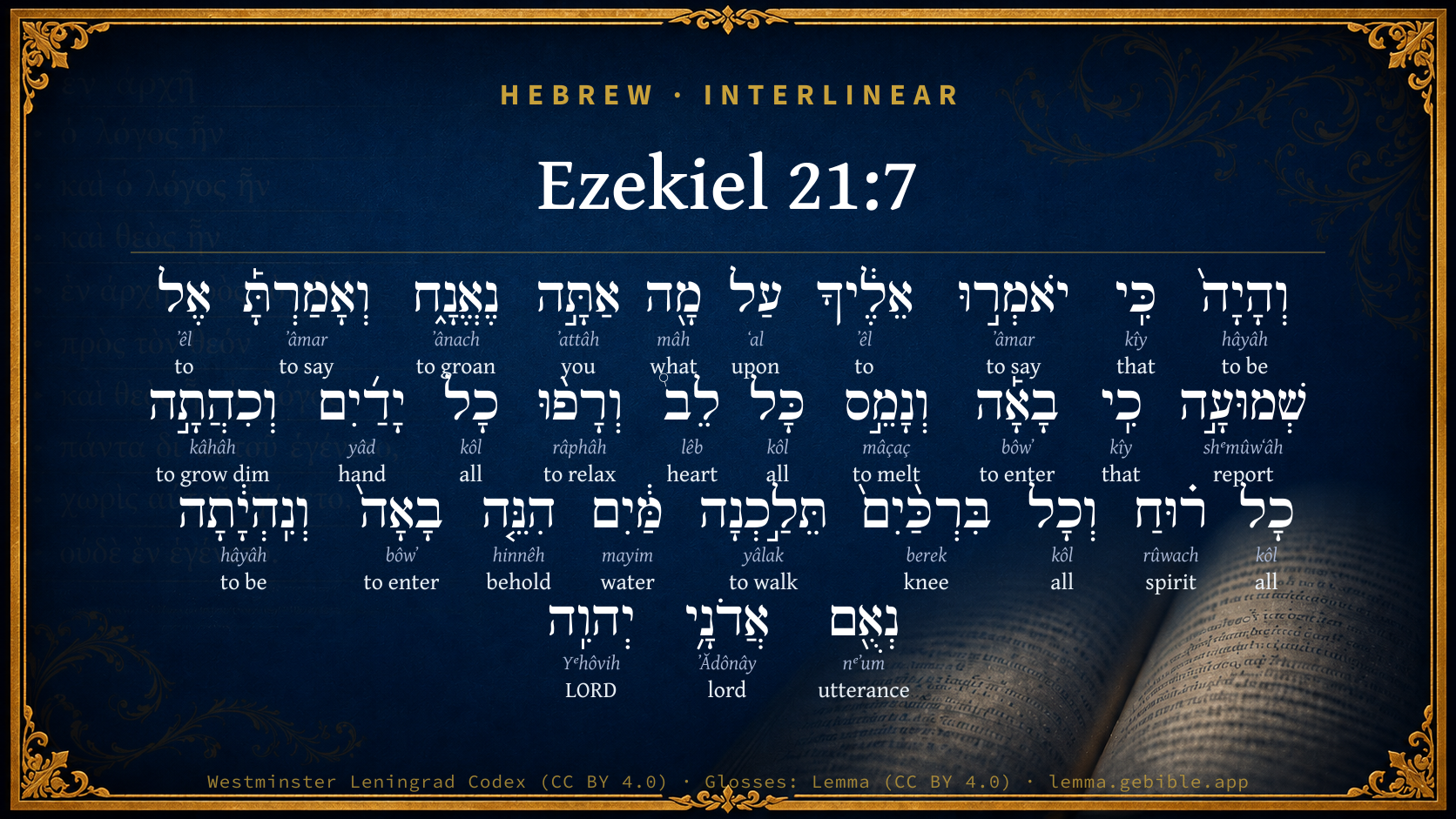
Hebrew (Westminster Leningrad Codex) Ezekiel 21:7 appears in the Hebrew Old Testament. The text above is from the Westminster Leningrad Codex. Each word links to its Strong’s number, a concise gloss, and parsing drawn from the Open Scriptures Hebrew Bible morphology. Click any word for its full Brown-Driver-Briggs (BDB) entry.
Download image
Cite this verse

Ezekiel 21:7 (World English Bible). Public Domain. Lemma interlinear Bible study tool, https://lemma.gebible.app/v/ezekiel/21/7.

Show BibTeX & RIS
BibTeX
RIS
English Translation
It shall be, when they tell you, Why do you sigh? that you shall say, Because of the news, for it comes; and every heart shall melt, and all hands shall be feeble, and every spirit shall faint, and all knees shall be weak as water: behold, it comes, and it shall be done, says the Lord Yahweh.
World English Bible · Public Domain
Download a study sheet

One document with this verse’s original text, its word-by-word gloss line, the meaning frame, cross-references with their text, attributed commentary, and full source and license credits — printable, and it pastes into notes with its structure intact.

This verse Autodidact and up

Study sheet (.html) Plain text (.txt)

A passage Seminary Student

Up to 50 verses in one chapter. A passage sheet keeps up to 6 commentary sources and 12 cross-references per verse, in the order this page ranks them, and says so on the sheet whenever that leaves anything out. Ask for a single verse and you get the Autodidact verse sheet above.

Everything on this page stays free to read, with no account — the sheet is a download of what is already on screen, not access to it.

Want to remove ads? Support Godless Engineer
Compare translations 3

The same verse in 3 English versions, stacked beneath the original-language interlinear above. Click any original word for its lexicon entry.

Each is an independent rendering of the whole verse — the interlinear is not word-aligned to these translations.

Highlighted words mark where these versions differ — a whole-verse word diff, not a word-by-word alignment.

  • World English Bible Public Domain
    It shall be, when they tell you, Why do you sigh? that you shall say, Because of the news, for it comes; and every heart shall melt, and all hands shall be feeble, and every spirit shall faint, and all knees shall be weak as water: behold, it comes, and it shall be done, says the Lord Yahweh.
  • King James Version Public Domain
    And it shall be, when they say unto thee, Wherefore sighest thou? that thou shalt answer, For the tidings; because it cometh: and every heart shall melt, and all hands shall be feeble, and every spirit shall faint, and all knees shall be weak as water: behold, it cometh, and shall be brought to pass, saith the Lord GOD.
  • unfoldingWord Literal Text CC BY-SA 4.0
    Then it will happen that they will ask you, ‘For what reason are you groaning?’ Then you will say, ‘Because of the news that is coming, for every heart will faint away, and every hand will falter! Every spirit will grow faint, and every knee will flow like water. Behold! It is coming and it will be like this!—this is the Lord Yahweh’s declaration.’”

unfoldingWord Literal Text — © unfoldingWord, licensed CC BY-SA 4.0. Word-aligned USFM3 via Door43 (git.door43.org/unfoldingWord/en_ult).

Versions to compare (up to 4)

3 of 4 selected

Show all 18 translations

Every available English version of this verse, each an independent rendering of the whole verse.

  • World English Bible Public Domain
    It shall be, when they tell you, Why do you sigh? that you shall say, Because of the news, for it comes; and every heart shall melt, and all hands shall be feeble, and every spirit shall faint, and all knees shall be weak as water: behold, it comes, and it shall be done, says the Lord Yahweh.
  • Berean Standard Bible Public Domain
    And when they ask, ‘Why are you groaning?’ you are to say, ‘Because of the news that is coming. Every heart will melt, and every hand will go limp. Every spirit will faint, and every knee will turn to water.’ Yes, it is coming and it will surely happen, declares the Lord GOD.”
  • Majority Standard Bible Public Domain
    And when they ask, ‘Why are you groaning?’ you are to say, ‘Because of the news that is coming. Every heart will melt, and every hand will go limp. Every spirit will faint, and every knee will turn to water.’ Yes, it is coming and it will surely happen, declares the Lord GOD.”
  • King James Version Public Domain
    And it shall be, when they say unto thee, Wherefore sighest thou? that thou shalt answer, For the tidings; because it cometh: and every heart shall melt, and all hands shall be feeble, and every spirit shall faint, and all knees shall be weak as water: behold, it cometh, and shall be brought to pass, saith the Lord GOD.
  • American Standard Version (1901) Public Domain
    And it shall be, when they say unto thee, Wherefore sighest thou? that thou shalt say, Because of the tidings, for it cometh; and every heart shall melt, and all hands shall be feeble, and every spirit shall faint, and all knees shall be weak as water: behold, it cometh, and it shall be done, saith the Lord Jehovah.
  • Revised Version (1885) Public Domain
    And it shall be, when they say unto thee, Wherefore sighest thou? that thou shalt say, Because of the tidings, for it cometh: and every heart shall melt, and all hands shall be feeble, and every spirit shall faint, and all knees shall be weak as water: behold, it cometh, and it shall be done, saith the Lord GOD.
  • Geneva Bible (1599) Public Domain
    And if they say vnto thee, Wherefore mournest thou? then answere, Because of the bruite: for it commeth, and euery heart shall melt, and all handes shall be weake, and all mindes shall faint, and all knees shall fall away as water: beholde, it commeth, and shall be done, saith the Lord God.
  • Douay-Rheims (1899) Public Domain
    And when they shall say to thee: Why mournest thou? thou shalt say: For that which I hear: because it cometh, and every heart shall melt, and all hands shall be made feeble, and every spirit shall faint, and water shall run down every knee: behold it cometh, and it shall be done, saith the Lord God.
  • Young's Literal Translation Public Domain
    and it hath come to pass, when they say unto thee, For what art thou sighing? that thou hast said: Because of the report, for it is coming, And melted hath every heart, And feeble hath been all hands, And weak is every spirit, And all knees go -- waters, Lo, it is coming, yea, it hath been, An affirmation of the Lord Jehovah.'
  • Literal Standard Version CC BY-SA 4.0
    and it has come to pass, when they say to you, Why are you sighing? That you have said: Because of the report, for it is coming, || And every heart has melted, || And all hands have been feeble, || And every spirit is weak, || And all knees go [as] waters, || Behold, it is coming, indeed, it has been, || A declaration of Lord YHWH.”
  • Unlocked Literal Bible CC BY-SA 4.0
    Then it will happen that they will ask you, 'For what reason are you groaning?' Then you will say, 'Because of the news that is coming, for every heart will faint away, and every hand will falter! Every spirit will grow faint, and every knee will flow like water. Behold! It is coming and it will be like this!—this is the Lord Yahweh's declaration.'”
  • unfoldingWord Literal Text CC BY-SA 4.0
    Then it will happen that they will ask you, ‘For what reason are you groaning?’ Then you will say, ‘Because of the news that is coming, for every heart will faint away, and every hand will falter! Every spirit will grow faint, and every knee will flow like water. Behold! It is coming and it will be like this!—this is the Lord Yahweh’s declaration.’”
  • Darby Bible Public Domain
    And it shall be, when they say unto thee, Wherefore dost thou sigh? that thou shalt say, Because of the tidings, for it cometh; and every heart shall melt, and all hands shall be feeble, and every spirit shall languish, and all knees shall melt into water: behold, it cometh; it is here, saith the Lord Jehovah.
  • World Messianic Bible Public Domain
    It shall be, when they ask you, ‘Why do you sigh?’ that you shall say, ‘Because of the news, for it comes! Every heart will melt, all hands will be feeble, every spirit will faint, and all knees will be weak as water. Behold, it comes, and it shall be done, says the Lord GOD.’”
  • Webster's Bible Public Domain
    And it shall be, when they say to thee, Why sighest thou? that thou shalt answer, For the tidings; because it cometh: and every heart shall melt, and all hands shall be feeble, and every spirit shall faint, and all knees shall be weak as water: behold, it cometh, and shall be brought to pass, saith the Lord GOD.
  • Free Bible Version CC BY-SA 4.0
    When they ask, ‘What are you groaning for?’ you are to tell them, ‘Because of the news that's coming. All of you will lose your courage and you'll be paralyzed with fear. All of you will be weak with worry—you won't be able to stand up!’ Watch out, because it's coming! It's going to happen! declares the Lord God.”
  • Bible in Basic English Public Domain
    And when they say to you, Why are you making sounds of grief? then say, Because of the news, for it is coming: and every heart will become soft, and all hands will be feeble, and every spirit will be burning low, and all knees will be turned to water: see, it is coming and it will be done, says the Lord.
  • JPS Tanakh (1917) Public Domain
    (21-12) And it shall be, when they say unto thee: Wherefore sighest thou? that thou shalt say: Because of the tidings, for it cometh; and every heart shall melt, and all hands shall be slack, and every spirit shall be faint, and all knees shall drip with water; behold, it cometh, and it shall be done, saith the Lord GOD.'

Literal Standard Version (2020), Covenant Press — licensed CC BY-SA 4.0. Text via the HelloAO Bible API (eBible.org). Unlocked Literal Bible (unfoldingWord) — licensed CC BY-SA 4.0. Text via the HelloAO Bible API (eBible.org). unfoldingWord Literal Text — © unfoldingWord, licensed CC BY-SA 4.0. Word-aligned USFM3 via Door43 (git.door43.org/unfoldingWord/en_ult). Free Bible Version, Dr. Jonathan Gallagher — licensed CC BY-SA 4.0. Text via the HelloAO Bible API (eBible.org).

Word by word

More ways to search: Search by grammar → Find every occurrence → Compare this word →

Practice this passage: Drill this verse → Learn its vocabulary →

וְכִהֲתָ֣ה
kâhâh
H3543
“and · to grow dim”
Conjunction + Verb, Piel, Sequential Perfect, 3rd Person, Feminine, Singular
Part of Speech
Conjunction + Verb
Stem
Piel
Form
Sequential Perfect
Person
3rd Person
Gender
Feminine
Number
Singular
Full BDB Definition

Origin: a primitive root

TWOT: 957

to grow weak, grow dim, grow faint, falter, be weak, be dim, be darkened, be restrained, be faint, fail - (Qal) to grow dim, grow faint - (Piel) to faint, grow weak, grow faint
  1. וְהָיָה֙ hâyâh H1961 “and · to be” Conjunction + Verb, Qal, Sequential Perfect, 3rd Person, Masculine, Singular
  2. כִּֽי kîy H3588 “that” Conjunction
  3. יֹאמְר֣וּ ʼâmar H559 “to say” Verb, Qal, Imperfect, 3rd Person, Masculine, Plural
  4. אֵלֶ֔יךָ ʼêl H413 “to · you” Preposition + Suffix, Personal, 2nd Person, Masculine, Singular
  5. עַל ʻal H5921 “upon” Preposition
  6. מָ֖ה mâh H4100 “what” Particle, Interrogative
  7. אַתָּ֣ה ʼattâh H859 “you” Pronoun, Personal, 2nd Person, Masculine, Singular
  8. נֶאֱנָ֑ח ʼânach H584 “groaning” Verb, Niphal, Participle Active, Masculine, Singular, Absolute
  9. וְאָמַרְתָּ֡ ʼâmar H559 “and · to say” Conjunction + Verb, Qal, Sequential Perfect, 2nd Person, Masculine, Singular
  10. אֶל ʼêl H413 “to” Preposition
  11. שְׁמוּעָ֣ה shᵉmûwʻâh H8052 “report” Noun, Common, Feminine, Singular, Absolute
  12. כִֽי kîy H3588 “that” Conjunction
  13. בָאָ֡ה bôwʼ H935 “entering” Verb, Qal, Participle Active, Feminine, Singular, Absolute
  14. וְנָמֵ֣ס mâçaç H4549 “and · to melt” Conjunction + Verb, Niphal, Sequential Perfect, 3rd Person, Masculine, Singular
  15. כָּל kôl H3605 “all of” Noun, Common, Masculine, Singular, Construct
  16. לֵב֩ lêb H3820 “heart” Noun, Common, Masculine, Singular, Absolute
  17. וְרָפ֨וּ râphâh H7503 “and · to relax” Conjunction + Verb, Qal, Sequential Perfect, 3rd Person, Common, Plural
  18. כָל kôl H3605 “all of” Noun, Common, Masculine, Singular, Construct
  19. יָדַ֜יִם yâd H3027 “hands” Noun, Common, Both, Dual, Absolute
  20. כָל kôl H3605 “all of” Noun, Common, Masculine, Singular, Construct
  21. ר֗וּחַ rûwach H7307 “spirit” Noun, Common, Both, Singular, Absolute
  22. וְכָל kôl H3605 “and · all of” Conjunction + Noun, Common, Masculine, Singular, Construct
  23. בִּרְכַּ֨יִם֙ berek H1290 “knees” Noun, Common, Feminine, Dual, Absolute
  24. תֵּלַ֣כְנָה yâlak H3212 “to walk” Verb, Qal, Imperfect, 3rd Person, Feminine, Plural
  25. מַּ֔יִם mayim H4325 “water(s)” Noun, Common, Masculine, Plural, Absolute
  26. הִנֵּ֤ה hinnêh H2009 “behold” Particle, Demonstrative
  27. בָאָה֙ bôwʼ H935 “entering” Verb, Qal, Participle Active, Feminine, Singular, Absolute
  28. וְנִֽהְיָ֔תָה hâyâh H1961 “and · to be” Conjunction + Verb, Niphal, Sequential Perfect, 3rd Person, Feminine, Singular
  29. נְאֻ֖ם nᵉʼum H5002 “utterance of” Noun, Common, Masculine, Singular, Construct
  30. אֲדֹנָ֥י ʼĂdônây H136 “Lord · my” Noun, Common, Masculine, Plural, Construct + Suffix, Personal, 1st Person, Common, Singular
  31. יְהוִֽה Yᵉhôvih H3069 “LORD” Noun, Proper

About this verse

These counts appear in no published source. They are computed here, from the morphology-tagged text and Lemma’s own curated glosses. What Lemma adds →

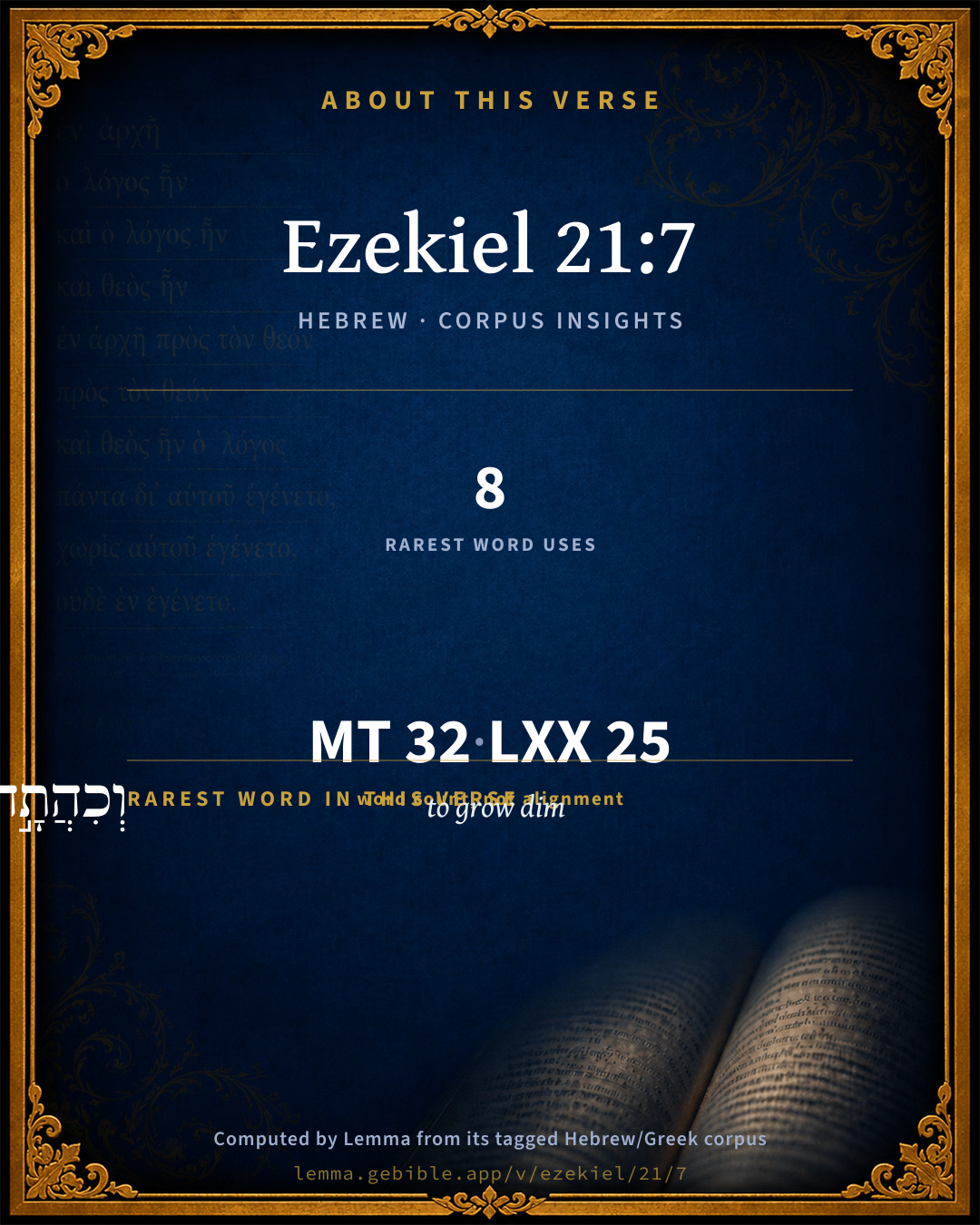
32
words
24
distinct lemmas
Prophets
section

Notable vocabulary

The rarest word here is וְכִהֲתָ֣ה to grow dim H3543 — appearing just 8 times in the whole Hebrew Bible.

Shared distinctive vocabulary

וְכִהֲתָ֣ה to grow dim H3543 occurs in 7 verses of the Hebrew Bible. Also found in:

Grammatical profile

  • 11 verbs
  • 13 nouns
  • 1 pronoun
  • 3 prepositions
  • 2 conjunctions
  • 2 particles

Verb forms

  • וְהָיָה֙ Qal · Sequential Perfect
  • יֹאמְר֣וּ Qal · Imperfect
  • נֶאֱנָ֑ח Niphal · Participle Active
  • וְאָמַרְתָּ֡ Qal · Sequential Perfect
  • בָאָ֡ה Qal · Participle Active
  • וְנָמֵ֣ס Niphal · Sequential Perfect
  • וְרָפ֨וּ Qal · Sequential Perfect
  • וְכִהֲתָ֣ה Piel · Sequential Perfect
  • תֵּלַ֣כְנָה Qal · Imperfect
  • בָאָה֙ Qal · Participle Active
  • וְנִֽהְיָ֔תָה Niphal · Sequential Perfect

Repetition

Words recur within this verse — often emphatic in Hebrew:

  • כָּל all H3605 ×4
  • וְהָיָה֙ to be H1961 ×2
  • יֹאמְר֣וּ to say H559 ×2
  • בָאָ֡ה to enter H935 ×2
  • כִּֽי that H3588 ×2
  • אֵלֶ֔יךָ to H413 ×2

Hebrew & Septuagint length

In English translation the verse runs 58 words from the Hebrew and 59 from the Septuagint (LXX English) — closely comparable.

A rough comparison of the two English renderings, which tokenize alike — not a word-level alignment.

Word counts can differ between the Hebrew and the Greek without any difference in meaning — e.g. the Hebrew direct-object marker אֵת has no separate Greek word, and Greek often adds the article ὁ.

In the original languages it is 32 Hebrew tokens and 25 Greek tokens — but the two are counted differently (Hebrew bundles its prefixes and suffixes into one token; the Greek is in lemma form), so that isn’t a like-for-like length.

Cross-references

28

Topical passages linked to Ezekiel 21:7 in the Treasury of Scripture Knowledge — connected by theme and wording, ordered by reader-vote popularity; previews shown in the World English Bible.

  • Ezekiel 7:17 All hands shall be feeble, and all knees shall be weak as water.
  • Isaiah 13:7 Therefore shall all hands be feeble, and every heart of man shall melt:
  • Jeremiah 50:43 The king of Babylon has heard the news of them, and his hands wax feeble: anguish has taken hold of him, [and] pangs as of a woman in travail.
  • Ezekiel 7:26 Mischief shall come on mischief, and rumor shall be on rumor; and they shall seek a vision of the prophet; but the law shall perish from the priest, and counsel from the elders.
  • Nahum 2:10 She is empty, void, and waste. The heart melts, the knees knock together, their bodies and faces have grown pale.
  • Hebrews 12:12 Therefore, lift up the hands that hang down and the feeble knees,
  • Exodus 15:15 Then the chiefs of Edom were dismayed. Trembling takes hold of the mighty men of Moab. All the inhabitants of Canaan are melted away.
  • Deuteronomy 20:8 The officers shall speak further to the people, and they shall say, What man is there who is fearful and faint-hearted? let him go and return to his house, lest his brother's heart melt as his heart.
  • Joshua 2:9–11 and she said to the men, I know that Yahweh has given you the land, and that the fear of you is fallen on us, and that all the inhabitants of the land melt away before you.
  • Joshua 5:1 It happened, when all the kings of the Amorites, who were beyond the Jordan westward, and all the kings of the Canaanites, who were by the sea, heard how that Yahweh had dried up the waters of the Jordan from before the children of Israel, until we were passed over, that their heart melted, neither was there spirit in them any more, because of the children of Israel.
  • 2 Samuel 17:10 Even he who is valiant, whose heart is as the heart of a lion, will utterly melt; for all Israel knows that your father is a mighty man, and those who are with him are valiant men.
  • 2 Kings 21:12 therefore thus says Yahweh, the God of Israel, Behold, I bring such evil on Jerusalem and Judah, that whoever hears of it, both his ears shall tingle.
  • Job 4:3–4 Behold, you have instructed many, You have strengthened the weak hands.
  • Isaiah 7:2 It was told the house of David, saying, "Syria is allied with Ephraim." His heart trembled, and the heart of his people, as the trees of the forest tremble with the wind.
  • Isaiah 28:19 As often as it passes though, it shall take you; for morning by morning shall it pass through, by day and by night: and it shall be nothing but terror to understand the message.
  • Isaiah 35:3 Strengthen you the weak hands, and confirm the feeble knees.
  • Jeremiah 6:22–24 Thus says Yahweh, Behold, a people comes from the north country; and a great nation shall be stirred up from the uttermost parts of the earth.
  • Jeremiah 8:18 Oh that I could comfort myself against sorrow! my heart is faint within me.
  • Jeremiah 49:23 Of Damascus. Hamath is confounded, and Arpad; for they have heard evil news, they are melted away: there is sorrow on the sea; it can't be quiet.
  • Lamentations 5:17 For this our heart is faint; For these things our eyes are dim;
  • Ezekiel 7:2–12 You, son of man, thus says the Lord Yahweh to the land of Israel, An end: the end is come on the four corners of the land.
  • Ezekiel 12:9–11 Son of man, has not the house of Israel, the rebellious house, said to you, What do you?
  • Ezekiel 12:22–28 Son of man, what is this proverb that you have in the land of Israel, saying, The days are prolonged, and every vision fails?
  • Ezekiel 20:49 Then said I, Ah Lord Yahweh! they say of me, Isn't he a speaker of parables?
  • Ezekiel 24:19 The people said to me, Won't you tell us what these things are to us, that you do so?
  • Luke 21:26 men fainting for fear, and for expectation of the things which are coming on the world: for the powers of the heavens will be shaken.
  • Leviticus 26:36 "'As for those of you who are left, I will send a faintness into their hearts in the lands of their enemies: and the sound of a driven leaf will put them to flight; and they shall flee, as one flees from the sword; and they will fall when no one pursues.
  • 1 Peter 4:7 But the end of all things is near. Therefore be of sound mind, self-controlled, and sober in prayer.

Cross-references courtesy of OpenBible.info (CC BY 4.0).

Hebrew and Greek witnesses Masoretic Hebrew ↔ Greek Septuagint

The same verse in the two great witnesses to the Old Testament, shown verse-for-verse.

These are two independent witnesses, not word-aligned to each other, and the Septuagint is shown in lemma (dictionary) form.

Hebrew Ezekiel 21:7 Masoretic · Westminster Leningrad Codex

וְהָיָה֙ כִּֽי יֹאמְר֣וּ אֵלֶ֔יךָ עַל מָ֖ה אַתָּ֣ה נֶאֱנָ֑ח וְאָמַרְתָּ֡ אֶל שְׁמוּעָ֣ה כִֽי בָאָ֡ה וְנָמֵ֣ס כָּל לֵב֩ וְרָפ֨וּ כָל יָדַ֜יִם וְכִהֲתָ֣ה כָל ר֗וּחַ וְכָל בִּרְכַּ֨יִם֙ תֵּלַ֣כְנָה מַּ֔יִם הִנֵּ֤ה בָאָה֙ וְנִֽהְיָ֔תָה נְאֻ֖ם אֲדֹנָ֥י יְהוִֽה

It shall be, when they tell you, Why do you sigh? that you shall say, Because of the news, for it comes; and every heart shall melt, and all hands shall be feeble, and every spirit shall faint, and all knees shall be weak as water: behold, it comes, and it shall be done, says the Lord Yahweh.

World English Bible · Public Domain

Greek LXX Ezekiel 21:7 Septuagint · lemma form

διά οὗτος προφητεύω υἱός ἄνθρωπος καί στηρίζω ὁ πρόσωπον σύ ἐπί ἰερουσαλήμ καί ἐπιβλέπω ἐπί ὁ ἅγιος αὐτός καί προφητεύω ἐπί ὁ γῆ ὁ ἰσραήλ

And it shall come to pass, if they shall say to you, Therefore do you groan? that you shall say, For the report; because it comes: and every heart shall break, and all hands shall become feeble, and all flesh and every spirit shall faint, and all thighs shall be defiled with moisture: behold, it comes, says the Lord.

LXX2012 (modern English Septuagint) · Public Domain

On this verse, The Cambridge Bible for Schools and Colleges discusses the Septuagint’s reading. Read the note in Commentary ↓

Hebrew: Westminster Leningrad Codex (CC BY 4.0). Greek: Septuagint (public domain); English from LXX2012 (modern English Septuagint) (Public Domain). How the Septuagint differs from the Hebrew →

Targum (Aramaic paraphrase)

1

The Targum is the ancient Jewish Aramaic paraphrase of the Hebrew Scriptures — an interpretive translation, not the Hebrew text itself. Onkelos (literal) and Pseudo-Jonathan (expansive) render the Torah, and Jonathan the Prophets. Coverage is partial: where no permissively-licensed English translation exists for a verse, only the Aramaic is shown. This is verse-level text, not a word-by-word alignment to the Hebrew.

  1. Targum Jonathan Prophets (Joshua–Malachi)
    בַּר אָדָם קַבֵיל נְבוּאָה עַל יְרוּשְׁלֵם וְאַלֵיף עַל מַקְדְשִׁין וְאִתְנַבֵּי עַל אַרְעָא דְיִשְׂרָאֵל:

    (no public-domain English translation for this verse)

    Targum Jonathan — Aramaic: “Mikraot Gedolot” (public domain). English: “Sefaria Community Translation” (CC0 1.0 (public-domain dedication)); “London "Chaldee Paraphrase," 1871” (public domain). Text via Sefaria.

Commentary

Notes on Ezekiel 21:7 from classic Christian and Jewish commentators (each source and its license shown beneath its notes). The classic Christian expositions comment on the surrounding passage and are grouped to its opening verse, so a note may address several verses; the Jewish commentaries on the Tanakh (Rashi and others) are per-verse, so they appear only where the commentator wrote on this verse.

Lemma curates 59 commentaries, every one of them public domain or Creative Commons licensed, each selected and text-cleaned for this edition rather than reprinted as found. About our sources →

Trapp's Complete Commentary

John Trapp

Eze 21:7 And it shall be, when they say unto thee, Wherefore sighest thou? that thou shalt answer, For the tidings; because it cometh: and every heart shall melt, and all hands shall be feeble, and every spirit shall faint, and all knees shall be weak [as] water: behold, it cometh, and shall be brought to pass, saith the Lord GOD.

Ver. 7. For the tidings.] Of the Chaldeans’ coming. This was to the wicked as those knuckles of a man’s hand were afterwards to Belshazzar, to write them their destiny; or as Daniel was to him, to read it unto them. Whenas the righteous man is no whit "afraid of evil tidings, his heart is fixed trusting in the Lord." {Psa 112:7}

And every heart shall melt, &c.] As wax before the fire, which, before the danger, seemed to be made all of steel or adamant. The wicked, when in adversity, are woefully despondent and crest fallen, as was the king of Sodom; {Gen 14:9-11} Manasseh among the bushes; {2Ch 33:12} and others not a few, who in their prosperity seem to face the heavens and to draw the devil himself to a duel.

And all hands shall be feeble.] The spirits and blood being run to the heart, in that fright to relieve it.

And all knees shall be weak as water.] Heb., Shall go into water - that is, they shall bepiss themselves for fear, saith Jerome; they shall be all on a cold sweat, say others; or their knees shall shake, instar aquae tremulae, like trembling water, and knock together, as Belshazzar’s did. {Dan 5:6}

John Trapp, A Commentary or Exposition upon All the Books of the Old and New Testament (1647–1656) — public domain. Text from a community e-Sword module.

Geneva Bible (1599)

Geneva Bible translators

Because of the great noise of the army of the Chaldeans.

Geneva Bible (1599) marginal notes — public domain. Text via Bolls.life.

Jamieson, Fausset & Brown

Robert Jamieson, A. R. Fausset & David Brown

The abrupt sentences and mournful repetitions imply violent emotions.

Jamieson, Fausset & Brown — Commentary Critical and Explanatory on the Whole Bible (1871) — public domain (CC PDM 1.0). Text via the HelloAO Bible API.

Adam Clarke's Commentary

Verse 7. Wherefore sighest thou?] The prophet was a sign unto them. His sighing and mourning showed them how they should act.

All knees shall be weak as water] See Clarke on Eze 7:17.

Adam Clarke's Commentary on the Bible (1810–1826) — public domain. Text from a community e-Sword/MySword module.

The Cambridge Bible for Schools and Colleges

gen. ed. J. J. S. Perowne

7. it cometh] i.e. the overwhelming disaster. The words, “and … to pass” are wanting in LXX.

The Cambridge Bible for Schools and Colleges (gen. ed. J. J. S. Perowne; Cambridge University Press, 1878–1918) — public domain. Text from a community e-Sword module.

John Gill's Exposition

Again, the word of the Lord came unto me, saying. Either this is a new prophecy of another sword, distinct and different from that of the Chaldeans, even of the sword of the Romans, as Cocceius thinks or it is a further explanation of the former, and an enlargement upon it.

Again, the word of the Lord came unto me, saying. Either this is a new prophecy of another sword, distinct and different from that of the Chaldeans, even of the sword of the Romans, as Cocceius thinks or it is a further explanation of the former, and an enlargement upon it.

Ezekiel 21:9

eze 21:9

eze 21:9

eze 21:9Son of man, prophesy and say, thus saith the Lord,.... Deliver out the following prophecy in the name of the Lord:

say, a sword, a sword is sharpened, and also furbished; it is not only drawn out of its sheath, as before, but is made sharp and bright, and ready for use. It is repeated, either to show the certainty of it, or to express the terror and anguish of mind on account of it; persons in distress generally repeating that which is the occasion of it. The Targum interprets it of two swords, the sword of the Babylonians, and the sword of the Ammonites; first the one was to be used, and then the other: this latter, Jarchi and Kimchi observe, was fulfilled by Ishmael the son of Nethaniah slaying Gedaliah, sent for that purpose by Baalis king of the Ammonites, Jer 40:14, but if two distinct swords are meant, I should rather think the sword of the Chaldeans, and the sword of the Romans, are intended. Cocceius, before observed, interprets it only of the latter; but Abendana both of the sword of the king of Babylon, and of the sword of the Romans.

John Gill's Exposition of the Whole Bible (1746–1763) — public domain (CC PDM 1.0). Text via the HelloAO Bible API.

Haydock's Catholic Bible Commentary

Melt. Literally, "decay," Josue vii., &c. --- Knee. Chap. vii. 17. (Haydock)

George Leo Haydock (1774–1849), Haydock's Catholic Family Bible and Commentary, 1859 edition — public domain. Excludes Psalms (Douay-Rheims chapter numbering differs from Protestant) and Deuterocanonical books (Catholic canon only).

Matthew Poole's English Annotations

This directs the prophet what account to give them, when they shall, as they certainly will, inquire what he meaneth by such unusual sorrows. Is it any private misery that makes thee sigh thus, or does it bode evil to others, or to us?

For the tidings; the news that is told me from Heaven, for the certain rumour of Nebuchadnezzar’s preparations, and march against you. The saddest news you ever heard is coming, it will most assuredly come. The courage of the stoutest heart shall fail. which shall appear in the feebleness of their hands, dejectedness of their spirit, and their knees not able to support the body; such terrors shall seize them as shall make them unable to shift from, or to make head against, the evils that come against them.

It cometh; none can prevent it.

Shall be brought to pass; it shall have its full effect, nothing shall be wanting to your complete undoing, and then, as I do for a sign to you, so you and yours shall do under the sorrows signified, sigh, and weep, to the breaking your very heart.

Matthew Poole's English Annotations on the Holy Bible (1683–1685) — public domain. Text from a community e-Sword/MySword module.

Whedon's Commentary on the Bible

Daniel D. Whedon

7. Faint — Rather, dulled.

Weak as water — Rather, melt into waters.

THE ODE OF THE SWORD, Eze_21:8-22.

This is a wild and irregular song of war, and, as Dr. Muller says, is one of the most powerful passages which we possess from the pen of Ezekiel. It is a “cry” rather than a poem (Eze_21:12). Yet it not only shows the parallelism common to Hebrew poetry, but evident traces of meter (D.H. Muller, Die Propheten, 1896).

The niceties of grammar are neglected, and to those who cannot see the singer’s gestures and hear his wails (Eze_21:6; Eze_21:12) there may seem a lack of connection between the lines and considerable obscurity of meaning. Dr. Skinner has given a good idea “both of the structure and the rugged vigor of the original,” though there are some phrases which he does not attempt to translate: —

I.

A sword, a sword! It is sharpened and burnished withal.

For a work of slaughter is it sharpened!

To gleam like lightning burnished!

* * * * * * * * * * * *

And ‘twas given to be smoothed for the grip of the hand,

Sharpened is it, and furbished —

To put in the hand of the slayer

(Eze_21:14-16).

II.

Cry and howl, son of man!

For it has come among my people;

Come among all the princes of Israel!

Victims of the sword are they, they and my people;

Therefore smite upon thy thigh!

* * * * * * * * * * * *

It shall not be, saith Jehovah the Lord

(Eze_21:17-18).

III.

But, thou son of man, prophesy, and smite hand on hand;

Let the sword be doubled and tripled (?)

A sword of the slain is it,

the great sword of the slain whirling around them —

That hearts may fail, and many be the fallen in all their gates.

* * * * * * * * * * * *

It is made like lightning, furbished for slaughter!

(Eze_21:19-20.)

IV.

Gather thee together! Smite to the right, to the left,

Whithersoever thine edge is appointed!

And I also will smite hand on hand,

And appease my wrath:

I Jehovah have spoken it (Eze_21:21-22).

As Dr. Skinner remarks, this ode, in spite of its obscurity and its abrupt transitions, exhibits a definite poetic form and a real progress of thought from the beginning to the close. “The prophet’s gaze is fascinated by the glittering sword which symbolized the instrument of Jehovah’s vengeance.”

In the opening stanza he describes the preparation of the sword, then (II) he announces the purpose for which it is prepared. In the next stanza (III) he sees the sword in action, and at length, having accomplished its work, it is seen at rest (IV).

Daniel D. Whedon (gen. ed.), Commentary on the Old and New Testaments (1874–1909) — public domain. Text from a community e-Sword module.

John Wesley's Explanatory Notes

Because - The saddest news you ever heard is coming.

John Wesley, Explanatory Notes Upon the Whole Bible (1754–1765) — public domain. Text via the GEBible commentary corpus.

Rashi

Rabbi Shlomo Yitzchaki (Rashi)

and prophesy Heb. וְהַטֵף, and prophesy. Similarly (Micah 2:6): “Preach (תַטִיפוּ) not”; (Amos 7: 16), “and do not prophesy (תַטִיף) concerning the house of Isaac.”

about the sanctuaries That is the forest of the field.

Sanctuaries denotes the two destructions.

Rashi on the Tanakh — English translations: “The Judaica Press complete Tanach with Rashi, translated by A. J. Rosenberg” (CC BY 4.0); “Pentateuch with Rashi's commentary by M. Rosenbaum and A.M. Silbermann, 1929-1934” (public domain); “The Metsudah Tanach series, Lakewood, N.J” (CC BY 4.0); and “The Book of Joshua, Metsudah Publications, 1997” (CC BY 4.0). Text via Sefaria.

Lesson kit

Teaching starters — assembled from the data on this page, not authored interpretation. Every prompt links to the verse data it draws on. Edit before teaching.

Ezekiel, in the Prophets, opens this verse with 32 words (24 distinct Hebrew lemmas). Its most distinctive word is kâhâh (“to grow dim”). A historical commentator’s framing appears above. Read the whole chapter for the surrounding context.

Discussion questions

  1. What does “to grow dim” (kâhâh) contribute to the verse as a whole?
  2. How does Genesis 27:1, which shares the word «to grow dim», read alongside this verse?
  3. What does the repetition of “all” (4× in this one verse) do in this verse?
  4. These translations render this verse differently. What is at stake in choosing one wording over another?
  5. «וְהָיָה֙» is a Qal Sequential Perfect verb. How does that grammatical form shape the action described?
  6. Compare how Trapp's Complete Commentary and Geneva Bible (1599) read this verse. Where do they agree or differ?

Things to notice

Reading settings

Reading text

Shown beneath each verse's original-language words.

Old Testament
Old Testament edition

Read the OT as the Masoretic Hebrew (MT) or the Greek Septuagint (LXX).

English shown for the Greek Septuagint (in the Hebrew ↔ Greek comparison).

Comparing translations? Open the Compare panel on any verse page to stack up to four side by side.