
Isaiah 39:3

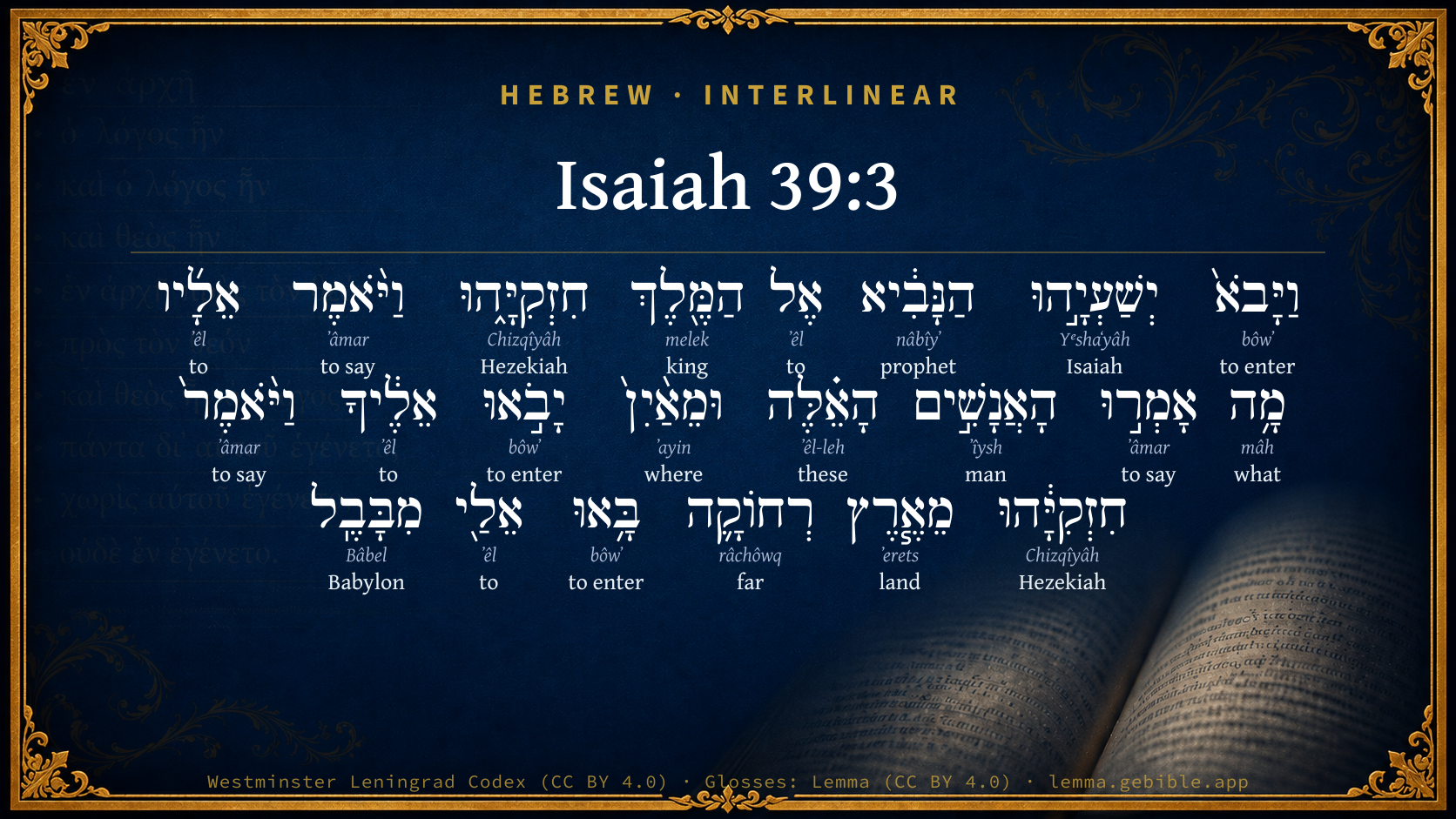
Hebrew (Westminster Leningrad Codex) Isaiah 39:3 appears in the Hebrew Old Testament. The text above is from the Westminster Leningrad Codex. Each word links to its Strong’s number, a concise gloss, and parsing drawn from the Open Scriptures Hebrew Bible morphology. Click any word for its full Brown-Driver-Briggs (BDB) entry.
Download image
Cite this verse

Isaiah 39:3 (World English Bible). Public Domain. Lemma interlinear Bible study tool, https://lemma.gebible.app/v/isaiah/39/3.

Show BibTeX & RIS
BibTeX
RIS
English Translation
Then came Isaiah the prophet to king Hezekiah, and said to him, What said these men? and from whence came they to you? Hezekiah said, They are come from a far country to me, even from Babylon.
World English Bible · Public Domain
Download a study sheet

One document with this verse’s original text, its word-by-word gloss line, the meaning frame, cross-references with their text, attributed commentary, and full source and license credits — printable, and it pastes into notes with its structure intact.

This verse Autodidact and up

Study sheet (.html) Plain text (.txt)

A passage Seminary Student

Up to 50 verses in one chapter. A passage sheet keeps up to 6 commentary sources and 12 cross-references per verse, in the order this page ranks them, and says so on the sheet whenever that leaves anything out. Ask for a single verse and you get the Autodidact verse sheet above.

Everything on this page stays free to read, with no account — the sheet is a download of what is already on screen, not access to it.

Want to remove ads? Support Godless Engineer
Compare translations 3

The same verse in 3 English versions, stacked beneath the original-language interlinear above. Click any original word for its lexicon entry.

Each is an independent rendering of the whole verse — the interlinear is not word-aligned to these translations.

Highlighted words mark where these versions differ — a whole-verse word diff, not a word-by-word alignment.

  • World English Bible Public Domain
    Then came Isaiah the prophet to king Hezekiah, and said to him, What said these men? and from whence came they to you? Hezekiah said, They are come from a far country to me, even from Babylon.
  • King James Version Public Domain
    Then came Isaiah the prophet unto king Hezekiah, and said unto him, What said these men? and from whence came they unto thee? And Hezekiah said, They are come from a far country unto me, even from Babylon.
  • unfoldingWord Literal Text CC BY-SA 4.0
    And Isaiah the prophet came to King Hezekiah and said to him, “What did these men say, and from where did they come to you?” And Hezekiah said, “They came to me from a distant land, from Babylon.”

unfoldingWord Literal Text — © unfoldingWord, licensed CC BY-SA 4.0. Word-aligned USFM3 via Door43 (git.door43.org/unfoldingWord/en_ult).

Versions to compare (up to 4)

3 of 4 selected

Show all 18 translations

Every available English version of this verse, each an independent rendering of the whole verse.

  • World English Bible Public Domain
    Then came Isaiah the prophet to king Hezekiah, and said to him, What said these men? and from whence came they to you? Hezekiah said, They are come from a far country to me, even from Babylon.
  • Berean Standard Bible Public Domain
    Then the prophet Isaiah went to King Hezekiah and asked, “Where did those men come from, and what did they say to you?” “They came to me from a distant land,” Hezekiah replied, “from Babylon.”
  • Majority Standard Bible Public Domain
    Then the prophet Isaiah went to King Hezekiah and asked, “Where did those men come from, and what did they say to you?” “They came to me from a distant land,” Hezekiah replied, “from Babylon.”
  • King James Version Public Domain
    Then came Isaiah the prophet unto king Hezekiah, and said unto him, What said these men? and from whence came they unto thee? And Hezekiah said, They are come from a far country unto me, even from Babylon.
  • American Standard Version (1901) Public Domain
    Then came Isaiah the prophet unto king Hezekiah, and said unto him, What said these men? and from whence came they unto thee? And Hezekiah said, They are come from a far country unto me, even from Babylon.
  • Revised Version (1885) Public Domain
    Then came Isaiah the prophet unto king Hezekiah, and said unto him, What said these men? and from whence came they unto thee? And Hezekiah said, They are come from a far country unto me, even from Babylon.
  • Geneva Bible (1599) Public Domain
    Then came Isaiah the Prophet vnto King Hezekiah, and said vnto him, What said these men? and from whence came they to thee? And Hezekiah saide, They are come from a farre countrey vnto me, from Babel.
  • Douay-Rheims (1899) Public Domain
    Then Isaias the prophet came to king Ezechias, and said to him: What said these men, and from whence came they to thee? And Ezechias said: From a far country they came to me, from Babylon
  • Young's Literal Translation Public Domain
    And Isaiah the prophet cometh in unto king Hezekiah, and saith unto him, `What said these men? and whence come they unto thee?' And Hezekiah saith, `From a land afar off they have come unto me -- from Babylon.'
  • Literal Standard Version CC BY-SA 4.0
    And Isaiah the prophet comes to King Hezekiah and says to him, “What did these men say? And from where do they come to you?” And Hezekiah says, “They have come to me from a far-off land—from Babylon.”
  • Unlocked Literal Bible CC BY-SA 4.0
    Then Isaiah the prophet came to King Hezekiah and asked him, “What did these men say to you? Where did they come from?” Hezekiah said, “They came to me from the distant country of Babylon.”
  • unfoldingWord Literal Text CC BY-SA 4.0
    And Isaiah the prophet came to King Hezekiah and said to him, “What did these men say, and from where did they come to you?” And Hezekiah said, “They came to me from a distant land, from Babylon.”
  • Darby Bible Public Domain
    Then came the prophet Isaiah to king Hezekiah, and said to him, What said these men? and from whence came they to thee? And Hezekiah said, They came from a far country to me, from Babylon.
  • World Messianic Bible Public Domain
    Then Isaiah the prophet came to King Hezekiah, and asked him, “What did these men say? From where did they come to you?” Hezekiah said, “They have come from a country far from me, even from Babylon.”
  • Webster's Bible Public Domain
    Then came Isaiah the prophet to king Hezekiah, and said to him, What said these men? and from whence came they to thee? and Hezekiah said, They have come to me from a far country, even from Babylon.
  • Free Bible Version CC BY-SA 4.0
    Then the prophet Isaiah went to King Hezekiah and asked him, “Where did those men come from, and what did they tell you?” “They came to see me from a long way away, from Babylon,” Hezekiah replied.
  • Bible in Basic English Public Domain
    Then Isaiah the prophet came to King Hezekiah, and said to him, What did these men say, and where did they come from? And Hezekiah said, They came from a far country, even from Babylon.
  • JPS Tanakh (1917) Public Domain
    Then came Isaiah the prophet unto king Hezekiah, and said unto him: 'What said these men? and from whence came they unto thee?' And Hezekiah said: 'They are come from a far country unto me, even from Babylon.'

Literal Standard Version (2020), Covenant Press — licensed CC BY-SA 4.0. Text via the HelloAO Bible API (eBible.org). Unlocked Literal Bible (unfoldingWord) — licensed CC BY-SA 4.0. Text via the HelloAO Bible API (eBible.org). unfoldingWord Literal Text — © unfoldingWord, licensed CC BY-SA 4.0. Word-aligned USFM3 via Door43 (git.door43.org/unfoldingWord/en_ult). Free Bible Version, Dr. Jonathan Gallagher — licensed CC BY-SA 4.0. Text via the HelloAO Bible API (eBible.org).

Word by word

More ways to search: Search by grammar → Find every occurrence → Compare this word →

Practice this passage: Drill this verse → Learn its vocabulary →

וּמֵאַ֨יִן֙
ʼayin
H370
“and · from · where”
Conjunction + Preposition + Particle, Interrogative
Part of Speech
Conjunction + Preposition + Particle
Type
Interrogative
Full BDB Definition

Origin: probably identical with H369 in the sense of query (compare H336 )

TWOT: 75f

where?, whence?
  1. וַיָּבֹא֙ bôwʼ H935 “and · to enter” Conjunction + Verb, Qal, Sequential Imperfect, 3rd Person, Masculine, Singular
  2. יְשַׁעְיָ֣הוּ Yᵉshaʻyâh H3470 “Isaiah” Noun, Proper
  3. הַנָּבִ֔יא nâbîyʼ H5030 “the · prophet” Particle, Definite Article + Noun, Common, Masculine, Singular, Absolute
  4. אֶל ʼêl H413 “to” Preposition
  5. הַמֶּ֖לֶךְ melek H4428 “the · king” Particle, Definite Article + Noun, Common, Masculine, Singular, Absolute
  6. חִזְקִיָּ֑הוּ Chizqîyâh H2396 “Hezekiah” Noun, Proper
  7. וַיֹּ֨אמֶר ʼâmar H559 “and · to say” Conjunction + Verb, Qal, Sequential Imperfect, 3rd Person, Masculine, Singular
  8. אֵלָ֜יו ʼêl H413 “to · him” Preposition + Suffix, Personal, 3rd Person, Masculine, Singular
  9. מָ֥ה mâh H4100 “what” Particle, Interrogative
  10. אָמְר֣וּ ʼâmar H559 “to say” Verb, Qal, Perfect, 3rd Person, Common, Plural
  11. הָאֲנָשִׁ֣ים ʼîysh H376 “the · men” Particle, Definite Article + Noun, Common, Masculine, Plural, Absolute
  12. הָאֵ֗לֶּה ʼêl-leh H428 “the · these” Particle, Definite Article + Pronoun, Demonstrative, Common, Plural
  13. יָבֹ֣אוּ bôwʼ H935 “to enter” Verb, Qal, Imperfect, 3rd Person, Masculine, Plural
  14. אֵלֶ֔יךָ ʼêl H413 “to · you” Preposition + Suffix, Personal, 2nd Person, Masculine, Singular
  15. וַיֹּ֨אמֶר֙ ʼâmar H559 “and · to say” Conjunction + Verb, Qal, Sequential Imperfect, 3rd Person, Masculine, Singular
  16. חִזְקִיָּ֔הוּ Chizqîyâh H2396 “Hezekiah” Noun, Proper
  17. מֵאֶ֧רֶץ ʼerets H776 “from · land” Preposition + Noun, Common, Both, Singular, Absolute
  18. רְחוֹקָ֛ה râchôwq H7350 “far” Adjective, Adjective, Feminine, Singular, Absolute
  19. בָּ֥אוּ bôwʼ H935 “to enter” Verb, Qal, Perfect, 3rd Person, Common, Plural
  20. אֵלַ֖י ʼêl H413 “to · me” Preposition + Suffix, Personal, 1st Person, Common, Singular
  21. מִבָּבֶֽל Bâbel H894 “from · Babylon” Preposition + Noun, Proper

About this verse

These counts appear in no published source. They are computed here, from the morphology-tagged text and Lemma’s own curated glosses. What Lemma adds →

22
words
14
distinct lemmas
Prophets
section

Notable vocabulary

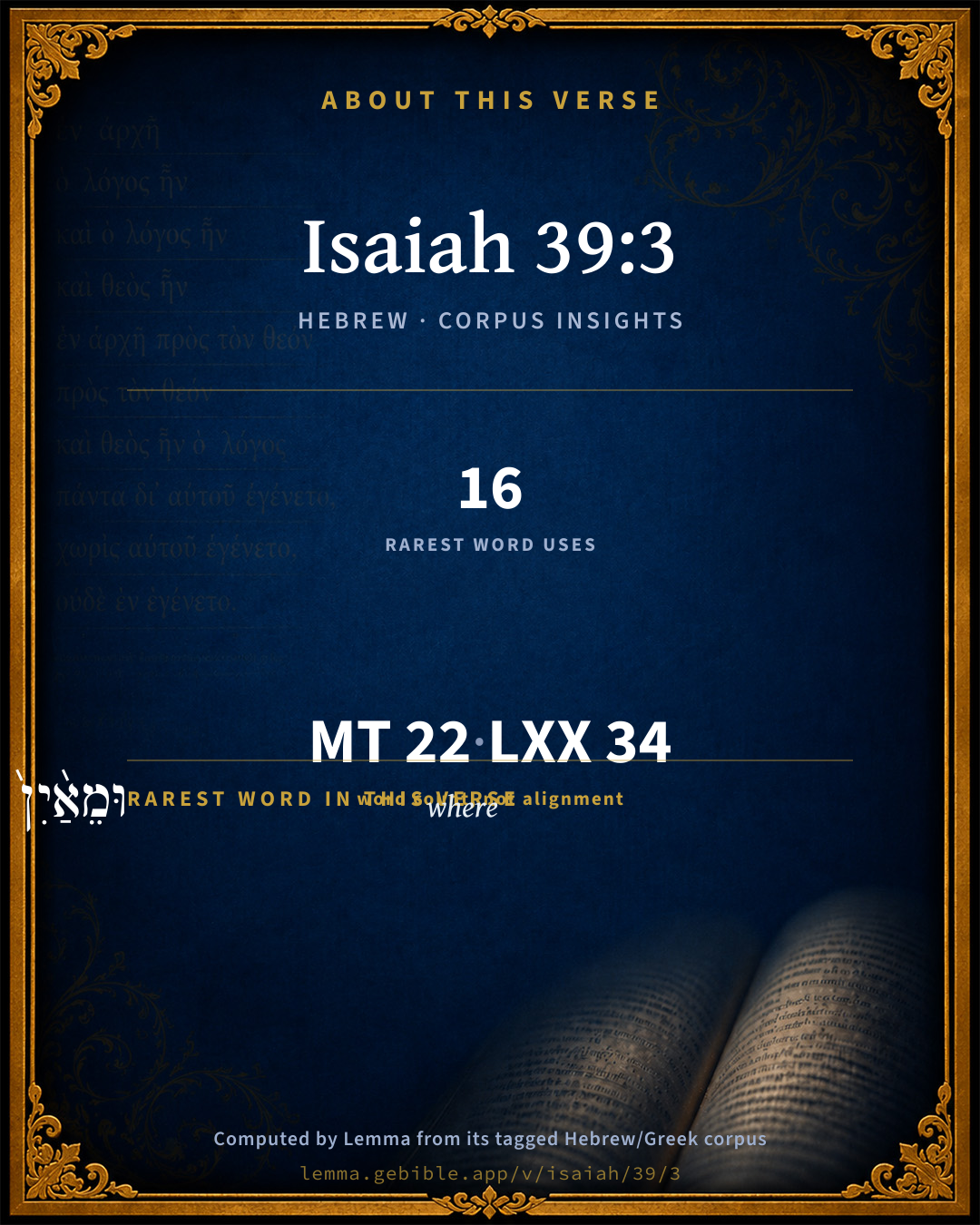
The rarest word here is וּמֵאַ֨יִן֙ where H370 — appearing just 16 times in the whole Hebrew Bible.

Shared distinctive vocabulary

וּמֵאַ֨יִן֙ where H370 occurs in 16 verses of the Hebrew Bible. Also found in:

Grammatical profile

  • 6 verbs
  • 8 nouns
  • 1 adjective
  • 1 pronoun
  • 4 prepositions
  • 2 particles

Verb forms

  • וַיָּבֹא֙ Qal · Sequential Imperfect
  • וַיֹּ֨אמֶר Qal · Sequential Imperfect
  • אָמְר֣וּ Qal · Perfect
  • יָבֹ֣אוּ Qal · Imperfect
  • וַיֹּ֨אמֶר֙ Qal · Sequential Imperfect
  • בָּ֥אוּ Qal · Perfect

Repetition

Words recur within this verse — often emphatic in Hebrew:

  • וַיָּבֹא֙ to enter H935 ×3
  • וַיֹּ֨אמֶר to say H559 ×3
  • חִזְקִיָּ֑הוּ Hezekiah H2396 ×2
  • אֶל to H413 ×4

Hebrew & Septuagint length

In English translation the verse runs 37 words from the Hebrew and 37 from the Septuagint (LXX English) — the same length.

A rough comparison of the two English renderings, which tokenize alike — not a word-level alignment.

Word counts can differ between the Hebrew and the Greek without any difference in meaning — e.g. the Hebrew direct-object marker אֵת has no separate Greek word, and Greek often adds the article ὁ.

In the original languages it is 22 Hebrew tokens and 34 Greek tokens — but the two are counted differently (Hebrew bundles its prefixes and suffixes into one token; the Greek is in lemma form), so that isn’t a like-for-like length.

Cross-references

12

Topical passages linked to Isaiah 39:3 in the Treasury of Scripture Knowledge — connected by theme and wording, ordered by reader-vote popularity; previews shown in the World English Bible.

  • Deuteronomy 28:49 Yahweh will bring a nation against you from far, from the end of the earth, as the eagle flies; a nation whose language you shall not understand;
  • 2 Samuel 12:1 Yahweh sent Nathan to David. He came to him, and said to him, "There were two men in one city; the one rich, and the other poor.
  • 2 Chronicles 16:7 At that time Hanani the seer came to Asa king of Judah, and said to him, Because you have relied on the king of Syria, and have not relied on Yahweh your God, therefore is the host of the king of Syria escaped out of your hand.
  • Jeremiah 5:15 Behold, I will bring a nation on you from far, house of Israel, says Yahweh: it is a mighty nation, it is an ancient nation, a nation whose language you don't know, neither understand what they say.
  • Joshua 9:6 They went to Joshua to the camp at Gilgal, and said to him, and to the men of Israel, We are come from a far country: now therefore make you a covenant with us.
  • Joshua 9:9 They said to him, From a very far country your servants are come because of the name of Yahweh your God: for we have heard the fame of him, and all that he did in Egypt,
  • 2 Kings 20:14–15 Then came Isaiah the prophet to king Hezekiah, and said to him, What said these men? and from whence came they to you? Hezekiah said, They are come from a far country, even from Babylon.
  • 2 Chronicles 25:15 Therefore the anger of Yahweh was kindled against Amaziah, and he sent to him a prophet, who said to him, Why have you sought after the gods of the people, which have not delivered their own people out of your hand?
  • Isaiah 38:1 In those days was Hezekiah sick to death. Isaiah the prophet the son of Amoz came to him, and said to him, Thus says Yahweh, Set your house in order; for you shall die, and not live.
  • Isaiah 38:5 Go, and tell Hezekiah, Thus says Yahweh, the God of David your father, I have heard your prayer, I have seen your tears: behold, I will add to your days fifteen years.
  • Jeremiah 22:1–2 Thus said Yahweh: Go down to the house of the king of Judah, and speak there this word,
  • 2 Chronicles 19:2 Jehu the son of Hanani the seer went out to meet him, and said to king Jehoshaphat, Should you help the wicked, and love those who hate Yahweh? for this thing wrath is on you from before Yahweh.

Cross-references courtesy of OpenBible.info (CC BY 4.0).

Hebrew and Greek witnesses Masoretic Hebrew ↔ Greek Septuagint

The same verse in the two great witnesses to the Old Testament, shown verse-for-verse.

These are two independent witnesses, not word-aligned to each other, and the Septuagint is shown in lemma (dictionary) form.

Hebrew Isaiah 39:3 Masoretic · Westminster Leningrad Codex

וַיָּבֹא֙ יְשַׁעְיָ֣הוּ הַנָּבִ֔יא אֶל הַמֶּ֖לֶךְ חִזְקִיָּ֑הוּ וַיֹּ֨אמֶר אֵלָ֜יו מָ֥ה אָמְר֣וּ הָאֲנָשִׁ֣ים הָאֵ֗לֶּה וּמֵאַ֨יִן֙ יָבֹ֣אוּ אֵלֶ֔יךָ וַיֹּ֨אמֶר֙ חִזְקִיָּ֔הוּ מֵאֶ֧רֶץ רְחוֹקָ֛ה בָּ֥אוּ אֵלַ֖י מִבָּבֶֽל

Then came Isaiah the prophet to king Hezekiah, and said to him, What said these men? and from whence came they to you? Hezekiah said, They are come from a far country to me, even from Babylon.

World English Bible · Public Domain

Greek LXX Isaiah 39:3 Septuagint · lemma form

καί ἔρχομαι ησαιας ὁ προφήτης πρός ὁ βασιλεύς εζεκιας καί εἶπον πρός αὐτός τίς λέγω ὁ ἄνθρωπος οὗτος καί πόθεν ἥκω πρός σύ καί εἶπον εζεκιας ἐκ γῆ πόρρωθεν ἥκω πρός ἐγώ ἐκ βαβυλών

And Esaias the prophet came to king Ezekias, and said to him, What say these men? and whence came they to you? and Ezekias said, They are come to me from a land afar off, from Babylon.

LXX2012 (modern English Septuagint) · Public Domain

Hebrew: Westminster Leningrad Codex (CC BY 4.0). Greek: Septuagint (public domain); English from LXX2012 (modern English Septuagint) (Public Domain). How the Septuagint differs from the Hebrew →

Targum (Aramaic paraphrase)

1

The Targum is the ancient Jewish Aramaic paraphrase of the Hebrew Scriptures — an interpretive translation, not the Hebrew text itself. Onkelos (literal) and Pseudo-Jonathan (expansive) render the Torah, and Jonathan the Prophets. Coverage is partial: where no permissively-licensed English translation exists for a verse, only the Aramaic is shown. This is verse-level text, not a word-by-word alignment to the Hebrew.

  1. Targum Jonathan Prophets (Joshua–Malachi)
    וַאֲתָא יְשַׁעְיָה נְבִיָא לְוַת מַלְכָּא חִזְקִיָה וַאֲמַר לֵיהּ מָה אֲמָרוּ גַבְרַיָא הָאִלֵן וּמְנַן אֲתוֹ לְוָתָךְ וַאֲמַר חִזְקִיָה מֵאַרְעָא רְחִיקָא אֲתוֹ לְוָתִי מִבָּבֶל:

    Then came Isaiah the prophet unto king Hezekiah, and said unto him, What said these men? and from whence came they unto thee? And Hezekiah said, They are come from a far country unto me, even from Babylon.

    Targum Jonathan — Aramaic: “Mikraot Gedolot” (public domain). English: “Sefaria Community Translation” (CC0 1.0 (public-domain dedication)); “London "Chaldee Paraphrase," 1871” (public domain). Text via Sefaria.

Commentary

Notes on Isaiah 39:3 from classic Christian and Jewish commentators (each source and its license shown beneath its notes). The classic Christian expositions comment on the surrounding passage and are grouped to its opening verse, so a note may address several verses; the Jewish commentaries on the Tanakh (Rashi and others) are per-verse, so they appear only where the commentator wrote on this verse.

Lemma curates 59 commentaries, every one of them public domain or Creative Commons licensed, each selected and text-cleaned for this edition rather than reprinted as found. About our sources →

The Biblical Illustrator

Joseph S. Exell

Isa_39:3

Then came Isaiah the prophet unto King Hezekiah

The prophet higher than the king

It is well to have Isaiahs in society, for Hezekiahs could never keep it together.

This is the tone we want. The prophet should be higher than the king. The Christian teacher should stand upon the topmost place. (J. Parker, D. D.)

The Biblical Illustrator, edited by Joseph S. Exell (c. 1880s–1900s) — public domain. Text from a community e-Sword module.

Whedon's Commentary on the Bible

Daniel D. Whedon

THREATENING OF THE BABYLONIAN CAPTIVITY OCCASIONED BY HEZEKIAH, Isa_39:3-8.

3, 4. Then came Isaiah — Who was an ethical terror to ill-doing monarchs and their false flatterers.

What said these men — The answer elicited did not satisfy the faithful prophet, who saw through the guise of the king’s flattered, perhaps wily, heart. Good as Hezekiah was, prosperity had elated and beguiled him. On the questions being pressed, however, he candidly told all, and submitted meekly to whatever should follow.

Daniel D. Whedon (gen. ed.), Commentary on the Old and New Testaments (1874–1909) — public domain. Text from a community e-Sword module.

Keil & Delitzsch

C. F. Keil & F. Delitzsch

The consequences of this coqueting with the children of the stranger, and this vain display, are pointed out in Isa 39:3-8 : "Then came Isaiah the prophet to king Hizkiyahu, and said to him, What have these men said, and whence come they to thee? Hizkiyahu said, They came to me from a far country (K. omits to me), out of Babel. He said further, What have they seen in thy house? Hizkiyahu said, All that is in my house have they seen: there was nothing in my treasures that I had not shown them. Then Isaiah said to Hizkiyahu, Hear the word of Jehovah of hosts (K. omits tsebhâ'ōth); Behold, days come, that all that is in thy house, and all that thy fathers have laid up unto this day, will be carried away to Babel (בּבל, K. בּבלה): nothing will be left behind, saith Jehovah. And of thy children that proceed from thee, whom thou shalt beget, will they take (K. chethib, 'will he take'); and they will be courtiers in the palace of the king of Babel. Then said Hizkiyahu to Isaiah, Good is the word of Jehovah which thou hast spoken. And he said further, Yea (כּי, K. אם הלוא), there shall be peace and stedfastness in my days." Hezekiah's two candid answers in vv. 3 and 4 are an involuntary condemnation of his own conduct, which was sinful in two respects. This self-satisfied display of worthless earthly possessions would bring its own punishment in their loss; and this obsequious suing for admiration and favour on the part of strangers, would be followed by plundering and enslaving on the part of those very same strangers whose envy he had excited. The prophet here foretells the Babylonian captivity; but, in accordance with the occasion here given, not as the destiny of the whole nation, but as that of the house of David. Even political sharp-sightedness might have foreseen, that some such disastrous consequences would follow Hezekiah's imprudent course; but this absolute certainty, that Babylon, which was then struggling hard for independence, would really be the heiress to the Assyrian government of the world, and that it was not from Assyria, which was actually threatening Judah with destruction for its rebellion, but from Babylon, that this destruction would really come, was impossible without the spirit of prophecy. We may infer from Isa 39:7 (cf., Isa 38:19, and for the fulfilment, Dan 1:3) that Hezekiah had no son as yet, at least none with a claim to the throne; and this is confirmed by Kg2 21:1. So far as the concluding words are concerned, we should quite misunderstand them, if we saw nothing in them but common egotism. כּי (for) is explanatory here, and therefore confirmatory. אם הלוא, however, does not mean "yea, if only," as Ewald supposes (324, b), but is also explanatory, though in an interrogative form, "Is it not good (i.e., still gracious and kind), if," etc.? He submits with humility to the word of Jehovah, in penitential acknowledgement of his vain, shortsighted, untheocratic conduct, and feels that he is mercifully spared by God, inasmuch as the divine blessings of peace and stability (אמת a self-attesting state of things, without any of those changes which disappoint our confident expectations) would continue. "Although he desired the prosperity of future ages, it would not have been right for him to think it nothing that God had given him a token of His clemency, by delaying His judgment" (Calvin).

Over the kingdom of Judah there was now hanging the very same fate of captivity and exile, which had put an end to the kingdom of Israel eight years before. When the author of the book of Kings prefaces the four accounts of Isaiah in Kg2 18:13-20, with the recapitulation in Kg2 18:9-12 (cf., Isa 17:5-6), his evident meaning is, that the end of the kingdom of Israel, and the beginning of the end of the kingdom of Judah, had their meeting-point in Hezekiah's time. As Israel fell under the power of the Assyrian empire, which foundered upon Judah, though only through a miraculous manifestation of the grace of God (see Hos 1:7); so did Judah fall a victim to the Babylonian empire. The four accounts are so arranged, that the first two, together with the epilogue in Isa 37:36., which contains the account of the fulfilment, bring the Assyrian period of judgment to a close; and the last two, with the eventful sketch in Isa 39:6-7, open the way for the great bulk of the prophecies which now follow in chapters 40-66, relating to the Babylonian period of judgment. This Janus-headed arrangement of the contents of chapters 36-39 is a proof that this historical section formed an original part of the "vision of Isaiah." At any rate, it leads to the conclusion that, whoever arranged the four accounts in their present order, had chapters 40-66 before him at the time. We believe, however, that we may, or rather, considering the prophetico-historical style of chapters 36-39, that we must, draw the still further conclusion, that Isaiah himself, when he revised the collection of his prophecies at the end of Hezekiah's reign, or possibly not till the beginning of Manasseh's, bridged over the division between the two halves of the collection by the historical trilogy in the seventh book.

Keil & Delitzsch — Biblical Commentary on the Old Testament (1861–1891) — public domain (CC PDM 1.0). Text via the HelloAO Bible API. (Old Testament only.)

Jamieson, Fausset & Brown

Robert Jamieson, A. R. Fausset & David Brown

What . . . whence--implying that any proposition coming from the idolatrous enemies of God, with whom Israel was forbidden to form alliance, should have been received with anything but gladness. Reliance on Babylon, rather than on God, was a similar sin to the previous reliance on Egypt (Isa. 30:1-31:9).

far country--implying that he had done nothing more than was proper in showing attention to strangers "from a far country."

Jamieson, Fausset & Brown — Commentary Critical and Explanatory on the Whole Bible (1871) — public domain (CC PDM 1.0). Text via the HelloAO Bible API.

Ellicott's Commentary for English Readers

(3) Then came Isaiah . . .—The words that follow, like those in Isa_7:3, are spoken with the authority at once of age and of a Divine mission, perhaps also of a master speaking to one who had been his pupil. No sooner does the arrival of the embassy from Babylon reach his ear than he goes straight to the king to ask him what it all meant. The king’s answer seems to plead that they came “from a far country” as an excuse. Could he refuse to admit those who had taken so long a journey in his honour? Could intercourse with a land so distant bring any moral or political danger? It was not like the alliance with Egypt, to which Isaiah was so strenuously opposed.

A Bible Commentary for English Readers, edited by Charles John Ellicott (1878–1897) — public domain. Text from a community e-Sword module.

The Cambridge Bible for Schools and Colleges

gen. ed. J. J. S. Perowne

3. The prophet’s appearance on the scene shews that he suspected the king of coquetting with a foreign alliance, although it is remarkable that on neither side is there any explicit allusion to the political aspect of the affair. Perhaps the first evasive answer of Hezekiah betrays a consciousness of wrong-doing.

from a far country] He answers that part of the question which involved least embarrassment. It is hardly likely that he means to hint that an alliance with so distant a country was out of the question; more probably he will excuse himself on the ground of hospitality to strangers who had come so far. It is noticeable that he does not mention the ostensible motive of the embassy.

The Cambridge Bible for Schools and Colleges (gen. ed. J. J. S. Perowne; Cambridge University Press, 1878–1918) — public domain. Text from a community e-Sword module.

John Gill's Exposition

Then came Isaiah the prophet unto King Hezekiah,.... Quickly after the ambassadors had been with the king, and he had shown them all his treasures; the prophet did not come of himself, but was sent by the Lord, though he was not sent for by the king; in the time of his distress and illness he could send for him, but now being well, and in prosperity, he forgot the prophet, to send for him, and have his advice, how he should behave towards these men, as not to offend the Lord:

and said unto him, what said these men? what was their errand to thee, and their business to thee? what did they communicate to thee, or request of thee?

and from whence came they unto thee? from what country? these questions the prophet put to the king, not as ignorant of the men, and their business, and country, but in order to have everything from the king himself, and to lead on to further conversation with him on these things:

and Hezekiah said, they are come from a far country unto me, even from Babylon; he makes no answer to the first question, but at once replies to the second, as being what his heart was lifted up with; that ambassadors should come to him from a very distant country, and from so famous and renowned a place as Babylon; which showed that his name was great in foreign parts, and was in high esteem in distant countries, and even so great a prince as the king of Babylon courted his friendship.

John Gill's Exposition of the Whole Bible (1746–1763) — public domain (CC PDM 1.0). Text via the HelloAO Bible API.

Albert Barnes' Notes on the Bible

Then came Isaiah - Isaiah was accustomed to declare the will of God most freely to monarchs (see Isa. 7)

What said these men? - What proposition have they made? What is the design of their coming? It is implied in the question that there had been some improper communication from them. To this question Hezekiah returned no answer.

And from whence came they? - It was doubtless known in Jerusalem that ambassadors had come, but it would not be likely to be known from what country they had come.

From a far country - Probably this was said in order to palliate and excuse his conducts, by intimating to the prophet that it was proper to show respectful attention to foreigners, and that he had done nothing more than was demanded by the laws of hospitality and kindness.

Albert Barnes' Notes on the Bible (1834–1885) — public domain. Text from a community e-Sword/MySword module.

The Pulpit Commentary

Then came Isaiah the prophet. Isaiah comes, unsent for, to rebuke the king. (comp. 2Sa_12:1-12 2Sa_24:11-14 1Ki_12:22-24 1Ki_13:2-5 2Ch_12:5-8 2Ch_16:7-9 2Ch_19:2, 2Ch_19:3, etc.) This bold attitude was one which prophets were entitled to take by virtue of their office, which called upon them to bear testimony, even before kings, and to have no respect of persons. A similar fearlessness is apparent in Isa_7:1-17, where the king with whom Isaiah has to deal was the wicked Ahaz. What said these men? "These men" is contemptuous. The demand to know what they said is almost without parallel. Diplomacy, if it is to be successful, must be secret; and Isaiah can scarcely have been surprised that his searching question received no answer. But he was zealous of God"s honour, and anxious that Hezekiah should rely on no "arm of flesh," whether it were Egypt or Babylon. Such dependence would straiten God"s arm, and prevent him from giving the aid that he was otherwise prepared to give. The desire of the prophet is to warn the king of the danger which he runs by coquetting with human helpers. From whence came they? Isaiah does not ask this question for the sake of information, Doubtless all Jerusalem was agog to see the strange envoys "from a far country," who had now for the first time penetrated to the city of David. All knew whence they had come, and suspected why. Isaiah asks, to force the king to a confession, on which he may base a prophecy and a warning. And Hezekiah said, They are come from a far country. Embassies from distant lands to their courts are made a con-slant subject of boasting by the Assyrian monarchs (see "Records of the Past," vol. 1. pp. 28, 68, 95; vol. 7. pp. 49, 51, etc.). Hezekiah, perhaps, is "lifted up" (2Ch_32:25) by the honour paid him, and intends to impress Isaiah with a sense of his greatness men are come all the way from Babylon to see me!"

The Pulpit Commentary (1880–1919), ed. H.D.M. Spence-Jones & Joseph S. Exell — public domain. Text from a community e-Sword module.

J. A. Alexander on Isaiah

Joseph Addison Alexander

“Then came Haman the prophet to the king Hezekiah, and said to him, What said these men, and whence came they unto thee? And Hezekiah said, From a far country came they unto me, from Babylon.” The Prophet was not sent for by the king, as in Isa 37:2; but he was no doubt sent by God, and came in his official character. The statement in Chronicles is that God left him, to try him, to know all in his heart. (2Ch 32:31). This may include the sins of vain ostentation and of distrust in God, showing itself in a longing after foreign alliances. A far country is nothing more than a familiar designation of Babylon or Babylonia.

Joseph Addison Alexander, The Prophecies of Isaiah (1846–1847; New York: Scribner, 1870–1878) — public domain. Text from a community e-Sword module.

unfoldingWord translationNotes

Door43 World Missions Community

They have seen everything in my house. There is nothing among my valuable things that I have not shown them

These two sentences mean the same thing and are used together to emphasize how much Hezekiah showed the men. (See: Parallelism)

everything in my house

This is a generalization, as Hezekiah showed them many things, but not necessarily everything in the palace. AT: "almost everything in my house" (See: Hyperbole and Generalization)

There is nothing among my valuable things that I have not shown them

This can be expressed positively. AT: "I showed them all the valuable things in my palace" (See: Double Negatives)

translationWords

Isaiah

prophet

king

Hezekiah

Babylon

house

unfoldingWord translationNotes — © Distant Shores Media and the Door43 World Missions Community, licensed CC BY-SA 4.0. Source: git.door43.org/Door43/en_tn.

Rashi

Rabbi Shlomo Yitzchaki (Rashi)

“They have come to me from a distant country” This is one of three people whom the Holy One, blessed be He, tested and found to be a chamber pot: Cain, Hezekiah, and Balaam. Hezekiah should have replied, “You are a prophet of the Omnipresent. Yet you ask me?” Instead, he commenced to become haughty, and said, “They have come to me from a distant country.” Therefore, he was punished, and because he rejoiced over them and fed them on his table. Similarly, Balaam, to whom He said, “Who are these men with you?” (Num 22:9) And he replied and said, “Balak the son of Zippor sent them to me.” Similarly, Cain, to whom He said, “Where is your brother Abel?” (Gen. 4:9) He should have replied, “Lord of the Universe, are not all hidden things revealed to You?” As it is stated in Tanhuma.

Rashi on the Tanakh — English translations: “The Judaica Press complete Tanach with Rashi, translated by A. J. Rosenberg” (CC BY 4.0); “Pentateuch with Rashi's commentary by M. Rosenbaum and A.M. Silbermann, 1929-1934” (public domain); “The Metsudah Tanach series, Lakewood, N.J” (CC BY 4.0); and “The Book of Joshua, Metsudah Publications, 1997” (CC BY 4.0). Text via Sefaria.

Lesson kit

Teaching starters — assembled from the data on this page, not authored interpretation. Every prompt links to the verse data it draws on. Edit before teaching.

Isaiah, in the Prophets, opens this verse with 22 words (14 distinct Hebrew lemmas). Its most distinctive word is ʼayin (“where”). A historical commentator’s framing appears above. Read the whole chapter for the surrounding context.

Discussion questions

  1. How does “where” (ʼayin) shape what this verse is saying?
  2. Genesis 29:4 shares the word «where» with this verse. How do the two illuminate each other?
  3. “to enter” occurs 3× in this one verse. What is the effect of the repetition?
  4. The translations on this page render this verse differently — a whole-verse word diff, not a word-by-word alignment. What might account for the different wordings?
  5. The verb «וַיָּבֹא֙» is Qal Sequential Imperfect. How does its form color the action?
  6. Reading how The Biblical Illustrator and Whedon's Commentary on the Bible read this verse, where do the two commentators agree and where do they part?

Things to notice

Reading settings

Reading text

Shown beneath each verse's original-language words.

Old Testament
Old Testament edition

Read the OT as the Masoretic Hebrew (MT) or the Greek Septuagint (LXX).

English shown for the Greek Septuagint (in the Hebrew ↔ Greek comparison).

Comparing translations? Open the Compare panel on any verse page to stack up to four side by side.