
1 Samuel 9:21

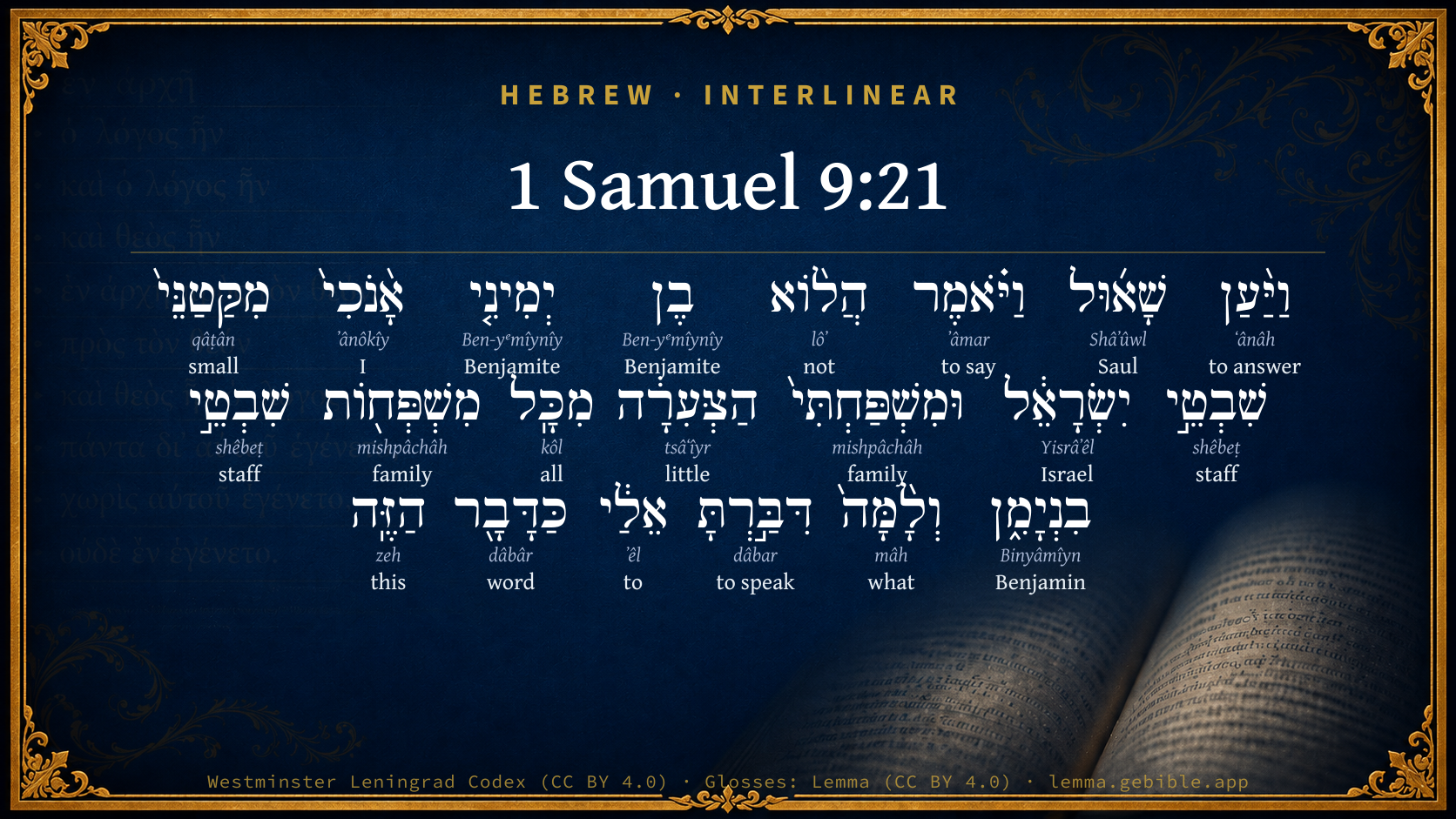
Hebrew (Westminster Leningrad Codex) 1 Samuel 9:21 appears in the Hebrew Old Testament. The text above is from the Westminster Leningrad Codex. Each word links to its Strong’s number, a concise gloss, and parsing drawn from the Open Scriptures Hebrew Bible morphology. Click any word for its full Brown-Driver-Briggs (BDB) entry.
Download image
Cite this verse

1 Samuel 9:21 (World English Bible). Public Domain. Lemma interlinear Bible study tool, https://lemma.gebible.app/v/1-samuel/9/21.

Show BibTeX & RIS
BibTeX
RIS
English Translation
Saul answered, Am I not a Benjamite, of the smallest of the tribes of Israel? and my family the least of all the families of the tribe of Benjamin? why then speak you to me after this manner?
World English Bible · Public Domain
Download a study sheet

One document with this verse’s original text, its word-by-word gloss line, the meaning frame, cross-references with their text, attributed commentary, and full source and license credits — printable, and it pastes into notes with its structure intact.

This verse Autodidact and up

Study sheet (.html) Plain text (.txt)

A passage Seminary Student

Up to 50 verses in one chapter. A passage sheet keeps up to 6 commentary sources and 12 cross-references per verse, in the order this page ranks them, and says so on the sheet whenever that leaves anything out. Ask for a single verse and you get the Autodidact verse sheet above.

Everything on this page stays free to read, with no account — the sheet is a download of what is already on screen, not access to it.

Want to remove ads? Support Godless Engineer
Compare translations 3

The same verse in 3 English versions, stacked beneath the original-language interlinear above. Click any original word for its lexicon entry.

Each is an independent rendering of the whole verse — the interlinear is not word-aligned to these translations.

Highlighted words mark where these versions differ — a whole-verse word diff, not a word-by-word alignment.

  • World English Bible Public Domain
    Saul answered, Am I not a Benjamite, of the smallest of the tribes of Israel? and my family the least of all the families of the tribe of Benjamin? why then speak you to me after this manner?
  • King James Version Public Domain
    And Saul answered and said, Am not I a Benjamite, of the smallest of the tribes of Israel? and my family the least of all the families of the tribe of Benjamin? wherefore then speakest thou so to me?
  • unfoldingWord Literal Text CC BY-SA 4.0
    And Saul answered and said, “ I not a Benjamite, from the smallest of the tribes of Israel, and my clan the least of all of the clans of the tribe of Benjamin? So why have you spoken to me according to this word?”

unfoldingWord Literal Text — © unfoldingWord, licensed CC BY-SA 4.0. Word-aligned USFM3 via Door43 (git.door43.org/unfoldingWord/en_ult).

Versions to compare (up to 4)

3 of 4 selected

Show all 18 translations

Every available English version of this verse, each an independent rendering of the whole verse.

  • World English Bible Public Domain
    Saul answered, Am I not a Benjamite, of the smallest of the tribes of Israel? and my family the least of all the families of the tribe of Benjamin? why then speak you to me after this manner?
  • Berean Standard Bible Public Domain
    Saul replied, “Am I not a Benjamite from the smallest tribe of Israel, and is not my clan the least of all the clans of Benjamin? So why would you say such a thing to me?”
  • Majority Standard Bible Public Domain
    Saul replied, “Am I not a Benjamite from the smallest tribe of Israel, and is not my clan the least of all the clans of Benjamin? So why would you say such a thing to me?”
  • King James Version Public Domain
    And Saul answered and said, Am not I a Benjamite, of the smallest of the tribes of Israel? and my family the least of all the families of the tribe of Benjamin? wherefore then speakest thou so to me?
  • American Standard Version (1901) Public Domain
    And Saul answered and said, Am not I a Benjamite, of the smallest of the tribes of Israel? and my family the least of all the families of the tribe of Benjamin? wherefore then speakest thou to me after this manner?
  • Revised Version (1885) Public Domain
    And Saul answered and said, Am not I a Benjamite, of the smallest of the tribes of Israel? and my family the least of all the families of the tribe of Benjamin? wherefore then speakest thou to me after this manner?
  • Geneva Bible (1599) Public Domain
    But Saul answered, and said, Am not I the sonne of Iemini of the smallest tribe of Israel? and my familie is the least of all the families of the tribe of Beniamin. Wherefore then speakest thou so to me?
  • Douay-Rheims (1899) Public Domain
    And Saul answering, said: Am not I a son of Jemini of the least tribe of Israel, and my kindred the last among all the families of the tribe of Benjamin? Why then hast thou spoken this word to me?
  • Young's Literal Translation Public Domain
    And Saul answereth and saith, `Am not I a Benjamite -- of the smallest of the tribes of Israel? and my family the least of all the families of the tribe of Benjamin? and why hast thou spoken unto me according to this word?'
  • Literal Standard Version CC BY-SA 4.0
    And Saul answers and says, “Am I not a Benjamite—of the smallest of the tribes of Israel? And my family the least of all the families of the tribe of Benjamin? And why have you spoken to me according to this word?”
  • Unlocked Literal Bible CC BY-SA 4.0
    Saul answered and said, “Am not I a Benjamite, from the smallest of the tribes of Israel? Is not my clan the least of all the clans of the tribe of Benjamin? Why then have you spoken to me in this manner?”
  • unfoldingWord Literal Text CC BY-SA 4.0
    And Saul answered and said, “ I not a Benjamite, from the smallest of the tribes of Israel, and my clan the least of all of the clans of the tribe of Benjamin? So why have you spoken to me according to this word?”
  • Darby Bible Public Domain
    And Saul answered and said, Am not I a Benjaminite, of the smallest of the tribes of Israel, and my family the least of all the families of the tribe of Benjamin? and why dost thou speak such words to me?
  • World Messianic Bible Public Domain
    Saul answered, “Am I not a Benjamite, of the smallest of the tribes of Israel? And my family the least of all the families of the tribe of Benjamin? Why then do you speak to me like this?”
  • Webster's Bible Public Domain
    And Saul answered and said, Am not I a Benjaminite, of the smallest of the tribes of Israel? and my family the least of all the families of the tribe of Benjamin? Why then speakest thou so to me?
  • Free Bible Version CC BY-SA 4.0
    “But I'm from the tribe of Benjamin, the smallest tribe in Israel, and my family is the least significant of all the families of the tribe of Benjamin!” Saul replied. “Why are you telling me this?”
  • Bible in Basic English Public Domain
    And Saul said, Am I not a man of Benjamin, the smallest of all the tribes of Israel? and my family the least of the families of Benjamin? why then do you say these words to me?
  • JPS Tanakh (1917) Public Domain
    And Saul answered and said: 'Am not I a Benjamite, of the smallest of the tribes of Israel? and my family the least of all the families of the tribe of Benjamin? wherefore then speakest thou to me after this manner?'

Literal Standard Version (2020), Covenant Press — licensed CC BY-SA 4.0. Text via the HelloAO Bible API (eBible.org). Unlocked Literal Bible (unfoldingWord) — licensed CC BY-SA 4.0. Text via the HelloAO Bible API (eBible.org). unfoldingWord Literal Text — © unfoldingWord, licensed CC BY-SA 4.0. Word-aligned USFM3 via Door43 (git.door43.org/unfoldingWord/en_ult). Free Bible Version, Dr. Jonathan Gallagher — licensed CC BY-SA 4.0. Text via the HelloAO Bible API (eBible.org).

Word by word

More ways to search: Search by grammar → Find every occurrence → Compare this word →

Practice this passage: Drill this verse → Learn its vocabulary →

בֶן
Ben-yᵉmîynîy
H1145
“Benjamite of”
Noun, Common, Masculine, Singular, Construct
Part of Speech
Noun
Type
Common
Gender
Masculine
Number
Singular
State
Construct
Full BDB Definition

Origin: sometimes (with article inserted) Ben-ha-y@miniy ben-hah-yem-ee-nee'with H376 inserted ( H1 ">1) Sa H9 :1) Ben-'iysh Y@miyniy ben-eesh' yem-ee-nee'

TWOT: adj

Benjamite = "son of the right hand" - one of the tribe of Benjamin
  1. וַיַּ֨עַן ʻânâh H6030 “and · to answer” Conjunction + Verb, Qal, Sequential Imperfect, 3rd Person, Masculine, Singular
  2. שָׁא֜וּל Shâʼûwl H7586 “Saul” Noun, Proper
  3. וַיֹּ֗אמֶר ʼâmar H559 “and · to say” Conjunction + Verb, Qal, Sequential Imperfect, 3rd Person, Masculine, Singular
  4. הֲל֨וֹא lôʼ H3808 “not” Particle, Interrogative + Particle, Negative
  5. יְמִינִ֤י Ben-yᵉmîynîy H1145 “Benjamite” Noun, Gentilic, Masculine, Singular, Absolute
  6. אָ֨נֹכִי֙ ʼânôkîy H595 “I” Pronoun, Personal, 1st Person, Common, Singular
  7. מִקַּטַנֵּי֙ qâṭân H6996 “from · small of” Preposition + Adjective, Adjective, Masculine, Plural, Construct
  8. שִׁבְטֵ֣י shêbeṭ H7626 “staffs of” Noun, Common, Masculine, Plural, Construct
  9. יִשְׂרָאֵ֔ל Yisrâʼêl H3478 “Israel” Noun, Proper
  10. וּמִשְׁפַּחְתִּי֙ mishpâchâh H4940 “and · family · my” Conjunction + Noun, Common, Feminine, Singular, Construct + Suffix, Personal, 1st Person, Common, Singular
  11. הַצְּעִרָ֔ה tsâʻîyr H6810 “the · little” Particle, Definite Article + Adjective, Adjective, Feminine, Singular, Absolute
  12. מִכָּֽל kôl H3605 “from · all of” Preposition + Noun, Common, Masculine, Singular, Construct
  13. מִשְׁפְּח֖וֹת mishpâchâh H4940 “families of” Noun, Common, Feminine, Plural, Construct
  14. שִׁבְטֵ֣י shêbeṭ H7626 “staffs of” Noun, Common, Masculine, Plural, Construct
  15. בִנְיָמִ֑ן Binyâmîyn H1144 “Benjamin” Noun, Proper
  16. וְלָ֨מָּה֙ mâh H4100 “and · to/for · what” Conjunction + Preposition + Particle, Interrogative
  17. דִּבַּ֣רְתָּ dâbar H1696 “to speak” Verb, Piel, Perfect, 2nd Person, Masculine, Singular
  18. אֵלַ֔י ʼêl H413 “to · me” Preposition + Suffix, Personal, 1st Person, Common, Singular
  19. כַּדָּבָ֖ר dâbâr H1697 “like/as the · word” Preposition, Determined + Noun, Common, Masculine, Singular, Absolute
  20. הַזֶּֽה zeh H2088 “the · this” Particle, Definite Article + Pronoun, Demonstrative, Masculine, Singular

About this verse

These counts appear in no published source. They are computed here, from the morphology-tagged text and Lemma’s own curated glosses. What Lemma adds →

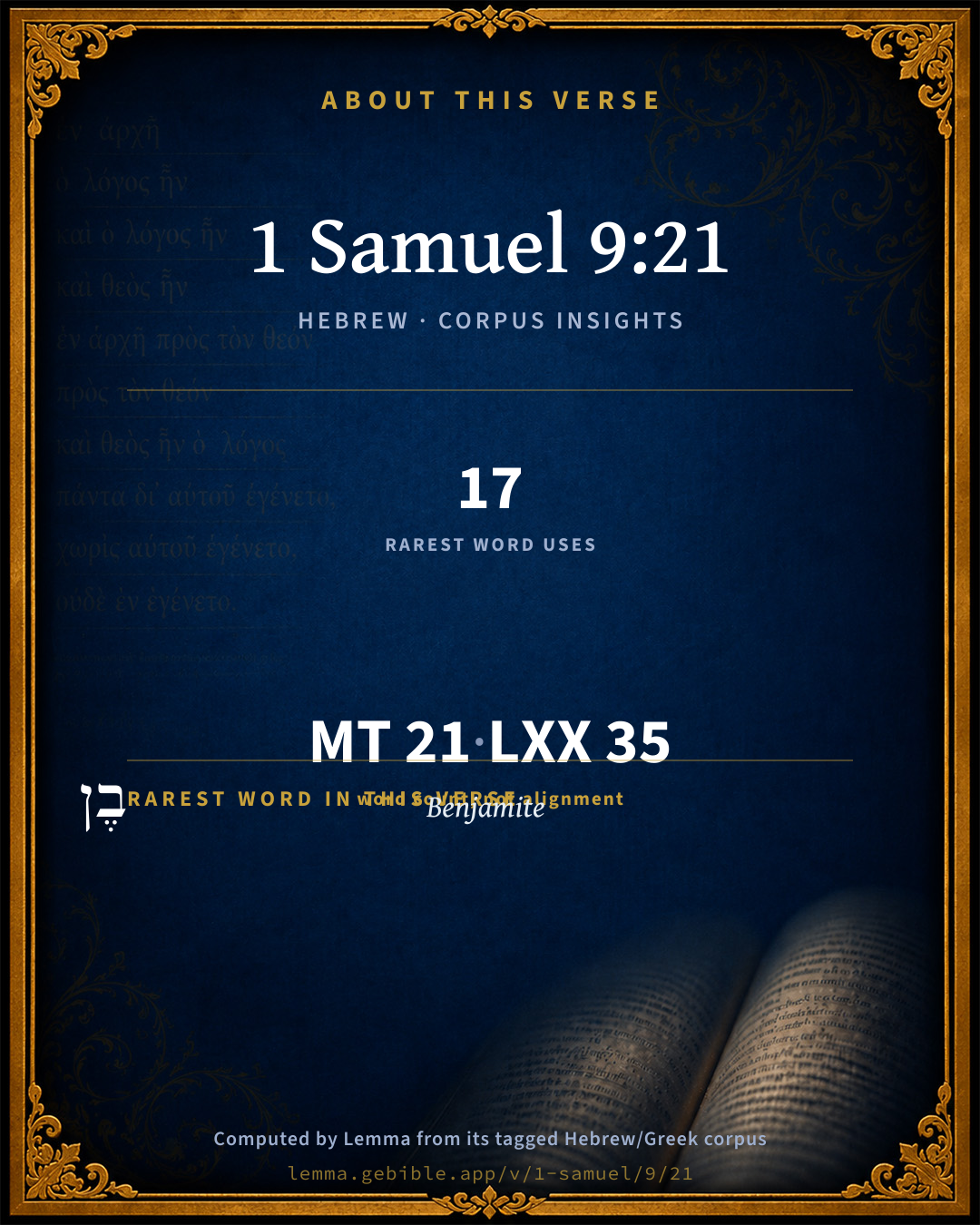
21
words
18
distinct lemmas
Historical
section

Notable vocabulary

The rarest word here is בֶן Benjamite H1145 — appearing just 17 times in the whole Hebrew Bible.

Shared distinctive vocabulary

בֶן Benjamite H1145 occurs in 9 verses of the Hebrew Bible. Also found in:

Grammatical profile

  • 3 verbs
  • 11 nouns
  • 2 adjectives
  • 2 pronouns
  • 1 preposition
  • 2 particles

Verb forms

  • וַיַּ֨עַן Qal · Sequential Imperfect
  • וַיֹּ֗אמֶר Qal · Sequential Imperfect
  • דִּבַּ֣רְתָּ Piel · Perfect

Repetition

Words recur within this verse — often emphatic in Hebrew:

  • בֶן Benjamite H1145 ×2
  • שִׁבְטֵ֣י staff H7626 ×2
  • וּמִשְׁפַּחְתִּי֙ family H4940 ×2

Hebrew & Septuagint length

In English translation the verse runs 38 words from the Hebrew and 43 from the Septuagint (LXX English) — closely comparable.

A rough comparison of the two English renderings, which tokenize alike — not a word-level alignment.

Word counts can differ between the Hebrew and the Greek without any difference in meaning — e.g. the Hebrew direct-object marker אֵת has no separate Greek word, and Greek often adds the article ὁ.

In the original languages it is 21 Hebrew tokens and 35 Greek tokens — but the two are counted differently (Hebrew bundles its prefixes and suffixes into one token; the Greek is in lemma form), so that isn’t a like-for-like length.

Cross-references

10

Topical passages linked to 1 Samuel 9:21 in the Treasury of Scripture Knowledge — connected by theme and wording, ordered by reader-vote popularity; previews shown in the World English Bible.

  • 1 Samuel 15:17 Samuel said, "Though you were little in your own sight, weren't you made the head of the tribes of Israel? Yahweh anointed you king over Israel;
  • Judges 20:46–48 So that all who fell that day of Benjamin were twenty-five thousand men who drew the sword; all these [were] men of valor.
  • Psalms 68:27 There is little Benjamin, their ruler, The princes of Judah, their council, The princes of Zebulun, and the princes of Naphtali.
  • Luke 14:11 For everyone who exalts himself will be humbled, and whoever humbles himself will be exalted."
  • Ephesians 3:8 To me, the very least of all saints, was this grace given, to preach to the Gentiles the unsearchable riches of Christ,
  • Judges 6:14–15 Yahweh looked at him, and said, Go in this your might, and save Israel from the hand of Midian: have not I sent you?
  • 1 Samuel 10:27 But certain worthless fellows said, How shall this man save us? They despised him, and brought him no present. But he held his peace.
  • 1 Samuel 18:18 David said to Saul, Who am I, and what is my life, [or] my father's family in Israel, that I should be son-in-law to the king?
  • 1 Samuel 18:23 Saul's servants spoke those words in the ears of David. David said, Seems it to you a light thing to be the king's son-in-law, seeing that I am a poor man, and lightly esteemed?
  • Hosea 13:1 When Ephraim spoke, there was trembling. He exalted himself in Israel, But when he became guilty in Baal, he died.

Cross-references courtesy of OpenBible.info (CC BY 4.0).

Hebrew and Greek witnesses Masoretic Hebrew ↔ Greek Septuagint

The same verse in the two great witnesses to the Old Testament, shown verse-for-verse.

These are two independent witnesses, not word-aligned to each other, and the Septuagint is shown in lemma (dictionary) form.

Hebrew 1 Samuel 9:21 Masoretic · Westminster Leningrad Codex

וַיַּ֨עַן שָׁא֜וּל וַיֹּ֗אמֶר הֲל֨וֹא בֶן יְמִינִ֤י אָ֨נֹכִי֙ מִקַּטַנֵּי֙ שִׁבְטֵ֣י יִשְׂרָאֵ֔ל וּמִשְׁפַּחְתִּי֙ הַצְּעִרָ֔ה מִכָּֽל מִשְׁפְּח֖וֹת שִׁבְטֵ֣י בִנְיָמִ֑ן וְלָ֨מָּה֙ דִּבַּ֣רְתָּ אֵלַ֔י כַּדָּבָ֖ר הַזֶּֽה

Saul answered, Am I not a Benjamite, of the smallest of the tribes of Israel? and my family the least of all the families of the tribe of Benjamin? why then speak you to me after this manner?

World English Bible · Public Domain

Greek LXX 1 Samuel 9:21 Septuagint · lemma form

καί ἀποκρίνω σαούλ καί εἶπον οὐ ἀνήρ υἱός ιεμιναῖος ἐγώ εἰμί ὁ μικρός σκῆπτρον φυλή ἰσραήλ καί ὁ φυλή ὁ ἐλαχύς ἐκ ὅλος σκῆπτρον βενιαμίν καί ἵνα τίς λαλέω πρός ἐγώ κατά ὁ ῥῆμα οὗτος

And Saul answered and said, Am not I the son of a Benjamite, the least tribe of the people of Israel? and of the least family of the whole tribe of Benjamin? and why have you spoken to me according to this word?

LXX2012 (modern English Septuagint) · Public Domain

Hebrew: Westminster Leningrad Codex (CC BY 4.0). Greek: Septuagint (public domain); English from LXX2012 (modern English Septuagint) (Public Domain). How the Septuagint differs from the Hebrew →

Targum (Aramaic paraphrase)

1

The Targum is the ancient Jewish Aramaic paraphrase of the Hebrew Scriptures — an interpretive translation, not the Hebrew text itself. Onkelos (literal) and Pseudo-Jonathan (expansive) render the Torah, and Jonathan the Prophets. Coverage is partial: where no permissively-licensed English translation exists for a verse, only the Aramaic is shown. This is verse-level text, not a word-by-word alignment to the Hebrew.

  1. Targum Jonathan Prophets (Joshua–Malachi)
    וְאָתֵיב שָׁאוּל וַאֲמַר הֲלָא בַּר שֵׁבֶט בִּנְיָמִן אֲנָא מִזְעִירֵי שִׁבְטַיָא דְיִשְׂרָאֵל וְזַרְעִיתִי חַלָשָׁא מִכָּל זַרְעֲיַת שֵׁבֶט בִּנְיָמִן וּלְמָא מַלֶלְתָּא עִמִי כְּפִתְגָמָא הָדֵין:

    (no public-domain English translation for this verse)

    Targum Jonathan — Aramaic: “Mikraot Gedolot” (public domain). English: “Sefaria Community Translation” (CC0 1.0 (public-domain dedication)); “London "Chaldee Paraphrase," 1871” (public domain). Text via Sefaria.

Commentary

Notes on 1 Samuel 9:21 from classic Christian and Jewish commentators (each source and its license shown beneath its notes). The classic Christian expositions comment on the surrounding passage and are grouped to its opening verse, so a note may address several verses; the Jewish commentaries on the Tanakh (Rashi and others) are per-verse, so they appear only where the commentator wrote on this verse.

Lemma curates 59 commentaries, every one of them public domain or Creative Commons licensed, each selected and text-cleaned for this edition rather than reprinted as found. About our sources →

Trapp's Complete Commentary

John Trapp

1Sa 9:21 And Saul answered and said, [Am] not I a Benjamite, of the smallest of the tribes of Israel? and my family the least of all the families of the tribe of Benjamin? wherefore then speakest thou so to me?

Ver. 21. Am not I a Benjamite, of the smallest, &c.] Yet out of the rubbish of Benjamin doth God raise the throne. That is not ever the best and fittest that God chooseth; but that which God chooseth is ever the fittest.

Wherefore then speakest thou so to me?] This he speaketh not in hypocrisy, whereof yet afterwards he was grossly guilty, but in simplicity and truth: likens Frederick, the elector of Saxony, refused the empire when it was offered him: and would take no money of those that accepted it. Gideon also might have been king, and would not. {Jdg 8:22-23}

John Trapp, A Commentary or Exposition upon All the Books of the Old and New Testament (1647–1656) — public domain. Text from a community e-Sword module.

Joseph Benson's Commentary

1Sa 9:21. Of the smallest of the tribes of Israel — Such indeed the tribe of Benjamin was, having been all cut off except six hundred, (Judges 20.,) which blow they never recovered, and therefore they were scarce reckoned as an entire tribe, but as a remnant of a tribe; and being ingrafted into Judah, in the division between the ten tribes and the two, they in some sort lost their name, and together with Judah were accounted but one tribe.

Joseph Benson's Commentary on the Old and New Testaments (1811–1818) — public domain. Text from a community e-Sword module.

Tyndale Open Study Notes

Tyndale Open Resources

9:21 the smallest tribe: Saul tried to downplay Benjamin’s prominence, but they were powerful warriors (Judg 20:14-31; cp. study note on 1 Sam 10:17). What better tribe to lead in battle? • least important of all the families: Cp. 9:1.

Tyndale Open Study Notes — © Tyndale Open Resources, licensed CC BY-SA 4.0. Text via the HelloAO Bible API.

Jamieson, Fausset & Brown

Robert Jamieson, A. R. Fausset & David Brown

And Saul answered and said, Am not I a Benjamite, of the smallest of the tribes of Israel, &c.--By selecting a king from this least and nearly extinct tribe (Jdg 20:46-48), divine wisdom designed to remove all grounds of jealousy among the other tribes.

Jamieson, Fausset & Brown — Commentary Critical and Explanatory on the Whole Bible (1871) — public domain (CC PDM 1.0). Text via the HelloAO Bible API.

Adam Clarke's Commentary

Verse 21. Am not I a Benjamite] This speech of Saul is exceedingly modest; he was now becomingly humble; but who can bear elevation and prosperity? The tribe of Benjamin had not yet recovered its strength, after the ruinous war it had with the other tribes, Jdg 20:29-46.

Adam Clarke's Commentary on the Bible (1810–1826) — public domain. Text from a community e-Sword/MySword module.

The Cambridge Bible for Schools and Colleges

gen. ed. J. J. S. Perowne

21. the smallest of the tribes of Israel] The warlike tribe of Benjamin, the smallest except Manasseh at the time of the numbering in the wilderness (Num_1:37), was reduced to insignificance by the terrible slaughter recorded in Jdg_20:46.

of the tribe of Benjamin] Heb. the tribes, If this reading is right, tribe here = clan or subdivision of a tribe, as in Num_4:18; Jdg_20:12 (Heb. tribes of B.). But the Sept. and all ancient versions read “tribe” in the singular.

The Cambridge Bible for Schools and Colleges (gen. ed. J. J. S. Perowne; Cambridge University Press, 1878–1918) — public domain. Text from a community e-Sword module.

John Gill's Exposition

And Saul answered and said, am not I a Benjamite,.... Or the son of Jemini, the name of one of his ancestors, see Sa1 9:1 or rather, as the Targum, a son of the tribe of Benjamin:

of the smallest of the tribes of Israel? having been greatly reduced, even to the number of six hundred men, by the fatal war between that tribe and the rest, on account of the Levite's concubine, and is called little Benjamin, Psa 68:27.

and my family the least of all the families of the tribe of Benjamin? the smallest in number, had the least share of authority in the tribe, and of land and cattle, wealth and substance:

wherefore then speakest thou so to me? Saul presently understood Samuel's meaning, that he should be chosen king of Israel, the affair of a king being at this time in everyone's mind and mouth; but could not believe that one of so small a tribe, and which sprung from the youngest son of Jacob, and of so mean a family, would be raised to such dignity, but that a person of great figure and character would be settled upon; and, therefore he took Samuel to be in joke, as Josephus (m) says, and not in earnest.

(m) Antiqu. l. 6. c. 4. sect. 1.

John Gill's Exposition of the Whole Bible (1746–1763) — public domain (CC PDM 1.0). Text via the HelloAO Bible API.

Albert Barnes' Notes on the Bible

The tribe of Benjamin, originally the smallest of all the tribes Num 1:36, if Ephraim and Manasseh are reckoned as one tribe, had been nearly annihilated by the civil war recorded in Judg. 20. It had of course not recovered from that terrible calamity in the time of Saul, and was doubtless literally much the smallest tribe at that time. Nothing could be more improbable, humanly speaking, than that this weak tribe should give a ruler to the mighty tribes of Joseph and Judah.

Albert Barnes' Notes on the Bible (1834–1885) — public domain. Text from a community e-Sword/MySword module.

Haydock's Catholic Bible Commentary

Jemini, or Benjamin, which was always one of the smallest tribes, and, since the unfortunate war, still more reduced; so that none of the other tribes could well take umbrage, or be filled with jealousy, when they saw a king selected from it. --- Last. Though all were equally noble, yet some families were more numerous, possessed greater riches, or had filled the posts of honour more frequently than others. Nothing can be more charming than the modesty of Saul on this occasion. (Calmet) --- Happy would he have been, had he continued always to cherish the like sentiments. (Haydock) --- He and his posterity might then have long enjoyed the regal dignity, chap. xiii. 13. (Menochius)

George Leo Haydock (1774–1849), Haydock's Catholic Family Bible and Commentary, 1859 edition — public domain. Excludes Psalms (Douay-Rheims chapter numbering differs from Protestant) and Deuterocanonical books (Catholic canon only).

Matthew Poole's English Annotations

The smallest of the tribes; for so indeed this was, having been all cut off except six hundred, Jdg 20, which blow they never recovered, and therefore they were scarce reckoned as an entire tribe, but only as a remnant or fragment of a tribe; and being ingrafted into Judah, in the division between the ten tribes and the two, they in some sort lost their name, and they, together with Judah, were accounted but one tribe, as 1Ki 11:32, &c.

The least of all the families of the tribe of Benjamin, i.e. one of the least; obscure and inconsiderable, in comparison of divers others; whence it may seem that Saul’s family was not so noble and wealthy as some imagine: See Poole "1Sa 9:1".

Wherefore then speakest thou so to me? why dost thou feed me with vain hopes of the kingdom?

Matthew Poole's English Annotations on the Holy Bible (1683–1685) — public domain. Text from a community e-Sword/MySword module.

Whedon's Commentary on the Bible

Daniel D. Whedon

21. Smallest of the tribes — And once almost annihilated by the tribal war. Judges 20. Saul is now little in his own eyes, but elevation to power developed in him a spirit of insubordinate ambition and pride. 1Sa_15:17.

Daniel D. Whedon (gen. ed.), Commentary on the Old and New Testaments (1874–1909) — public domain. Text from a community e-Sword module.

The Pulpit Commentary

Wherefore then speakest thou so to me? Though Samuel"s words contained the promise of supreme power, for to whom less than a king could all that was desirable in Israel belong? yet Saul probably regarded them as a high-flown compliment, such as Orientals love to use, and gave a modest and proper answer. Benjamin, already the smallest tribe, had been so crushed that its power must have been very small, and Soul"s house, though opulent, was not a leading one; how then could one of its members expect so high a dignity? For families of the tribe of Benjamin the Hebrew has "tribes," probably owing to some confusion with the words "tribes of Israel" just before.

The Pulpit Commentary (1880–1919), ed. H.D.M. Spence-Jones & Joseph S. Exell — public domain. Text from a community e-Sword module.

John Wesley's Explanatory Notes

The smallest - For so indeed this was, having been all cut off except six hundred, Judg. xx, 46-48, which blow they never recovered, and therefore they were scarce reckoned as an entire tribe, but only as a remnant of a tribe; and being ingrafted into Judah, in the division between the ten tribes and the two, they in some sort lost their name, and together with Judah were accounted but one tribe.

John Wesley, Explanatory Notes Upon the Whole Bible (1754–1765) — public domain. Text via the GEBible commentary corpus.

Lesson kit

Teaching starters — assembled from the data on this page, not authored interpretation. Every prompt links to the verse data it draws on. Edit before teaching.

1 Samuel, in the Historical, opens this verse with 21 words (18 distinct Hebrew lemmas). Its most distinctive word is Ben-yᵉmîynîy (“Benjamite”). A historical commentator’s framing appears above. Read the whole chapter for the surrounding context.

Discussion questions

  1. How does “Benjamite” (Ben-yᵉmîynîy) shape what this verse is saying?
  2. Judges 3:15 shares the word «Benjamite» with this verse. How do the two illuminate each other?
  3. “Benjamite” occurs 2× in this one verse. What is the effect of the repetition?
  4. The translations on this page render this verse differently — a whole-verse word diff, not a word-by-word alignment. What might account for the different wordings?
  5. The verb «וַיַּ֨עַן» is Qal Sequential Imperfect. How does its form color the action?
  6. Reading how Trapp's Complete Commentary and Joseph Benson's Commentary read this verse, where do the two commentators agree and where do they part?

Things to notice

Reading settings

Reading text

Shown beneath each verse's original-language words.

Old Testament
Old Testament edition

Read the OT as the Masoretic Hebrew (MT) or the Greek Septuagint (LXX).

English shown for the Greek Septuagint (in the Hebrew ↔ Greek comparison).

Comparing translations? Open the Compare panel on any verse page to stack up to four side by side.