
Ecclesiastes 11:2

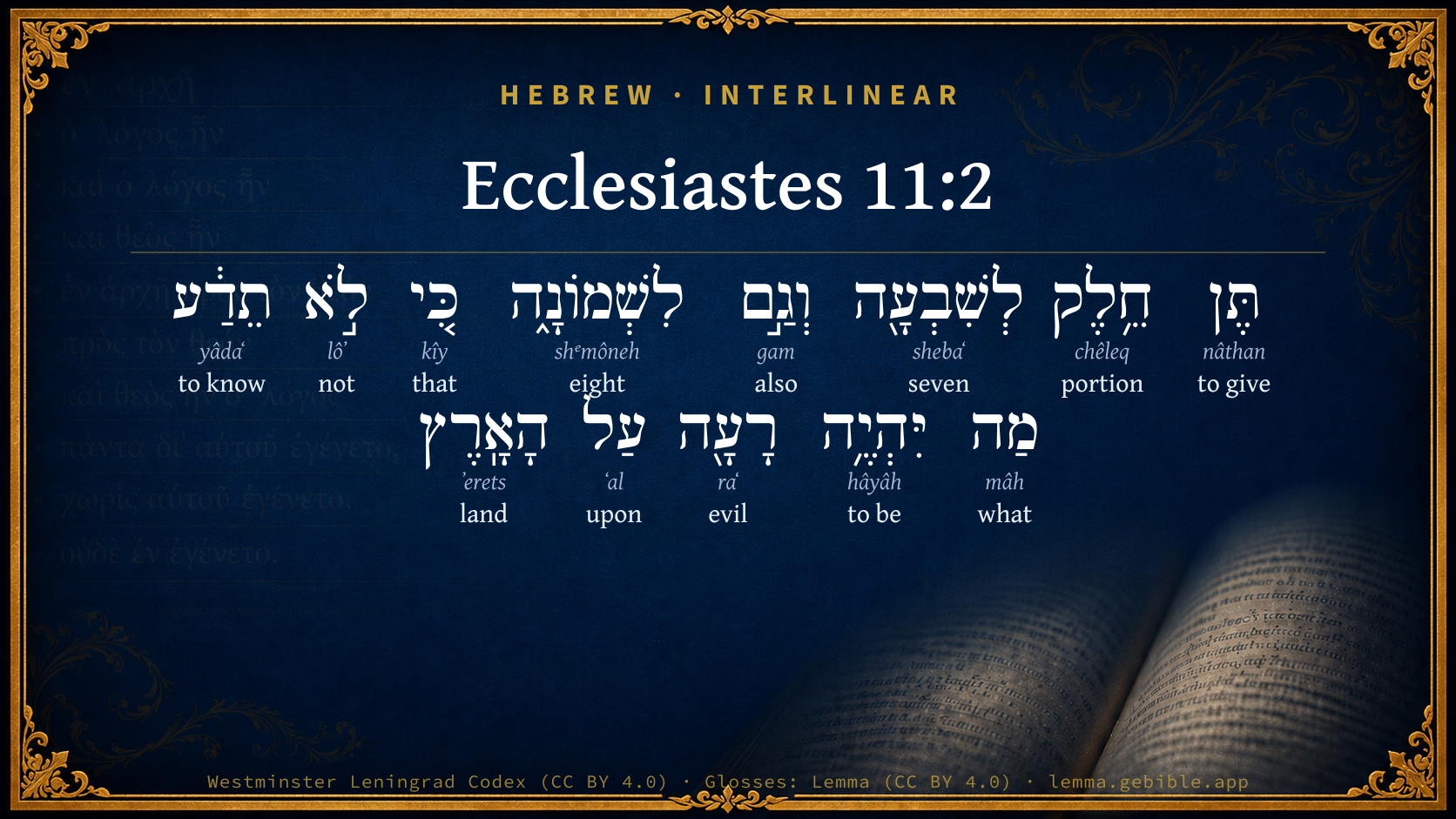
Hebrew (Westminster Leningrad Codex) Ecclesiastes 11:2 appears in the Hebrew Old Testament. The text above is from the Westminster Leningrad Codex. Each word links to its Strong’s number, a concise gloss, and parsing drawn from the Open Scriptures Hebrew Bible morphology. Click any word for its full Brown-Driver-Briggs (BDB) entry.
Download image
Cite this verse

Ecclesiastes 11:2 (World English Bible). Public Domain. Lemma interlinear Bible study tool, https://lemma.gebible.app/v/ecclesiastes/11/2.

Show BibTeX & RIS
BibTeX
RIS
English Translation
Give a portion to seven, yes, even to eight; For you don't know what evil will be on the earth.
World English Bible · Public Domain
Download a study sheet

One document with this verse’s original text, its word-by-word gloss line, the meaning frame, cross-references with their text, attributed commentary, and full source and license credits — printable, and it pastes into notes with its structure intact.

This verse Autodidact and up

Study sheet (.html) Plain text (.txt)

A passage Seminary Student

Up to 50 verses in one chapter. A passage sheet keeps up to 6 commentary sources and 12 cross-references per verse, in the order this page ranks them, and says so on the sheet whenever that leaves anything out. Ask for a single verse and you get the Autodidact verse sheet above.

Everything on this page stays free to read, with no account — the sheet is a download of what is already on screen, not access to it.

Want to remove ads? Support Godless Engineer
Compare translations 3

The same verse in 3 English versions, stacked beneath the original-language interlinear above. Click any original word for its lexicon entry.

Each is an independent rendering of the whole verse — the interlinear is not word-aligned to these translations.

Highlighted words mark where these versions differ — a whole-verse word diff, not a word-by-word alignment.

  • World English Bible Public Domain
    Give a portion to seven, yes, even to eight; For you don't know what evil will be on the earth.
  • King James Version Public Domain
    Give a portion to seven, and also to eight; for thou knowest not what evil shall be upon the earth.
  • unfoldingWord Literal Text CC BY-SA 4.0
    Give a portion to seven and even to eight, for you do not know what will be a misfortune on the earth. q1

unfoldingWord Literal Text — © unfoldingWord, licensed CC BY-SA 4.0. Word-aligned USFM3 via Door43 (git.door43.org/unfoldingWord/en_ult).

Versions to compare (up to 4)

3 of 4 selected

Show all 18 translations

Every available English version of this verse, each an independent rendering of the whole verse.

  • World English Bible Public Domain
    Give a portion to seven, yes, even to eight; For you don't know what evil will be on the earth.
  • Berean Standard Bible Public Domain
    Divide your portion among seven, or even eight, for you do not know what disaster may befall the land.
  • Majority Standard Bible Public Domain
    Divide your portion among seven, or even eight, for you do not know what disaster may befall the land.
  • King James Version Public Domain
    Give a portion to seven, and also to eight; for thou knowest not what evil shall be upon the earth.
  • American Standard Version (1901) Public Domain
    Give a portion to seven, yea, even unto eight; for thou knowest not what evil shall be upon the earth.
  • Revised Version (1885) Public Domain
    Give a portion to seven, yea, even unto eight; for thou knowest not what evil shall be upon the earth.
  • Geneva Bible (1599) Public Domain
    Giue a portion to seuen, and also to eight: for thou knowest not what euill shalbe vpon ye earth.
  • Douay-Rheims (1899) Public Domain
    Give a portion to seven, and also to eight: for thou knowest not what evil shall be upon the earth.
  • Young's Literal Translation Public Domain
    Give a portion to seven, and even to eight, For thou knowest not what evil is on the earth.
  • Literal Standard Version CC BY-SA 4.0
    Give a portion to seven, and even to eight, || For you do not know what evil is on the earth.
  • Unlocked Literal Bible CC BY-SA 4.0
    Share it with seven, even eight people, for you do not know what disasters are coming on the earth.
  • unfoldingWord Literal Text CC BY-SA 4.0
    Give a portion to seven and even to eight, for you do not know what will be a misfortune on the earth. q1
  • Darby Bible Public Domain
    Give a portion to seven, and also to eight; for thou knowest not what evil shall be upon the earth.
  • World Messianic Bible Public Domain
    Give a portion to seven, yes, even to eight; for you don’t know what evil will be on the earth.
  • Webster's Bible Public Domain
    Give a portion to seven, and also to eight; for thou knowest not what evil shall be upon the earth.
  • Free Bible Version CC BY-SA 4.0
    Share what you own with seven or eight people, for you never know what disaster could happen.
  • Bible in Basic English Public Domain
    Give a part to seven or even to eight, because you have no knowledge of the evil which will be on the earth.
  • JPS Tanakh (1917) Public Domain
    Divide a portion into seven, yea, even into eight; for thou knowest not what evil shall be upon the earth.

Literal Standard Version (2020), Covenant Press — licensed CC BY-SA 4.0. Text via the HelloAO Bible API (eBible.org). Unlocked Literal Bible (unfoldingWord) — licensed CC BY-SA 4.0. Text via the HelloAO Bible API (eBible.org). unfoldingWord Literal Text — © unfoldingWord, licensed CC BY-SA 4.0. Word-aligned USFM3 via Door43 (git.door43.org/unfoldingWord/en_ult). Free Bible Version, Dr. Jonathan Gallagher — licensed CC BY-SA 4.0. Text via the HelloAO Bible API (eBible.org).

Word by word

More ways to search: Search by grammar → Find every occurrence → Compare this word →

Practice this passage: Drill this verse → Learn its vocabulary →

חֵ֥לֶק
chêleq
H2506
“portion”
Noun, Common, Masculine, Singular, Absolute
Part of Speech
Noun
Type
Common
Gender
Masculine
Number
Singular
State
Absolute
Full BDB Definition

Origin: from H2505

TWOT: 669a

portion, share, part, territory - portion, share - portion, tract, parcel (of land) - one's portion, one's possession - (chosen) portion - portion, award (from God) - smoothness, seductiveness, flattery
  1. תֶּן nâthan H5414 “give” Verb, Qal, Imperative, 2nd Person, Masculine, Singular
  2. לְשִׁבְעָ֖ה shebaʻ H7651 “to/for · seven” Preposition + Adjective, Cardinal number, Masculine, Singular, Absolute
  3. וְגַ֣ם gam H1571 “and · also” Conjunction + Particle, Accusative
  4. לִשְׁמוֹנָ֑ה shᵉmôneh H8083 “to/for · eight” Preposition + Adjective, Cardinal number, Masculine, Singular, Absolute
  5. כִּ֚י kîy H3588 “that” Conjunction
  6. לֹ֣א lôʼ H3808 “not” Particle, Negative
  7. תֵדַ֔ע yâdaʻ H3045 “to know” Verb, Qal, Imperfect, 2nd Person, Masculine, Singular
  8. מַה mâh H4100 “what” Particle, Interrogative
  9. יִּהְיֶ֥ה hâyâh H1961 “to be” Verb, Qal, Imperfect, 3rd Person, Masculine, Singular
  10. רָעָ֖ה raʻ H7451 “evil” Noun, Common, Feminine, Singular, Absolute
  11. עַל ʻal H5921 “upon” Preposition
  12. הָאָֽרֶץ ʼerets H776 “the · land” Particle, Definite Article + Noun, Common, Both, Singular, Absolute

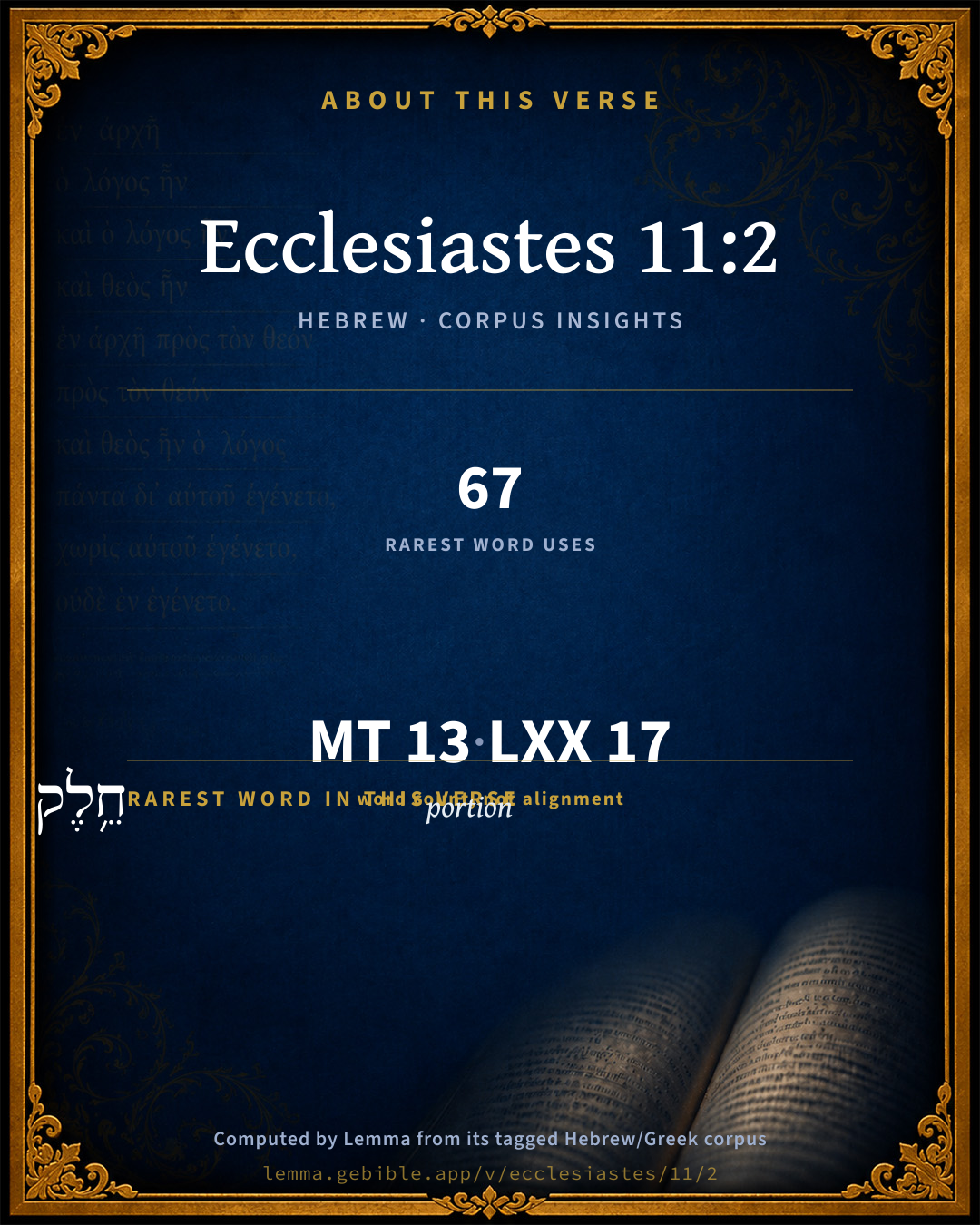
About this verse

These counts appear in no published source. They are computed here, from the morphology-tagged text and Lemma’s own curated glosses. What Lemma adds →

13
words
13
distinct lemmas
Wisdom
section

Grammatical profile

  • 3 verbs
  • 3 nouns
  • 2 adjectives
  • 1 preposition
  • 1 conjunction
  • 3 particles

Verb forms

  • תֶּן Qal · Imperative
  • תֵדַ֔ע Qal · Imperfect
  • יִּהְיֶ֥ה Qal · Imperfect

Hebrew & Septuagint length

In English translation the verse runs 20 words from the Hebrew and 21 from the Septuagint (LXX English) — closely comparable.

A rough comparison of the two English renderings, which tokenize alike — not a word-level alignment.

Word counts can differ between the Hebrew and the Greek without any difference in meaning — e.g. the Hebrew direct-object marker אֵת has no separate Greek word, and Greek often adds the article ὁ.

In the original languages it is 13 Hebrew tokens and 17 Greek tokens — but the two are counted differently (Hebrew bundles its prefixes and suffixes into one token; the Greek is in lemma form), so that isn’t a like-for-like length.

Cross-references

17

Topical passages linked to Ecclesiastes 11:2 in the Treasury of Scripture Knowledge — connected by theme and wording, ordered by reader-vote popularity; previews shown in the World English Bible.

  • 1 Timothy 6:18–19 that they do good, that they be rich in good works, that they be ready to distribute, willing to communicate;
  • Job 5:19 He will deliver you in six troubles; Yes, in seven there shall no evil touch you.
  • Psalms 112:9 He has dispersed, he has given to the poor. His righteousness endures forever. His horn will be exalted with honor.
  • Proverbs 6:16 There are six things which Yahweh hates; Yes, seven which are an abomination to him:
  • Luke 6:30–35 Give to everyone who asks you, and don't ask him who takes away your goods to give them back again.
  • Daniel 4:27 Therefore, O king, let my counsel be acceptable to you, and break off your sins by righteousness, and your iniquities by showing mercy to the poor; if there may be a lengthening of your tranquillity.
  • Nehemiah 8:10 Then he said to them, Go your way, eat the fat, and drink the sweet, and send portions to him for whom nothing is prepared; for this day is holy to our Lord: neither be you grieved; for the joy of Yahweh is your strength.
  • Esther 9:19 Therefore do the Jews of the villages, who dwell in the unwalled towns, make the fourteenth day of the month Adar [a day of] gladness and feasting, and a good day, and of sending portions one to another.
  • Esther 9:22 as the days in which the Jews had rest from their enemies, and the month which was turned to them from sorrow to gladness, and from mourning into a good day; that they should make them days of feasting and gladness, and of sending portions one to another, and gifts to the needy.
  • Micah 5:5 He will be our peace when Assyria invades our land, And when he marches through our fortresses, Then we will raise against him seven shepherds, And eight leaders of men.
  • Matthew 5:42 Give to him who asks you, and don't turn away him who desires to borrow from you.
  • Matthew 18:22 Jesus said to him, "I don't tell you until seven times, but, until seventy times seven.
  • Luke 17:4 If he sins against you seven times in the day, and seven times returns, saying, 'I repent,' you shall forgive him."
  • Acts 11:28–30 One of them named Agabus stood up, and indicated by the Spirit that there should be a great famine all over the world, which also happened in the days of Claudius.
  • Galatians 6:1 Brothers, even if a man is caught in some fault, you who are spiritual must restore such a one in a spirit of gentleness; looking to yourself so that you also aren't tempted.
  • Ephesians 5:16 redeeming the time, because the days are evil.
  • Hebrews 13:3 Remember those who are in bonds, as bound with them; and those who are ill-treated, since you are also in the body.

Cross-references courtesy of OpenBible.info (CC BY 4.0).

Hebrew and Greek witnesses Masoretic Hebrew ↔ Greek Septuagint

The same verse in the two great witnesses to the Old Testament, shown verse-for-verse.

These are two independent witnesses, not word-aligned to each other, and the Septuagint is shown in lemma (dictionary) form.

Hebrew Ecclesiastes 11:2 Masoretic · Westminster Leningrad Codex

תֶּן חֵ֥לֶק לְשִׁבְעָ֖ה וְגַ֣ם לִשְׁמוֹנָ֑ה כִּ֚י לֹ֣א תֵדַ֔ע מַה יִּהְיֶ֥ה רָעָ֖ה עַל הָאָֽרֶץ

Give a portion to seven, yes, even to eight; For you don't know what evil will be on the earth.

World English Bible · Public Domain

Greek LXX Ecclesiastes 11:2 Septuagint · lemma form

δίδωμι μερίς ὁ ἑπτά καί γέ ὁ ὀκτώ ὅτι οὐ γιγνώσκω τίς εἰμί πονηρός ἐπί ὁ γῆ

Give a portion to seven, and also to eight; for you know not what evil there shall be upon the earth.

LXX2012 (modern English Septuagint) · Public Domain

Hebrew: Westminster Leningrad Codex (CC BY 4.0). Greek: Septuagint (public domain); English from LXX2012 (modern English Septuagint) (Public Domain). How the Septuagint differs from the Hebrew →

Commentary

Notes on Ecclesiastes 11:2 from classic Christian and Jewish commentators (each source and its license shown beneath its notes). The classic Christian expositions comment on the surrounding passage and are grouped to its opening verse, so a note may address several verses; the Jewish commentaries on the Tanakh (Rashi and others) are per-verse, so they appear only where the commentator wrote on this verse.

Lemma curates 59 commentaries, every one of them public domain or Creative Commons licensed, each selected and text-cleaned for this edition rather than reprinted as found. About our sources →

Trapp's Complete Commentary

John Trapp

Ecc 11:2 Give a portion to seven, and also to eight; for thou knowest not what evil shall be upon the earth.

Ver. 2. Give a portion to seven, and also to eight.] A portion - i.e., a good deal, a fair proportion - to a good many; as B. Hooper did to his board of beggars, whom he fed every day by course, serving them by four at a mess, with whole and wholesome food. {a} Or give a portion, i.e., a part, such as thou canst well part with, not stretching beyond the staple, lest ye mar all, while "others are eased, and you burdened, but by an equality," &c. {2Co 8:13-14} Give to him that asketh, saith our Saviour {Luk 6:30} - scil., according to his necessity, and thine ability. Give with discretion. {Psa 112:5} Have a special respect to the family of faith, {Gal 6:10} those "excellent ones of the earth," in whom was David’s "delight." {Psa 16:3} The Jews, from this text, grounded a custom of giving alms to seven poor people every day, or to eight at utmost, if they saw cause. But here is a finite number put for an infinite, as when Christ bade Peter forgive his brother "seventy times seven times," and as {Mic 5:5} "seven shepherds and eight principal men" signify so many shepherds, both teachers and rulers, as shall sufficiently feed the flock of Christ, and defend it from enemies.

For thou knowest not what evll shall be upon the earth.] Therefore lay in lustily; or rather, lay out liberally, and so lay up for a rainy day. Thou mayest be soon shred of thy goods, and as much need other men’s mercy as they now need thine. Sow, therefore, while thou hast it, that thou mayest "reap again in due season." "Water, that thou mayest be watered again." {Pro 11:25} "Lay up for thyself a good foundation against the time to come." {1Ti 6:18} Lay out thy talent; work while the tool is in thine hand. Make friends with thy mammon. Say not, as one rich churl did, when requested to do somewhat toward his minister’s maintenance, The more I give, the less I have. Another answered that he knew how to bestow his money better. A third old man said, I see the beginning of my life, but I see not my latter; I may come to want that which I now give. Thou mayest do so, saith Solomon here, and by thy tenacity thou art very likely to do so; but wilt thou know, O man! how thou mayest prevent this misery, and not feel what thou fearest "Give a portion to seven," &c. Part, therefore, freely with that which thou art not sure to keep, that thou mayest gain that which thou art sure never to Lose."he that giveth to the poor shall not lack." {Pro 28:27}

{a} Acts and Mon., fol. 1368.

John Trapp, A Commentary or Exposition upon All the Books of the Old and New Testament (1647–1656) — public domain. Text from a community e-Sword module.

Joseph Benson's Commentary

Ecc 11:2. Give a portion to seven — A part of thy estate or provisions. He alludes to the ancient custom, whereby the master of the feast distributed several parts to each guest, and withal sent portions to the poor. And also to eight — To as many as thou art able. For thou knowest not what evil shall be, &c. — Great calamities may come, whereby thou mayest be brought to poverty, and so disabled from doing good. And moreover thou mayest possibly hereafter need the charity of others, which thou wilt have good reason to expect, through the powerful providence of God disposing men’s hearts to pity and help thee, if thou hast been kind and merciful to others; whereas, on the contrary, they can expect no mercy from God or men, who have showed no mercy to others.

Joseph Benson's Commentary on the Old and New Testaments (1811–1818) — public domain. Text from a community e-Sword module.

Keil & Delitzsch

C. F. Keil & F. Delitzsch

"Divide the portion into seven, yea, eight (parts); for thou knowest not what evil shall happen on the earth." With that other interpretation, עליך was to be expected instead of 'al-haarets; for an evil spreading abroad over the earth, a calamity to the land, does not yet fall on every one without exception; and why was not the רעה designated directly as personal? The impression of the words לשׁם ... תּן־, established in this general manner, is certainly this, that on the supposition of the possibility of a universal catastrophe breaking in, they advise a division of our property, so that if we are involved in it, our all may not at once be lost, but only this or that part of it, as Jacob, Gen 32:9, says. With reference to 1a, it is most natural to suppose that one is counselled not to venture his all in one expedition, so that if this is lost in a storm, all might not at once be lost (Mendelss., Preston, Hitz., Stuart); with the same right, since 1a is only an example, the counsel may be regarded as denoting that one must not commit all to one caravan; or, since in Ecc 11:2 לחמך is to be represented not merely as a means of obtaining gain, that one ought not to lay up all he has gathered in one place, Jdg 6:11; Jer 41:8 (Nachtigal); in short, that one ought not to put all into one business, or, as we say literally, venture all on one card. חלק is either the portion which one possesses, i.e., the measure of the possession that has fallen to him (Psa 16:5), or חלק נתן means to make portions, to undertake a division. In the first case, the expression ל ... נתן follows the scheme of Gen 17:20 : make the part into seven, yea, into eight (parts); in the second case, the scheme of Jos 18:5 : make division into seven, etc. We prefer the former, because otherwise that which is to be divided remains unknown; חלק is the part now in possession: make the much or the little that thou hast into seven or yet more parts. The rising from seven to eight is as at Job 5:19, and like the expression ter quaterque, etc. The same inverted order of words as in Ecc 11:2 is found in Est 6:3; Kg2 8:12.

Keil & Delitzsch — Biblical Commentary on the Old Testament (1861–1891) — public domain (CC PDM 1.0). Text via the HelloAO Bible API. (Old Testament only.)

Jamieson, Fausset & Brown

Robert Jamieson, A. R. Fausset & David Brown

portion--of thy bread.

seven--the perfect number.

eight--even to more than seven; that is, "to many" (so "waters," Ecc 11:1), nay, even to very many in need (Job 5:19; Mic 5:5).

evil--The day may be near, when you will need the help of those whom you have bound to you by kindnesses (Luk 16:9). The very argument which covetous men use against liberality (namely, that bad times may come), the wise man uses for it.

Jamieson, Fausset & Brown — Commentary Critical and Explanatory on the Whole Bible (1871) — public domain (CC PDM 1.0). Text via the HelloAO Bible API.

Adam Clarke's Commentary

Verse 2. Give a portion to seven] Never cease giving while thou seest a person in distress, and hast wherewithal to relieve him.

Thou knowest not what evil] Such may be the change of times, that thou mayest yet stand in need of similar help thyself. Do as thou wouldst be done by.

Adam Clarke's Commentary on the Bible (1810–1826) — public domain. Text from a community e-Sword/MySword module.

Ellicott's Commentary for English Readers

(2) To seven, and also to eight.—Quite similar forms of expression occur in Job_5:19; Pro_30:21; Amo_1:3; Mic_5:4. The numbers seven and eight are used indefinitely in the advice to multiply our modes of exertion, ignorant as we are which may miscarry.

A Bible Commentary for English Readers, edited by Charles John Ellicott (1878–1897) — public domain. Text from a community e-Sword module.

The Cambridge Bible for Schools and Colleges

gen. ed. J. J. S. Perowne

2. Give a portion to seven, and also to eight] The precept is clearly a pendant to Ecc_11:1 and has received the same variety of interpretations. Following the same line of thought as before, we find in it the counsel to give freely as opportunities present themselves. The combination of “to seven and also to eight,” is, like that of “six and seven” in Job_5:19, of “three and four” in Amos 1, 2, like the “seventy times seven” of Mat_18:22, a Hebrew form of the definite for the indefinite. There is, in our acts of kindness, to be no grudging narrowness. In such things

“Kind heaven disdains the lore

Of nicely calculated less or more.”

And the reason given fits in with the counsel, “Thou knowest not what evil shall be on earth.” “Hard times may come, when thou shalt have no means for giving; therefore waste not the present opportunity. Help those to whom thou givest to meet the hazards of the uncertain future.” Here again men interpret according to their character, and so, we have, as before, the licentious moralist finding a plea for unlimited voluptuousness, while the prudential adviser sees in the precept, which he renders “Divide the portion into seven, yea eight parts,” a caution like that which led Jacob to divide his caravan into two portions for the sake of safety (Gen_32:7-8). Taken in this last sense the precept stands on a level with the current saying of the Stock Exchange that it isn’t wise to “put all your eggs into one basket,” with the “hedging” of those who bet on more than one horse at the Derby and other races. It may well be left to the student to decide which of these interpretations has most to commend it.

It may be admitted, however, as it is the enigmatic form of the precept which has given rise to these discordant views as to its meaning, that the grave irony of the writer, which we have already traced in ch. Ecc_10:4; Ecc_10:20 may have led him to adopt that form because it served as a test of character, each scholar finding what he sought. Here also it might be added “Who hath ears to hear, let him hear” (Mat_13:9).

The Cambridge Bible for Schools and Colleges (gen. ed. J. J. S. Perowne; Cambridge University Press, 1878–1918) — public domain. Text from a community e-Sword module.

John Gill's Exposition

Give a portion to seven, and also to eight,.... Or, a "part" (q); not the whole of a man's substance, for he must have to support himself and his family; he that does not take care of that is worse than an infidel; a man may bestow all his goods on the poor, and not have charity; though no doubt there was true charity, or love, in the poor widow that threw in all her substance into the treasury, which was an extraordinary case, Ti1 5:8; but a man is to give of such things that he has, ordinarily, and not all that he has, Luk 11:41; he is to give according to his ability, and what he can spare from the service of himself and family; and this is to be distributed, and given in parts to the poor, according to their necessities; not all to one, but something to everyone, "to seven, and also to eight": if seven persons apply, give them everyone a part; and, if an eighth person comes, send him not away empty; give to every one that asketh, Luk 6:30; compare with this phrase Mic 5:5; Some think this respects time, so Aben Ezra; that a man should give constantly and continually, should be daily giving, all the seven days of the week, and when the eighth day comes, or the week begins again, go on in the same course. The Targum is,

"put a good part of seed in thy field in Tisri (the seventh month), and do not cease from sowing even in Casleu,''

the eighth month;

for thou knowest not what evil shall be upon the earth; what calamities shall come upon it, which may sweep away all a man's substance; it may be destroyed by fire, or washed away by a deluge of water, or plundered by an enemy; or, however, the day of death may quickly come, as it certainly shall, and then it will be no longer in a man's power to do good with what he has. Moreover, the arguments which covetous men use against liberality, the wise man uses for it; they argue that bad times may come, and they may sustain great losses; or have a greater charge upon them, a growing family; or they may live to old age, and want it themselves: be it no, these are reasons why they should give liberally while they can; that when these things they fear shall come upon them, they may be relieved and supplied by others; for those that show mercy shall find mercy; and this is the way to make themselves friends in a time of need, and against it; see Luk 16:9.

(q) "partem", Pagninus, Montanus, Munster, Vatablus, Drusius, Junius & Tremellius, Piscator, &c.

John Gill's Exposition of the Whole Bible (1746–1763) — public domain (CC PDM 1.0). Text via the HelloAO Bible API.

Albert Barnes' Notes on the Bible

The verse means: “Let your hospitality and your alms be extensive: for you know not what reverses may befall either that person who by your liberality will be strengthened to meet them, or yourself who may come to need grateful friends.” Compare Luk 16:9.

Seven, and also to eight - A definite number for an indefinite (compare marginal reference).

Albert Barnes' Notes on the Bible (1834–1885) — public domain. Text from a community e-Sword/MySword module.

Haydock's Catholic Bible Commentary

Eight. To as many as thou art able, (Calmet) especially to those who are of the household of faith, (Galatians vi. 10.; Haydock) whether under the old or the new Testament, signified by the numbers, seven and eight. (Worthington) (St. Jerome) --- Mandatum accipis octo illis partem dare, fortasse benedictionibus, (St. Ambrose in Luke vi. n. 49.) which intimates, that we must apply ourselves to the pursuit of al virtues, as the number eight denotes perfection. (Calmet)

George Leo Haydock (1774–1849), Haydock's Catholic Family Bible and Commentary, 1859 edition — public domain. Excludes Psalms (Douay-Rheims chapter numbering differs from Protestant) and Deuterocanonical books (Catholic canon only).

Matthew Poole's English Annotations

Give a portion; a part of thy estate or provisions. He alludes to the ancient custom, whereby the master of the feast did distribute several parts to each guest, and withal sent portions to the poor; of which custom see 2Sa 6:19; Neh 8:10,12; Es 9:22.

To seven, and also to eight; to as many as thou art able; a certain number for an uncertain, as Mic 5:5, and oft elsewhere.

Thou knowest not what evil shall be upon the earth; great calamities may come, whereby thou mayst be brought to poverty, and so both utterly lose that blessed opportunity of doing good, which now thou hast in thine hands, whereby thou mayst gain unspeakable honour, and comfort, and advantage to thyself, and moreover need the charity of others, which thou mayst comfortably expect, either from men, or at least from the powerful providence of God, disposing the hearts of men to pity and help thee, if thou hast been kind and merciful to others; as, on the contrary, they can expect no mercy from God or men, who have showed no mercy to others. Thus he not only answers, but retorts, the argument by which the covetous man excuseth his uncharitableness, because he must lay up against a rainy day.

Matthew Poole's English Annotations on the Holy Bible (1683–1685) — public domain. Text from a community e-Sword/MySword module.

Whedon's Commentary on the Bible

Daniel D. Whedon

2. Give a portion — That is, of thy bread.

To seven, and also to eight — Meaning to no limited and selected number, but donating it widely and generously. “Seven” is often used in Scripture to suggest an exclusive number. Of those thus hospitably treated, some will be unthankful, but others will hold their kind treatment in grateful remembrance and in some emergency will repay it. But even where the generous man has reason to hope for nothing again, and even suffers from the sting of ingratitude, it is still good, when evil — reverse of fortune — may come, to comfort one’s self, as the thought did Job, that he “ate not his morsel alone” while he had it.

Daniel D. Whedon (gen. ed.), Commentary on the Old and New Testaments (1874–1909) — public domain. Text from a community e-Sword module.

The Pulpit Commentary

Give a portion to seven, and also to eight. This further explains, without any metaphor, the injunction of beneficence in ver. 1.

Give portions of thy "bread" to any number of those who need. Delitzsch and others who interpret the passage of maritime enterprise would see in it a recommendation, (like the proceeding of Jacob Gen_32:16, etc.) not to risk all at once, to divide one"s ventures into various ships. But the expression in the text is merely a mode of enjoining unlimited benevolence. The numbers are purposely indefinite. Instances of this form of speech are common enough. (see Pro_6:16 Pro_30:7-9, etc.; Amo_1:3. etc.; Mic_5:5; Ecc 23:16; Ecc 26:5, Ecc 26:28) Wordsworth notes that the word for portion (chelek) is that used specially for the portion of the Levites; (Num_18:20) and in accordance with his view of the date of the book, finds here an injunction not to confine one"s offerings to the Levites of Judah, but to extend them to the refugees who come from Israel. For thou knowest not what evil shall be upon the earth. A time may come when you yourself may need help; the power of giving may no longer be yours; therefore make friends now who may be your comfort in distress. So the Lord urges, "Make to yourselves friends by means of the mammon of unrighteousness". (Luk_16:9) It seems a low motive on which to base charitable actions; but men act on such secondary motives every day, and the moralist cannot ignore them. In the Book of Proverbs secondary and worldly motives are largely urged as useful in the conduct of life (see the Introduction to Proverbs, pp. 8., 9.). St. Paul reminds us that we some day may need a brother"s help. (Gal_6:1) The Fathers have spiritualized the passage, so as to make it of Christian application, far away indeed from Koheleth"s thought. Thus St. Gregory: "By the number seven is understood the whole of this temporal condition this is shown more plainly when the number eight is mentioned after it. For when another number besides follows after seven, it is set forth by this very addition, that this temporal state is brought to an end and closed by eternity. For by the number seven Solomon expressed the present time, which is passed by periods of seven days. But by the number eight he designated eternal life, which the Lord made known to us by his resurrection. For he rose in truth on the Lord"s day, which, as following the seventh day, i.e. the sabbath, is found to be the eighth from the creation. But it is well said, "Give portions," etc. As if it were plainly said, "So dispense temporal goods, as not to forget to desire those that are eternal. For thou oughtest to provide for the future by well-doing, who knowest not what tribulation succeeds from the future judgment ("Moral," 35:17, Oxford transl.).

The Pulpit Commentary (1880–1919), ed. H.D.M. Spence-Jones & Joseph S. Exell — public domain. Text from a community e-Sword module.

John Wesley's Explanatory Notes

Give - A part of thy estate or provisions. He alludes to the ancient custom, whereby the master of the feast distributed several parts to each guest, and withal sent portions to the poor. To eight - To as many as thou art able. For - Great calamities may come whereby thou mayest be brought to poverty, and so disabled from doing good.

John Wesley, Explanatory Notes Upon the Whole Bible (1754–1765) — public domain. Text via the GEBible commentary corpus.

Rashi

Rabbi Shlomo Yitzchaki (Rashi)

Give a portion to seven and even to eight If you have shared your food and your drink with seven who need kindness, share further with eight who come after them, and do not say, “Enough.”

for you do not know what evil will be Perhaps days will yet come and you will need them all. Then you will be saved from the evil by this charity, and if not now, when? Our Sages, however, said:

Give a portion, etc. These are the seven days of Creation. Give one of them as a portion to your Creator, to rest on the Sabbath. and even to eight These are the eight days preceding circumcision.

Another explanation: Give a portion to seven the communal sacrifices of the seven days of Passover. and even to eight days of the Festival [of Succoth].

for you do not know what evil will be if the Temple will be destroyed, and you will not sacrifice any longer, and the first sacrifices will avail to annul the evil decree.

Another explanation: for you do not know what will be You do not know what has been decreed on the rains on the Festival [of Succoth], and the sacrifices will avail, and they will annul evil decrees.

Rashi on the Tanakh — English translations: “The Judaica Press complete Tanach with Rashi, translated by A. J. Rosenberg” (CC BY 4.0); “Pentateuch with Rashi's commentary by M. Rosenbaum and A.M. Silbermann, 1929-1934” (public domain); “The Metsudah Tanach series, Lakewood, N.J” (CC BY 4.0); and “The Book of Joshua, Metsudah Publications, 1997” (CC BY 4.0). Text via Sefaria.

Lesson kit

Teaching starters — assembled from the data on this page, not authored interpretation. Every prompt links to the verse data it draws on. Edit before teaching.

Ecclesiastes, in the Wisdom, opens this verse with 13 words (13 distinct Hebrew lemmas). Its most distinctive word is chêleq (“portion”). A historical commentator’s framing appears above. Read the whole chapter for the surrounding context.

Discussion questions

  1. What does “portion” (chêleq) contribute to the verse as a whole?
  2. 1 Timothy 6:18–19 shares this passage’s theme. How do the two illuminate each other?
  3. These translations render this verse differently; the difference is in the English rendering, not the original. What questions does that raise?
  4. The verb «תֶּן» is Qal Imperative. How does its form color the action?
  5. Reading how Trapp's Complete Commentary and Joseph Benson's Commentary read this verse, where do the two commentators agree and where do they part?

Things to notice

Reading settings

Reading text

Shown beneath each verse's original-language words.

Old Testament
Old Testament edition

Read the OT as the Masoretic Hebrew (MT) or the Greek Septuagint (LXX).

English shown for the Greek Septuagint (in the Hebrew ↔ Greek comparison).

Comparing translations? Open the Compare panel on any verse page to stack up to four side by side.