
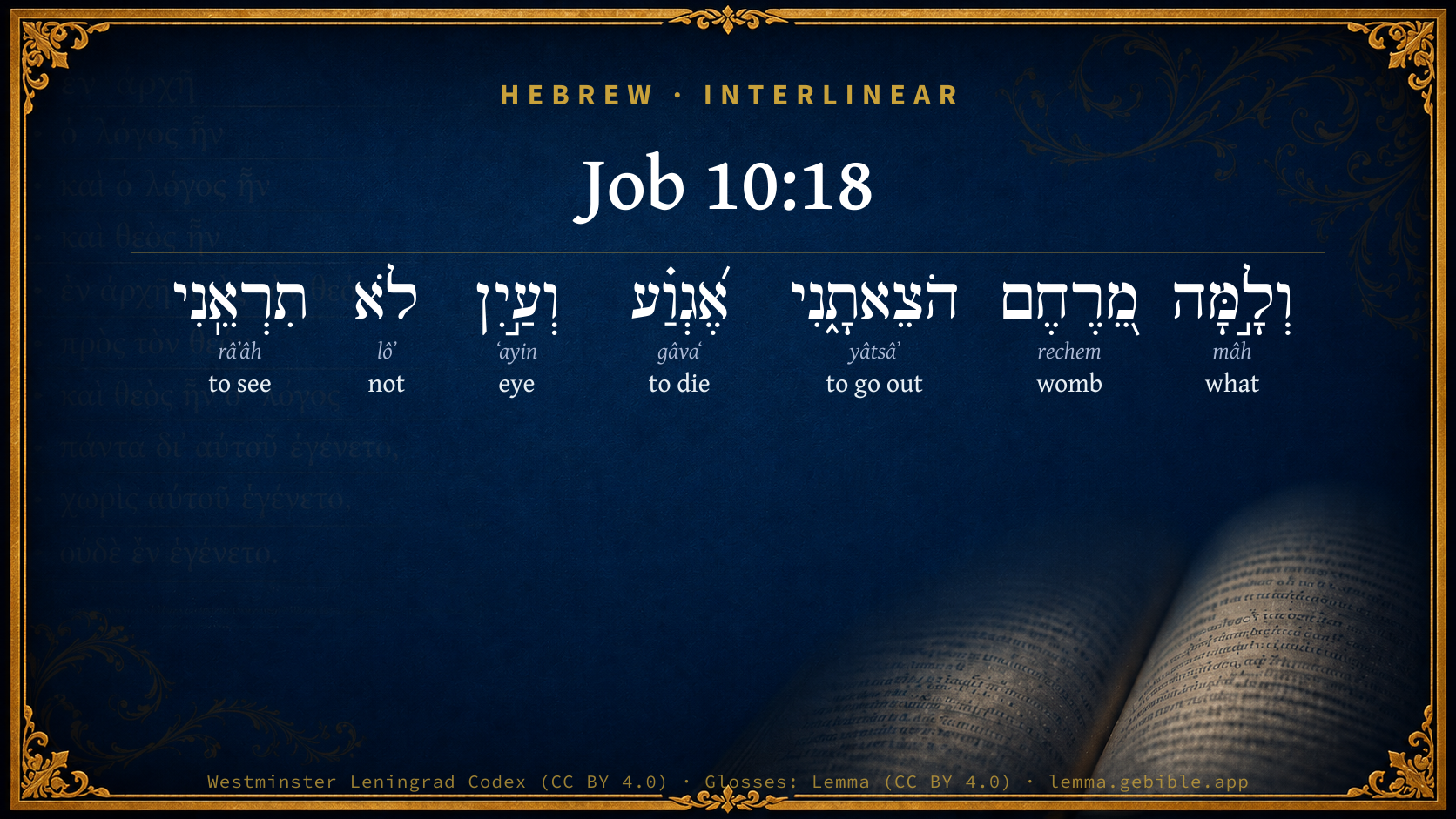
Job 10:18

Hebrew (Westminster Leningrad Codex) Job 10:18 appears in the Hebrew Old Testament. The text above is from the Westminster Leningrad Codex. Each word links to its Strong’s number, a concise gloss, and parsing drawn from the Open Scriptures Hebrew Bible morphology. Click any word for its full Brown-Driver-Briggs (BDB) entry.
Download image
Cite this verse

Job 10:18 (World English Bible). Public Domain. Lemma interlinear Bible study tool, https://lemma.gebible.app/v/job/10/18.

Show BibTeX & RIS
BibTeX
RIS
English Translation
"'Why, then, have you brought me forth out of the womb? I wish I had given up the spirit, and no eye had seen me.
World English Bible · Public Domain
Download a study sheet

One document with this verse’s original text, its word-by-word gloss line, the meaning frame, cross-references with their text, attributed commentary, and full source and license credits — printable, and it pastes into notes with its structure intact.

This verse Autodidact and up

Study sheet (.html) Plain text (.txt)

A passage Seminary Student

Up to 50 verses in one chapter. A passage sheet keeps up to 6 commentary sources and 12 cross-references per verse, in the order this page ranks them, and says so on the sheet whenever that leaves anything out. Ask for a single verse and you get the Autodidact verse sheet above.

Everything on this page stays free to read, with no account — the sheet is a download of what is already on screen, not access to it.

Want to remove ads? Support Godless Engineer
Compare translations 3

The same verse in 3 English versions, stacked beneath the original-language interlinear above. Click any original word for its lexicon entry.

Each is an independent rendering of the whole verse — the interlinear is not word-aligned to these translations.

Highlighted words mark where these versions differ — a whole-verse word diff, not a word-by-word alignment.

  • World English Bible Public Domain
    "'Why, then, have you brought me forth out of the womb? I wish I had given up the spirit, and no eye had seen me.
  • King James Version Public Domain
    Wherefore then hast thou brought me forth out of the womb? Oh that I had given up the ghost, and no eye had seen me!
  • unfoldingWord Literal Text CC BY-SA 4.0
    So why did you bring me out from the womb? Would that I had expired and an eye had not seen me!

unfoldingWord Literal Text — © unfoldingWord, licensed CC BY-SA 4.0. Word-aligned USFM3 via Door43 (git.door43.org/unfoldingWord/en_ult).

Versions to compare (up to 4)

3 of 4 selected

Show all 18 translations

Every available English version of this verse, each an independent rendering of the whole verse.

  • World English Bible Public Domain
    "'Why, then, have you brought me forth out of the womb? I wish I had given up the spirit, and no eye had seen me.
  • Berean Standard Bible Public Domain
    Why then did You bring me from the womb? Oh, that I had died, and no eye had seen me!
  • Majority Standard Bible Public Domain
    Why then did You bring me from the womb? Oh, that I had died, and no eye had seen me!
  • King James Version Public Domain
    Wherefore then hast thou brought me forth out of the womb? Oh that I had given up the ghost, and no eye had seen me!
  • American Standard Version (1901) Public Domain
    Wherefore then hast thou brought me forth out of the womb? I had given up the ghost, and no eye had seen me.
  • Revised Version (1885) Public Domain
    Wherefore then hast thou brought me forth out of the womb? I had given up the ghost, and no eye had seen me.
  • Geneva Bible (1599) Public Domain
    Wherfore then hast thou brought me out of the wombe? Oh that I had perished, and that none eye had seene me!
  • Douay-Rheims (1899) Public Domain
    Why didst thou bring me forth out of the womb: O that I had been consumed that eye might not see me!
  • Young's Literal Translation Public Domain
    And why from the womb Hast Thou brought me forth? I expire, and the eye doth not see me.
  • Literal Standard Version CC BY-SA 4.0
    And why from the womb || Have You brought me forth? I expire, and the eye does not see me.
  • Unlocked Literal Bible CC BY-SA 4.0
    Why, then, have you brought me out of the womb? I wish I had given up my spirit and that no eye had ever seen me.
  • unfoldingWord Literal Text CC BY-SA 4.0
    So why did you bring me out from the womb? Would that I had expired and an eye had not seen me!
  • Darby Bible Public Domain
    And wherefore didst thou bring me forth out of the womb? I had expired, and no eye had seen me.
  • World Messianic Bible Public Domain
    “‘Why, then, have you brought me out of the womb? I wish I had given up the spirit, and no eye had seen me.
  • Webster's Bible Public Domain
    Why then hast thou brought me forth from the womb? O that I had expired, and no eye had seen me!
  • Free Bible Version CC BY-SA 4.0
    So why did you allow me to be born? I wish that I had died, and nobody had ever seen me!
  • Bible in Basic English Public Domain
    Why then did you make me come out of my mother's body? It would have been better for me to have taken my last breath, and for no eye to have seen me,
  • JPS Tanakh (1917) Public Domain
    Wherefore then hast Thou brought me forth out of the womb? Would that I had perished, and no eye had seen me!

Literal Standard Version (2020), Covenant Press — licensed CC BY-SA 4.0. Text via the HelloAO Bible API (eBible.org). Unlocked Literal Bible (unfoldingWord) — licensed CC BY-SA 4.0. Text via the HelloAO Bible API (eBible.org). unfoldingWord Literal Text — © unfoldingWord, licensed CC BY-SA 4.0. Word-aligned USFM3 via Door43 (git.door43.org/unfoldingWord/en_ult). Free Bible Version, Dr. Jonathan Gallagher — licensed CC BY-SA 4.0. Text via the HelloAO Bible API (eBible.org).

Word by word

More ways to search: Search by grammar → Find every occurrence → Compare this word →

Practice this passage: Drill this verse → Learn its vocabulary →

About this verse

These counts appear in no published source. They are computed here, from the morphology-tagged text and Lemma’s own curated glosses. What Lemma adds →

7
words
7
distinct lemmas
Wisdom
section

Notable vocabulary

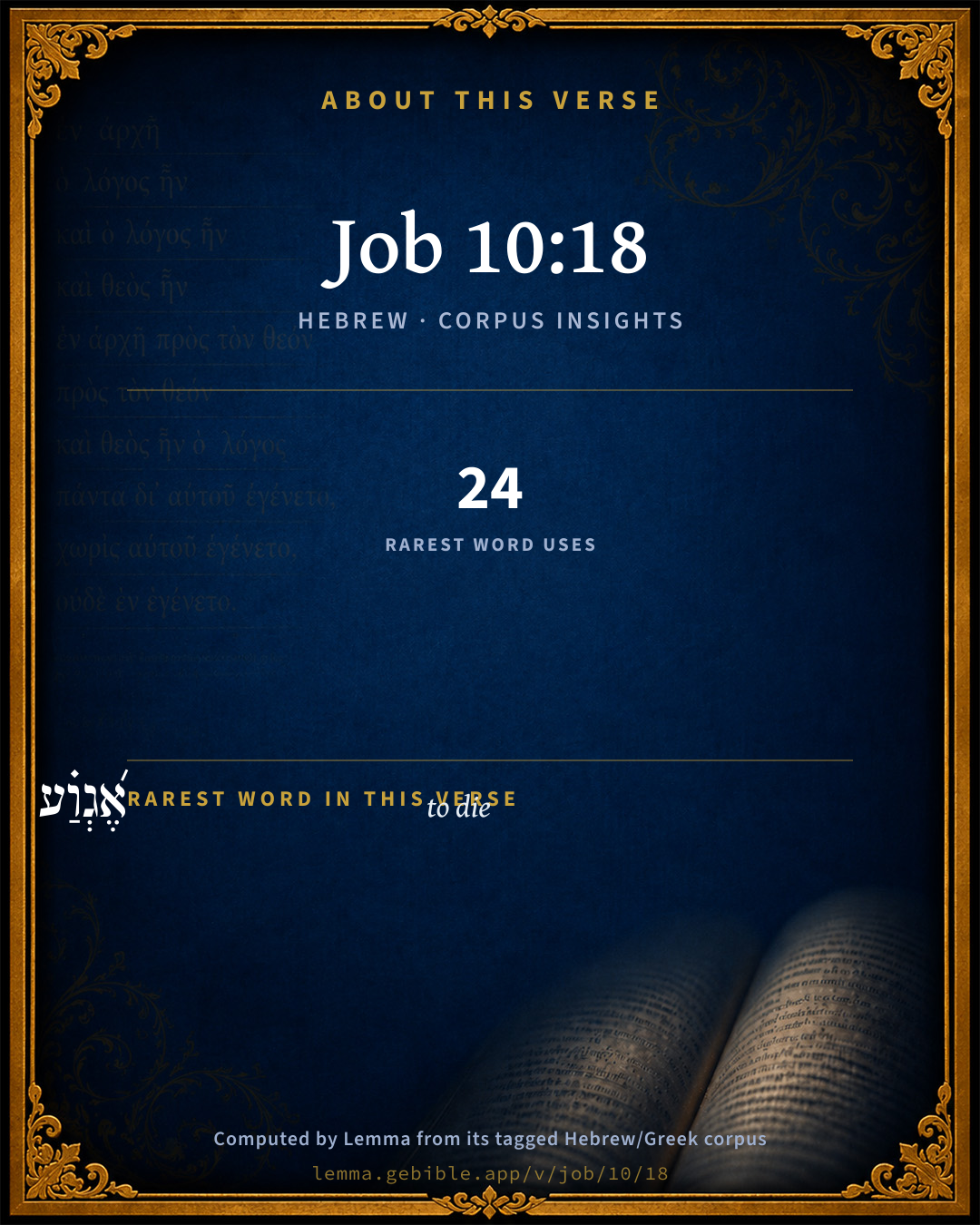
The rarest word here is אֶ֝גְוַ֗ע to die H1478 — appearing just 24 times in the whole Hebrew Bible.

Shared distinctive vocabulary

אֶ֝גְוַ֗ע to die H1478 occurs in 23 verses of the Hebrew Bible. Also found in:

Grammatical profile

  • 3 verbs
  • 2 nouns
  • 2 particles

Verb forms

  • הֹצֵאתָ֑נִי Hiphil · Perfect
  • אֶ֝גְוַ֗ע Qal · Imperfect
  • תִרְאֵֽנִי Qal · Imperfect

Hebrew & Septuagint length

In English translation the verse runs 25 words from the Hebrew and 21 from the Septuagint (LXX English) — closely comparable.

A rough comparison of the two English renderings, which tokenize alike — not a word-level alignment.

Word counts can differ between the Hebrew and the Greek without any difference in meaning — e.g. the Hebrew direct-object marker אֵת has no separate Greek word, and Greek often adds the article ὁ.

Cross-references

6

Topical passages linked to Job 10:18 in the Treasury of Scripture Knowledge — connected by theme and wording, ordered by reader-vote popularity; previews shown in the World English Bible.

  • Jeremiah 20:14–18 Cursed be the day in which I was born: don't let the day in which my mother bore me be blessed.
  • Job 3:10–11 Because it didn't shut up the doors of my mother's womb, Nor did it hide trouble from my eyes.
  • Job 11:20 But the eyes of the wicked shall fail, They shall have no way to flee; Their hope shall be the giving up of the spirit."
  • Job 14:10 But man dies, and is laid low. Yes, man gives up the spirit, and where is he?
  • Jeremiah 15:10 Woe is me, my mother, that you have borne me a man of strife and a man of contention to the whole earth! I have not lent, neither have men lent to me; [yet] everyone of them does curse me.
  • Matthew 26:24 The Son of Man goes, even as it is written of him, but woe to that man through whom the Son of Man is betrayed! It would be better for that man if he had not been born."

Cross-references courtesy of OpenBible.info (CC BY 4.0).

Hebrew and Greek witnesses Masoretic Hebrew ↔ Greek Septuagint

The same verse in the two great witnesses to the Old Testament, shown verse-for-verse.

These are two independent witnesses, not word-aligned to each other, and the Septuagint is shown in lemma (dictionary) form.

Hebrew Job 10:18 Masoretic · Westminster Leningrad Codex

וְלָ֣מָּה מֵ֭רֶחֶם הֹצֵאתָ֑נִי אֶ֝גְוַ֗ע וְעַ֣יִן לֹא תִרְאֵֽנִי

"'Why, then, have you brought me forth out of the womb? I wish I had given up the spirit, and no eye had seen me.

World English Bible · Public Domain

Greek LXX Job 10:18 Septuagint · lemma form

ἵνα τίς οὖν ἐκ κοιλία ἐγώ ἐκἄγω καί οὐ ἀποθνήσκω ὀφθαλμός δέ ἐγώ οὐ ὁράω

Why then did you bring me out of the womb? and why did I not die, and no eye see me,

LXX2012 (modern English Septuagint) · Public Domain

Hebrew: Westminster Leningrad Codex (CC BY 4.0). Greek: Septuagint (public domain); English from LXX2012 (modern English Septuagint) (Public Domain). How the Septuagint differs from the Hebrew →

Commentary

Notes on Job 10:18 from classic Christian and Jewish commentators (each source and its license shown beneath its notes). The classic Christian expositions comment on the surrounding passage and are grouped to its opening verse, so a note may address several verses; the Jewish commentaries on the Tanakh (Rashi and others) are per-verse, so they appear only where the commentator wrote on this verse.

Lemma curates 59 commentaries, every one of them public domain or Creative Commons licensed, each selected and text-cleaned for this edition rather than reprinted as found. About our sources →

Trapp's Complete Commentary

John Trapp

Job 10:18 Wherefore then hast thou brought me forth out of the womb? Oh that I had given up the ghost, and no eye had seen me!

Ver. 18. Wherefore hast thou brought me forth out of the womb?] Why? but was not that a mercy? David esteemed it so, and gives God the glory, Psa 22:9. But discontent is an utter enemy to thankfulness. The bird sings not till she have taken up her stand to her mind. Some men’s eyes are so bleared and glazed with tears for what they want, that they cannot see what good they have, cannot see mercies for blessings. Job here, in a distemper, wisheth himself (as he had done before, Job 3:1-26. "Who can understand his errors?" Psa 19:12) either unborn, or presently dead, without the distance of one day between his birth and his burial. In quo errorem erravit non levem, vir alioqui pientissimus; this was a worse wish than if he had desired that his life might be presently taken away from him, for herein he showeth himseff unthankful to God for all his former benefits; and not so only, but angry with God for the good he had done him: thus we have seen dogs in a chase fly at their masters, and children in a pelt strike at their parents. But these were the voices of the flesh lusting against the spirit, which afterwards (being justly reprehended for them, first by Elihu, and then also by God himself) he repressed and repented of in dust and ashes, Job 42:6.

Oh that I had given up the ghost, and no eye had seen me!] sc. With delight: for what pleasure is there in seeing a dead corpse, especially a stillborn child? See Gen 23:4, with the note. This text teacheth us, saith an interpreter, what sad effects extreme grief and pain worketh in the very best: it distempereth their spirits, and so disturbeth them, that their complaints look like the blasphemies of the wicked, and they sometimes wish absurd things, dishonourable to God, and prejudicial to themselves.

John Trapp, A Commentary or Exposition upon All the Books of the Old and New Testament (1647–1656) — public domain. Text from a community e-Sword module.

The Biblical Illustrator

Joseph S. Exell

Job_10:18-22

Oh that I had given up the ghost!

The effects of Jobs sufferings

The patriarch had already in the previous verses expressed to the Almighty that his sufferings were--

(1) Too great to render any efforts at self-consolation effective,

(2) Too deserved to justify any hope of relief,

(3) Too overwhelming to check the expression of his complaint, and now as

(4) Too crushing to give to existence anything but an intolerable curse, His sufferings, judging from his language here, had destroyed within him for a time three of the primary instincts of the soul.

I. A sense of duty. Sense of obligation to the Supreme is an instinct as universal as man, as deep as life itself; but the patriarch, in wishing that he had never been, or that his first breath had been extinguished, had lost all feeling in relation to the wonderful mercies which his Creator had conferred upon him during the past years of his existence.

What were those mercies?

1. Great material wealth.

2. Great domestic enjoyment.

3. Immense social influence.

II. A love of life. Seldom do we find, even amongst the most miserable of men, one who struggles not to perpetuate his existence. But this instinct Job now seems to have lost, if not its existence, its power. Existence has become so intolerable that he wishes he had never had it, and yearns for annihilation. Two thoughts are here suggested.

1. There may be something worse for man than annihilation.

2. This annihilation is beyond the reach of creatures.

III. Hope of a hereafter. Hope for future good is another of the strongest instincts of our nature. Thou didst make me hope when I was upon my mothers breasts. Indeed it is one of those powers within us that, like a mainspring, keeps every wheel in action. Man never is but always to be blest. Job seems to have lost this now. Hence his description of the future. Before I go whence I shall not return, even to the land of darkness, and the shadow of death; a land of darkness, as darkness itself; and of the shadow of death, without any order, and where the light is as darkness. He saw a future, but what was it?

1. Darkness. A starless, moonless midnight, a vast immeasurable abyss--the land of darkness. His hereafter was black, not a ray of light streamed from the firmament.

2. Confusion. Without any order. Small and great, young and old, all together in black chaos.

Conclusion--

1. That great suffering in this world in the case of individuals does not mean great sin.

2. The power of the devil over man.

3. The value of the Gospel. This man had no clear revelation of a blessed future. Hence one scarcely wonders at his frequent and impassioned complaints. How different our life to his! (Homilist.)

A good mans distempers

This passage teaches--

1. Saints highest fits of passion will not last, but mercy will reclaim them, and give them a cool of that fever.

2. As the fevers and distempers of saints may come to a very great height, so, ordinarily, that height or excess of them proves the step next to their cool.

3. Humble, sober prayer is a notable evidence and mean in calming distempered spirits; it is as the shower to allay that poisonous wind.

4. As mans life is but uncertain and short, so the thoughts of this should make men employ their time well, and to be very needy and pressing after God, and proofs of Him.

5. Such as are excited with much trouble, and have their exercises blessed to them, will be sober, and esteem much of little ease, to get leave to breathe, or to comfort and refresh themselves a little, with a sight of God, or of His grace in them, and not their own passions which they ought to abhor.

6. The least ease, breathing, or comfort, under trouble, cannot be had but of Gods indulgence.

7. It is the duty of men to acquaint themselves with death beforehand; and especially in times of trouble they should study it in its true colours.

8. Death and the grave in themselves, and when Christs victory over them is not studied, and men are hurried away to them in a tempest of trouble, are very terrible, and an ugly sight, as bringing an irreparable loss as to any restitution in this life.

9. The consideration of the ugliness of death and the grave, doth call upon all to provide somewhat before they lie down in that cold bed, wherein they will continue so long, and somewhat that may light them through that dark passage. (George Hutcheson.)

The Biblical Illustrator, edited by Joseph S. Exell (c. 1880s–1900s) — public domain. Text from a community e-Sword module.

Whedon's Commentary on the Bible

Daniel D. Whedon

b. Lost in the perplexities of existence, the sole favour he has to ask is a little respite (for reflection) before he descends to the land of deepest darkness, Job_10:18-22.

18. O that I had given up the ghost — Rather, I should have died. “If the flesh should murmur and cry out, as Christ even cried out and was feeble,” (says Luther, in one of his consolatory letters,) “the spirit nevertheless is ready and willing, and, with sighings that cannot be uttered, will cry, Abba, Father, is it thou? thy rod is hard, but thou still art Father; I know that of a truth.” — Delitzsch. In sad contrast with this, and in harmony with Job, is the language of Artabanus, the Persian: “Short as our time is, there is no man, whether it be here among this multitude or elsewhere, who is so happy as not to have felt the wish — I will not say once, but full many a time — that he were dead, rather than alive.” — Herodotus, 7:46.

Daniel D. Whedon (gen. ed.), Commentary on the Old and New Testaments (1874–1909) — public domain. Text from a community e-Sword module.

Keil & Delitzsch

C. F. Keil & F. Delitzsch

18 And wherefore hast Thou brought me forth out of the womb?

I should have expired, that no eye had seen me,

19 I should have been as though I had never been,

Carried from the womb to the grave.

20 Are not my days few? then cease

And turn from me, that I may become a little cheerful,

21 Before I go to return no more

Into the land of darkness and of the shadow of death,

22 The land of deep darkness like to midnight,

Of the shadow of death and of confusion,

And which is bright like midnight.

The question Wherefore? Job 10:18, is followed by futt. as modi conditionales (Ges. 127, 5) of that which would and should have happened, if God had not permitted him to be born alive: I should have expired, prop. I ought to have expired, being put back to the time of birth (comp. Job 3:13, where the praet. more objectively expressed what would then have happened). These modi condit. are continued in Job 10:19 : I should have been (sc. in the womb) as though I had not been (comp. the short elliptical

(Note: כלא is there = לא כאשׁר, like ללא, Isa 65:1 = לא לאשׁר [vid. Ges. 123, 3], and כּ is used as a conjunction as little as ל (vid., on Psa 38:14).)

expression, Oba 1:16), i.e., as one who had scarcely entered upon existence, and that only of the earliest (as at conception); I should have been carried (הוּבל, as Job 21:32) from the womb (without seeing the light as one born alive) to the grave. This detestation of his existence passes into the wish, Job 10:20, that God would be pleased at least somewhat to relieve him ere he is swallowed up by the night of Hades. We must neither with the Targ. translate: are not my days few, and vanishing away? nor with Oetinger: will not my fewness of days cease? Both are contrary to the correct accentuation. Olshausen thinks it remarkable that there is not a weaker pausal accent to ימי; but such a one is really indirectly there, for Munach is here equivalent to Dech, from which it is formed (vid., the rule in Comm. ber den Psalter, ii. 504). Accordingly, Seb. Schmid correctly translates: nonne parum dies mei? ideo cessa. The Keri substitutes the precative form of expression for the optative: cease then, turn away from me then (imper. consec. with waw of the result, Ewald, 235, a); comp. the precative conclusion to the speech, Job 7:16., but there is no real reason for changing the optative form of the text. ישׁית (voluntative for ישׁת, Job 9:33) may be supplemented by ידו, פניו, עיניו ,פ, or לבו (Job 7:17) (not, however, with Hirz., שׁבטו, after Job 9:34, which is too far-fetched for the usage of the language, or with Bttch., מחנהו, copias suas); שׁית can however, like שׂים, Job 4:20, signify to turn one's self to, se disponere = to attend to, consequently מן שׁית, to turn the attention from, as מן שׁעה, Job 7:19, Ps. 39:14 (where, as here, ואבליגה follows).

He desires a momentary alleviation of his sufferings and ease before his descent to Hades, which seems so near at hand. He calls Hades the land of darkness and of the shadow of death. צלמות, which occurs for the first time in the Old Testament in Psa 23:4, is made into a compound from סלמוּת, and is the proper word for the obscurity of the region of the dead, and is accordingly repeated later on. Further, he calls it the land of encircling darkness (עפתה, defective for עיפתה, from עוף, caligare, and with He parag. intensive for עיפה, in Amo 4:13, who also uses הבליג, Job 5:9, in common with Job), like midnight darkness. אפל cannot mean merely the grey of twilight, it is the entire absence of sunlight, Job 3:6; Job 28:3; Psa 91:6; comp. ex. Job 10:22, where the Egyptian darkness is called אפלה חשׁך. Bttch. correctly compares אפל and נפל: mersa ad imum h.e. profunda nox (the advancing night). Still further he calls it (the land) of the shadow of death, and devoid of order (סדרים, ἅπ. λεγ. in the Old Testament, but a common word in the later Hebrew), i.e., where everything is so encompassed by the shadow of death that it seems a chaos, without any visible or distinct outline. It is difficult to determine whether ותּפע is to be referred to ארץ: and which lights (fut. consec. as the accent on the penult. indicates, the syntax like Job 3:21, Job 3:23; Isa 57:3); or is to be taken as neuter: and it shines there (= and where it shines) like midnight darkness. Since ותּפע (from יפע = ופע, to rise, shine forth; vid., on Psa 95:4), as also האיר, does not occur elsewhere as neuter, we prefer, with Hirzel, to refer it to ארץ ot, as being more certain. Moreover, אפל is here evidently the intensest darkness, ipsum medullitium umbrae mortis ejusque intensissimum, as Oetinger expresses it. That which is there called light, i.e., the faintest degree of darkness, is like the midnight of this world; "not light, but darkness visible," as Milton says of hell.

The maxim of the friends is: God does not pervert right, i.e., He deals justly in all that He does. They conclude from this, that no man, no sufferer, dare justify himself: it is his duty to humble himself under the just hand of God. Job assents to all this, but his assent is mere sarcasm at what they say. He admits that everything that God does is right, and must be acknowledged as right; not, however, because it is right in itself, but because it is the act of the absolute God, against whom no protest uttered by the creature, though with the clearest conviction of innocence, can avail. Job separates goodness from God, and regards that which is part of His very being as a produce of His arbitrary will. What God says and does must be true and right, even if it be not true and right in itself. The God represented by the friends is a God of absolute justice; the God of Job is a God of absolute power. The former deals according to the objective rule of right; the latter according to a freedom which, because removed from all moral restraint, is pure caprice.

How is it that Job entertains such a cheerless view of the matter? The friends, by the strong view which they have taken up, urge him into another extreme. On their part, they imagine that in the justice of God they have a principle which is sufficient to account for all the misfortunes of mankind, and Job's in particular. They maintain, with respect to mankind in general (Eliphaz by an example from his own observation, and Bildad by calling to his aid the wisdom of the ancients), that the ungodly, though prosperous for a time, come to a fearful end; with respect to Job, that his affliction is a just chastisement from God, although designed for his good. Against the one assertion Job's own experience of life rebels; against the other his consciousness rises up with indignation. Job's observation is really as correct as that of the friends; for the history of the past and of the present furnishes as many illustrations of judgments which have suddenly come upon the godless in the height of their prosperity, as of general visitations in which the innocent have suffered with the guilty, by whom these judgments have been incurred. But with regard to his misfortune, Job cannot and ought not to look at it from the standpoint of the divine justice. For the proposition, which we will give in the words of Brentius, quidquid post fidei justificationem pio acciderit, innocenti accidit, is applicable to our present subject.

If, then, Job's suffering were not so severe, and his faith so powerfully shaken, he would comfort himself with the thought that the divine ways are unsearchable; since, on the one hand, he cannot deny the many traces of the justice of the divine government in the world (he does not deny them even here), and on the other hand, is perplexed by the equally numerous incongruities of human destiny with the divine justice. (This thought is rendered more consolatory to us by the revelation which we possess of the future life; although even in the later Old Testament times the last judgment is referred to as the adjustment of all these incongruities; vid., the conclusion of Ecclesiastes.) His own lot might have remained always inexplicable to him, without his being obliged on that account to lose the consciousness of the divine love, and that faith like Asaph's, which, as Luther says, struggles towards God through wrath and disfavour, as through thorns, yea, even through spears and swords.

Job is passing through conflict and temptation. He does not perceive the divine motive and purpose of his suffering, nor has he that firm and unshaken faith which will keep him from mistaken views of God, although His dispensations are an enigma to him; but, as his first speech (ch. 3) shows, he is tormented by thoughts which form part of the conflict of temptation. The image of the gracious God is hidden from him, he feels only the working of the divine wrath, and asks, Wherefore doth God give light to the suffering ones? - a question which must not greatly surprise us, for, as Luther says, "There has never been any one so holy that he has not been tormented with this quare, quare, Wherefore? wherefore should it be so?" And when the friends, who know as little as Job himself about the right solution of this mystery, censure him for his inquiry, and think that in the propositions: man has no righteousness which he can maintain before God, and God does not pervert the right, they have found the key to the mystery, the conflict becomes fiercer for Job, because the justice of God furnishes him with no satisfactory explanation of his own lot, or of the afflictions of mankind generally. The justice of God, which the friends consider to be sufficient to explain everything that befalls man, Job can only regard as the right of the Supreme Being; and while it appears to the friends that every act of God is controlled by His justice, it seems to Job that whatever God does must be right, by virtue of His absolute power.

This principle, devoid of consolation, drives Job to the utterances so unworthy of him, that, in spite of his conviction of his innocence, he must appear guilty before God, because he must be speechless before His terrible majesty, - that if, however, God would only for once so meet him that he could fearlessly address Him, he would know well enough how to defend himself (ch. 9). After these utterances of his feeling, from which all consciousness of the divine love is absent, he puts forth the touching prayer: Condemn me not without letting me know why Thou dost condemn me! (Job 10:1-7).

As he looks back, he is obliged to praise God, as his Creator and Preserver, for what He has hitherto done for him (Job 10:8-12); but as he thinks of his present condition, he sees that from the very beginning God designed to vent His wrath upon him, to mark his infirmities, and to deprive him of all joy in the consciousness of his innocence (Job 10:13-17). He is therefore compelled to regard God as his enemy, and this thought overpowers the remembrance of the divine goodness. If, however, God were his enemy, he might well ask, Wherefore then have I come into being? And while he writhes as a worm crushed beneath the almighty power of God, he prays that God would let him alone for a season ere he passes away into the land of darkness, whence there is no return (Job 10:18-22).

Brentius remarks that this speech of Job contains inferni blasphemias, and explains them thus: non enim in tanto judicii horrore Deum patrem, sed carnificem sentit; but also adds, that in passages like Job 10:8-12 faith raises its head even in the midst of judgment; for when he praises the mercies of God, he does so spiritu fidei, and these he would not acknowledge were there not a fidei scintilla still remaining. This is true. The groundwork of Job's faith remains even in the fiercest conflict of temptation, and is continually manifest; we should be unable to understand the book unless we could see this fidei scintilla, the extinction of which would be the accomplishment of Satan's design against him, glimmering everywhere through the speeches of Job. The unworthy thoughts he entertains of God, which Brentius calls inferni blasphemias, are nowhere indulged to such a length that Job charges God with being his enemy, although he fancies Him to be an enraged foe. In spite of the imagined enmity of God against him, Job nowhere goes so far as to declare enmity on his part against God, so far as אלהים ברך. He does not turn away from God, but inclines to Him in prayer. His soul is filled with adoration of God, and with reverence of His power and majesty; he can clearly discern God's marvellous works in nature and among men, and His creative power and gracious providence, the workings of which he has himself experienced. But that mystery, which the friends have made still more mysterious, has cast a dark cloud over his vision, so that he can no longer behold the loving countenance of God. His faith is unable to disperse this cloud, and so he sees but one side of the divine character - His Almightiness. Since he consequently looks upon God as the Almighty and the Wrathful One, his felling alternately manifests itself under two equally tragical phases. At one time he exalts himself in his consciousness of the justice of his cause, to sink back again before the majesty of God, to whom he must nevertheless succumb; at another time his feeling of self-confidence is overpowered by the severity of his suffering, and he betakes himself to importunate supplication.

It is true that Job, so long as he regards his sufferings as a dispensation of divine judgment, is as unjust towards God as he believes God to be unjust towards him; but if we bear in mind that this state of conflict and temptation does not preclude the idea of a temporal withdrawal of faith, and that, as Baumgarten (Pentat. i. 209) aptly expresses it, the profound secret of prayer is this, that man can prevail with the Divine Being, then we shall understand that this dark cloud need only be removed, and Job again stands before the God of love as His saint.

Keil & Delitzsch — Biblical Commentary on the Old Testament (1861–1891) — public domain (CC PDM 1.0). Text via the HelloAO Bible API. (Old Testament only.)

Adam Clarke's Commentary

Verse 18. Wherefore then] Why didst thou give me a being, when thou didst foresee I should be exposed to such incredible hardships? See on Job 3:10, &c.

Adam Clarke's Commentary on the Bible (1810–1826) — public domain. Text from a community e-Sword/MySword module.

Ellicott's Commentary for English Readers

(18) Wherefore then hast thou brought me forth?—Here Job reverts to the strain of his original curse (Job_3:11, &c.).

A Bible Commentary for English Readers, edited by Charles John Ellicott (1878–1897) — public domain. Text from a community e-Sword module.

The Cambridge Bible for Schools and Colleges

gen. ed. J. J. S. Perowne

18, 19. Perplexed even to despair by this idea of the purpose of God Job asks, Why God ever gave him existence at all? and as in ch. Job_3:11 seq. wishes he had never seen life.

hast thou brought] didst thou bring.

Oh that I had given] I should have given.

The Cambridge Bible for Schools and Colleges (gen. ed. J. J. S. Perowne; Cambridge University Press, 1878–1918) — public domain. Text from a community e-Sword module.

John Gill's Exposition

I should have been as though I had not been,.... For though it cannot be said absolutely of such an one, an abortive or untimely birth, that it is a nonentity, or never existed; yet comparatively it is as if it never had a being; it being seen by none or very few, it having had no name, nor any conversation among men; but at once buried, and buried in forgetfulness, as if no such one had ever been; see Ecc 6:3. This Job wished for, for so some render it, "oh, that I had been as though I had never been" (f); and then he would have never been involved in such troubles he was, he would have been free from all his afflictions and distresses, and never have had any experience of the sorrows that now surrounded him:

I should have been carried from the womb to the grave; if he had not been brought out of it, the womb had been his grave, as in Jer 20:17; or if he had died in it, and had been stillborn, he would quickly have been carried to his grave; he would have seen and known nothing of life and of the world, and the things in it; and particularly of the troubles that attend mortals here: his passage in it and through it would have been very short, or none at all, no longer than from the womb to the grave; and so should never have known what sorrow was, or such afflictions he now endured; such an one being in his esteem happier than he; see Ecc 4:3.

(f) So Vatablus, Piscator, and some in Mercerus.

John Gill's Exposition of the Whole Bible (1746–1763) — public domain (CC PDM 1.0). Text via the HelloAO Bible API.

Albert Barnes' Notes on the Bible

Wherefore then hast thou brought me forth - See the notes at Job 3:11.

Albert Barnes' Notes on the Bible (1834–1885) — public domain. Text from a community e-Sword/MySword module.

Matthew Poole's English Annotations

To wit, alive, i.e. that I had never been born alive.

Matthew Poole's English Annotations on the Holy Bible (1683–1685) — public domain. Text from a community e-Sword/MySword module.

The Pulpit Commentary

Wherefore then hast thou brought me forth out of the womb? A recurrence to his original complaint; (Job_3:3-10) as if, after full consideration, he returned to the conviction that the root of the whole matter the real thing of which he might justly complain was that he had ever been born into the world alive! Oh that I had given up the ghost! Before birth, or in the act of birth. (so Job_3:11) And no eye had seen me! "No eye," i.e. , "had looked upon my living face." For then

Vers. 18-22. Job to God: the progress of the third controversy:. An old complaint renewed.

I A GREAT MERCY DESPISED. Life. "Wherefore then hast thou brought me forth out of the womb?" (ver. 18). Job here announces an important truth, that the extraction of an infant from the womb is practically God"s work, (Psa_22:9 Psa_71:6) but likewise commits a sin in regarding as an evil fortune what, rightly pondered, should have been esteemed a valuable blessing. Life, as God bestows it, is a precious gift; though frequently, as man makes it, it proves a dreadful curse. Job"s ingratitude was all the more reprehensible that in his case life had been crowned with mercies with great material wealth, with true domestic enjoyment, with immense social influence, with rich spiritual grace, with palpable Divine favour.

II A SINFUL REGRET INDULGED. That he had not been carried from the womb to the grave. "Oh that I had given up the ghost, and no eye had seen me!" (ver. 18). Job"s regret was:

1. Sinful; inasmuch as it undervalued a Divine gift.

2. Unnatural; since it contradicted the instinct of love of life which the Creator has implanted in all his creatures.

3. Foolish; for though Job might have thereby escaped bodily pain, he would also have missed much happiness and many opportunities of glorifying God by doing good and enduring affliction.

4. Mistaken; as though Job had been carried from the womb to the grave, his expectation," I should have been as though I had not been," would not have proved correct. The child who opens its eyes on earth simply to shut them again does not return to the wide womb of nothingness when its tiny form is deposited in the dust. The fact of its being horn into Adam"s race constitutes it an immortal. The doctrine of annihilation, if not absolutely unphilosophical, is certainly unnatural and unscriptural.

III A PASSIONATE ENTREATY OFFERED. For a brief respite in the midst of his sufferings. "Are not my days few? cease then, and let me alone, that I may take comfort a little.

1. The prayer. "Let me alone." Job craved a momentary alleviation in his troubles. Few sufferers are without such interludes of ease. God mercifully mitigates human sorrow by granting brief periods of relief; otherwise men would be crushed, and the end of affliction defeated.

2. The purpose. "That I may be cheerful a little." Job could not brighten up while tormented by incessant pain and haunted by continual fear. (Job_9:27) Only the lifting of God"s hand would remove the load from his heart and the cloud from his brow. And this he felt was desirable before he went to the under world. Most men will sympathize with Job in desiring a brief period of freedom from pain before passing into the eternal world, to enable them to calm their spirits, to collect their thoughts, to prepare their souls for the last conflict and the great hereafter.

3. The plea. "Are not my days few?" Job thought himself upon the brink of the grave. In this, however, he was mistaken. Most men deem themselves further from the unseen world than they really are, (1Sa_20:3) but occasionally sufferers judge themselves nearer the close of life than they eventually prove to be. If the first is a sin of presumption, the second is an error caused by feeble faith. If the first is peculiar to youth and health, the second is not infrequent to suffering and age.

IV A DISMAL FUTURE DEPICTED. Hades. The melancholy region, into which Job anticipated almost instantaneous departure, was not the grave, which was, properly speaking, only the receptacle of the dead body; but Sheol, the abode of departed spirits. As conceived by Job and other Old Testament saints, this was not a place where the disembodied spirit either found annihilation or sank into unconsciousness, but a realm in which the spirit, existing apart from the body, retained its self-consciousness. Yet the gloom which overhung this silent and impenetrable land was such as to render it unattractive in the extreme. It was a land of:

1. Perpetual exile. Before I go whence I shall not return" (ver. 21); "the undiscovered country, from whose bourn no traveller returns" ("Hamlet," act 3. sc. 1).

2. Thick darkness. "A land of darkness, as darkness itself" (ver. 22). Four different terms are employed to depict the gloom of this dismal world; the first (used in Gen_1:2) probably depicting a condition of things upon which light has not yet arisen; the second representing this lightless region as death"s shade, i.e. the veil which death draws around the eyes of men; the third setting forth this darkness as that which covers up or encircles all things; and the fourth pointing to the complete shooting off of light, the deepest and thickest gloom. This horrible picture the poet finishes by adding, "and the light is as the thick darkness," meaning that in that doleful region the daylight or the noontide is like the midnight gloom of earth: "not light, but darkness visible" (Milton, "Paradise Lost," bk. 1.).

3. Complete disorder. A land "without any order" (ver. 22); meaning either without form or outline, every object being so wrapt in gloom that it appears devoid of shape, or without regular succession, as of day and night; a realm without light, without beauty, without form, without order; a dark subterranean chaos filled with pale ghosts, waiting in comparative inactivity during that "night in which no man can work," for the dawning of the resurrection morn. Contrast with all this the Christian Paradise, where the spirits of just men made perfect are now for ever with the Lord; not a laud of exile from which one shall no more return, but a better country, even a heavenly, from which one shall go no more out; (Rev_3:12) not a region of darkness, but a bright realm of light; (Rev_21:23) not a chaos of confusion, but a glorious cosmos of life, order, and beauty. (Rev_21:1)

Learn:

1. The danger of unsanctified affliction.

2. The power of Satan over the human heart.

3. The short-sightedness of sense and reason.

4. The propriety of ever being ready for our departure into the unseen world.

5. The value of the gospel, which has brought life and immortality to light.

6. The advantage possessed by those who live under the gospel dispensation.

7. The greater responsibility of those who enjoy greater light than Job did.

The Pulpit Commentary (1880–1919), ed. H.D.M. Spence-Jones & Joseph S. Exell — public domain. Text from a community e-Sword module.

unfoldingWord translationNotes

Door43 World Missions Community

brought me out of the womb

Here being brought out of the womb represents being born into this world. AT: "brought me out of my mother's womb" or "brought me into this world" (See: Metaphor)

given up my spirit

Giving up one's spirit represents dying. AT: "died" (See: Metaphor)

and that no eye had ever seen me

Job uses "eye" here to refer to the whole person. He wishes he could have died at birth, before anyone saw him. AT: "before any person had ever seen me" or "before I was born" (See: Synecdoche)

I had never existed

"I had never lived"

I would have been carried

"My body would have been carried"

translationWords

womb

spirit

grave

unfoldingWord translationNotes — © Distant Shores Media and the Door43 World Missions Community, licensed CC BY-SA 4.0. Source: git.door43.org/Door43/en_tn.

Rashi

Rabbi Shlomo Yitzchaki (Rashi)

Would that I had died and no eye had seen me If only I had died [upon emerging] from the womb.

Rashi on the Tanakh — English translations: “The Judaica Press complete Tanach with Rashi, translated by A. J. Rosenberg” (CC BY 4.0); “Pentateuch with Rashi's commentary by M. Rosenbaum and A.M. Silbermann, 1929-1934” (public domain); “The Metsudah Tanach series, Lakewood, N.J” (CC BY 4.0); and “The Book of Joshua, Metsudah Publications, 1997” (CC BY 4.0). Text via Sefaria.

Lesson kit

Teaching starters — assembled from the data on this page, not authored interpretation. Every prompt links to the verse data it draws on. Edit before teaching.

Job, in the Wisdom, opens this verse with 7 words (7 distinct Hebrew lemmas). Its most distinctive word is gâvaʻ (“to die”). A historical commentator’s framing appears above. Read the whole chapter for the surrounding context.

Discussion questions

  1. What does “to die” (gâvaʻ) contribute to the verse as a whole?
  2. How does Genesis 6:17, which shares the word «to die», read alongside this verse?
  3. These translations render this verse differently. What is at stake in choosing one wording over another?
  4. «הֹצֵאתָ֑נִי» is a Hiphil Perfect verb. How does that grammatical form shape the action described?
  5. Compare how Trapp's Complete Commentary and The Biblical Illustrator read this verse. Where do they agree or differ?

Things to notice

Reading settings

Reading text

Shown beneath each verse's original-language words.

Old Testament
Old Testament edition

Read the OT as the Masoretic Hebrew (MT) or the Greek Septuagint (LXX).

English shown for the Greek Septuagint (in the Hebrew ↔ Greek comparison).

Comparing translations? Open the Compare panel on any verse page to stack up to four side by side.