
Jeremiah 5:19

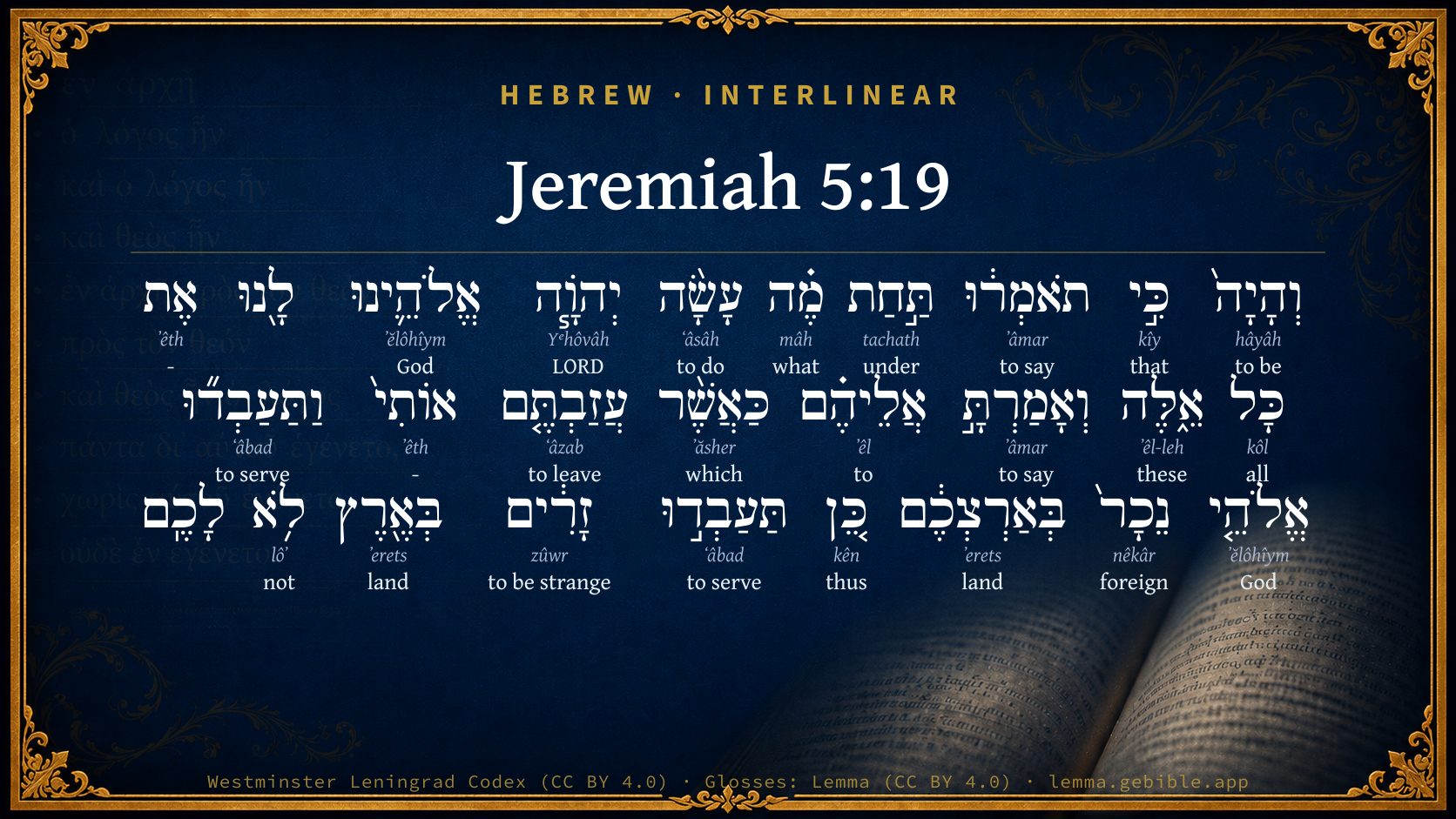
Hebrew (Westminster Leningrad Codex) Jeremiah 5:19 appears in the Hebrew Old Testament. The text above is from the Westminster Leningrad Codex. Each word links to its Strong’s number, a concise gloss, and parsing drawn from the Open Scriptures Hebrew Bible morphology. Click any word for its full Brown-Driver-Briggs (BDB) entry.
Download image
Cite this verse

Jeremiah 5:19 (World English Bible). Public Domain. Lemma interlinear Bible study tool, https://lemma.gebible.app/v/jeremiah/5/19.

Show BibTeX & RIS
BibTeX
RIS
English Translation
It shall happen, when you shall say, Why has Yahweh our God done all these things to us? then shall you say to them, Like as you have forsaken me, and served foreign gods in your land, so shall you serve strangers in a land that is not yours.
World English Bible · Public Domain
Download a study sheet

One document with this verse’s original text, its word-by-word gloss line, the meaning frame, cross-references with their text, attributed commentary, and full source and license credits — printable, and it pastes into notes with its structure intact.

This verse Autodidact and up

Study sheet (.html) Plain text (.txt)

A passage Seminary Student

Up to 50 verses in one chapter. A passage sheet keeps up to 6 commentary sources and 12 cross-references per verse, in the order this page ranks them, and says so on the sheet whenever that leaves anything out. Ask for a single verse and you get the Autodidact verse sheet above.

Everything on this page stays free to read, with no account — the sheet is a download of what is already on screen, not access to it.

Want to remove ads? Support Godless Engineer
Compare translations 3

The same verse in 3 English versions, stacked beneath the original-language interlinear above. Click any original word for its lexicon entry.

Each is an independent rendering of the whole verse — the interlinear is not word-aligned to these translations.

Highlighted words mark where these versions differ — a whole-verse word diff, not a word-by-word alignment.

  • World English Bible Public Domain
    It shall happen, when you shall say, Why has Yahweh our God done all these things to us? then shall you say to them, Like as you have forsaken me, and served foreign gods in your land, so shall you serve strangers in a land that is not yours.
  • King James Version Public Domain
    And it shall come to pass, when ye shall say, Wherefore doeth the LORD our God all these things unto us? then shalt thou answer them, Like as ye have forsaken me, and served strange gods in your land, so shall ye serve strangers in a land that is not your's.
  • unfoldingWord Literal Text CC BY-SA 4.0
    And it will happen when you say, ‘Why has Yahweh our God done all these things to us?’ then you shall say to them, ‘Just as you abandoned me and served gods of a foreigner in your land, so you will serve strangers in a land not yours.’

unfoldingWord Literal Text — © unfoldingWord, licensed CC BY-SA 4.0. Word-aligned USFM3 via Door43 (git.door43.org/unfoldingWord/en_ult).

Versions to compare (up to 4)

3 of 4 selected

Show all 18 translations

Every available English version of this verse, each an independent rendering of the whole verse.

  • World English Bible Public Domain
    It shall happen, when you shall say, Why has Yahweh our God done all these things to us? then shall you say to them, Like as you have forsaken me, and served foreign gods in your land, so shall you serve strangers in a land that is not yours.
  • Berean Standard Bible Public Domain
    And when the people ask, ‘For what offense has the LORD our God done all these things to us?’ You are to tell them, ‘Just as you have forsaken Me and served foreign gods in your land, so will you serve foreigners in a land that is not your own.’”
  • Majority Standard Bible Public Domain
    And when the people ask, ‘For what offense has the LORD our God done all these things to us?’ You are to tell them, ‘Just as you have forsaken Me and served foreign gods in your land, so will you serve foreigners in a land that is not your own.’”
  • King James Version Public Domain
    And it shall come to pass, when ye shall say, Wherefore doeth the LORD our God all these things unto us? then shalt thou answer them, Like as ye have forsaken me, and served strange gods in your land, so shall ye serve strangers in a land that is not your's.
  • American Standard Version (1901) Public Domain
    And it shall come to pass, when ye shall say, Wherefore hath Jehovah our God done all these things unto us? then shalt thou say unto them, Like as ye have forsaken me, and served foreign gods in your land, so shall ye serve strangers in a land that is not yours.
  • Revised Version (1885) Public Domain
    And it shall come to pass, when ye shall say, Wherefore hath the LORD our God done all these things unto us? then shalt thou say unto them, Like as ye have forsaken me, and served strange gods in your land, so shall ye serve strangers in a land that is not yours.
  • Geneva Bible (1599) Public Domain
    And when ye shall say, Wherefore doeth the Lord our God doe these things vnto vs? then shalt thou answere them, Like as ye haue forsaken me and serued strange gods in your land, so shall ye serue strangers in a land that is not yours.
  • Douay-Rheims (1899) Public Domain
    And if you shall say: why hath the Lord our God done all these things to us? thou shalt say to them: As you have forsaken me, and served a strange god in your own land, so shall you serve strangers in a land that is not your own.
  • Young's Literal Translation Public Domain
    And it hath come to pass, when ye say, `For what hath Jehovah our God done to us all these?' That thou hast said unto them, `As ye have forsaken Me, And serve the gods of a foreigner in your land, So do ye serve strangers in a land not yours.
  • Literal Standard Version CC BY-SA 4.0
    And it has come to pass, when you say, Why has our God YHWH done all these [things] to us? That you have said to them, As you have forsaken Me, || And serve the gods of a foreigner in your land, || So you serve strangers in a land [that is] not yours.
  • Unlocked Literal Bible CC BY-SA 4.0
    When you, Israel and Judah, say, 'Why has Yahweh our God done all these things to us?' then you, Jeremiah, will say to them, 'Just as you abandoned Yahweh and served foreign gods in your land, so you must also serve strangers in a land that is not your own.'
  • unfoldingWord Literal Text CC BY-SA 4.0
    And it will happen when you say, ‘Why has Yahweh our God done all these things to us?’ then you shall say to them, ‘Just as you abandoned me and served gods of a foreigner in your land, so you will serve strangers in a land not yours.’
  • Darby Bible Public Domain
    And it shall come to pass, when ye shall say, Wherefore hath Jehovah our God done all these things unto us? then shalt thou say to them, As ye have forsaken me, and served strange gods in your land, so shall ye serve strangers in a land that is not yours.
  • World Messianic Bible Public Domain
    It will happen when you say, ‘Why has the LORD our God done all these things to us?’ Then you shall say to them, ‘Just as you have forsaken me and served foreign gods in your land, so you will serve strangers in a land that is not yours.’
  • Webster's Bible Public Domain
    And it shall come to pass, when ye shall say, Why doeth the LORD our God all these things to us? then shalt thou answer them, As ye have forsaken me, and served strange gods in your land, so shall ye serve strangers in a land that is not yours.
  • Free Bible Version CC BY-SA 4.0
    When people ask you Jeremiah, “Why did the Lord our God do all these things to us?” you are to tell them, “In the same way you have abandoned me and served foreign gods here in your country, so you will serve foreigners in a country that isn't your own.”
  • Bible in Basic English Public Domain
    And it will come about, when you say, Why has the Lord our God done all these things to us? that you will say to them, As you gave me up, making yourselves servants to strange gods in your land, so will you be servants to strange men in a land which is not yours.
  • JPS Tanakh (1917) Public Domain
    And it shall come to pass, when ye shall say: 'Wherefore hath the LORD our God done all these things unto us?' then shalt Thou say unto them: 'Like as ye have forsaken Me, and served strange gods in your land, so shall ye serve strangers in a land that is not yours.'

Literal Standard Version (2020), Covenant Press — licensed CC BY-SA 4.0. Text via the HelloAO Bible API (eBible.org). Unlocked Literal Bible (unfoldingWord) — licensed CC BY-SA 4.0. Text via the HelloAO Bible API (eBible.org). unfoldingWord Literal Text — © unfoldingWord, licensed CC BY-SA 4.0. Word-aligned USFM3 via Door43 (git.door43.org/unfoldingWord/en_ult). Free Bible Version, Dr. Jonathan Gallagher — licensed CC BY-SA 4.0. Text via the HelloAO Bible API (eBible.org).

Word by word

More ways to search: Search by grammar → Find every occurrence → Compare this word →

Practice this passage: Drill this verse → Learn its vocabulary →

נֵכָר֙
nêkâr
H5236
“foreign”
Noun, Common, Masculine, Singular, Absolute
Part of Speech
Noun
Type
Common
Gender
Masculine
Number
Singular
State
Absolute
Full BDB Definition

Origin: from H5234

TWOT: 1368b

foreign, alien, foreignness, that which is foreign - foreignness, foreign gods - alien, foreigner - foreign (vanities)
  1. וְהָיָה֙ hâyâh H1961 “and · to be” Conjunction + Verb, Qal, Sequential Perfect, 3rd Person, Masculine, Singular
  2. כִּ֣י kîy H3588 “that” Conjunction
  3. תֹאמְר֔וּ ʼâmar H559 “to say” Verb, Qal, Imperfect, 2nd Person, Masculine, Plural
  4. תַּ֣חַת tachath H8478 “under” Preposition
  5. מֶ֗ה mâh H4100 “what” Particle, Interrogative
  6. עָשָׂ֨ה ʻâsâh H6213 “to do” Verb, Qal, Perfect, 3rd Person, Masculine, Singular
  7. יְהֹוָ֧ה Yᵉhôvâh H3068 “LORD” Noun, Proper
  8. אֱלֹהֵ֛ינוּ ʼĕlôhîym H430 “God(s) · our” Noun, Common, Masculine, Plural, Construct + Suffix, Personal, 1st Person, Common, Plural
  9. אֶת ʼêth H853 “-” Particle, Direct Object
  10. כָּל kôl H3605 “all of” Noun, Common, Masculine, Singular, Construct
  11. אֵ֑לֶּה ʼêl-leh H428 “these” Pronoun, Demonstrative, Common, Plural
  12. וְאָמַרְתָּ֣ ʼâmar H559 “and · to say” Conjunction + Verb, Qal, Sequential Perfect, 2nd Person, Masculine, Singular
  13. אֲלֵיהֶ֗ם ʼêl H413 “to · them” Preposition + Suffix, Personal, 3rd Person, Masculine, Plural
  14. כַּאֲשֶׁ֨ר ʼăsher H834 “like/as · which” Preposition + Particle, Relative
  15. עֲזַבְתֶּ֤ם ʻâzab H5800 “to leave” Verb, Qal, Perfect, 2nd Person, Masculine, Plural
  16. אוֹתִי֙ ʼêth H853 “- · me” Particle, Direct Object + Suffix, Personal, 1st Person, Common, Singular
  17. וַתַּעַבְד֞וּ ʻâbad H5647 “and · to serve” Conjunction + Verb, Qal, Sequential Imperfect, 2nd Person, Masculine, Plural
  18. אֱלֹהֵ֤י ʼĕlôhîym H430 “God(s) of” Noun, Common, Masculine, Plural, Construct
  19. בְּאַרְצְכֶ֔ם ʼerets H776 “in/at · land · your” Preposition + Noun, Common, Both, Singular, Construct + Suffix, Personal, 2nd Person, Masculine, Plural
  20. כֵּ֚ן kên H3651 “thus” Particle, Demonstrative
  21. תַּעַבְד֣וּ ʻâbad H5647 “to serve” Verb, Qal, Imperfect, 2nd Person, Masculine, Plural
  22. זָרִ֔ים zûwr H2114 “strange” Adjective, Adjective, Masculine, Plural, Absolute
  23. בְּאֶ֖רֶץ ʼerets H776 “in/at · land” Preposition + Noun, Common, Both, Singular, Absolute
  24. לֹ֥א lôʼ H3808 “not” Particle, Negative

About this verse

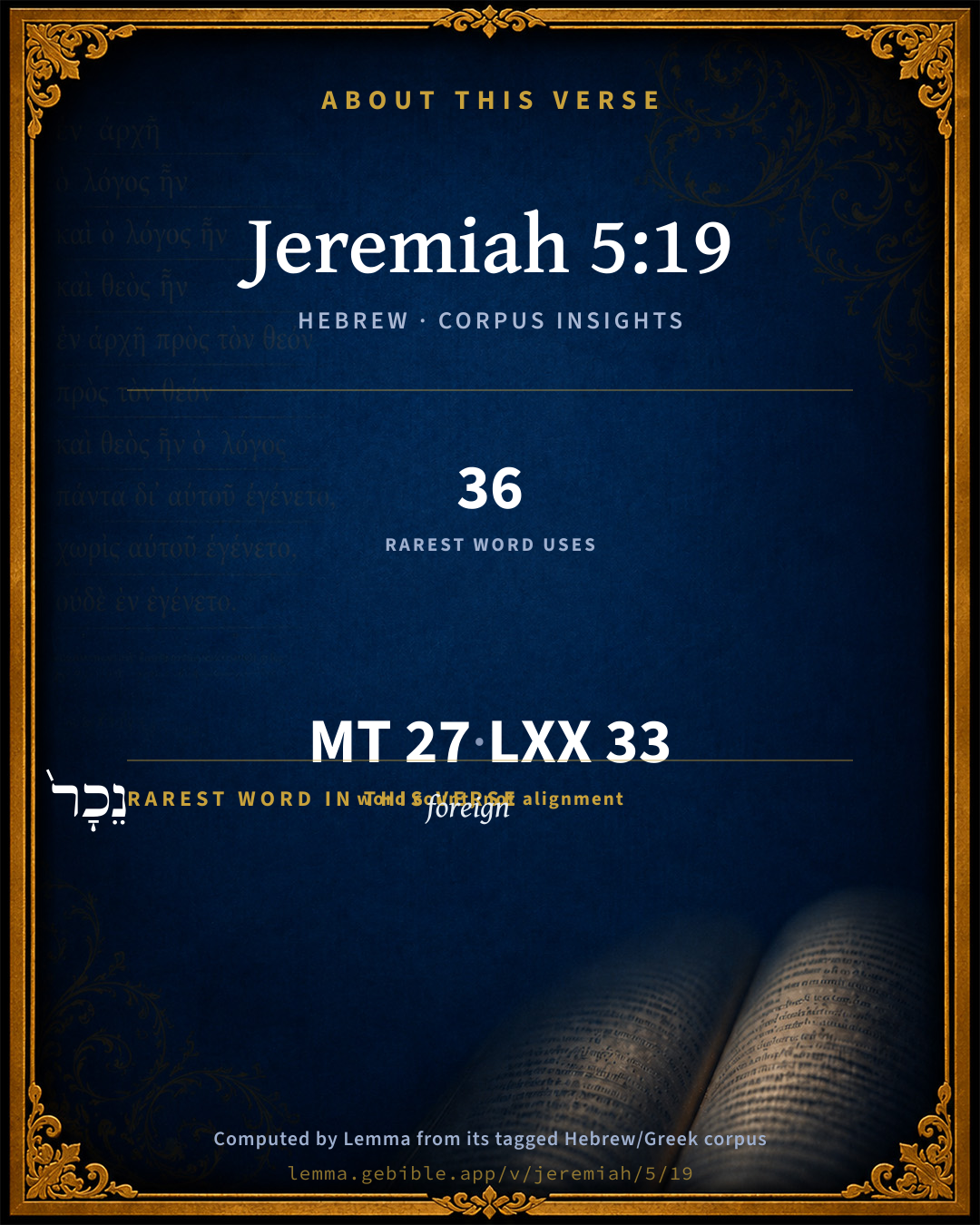
These counts appear in no published source. They are computed here, from the morphology-tagged text and Lemma’s own curated glosses. What Lemma adds →

27
words
20
distinct lemmas
Prophets
section

Shared distinctive vocabulary

נֵכָר֙ foreign H5236 occurs in 35 verses of the Hebrew Bible. Also found in:

Grammatical profile

  • 7 verbs
  • 7 nouns
  • 1 adjective
  • 1 pronoun
  • 4 prepositions
  • 1 conjunction
  • 6 particles

Verb forms

  • וְהָיָה֙ Qal · Sequential Perfect
  • תֹאמְר֔וּ Qal · Imperfect
  • עָשָׂ֨ה Qal · Perfect
  • וְאָמַרְתָּ֣ Qal · Sequential Perfect
  • עֲזַבְתֶּ֤ם Qal · Perfect
  • וַתַּעַבְד֞וּ Qal · Sequential Imperfect
  • תַּעַבְד֣וּ Qal · Imperfect

Repetition

Words recur within this verse — often emphatic in Hebrew:

  • תֹאמְר֔וּ to say H559 ×2
  • אֱלֹהֵ֛ינוּ God H430 ×2
  • וַתַּעַבְד֞וּ to serve H5647 ×2
  • בְּאַרְצְכֶ֔ם land H776 ×2

Hebrew & Septuagint length

In the original languages it is 27 Hebrew tokens and 33 Greek tokens — but the two are counted differently (Hebrew bundles its prefixes and suffixes into one token; the Greek is in lemma form), so that isn’t a like-for-like length.

Cross-references

12

Topical passages linked to Jeremiah 5:19 in the Treasury of Scripture Knowledge — connected by theme and wording, ordered by reader-vote popularity; previews shown in the World English Bible.

  • 1 Kings 9:8–9 Though this house is so high, yet shall everyone who passes by it be astonished, and shall hiss; and they shall say, Why has Yahweh done thus to this land, and to this house?
  • Deuteronomy 28:47–48 Because you didn't serve Yahweh your God with joyfulness, and with gladness of heart, by reason of the abundance of all things;
  • Jeremiah 22:8–9 Many nations shall pass by this city, and they shall say every man to his neighbor, Why has Yahweh done thus to this great city?
  • Jeremiah 13:22 If you say in your heart, Why are these things come on me? for the greatness of your iniquity are your skirts uncovered, and your heels suffer violence.
  • Jeremiah 16:13 therefore will I cast you forth out of this land into the land that you have not known, neither you nor your fathers; and there shall you serve other gods day and night; for I will show you no favor.
  • Deuteronomy 29:24–28 even all the nations shall say, Why has Yahweh done thus to this land? what means the heat of this great anger?
  • Jeremiah 16:10–11 It shall happen, when you shall show this people all these words, and they shall tell you, Why has Yahweh pronounced all this great evil against us? or what is our iniquity? or what is our sin that we have committed against Yahweh our God?
  • Deuteronomy 4:25–28 When you shall father children, and children's children, and you shall have been long in the land, and shall corrupt yourselves, and make an engraved image in the form of anything, and shall do that which is evil in the sight of Yahweh your God, to provoke him to anger;
  • 2 Chronicles 7:21–22 This house, which is so high, everyone who passes by it shall be astonished, and shall say, Why has Yahweh done thus to this land, and to this house?
  • Jeremiah 2:13 For my people have committed two evils: they have forsaken me, the spring of living waters, and hewed them out cisterns, broken cisterns, that can hold no water.
  • Jeremiah 2:35 Yet you said, I am innocent; surely his anger is turned away from me. Behold, I will enter into judgment with you, because you say, I have not sinned.
  • Lamentations 5:8 Servants rule over us: There is none to deliver us out of their hand.

Cross-references courtesy of OpenBible.info (CC BY 4.0).

Hebrew and Greek witnesses Masoretic Hebrew ↔ Greek Septuagint

The same verse in the two great witnesses to the Old Testament, shown verse-for-verse.

These are two independent witnesses, not word-aligned to each other, and the Septuagint is shown in lemma (dictionary) form.

Hebrew Jeremiah 5:19 Masoretic · Westminster Leningrad Codex

וְהָיָה֙ כִּ֣י תֹאמְר֔וּ תַּ֣חַת מֶ֗ה עָשָׂ֨ה יְהֹוָ֧ה אֱלֹהֵ֛ינוּ לָ֖נוּ אֶת כָּל אֵ֑לֶּה וְאָמַרְתָּ֣ אֲלֵיהֶ֗ם כַּאֲשֶׁ֨ר עֲזַבְתֶּ֤ם אוֹתִי֙ וַתַּעַבְד֞וּ אֱלֹהֵ֤י נֵכָר֙ בְּאַרְצְכֶ֔ם כֵּ֚ן תַּעַבְד֣וּ זָרִ֔ים בְּאֶ֖רֶץ לֹ֥א לָכֶֽם

It shall happen, when you shall say, Why has Yahweh our God done all these things to us? then shall you say to them, Like as you have forsaken me, and served foreign gods in your land, so shall you serve strangers in a land that is not yours.

World English Bible · Public Domain

Greek LXX Structure differs

In the Septuagint, Jeremiah is about an eighth shorter than the Hebrew and arranges its material differently — the Oracles Against the Nations (Hebrew chapters 46–51) appear in the middle of the Greek book, after 25:13. Because the chapter and verse boundaries do not line up, a verse-for-verse comparison with the Hebrew is not shown.

A verse-for-verse comparison isn’t shown here because the chapters and verses don’t line up. Switch to the LXX edition with the MT / LXX toggle above to read the Greek directly.

Hebrew: Westminster Leningrad Codex (CC BY 4.0). Greek: Septuagint (public domain); English from a public-domain English Septuagint. How the Septuagint differs from the Hebrew →

Targum (Aramaic paraphrase)

1

The Targum is the ancient Jewish Aramaic paraphrase of the Hebrew Scriptures — an interpretive translation, not the Hebrew text itself. Onkelos (literal) and Pseudo-Jonathan (expansive) render the Torah, and Jonathan the Prophets. Coverage is partial: where no permissively-licensed English translation exists for a verse, only the Aramaic is shown. This is verse-level text, not a word-by-word alignment to the Hebrew.

  1. Targum Jonathan Prophets (Joshua–Malachi)
    וִיהֵי אֲרֵי תֵימְרוּן חֲלַף מָה עֲבַד יְיָ אֱלָהָנָא לִנָא יַת כָּל אִלֵין וְתֵימַר לְהוֹן כְּמָא דִשְׁבַקְתּוּן פּוּלְחָנִי וּפְלַחְתּוּן לְטַעֲוַת פַּלְחֵי כּוֹכְבַיָא בְּאַרְעֲכוֹן כֵּן תִּשְׁתַּעְבְּדוּן לְעַמְמַיָא פַּלְחֵי כּוֹכְבַיָא בְּאַרְעָא דְלָא דִילְכוֹן:

    (no public-domain English translation for this verse)

    Targum Jonathan — Aramaic: “Mikraot Gedolot” (public domain). English: “Sefaria Community Translation” (CC0 1.0 (public-domain dedication)); “London "Chaldee Paraphrase," 1871” (public domain). Text via Sefaria.

Commentary

Notes on Jeremiah 5:19 from classic Christian and Jewish commentators (each source and its license shown beneath its notes). The classic Christian expositions comment on the surrounding passage and are grouped to its opening verse, so a note may address several verses; the Jewish commentaries on the Tanakh (Rashi and others) are per-verse, so they appear only where the commentator wrote on this verse.

Lemma curates 59 commentaries, every one of them public domain or Creative Commons licensed, each selected and text-cleaned for this edition rather than reprinted as found. About our sources →

Trapp's Complete Commentary

John Trapp

Jer 5:19 And it shall come to pass, when ye shall say, Wherefore doeth the LORD our God all these [things] unto us? then shalt thou answer them, Like as ye have forsaken me, and served strange gods in your land, so shall ye serve strangers in a land [that is] not yours.

Ver. 19. Wherefore doeth the Lord our God all these things unto us?] Why? Could not they yet tell? And had they not been oft enough (if anything were enough) told wherefore? But they were never willing to hear on that ear. Some of our hearers turn the deaf ear, and say, What tell you us of these terrible things, &c. Many sit before us as senseless as the seats they sit on, the pillars they lean to, the dead bodies they tread upon.

So shall ye serve strangers.] God loves to retaliate.

John Trapp, A Commentary or Exposition upon All the Books of the Old and New Testament (1647–1656) — public domain. Text from a community e-Sword module.

The Biblical Illustrator

Joseph S. Exell

Jer_5:19

When ye shall say, Wherefore doeth the Lord our God these things unto us?

In the time of tribulation

I. Acknowledgment of God as that Supreme Ruler of all from whose hand afflictions come. It is one great secret of that peace which passeth all understanding to mark the hand of God in all the changes and sorrows of this ever-varying scene of things; the want of this it is which so frequently leaves the men of the world a prey to vexation and despair. Secondary causes are but the links in the chain of providence; follow them by the light of Gods Word and the guidance of a simple faith, and you will find that chain depending from the very throne of God Himself, held in His own hand; every part of it adjusted as He sees it best to permit, according to the counsel of His own will.

II. A conviction that when God sends affliction He has a reason for what He does.

1. God often uses affliction for the purpose of correcting His childrens faults, and bringing them to a sense of their guilt.

2. The promotion of our growth in grace is another reason of Gods afflictive dispensations. Holy men are by trial weaned from a vain and evil world; are brought more and more to realise experimentally what religion is; and are enabled to enjoy in a peculiar manner the consolation of the Gospel of Christ.

III. A wish to know what that reason is. Not that we may be satisfied that God is just in what He does. But that understanding what the reason of His dispensation is, we may ask ourselves, have, then, those dispensations wrought in us the result designed? But how is he to ascertain it? I apprehend that we shall generally be guided to it when depending on the Holy Spirit for direction; we simply look at the nature of the trial, and the state of our own hearts. (J. Harding.)

The Biblical Illustrator, edited by Joseph S. Exell (c. 1880s–1900s) — public domain. Text from a community e-Sword module.

Joseph Benson's Commentary

Jer 5:19. And when ye shall say, Wherefore doeth the Lord our God all these things? — Those that fall under the severity of God’s judgments are apt to think so favourably of themselves, as to wonder why they should be singled out for examples of the divine vengeance, and of terror to others. And particularly the Jews were very apt to think themselves innocent, however guilty they were, and to contend they did not deserve the punishments inflicted on them; and that this severe proceeding was not consistent with those many gracious promises which God had made to their nation. Then shalt thou answer them, &c. — God doth not execute these judgments upon you without cause. All his promises were made to you, to be fulfilled upon condition of your obedience, which, when you withheld, you had reason to expect that his threatenings, instead of his promises, as he had repeatedly warned you, would take effect. Like as ye have forsaken me — I only retaliate upon you your own conduct: you have forsaken me, therefore I forsake you. You, in that good land which I gave you, have served strange gods, to whom you owed nothing; as being, indeed, the work of your own hands, of mere imaginary beings that had no existence; so will I make you to serve strange masters and lords in a land that is not yours — And where you shall not be able to call any thing your own. You have loved strangers, and to strangers you shall go. Or, as some paraphrase the words, “As you have refused to have me for your God, your Master, and your King, you shall have other kings and masters in a strange land, and shall experience the difference between my dominion and that of these severe and tyrannical masters.”

Joseph Benson's Commentary on the Old and New Testaments (1811–1818) — public domain. Text from a community e-Sword module.

Whedon's Commentary on the Bible

Daniel D. Whedon

JUDAH’S OBDURACY WILL CALL DOWN UPON HER RUIN, Jer_5:19-31.

19. Like as — The penalty answers to the sin. Because Judah in her own land served the gods of foreigners, so she must serve strangers in a foreign land.

Daniel D. Whedon (gen. ed.), Commentary on the Old and New Testaments (1874–1909) — public domain. Text from a community e-Sword module.

Keil & Delitzsch

C. F. Keil & F. Delitzsch

This calamity Judah is preparing for itself by its obduracy and excess of wickedness. - Jer 5:19. "And if ye then shall say, Wherefore hath Jahveh our God done all this unto us? then say to them, Like as ye have forsaken me and served strange gods in your land, so shall ye serve strangers in a land that is not yours. Jer 5:20. Declare this in the house of Jacob, and publish it in Judah, saying, Jer 5:21. Hear now this, foolish people without understanding, that have eyes and see not, have ears and hear not. Jer 5:22. Me will ye not fear, saith Jahve, nor tremble before me? who have set the sand for a bound to the sea, an everlasting boundary that it passes not, and its waves toss themselves and cannot, and roar and pass not over. Jer 5:23. But this people hath a stubborn and rebellious heart; they turned away and went. Jer 5:24. And said not in their heart: Let us now fear Jahveh our God, who giveth rain, the early rain and the late rain, in its season; who keepeth for us the appointed weeks of the harvest. Jer 5:25. Your iniquities have turned away these, and your sins have withholden the good from you. Jer 5:26. For among my people are found wicked men; they lie in wait as fowlers stoop; they set a trap, they catch men. Jer 5:27. As a cage full of birds, so are their houses full of deceit; therefore are they become great and rich. Jer 5:28. They are grown fat and sleek, they go beyond bound in wickedness; the cause they try not, the cause of the orphans, that they might have prosperity; and the right of the needy they judge not. Jer 5:29. Shall I not punish this? saith Jahveh; shall not my soul be avenged on such a people as this? Jer 5:30. The appalling and horrible is done in the land. Jer 5:31. The prophets prophesy falsely, and the priests bear rule under their lead, and my people loves it so. But what will ye do in the end thereof."

The thought of Jer 5:19, that the people, by its apostasy, draws down this judgment on itself, forms the transition from the threat of punishment to the reproof of sins. The penalty corresponds to the sin. Because Judah in its own land serves the gods of foreigners, so it must serve strangers in a foreign land.

Jer 5:20-22

The reproof of sins is introduced by an apostrophe to the hardened race. The exhortation, "Publish this," is addressed to all the prophet's hearers who have the welfare of the people at heart. "This," in Jer 5:20 and Jer 5:21, refers to the chiding statement from Jer 5:23 onwards, that the people fears not God. The form of address, people foolish and without understanding (cf. Jer 4:22; Hos 7:11), is made cutting, in order, if possible, to bring the people yet to their senses. The following clauses, "they have eyes," etc., depict spiritual blindness and deafness, as in Eze 12:22; cf. Deu 29:3. Blindness is shown in that they see not the government of God's almighty power in nature; deafness, in that they hear not the voice of God in His word. They have no fear even of the God whose power has in the sand set an impassable barrier for the mighty waves of the sea. "Me" is put first for emphasis. The waves beat against their appointed barrier, but are not able, sc. to pass it.

Jer 5:23-24

But this people has a stubborn and rebellious heart; it bows not beneath the almighty hand of God. "Stubborn and rebellious," joined as in Deu 21:18, Deu 21:20. Hence the following סרוּ is not to be taken from סרר: they defy (Hitz.), but from סוּר: they turn away and go off, and consider not that they owe their daily bread to the Lord. Neither does God's power move the obdurate people to the fear of Him, nor do the proofs of His love make any impression. They do not consider that God gives them the rain which lends the land its fruitfulness, so that at the fixed time they may gather in the harvest. The ו cop. before יורה is rejected by the Masoretes in the Keri as out of place, since גּשׁם is not any special rain, co-ordinate to the early and late rain (Hitz.), or because they had Deu 11:14; Joe 2:23 before them. But in this they failed to notice that the ו before יורה and that before מלקושׁ are correlative, having the force of et - et. שׁבעת is stat. constr. from שׁבעת, weeks, and to it חקּות is co-ordinated in place of an adjective, so that קציר is dependent on two co-ordinate stat. constr., as in Jer 46:9, Jer 46:11; Zep 2:6. But the sense is not, the weeks, the statutes, of the harvest, i.e., the fixed and regulated phenomena which regulate the harvest (Graf), but, appointed weeks of harvest. The seven weeks between the second day of the passover and the feast of harvest, or of weeks, Exo 23:16; Exo 34:22; Deu 16:9., are what is here meant. We must reject the rendering, "oath as to the harvest-time" (L. de Dieu, J. D. Mich., and Ew.), since Scripture knows nothing of oaths taken by God as to the time of harvest; in Gen 8:22 there is no word of an oath.

Jer 5:25-27

The people has by its sins brought about the withdrawal of these blessings (the withholding of rain, etc.). הטּוּ, turned away, as in Amo 5:12; Mal 3:5. "These," i.e., the blessings mentioned in Jer 5:24. The second clause repeats the same thing. The good, i.e., which God in His goodness bestowed on them.

This is established in Jer 5:26. by bringing home to the people their besetting sins. In (amidst) the people are found notorious sinners. ישׁוּר in indefinite generality: they spy about, lie in wait; cf. Hos 13:7. The singular is chosen because the act described is not undertaken in company, but by individuals. שׁך from שׁכך, bend down, stoop, as bird-catchers hide behind the extended nets till the birds have gone in, so as then to draw them tight. "They set;" not the fowlers, but the wicked ones. משׁחית, destroyer (Exo 12:23, and often), or destruction (Ezek. 21:36); here, by virtue of the context, a trap which brings destruction. The men they catch are the poor, the needy, and the just; cf. Jer 5:28 and Isa 29:21. The figure of bird-catching leads to a cognate one, by which are set forth the gains of the wicked or the produce of their labours. As a cage is filled with captured birds, so the houses of the wicked are filled with deceit, i.e., possessions obtained by deceit, through which they attain to credit, power, and wealth. Graf has overthrown Hitz.'s note, that we must understand by מרמה, not riches obtained by deceit, but he means and instruments of deceit; and this on account of the following: therefore they enrich themselves. But, as Graf shows, it is not the possession of these appliances, but of the goods acquired by deceit, that has made these people great and rich, "as the birds that fill the cage are not a means for capture, but property got by cunning." כּלוּב, cage, is not strictly a bird-cage, but a bird-trap woven of willows (Amo 8:1), with a lid to shut down, by means of which birds were caught.

Jer 5:28

Through the luxurious living their wealth makes possible to them, they are grown fat and sleek. עשׁתוּ, in graphic description, is joined asynd. to the preceding verb. It is explained by recent comm. of fat bodies, become glossy, in keeping with the noun עשׁת, which in Sol 5:14 expresses the glitter of ivory; for the meaning cogitare, think, meditate, which עשׁת bears in Chald., yields no sense available here. The next clause is variously explained. גּם points to another, yet worse kind of behaviour. It is not possible to defend the translation: they overflow with evil speeches, or swell out with evil things (Umbr., Ew.), since עבר c. accus. does not mean to overflow with a thing. Yet more arbitrary is the assumption of a change of the subject: (their) evil speeches overflow. The only possible subject to the verb is the wicked ones, with whom the context deals before and after. דּברי־רע are not words of wickedness = what may be called wickedness, but things of wickedness, wicked things. דּברי serves to distribute the idea of רע into the particular cases into which it falls, as in Psa 65:4; Psa 105:27, and elsewhere, where it is commonly held to be pleonastic. Hitz. expounds truly: the individual wickednesses in which the abstract idea of wicked manifests itself. Sense: they go beyond all that can be conceived as evil, i.e., the bounds of evil or wickedness. The cause they plead not, namely, the case of the orphans. ויצליחוּ, imperf. c. ו consec.: that so they might have prosperity. Hitz. regards the wicked men as the subject, and explains the words thus: such justice would indeed be a necessary condition of their success. But that the wicked could attain to prosperity by seizing every opportunity of defending the rights of the fatherless is too weak a thought, coming after what has preceded, and besides it does not fit the case of those who go beyond all bounds in wickedness. Ew. and Graf translate: that they (the wicked) might make good the rightful cause (of the orphan), help the poor man to his rights. But even if הצליח seems in Ch2 7:11; Dan 8:25, to have the signif. carry through, make good, yet in these passages the sig. carry through with success is fundamental; there, as here, this will not suit, הצליח being in any case applicable only to doubtful and difficult causes - a thought foreign to the present context. Blame is attached to the wicked, not because they do not defend the orphan's doubtful pleas, but because they give no heed at all to the orphan's rights. We therefore hold with Raschi that the orphans are subject to this verb: that the orphans might have had prosperity. The plural is explained when we note that יתום is perfectly general, and may be taken as collective. The accusation in this verse shows further that the prophet had the godless rulers and judges of the people in his eye.

Jer 5:29-31

Jer 5:29 is a refrain-like repetition of Jer 5:9. - The Jer 5:30 and Jer 5:31 are, as Hitz. rightly says, "a sort of epimetrum added after the conclusion in Jer 5:29," in which the already described moral depravity is briefly characterized, and is asserted of all ranks of the people. Appalling and horrible things happen in the land; cf. Jer 2:12; Jer 23:14; Jer 18:13; Hos 6:10. The prophets prophesy with falsehood, בּשּׁקר, as in Jer 20:6; Jer 29:9; more fully בּשׁמי לשׁקר, Jer 23:25; Jer 27:15. The priests rule על, at their (the prophets') hands, i.e., under their guidance or direction; cf. Ch1 25:2., Ch2 23:18; not: go by their side (Ges., Dietr.), for רדה is not: go, march on, but: trample down. My people loves it so, yields willingly to such a lead; cf. Amo 4:5. What will ye do לאחריתהּ, as to the end of this conduct? The suff. faem. with neuter force. The end thereof will be the judgment; will ye be able to turn it away?

Keil & Delitzsch — Biblical Commentary on the Old Testament (1861–1891) — public domain (CC PDM 1.0). Text via the HelloAO Bible API. (Old Testament only.)

Geneva Bible (1599)

Geneva Bible translators

Meaning, the Prophet Jeremiah.

Geneva Bible (1599) marginal notes — public domain. Text via Bolls.life.

Jamieson, Fausset & Brown

Robert Jamieson, A. R. Fausset & David Brown

Retribution in kind. As ye have forsaken Me (Jer 2:13), so shall ye be forsaken by Me. As ye have served strange (foreign) gods in your land, so shall ye serve strangers (foreigners) in a land not yours. Compare the similar retribution in Deu 28:47-48.

Jamieson, Fausset & Brown — Commentary Critical and Explanatory on the Whole Bible (1871) — public domain (CC PDM 1.0). Text via the HelloAO Bible API.

John Calvin's Commentaries

It hence appears that what I have said is true, — that the Prophet did not soften what was severe in the threatenings which we have noticed, but that he treated the Jews according to their perverseness; for he saw that they were untamable; and the Spirit had taught him that such would be their obstinacy, that until they were wholly broken down, they would not bend their necks to receive the yoke. He further assigns the cause here, that they might not contend with God, as hypocrites are wont to do, whenever God sharply chastises them; for they murmur against him, and complain and demand reasons why he treats them so severely, as though they were wholly innocent. As, then, hypocrites made such complaints, the Prophet here replies to them.

It shall be, he says, when ye shall say: he addresses the Jews in the person of God. He then immediately turns God’s address to himself, Why has Jehovah our God done to us all these things? He ascribes here to hypocrites what is ever in their mouths whenever they are summoned to judgment; for they are so well prepared to contend, as though their cause was the best that could be; and, could God be constrained to render an account, they would prove him guilty of cruelty and of immoderate rigor. We hence see how graphically the Prophet describes refractory men, who will not yield nor acknowledge their fault, but with an iron front rise up against God: and the same thing we find in other passages in the prophets, especially in the first chapter of Malachi; for there the Prophet often repeats the words of the people, “In what? In what? What means this?” So also here Jeremiah says, When ye shall say, Why has Jehovah done all these things to us? as though they were innocent: for the reprobate, as though they had washed away all their sins by having wiped their mouths, boldly come forth and demand a reason why God chastises them. So also in this place they hesitate not to call God their God, as though they had not denied God, according to what we have seen yesterday. For so gross an impiety prevailed among them, that they imagined that all things were ruled by chance, and that God unjustly punished them. Though then they had perfidiously forsaken God, yet the Prophet here, in order to expose their petulancy, introduces them here as saying that they regarded God as connected with them.

Then, he says, thou shalt say God one while addresses the people, and at another time the Prophet. When, therefore, they shall begin thus to murmur, then thou mayest reply, Because ye have forsaken me That what was said might have more weight, God would have the Prophet to speak in his name, “because ye have forsaken me, “as though Jeremiah did not himself say the words, but God by his mouth; and have served the gods of the alien, that is, of aliens, in your land God shews here briefly what the Jews deserved; and he thought it sufficient to mention one kind of sin only. We shall see elsewhere, as we have often seen, that they were in other respects wicked and guilty before God. But the Prophet observes brevity here, and charges them only with one sort of sin. Ye shall serve tyrants, he says, in a strange land, who shall cruelly oppress you, because ye have served their gods in your own land

God reproves them here for having abused his kindness; for he had expelled the heathen nations from Canaan, and gave that land, which was so pleasant and fruitful, as an inheritance to them, so as to be to them a perpetual rest. God called the land his own rest, because he protected the Jews there, and appointed them as the legitimate heirs of the land even to the end of the world. Hence he says now, your land The reminding them of this kindness was doubtless intended to amplify their guilt; for they possessed the land by the best title, though they had not acquired it themselves.

In your land, he says, ye worshipped gods; he does not say, “strange gods, “but “the gods of the stranger, “or of strangers. The prophets often speak thus; they call them the gods of the strangers, or of strange people: but the expression is emphatical; for it was very base and less excusable for the Jews, while they had God dwelling among them, to seek gods here and there, and as it were to entreat heathens for gods, and say, “Give us your gods.” It was then this base conduct that the Prophet now points out as with the finger, Because ye have served the gods of strangers.

He afterwards adds, Ye shall serve strangers; he does not mean, as I think, strange gods; and it seems to me that those who introduce “gods” here, pervert the meaning. He speaks of tyrants, according to what is said elsewhere,

“I had given you my good laws, which if any one keeps he shall live in them; and ye would not obey: I will therefore give you laws which are not good,” (Ezekiel 20:21, 25:)

that is, “I will lay on you a tyrannical yoke, and conquerors, and those barbarians whose language shall be unknown to you, shall plunder you and your possessions, because ye have been disobedient and unteachable.” It follows —

John Calvin's Commentaries (1540-1563) — public domain. Text from the Calvin Translation Society English edition (1840s-50s) via the Christian Classics Ethereal Library (ccel.org). Calvin's coverage is partial (roughly two-thirds of the Bible); uncommented books and verses are honest gaps, never fabricated. The 19th-century editor's footnotes and remarks are omitted so the notes are faithfully Calvin's own voice.

Ellicott's Commentary for English Readers

(19) When ye shall say.—The implied promise in Jer_5:18 is explained. Then there shall come the backward glance at the past, which brings with it questionings and repentance.

Strange gods.—Stronger than the “other gods” of Jer_1:16, “gods of an alien race.” The threats that they should “serve strangers” in a “land” that was not theirs points to the Chaldæan rather than to the Scythian invasion. With this ends the section which began in Jer_5:14.

A Bible Commentary for English Readers, edited by Charles John Ellicott (1878–1897) — public domain. Text from a community e-Sword module.

The Cambridge Bible for Schools and Colleges

gen. ed. J. J. S. Perowne

19. The punishment was to be severe, because the wickedness which had called it forth was gross.

in a land that is not yours] Referring to the approach of exile, and therefore belonging to the time of the Roll (b.c. 604). Cp. Jer_16:10-13, Jer_22:8 f.; Deu_29:24 ff.; 1Ki_9:8 f.

The Cambridge Bible for Schools and Colleges (gen. ed. J. J. S. Perowne; Cambridge University Press, 1878–1918) — public domain. Text from a community e-Sword module.

John Gill's Exposition

And it shall come to pass, when ye shall say,.... That is, the people of the Jews, to whom the prophet belonged, after they had been spoiled by the enemy, and carried captive:

wherefore doth the Lord our God all these things unto us? as if they were innocent and guiltless, and had done nothing to provoke the Lord to anger; and it may be observed, that they professed to know the Lord in words, and call him their God, though in works they had denied him; and they own the hand of the Lord in all those evils that would now be come upon them; though before they had said they were not spoken by the Lord, nor would they befall them, Jer 5:12,

thou shalt then answer them; that is, the Prophet Jeremiah, in the name of the Lord:

like as ye have forsaken me, and served strange gods in your land; when they were in their own land they forsook the worship and ordinances of God, and served the idols of the Gentiles, as the Targum rightly explains it:

so shall ye serve strangers in a land that is not yours: which some understand of strange gods; but rather it designs strange lords, as the Chaldeans in the land of Babylon, a land not theirs; and so it is measure for measure, a just retaliation in righteous judgment upon them.

John Gill's Exposition of the Whole Bible (1746–1763) — public domain (CC PDM 1.0). Text via the HelloAO Bible API.

Albert Barnes' Notes on the Bible

The reason why God so chastises His people. As they in a land especially consecrated to Yahweh had served “strange” (i. e., foreign gods, so shall they in a land belonging to others be the slaves of strangers.

Albert Barnes' Notes on the Bible (1834–1885) — public domain. Text from a community e-Sword/MySword module.

Haydock's Catholic Bible Commentary

Own. You shall thus know the difference between the masters. (Calmet)

George Leo Haydock (1774–1849), Haydock's Catholic Family Bible and Commentary, 1859 edition — public domain. Excludes Psalms (Douay-Rheims chapter numbering differs from Protestant) and Deuterocanonical books (Catholic canon only).

Matthew Poole's English Annotations

Wherefore doeth the Lord our God all these things unto us? this speaks either their unparalleled insolency, in a manner challenging God, as if they had not deserved such dealing at his hands, they might have expected better usage from him; the Jews were good at these kinds of challenging of God, Isa 58:3. Or gross stupidity, as being such sots as not to be sensible of what they had done to provoke him; like to that Jer 16:10.

Served strange gods, Heb. gods of the stranger; he doth not say strange gods, but gods of the stranger, which aggravated their crime, that while they lived in their own land, and the true God among them, they would precariously go fetch in gods from the heathens.

Serve strangers in a land that is not yours: here the prophet,

1. Opposeth strange lords to rule over them to those strange gods that they had served, which God calls a forsaking of him.

2. He opposes a land not theirs to their own land; so that by this the prophet shows what resentments God had of their sin; for it implies that their sin was much greater, that they served strange gods in their own land, than if they had done it in another, under the tyrannical imposition of a stranger; and therefore he would accordingly suit their punishment, that they should serve in a strange land, which should be worse than to be servants in their own. This is a dreadful but a just retaliation.

Matthew Poole's English Annotations on the Holy Bible (1683–1685) — public domain. Text from a community e-Sword/MySword module.

The Pulpit Commentary

Vers. 19-29. Judah"s own obstinacy and flagrant disobedience are the causes of this sore judgment.

Like as ye have forsaken me, etc. The law of correspondence between sin and punishment pervades Old Testament prophecy. (comp. Isa 5) As the Jews served foreign gods in Jehovah"s land, they shall become the slaves of foreigners in a land which is not theirs.

Suitable retribution.

In anticipation of their astonishment at the character of the retribution that is to fall upon them the Jews are to be shown that this is fitting and rightly corresponds to their conduct.

I THEY WHO FORSAKE GOD IN PROSPERITY WILL FEEL THE LOSS OF GOD IN ADVERSITY. According to the religious conduct in sunny days will be the condition of rest or ruin in dark days.

II THE FALSE GODS OF PROSPERITY PROVE WORTHLESS IN ADVERSITY. Israel served heathen gods in their own laud. In their captivity they are to be slaves to strange men. The gods are then nowhere. Men make gods of wealth, pleasure, fame, etc., and find that, though these may be worshipped, they can do nothing to deliver their devotees.

III THEY WHO THROW OFF THE SERVICE OF GOD MUST SUBMIT TO HARDER SERVICE. They think to be free, but they really are the slaves of sin. (Joh_8:34) They reject the easy yoke and light burden of Christ only to find themselves bound in the galling fetters of Satan.

IV THE ABUSE OF BLESSINGS IS NATURALLY PUNISHED BY THE LOSS OF THEM. In their own land the Jews had proved unfaithful to the God who had given it them. They are rightly punished by exile to a strange land, where they must miss his gracious government.

HOMILIES BY J. WAITE Vers. 20-24. Nature"s witness against blind eyes and rebellious hearts.

Three forms of evil are rebuked here.

I THE DULNESS OF SPIRITUAL SENSIBILITY THAT FAILS TO DISCERN THE DIVINE MEANING OF NATURE. Israel and Judah are addressed as a "foolish people, without understanding," etc. Their crimes and sorrows sprang in great part out of their blindness and thoughtlessness. (Isa_1:3 Isa_5:12, Isa_5:13) They would not use even the powers of spiritual discernment they possessed. They perceived not the Divine presence in natural things the sounding shore, the revolving seasons so as to bow with adoring reverence before it. Few things are stranger or sadder than the insensibility of the spirits of men to the Divine in nature. "They have eyes, but do not see" the "invisible things" of the Great Creator "through the things that are made, even his eternal power and Godhead." They must be startled into the recognition of the present God. When some event out of the ordinary course occurs, they stand in awe before it, but in the familiar round of nature they find nothing Divine. We are all more or less open to this charge. The earthquake, the lightning flash, the hurricane, set us thinking of the majesty of him who wields such mighty forces at his will; but we forget the still more marvelous exercise of power that maintains the silent harmony of the spheres, holds the due balance of earth and sea, chases away the darkness of the night by the gently spreading dawn of every new morning, brings the grass blades and the flowers up out of the cold sod, ripens the fruit upon the trees, and changes the green carpet of the springing corn into the golden glory of the harvest. Of course it cannot be expected that any incident in the familiar daily round of nature should produce precisely the same effect on us as some new and startling phenomenon. The glory of the setting sun, that we have gazed upon a thousand times before, must needs be less to us in this respect than that of some flaming meteor that bursts suddenly upon the darkness and is gone. But it is deeply significant of the dullness of our spiritual sensibility that we can gaze so often on the world of wonders around us without being solemnly impressed with the presence of the living God.

II THE SELF-WILL THAT SPURNS THE DIVINE CONTROL. A contrast is here drawn between the subjection of the great sea to the laws God"s will has imposed on it, and the bounds his hand has drawn around it, and the insubordination of the rebellious spirit of man. It is a grand expression of Divine power in the material realm that the sea-shore presents. We are impressed with the majestic force of the rolling tide, but, after all, there is something still more wonderful in the solid strength of the belt of sand that resists and restrains it. (Even as the moral strength of a man is seen not so much in the ungoverned fury of his passions, as in the calm resolution that controls them.) The sea is subject to restraint; not so the wayward spirit of man. The sea, in its wildest raging, obeys the laws that are imposed on it, and "its own appointed limits keeps;" but the rebellious heart of man defies all authority other than its own impulses. How deep the mystery of this difference between material and spiritual forces! How awful the prerogative of a being on whom God has conferred a moral freedom like his own! He will never violate that freedom in any of his dealings with us; that were to destroy the very nature he has given. But in proportion to the dignity of the self-determining power, so dreadful must be the penalty of abusing it.

III THE INGRATITUDE THAT YIELDS NO RETURN OF LOVE FOR THE DIVINE BENEFICENCE. It was an aggravation of the guilt of Israel that they were as unmoved by the perpetual manifestation of the goodness of God as they were by the revelations of his power. Even that did not lead them to repentance or teach them to fear him. Few evidences of the thoughtful goodness of God have been more conspicuous through all the ages than the beneficent round of the seasons. In spite of all the wickedness of man"s ways, "he left not himself without witness, in that he did good," etc. (Act_14:17) The appeal this great fact makes to the consciences and hearts of men is specially forcible as bearing on those whose calling is to be fellow-workers with God in developing the harvests of the earth. "Labor is a sublime necessity," not as a mere "necessity," but because of its moral meaning and moral uses. And of all physical labor, the husbandry of the earth is most rich in moral associations, as educating men to lowly dependence on God, and grateful devotion to him in response to his fatherly providence and long-suffering grace.

Learn As all Divine manifestations speak to us alike of infinite power and infinite beneficence, so the result in us should be the blended affections of fear and love. W.

The Pulpit Commentary (1880–1919), ed. H.D.M. Spence-Jones & Joseph S. Exell — public domain. Text from a community e-Sword module.

Kretzmann's Popular Commentary

Paul E. Kretzmann

Blindness of Heart, Ingratitude, Deceit, and Violence

v. 19. And it shall come to pass, when ye shall say, Wherefore doeth the Lord, our God, all these things unto us? when they finally reach the point that they make inquiry concerning the punishment striking them, then shall thou answer them, Like as ye have forsaken Me and served strange gods in your land, in idolatrous worship, so shall ye serve strangers in a land that is not yours. Cf Deu 28:47-48. This was the Lord’s retribution, which repaid the idolatrous people in kind.

v. 20. Declare this in the house of Jacob and publish it in Judah, saying, for the benefit of the whole nation,

v. 21. Hear now this, O foolish people and without understanding, lacking in spiritual insight, which have eyes and see not, which have ears and hear not, who are afflicted with spiritual blindness and dullness, who have hardened their hearts against every influence for good:

v. 22. Fear ye not Me? saith the Lord; will ye not tremble at My presence, standing in awe and reverence before Him, which have placed the sand for the bound of the sea, defining the shore-line, by a perpetual decree that it cannot pass it, being held in check by the barriers erected by the Creator; and though the waves thereof toss themselves, in rage and fury, yet can they not prevail; though they roar, yet can they not pass over it? The immense body of the ocean with its turbulent waves, the wildest and most irresistible force of nature, is yet held in check by the power of the one true God; who, then, will not fear Him?

v. 23. But this people hath a revolting and rebellious heart, not only apostate, but positively hostile to the Lord; they are revolted, breaking loose from their affiliation with the Lord, and gone, far away from Him who is the one Hope of their deliverance.

v. 24. Neither say they in their heart, in repenting of their evil ways. Let us now fear the Lord, our God, that giveth rain, both the former, shortly after the crop has been sown, from October to December, and the latter, which falls before harvest, in March and April, in his season; He reserveth unto us the appointed weeks of the harvest, whence it follows that His goodness ought to lead men to repentance and to a proper fear of Him.

v. 25. Your iniquities have turned away these things, the blessings of God’s goodness, and your sins have withholden good things from you, acting as a barrier against the flow of God’s gifts.

v. 26. For among My people are found wicked men, evil and godless persons; they lay wait, they spend their time in lurking, as he that setteth snares, as fowlers crouch when laying their snares; they set a trap, they catch men, namely, for the purpose of destroying them.

v. 27. As a cage is full of birds, so are their houses full of deceit, filled with treasures gained by fraud; therefore they are become great and waxen rich, their unrighteous wealth giving them a position of honor before the world.

v. 28. They are waxen fat, from a life of laziness and indulgence, they shine, with the sleekness due to their luxurious living; yea, they overpass the deeds of the wicked, exceeding the ordinary measure of wickedness, as presented in the case of the Gentiles; they judge not the cause, they do not carry out the principles of right and justice, the cause of the fatherless, although the care of widows and orphans was especially enjoined in Scripture, yet they prosper, and the right of the needy do they not judge, they not only prosecute the fatherless, but they take no steps to defend the rights of the poor. Therefore the Lord once more asks His searching question,

v. 29. Shall I not visit for these things? saith the Lord? Shall not My soul be avenged on such a nation as this? Cf v. 9.

v. 30. A wonderful and horrible thing is committed in the land, something fearful and horrible has happened, 18:13; 23:14; Hos 6:10.

v. 31. The prophets prophesy falsely, proclaiming lies, and the priests bear rule by their means, literally, "by their hands," that is, at their side, under the guidance of the false prophets, lording it over the people by such shady methods; and My people love to have it so, are altogether satisfied with such deception, their sound sense having left them to such an extent that they do not react against oppression and injustice; and what will ye do in the end thereof? Under such circumstances the judgment is inevitable, is bound to be the fatal issue of this sinful course; and who will be able to avert it? The attitude of the men of Noah’s time and of people in every crisis of the world’s history is found also in our days, in spite of the earnest warning which the Lord issues in so many passages of the Bible. Cf 1Co 10:1-13; 2Pe 3:5-10.

Paul E. Kretzmann, Popular Commentary of the Bible (1921–1924) — public domain. Text from a community e-Sword module.

Lesson kit

Teaching starters — assembled from the data on this page, not authored interpretation. Every prompt links to the verse data it draws on. Edit before teaching.

Jeremiah, in the Prophets, opens this verse with 27 words (20 distinct Hebrew lemmas). Its most distinctive word is nêkâr (“foreign”). A historical commentator’s framing appears above. Read the whole chapter for the surrounding context.

Discussion questions

  1. How does “foreign” (nêkâr) shape what this verse is saying?
  2. Genesis 17:12 shares the word «foreign» with this verse. How do the two illuminate each other?
  3. “to say” occurs 2× in this one verse. What is the effect of the repetition?
  4. These translations render this verse differently; the difference is in the English rendering, not the original. What questions does that raise?
  5. The verb «וְהָיָה֙» is Qal Sequential Perfect. How does its form color the action?
  6. Reading how Trapp's Complete Commentary and The Biblical Illustrator read this verse, where do the two commentators agree and where do they part?

Things to notice

Reading settings

Reading text

Shown beneath each verse's original-language words.

Old Testament
Old Testament edition

Read the OT as the Masoretic Hebrew (MT) or the Greek Septuagint (LXX).

English shown for the Greek Septuagint (in the Hebrew ↔ Greek comparison).

Comparing translations? Open the Compare panel on any verse page to stack up to four side by side.