Psalms 68:16

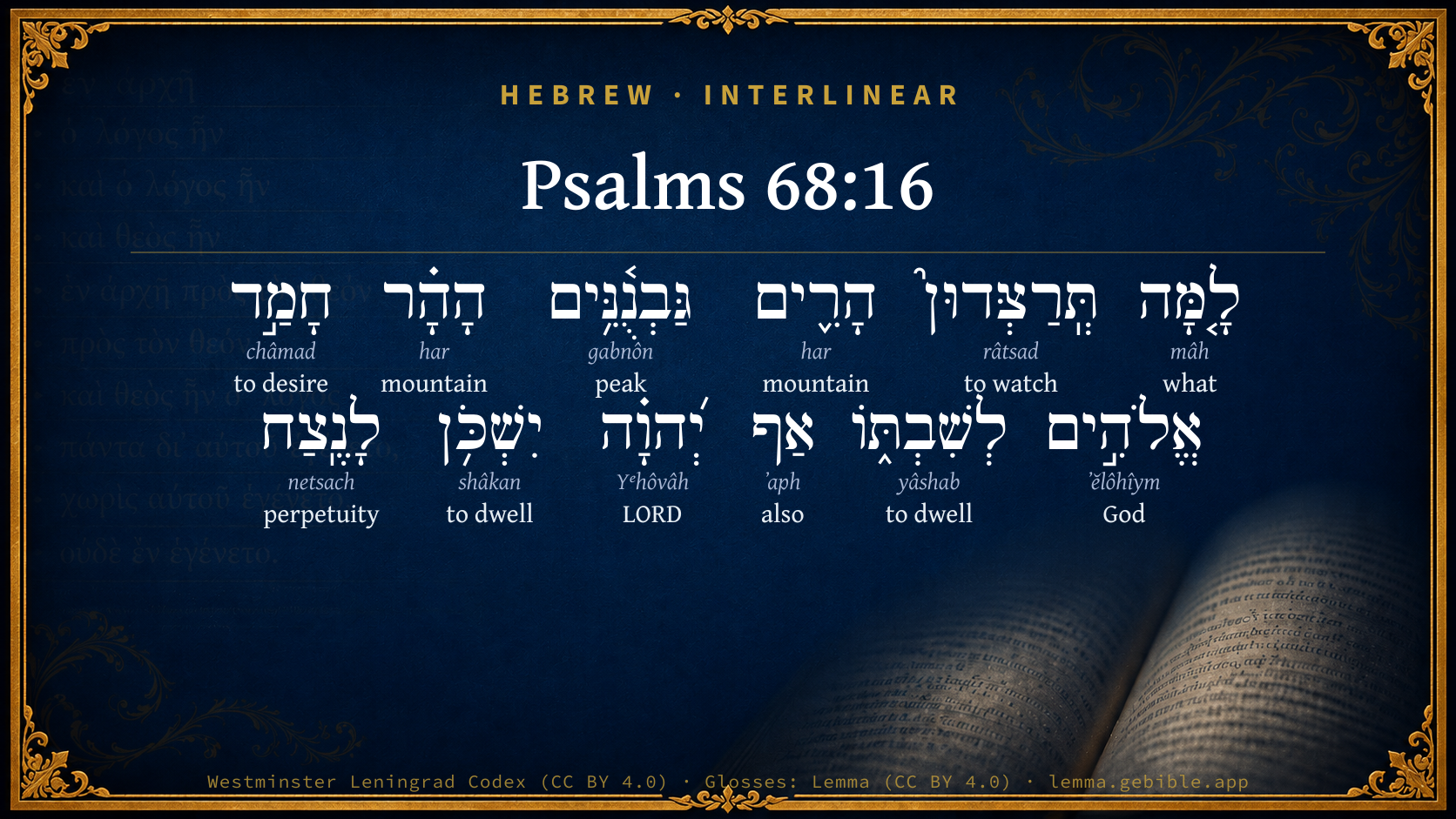
Hebrew (Westminster Leningrad Codex) Psalms 68:16 appears in the Hebrew Old Testament. The text above is from the Westminster Leningrad Codex. Each word links to its Strong’s number, a concise gloss, and parsing drawn from the Open Scriptures Hebrew Bible morphology. Click any word for its full Brown-Driver-Briggs (BDB) entry.
Download image
Cite this verse

Psalms 68:16 (World English Bible). Public Domain. Lemma interlinear Bible study tool, https://lemma.gebible.app/v/psalms/68/16.

Show BibTeX & RIS
BibTeX
RIS
English Translation
Why do you look in envy, you rugged mountains, At the mountain where God chooses to reign? Yes, Yahweh will dwell there forever.
World English Bible · Public Domain
Highlights
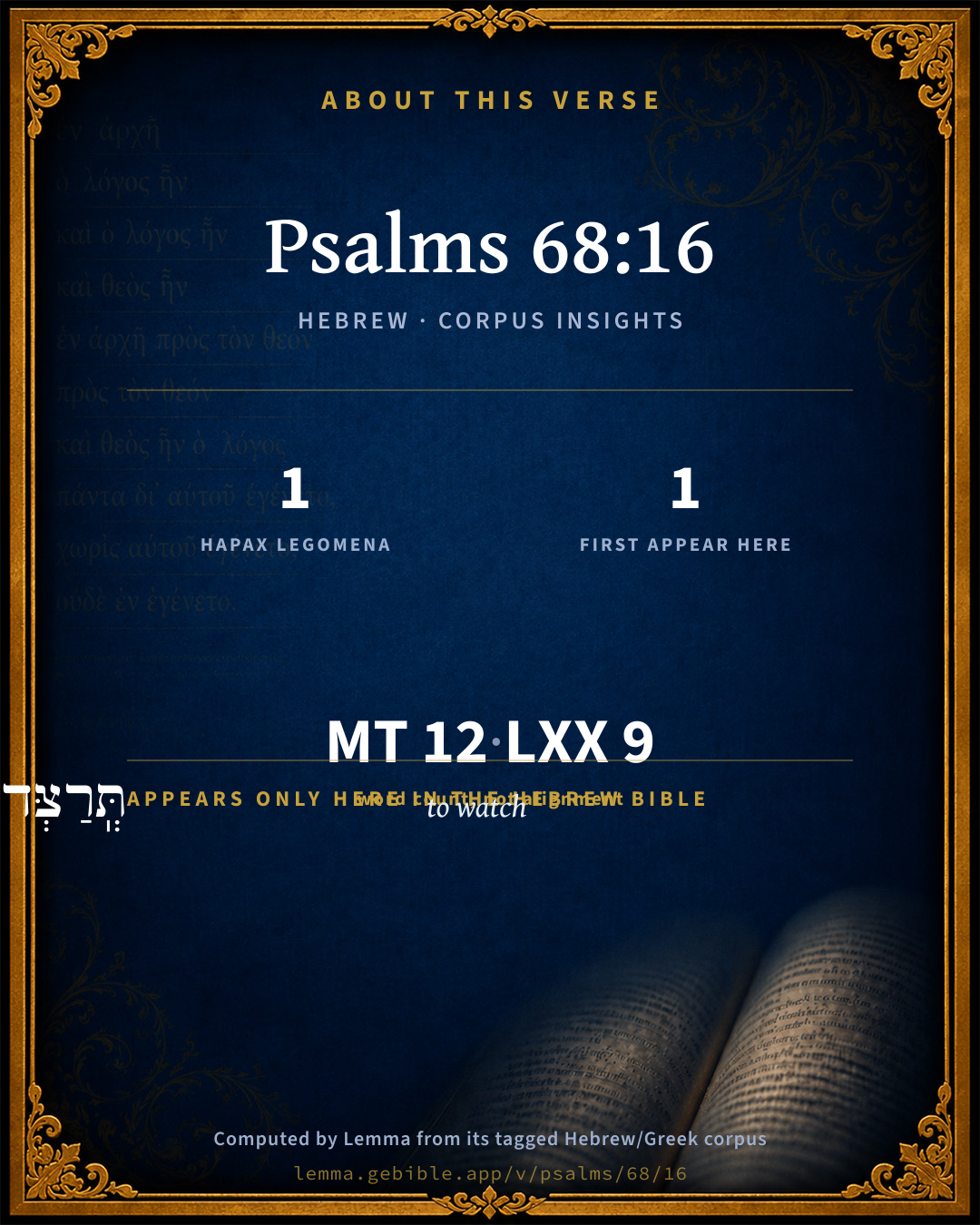
  • 1 hapax legomenon — only here in the Hebrew Bible
  • 1 first appearance in the Hebrew Bible
Full analysis ↓
Download a study sheet

One document with this verse’s original text, its word-by-word gloss line, the meaning frame, cross-references with their text, attributed commentary, and full source and license credits — printable, and it pastes into notes with its structure intact.

This verse Autodidact and up

Study sheet (.html) Plain text (.txt)

A passage Seminary Student

Up to 50 verses in one chapter. A passage sheet keeps up to 6 commentary sources and 12 cross-references per verse, in the order this page ranks them, and says so on the sheet whenever that leaves anything out. Ask for a single verse and you get the Autodidact verse sheet above.

Everything on this page stays free to read, with no account — the sheet is a download of what is already on screen, not access to it.

Want to remove ads? Support Godless Engineer
Compare translations 3

The same verse in 3 English versions, stacked beneath the original-language interlinear above. Click any original word for its lexicon entry.

Each is an independent rendering of the whole verse — the interlinear is not word-aligned to these translations.

Highlighted words mark where these versions differ — a whole-verse word diff, not a word-by-word alignment.

  • World English Bible Public Domain
    Why do you look in envy, you rugged mountains, At the mountain where God chooses to reign? Yes, Yahweh will dwell there forever.
  • King James Version Public Domain
    Why leap ye, ye high hills? this is the hill which God desireth to dwell in; yea, the LORD will dwell in it for ever.
  • unfoldingWord Literal Text CC BY-SA 4.0
    Why do you look enviously, mountains, peaks, the mountain God desired for his dwelling? Indeed, Yahweh will inhabit forever.

unfoldingWord Literal Text — © unfoldingWord, licensed CC BY-SA 4.0. Word-aligned USFM3 via Door43 (git.door43.org/unfoldingWord/en_ult).

Versions to compare (up to 4)

3 of 4 selected

Show all 18 translations

Every available English version of this verse, each an independent rendering of the whole verse.

  • World English Bible Public Domain
    Why do you look in envy, you rugged mountains, At the mountain where God chooses to reign? Yes, Yahweh will dwell there forever.
  • Berean Standard Bible Public Domain
    Why do you gaze in envy, O mountains of many peaks? This is the mountain God chose for His dwelling, where the LORD will surely dwell forever.
  • Majority Standard Bible Public Domain
    Why do you gaze in envy, O mountains of many peaks? This is the mountain God chose for His dwelling, where the LORD will surely dwell forever.
  • King James Version Public Domain
    Why leap ye, ye high hills? this is the hill which God desireth to dwell in; yea, the LORD will dwell in it for ever.
  • American Standard Version (1901) Public Domain
    Why look ye askance, ye high mountains, At the mountain which God hath desired for his abode? Yea, Jehovah will dwell `in it' for ever.
  • Revised Version (1885) Public Domain
    Why look ye askance, ye high mountains, at the mountain which God hath desired for his abode? yea, the LORD will dwell in it for ever.
  • Geneva Bible (1599) Public Domain
    Why leape ye, ye high mountaines? as for this Mountaine, God deliteth to dwell in it: yea, the Lord will dwell in it for euer.
  • Douay-Rheims (1899) Public Domain
    The mountain of God is a fat mountain. A curdled mountain, a fat mountain.
  • Young's Literal Translation Public Domain
    Why do ye envy, O high hills, The hill God hath desired for His seat? Jehovah also doth tabernacle for ever.
  • Literal Standard Version CC BY-SA 4.0
    Why do you envy, O high hills, || The hill God has desired for His seat? YHWH also dwells forever.
  • Unlocked Literal Bible CC BY-SA 4.0
    Why do you look in envy, you high hill country, at the mountain which God desires for the place he will live? Indeed, Yahweh will live in it forever.
  • unfoldingWord Literal Text CC BY-SA 4.0
    Why do you look enviously, mountains, peaks, the mountain God desired for his dwelling? Indeed, Yahweh will inhabit forever.
  • Darby Bible Public Domain
    Why do ye look with envy, ye many-peaked mountains, upon the mount that God hath desired for his abode? yea, Jehovah will dwell [there] for ever.
  • World Messianic Bible Public Domain
    Why do you look in envy, you rugged mountains, at the mountain where God chooses to reign? Yes, the LORD will dwell there forever.
  • Webster's Bible Public Domain
    \\68:15\\The hill of God is as the hill of Bashan; a high hill as the hill of Bashan.
  • Free Bible Version CC BY-SA 4.0
    why do you look enviously, mountain with many peaks, at the mountain God chose as his home, where the Lord will live forever?
  • Bible in Basic English Public Domain
    Why are you looking with envy, you high hills, on the hill desired by God as his resting-place? truly, God will make it his house for ever.
  • JPS Tanakh (1917) Public Domain
    (68-17) Why look ye askance, ye mountains of peaks, at the mountain which God hath desired for His abode? Yea, the LORD will dwell therein for ever.

Literal Standard Version (2020), Covenant Press — licensed CC BY-SA 4.0. Text via the HelloAO Bible API (eBible.org). Unlocked Literal Bible (unfoldingWord) — licensed CC BY-SA 4.0. Text via the HelloAO Bible API (eBible.org). unfoldingWord Literal Text — © unfoldingWord, licensed CC BY-SA 4.0. Word-aligned USFM3 via Door43 (git.door43.org/unfoldingWord/en_ult). Free Bible Version, Dr. Jonathan Gallagher — licensed CC BY-SA 4.0. Text via the HelloAO Bible API (eBible.org).

Word by word

More ways to search: Search by grammar → Find every occurrence → Compare this word →

Practice this passage: Drill this verse → Learn its vocabulary →

תְּֽרַצְּדוּן֮
râtsad
H7520
“to watch”
Verb, Piel, Imperfect, 2nd Person, Masculine, Plural + Suffix, n
Part of Speech
Verb
Stem
Piel
Form
Imperfect
Person
2nd Person
Gender
Masculine
Number
Plural
Full BDB Definition

Origin: a primitive root

TWOT: 2206

(Piel) to watch stealthily or with envious hostility, watch with enmity, watch with envy
  1. לָ֤מָּה mâh H4100 “to/for · what” Preposition + Particle, Interrogative
  2. הָרִ֪ים har H2022 “mountains” Noun, Common, Masculine, Plural, Absolute
  3. גַּבְנֻ֫נִּ֥ים gabnôn H1386 “peaks” Noun, Common, Masculine, Plural, Absolute
  4. הָהָ֗ר har H2022 “the · mountain” Particle, Definite Article + Noun, Common, Masculine, Singular, Absolute
  5. חָמַ֣ד châmad H2530 “to desire” Verb, Qal, Perfect, 3rd Person, Masculine, Singular
  6. אֱלֹהִ֣ים ʼĕlôhîym H430 “God(s)” Noun, Common, Masculine, Plural, Absolute
  7. לְשִׁבְתּ֑וֹ yâshab H3427 “to dwell · him” Preposition + Verb, Qal, Infinitive Construct + Suffix, Personal, 3rd Person, Masculine, Singular
  8. אַף ʼaph H637 “also” Particle, Accusative
  9. יְ֝הוָ֗ה Yᵉhôvâh H3068 “LORD” Noun, Proper
  10. יִשְׁכֹּ֥ן shâkan H7931 “to dwell” Verb, Qal, Imperfect, 3rd Person, Masculine, Singular
  11. לָנֶֽצַח netsach H5331 “to/for · perpetuity” Preposition + Noun, Common, Masculine, Singular, Absolute

About this verse

These counts appear in no published source. They are computed here, from the morphology-tagged text and Lemma’s own curated glosses. What Lemma adds →

12
words
11
distinct lemmas
Wisdom
section

Notable vocabulary

1 hapax legomenon — a word that appears only here in the entire Hebrew Bible:

  • תְּֽרַצְּדוּן֮ to watch H7520

First appearance in Scripture

This word makes its first canonical appearance in the Hebrew Bible here:

  • תְּֽרַצְּדוּן֮ to watch H7520

Shared distinctive vocabulary

גַּבְנֻ֫נִּ֥ים peak H1386 occurs in 2 verses of the Hebrew Bible. Also found in:

Grammatical profile

  • 4 verbs
  • 6 nouns
  • 2 particles

Verb forms

  • תְּֽרַצְּדוּן֮ Piel · Imperfect
  • חָמַ֣ד Qal · Perfect
  • לְשִׁבְתּ֑וֹ Qal · Infinitive Construct
  • יִשְׁכֹּ֥ן Qal · Imperfect

Repetition

A word recurs within this verse — often emphatic in Hebrew:

  • הָרִ֪ים mountain H2022 ×2

Hebrew & Septuagint length

In English translation the verse runs 23 words from the Hebrew and 28 from the Septuagint (LXX English) — closely comparable.

A rough comparison of the two English renderings, which tokenize alike — not a word-level alignment.

Word counts can differ between the Hebrew and the Greek without any difference in meaning — e.g. the Hebrew direct-object marker אֵת has no separate Greek word, and Greek often adds the article ὁ.

In the original languages it is 12 Hebrew tokens and 9 Greek tokens — but the two are counted differently (Hebrew bundles its prefixes and suffixes into one token; the Greek is in lemma form), so that isn’t a like-for-like length.

Cross-references

10

Topical passages linked to Psalms 68:16 in the Treasury of Scripture Knowledge — connected by theme and wording, ordered by reader-vote popularity; previews shown in the World English Bible.

  • Deuteronomy 12:5 But to the place which Yahweh your God shall choose out of all your tribes, to put his name there, even to his habitation shall you seek, and there you shall come;
  • Psalms 132:13–14 For Yahweh has chosen Zion. He has desired it for his habitation.
  • Revelation 21:2–3 I saw the holy city, New Jerusalem, coming down out of heaven from God, made ready like a bride adorned for her husband.
  • Hebrews 12:22–23 But you have come to Mount Zion, and to the city of the living God, the heavenly Jerusalem, and to innumerable hosts of angels,
  • Deuteronomy 12:11 then it shall happen that to the place which Yahweh your God shall choose, to cause his name to dwell there, there shall you bring all that I command you: your burnt offerings, and your sacrifices, your tithes, and the heave-offering of your hand, and all your choice vows which you vow to Yahweh.
  • 1 Kings 9:3 Yahweh said to him, I have heard your prayer and your supplication, that you have made before me: I have made this house holy, which you have built, to put my name there forever; and my eyes and my heart shall be there perpetually.
  • Isaiah 2:2 It shall happen in the latter days, that the mountain of Yahweh's house shall be established on the top of the mountains, And shall be raised above the hills; And all nations shall flow to it.
  • Psalms 87:1–2 His foundation is in the holy mountains.
  • Psalms 114:4 The mountains skipped like rams, The little hills like lambs.
  • Psalms 114:6 You mountains, that you skipped like rams; You little hills, like lambs?

Cross-references courtesy of OpenBible.info (CC BY 4.0).

Hebrew and Greek witnesses Masoretic Hebrew ↔ Greek Septuagint

The same verse in the two great witnesses to the Old Testament, shown verse-for-verse.

You’re reading Greek Psalm 67 (Hebrew Psalm 68). The Septuagint counts the superscription, so verse numbers can differ from the Hebrew — chapter-level alignment, not verse-by-verse. Numbering follows Rahlfs.

These are two independent witnesses, not word-aligned to each other, and the Septuagint is shown in lemma (dictionary) form.

Hebrew Psalms 68:16 Masoretic · Westminster Leningrad Codex

לָ֤מָּה תְּֽרַצְּדוּן֮ הָרִ֪ים גַּבְנֻ֫נִּ֥ים הָהָ֗ר חָמַ֣ד אֱלֹהִ֣ים לְשִׁבְתּ֑וֹ אַף יְ֝הוָ֗ה יִשְׁכֹּ֥ן לָנֶֽצַח

Why do you look in envy, you rugged mountains, At the mountain where God chooses to reign? Yes, Yahweh will dwell there forever.

World English Bible · Public Domain

Greek LXX Greek Psalm 67:16 Septuagint · lemma form

ὄρος ὁ θεός ὄρος πίνω ὄρος τυρόω ὄρος πίνω

Therefore do you⌃ conceive evil, you⌃ swelling mountains? this is the mountain which God has delighted to dwell in; yes, the Lord will dwell in it for ever.

LXX2012 (modern English Septuagint) · Public Domain

Hebrew: Westminster Leningrad Codex (CC BY 4.0). Greek: Septuagint (public domain); English from LXX2012 (modern English Septuagint) (Public Domain). How the Septuagint differs from the Hebrew →

Commentary

Notes on Psalms 68:16 from classic Christian and Jewish commentators (each source and its license shown beneath its notes). The classic Christian expositions comment on the surrounding passage and are grouped to its opening verse, so a note may address several verses; the Jewish commentaries on the Tanakh (Rashi and others) are per-verse, so they appear only where the commentator wrote on this verse.

Lemma curates 59 commentaries, every one of them public domain or Creative Commons licensed, each selected and text-cleaned for this edition rather than reprinted as found. About our sources →

Trapp's Complete Commentary

John Trapp

Psa 68:16 Why leap ye, ye high hills? [this is] the hill [which] God desireth to dwell in; yea, the LORD will dwell [in it] for ever.

Ver. 16. Why leap ye, ye high hills?] Why do ye pride and please yourselves in your privileges of nature, so far above this of Sion? Quare contenditis, montes gibbosi? so some render it, and tell us, that the original word ratsad is Syriac, and significth to envy, to irritate, to insult, or contend with any one.

This is the hill which God desireth to dwell in] This low, little, barren hill of Sion; and God’s election maketh the difference, as it did of Aaron’s rod from the rest, and doth still of the Church from the rest of the world. The Lamb Christ is on Mount Sion, Rev 14:1.

John Trapp, A Commentary or Exposition upon All the Books of the Old and New Testament (1647–1656) — public domain. Text from a community e-Sword module.

Joseph Benson's Commentary

Psa 68:16. Why leap ye, ye high hills — Why exult ye, or triumph, boasting of your height, and looking down upon poor Zion with scorn and contempt, as an obscure and inconsiderable hill, if compared with you? He speaks to the hills by a usual figure, called a prosopopœia. This is the hill, &c. — This hill, though despicable in your eyes, is precious and honourable in the eyes of God, and chosen by him for the place of his settled and perpetual residence. Dr. Chandler, however, gives a different sense to the word תרצדון, teratsdun, here rendered, leap ye; and translates the whole verse thus: Why look ye with envy, ye craggy hills? This is the mountain God hath desired to dwell in; yea, the Lord will dwell there for ever. Thus he considers the psalmist as poetically introducing Bashan, and the other little hills, as looking with envy on mount Zion, that she, above all the other mountains, should be favoured with the residence of the eternal God, and become the fixed seat of his ark. He tacitly bids them cease their envy; and by pointing to mount Zion, says, “See! there is the hill which God hath chosen, above all others, to inhabit! Yea, the Lord will dwell there for ever. His ark shall never be removed from it to any other dwelling whatsoever.” For, though the ark was removed from that particular spot, in which it was now to be placed, to the hill of Moriah, upon which the temple was to be built; yet it must be remembered that Zion and Moriah stood near each other, being both in Jerusalem, and were, probably, but two tops of one and the same hill. Here, excepting the seventy years of the Babylonish captivity, during which time Jerusalem lay desolate, God would dwell “till the old dispensation should be at an end; till the glory of the Lord should be revealed in human nature; till God should be manifest in the flesh; and the true tabernacle and temple should succeed the typical. After that, the privileges of Zion were transferred to the Christian Church; she became, and, while the world lasts, will continue to be, the hill in which God delighteth to dwell; she will therefore be justly entitled to the pre-eminence over all that may seem to be great and glorious in the world.” — Horne.

Joseph Benson's Commentary on the Old and New Testaments (1811–1818) — public domain. Text from a community e-Sword module.

J. A. Alexander on Psalms

Joseph Addison Alexander

17. (Psa 68:16). Why will ye watch, (ye) hills, (ye) ridges, the hill God hathdesired for his dwelling? Yea, Jehovah will inhabit (it) for ever. The interrogative form implies disapprobation and contempt. See above, on Psa 2:1. The verb occurs nowhere else in the Old Testament, but its meaning has been preserved in Arabic, namely, to watch as an enemy, to lie in wait, or, as some allege, to view with envy. Common to both is the idea of hostility or ill-will. The translation of this verb in the English Bible (leap) and in the Prayer-Book version (hop) seems to rest on mere conjecture. The two nouns, hills and ridges, are by some supposed to form a sort of compound, ridge-hills, i. e. high or rugged hills. Compare the phrase wine-reeling, Psa 60:3. The plural form may denote the several peaks, or the whole class which this range of mountains merely represented. Zion is here described as an object of hostility or envy to the mountains of the heathen world, on account of the honour put upon it by its being chosen as the earthly residence of God. Having first poetically said that he desired it, i.e. preferred and chose it, to preclude all doubt as to the event, the Psalmist adds, not only so, but he does and will dwell there for ever. The verbs of the second and third clause, although synonymous, are not identical in Hebrew. There is evident significance in the choice of the divine names here employed. Not only did he choose it, as Elohim, for his dwelling, but he actually dwells there as Jehovah, as the God of revelation and the covenanted God of Israel.

Joseph Addison Alexander, The Psalms Translated and Explained (1850) — public domain. Text from a community e-Sword module.

Tyndale Open Study Notes

Tyndale Open Resources

68:16 Why do you look with envy? Bashan is physically much more impressive than the mountains around Jerusalem, but it was not the home of the Lord. Only Mount Zion enjoyed the privilege of providing God’s dwelling place.

Tyndale Open Study Notes — © Tyndale Open Resources, licensed CC BY-SA 4.0. Text via the HelloAO Bible API.

Geneva Bible (1599)

Geneva Bible translators

Why boast ye of your strength and beauty against this Mountain of God?

Geneva Bible (1599) marginal notes — public domain. Text via Bolls.life.

Adam Clarke's Commentary

Verse 16. Why leap ye, ye high hills?] "God said, Why leap ye, ye high hills? It is not pleasing to me to give my law upon high and towering hills. Behold, Mount Sinai is low; and the WORD of the Lord has desired to place on it the Divine majesty. Moreover, the Lord dwells for ever in the heaven of heavens." - Targum.

The psalmist is speaking particularly of the mountains of Judea, and those of Gilead; the former were occupied by the Canaanites, and the others by Og, king of Bashan, and Sihon, king of the Amorites, whom Moses defeated.

Adam Clarke's Commentary on the Bible (1810–1826) — public domain. Text from a community e-Sword/MySword module.

John Calvin's Commentaries

16. Why leap ye, ye high hills? In this verse there is no obscurity or ambiguity. David having said that there was only one mountain in all the world which God had chosen, calls upon the highest hills to yield it the pre-eminency. As he repeats in the plural number what had been said immediately before of Bashan, this leads me to think that he intended first to oppose that mountain, and then all other high mountains generally, to Zion. Mountains are here to be understood figuratively, and the great truth conveyed is, that the kingdom of Christ, which God had begun to shadow forth in the person of David, far excels all that is reckoned glorious by the world. The reproof which the Psalmist administers, in order to humble the proud boasting of the world, is justified by that contempt which we know that carnal and ungodly persons entertain of Christ’s kingdom, devoted as they are to their own pleasures or wealth, and unable to appreciate spiritual blessings. The lesson will be felt to be the more useful and necessary, if we consider that this vain pride of man rises to an additional height, when the slightest occasion is afforded for its exercise. When we see those indulging it who have no grounds to do so, we need not wonder at the arrogance of such as are possessed of wealth and influence. But the Lord’s people may afford to leave them to their self-complacency, resting satisfied with the privilege of knowing that God has chosen to take up his habitation in the midst of them. They have no reason to repine at their lot so long as they have union with God, the only and the sufficient source of their happiness.

John Calvin's Commentaries (1540-1563) — public domain. Text from the Calvin Translation Society English edition (1840s-50s) via the Christian Classics Ethereal Library (ccel.org). Calvin's coverage is partial (roughly two-thirds of the Bible); uncommented books and verses are honest gaps, never fabricated. The 19th-century editor's footnotes and remarks are omitted so the notes are faithfully Calvin's own voice.

Ellicott's Commentary for English Readers

(16) Why leap ye?—The verb occurs only here, but is explained by Delitzsch, by comparison with an Arabic root, to express the attitude of a beast crouching down for a spring on its prey; a fine image: the jealous hills lying, like panthers, ready to spring on the passing Israelites. Or does the old feeling of jealousy of the tribes on the other side of Jordan still show itself lurking in this verse? Browning has an image some what similar:—

“Those two hills on the right

Crouched like two bulls.”

Others make the meaning simply “to look enviously on.” The older versions have caught the sense, “Why watch with suspicion?” We may translate the verse, Why, mountains of many peaks, glare ye at the mountain which God hath desired for a residence? Yea, Jehovah will dwell there for ever.

A Bible Commentary for English Readers, edited by Charles John Ellicott (1878–1897) — public domain. Text from a community e-Sword module.

The Cambridge Bible for Schools and Colleges

gen. ed. J. J. S. Perowne

16. Why look ye enviously, ye high-peaked mountains,

At the mountain which God hath desired for his abode?

Yea, Jehovah will dwell in it for ever.

The grander mountains of Bashan, not Hermon only, but the rugged basaltic mountains which rise in precipitous peaks, suggesting ideas of majesty, antiquity, impregnability, are represented as looking enviously upon the insignificant mountain of Zion which God has chosen for His earthly dwelling-place. Sinai had been his temporary abode (Exo_24:16); on Zion He will dwell for ever. Cp. 1Ki_8:12-13. The choice of Zion is a parable of the method of God’s dealings with men. Cp. 1Co_1:26-29.

The A.V. why leap ye comes from the Targ., and assumes that the root rtsd, occurring here only, is synonymous with rqd, used in a similar apostrophe, Psa_114:4; Psa_114:6. But it is certainly to be explained from the meaning of the same root in Arabic.

The Cambridge Bible for Schools and Colleges (gen. ed. J. J. S. Perowne; Cambridge University Press, 1878–1918) — public domain. Text from a community e-Sword module.

John Gill's Exposition

Why leap ye, ye high hills?.... Meaning the kingdoms of this world that lift up themselves above, and look with contempt upon the interest, kingdom, and church of Christ; lie in wait for it, leap upon it, insult over it, and endeavour to crush and extirpate it; but all in vain; these high hills and mountains are nothing before Zerubbabel King of saints; his church is built on a rock, and the gates of hell cannot prevail against it; the little stone cut out of the mountain without hands will become a great mountain, and fill the whole earth, and break in pieces and consume the kingdoms of it: the word in, the Arabic language, signifies "to lie in wait", as Jarchi from R. Moses Hadarsan observes; and to look out, and leap upon the prey; so R. Hai in Ben Melech says, it has the signification of looking, observing, hoping, or waiting, in the Arable language (k);

this is the hill which God desireth to dwell in; as in Psa 132:13; the Word of the Lord, as the Targum; the essential Word, the Messiah: his desire was towards his church and people, in eternity, in time, and now is; he has chosen and desired them for his habitation, and in the midst of them he delights to be, Rev 1:13;

yea, the Lord will dwell in it for ever: he dwells in his church now by his gracious presence; he will dwell in the New Jerusalem church state personally for the space of a thousand years; and after that he will dwell with and among his people to all eternity; see Psa 132:14.

(k) "Ratzad, insidiatus fuit, uti praedae leo", Golius, col. 991. Castel. col. 3633.

John Gill's Exposition of the Whole Bible (1746–1763) — public domain (CC PDM 1.0). Text via the HelloAO Bible API.

Albert Barnes' Notes on the Bible

Why leap ye, ye high hills? - That is, with exultation; with pride; with conscious superiority. Why do you seem to regard yourselves as so superior to Mount Zion, in strength, in beauty, in grandeur? The Hebrew, however - רצד râtsad - rather means, “Why do ye watch insidiously? why do ye look askance at?” The word occurs only in this place. In Arabic it means to watch closely; to lie in wait for. This is the idea here. The mountains around Palestine - the mountains of the pagan world - the lofty hills - as if conscious of their grandeur, are represented as looking “askance,” in their pride, at Mount Zion; as eyeing it with silent contempt, as if it were not worthy of notice; as if it were so insignificant that it had no claim to attention. The idea is not that of “leaping,” as in our English Bible, or of “hopping,” as in the version of the Episcopal Prayer Book, but that of a look of silent disdain, as if, by their side, Zion, so insignificant, was not worthy of regard. “Perhaps,” by the high hills here, however, are disguisedly also represented the mighty powers of the pagan world, as if looking with contempt on the people of the land where Zion was the place of worship.

This is the hill which God desireth to dwell in - The hill which “he” has selected as his abode, and which “he” has honored above all the mountains of the earth, by his permanent residence there. As such, Zion has an honor above the loftiest hills and ranges of mountains in the earth.

Yea, the Lord will dwell in it for ever - Permanently; he will make it his fixed habitation on earth. Not-withstanding the envy or the contempt of surrounding hills, he will make this his settled abode. He has chosen it; he delights in it; he will not forsake it for the mountains and hills that are in themselves more grand and lofty.

Albert Barnes' Notes on the Bible (1834–1885) — public domain. Text from a community e-Sword/MySword module.

Matthew Poole's English Annotations

Why leap ye? why do you triumph and boast of your height, and look upon poor Zion with scorn and contempt, as an obscure and inconsiderable hill, if compared with you? He speaks to the hills by a usual figure called prosopopaeia. This hill, though despicable in your eyes, is precious and honourable in God’s eyes, and chosen by him for his settled and perpetual residence. For though the ark was removed from this particular place, in which it was now to be placed, to the hill of Moriah, upon which the temple was built, yet it must be remembered that Zion and Moriah stood one near to the other, being both in Jerusalem, and are by some said to have been but two tops of one and the same hill.

Matthew Poole's English Annotations on the Holy Bible (1683–1685) — public domain. Text from a community e-Sword/MySword module.

The Treasury of David

Charles H. Spurgeon

Ver. 16. Why leap ye, ye high hills? Why are ye moved to envy? Envy as ye may, the Lord's choice is fixed. Lift up yourselves, and even leap from your seats, ye cannot reach the sublimity which Jehovah's presence has bestowed on the little hill of Moriah.

This is the hill which God desireth to dwell in. Elohim makes Zion his abode, yea, Jehovah resides there.

Yea, the Lord will dwell in it for ever. Spiritually the Lord abides eternally in Zion, his chosen church, and it was Zion's glory to be typical thereof. What were Carmel and Sirion, with all their height, compared to Zion, the joy of the whole earth! God's election is a patent of nobility. They are choice men whom God has chosen, and that place is superlatively honoured which he honours with his presence.

Ver. 15-16: -- See Psalms on "Ps 68:15" for further information.

Ver. 16. Why leap ye? As triumphing, and making a show of your natural advantages over Sion. Or, to insult over it, and compare and equalise yourselves in honour with it; poetical kind of speeches. Others translate it, Why gaze you, as though you were ravished with admiration? John Diodati.

Ver. 16. This is the hill which God desireth to dwell in. This low, little, barren hill of Zion; and God's election maketh the difference, as it did of Aaron's rod from the rest, and doth still of the church from the rest of the world. The Lamb Christ is on Mount Zion. Re 14:1. John Trapp.

Ver. 16.

I. The church the dwelling place of God.

1. Elected of old.

2. Favoured for ever.

3. Affording rest, etc., as a home for God.

4. Receiving honour, etc., for herself. II. The church, therefore, envied by others.

1. They feel their own greatness outdone.

2. They leap with rage.

3. They are unreasonable in so doing.

Psalms 68:17*

Charles H. Spurgeon's The Treasury of David (1869–1885) — public domain. Psalms only. Text from a community e-Sword/MySword module.

Whedon's Commentary on the Bible

Daniel D. Whedon

16. Why leap ye, ye high hills—The word translated “leap,” which occurs nowhere else, would be better rendered in the sense of looking askance, watching insidiously. Why will ye be jealous, or envious, ye lofty mountains? These mountains on the northern outskirts of Israel might, as inhabited mostly by heathen, be supposed to be envious of the honour ascribed to Zion, (somewhat as the rivers of Damascus to Jordan, 2Ki_5:12,) and, according to the heathen idea of worshipping upon high places and the tops of lofty mountains, might claim the precedence. But God looketh not to such outward and material grandeur, and, in choosing Zion, rebukes it.

This is the hill which God desireth—Namely, Zion. It was not necessary to name it, it is identified by the fact “God desireth to dwell in” it.

Daniel D. Whedon (gen. ed.), Commentary on the Old and New Testaments (1874–1909) — public domain. Text from a community e-Sword module.

The Pulpit Commentary

Why leap ye, ye high hills? rather, Why look ye askance, ye mountains of peaks? In jealousy at not being chosen. This is the hill which God desireth to dwell in; rather, on the mountain which God desireth to dwell in a continuation of the preceding sentence. The mountain intended is, of course, Mount Zion, a comparatively low elevation. Yea, the Lord will dwell in it forever; i.e. make it his permanent, not merely his temporary, habitation, like Sinai.

The Pulpit Commentary (1880–1919), ed. H.D.M. Spence-Jones & Joseph S. Exell — public domain. Text from a community e-Sword module.

John Wesley's Explanatory Notes

Leap - Why do you triumph and look upon Zion with contempt? He speaks to the hills by an usual figure. Will dwell - This hill, though despicable in your eyes, is precious in God's, and chosen by him for his perpetual residence.

John Wesley, Explanatory Notes Upon the Whole Bible (1754–1765) — public domain. Text via the GEBible commentary corpus.

Rashi

Rabbi Shlomo Yitzchaki (Rashi)

The mountain of God is the mountain of Bashan And where did He spread it out? On Mt. Sinai, which is the mountain of God and is near Bashan on the eastern side of the Jordan.

the mountain of peaks The special mountain among the mountains.

peaks Heb. גבננים, an expression of mountains, because of their height, as (Ezek. 16:24): “and you built for yourself a platform (גב).” Any high thing is called גַב.

Rashi on the Tanakh — English translations: “The Judaica Press complete Tanach with Rashi, translated by A. J. Rosenberg” (CC BY 4.0); “Pentateuch with Rashi's commentary by M. Rosenbaum and A.M. Silbermann, 1929-1934” (public domain); “The Metsudah Tanach series, Lakewood, N.J” (CC BY 4.0); and “The Book of Joshua, Metsudah Publications, 1997” (CC BY 4.0). Text via Sefaria.

Lesson kit

Teaching starters — assembled from the data on this page, not authored interpretation. Every prompt links to the verse data it draws on. Edit before teaching.

Psalms, in the Wisdom, opens this verse with 12 words (11 distinct Hebrew lemmas). Its most distinctive word is râtsad (“to watch”). A historical commentator’s framing appears above. Read the whole chapter for the surrounding context.

Discussion questions

  1. The word râtsad carries the sense “to watch.” How does it shape the verse?
  2. 1 word here appears nowhere else in the Hebrew Bible. Why might the author reach for such rare wording?
  3. This is the first place “to watch” appears in Scripture (first appears here). What does its debut here establish?
  4. How does Psalms 68:15, which shares the word «peak», read alongside this verse?
  5. What does the repetition of “mountain” (2× in this one verse) do in this verse?
  6. The translations on this page render this verse differently — a whole-verse word diff, not a word-by-word alignment. What might account for the different wordings?
  7. «תְּֽרַצְּדוּן֮» is a Piel Imperfect verb. How does that grammatical form shape the action described?
  8. Compare how Trapp's Complete Commentary and Joseph Benson's Commentary read this verse. Where do they agree or differ?

Things to notice

  • 1 word in this verse appears nowhere else in the Hebrew Bible.
  • 1 word makes its first canonical appearance in Scripture here.
  • This verse counts 12 Hebrew ↔ 9 Greek words.
  • These translations choose different wording for 30 words in this verse.
  • “mountain” occurs 2× in this single verse.

Reading settings

Reading text

Shown beneath each verse's original-language words.

Old Testament
Old Testament edition

Read the OT as the Masoretic Hebrew (MT) or the Greek Septuagint (LXX).

English shown for the Greek Septuagint (in the Hebrew ↔ Greek comparison).

Comparing translations? Open the Compare panel on any verse page to stack up to four side by side.