Ecclesiastes 5:11

Hebrew (Westminster Leningrad Codex) Ecclesiastes 5:11 appears in the Hebrew Old Testament. The text above is from the Westminster Leningrad Codex. Each word links to its Strong’s number, a concise gloss, and parsing drawn from the Open Scriptures Hebrew Bible morphology. Click any word for its full Brown-Driver-Briggs (BDB) entry.
Download image
Cite this verse

Ecclesiastes 5:11 (World English Bible). Public Domain. Lemma interlinear Bible study tool, https://lemma.gebible.app/v/ecclesiastes/5/11.

Show BibTeX & RIS
BibTeX
RIS
English Translation
When goods increase, those who eat them are increased; and what advantage is there to its owner, except to feast on them with his eyes?
World English Bible · Public Domain
Highlights
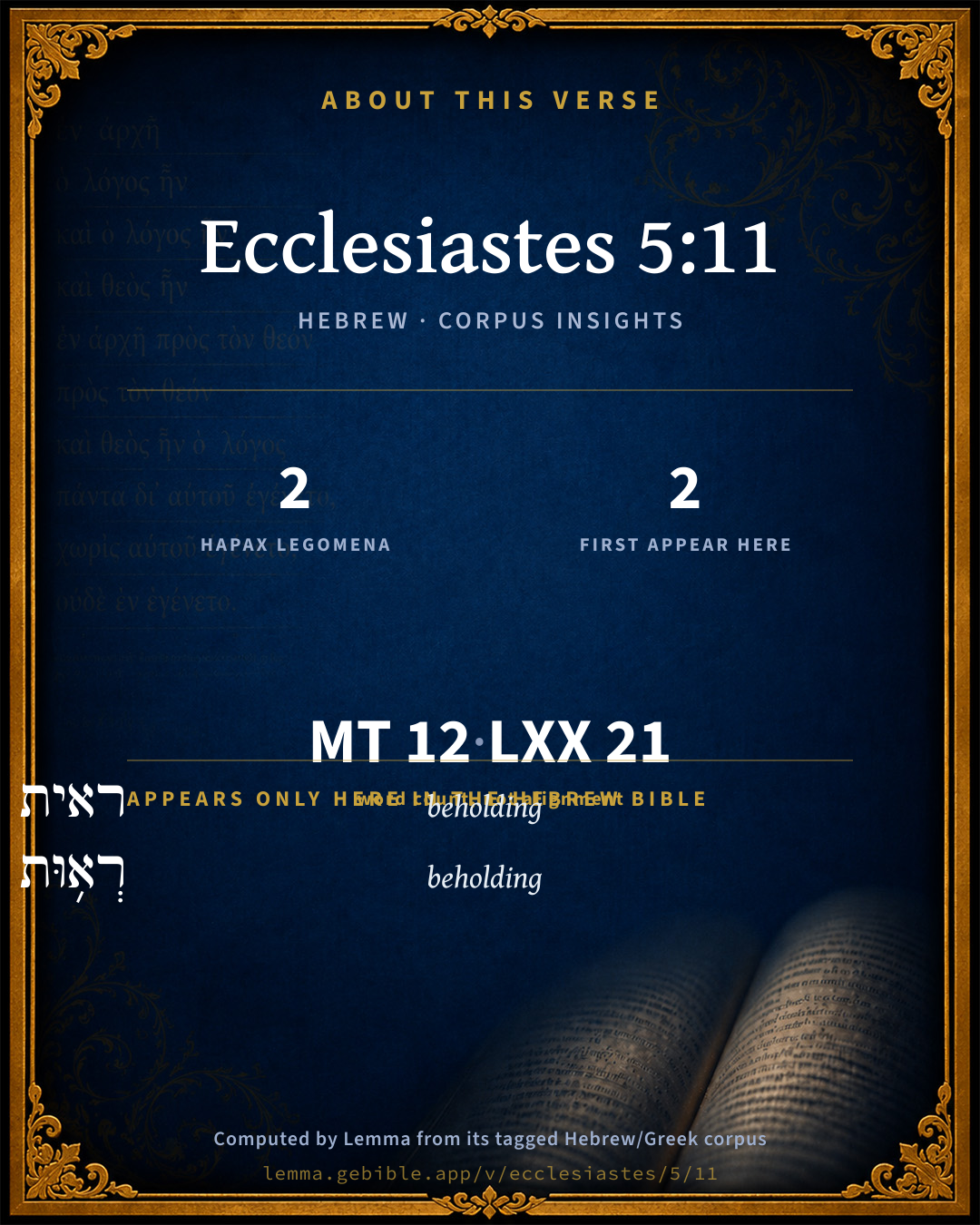
  • 2 hapax legomena — only here in the Hebrew Bible
  • 2 first appearances in the Hebrew Bible
Full analysis ↓
Download a study sheet

One document with this verse’s original text, its word-by-word gloss line, the meaning frame, cross-references with their text, attributed commentary, and full source and license credits — printable, and it pastes into notes with its structure intact.

This verse Autodidact and up

Study sheet (.html) Plain text (.txt)

A passage Seminary Student

Up to 50 verses in one chapter. A passage sheet keeps up to 6 commentary sources and 12 cross-references per verse, in the order this page ranks them, and says so on the sheet whenever that leaves anything out. Ask for a single verse and you get the Autodidact verse sheet above.

Everything on this page stays free to read, with no account — the sheet is a download of what is already on screen, not access to it.

Want to remove ads? Support Godless Engineer
Compare translations 3

The same verse in 3 English versions, stacked beneath the original-language interlinear above. Click any original word for its lexicon entry.

Each is an independent rendering of the whole verse — the interlinear is not word-aligned to these translations.

Highlighted words mark where these versions differ — a whole-verse word diff, not a word-by-word alignment.

  • World English Bible Public Domain
    When goods increase, those who eat them are increased; and what advantage is there to its owner, except to feast on them with his eyes?
  • King James Version Public Domain
    When goods increase, they are increased that eat them: and what good is there to the owners thereof, saving the beholding of them with their eyes?
  • unfoldingWord Literal Text CC BY-SA 4.0
    When the good increases, the eating it increase. And what advantage to its master except the sight of his eyes?

unfoldingWord Literal Text — © unfoldingWord, licensed CC BY-SA 4.0. Word-aligned USFM3 via Door43 (git.door43.org/unfoldingWord/en_ult).

Versions to compare (up to 4)

3 of 4 selected

Show all 18 translations

Every available English version of this verse, each an independent rendering of the whole verse.

  • World English Bible Public Domain
    When goods increase, those who eat them are increased; and what advantage is there to its owner, except to feast on them with his eyes?
  • Berean Standard Bible Public Domain
    When good things increase, so do those who consume them; what then is the profit to the owner, except to behold them with his eyes?
  • Majority Standard Bible Public Domain
    When good things increase, so do those who consume them; what then is the profit to the owner, except to behold them with his eyes?
  • King James Version Public Domain
    When goods increase, they are increased that eat them: and what good is there to the owners thereof, saving the beholding of them with their eyes?
  • American Standard Version (1901) Public Domain
    When goods increase, they are increased that eat them; and what advantage is there to the owner thereof, save the beholding `of them' with his eyes?
  • Revised Version (1885) Public Domain
    When goods increase, they are increased that eat them: and what advantage is there to the owner thereof, saving the beholding of them with his eyes?
  • Geneva Bible (1599) Public Domain
    The sleepe of him that traueileth, is sweete, whether he eate litle or much: but the sacietie of the riche will not suffer him to sleepe.
  • Douay-Rheims (1899) Public Domain
    Sleep is sweet to a labouring man, whether he eat lttle or much: but the fulness of the rich will not suffer him to sleep.
  • Young's Literal Translation Public Domain
    In the multiplying of good have its consumers been multiplied, and what benefit `is' to its possessor except the sight of his eyes?
  • Literal Standard Version CC BY-SA 4.0
    In the multiplying of good have its consumers been multiplied, and what benefit [is] to its possessor except the sight of his eyes?
  • Unlocked Literal Bible CC BY-SA 4.0
    As prosperity increases, so also do the people who consume it. What advantage in wealth is there to the owner except to watch it with his eyes?
  • unfoldingWord Literal Text CC BY-SA 4.0
    When the good increases, the eating it increase. And what advantage to its master except the sight of his eyes?
  • Darby Bible Public Domain
    When goods increase, they are increased that eat them; and what profit is there to the owner thereof, except the beholding [of them] with his eyes?
  • World Messianic Bible Public Domain
    When goods increase, those who eat them are increased; and what advantage is there to its owner, except to feast on them with his eyes?
  • Webster's Bible Public Domain
    \\5:12\\The sleep of a laboring man is sweet, whether he eateth little or much: but the abundance of the rich will not suffer him to sleep.
  • Free Bible Version CC BY-SA 4.0
    The more you earn, the more you have eating into your income. It only looks like you have more!
  • Bible in Basic English Public Domain
    The sleep of a working man is sweet, if he has little food or much; but to him who is full, sleep will not come.
  • JPS Tanakh (1917) Public Domain
    (5-10) When goods increase, they are increased that eat them; and what advantage is there to the owner thereof, saving the beholding of them with his eyes?

Literal Standard Version (2020), Covenant Press — licensed CC BY-SA 4.0. Text via the HelloAO Bible API (eBible.org). Unlocked Literal Bible (unfoldingWord) — licensed CC BY-SA 4.0. Text via the HelloAO Bible API (eBible.org). unfoldingWord Literal Text — © unfoldingWord, licensed CC BY-SA 4.0. Word-aligned USFM3 via Door43 (git.door43.org/unfoldingWord/en_ult). Free Bible Version, Dr. Jonathan Gallagher — licensed CC BY-SA 4.0. Text via the HelloAO Bible API (eBible.org).

Word by word

More ways to search: Search by grammar → Find every occurrence → Compare this word →

Practice this passage: Drill this verse → Learn its vocabulary →

ראית
rᵉʼîyth
H7212
“beholding of”
Noun, Common, Masculine, Singular, Construct
Part of Speech
Noun
Type
Common
Gender
Masculine
Number
Singular
State
Construct
Full BDB Definition

Origin: from H7200

TWOT: 2095d

(Qal) look
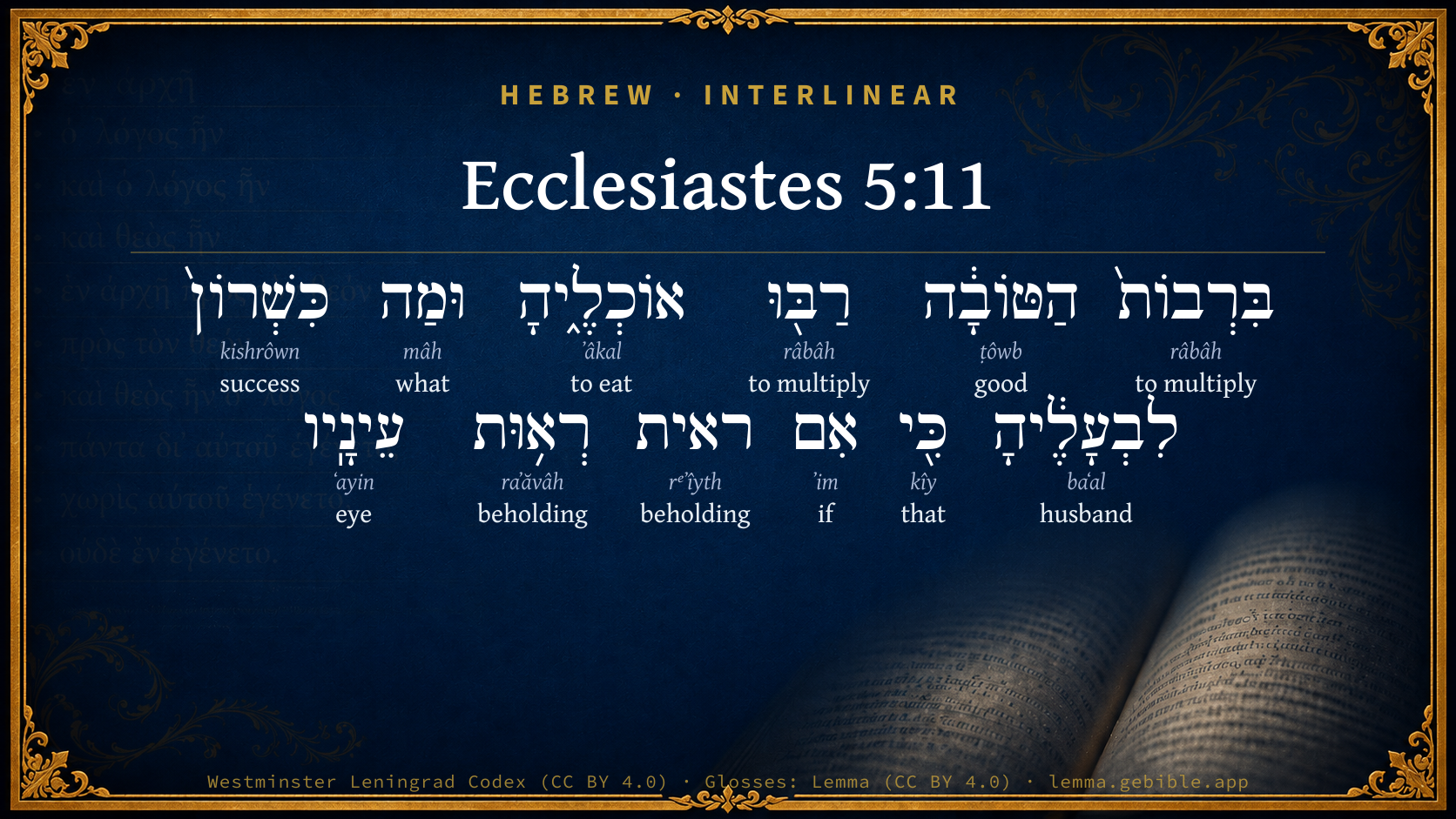
  1. בִּרְבוֹת֙ râbâh H7235 “in/at · to multiply” Preposition + Verb, Qal, Infinitive Construct
  2. הַטּוֹבָ֔ה ṭôwb H2896 “the · good” Particle, Definite Article + Adjective, Adjective, Feminine, Singular, Absolute
  3. רַבּ֖וּ râbâh H7235 “to multiply” Verb, Qal, Perfect, 3rd Person, Common, Plural
  4. אוֹכְלֶ֑יהָ ʼâkal H398 “eating · her” Verb, Qal, Participle Active, Masculine, Plural, Construct + Suffix, Personal, 3rd Person, Feminine, Singular
  5. וּמַה mâh H4100 “and · what” Conjunction + Particle, Interrogative
  6. כִּשְׁרוֹן֙ kishrôwn H3788 “success” Noun, Common, Masculine, Singular, Absolute
  7. לִבְעָלֶ֔יהָ baʻal H1167 “to/for · husbands · her” Preposition + Noun, Common, Masculine, Plural, Construct + Suffix, Personal, 3rd Person, Feminine, Singular
  8. כִּ֖י kîy H3588 “that” Conjunction
  9. אִם ʼim H518 “if” Conjunction
  10. רְא֥וּת raʼăvâh H7207 “beholding of” Noun, Common, Feminine, Singular, Construct
  11. עֵינָֽיו ʻayin H5869 “eyes · his” Noun, Common, Both, Dual, Construct + Suffix, Personal, 3rd Person, Masculine, Singular

About this verse

These counts appear in no published source. They are computed here, from the morphology-tagged text and Lemma’s own curated glosses. What Lemma adds →

12
words
11
distinct lemmas
Wisdom
section

Notable vocabulary

2 hapax legomena — words that appear only here in the entire Hebrew Bible:

  • ראית beholding H7212
  • רְא֥וּת beholding H7207

First appearance in Scripture

These words make their first canonical appearance in the Hebrew Bible here:

  • ראית beholding H7212
  • רְא֥וּת beholding H7207

Shared distinctive vocabulary

כִּשְׁרוֹן֙ success H3788 occurs in 3 verses of the Hebrew Bible. Also found in:

Grammatical profile

  • 3 verbs
  • 5 nouns
  • 1 adjective
  • 2 conjunctions
  • 1 particle

Verb forms

  • בִּרְבוֹת֙ Qal · Infinitive Construct
  • רַבּ֖וּ Qal · Perfect
  • אוֹכְלֶ֑יהָ Qal · Participle Active

Repetition

A word recurs within this verse — often emphatic in Hebrew:

  • בִּרְבוֹת֙ to multiply H7235 ×2

Hebrew & Septuagint length

In English translation the verse runs 25 words from the Hebrew and 29 from the Septuagint (LXX English) — closely comparable.

A rough comparison of the two English renderings, which tokenize alike — not a word-level alignment.

Word counts can differ between the Hebrew and the Greek without any difference in meaning — e.g. the Hebrew direct-object marker אֵת has no separate Greek word, and Greek often adds the article ὁ.

In the original languages it is 12 Hebrew tokens and 21 Greek tokens — but the two are counted differently (Hebrew bundles its prefixes and suffixes into one token; the Greek is in lemma form), so that isn’t a like-for-like length.

Cross-references

14

Topical passages linked to Ecclesiastes 5:11 in the Treasury of Scripture Knowledge — connected by theme and wording, ordered by reader-vote popularity; previews shown in the World English Bible.

  • 1 John 2:16 For all that is in the world, the lust of the flesh, the lust of the eyes, and the pride of life, isn't the Father's, but is the world's.
  • Habakkuk 2:13 Behold, isn't it of Yahweh of Hosts that the peoples labor for the fire, and the nations weary themselves for vanity?
  • Psalms 119:36–37 Turn my heart toward your statutes, Not toward selfish gain.
  • Proverbs 23:5 Why do you set your eyes on that which is not? For it certainly sprouts wings like an eagle and flies in the sky.
  • Ecclesiastes 6:9 Better is the sight of the eyes than the wandering of the desire. This also is vanity and a chasing after wind.
  • Genesis 12:16 He dealt well with Abram for her sake. He had sheep, and oxen, and male donkeys, and men-servants, and maid-servants, and female donkeys, and camels.
  • Genesis 13:2 Abram was very rich in cattle, in silver, and in gold.
  • Genesis 13:5–7 Lot also, who went with Abram, had flocks, and herds, and tents.
  • Joshua 7:21–25 when I saw among the spoil a goodly Babylonian mantle, and two hundred shekels of silver, and a wedge of gold of fifty shekels weight, then I coveted them, and took them; and, behold, they are hid in the earth in the midst of my tent, and the silver under it.
  • 1 Kings 5:13–16 King Solomon raised a levy out of all Israel; and the levy was thirty thousand men.
  • Nehemiah 5:17–18 Moreover there were at my table, of the Jews and the rulers, one hundred fifty men, besides those who came to us from among the nations that were round about us.
  • Ecclesiastes 11:9 Rejoice, young man, in your youth, And let your heart cheer you in the days of your youth, And walk in the ways of your heart, And in the sight of your eyes; But know that for all these things God will bring you into judgment.
  • 1 Kings 4:22–23 Solomon's provision for one day was thirty measures of fine flour, and sixty measures of meal,
  • Jeremiah 17:11 As the partridge that sits on [eggs] which she has not laid, so is he who gets riches, and not by right; in the midst of his days they shall leave him, and at his end he shall be a fool.

Cross-references courtesy of OpenBible.info (CC BY 4.0).

Hebrew and Greek witnesses Masoretic Hebrew ↔ Greek Septuagint

The same verse in the two great witnesses to the Old Testament, shown verse-for-verse.

These are two independent witnesses, not word-aligned to each other, and the Septuagint is shown in lemma (dictionary) form.

Hebrew Ecclesiastes 5:11 Masoretic · Westminster Leningrad Codex

בִּרְבוֹת֙ הַטּוֹבָ֔ה רַבּ֖וּ אוֹכְלֶ֑יהָ וּמַה כִּשְׁרוֹן֙ לִבְעָלֶ֔יהָ כִּ֖י אִם ראית רְא֥וּת עֵינָֽיו

When goods increase, those who eat them are increased; and what advantage is there to its owner, except to feast on them with his eyes?

World English Bible · Public Domain

Greek LXX Ecclesiastes 5:11 Septuagint · lemma form

γλυκύς ὕπνος ὁ δοῦλος εἰ ὀλίγος καί εἰ πολύς ἐσθίω καί ὁ ἐνπίμπλημι ὁ πλουτέω οὐ εἰμί ἀποἵημι αὐτός ὁ ὑπνόω

The sleep of a servant is sweet, whether he eat little or much: but to one who is satiated with wealth, there is none that suffers him to sleep.

LXX2012 (modern English Septuagint) · Public Domain

On this verse, The Pulpit Commentary discusses the Septuagint’s reading. Read the note in Commentary ↓

Hebrew: Westminster Leningrad Codex (CC BY 4.0). Greek: Septuagint (public domain); English from LXX2012 (modern English Septuagint) (Public Domain). How the Septuagint differs from the Hebrew →

Commentary

Notes on Ecclesiastes 5:11 from classic Christian and Jewish commentators (each source and its license shown beneath its notes). The classic Christian expositions comment on the surrounding passage and are grouped to its opening verse, so a note may address several verses; the Jewish commentaries on the Tanakh (Rashi and others) are per-verse, so they appear only where the commentator wrote on this verse.

Lemma curates 59 commentaries, every one of them public domain or Creative Commons licensed, each selected and text-cleaned for this edition rather than reprinted as found. About our sources →

Trapp's Complete Commentary

John Trapp

Ecc 5:11 When goods increase, they are increased that eat them: and what good [is there] to the owners thereof, saving the beholding [of them] with their eyes?

Ver. 11. When goods increase, they are increased that eat them.] Servants, friends, flatterers, trencher men, pensioners, and other hangerons that will flock to a rich man, as crows do to a dead carcase, not to defend, but to devour it. Caesar perished in the midst of his friends, whose boundless hopes and expectations he was not able to satisfy. The King of Spain, were it not for the West India fleet, were never able to subsist, though he be by far the greatest prince in Christendom, gives for his motto, Totus non sufficit orbis, and hath his empire so far extended that he may truly say, Sol mihi semper lucet, The sun ever shines upon my dominions. {a} The Duke of Bavaria’s house is so pestered with friars and Jesuits that, notwithstanding the greatness of his revenue, he is very poor, as spending all his estate on those Popish flesh flies, those inutiles et ribaldi (Lyra’s words upon this text), useless, needless, ribaldry fellows. {b}

Saving the beholding of them with his eyes.] To such a large retinue, such a numerous family; as Job, who had a very great household, {Job 1:3} and Abraham, who had a trained hand in his family, but especially as Solomon, who had thousands of servants and work folk. Whereunto I may add Cardinal Wolsey’s pompous family, consisting of one earl, nine barons, knights and esquires very many, chaplains and other servants, besides retainers, at bed and board, no fewer than four hundred. Or, to see so much wealth, and to tumble in it; as Caligula the emperor was wont to do, contrectandae pecuniae cupidine incensus, loving to handle his money, to walk upon it with his bare feet, and to roll among it with his whole body, as Suetonins relateth. {c} The like is reported of Heliogabalus, who also, besides what he did eat, is said to have provided himself, in case he should be in danger to be surprised by his enemies, silken halters to hang himself with, ponds of sweet water to drown himself, gilded poisons to poison himself with, &c.

{a} Camden.

{b} Heylin.

{c} Toto corpore aliquandiu volutatus. - Sueton.

John Trapp, A Commentary or Exposition upon All the Books of the Old and New Testament (1647–1656) — public domain. Text from a community e-Sword module.

Geneva Bible (1599)

Geneva Bible translators

That is, his great abundance of riches, or the surfeiting, which cometh by his great feeding.

Geneva Bible (1599) marginal notes — public domain. Text via Bolls.life.

Jamieson, Fausset & Brown

Robert Jamieson, A. R. Fausset & David Brown

they . . . that eat them--the rich man's dependents (Psa 23:5).

Jamieson, Fausset & Brown — Commentary Critical and Explanatory on the Whole Bible (1871) — public domain (CC PDM 1.0). Text via the HelloAO Bible API.

Adam Clarke's Commentary

Verse 11. When goods increase] An increase of property always brings an increase of expense, by a multitude of servants; and the owner really possesses no more, and probably enjoys much less, than he did, when every day provided its own bread, and could lay up no store for the next. But if he have more enjoyment, his cares are multiplied; and he has no kind of profit. "This also is vanity."

Adam Clarke's Commentary on the Bible (1810–1826) — public domain. Text from a community e-Sword/MySword module.

The Cambridge Bible for Schools and Colleges

gen. ed. J. J. S. Perowne

11. When goods increase, they are increased that eat them] The fact is one which has met the gaze of the moralists of all countries. A large household, numerous retainers, these are but so many elements of trouble. In the dialogue of Crœsus and Solon (Herod. i. 32), yet more closely in that of Pheraulas and Sacian (quoted by Ginsburg) in Xenophon (Cyrop. viii. 3, pp. 35–44), we have distinct parallels. The latter presents so striking a resemblance as to be worth quoting, “Do you think, Sacian, that I live with the more pleasure the more I possess.… By having this abundance, I gain merely this, that I have to guard more, to distribute more to others, and to have the trouble of taking care of more; for a great many domestics now demand of me their food, their drink, and their clothes … Whosoever, therefore, is greatly pleased with the possession of riches will, be assured, feel much annoyed at the expenditure of them.”

saving the beholding of them with their eyes] So Horace paints the miser:

“Congestis undique saccis

Indormis inhians, et tanquam parcere sacris

Cogeris, aut pictis tanquam gaudere tabellis.”

“Sleepless thou gazest on thy heaped-up bags,

And yet art forced to hold thy hand from them,

As though they were too sacred to be touched,

Or were but painted pictures for thine eyes.”

Sat. i. 1. 66.

The Cambridge Bible for Schools and Colleges (gen. ed. J. J. S. Perowne; Cambridge University Press, 1878–1918) — public domain. Text from a community e-Sword module.

John Gill's Exposition

When goods increase, they are increased that eat them,.... When a man's substance increases by trade, or otherwise, very often so it is that his family increases, and he has more mouths to feed, and backs to clothe; or his estate growing larger, if he lives suitably to it, he must keep more servants; and these, as they have but little work to do, are described by their eating, rather than by their working; and besides, such a growing man in the world has more friends and visitors that come about him, and eat with him, as well as the poor, which wait upon him to receive his alms: and if his farms, and his fields, and his flocks, are enlarged, he must have more husbandmen, and labourers, and shepherds to look after them, who all must be maintained. So Pheraulas in Xenophon (h) observes,

"that now he was possessed of much, that he neither ate, nor drank, nor slept the sweeter for it; what he got by his plenty was, that he had more committed to his keeping, and more to distribute to others; he had more care and more business, with trouble; for now, says he, many servants require food of me, many drink, many clothing, some need physicians, &c. it must needs be, adds he, that they that possess much must spend much on the gods, on friends, and on guests;''

and what good is there to the owners thereof, saving the beholding of them with their eyes? he can go into his grounds, his fields, and his meadows to behold his flocks and his herds, and can say, all these are mine; he can go into his chambers and open his treasures, and feed his eyes with looking upon his bags of gold and silver, his jewels, and other riches; he can behold a multitude of people at his table, eating at his expense, and more maintained at his cost: and, if a liberal man, it may be a pleasure to him; if otherwise, it will give him pain: and, excepting these, he enjoys no more than food and raiment; and often so it is, that even his very servants have in some things the advantage of him, as follows. The Targum is,

"what profit is there to the owner thereof who gathers it, unless he does good with it, that he may see the gift of the reward with his eyes in the world to come?''

Jarchi interprets it after this manner,

"when men bring many freewill offerings, the priests are increased that eat them; and what good is to the owner of them, the Lord, but the sight of his eyes, who says, and his will is done?''

(h) Cyropaedia, l. 8. c. 26.

John Gill's Exposition of the Whole Bible (1746–1763) — public domain (CC PDM 1.0). Text via the HelloAO Bible API.

Albert Barnes' Notes on the Bible

They ... that eat them - i. e., The laborers employed, and the household servants.

Albert Barnes' Notes on the Bible (1834–1885) — public domain. Text from a community e-Sword/MySword module.

Haydock's Catholic Bible Commentary

Sleep. Is not the health and content of the poor to be preferred?

George Leo Haydock (1774–1849), Haydock's Catholic Family Bible and Commentary, 1859 edition — public domain. Excludes Psalms (Douay-Rheims chapter numbering differs from Protestant) and Deuterocanonical books (Catholic canon only).

Matthew Poole's English Annotations

They are increased that eat them; they require and are more commonly attended with a numerous company of servants, and friends, and retinues to consume them; which is a great torment to a covetous man, of whom he here speaks.

What good is there to the owners thereof? what benefit hath he above others, who feed upon his provisions, and enjoy the same comforts which he doth, without his fears, and cares, and troubles about them?

The beholding of them with their eyes; either,

1. With a reflection upon his propriety.in them. Or,

2. With unlimited freedom. He can go and look upon his bags or chests of silver as long and as oft as he pleaseth, whereas other men are seldom admitted to that prospect, and see only some few of the fruits or purchases of it.

Matthew Poole's English Annotations on the Holy Bible (1683–1685) — public domain. Text from a community e-Sword/MySword module.

The Pulpit Commentary

Koheleth proceeds to notice some of the inconveniences which accompany wealth, which go far to prove that God is over all. When goods increase, they are increased that eat them. The more riches a man possesses, the greater are the claims upon him. He increases his household, retainers, and dependents, and is really none the better off for all his wealth. So Job in his prosperous days is said to have had "a very great household", (Job_1:3) and the servants and laborers employed by Solomon must have taxed to the utmost even his abnormal resources. (1Ki_5:13, etc.) Commentators from Piueda downwards have quoted the remarkable parallel in Xenoph., "Cyropaed.," 8:3, wherein the wealthy Persian Pheraulas, who had risen from poverty to high estate, disabuses a young Sacian friend of the idea that his riches made him happier or afforded supreme content. "Do you not know," said he," that I neither eat, nor drink, nor sleep with any more pleasure now than I did when I was poor? by having this abundance I gain merely this, that I have to guard more, to distribute more among others, and to have the trouble of taking care of more. For now numerous domestics demand of me food, drink, clothes; some want the doctor; one comes and brings me sheep that have been torn by wolves, or oxen killed by failing down a precipice, or tells of a murrain that has affected the cattle; so that I seem to myself to have more afflictions in my abundance than I had when I was poor, It is obligatory on him who possesses much to expend much both on the gods and on friends and on strangers; and whosoever is greatly pleased with the possession of riches will, you may be assured, be greatly annoyed at the expenditure of them." What good is there to the owners thereof, saving the beholding of them with their eyes? What it is that the owners behold is doubtful. Ginsburg considers that the increased number of devourers is meant; but surely this sight could hardly be called kishron, "success, profit." So it is better to take the sight to be the amassed wealth. The contemplation of this is the only enjoyment that the possessor realizes. So the Vulgate, Et quid prodest possessori, nisi quod cernit divitias oculis suis? Septuagint, Kai ajndreia tw par aujthv oti ajrch tou oJran ojfqalmoiv aujtou," And in what does the excellence of the owner consist? except the power of seeing it with his eyes." A Lapide quotes Horace"s portrait of the miser ("Sat.," 1:1.66, sqq.)

Populus me sibilat; ut mihi plaudo Ipse domi, simul ac, nummos contemplor in area... ... congestis undique saccis Indormis inhians et tanquam parcere sacris Cogeris aut pictis tanquam gaudere tabellis.

He, when the people hissed, would turn about, And dryly thus accost the rabble-rout: Hiss on; heed you not, ye saucy wags, While self-applauses greet me o"er my bags.

O"er countless heaps in nicest order stored, You pore agape, and gaze upon the hoard, As relics to be laid with reverence by, Or pictures only meant to please the eye. (Howes. )

The Pulpit Commentary (1880–1919), ed. H.D.M. Spence-Jones & Joseph S. Exell — public domain. Text from a community e-Sword module.

Keil & Delitzsch

C. F. Keil & F. Delitzsch

"When property and goods increase, they become many who consume them; and what advantage hath the owner thereof but the sight of them with his eyes?" The verb רבה signifies to increase, the רבב, to be many; but also (which Bttch. denies) inchoatively: to become many, Gen 6:1; rightly, the lxx, ἐπληθύνθησαν. The author has not a miser in view, who shuts up his money in chests, and only feeds himself in looking at it with closed doors; but a covetous man, of the sort spoken of in Psa 49:12; Isa 5:8. If the hattovah, the possession of such an one, increases, in like manner the number of people whom he must maintain increases also, and thus the number of those who eat of it along with him, and at the same time also his disquiet and care, increase; and what advantage, what useful result (vid., regarding Kishron, above, p. 638, and under Ecc 2:21) has the owner of these good things from them but the beholding of them (reith; Kerı̂, reuth; cf. the reverse case, Psa 126:4)? - the possession does not in itself bring happiness, for it is never great enough to satisfy him, but is yet great enough to fill him with great care as to whether he may be able to support the demands of so great a household: the fortune which it brings to him consists finally only in this, that he can look on all he has accumulated with proud self-complacency.

Keil & Delitzsch — Biblical Commentary on the Old Testament (1861–1891) — public domain (CC PDM 1.0). Text via the HelloAO Bible API. (Old Testament only.)

Rashi

Rabbi Shlomo Yitzchaki (Rashi)

The sleep of the laborer is sweet The one who tills the soil sleeps, and he enjoys his sleep, whether he eats little or whether he eats much, for he is already accustomed to it.

but the satiety of the rich does not allow him to sleep But the satiety of belongings of the rich man, who owns much merchandise, does not allow him to sleep; all night he thinks about them. Another explanation: The year of the one who serves God is sweet; whether the days of his years are few or many, he will eat his reward—the one who had few years like the one who had many years. Moses led Israel forty years, and the prophet Samuel led them ten years, yet Scripture equated them, this one like that one, as it is said (Ps. 99.6): “Moses and Aaron among His priests, and Samuel among those who call in His name, etc.” So is it expounded upon in Tanhuma (Ki Thissa 3).

but the satiety of the rich the one who has taught many traditions.

does not allow him to sleep in the grave, as it is said (Song 7:10): “making the lips of the sleeping speak.” Every Torah scholar, in whose name a traditional law is recited—his lips speak in the grave.

Rashi on the Tanakh — English translations: “The Judaica Press complete Tanach with Rashi, translated by A. J. Rosenberg” (CC BY 4.0); “Pentateuch with Rashi's commentary by M. Rosenbaum and A.M. Silbermann, 1929-1934” (public domain); “The Metsudah Tanach series, Lakewood, N.J” (CC BY 4.0); and “The Book of Joshua, Metsudah Publications, 1997” (CC BY 4.0). Text via Sefaria.

Lesson kit

Teaching starters — assembled from the data on this page, not authored interpretation. Every prompt links to the verse data it draws on. Edit before teaching.

Ecclesiastes, in the Wisdom, opens this verse with 12 words (11 distinct Hebrew lemmas). Its most distinctive word is rᵉʼîyth (“beholding”). A historical commentator’s framing appears above. Read the whole chapter for the surrounding context.

Discussion questions

  1. How does “beholding” (rᵉʼîyth) shape what this verse is saying?
  2. 2 words here appear nowhere else in the Hebrew Bible. Why might the author reach for such rare wording?
  3. 2 words make their first appearance in Scripture here. What does this debut establish?
  4. How does Ecclesiastes 2:21, which shares the word «success», read alongside this verse?
  5. What does the repetition of “to multiply” (2× in this one verse) do in this verse?
  6. These translations render this verse differently; the difference is in the English rendering, not the original. What questions does that raise?
  7. «בִּרְבוֹת֙» is a Qal Infinitive Construct verb. How does that grammatical form shape the action described?
  8. Compare how Trapp's Complete Commentary and Geneva Bible (1599) read this verse. Where do they agree or differ?

Things to notice

  • 2 words in this verse appear nowhere else in the Hebrew Bible.
  • 2 words make their first canonical appearance in Scripture here.
  • This verse counts 12 Hebrew ↔ 21 Greek words.
  • These translations choose different wording for 18 words in this verse.
  • “to multiply” occurs 2× in this single verse.

Reading settings

Reading text

Shown beneath each verse's original-language words.

Old Testament
Old Testament edition

Read the OT as the Masoretic Hebrew (MT) or the Greek Septuagint (LXX).

English shown for the Greek Septuagint (in the Hebrew ↔ Greek comparison).

Comparing translations? Open the Compare panel on any verse page to stack up to four side by side.