Psalms 42:9

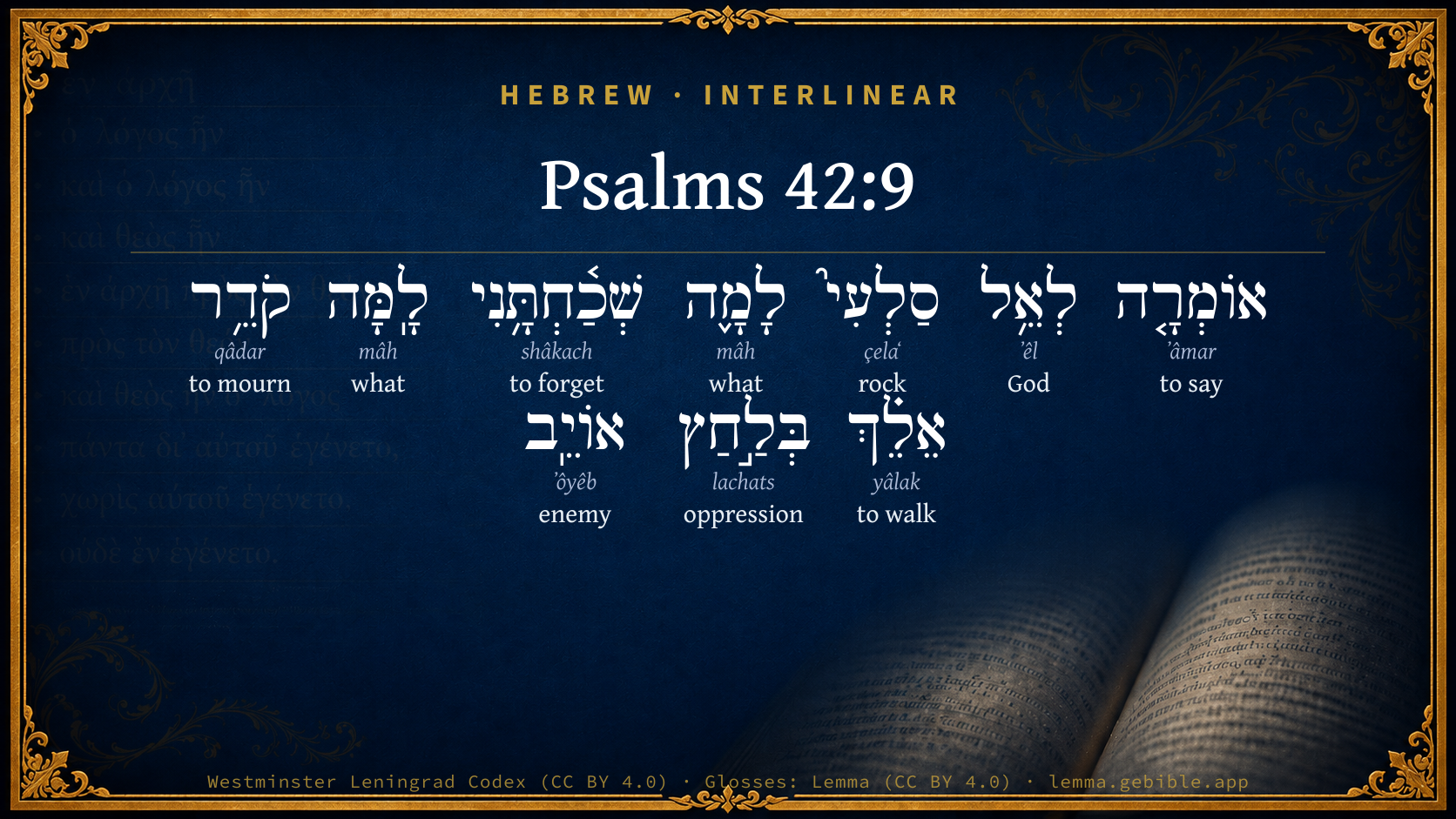
Hebrew (Westminster Leningrad Codex) Psalms 42:9 appears in the Hebrew Old Testament. The text above is from the Westminster Leningrad Codex. Each word links to its Strong’s number, a concise gloss, and parsing drawn from the Open Scriptures Hebrew Bible morphology. Click any word for its full Brown-Driver-Briggs (BDB) entry.
Download image
Cite this verse

Psalms 42:9 (World English Bible). Public Domain. Lemma interlinear Bible study tool, https://lemma.gebible.app/v/psalms/42/9.

Show BibTeX & RIS
BibTeX
RIS
English Translation
I will ask God, my rock, "Why have you forgotten me? Why do I go mourning because of the oppression of the enemy?"
World English Bible · Public Domain
Download a study sheet

One document with this verse’s original text, its word-by-word gloss line, the meaning frame, cross-references with their text, attributed commentary, and full source and license credits — printable, and it pastes into notes with its structure intact.

This verse Autodidact and up

Study sheet (.html) Plain text (.txt)

A passage Seminary Student

Up to 50 verses in one chapter. A passage sheet keeps up to 6 commentary sources and 12 cross-references per verse, in the order this page ranks them, and says so on the sheet whenever that leaves anything out. Ask for a single verse and you get the Autodidact verse sheet above.

Everything on this page stays free to read, with no account — the sheet is a download of what is already on screen, not access to it.

Want to remove ads? Support Godless Engineer
Compare translations 3

The same verse in 3 English versions, stacked beneath the original-language interlinear above. Click any original word for its lexicon entry.

Each is an independent rendering of the whole verse — the interlinear is not word-aligned to these translations.

Highlighted words mark where these versions differ — a whole-verse word diff, not a word-by-word alignment.

  • World English Bible Public Domain
    I will ask God, my rock, "Why have you forgotten me? Why do I go mourning because of the oppression of the enemy?"
  • King James Version Public Domain
    I will say unto God my rock, Why hast thou forgotten me? why go I mourning because of the oppression of the enemy?
  • unfoldingWord Literal Text CC BY-SA 4.0
    Let me say to God, my rock, “Why have you forgotten me? Why do I walk about mourning because of the oppression of the enemy?”

unfoldingWord Literal Text — © unfoldingWord, licensed CC BY-SA 4.0. Word-aligned USFM3 via Door43 (git.door43.org/unfoldingWord/en_ult).

Versions to compare (up to 4)

3 of 4 selected

Show all 18 translations

Every available English version of this verse, each an independent rendering of the whole verse.

  • World English Bible Public Domain
    I will ask God, my rock, "Why have you forgotten me? Why do I go mourning because of the oppression of the enemy?"
  • Berean Standard Bible Public Domain
    I say to God my Rock, “Why have You forgotten me? Why must I walk in sorrow because of the enemy’s oppression?”
  • Majority Standard Bible Public Domain
    I say to God my Rock, “Why have You forgotten me? Why must I walk in sorrow because of the enemy’s oppression?”
  • King James Version Public Domain
    I will say unto God my rock, Why hast thou forgotten me? why go I mourning because of the oppression of the enemy?
  • American Standard Version (1901) Public Domain
    I will say unto God my rock, Why hast thou forgotten me? Why go I mourning because of the oppression of the enemy?
  • Revised Version (1885) Public Domain
    I will say unto God my rock, Why hast thou forgotten me? why go I mourning because of the oppression of the enemy?
  • Geneva Bible (1599) Public Domain
    I wil say vnto God, which is my rocke, Why hast thou forgotten mee? why goe I mourning, when the enemie oppresseth me?
  • Douay-Rheims (1899) Public Domain
    In the daytime the Lord hath commanded his mercy; and a canticle to him in the night. With me is prayer to the God of my life.
  • Young's Literal Translation Public Domain
    I say to God my rock, `Why hast Thou forgotten me? Why go I mourning in the oppression of an enemy?
  • Literal Standard Version CC BY-SA 4.0
    I say to God my Rock, “Why have You forgotten me? Why do I go mourning in the oppression of an enemy?”
  • Unlocked Literal Bible CC BY-SA 4.0
    I will say to God, my rock, “Why have you forgotten me? Why do I go mourning because of the oppression of the enemy?”
  • unfoldingWord Literal Text CC BY-SA 4.0
    Let me say to God, my rock, “Why have you forgotten me? Why do I walk about mourning because of the oppression of the enemy?”
  • Darby Bible Public Domain
    I will say unto ùGod my rock, Why hast thou forgotten me? why go I mourning because of the oppression of the enemy?
  • World Messianic Bible Public Domain
    I will ask God, my rock, “Why have you forgotten me? Why do I go mourning because of the oppression of the enemy?”
  • Webster's Bible Public Domain
    \\42:8\\Yet the LORD will command his loving-kindness in the day-time, and in the night his song shall be with me, and my prayer to the God of my life.
  • Free Bible Version CC BY-SA 4.0
    I cry out, “My God, my rock, why have you forgotten me? Why must I go around weeping because of the attacks of my enemies?”
  • Bible in Basic English Public Domain
    I will say to God my Rock, Why have you let me go from your memory? why do I go in sorrow because of the attacks of my haters?
  • JPS Tanakh (1917) Public Domain
    (42-10) I will say unto God my Rock: 'Why hast Thou forgotten me? Why go I mourning under the oppression of the enemy?'

Literal Standard Version (2020), Covenant Press — licensed CC BY-SA 4.0. Text via the HelloAO Bible API (eBible.org). Unlocked Literal Bible (unfoldingWord) — licensed CC BY-SA 4.0. Text via the HelloAO Bible API (eBible.org). unfoldingWord Literal Text — © unfoldingWord, licensed CC BY-SA 4.0. Word-aligned USFM3 via Door43 (git.door43.org/unfoldingWord/en_ult). Free Bible Version, Dr. Jonathan Gallagher — licensed CC BY-SA 4.0. Text via the HelloAO Bible API (eBible.org).

Word by word

More ways to search: Search by grammar → Find every occurrence → Compare this word →

Practice this passage: Drill this verse → Learn its vocabulary →

בְּלַ֣חַץ
lachats
H3906
“in/at · oppression of”
Preposition + Noun, Common, Masculine, Singular, Construct
Part of Speech
Preposition + Noun
Type
Common
Gender
Masculine
Number
Singular
State
Construct
Full BDB Definition

Origin: from H3905

TWOT: 1106a

oppression, distress, pressure
  1. אוֹמְרָ֤ה ʼâmar H559 “to say” Verb, Qal, Cohortative, 1st Person, Common, Singular
  2. לְאֵ֥ל ʼêl H410 “to/for · God” Preposition + Noun, Common, Masculine, Singular, Absolute
  3. סַלְעִי֮ çelaʻ H5553 “rock · my” Noun, Common, Masculine, Singular, Construct + Suffix, Personal, 1st Person, Common, Singular
  4. לָמָ֪ה mâh H4100 “to/for · what” Preposition + Particle, Interrogative
  5. שְׁכַ֫חְתָּ֥נִי shâkach H7911 “to forget · me” Verb, Qal, Perfect, 2nd Person, Masculine, Singular + Suffix, Personal, 1st Person, Common, Singular
  6. לָֽמָּה mâh H4100 “to/for · what” Preposition + Particle, Interrogative
  7. קֹדֵ֥ר qâdar H6937 “mourning” Verb, Qal, Participle Active, Masculine, Singular, Absolute
  8. אֵלֵ֗ךְ yâlak H3212 “to walk” Verb, Qal, Imperfect, 1st Person, Common, Singular
  9. אוֹיֵֽב ʼôyêb H341 “enemy” Verb, Qal, Participle Active, Masculine, Singular, Absolute

About this verse

These counts appear in no published source. They are computed here, from the morphology-tagged text and Lemma’s own curated glosses. What Lemma adds →

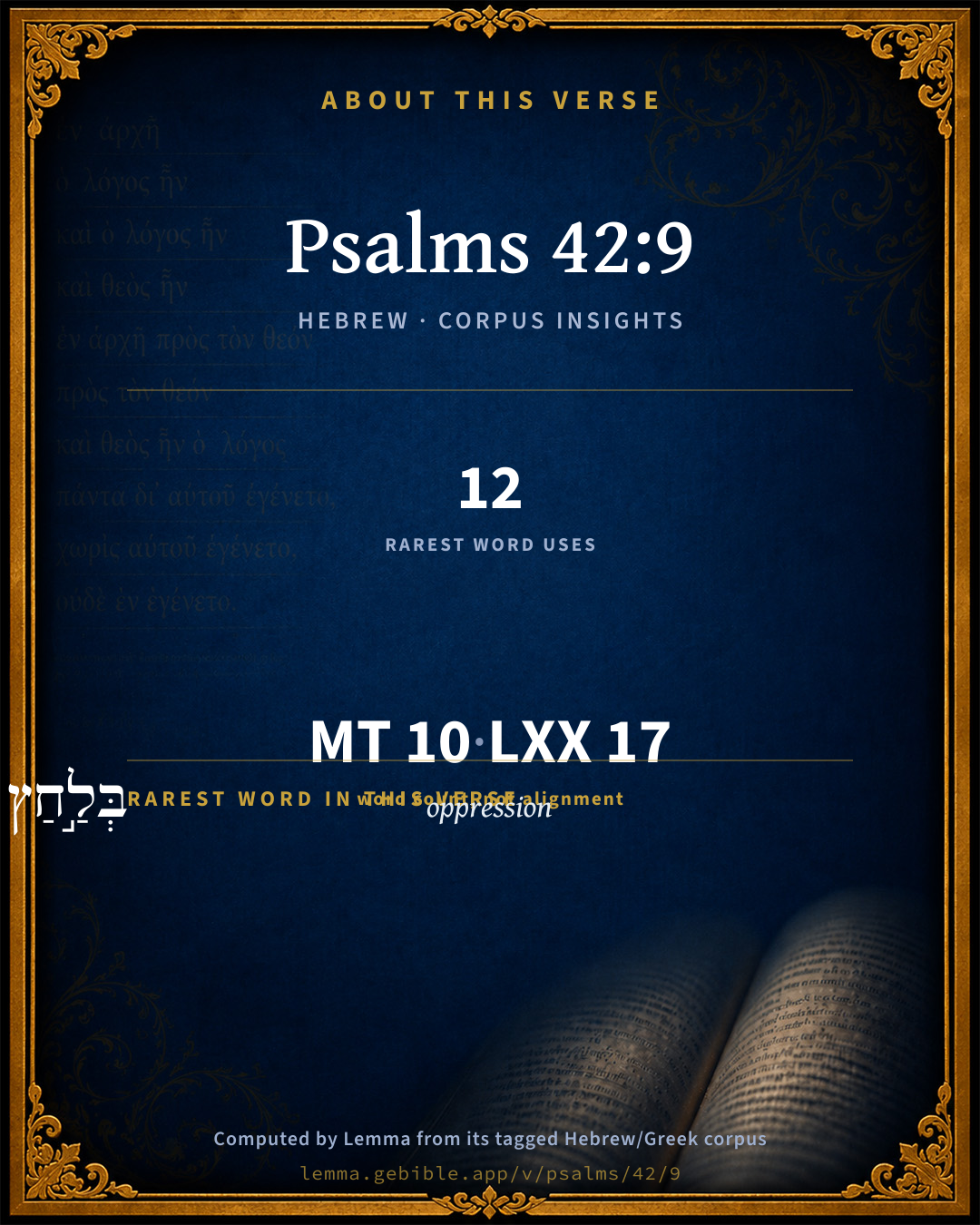
10
words
9
distinct lemmas
Wisdom
section

Notable vocabulary

The rarest word here is בְּלַ֣חַץ oppression H3906 — appearing just 12 times in the whole Hebrew Bible.

Shared distinctive vocabulary

בְּלַ֣חַץ oppression H3906 occurs in 10 verses of the Hebrew Bible. Also found in:

Grammatical profile

  • 5 verbs
  • 3 nouns
  • 2 particles

Verb forms

  • אוֹמְרָ֤ה Qal · Cohortative
  • שְׁכַ֫חְתָּ֥נִי Qal · Perfect
  • קֹדֵ֥ר Qal · Participle Active
  • אֵלֵ֗ךְ Qal · Imperfect
  • אוֹיֵֽב Qal · Participle Active

Repetition

A word recurs within this verse — often emphatic in Hebrew:

  • לָמָ֪ה what H4100 ×2

Hebrew & Septuagint length

In English translation the verse runs 23 words from the Hebrew and 26 from the Septuagint (LXX English) — closely comparable.

A rough comparison of the two English renderings, which tokenize alike — not a word-level alignment.

Word counts can differ between the Hebrew and the Greek without any difference in meaning — e.g. the Hebrew direct-object marker אֵת has no separate Greek word, and Greek often adds the article ὁ.

In the original languages it is 10 Hebrew tokens and 17 Greek tokens — but the two are counted differently (Hebrew bundles its prefixes and suffixes into one token; the Greek is in lemma form), so that isn’t a like-for-like length.

Cross-references

18

Topical passages linked to Psalms 42:9 in the Treasury of Scripture Knowledge — connected by theme and wording, ordered by reader-vote popularity; previews shown in the World English Bible.

  • Psalms 38:6 I am pained and bowed down greatly. I go mourning all day long.
  • Psalms 18:2 Yahweh is my rock, my fortress, and my deliverer; My God, my rock, in whom I take refuge; My shield, and the horn of my salvation, my high tower.
  • Psalms 43:2 For you are the God of my strength. Why have you rejected me? Why do I go mourning because of the oppression of the enemy?
  • Psalms 28:1 To you, Yahweh, I call. My rock, don't be deaf to me; Lest, if you are silent to me, I would become like those who go down into the pit.
  • Psalms 44:23–24 Wake up! Why do you sleep, Lord? Arise! Don't reject us forever.
  • Psalms 62:2 He alone is my rock and my salvation, my fortress-- I will never be greatly shaken.
  • Isaiah 40:27 Why say you, Jacob, and speak, Israel, My way is hid from Yahweh, and the justice [due] to me is passed away from my God?
  • Lamentations 5:1–16 Remember, Yahweh, what has come on us: Look, and see our reproach.
  • Job 30:26–31 When I looked for good, then evil came; When I waited for light, there came darkness.
  • Psalms 13:1 How long, Yahweh? Will you forget me forever? How long will you hide your face from me?
  • Psalms 22:1–2 My God, my God, why have you forsaken me? Why are you so far from helping me, and from the words of my groaning?
  • Psalms 55:3 Because of the voice of the enemy, Because of the oppression of the wicked. For they bring suffering on me. In anger they hold a grudge against me.
  • Psalms 62:6–7 He alone is my rock and my salvation, my fortress. I will not be shaken.
  • Psalms 77:9 Has God forgotten to be gracious? Has he, in anger, withheld his compassion?" Selah.
  • Psalms 78:35 They remembered that God was their rock, The Most High God their redeemer.
  • Psalms 88:9 My eyes are dim from grief. I have called on you daily, Yahweh. I have spread out my hands to you.
  • Ecclesiastes 4:1 Then I returned and saw all the oppressions that are done under the sun: and, behold, the tears of those who were oppressed, and they had no comforter; and on the side of their oppressors there was power; but they had no comforter.
  • Isaiah 49:15 Can a woman forget her sucking child, that she should not have compassion on the son of her womb? yes, these may forget, yet I will not forget you.

Cross-references courtesy of OpenBible.info (CC BY 4.0).

Hebrew and Greek witnesses Masoretic Hebrew ↔ Greek Septuagint

The same verse in the two great witnesses to the Old Testament, shown verse-for-verse.

You’re reading Greek Psalm 41 (Hebrew Psalm 42). The Septuagint counts the superscription, so verse numbers can differ from the Hebrew — chapter-level alignment, not verse-by-verse. Numbering follows Rahlfs.

These are two independent witnesses, not word-aligned to each other, and the Septuagint is shown in lemma (dictionary) form.

Hebrew Psalms 42:9 Masoretic · Westminster Leningrad Codex

אוֹמְרָ֤ה לְאֵ֥ל סַלְעִי֮ לָמָ֪ה שְׁכַ֫חְתָּ֥נִי לָֽמָּה קֹדֵ֥ר אֵלֵ֗ךְ בְּלַ֣חַץ אוֹיֵֽב

I will ask God, my rock, "Why have you forgotten me? Why do I go mourning because of the oppression of the enemy?"

World English Bible · Public Domain

Greek LXX Greek Psalm 41:9 Septuagint · lemma form

ἡμέρα ἐντελέω κύριος ὁ ἔλεος αὐτός καί νύξ ᾠδή παρά ἐγώ προσευχή ὁ θεός ὁ ζωή ἐγώ

I will say to God, You are my helper; why have you forgotten me? therefore do I go sad of countenance, while the enemy oppresses me?

LXX2012 (modern English Septuagint) · Public Domain

On this verse, The Cambridge Bible for Schools and Colleges discusses the Septuagint’s reading. Read the note in Commentary ↓

Hebrew: Westminster Leningrad Codex (CC BY 4.0). Greek: Septuagint (public domain); English from LXX2012 (modern English Septuagint) (Public Domain). How the Septuagint differs from the Hebrew →

Commentary

Notes on Psalms 42:9 from classic Christian and Jewish commentators (each source and its license shown beneath its notes). The classic Christian expositions comment on the surrounding passage and are grouped to its opening verse, so a note may address several verses; the Jewish commentaries on the Tanakh (Rashi and others) are per-verse, so they appear only where the commentator wrote on this verse.

Lemma curates 59 commentaries, every one of them public domain or Creative Commons licensed, each selected and text-cleaned for this edition rather than reprinted as found. About our sources →

Trapp's Complete Commentary

John Trapp

Psa 42:9 I will say unto God my rock, Why hast thou forgotten me? why go I mourning because of the oppression of the enemy?

Ver. 9. I will say unto God my rock, Why hast thou forgotten me?] Tene veto mei immemorem esse? Thus I will in a familiar manner expostulate with him, and lay my case open unto him, as to a friend. The flesh suggesteth that he is forgotten, but faith holdeth its own, fastening on the Rock of ages.

Why go I mourning] Heb. Black, as one that is in mourning weeds; or, that had lain among the pots.

John Trapp, A Commentary or Exposition upon All the Books of the Old and New Testament (1647–1656) — public domain. Text from a community e-Sword module.

The Biblical Illustrator

Joseph S. Exell

Psa_42:9

I will say unto God my Rock, Why hast Thou forgotten me?

why go I mourning because of the oppression of the enemy?

Davids expostulation with God

I. The preface or introduction. I will say unto God, etc.

1. The terms upon which David addresses himself to God. My Rock. This was an expression suitable to the condition which David was now in, and the metaphor which he had it set forth by, to wit, of being in the deep; he had said, the waves and billows went over him, and now, therefore, does he repair to the Rock. The Lord is pleased still in Scripture to represent Himself to us as most agreeable to our present necessities. If we be sick, He is our health; if we be dead, He is our life; if we be pursued, He is our castle; if we be assaulted, He is our shield; if we be ready to sink under dangers and calamities, He is then our Rock (Psa_18:2; Psa_89:26; Psa_94:22). It is a small booty to us, for God to be a rock, except He be ours, and therefore David adds this to the other. Not only the rock which I have right to, but also the rock which I have proof and trial of in former proceedings. I have made Him my rock by faith, He has made Himself my rock by love. Thus the servants of God, as they go confidently where they have interest, so they go more confidently still there where they have experience (Psa_57:2).

2. His preparation of himself to this address. I will say.

(1) A word of premeditation and advice. David being now to come before God, and to address himself unto Him, does not come to Him hand over head, he cares not how; but he thinks first with himself what he will utter and speak before Him when he shall come into His presence.

(2) A word of resolution. David had tried other ways, he had spoken to his own soul already, and that would not do the deed; and now he resolves to go to God Himself, and to fasten his complaints upon Him, or at least to spread them before Him, and to desire His relief of Him in them. And this is what all Christians should resolve on; it is the best course which can be taken.

II. The expostulation itself. Why hast Thou, etc.

1. Look upon this complaint as it refers to God. Why hast Thou forgotten me? This may be understood either as such which there was causes and ground for indeed, or else as such which was so only according to Davids apprehension.

(1) God does sometimes so carry Himself towards His servants as if He had forgotten them, while He suffers them to continue and abide under sundry evils which they fall into. God forgets them that so they may remember themselves. The servants of God in prosperity, and in the enjoyment of all things to their minds, are apt very often to wander and go astray, and to go out of the way; now desertion it brings them in again and reduces them, and recovers them to themselves (Luk_15:17; 1Ki_8:47; Psa_119:67). As God forgets His people that so they may remember themselves, so also sometimes that they may remember Him (Isa_17:10). That they may remember others (Amo_6:6).

(2) As we may look upon this forgetting as so indeed, so we may look upon it as being so only in Davids apprehension, and so signifying thus much unto us, that Gods servants are apt to think God forgets them, even then when He is yet mindful of them. From want of due understanding and consideration of the manner of Gods dealings. From impatience and too much haste.

2. As it refers to himself.

(1) He expostulates about the occasion. Why go I mourning? The occasions hereof to Gods people are sundry and various: as

(a) their own sins, and the corruptions which do cleave unto them.

(b) The sins of others. Gods children go mourning for these also.

(c) For their own and others afflictions.

(2) He expostulates as to the affection. Why go I mourning? that is, Why do I mourn in this excess, as I now perceive myself to do? This is that which the servants of God are oftentimes troubled withal, even the inordinacy and distemper of their affections, when they go beyond their due measure and bounds; not only as it is painful, but as it is sinful.

(3) This expostulation hath reference to the adversaries and opposites of David, Because of the oppression of the enemy. (Thomas Herren, D. D.)

The Biblical Illustrator, edited by Joseph S. Exell (c. 1880s–1900s) — public domain. Text from a community e-Sword module.

J. A. Alexander on Psalms

Joseph Addison Alexander

10. (Psa 42:9). I will say to God, my rock, why hast thou forgotten me? Why go I mourning in the oppression of the enemy? This expostulation may be regarded as a part or a sample of the prayer which God enabled him to offer, even in the midst of his afflictions. The divine name here used is the one significant of strength. My rock, my refuge, my protector, and the foundation of my hope. See above, on Psa 18:3 (2). Why go I? more exactly, why shall or must I go? Mourning, literally squalid, dirty. See above, on Psa 34:14; Psa 38:7 (6). In the oppression, may either mean during its continuance, or in consequence of it, or rather both ideas are included.

Joseph Addison Alexander, The Psalms Translated and Explained (1850) — public domain. Text from a community e-Sword module.

Tyndale Open Study Notes

Tyndale Open Resources

42:9-10 The psalmist brings his many doubts, discouragements, and questions directly to God.

Tyndale Open Study Notes — © Tyndale Open Resources, licensed CC BY-SA 4.0. Text via the HelloAO Bible API.

Jamieson, Fausset & Brown

Robert Jamieson, A. R. Fausset & David Brown

in view of which [Psa 42:8], he dictates to himself a prayer based on his distress, aggravated as it was by the cruel taunts and infidel suggestions of his foes.

Jamieson, Fausset & Brown — Commentary Critical and Explanatory on the Whole Bible (1871) — public domain (CC PDM 1.0). Text via the HelloAO Bible API.

Adam Clarke's Commentary

Verse 9. I will say unto God my rock] God, my Fortress and Support.

Why hast thou forgotten meat] This and the following verse is badly pointed in our Bibles: "Why go I mourning as with a sword in my bones because of the oppression of the enemy? Mine enemies reproach me daily, while they say unto me, Where is thy God?" See on Ps 42:3. Their reproaches are to my soul as cutting and severe as a sword thrust into my body, and separating between my bones; because these reproaches are intended to fall on thee, my God, as if thou hadst not power to save us from the hands of our oppressors.

Adam Clarke's Commentary on the Bible (1810–1826) — public domain. Text from a community e-Sword/MySword module.

John Calvin's Commentaries

9. I will say to God my rock If we read the preceding verse in the past tense, the meaning of this verse will be, Since God has, in this way, heretofore shown himself so kind towards me, I will pray to him now with so much the greater confidence: for the experience which I have had of his goodness will inspire me with courage. But if the preceding verse is rendered in the future tense, David, in this verse, combines the prayer which it contains with the reflections which faith led him to make. And, surely, whoever, from a persuasion of the paternal love of God, anticipates for himself the same favor which David has just described, will also be induced from his example to pray for it with greater confidence. The meaning, then, will be this: Since I expect that God will be favorable to me, inasmuch as by day he manifests his favor towards me, and continues to do this, so that even by night I have occasion to praise him, I will bewail the more frankly my miseries before him, saying, O Lord! my rock, why hast thou forgotten me? In making such a complaint, the faithful are not to be understood as meaning that God has utterly rejected them: for if they did not believe that they were under his care and protection, it were in vain for them to call upon him. But they speak in this manner according to the sense of the flesh. This forgetfulness, then, relates both to outward appearance, and to the disquietude by which the faithful are troubled according to the flesh, although, in the meantime, they rest assured by faith that God regards them, and will not be deaf to their request.

John Calvin's Commentaries (1540-1563) — public domain. Text from the Calvin Translation Society English edition (1840s-50s) via the Christian Classics Ethereal Library (ccel.org). Calvin's coverage is partial (roughly two-thirds of the Bible); uncommented books and verses are honest gaps, never fabricated. The 19th-century editor's footnotes and remarks are omitted so the notes are faithfully Calvin's own voice.

Ellicott's Commentary for English Readers

(9) Apparently we have now the very words of the prayer just mentioned.

A Bible Commentary for English Readers, edited by Charles John Ellicott (1878–1897) — public domain. Text from a community e-Sword module.

The Cambridge Bible for Schools and Colleges

gen. ed. J. J. S. Perowne

9. I will say] Or, Let me say, the tense (voluntative, as in Psa_42:4) emphatically expressing his resolution.

my rock] The word, lit. my cliff or crag (sela), is used of God as a refuge only in Psa_18:2 (= 2Sa_22:2); Psa_31:3 (=Psa_71:3). On the more common word for rock (tsûr) see note on Psa_18:2 (A.V. my strength).

The original edition of the A.V. (1611) has unto God, My rock, why; treating my rock as a vocative, with LXX and Jerome. Editions of 1612 and 1630 have God, my rock, why: and the usual punctuation God my rock, Why appears to have been introduced in editions of 1629, 1638. See Scrivener, Authorised Ed. of the English Bible, p. 165.

Why &c.] Not a demand for explanation, but the expostulation of perplexity. Cp. Psa_13:1; Psa_22:1; Psa_77:9; Psa_88:14.

mourning] Cp. Psa_35:14, Psa_38:6; Job_30:28.

because of the oppression of the enemy] Or, as R.V. marg. (cp. P.B.V.), while the enemy oppresseth. The substantive occurs in the Psalter only here and in Psa_43:2; Psa_44:24; the verb only in Psa_56:1; Psa_106:42. Both are used elsewhere, especially of the oppression of Israel by foreign invaders (Jdg_2:18; 1Sa_10:18; 2Ki_13:4; Amo_6:14; &c.).

9–11. Having thus recalled God’s mercy in the past he expostulates with Him for having abandoned him, and exposed him to the sneers of his enemies.

The Cambridge Bible for Schools and Colleges (gen. ed. J. J. S. Perowne; Cambridge University Press, 1878–1918) — public domain. Text from a community e-Sword module.

John Gill's Exposition

I will say unto God my rock,.... A name frequently given to the eternal God, Father, Son, and Spirit, Deu 32:4; See Gill on Psa 18:2;

why hast thou forgotten me? See Gill on Psa 13:1;

why go I mourning because of the oppression of the enemy? meaning perhaps Saul; though it may be applied to any spiritual enemy, sin, Satan, and the world; who are very oppressive and afflicting, and occasion continual mourning to the children of God.

John Gill's Exposition of the Whole Bible (1746–1763) — public domain (CC PDM 1.0). Text via the HelloAO Bible API.

Albert Barnes' Notes on the Bible

I will say unto God my rock - I will appeal to God as my defense, my helper, my Saviour. On the word rock, as applied to God, see the notes at Psa 18:2.

Why hast thou forgotten me? - See the notes at Psa 22:1. He had seemed to forget and forsake him, for He did not come to interpose and save him. This is a part of the prayer which he says Psa 42:8 that he would use.

Why go I mourning? - On the meaning of the word used here - קדר qodēr - see Psa 35:14, note; Psa 38:6, note. The idea is that of being bowed down, made sad, deeply afflicted, as one forsaken.

Because of the oppression of the enemy - In the oppression of the enemy; that is, during its continuance, or on account of it. The word here rendered “oppression” means distress, affliction, straits, Job 36:15; 1Ki 22:27; Isa 30:20. The “enemy” here referred to may have been Absalom, who had driven him from his throne and kingdom.

Albert Barnes' Notes on the Bible (1834–1885) — public domain. Text from a community e-Sword/MySword module.

Matthew Poole's English Annotations

I will say unto God; I will expostulate the case with him.

My rock; who hath formerly been a sure refuge to me.

Why hast thou forgotten me? why dost thou now seem quite to forget and neglect me? Why go I mourning? why dost thou leave me in this mournful state, and not succour me speedily?

Matthew Poole's English Annotations on the Holy Bible (1683–1685) — public domain. Text from a community e-Sword/MySword module.

The Treasury of David

Charles H. Spurgeon

Ver. 9. I will say unto God my rock, Why hast thou forgotten me? Faith is allowed to enquire of her God the causes of his displeasure, and she is even permitted to expostulate with him and put him in mind of his promises, and ask why apparently they are not fulfilled. If the Lord be indeed our refuge, when we find no refuge, it is time to be raising the question, "Why is this?" Yet we must not let go our hold, the Lord must be my rock still; we must keep to him as our alone confidence, and never forego our interest in him. Why go I mourning because of the oppression of the enemy? He who condescends to be pleaded with by Abraham, his friend, allows us to put to him the question that we may search out the causes of his severity towards us. Surely he can have no pleasure in seeing the faces of his servants stained and squalid with their tears; he can find no content in the harshness with which their foes assail them. He can never take pleasure in the tyranny with which Satan vexes them. Why then does he leave them to be mocked by his enemies and theirs? How can the strong God, who is as firm and abiding as a rock, be also as hard and unmoved as a rock towards those who trust in him? Such enquiries humbly pressed often afford relief to the soul. To know the reason for sorrow is in part to know how to escape it, or at least to endure it. Want of attentive consideration often makes adversity appear to be more mysterious and hopeless than it really is. It is a pitiable thing for any man to have a limb amputated, but when we know that the operation was needful to save life, we are glad to hear that it has been successfully performed; even thus as trial unfolds, the design of the Lord sending it becomes far more easy to bear.

Ver. 9. God my rock. David was a fugitive, with little means of defence, and continually pursued by enemies who were powerful and numerous. The country in which he wandered was mountainous, and he often sought and found shelter on the tops of precipitous rocks, or in their natural hollows or excavated caves. Thus the idea of shelter and defence being associated in his mind with that of a rock, how natural that he should apply the term to God, and when seeking him as his refuge and helper, should address him by that appellation... Why hast thou forgotten me? Not that he supposed he was literally forgotten of God, so as to be given up and abandoned by him; because he had still sufficient trust in his faithfulness to seek him for a refuge, and to hope in his mercy. His expression is to be regarded as the language of feeling, not of judgment. He felt, he seemed, as one forgotten by God. Those visits of love, those manifestations of favour with which he had formerly been indulged, and which then seemed to him to be so many tokens of the divine remembrance, were now withheld, now when, on account of his distress, they appeared so unspeakably more needful and desirable; whence it was that he felt as one forgotten. Henry March.

Ver. 9. God my rock. Appellations of God, suited to circumstances.

Ver. 9. My rock. See Keach in his metaphors.

Ver. 9.

1. Why thou?

2. Why I?

3. Why he? It is a why to all three. To God, Why has thou forgotten me? To David himself, Why do I go mourning? To David's adversary, whoever he was, Why does the enemy oppress me? T. Horton.

Psalms 42:10*

Charles H. Spurgeon's The Treasury of David (1869–1885) — public domain. Psalms only. Text from a community e-Sword/MySword module.

Whedon's Commentary on the Bible

Daniel D. Whedon

9. I will say unto God—That is, in order to bring about the deliverance just assured, “I will say,” etc. He will urge his cause to this end.

Daniel D. Whedon (gen. ed.), Commentary on the Old and New Testaments (1874–1909) — public domain. Text from a community e-Sword module.

The Pulpit Commentary

I will say unto God my Rock. (comp. Psa_18:1 Psa_31:3) Why hast thou forgotten me? (see the comment on Psa_13:1) God does not forget even when he most seems to forget. (comp. Psa_9:12 Psa_37:28) As the event showed, he had not now forgotten David. (see 2Sa_19:9-40) Why go I mourning because of the oppression of the enemy? Why am. I allowed to remain so long an exile, sorrowing and oppressed? (comp. Psa_43:2) Even to repentant sinners God"s judgments are apt to seem too severe, too much prolonged, too grievous.

The Pulpit Commentary (1880–1919), ed. H.D.M. Spence-Jones & Joseph S. Exell — public domain. Text from a community e-Sword module.

unfoldingWord translationNotes

Door43 World Missions Community

I will say to God, my rock

The writer speaks of God as if he were a huge rock that would provide protection from enemy attack. (See: Metaphor)

Why do I go mourning

To "go mourning" is to perform customs related to being very sad.

As with a sword in my bones

The writer describes his adversaries' rebukes as his receiving a fatal wound. (See: Simile)

they always say to me

This is an exaggeration; his enemies are not saying this constantly but are saying it often. (See: Hyperbole and Generalization)

Where is your God?

The writer's enemies use this question to mock him and to express that they do not see God helping him. AT: "Your God is not here to help you" (See: Rhetorical Question)

translationWords

mourn

oppress

adversary

sword

rebuke

unfoldingWord translationNotes — © Distant Shores Media and the Door43 World Missions Community, licensed CC BY-SA 4.0. Source: git.door43.org/Door43/en_tn.

Rashi

Rabbi Shlomo Yitzchaki (Rashi)

By day, may the Lord command His kindness May the light of the redemption come, and may the Lord command His kindness to us.

and at night In the darkness of the exile and the troubles.

may His resting place be with me Heb. שירה. May His resting place be in our midst. שּׁירה is an expression of camping, as we translate (II Sam. 17:26): “And Israel encamped,” וּשְּׁרָא. I learned this from the Great Masorah, which associates this [word] with (I Kings 5:12): “And his songs (שירו) were a thousand and five,” in the “aleph-beth” of two words with different meanings (homonyms). This taught [me] that this is not an expression of song, but the Midrash Aggadah does interpret it as an expression of song, interpreting in this manner: Israel says to the Holy One, blessed be He: “We remember what You did for us in Egypt. You commanded us one commandment by day on the eve of the Passover, and we observed it, and at night, You redeemed us and we sang Hallel before You. But now we keep many commandments, yet You do not redeem us. Because of this, I will say to God, my Rock, ‘Why have You forgotten me?’ “

Rashi on the Tanakh — English translations: “The Judaica Press complete Tanach with Rashi, translated by A. J. Rosenberg” (CC BY 4.0); “Pentateuch with Rashi's commentary by M. Rosenbaum and A.M. Silbermann, 1929-1934” (public domain); “The Metsudah Tanach series, Lakewood, N.J” (CC BY 4.0); and “The Book of Joshua, Metsudah Publications, 1997” (CC BY 4.0). Text via Sefaria.

Lesson kit

Teaching starters — assembled from the data on this page, not authored interpretation. Every prompt links to the verse data it draws on. Edit before teaching.

Psalms, in the Wisdom, opens this verse with 10 words (9 distinct Hebrew lemmas). Its most distinctive word is lachats (“oppression”). A historical commentator’s framing appears above. Read the whole chapter for the surrounding context.

Discussion questions

  1. How does “oppression” (lachats) shape what this verse is saying?
  2. How does Exodus 3:9, which shares the word «oppression», read alongside this verse?
  3. What does the repetition of “what” (2× in this one verse) do in this verse?
  4. These translations render this verse differently. What is at stake in choosing one wording over another?
  5. «אוֹמְרָ֤ה» is a Qal Cohortative verb. How does that grammatical form shape the action described?
  6. Compare how Trapp's Complete Commentary and The Biblical Illustrator read this verse. Where do they agree or differ?

Things to notice

Reading settings

Reading text

Shown beneath each verse's original-language words.

Old Testament
Old Testament edition

Read the OT as the Masoretic Hebrew (MT) or the Greek Septuagint (LXX).

English shown for the Greek Septuagint (in the Hebrew ↔ Greek comparison).

Comparing translations? Open the Compare panel on any verse page to stack up to four side by side.