
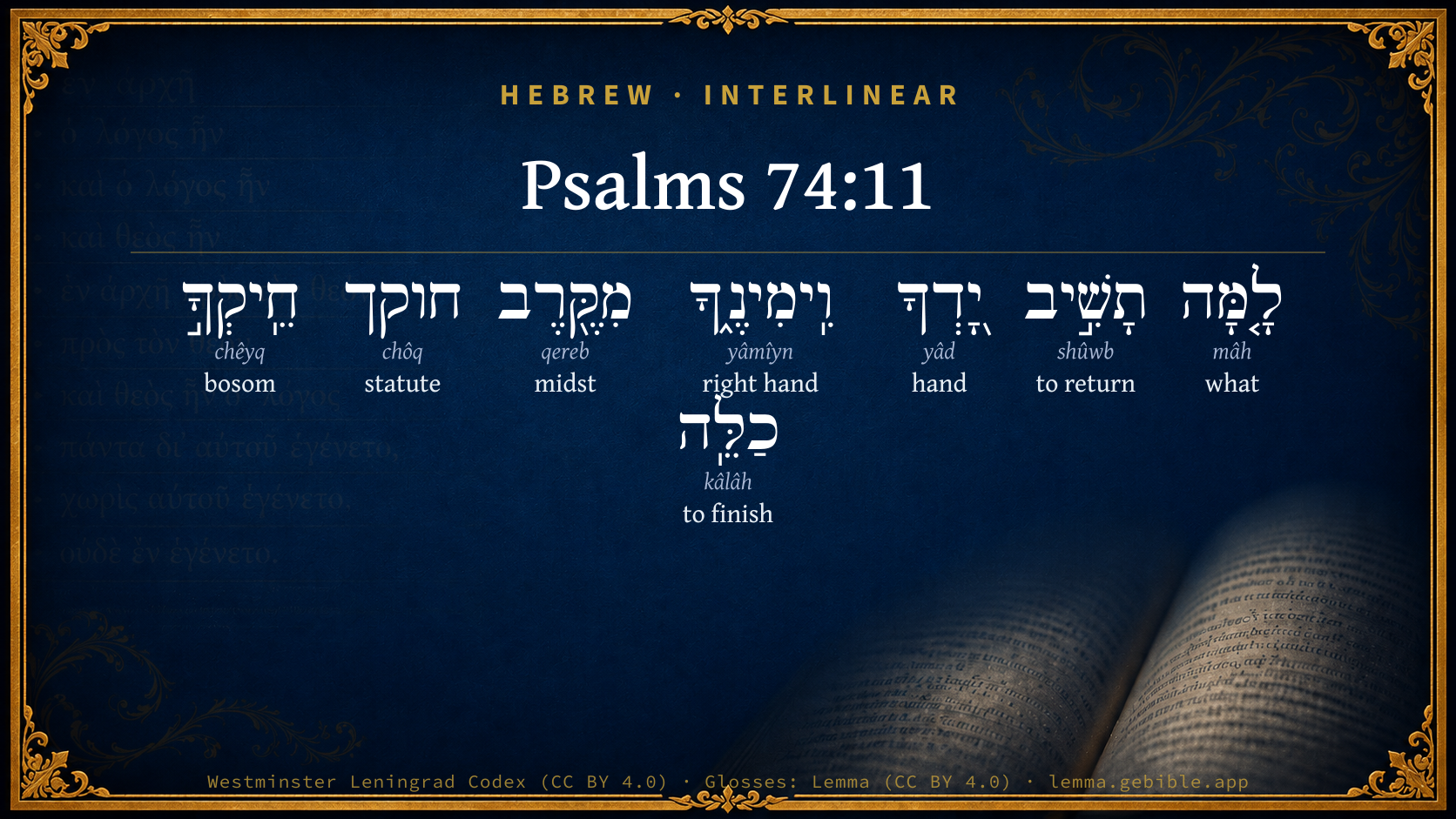
Psalms 74:11

Hebrew (Westminster Leningrad Codex) Psalms 74:11 appears in the Hebrew Old Testament. The text above is from the Westminster Leningrad Codex. Each word links to its Strong’s number, a concise gloss, and parsing drawn from the Open Scriptures Hebrew Bible morphology. Click any word for its full Brown-Driver-Briggs (BDB) entry.
Download image
Cite this verse

Psalms 74:11 (World English Bible). Public Domain. Lemma interlinear Bible study tool, https://lemma.gebible.app/v/psalms/74/11.

Show BibTeX & RIS
BibTeX
RIS
English Translation
Why do you draw back your hand, even your right hand? Take it out of your pocket and consume them!
World English Bible · Public Domain
Download a study sheet

One document with this verse’s original text, its word-by-word gloss line, the meaning frame, cross-references with their text, attributed commentary, and full source and license credits — printable, and it pastes into notes with its structure intact.

This verse Autodidact and up

Study sheet (.html) Plain text (.txt)

A passage Seminary Student

Up to 50 verses in one chapter. A passage sheet keeps up to 6 commentary sources and 12 cross-references per verse, in the order this page ranks them, and says so on the sheet whenever that leaves anything out. Ask for a single verse and you get the Autodidact verse sheet above.

Everything on this page stays free to read, with no account — the sheet is a download of what is already on screen, not access to it.

Want to remove ads? Support Godless Engineer
Compare translations 3

The same verse in 3 English versions, stacked beneath the original-language interlinear above. Click any original word for its lexicon entry.

Each is an independent rendering of the whole verse — the interlinear is not word-aligned to these translations.

Highlighted words mark where these versions differ — a whole-verse word diff, not a word-by-word alignment.

  • World English Bible Public Domain
    Why do you draw back your hand, even your right hand? Take it out of your pocket and consume them!
  • King James Version Public Domain
    Why withdrawest thou thy hand, even thy right hand? pluck it out of thy bosom.
  • unfoldingWord Literal Text CC BY-SA 4.0
    Why do you hold back your hand, even your right hand? From the midst of your bosom finish!

unfoldingWord Literal Text — © unfoldingWord, licensed CC BY-SA 4.0. Word-aligned USFM3 via Door43 (git.door43.org/unfoldingWord/en_ult).

Versions to compare (up to 4)

3 of 4 selected

Show all 18 translations

Every available English version of this verse, each an independent rendering of the whole verse.

  • World English Bible Public Domain
    Why do you draw back your hand, even your right hand? Take it out of your pocket and consume them!
  • Berean Standard Bible Public Domain
    Why do You withdraw Your strong right hand? Stretch it out to destroy them!
  • Majority Standard Bible Public Domain
    Why do You withdraw Your strong right hand? Stretch it out to destroy them!
  • King James Version Public Domain
    Why withdrawest thou thy hand, even thy right hand? pluck it out of thy bosom.
  • American Standard Version (1901) Public Domain
    Why drawest thou back thy hand, even thy right hand? `Pluck it' out of thy bosom `and' consume `them'.
  • Revised Version (1885) Public Domain
    Why drawest thou back thy hand, even thy right hand? pluck it out of thy bosom and consume them.
  • Geneva Bible (1599) Public Domain
    Why withdrawest thou thine hand, euen thy right hand? drawe it out of thy bosome, and consume them.
  • Douay-Rheims (1899) Public Domain
    Why dost thou turn away thy hand: and thy right hand out of the midst of thy bosom for ever?
  • Young's Literal Translation Public Domain
    Why dost Thou turn back Thy hand, Even Thy right hand? From the midst of Thy bosom remove `it'.
  • Literal Standard Version CC BY-SA 4.0
    Why do You turn back Your hand, || Even Your right hand? Remove [it] from the midst of Your bosom.
  • Unlocked Literal Bible CC BY-SA 4.0
    Why do you hold back your hand, your right hand? Take your right hand from your garment and destroy them.
  • unfoldingWord Literal Text CC BY-SA 4.0
    Why do you hold back your hand, even your right hand? From the midst of your bosom finish!
  • Darby Bible Public Domain
    Why withdrawest thou thy hand, and thy right hand? [pluck it] out of thy bosom: consume [them].
  • World Messianic Bible Public Domain
    Why do you draw back your hand, even your right hand? Take it from your chest and consume them!
  • Webster's Bible Public Domain
    Why withdrawest thou thy hand, even thy right hand? pluck it out of thy bosom.
  • Free Bible Version CC BY-SA 4.0
    Why do you hold back from doing something? Take action and destroy them!
  • Bible in Basic English Public Domain
    Why are you keeping back your hand, and covering your right hand in your robe?
  • JPS Tanakh (1917) Public Domain
    Why withdrawest Thou Thy hand, even Thy right hand? Draw it out of Thy bosom and consume them.

Literal Standard Version (2020), Covenant Press — licensed CC BY-SA 4.0. Text via the HelloAO Bible API (eBible.org). Unlocked Literal Bible (unfoldingWord) — licensed CC BY-SA 4.0. Text via the HelloAO Bible API (eBible.org). unfoldingWord Literal Text — © unfoldingWord, licensed CC BY-SA 4.0. Word-aligned USFM3 via Door43 (git.door43.org/unfoldingWord/en_ult). Free Bible Version, Dr. Jonathan Gallagher — licensed CC BY-SA 4.0. Text via the HelloAO Bible API (eBible.org).

Word by word

More ways to search: Search by grammar → Find every occurrence → Compare this word →

Practice this passage: Drill this verse → Learn its vocabulary →

חֵֽיקְךָ֣
chêyq
H2436
“bosom · your”
Noun, Common, Masculine, Singular, Construct + Suffix, Personal, 2nd Person, Masculine, Singular
Part of Speech
Noun
Type
Common
Gender
Masculine
Number
Singular
State
Construct
Full BDB Definition

Origin: from an unused root, apparently meaning to inclose

TWOT: 629a

bosom, hollow, bottom, midst
  1. לָ֤מָּה mâh H4100 “to/for · what” Preposition + Particle, Interrogative
  2. תָשִׁ֣יב shûwb H7725 “to return” Verb, Hiphil, Imperfect, 2nd Person, Masculine, Singular
  3. יָ֭דְךָ yâd H3027 “hand · your” Noun, Common, Both, Singular, Construct + Suffix, Personal, 2nd Person, Masculine, Singular
  4. וִֽימִינֶ֑ךָ yâmîyn H3225 “and · right hand · your” Conjunction + Noun, Common, Feminine, Singular, Construct + Suffix, Personal, 2nd Person, Masculine, Singular
  5. מִקֶּ֖רֶב qereb H7130 “from · midst of” Preposition + Noun, Common, Masculine, Singular, Construct
  6. חוקך chôq H2706 “statute · your” Noun, Common, Masculine, Singular, Construct + Suffix, Personal, 2nd Person, Masculine, Singular
  7. כַלֵּֽה kâlâh H3615 “finish” Verb, Piel, Imperative, 2nd Person, Masculine, Singular

About this verse

These counts appear in no published source. They are computed here, from the morphology-tagged text and Lemma’s own curated glosses. What Lemma adds →

8
words
8
distinct lemmas
Wisdom
section

Shared distinctive vocabulary

חֵֽיקְךָ֣ bosom H2436 occurs in 34 verses of the Hebrew Bible. Also found in:

Grammatical profile

  • 2 verbs
  • 5 nouns
  • 1 particle

Verb forms

  • תָשִׁ֣יב Hiphil · Imperfect
  • כַלֵּֽה Piel · Imperative

Hebrew & Septuagint length

In English translation the verse runs 20 words from the Hebrew and 18 from the Septuagint (LXX English) — closely comparable.

A rough comparison of the two English renderings, which tokenize alike — not a word-level alignment.

Word counts can differ between the Hebrew and the Greek without any difference in meaning — e.g. the Hebrew direct-object marker אֵת has no separate Greek word, and Greek often adds the article ὁ.

Cross-references

4

Topical passages linked to Psalms 74:11 in the Treasury of Scripture Knowledge — connected by theme and wording, ordered by reader-vote popularity; previews shown in the World English Bible.

  • Lamentations 2:3 He has cut off in fierce anger all the horn of Israel; He has drawn back his right hand from before the enemy: He has burned up Jacob like a flaming fire, which devours round about.
  • Psalms 78:65–66 Then the Lord awakened as one out of sleep, Like a mighty man who shouts by reason of wine.
  • Psalms 44:23 Wake up! Why do you sleep, Lord? Arise! Don't reject us forever.
  • Isaiah 64:12 Will you refrain yourself for these things, Yahweh? will you hold your peace, and afflict us very sore?

Cross-references courtesy of OpenBible.info (CC BY 4.0).

Hebrew and Greek witnesses Masoretic Hebrew ↔ Greek Septuagint

The same verse in the two great witnesses to the Old Testament, shown verse-for-verse.

You’re reading Greek Psalm 73 (Hebrew Psalm 74). The Septuagint counts the superscription, so verse numbers can differ from the Hebrew — chapter-level alignment, not verse-by-verse. Numbering follows Rahlfs.

These are two independent witnesses, not word-aligned to each other, and the Septuagint is shown in lemma (dictionary) form.

Hebrew Psalms 74:11 Masoretic · Westminster Leningrad Codex

לָ֤מָּה תָשִׁ֣יב יָ֭דְךָ וִֽימִינֶ֑ךָ מִקֶּ֖רֶב חוקך חֵֽיקְךָ֣ כַלֵּֽה

Why do you draw back your hand, even your right hand? Take it out of your pocket and consume them!

World English Bible · Public Domain

Greek LXX Greek Psalm 73:11 Septuagint · lemma form

ἵνα τίς ἀποστρέφω ὁ χείρ σύ καί ὁ δεξιός σύ ἐκ μέσος ὁ κόλπος σύ εἰς τέλος

Therefore turn you away your hand, and your right hand from the midst of your bosom for ever?

LXX2012 (modern English Septuagint) · Public Domain

Hebrew: Westminster Leningrad Codex (CC BY 4.0). Greek: Septuagint (public domain); English from LXX2012 (modern English Septuagint) (Public Domain). How the Septuagint differs from the Hebrew →

Commentary

Notes on Psalms 74:11 from classic Christian and Jewish commentators (each source and its license shown beneath its notes). The classic Christian expositions comment on the surrounding passage and are grouped to its opening verse, so a note may address several verses; the Jewish commentaries on the Tanakh (Rashi and others) are per-verse, so they appear only where the commentator wrote on this verse.

Lemma curates 59 commentaries, every one of them public domain or Creative Commons licensed, each selected and text-cleaned for this edition rather than reprinted as found. About our sources →

Trapp's Complete Commentary

John Trapp

Psa 74:11 Why withdrawest thou thy hand, even thy right hand? pluck [it] out of thy bosom.

Ver. 11. Why withdrawest thou thy hand] Some by hand understand the left hand, and so both hands are withdrawn, yea, held behind ( retrovertis), after the manner of those that have little to do, and less to care for.

Out of thy bosom] Another posture to the same purpose, Pro 19:24; Pro 26:15.

John Trapp, A Commentary or Exposition upon All the Books of the Old and New Testament (1647–1656) — public domain. Text from a community e-Sword module.

J. A. Alexander on Psalms

Joseph Addison Alexander

Psa 74:11. Why wilt thou withdraw thy hand and thy right hand From the midst of thy bosom (draw it and) consume (them). The future here includes the present (why dolt thou withdraw thy hand?) with the additional idea of continuance or perseverance in so doing. The hand, and especially the right hand, is the seat and symbol of strength. The and between them is equivalent to the English even. To make the hand return, or draw it back, is to cease from action, the continuance of which cessation is described as hiding it in the bosom.

Joseph Addison Alexander, The Psalms Translated and Explained (1850) — public domain. Text from a community e-Sword module.

Geneva Bible (1599)

Geneva Bible translators

They join their deliverance with God’s glory and power, knowing that the punishment of the enemy should be their deliverance.

Geneva Bible (1599) marginal notes — public domain. Text via Bolls.life.

Adam Clarke's Commentary

Verse 11. Why withdrawest thou thy hand] It has been remarked, that as the outward habit of the easterns had no sleeves, the hands and arms were frequently covered with the folds of the robe; and in order to do any thing, the hand must be disentangled and drawn out. The literal version of the Hebrew is: "To what time wilt thou draw back thy hand; yea, thy right hand, from within thy bosom?" Consume; that is, manifest thy power, and destroy thy adversaries. I have, in the introduction to the book of Psalms, spoken of the old metrical version by Sternhold and Hopkins, and have stated that it was formed from the original text. A proof of this may be seen by the learned reader in this and the preceding verse; where, though their version is harsh, and some of their expressions quaint almost to ridicule, yet they have hit the true meaning which our prose translators have missed: -

Ver. 10. When wilt thou once, Lord, end this shame,

And cease thine en'mies strong?

Shall they always blaspheme thy name,

And rail on thee so long?

Ver. 11. Why dost thou draw thy hand aback,

And hide it in thy lap?

O pluck it out, and be not slack

To give thy foes a rap!

Adam Clarke's Commentary on the Bible (1810–1826) — public domain. Text from a community e-Sword/MySword module.

John Calvin's Commentaries

11. How long wilt thou withdraw thy hand? It is easy to see what the prophet here intends, and yet interpreters are not agreed as to the words. Some by the word hand, in the first part of the verse, understand the left hand, to distinguish it from the right hand, mentioned in the last clause of the verse. But this is mere trifling; for when he uses the term right hand, he simply repeats the same thing according to his usual manner. Some translate the verb כלה, kalah, the last word of the verse, by hinder or restrain, as if the prophet had said, Do thou at length stretch forth thy hand, which has been kept too long in thy bosom. But this is a forced sense, to which they have recourse without any color of reason. Those who translate it consume understand the midst of God’s bosom, as denoting allegorically his temple, an interpretation of which I cannot approve. It will be better to continue the interrogation to the last word in this way: “How long wilt thou withdraw thy hand? Yea, wilt thou withdraw it from the midst of thy bosom? Consume, therefore, these ungodly men who so proudly despise thee.” We may also not improperly view the words as a prayer that as God’s enemies persuaded themselves that he was slothful and idle, because he did not bestir himself, nor openly lift up his hand; he would cause them to feel that he was perfectly able to destroy them with his nod alone, although he should not move so much as a finger.

John Calvin's Commentaries (1540-1563) — public domain. Text from the Calvin Translation Society English edition (1840s-50s) via the Christian Classics Ethereal Library (ccel.org). Calvin's coverage is partial (roughly two-thirds of the Bible); uncommented books and verses are honest gaps, never fabricated. The 19th-century editor's footnotes and remarks are omitted so the notes are faithfully Calvin's own voice.

Ellicott's Commentary for English Readers

(11) Why withdrawest thou.—Literally, returnest, i.e., into the ample folds of the Eastern robe. The poet is thinking of Exo_4:7.

Pluck it out of thy bosom.—Literally, out of the midst of thy bosom consume. For the same absolute use of this verb comp. Psa_59:13. The clause is an instance of pregnant construction (comp. Psa_74:7), and is plainly equivalent to, Why dost thou not pluck out thy right hand to consume?

A Bible Commentary for English Readers, edited by Charles John Ellicott (1878–1897) — public domain. Text from a community e-Sword module.

The Cambridge Bible for Schools and Colleges

gen. ed. J. J. S. Perowne

11. Why drawest thou back thy hand, even thy right hand?

(Pluck it) out of thy bosom (and) consume (them).

The right hand which in days of old was stretched out to annihilate the Egyptians (Exo_15:12), is now as it were thrust idly into the folded garment. Cp. Lam_2:3.

The Cambridge Bible for Schools and Colleges (gen. ed. J. J. S. Perowne; Cambridge University Press, 1878–1918) — public domain. Text from a community e-Sword module.

John Gill's Exposition

For God is my King of old,.... Or "but God", or "verily God", &c. (d); for these words contain the church's consolation under all the above melancholy circumstances, taken from what God was, and had been to her, even Christ, who is God over all; he was her King by the constitution and designation of his Father, and so he had been of old, even from everlasting; for so early was he set up as King; and he had in all ages been exercising his kingly office for the good of his church, and continued to do so; and this was her comfort, and is the comfort of saints in the worst of times, that Zion's King reigneth, see Psa 46:1.

working salvation in the midst of the earth; it is "salvations" (e) in the plural number, and means both spiritual and eternal salvation, which the Lord has wrought out; and is continually applying to his people; and temporal salvation, which the Lord has been and is daily working out; he continually protecting his people, and saving them from their enemies, and delivering them out of their afflictions and temptations; and which the church considers and improves into an argument to encourage her faith, and expect the time when her walls would be salvation, and her gates praise; and she should have reason to say, now is come salvation and strength, and the kingdom of our God and the power of his Christ; and give him all the glory of it; see Isa 60:18, which salvation, as it has been, so will be wrought

in the midst of the earth; meaning not in the midst of the land of Judea, or in Judea, the middle of the world, but openly and publicly in all the earth; though Cyril of Jerusalem says (f) Golgotha is the midst of the earth, where Christ suffered and wrought out salvation; and that it is here referred to.

(d) "atqui Deus", Junius & Tremellius, Piscator; "at Deus" Vatablus, Cocceius; "equidem", Tigurine version; "certe", Schmidt. (e) "salutes", Pagninus, Montanus, Tigurine version, Cocceius, Gejerus. (f) Cateches. 13. sect. 13. p. 180. Vid. Amamae Antibarb. Bibl. l. 3. p. 798, &c.

John Gill's Exposition of the Whole Bible (1746–1763) — public domain (CC PDM 1.0). Text via the HelloAO Bible API.

Albert Barnes' Notes on the Bible

Why withdrawest thou thy hand, even thy right hand? - Why dost thou not stretch forth thy hand for our deliverance? The hand, especially the right hand, is the instrument by which we wield a sword, or strike a blow; and the expression here is equivalent to asking why God did not interfere and save them.

Pluck it out of thy bosom - As if God had hidden his hand beneath the folds of his garment, or had wrapped his robe tightly around him. It “seemed” as if he had done this, as if he looked calmly on, and saw the temple fired, the synagogues burned up, the land laid waste, and the people slaughtered, without an attempt to interpose. How often are we constrained to use similar language - to ask a similar question - when iniquity abounds, when crime prevails, when sinners are perishing, when the church mourns - for God seems to have withdrawn his hand, and to be looking on with unconcern! No one can tell why this is so; and, without irreverence, or a spirit of complaining, but deeply affected with the mystery of the fact, we may ask “Why” this is so.

Albert Barnes' Notes on the Bible (1834–1885) — public domain. Text from a community e-Sword/MySword module.

Matthew Poole's English Annotations

Why withdrawest thou thy hand? why dost thou suspend or forbear the exercise of that power, which thou hast so oft put forth on the behalf of thy people?

Pluck it out of thy bosom, in which thou now seemest to hide it, as idle persons use to do, Pro 19:24; 26:15. Bestir thyself on the behalf of thy people.

Matthew Poole's English Annotations on the Holy Bible (1683–1685) — public domain. Text from a community e-Sword/MySword module.

The Treasury of David

Charles H. Spurgeon

Ver. 11. Why withdrawest thou thy hand, even thy right hand? Wherefore this inaction, this indifference for thine own honour and thy people's safety? How bold is the suppliant! Does he err? Nay, verily, we who are so chill, and distant, and listless in prayer are the erring ones. The kingdom of heaven suffereth violence, and he who learns the art shall surely prevail with God by its means. It is fit that we should enquire why the work of grace goes on so slowly, and the enemy has so much power over men: the inquiry may suggest practical reflections of unbounded value.

"Why dost thou from the conflict stay?

Why do thy chariot wheels delay?

Lift up thyself, hell's kingdom shake,

Arm of the Lord, awake, awake."

Pluck it out of thy bosom. A bold simile, but dying men must venture for their lives. When God seems to fold his arms we must not fold ours, but rather renew our entreaties that he would again put his hand to the work. O for more agony in prayer among professing Christians, then should we see miracles of grace. We have here before us a model of pleading, a very rapture of prayer. It is humble, but very bold, eager, fervent, and effectual. The heart of God is always moved by such entreaties. When we bring forth out strong reasons, then will he bring forth his choice mercies.

None.

Ver. 11.

I. The patience of God with man: He `withdraws his hand,

even, 'etc., he hesitates to strike.

II. The impatience of man with God: "pluck it, "etc. G. R.

Psalms 74:12*

Charles H. Spurgeon's The Treasury of David (1869–1885) — public domain. Psalms only. Text from a community e-Sword/MySword module.

Whedon's Commentary on the Bible

Daniel D. Whedon

11. Pluck it out of thy bosom—With the orientals the hand in the bosom indicates a state of rest, inaction. “In the folds of the garment, in front of the body, they keep their little valuables, (see Psa_79:12, and note,) and there, when they are perfectly at ease, they place their hands.”— Roberts.

Daniel D. Whedon (gen. ed.), Commentary on the Old and New Testaments (1874–1909) — public domain. Text from a community e-Sword module.

The Pulpit Commentary

Why withdrawest thou thy hand, even thy right hand? Why dost thou keep back the right hand of thy power, hiding it in thy besom? Why not show forth thy power, and consume them, as it were, in a moment? (See the next clause.) Pluck it out of thy bosom; rather, out with it frown thy bosom, and consume them. The psalmist sees no reason why the Babylonians should not be consumed, and Israel delivered, at once. He has an insufficient sense of the greatness of Israel"s sin.

The Pulpit Commentary (1880–1919), ed. H.D.M. Spence-Jones & Joseph S. Exell — public domain. Text from a community e-Sword module.

John Wesley's Explanatory Notes

Why - Why dost thou forebear the exercise of thy power? Bosom - In which thou now seemest to hide it.

John Wesley, Explanatory Notes Upon the Whole Bible (1754–1765) — public domain. Text via the GEBible commentary corpus.

Rashi

Rabbi Shlomo Yitzchaki (Rashi)

Draw it out from within Your bosom Cast it and draw it out from within Your bosom and wage battle with Your enemies. כַּלֵה is an expression of driving out, as (Exod. 11:1): “he will drive you out completely (כלה).”

Rashi on the Tanakh — English translations: “The Judaica Press complete Tanach with Rashi, translated by A. J. Rosenberg” (CC BY 4.0); “Pentateuch with Rashi's commentary by M. Rosenbaum and A.M. Silbermann, 1929-1934” (public domain); “The Metsudah Tanach series, Lakewood, N.J” (CC BY 4.0); and “The Book of Joshua, Metsudah Publications, 1997” (CC BY 4.0). Text via Sefaria.

Lesson kit

Teaching starters — assembled from the data on this page, not authored interpretation. Every prompt links to the verse data it draws on. Edit before teaching.

Psalms, in the Wisdom, opens this verse with 8 words (8 distinct Hebrew lemmas). Its most distinctive word is chêyq (“bosom”). A historical commentator’s framing appears above. Read the whole chapter for the surrounding context.

Discussion questions

  1. How does “bosom” (chêyq) shape what this verse is saying?
  2. How does Genesis 16:5, which shares the word «bosom», read alongside this verse?
  3. These translations render this verse differently. What is at stake in choosing one wording over another?
  4. «תָשִׁ֣יב» is a Hiphil Imperfect verb. How does that grammatical form shape the action described?
  5. Compare how Trapp's Complete Commentary and J. A. Alexander on Psalms read this verse. Where do they agree or differ?

Things to notice

Reading settings

Reading text

Shown beneath each verse's original-language words.

Old Testament
Old Testament edition

Read the OT as the Masoretic Hebrew (MT) or the Greek Septuagint (LXX).

English shown for the Greek Septuagint (in the Hebrew ↔ Greek comparison).

Comparing translations? Open the Compare panel on any verse page to stack up to four side by side.