Jeremiah 2:5

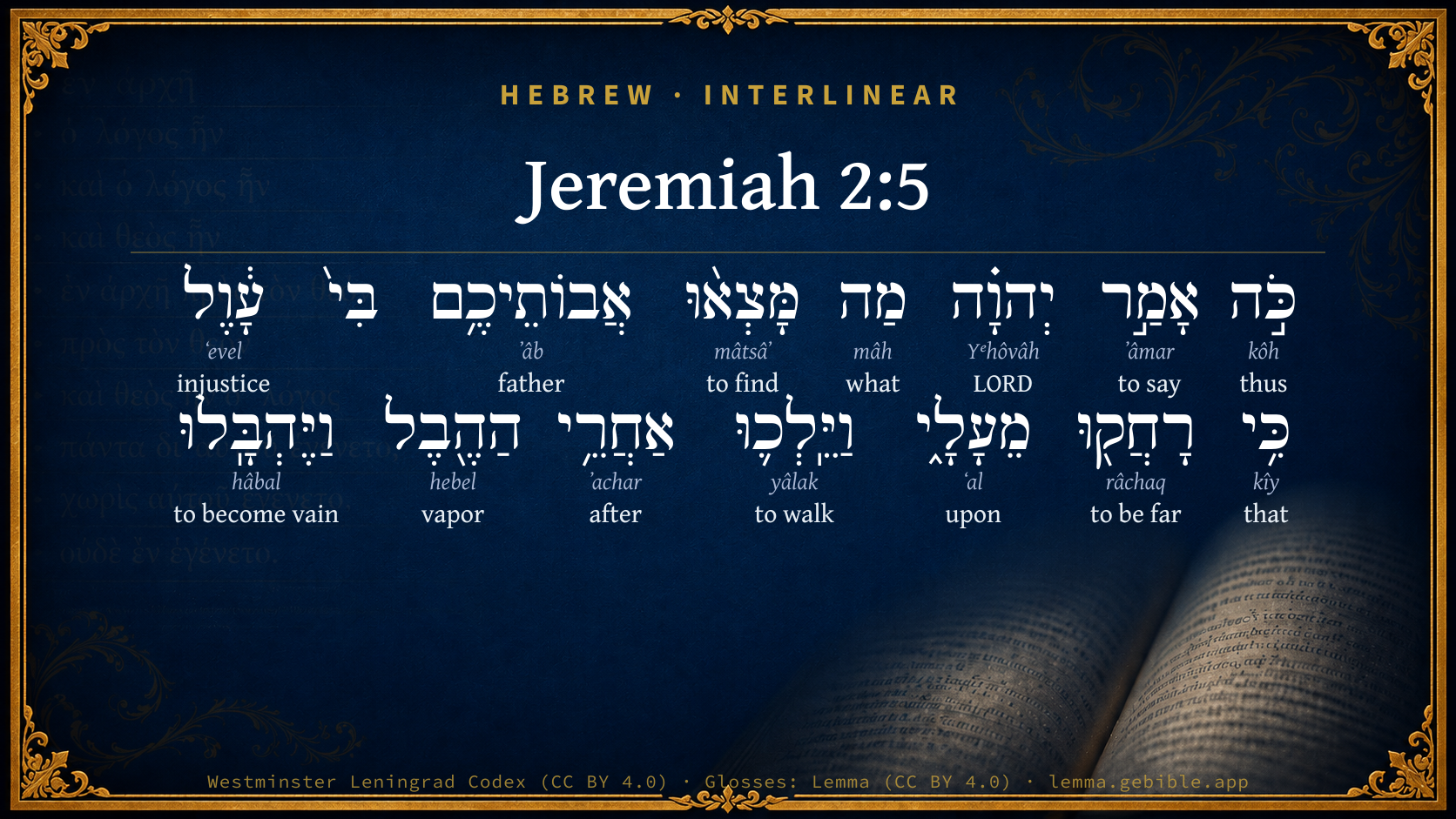
Hebrew (Westminster Leningrad Codex) Jeremiah 2:5 appears in the Hebrew Old Testament. The text above is from the Westminster Leningrad Codex. Each word links to its Strong’s number, a concise gloss, and parsing drawn from the Open Scriptures Hebrew Bible morphology. Click any word for its full Brown-Driver-Briggs (BDB) entry.
Download image
Cite this verse

Jeremiah 2:5 (World English Bible). Public Domain. Lemma interlinear Bible study tool, https://lemma.gebible.app/v/jeremiah/2/5.

Show BibTeX & RIS
BibTeX
RIS
English Translation
thus says Yahweh, What unrighteousness have your fathers found in me, that they have gone far from me, and have walked after vanity, and are become vain?
World English Bible · Public Domain
Download a study sheet

One document with this verse’s original text, its word-by-word gloss line, the meaning frame, cross-references with their text, attributed commentary, and full source and license credits — printable, and it pastes into notes with its structure intact.

This verse Autodidact and up

Study sheet (.html) Plain text (.txt)

A passage Seminary Student

Up to 50 verses in one chapter. A passage sheet keeps up to 6 commentary sources and 12 cross-references per verse, in the order this page ranks them, and says so on the sheet whenever that leaves anything out. Ask for a single verse and you get the Autodidact verse sheet above.

Everything on this page stays free to read, with no account — the sheet is a download of what is already on screen, not access to it.

Want to remove ads? Support Godless Engineer
Compare translations 3

The same verse in 3 English versions, stacked beneath the original-language interlinear above. Click any original word for its lexicon entry.

Each is an independent rendering of the whole verse — the interlinear is not word-aligned to these translations.

Highlighted words mark where these versions differ — a whole-verse word diff, not a word-by-word alignment.

  • World English Bible Public Domain
    thus says Yahweh, What unrighteousness have your fathers found in me, that they have gone far from me, and have walked after vanity, and are become vain?
  • King James Version Public Domain
    Thus saith the LORD, What iniquity have your fathers found in me, that they are gone far from me, and have walked after vanity, and are become vain?
  • unfoldingWord Literal Text CC BY-SA 4.0
    Thus says Yahweh, “What did your fathers find wrong in me, that they went far away from upon me, and they went after the empty, and became empty?

unfoldingWord Literal Text — © unfoldingWord, licensed CC BY-SA 4.0. Word-aligned USFM3 via Door43 (git.door43.org/unfoldingWord/en_ult).

Versions to compare (up to 4)

3 of 4 selected

Show all 18 translations

Every available English version of this verse, each an independent rendering of the whole verse.

  • World English Bible Public Domain
    thus says Yahweh, What unrighteousness have your fathers found in me, that they have gone far from me, and have walked after vanity, and are become vain?
  • Berean Standard Bible Public Domain
    This is what the LORD says: “What fault did your fathers find in Me that they strayed so far from Me, and followed worthless idols, and became worthless themselves?
  • Majority Standard Bible Public Domain
    This is what the LORD says: “What fault did your fathers find in Me that they strayed so far from Me? They followed worthless idols, and became worthless themselves.
  • King James Version Public Domain
    Thus saith the LORD, What iniquity have your fathers found in me, that they are gone far from me, and have walked after vanity, and are become vain?
  • American Standard Version (1901) Public Domain
    thus saith Jehovah, What unrighteousness have your fathers found in me, that they are gone far from me, and have walked after vanity, and are become vain?
  • Revised Version (1885) Public Domain
    thus saith the LORD, What unrighteousness have your fathers found in me, that they are gone far from me, and have walked after vanity, and are become vain?
  • Geneva Bible (1599) Public Domain
    Thus sayeth the Lord, What iniquitie haue your fathers founde in mee, that they are gone farre from mee, and haue walked after vanitie, and are become vaine?
  • Douay-Rheims (1899) Public Domain
    Thus saith the Lord: What iniquity have your fathers found in me, that they are gone far from me, and have walked after vanity, and are become vain?
  • Young's Literal Translation Public Domain
    Thus said Jehovah: What -- have your fathers found in Me perversity, That they have gone far off from Me, And go after the vanity, and become vain,
  • Literal Standard Version CC BY-SA 4.0
    Thus said YHWH: “What perversity have your fathers found in Me, || That they have gone far off from Me, || And go after vanity, and become vain,
  • Unlocked Literal Bible CC BY-SA 4.0
    Yahweh says this, “What did your fathers find wrong with me, that they went far from following me? That they went after useless idols and became useless themselves?
  • unfoldingWord Literal Text CC BY-SA 4.0
    Thus says Yahweh, “What did your fathers find wrong in me, that they went far away from upon me, and they went after the empty, and became empty?
  • Darby Bible Public Domain
    Thus saith Jehovah: What injustice have your fathers found in me, that they are gone far from me, and have walked after vanity, and become vain?
  • World Messianic Bible Public Domain
    The LORD says, “What unrighteousness have your fathers found in me, that they have gone far from me, and have walked after worthless vanity, and have become worthless?
  • Webster's Bible Public Domain
    Thus saith the LORD, What iniquity have your fathers found in me, that they have gone far from me, and have walked after vanity, and have become vain?
  • Free Bible Version CC BY-SA 4.0
    This is what the Lord says: What did your forefathers think was wrong with me that they went so far away from me? They went off to worship useless idols, and as a result became useless themselves!
  • Bible in Basic English Public Domain
    These are the words of the Lord: What evil have your fathers seen in me that they have gone far from me, and, walking after what is false, have become false?
  • JPS Tanakh (1917) Public Domain
    Thus saith the LORD: What unrighteousness have your fathers found in Me, that they are gone far from Me, and have walked after things of nought, and are become nought?

Literal Standard Version (2020), Covenant Press — licensed CC BY-SA 4.0. Text via the HelloAO Bible API (eBible.org). Unlocked Literal Bible (unfoldingWord) — licensed CC BY-SA 4.0. Text via the HelloAO Bible API (eBible.org). unfoldingWord Literal Text — © unfoldingWord, licensed CC BY-SA 4.0. Word-aligned USFM3 via Door43 (git.door43.org/unfoldingWord/en_ult). Free Bible Version, Dr. Jonathan Gallagher — licensed CC BY-SA 4.0. Text via the HelloAO Bible API (eBible.org).

Word by word

More ways to search: Search by grammar → Find every occurrence → Compare this word →

Practice this passage: Drill this verse → Learn its vocabulary →

וַיֶּהְבָּֽלוּ
hâbal
H1891
“and · to become vain”
Conjunction + Verb, Qal, Sequential Imperfect, 3rd Person, Masculine, Plural
Part of Speech
Conjunction + Verb
Stem
Qal
Form
Sequential Imperfect
Person
3rd Person
Gender
Masculine
Number
Plural
Full BDB Definition

Origin: a primitive root

TWOT: 463

to act emptily, become vain, be vain - (Qal) - to become vain - to be utterly vain (with cognate acc) - (Hiphil) - to cause to become vain - to fill with vain hopes
  1. כֹּ֣ה kôh H3541 “thus” Adverb
  2. אָמַ֣ר ʼâmar H559 “to say” Verb, Qal, Perfect, 3rd Person, Masculine, Singular
  3. יְהוָ֗ה Yᵉhôvâh H3068 “LORD” Noun, Proper
  4. מַה mâh H4100 “what” Particle, Interrogative
  5. מָּצְא֨וּ mâtsâʼ H4672 “to find” Verb, Qal, Perfect, 3rd Person, Common, Plural
  6. אֲבוֹתֵיכֶ֥ם ʼâb H1 “fathers · your” Noun, Common, Masculine, Plural, Construct + Suffix, Personal, 2nd Person, Masculine, Plural
  7. עָ֔וֶל ʻevel H5766 “injustice” Noun, Common, Both, Singular, Absolute
  8. כִּ֥י kîy H3588 “that” Conjunction
  9. רָחֲק֖וּ râchaq H7368 “to be far” Verb, Qal, Perfect, 3rd Person, Common, Plural
  10. מֵעָלָ֑י ʻal H5921 “from · upon · me” Preposition + Preposition + Suffix, Personal, 1st Person, Common, Singular
  11. וַיֵּֽלְכ֛וּ yâlak H3212 “and · to walk” Conjunction + Verb, Qal, Sequential Imperfect, 3rd Person, Masculine, Plural
  12. אַחֲרֵ֥י ʼachar H310 “after” Preposition
  13. הַהֶ֖בֶל hebel H1892 “the · vapor” Particle, Definite Article + Noun, Common, Masculine, Singular, Absolute

About this verse

These counts appear in no published source. They are computed here, from the morphology-tagged text and Lemma’s own curated glosses. What Lemma adds →

15
words
14
distinct lemmas
Prophets
section

Notable vocabulary

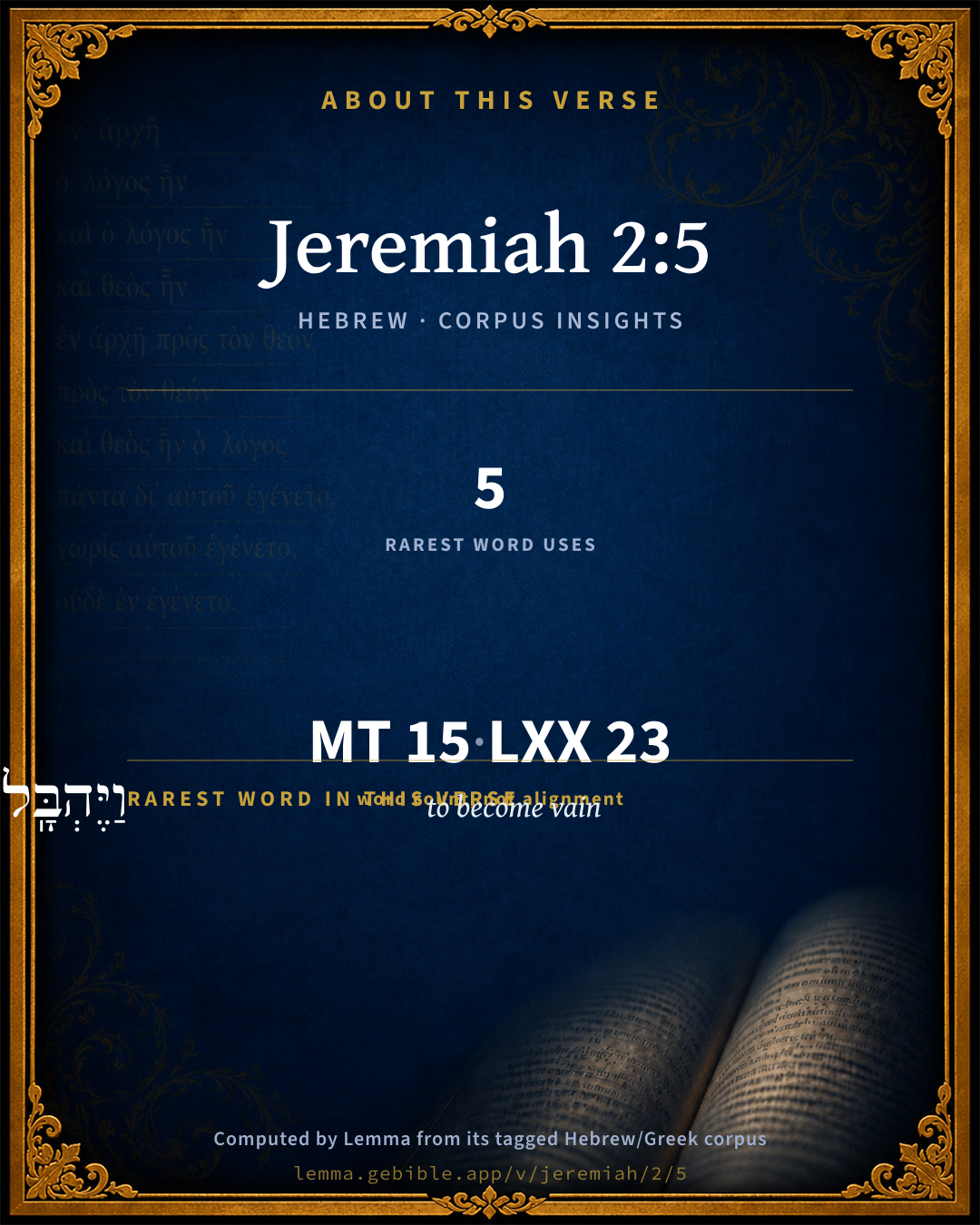
The rarest word here is וַיֶּהְבָּֽלוּ to become vain H1891 — appearing just 5 times in the whole Hebrew Bible.

Shared distinctive vocabulary

וַיֶּהְבָּֽלוּ to become vain H1891 occurs in 5 verses of the Hebrew Bible. Also found in:

Grammatical profile

  • 5 verbs
  • 4 nouns
  • 3 prepositions
  • 1 conjunction
  • 1 adverb
  • 1 particle

Verb forms

  • אָמַ֣ר Qal · Perfect
  • מָּצְא֨וּ Qal · Perfect
  • רָחֲק֖וּ Qal · Perfect
  • וַיֵּֽלְכ֛וּ Qal · Sequential Imperfect
  • וַיֶּהְבָּֽלוּ Qal · Sequential Imperfect

Hebrew & Septuagint length

In the original languages it is 15 Hebrew tokens and 23 Greek tokens — but the two are counted differently (Hebrew bundles its prefixes and suffixes into one token; the Greek is in lemma form), so that isn’t a like-for-like length.

Cross-references

20

Topical passages linked to Jeremiah 2:5 in the Treasury of Scripture Knowledge — connected by theme and wording, ordered by reader-vote popularity; previews shown in the World English Bible.

  • 2 Kings 17:15 They rejected his statutes, and his covenant that he made with their fathers, and his testimonies which he testified to them; and they followed vanity, and became vain, and [went] after the nations that were round about them, concerning whom Yahweh had charged those who they should not do like them.
  • Romans 1:21 Because, knowing God, they didn't glorify him as God, neither gave thanks, but became vain in their reasoning, and their senseless heart was darkened.
  • Psalms 115:8 Those who make them will be like them; Yes, everyone who trusts in them.
  • Jeremiah 10:14–15 Every man is become brutish [and is] without knowledge; every goldsmith is disappointed by his engraved image; for his molten image is falsehood, and there is no breath in them.
  • Jonah 2:8 Those who regard lying vanities forsake their own mercy.
  • Deuteronomy 32:21 They have moved me to jealousy with that which is not God; They have provoked me to anger with their vanities: I will move them to jealousy with those who are not a people; I will provoke them to anger with a foolish nation.
  • 1 Samuel 12:21 and don't turn aside; for [then would you go] after vain things which can't profit nor deliver, for they are vain.
  • Isaiah 44:9 Those who fashion an engraved image are all of them vanity; and the things that they delight in shall not profit; and their own witnesses don't see, nor know: that they may be disappointed.
  • Jeremiah 51:17–18 Every man is become brutish [and is] without knowledge; every goldsmith is disappointed by his image; for his molten image is falsehood, and there is no breath in them.
  • Acts 14:15 "Men, why are you doing these things? We also are men of like passions with you, and bring you good news, that you should turn from these vain things to the living God, who made the sky and the earth and the sea, and all that is in them;
  • Isaiah 5:3–4 "Now, inhabitants of Jerusalem and men of Judah, Please judge between me and my vineyard.
  • Jeremiah 2:31 Generation, see the word of Yahweh. Have I been a wilderness to Israel? or a land of thick darkness? why say my people, We are broken loose; we will come no more to you?
  • Micah 6:2–3 Hear, you mountains, Yahweh's controversy, And you enduring foundations of the earth; For Yahweh has a controversy with his people, And he will contend with Israel.
  • Isaiah 29:13 The Lord said, Because this people draw near [to me], and with their mouth and with their lips to honor me, but have removed their heart far from me, and their fear of me is a commandment of men which has been taught [them];
  • Isaiah 43:22–23 Yet you have not called on me, Jacob; but you have been weary of me, Israel.
  • Jeremiah 10:8 But they are together brutish and foolish: the instruction of idols! it is but a stock.
  • Jeremiah 12:2 You have planted them, yes, they have taken root; they grow, yes, they bring forth fruit: you are near in their mouth, and far from their heart.
  • Jeremiah 14:22 Are there any among the vanities of the nations that can cause rain? or can the sky give showers? Aren't you he, Yahweh our God? therefore we will wait for you; for you have made all these things.
  • Ezekiel 11:15 Son of man, your brothers, even your brothers, the men of your relatives, and all the house of Israel, all of them, [are they] to whom the inhabitants of Jerusalem have said, Get you far from Yahweh; to us is this land given for a possession.
  • Matthew 15:8 'These people draw near to me with their mouth, And honor me with their lips; But their heart is far from me.

Cross-references courtesy of OpenBible.info (CC BY 4.0).

Hebrew and Greek witnesses Masoretic Hebrew ↔ Greek Septuagint

The same verse in the two great witnesses to the Old Testament, shown verse-for-verse.

These are two independent witnesses, not word-aligned to each other, and the Septuagint is shown in lemma (dictionary) form.

Hebrew Jeremiah 2:5 Masoretic · Westminster Leningrad Codex

כֹּ֣ה אָמַ֣ר יְהוָ֗ה מַה מָּצְא֨וּ אֲבוֹתֵיכֶ֥ם בִּי֙ עָ֔וֶל כִּ֥י רָחֲק֖וּ מֵעָלָ֑י וַיֵּֽלְכ֛וּ אַחֲרֵ֥י הַהֶ֖בֶל וַיֶּהְבָּֽלוּ

thus says Yahweh, What unrighteousness have your fathers found in me, that they have gone far from me, and have walked after vanity, and are become vain?

World English Bible · Public Domain

Greek LXX Structure differs

In the Septuagint, Jeremiah is about an eighth shorter than the Hebrew and arranges its material differently — the Oracles Against the Nations (Hebrew chapters 46–51) appear in the middle of the Greek book, after 25:13. Because the chapter and verse boundaries do not line up, a verse-for-verse comparison with the Hebrew is not shown.

A verse-for-verse comparison isn’t shown here because the chapters and verses don’t line up. Switch to the LXX edition with the MT / LXX toggle above to read the Greek directly.

On this verse, The Pulpit Commentary discusses the Septuagint’s reading. Read the note in Commentary ↓

Hebrew: Westminster Leningrad Codex (CC BY 4.0). Greek: Septuagint (public domain); English from a public-domain English Septuagint. How the Septuagint differs from the Hebrew →

Targum (Aramaic paraphrase)

1

The Targum is the ancient Jewish Aramaic paraphrase of the Hebrew Scriptures — an interpretive translation, not the Hebrew text itself. Onkelos (literal) and Pseudo-Jonathan (expansive) render the Torah, and Jonathan the Prophets. Coverage is partial: where no permissively-licensed English translation exists for a verse, only the Aramaic is shown. This is verse-level text, not a word-by-word alignment to the Hebrew.

  1. Targum Jonathan Prophets (Joshua–Malachi)
    כִּדְנַן אֲמַר יְיָ מַה אַשְׁכָּחוּ אֲבָהַתְכוֹן בְּמֵימְרִי שְׁקַר אֲרֵי אִתְרְחָקוּ מִדְחַלְתִּי וּטְעוֹ בָּתַר טַעֲוָתָא וַהֲווֹ לִלְמָא:

    (no public-domain English translation for this verse)

    Targum Jonathan — Aramaic: “Mikraot Gedolot” (public domain). English: “Sefaria Community Translation” (CC0 1.0 (public-domain dedication)); “London "Chaldee Paraphrase," 1871” (public domain). Text via Sefaria.

Commentary

Notes on Jeremiah 2:5 from classic Christian and Jewish commentators (each source and its license shown beneath its notes). The classic Christian expositions comment on the surrounding passage and are grouped to its opening verse, so a note may address several verses; the Jewish commentaries on the Tanakh (Rashi and others) are per-verse, so they appear only where the commentator wrote on this verse.

Lemma curates 59 commentaries, every one of them public domain or Creative Commons licensed, each selected and text-cleaned for this edition rather than reprinted as found. About our sources →

Trapp's Complete Commentary

John Trapp

Jer 2:5 Thus saith the LORD, What iniquity have your fathers found in me, that they are gone far from me, and have walked after vanity, and are become vain?

Ver. 5. What iniquity have your fathers found in me?] How unreasonable was their apostasy! and how senseless is your pleading from their example! Nothing is more irrational than irreligion.

That they are gone far from me.] Are ye weary of receiving so many benefits by one man? said Themistocles to his ungrateful countrymen.

And have walked after vanity.] An idol is nothing at all, but only in the vain opinion of the idolater.

And are become vain,] scil., " In their imaginations"; {Rom 1:21} as vain as their very idols. {Psa 115:8}

John Trapp, A Commentary or Exposition upon All the Books of the Old and New Testament (1647–1656) — public domain. Text from a community e-Sword module.

Tyndale Open Study Notes

Tyndale Open Resources

2:5 The Israelites worshiped worthless idols, so their lives were ruled by delusions.

Tyndale Open Study Notes — © Tyndale Open Resources, licensed CC BY-SA 4.0. Text via the HelloAO Bible API.

Geneva Bible (1599)

Geneva Bible translators

Altogether given to vanity, and are become blind and insensible as the idols that they serve.

That is, fallen to most vile idolatry.

Geneva Bible (1599) marginal notes — public domain. Text via Bolls.life.

Jamieson, Fausset & Brown

Robert Jamieson, A. R. Fausset & David Brown

iniquity--wrong done to them (Isa 5:4; Mic 6:3; compare Deu 32:4).

walked after vanity--contrasted with "walkest after me in the wilderness" (Jer 2:2): then I was their guide in the barren desert; now they take idols as their guides.

vanity . . . vain--An idol is not only vain (impotent and empty), but vanity itself. Its worshippers acquire its character, becoming vain as it is (Deu 7:26; Psa 115:8). A people's character never rises above that of its gods, which are its "better nature" [BACON] (Kg2 17:15; Jon 2:8).

Jamieson, Fausset & Brown — Commentary Critical and Explanatory on the Whole Bible (1871) — public domain (CC PDM 1.0). Text via the HelloAO Bible API.

Adam Clarke's Commentary

Verse 5. What iniquity have your fathers found in me] Have they ever discovered any thing cruel, unjust, oppressive in my laws? Any thing unkind or tyrannical in my government? Why then have they become idolaters?

Adam Clarke's Commentary on the Bible (1810–1826) — public domain. Text from a community e-Sword/MySword module.

John Calvin's Commentaries

Then follows the charge: What, iniquity have your fathers found in me, that having forsaken me they should walk after vanity and become vain? Here Jeremiah charges the people with two crimes, — that they had departed from the true God, whom they had found to be a deliverer, — and that they had become vain in their devices; or, in other words, that they were become for no reason apostates: for their sin was enhanced, because there had been no occasion given them to forsake God, and to alienate themselves from him. As then God had kindly treated them, and they themselves had shaken off the yoke, and as there was no one whom they could compare with God, they could not have said, “We have been deceived,” — how so? “For ye have, he says, followed vanity; and vanity alone was the reason why ye have departed from me.” I wish I could proceed farther; but I have some business to which I was called even before the lecture.

John Calvin's Commentaries (1540-1563) — public domain. Text from the Calvin Translation Society English edition (1840s-50s) via the Christian Classics Ethereal Library (ccel.org). Calvin's coverage is partial (roughly two-thirds of the Bible); uncommented books and verses are honest gaps, never fabricated. The 19th-century editor's footnotes and remarks are omitted so the notes are faithfully Calvin's own voice.

Ellicott's Commentary for English Readers

(5) Vanity.—In the special sense, as a synonym for idol-worship (Deu_32:21; 1Ki_16:13). As in the character of a husband wronged by his wife’s desertion Jehovah pleads with His people, and asks whether He has failed in anything.

A Bible Commentary for English Readers, edited by Charles John Ellicott (1878–1897) — public domain. Text from a community e-Sword module.

The Cambridge Bible for Schools and Colleges

gen. ed. J. J. S. Perowne

5. Has Israel had any excuse for their disloyalty to Me? None.

have walked after vanity] ‘vanity’ (lit. a breath) is here used in the same sense as in 1Ki_16:13. Jehovah and His prophets regarded idols simply as unsubstantial, unreal things. Hence ‘vanity’ (i.e. idols) expresses their view. So in 1Co_8:4. Cp. Jer_2:8; Jer_2:11, Jer_16:19; 1Sa_12:21; Isa_44:9 f. Ch. Jer_10:10 contrasts God as “the true God,” “the living God”; while the notions of that which is unreal and that which is positively injurious are combined in Jer_16:19.

and are become vain] have their characters assimilated to the objects which they serve. Cp. Rom_1:21 f., they “became vain in their reasonings … they became fools.”

The Cambridge Bible for Schools and Colleges (gen. ed. J. J. S. Perowne; Cambridge University Press, 1878–1918) — public domain. Text from a community e-Sword module.

John Gill's Exposition

Neither said they, where is the Lord?.... They did not ask after him, nor seek his face and favour, nor worship him, nor took any notice of the blessings he bestowed upon them:

that brought us up out of the land of Egypt? by means of Moses the deliverer, with a mighty hand, and outstretched arm; for, though Moses was the instrument, God was the efficient cause of the deliverance; the favour was his, and the glory of it ought to have been given to him:

that led us through the wilderness; of "Shur", or of "Sin", the desert of Arabia, Exo 15:22 and a dreadful and terrible one it was:

through a land of deserts and of pits, through a land of drought, and of the shadow of death; where were scorpions, fiery serpents, drought, and no water, and so very dangerous as well as uncomfortable travelling; and yet through all this they were led, and wonderfully supplied and preserved;

through a land that no man passed through, and where no man dwelt; there was no passenger in it, nor inhabitants on it, so that there were none to relieve them; whence it appears, that all their supply, support, and preservation, were from the Lord. The Jews (y) interpret this of the first man Adam, after this manner,

"all land, concerning which the first man decreed that it should be inhabited, it is inhabited; and all land, concerning which he did not decree it should be inhabited, it is not inhabited; and such they suggest was this wilderness;''

see Deu 8:15.

(y) T. Bab. Beracot, fol. 31. 1. & Sota, fol. 46. 2.

John Gill's Exposition of the Whole Bible (1746–1763) — public domain (CC PDM 1.0). Text via the HelloAO Bible API.

Haydock's Catholic Bible Commentary

Vanity; idols, whom he will not mention, to spare their shame. (Calmet)

George Leo Haydock (1774–1849), Haydock's Catholic Family Bible and Commentary, 1859 edition — public domain. Excludes Psalms (Douay-Rheims chapter numbering differs from Protestant) and Deuterocanonical books (Catholic canon only).

Matthew Poole's English Annotations

God having, as it were on his own behalf, shown how kind he had been, calls upon them to speak now, if they knew any thing of injury, either in breach of covenant or severity, that they can charge him with, that they have thus apostatized. See Poole "Isa 1:18"; See Poole "Isa 5:3": compare Mic 6:2-4. By this manner of speech his proceeding appears the more justifiable; he both makes their conviction the clearer, and the reproof the sharper.

Walked after vanity, viz. idols, showing their folly in going from God to such vain things as idols are, Deu 32:21; 1Sa 12:20,21; and see on Isa 41:29; the abstract for the concrete, Ecc 1:2.

Become vain, viz. in following their imaginations; fools,

Rom 1:21,22, as senseless as the stocks and stones that they made their idols of, Psa 115:8; and herein they are said to go far from God, and choose their delusions, Jon 2:8.

Matthew Poole's English Annotations on the Holy Bible (1683–1685) — public domain. Text from a community e-Sword/MySword module.

Whedon's Commentary on the Bible

Daniel D. Whedon

5. Have walked after vanity — The original of “vanity” is, in the historical books, used in the sense of idols or false gods, as in Deu_32:21; 1Ki_16:13; 1Ki_16:26, etc.; but in Job, Proverbs, Ecclesiastes, and some of the Psalms, it is used in a more general or abstract sense. In this book it is used in its earlier import, and this is one of many indications of the affinity of this book in thought and language with the formative period of Hebrew life. The precise words of this text occur in 2Ki_17:15, where they are applied to the ten tribes. They involve the universally recognised law that the worshipper will be as the worshipped. The deity enshrined in the soul will, of necessity, be the dominant force in the life and character. God will be first of all — Creator in his own realm.

Daniel D. Whedon (gen. ed.), Commentary on the Old and New Testaments (1874–1909) — public domain. Text from a community e-Sword module.

The Pulpit Commentary

What iniquity, etc.; rather, what unrighteousness, etc. (comp. Deu_32:4, "a God of faithfulness, and without unrighteousness," alluding to the "covenant" between Jehovah and Israel) God"s condescending grace (his anavah, Psa_18:36). As if he were under an obligation to Israel. (comp. Mic_6:3, etc.; Isa_5:3) Vanity; i.e. the idols; literally, a breath. (so Jer_10:15 Jer_14:22 Jer_16:19) Are become vain. The whole being of man is affected by the want of solid basis to his religion; (comp. Jer_23:16 Psa_115:8) and the evident allusion to our passage in Rom_1:21 (St. Paul has emataiwyhsan , as Septuagint here). The clause is verbally repeated in 2Ki_17:15, with reference to the ten tribes.

Vers. 5-7. The ingratitude of sin.

Of the many aspects under which sin may be viewed none is more sad than that of ingratitude to God. Every act of sin is a distinct act of ingratitude; for every such act is an offence against him who has shown to us nothing but love, and from whom we are taking innumerable favors in the very moment of our transgression.

I THE INGRATITUDE OF SIN IS SEEN IN THE FORGETFULNESS OF GOD"S SAVING MERCY. So the Israelites forget the glorious deliverance from Egypt, and preservation amidst the horrors of the wilderness (ver. 6). God is resorted to in distress only to be ignored, forsaken, insulted, directly rebelled against, when he has effected a deliverance.

II THE INGRATITUDE OF SIN IS SEEN IN THE IGNORING OF THE PRESENT GOODNESS OF GOD. (Ver. 7) The Israelites were eating the fruit of the good land which God had given to them while they were rebelling against him. This is even worse than ingratitude for past blessings. Such ingratitude might attempt to plead the excuse of failure of memory; but ingratitude for present mercies can only arise from gross spiritual blindness or willful disregard of all claims of justice and affection.

III THE INGRATITUDE OF SIN IS SEEN IN THE FALSE CHARACTER WHICH IS ASCRIBED TO GOD. God asks, "What unrighteousness have your fathers found in me?" The conduct of the Jews was a direct indictment of the character of God. They deliberately insulted him, and rejected him for heathen deities. Such conduct could only be justified by the discovery that he was not what he claimed to be. After God has revealed himself to men in myriad fold evidences of goodness, there are some who hold, if they do not confess to, such evil conceptions of his character as amount to the basest calumnies of heartless ingratitude.

IV THE INGRATITUDE OF SIN IS SEEN IN THE CHARACTER OF THE GODS WHO ARE PREFERRED TO JEHOVAH. These are "false" gods. Jews who knew that converted religious worship into an unreality, and thus became themselves hollow and unreal. For this miserable result did they forsake the God of heaven and earth, their Savior and constant Benefactor! If they had found a rival with some pretensions to worth the insult would have been less. Herein is the grossness of the insult to God seen in all sin. What do men prefer to him? Transient pleasures, earthly dross. The pearl of great price is flung away, not for a smaller pearl, but for dust and ashes.

V THE INGRATITUDE OF SIN IS SEEN IN THE ABUSE AND CORRUPTION OF GOD"S GIFTS. God gave the Israelites "gardenland," and they defiled it; they made Gods heritage an abomination. When we sin we do so by employing the very powers which God has bestowed upon us. We insult him by turning his own gifts into weapons of rebellion. We blaspheme him with the tongue which he has made.

The Pulpit Commentary (1880–1919), ed. H.D.M. Spence-Jones & Joseph S. Exell — public domain. Text from a community e-Sword module.

John Wesley's Explanatory Notes

Vanity - Idols. Vain - Fools; senseless as the stocks and stones that they made their idols of.

John Wesley, Explanatory Notes Upon the Whole Bible (1754–1765) — public domain. Text via the GEBible commentary corpus.

Lesson kit

Teaching starters — assembled from the data on this page, not authored interpretation. Every prompt links to the verse data it draws on. Edit before teaching.

Jeremiah, in the Prophets, opens this verse with 15 words (14 distinct Hebrew lemmas). Its most distinctive word is hâbal (“to become vain”). A historical commentator’s framing appears above. Read the whole chapter for the surrounding context.

Discussion questions

  1. How does “to become vain” (hâbal) shape what this verse is saying?
  2. 2 Kings 17:15 shares the word «to become vain» with this verse. How do the two illuminate each other?
  3. These translations render this verse differently. What is at stake in choosing one wording over another?
  4. The verb «אָמַ֣ר» is Qal Perfect. How does its form color the action?
  5. Reading how Trapp's Complete Commentary and Tyndale Open Study Notes read this verse, where do the two commentators agree and where do they part?

Things to notice

Reading settings

Reading text

Shown beneath each verse's original-language words.

Old Testament
Old Testament edition

Read the OT as the Masoretic Hebrew (MT) or the Greek Septuagint (LXX).

English shown for the Greek Septuagint (in the Hebrew ↔ Greek comparison).

Comparing translations? Open the Compare panel on any verse page to stack up to four side by side.