Psalms 56:4

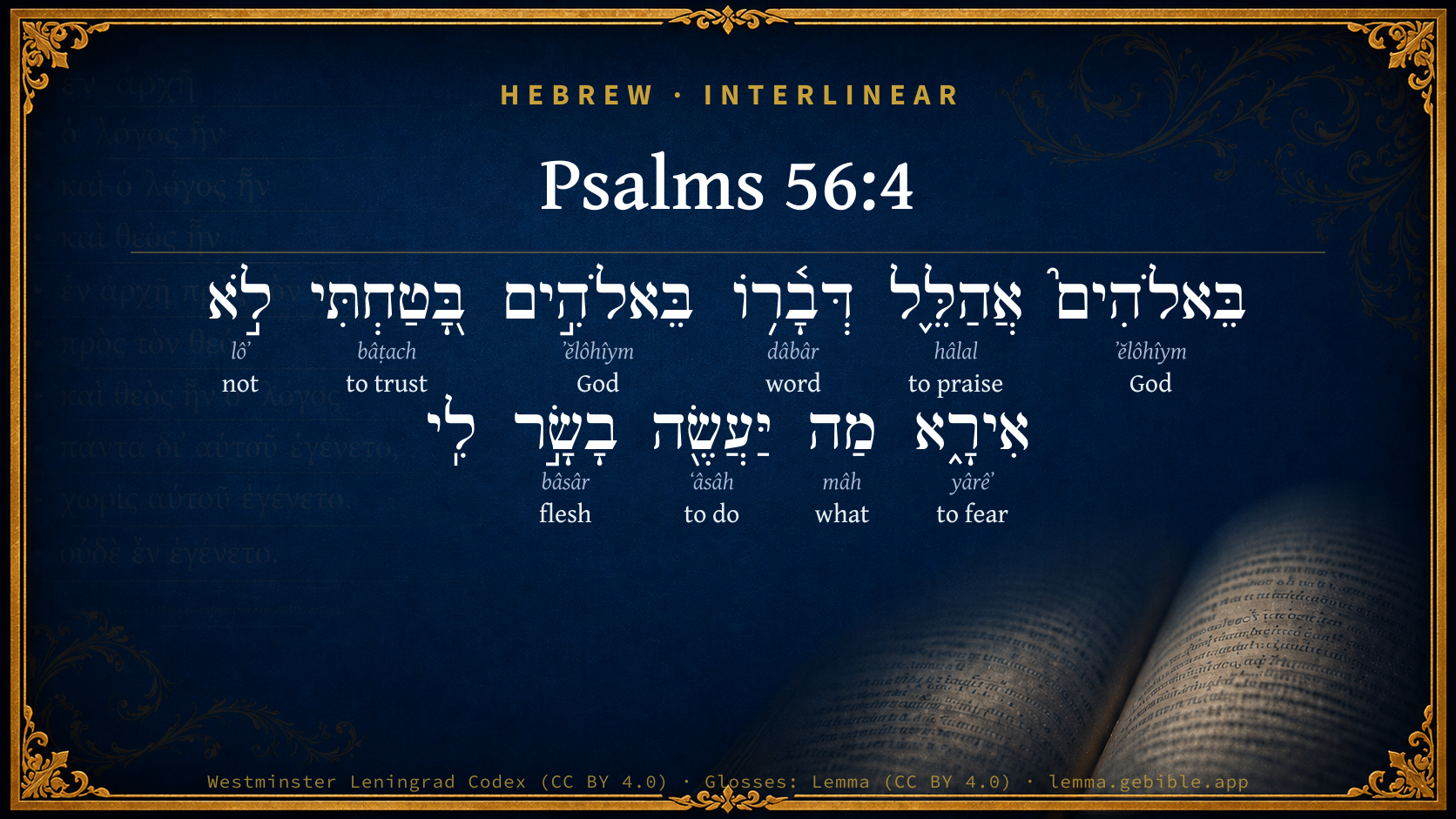
Hebrew (Westminster Leningrad Codex) Psalms 56:4 appears in the Hebrew Old Testament. The text above is from the Westminster Leningrad Codex. Each word links to its Strong’s number, a concise gloss, and parsing drawn from the Open Scriptures Hebrew Bible morphology. Click any word for its full Brown-Driver-Briggs (BDB) entry.
Download image
Cite this verse

Psalms 56:4 (World English Bible). Public Domain. Lemma interlinear Bible study tool, https://lemma.gebible.app/v/psalms/56/4.

Show BibTeX & RIS
BibTeX
RIS
English Translation
In God, I praise his word. In God, I put my trust. I will not be afraid. What can flesh do to me?
World English Bible · Public Domain
Download a study sheet

One document with this verse’s original text, its word-by-word gloss line, the meaning frame, cross-references with their text, attributed commentary, and full source and license credits — printable, and it pastes into notes with its structure intact.

This verse Autodidact and up

Study sheet (.html) Plain text (.txt)

A passage Seminary Student

Up to 50 verses in one chapter. A passage sheet keeps up to 6 commentary sources and 12 cross-references per verse, in the order this page ranks them, and says so on the sheet whenever that leaves anything out. Ask for a single verse and you get the Autodidact verse sheet above.

Everything on this page stays free to read, with no account — the sheet is a download of what is already on screen, not access to it.

Want to remove ads? Support Godless Engineer
Compare translations 3

The same verse in 3 English versions, stacked beneath the original-language interlinear above. Click any original word for its lexicon entry.

Each is an independent rendering of the whole verse — the interlinear is not word-aligned to these translations.

Highlighted words mark where these versions differ — a whole-verse word diff, not a word-by-word alignment.

  • World English Bible Public Domain
    In God, I praise his word. In God, I put my trust. I will not be afraid. What can flesh do to me?
  • King James Version Public Domain
    In God I will praise his word, in God I have put my trust; I will not fear what flesh can do unto me.
  • unfoldingWord Literal Text CC BY-SA 4.0
    In God—I praise his word—in God I trust. I will not fear. What will flesh do to me?

unfoldingWord Literal Text — © unfoldingWord, licensed CC BY-SA 4.0. Word-aligned USFM3 via Door43 (git.door43.org/unfoldingWord/en_ult).

Versions to compare (up to 4)

3 of 4 selected

Show all 18 translations

Every available English version of this verse, each an independent rendering of the whole verse.

  • World English Bible Public Domain
    In God, I praise his word. In God, I put my trust. I will not be afraid. What can flesh do to me?
  • Berean Standard Bible Public Domain
    In God, whose word I praise—in God I trust. I will not be afraid. What can man do to me?
  • Majority Standard Bible Public Domain
    In God, whose word I praise—in God I trust. I will not be afraid. What can man do to me?
  • King James Version Public Domain
    In God I will praise his word, in God I have put my trust; I will not fear what flesh can do unto me.
  • American Standard Version (1901) Public Domain
    In God (I will praise his word), In God have I put my trust, I will not be afraid; What can flesh do unto me?
  • Revised Version (1885) Public Domain
    In God I will praise his word: in God have I put my trust, I will not be afraid; what can flesh do unto me?
  • Geneva Bible (1599) Public Domain
    I will reioyce in God, because of his word, I trust in God, and will not feare what flesh can doe vnto me.
  • Douay-Rheims (1899) Public Domain
    From the height of the day I shall fear: but I will trust in thee.
  • Young's Literal Translation Public Domain
    In God I praise His word, in God I have trusted, I fear not what flesh doth to me.
  • Literal Standard Version CC BY-SA 4.0
    In God I praise His word, in God I have trusted, || I do not fear what flesh does to me.
  • Unlocked Literal Bible CC BY-SA 4.0
    In God, whose word I praise— in God I have put my trust; I will not be afraid; what can mere man do to me?
  • unfoldingWord Literal Text CC BY-SA 4.0
    In God—I praise his word—in God I trust. I will not fear. What will flesh do to me?
  • Darby Bible Public Domain
    In God will I praise his word, in God I put my confidence: I will not fear; what can flesh do unto me?
  • World Messianic Bible Public Domain
    In God, I praise his word. In God, I put my trust. I will not be afraid. What can flesh do to me?
  • Webster's Bible Public Domain
    \\56:3\\In the time when I am afraid, I will trust in thee.
  • Free Bible Version CC BY-SA 4.0
    I thank God for his promises. I trust in God, so why should I be fearful? What can mere human beings do to me?
  • Bible in Basic English Public Domain
    In God will I give praise to his word; in God have I put my hope; I will have no fear of what flesh may do to me.
  • JPS Tanakh (1917) Public Domain
    (56-5) In God — I will praise His word — in God do I trust, I will not be afraid; what can flesh do unto me?

Literal Standard Version (2020), Covenant Press — licensed CC BY-SA 4.0. Text via the HelloAO Bible API (eBible.org). Unlocked Literal Bible (unfoldingWord) — licensed CC BY-SA 4.0. Text via the HelloAO Bible API (eBible.org). unfoldingWord Literal Text — © unfoldingWord, licensed CC BY-SA 4.0. Word-aligned USFM3 via Door43 (git.door43.org/unfoldingWord/en_ult). Free Bible Version, Dr. Jonathan Gallagher — licensed CC BY-SA 4.0. Text via the HelloAO Bible API (eBible.org).

Word by word

More ways to search: Search by grammar → Find every occurrence → Compare this word →

Practice this passage: Drill this verse → Learn its vocabulary →

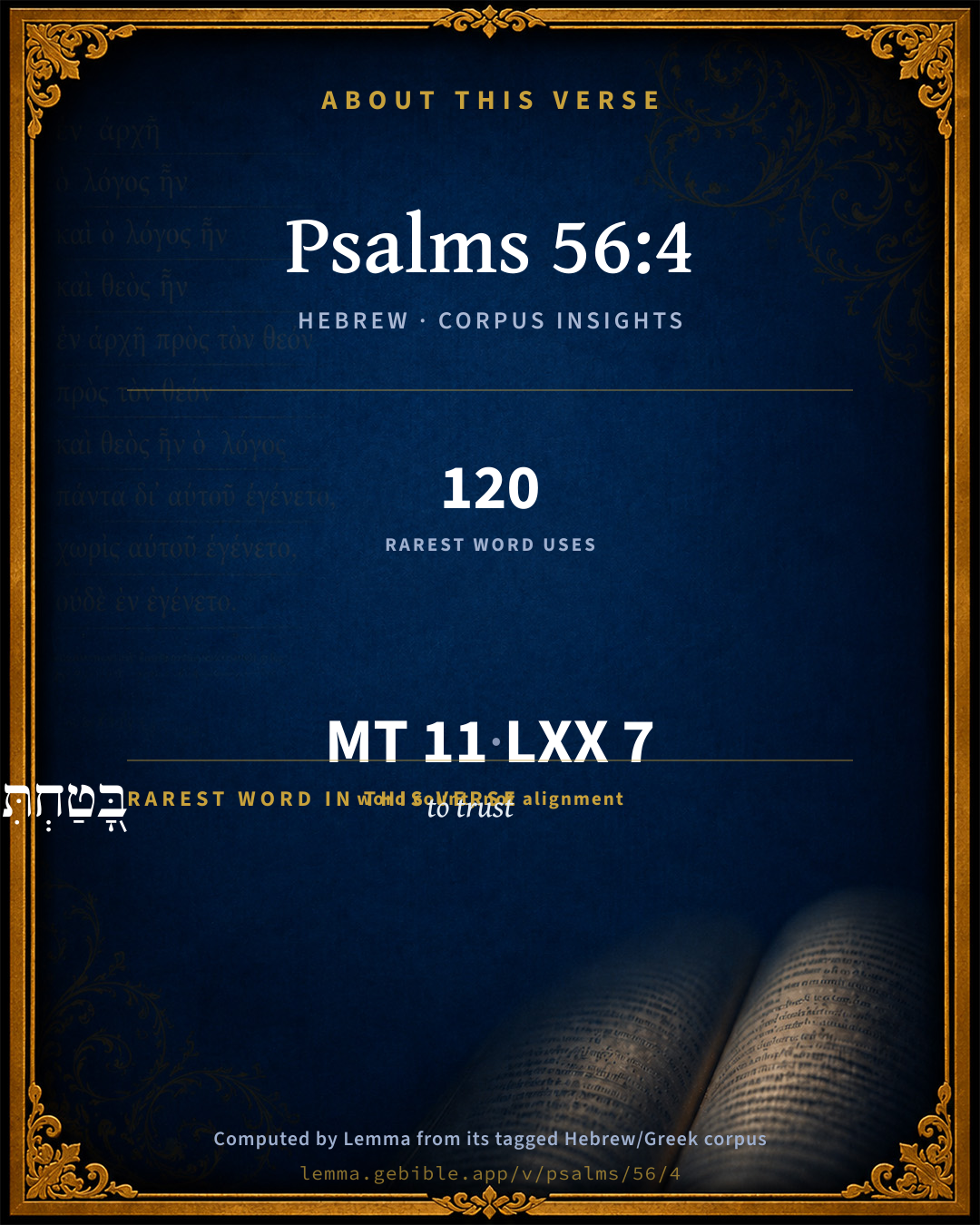
בָּ֭טַחְתִּי
bâṭach
H982
“to trust”
Verb, Qal, Perfect, 1st Person, Common, Singular
Part of Speech
Verb
Stem
Qal
Form
Perfect
Person
1st Person
Gender
Common
Number
Singular
Full BDB Definition

Origin: a primitive root

TWOT: 233

to trust - (Qal) - to trust, trust in - to have confidence, be confident - to be bold - to be secure - (Hiphil) - to cause to trust, make secure - (TWOT) to feel safe, be careless
  1. בֵּאלֹהִים֮ ʼĕlôhîym H430 “in/at · God(s)” Preposition + Noun, Common, Masculine, Plural, Absolute
  2. אֲהַלֵּ֪ל hâlal H1984 “to praise” Verb, Piel, Imperfect, 1st Person, Common, Singular
  3. דְּבָ֫ר֥וֹ dâbâr H1697 “word · his” Noun, Common, Masculine, Singular, Construct + Suffix, Personal, 3rd Person, Masculine, Singular
  4. בֵּאלֹהִ֣ים ʼĕlôhîym H430 “in/at · God(s)” Preposition + Noun, Common, Masculine, Plural, Absolute
  5. לֹ֣א lôʼ H3808 “not” Particle, Negative
  6. אִירָ֑א yârêʼ H3372 “to fear” Verb, Qal, Imperfect, 1st Person, Common, Singular
  7. מַה mâh H4100 “what” Particle, Interrogative
  8. יַּעֲשֶׂ֖ה ʻâsâh H6213 “to do” Verb, Qal, Imperfect, 3rd Person, Masculine, Singular
  9. בָשָׂ֣ר bâsâr H1320 “flesh” Noun, Common, Masculine, Singular, Absolute

About this verse

These counts appear in no published source. They are computed here, from the morphology-tagged text and Lemma’s own curated glosses. What Lemma adds →

11
words
9
distinct lemmas
Wisdom
section

Grammatical profile

  • 4 verbs
  • 4 nouns
  • 1 preposition
  • 2 particles

Verb forms

  • אֲהַלֵּ֪ל Piel · Imperfect
  • בָּ֭טַחְתִּי Qal · Perfect
  • אִירָ֑א Qal · Imperfect
  • יַּעֲשֶׂ֖ה Qal · Imperfect

Repetition

A word recurs within this verse — often emphatic in Hebrew:

  • בֵּאלֹהִים֮ God H430 ×2

Hebrew & Septuagint length

In English translation the verse runs 23 words from the Hebrew and 25 from the Septuagint (LXX English) — closely comparable.

A rough comparison of the two English renderings, which tokenize alike — not a word-level alignment.

Word counts can differ between the Hebrew and the Greek without any difference in meaning — e.g. the Hebrew direct-object marker אֵת has no separate Greek word, and Greek often adds the article ὁ.

In the original languages it is 11 Hebrew tokens and 7 Greek tokens — but the two are counted differently (Hebrew bundles its prefixes and suffixes into one token; the Greek is in lemma form), so that isn’t a like-for-like length.

Cross-references

15

Topical passages linked to Psalms 56:4 in the Treasury of Scripture Knowledge — connected by theme and wording, ordered by reader-vote popularity; previews shown in the World English Bible.

  • Hebrews 13:6 So that with good courage we say, "The Lord is my helper. I will not fear. What can man do to me?"
  • Psalms 118:6 Yahweh is on my side. I will not be afraid. What can man do to me?
  • Romans 8:31–39 What then shall we say about these things? If God is for us, who can be against us?
  • Psalms 27:1 Yahweh is my light and my salvation. Whom shall I fear? Yahweh is the strength of my life. Of whom shall I be afraid?
  • Isaiah 41:10 Don't you be afraid, for I am with you; don't be dismayed, for I am your God; I will strengthen you; yes, I will help you; yes, I will uphold you with the right hand of my righteousness.
  • Luke 12:4–5 "I tell you, my friends, don't be afraid of those who kill the body, and after that have no more that they can do.
  • Psalms 56:10–11 In God, I will praise his word. In Yahweh, I will praise his word.
  • Psalms 46:1–2 God is our refuge and strength, A very present help in trouble.
  • Psalms 119:89–90 Yahweh, your word is settled in heaven forever.
  • Isaiah 31:3 Now the Egyptians are men, and not God; and their horses flesh, and not spirit: and when Yahweh shall stretch out his hand, both he who helps shall stumble, and he who is helped shall fall, and they all shall be consumed together.
  • Psalms 19:7–8 Yahweh's law is perfect, restoring the soul. Yahweh's testimony is sure, making wise the simple.
  • Psalms 12:6 The words of Yahweh are flawless words, As silver refined in a clay furnace, purified seven times.
  • Psalms 119:160 All of your words are truth. Every one of your righteous ordinances endures forever.
  • Psalms 138:2 I will bow down toward your holy temple, And give thanks to your Name for your loving kindness and for your truth; For you have exalted your Name and your Word above all.
  • John 10:35 If he called them gods, to whom the word of God came (and the Scripture can't be broken),

Cross-references courtesy of OpenBible.info (CC BY 4.0).

Hebrew and Greek witnesses Masoretic Hebrew ↔ Greek Septuagint

The same verse in the two great witnesses to the Old Testament, shown verse-for-verse.

You’re reading Greek Psalm 55 (Hebrew Psalm 56). The Septuagint counts the superscription, so verse numbers can differ from the Hebrew — chapter-level alignment, not verse-by-verse. Numbering follows Rahlfs.

These are two independent witnesses, not word-aligned to each other, and the Septuagint is shown in lemma (dictionary) form.

Hebrew Psalms 56:4 Masoretic · Westminster Leningrad Codex

בֵּאלֹהִים֮ אֲהַלֵּ֪ל דְּבָ֫ר֥וֹ בֵּאלֹהִ֣ים בָּ֭טַחְתִּי לֹ֣א אִירָ֑א מַה יַּעֲשֶׂ֖ה בָשָׂ֣ר לִֽי

In God, I praise his word. In God, I put my trust. I will not be afraid. What can flesh do to me?

World English Bible · Public Domain

Greek LXX Greek Psalm 55:4 Septuagint · lemma form

ἡμέρα φοβέω ἐγώ δέ ἐπί σύ ἐλπίζω

In God I will praise my words; all the day have I hoped in God; I will not fear what flesh shall do to me.

LXX2012 (modern English Septuagint) · Public Domain

On this verse, Ellicott's Commentary for English Readers discusses the Septuagint’s reading. Read the note in Commentary ↓

Hebrew: Westminster Leningrad Codex (CC BY 4.0). Greek: Septuagint (public domain); English from LXX2012 (modern English Septuagint) (Public Domain). How the Septuagint differs from the Hebrew →

Commentary

Notes on Psalms 56:4 from classic Christian and Jewish commentators (each source and its license shown beneath its notes). The classic Christian expositions comment on the surrounding passage and are grouped to its opening verse, so a note may address several verses; the Jewish commentaries on the Tanakh (Rashi and others) are per-verse, so they appear only where the commentator wrote on this verse.

Lemma curates 59 commentaries, every one of them public domain or Creative Commons licensed, each selected and text-cleaned for this edition rather than reprinted as found. About our sources →

Trapp's Complete Commentary

John Trapp

Psa 56:4 In God I will praise his word, in God I have put my trust; I will not fear what flesh can do unto me.

Ver. 4. In God I will praise his word] Having placed my confidence in God, I will take his bare word for my security. He hath promised to make me king, 1Sa 16:13, and he will not suffer his faithfulness to fail, or alter the thing that is gone out of his mouth, Psa 89:33. The word of God cannot be broken, Joh 5:35. David once doubted it, but he soon took himself up for halting, Psa 116:11.

I will not fear what flesh can do unto me] Flesh is terminus diminuens. What can proud flesh do against the God of the spirits of all flesh? Man is but despicable flesh at the best.

John Trapp, A Commentary or Exposition upon All the Books of the Old and New Testament (1647–1656) — public domain. Text from a community e-Sword module.

The Biblical Illustrator

Joseph S. Exell

Psa_56:4

In God will I praise His word.

The moral impulse imparted to individuals and communities by the study of the Bible

My object is not merely to demonstrate the inspiration of the Bible, but to win you to the study of it. It may possibly be alleged by many persons, especially of the more busy classes of society, that they have no time for the attention to the Bible which is recommended.

1. The plea is dangerous as well as monstrous and criminal. If a son or a friend were to aver that he had become too busy, that he was too much engaged, for days and weeks and months together, to read an epistle from a distant land, dictated by parental love or by friendship, to what conclusion should we come as to the nature of the pretence or the character of the mind that could dictate it? Could we, even in this ordinary ease, admit for an instant the validity of the excuse, or suppose that any business of life could be so urgent?

2. The plea is untrue. A few verses, snatched from the hurry of life (if life must indeed be so hurried) may suffice. In a few minutes you may read enough to furnish materials for reflection and inquiry. You may walk or work--and think. And we claim such study for the Bible because--

I. The influence which it exerts is distinctly moral. It deals with man as a moral being, responsible for his actions, and to be influenced by motives.

II. And this impulse which it communicates is holy. Notwithstanding passages in it which infidels have urged have an unholy tendency, the overwhelming effect of the book is towards holiness. Not so other sacred books--the Koran, and the like.

III. And this impulse is mighty.

IV. Progressive.

V. But simply instrumental. The truth contained in the sacred volume exerts an influence analogous, both in its force and its secrecy, to that of some of the most wonder-working agencies of nature. It resembles the unseen presence of magnetism or electricity, which move as by a touch the elements and masses around us--disposing them to order or clothing them with beauty; or it is like the vegetative power, that in the darkness and concealment of the earth and the clods of the valley impels the seed to shoot and rise and spread fertility upon the smiling surface. In the secret recesses of the soul, and in the dark and hidden depths of a heart, no human eye can penetrate and no human philosophy unravel--it subdues and sanctifies, works repentance and humiliation, and the settled purposes of a renewed mind, till on the surface appears the penitential tear, the bended knee, the contrite sigh, the believing and imploring reception of Christ, the moral and spiritual renewal of character, the outward, fearless, and heaven-sealing profession of a true religion; and every right-minded observer attests the truth of the Divine declaration, Behold I make all things new. (F. A. Cox, D. D.)

The Biblical Illustrator, edited by Joseph S. Exell (c. 1880s–1900s) — public domain. Text from a community e-Sword module.

J. A. Alexander on Psalms

Joseph Addison Alexander

5. (Psa 56:4). In God I will praise his word, in God I have trusted; I will not fear; what can flesh do unto me? The meaning of the first clause seems to be, that in the general praise of God he will include a particular acknowledgment of his gracious word or promise upon this occasion. The construction of the last clause in the English Bible, I will not fear what flesh can do unto me, gives substantially the same sense, but does not agree so well with the masoretic interpunction of the sentence. Flesh, humanity, as opposed to deity. See below, on Psa 65:2, and compare Isa 22:3; Isa 40:6.

Joseph Addison Alexander, The Psalms Translated and Explained (1850) — public domain. Text from a community e-Sword module.

Tyndale Open Study Notes

Tyndale Open Resources

56:4 mere mortals: Or mere flesh, in contrast to the immortal and infinitely more powerful God (see Isa 2:22).

Tyndale Open Study Notes — © Tyndale Open Resources, licensed CC BY-SA 4.0. Text via the HelloAO Bible API.

Geneva Bible (1599)

Geneva Bible translators

He stayeth his conscience upon God’s promise, though he see not present help.

Geneva Bible (1599) marginal notes — public domain. Text via Bolls.life.

Jamieson, Fausset & Brown

Robert Jamieson, A. R. Fausset & David Brown

in God . . . his word--By His grace or aid (Psa 60:12; Psa 108:13), or, "I will boast in God as to His word"; in either case His word is the special matter and cause of praise.

flesh--for mankind (Psa 65:2; Isa 31:3), intimating frailty.

Jamieson, Fausset & Brown — Commentary Critical and Explanatory on the Whole Bible (1871) — public domain (CC PDM 1.0). Text via the HelloAO Bible API.

Adam Clarke's Commentary

Verse 4. In God I will praise his word] באלהים belohim may mean here, through God, or by the help of God, I will praise his word. And, that he should have cause to do it, he says, "In God I have put my trust," and therefore he says, "I will not fear what flesh can do unto me." Man is but FLESH, weak and perishing; God is an infinite SPIRIT, almighty and eternal. He repeats this sentiment in the tenth and eleventh verses. Ps 56:10-11

Adam Clarke's Commentary on the Bible (1810–1826) — public domain. Text from a community e-Sword/MySword module.

John Calvin's Commentaries

4. In God I will praise his word Here he grows more courageous in the exercise of hope, as generally happens with the people of God. They find it difficult at first to reach this exercise. It is only after a severe struggle that they rise to it, but the effort being once made, they emerge from their fears into the fullness of confidence, and are prepared to grapple with the most formidable enemies. To praise, is here synonymous with glorying or boasting. He was now in possession of a triumphant confidence, and rejoiced in the certainty of hope. The ground of his joy is said to be the divine word; and this implies, that however much he might seem to be forsaken and abandoned by God, he satisfied himself by reflecting on the truthfulness of his promises. He would glory in God notwithstanding, and although there should be no outward appearance of help, or it should even be sensibly withdrawn, he would rest contented with the simple security of his word. The declaration is one that deserves our notice. How prone are we to fret and to murmur when it has not pleased God immediately to grant us our requests! Our discontent may not be openly expressed, but it is inwardly felt, when we are left in this manner to depend upon his naked promises. It was no small attainment in David, that he could thus proceed to praise the Lord, in the midst of dangers, and with no other ground of support but the word of God. The sentiment contained in the latter clause of the verse might seem at first glance to merit little consideration. What more obvious than that God is able to protect us from the hand of men, that his power to defend is immensely greater than their power to injure? This may be true, but we all know too well how much of that perverse unbelief there is in our hearts, which leads us to rate the ability of God below that of the creature. It was no small proof, therefore, of the faith of David, that he could despise the threatenings of his enemies. And it would be well if all the saints of God were impressed with such a sense of his superiority to their adversaries as would lead them to show a similar contempt of danger. When assailed by these, it should never escape their recollection, that the contest is in reality between their enemies and God, and that it were blasphemous in this case to doubt the issue. The great object which these have in view is to shake our faith in the promised help of the Lord; and we are chargeable with limiting his power, unless we realize him standing at our right hand, able with one movement of his finger, or one breath of his mouth, to dissipate their hosts, and confound their infatuated machinations. Shall we place him on a level with mortal man, and measure his probable success by the numbers which are set against him? “But how,” may it be asked, “are we to account for this sudden change in the exercise of David? A moment before, he was expressing his dread of destruction, and now he bids defiance to the collected strength of his enemies.” I reply, that there is nothing in his words which insinuate that he was absolutely raised above the influence of fear, and every sense of the dangers by which he was encompassed. They imply no more than that he triumphed over his apprehensions, through that confident hope of salvation with which he was armed. Men he terms in this verse flesh, to impress the more upon his mind the madness of their folly in attempting a contest so infinitely above their strength.

John Calvin's Commentaries (1540-1563) — public domain. Text from the Calvin Translation Society English edition (1840s-50s) via the Christian Classics Ethereal Library (ccel.org). Calvin's coverage is partial (roughly two-thirds of the Bible); uncommented books and verses are honest gaps, never fabricated. The 19th-century editor's footnotes and remarks are omitted so the notes are faithfully Calvin's own voice.

Ellicott's Commentary for English Readers

(4) In God.—This verse, which forms the refrain (Psa_56:11-12 are wrongly separated), is as it stands hardly intelligible, and the text is rendered suspicious by the fact that the LXX. read “my words,” instead of “his word,” and by the omission of the suffix altogether in Psa_56:11, where the first clause of the refrain is doubled. The obvious treatment of the verse is to take the construction as in Psa_44:8, “I praise God with my word,” i.e., in spite of all my enemies I find words to praise God.

I will not.—Rather, I fear not What can flesh do?

A Bible Commentary for English Readers, edited by Charles John Ellicott (1878–1897) — public domain. Text from a community e-Sword module.

The Cambridge Bible for Schools and Colleges

gen. ed. J. J. S. Perowne

4. in God I will praise his word] In God’s strength, by the help of His grace, I shall be enabled to praise His words of promise (Psa_130:5). Cp. Psa_44:8. This rendering is preferable to the possible alternative, In God do I make my boast, even in his word.

in God &c.] R.V., In God have I put my trust, I will not be afraid; what can flesh do unto me? Flesh, synonymous with man in Psa_56:11, denotes man on the material side of his nature, as a frail and perishable being, contrasted with God the Eternal and Almighty. Cp. Psa_78:39; Gen_6:3; Job_10:4; Isa_40:5-6; Jer_17:5.

The Cambridge Bible for Schools and Colleges (gen. ed. J. J. S. Perowne; Cambridge University Press, 1878–1918) — public domain. Text from a community e-Sword module.

John Gill's Exposition

In God I will praise his word,.... Or praise him for his words for the whole Scripture that was then in being; for those testimonies which were David's counsellors in times of difficulty and distress; and particularly for some word of promise made unto him, he was persuaded would be fulfilled, and in which he gloried and made his boast of, and on which his faith and hope were built; and this he did, and determined to do, in the strength of the Lord, and by the assistance of his grace;

in God I have put my trust; either in times past, and was not ashamed or confounded; or now, as he determined he would in Psa 56:3;

I will not fear what flesh can do unto me: or continue to fear any or all of my enemies; though I have been afraid of them, I will shake off these fears, trusting in the Lord, and depending on his word. Or, "what can flesh do unto me?" (t) which is as grass, and the goodliness thereof as the flower of the field. Poor, frail, mortal man! what can he do against me, if God be for me? And therefore why should I fear? Men may contrive schemes, form weapons, and attempt many things against the saints, but can execute nothing, except permitted by the Lord; and the utmost they can do, when suffered, is to kill the body.

(t) So Junius & Tremellius, Piscator, Cocceius, Gejerus, Michaelis.

John Gill's Exposition of the Whole Bible (1746–1763) — public domain (CC PDM 1.0). Text via the HelloAO Bible API.

Albert Barnes' Notes on the Bible

In God I will praise his word - The meaning of this seems to be, “In reference to God - or, in my trust on God - I will especially have respect to his “word” - his gracious promise; I will make that the special object of my praise. In dwelling in my own mind on the divine perfections; in finding there materials for praise, I will have special respect to his revealed truth - to what he has “spoken” as an encouragement to me. I will be thankful that he “has” spoken, and that he has given me assurances on which I may rely in the times of danger.” The idea is, that he would “always” find in God that which was the ground or foundation for praise; and that that which called for special praise in meditating on the divine character, was the word or promise which God had made to his people.

I will not fear what flesh can do unto me - What man can do to me. Compare the notes at Mat 10:28 (notes); Rom 8:31-34 (notes); Heb 13:6 (notes).

Albert Barnes' Notes on the Bible (1834–1885) — public domain. Text from a community e-Sword/MySword module.

Matthew Poole's English Annotations

In God I will praise his word: the sense is, either,

1. I will praise or boast in the Lord’s word, or the Lord for his word. Or,

2. With or by the Lord (i.e. by his favour or help) I will praise his word. Or rather,

3. This, as I humbly conceive: There are many things to be praised and celebrated in God, his power and wisdom, &c.; but amongst all, and above all, I shall at this time praise him for his word, which he hath magnified above all his name, as is said, Psa 138:2, even for his promises of protection and deliverance made to his people in all their exigencies, and particularly and especially for that promise of the kingdom made to me; for which I will now praise him, because I am as sure of its accomplishment as if I had it already in mine hand.

Flesh; infirm and mortal men, altogether unable to oppose thy infinite Majesty; called flesh by way of contempt, as Psa 78:39; Isa 31:3; Jer 17:5.

Matthew Poole's English Annotations on the Holy Bible (1683–1685) — public domain. Text from a community e-Sword/MySword module.

The Treasury of David

Charles H. Spurgeon

Ver. 4. In God I will praise his word. Faith brings forth praise. He who can trust will soon sing. God's promise, when fulfilled, is a noble subject for praise, and even before fulfilment it should be the theme of song. It is in or through God that we are able to praise. We praise as well as pray in the Spirit. Or we may read it--in extolling the Lord one of the main points for thanksgiving is his revealed will in the Scriptures, and the fidelity with which he keeps his word of promise.

In God I have put my trust. Altogether and alone should we stay ourselves on God. What was a gracious resolve in the former verse, is here asserted as already done.

I will not fear what flesh can do unto me. Faith exercised, fear is banished, and holy triumph ensues, so that the soul asks, "What can flesh do unto me?" What indeed? He can do me no real injury; all his malice shall be overruled for my good. Man is flesh, flesh is grass--Lord, in thy name I defy its utmost wrath. There were two verses of complaint, and here are two of confidence; it is well to weigh out a sufficient quantity of the sweet to counteract the sour.

Ver. 4. In God I will praise his word. Or, praise him for his word; for the whole Scripture that was then in being. John Gill.

Ver. 4. The best hold that faith can have of God, is to take him by his word, however his dispensation seems to be; this will give satisfaction at length; for In God I will praise his word, is as much as to say, albeit he withhold comfort and deliverance from me, so that I cannot find what I would, yet let me have his word, and I will give him the glory of all his attributes. David Dickson.

Ver. 4. I will not fear what flesh can do unto me. Fear not man, he is but flesh. Thou needest not, thou oughtest not to fear. Thou needest not. What, not such a great man; not such a number of men, who have the keys of all the prisons at their girdle; who can kill or save alive? No, not these; only look they be thy enemies for righteousness sake. Take heed thou makest not the least child thine enemy, by offering wrong to him; God will right the wicked even upon the saint. If he offends he shall find no shelter under God's wing for his sin. This made Jerome complain that the Christian sin made the arms of those barbarous nations which invaded Christendom victorious: Nostris peccatis fortes sunt barbari. But if man's wrath find thee on God's way, and his fury take fire at thy holiness, thou needest not fear though thy life be the prey he hunts for. Flesh can only wound flesh; he may kill thee, but not hurt thee. Why shouldest thou fear to be stripped of that which thou hast resigned already to Christ? It is the first lesson you learn, if a Christian, to deny thyself, take up thy cross, and follow thy Master; so that the enemy comes too late; thou hast no life to lose, because thou hast given it already to Christ; nor can man take away that without God's leave; all thou hast is insured; and though God hath not promised thee immunity from suffering in this kind, yet he hath undertaken to bear the loss, yea, to pay thee a hundredfold, and thou shalt not stay for it till another world. Again, thou oughtest not to fear flesh. Our Saviour (Matthew 10) thrice, in the compass of six verses, commands us not to fear man: if thy heart quail at him, how wilt thou behave thyself in the last against Satan, whose little finger is heavier than man's loins? The Romans had arma proelusoria, weapons rebated or cudgels, which they were tried at before they came to the sharp. If thou canst not bear a bruise in thy flesh from man's cudgels and blunt weapons, what wilt thou do when thou shalt have Satan's sword in thy side? God counts himself reproached when his children fear a sorry man; therefore we are bid sanctify the Lord, not to fear their fear. William Gurnall.

Ver. 4. I will not fear, etc. Eusebius tells us of a notable speech that Ignatius used when he was in his enemies' hands, not long before he was to suffer, which argued a raised spirit to a wonderful height above the world, and above himself. "I care, "says he, "for nothing visible or invisible, that I might get Christ. Let fire, the cross, the letting out of beasts upon me, breaking of my bones, the tearing of my members, the grinding of my whole body, and the torments of the devils come upon me, so be it I may get Christ." From Jeremiah Burroughs' "Moses his Self denial, "1649.

Ver. 4. What flesh can do, etc. It is according to the phrase of Scripture, when it would speak contemptibly of man and show him to be the lowest creature, to call him "flesh, "to set forth the weakness that man is subject to. John Arrowsmith, 1600-1660.

Ver. 4. (last clause). Fear of man --grim idol, bloody mouthed; many souls has he devoured and trampled down into hell! His eyes are full of hatred to Christ's disciples. Scoffs and jeers lurk in his eye. The laugh of the scorner growls in his throat. Cast down this idol. This keeps some of you from secret prayer, from worshipping God in your family, from going to lay your case before ministers, from openly confessing Christ. You that have felt God's love and Spirit, dash this idol to pieces. "Who art thou, that thou shouldest be afraid of a man that shall die?" "Fear not, thou worm Jacob." "What have I to do any more with idols?" Robert Murray Macheyne, 1813-1843.

Ver. 4. Faith groweth valiant in fight; albeit it began like a coward, and staggered in the first conflict, yet it groweth stout, incontinent, and pulls its adversaries under foot: In God I have put my trust; I will not fear what flesh can do unto me. David Dickson.

None.

Psalms 56:5*

Charles H. Spurgeon's The Treasury of David (1869–1885) — public domain. Psalms only. Text from a community e-Sword/MySword module.

Whedon's Commentary on the Bible

Daniel D. Whedon

4. In God I will praise his word—God’s “word,” here, probably refers specially to that spoken by Samuel when he anointed him, 1Sa_16:13; and also probably at Ramah, 1Sa_19:18, by which David became the promised king of Israel. The phrase “in God I will praise,” etc., is equal to by his help, or through his grace, I will praise, etc. His faith held firmly to the word of promise against contradictory appearances.

What flesh can do—What all mankind can do. When the word “flesh” is thus figuratively and genetically used, it always takes the adsignification of weakness, mortality. The same word occurs Psa_56:1. The Hebrew punctuation places the text thus:—

In God I have confidence,

I will not fear;

What can flesh [frail man] do to me?

Noble words of a triumphant faith.

Daniel D. Whedon (gen. ed.), Commentary on the Old and New Testaments (1874–1909) — public domain. Text from a community e-Sword module.

The Pulpit Commentary

In God I will praise his word; rather, through God; i.e. "with God"s help, by his grace," I am ready to praise whatever sentence he pronounces, whatever flat goes forth from him. In God I have put my trust (so again, ver. 11). This is at once the refrain and the keynote of the psalm. In all dangers, in all troubles, whatever happens, whatever seems to be impending, the psalmist will never relinquish his trust in the Almighty. I will not fear what flesh can do unto me. This is the true martyr spirit. Compare our Lord"s words, "Fear not them which kill the body, but are not able to kill the soul: but rather fear him which is able to destroy both body and soul in hell". (Mat_10:28)

Vers. 4, 10, 11. The expression and the result of faith.

"In God I will praise his word," etc. This is not a vain repetition or a mere poetic burden. The meaning is enlarged and strengthened. In ver. 4 that Divine name is used which speaks of the Almighty Creator, "God." In ver. 10 this is repeated, but that personal name is added which speaks of God"s covenant and faithfulness, "in the Lord" (equivalent to "Jehovah"). Again, in ver. 4 the psalmist speaks of man in his weakness but in ver. 11 man can do man in his utmost strength is defied to hurt one of God"s refugees. Here is

(1) the expression of faith;

(2) the result of faith.

I THE EXPRESSION OF FAITH. "In God will I praise his word." The word of God is everywhere in Scripture the special object of faith, for this reason that it is by his word, viz. his commands and his promises, that God enters into moral relations with us, and enables us to enter into such relations to him. Hence room not for mere vague faith, such as we might have in the Creator of the universe, the Almighty Ruler, the Author of our being; but direct personal trust, accepting and grasping God"s word. The name "Jehovah" warrants this faith. The word of promise is chiefly meant. This faith is in contrast to all the causes and circumstances of fear and peril (vers. 1, 2).

II THE RESULT OF FAITH. "I will not fear." As love casts out the slavish fear of God the fear which would drive or keep us from him (1Jn_4:18) so faith casts out the fear of man. Let the arrows fly like hail; behind "the shield of faith" (Eph_6:16) we are safe, not only from what "flesh and blood" can do, but from our spiritual foes. (Eph_6:12) Illustrate from such passages as Gen 16:1Jo Gen_6:20. Courage, therefore, is a duty. The courage of self-reliance belongs only to the strong, but the courage of reliance on God is within reach of the weakest. Man of the world, canst thou look the future in the face and say, "I will not fear"?

The Pulpit Commentary (1880–1919), ed. H.D.M. Spence-Jones & Joseph S. Exell — public domain. Text from a community e-Sword module.

John Wesley's Explanatory Notes

Will praise - I will praise the Lord for his word, for his promises of protection and deliverance, made to his people. Flesh - Infirm and mortal men, called flesh by way of contempt, as chap. lxxviii, 39 Isaiah xxxi, 3.

John Wesley, Explanatory Notes Upon the Whole Bible (1754–1765) — public domain. Text via the GEBible commentary corpus.

Lesson kit

Teaching starters — assembled from the data on this page, not authored interpretation. Every prompt links to the verse data it draws on. Edit before teaching.

Psalms, in the Wisdom, opens this verse with 11 words (9 distinct Hebrew lemmas). Its most distinctive word is bâṭach (“to trust”). A historical commentator’s framing appears above. Read the whole chapter for the surrounding context.

Discussion questions

  1. The word bâṭach carries the sense “to trust.” How does it shape the verse?
  2. How does Hebrews 13:6, which shares this passage’s theme, read alongside this verse?
  3. What does the repetition of “God” (2× in this one verse) do in this verse?
  4. These translations render this verse differently. What is at stake in choosing one wording over another?
  5. «אֲהַלֵּ֪ל» is a Piel Imperfect verb. How does that grammatical form shape the action described?
  6. Compare how Trapp's Complete Commentary and The Biblical Illustrator read this verse. Where do they agree or differ?

Things to notice

Reading settings

Reading text

Shown beneath each verse's original-language words.

Old Testament
Old Testament edition

Read the OT as the Masoretic Hebrew (MT) or the Greek Septuagint (LXX).

English shown for the Greek Septuagint (in the Hebrew ↔ Greek comparison).

Comparing translations? Open the Compare panel on any verse page to stack up to four side by side.