Psalms 74:9

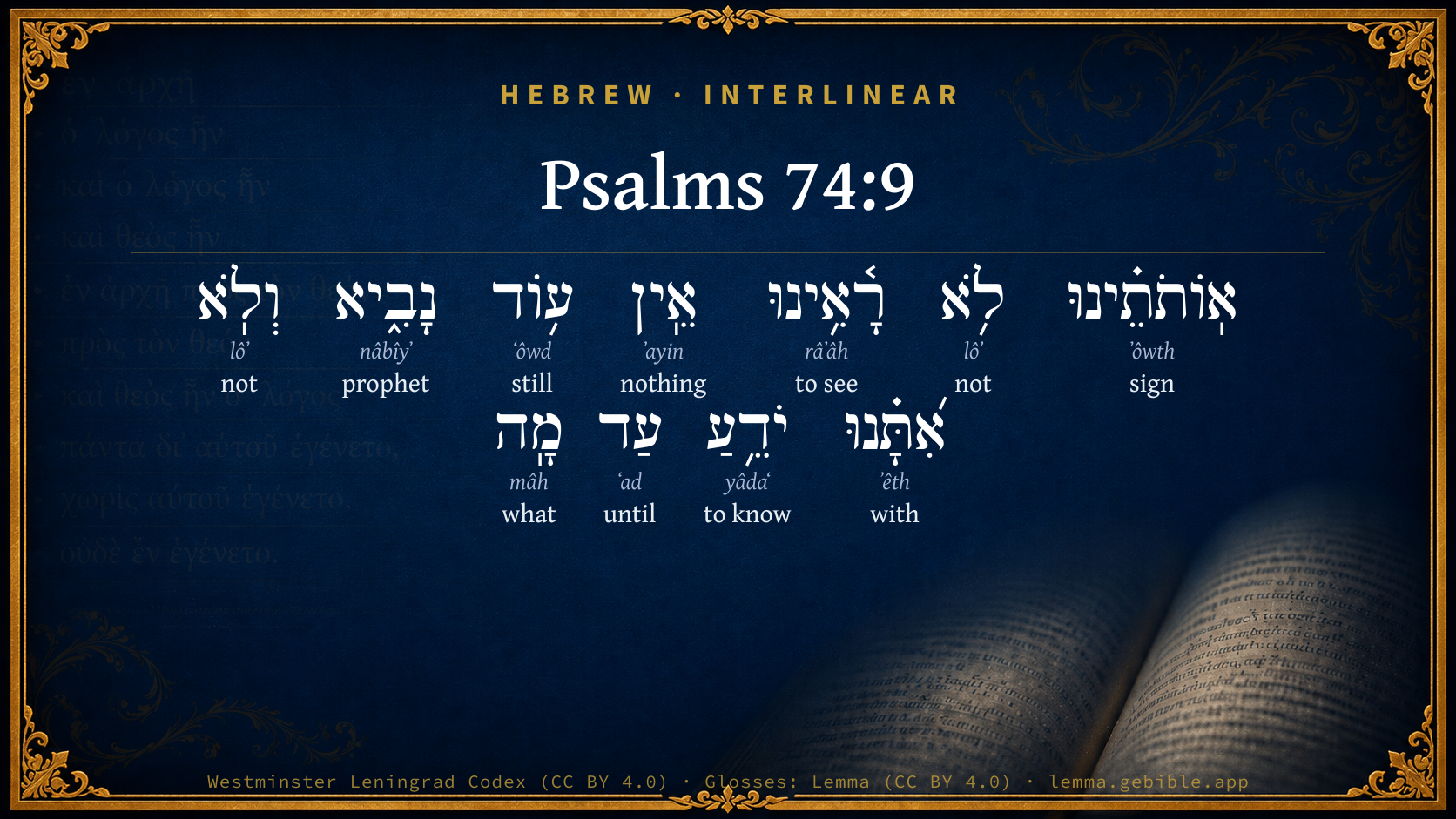
Hebrew (Westminster Leningrad Codex) Psalms 74:9 appears in the Hebrew Old Testament. The text above is from the Westminster Leningrad Codex. Each word links to its Strong’s number, a concise gloss, and parsing drawn from the Open Scriptures Hebrew Bible morphology. Click any word for its full Brown-Driver-Briggs (BDB) entry.
Download image
Cite this verse

Psalms 74:9 (World English Bible). Public Domain. Lemma interlinear Bible study tool, https://lemma.gebible.app/v/psalms/74/9.

Show BibTeX & RIS
BibTeX
RIS
English Translation
We see no miraculous signs. There is no longer any prophet, Neither is there among us anyone who knows how long.
World English Bible · Public Domain
Download a study sheet

One document with this verse’s original text, its word-by-word gloss line, the meaning frame, cross-references with their text, attributed commentary, and full source and license credits — printable, and it pastes into notes with its structure intact.

This verse Autodidact and up

Study sheet (.html) Plain text (.txt)

A passage Seminary Student

Up to 50 verses in one chapter. A passage sheet keeps up to 6 commentary sources and 12 cross-references per verse, in the order this page ranks them, and says so on the sheet whenever that leaves anything out. Ask for a single verse and you get the Autodidact verse sheet above.

Everything on this page stays free to read, with no account — the sheet is a download of what is already on screen, not access to it.

Want to remove ads? Support Godless Engineer
Compare translations 3

The same verse in 3 English versions, stacked beneath the original-language interlinear above. Click any original word for its lexicon entry.

Each is an independent rendering of the whole verse — the interlinear is not word-aligned to these translations.

Highlighted words mark where these versions differ — a whole-verse word diff, not a word-by-word alignment.

  • World English Bible Public Domain
    We see no miraculous signs. There is no longer any prophet, Neither is there among us anyone who knows how long.
  • King James Version Public Domain
    We see not our signs: there is no more any prophet: neither is there among us any that knoweth how long.
  • unfoldingWord Literal Text CC BY-SA 4.0
    We do not see our signs; there is no longer a prophet and not one with us knowing until when.

unfoldingWord Literal Text — © unfoldingWord, licensed CC BY-SA 4.0. Word-aligned USFM3 via Door43 (git.door43.org/unfoldingWord/en_ult).

Versions to compare (up to 4)

3 of 4 selected

Show all 18 translations

Every available English version of this verse, each an independent rendering of the whole verse.

  • World English Bible Public Domain
    We see no miraculous signs. There is no longer any prophet, Neither is there among us anyone who knows how long.
  • Berean Standard Bible Public Domain
    There are no signs for us to see. There is no longer any prophet. And none of us knows how long this will last.
  • Majority Standard Bible Public Domain
    There are no signs for us to see. There is no longer any prophet. And none of us knows how long this will last.
  • King James Version Public Domain
    We see not our signs: there is no more any prophet: neither is there among us any that knoweth how long.
  • American Standard Version (1901) Public Domain
    We see not our signs: There is no more any prophet; Neither is there among us any that knoweth how long.
  • Revised Version (1885) Public Domain
    We see not our signs: there is no more any prophet; neither is there among us any that knoweth how long.
  • Geneva Bible (1599) Public Domain
    We see not our signes: there is not one Prophet more, nor any with vs that knoweth howe long.
  • Douay-Rheims (1899) Public Domain
    Our signs we have not seen, there is now no prophet: and he will know us no more.
  • Young's Literal Translation Public Domain
    Our ensigns we have not seen, There is no more a prophet, Nor with us is one knowing how long.
  • Literal Standard Version CC BY-SA 4.0
    We have not seen our ensigns, || There is no longer a prophet, || Nor with us is one knowing how long.
  • Unlocked Literal Bible CC BY-SA 4.0
    We do not see any more signs; there is no prophet any more, and no one among us knows how long this will last.
  • unfoldingWord Literal Text CC BY-SA 4.0
    We do not see our signs; there is no longer a prophet and not one with us knowing until when.
  • Darby Bible Public Domain
    We see not our signs; there is no more any prophet, neither is there among us any that knoweth how long.
  • World Messianic Bible Public Domain
    We see no miraculous signs. There is no longer any prophet, neither is there among us anyone who knows how long.
  • Webster's Bible Public Domain
    We see not our signs: there is no more any prophet: neither is there among us any that knoweth how long.
  • Free Bible Version CC BY-SA 4.0
    We no longer see any signs. There are no prophets left. And no one among us knows how long this will last.
  • Bible in Basic English Public Domain
    We do not see our signs: there is no longer any prophet, or anyone among us to say how long.
  • JPS Tanakh (1917) Public Domain
    We see not our signs; there is no more any prophet; neither is there among us any that knoweth how long.

Literal Standard Version (2020), Covenant Press — licensed CC BY-SA 4.0. Text via the HelloAO Bible API (eBible.org). Unlocked Literal Bible (unfoldingWord) — licensed CC BY-SA 4.0. Text via the HelloAO Bible API (eBible.org). unfoldingWord Literal Text — © unfoldingWord, licensed CC BY-SA 4.0. Word-aligned USFM3 via Door43 (git.door43.org/unfoldingWord/en_ult). Free Bible Version, Dr. Jonathan Gallagher — licensed CC BY-SA 4.0. Text via the HelloAO Bible API (eBible.org).

Word by word

More ways to search: Search by grammar → Find every occurrence → Compare this word →

Practice this passage: Drill this verse → Learn its vocabulary →

אֽוֹתֹתֵ֗ינוּ
ʼôwth
H226
“signs · our”
Noun, Common, Both, Plural, Construct + Suffix, Personal, 1st Person, Common, Plural
Part of Speech
Noun
Type
Common
Gender
Both
Number
Plural
State
Construct
Full BDB Definition

Origin: probably from H225 (in the sense of appearing)

TWOT: 41a

sign, signal - a distinguishing mark - banner - remembrance - miraculous sign - omen - warning - token, ensign, standard, miracle, proof
  1. לֹ֥א lôʼ H3808 “not” Particle, Negative
  2. רָ֫אִ֥ינוּ râʼâh H7200 “to see” Verb, Qal, Perfect, 1st Person, Common, Plural
  3. אֵֽין ʼayin H369 “nothing” Particle, Negative
  4. ע֥וֹד ʻôwd H5750 “still” Adverb
  5. נָבִ֑יא nâbîyʼ H5030 “prophet” Noun, Common, Masculine, Singular, Absolute
  6. וְלֹֽא lôʼ H3808 “and · not” Conjunction + Particle, Negative
  7. אִ֝תָּ֗נוּ ʼêth H854 “with · us” Preposition + Suffix, Personal, 1st Person, Common, Plural
  8. יֹדֵ֥עַ yâdaʻ H3045 “knowing” Verb, Qal, Participle Active, Masculine, Singular, Absolute
  9. עַד ʻad H5704 “until” Preposition
  10. מָֽה mâh H4100 “what” Particle, Interrogative

About this verse

These counts appear in no published source. They are computed here, from the morphology-tagged text and Lemma’s own curated glosses. What Lemma adds →

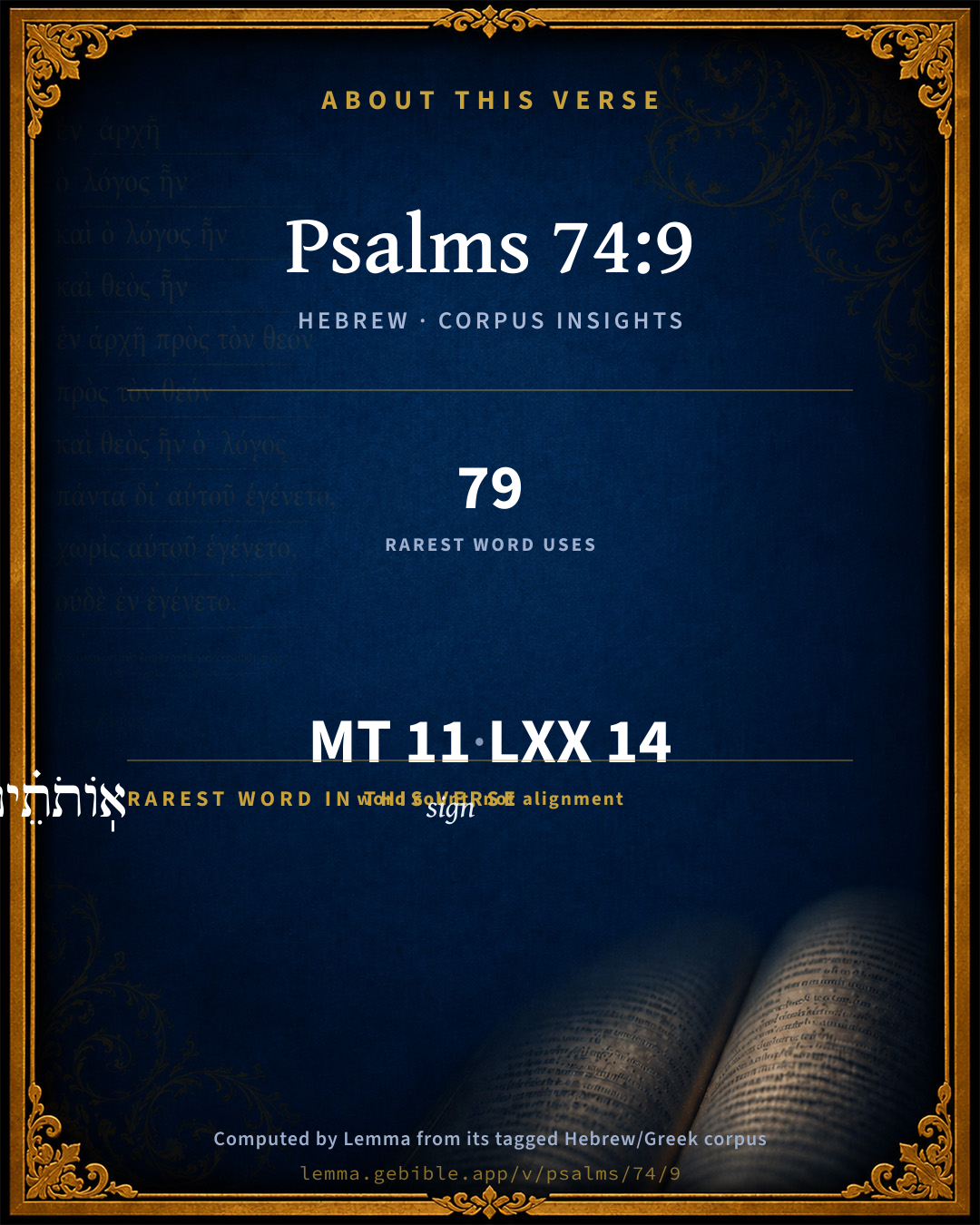
11
words
10
distinct lemmas
Wisdom
section

Grammatical profile

  • 2 verbs
  • 2 nouns
  • 2 prepositions
  • 1 adverb
  • 4 particles

Verb forms

  • רָ֫אִ֥ינוּ Qal · Perfect
  • יֹדֵ֥עַ Qal · Participle Active

Repetition

A word recurs within this verse — often emphatic in Hebrew:

Hebrew & Septuagint length

In English translation the verse runs 21 words from the Hebrew and 20 from the Septuagint (LXX English) — closely comparable.

A rough comparison of the two English renderings, which tokenize alike — not a word-level alignment.

Word counts can differ between the Hebrew and the Greek without any difference in meaning — e.g. the Hebrew direct-object marker אֵת has no separate Greek word, and Greek often adds the article ὁ.

In the original languages it is 11 Hebrew tokens and 14 Greek tokens — but the two are counted differently (Hebrew bundles its prefixes and suffixes into one token; the Greek is in lemma form), so that isn’t a like-for-like length.

Cross-references

10

Topical passages linked to Psalms 74:9 in the Treasury of Scripture Knowledge — connected by theme and wording, ordered by reader-vote popularity; previews shown in the World English Bible.

  • Amos 8:11 Behold, the days come," says the Lord Yahweh, "That I will send a famine in the land, Not a famine of bread, Nor a thirst for water, But of hearing the words of Yahweh.
  • Ezekiel 7:26 Mischief shall come on mischief, and rumor shall be on rumor; and they shall seek a vision of the prophet; but the law shall perish from the priest, and counsel from the elders.
  • 1 Samuel 3:1 The child Samuel ministered to Yahweh before Eli. The word of Yahweh was precious in those days; there was no frequent vision.
  • Lamentations 2:9 Her gates are sunk into the ground; he has destroyed and broken her bars: Her king and her princes are among the nations where the law is not; Yes, her prophets find no vision from Yahweh.
  • Exodus 12:13 The blood shall be to you for a token on the houses where you are: and when I see the blood, I will pass over you, and there shall no plague be on you to destroy you, when I strike the land of Egypt.
  • Exodus 13:9–10 It shall be for a sign to you on your hand, and for a memorial between your eyes, that the law of Yahweh may be in your mouth; for with a strong hand Yahweh has brought you out of Egypt.
  • Ezekiel 20:12 Moreover also I gave them my Sabbaths, to be a sign between me and them, that they might know that I am Yahweh who sanctifies them.
  • Micah 3:6 "Therefore night is over you, with no vision, And it is dark to you, that you may not divine; And the sun will go down on the prophets, And the day will be black over them.
  • Judges 6:17 He said to him, If now I have found favor in your sight, then show me a sign that it is you who talk with me.
  • Hebrews 2:4 God also bearing witness with them, both by signs and wonders, and by various works of power, and by gifts of the Holy Spirit, according to his own will?

Cross-references courtesy of OpenBible.info (CC BY 4.0).

Hebrew and Greek witnesses Masoretic Hebrew ↔ Greek Septuagint

The same verse in the two great witnesses to the Old Testament, shown verse-for-verse.

You’re reading Greek Psalm 73 (Hebrew Psalm 74). The Septuagint counts the superscription, so verse numbers can differ from the Hebrew — chapter-level alignment, not verse-by-verse. Numbering follows Rahlfs.

These are two independent witnesses, not word-aligned to each other, and the Septuagint is shown in lemma (dictionary) form.

Hebrew Psalms 74:9 Masoretic · Westminster Leningrad Codex

אֽוֹתֹתֵ֗ינוּ לֹ֥א רָ֫אִ֥ינוּ אֵֽין ע֥וֹד נָבִ֑יא וְלֹֽא אִ֝תָּ֗נוּ יֹדֵ֥עַ עַד מָֽה

We see no miraculous signs. There is no longer any prophet, Neither is there among us anyone who knows how long.

World English Bible · Public Domain

Greek LXX Greek Psalm 73:9 Septuagint · lemma form

ὁ σημεῖον ἐγώ οὐ ὁράω οὐ εἰμί ἔτι προφήτης καί ἐγώ οὐ γιγνώσκω ἔτι

We have not seen our signs; there is no longer a prophet; and God will not know us any more.

LXX2012 (modern English Septuagint) · Public Domain

Hebrew: Westminster Leningrad Codex (CC BY 4.0). Greek: Septuagint (public domain); English from LXX2012 (modern English Septuagint) (Public Domain). How the Septuagint differs from the Hebrew →

Commentary

Notes on Psalms 74:9 from classic Christian and Jewish commentators (each source and its license shown beneath its notes). The classic Christian expositions comment on the surrounding passage and are grouped to its opening verse, so a note may address several verses; the Jewish commentaries on the Tanakh (Rashi and others) are per-verse, so they appear only where the commentator wrote on this verse.

Lemma curates 59 commentaries, every one of them public domain or Creative Commons licensed, each selected and text-cleaned for this edition rather than reprinted as found. About our sources →

Trapp's Complete Commentary

John Trapp

Psa 74:9 We see not our signs: [there is] no more any prophet: neither [is there] among us any that knoweth how long.

Ver. 9. We see not our signs] Those testimonies of God’s special favour, the public ordinances, together with the legal ceremonies, which was then Christ in figure, q.d. we are utterly benighted as to thee-ward.

There is no more any prophet, &c.] Hence some conclude that this psalm was written about the end of the Babylonish captivity, when there was Chathimath Chazon, a sealing up of prophecy, as Dan 12:9, unless it were so that they had prophets, Jeremiah, Ezekiel, Daniel, &c., but took no notice of them, through extremity of calamity, as Isa 59:10.

Neither is there among us any] The want of the word, the stopping of the true ministers’ mouths, &c., should touch us to the quick.

John Trapp, A Commentary or Exposition upon All the Books of the Old and New Testament (1647–1656) — public domain. Text from a community e-Sword module.

The Biblical Illustrator

Joseph S. Exell

Psa_74:9

We see not our signs.

Signs of life

This psalm is clearly not one written by David. Verses 6, 7 prove that; but it is one of the psalms of the Exile. The signs here meant, which the writer mourns that he did not see, were certain outward marks of Gods special favour. It is said that there were five signs in the first temple which the second had not--the ark of the covenant; the fire from heaven; the Shechinah; the Urim and Thummim; the spirit of prophecy, for that spirit ceased with Malachi, and did not reappear until John the Baptist. Now, on this groundwork we may build up a spiritual interpretation. We may not always do this, but only where there is, as here, a real groundwork for it, and where there is a response to it in the heart. The Church of to-day often has to lament that she sees not her signs. In considering this, note--

I. The nature of their signs. They are marks of Gods favour, and there appear to be two classes of them.

1. Those which, if removed, would not remove the thing itself which they signify. The crown of a monarch, you may take that away, but he remains a monarch still. Remove the milestones on a road, but you do not remove the distances which they indicate. Banknotes also. But--

2. There are other signs which are constituent parts of the thing itself, so that the taking away of the sign is a taking away of the thing. For example, the lengthening days are a sign of spring; but if there be not this sign there is no spring. Now, of this sort of sign are those which the text tells of. Not, however, entirely. For good works may be absent, partly and for a time, but the life of grace may yet be present. And when good works are present they are not infallible signs of grace.

3. But for the most part the sign and the thing it indicates go together. As, the fear of the Lord; the spirit of grace and of supplication; repentance; faith in Christ; love to the Lords people and to Christ; the witness of the Spirit; a life consistent with the Gospel.

II. The seeing of these signs. What does this mean? It is implied that there are times when the signs can be seen, as well as when they cannot. Now, what is requisite to see them? Those that travel along the heavenward way have certain landmarks--Ebenezers, stones of help. But in order to see them there must be light, that told of in Psa_36:9; not the pale moonlight of speculation, nor the frosty northern light of cold doctrine, nor the meteor light--the ignis fatuus of delusion; not the mere phosphoric light, which dimly gleams by rubbing together rotten evidences; not the sparks of their own kindling, elicited by the collision of flinty hearts and steeled consciences; we want no light such as we can make, but the Lords light.

III. Why it is that we see not our signs. Some people say they can always see them. This is not true, and the belief of it full of evil. But the causes of our not seeing them are various: the smoke of infidelity; the fogs of unbelief; the valley of trouble; the sun may go down by the Lords bidding. But all this will be a source of sorrow and lamentation, for such things are no signs of grace, though not inconsistent with it. But you must have seen the signs before you can lament that you see them not. (J. C. Philpot.)

The prospects of the age

If it were suggested that there could be any parallel between our own prosperous, progressive, enlightened age, and those melancholy days to which the psalm relates, the supposition might at once be scouted as absurdity. Yet I am not so sure but that in respect at least of the one particular referred to in the text--the dearth of the greater order of men--some degree of parallel might not very fairly be argued.

I. First, then, as to the fact--how far this description of the text answers to anything that exists in our own times. I have in view chiefly the bearings of this subject on religion, but it is not in religion only, but in all the spheres of our thought and life that I think this falling off of the greater order of minds can be detected. We had a series of great poets in the early part and middle of last century. Where is the poet of the present day whose works are likely to live like theirs? We have had a succession of great writers of fiction--their books are on every ones shelves--but where is the writer of to-day whose books we would put in the same rank? We have had great musicians--Mozart, Handel, Beethoven, Haydn, and the like. Their compositions live. Who are producing pieces of the same grandeur? We have had a century of great statesmen. It is no disparagement of the men of the younger generation to say that they are not men of the calibre of those who have led the country for the last fifty or eighty years. We had a generation or two of great preachers--men like Chalmers, Guthrie, MacLeod. Once more the piety and teaching of the past generation gave us Christians, whose weight of religious character it was a pleasure to acknowledge--men reverent, sober-minded, deeply instructed in Gods Word, massive in Christian substance, matured and real in Christian experience; is the newer type of religious character--brighter and more attractive as it is in some of its aspects--characterized by anything like the same depth, solidity, and durableness?

II. THE causes of this apparent absence, in all spheres of life, of the greater order of men in our midst, and what are the possible remedies.

1. One thing which should give us hope is the fact that after every great and creative epoch in history, there comes necessarily a period of pause. The human mind cannot always be at its highest stretch. History does not flow on evenly, but in great ebbs and flows--in grand creative epochs, followed by long-breathing spaces, in times when the strongest call is made for great men, and they are drawn out and developed by the very magnitude of the crisis that calls for them, and quieter times, when people rejoice in the possessions they have won, and do not feel impelled to great efforts.

2. Again, it is to be remembered that after every great creative period which men live through, there comes a time when the results of that creative activity have to be gathered up; and this very process puts of necessity a check, for the time being, on further production. This, indeed, is how history proceeds--there is first a great burst of creative genius under the influence of some new idea or impulse; then, when the wealth of that new movement has been poured into the lap of the age, men have the new task laid upon them of sitting down and looking carefully into the nature of their treasure, taking stock of it, as it were, seeing what it really amounts to; getting to understand it, and working it out to its practical results. This is the labour of industry more than of creation, but it is equally essential to the worlds progress. There is another part of this task which is of great importance. With every great advance of thought or discovery--with every burst of new truth into the world--there is laid on those who receive it, the duty of adjusting it to the truth they already possess.

3. There are, however, special causes which do belong to the character of the present age which tend, I think, to explain more particularly the dearth of the greatest type of minds in our midst.

(1) It is obvious that from the very multiplicity of its possessions our age tends to diffusion rather than to concentration.

(2) Our age is critical rather than constructive.

(3) The bent of the present age has been to material ends rather than spiritual. (James Orr, D. D.)

Faith in signs and without them

The Israelites had formed a certain conception of God, and of His relation to them. They thought themselves to be His own peculiar people, and thought, therefore, that for them there would be a peculiar place among the nations of the earth. When they triumphed over their enemies, they regarded it as a sign of Gods presence with them. National supremacy was one of the signs of God. At the time of this psalm that sign was not to be seen. National supremacy there was none. What was the truth behind that dogma? What was it that was struggling for utterance in it? That truth, I believe, was this: that through them the world was to receive a universal religion. They mistook their true spiritual significance for a prophecy of national dominion over the world. And, therefore, they were looking for victories as signs of the Divine Presence. In times of defeat they had to say, We see not our signs. Again, they connected the Divine Presence specially with certain places. The sanctuaries were the peculiar dwelling-abodes of God--His places of revelation. But here are the enemies roaring in the midst of the congregation, and breaking down the carved work with axes and hammers; burning up all the synagogues of God in the land. No wonder they cry, We see not our signs. This disposition to fix upon certain signs of God is still with us, and it is the prolific source of religious despondency and of partial temporary eclipses of religious faith. Some, when their undertakings do not succeed, cry dolefully, We see not our signs. Others of us can maintain our spirit bravely enough until our sanctuaries are touched. One mans sanctuary is the Church. Another mans sanctuary is a theory about the Bible. The Bible is an infallible book, a Word of God indisputable. Question that theory, and they say they have no sign left, they cant be sure of God. Now, what are we doing when we thus choose signs of God? We are creating for ourselves the possibility, often the certainty, of overwhelming disappointments. We are liable to come to crises where such signs will fail us. In reality we have been setting up a little god of our own make as truly as if we had made an image of wood or stone, and the idol may be destroyed. I am glad to think that there is a faith without signs, and a faith that persists when things are apparently against us. And it is this faith which lies deepest in the human soul. This, I think, is evident even in the history of those who have looked for signs. When the signs do not appear, they are disappointed, they cry bitterly; but even then, as a rule, they pray! Their eclipses are only temporary. Indeed, nothing is more remarkable than the way in which religious faith, that apparently rests on some supposed evidences, can still live when those evidences are taken from it. This shows that the real root of faith was not in such evidences at all, but deeper in the soul of man. The sense of God belongs to us. And like this psalm, even when we have been expecting signs, and cannot see them, we pray to a God above the clouds, whose face is light and whose favour is life. Like the man in the Gospels we say, I believe, help Thou my unbelief. We may doubt all the arguments for Gods existence, declare this unsatisfactory and that untenable, and when every argument fails we find we believe in God still. We feel and know that He is here. Eternal Father, strong to save, Thy child lives in Thee. (T. R. Williams.)

The Biblical Illustrator, edited by Joseph S. Exell (c. 1880s–1900s) — public domain. Text from a community e-Sword module.

Joseph Benson's Commentary

Psa 74:9. We see not our signs — Those tokens of God’s gracious presence with us, which we and our ancestors used to enjoy. There is no more any prophet — Either, 1st, Any public teacher. We have few or none left to instruct us in the law of God, and in divine things. Or, 2d, Any extraordinary prophet, who can foretel things to come, as the next words explain it. For as for Jeremiah and Ezekiel, they might be dead when this Psalm was composed; and Daniel was involved in civil affairs, and did not teach the people as a prophet; and the prophetical spirit, which sometimes came upon him, and made those great discoveries to him which we read in his book, might possibly at this time suspend his influences. Besides, it is not unusual, in Scripture, to say there is none of a sort of persons or things, when there is a very great scarcity of them. Bishop Patrick thinks what is here said respecting there being no prophet, to tell the Jews how long the captivity would last, is a proof that this Psalm was written toward the end of that captivity.

Joseph Benson's Commentary on the Old and New Testaments (1811–1818) — public domain. Text from a community e-Sword module.

Keil & Delitzsch

C. F. Keil & F. Delitzsch

The worst thing the poet has to complain of is that God has not acknowledged His people during this time of suffering as at other times. "Our signs" is the direct antithesis to "their sings" (Psa 74:4), hence they are not to be understood, after Psa 86:17, as signs which God works. The suffix demands, besides, something of a perpetual character; they are the instituted ordinances of divine worship by means of which God is pleased to stand in fellowship with His people, and which are now no longer to be seen because the enemies have set them aside. The complaint "there is not prophet any more" would seem strange in the period immediately after the destruction of Jerusalem, for Jeremiah's term of active service lasted beyond this. Moreover, a year before (in the tenth year of Zedekiah's reign) he had predicted that the Babylonian domination, and relatively the Exile, would last seventy years; besides, six years before the destruction Ezekiel appeared, who was in communication with those who remained behind in the land. The reference to Lam 2:9 (cf. Eze 7:26) does not satisfy one; for there it is assumed that there were prophets, a fact which is here denied. Only perhaps as a voice coming out of the Exile, the middle of which (cf. Hos 3:4; Ch2 15:3, and besides Canticum trium puerorum, Psa 74:14 : καὶ οὐκ ἔστιν ἐν τῷ καιρῷ τούτῳ ἄρχων καὶ προφήτης καὶ ἡγούμενος) was truly thus devoid of signs or miracles, and devoid of the prophetic word of consolation, can Psa 74:9 be comprehended. The seventy years of Jeremiah were then still a riddle without any generally known solution (Dan. 9). If, however, synagogues are meant in Psa 74:8, Psa 74:9 now too accords with the like-sounding lament in the calamitous times of Antiochus (1 Macc. 4:46; 9:27; 14:41). In Psa 74:10 the poet turns to God Himself with the question "How long?" how long is this (apparently) endless blaspheming of the enemy to last? Why dost Thou draw back (viz., ממּנוּ, from us, not עלינוּ, Psa 81:15) Thy hand and Thy right hand? The conjunction of synonyms "Thy hand and Thy right hand" is, as in Psa 44:4, Sirach 33:7, a fuller expression for God's omnipotent energy. This is now at rest; Psa 74:11 calls upon it to give help by an act of judgment. "Out of the midst of Thy bosom, destroy," is a pregnant expression for, "drawing forth out of Thy bosom the hand that rests inactive there, do Thou destroy." The Chethb חוקך has perhaps the same meaning; for חוק, Arab. ḥawq, signifies, like חיק, Arab. ḥayq, the act of encompassing, then that which encompasses. Instead of מחיקך (Exo 4:7) the expression is מקּרב חיקך, because there, within the realm of the bosom, the punitive justice of God for a time as it were slumbers. On the כלּה, which outwardly is without any object, cf. Psa 59:14.

Keil & Delitzsch — Biblical Commentary on the Old Testament (1861–1891) — public domain (CC PDM 1.0). Text via the HelloAO Bible API. (Old Testament only.)

J. A. Alexander on Psalms

Joseph Addison Alexander

Psa 74:9. Our signs we see not; there is no more (any) prophet, and (there is) not with us (any one) knowing until what time, or how long, these things are to last. By signs we are here to understand the tokens of God's presence, and of Israel's peculiar relation to him. One of these is then specified, to wit, the gift of prophecy, which seemed to cease at the time of the Babylonian conquest, although afterwards renewed. Even Jeremiah's ministry may be considered as then closing. The complaint of this, as of a recent loss, shews that the period meant is not that of the persecutions under Antiochus Epiphanes, when the gift of prophecy had been withdrawn for many generations.

Joseph Addison Alexander, The Psalms Translated and Explained (1850) — public domain. Text from a community e-Sword module.

Geneva Bible (1599)

Geneva Bible translators

They lament that they have no Prophet among them to show them how long their misery should endure.

Geneva Bible (1599) marginal notes — public domain. Text via Bolls.life.

Adam Clarke's Commentary

Verse 9. We see not our signs] "They have taken away all our trophies, and have left us no memorial that God has been among us. Even thou thyself hast left us destitute of all those supernatural evidences that have so often convinced us that thou wert among us of a truth." But we may say that they were not totally destitute even of these. The preservation of Daniel in the lion's den, and of the three Hebrews in the fiery furnace; the metamorphosis of Nebuchadnezzar; the handwriting that appeared to Belshazzar; were all so many prodigies and evidences that God had not left them without proofs of his being and his regard.

There is no more any prophet] There was not one among them in that place that could tell them how long that captivity was yet to endure. But there were prophets in the captivity. Daniel was one; but his prophecies were confined to one place. Ezekiel was another, but he was among those captives who were by the river Chebar. They had not, as usual, prophets who went to and fro through the land, preaching repentance and remission of sins.

Adam Clarke's Commentary on the Bible (1810–1826) — public domain. Text from a community e-Sword/MySword module.

John Calvin's Commentaries

9. We see not our signs. Here the pious Jews show that their calamities were aggravated from the circumstance that they had no consolation by which to alleviate them. It is a powerful means of encouraging the children of God, when he enables them to cherish the hope of his being reconciled to them, by promising, that even in the midst of his wrath he will remember his mercy. Some limit the signs here spoken of to the miracles by which God had in the days of old testified, at the very time when he was afflicting his people, that he would, notwithstanding, still continue to be gracious to them. But the faithful rather complain that he had removed from them the tokens of his favor, and had in a manner hidden his face from them. We are overwhelmed with darkness, as if the prophet had said, because thou, O God! dost not make thy face to shine upon us as thou hast been accustomed to do. Thus it is common for us to speak of persons giving us signs either of their love or of their hatred. In short, God’s people here complain not only that the time was cloudy and dark, but also that they were enveloped in darkness so thick, that there did not appear so much as a single ray of light. As to be assured by the prophets of future deliverance was one of the chief signs of God’s favor, they lament that there is no longer a prophet to foresee the end of their calamities. From this we learn that the office of imparting consolation was committed to the prophets, that they might lift up the hearts which were cast down with sorrow, by inspiring them with the hope of Divine mercy. They were, it is true, heralds and witnesses of the wrath of God to drive the obstinate and rebellious to repentance by threatenings and terrors. But had they merely and without qualification denounced the vengeance of God, their doctrine, which was appointed and intended for the salvation of the people, would have only been the means of their destruction. Accordingly, the foretelling of the issue of calamities while yet hidden in the future, is ascribed to them as a part of their office; for temporary punishments are the fatherly chastisements of God, and the consideration that they are temporary alleviates sorrow; but his continual displeasure causes poor and wretched sinners to sink into utter despair. If, therefore, we also would find matter for patience and consolation, when we are under the chastening hand of God, let us learn to fix our eyes on this moderation on the part of God, by which he encourages us to entertain good hope; and from it let us rest assured, that although he is angry, yet he ceases not to be a father. The correction which brings deliverance does not inflict unmitigated grief: the sadness which it produces is mingled with joy. This end all the prophets endeavored to keep in view in the doctrine which they delivered. They, no doubt, often make use of very hard and severe language in their dealings with the people, in order, by inspiring them with terror, to break and subdue their rebellion; but whenever they see men humbled, they immediately address them in words of consolation, which, however, would be no consolation at all, were they not encouraged to hope for future deliverance.

The question may here be asked, whether God, with the view of assuaging the sadness arising from the chastisement, which he inflicted, always determined the number of years and days during which they would last? To this I answer, that although the prophets have not always marked out and defined a fixed time, yet they frequently gave the people assurance that deliverance was near at hand; and, moreover, all of them spoke of the future restoration of the Church. If it is again objected, that the people in their affliction did wrong in not applying to themselves the general promises, which it is certain were the common property of all ages, I answer, that as it was God’s usual way to send in every affliction a messenger to announce the tidings of deliverance, the people, when at the present time no prophet appeared to be expressly sent for that purpose, not without cause complain that they were deprived of the signs of the Divine favor which they had been accustomed to enjoy. Until the coming of Christ it was highly necessary that the memory of the promised deliverance should be renewed in every age, to show the people of God that to whatever afflictions they might be subjected, he still continued to care for them, and would afford them succor.

John Calvin's Commentaries (1540-1563) — public domain. Text from the Calvin Translation Society English edition (1840s-50s) via the Christian Classics Ethereal Library (ccel.org). Calvin's coverage is partial (roughly two-thirds of the Bible); uncommented books and verses are honest gaps, never fabricated. The 19th-century editor's footnotes and remarks are omitted so the notes are faithfully Calvin's own voice.

Ellicott's Commentary for English Readers

(9) We see not our signs . . .—It is natural to take this statement in direct contrast to what Psa_74:4 (see Note) says of the heathen signs. While these abominations—rallying points of savage profanity—were visibly set up, the tokens of the invisible God’s presence, His wonders wrought for Israel, are no more seen.

There is no more any prophet.—This was the constant lament of the Maccabæan period (1Ma_4:46; 1Ma_9:27; 1Ma_14:41), and suits no earlier time—at least none into which the rest of the psalm would fit. During the exile period Jeremiah and Ezekiel were prophesying, and the complaint took quite a different form then and probably for some time afterwards (Lam_2:9; Eze_7:26). The full desolation of the situation is told in “Song of the Three Children,” Psa_74:15; “Neither is there at this time prince, or prophet, or leader, or burnt offering, or sacrifice, or oblation, or incense, or place to sacrifice before Thee or find mercy.”

Neither is there among us any that knoweth how long.—This, too, carries us on past the time of Jeremiah, who had given an exact date for the termination of the exile. Probably (if the arrangement of the words is right) we have here another expression of a widely-spread feeling—a feeling which inspired the apocalyptic literature, which had for its object partly to answer this question, how long? But it has been suggested, as more in the Hebrew style, to end the clause with the word know, and make it directly parallel with the preceding (“there is neither a prophet nor one who knows”), and carry on the interrogative to the next verse, where its repetition would add much to the force of the question there put. (Burgess.)

A Bible Commentary for English Readers, edited by Charles John Ellicott (1878–1897) — public domain. Text from a community e-Sword module.

The Cambridge Bible for Schools and Colleges

gen. ed. J. J. S. Perowne

9. our signs] The outward and visible symbols of our religion, such as sabbath and festival, which God “had caused to be forgotten in Zion” (Lam_2:6). The sabbath is spoken of as a sign in Exo_31:13; Exo_31:17; Eze_20:12; Eze_20:20. The words would of course be specially appropriate to the time at which Antiochus attempted to suppress all the distinctive ordinances of the Jewish religion (1Ma_1:45-46; 1Ma_1:60-61). Note the contrast with the ‘signs’ of hostile domination, Psa_74:4.

there is no more any prophet] A characteristic of the Maccabaean age (1Ma_4:46; 1Ma_9:27; 1Ma_14:41): but the complaints of the exile are not dissimilar (Lam_2:9; Eze_7:26); and even after the Return the angel in Zechariah’s vision (Zec_1:12) asks ‘How long?’

The Cambridge Bible for Schools and Colleges (gen. ed. J. J. S. Perowne; Cambridge University Press, 1878–1918) — public domain. Text from a community e-Sword module.

John Gill's Exposition

O God, how long shall the adversary reproach?.... The name of God, as in the next clause, the divine Persons and perfections, the purposes and providence of God, his people, ways, worship, truths, and ordinances:

shall the enemy blaspheme thy name for ever? The "adversary" and "enemy" being in the singular number, may intend some particular one, as antichrist; who is emphatically and eminently "the enemy" of God, he opposing himself to, and exalting himself above, all that is called God; and the adversary of Christ, as his name shows; not only setting himself in his room and stead, but undermining him in all his offices; changing his laws as a King, dishonouring his sacrifice and intercession as a priest, and doing injury to his word and ordinances as a Prophet; and who has a mouth speaking blasphemies against God, his name, and tabernacle, heaven, and they that dwell therein, angels and saints, Rev 13:5. He reproaches and blasphemes God himself, by showing himself to be God, by suffering himself to be so called, and to be worshipped as if he was God; by taking infallibility to himself, and setting up image worship, and obliging persons to it: he reproaches and blasphemes the Son of God, in whom the name of God is, by pretending to be his vicar on earth, and head of the church; to transubstantiate the bread and wine into the body and blood of Christ; and to offer him up again in the blasphemous service of the mass: he reproaches and blasphemes his Gospel, which is his name, Act 9:15, by introducing doctrines contrary to it, as the doctrines of merit, of works of supererogation, and justification by works; and the Scriptures, which bear the name and authority of God, by making them a nose of wax, taking upon himself to be the infallible interpreter of Scripture, and sole judge of controversies; by setting up his own unwritten traditions upon an equality with them, and forbidding the use of them to the people in their mother tongue: and he reproaches and blasphemes his name and authority by assuming it to himself in civil things, deposing and setting up kings at his pleasure; in religious affairs, dispensing with the laws of God, and teaching for doctrines the commandments of men; yea, in matters of salvation, giving out pardons and indulgences, pretending to open and shut heaven at pleasure. Moreover, these terms may be understood of many enemies and adversaries, even of all the enemies of the grace of God, and person of Christ; such reproach and blaspheme the name of God the Father; by denying some of his perfections, as his sovereignty, omniscience, and punitive justice, and by charging his decrees with injustice, insincerity, and cruelty; they reproach and blaspheme the name of Christ, by denying his deity, eternal sonship, and distinct personality, and by speaking contemptuously of his righteousness, blood, and sacrifice; and they do despight unto the Spirit of grace, and speak evil of his person, and the operations of his grace on the souls of men; and such a day of rebuke and blasphemy is the present one: and these things give good men that observe them a great concern for the name of God, who are ready to fear there will be no end to these reproaches and blasphemies; but there will, the time is coming when the name of the Lord will be excellent in all the earth, and the Lord alone shall be exalted; but it is not known how long it will be to it.

John Gill's Exposition of the Whole Bible (1746–1763) — public domain (CC PDM 1.0). Text via the HelloAO Bible API.

Albert Barnes' Notes on the Bible

We see not our signs - The emblems of worship, or the national emblems or banners, which we have been accustomed to see. There are no signals or tokens of our nationality in the land. All have been removed by the invaders, and we see everywhere evidences of the presence of a foreign power. The marks of our own independency are gone. The nation is subdued and conquered.

There is no more any prophet - No one is raised up as the special messenger of God to assure us of his favor, or to take the lead in the national troubles. In times of danger God had been accustomed to send to them some special teacher who would declare his will, direct the nation what to do, and give encouraging assurances that the national troubles would cease, and that deliverance would come. They saw no such messengers of God now. This is not inconsistent with the supposition that this psalm was written before the captivity, and in the time of the Chaldean invasion, or with the supposition that Jeremiah was then alive, for the meaning may be, not that literally there was no prophet in the land, but that there was no one who had come from God as a special messenger of comfort and deliverance. Ruin had come upon them, and there were no indications of divine interposition in their behalf.

Neither is there among us any that knoweth how long - How long these calamities are to continue. No one can tell when they are to end. The prophetic office seemed to have ceased among them. It was renewed, however, after the captivity, in the case of Daniel, Ezra, Nehemiah, Haggai, and Malachi.

Albert Barnes' Notes on the Bible (1834–1885) — public domain. Text from a community e-Sword/MySword module.

Matthew Poole's English Annotations

Our signs, i.e. those tokens of God’s gracious presence which we and our ancestors formerly used to enjoy; either,

1. Miracles wrought for us, which are called

signs, Psa 78:43; 135:9. Or,

2. The ordinances of God, the temple, and ark, and sacrifices, and solemn feasts, all which were signs between God and his people.

Any prophet: either,

1. Any teacher. We have few or no teachers left to us. Or,

2. Any extraordinary prophet, who can foretell things to come, as the next words explain it. For as for Ezekiel and Jeremiah, they might be dead when this Psalm was composed; and Daniel was involved in civil affairs, and did not teach the people as a prophet; and the prophetical Spirit which sometimes came upon him, and made those great discoveries to him which we read in his book, might possibly at this time suspend his influences. Besides, it is not unusual in Scripture, to say that there is none of a sort of persons or things, when there is a very great scarcity of them. But others make this their great argument, that this Psalm speaks of that persecution in the time of Antiochus, when indeed there was no prophet at all.

How long; either,

1. How long their captivity should continue; for though seventy years were determined, yet there might arise doubts among them, as there now are among us, whence they were to be computed, which might make their end uncertain. Or,

2. How long they should lie under reproach, as it follows, Psa 74:10, which they really did, and might foresee that they should, even after the expiration of their captivity, Neh 1:3.

Matthew Poole's English Annotations on the Holy Bible (1683–1685) — public domain. Text from a community e-Sword/MySword module.

The Treasury of David

Charles H. Spurgeon

Ver. 9. We see not our signs. Alas, poor Israel! No Urim and Thummim blazed on the High Priest's bosom, and no Shechaniah shone from between the cherubim. The smoke of sacrifice and cloud of incense no more arose from the holy hill; solemn feasts were suspended, and even circumcision, the covenant sign, was forbidden by the tyrant. We, too, as believers, know what it is to lose our evidences and grope in darkness; and too often do our churches also miss the tokens of the Redeemer's presence, and their lamps remain untrimmed. Sad complaint of a people under a cloud!

There is no more any prophet. Prophecy was suspended. No inspiring psalm or consoling promise fell from bard or seer. It is ill with the people of God when the voice of the preacher of the gospel fails, and a famine of the word of life falls on the people. God sent ministers are as needful to the saints as their daily bread, and it is a great sorrow when a congregation is destitute of a faithful pastor. It is to be feared, that with all the ministers now existing, there is yet a dearth of men whose hearts and tongues are touched with the celestial fire.

Neither is there any among us that knoweth how long. If someone could foretell an end, the evil might be borne with a degree of patience, but when none can see a termination, or foretell an escape, the misery has a hopeless appearance, and is overwhelming. Blessed be God, he has not left his church in these days to be so deplorably destitute of cheering words; let us pray that he never may. Contempt of the word is very common, and may well provoke the Lord to withdraw it from us; may his long suffering endure the strain, and his mercy afford us still the word of life.

Ver. 9. We see not our signs. As if they had said, heretofore God was wont to give us signs and tokens, he would even work miracles for us, or he would send a prophet to instruct and advise us what to do; we had those who could tell us how long, that is, how long our troubles should last, and when we should have our expected end of them; but now we are in trouble, and no man can tell us how long, now we are left to the wide world, to shift for ourselves as well as we can; the Lord will not advise us what to do, nor give us his mind what's best to be done, or how to proceed; thus deplorable was their condition upon the hiding of God's face from them. Joseph Caryl.

Ver. 9. We see not our signs. These signs, which he mourned that he did not see, were certain outward marks of God's special favour, certain testimonies of his presence, certain memorials that he was with them to bless them. And it is said that there were five things in Solomon's temple destroyed by Nebuchadnezzar, which were not in the second temple, which was erected after the Babylonish captivity. Five memorials or tokens of God's special presence were then wanting. One was the ark of the covenant; another, the fire from heaven upon the brazen altar; the third, the Shechaniah, or cloud that rested upon the mercyseat; the fourth, the Urim and Thummim which were in the breastplate of the high priest; and the fifth, the spirit of prophecy. For though there were the prophets, Haggai, Zechariah, and Malachi, at the time of, and shortly after, the restoration; yet the spirit of prophecy ceased with Malachi, and did not reappear until John the Baptist, the forerunner of the Lord Jesus... The lamentation of the church here, then, was, that she saw not her signs. So now, the church of the living God, the regenerate family of Zion, have often reason to pour out the same melancholy complaint. Signs of God's favour, marks and testimonies of his work of grace upon their souls, are often so out of sight, so buried in obscurity, so enveloped in clouds of darkness, that the living family are compelled, from soul feeling, to take up the language of lamentation here expressed, and say, We see not our signs. J. C. Philpot. 1802-1869.

Ver. 9. Our signs. The ordinary signs of Israel being God's peculiar people are the passover (Ex 12:13), the Sabbath (Ex 21:13), the temple, the altar, the sacrifices; the extraordinary ones are God's miracles wrought in his people's behalf (Ps 78:43). A. R. Fausset.

Ver. 9. There is no more any prophet. By us it ought to be observed what they do not say: It is not, --here is no more any giant or warlike leader who may deliver us from the adversary: but, there is no more any prophet. And yet when the prophets were with them, they were contemptible in the eyes of all, maltreated by the wicked and put to death. Musculus.

Ver. 9. (first clause).

I. There are such things as signs, that is, tokens

and marks of God's special favour to the soul.

II. There is also a seeing those signs when God, the

Holy Ghost, is pleased to shine upon them.

III. There is a third state, where there is not seeing

the signs, those signs being enveloped in darkness,

dimness, and obscurity. J. C. Philpot.

Psalms 74:10*

Charles H. Spurgeon's The Treasury of David (1869–1885) — public domain. Psalms only. Text from a community e-Sword/MySword module.

Whedon's Commentary on the Bible

Daniel D. Whedon

9. We see not our signs—The word rendered “our signs” implies tokens or answers of prayer, of a general character, connected with the instituted ordinances of worship. These they had not, now that their temple and altars were destroyed, and they in exile.

There is no more… prophet—For Jeremiah did not accompany the exiles, but was released at Ramah and returned to Mizpah. Jer_40:1-6. Ezekiel, however, did live and prophesy among the exiles of Mesopotamia, by the river Chebar, or Chaboras, (Eze_1:1-3,) but did not go into Babylonia. The complaint strongly indicates that the psalm was written after Ezekiel’s death, and before Daniel came into public repute as a prophet.

Neither is there among us any that knoweth how long—They did not know how long the captivity was to continue, though Jeremiah had foretold it, (Jer_25:12,) and afterward wrote to the exiles more specifically as to the time. Jer_29:10. For the same cause the disciples understood not the Saviour’s prediction of his own death and sufferings.

Luk_18:31-34. It was against their traditional faith, not against their sacred writings, and they had not risen to the height of the new dispensation.

Daniel D. Whedon (gen. ed.), Commentary on the Old and New Testaments (1874–1909) — public domain. Text from a community e-Sword module.

The Pulpit Commentary

We see not our signs. Some suppose "standards" to be meant, as in ver. 4, where the same word is used; but it is, perhaps, better to understand, with Dr. Kay, "Divine ordinances, which were standing signs of God"s presence as the tabernacle, the sacrifices, the sabbaths." There is no more any prophet. It has been said that this shows the psalm not to have been written on the occasion of the destruction of Jerusalem by Nebuchadnezzar, since Jeremiah, Ezekiel, and Daniel were, all of them, then living. But the writer only means to say that there are no prophets in Palestine, where he is residing. Jeremiah in Egypt, Ezekiel on the banks of Chebar, Daniel in Babylon, are nothing to him, even if he knows of their existence, and in no way fill up the gap whereof he complains. Neither is there among us any who knoweth how long. Jeremiah"s prophecy of the seventy years (Jer_25:11, Jer_25:12) did net remove the doubt, since it was uncertain from what event the seventy years were to be counted. Jeremiah"s prophecies, moreover, were not yet, in all probability, collected into a volume, and so may not have been known to the psalmist.

"We see not our signs.

It is said that there were five signs in the first temple which the second had not the ark of the covenant, the fire from heaven, the Shechinah, the Urim and Thummim, and the spirit of prophecy. So in the Church of Christ there are signs which are very blessed for us to see.

I SIGNS OF WHAT? it will be asked. Of the presence, the power, the love of the Lord in our midst. This was what the signs in the first temple told of.

II WHAT ARE THESE SIGNS?

1. The attention of men around.

2. The work of conversion going on.

3. Witness of believers.

4. Their love to one another and to their fellow men, because of their love to God.

5. Their peace and joy in God.

III THE DIFFERENT RELATIONS BETWEEN THE SEEING AND THESE SIGNS.

1. There tray be neither. It is better there should be no fancied seeing, if the reality be not there. For:

2. There may be the seeing, and not the signs.

3. There may be the signs, and yet not the seeing.

4. There may be both. This is most blessed of all. S.C.

The Pulpit Commentary (1880–1919), ed. H.D.M. Spence-Jones & Joseph S. Exell — public domain. Text from a community e-Sword module.

John Wesley's Explanatory Notes

Signs - Those tokens of God's gracious presence, which we used to enjoy. The temple and ark, and sacrifices, and solemn feasts, were signs between God and his people. Prophet - Who can foretell things to come. Probably Ezekiel and Jeremiah were dead when this psalm was composed; and David was involved in civil affairs, and did not teach the people as a prophet. Knoweth - How long their captivity should continue.

John Wesley, Explanatory Notes Upon the Whole Bible (1754–1765) — public domain. Text via the GEBible commentary corpus.

unfoldingWord translationNotes

Door43 World Missions Community

General Information:

Asaph is addressing God about the destruction he sees.

We do not see any more signs

Possible meanings are 1) "We do not see any more miraculous signs from God" or 2) "All our sacred symbols are gone" or 3) the "signs" are the flags and symbols of an army representing the army itself. AT: "They have completely destroyed our army" (See: Metaphor and Metonymy)

How long, God, will the enemy throw insults at you?

This can be translated as a statement. AT: "God, the enemy has been throwing insults at you for too long!" (See: Rhetorical Question)

Will the enemy blaspheme your name forever?

This can be translated as a statement. AT: "It seems as if you will never stop the enemy from blaspheming your name!" (See: Rhetorical Question)

blaspheme your name

The word "name" is a metonym for God himself. AT: "say that you are bad" or "insult you" (See: Metonymy)

Why do you hold back your hand, your right hand?

The psalmist speaks of God as if he had a physical body. This can be translated as a statement. AT: "Stop holding back your hand, your right hand!" (See: Rhetorical Question and Personification)

hold back your hand

Here the word "hand" is a metonym for power. AT: "not show your power" or "not use your power to destroy your enemies" (See: Metonymy and Assumed Knowledge and Implicit Information)

your right hand

"your strongest hand"

Take your right hand from your garment

The psalmist speaks of God as if he had a physical body. "Stop hiding your power and take action" (See: Metonymy and Personification)

translationWords

miracle

sign

God

prophet

blasphemy

name

eternity

hand

unfoldingWord translationNotes — © Distant Shores Media and the Door43 World Missions Community, licensed CC BY-SA 4.0. Source: git.door43.org/Door43/en_tn.

Rashi

Rabbi Shlomo Yitzchaki (Rashi)

our signs which You promised us through Your prophets—we have not seen them in the many days that we have been in exile. Asaph prophesied concerning the days of the (last) exile.

how long How long we will be in this trouble.

Rashi on the Tanakh — English translations: “The Judaica Press complete Tanach with Rashi, translated by A. J. Rosenberg” (CC BY 4.0); “Pentateuch with Rashi's commentary by M. Rosenbaum and A.M. Silbermann, 1929-1934” (public domain); “The Metsudah Tanach series, Lakewood, N.J” (CC BY 4.0); and “The Book of Joshua, Metsudah Publications, 1997” (CC BY 4.0). Text via Sefaria.

Lesson kit

Teaching starters — assembled from the data on this page, not authored interpretation. Every prompt links to the verse data it draws on. Edit before teaching.

Psalms, in the Wisdom, opens this verse with 11 words (10 distinct Hebrew lemmas). Its most distinctive word is ʼôwth (“sign”). A historical commentator’s framing appears above. Read the whole chapter for the surrounding context.

Discussion questions

  1. What does “sign” (ʼôwth) contribute to the verse as a whole?
  2. Amos 8:11 shares this passage’s theme. How do the two illuminate each other?
  3. “not” occurs 2× in this one verse. What is the effect of the repetition?
  4. The translations on this page render this verse differently — a whole-verse word diff, not a word-by-word alignment. What might account for the different wordings?
  5. The verb «רָ֫אִ֥ינוּ» is Qal Perfect. How does its form color the action?
  6. Reading how Trapp's Complete Commentary and The Biblical Illustrator read this verse, where do the two commentators agree and where do they part?

Things to notice

Reading settings

Reading text

Shown beneath each verse's original-language words.

Old Testament
Old Testament edition

Read the OT as the Masoretic Hebrew (MT) or the Greek Septuagint (LXX).

English shown for the Greek Septuagint (in the Hebrew ↔ Greek comparison).

Comparing translations? Open the Compare panel on any verse page to stack up to four side by side.