Song of Solomon 4:10

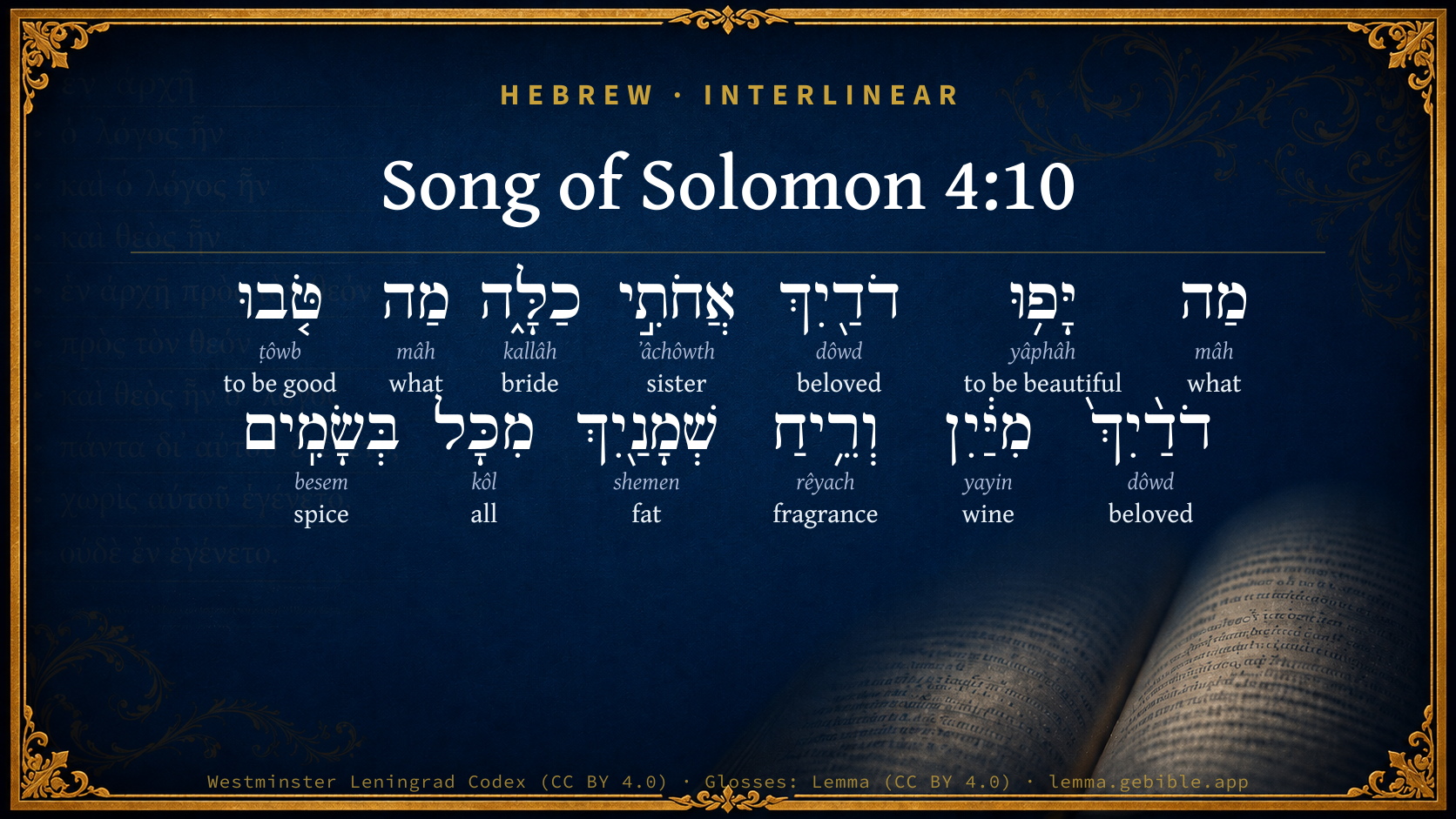
Hebrew (Westminster Leningrad Codex) Song of Solomon 4:10 appears in the Hebrew Old Testament. The text above is from the Westminster Leningrad Codex. Each word links to its Strong’s number, a concise gloss, and parsing drawn from the Open Scriptures Hebrew Bible morphology. Click any word for its full Brown-Driver-Briggs (BDB) entry.
Download image
Cite this verse

Song of Solomon 4:10 (World English Bible). Public Domain. Lemma interlinear Bible study tool, https://lemma.gebible.app/v/song-of-solomon/4/10.

Show BibTeX & RIS
BibTeX
RIS
English Translation
How beautiful is your love, my sister, my bride! How much better is your love than wine! The fragrance of your perfumes than all manner of spices!
World English Bible · Public Domain
Download a study sheet

One document with this verse’s original text, its word-by-word gloss line, the meaning frame, cross-references with their text, attributed commentary, and full source and license credits — printable, and it pastes into notes with its structure intact.

This verse Autodidact and up

Study sheet (.html) Plain text (.txt)

A passage Seminary Student

Up to 50 verses in one chapter. A passage sheet keeps up to 6 commentary sources and 12 cross-references per verse, in the order this page ranks them, and says so on the sheet whenever that leaves anything out. Ask for a single verse and you get the Autodidact verse sheet above.

Everything on this page stays free to read, with no account — the sheet is a download of what is already on screen, not access to it.

Want to remove ads? Support Godless Engineer
Compare translations 3

The same verse in 3 English versions, stacked beneath the original-language interlinear above. Click any original word for its lexicon entry.

Each is an independent rendering of the whole verse — the interlinear is not word-aligned to these translations.

Highlighted words mark where these versions differ — a whole-verse word diff, not a word-by-word alignment.

  • World English Bible Public Domain
    How beautiful is your love, my sister, my bride! How much better is your love than wine! The fragrance of your perfumes than all manner of spices!
  • King James Version Public Domain
    How fair is thy love, my sister, my spouse! how much better is thy love than wine! and the smell of thine ointments than all spices!
  • unfoldingWord Literal Text CC BY-SA 4.0
    How your love is beautiful, my sister, bride! How your love better than wine and the smell of your oils than all spices!

unfoldingWord Literal Text — © unfoldingWord, licensed CC BY-SA 4.0. Word-aligned USFM3 via Door43 (git.door43.org/unfoldingWord/en_ult).

Versions to compare (up to 4)

3 of 4 selected

Show all 18 translations

Every available English version of this verse, each an independent rendering of the whole verse.

  • World English Bible Public Domain
    How beautiful is your love, my sister, my bride! How much better is your love than wine! The fragrance of your perfumes than all manner of spices!
  • Berean Standard Bible Public Domain
    How delightful is your love, my sister, my bride! Your love is much better than wine, and the fragrance of your perfume than all spices.
  • Majority Standard Bible Public Domain
    How delightful is your love, my sister, my bride! Your love is much better than wine, and the fragrance of your perfume than all spices.
  • King James Version Public Domain
    How fair is thy love, my sister, my spouse! how much better is thy love than wine! and the smell of thine ointments than all spices!
  • American Standard Version (1901) Public Domain
    How fair is thy love, my sister, `my' bride! How much better is thy love than wine! And the fragrance of thine oils than all manner of spices!
  • Revised Version (1885) Public Domain
    How fair is thy love, my sister, my bride! how much better is thy love than wine! and the smell of thine ointments than all manner of spices!
  • Geneva Bible (1599) Public Domain
    My sister, my spouse, how faire is thy loue? howe much better is thy loue then wine? and the sauour of thine oyntments then all spices?
  • Douay-Rheims (1899) Public Domain
    How beautiful are thy breasts, my sister, my spouse! thy breasts are more beautiful than wine, and the sweet smell of thy ointments above all aromatical spices.
  • Young's Literal Translation Public Domain
    How wonderful have been thy loves, my sister-spouse, How much better have been thy loves than wine, And the fragrance of thy perfumes than all spices.
  • Literal Standard Version CC BY-SA 4.0
    How beautiful have been your loves, my sister-spouse, || How much better have been your loves than wine, || And the fragrance of your perfumes than all spices.
  • Unlocked Literal Bible CC BY-SA 4.0
    How beautiful is your love, my sister, my bride! How much better is your love than wine, and the fragrance of your perfume than any spice.
  • unfoldingWord Literal Text CC BY-SA 4.0
    How your love is beautiful, my sister, bride! How your love better than wine and the smell of your oils than all spices!
  • Darby Bible Public Domain
    How fair is thy love, my sister, [my] spouse! How much better is thy love than wine! And the fragrance of thine ointments than all spices!
  • World Messianic Bible Public Domain
    How beautiful is your love, my sister, my bride! How much better is your love than wine, the fragrance of your perfumes than all kinds of spices!
  • Webster's Bible Public Domain
    How fair is thy love, my sister, my spouse! how much better is thy love than wine! and the smell of thy ointments than all spices!
  • Free Bible Version CC BY-SA 4.0
    How wonderful is your love, my sister, my bride! Your love is sweeter than wine. The way you smell from your perfumed oils is better than any spice.
  • Bible in Basic English Public Domain
    How fair is your love, my sister! How much better is your love than wine, and the smell of your oils than any perfume!
  • JPS Tanakh (1917) Public Domain
    How fair is thy love, my sister, my bride! how much better is thy love than wine! and the smell of thine ointments than all manner of spices!

Literal Standard Version (2020), Covenant Press — licensed CC BY-SA 4.0. Text via the HelloAO Bible API (eBible.org). Unlocked Literal Bible (unfoldingWord) — licensed CC BY-SA 4.0. Text via the HelloAO Bible API (eBible.org). unfoldingWord Literal Text — © unfoldingWord, licensed CC BY-SA 4.0. Word-aligned USFM3 via Door43 (git.door43.org/unfoldingWord/en_ult). Free Bible Version, Dr. Jonathan Gallagher — licensed CC BY-SA 4.0. Text via the HelloAO Bible API (eBible.org).

Word by word

More ways to search: Search by grammar → Find every occurrence → Compare this word →

Practice this passage: Drill this verse → Learn its vocabulary →

יָּפ֥וּ
yâphâh
H3302
“to be beautiful”
Verb, Qal, Perfect, 3rd Person, Common, Plural
Part of Speech
Verb
Stem
Qal
Form
Perfect
Person
3rd Person
Gender
Common
Number
Plural
Full BDB Definition

Origin: a primitive root

TWOT: 890

to be bright, be beautiful, be handsome, be fair - (Qal) to be beautiful - (Piel) to beautify - (Pual) to be beautiful - (Hithpael) to beautify oneself
  1. מַה mâh H4100 “what” Particle, Interrogative
  2. דֹדַ֖יִךְ dôwd H1730 “love · your” Noun, Common, Masculine, Plural, Construct + Suffix, Personal, 2nd Person, Feminine, Singular
  3. אֲחֹתִ֣י ʼâchôwth H269 “sister · my” Noun, Common, Feminine, Singular, Construct + Suffix, Personal, 1st Person, Common, Singular
  4. כַלָּ֑ה kallâh H3618 “bride” Noun, Common, Feminine, Singular, Absolute
  5. מַה mâh H4100 “what” Particle, Interrogative
  6. טֹּ֤בוּ ṭôwb H2895 “to be good” Verb, Qal, Perfect, 3rd Person, Common, Plural
  7. דֹדַ֨יִךְ֙ dôwd H1730 “love · your” Noun, Common, Masculine, Plural, Construct + Suffix, Personal, 2nd Person, Feminine, Singular
  8. מִיַּ֔יִן yayin H3196 “from · wine” Preposition + Noun, Common, Masculine, Singular, Absolute
  9. וְרֵ֥יחַ rêyach H7381 “and · fragrance of” Conjunction + Noun, Common, Masculine, Singular, Construct
  10. שְׁמָנַ֖יִךְ shemen H8081 “fat · your” Noun, Common, Masculine, Plural, Construct + Suffix, Personal, 2nd Person, Feminine, Singular
  11. מִכָּל kôl H3605 “from · all of” Preposition + Noun, Common, Masculine, Singular, Construct
  12. בְּשָׂמִֽים besem H1314 “spices” Noun, Common, Masculine, Plural, Absolute

About this verse

These counts appear in no published source. They are computed here, from the morphology-tagged text and Lemma’s own curated glosses. What Lemma adds →

13
words
11
distinct lemmas
Wisdom
section

Notable vocabulary

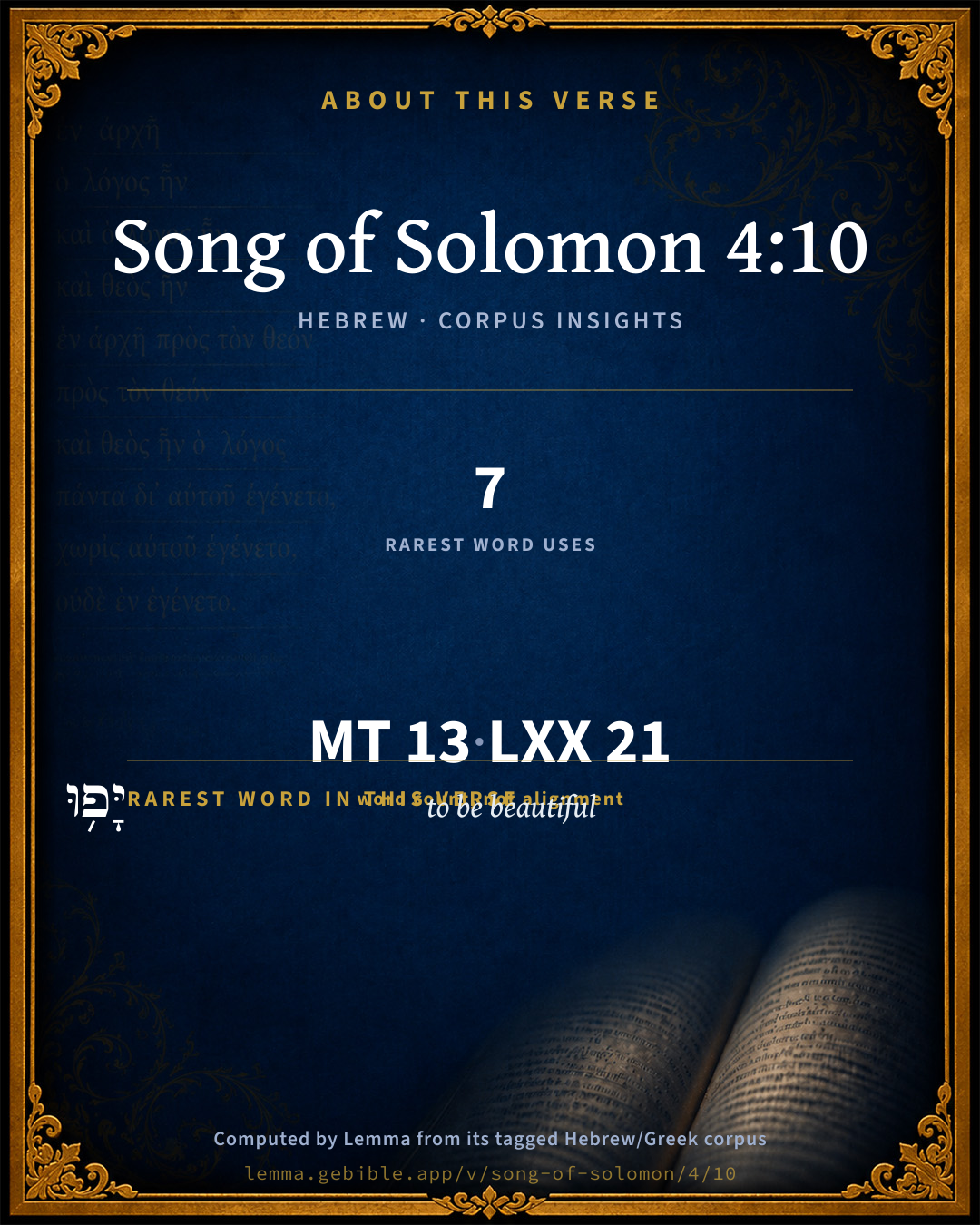
The rarest word here is יָּפ֥וּ to be beautiful H3302 — appearing just 7 times in the whole Hebrew Bible.

Shared distinctive vocabulary

יָּפ֥וּ to be beautiful H3302 occurs in 7 verses of the Hebrew Bible. Also found in:

Grammatical profile

  • 2 verbs
  • 9 nouns
  • 2 particles

Verb forms

  • יָּפ֥וּ Qal · Perfect
  • טֹּ֤בוּ Qal · Perfect

Repetition

Words recur within this verse — often emphatic in Hebrew:

  • דֹדַ֖יִךְ beloved H1730 ×2
  • מַה what H4100 ×2

Hebrew & Septuagint length

In English translation the verse runs 27 words from the Hebrew and 27 from the Septuagint (LXX English) — the same length.

A rough comparison of the two English renderings, which tokenize alike — not a word-level alignment.

Word counts can differ between the Hebrew and the Greek without any difference in meaning — e.g. the Hebrew direct-object marker אֵת has no separate Greek word, and Greek often adds the article ὁ.

In the original languages it is 13 Hebrew tokens and 21 Greek tokens — but the two are counted differently (Hebrew bundles its prefixes and suffixes into one token; the Greek is in lemma form), so that isn’t a like-for-like length.

Cross-references

9

Topical passages linked to Song of Solomon 4:10 in the Treasury of Scripture Knowledge — connected by theme and wording, ordered by reader-vote popularity; previews shown in the World English Bible.

  • Song of Solomon 1:2–4 Let him kiss me with the kisses of his mouth; For your love is better than wine.
  • Song of Solomon 7:6 How beautiful and how pleasant are you, Love, for delights!
  • Galatians 5:22 But the fruit of the Spirit is love, joy, peace, patience, kindness, goodness, faithfulness,
  • Song of Solomon 1:12 While the king sat at his table, My perfume spread its fragrance.
  • Song of Solomon 3:6 Who is this who comes up from the wilderness like pillars of smoke, Perfumed with myrrh and frankincense, With all spices of the merchant?
  • Song of Solomon 5:5 I rose up to open for my beloved. My hands dripped with myrrh, My fingers with liquid myrrh, On the handles of the lock.
  • Philippians 4:18 But I have all things, and abound. I am filled, having received from Epaphroditus the things that came from you, a sweet-smelling fragrance, an acceptable and well-pleasing sacrifice to God.
  • 2 Corinthians 1:21–22 Now he who establishes us with you in Christ, and anointed us, is God;
  • Revelation 5:8 Now when he had taken the book, the four living creatures and the twenty-four elders fell down before the Lamb, each one having a harp, and golden bowls full of incense, which are the prayers of the saints.

Cross-references courtesy of OpenBible.info (CC BY 4.0).

Hebrew and Greek witnesses Masoretic Hebrew ↔ Greek Septuagint

The same verse in the two great witnesses to the Old Testament, shown verse-for-verse.

These are two independent witnesses, not word-aligned to each other, and the Septuagint is shown in lemma (dictionary) form.

Hebrew Song of Solomon 4:10 Masoretic · Westminster Leningrad Codex

מַה יָּפ֥וּ דֹדַ֖יִךְ אֲחֹתִ֣י כַלָּ֑ה מַה טֹּ֤בוּ דֹדַ֨יִךְ֙ מִיַּ֔יִן וְרֵ֥יחַ שְׁמָנַ֖יִךְ מִכָּל בְּשָׂמִֽים

How beautiful is your love, my sister, my bride! How much better is your love than wine! The fragrance of your perfumes than all manner of spices!

World English Bible · Public Domain

Greek LXX Song of Solomon 4:10 Septuagint · lemma form

τίς καλλιόω μαστός σύ ἀδελφή ἐγώ νύμφη τίς καλλιόω μαστός σύ ἀπό οἶνος καί ὀσμή ἱμάτιον σύ ὑπέρ πᾶς ὁ ἄρωμα

How beautiful are your breasts, my sister, my spouse! how much more beautiful are your breasts than wine, and the smell of your garments than all spices!

LXX2012 (modern English Septuagint) · Public Domain

On this verse, Adam Clarke's Commentary discusses the Septuagint’s reading. Read the note in Commentary ↓

Hebrew: Westminster Leningrad Codex (CC BY 4.0). Greek: Septuagint (public domain); English from LXX2012 (modern English Septuagint) (Public Domain). How the Septuagint differs from the Hebrew →

Commentary

Notes on Song of Solomon 4:10 from classic Christian and Jewish commentators (each source and its license shown beneath its notes). The classic Christian expositions comment on the surrounding passage and are grouped to its opening verse, so a note may address several verses; the Jewish commentaries on the Tanakh (Rashi and others) are per-verse, so they appear only where the commentator wrote on this verse.

Lemma curates 59 commentaries, every one of them public domain or Creative Commons licensed, each selected and text-cleaned for this edition rather than reprinted as found. About our sources →

Trapp's Complete Commentary

John Trapp

Son 4:10 How fair is thy love, my sister, [my] spouse! how much better is thy love than wine! and the smell of thine ointments than all spices!

Ver. 10. How fair is thy love.] Heb., Loves, in the plural, noting not only their multitude, but excellence also, such as do far preponderate all carnal affections. These are said to be inexpressibly fair and lovely (noted by the exclamation and repetition here used, as if words were too weak to utter it), because (1.) It is undissembled - a man may paint fire, but he cannot paint heat; a man may dissemble actions in religion, but he cannot dissemble affections - (2.) It is rare, and in respect of common Christians it may be said, as in Eph 3:19, to "pass knowledge," since most have little of the life of it in their breasts, less of the light and lustre of it in their lives.

How much better is thy love than wine.] This same she had said of him in Son 1:2. Now he returns it upon her, as is usual among lovers. He had confessed himself ravished with her love. {Son 4:9} Now here he shows why he was so. He found her not lovely only, but loving; he had made her so, aud now takes singular delight and complacency in his own work, as once he did in his work of creation. He well perceived that he had not lost his love upon his Church, as David did upon his Absalom, as Paul did upon his Corinthians (of whom he complains, that the more he had loved, the less he was beloved), as Job upon his miserable comforters, whom he compares to the brooks of Tema, that in a moisture swell, in a drought fail. {Job 6:15-17} But Christ finds no such fickleness or false heartedhess in his beloved - he had love for love; and as he had been a sweet friend to her, so was she to him. Her love was better than the best wine (which yet is both costly and comfortable), yea, than all the delights that this life can afford; so much is implied by "wine" here, and so he is pleased to esteem it. Unworthy she of so kind acceptance of that little she can do this way, if she do not her utmost; if she cry not out with her son David, "I will love thee dearly," or entirely, with mine utmost bowels - with the same tenderness of affections as is in mothers towards the fruit of their bodies, so the Hebrew word signifies. {Psa 18:1} And again, "I love" (so he abruptly expresseth himself by a passionate pang of love), "because the Lord hath heard the voice of my supplications," &c. {Psa 116:1} He saw, and we may all see, so much cause to love the Lord, as that he must needs be a monster, and not a man, that loves not the Lord Jesus Christ in sincerity. It was a miracle that those worthies in Daniel should be in the midst of a fiery furnace, and not burn. It is no less that men should be in the midst of mercies on all hands, and not love Christ. It would be as great a wonder men should fail here, as for a river to run backwards. "I have drawn them by the bands of love, by the cords of a man," {Hos 11:4} that is, with reasons and motives of love befitting the nature of a man, of a rational creature. But most men, alas! (and those that profess to be the children of the Church too), move like the river Araris, backward or forward, who can tell? {a} This is to give Christ vinegar for wine; this is as lukewarm water to his nice and nauseating stomach. {Rev 3:16} There is a prophecy reported in Telesphorus, that Antichrist shall never overcome Venice, nor Paris, nor London. But we have a more certain word, and let us take heed, lest for our lukewarmness Christ spew us out of his mouth. What hath been the opinion and fear of some not inconsiderable divines, that Antichrist, before his abolition, shall once again overflow the whole face of the west, and suppress the whole Protestant Churches for a punishment of their loss of their first love, I pray Christ to avert.

And the smell of thine ointments, than all spice!] That is, Of thy sweet graces actuated and exercised. {Psa 89:20 Joh 1:20; Joh 1:27} It was an aggravation of the fall of Saul, that he fell "as though he had not been anointed"; {2Sa 1:21} so for the saints to fall from their first love or from their own steadfastness. Such a dead fly will cause their once sweet ointments to send forth a stinking savour. {Ecc 10:1} Corruptio optimi est pessima. The best things are the worst things I corrupt.

{a} Oculis in utram partem fluat iudicari non potest. - Caesar. de bello Gal., lib. i.

John Trapp, A Commentary or Exposition upon All the Books of the Old and New Testament (1647–1656) — public domain. Text from a community e-Sword module.

The Biblical Illustrator

Joseph S. Exell

Son_4:10-11

How fair is thy love, My sister, My spouse! how much better is thy love than wine! and the smell of thine ointments than all spices!

Christs estimate of His people

I.

Christ first praises His peoples love. Dost thou love God, my hearer? Dost thou love Jesus? Hearken, then, to what the Lord Jesus says to thee, by His Holy Spirit, from this Song! Thy love, poor, feeble, and cold though it be, is very precious unto the Lord Jesus, in fact it is so precious, that He Himself cannot tell how precious it is. He does not say how precious, but He says how fair Pause here, my soul, to contemplate a moment, and let thy joy wait a while. Jesus Christ has banquets in heaven, such as we have never yet tasted, and yet He does not feed there. He has wines in heaven richer far than all the grapes of Eshcol could produce, but where does he seek His wines? In our hearts. Not all the love of angels, nor all the joys cf. Paradise, are so dear to. Him as the love of His poor people compassed with infirmity. The love of the believer is sweet to Christ.

II. Do not imagine, however, that Christ despises our faith, or our hope, or our patience, or our humility. All these graces are precious to Him, and they are described in the next sentence under the title of ointment, and the working of these graces, their exercise and development, are compared with the smell of ointment. Now both wine and ointment were used in the sacrifice of the Jews; sweet smelling myrrh and spices were used in meat-offerings and drink-offerings before the Lord. But, saith Jesus Christ to His Church, all these offerings of wine, and all that burning of incense, is nothing to Me compared to your graces. Your love is My wine, your virtues are My sweet-smelling ointments. Yes, believer, when you are on your sick-bed and are suffering with patience; when you go about your humble way to do good by stealth; when you distribute of your alms to the poor; when you lift up your thankful eye to Heaven; when you draw near to God with humble prayer; when you make confession of your sin to Him; all these acts are like the smell of ointment to Him, the smell of a sweet savour, and He is gratified and pleased. O Jesus, this is condescension indeed, to be pleased with such poor things as we have. Oh, this is love; it proves Thy love to us, that Thou canst make so much out of little, and esteem so highly that which is of such little worth!

III. Now we come to the third, Thy lips, O My spouse, drop as the honeycomb. Christs people are not a dumb people, they were once, but they talk now. I do not believe a Christian can keep the secret that God gives him if he were to try; it would burst his lips open to get out. Now it is but poor, poor matter that any of us can speak. When we are most eloquent in our Masters praise, how far our praises fall beneath His worth! When we are most earnest in prayer, how powerless is our wrestling compared with the great blessing that we seek to obtain! But Jesus Christ does not find any fault in what the Church speaks. He says, No, Thy lips, O My spouse, drop as the honeycomb. You know the honey that drops out of the honeycomb is the best--it is called the life-honey. So the words that drop from the Christians lips are the very words of his life, his life-honey, and they ought to be sweet to every one. They are as sweet to the taste of the Lord Jesus as the drops of the honeycomb. And now, Christians, will you not talk much about Jesus? Will you not speak often of Him? Will you not give your tongue more continually to prayer and praise, and speech that ministers to edifying, when you have such a listener as this, such an auditor who stoops from heaven to hear you, and who values every word you speak for Him? But, says one, if I were to try to talk about Jesus Christ, I do not know what I should say. If you wanted any honey, and nobody would bring it to you, I suppose the best way, if you were in the country, would be to keep some bees, would it not? It would be very well for you Christian people if you kept bees. Well, says one, I suppose our thoughts are to be the bees. We are always to be looking about for good thoughts, and flying on to the flowers where they are to be found; by reading, by meditation, and by prayer, we are to send bees out of the hive. Certainly, if you do not read your Bibles, you will have no honey, because you have no bees. But when you read your Bibles, and study those precious texts, it is like bees settling on flowers, and sucking the sweetness out of them.

IV. This brings us to the next topic Honey and milk are under thy tongue. I find it necessary when I preach to keep a good stock of words under my tongue as well as those that are on it. Very often I have got a simile just ready to come out, and I have thought, Ah, that is one of your laughable similes, take that back. I am obliged to change it for something else. If I did that a little oftener perhaps it would be better, but I cannot do it. I have sometimes a whole host of them under my tongue, and I am obliged to keep them back. Honey and milk are under thy tongue. That is not the only meaning. The Christian is to have words ready to come out by and by. Yon know the hypocrite has words upon his tongue. We speak about solemn sounds upon a thoughtless tongue; but the Christian has his words first under the tongue. There they lie. They come from his heart; they do not come from the top of his tongue,--they are not superficial surface-work, but they come from under the tongue--down deep,--things that he feels, and matters that he knows. Nor is this the only meaning. The things that are under the tongue are thoughts that have never yet been expressed; they do not get to the top of the tongue, but lie there half formed and are ready to come out; but either because they cannot come out, or we have not time to let them out, there they remain, and never come into actual words. Now Jesus Christ thinks very much even of these; He says, Honey and milk are under thy tongue; and Christian meditation and Christian contemplation are to Christ like honey for sweetness and like milk for nourishment.

V. And, then, last of all, the smell of thy garments is like the smell of Lebanon. The odiferous herbs that grew on the side of Lebanon delighted the traveller, and, perhaps, here is an allusion to the peculirly sweet smell of the cedar wood. Now, the garments of a Christian are twofold--the garment of imputed righteousness, and the garment of inwrought sanctification. I think the allusion here is to the second. The garments of a Christian are his every-day actions--the things that he wears upon him wherever he goes. Now these smell very sweet to the Lord Jesus. What should you think if Jesus should meet you at the close of the day, and say to you, I am pleased with the works of to-day? I know you would reply, Lord, I have done nothing for Thee. You would say like those at the last day, Lord, when saw we Thee hungry and fed Thee? when saw we Thee thirsty and gave Thee drink? You would begin to deny that you had done any good thing. He would say, Ah, when thou wast under the fig tree I saw thee; when thou wast at thy bedside in prayer I heard thee; I saw thee when the tempter came, and thou saidst, Get thee hence, Satan; I saw thee give thine alms to one of My poor sick children; I heard thee speak a good word to the little child and teach him the name of Jesus; I heard the groan when swearing polluted thine ears: I heard thy sigh when thou sawest the iniquity of this great city; I saw thee when thine hands were busy; I saw that thou wast not an eye-servant or a man-pleaser, but that in singleness of purpose thou didst serve God in doing thy daily business; I saw thee, when the day was ended, give thyself to God again; I have marked thee mourning over the sins thou hast committed, and I tell thee I am pleased with thee. The smell of thy garments is like the smell of Lebanon. (C. H. Spurgeon.)

The Biblical Illustrator, edited by Joseph S. Exell (c. 1880s–1900s) — public domain. Text from a community e-Sword module.

Tyndale Open Study Notes

Tyndale Open Resources

4:10-11 wine . . . nectar . . . honey . . . milk: The woman is compared with much that is smooth, sweet, and sensuous. Her love and their kissing within the lavish fragrance around them is nearing the ultimate delight for this bridegroom.

Tyndale Open Study Notes — © Tyndale Open Resources, licensed CC BY-SA 4.0. Text via the HelloAO Bible API.

Adam Clarke's Commentary

Verse 10. How much better is thy love] דדיך dodayich; Hebrew. μαστοισου; Septuagint. Ubera tua; Vulgate. "Thy breasts." And so all the versions, except the Chaldee.

Smell of thine ointments] Perfumes.

Adam Clarke's Commentary on the Bible (1810–1826) — public domain. Text from a community e-Sword/MySword module.

The Cambridge Bible for Schools and Colleges

gen. ed. J. J. S. Perowne

10. How fair is thy love] How sweet are thy caresses. In the next clause also, love should be caresses.

spices] Better, perfumes.

The Cambridge Bible for Schools and Colleges (gen. ed. J. J. S. Perowne; Cambridge University Press, 1878–1918) — public domain. Text from a community e-Sword module.

Haydock's Catholic Bible Commentary

Spices. He returns her compliment, chap. i. 2.

George Leo Haydock (1774–1849), Haydock's Catholic Family Bible and Commentary, 1859 edition — public domain. Excludes Psalms (Douay-Rheims chapter numbering differs from Protestant) and Deuterocanonical books (Catholic canon only).

Matthew Poole's English Annotations

How fair, how amiable and acceptable to me, is thy love! I do not disdain thy love, as I might do, but take it kindly, and prize it highly.

How much better is thy love than wine! of which See Poole "Son 1:2", See Poole "Son 1:4".

Of thine ointments; of the gifts and graces of God’s Spirit, wherewith thou art anointed. Compare Isa 61:1; 1Jo 2:20,27.

Matthew Poole's English Annotations on the Holy Bible (1683–1685) — public domain. Text from a community e-Sword/MySword module.

Whedon's Commentary on the Bible

Daniel D. Whedon

10. Wine, “that maketh glad the heart of man,” is mentioned even by Homer as grateful to gods and men. But the sympathy of woman, warming into tenderness and concentrating into love, is uniformly spoken of as the most gladdening and enlivening to the heart of man. And the smell, etc.

Sweeter than breath of morn in Ceylon’s grove,

Breathed from her lips the fragrance of her love.

Daniel D. Whedon (gen. ed.), Commentary on the Old and New Testaments (1874–1909) — public domain. Text from a community e-Sword module.

The Pulpit Commentary

Vers. 10, 11. How fair is thy love, my sister, my bride! How much better is thy love than wine! and the smell of thine ointments than all manner of spices! Thy lips, O my bride, drop as the honeycomb; honey and milk are under thy tongue; and the smell of thy garments is like the smell of Lebanon. The expression of thy love, that is, the endearments, the embraces, are delightful. The allusion to the lips may be a mere amplification of the word "love," but it may also refer to speech, and we think of the nineteenth psalm and the description of the words and testimony of the Lord, "more to be desired than gold, and sweeter than honey and the droppings of the honeycomb". (cf. Gen_27:27 Hos_4:7 Psa_45:9) The words of pure, inward joy flowing forth from the lips may be so described. So the Lord has said, in Isa_62:5, that he rejoiceth over his people as the bridegroom rejoiceth over the bride.

Vers. 10, 11. Christ"s appraisement of believers.

The interest which God takes in men is marvellous. Why he should have designed to save men from sin"s curse, at such personal cost, is a mystery, and must remain so. It is equally a mystery why Jesus should have set such strong love on the fishermen of Galilee. Notwithstanding their glaring misconduct, "he loved them to the end." In like manner Jesus speaks in this passage of his high appreciation of his people"s love. The love of Christ to us is a theme on which any Christian may well become eloquent. But to hear that Christ sets high store on our poor love to him, this staggers our thoughts, and almost seals our lips. Nevertheless it is a fact. Full of blemish and imperfection as we are, he counts us his jewels, his choicest possessions. He finds "his inheritance in the saints." With his generous heart he discerns all the goodness there is in us. He sets high value on our love, and in this way encourages us to give him more.

I NOTE CHRIST"S HIGH APPRAISEMENT OF A CHRISTIAN"S LOVE.

1. The very indefiniteness of the language is instructive. "How fair!" He does not say how precious it is. It is not the language of precise, calculating logic. It is the language of strong feeling. It is the generous ejaculation of the heart fair!" This is spoken after the manner of men. When the intellect is overborne by emotion, we break into an exclamation, and say, almost in a spirit of inquiry, "How lovely! how fair!" As if we would say, "We cannot measure the worth; if any one else can, let him say.

2. It is the love of tender relationship. "My sister, my spouse." This mention of earthly relatives is used by way of comparison. What form of love among us is winsome, valued, precious? For sweetness and purity, what love is like a sister"s? For strength and generousness, what affection like that of a wife? Jesus combines these both in his thought. Blend the love of sister and wife into one, and even then this poorly represents the love which Jesus discovers in us glowing for himself. He sets more value upon our love than we set upon the love of our most intimate friend.

3. The language impresses us by a comparison. "It is better than wine." As at a banquet one"s bodily sensations are refreshed and quickened and gladdened with choice wine, so Jesus finds a cordial more refreshing, more inspiring, in his creature"s love. To his inmost soul this love of man is a luxury. He has many sources of enjoyment in heaven, but this enjoyment is his choicest. The love of his ransomed is his rarest, sweetest joy. When in his lifetime he sat down to meat at the Pharisee"s table, the tears of the penitent harlot were more delicious fare than Simon"s choicest wine. It is possible that, though the angels "excel in strength," they may be deficient in love. Anyhow, our shallow, inconstant, imperfect love is precious in the eyes of Immanuel; it is a fountain of joy to his heart.

II OBSERVE CHRIST"S APPRECIATION OF OUR HOLY INFLUENCE. How much better is "the scent of thy perfumes than all spices"! In the East the dwellings are not so sweet as in our own land. Want of general cleanliness, want of water, want of drainage, will account for this. As a consequence, unguents and perfumes about the person are very common. So in the hallowed savour of our piety there is a delicate fragrance very acceptable to Jesus. Our influence over others is something undefinable, yet very potent. It pertains to every habit of life, to every tone of voice, to every expression of countenance. It lives in a smile or in a tear; and results, begun in the minutest circumstance, stretch far away into the great eternity. Jesus highly esteems this quiet, mystic influence. It is a fragrant atmosphere created by love, and, like the savour of Mary"s spikenard, it fills the house. Obdurate men may ridicule our pious words; they cannot ridicule nor resist the influence of a holy life. Our humility, our heavenly-mindedness, our consecrated zeal, diffuse a delicate perfume, like the subtle scent of roses, which every man of refinement appreciates, and in it Jesus finds delight. It is richer and rarer than all the spices of Araby.

III MARK THE FACT THAT JESUS GREATLY ESTEEMS A CHRISTIAN"S TESTIMONY. "Thy lips drop as the honeycomb." The gift of speech is a noble endowment conferred on us by God. It distinguishes man above the animals. The human voice, either in oratory or in song, has potent enchantment for men. Speech is man"s glory. By it he rules a nation. By it he enlightens and inspires the young. By it he moulds the destinies of mankind. Jesus loves to see this endowment consecrated to his cause. He loves to hear our testimony to his goodness. He loves to hear our pious songs. On one occasion Jesus cast out a demon from a man who was dumb, and immediately the dumb man spake. So, when Jesus "sheds abroad his love in our hearts," our lips cannot be silent. The desire to speak of his grace will be like a fire in our bones. A strange impulse stirs within to make all men know of his mighty virtue, and the tongue of the dumb will be unloosed. As the richest, sweetest of all honey is that which drops freely and first from the honeycomb, so the words of our fresh, warm love are very sweet in the car of Jesus. He intertwines the welfare of his kingdom with human speech, for he has ordained preaching to be his great weapon in the sacred crusade with sin. If we did but remember that Jesus is always a hearer a generous, appreciative hearer of all that drops from our lips, should we not take care that he heard only what was true and kind and beautiful? Should we not be eager to "order our conversation aright," and to have our speech like the droppings of the honeycomb?

IV MARK THAT JESUS APPRECIATES OUR PURPOSES TO PLEASE HIM. When David conceived the thought that he would build a substantial temple to Jehovah, and the plan began to ripen into resolve, God sent his prophet to say this to David, "It was well that it was in thine heart." We loudly applaud the man who makes heroic self-sacrifice for the cause of Christ; but very likely there is a purpose burning in the soul of some gentle woman to do battle for Christ more noble still, yet which cannot be realized. Well, that secret purpose is sweet as honey to Christ. His searching eye sees it all sees every right motive, every heavenly disposition, every upward aspiration; and the sight is a delicious joy. It is the fruit of his incarnation. It is the work of his Spirit. Just as every man finds peculiar delight in his work, be it a building, or a painting, or a mechanical invention; so, and much more, does Jesus find exquisite pleasure in his successful work of making us godlike and Divine. "Honey and milk are under thy tongue." Thy secret thoughts and purposes bring me joy.

V JESUS CHRIST APPRAISES HIGHLY EVERY DISCIPLE"S SERVICE. "The smell of thy garments is like the smell of Lebanon." The scent of pine trees and of cedar forests is peculiarly pleasant, and in this respect Lebanon surpassed all other forests in Palestine. it is in keeping with the symbolism of the Bible to employ "garments" as an emblem of human actions. We have a similar figure in our own language, for we use the word "habit" to denote one kind of apparel, and also to denote a constant line of action. Acts frequently performed become habits. So the "garments of a Christian are his everyday actions the things he wears wherever he goes." The lesson here is that Jesus finds pleasure in everything we do, however trivial and insignificant. For there is nothing insignificant. You may read a man"s character more clearly in the hourly business of every day than in his conduct on Sundays, or than in some great action of his life. The serving woman in a shop, or the drudge in the scullery, or the hodman on the scaffolding, can serve Christ as well as the bishop in the pulpit. Jesus loves to see how faithfully we do little things. In his sight there is nothing little. It gave him untold pleasure to see the farthing which a poor widow dropped into his treasury. He counts every hair upon our heads. He notes when a sparrow falls. This is a mark of true greatness that it never overlooks the tiniest things. If from a disposition of love, and with cheerful temper, we sew a garment or drive a nail, we bring new pleasure to our Lord. "Therefore," says the apostle, "whatsoever ye do, whether in word or in deed, do all in the name of the Lord Jesus." Sweetly does old Herbert sing "A servant with this clause Makes drudgery Divine; Who sweeps a room as for thy laws Makes that and th" action fine. D.

The Pulpit Commentary (1880–1919), ed. H.D.M. Spence-Jones & Joseph S. Exell — public domain. Text from a community e-Sword module.

John Wesley's Explanatory Notes

Fair - How amiable and acceptable to me. Ointments - Of the gifts and graces of God's Spirit, wherewith thou art anointed.

John Wesley, Explanatory Notes Upon the Whole Bible (1754–1765) — public domain. Text via the GEBible commentary corpus.

unfoldingWord translationNotes

Door43 World Missions Community

General Information:

The man continues to praise the woman.

How beautiful is your love

"Your love is wonderful"

my sister

This is an idiom of affection. They are not actually brother and sister. See how you translated this in Song of Songs 4:9. AT: "my dear" or "my darling" (See: Idiom)

my bride

This Hebrew word can refer to a woman who is married or to one whom a man has arranged to become his son's wife. If your language has a polite word that a man would use to his wife and that has not been used yet in this book, you could use it here. Otherwise you could use any polite term a man would use with his wife. See how you translated this in Song of Songs 4:9.

How much better is your love than wine

"Your love is much better than wine." See how you translated a similar phrase in Song of Songs 1:2.

the fragrance of your perfume than any spice

The verb may be supplied from the previous phrase. AT: "how much better is the fragrance of your perfume than the fragrance of any spice" (See: Ellipsis)

fragrance ... perfume

See how you translated these words in Song of Songs 1:3.

spice

dried plants or seeds that have a good smell or taste

Your lips ... drip honey

Possible meanings are that honey is a metaphor for 1) the sweet taste of the woman's kisses or 2) the woman's words. (See: Metaphor)

honey and milk are under your tongue

Because "milk and honey" is a common phrase in the Bible, you should translate literally. Possible meanings are that honey is a metaphor for 1) the sweet taste of the woman's kisses or 2) the woman's words. Milk is a metaphor for luxury, owning many things that help people enjoy life. When the woman kisses the man, he enjoys life. (See: Metaphor)

the fragrance of your garments is like the fragrance of Lebanon

"the smell of your clothes is like the smell of Lebanon." Many cedar trees grew in Lebanon. Cedar trees smell very good, so Lebanon would have smelled sweet and fresh.

translationWords

love

bride

wine

honey

like

Lebanon

unfoldingWord translationNotes — © Distant Shores Media and the Door43 World Missions Community, licensed CC BY-SA 4.0. Source: git.door43.org/Door43/en_tn.

Rashi

Rabbi Shlomo Yitzchaki (Rashi)

how much better is your love Every place where you showed Me affection is beautiful in my eyes: Gilgal, Shiloh, Nob, Gibeon, and the everlasting Temple. That is what the “Babylonian (poet)” composed: “A resting place and other meeting places”: “resting place” refers to Jerusalem, and “other meeting places” refers to the place where the Shechinah met with Israel.

and the fragrance of your oils your good name.

Rashi on the Tanakh — English translations: “The Judaica Press complete Tanach with Rashi, translated by A. J. Rosenberg” (CC BY 4.0); “Pentateuch with Rashi's commentary by M. Rosenbaum and A.M. Silbermann, 1929-1934” (public domain); “The Metsudah Tanach series, Lakewood, N.J” (CC BY 4.0); and “The Book of Joshua, Metsudah Publications, 1997” (CC BY 4.0). Text via Sefaria.

Lesson kit

Teaching starters — assembled from the data on this page, not authored interpretation. Every prompt links to the verse data it draws on. Edit before teaching.

Song of Solomon, in the Wisdom, opens this verse with 13 words (11 distinct Hebrew lemmas). Its most distinctive word is yâphâh (“to be beautiful”). A historical commentator’s framing appears above. Read the whole chapter for the surrounding context.

Discussion questions

  1. How does “to be beautiful” (yâphâh) shape what this verse is saying?
  2. Psalms 45:2 shares the word «to be beautiful» with this verse. How do the two illuminate each other?
  3. “beloved” occurs 2× in this one verse. What is the effect of the repetition?
  4. These translations render this verse differently. What is at stake in choosing one wording over another?
  5. The verb «יָּפ֥וּ» is Qal Perfect. How does its form color the action?
  6. Reading how Trapp's Complete Commentary and The Biblical Illustrator read this verse, where do the two commentators agree and where do they part?

Things to notice

Reading settings

Reading text

Shown beneath each verse's original-language words.

Old Testament
Old Testament edition

Read the OT as the Masoretic Hebrew (MT) or the Greek Septuagint (LXX).

English shown for the Greek Septuagint (in the Hebrew ↔ Greek comparison).

Comparing translations? Open the Compare panel on any verse page to stack up to four side by side.