Psalms 42:10

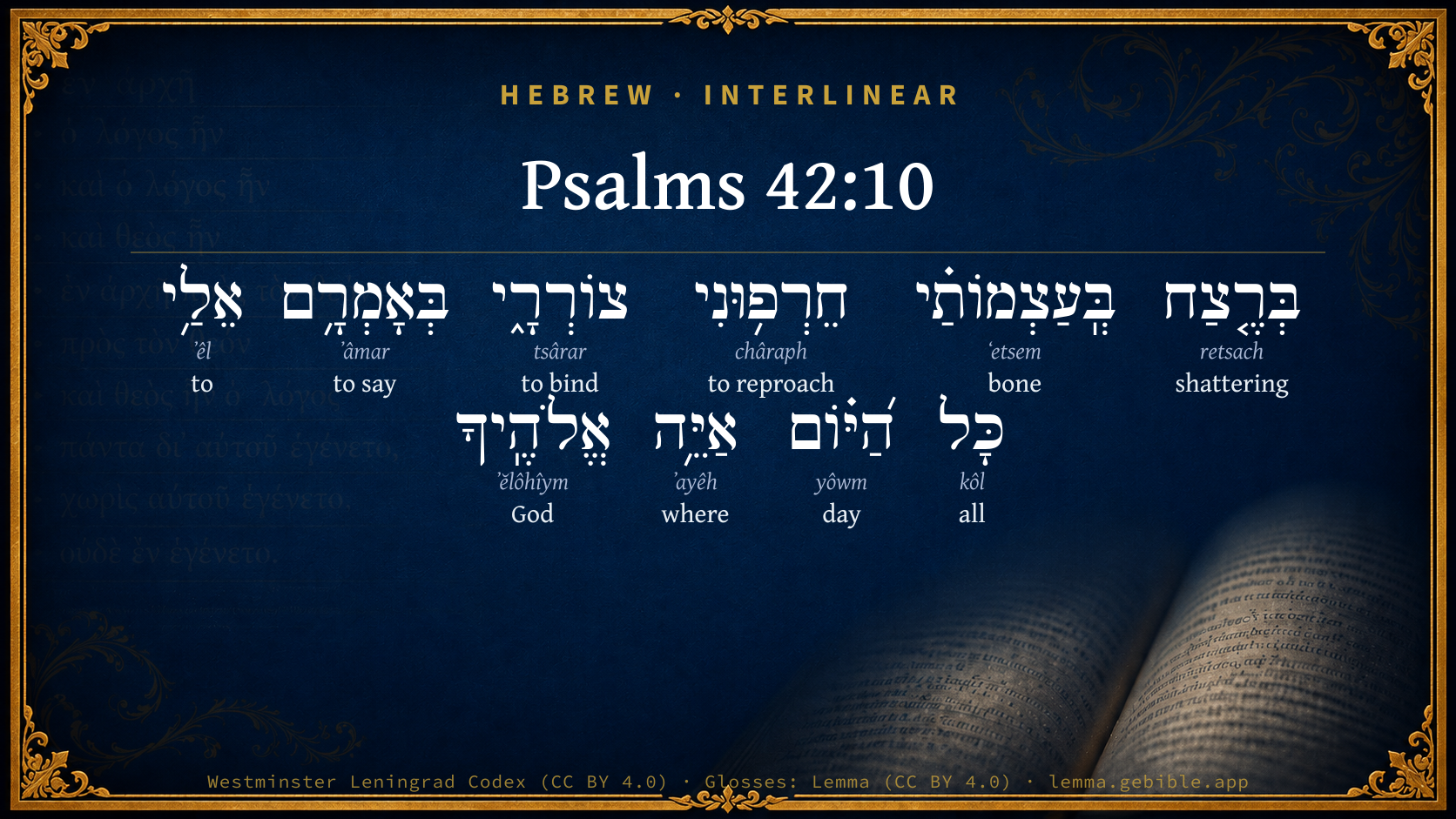
Hebrew (Westminster Leningrad Codex) Psalms 42:10 appears in the Hebrew Old Testament. The text above is from the Westminster Leningrad Codex. Each word links to its Strong’s number, a concise gloss, and parsing drawn from the Open Scriptures Hebrew Bible morphology. Click any word for its full Brown-Driver-Briggs (BDB) entry.
Download image
Cite this verse

Psalms 42:10 (World English Bible). Public Domain. Lemma interlinear Bible study tool, https://lemma.gebible.app/v/psalms/42/10.

Show BibTeX & RIS
BibTeX
RIS
English Translation
As with a sword in my bones, my adversaries reproach me, While they continually ask me, "Where is your God?"
World English Bible · Public Domain
Highlights
  • 1 first appearance in the Hebrew Bible
Full analysis ↓
Download a study sheet

One document with this verse’s original text, its word-by-word gloss line, the meaning frame, cross-references with their text, attributed commentary, and full source and license credits — printable, and it pastes into notes with its structure intact.

This verse Autodidact and up

Study sheet (.html) Plain text (.txt)

A passage Seminary Student

Up to 50 verses in one chapter. A passage sheet keeps up to 6 commentary sources and 12 cross-references per verse, in the order this page ranks them, and says so on the sheet whenever that leaves anything out. Ask for a single verse and you get the Autodidact verse sheet above.

Everything on this page stays free to read, with no account — the sheet is a download of what is already on screen, not access to it.

Want to remove ads? Support Godless Engineer
Compare translations 3

The same verse in 3 English versions, stacked beneath the original-language interlinear above. Click any original word for its lexicon entry.

Each is an independent rendering of the whole verse — the interlinear is not word-aligned to these translations.

Highlighted words mark where these versions differ — a whole-verse word diff, not a word-by-word alignment.

  • World English Bible Public Domain
    As with a sword in my bones, my adversaries reproach me, While they continually ask me, "Where is your God?"
  • King James Version Public Domain
    As with a sword in my bones, mine enemies reproach me; while they say daily unto me, Where is thy God?
  • unfoldingWord Literal Text CC BY-SA 4.0
    With crushing in my bones, the ones afflicting me reproach me in their saying to me all of the day, “Where is your God?”

unfoldingWord Literal Text — © unfoldingWord, licensed CC BY-SA 4.0. Word-aligned USFM3 via Door43 (git.door43.org/unfoldingWord/en_ult).

Versions to compare (up to 4)

3 of 4 selected

Show all 18 translations

Every available English version of this verse, each an independent rendering of the whole verse.

  • World English Bible Public Domain
    As with a sword in my bones, my adversaries reproach me, While they continually ask me, "Where is your God?"
  • Berean Standard Bible Public Domain
    Like the crushing of my bones, my enemies taunt me, while they say to me all day long, “Where is your God?”
  • Majority Standard Bible Public Domain
    Like the crushing of my bones, my enemies taunt me, while they say to me all day long, “Where is your God?”
  • King James Version Public Domain
    As with a sword in my bones, mine enemies reproach me; while they say daily unto me, Where is thy God?
  • American Standard Version (1901) Public Domain
    As with a sword in my bones, mine adversaries reproach me, While they continually say unto me, Where is thy God?
  • Revised Version (1885) Public Domain
    As with a sword in my bones, mine adversaries reproach me; while they continually say unto me, Where is thy God?
  • Geneva Bible (1599) Public Domain
    My bones are cut asunder, while mine enemies reproch me, saying dayly vnto me, Where is thy God?
  • Douay-Rheims (1899) Public Domain
    I will say to God: Thou art my support. Why hast thou forgotten me? and why go I mourning, whilst my enemy afflicteth me?
  • Young's Literal Translation Public Domain
    With a sword in my bones Have mine adversaries reproached me, In their saying unto me all the day, `Where `is' thy God?'
  • Literal Standard Version CC BY-SA 4.0
    With a sword in my bones || My adversaries have reproached me, || In their saying to me all the day, “Where [is] your God?”
  • Unlocked Literal Bible CC BY-SA 4.0
    As with a sword in my bones, my adversaries rebuke me, while they always say to me, “Where is your God?”
  • unfoldingWord Literal Text CC BY-SA 4.0
    With crushing in my bones, the ones afflicting me reproach me in their saying to me all of the day, “Where is your God?”
  • Darby Bible Public Domain
    As with a crushing in my bones mine adversaries reproach me, while they say unto me all the day, Where is thy God?
  • World Messianic Bible Public Domain
    As with a sword in my bones, my adversaries reproach me, while they continually ask me, “Where is your God?”
  • Webster's Bible Public Domain
    \\42:9\\I will say to God my rock, Why hast thou forgotten me? why go I mourning because of the oppression of the enemy?
  • Free Bible Version CC BY-SA 4.0
    The mocking of my attackers crushes my bones. They're always asking me, “Where is your God?”
  • Bible in Basic English Public Domain
    The cruel words of my haters are like a crushing of my bones; when they say to me every day, Where is your God?
  • JPS Tanakh (1917) Public Domain
    (42-11) As with a crushing in my bones, mine adversaries taunt me; while they say unto me all the day: 'Where is Thy God?'

Literal Standard Version (2020), Covenant Press — licensed CC BY-SA 4.0. Text via the HelloAO Bible API (eBible.org). Unlocked Literal Bible (unfoldingWord) — licensed CC BY-SA 4.0. Text via the HelloAO Bible API (eBible.org). unfoldingWord Literal Text — © unfoldingWord, licensed CC BY-SA 4.0. Word-aligned USFM3 via Door43 (git.door43.org/unfoldingWord/en_ult). Free Bible Version, Dr. Jonathan Gallagher — licensed CC BY-SA 4.0. Text via the HelloAO Bible API (eBible.org).

Word by word

More ways to search: Search by grammar → Find every occurrence → Compare this word →

Practice this passage: Drill this verse → Learn its vocabulary →

בְּרֶ֤צַח
retsach
H7524
“in/at · shattering”
Preposition + Noun, Common, Masculine, Singular, Absolute
Part of Speech
Preposition + Noun
Type
Common
Gender
Masculine
Number
Singular
State
Absolute
Full BDB Definition

Origin: from H7523

TWOT: 2208a

shattering
  1. בְּֽעַצְמוֹתַ֗י ʻetsem H6106 “in/at · bones · my” Preposition + Noun, Common, Feminine, Plural, Construct + Suffix, Personal, 1st Person, Common, Singular
  2. חֵרְפ֥וּנִי châraph H2778 “to reproach · me” Verb, Piel, Perfect, 3rd Person, Common, Plural + Suffix, Personal, 1st Person, Common, Singular
  3. צוֹרְרָ֑י tsârar H6887 “binding · me” Verb, Qal, Participle Active, Masculine, Plural, Construct + Suffix, Personal, 1st Person, Common, Singular
  4. בְּאָמְרָ֥ם ʼâmar H559 “in/at · to say · them” Preposition + Verb, Qal, Infinitive Construct + Suffix, Personal, 3rd Person, Masculine, Plural
  5. אֵלַ֥י ʼêl H413 “to · me” Preposition + Suffix, Personal, 1st Person, Common, Singular
  6. כָּל kôl H3605 “all of” Noun, Common, Masculine, Singular, Construct
  7. הַ֝יּ֗וֹם yôwm H3117 “the · day” Particle, Definite Article + Noun, Common, Masculine, Singular, Absolute
  8. אַיֵּ֥ה ʼayêh H346 “where” Particle, Interrogative
  9. אֱלֹהֶֽיךָ ʼĕlôhîym H430 “God(s) · your” Noun, Common, Masculine, Plural, Construct + Suffix, Personal, 2nd Person, Masculine, Singular

About this verse

These counts appear in no published source. They are computed here, from the morphology-tagged text and Lemma’s own curated glosses. What Lemma adds →

10
words
10
distinct lemmas
Wisdom
section

Notable vocabulary

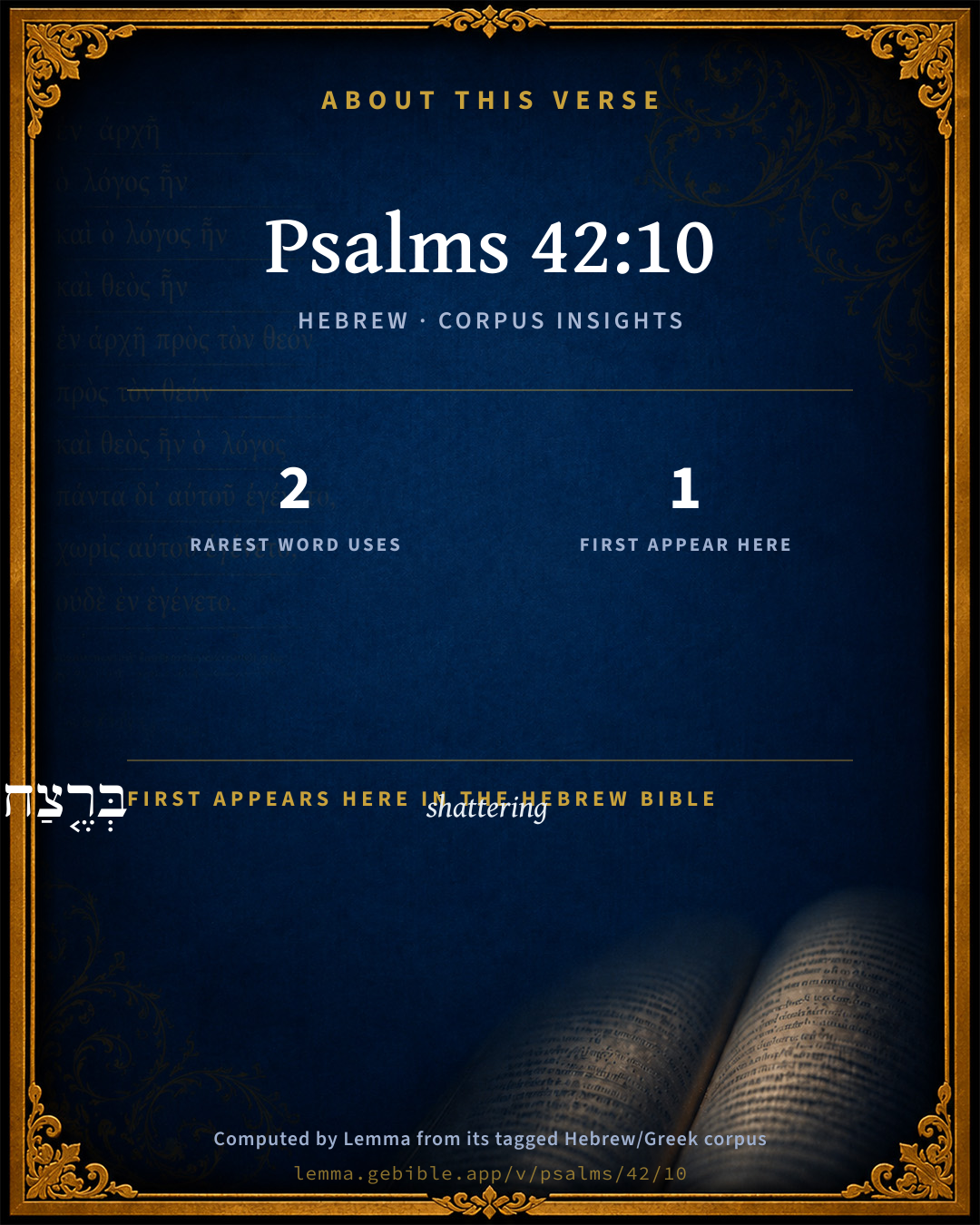
The rarest word here is בְּרֶ֤צַח shattering H7524 — appearing just 2 times in the whole Hebrew Bible.

First appearance in Scripture

This word makes its first canonical appearance in the Hebrew Bible here:

  • בְּרֶ֤צַח shattering H7524

Shared distinctive vocabulary

בְּרֶ֤צַח shattering H7524 occurs in 2 verses of the Hebrew Bible. Also found in:

Grammatical profile

  • 3 verbs
  • 5 nouns
  • 1 preposition
  • 1 particle

Verb forms

  • חֵרְפ֥וּנִי Piel · Perfect
  • צוֹרְרָ֑י Qal · Participle Active
  • בְּאָמְרָ֥ם Qal · Infinitive Construct

Hebrew & Septuagint length

In English translation the verse runs 20 words from the Hebrew and 21 from the Septuagint (LXX English) — closely comparable.

A rough comparison of the two English renderings, which tokenize alike — not a word-level alignment.

Word counts can differ between the Hebrew and the Greek without any difference in meaning — e.g. the Hebrew direct-object marker אֵת has no separate Greek word, and Greek often adds the article ὁ.

Cross-references

5

Topical passages linked to Psalms 42:10 in the Treasury of Scripture Knowledge — connected by theme and wording, ordered by reader-vote popularity; previews shown in the World English Bible.

  • Psalms 42:3 My tears have been my food day and night, While they continually ask me, "Where is your God?"
  • Joel 2:17 Let the priests, the ministers of Yahweh, weep between the porch and the altar, And let them say, "Spare your people, Yahweh, And don't give your heritage to reproach, That the nations should rule over them. Why should they say among the peoples, 'Where is their God?'"
  • Proverbs 12:18 There is one who speaks rashly like the piercing of a sword, But the tongue of the wise heals.
  • Luke 2:35 Yes, a sword will pierce through your own soul, that the thoughts of many hearts may be revealed."
  • Micah 7:10 Then my enemy will see it, And shame will cover her who said to me, Where is Yahweh your God? Then my enemy will see me and will cover her shame. Now she will be trodden down like the mire of the streets.

Cross-references courtesy of OpenBible.info (CC BY 4.0).

Hebrew and Greek witnesses Masoretic Hebrew ↔ Greek Septuagint

The same verse in the two great witnesses to the Old Testament, shown verse-for-verse.

You’re reading Greek Psalm 41 (Hebrew Psalm 42). The Septuagint counts the superscription, so verse numbers can differ from the Hebrew — chapter-level alignment, not verse-by-verse. Numbering follows Rahlfs.

These are two independent witnesses, not word-aligned to each other, and the Septuagint is shown in lemma (dictionary) form.

Hebrew Psalms 42:10 Masoretic · Westminster Leningrad Codex

בְּרֶ֤צַח בְּֽעַצְמוֹתַ֗י חֵרְפ֥וּנִי צוֹרְרָ֑י בְּאָמְרָ֥ם אֵלַ֥י כָּל הַ֝יּ֗וֹם אַיֵּ֥ה אֱלֹהֶֽיךָ

As with a sword in my bones, my adversaries reproach me, While they continually ask me, "Where is your God?"

World English Bible · Public Domain

Greek LXX Greek Psalm 41:10 Septuagint · lemma form

εἶπον ὁ θεός ἀντιλήμπτωρ ἐγώ εἰμί διά τίς ἐγώ ἐπιλανθάνω ἵνα τίς σκυθρωπάζω πορεύομαι ἐν ὁ ἐκθλίβω ὁ ἐχθρός ἐγώ

While my bones were breaking, they that afflicted me reproached me; while they said to me daily, Where is your God?

LXX2012 (modern English Septuagint) · Public Domain

On this verse, Albert Barnes' Notes on the Bible discusses the Septuagint’s reading. Read the note in Commentary ↓

Hebrew: Westminster Leningrad Codex (CC BY 4.0). Greek: Septuagint (public domain); English from LXX2012 (modern English Septuagint) (Public Domain). How the Septuagint differs from the Hebrew →

Commentary

Notes on Psalms 42:10 from classic Christian and Jewish commentators (each source and its license shown beneath its notes). The classic Christian expositions comment on the surrounding passage and are grouped to its opening verse, so a note may address several verses; the Jewish commentaries on the Tanakh (Rashi and others) are per-verse, so they appear only where the commentator wrote on this verse.

Lemma curates 59 commentaries, every one of them public domain or Creative Commons licensed, each selected and text-cleaned for this edition rather than reprinted as found. About our sources →

Trapp's Complete Commentary

John Trapp

Psa 42:10 [As] with a sword in my bones, mine enemies reproach me; while they say daily unto me, Where [is] thy God?

Ver. 10. As with a sword in my bones] Heb. a murdering weapon, which, when thrust into the bones, causeth most exquisite pain; so deeply was good David affected with the dishonour done to God by his blasphemous enemies; it went to the very heart of him, as a dagger.

While they say daily] {See Trapp on "Psa 42:3"}

John Trapp, A Commentary or Exposition upon All the Books of the Old and New Testament (1647–1656) — public domain. Text from a community e-Sword module.

The Biblical Illustrator

Joseph S. Exell

Psa_42:10

As with a sword in my bones, mine enemies reproach me: while they say daily unto me, Where is thy God?

The sword of the wicked

I. The carriage, disposition and expression of others to David.

1. They were his enemies. Gods children will never want such.

2. They reproached him. Their tongues were tipped from hell, and they did but utter that which was in their hearts. But such reproach is grievous. See Gal_4:1-31., how Ishmael persecuted Isaac.

3. The specialty of their reproach was, They say unto me, Where is thy God? They touch him in his religion. They did not deny that there was any God, but they upbraid him with his singularity, Where is thy God? And this is an ordinary reproach to be east at a good man in trouble. They seek to shake his faith. So did Satan try our Lord (Mat_4:3).

4. And they say out their reproach to his face. They are that impudent. Malice is so, and will always be so.

5. And they say it daily. They are unwearied: their malice is fed with a spring; it never wants for words.

6. And that which they say is--Where is now thy God? God does at times hide Himself (Isa_45:15; Mat_27:46). God was never nearer Christ in all His life than then, and yet He thus cries out. But our life is hid with Christ in God (Col_3:3). As in winter the life of a tree is hid in its roots. But God was not gone from David. God was never nearer Moses than when he was sprawling upon the water in that ark they had made for him (Exo_2:8). David might have said to them, Where are your eyes? For God was not only in heaven, but in his soul.

II. How did this reproach affect David? As with a sword in my bones. Now, this was so

1. Because it tended to the reproach of God. It disparaged God, and so touched David, who loved God.

2. And it touched upon religion itself. As if it were vain to serve God. It was a base thought to think that God would do no good to them that serve Him. Even the devil does that.

3. This reproach was for the damping of the spirits of all good men. Words affect strangely; they have a strange force with men, especially in such as are weak (Num_13:32).

III. Conclusion. To make some use of all this--how does hearing God reproached affect us? Is it as a sword in our bones? It should be. That which hath no grief when there is cause of grief is to be accounted but as dead flesh. When Gods enemies persecute His people we ought to be stirred. Paul (Act_13:10). And we may learn here how to enlarge the commandments. The swords spoken of here were but words. He is a murderer in Gods esteem that wounds another with his tongue (Rom_3:13; Pro_12:18). (R. Sibbes.)

Where is thy God? How God is known

During the prevalence of the disease known as the Black Death, in the fourteenth century, the people in some of the European cities, attributing the disorder to poison secretly disseminated by Jews, furiously murdered these Israelites, it is said, by thousands, and then built Christian churches and church belfries out of the houses and estates of the slaughtered victims. See, too, the atrocities of the Inquisition, who tormented mankind in the name of God. Also the malignity of the Jews in Joh_9:1-41. toward the blind man cured by our Lord. These and other such facts move two questions--What is our knowledge of God? and, What has such knowledge to do with personal character? We speak of God as if there were a common understanding about Him, which is far from being the case. There are as many impressions of God as there are persons, and no uniformity will be attained by any attempts at definitions, for all these will be modified by our own individuality. Still we are told in Scripture that we ought to know God, and that the people that know Him shall be strong. But our apprehensions of Gods character depends, and was meant to depend, very largely on conditions for which we are ourselves responsible. The text implies this. The mere idea of God--however derived--may be said to be natural, but the conception of the Divine character is compounded of many elements. Christians deem the grand essentials of that character to be wisdom, power, goodness. Find these three in perfect degree and balance in a living person, and He will be the Christians God--All-wise, Almighty, All-good. But we can only realize these as we possess them in ourselves. If we have no goodness in us we cannot understand goodness. In the measure that we receive Gods Spirit shall we know God, and so only. Slavish peoples crouch before a despotic deity. Given the character of the people, and you may know what their gods will be. As to character, God is what we look to as the best goodness embodied in an unseen person. Even Revelation, in all its many and varied forms, its combined voices and cross lights, will not produce uniformity of conception, for that must depend upon what our minds are. We must long to be better men would we know how good God is. (Bishop Huntington.)

The Biblical Illustrator, edited by Joseph S. Exell (c. 1880s–1900s) — public domain. Text from a community e-Sword module.

Joseph Benson's Commentary

Psa 42:10. As with a sword in my bones — Or, in my body, the bones being often put for the body, whereof they are a very considerable part. Or, as a sword which pierceth and cutteth my flesh even to the bones, and cutteth or breaketh the very bones also. So painful and vexatious are their reproaches. While they say, Where is thy God? — What is become of thy God. in whom thou trustedst? Why does he make no more haste to send thee deliverance?

Joseph Benson's Commentary on the Old and New Testaments (1811–1818) — public domain. Text from a community e-Sword module.

J. A. Alexander on Psalms

Joseph Addison Alexander

11. (Psa 42:10). With murder in my bones, my enemies have taunted me, in their saying to me all the day, where is thy God? The strong expression in the first clause is intended to denote excruciating pain. My enemies, oppressors, or persecutors, as the Hebrew word denotes. Taunted me, a stronger exression than reproach or reviled me, implying scorn as well as anger and hatred. In their saying, i.e. by their saying and while they say, as in the foregoing verse. All the day, continually. See above, on Psa 42:9 (8). Where is thy God? See above, on Psa 42:4 (3).

Joseph Addison Alexander, The Psalms Translated and Explained (1850) — public domain. Text from a community e-Sword module.

Geneva Bible (1599)

Geneva Bible translators

That is, I am most grievously tormented.

Geneva Bible (1599) marginal notes — public domain. Text via Bolls.life.

John Calvin's Commentaries

10 It is as a slaughter in my bones. This verse is somewhat involved in point of expression; but as to the meaning of it there is no obscurity. David here affirms that the grief which he experienced from the reproaches of his enemies, wounded him in no degree less than if they had pierced through his bones. The word ברצה, beretsach, signifies killing; and, therefore, I have retained this idea in the translation of it. And yet I do not condemn the opinion of those who render it a slaughtering sword. There is here a difference as to the reading, arising from the great similarity which there is between the two letters ב, beth, and כ, caph, the mark of similitude. As the letter ב beth, is often superfluous, I would rather be disposed, in a doubtful matter like this, to omit it altogether. But as I have said, the sense is perfectly plain, except that interpreters do not seem to take this sufficiently into their consideration, that by the terms my bones, the bitterness of grief is referred to; for we feel much more acutely any injury which is done to the bones, than if a sword should pierce the bowels, or the other parts of the body which are soft and yielding. Nor should the children of God regard this similitude as hyperbolical; and if one should wonder why David took so sorely to heart the derision of his enemies, he only manifests in this his own insensibility. For of all the bitter evils which befall us, there is nothing which can inflict upon us a severer wound than to see the wicked tear in pieces the majesty of God, and endeavor to destroy and overturn our faith. The doctrine taught by Paul, (Galatians 4:24,) concerning the persecution of Ishmael, is well known. Many consider his childish jesting as of little moment, but as it tended to this effect, that the covenant of God should be esteemed as a thing of no value, it is on that account, according to the judgment of the Holy Spirit, to be accounted a most cruel persecution. David, therefore, with much propriety, compares to a slaughtering sword, which penetrates even within the bones and marrow, the derision of his enemies, by which he saw his own faith and the word of God trampled under foot. And would to God that all who boast themselves of being his children would learn to bear their private wrongs more patiently, and to manifest the same vehement zeal for which David is here distinguished, when their faith is assailed to the dishonor of God, and when the word also which gives them life is included in the same reproach!

John Calvin's Commentaries (1540-1563) — public domain. Text from the Calvin Translation Society English edition (1840s-50s) via the Christian Classics Ethereal Library (ccel.org). Calvin's coverage is partial (roughly two-thirds of the Bible); uncommented books and verses are honest gaps, never fabricated. The 19th-century editor's footnotes and remarks are omitted so the notes are faithfully Calvin's own voice.

Ellicott's Commentary for English Readers

(10) As with a sword.—Margin, killing; better, crushing. The insertion of the conjunction is erroneous. Render, with a shattering of my bones. This, no doubt, refers to actual ill-treatment of the exile by his conductors, who heaped blows, as well as insults, on their captives. We may even suppose this violence especially directed at this particular sufferer, who could not refrain from lingering and looking back, and so irritating his convoy, who would naturally be in a hurry to push forwards. How vividly, too, does the picture of the insulting taunt, “Where is thy God?” rise before us, if we think of the soldiers overhearing the exile’s ejaculations of prayer.

A Bible Commentary for English Readers, edited by Charles John Ellicott (1878–1897) — public domain. Text from a community e-Sword module.

The Cambridge Bible for Schools and Colleges

gen. ed. J. J. S. Perowne

10. My bones are smitten asunder with mine adversaries’ reproaches,

While they continually say unto me, Where is thy God?

Lit. with crushing in my bones do mine adversaries reproach me. They stab him to the heart with their taunts. ‘The bones,’ in the language of Hebrew poetry, denote the whole physical organism of the living man, as being the framework of it. They are the seat of pain; and mental torture affects the body. Cp. Psa_6:2 (note); Lam_3:4; Isa_38:13.

The Cambridge Bible for Schools and Colleges (gen. ed. J. J. S. Perowne; Cambridge University Press, 1878–1918) — public domain. Text from a community e-Sword module.

John Gill's Exposition

As with a sword in my bones, mine enemies reproach me,.... The reproaches of his enemies were grievous and cutting to him, as if a sword pierced through the marrow in his bones, which, being very sensitive, gives exquisite pain. There is a various reading here: some copies, as Vatablus observes, read "in", or with, and others "as", which seems to be the truest; and our translators supply "as", to make the sense, though they read "with"; but some (n) only read "as"; and the sense is, the reproaches cast upon the psalmist were as a sword cutting and killing; and these reproaches were as follow;

while they say daily unto me, where is thy God? See Gill on Psa 42:3.

(n) , Symmachus in Drusius; "ut occisio", Pagninus, Amama; so Aben Ezra interprets it.

John Gill's Exposition of the Whole Bible (1746–1763) — public domain (CC PDM 1.0). Text via the HelloAO Bible API.

Albert Barnes' Notes on the Bible

As with a sword in my bones - Margin, killing. The treatment which I receive in their reproaches is like death. The word rendered “sword” - רצח retsach - means properly killing, slaying, breaking in pieces, crushing. It occurs only here and in Eze 21:22, where it is rendered slaughter. The Septuagint renders it, “In the bruising of my bones they reproach me.” The Vulgate, “While they break my bones they reproach me.” Luther, “It is as death in my bones, that my enemies reproach me.” The idea in the Hebrew is, that their reproaches were like breaking or crushing his very bones. The idea of the “sword” is not in the original.

Mine enemies reproach me - That is, as one forsaken of God, and as suffering justly under his displeasure. Their argument was, that if he was truly the friend of God, he would not leave him thus; that the fact of his being thus abandoned proved that he was not a friend of God.

While they say daily unto me - They say this constantly. I am compelled to hear it every day.

Where is thy God? - See the notes at Psa 42:3.

Albert Barnes' Notes on the Bible (1834–1885) — public domain. Text from a community e-Sword/MySword module.

Matthew Poole's English Annotations

In my bones, or in my body, the bones being oft put for the body, whereof they are a very considerable part. Or, as a sword, which pierceth and cutteth my flesh even to the bones, and cutteth or breaketh the very bones also. So painful and vexatious are their reproaches.

Where is thy God? of which See Poole "Psa 42:3".

Matthew Poole's English Annotations on the Holy Bible (1683–1685) — public domain. Text from a community e-Sword/MySword module.

The Treasury of David

Charles H. Spurgeon

Ver. 10. As with a sword in my bones, mine enemies reproach me. Cruel mockeries cut deeper than the flesh, they reach the soul as though a rapier were introduced between the ribs to prick the heart. If reproaches kill not, yet they are killing, the pain caused is excruciating. The tongue cuts to the bone, and its wounds are hard to cure. While they say daily unto me, Where is thy God? This is the most unkind cut of all, reflecting as it does both upon the Lord's faithfulness and his servant's character. Such was the malice of David's foes, that having thought of the cruel question, they said it, said it daily, repeated it to him, and that for a length, of time; surely the continual yapping of these curs at his heel was enough to madden him, and perhaps would have done so had he not resorted to prayer and made the persecutions of his enemies a plea with his Lord.

Ver. 10. Mine enemies. It is strange that he should have enemies, that was so harmless a man that when they were sick and distressed, he prayed for them, and put on sackcloth for them, as it is, Ps 35:1-28. This compassionate sweet natured man, yet, notwithstanding, you see he had enemies, and enemies that would discover themselves to reproach him, and that bitterly; in the bitterest manner, they reproach him in his religion. We may be armed by this observation against the scandal of oppositionthat if we meet with enemies in the world, we should not be much offended at it; grieve we may, but wonder we need not. Was there ever any that did more good than our Saviour Christ? "He went about doing good." Ac 10:38. He did never a miracle that was harmful (but only of the swine that were drowned in the sea, and that was their own fault), but he went about doing all the good he could; yet, notwithstanding, we see what malicious opposites he had. That that is true of the head must be true in the members. Therefore we should rejoice in our conformity to Christ, if it be in a good cause, that we find enemies and opposition. The devil is not made a Christian yet, and he will never be made good, for his is in termino, as we say, he is in his bounds, his nature is immovable; he is in hell in regard of his estate, though he be loose to do mischief. Now, until the devil be good, God's children shall never want enemies; and he will never be good; therefore, though there were good kings and good governors over all the world, yet good men shall never want enemies as long as the devil is alive, as long as he hath anything to do in the world. Enemies, therefore, we must look for, and such enemies as will not conceal their malice neither; for that were something, if they would suffer their malice to boil and concoct in their own hearts, but that will not be, but "out of the abundance of the heart the mouth will speak." Richard Sibbes.

Ver. 10. They say daily unto me. Here's their constancy and perseverance in this their carriage and language, it is daily, or all the day, (Mwyh-lk) It is not only for a fit and away, but it is their frequent and continual practice; it's every, and it's all the day; they begin in the morning, and they hold out still till night as unquiet persons use to do; and they begin the week with it, and so they continue till the end; he could never come into their company or near them, but he had such language from them. Thomas Horton.

Ver. 10. Where is thy God? David might rather have said to them, Where are your eyes? where is your sight? for God is not only in heaven, but in me. Though David was shut out from the sanctuary, yet David's soul was a sanctuary for God; for God is not tied to a sanctuary made with hands. God hath two sanctuaries, he hath two heavensthe heaven of heavens and a broken spirit. God dwelt in David as in his temple. God was with David and in him; and he was never more with him, nor never more in him than in his greatest afflictions. They wanted eyes, he wanted not God. Though sometimes God hide himself, not only from the world but from his own children, yet he is there; howsoever their sorrow is such that it dims their sight (as we see in Hagar), so that they cannot see him for the present, he sometimes looks in their face, as we see in Mary's case. She could not see Christ distinctly, but thought him to be the gardener. There is a kind of concealment awhile in heavenly wisdom, yet notwithstanding, God is with his children always, and they know it by faith though not by feeling always...Therefore, it was an ignorant question of them to ask, Where is thy God? It showed that they were ignorant of the passages of God's dealing with his children, as indeed none are greater atheists than your scoffers. Where is thy God? as if God had been only a God of observation, to be observed outwardly in all his passages towards his children; whereas, as I said, he is a God hiding himself ofttimes; and he shows himself in contrary conditions most of all, most comfortably. His work is by contraries. But these carnal men were ignorant of the mysteries of religion, and the mysteries of divine providence towards God's children. Therefore, their question savours of their disposition, Where is now thy God? Richard Sibbes.

Ver. 10. Where is thy God? It is the deriding question which persecutors put to the saints in the time of their trials and troubles, Ubi Deus? "Where is now your God?" But they may return a bold and confident answer, Hic Deus, "Our God is here, "our God is nigh unto us, our God is round about us, our God is in the midst of us, our God has given us his promise "that he will never leave us nor forsake us." Heb 13:5. In every trouble, in every danger, in every death, the Lord will be sure to keep us company. God will bear his children company, not only whilst they are in a delightful paradise, but also when they are in a howling wilderness. Ho 2:14. When a company of poor Christians were going into banishment, one standing by to see them pass along said, that it was a very sad condition that those poor people were in, to be thus hurried from the society of men, and to be made companions of the beasts of the fields. True, said another, it were a sad condition indeed, if they were carried to a place where they should not find their God; but let them be of good cheer, for God goes along with them, and will exhibit the comforts of his presence whithersoever they go, his presence is infinite, and filleth all places. The Rabbins put Makom, which signifies place, among the names of God; Bythner brings them in expounding that text Es 4:14, thus: "Deliverance shall arise from another place, "that is, from God. Now, they called God place, because he is in every place, filling heaven and earth with his presence. Thomas Brooks.

Ver. 10. Forest flies, small as they are, drive the noble war horse mad; therefore David says, As with a sword in my bones, mine enemies reproach me; while they say daily unto me, Where is thy God? Frederick William Robertson, 1851.

Ver. 10. The most grievous of taunts.

Psalms 42:11*

Charles H. Spurgeon's The Treasury of David (1869–1885) — public domain. Psalms only. Text from a community e-Sword/MySword module.

Whedon's Commentary on the Bible

Daniel D. Whedon

10. With a sword in my bones—The reproaches of my enemies pierce me to the bones like a dagger, or they are as a crushing “in my bones.”

Daniel D. Whedon (gen. ed.), Commentary on the Old and New Testaments (1874–1909) — public domain. Text from a community e-Sword module.

The Pulpit Commentary

As with a sword in my bones, mine enemies reproach me. The reproaches of his enemies were as daggers struck into his bones; or, according to others, as blows that crushed his bones (LXX). So keenly did he feel them. The worst of all was that they could say daily unto him, Where is thy God? What has become of him? Has he wholly forsaken thee (see above, ver. 3)?

The Pulpit Commentary (1880–1919), ed. H.D.M. Spence-Jones & Joseph S. Exell — public domain. Text from a community e-Sword module.

John Wesley's Explanatory Notes

As - As a sword, which cutteth the very bones, so painful are their reproaches.

John Wesley, Explanatory Notes Upon the Whole Bible (1754–1765) — public domain. Text via the GEBible commentary corpus.

Rashi

Rabbi Shlomo Yitzchaki (Rashi)

in gloom Heb. קדר, an expression of blackness, as (Micah 3:6): “and...shall be darkened (וקדר) about them.”

Rashi on the Tanakh — English translations: “The Judaica Press complete Tanach with Rashi, translated by A. J. Rosenberg” (CC BY 4.0); “Pentateuch with Rashi's commentary by M. Rosenbaum and A.M. Silbermann, 1929-1934” (public domain); “The Metsudah Tanach series, Lakewood, N.J” (CC BY 4.0); and “The Book of Joshua, Metsudah Publications, 1997” (CC BY 4.0). Text via Sefaria.

Lesson kit

Teaching starters — assembled from the data on this page, not authored interpretation. Every prompt links to the verse data it draws on. Edit before teaching.

Psalms, in the Wisdom, opens this verse with 10 words (10 distinct Hebrew lemmas). Its most distinctive word is retsach (“shattering”). A historical commentator’s framing appears above. Read the whole chapter for the surrounding context.

Discussion questions

  1. The word retsach carries the sense “shattering.” How does it shape the verse?
  2. This is the first place “shattering” appears in Scripture (first appears here). What does its debut here establish?
  3. How does Ezekiel 21:22, which shares the word «shattering», read alongside this verse?
  4. The translations on this page render this verse differently — a whole-verse word diff, not a word-by-word alignment. What might account for the different wordings?
  5. «חֵרְפ֥וּנִי» is a Piel Perfect verb. How does that grammatical form shape the action described?
  6. Compare how Trapp's Complete Commentary and The Biblical Illustrator read this verse. Where do they agree or differ?

Things to notice

Reading settings

Reading text

Shown beneath each verse's original-language words.

Old Testament
Old Testament edition

Read the OT as the Masoretic Hebrew (MT) or the Greek Septuagint (LXX).

English shown for the Greek Septuagint (in the Hebrew ↔ Greek comparison).

Comparing translations? Open the Compare panel on any verse page to stack up to four side by side.