
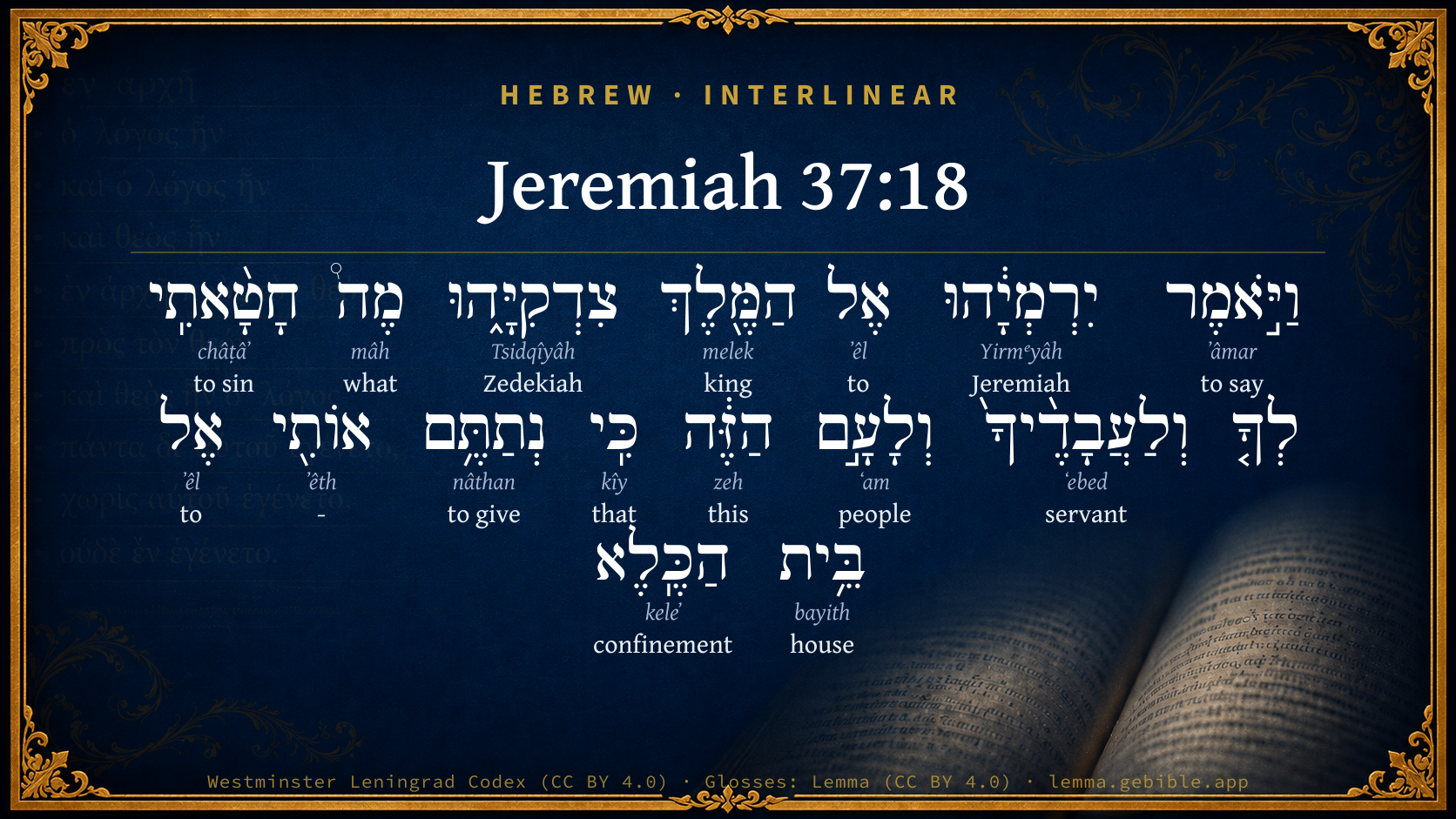
Jeremiah 37:18

Hebrew (Westminster Leningrad Codex) Jeremiah 37:18 appears in the Hebrew Old Testament. The text above is from the Westminster Leningrad Codex. Each word links to its Strong’s number, a concise gloss, and parsing drawn from the Open Scriptures Hebrew Bible morphology. Click any word for its full Brown-Driver-Briggs (BDB) entry.
Download image
Cite this verse

Jeremiah 37:18 (World English Bible). Public Domain. Lemma interlinear Bible study tool, https://lemma.gebible.app/v/jeremiah/37/18.

Show BibTeX & RIS
BibTeX
RIS
English Translation
Moreover Jeremiah said to king Zedekiah, Wherein have I sinned against you, or against your servants, or against this people, that you have put me in prison?
World English Bible · Public Domain
Download a study sheet

One document with this verse’s original text, its word-by-word gloss line, the meaning frame, cross-references with their text, attributed commentary, and full source and license credits — printable, and it pastes into notes with its structure intact.

This verse Autodidact and up

Study sheet (.html) Plain text (.txt)

A passage Seminary Student

Up to 50 verses in one chapter. A passage sheet keeps up to 6 commentary sources and 12 cross-references per verse, in the order this page ranks them, and says so on the sheet whenever that leaves anything out. Ask for a single verse and you get the Autodidact verse sheet above.

Everything on this page stays free to read, with no account — the sheet is a download of what is already on screen, not access to it.

Want to remove ads? Support Godless Engineer
Compare translations 3

The same verse in 3 English versions, stacked beneath the original-language interlinear above. Click any original word for its lexicon entry.

Each is an independent rendering of the whole verse — the interlinear is not word-aligned to these translations.

Highlighted words mark where these versions differ — a whole-verse word diff, not a word-by-word alignment.

  • World English Bible Public Domain
    Moreover Jeremiah said to king Zedekiah, Wherein have I sinned against you, or against your servants, or against this people, that you have put me in prison?
  • King James Version Public Domain
    Moreover Jeremiah said unto king Zedekiah, What have I offended against thee, or against thy servants, or against this people, that ye have put me in prison?
  • unfoldingWord Literal Text CC BY-SA 4.0
    Then Jeremiah said to King Zedekiah, “How have I sinned against you, your servants, or this people so that you have placed me in prison?

unfoldingWord Literal Text — © unfoldingWord, licensed CC BY-SA 4.0. Word-aligned USFM3 via Door43 (git.door43.org/unfoldingWord/en_ult).

Versions to compare (up to 4)

3 of 4 selected

Show all 18 translations

Every available English version of this verse, each an independent rendering of the whole verse.

  • World English Bible Public Domain
    Moreover Jeremiah said to king Zedekiah, Wherein have I sinned against you, or against your servants, or against this people, that you have put me in prison?
  • Berean Standard Bible Public Domain
    Then Jeremiah asked King Zedekiah, “How have I sinned against you or your servants or these people, that you have put me in prison?
  • Majority Standard Bible Public Domain
    Then Jeremiah asked King Zedekiah, “How have I sinned against you or your servants or these people, that you have put me in prison?
  • King James Version Public Domain
    Moreover Jeremiah said unto king Zedekiah, What have I offended against thee, or against thy servants, or against this people, that ye have put me in prison?
  • American Standard Version (1901) Public Domain
    Moreover Jeremiah said unto king Zedekiah, Wherein have I sinned against thee, or against thy servants, or against this people, that ye have put me in prison?
  • Revised Version (1885) Public Domain
    Moreover Jeremiah said unto king Zedekiah, Wherein have I sinned against thee, or against thy servants, or against this people, that ye have put me in prison?
  • Geneva Bible (1599) Public Domain
    Moreouer, Ieremiah sayd vnto King Zedekiah, What haue I offended against thee, or against thy seruants, or against this people, that ye haue put me in prison?
  • Douay-Rheims (1899) Public Domain
    Where are your prophets that prophesied to you, and said: The king of Babylon shall not come against you, and against this land?
  • Young's Literal Translation Public Domain
    And Jeremiah saith unto the king Zedekiah, `What have I sinned against thee, and against thy servants, and against this people, that ye have given me unto a prison-house?
  • Literal Standard Version CC BY-SA 4.0
    And Jeremiah says to King Zedekiah, “What have I sinned against you, and against your servants, and against this people, that you have put me into a prison-house?
  • Unlocked Literal Bible CC BY-SA 4.0
    Then Jeremiah said to King Zedekiah, “How have I sinned against you, your servants, or this people so that you have placed me in prison?
  • unfoldingWord Literal Text CC BY-SA 4.0
    Then Jeremiah said to King Zedekiah, “How have I sinned against you, your servants, or this people so that you have placed me in prison?
  • Darby Bible Public Domain
    And Jeremiah said unto king Zedekiah, What have I offended against thee, or against thy servants, or against this people, that ye have put me in the prison?
  • World Messianic Bible Public Domain
    Moreover Jeremiah said to King Zedekiah, “How have I sinned against you, against your servants, or against this people, that you have put me in prison?
  • Webster's Bible Public Domain
    Moreover Jeremiah said to king Zedekiah, In what have I offended against thee, or against thy servants, or against this people, that ye have put me in prison?
  • Free Bible Version CC BY-SA 4.0
    Then Jeremiah asked King Zedekiah, “What wrong have I done to you or your servants or these people, for you to put me in prison?
  • Bible in Basic English Public Domain
    Then Jeremiah said to King Zedekiah, What has been my sin against you or against your servants or against this people, that you have put me in prison?
  • JPS Tanakh (1917) Public Domain
    Moreover Jeremiah said unto king Zedekiah: 'Wherein have I sinned against thee, or against thy servants, or against this people, that ye have put me in prison?

Literal Standard Version (2020), Covenant Press — licensed CC BY-SA 4.0. Text via the HelloAO Bible API (eBible.org). Unlocked Literal Bible (unfoldingWord) — licensed CC BY-SA 4.0. Text via the HelloAO Bible API (eBible.org). unfoldingWord Literal Text — © unfoldingWord, licensed CC BY-SA 4.0. Word-aligned USFM3 via Door43 (git.door43.org/unfoldingWord/en_ult). Free Bible Version, Dr. Jonathan Gallagher — licensed CC BY-SA 4.0. Text via the HelloAO Bible API (eBible.org).

Word by word

More ways to search: Search by grammar → Find every occurrence → Compare this word →

Practice this passage: Drill this verse → Learn its vocabulary →

הַכֶּֽלֶא
keleʼ
H3608
“the · confinement”
Particle, Definite Article + Noun, Common, Masculine, Singular, Absolute
Part of Speech
Particle + Noun
Type
Common
Gender
Masculine
Number
Singular
State
Absolute
Full BDB Definition

Origin: from H3607

TWOT: 980a

imprisonment, confinement, restraint
  1. וַיֹּ֣אמֶר ʼâmar H559 “and · to say” Conjunction + Verb, Qal, Sequential Imperfect, 3rd Person, Masculine, Singular
  2. יִרְמְיָ֔הוּ Yirmᵉyâh H3414 “Jeremiah” Noun, Proper
  3. אֶל ʼêl H413 “to” Preposition
  4. הַמֶּ֖לֶךְ melek H4428 “the · king” Particle, Definite Article + Noun, Common, Masculine, Singular, Absolute
  5. צִדְקִיָּ֑הוּ Tsidqîyâh H6667 “Zedekiah” Noun, Proper
  6. מֶה֩ mâh H4100 “what” Particle, Interrogative
  7. חָטָ֨אתִֽי châṭâʼ H2398 “to sin” Verb, Qal, Perfect, 1st Person, Common, Singular
  8. וְלַעֲבָדֶ֨יךָ֙ ʻebed H5650 “and · to/for · servants · your” Conjunction + Preposition + Noun, Common, Masculine, Plural, Construct + Suffix, Personal, 2nd Person, Masculine, Singular
  9. וְלָעָ֣ם ʻam H5971 “and · to/for the · people” Conjunction + Preposition, Determined + Noun, Common, Masculine, Singular, Absolute
  10. הַזֶּ֔ה zeh H2088 “the · this” Particle, Definite Article + Pronoun, Demonstrative, Masculine, Singular
  11. כִּֽי kîy H3588 “that” Conjunction
  12. נְתַתֶּ֥ם nâthan H5414 “to give” Verb, Qal, Perfect, 2nd Person, Masculine, Plural
  13. אוֹתִ֖י ʼêth H853 “- · me” Particle, Direct Object + Suffix, Personal, 1st Person, Common, Singular
  14. אֶל ʼêl H413 “to” Preposition
  15. בֵּ֥ית bayith H1004 “house of” Noun, Common, Masculine, Singular, Construct

About this verse

These counts appear in no published source. They are computed here, from the morphology-tagged text and Lemma’s own curated glosses. What Lemma adds →

17
words
15
distinct lemmas
Prophets
section

Notable vocabulary

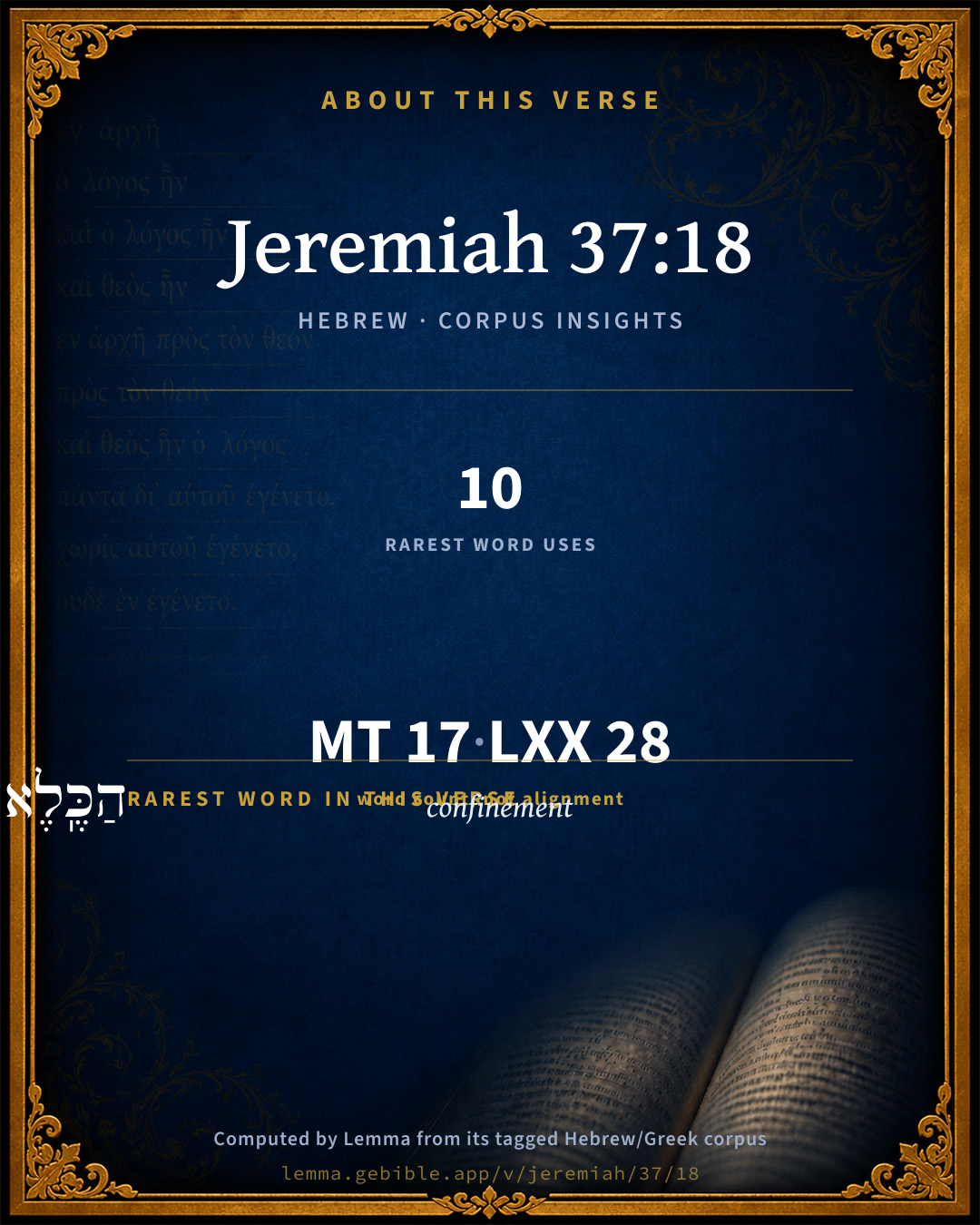
The rarest word here is הַכֶּֽלֶא confinement H3608 — appearing just 10 times in the whole Hebrew Bible.

Shared distinctive vocabulary

הַכֶּֽלֶא confinement H3608 occurs in 10 verses of the Hebrew Bible. Also found in:

Grammatical profile

  • 3 verbs
  • 7 nouns
  • 1 pronoun
  • 3 prepositions
  • 1 conjunction
  • 2 particles

Verb forms

  • וַיֹּ֣אמֶר Qal · Sequential Imperfect
  • חָטָ֨אתִֽי Qal · Perfect
  • נְתַתֶּ֥ם Qal · Perfect

Repetition

A word recurs within this verse — often emphatic in Hebrew:

  • אֶל to H413 ×2

Hebrew & Septuagint length

In the original languages it is 17 Hebrew tokens and 28 Greek tokens — but the two are counted differently (Hebrew bundles its prefixes and suffixes into one token; the Greek is in lemma form), so that isn’t a like-for-like length.

Cross-references

15

Topical passages linked to Jeremiah 37:18 in the Treasury of Scripture Knowledge — connected by theme and wording, ordered by reader-vote popularity; previews shown in the World English Bible.

  • John 10:32 Jesus answered them, "I have shown you many good works from my Father. For which of those works do you stone me?"
  • Acts 25:8 while he said in his defense, "Neither against the law of the Jews, nor against the temple, nor against Caesar, have I sinned at all."
  • Daniel 6:22 My God has sent his angel, and has shut the lions' mouths, and they have not hurt me; because as before him innocence was found in me; and also before you, O king, have I done no hurt.
  • Acts 25:11 For if I have done wrong, and have committed anything worthy of death, I don't refuse to die; but if none of those things is true that they accuse me of, no one can give me up to them. I appeal to Caesar!"
  • Acts 25:25 But when I found that he had committed nothing worthy of death, and as he himself appealed to the emperor I determined to send him.
  • Genesis 31:36 Jacob was angry, and argued with Laban. Jacob answered Laban, "What is my trespass? What is my sin, that you have hotly pursued after me?
  • 1 Samuel 24:9–15 David said to Saul, Why listen you to men's words, saying, Behold, David seeks your hurt?
  • 1 Samuel 26:18–21 He said, Why does my lord pursue after his servant? for what have I done? or what evil is in my hand?
  • Proverbs 17:13 Whoever rewards evil for good, Evil shall not depart from his house.
  • Proverbs 17:26 Also to punish the righteous is not good, Nor to flog officials for their integrity.
  • Jeremiah 26:19 Did Hezekiah king of Judah and all Judah put him to death? Didn't he fear Yahweh, and entreat the favor of Yahweh, and Yahweh repented him of the evil which he had pronounced against them? Thus should we commit great evil against our own souls.
  • Acts 23:1 Paul, looking steadfastly at the council, said, "Brothers, I have lived before God in all good conscience until this day."
  • Acts 24:16 Herein I also practice always having a conscience void of offense toward God and men.
  • Acts 26:31 When they had withdrawn, they spoke one to another, saying, "This man does nothing worthy of death or of bonds."
  • Galatians 4:16 So then, have I become your enemy by telling you the truth?

Cross-references courtesy of OpenBible.info (CC BY 4.0).

Hebrew and Greek witnesses Masoretic Hebrew ↔ Greek Septuagint

The same verse in the two great witnesses to the Old Testament, shown verse-for-verse.

These are two independent witnesses, not word-aligned to each other, and the Septuagint is shown in lemma (dictionary) form.

Hebrew Jeremiah 37:18 Masoretic · Westminster Leningrad Codex

וַיֹּ֣אמֶר יִרְמְיָ֔הוּ אֶל הַמֶּ֖לֶךְ צִדְקִיָּ֑הוּ מֶה֩ חָטָ֨אתִֽי לְךָ֤ וְלַעֲבָדֶ֨יךָ֙ וְלָעָ֣ם הַזֶּ֔ה כִּֽי נְתַתֶּ֥ם אוֹתִ֖י אֶל בֵּ֥ית הַכֶּֽלֶא

Moreover Jeremiah said to king Zedekiah, Wherein have I sinned against you, or against your servants, or against this people, that you have put me in prison?

World English Bible · Public Domain

Greek LXX Structure differs

In the Septuagint, Jeremiah is about an eighth shorter than the Hebrew and arranges its material differently — the Oracles Against the Nations (Hebrew chapters 46–51) appear in the middle of the Greek book, after 25:13. Because the chapter and verse boundaries do not line up, a verse-for-verse comparison with the Hebrew is not shown.

A verse-for-verse comparison isn’t shown here because the chapters and verses don’t line up. Switch to the LXX edition with the MT / LXX toggle above to read the Greek directly.

Hebrew: Westminster Leningrad Codex (CC BY 4.0). Greek: Septuagint (public domain); English from a public-domain English Septuagint. How the Septuagint differs from the Hebrew →

Targum (Aramaic paraphrase)

1

The Targum is the ancient Jewish Aramaic paraphrase of the Hebrew Scriptures — an interpretive translation, not the Hebrew text itself. Onkelos (literal) and Pseudo-Jonathan (expansive) render the Torah, and Jonathan the Prophets. Coverage is partial: where no permissively-licensed English translation exists for a verse, only the Aramaic is shown. This is verse-level text, not a word-by-word alignment to the Hebrew.

  1. Targum Jonathan Prophets (Joshua–Malachi)
    וַאֲמַר יִרְמְיָה לְמַלְכָּא צִדְקִיָה מָה חָבֵית לָךְ וּלְעַבְדָךְ וּלְעַמָא הָדֵין אֲרֵי יְהַבְתּוּן יָתִי לְבֵית אֲסִירֵי:

    (no public-domain English translation for this verse)

    Targum Jonathan — Aramaic: “Mikraot Gedolot” (public domain). English: “Sefaria Community Translation” (CC0 1.0 (public-domain dedication)); “London "Chaldee Paraphrase," 1871” (public domain). Text via Sefaria.

Commentary

Notes on Jeremiah 37:18 from classic Christian and Jewish commentators (each source and its license shown beneath its notes). The classic Christian expositions comment on the surrounding passage and are grouped to its opening verse, so a note may address several verses; the Jewish commentaries on the Tanakh (Rashi and others) are per-verse, so they appear only where the commentator wrote on this verse.

Lemma curates 59 commentaries, every one of them public domain or Creative Commons licensed, each selected and text-cleaned for this edition rather than reprinted as found. About our sources →

Trapp's Complete Commentary

John Trapp

Jer 37:18 Moreover Jeremiah said unto king Zedekiah, What have I offended against thee, or against thy servants, or against this people, that ye have put me in prison?

Ver. 18. What have I offended against thee?] As I know mine own innocence, so I would thou shouldst know that I am no stoic, or stock, indolent, or insensible of my grievous sufferings through the cruelty of thy princes, who have committed me to this ugly prison.

John Trapp, A Commentary or Exposition upon All the Books of the Old and New Testament (1647–1656) — public domain. Text from a community e-Sword module.

Joseph Benson's Commentary

Jer 37:18-21. Moreover Jeremiah said, What have I offended against thee — What law have I broken? What injury have I done to thee, or thy people, or government, that ye have put me in prison — Have put me into the pit or dungeon, as a malefactor of the worst kind? Where are now your prophets — That is, your false prophets? Surely the event has now convinced you, how much they have deceived you: for you see the siege renewed, and the city in imminent danger of being taken. Here we see Jeremiah’s confinement in the dungeon had not broken his spirit, or diminished either his zeal or courage in delivering God’s message: he still speaks with the greatest boldness, and as one having authority. No doubt he would have been willing, had God called him to it, to seal his testimony with his blood: nevertheless, having so fair an opportunity to obtain relief, he thought it his duty to embrace it, and therefore, with great humility and submissiveness, and in a most respectful manner, presents his supplication, not indeed for an entire deliverance from restraint, which, however, it would not have been unreasonable to ask, but for a less cruel treatment. Then Zedekiah commanded that they should commit Jeremiah into the court of the prison — A more agreeable place of confinement; and that they should give him daily a piece of bread, &c. — Namely, out of the public stock, (for the prison was within the precincts of the court,) in order that he might not die for want. Until all the bread of the city was spent —

Till the famine forced the city to surrender, Jer 52:6. This was the king’s first order, but afterward it was reversed, by the importunity of the princes and great men, Jer 38:6, when Jeremiah was again thrown into the dungeon. Though after that he was released from that place, and returned to his former confinement, ibid. Jer 38:28.

Joseph Benson's Commentary on the Old and New Testaments (1811–1818) — public domain. Text from a community e-Sword module.

Tyndale Open Study Notes

Tyndale Open Resources

37:18-20 Jeremiah evidently assumed that Zedekiah was involved in his arrest and imprisonment. The prophet would have been in poor physical condition after being flogged and confined without medical treatment and with little food.

Tyndale Open Study Notes — © Tyndale Open Resources, licensed CC BY-SA 4.0. Text via the HelloAO Bible API.

Jamieson, Fausset & Brown

Robert Jamieson, A. R. Fausset & David Brown

What--In what respect have I offended?

Jamieson, Fausset & Brown — Commentary Critical and Explanatory on the Whole Bible (1871) — public domain (CC PDM 1.0). Text via the HelloAO Bible API.

John Calvin's Commentaries

Though the Prophet had spoken what was displeasing to the king, he yet complains that wrong had been done to him, as he had been cast into prison; and thus he shews that he had been unjustly condemned for having threatened ruin to the city and destruction to the kingdom, because he was constrained to do this by the obligations of his office. Hence the Prophet shews that he had not sinned in this — that he had proclaimed God’s commands, however bitter they were to the king and to the people.

This passage deserves special notice: earthly princes are so proud, that as soon as they order anything, they wish every dispute about their authority to be suspended; for they will have their own ordinances to be counted laws, and their own decrees to be sacred and authoritative; and yet we know, that by following their own wills, they decree often what is wholly unjust and inconsistent with everything that is reasonable. This passage then, as I have said, deserves special notice; for Jeremiah boldly declares that he had not sinned, because he had threatened the king, displeased his counsellors, inveighed against the impiety of the people, and denounced utter ruin on the city and the Temple. He then denies that in all this he had done anything wrong. So also Daniel said,

“Against God and the king have I not sinned,” (Daniel 6:22)

and yet he had disregarded the king’s decree, and firmly refused by an impious flattery to put the king in the place of God: he however denied that he had done anything wrong against the king, because his decree was unjust and wicked. Let us then bear in mind, that though princes may in bear their decrees to be disregarded by us, they are yet not absolved before God and his angels, and also that we can boldly, openly, and with a full mouth, as they say, assert our innocence, when religion constrains us, and when it is not lawful to obey the impious and unjust edicts of kings. He afterwards adds —

John Calvin's Commentaries (1540-1563) — public domain. Text from the Calvin Translation Society English edition (1840s-50s) via the Christian Classics Ethereal Library (ccel.org). Calvin's coverage is partial (roughly two-thirds of the Bible); uncommented books and verses are honest gaps, never fabricated. The 19th-century editor's footnotes and remarks are omitted so the notes are faithfully Calvin's own voice.

Ellicott's Commentary for English Readers

(18) What have I offended against thee . . .?—The cruelty of his treatment draws from the prophet an indignant protest. Of what crime had he been guilty, but that of speaking the word which the Lord had given him to speak, and was this a crime in the eyes of any true Israelite? No act of treachery or desertion could be proved against him.

A Bible Commentary for English Readers, edited by Charles John Ellicott (1878–1897) — public domain. Text from a community e-Sword module.

John Gill's Exposition

Moreover, Jeremiah said unto King Zedekiah,.... Having this opportunity with him alone, and perhaps observing the king was melted and softened with what he had said; however, finding liberty in his own mind, he enlarges his discourse, and freely expostulates with him in the following manner:

what have I offended against thee, or against thy servants, or against this people, that ye have put me in prison? or, "what have I sinned?" have I been guilty of treason against thee, O king? or of scandal and defamation of any of thy nobles and courtiers? have I done any injury to any of the king's subjects? has there been any falsehood in my prophecies? has not everything appeared to be true that I have spoken, concerning the coming of the Chaldeans to invade the land, and besiege the city? and concerning the return of the Chaldean army when broken up? why then should I be cast into prison, and detained there? is it not a clear case that what I have said comes from the Lord? and therefore ought not to be used in this manner.

John Gill's Exposition of the Whole Bible (1746–1763) — public domain (CC PDM 1.0). Text via the HelloAO Bible API.

Haydock's Catholic Bible Commentary

Prophets. He insults over these impostors, and speaks boldly. The Chaldeans were now returned, chap. xxxviii.

George Leo Haydock (1774–1849), Haydock's Catholic Family Bible and Commentary, 1859 edition — public domain. Excludes Psalms (Douay-Rheims chapter numbering differs from Protestant) and Deuterocanonical books (Catholic canon only).

Matthew Poole's English Annotations

That is, What have I done worthy of bonds? I have faithfully heretofore revealed to you the mind and will of God; if this hath offended you, I am not to be blamed, I could not but execute God’s commands.

Matthew Poole's English Annotations on the Holy Bible (1683–1685) — public domain. Text from a community e-Sword/MySword module.

unfoldingWord translationNotes

Door43 World Missions Community

How have I sinned against you ... prison?

Jeremiah uses this question to emphasize that he has not done anything wrong. AT: "I have not done anything wrong to you ... prison." (See: Rhetorical Question)

this people

the people of the kingdom of Judah

have placed

"have put"

Where are your prophets, the ones who prophesied ... against this land?

Jeremiah uses this question to emphasize that the other prophets were lying but that he had done nothing wrong because he had told the truth. AT: "Your prophets who prophesied ... against this land were obviously wrong, but now it is clear that I was telling you the truth." (See: Rhetorical Question and Assumed Knowledge and Implicit Information)

your prophets

The word "your" refers to King Zedekiah and the other people of the kingdom of Judah.

will not come against you or against this land

"will not attack you or attack this land"

Let my pleas come before you

"Hear me plead for mercy and do as I ask." See how you translated "their pleas for mercy will come before Yahweh" in Jeremiah 36:7.

the house of Jonathan the scribe

"the house of Jonathan, who is a scribe." See how you translated this in Jeremiah 37:15.

translationWords

Jeremiah

king

Zedekiah

sin

servant

people group

prison

false prophet

prophet

Babylon

lord

plea

scribe

die

unfoldingWord translationNotes — © Distant Shores Media and the Door43 World Missions Community, licensed CC BY-SA 4.0. Source: git.door43.org/Door43/en_tn.

Lesson kit

Teaching starters — assembled from the data on this page, not authored interpretation. Every prompt links to the verse data it draws on. Edit before teaching.

Jeremiah, in the Prophets, opens this verse with 17 words (15 distinct Hebrew lemmas). Its most distinctive word is keleʼ (“confinement”). A historical commentator’s framing appears above. Read the whole chapter for the surrounding context.

Discussion questions

  1. How does “confinement” (keleʼ) shape what this verse is saying?
  2. 1 Kings 22:27 shares the word «confinement» with this verse. How do the two illuminate each other?
  3. “to” occurs 2× in this one verse. What is the effect of the repetition?
  4. These translations render this verse differently; the difference is in the English rendering, not the original. What questions does that raise?
  5. The verb «וַיֹּ֣אמֶר» is Qal Sequential Imperfect. How does its form color the action?
  6. Reading how Trapp's Complete Commentary and Joseph Benson's Commentary read this verse, where do the two commentators agree and where do they part?

Things to notice

Reading settings

Reading text

Shown beneath each verse's original-language words.

Old Testament
Old Testament edition

Read the OT as the Masoretic Hebrew (MT) or the Greek Septuagint (LXX).

English shown for the Greek Septuagint (in the Hebrew ↔ Greek comparison).

Comparing translations? Open the Compare panel on any verse page to stack up to four side by side.